Exploitation of Chickpea Landraces for Drought and Heat Stress Adapted Varieties


Abstract
1. Introduction
2. Materials and Methods
2.1. Field Experimentation
2.2. Climatic Parameters
2.2.1. First Year
2.2.2. 2nd Year
2.2.3. 3rd and 4th Year
2.2.4. Stress Indices
2.2.5. Statistical Analyses
3. Results
3.1. Single-Plant Selection
3.2. ILs Evaluation at Farming Conditions
4. Discussion
4.1. Selection Phase
4.2. Evaluation Phase
4.3. Selection Efficiency (SE)
5. Conclusions
Author Contributions
Funding
Data Availability Statement
Conflicts of Interest
Abbreviations
| GMP | Geometric Mean Productivity |
| IL | Improved Line |
| PL | Parental Line |
| LCYP | Line Crop Yield Potential |
| MP | Mean Productivity |
| STI | Stress Tolerance Index |
| Yp | the grain yield of cultivar under non-stress condition |
| Yp− | the mean yields of all genotypes under non-stress conditions |
| Ys | the grain yield of genotype under stress |
| Ys− | the mean yields of all genotypes under stress |
References
- Gaur, P.M.; Krishnamurthy, L.; Kashiwagi, J. Improving Drought-Avoidance Root Traits in Chickpea (Cicer arietinum L.)—Current Status of Research at ICRISAT. Plant Prod. Sci. 2008, 11, 3–11. [Google Scholar] [CrossRef]
- Varshney, R.K.; Roorkiwal, M.; Nguyen, H.N. Legume genomics: From genomic resources to molecular breeding. Plant Genome 2013, 6, 1–7. [Google Scholar] [CrossRef]
- F.A.O. Statistical Database; Food and Agriculture Organization of the United Nations: Rome, Italy, 2016. [Google Scholar]
- Maurya, O.; Kumar, H. Growth of Chickpea Production in India. J. Pharmacogn. Phytochem. 2018, 7, 1175–1177. [Google Scholar]
- Gaur, P.M.; Samineni, S.; Thudi, M.; Tripathi, S.; Sajja, S.B.; Jayalakshmi, V.; Mannur, D.M.; Vijayakumar, A.G.; Gangarao, N.V.P.R.; Ojiewo, C.; et al. Integrated Breeding Approaches for Improving Drought and Heat Adaptation in Chickpea (Cicer arietinum L.). Plant Breed. 2019, 138, 389–400. [Google Scholar] [CrossRef]
- Millan, T.; Clarke, H.J.; Siddique, K.H.M.; Buhariwalla, H.K.; Gaur, P.M.; Kumar, J. Chickpea Molecular Breeding: New Tools and Concepts. Euphytica 2006, 147, 81–103. [Google Scholar] [CrossRef]
- Mantri, N.L.; Ford, R.; Coram, T.E.; Pang, E.C. Evidence of Unique and Shared Responses to Major Biotic and Abiotic Stresses in Chickpea. Environ. Exp. Bot. 2010, 69, 286–292. [Google Scholar] [CrossRef]
- Jha, U.C.; Chaturvedi, S.K.; Bohra, A.; Basu, P.S.; Khan, M.S.; Barh, D. Abiotic Stresses, Constraints and Improvement Strategies in Chickpea. Plant Breed. 2014, 133, 163–178. [Google Scholar] [CrossRef]
- Garg, R.; Bhattacharjee, A.; Jain, M. Genome-Scale Transcriptomic Insights into Molecular Aspects of Abiotic Stress Responses in Chickpea. Plant Mol. Biol. Rep. 2015, 33, 388–400. [Google Scholar] [CrossRef]
- Shahnaz, Z.; Shahnaz, A.; Ismail, A.; Manzoor, Z.; Iqbal, R.; Zia, M.A.B. Chickpea (Cicer arietinum) Genetic Diversity: Genetic Resources, Breeding Progress, and Future Prospects. Crop Pasture Sci. 2025, 76, 24238. [Google Scholar] [CrossRef]
- Gaur, P.M.; Jukanti, A.K.; Srinivasan, S.; Chaturvedi, S.K.; Basu, P.S.; Babbar, A.; Jayalakshmi, V.; Nayyar, H.; Devasirvatham, V.; Mallikarjuna, N.; et al. Climate Change and Heat Stress Tolerance in Chickpea. In Climate Change and Plant Abiotic Stress Tolerance; Tuteja, N., Gill, S.S., Eds.; Wiley: Weinheim, Geermany, 2013; pp. 837–856. [Google Scholar]
- Kadiyala, M.D.M.; Kumara Charyulu, D.; Nedumaran, S.; Shyam, D.M.; Gumma, M.K.; Bantilan, M.C.S. Agronomic Management Options for Sustaining Chickpea Yield Under climate Change Scenario. J. Agrometeorol. 2016, 18, 41–47. [Google Scholar] [CrossRef]
- Cramer, W.; Guiot, J.; Fadern, M.; Garrabou, J.; Gattuso, J.P.; Iglesias, A.; Lange, M.A.; Lionello, P.; Llasat, M.C.; Paz, S.; et al. Climate Change and Interconnected Risks to Sustainable Development in the Mediterranean. Nat. Clim. Change 2018, 8, 972–980. [Google Scholar] [CrossRef]
- Lionello, P.; Scarascia, L. The Relation Between Climate Change in the Mediterranean Region and Global Warming. Reg. Environ. Change 2018, 18, 1481–1493. [Google Scholar] [CrossRef]
- Seneviratne, S.I.; Donat, M.G.; Pitman, A.J.; Knutti, R.; Wilby, R.L. Allowable CO2 Emissions Based on Regional and Impact-Related Climate Targets. Nature 2016, 529, 477–483. [Google Scholar] [CrossRef] [PubMed]
- Pfeifer, S.; Rechid, D.; Reuter, M.; Viktor, E.; Jacob, D. 1.5°, 2°, and 3° Global Warming: Visualizing European Regions Affected by Multiple Changes. Reg. Environ. Change 2019, 19, 1777–1786. [Google Scholar] [CrossRef]
- Forzieri, G.; Feyen, L.; Rojas, R.; Flörke, M.; Wimmer, F.; Bianchi, A. Ensemble Projections of Future Streamflow Droughts in Europe. Hydrol. Earth Syst. Sci. 2014, 18, 85–108. [Google Scholar] [CrossRef]
- Pantavou, K.; Kotroni, V.; Lagouvardos, K.; Kyriakou, P. Future Changes of Bioclimate in Greece: Variations in Thermal Stress According to the Universal Thermal Climate Index (UTCI). Sci. Total Environ. 2025, 980, 179514. [Google Scholar] [CrossRef]
- Farooq, M.; Wahid, A.; Kobayashi, N.; Fujita, D.; Basra, S.M.A. Plant Drought Stress: Effects, Mechanisms and Management. Agron. Sustain. Dev. 2009, 29, 153–188. [Google Scholar] [CrossRef]
- Tardieu, F.; Simonneau, T.; Muller, B. The Physiological Basis of Drought Tolerance in Crop Plants: A Scenario-Dependent Probabilistic Approach. Annu. Rev. Plant Biol. 2018, 69, 733–759. [Google Scholar] [CrossRef]
- Yordanov, I.; Velikova, V.; Tsonev, T. Plant Responses to Drought, Acclimation, and Stress Tolerance. Photosynthetica 2000, 38, 171–186. [Google Scholar] [CrossRef]
- Barnabas, B.; Jager, K.; Feher, A. The Effect of Drought and Heat Stress on Reproductive Processes on Cereals. Plant Cell Environ. 2008, 31, 11–38. [Google Scholar] [CrossRef]
- Ahmad, F.; Gaur, P.M.; Croser, J. Chickpea (Cicer arietinum L.). In Genetic Resources, Chromosome Engineering, and Crop Improvement-Grain Legumes; Taylor & Francis: Boca Raton, FL, USA, 2005; Volume 1, pp. 185–214. [Google Scholar]
- Thudi, M.; Upadhyaya, H.D.; Rathore, A.; Gaur, P.M.; Krishnamurthy, L.; Roorkiwal, M.; Spurthi, N.N.; Chaturvedi, S.K.; Basu, P.S.; Gangarao, N.V.P.R.; et al. Genetic Dissection of Drought and Heat Tolerance in Chickpea through Genome-Wide and Candidate Gene-Based Association Mapping Approaches. PLoS ONE 2014, 9, 96758. [Google Scholar] [CrossRef]
- Kaushal, N.; Awasthi, R.; Gupta, K.; Gaur, P.M.; Siddique, K.H.M.; Nayyar, H. Heat Stress Induced Reproductive Failures in Chickpea (Cicer arietinum L.) Are Associated with Impaired Sucrose Metabolism in Leaves and Anthers. Funct. Plant Biol. 2013, 40, 1334–1349. [Google Scholar] [CrossRef]
- Devasirvatham, V.; Tan, D.K.; Gaur, P.M.; Trethowan, R.M. Chickpea and Temperature Stress: An Overview. In Legumes Under Environmental Stress: Yield, Improvement and Adaptations; Azooz, E.M.M., Ahmad, P., Eds.; John Wiley & Sons: Hoboken, NJ, USA, 2015; pp. 97–106. [Google Scholar]
- Wang, J.; Gan, Y.; Clarke, F.; McDonald, C.L. Response of Chickpea Yield to High Temperature Stress During Reproductive Development. Crop Sci. 2006, 46, 2171–2178. [Google Scholar] [CrossRef]
- Basu, P.S.; Ali, M.; Chaturvedi, S.K. Terminal Heat Stress Adversely Affects Chickpea Productivity in Northern India–Strategies to Improve Thermotolerance in the Crop Under Climate Change. In Proceedings of the W3 Workshop Proceedings. Impact Climate Change on Agriciculture; International Society for Photogrammetry and Remote Sensing: New Delhi, India, 2009; pp. 189–193. [Google Scholar]
- Devasirvatham, V.; Tan, D.K.Y.; Gaur, P.M.; Raju, T.N.; Trethowan, R.M. High Temperature Tolerance in Chickpea and Its Implications for Plant Improvement. Crop Pasture Sci. 2012, 63, 419–428. [Google Scholar] [CrossRef]
- Kobraee, S.; Shamsi, K.; Rasekhi, B. Investigation of Correlation Analysis and Relationships between Grain Yield and Other Quantitative Traits in Chickpea (Cicer arietinum L.). Afr. J. Biotechnol. 2010, 9, 2342–2348. [Google Scholar]
- Berger, J.D. Ecogeographic and Evolutionary Approaches to Improving Adaptation of Autumn-Sown Chickpea (Cicer arietinum L.) to Terminal Drought: The Search for Reproductive Chilling Tolerance. Field Crops Res. 2007, 104, 112–122. [Google Scholar] [CrossRef]
- Canci, H.; Toker, C. Evaluation of Yield Criteria for Drought and Heat Resistance in Chickpea (Cicer arietinum L.). J. Agron. Crop Sci. 2009, 19, 47–54. [Google Scholar] [CrossRef]
- Camacho Villa, T.C.; Maxted, N.; Scholten, M.; Ford-Lloyd, B. Defining and Identifying Crop Landraces. Plant Genet. Resour. 2005, 3, 373–384. [Google Scholar] [CrossRef]
- Gepts, P. A Comparison Between Crop Domestication, Classical Plant Breeding, and Genetic Engineering. Crop Sci. 2002, 42, 1780–1790. [Google Scholar] [CrossRef]
- Stefaniak, T.R.; McPhee, K.E. Lentil. In Grain Legumes, Handbook of Plant Breeding; Ron, E.A., Ed.; Springer: New York, NY, USA, 2015; Volume 10, pp. 111–140. [Google Scholar] [CrossRef]
- Marone, D.; Russo, M.A.; Mores, A.; Ficco, D.B.M.; Laidò, G.; Mastrangelo, A.M.; Borrelli, G.M. Importance of Landraces in Cereal Breeding for Stress Tolerance. Plants 2021, 10, 1267. [Google Scholar] [CrossRef] [PubMed]
- Fischer, M.C.; Rellstab, C.; Tedder, A.; Zoller, S.; Gugerli, F.; Shimizu, K.K.; Holderegger, R.; Widmer, A. Population Genomic Footprints of Selection and Associations with Climate in Natural Populations of Arabidopsis Halleri from the Alps. Mol. Ecol. 2013, 22, 5594–5607. [Google Scholar] [CrossRef]
- Lazaridi, E.; Kapazoglou, A.; Gerakari, M.; Kleftogianni, K.; Passa, K.; Sarri, E.; Papasotiropoulos, V.; Tani, E.; Bebeli, P.J. Crop Landraces and Indigenous Varieties: A Valuable Source of Genes for Plant Breeding. Plants 2024, 13, 758. [Google Scholar] [CrossRef]
- Galvan, M.Z.; Menendez-Sevillano, M.C.; DeRon, A.M.; Santalla, M.; Balatti, P.A. Genetic Diversity among Wild Common Beans from North Western Argentina Based on Morphoagronomic and RAPD Data. Genet. Resour. Crop Evol. 2006, 53, 891–900. [Google Scholar] [CrossRef]
- Bektas, H.; Hohn, C.E.; Waines, J.G. Root and Shoot Traits of Bread Wheat (Triticum aestivum L.) Landraces and Cultivars. Euphytica 2016, 212, 297–311. [Google Scholar] [CrossRef]
- Tokatlidis, I.S.; Papadopoulos, I.I.; Baxevanos, D.; Koutita, O. GxE Effects on Single Plant Selection at Low Density for Yield and Stability in Climbing Dry Bean. Crop Sci. 2010, 50, 775–783. [Google Scholar] [CrossRef]
- Kargiotidou, A.; Chatzivassiliou, E.; Sinapidou, E.; Papageorgiou, A.; Skaracis, G.; Tokatlidis, I.S. Selection at Ultra-Low Density Highlights Plants Escaping Virus Infection and Leads Towards High-Performing Pure-Line Cultivars in Lentil. J. Agric. Sci. 2014, 152, 749–758. [Google Scholar] [CrossRef]
- Tokatlidis, I.; Vlachostergios, D. Sustainable Stewardship of the Landrace Diversity. Diversity 2016, 8, 29. [Google Scholar] [CrossRef]
- Vlachostergios, D.N.; Tzantarmas, C.; Kargiotidou, A.; Ninou, E.; Pankou, C.; Gaintatzi, C.; Mylonas, I.; Papadopoulos, I.; Foti, C.; Chatzivassiliou, E.K.; et al. Single-Plant Selection within Lentil Landraces at Ultra-Low Density: A Short-Time Tool to Breed High Yielding and Stable Varieties Across Divergent Environments. Euphytica 2018, 214, 58. [Google Scholar] [CrossRef]
- Ninou, E.G.; Mylonas, I.G.; Tsivelikas, A.; Ralli, P.; Dordas, C.; Tokatlidis, I.S. Wheat Landraces Are Better Qualified as Potential Gene Pools at Ultra Spaced Rather than Densely Grown Conditions. Sci. World J. 2014, 2014, 957472. [Google Scholar] [CrossRef]
- Muruiki, R.; Kimurto, P.; Vandez, V.; Gangarao, R.; Silim, S.; Siambi, M. Effect of Drought Stress on Yield Performance of Parental Chickpea Genotypes in Semi-Arid Tropics. J. Life Sci. 2018, 12, 159–168. [Google Scholar] [CrossRef]
- Rani, A.; Devi, P.; Jha, U.C.; Sharma, K.D.; Siddique, K.H.M.; Nayyar, H. Developing Climate-Resilient Chickpea Involving Physiological and Molecular Approaches with Focus on Temperature and Drought Stresses. Front. Plant Sci. 2020, 10, 1759. [Google Scholar] [CrossRef]
- Hall, A.E. Is Dehydration Tolerance Relevant to Genotypic Differences in Leaf Senescence and Crop Adaptation to Dry Environments? In Plant Responses to Cellular Dehydration During Environmental Stress; Close, T.J., Bray, E.A., Eds.; American Society of Plant Physiologists: Rockville, MD, USA, 1993; pp. 1–10. [Google Scholar]
- Blum, A. Plant Breeding for Stress Environments; CRC Press Inc.: Boca Raton, FL, USA, 1988. [Google Scholar] [CrossRef]
- Rosielle, A.A.; Hamblin, J. Theoretical Aspects of Selection for Yield in Stress and Nonstress Environments. Crop Sci. 1981, 21, 943–946. [Google Scholar] [CrossRef]
- Fernandez, G.C.J. Effective Selection Criteria for Assessing Plant Stress Tolerance. In Proceedings of the International Symposium on Adaptation of Vegetables and Other Food Crops in Temperature and Water Stress, Taiwan, 13–18 August 1992; Kuo, E.C.G., Ed.; Asian Vegetable Research and Development Center: Tainan City, Taiwan, 1992; pp. 257–270. [Google Scholar] [CrossRef]
- Ramirez, V.P.; Kelly, J.D. Traits Related to Drought Resistance in Common Bean. Euphytica 1998, 99, 127–136. [Google Scholar] [CrossRef]
- Fasoulas, A.C.; Fasoula, V.A. Honeycomb Selection Designs. Plant Breed. Rev. 1995, 13, 87–139. [Google Scholar] [CrossRef]
- Iliadis, C.G.; Roupakias, D.G.; Goulas, C.K. Effectiveness of Honeycomb Selection for Yield Superiority at Three Interplant Distances: A Field Simulation Study Using Chickpea (Cicer arietinum L.) Inbred Lines. Euphytica 2003, 133, 299–311. [Google Scholar] [CrossRef]
- Hamwieh, A.; Imtiaz, M. Identifying Water-Responsive and Drought-Tolerant Chickpea Genotypes. Crop Pasture Sci. 2015, 66, 1003–1011. [Google Scholar] [CrossRef]
- Fasoula, V.A.; Tokatlidis, I.S. Development of Crop Cultivars by Honeycomb Breeding. Agron. Sustain. Dev. 2012, 32, 161–180. [Google Scholar] [CrossRef]
- Mauromoustakos, A.; Thompson, K.C.; Fasoula, V.A. Honeycomb Designs Addin; JMP Discovery Summit: Frankfurt, Germany, 2018. [Google Scholar]
- Fasoula, V.A.; Thomson, K.C.; Mauromoustakos, A. The Prognostic Breeding Application JMP Add-In Program. Agronomy 2019, 9, 25. [Google Scholar] [CrossRef]
- Awasthi, R.; Gaur, P.; Turner, N.C.; Vadez, V.; Siddique, K.H.M.; Nayyar, H. Effects of Individual and Combined Heat and Drought Stress During Seed Filling on the Oxidative Metabolism and Yield of Chickpea (Cicer arietinum) Genotypes Differing in Heat and Drought Tolerance. Crop Pasture Sci. 2017, 68, 823–841. [Google Scholar] [CrossRef]
- Benali, A.; El Haddad, N.; Patil, S.B.; Goyal, A.; Hejjaoui, K.; El Baouchi, A.; Gaboun, F.; Taghouti, M.; Ouhssine, M.; Kumar, S. Impact of Terminal Heat and Combined Heat-Drought Stress on Plant Growth, Yield, Grain Size, and Nutritional Quality in Chickpea (Cicer arietinum L.). Plants 2023, 12, 3726. [Google Scholar] [CrossRef]
- Sachdeva, S.; Bharadwaj, C.; Patil, B.S.; Pal, M.; Roorkiwal, M.; Varshney, R.K. Agronomic Performance of Chickpea Affected by Drought Stress at Different Growth Stages. Agronomy 2022, 12, 995. [Google Scholar] [CrossRef]
- Sari, D.; Sari, H.; Eker, T.; Ikten, C.; Uzun, B.; Toker, C. Intraspecific versus interspecific crosses for superior progeny in Cicer species. Crop Sci. 2022, 62, 2122–2137. [Google Scholar] [CrossRef]
- Khoury, C.K.; Brush, S.; Costich, D.E.; Curry, H.A.; Haan, S.; Engels, J.M.M.; Guarino, L.; Hoban, S.; Mercer, K.L.; Miller, A.J.; et al. Crop Genetic Erosion: Understanding and Responding to Loss of Crop Diversity. New Phytol. 2022, 233, 84–118. [Google Scholar] [CrossRef]
- Thanopoulos, R.; Chatzigeorgiou, T.; Argyropoulou, K.; Kostouros, N.M.; Bebeli, P.J. State of Crop Landraces in Arcadia (Greece) and In-Situ Conservation Potential. Diversity 2021, 13, 558. [Google Scholar] [CrossRef]
- Thanopoulos, R.; Drossinou, I.; Koutroumpelas, I.; Chatzigeorgiou, T.; Stavrakaki, M.; Bebeli, P.J. Hilly, Semi-Mountainous and Mountainous Areas Harbor Landraces Diversity: The Case of Messinia (Peloponnese-Greece). Diversity 2024, 16, 151. [Google Scholar] [CrossRef]
- Muehlbauer, F.J.; Sarker, A. Economic Importance of Chickpea: Production, Value, and World Trade. In The Chickpea Genome. Compendium of Plant Genomes; Varshney, E.R., Thudi, M., Muehlbauer, F., Eds.; Springer: Cham, Switzerland, 2017. [Google Scholar] [CrossRef]
- Gaur, P.; Srinivasan, S.; Varshney, R. Drought and Heat Tolerance in Chickpea. Legume Perspect. 2014, 3, 15–17. [Google Scholar]
- Tsivelikas, A.L.; Ben Ghanem, H.; El-Baouchi, A.; Kehel, Z. Single-Plant Selection at Ultra-Low Density Enhances Buffering Capacity of Barley Varieties and Landraces to Unpredictable Environments and Improves Their Agronomic Performance. Front. Plant Sci. 2022, 13, 838536. [Google Scholar] [CrossRef]
- Fasoulas, A. Principles and Methods of Plant Breeding. Dept of Genetics and Plant Breeding; Department of Genetics and Plant Breeding, Aristolelian University of Thessaloniki: Thessaloniki, Greece, 1981. [Google Scholar]
- Fasoulas, A.C. Principles of Crop Breeding; Department of Genetics and Plant Breeding, Aristolelian University of Thessaloniki: Thessaloniki, Greece, 1993. [Google Scholar]
- Sakai, K.I. Competitive Ability in Plants: Its Inheritance and Related Problems. Mech. Biol. Compet. 1961, 15, 245–263. [Google Scholar]
- Tokatlidis, I. Crop Resilience via Inter-Plant Spacing Brings to the Fore the Productive Ideotype. Front. Plant Sci. 2022, 13, 934359. [Google Scholar] [CrossRef]
- Devi, P.; Awasthi, R.; Jha, U.; Sharma, K.D.; Prasad, P.V.V.; Siddique, K.H.M.; Roorkiwal, M.; Nayyar, H. Understanding the Effect of Heat Stress During Seed Filling on Nutritional Composition and Seed Yield in Chickpea (Cicer arietinum L.). Sci. Rep. 2023, 13, 15450. [Google Scholar] [CrossRef]
- Maqbool, M.A.; Aslam, M.; Ali, H. Breeding for Improved Drought Tolerance in Chickpea (Cicer arietinum L.). Plant Breed. 2017, 136, 300–318. [Google Scholar] [CrossRef]
- Shah, T.M.; Imran, M.; Atta, B.M.; Ashraf, M.Y.; Hameed, A.; Waqar, I.; Shaqif, M.; Hussain, K.; Naveed, M.; Aslam, M.; et al. Selection and Screening of Drought Tolerant High Yielding Chickpea Genotypes Based on Physio-Biochemical Indices and Multi-Environmental Yield Trials. BMC Plant Biol. 2020, 20, 171. [Google Scholar] [CrossRef]
- Falconer, D.S. Introduction to Quantitative Genetics, 2nd ed.; Longman Group Ltd.: London, UK, 1981. [Google Scholar]
- Vlachostergios, D.N.; A, L.; Baxevanos, D.; Mavromatis, A.; Noulas, C.; Roupakias, D.G. Evaluation of Lentil Varieties and Farming System Effect on Seed Damage and Yield Loss Due to Bruchid Infestation. Crop Pasture Sci. 2018, 69, 387–394. [Google Scholar] [CrossRef]
- Vlachostergios, D.N.; Lithourgidis, A.S.; Roupakias, D.G. Effectiveness of Single-Plant Selection at Low Density Under Organic Environment: A Field Study with Lentil. Crop Sci. 2011, 51, 41–51. [Google Scholar] [CrossRef]
- Anonymous. Decision of the Deputy-Minister of Rural Development and Food No. 372261/2024. J. Gov. Hell. Repub. 2024, 10-12-2024. [Google Scholar]
- Instabuli, T.; Nassar, A.E.; Abd El-Maksoud, M.M.; Tawkaz, S.; Alsamman, A.M.; Hamwieh, A. Genome-Wide Association Study Reveals SNP Markers Controlling Drought Tolerance and Related Agronomic Traits in Chickpea Across Multiple Environments. Front. Plant Sci. 2024, 15, 1260690. [Google Scholar] [CrossRef] [PubMed]
- Tricker, P.J.; ElHabti, A.; Schmidt, J.; Fleury, D. The Physiological and Genetic Basis of Combined Drought and Heat Tolerance in Heat. J. Exp. Bot. 2018, 69, 3195–3210. [Google Scholar] [CrossRef]



| Entry | Genotype (Code Name) | Type | Size (1000 SW) | Origin |
|---|---|---|---|---|
| C1 | M-15370 | Variety (Control 1) | 350 | Greece (IIFC) |
| C2 | E-202 | Variety (Control 2) | 462 | Greece (IIFC) |
| 1 | L1 | Landrace | 460 | Greece (IIFC) |
| 2 | LV | Old Local variety | 670 | Mexico |
| 3 | L3 | Landrace | 419 | Greece (IIFC) |
| 4 | L4 | Landrace | 395 | ICARDA |
| 5 | L5 | Landrace | 421 | Greece (IIFC) |
| 6 | L6 | Landrace | 381 | ICARDA |
| 7 | L7 | Landrace | 445 | Greece, island Sifnos (IIFC) |
| 8 | L8 | Landrace | 484 | Greece, island Mytilene |
| 9 | L9 | Landrace | 348 | ICARDA |
| 10 | L10 | Landrace | 168 | Greece (IIFC) |
| 11 | L11 | Landrace | 165 | Greece (IIFC) |
| 12 | L12 | Landrace | 370 | Greece, island Lemnos (IIFC) |
| 13 | L13 | Landrace | 434 | Greece, lakeside area Kastoria |
| 14 | AL | Advanced Line | 445 | Canada |
| Year | Days with Mean Temperature > 30 °C | Precipitation Difference (mm) | ||||
|---|---|---|---|---|---|---|
| Normal Period | Off-Season | Normal Period—Off-Season | ||||
| A | PF | A | PF | A | PF | |
| 2017 | 0 | 3 | 3 | 14 | −90.8 | +111.2 |
| 2018 | 0 | 1 | 3 | 8 | −96.6 | +100.4 |
| 2019 | 0 | 2 | 2 | 11 | +20.0 | +9.2 |
| 2020 | 0 | 1 | 2 | 6 | −41.4 | +15.9 |
| 1st Year | |||||
| n | Mean | Min | Max | CV% | |
| Normal sowing | 667 | 47.85 | 0.00 | 252.50 | 82.2 |
| Off-season sowing | 790 | 32.76 | 0.00 | 130.96 | 72.7 |
| 2nd Year | |||||
| n | Mean | Min | Max | CV% | |
| Normal sowing | 742 | 29.79 | 0.00 | 92.53 | 69.6 |
| Off-season sowing | 813 | 14.54 | 0.00 | 59.00 | 71.3 |
| Normal Sowing | Off-Season Sowing | |||||
|---|---|---|---|---|---|---|
| Entry | Mean Yield | LCYP | Yield of Selected Plant | Mean Yield | LCYP | Yield of Selected Plant |
| C1 | 47.13 | 1.476 | 166.68 | 38.34 | 3.835 | 91.26 |
| C2 | 47.86 | 0.961 | 123.56 | 27.58 | 0.858 | 99.06 |
| 1 | 51.51 | 1.037 | 205.59 | 31.42 | 2.125 | 81.16 |
| 2 | 45.91 | 1.386 | 80.90 | 31.63 | 3.316 | 61.84 |
| 3 | 45.49 | 0.961 | 87.55 | 36.91 | 2.284 | 125.90 |
| 4 | 48.71 | 1.552 | 138.56 | 35.87 | 2.560 | 96.10 |
| 5 | 45.16 | 0.803 | 162.56 | 37.70 | 2.126 | 130.96 |
| 6 | 34.47 | 0.449 | 116.87 | 20.89 | 0.701 | 65.02 |
| 7 | 62.43 | 1.816 | 252.55 | 40.59 | 3.341 | 105.68 |
| 8 | 41.39 | 0.935 | 130.36 | 31.38 | 1.579 | 98.82 |
| 9 | 49.61 | 0.942 | 106.88 | 33.29 | 1.977 | 111.52 |
| 10 | 50.17 | 2.177 | 116.80 | 29.55 | 2.093 | 82.22 |
| 11 | 52.25 | 1.885 | 153.65 | 30.77 | 2.478 | 70.28 |
| Mean | 47.85 | 1.26 | 141.73 | 32.76 | 2.25 | 93.83 |
| Normal Sowing Period | Off-Season Sowing Period | |||||||
|---|---|---|---|---|---|---|---|---|
| Entry (PLs) | Mean | LCYP | Mean Yield of Five Selected Plants | Difference from PL (%) | Mean | LCYP | Mean Yield of Five Selected Plants | Difference from PL (%) |
| C1 | 30.48 | 1.871 | 60.67 | 99.1 | 13.41 | 0.858 | 30.78 | 128.0 |
| C2 | 37.95 | 5.015 | 75.56 | 99.0 | 10.93 | 3.835 | 24.92 | 129.5 |
| 1 | 23.69 | 0.958 | 51.95 | 119.3 | 10.09 | 2.125 | 22.37 | 121.7 |
| 2 | 24.11 | 1.597 | 43.41 | 80.0 | 11.70 | 3.316 | 28.20 | 141.0 |
| 3 | 41.29 | 5.649 | 65.77 | 59.3 | 12.77 | 2.284 | 28.14 | 120.4 |
| 4 | 26.32 | 1.704 | 51.45 | 95.5 | 15.40 | 2.560 | 34.86 | 126.4 |
| 5 | 37.61 | 4.299 | 72.53 | 92.8 | 15.20 | 2.126 | 32.48 | 113.7 |
| 6 | 26.02 | 1.901 | 48.24 | 85.4 | 11.40 | 0.701 | 25.16 | 120.7 |
| 7 | 26.47 | 1.194 | 65.91 | 149.0 | 18.08 | 3.341 | 43.88 | 142.7 |
| 8 | 38.12 | 3.599 | 69.92 | 83.4 | 19.42 | 1.579 | 42.02 | 116.4 |
| 9 | 26.90 | 1.408 | 55.15 | 105.0 | 17.33 | 1.977 | 37.52 | 116.5 |
| 10 | 23.28 | 1.018 | 31.92 | 37.1 | 10.22 | 2.093 | 20.01 | 95.8 |
| 11 | 21.99 | 0.914 | 39.19 | 78.2 | 11.54 | 2.478 | 22.17 | 92.1 |
| 12 | 31.80 | 3.009 | 66.78 | 110.0 | 20.73 | 6.517 | 41.25 | 99.0 |
| 13 | 27.14 | 1.990 | 51.64 | 90.3 | 20.07 | 5.438 | 40.25 | 100.5 |
| 14 | 33.41 | 2.429 | 72.48 | 116.9 | 14.33 | 0.960 | 36.72 | 156.2 |
| Mean | 29.79 | 2.41 | 57.66 | 93.6 | 14.54 | 2.64 | 31.92 | 119.6 |
| Source of Variance | df | MS | F | p | ΕSS (%) |
|---|---|---|---|---|---|
| Year | 1 | 17.63 | 64.06 | * | 9.18 |
| SD | 1 | 80.56 | 292.81 | * | 41.96 |
| Y × SD | 1 | 6.28 | 22.82 | * | 3.27 |
| G | 15 | 4.28 | 15.54 | * | 33.41 |
| Y × G | 15 | 0.32 | 1.17 | ns | 2.52 |
| SD × G | 15 | 0.86 | 3.13 | * | 6.72 |
| Y × SD × G | 15 | 0.38 | 1.37 | ns | 2.94 |
| Error | 128 | 0.28 |
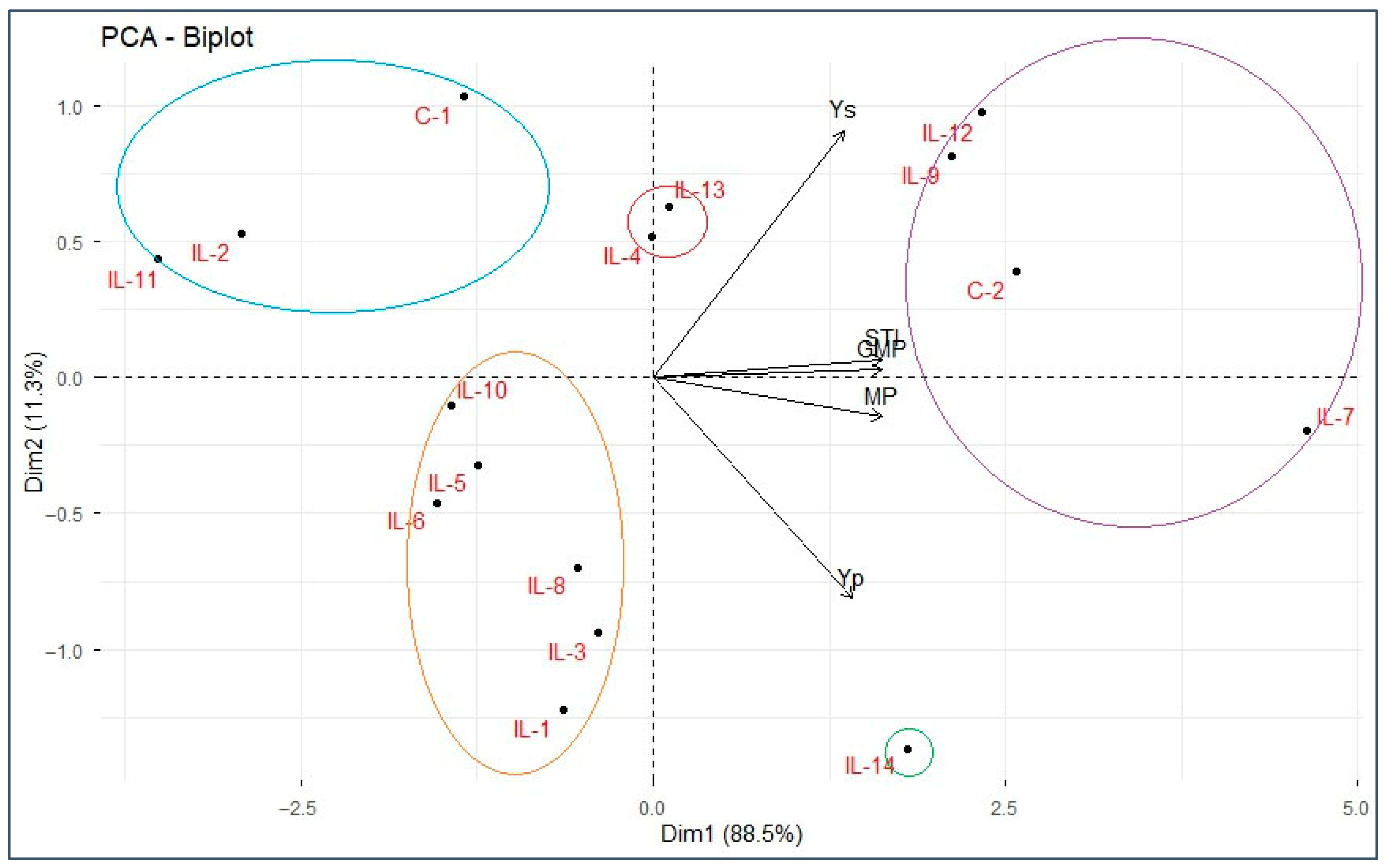
| Genotype | MP | GMP | STI |
|---|---|---|---|
| C-1 | 59.24 | 59.24 | 0.58 |
| C-2 | 79.96 | 79.31 | 1.04 |
| IL-1 | 65.67 | 62.31 | 0.64 |
| IL-2 | 51.09 | 51.02 | 0.43 |
| IL-3 | 66.49 | 63.86 | 0.67 |
| IL-4 | 66.63 | 66.35 | 0.73 |
| IL-5 | 61.07 | 59.87 | 0.59 |
| IL-6 | 59.65 | 58.23 | 0.56 |
| IL-7 | 90.86 | 89.12 | 1.31 |
| IL-8 | 65.34 | 63.30 | 0.66 |
| IL-9 | 77.26 | 77.03 | 0.98 |
| IL-10 | 59.77 | 58.94 | 0.57 |
| IL-11 | 47.85 | 47.77 | 0.38 |
| IL-12 | 78.17 | 78.03 | 1.01 |
| IL-13 | 67.16 | 66.95 | 0.74 |
| IL-14 | 78.56 | 74.54 | 0.92 |
Disclaimer/Publisher’s Note: The statements, opinions and data contained in all publications are solely those of the individual author(s) and contributor(s) and not of MDPI and/or the editor(s). MDPI and/or the editor(s) disclaim responsibility for any injury to people or property resulting from any ideas, methods, instructions or products referred to in the content. |
© 2025 by the authors. Licensee MDPI, Basel, Switzerland. This article is an open access article distributed under the terms and conditions of the Creative Commons Attribution (CC BY) license (https://creativecommons.org/licenses/by/4.0/).
Share and Cite
Koskosidis, A.; Vlachostergios, D.N. Exploitation of Chickpea Landraces for Drought and Heat Stress Adapted Varieties. Agronomy 2025, 15, 2909. https://doi.org/10.3390/agronomy15122909
Koskosidis A, Vlachostergios DN. Exploitation of Chickpea Landraces for Drought and Heat Stress Adapted Varieties. Agronomy. 2025; 15(12):2909. https://doi.org/10.3390/agronomy15122909
Chicago/Turabian StyleKoskosidis, Avraam, and Dimitrios N. Vlachostergios. 2025. "Exploitation of Chickpea Landraces for Drought and Heat Stress Adapted Varieties" Agronomy 15, no. 12: 2909. https://doi.org/10.3390/agronomy15122909
APA StyleKoskosidis, A., & Vlachostergios, D. N. (2025). Exploitation of Chickpea Landraces for Drought and Heat Stress Adapted Varieties. Agronomy, 15(12), 2909. https://doi.org/10.3390/agronomy15122909