Article

A Novel Composite Amendment for Soda Saline–Alkali Soils: Reducing Alkalinity, Enhancing Nutrient Content, and Increasing Maize Yield

by
Can Zhang
,
Liqian Zhou
,
Qing Lv
and
Xianfa Ma
*
School of Resources and Environment, Northeast Agricultural University, Harbin 150030, China
*
Author to whom correspondence should be addressed.
Agronomy 2025, 15(12), 2910; https://doi.org/10.3390/agronomy15122910
Submission received: 9 November 2025 / Revised: 12 December 2025 / Accepted: 15 December 2025 / Published: 18 December 2025
(This article belongs to the Section Soil and Plant Nutrition)

Abstract

Soda saline–alkaline soils have seriously restricted the sustainable development of agriculture in the Songnen Plain, China. Applying soil amendments has proven to be an effective remediation strategy for these sodic soils; however, conventional amendments face limitations, including prolonged remediation periods and the potential to cause secondary pollution upon misapplication. In this study, we combined three different amendments and applied them as four distinct treatments—citric acid + nano-silica (CS), citric acid + nano-silica + humic acid (CSH), nano-silica + humic acid (SH), and citric acid + humic acid (CH)—with no amendment used as the control (CK). The effects of these treatments on improving the soda saline–alkali soil was evaluated using a field positioning experiment. The results indicate that, compared to the CK treatment, applying the amendments significantly increased the concentrations of available phosphorus (AP) (9.19% to 44.43%) and organic matter (SOM) (3.53% to 16.48%) while decreasing alkalinity and salinity indicators (pH, EC (electrical conductivity), ESP (exchangeable sodium percentage), SAR (sodium adsorption ratio), and TA (total alkalinity)) and soil alkali stress ions (water-soluble and exchangeable Na+, CO32−, and HCO3). The partial least squares path modeling analysis (PLS-PM) demonstrated that the application of the amendments improved soil quality by changing its alkalinity and ion composition, thereby increasing the maize yield (from 3.01% to 9.80%).

1. Introduction

For an extended period, saline–alkali soils have severely hindered the sustainable development of global agriculture and the environment. Sodic saline–alkali soils are particularly challenging, characterized by a high pH (>8.5) and elevated concentrations of sodium carbonate (Na2CO3) and sodium bicarbonate (NaHCO3) [1]. There are approximately 3.42 million hectares of soda saline–alkaline soils in the The Songnen Plain of Northeast China, which is the area with the greatest distribution of such soils globally [2]. Excessive alkalinity and sodium salts induce soil swelling and particle dispersion, thereby degrading soil structure and causing losses of organic matter and nutrients [3,4]. Furthermore, high salinity and pH levels hinder the uptake and translocation of nutrients in crops, severely threatening plant growth and regional agricultural productivity [5,6]. Additionally, the increasing area of such soil exacerbates the global issue of limited arable land and food security. Therefore, adopting rapid and effective measures is highly significant for the sustainable development of global agriculture and the environment.
Due to the high salinity, intense alkalinity, and poor physical structure of sodic saline–alkali soils, traditional leaching methods alone prove insufficient for short-term amelioration. As a result, amendments that offer rapid efficacy and flexible compositional design have become essential tools for saline–alkali land remediation [7]. At present, although various types of amendments exist, they generally fall into two classes—organic and inorganic—based on their origin and mode of action. Inorganic amendments primarily mitigate salinization through ion exchange, acid–base neutralization, physical adsorption, and other related mechanisms. For example, aluminum sulfate hydrolyzes in soil, releasing H+, which lowers the soil’s pH and neutralizes alkalinity. The Al3+ is exchanged with Na+ on soil particles, reducing the ESP and promoting the leaching of sodium ions from the root zone [8]. Phosphogypsum can supply Ca2+, which replaces Na+ on soil colloids, reducing the ESP, SAR, and soil pH, thereby reducing soil salinity and alkalinity [9,10]. Organic amendments improve salinization primarily through increasing the soil’s organic matter and nutrient content, and improving its structure. For instance, an experiment in the Songnen Plain found that long-term application of cattle manure significantly increased the porosity, water-holding capacity, and saturated hydraulic conductivity of soda saline–alkaline soils, while decreasing their bulk density [11]. Additionally, biochar can considerably ameliorate soil salinity, through enhancing the porosity and organic carbon in arid irrigated zones [12]. Although numerous studies have confirmed the effectiveness of amendments in improving saline–alkali soils, many modifiers act slowly and, if misapplied, may lead to secondary soil pollution.
Citric acid is a common organic weak acid, containing three carboxyl groups (-COOH) and one hydroxyl group (-OH), with a pH of 1.7 (10 g L−1) as an aqueous solution [13]. Due to its safety, biodegradability, and versatility, it is widely used in food and industrial industries as a souring agent, preservative, and cleaning agent [14,15]; in addition, previous research has shown that citric acid can significantly reduce soil pH and promote the dissolution of carbonate [16]. Humic acid is an organic acid with a high organic carbon content and rich functional groups [17]. Indeed, previous studies have demonstrated its efficacy in reducing soil’s electrical conductivity and increasing soil’s organic matter [18,19]. Nano-silica is a highly dispersed white powder with a large surface area, providing it a strong adsorption capacity [20]. Previous studies have shown that it can reduce soil’s electrical conductivity and increase crop yield under saline–alkali stress [21].
Building on this research, the present study aims to develop a novel composite amendment capable of simultaneously improving the quality of sodic saline–alkali soils and enhancing crop yield. Therefore, in this study, citric acid, humic acid, and nano-silica were combined, and the effects of their various combinations on soda saline–alkali soil and crop yield were evaluated through a field experiment. We hypothesized that (1) the amendments would significantly increase the concentrations of soil nutrients; (2) the amendments could significantly improve soil quality and increased crop yield; and (3) the synergistic effect of the three materials would be significantly superior to that of any two-material combination in improving soda saline–alkali soil.

2. Materials and Methods

2.1. Study Site

The study site is located in Zhaodong County, Heilongjiang Province (125°48′ N, 46°15′ E), a region experiencing a cold temperate continental monsoon climate, with an average annual accumulated temperature (≥10 °C) of 2772 °C. Here, the four seasons are distinctly demarcated, characterized by cold winters, warm summers, and generally dry conditions. The mean annual temperature is 3.1 °C, with an average of 2789 h of sunshine, a frost-free period of 136 days, annual precipitation of 425.3 mm, and annual evaporation of 1638 mm. The experimental soil is mildly soda saline, and its physicochemical properties are summarized in Table 1.

2.2. Testing Materials

The nano-silica used in this study is derived from rice husk; it has a purity of 95.64–97.94%, a specific surface area of 86.516 m2 g−1 (as determined by the Brunauer–Emmett–Teller (BET) method), and an average adsorption pore size of 6.118 nm. The citric acid used was food grade, with a purity exceeding 99% and a pH of 2.64 at a 5% (w/v) concentration. The humic acid was extracted from lignite powder, containing 86.71% organic matter, with a pH of 6.46 and a moisture content of 14.62%.

2.3. Experimental Design

A total of five treatments were developed in the experiment: (1) control group (CK), with no amendments added; (2) citric acid + nano-silica (CS); (3) citric acid + nano-silica + humic acid (CSH); (4) nano-silica + humic acid (SH); and (5) citric acid + humic acid (CH). The dosage of the amendments was determined based on the results of previous tests (not detailed here). The specific experimental treatments and dosages are detailed in Table 2. The experiment had a randomized complete block design with three replicates, and each plot measured 40 m2 (5 m × 8 m). Prior to sowing, the field application of the developed treatments was conducted as follows: a furrow approximately 15 cm deep was opened along the center of each ridge, and then the treatment was uniformly applied into the furrow and manually covered with soil. Upon completion of the application, the field was subjected to rotary cultivation to a depth of 20 cm using a rotary cultivator (1GQN-18). The experimental crop, Zea mays L. (variety is Xianyu 335), was planted in May 2024 with a within-row spacing of 0.31 m and a row spacing of 0.36 m. Throughout the crop growing season, rainfall remained below 300 mm, and no irrigation was applied. In addition, to mitigate the effects of rainfall variability and plot proximity, a large-ridge, double-row, high-platform planting pattern was adopted.

2.4. Sample Collection and Determination

After the autumn harvest, soil samples from the 0–20 cm layer were collected using a five-point sampling method outside the protection line, and roots, weeds, and other debris were promptly removed. The collected samples were air-dried and sieved through 2 mm meshes for the analysis of soil saline–alkali parameters and through 1 mm meshes for the analysis of soil nutrients. In addition, a sample of 20 ears of maize with uniform growth was selected from each plot. These samples were then threshed, dried, and weighed. Then the yield was calculated based on a standard grain moisture content of 14% and mechanical loss of 5%.
The soil’s organic matter was determined using the potassium dichromate external heating method [22], and alkali–hydrolysable nitrogen (AN), the available phosphorus (AP), and the available potassium (AK) were quantified using the alkali solution diffusion method, the molybdenum blue colorimetric method, and flame photometry, respectively [23]. The soil’s pH and EC were determined using potentiometry, and the radio of soil to water (w/v) was 1:2.5 and 1:5, respectively. Total cation exchange capacity (CEC) and water-soluble and exchangeable Na+, K+, Ca2+, Mg2+, CO32−, HCO3, Cl, and SO42− were determined in accordance with the method described in Bao (2000) [24]. Soil’s sodium adsorption ratio (SAR), exchange sodium percentage (ESP) and total alkalinity (TA) were calculated according to the following formula:
S A R = N a + C a 2 + + M g 2 + 2
where SAR is sodium adsorption ratio; Na+, Ca2+, and Mg2+ are the content of soil water-soluble sodium, calcium, and magnesium (cmol kg−1).
ESP = Ex - Na + CEC × 100 %
where ESP is the exchanged sodium percentage (%); Ex-Na+ is the content of soil exchangeable sodium (cmol kg−1); and CEC is cation exchange capacity (cmol kg−1).
TA = CO 3 2 + HCO 3
where TA is total alkalinity (cmol/kg); CO32− and HCO3 are the content of soil carbonate and bicarbonate (cmol kg−1).

2.5. Soil Quality Index

The soil quality index (SQI) was calculated and scored in combination with the weight of each soil quality evaluation index, which reflected the soil quality. The SQI was calculated using the total data set (TDS) method. The principal component analysis (PCA) method was used to reduce data redundancy, with principal components with eigenvalues greater than one selected. The detailed steps and calculation formulae described by Fan and Mamehpour were used [25,26]. The scoring functions used in this study are the “the more the better”-type index scoring function (4) and “the less the better”-type index scoring function (5) [27]. The former was applied to indicators reflecting a positive effect on soil quality—including SOM, AN, AP, AK, CEC, and water-soluble and exchangeable K+, Ca2+, and Mg2+—whereas the latter was applied to indicators reflecting a negative effect on soil quality—soil pH, EC, CO32−, HCO3, SO42−, Cl, and water-soluble and exchangeable Na+. After determining the weight and score of each indicator, the SQI was calculated according to Equation (6).
N i   = x i x m i n x m a x x m i n
N i   = x m a x x i x m a x x m i n
where Ni is the linear index score between 0 and 1, xi represents the soil property value, and xmax and xmin represent the maximum and minimum values of soil property, respectively.
S Q I = i = 1 n W i   · N i  
where SQI is the soil quality index; Wi is the weight of the i-th index; and Ni is the composite score of the i-th indicator.

2.6. Statistical Analyses

One-way analysis of variance (ANOVA) was performed using SPSS 26.0, and Duncan’s method was used for multiple comparisons to test the significance of the differences between treatments (p < 0.05). Principal component analysis (PCA) was performed using the FactoMineR package (2.12) in R language 4.2.3. The relationship between soil saline–alkali ions and the parameters was analyzed using Pearson’s correlation analysis in SPSS 26.0. In R language 4.2.3, the effects of soil salt ions on soil nutrients were analyzed by redundancy analysis (RDA) using the vegan package; random forest analysis (RF–SHAP) was used to analyze the factors restricting crop yield using the fastshap package; and partial least squares path modeling analysis (PLS-PM) was used to analyze the effect of each amendment. The PLSPM package (0.6.0) with 1000 bootstraps was used to prove the estimates of the path coefficients and coefficients of determination (R2). The path coefficients, as represented by direct effects, quantified the linear relationships between the variables. The graphs were generated using GraphPad Prism 10 and R language 4.2.3.

3. Results

3.1. Soil Salts Ions, Salinization, and Alkalization Parameters

Compared with CK, the application of amendments significantly altered the composition of soil ions (Table 3). Except CH, the other treatments significantly decreased the concentrations of water-soluble Na+ and Mg2+ (p < 0.05), with the decrease of 43.08% and 23.73% in CS, 52.61% and 25.42% in CSH, and 57.44% and 23.73% in SH, respectively, compared with those of CK. Relative to CK, the contents of CO32− decreased by 47.94% in CS, 54.68% in CSH, 58.05% in SH, and 34.08% in CH, respectively. Similarly, the concentrations of HCO3 decreased by 23.40%, 38.65%, 19.50%, and 32.21%, respectively. For K+, Ca2+, Cl, and SO42−, no significant difference was observed. Adding amendments significantly decreased the concentrations of exchangeable Na+ (p < 0.05), with a decrease of 45.14% in CS, 70.54% in CSH, 25.68% in SH, and 68.65% in CH. The concentrations of exchangeable Ca2+ increased by 27.19% in CS, 47.38% in CSH, 31.32% in SH, and 34.49% in CH, respectively.
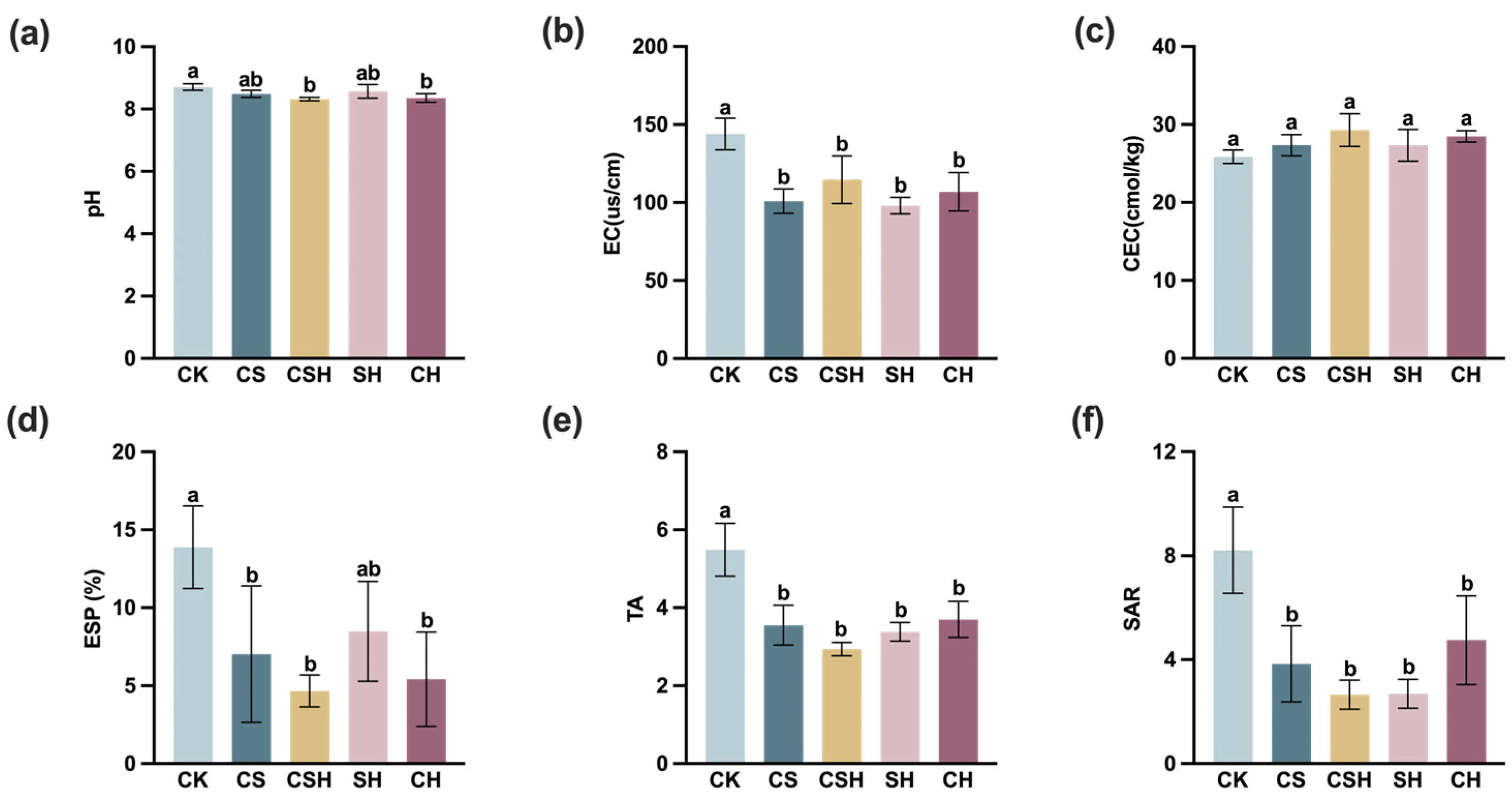
Applying amendments significantly improved the degree of soil salinization and alkalization (Figure 1). Compared to CK, the soil pH of CSH and CH (p < 0.05) decreased by 0.38 and 0.35 units, respectively. All treatments decreased the EC (p < 0.05), with a decrease of 29.92%, 20.31%, 31.82%, and 25.71% in CS, CSH, SH, and CH, respectively, compared with that of CK. Similarly, the SAR decreased by 49.35%, 64.98%, 64.51%, and 37.30%; the TA decreased by 25.32%, 46.45%, 38.42% and 32.64%, respectively. Except SH, the other treatments significantly decreased the values of ESP (p < 0.05), with a decrease of 49.34% in CS, 66.40% in CSH, and 60.95% in CH. For CEC, no significant changes were observed in all treatments.
The correlation analysis between salts ions and the salinization–alkalization parameters indicated that the soil pH was positively correlated with ESP, TA, HCO3, and Ex-Na+ (p < 0.05) (Table 4). The EC exhibited positively correlated with SAR, ESP, TA, Na+, CO32−, and HCO3. Ex-Ca2+ was negatively correlated with all salinization–alkalization parameters (p < 0.05). Among soil salts ions, Na+ and Ex-Na+ exhibited positive correlations with HCO3 and CO32−, and negatively correlations with Ex-Ca2+ (p < 0.05).

3.2. Soil Nutrients

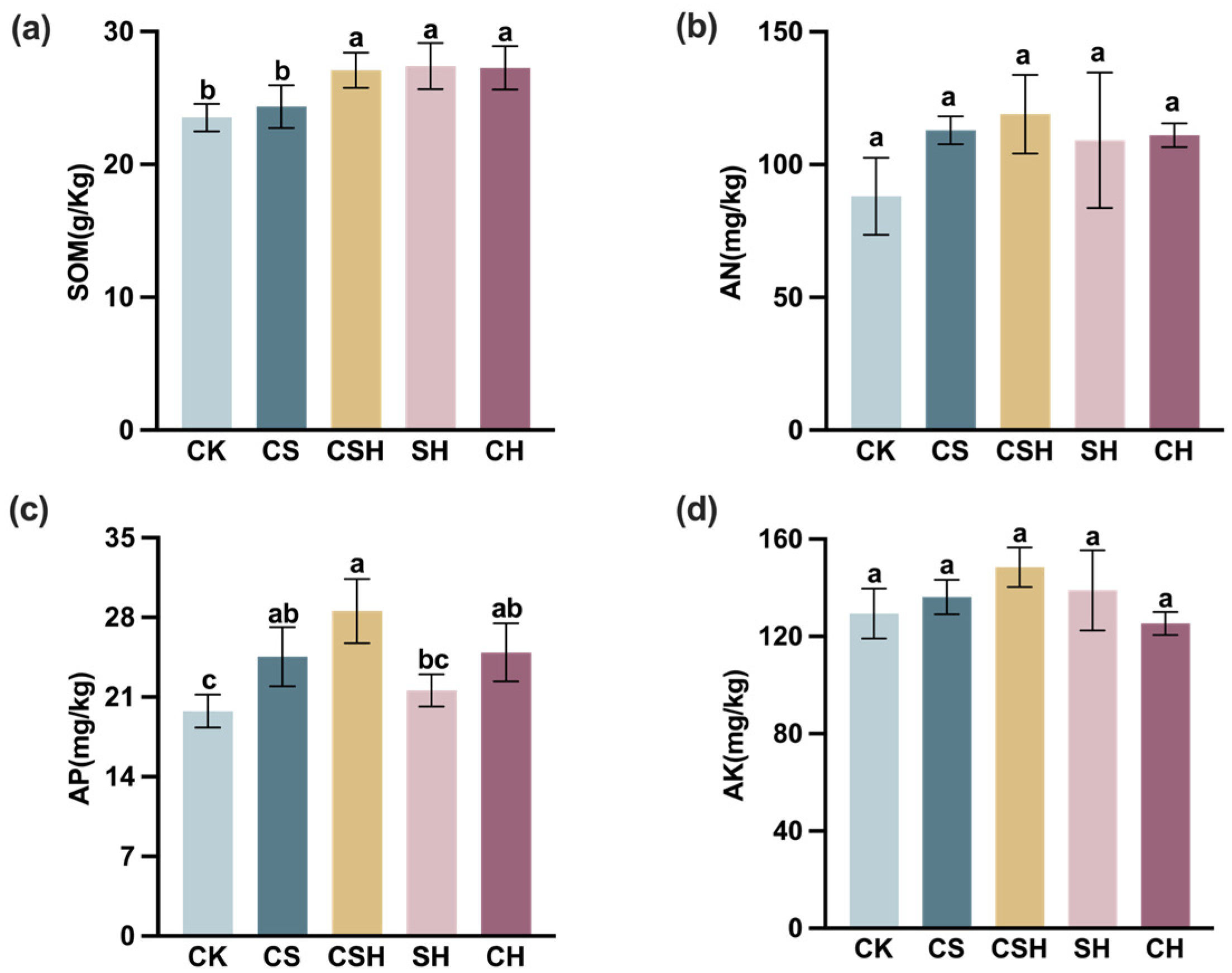
The application of amendments significantly increased the concentrations of SOM, AP, AN, and AK (Figure 2). Relative to CK, the concentration of SOM was increased by 35.12% in CSH, 24% in SH, and 26.12% in CH, respectively (p < 0.05), and no significant difference was observed in CS. Except SH, the other treatments significantly increased the content of AP (p < 0.05), with an increase of 24.12% in CS, 44.43% in CSH, and 26.11% in CH, respectively. Although all treatments increased the concentrations of AN and AK, no significant difference was observed. In addition, it is worth noting that, in all treatments, CSH had the largest increase in the concentrations of soil available nutrients and organic matter.
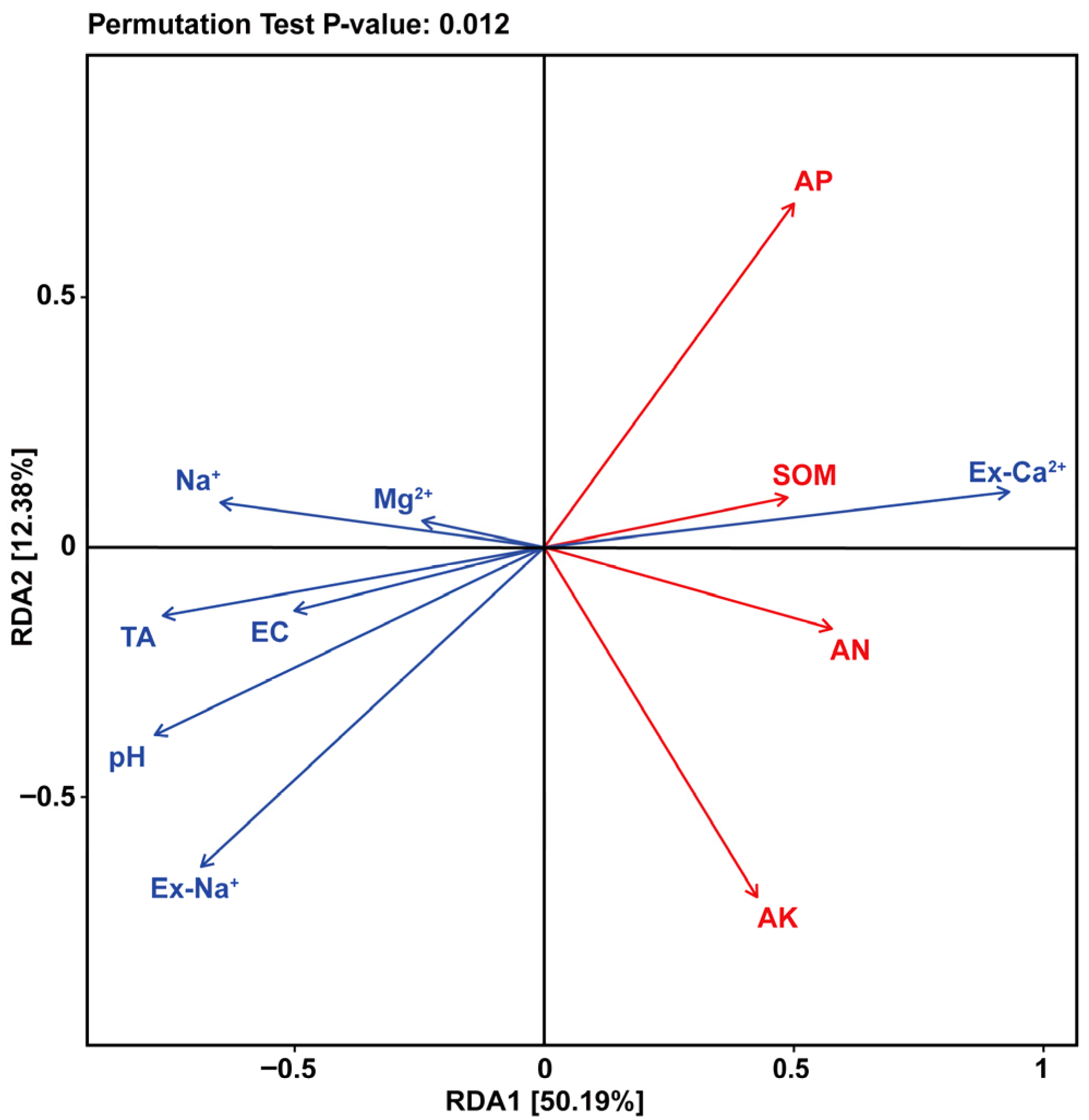
The variation trends of soil nutrients were roughly opposite to those of main salt ions and saline–alkali parameters. The redundancy analysis (RDA) indicated that the main salt ions and saline–alkali parameters could significantly affect the variations in soil nutrients (Figure 3), and the variance ratio of RDA1 is as high as 50.19% (p < 0.05). In the biplot, the pH, EC, TA, Na+, Mg2+, and Ex-Na+ exhibited negatively correlated with soil nutrients, while Ex-Ca2+ was positively correlated with them. Furthermore, across all negative parameters, the Ex-Na+ had the greatest impacts, followed by pH, TA, Na+, EC, and Mg2+, respectively.

3.3. Soil Quality Index

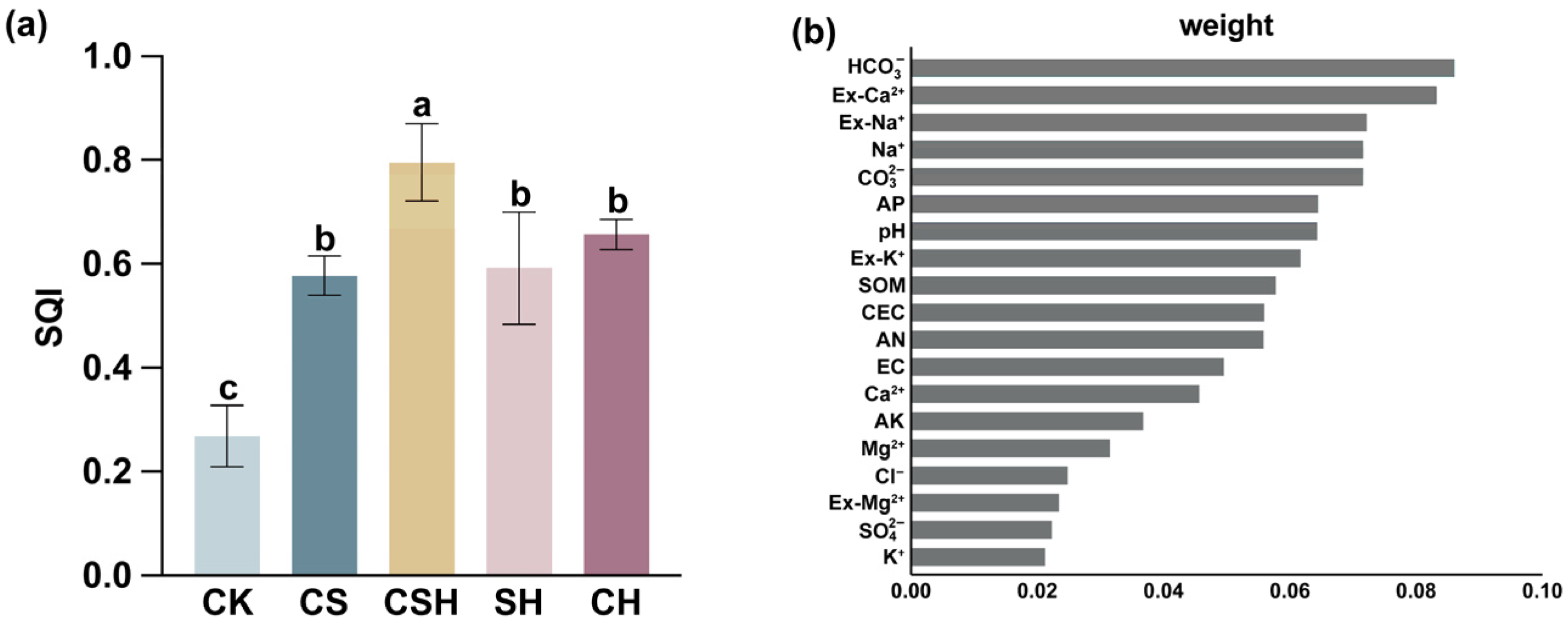
The soil quality index (SQI) was calculated using the complete data set comprising 19 indicators (Figure 4). The values of SQI were significantly increased after applying amendments (p < 0.05), with an increase of 0.31 in CS, 0.53 in CSH, 0.32 in SH, and 0.39 in CH, respectively, compared with that of CK. Among all treatments, the CSH treatment had the highest SQI, and was significantly higher than CS, SH, and CH (p < 0.05). In terms of the composition of SQI, the weight of soil saline–alkali parameters (e.g., HCO3 and Ex-Na+) was significantly higher than soil fertility parameters (e.g., AP and SOM).

3.4. Mazie Yield

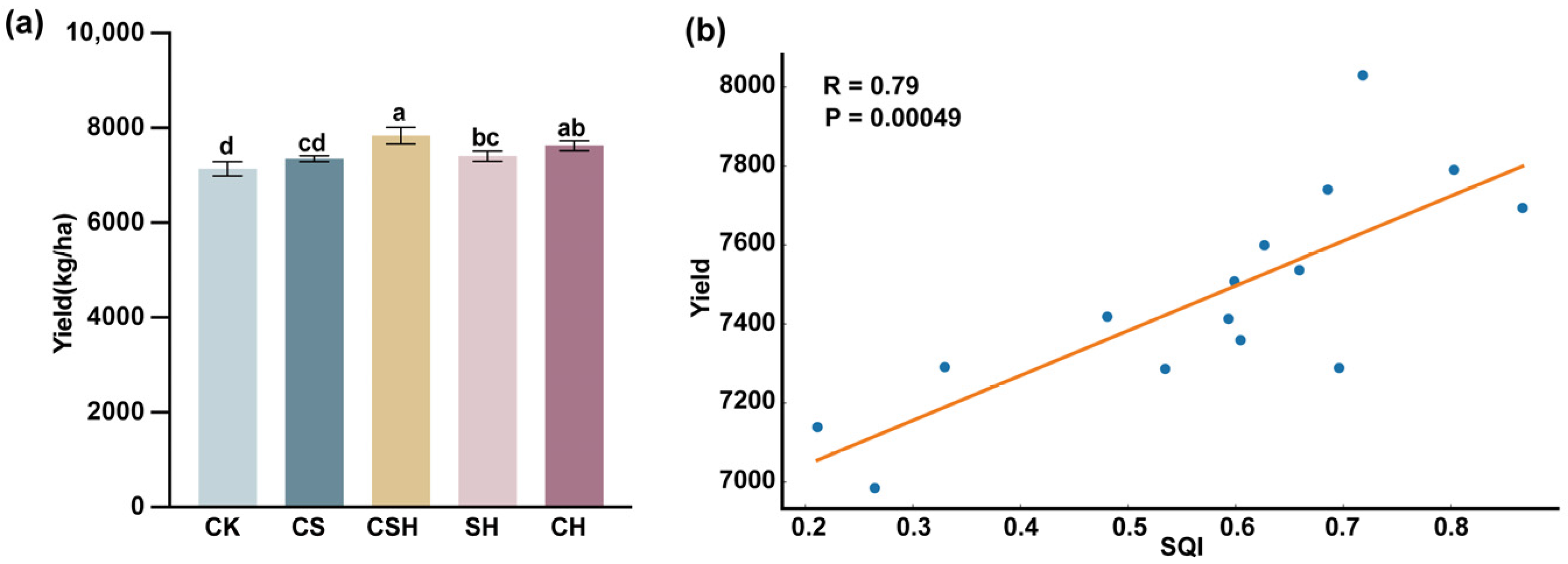
Except CS, the other treatments significantly increased the maize yield (p < 0.05), with an increase of 9.80% in CSH, 3.74% in SH, and 6.83% in CH (Figure 5a). Across all treatments, the CSH and CH had the highest yield. Moreover, linear regression analysis revealed a significant positive correlation between maize yield and SQI (Figure 5b) (p < 0.05, R = 0.79).
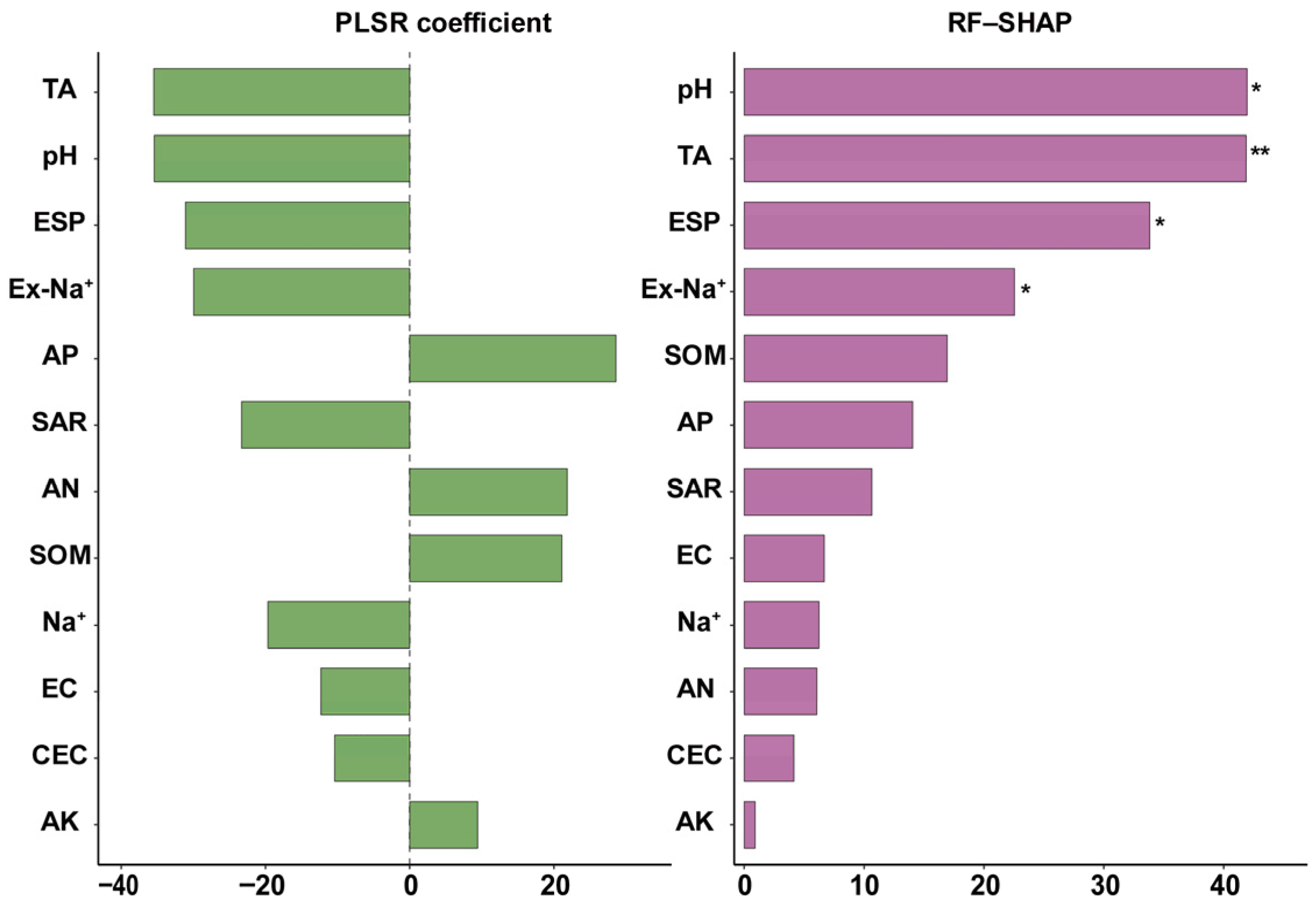
The parameters with significant differences were selected to analyze the limiting factors of crop yield. Partial least squares regression (PLSR) and random forest SHAP (RF–SHAP) analyses consistently identified soil alkalinity parameters as the primary constraints on yield, whereas soil nutrients played a secondary but positive role (Figure 6). In the PLSR model, AP, AN, and SOM showed clear positive coefficients, indicating that enhanced nutrient supply was associated with higher yields, with AP exerting the highest effect. Conversely, TA, pH, ESP, and Ex-Na+ exhibited negative coefficients, reflecting the inhibitory influence of soil alkalinity on crop yield. The RF–SHAP results further underscored the importance of alkalinity-related variables: pH, TA, ESP, and Ex-Na+ ranked as the most influential predictors (p < 0.05), whereas SOM and AP contributed moderately.

3.5. Partial Least Squares Path Models

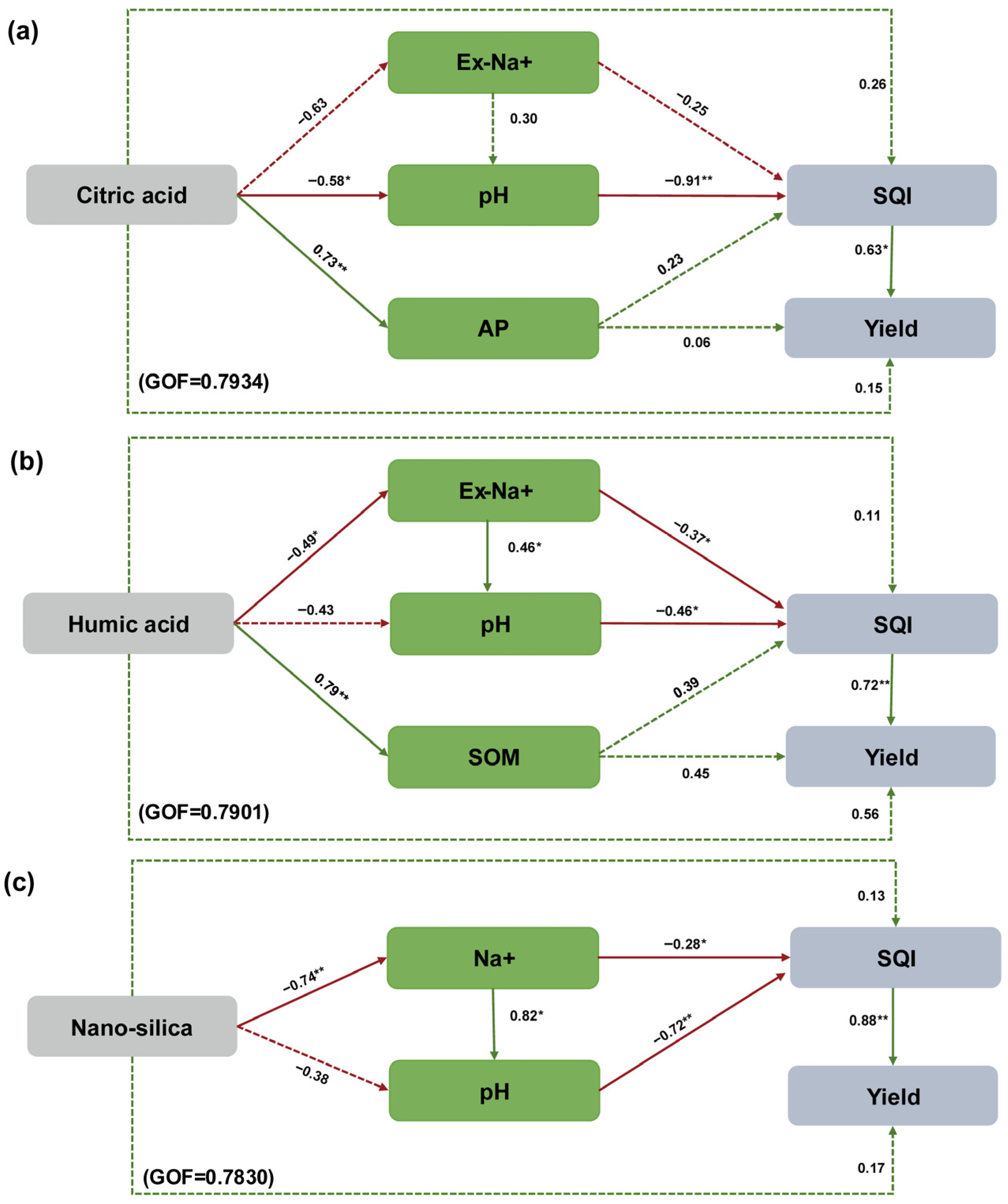
The individual effects of three amendments were revealed by partial least squares path modeling (PLS-PM) (Figure 7). The effects of each amendment were different. Citric acid significantly decreased soil pH and increased the concentrations of AP. Humic acid markedly decreased the proportion of exchangeable sodium ions and enhanced soil organic matter. Nano-silica significantly reduced the proportion of water-soluble sodium ions but exerted no detectable effects on soil fertility. Moreover, the direct effects of adding amendments on crop yield and soil quality were not observed. In contrast, amendments indirectly improve soil quality by changing soil saline–alkali parameters or ions, thereby increasing crop yield. These results indicate that the effect of amendments on soil quality and crop yield is indirect, mediated by the regulation of soil saline–alkali characteristics.

4. Discussion

4.1. Effect of Adding Amendments on Soil Saline–Alkali Characteristics

The reduction in soil salinity and alkalinity has long been the central objective of saline–alkali soil amelioration. In terms of soda saline–alkali soil, reducing soil’s sodium content and alkalinity is of high priority for the amelioration of such soil. The results of the field experiment confirmed that the composite amendments proposed in this study significantly reduced both alkalinity and sodium salt content. Relative to CK, the treatments containing nano-silica significantly decreased the concentrations of water-soluble Na+, with a decrease of 43.08% in CS, 52.61% in CSH, and 57.44% in SH, respectively (Table 3). This finding suggests that nano-silica effectively decreases water-soluble Na+ concentrations, which is consistent with the results of the PLS-PM analysis (Figure 7). This effect can be attributed to the unique structure of nano-silica. Nano-silica has a high specific surface area (the nano-silica in this study has single-point specific surface area of 86.516 m2 g−1 and an average adsorption pore size of 6.118 nm), abundant surface silanols (Si-OH), and can adsorb Na+ in aqueous solution by electrostatic interaction or ion exchange [28]. The changes in CO32− and HCO3 are similar to those in Na+. Furthermore, the correlation analysis indicated that CO32− and HCO3 were positively correlated with Na+ (Table 4). This is consistent with the long-standing understanding that the Na2CO3 and NaHCO3 are the main sodic salt components in soda saline–alkali soil.
The concentrations of Ex-Na+ decreased by 45.14% in CS, 70.54% in CSH, 25.68% in SH, and 68.65% in CH, while the concentrations of Ex-Ca2+ increased by 27.19% in CS, 47.38% in CSH, 31.32% in SH, and 34.49% in CH, respectively, compared with those of CK. Moreover, the effects in CSH and CH were higher than other treatments. This result suggests that soil’s exchangeable Na+ may be replaced by Ca2+, with citric acid and humic acid promoting this process. Saline–alkali soil typically contains a large amount of insoluble calcium, commonly in the form of calcium carbonate (CaCO3), which is minimally effective in high-pH environments [29]. As an organic weak acid, citric acid can release H+, increase the solubility of insoluble calcium minerals (such as calcium carbonate) in the soil, and promote the release of calcium ions [30]. In addition, humic acid contains a large number of functional groups, which can provide adsorption sites for Ca2+ in soil, facilitating exchange Na+ on soil colloids [31].
ESP and SAR, and TA, pH, and EC are key indicators for assessing and managing saline–alkali soils. In this study, the values of these parameters significantly decreased after the application of amendments (p < 0.05), and the trend changes were similar to those seen with CO32−, HCO3, Ex-Na+, and Na+. The correlation analysis also indicated that CO32−, HCO3, and Na+ were positively correlated with these parameters (Table 4). These results showed that CO32−, HCO3, Ex-Na+, and Na+ were key ions in soda saline–alkali soil under experimentation. The application of amendments in this study improved the overall saline–alkali status of soil by changing the concentrations of these key ions.

4.2. Effects of Adding Amendments on Soil Nutrients

Owing to the intense alkalinity and sodium stress, the concentrations of soil organic matter (SOM) and nutrient availability are extremely low in soda saline–alkaline soil, particularly for phosphorus [32,33]. Therefore, enhancing soil’s nutrient availability and organic matter content is critical in the improvement of saline–alkali land. The results of field experiments show that the composite amendments developed in this study effectively increase the concentrations of SOM and AP. Specially, relative to CK, the treatments containing humic acid significantly increase the concentrations of SOM, and the treatments containing citric acid significantly increased the concentrations of AP (Figure 2). This suggests that humic acid and citric acid have positive effects for soil SOM and AP, respectively. The results of PLS-PM analysis further confirm these effects. The positive effect of humic acid on SOM has been widely reported. Humic acid contains substantial organic matter, and it can act as a direct exogenous organic matter input, rapidly increasing SOM content [34]. The increase in soil AP content can be attributed to the unique chemical properties of citric acid. On the one hand, citric acid contains numerous anions that can compete with phosphate anions for the specific adsorption sites on the surface of soil particles, thereby reducing the fixation of soluble phosphorus in soil [35]. On the other hand, citric acid, as a tricarboxylic acid, exhibits strong chelating properties, allowing it to form stable complexes with metal cations and thereby facilitating the release of phosphorus from insoluble phosphates (e.g., calcium phosphate) [36].
While the relationship between soil salinity and nutrient dynamics has garnered growing interest, existing research has primarily focused on the influence of salinity/alkalinity on plant mineral nutrient acquisition [9,37]. Research regarding the impact of soil salinity/alkalinity on the transformation of nutrients is limited. The RDA demonstrated that the high alkalinity induced by CO32−, HCO3, Ex-Na+, and Na+ was the primary limiting factors for soil nutrients (Figure 3). Therefore, reducing soil salinity and alkalinity is crucial for improving soil nutrient condition in soda saline–alkali soils.

4.3. Effect of Adding Amendments on Soil Quality and Maize Yield

The soil quality index (SQI) is a crucial tool for evaluating soil quality as it integrates multiple indicators into a single, quantitative measure, enabling comprehensive assessment and comparison across different land uses, management practices, and environmental conditions [38,39,40,41]. This study demonstrated that the application of amendments significantly increased the value of SQI, with an increase of 0.31 in CS, 0.53 in CSH, 0.32 in SH, and 0.39 in CH, respectively, compared with that of CK (Figure 4a). Among all treatments, the CSH treatment had the highest SQI, and significantly higher than CS, SH, and CH (p < 0.05). Furthermore, the weight of soil saline–alkali parameters is significantly greater than that of soil nutrients in the composition of SQI (Figure 4b). Therefore, in saline–alkali soil remediation, reducing salinity and alkalinity should be the primary objective, thereby establishing a foundation for the subsequent step of improving soil nutrient availability.
Except CS, the other treatments significantly increased the crop yield (p < 0.05), with the increase of 9.80% in CSH, 3.74% in SH, and 6.83% in CH (Figure 5a). Across all treatments, the CSH and CH had the highest yield. The random forest model (Figure 6) was used to identify the factors influencing yield. The results revealed that the saline–alkali parameters (pH, Ex-Na+, TA, and ESP) had significant negative effects for crop yield. This indicated that soil alkali stress induced by CO32−, HCO3, and Na+ is a key factor restricting crops’ yield in soda saline–alkali soil. Furthermore, linear regression (Figure 5b) analyses showed that crop yield was significantly positively correlated with SQI, indicating that the yield-enhancing effect of amendments was indirectly achieved through improvements in soil quality. Moreover, across all treatments, the CSH had the most pronounced effects on both increasing SQI and enhancing crop yield. This indicates that combining all three materials provided the most substantial improvement in soda saline–alkali soil. In conclusion, the field experiments demonstrate that the designed amendments significantly improved both soil quality and crop yield, proving to be an effective practice for soda saline–alkali soil improvement.

5. Conclusions

Overall, the field experiments demonstrated the efficacy of a novel composite amendment, comprising citric acid, humic acid, and nano-silica, for improving both soil quality and crop yield. The application of amendments significantly increased the concentrations of AP (9.19% to 44.43%) and SOM (3.53% to 16.48%), while it decreased the concentrations of water-soluble Na+ (26.11% to 56.44%), CO32− (34.08% to 58.05%) HCO3 (19.50% to 38.65%), exchangeable Na+ (25.68% to 70.54%), and the values of the pH (0.13 to 0.38), EC (20.31% to 31.82%), ESP (38.85% to 66.40%), SAR (37.30% to 64.98%), and TA (32.64% to 46.45%), compared with those of CK. Citric acid primarily neutralized the pH and enhanced the availability of phosphorus. Humic acid significantly increased the concentration of SOM and reduced exchangeable Na+ levels. Nano-silica primarily adsorbed water-soluble Na+. Across all treatments, the synergistic effect of the three materials was significantly greater than that of two-material combinations. The soil alkali stress induced by CO32−, HCO3, and Na+ is a key factor restricting the nutrients, quality, and crop yield of soda saline–alkali soil. The application of amendments improved the soil’s quality by reducing the alkalinity and the concentration of Na+, and increasing the contents of AP and SOM, thereby increasing the crop yield. Therefore, applying composite amendments comprising citric acid, humic acid, and nano-silica is an effective measure for improving the quality and crop yield of soda saline–alkali soil. This study introduces a novel approach to the management of soda saline–alkali soils, with positive implications for the sustainable development of global agriculture. However, a key limitation of this study is the absence of a formal cost or cost–benefit analysis of the composite amendment. Future work should quantitatively assess the costs, economic returns, and adoption potential of this technology under realistic farm-scale conditions.

Author Contributions

Conceptualization, X.M. and C.Z.; methodology, C.Z. and L.Z.; formal analysis, C.Z., L.Z., and Q.L.; validation, C.Z., L.Z., and Q.L.; investigation, C.Z., L.Z., and Q.L.; writing—original draft preparation, C.Z.; resources, X.M.; writing—review and editing, X.M.; and supervision, X.M. All authors have read and agreed to the published version of the manuscript.

Funding

This research received no external funding.

Data Availability Statement

The datasets generated and/or analyzed during the current study are available from the corresponding author upon reasonable request.

Conflicts of Interest

The authors declare no conflicts of interest.

References

  1. Fei, Y.; Jiao, K.; Liu, X.; Wang, B.; Song, R.; Meng, Z.; Liu, B.; Wu, J.; Qi, C.; Zhou, W.; et al. A Sulfate-Palygorskite Composite Amendment for Saline-alkali Soil: Simultaneous Alkalinity Reduction, Nutrient Enrichment, and Crop Growth Promotion. Soil Tillage Res. 2026, 256, 106872. [Google Scholar] [CrossRef]
  2. Li, S.; Chen, H.; Chen, Z. Water and Salt Migration Characterization in NaHCO3 Saline Soils During Unidirectional Freezing Conditions. Cold Reg. Sci. Technol. 2023, 213, 103940. [Google Scholar] [CrossRef]
  3. Gong, H.; Li, Y.; Li, S. Effects of the Interaction between Biochar and Nutrients on Soil Organic Carbon Sequestration in Soda Saline-alkali Grassland: A review. Glob. Ecol. Conserv. 2021, 26, e01449. [Google Scholar] [CrossRef]
  4. Zahedifar, M. Effect of Biochar on Cadmium Fractions in Some Polluted Saline and Sodic Soils. Environ. Manag. 2020, 66, 1133–1141. [Google Scholar] [CrossRef]
  5. Wang, X.; Zhu, H.; Wang, B.; Yan, B. Optimizing Fertilizer Usage for Source Reduction of Salt and Fluoride Ion Runoff Discharge from a Soda Saline-alkali Paddy Field. J. Environ. Manag. 2024, 364, 121489. [Google Scholar] [CrossRef]
  6. Li, X.; Zheng, H.; Wu, W.; Liu, H.; Wang, J.; Jia, Y.; Li, J.; Yang, L.; Lei, L.; Zou, D.; et al. QTL Mapping and Candidate Gene Analysis for Alkali Tolerance in Japonica Rice at the bud Stage Based on Linkage Mapping and Genome-Wide Association Study. Rice 2020, 13, 48. [Google Scholar] [CrossRef]
  7. Yang, J.; Yao, R.; Wang, X.; Xie, W.; Zhang, X.; Zhu, W.; Zhang, L.; Sun, R. Research on Salt-Affected Soils in China: History, Status Quo and Prospect. Acta Pedol. Sin. 2022, 59, 10–27. [Google Scholar] [CrossRef]
  8. Wang, Y.; Hang, X.; Zhao, L. Study on Function of Aluminum Sulfate on Soda Alkali-saline Soil Improvement. J. Soil Water Conserv. 2006, 04, 50–53. [Google Scholar] [CrossRef]
  9. Huang, L.; Liu, Y.; Ferreira, J.F.S.; Wang, M.; Na, J.; Huang, J.; Liang, Z. Long-term Combined Effects of Tillage and Rice Cultivation with Phosphogypsum or Farmyard Manure on the Concentration of Salts, Minerals, and Heavy metals of Saline-sodic Paddy Fields in Northeast China. Soil Tillage Res. 2022, 215, 105222. [Google Scholar] [CrossRef]
  10. Armstrong, A.S.B.; Tanyton, T.W. Gypsum Applications to Aggregated Saline—Sodic Clay Topsoils. Eur. J. Soil Sci. 1992, 43, 249–260. [Google Scholar] [CrossRef]
  11. Meng, Q.; Ma, X.; Zhang, J.; Yu, Z. The long-term Effects of Cattle Manure Application to Agricultural Soils as a Natural-Based Solution to Combat Salinization. CATENA 2019, 175, 193–202. [Google Scholar] [CrossRef]
  12. Ren, S.; Zhong, J.; Wang, K.; Liu, R.; Feng, H.; Dong, Q.g.; Yang, Y. Application of Biochar in Saline Soils Enhances Soil Resilience and Reduces Greenhouse Gas Emissions in Arid Irrigation Areas. Soil Tillage Res. 2025, 250, 106500. [Google Scholar] [CrossRef]
  13. Ksiek, E. Citric Acid: Properties, Microbial Production, and Applications in Industries. Molecules 2024, 29, 22. [Google Scholar] [CrossRef]
  14. Igliński, B.; Kiełkowska, U.; Piechota, G. Proecological Aspects of Citric Acid Technology. Clean Technol. Environ. Policy 2022, 24, 2061–2079. [Google Scholar] [CrossRef]
  15. Mahato, N.; Sinha, M.; Sharma, K.; Koteswararao, R.; Cho, M.H. Modern Extraction and Purification Techniques for Obtaining High Purity Food-Grade Bioactive Compounds and Value-Added Co-Products from Citrus Wastes. Foods 2019, 8, 523. [Google Scholar] [CrossRef]
  16. Xiao, F.; Zhou, B.; Wang, H.; Duan, M.; Feng, L. Effects of Different Soil Amendments on Physicochemical Property of Soda Saline-alkali Soil and Crop Yield in Northeast China. Int. J. Agric. Biol. Eng. 2022, 15, 192–198. [Google Scholar] [CrossRef]
  17. Alomar, T.; Qiblawey, H.; Almomani, F.; Al-Raoush, R.I.; Han, D.S.; Ahmad, N.M. Recent Advances on Humic Acid Removal from Wastewater Using Adsorption Process. J. Water Process Eng. 2023, 53, 103679. [Google Scholar] [CrossRef]
  18. Song, J.; Zhang, H.; Chang, F.; Yu, R.; Zhang, X.; Wang, X.; Wang, W.; Liu, J.; Zhou, J.; Li, Y. Humic Acid Plus Manure Increases the Soil Carbon Pool by Inhibiting Salinity and Alleviating the Microbial Resource Limitation in Saline Soils. CATENA 2023, 233, 107527. [Google Scholar] [CrossRef]
  19. Guo, Y.; Liu, H.; Gong, P.; Li, P.; Tian, R.; Zhang, Y.; Xu, Y.; Xue, B. Preliminary Studies on How to Reduce the Effects of Salinity. Agronomy 2022, 12, 3006. [Google Scholar] [CrossRef]
  20. Loganathan, R.; Mohammed, B.S. Properties of Rubberized Engineered Cementitious Composites Containing Nano-Silica. Materials 2021, 14, 3765. [Google Scholar] [CrossRef] [PubMed]
  21. Alharbi, K.; Rashwan, E.A.; Hussein, H.; Awadalla, A.O.; Omara, A.E.-D.; Hafez, E.; Alshaal, T. Application of Silica Nanoparticles in Combination with Two Bacterial Strains Improves the Growth, Antioxidant Capacity and Production of Barley Irrigated with Saline Water in Salt-Affected Soil. Plants 2022, 11, 2026. [Google Scholar] [CrossRef]
  22. Sims, J.R.; Haby, V.A. Simplified Colorimetric Determination of Soil Organic Matter. Soil Sci. 1971, 112, 137–141. [Google Scholar] [CrossRef]
  23. Pansu, M.; Gautheyrou, J. Handbook of Soil Analysis: Mineralogical, Organic and Inorganic Methods; Springer: Berlin/Heidelberg, Germany, 2006. [Google Scholar] [CrossRef]
  24. Bao, S.D. Soil and Agricultural Chemistry Analysis; China Agricultural Publishing House: Beijing, China, 2000; pp. 25–97. Available online: https://www.researchgate.net/publication/301822463_Soil_and_agricultural_chemistry_analysis (accessed on 14 December 2025).
  25. Fan, Y.; Zhang, Y.; Chen, Z.; Wang, X.; Huang, B. Comprehensive Assessments of Soil Fertility and Environmental Quality in Plastic Greenhouse Production Systems. Geoderma 2021, 385, 114899. [Google Scholar] [CrossRef]
  26. Mamehpour, N.; Rezapour, S.; Ghaemian, N. Quantitative Assessment of Soil Quality Indices for Urban Croplands in a Calcareous Semi-Arid Ecosystem. Geoderma 2021, 382, 114781. [Google Scholar] [CrossRef]
  27. Masto, R.E.; Chhonkar, P.K.; Singh, D.; Patra, A.K. Alternative Soil Quality Indices for Evaluating the Effect of Intensive Cropping, Fertilisation and Manuring for 31 Years in the Semi-Arid Soils of India. Environ. Monit. Assess. 2008, 136, 419–435. [Google Scholar] [CrossRef]
  28. Morag, J.; Dishon, M.; Sivan, U. The Governing Role of Surface Hydration in Ion Specific Adsorption to Silica: An AFM-Based Account of the Hofmeister Universality and Its Reversal. Langmuir 2013, 29, 6317–6322. [Google Scholar] [CrossRef] [PubMed]
  29. Rengasamy, P. Soil Processes Affecting Crop Production in Salt-affected Soils. Funct. Plant Biol. 2010, 37, 613–620. [Google Scholar] [CrossRef]
  30. Bulmer, D. Chemical Interactions of Citrate, Calcium and Phosphate in a Calcareous Saskatchewan Subsoil. 2018. Available online: https://www.semanticscholar.org/paper/CHEMICAL-INTERACTIONS-OF-CITRATE%2C-CALCIUM-AND-IN-A-Bulmer/1b79cc449063d86ed0891dd2099c8d0658e66ad7 (accessed on 14 December 2025).
  31. Zhao, W.; Wang, S.; Tang, L.; Xiao, J.; Chen, G. Combined Application of Humic Acid and Attapulgite Improves Physical Structure and Nutrients in Coastal Saline-Alkali Soils. Land Degrad. Dev. 2025, 36, 4415–4424. [Google Scholar] [CrossRef]
  32. Wang, S.; Chang, H.; Dong, Z.; Ren, Y.; Tan, T.; Deng, H. Dephenolization Pyrolysis Fluid Improved Physicochemical Properties and Microbial Community Structure of Saline-alkali Soils. Environ. Sci. Pollut. Res. 2023, 30, 20223–20234. [Google Scholar] [CrossRef] [PubMed]
  33. Li, W.D.; Wang, H.J.; Zhong, M.T.; Song, J.H.; Shi, X.Y.; Tian, T.; Wang, J.G.; Zhu, Y.Q.; Jiang, M.H. Effects Of Straw Return and Biochar Application on Soil Nutrients and Osmotic Regulation in Cotton under Different Soil Salinity Levels. Appl. Ecol. Environ. Res. 2023, 21, 957–974. [Google Scholar] [CrossRef]
  34. Guo, L.; Nie, Z.; Zhou, J.; An, F.; Zhang, L.; Zhang, S.; Tóth, T.; Yang, F.; Wang, Z. Effects of Organic Amendments on Soil Bacterial Community Structure and Yield in a Saline-Sodic soil Cropped with Rice. Land Degrad. Dev. 2023, 34, 5514–5527. [Google Scholar] [CrossRef]
  35. Santos, S.; Silva, E.; Alleoni, L.; Grazziotti, P. Citric Acid Influence on Soil Phosphorus Availability. J. Plant Nutr. 2017, 40, 2138–2145. [Google Scholar] [CrossRef]
  36. Amarasinghe, T.; Madhusha, C.; Munaweera, I.; Kottegoda, N. Review on Mechanisms of Phosphate Solubilization in Rock Phosphate Fertilizer. Commun. Soil Sci. Plant Anal. 2022, 53, 944–960. [Google Scholar] [CrossRef]
  37. Hu, Y.; Schmidhalter, U. Drought and Salinity: A Comparison of Their Effects on Mineral Nutrition of Plants. J. Plant Nutr. Soil Sci. 2005, 168, 541–549. [Google Scholar] [CrossRef]
  38. Marion, L.F.; Schneider, R.; Cherubin, M.R.; Colares, G.S.; Wiesel, P.G.; da Costa, A.B.; Lobo, E.A. Development of a Soil Quality Index to Evaluate Agricultural Cropping Systems in Southern Brazil. Soil Tillage Res. 2022, 218, 105293. [Google Scholar] [CrossRef]
  39. Vasu, D.; Tiwary, P.; Chandran, P. A Novel and Comprehensive Soil Quality Index Integrating Soil Morphological, Physical, Chemical, and Biological Properties. Soil Tillage Res. 2024, 244, 106246. [Google Scholar] [CrossRef]
  40. Yu, P.; Liu, J.; Tang, H.; Sun, X.; Liu, S.; Tang, X.; Ding, Z.; Ma, M.; Ci, E. Establishing a Soil Quality Index to Evaluate Soil Quality after Afforestation in a Karst Region of Southwest China. CATENA 2023, 230, 107237. [Google Scholar] [CrossRef]
  41. Zhang, Y.; Wang, L.; Jiang, J.; Zhang, J.; Zhang, Z.; Zhang, M. Application of Soil Quality Index to Determine the Effects of Different Vegetation Types on Soil Quality in the Yellow River Delta wetland. Ecol. Indic. 2022, 141, 109116. [Google Scholar] [CrossRef]
Figure 1. The changes in soil saline–alkali parameters across different treatments. Different lowercase letters indicate significant differences among treatments (p < 0.05). Bars represent means ± SEM, n = 3. CK: no modified materials were added; CS: citric acid + nano-silica; CSH: citric acid + nano-silica + humic acid; SH: nano-silica + humic acid; and CH: citric acid + humic acid. pH (a); EC: electrical conductivity (b); CEC: total cation exchange capacity (c); ESP: exchange sodium percentage (d); TA: total alkalinity (e); and SAR: soil sodium adsorption ratio (f). The same below.
Agronomy 15 02910 g001
Figure 2. The variations in soil’s available nutrients and organic matter. Different lowercase letters indicate significant differences among treatments (p < 0.05). Bars represent means ± SEM, n = 3. SOM: soil organic matter (a); AN: alkaline hydrolysis nitrogen (b); AP: available phosphorus (c); and AK: available potassium (d).
Agronomy 15 02910 g002
Figure 3. The redundancy analysis (RDA) for the effect of soil salts ions and saline–alkali parameters on soil fertility parameters. Soil salt ions and part of the saline–alkali parameters with significant changes (pH, EC, TA, Na2+, Mg2+, Ex-Na+, and Ex-Ca2+) were explanatory variables (blue arrow), while soil fertility parameters were response variables (red arrow). SOM, AN, AP, and AK represent soil organic matter, alkaline–hydrolysis nitrogen, available phosphorus, and available potassium, respectively. TA represents total alkalinity, which characterizes the changes in CO32− and HCO3, while EC and Ex-Na+ represent electrical conductivity and exchangeable Na+, respectively.
Agronomy 15 02910 g003
Figure 4. The changes in soil quality index (SQI) (a); the index weight of constructing SQI (b). Different lowercase letters indicate significant differences among treatments (p < 0.05). Bars represent means ± SEM, n = 3.
Agronomy 15 02910 g004
Figure 5. Maize yield under different treatments (a); the relationship between maize yield and soil quality index (b). Different lowercase letters indicate significant differences among treatments (p < 0.05). Bars represent means ± SEM, n = 3.
Agronomy 15 02910 g005
Figure 6. Determinants of crop yield identified by PLSR and RF–SHAP analyses. Bars on the left panel represent standardized regression coefficients from the partial least squares regression (PLSR), indicating the direction and relative strength of each soil variable’s linear contribution to yield (positive values denote promotion; negative values denote inhibition). Bars on the right panel show the mean SHAP values from the random forest (RF) model, reflecting the relative importance of each variable in explaining yield variation; longer bars indicate higher contribution. Asterisks denote significance levels from permutation tests (* p < 0.05, ** p < 0.01).
Agronomy 15 02910 g006
Figure 7. Partial least squares path modeling analysis (PLS-PM) describing the effect path of different modifiers ((a) citric acid, (b) humic acid, and (c) nano-silica). Ex-Na+ represents soil’s exchangeable Na+, including content and interrelating parameter (ESP). Na+ represents soil water-soluble Na+, including content and interrelating parameter (SAR). SOM and AP denote soil organic matter and available phosphorus. Solid green and red arrows indicate positive and negative relationships, respectively, whereas dashed arrows indicate no significant relationships. The statistical significance levels are denoted as * p < 0.05 and ** p < 0.01.
Agronomy 15 02910 g007
Table 1. The basic fertility of 0–20 cm soil in the study area.
SOM (g kg−1)AN (mg kg−1)AP (mg kg−1)AK (mg kg−1)pHEC (Us/cm)
17.7271.417.21140.298.81155.6
SOM, soil organic matter; AN, alkaline hydrolysis nitrogen; AP, available phosphorus; AK, available potassium; and EC, electrical conductivity.
Table 2. Application rate of soil improvement materials.
TreatmentsCitric Acid (kg ha−1)Nano-Silica (kg ha−1)Humic Acid (kg ha−1)
CK000
CS187511250
CSH187511253000
SH011253000
CH187503000
Table 3. The content of soil salts ions in different treatments (cmol kg−1).
TreatmentsNa+K+Ca2+Mg2+CO32− HCO3ClSO42−Ex-Na+Ex-K+Ex-Ca2+Ex-Mg2+
CK7.66 ± 1.68 a0.19 ± 0.14 a2.08 ± 0.32 a0.59 ± 0.08 a2.67 ± 0.55 a2.82 ± 0.23 a0.13 ± 0.02 a0.22 ± 0.01 a3.70 ± 0.50 a0.56 ± 0.16 a13.57 ± 2.20 c6.51 ± 0.96 a
CS4.36 ± 1.68 b0.12 ± 0.1 a2.14 ± 0.22 a0.45 ± 0.03 b1.39 ± 0.42 b2.16 ± 0.13 bc0.15 ± 0.04 a0.22 ± 0.01 a2.03 ± 0.60 c0.64 ± 0.07 a17.26 ± 0.84 b5.40 ± 0.81 a
CSH3.63 ± 0.63 b0.19 ± 0.14 a3.4 ± 0.94 a0.44 ± 0.06 b1.21 ± 0.16 b1.73 ± 0.1 d0.16 ± 0.04 a0.24 ± 0.02 a1.09 ± 0.29 d0.81 ± 0.10 a20.00 ± 0.34 a6.48 ± 1.52 a
SH3.26 ± 0.63 b0.13 ± 0.06 a2.5 ± 0.05 a0.45 ± 0.09 b1.12 ± 0.16 b2.27 ± 0.1 b0.24 ± 0.19 a0.32 ± 0.11 a2.75 ± 0.17 b0.75 ± 0.04 a17.82 ± 1.51 ab6.48 ± 1.35 a
CH5.66 ± 1.65 ab0.19 ± 0.04 a2.53 ± 0.45 a0.59 ± 0.07 a1.76 ± 0.42 b1.94 ± 0.06 cd0.14 ± 0.04 a0.27 ± 0.02 a1.16 ± 0.23 d0.71 ± 0.10 a18.25 ± 0.70 ab4.60 ± 1.93 a
Ex-Na+, Ex-K+, Ex-Ca2+, and Ex-Mg2+ denote exchangeable Na+, K+, Ca2+, and Mg2+, respectively. Different lowercase letters indicate significant differences among treatments (p < 0.05).
Table 4. The correlations analysis between soil salts ions, and salinization–alkalization parameters.
ECSARESPCECTANa+K+Ca2+Mg2+CO32−HCO3ClSO42−Ex-Na+Ex-K+Ex-Ca2+Ex-Mg2+
pH0.3750.4490.567 *−0.4550.581 *0.3550.015−0.472−0.0520.4080.757 **−0.2730.2590.754 **−0.402−0.646 **0.456
EC 0.753 **0.557 *−0.3180.723 **0.737 **−0.044−0.2200.2440.729 **0.570 *−0.147−0.3440.459−0.434−0.580 *0.001
SAR 0.774 **−0.4580.939 **0.957 **0.211−0.552 *0.550 *0.952 **0.731 **−0.273−0.3230.597 *−0.575 *−0.613 *−0.183
ESP −0.568 *0.836 **0.723 **0.225−0.4660.3160.721 **0.866 **0.051−0.2810.852 **−0.416−0.590 *0.109
CEC −0.496−0.386−0.0840.716 **−0.11−0.359−0.629 *0.0370.325−0.564 *0.593 *0.740 **0.277
TA 0.833 **0.258−0.4830.593 *0.957 **0.874 **−0.194−0.2930.768 **−0.524 *−0.680 **0.037
Na+ 0.094−0.4740.4790.853 **0.634 *−0.307−0.3140.503−0.625 *−0.571 *−0.261
K+ 0.0210.4660.3460.057−0.055−0.27700.380.1820.161
Ca2+ −0.099−0.392−0.540 *−0.0110.028−0.460.528 *0.558 *0.413
Mg2+ 0.650 **0.3810.004−0.2660.249−0.159−0.193−0.145
CO32− 0.697 **−0.271−0.3370.568 *−0.442−0.542 *−0.048
HCO3 −0.025−0.160.952 **−0.559 *−0.777 **0.171
Cl 0.0280.0750.3390.267−0.094
SO42− 0.0030.1460.2060.307
Ex-Na+ −0.517 *−0.676 **0.282
Ex-K+ 0.786 **0.285
Ex-Ca2+ −0.032
EC denotes electrical conductivity, CEC denotes total cation exchange capacity, ESP denotes exchangeable sodium percentage, TA denotes total alkalinity, and SAR denotes soil sodium adsorption ratio. Ex-Na+, Ex-K+, Ex-Ca2+, and Ex-Mg2+ denote exchangeable Na+, K+, Ca2+, and Mg2+, respectively. The statistical significance levels are denoted as * p < 0.05 and ** p < 0.01.
Disclaimer/Publisher’s Note: The statements, opinions and data contained in all publications are solely those of the individual author(s) and contributor(s) and not of MDPI and/or the editor(s). MDPI and/or the editor(s) disclaim responsibility for any injury to people or property resulting from any ideas, methods, instructions or products referred to in the content.