


Abstract
Oxalis tuberosa (Oca) is traditionally cultivated in the high Andean regions of Peru and represents a promising alternative source of starch with potential industrial uses, ranking among the most essential tubers after the potato. This study aimed to evaluate the physicochemical, morphological, techno-functional, and thermal properties of starch isolated from three specific varieties of Oca (yellow, black, and white) harvested at the Ccanccayllo production center in Andahuaylas, Peru. The isolated starches exhibited high purity, characterized by high luminosity (L* > 92.28) and a whiteness index exceeding 92.10. Moisture content ranged from 9.36% to 10.01%, correlating with low water activity (a_w = 0.44), indicating stability. Notably, the amylose content was significantly higher than that of other previously studied Oca varieties. This composition contributed to a favorable water absorption capacity, solubility index, swelling power, and viscosity, with the white variety displaying superior functional performance. Colloidal stability in aqueous media was moderate, as indicated by zeta potential analysis. Particle size analysis revealed granules ranging from 26.32 to 27.74 μm, with elongated and oval morphologies confirmed by SEM, displaying characteristic functional groups. Thermal analysis (DSC) demonstrated gelatinization temperatures between 52.73 and 53.12 °C and enthalpies ranging from 4.92 to 6.11 J/g, while Thermogravimetric Analysis (TGA) indicated thermal degradation up to approximately 74–80%. These findings suggest that the studied Oca starches possess significant potential for application in the food and pharmaceutical industries due to their distinct functional properties.
1. Introduction
Oca is a tuber native to the central Andes, traditionally cultivated at altitudes exceeding 3000 m, especially in rural regions of Peru and Bolivia. Since pre-Incan times, this crop has been an essential component of Andean community diets, not only as a carbohydrate source but also for its notable resilience to adverse climatic conditions. Unlike other crops, oca tolerates low-fertility soils, scarce precipitation, and low temperatures, making it a viable alternative in the face of climate change and soil degradation [1]. However, despite its cultural and agricultural importance, oca remains an underutilized crop with limited technological valorization.
One of the main components of oca is starch, a reserve polysaccharide that serves as a primary energy source in the human diet. This biopolymer consists of two macromolecules: amylose, a linear macromolecule, and amylopectin, a highly branched macromolecule. The ratio between them directly influences physicochemical and functional properties such as viscosity, gelatinization, gel formation, swelling capacity, and retrogradation [2,3]. Due to these characteristics, starch is used in the food industry as a thickener, stabilizer, and texturizing agent. It is also employed in non-food sectors such as pharmaceuticals, cosmetics, paper, textiles, and the production of biodegradable materials.
However, native starches, including those from conventional sources such as corn, potato, or rice, have limitations that limit their use in demanding industrial conditions. Key disadvantages include low thermal stability, sensitivity to acidity and freeze–thaw cycles, limited shear resistance, and a tendency to retrograde during storage [4,5]. Furthermore, many starches exhibit poor cold-water solubility and limited functionality in complex food matrices [6]. These shortcomings have sparked interest in studying new starch sources, such as oca, which may offer more favorable functional properties than those of alternative or underexplored crops.
Oca starch represents an interesting and underexplored alternative. Previous studies have suggested that starches derived from lesser-known Andean tubers could present distinct properties, such as higher swelling power, lower gelatinization temperatures, or a favorable rheological profile for certain processes [7,8,9]. Although various studies on oca starch properties exist, further characterization of different varieties is needed, considering genetic and environmental differences, to establish their application potential in different industrial sectors.
Starch functionality depends on various factors, including granular structure, particle size, crystallinity, moisture content, and amylose/amylopectin ratio [10]. These attributes influence key parameters, including water absorption capacity, peak viscosity, gelatinization temperature, thermal stability, and retrogradation. Evaluating these properties in starches from local oca varieties not only enhances understanding of their processing behavior but also promotes the revalorization of native crops that have been historically marginalized in scientific research and industrial development.
Therefore, this study aimed to characterize starch extracted from three oca (Oxalis tuberosa) varieties cultivated in the Peruvian highlands by evaluating their physicochemical, structural, thermal, and techno-functional properties. The results will help establish their potential use as an ingredient in food and non-food applications, thereby contributing to the sustainable utilization of native agrobiodiversity resources with high strategic value.
2. Materials and Methods
2.1. Raw Material
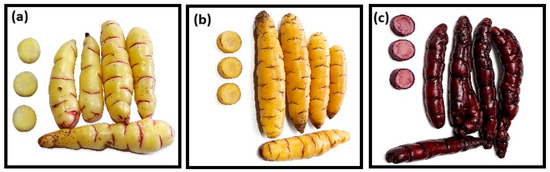
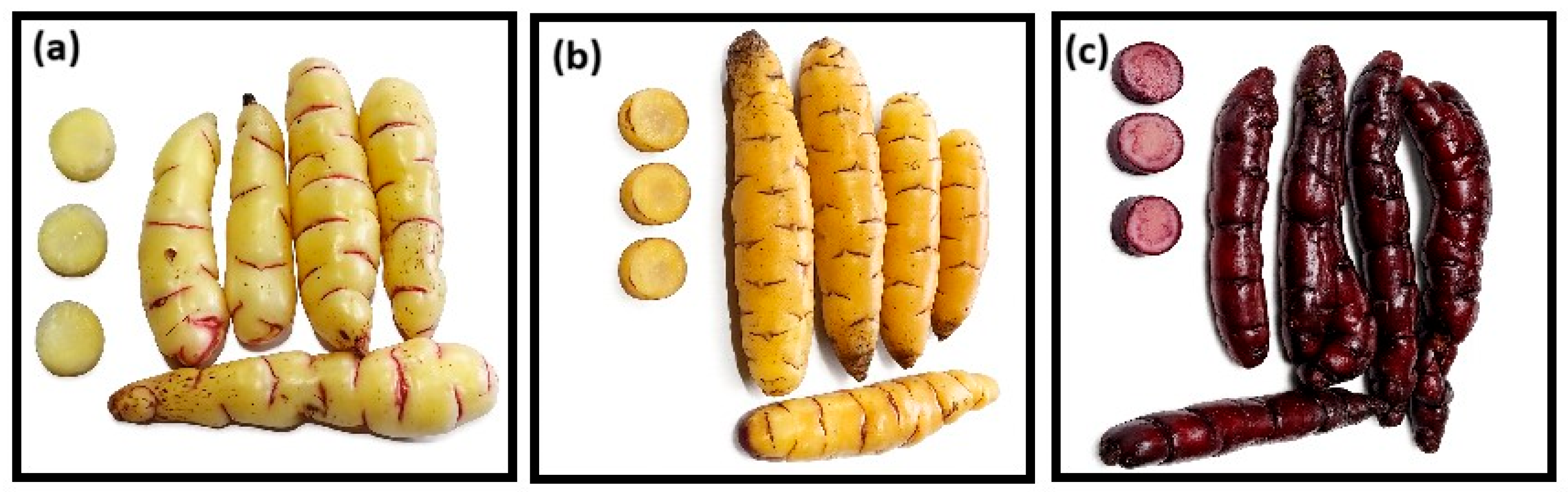
Oca tubers of white (WOS), yellow (YOS) and black (BOS) varieties (Figure 1), cultivated during the 2023–2024 harvest period, were collected at physiological maturity post-flowering in June in the Ccanccayllo community (13°44′55.9″ S, 73°30′37.2″ W, 3433 m of altitude), Andahuaylas, Peru.
Figure 1.
Varieties of oca: (a) white, (b) yellow, and (c) black.
2.2. Starch Extraction
Tubers were thoroughly washed to remove adhering soil and debris, then cut into approximately 2 cm cubes and homogenized at maximum speed using a domestic blender. The slurry was filtered through an 80-mesh sieve, and the filtrate was decanted and allowed to settle for 24 h. The supernatant was carefully discarded, and the starch sediment was recovered and washed with distilled water by centrifugation at 6000 rpm for 5 min at 6 °C. The wet starch was dried in a forced-air oven (UF160mplus, Memmert, Büchenbach, Germany) at 45 °C for 24 h, milled, passed through a 65-mesh sieve, and stored in containers until analysis [11].
2.3. Yield Determination
Starch extraction yield was determined using Equation (1) [12].
where % EY is the extraction yield percentage; Wes is the weight of extracted starch; and Wo is the initial weight of oca tubers.
2.4. Color
Color was determined using a colorimeter (Model CR-5, Konica-Minolta, Tokyo, Japan) in the L*, a*, b* color space. The whiteness index (WI), yellow index (YI), and color index (CI) were calculated using Equations (2)–(4), respectively [13].
2.5. Moisture Content and Water Activity
Moisture content was determined following the AOAC 964.22 standard method AOAC. Water activity was measured using a calibrated instrument (Model HygroPalm23-AW, Rotronic, Bassersdorf, Switzerland) following the manufacturer’s protocols.
2.6. Zeta Potential and Particle Size
Analysis was performed using a Zetasizer ZSU3100 (Malvern Instrument, Malvern, UK). Starch (0.15 g) was mixed with 50 mL of ultrapure water and vortexed at 3500 rpm. The mixture was placed in a disposable folded capillary cell DTS 1080. Measurements were taken at 25 °C with a wavelength of 632.8 nm.
For particle size, 2 g of starch was mixed in 250 mL of isopropyl alcohol (99.5%), sonicated for 60 s at 30% amplitude, and then analyzed using a Dynamic Light Scattering (DLS) instrument (Mastersizer 3000, Malvern Instruments, Malvern, UK) with continuous stirring at 1500 rpm for 10 s.
2.7. Morphological Determination
Starch samples were fixed on carbon tape and examined using a Quanta 200 scanning electron microscope (SEM, Thermo Fisher, Waltham, MA, USA) under low vacuum at 25 kV acceleration and 1000× magnification.
2.8. XRD Analysis
Starch samples were analyzed using a Bruker D8-Focus diffractometer (Karlsruhe, Germany) with a Cu Kα1 radiation source (λ = 1.5406 Å) at 40 kV and 40 mA, equipped with a Lynxeye PSD-type detector. Scans were performed over a 5° to 60° (2θ) angular range with a step size of 0.04°.
The degree of crystallinity (DC) was calculated as the ratio of the area corresponding to crystalline regions to the total area of the diffractogram, using Equation (5) [14].
where Sct.p is the area of the crystalline phase, and St is the total area of the diffractogram.
2.9. Amylose and Amylopectin Content Determination
Starch samples (10 mg) were mixed with 0.1 mL of 95% ethanol and 0.9 mL of 1 M sodium hydroxide, and left at ambient temperature for 24 h. The volume was then adjusted to 10 mL with ultrapure water, vortexed rigorously, and left to stand for 30 min. An aliquot (0.5 mL) was mixed with 1 mL of 1 M acetic acid, followed by 0.2 mL of Lugol’s solution. The volume was adjusted to 10 mL with deionized water, and the mixture was kept in darkness for 20 min. Absorbance was measured at 620 nm using a UV-Vis spectrophotometer [15]. A calibration curve was prepared using a 1 mg/mL solution of amylose in deionized water. Amylose content (%) was calculated using Equation (6).
where M is the amylose mass (mg) from the calibration curve, d is the dilution factor, and f is the starch mass. Amylopectin content was determined by calculating the difference.
2.10. IR Analysis
Starch samples were prepared as 0.1% KBr pellets and analyzed using an FTIR spectrometer (Nicolet IS50, Thermo Fisher, Waltham, MA, USA) in transmission mode. Spectra were recorded in the range of 4000 to 400 cm−1 with a resolution of 4 cm−1.
2.11. Determination of Water Absorption Capacity (WAC), Water Solubility Index (WSI), and Swelling Power (SP)
A starch suspension (0.2 g in 15 mL distilled water) was heated in a water bath at controlled temperatures ranging from 50 °C to 90 °C for 30 min with constant stirring. After cooling to room temperature, the suspension was centrifuged at 2500 rpm for 30 min. The supernatant was decanted and dried in Petri dishes at 90 °C for 24 h. The weight of the swollen starch gel sediment and the dried supernatant was recorded [16]. The indices were calculated using Equations (7)–(9).
2.12. Rheological Behavior Determination
Flow curves were obtained for 5% (w/v) starch suspensions using a rotational rheometer (Anton Paar MCR702e, Graz, Austria) with a concentric cylinder geometry. Measurements were performed under a controlled shear rate from 1 to 30 s−1. The experimental data were fitted to the Power Law model for non-Newtonian fluids (Equation (10)).
where is the shear stress (Pa); is the shear rate (s−1); is the consistency index (Pa·sn); and is the flow behavior index.
2.13. Thermal Analysis
Starch thermal stability was determined through Thermogravimetric Analysis (TGA). An amount of 10 milligrams of starch was analyzed using TA Instruments equipment, model TGA550 (New Castle, DE, USA), over a temperature range of 20 to 600 °C at a heating rate of 10 °C/min under a nitrogen (N2) atmosphere [17].
Thermal transition properties were analyzed using a Differential Scanning Calorimeter (DSC2500, TA Instruments, New Castle, DE, USA) under a nitrogen flow rate of 50 mL/min. Samples were prepared at a 1:2 starch-to-water ratio, sealed in aluminum pans, and heated from 20 to 200 °C at 5 °C/min [18].
2.14. Statistical Analysis
Physical, chemical, techno-functional, and thermal properties were evaluated using a Completely Randomized Design with three replicates. Analysis of variance (ANOVA) was performed at a 5% significance level; when significant differences were found, Tukey’s mean comparison test was applied. Data were processed using STATGRAPHICS® CENTURION XVI, and graphs were generated using Origin Pro 2023.
3. Results and Discussion
3.1. Yield, Color, Moisture Content, Water Activity, Particle Size, and Zeta Potential
Starch yields are shown in Table 1, with significant differences (p < 0.05) observed. The highest yield was for the WOS variety (8.25%), and the lowest for the YOS variety (7.58%). Differences in starch content among oca varieties are attributed to climatic conditions, soil type, tuber maturity, extraction methods and varietal growth conditions [19,20].
Table 1.
Yield, color, whiteness index, humidity, water activity, zeta potential, and particle size of starches.
The starch yield obtained in this study (~8%) is relatively low compared with conventional starch sources, which could limit its economic feasibility for large-scale production. However, oca starch exhibits distinctive physicochemical and functional properties that could justify its use in specific or value-added applications, where the functional performance of the starch is more relevant than the extraction yield.
Color is an important attribute influencing consumer acceptability and final product quality. The color parameters (L*, a*, b*) and whiteness indices for oca starches are presented in Table 1, showing significant differences (p < 0.05). Luminosity (L) values exceeded 92.28, and whiteness indices exceeded 92.10. L* values greater than 90 indicate high-purity starches [21], confirming the near-white appearance of oca starch. Chroma a* values were near zero for all varieties, indicating a neutral color within the a* range [22], while low b* values suggest a slight yellowish tendency [23]. Differences among varieties are likely due to pigment leaching, such as anthocyanins in black oca and carotenoids in the yellow variety [24].
Similarly, yellow index (YI) and color index (CI) values complement this characterization. The BOS variety showed the highest YI, indicating a greater contribution of yellow pigments, possibly from oxidized anthocyanins or retained carotenoids [25]. In contrast, WOS exhibited the lowest YI, suggesting higher whiteness and less interference from colored compounds. Regarding CI values, WOS showed the highest (2.43), indicating greater chromatic intensity, while the negative CI value for BOS (−0.25) suggests a more neutral color, consistent with pigment loss during extraction [26,27].
Moisture content and aw are fundamental parameters for the stability, storage, and quality of starch, as they describe the state and availability of water in food systems. These factors directly influence the safety and behavior of starch during storage, since high values promote biochemical reactions and microbial growth [28,29]. Oca starches showed moisture contents below 11% and water activity (aw) values ranging from 0.40 to 0.44 (Table 1), with significant differences (p < 0.05). These values indicate sufficiently low water availability to inhibit microbial growth and ensure good storage stability [30,31,32]. The differences may be related to amylose content, as amylose’s linear structure has higher water affinity than amylopectin [33]. Accordingly, YOS, with the highest amylose content (24.71%), also showed slightly higher moisture.
On the other hand, microorganisms cannot grow at aw < 0.60 [32], confirming the microbiological stability of these starches during storage. This observation aligns with polysaccharide-rich matrices, in which robust intermolecular hydrophilic interactions occur between starch hydroxyl groups (O–H) and water molecules, thereby reducing the amount of free water [31,34]. Variations among varieties are linked to differences in the amylose-to-amylopectin ratio (Table 2). Starches with higher amylopectin levels tend to hold more water within their granular structure due to their branched configuration, resulting in lower aw [20,34,35]. In contrast, starches with higher amylose content are more susceptible to releasing free water due to their propensity for easier association and retrogradation processes [20,34].
Table 2.
Amylose and amylopectin content.
Zeta potential evaluates repulsive or attractive forces between starch granules, indicating suspension stability [36]. High values indicate greater electrostatic repulsion, preventing aggregation, while low values promote particle attraction and sedimentation [37]. Table 1 shows significant differences (p < 0.05) in zeta potential among varieties. WOS and BOS showed higher values (−29.29 mV and −25.25 mV, respectively), indicating moderate colloidal stability [38]. In contrast, YOS showed the lowest value (−14.39 mV), suggesting a less stable system prone to flocculation [38]. These differences are likely due to varietal factors, cultivation conditions, soil, climate, and agricultural practices affecting chemical composition [39]. These results suggest that WOS and BOS dispersions could remain relatively homogeneous for extended periods.
Particle size is a structural characteristic that influences physical, chemical, and functional properties, such as water absorption, swelling, gelatinization, and viscosity [20]. Significant differences (p < 0.05) were observed among varieties (Table 1). Larger particle sizes may be attributed to higher amylose content (Table 2), as amylose is directly related to granule growth [40]. Particle size also varies depending on botanical origin, variety, and growth conditions [24]. The distribution of starch granule size plays a decisive role in its functional and technological properties, as well as in the rate of hydrolysis when used as a raw material [41]. Granule size determines its potential applications, particularly in functions such as emulsification and encapsulation, and contributes significantly to the stability, texture, and functional performance of starch in different food and technological systems [42].
3.2. Amylose and Amylopectin Content
Table 2 presents the amylose/amylopectin ratio and shows significant differences among varieties. YOS had the highest amylose content (24.71%), while BOS had the lowest (21.81%). Amylose and amylopectin content significantly influence starch functional properties [30]. These obtained values are comparable to those reported for oca starch by other authors [9,43].
These differences are mainly due to genetic variability, botanical origin, harvest period, tuber type, cultural practices, and growth conditions, such as climate and soil type [20,44]. Likewise, granule particle size also directly influences structural composition [45]. Studies report that higher amylose content is associated with larger particles, consistent with the values in Table 1, whereas smaller granules are associated with lower amylose content [40,46]. This direct relationship impacts the structural and functional characteristics of starch [40]. The functional properties of starches are heavily influenced by their amylose and amylopectin levels [30]. High-amylose starches exhibit strong gelling properties, making them useful in pasta, confectionery, bread, and coating applications [47].
3.3. Morphological Analysis
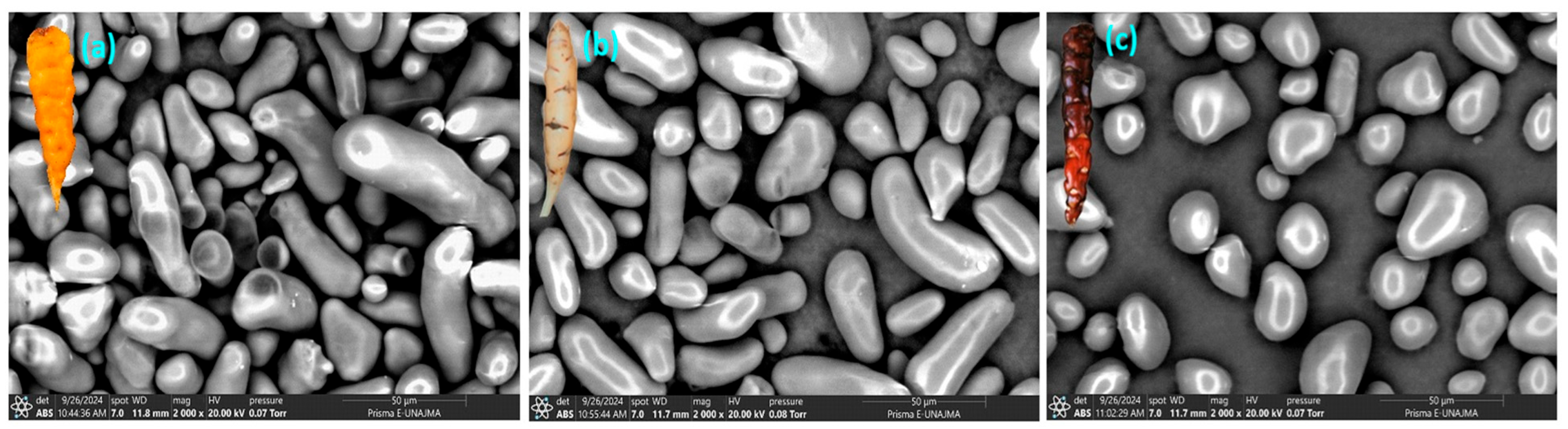
Scanning Electron Microscopy (SEM) is essential for analyzing the microstructure of starch granules, providing detailed information on morphology, size, and surface characteristics [48]. SEM micrographs revealed morphological differences among varieties. YOS and WOS granules exhibited oval, elliptical, and elongated shapes [49,50,51], while BOS granules were spherical and oval [39,52]. Granules were dispersed within the starch matrix, showing morphological variability. These shapes are typical of tuber starches, especially those from Andean roots and tubers, where amyloplast development results in heterogeneous granule geometry [53,54]. All starches showed smooth, planar surfaces without fissures, indicating native, structurally intact granules [55]. As shown in Figure 2, shape differences among isolated starches are due to botanical source and variety [51].
Figure 2.
(a) SEM image of YOS, (b) SEM image of WOS, and (c) SEM image of BOS.
3.4. XRD and IR Analysis
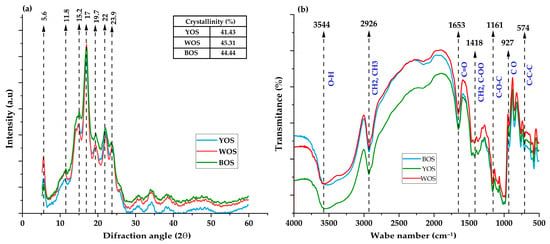
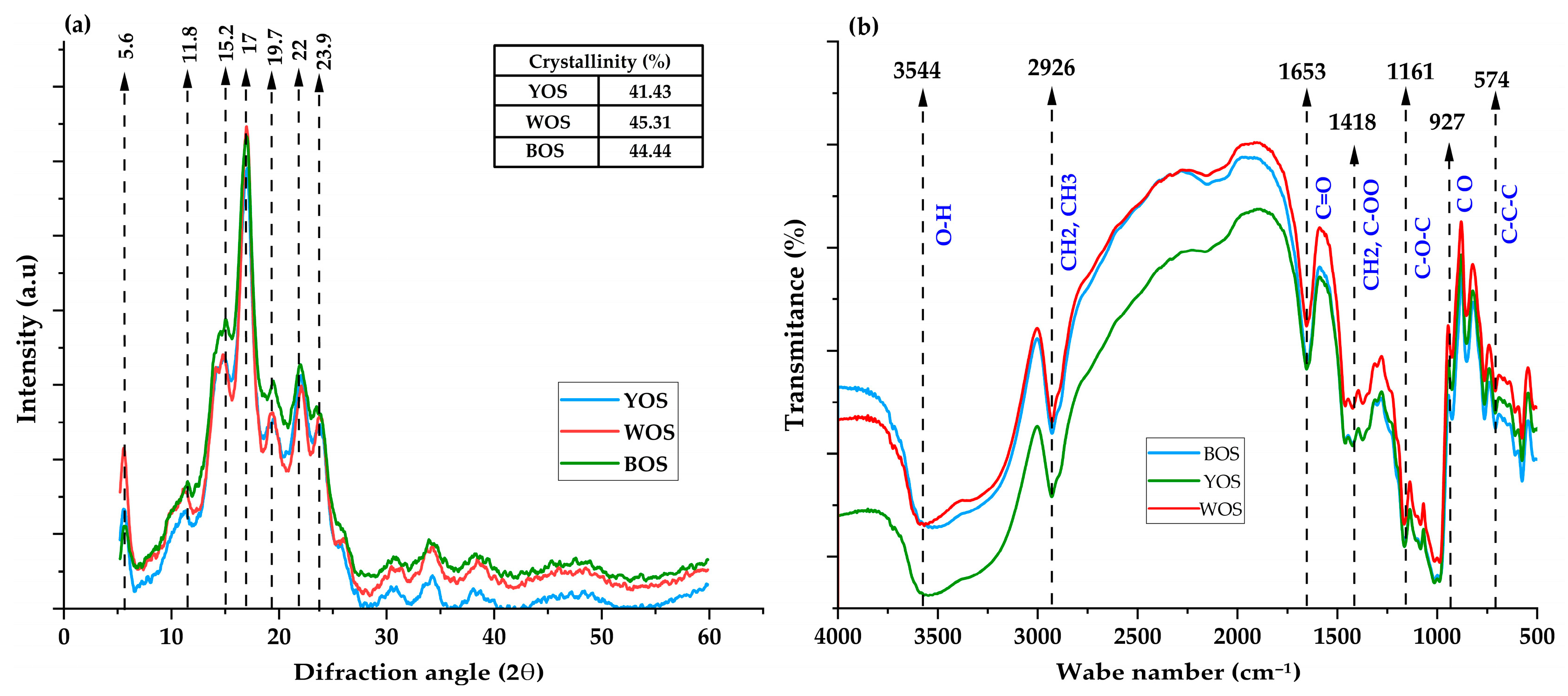
Figure 3 integrates the XRD and FTIR results for WOS, BOS, and YOS samples. The techniques characterize the semicrystalline organization and functional groups of the polymer, providing essential structural and behavioral information.
Figure 3.
(a) X-ray diffractogram and degree of crystallinity; (b) FTIR spectra of oca starches of three varieties.
XRD was used to determine the starch crystalline pattern and quantify crystallinity. The XRD patterns (Figure 3a) show a B-type crystallinity pattern, characterized by defined peaks at 2θ angles of 5.6, 11.8, 15.2, 17, 19.7, 22, and 23.9°, consistent with reports for Andean tuber starches [17,56,57]. These peaks result from the semicrystalline structure of the starch, where crystalline and amorphous regions coexist. B-type patterns appear when amylopectin double helices assemble into a highly hydrated hexagonal structure with wide cavities that allow the incorporation of water molecules [34,57,58,59]. The most intense peak at 2θ ≈ 17° is the main marker of the B-pattern, indicating a high degree of amylopectin double-helix ordering within crystalline regions [60,61]. The greater intensity of this peak in WOS and BOS samples suggests a more ordered structure compared to YOS.
A higher degree of crystallinity was reported for WOS and BOS (45.31% and 44.44%, respectively), indicating a greater proportion of crystalline regions, while YOS showed 41.32%. These values are comparable to those reported by other authors [17,61,62]. Variation may be influenced by variety, cultivation conditions, and isolation method [34,63].
FTIR is widely used to characterize the chemical structure of starch. Spectra in the 400–4000 cm−1 range are shown in Figure 3b. A broad band around 3500 cm−1 indicates the presence of hydroxyl (-OH) groups in glucose chains [64,65]. These absorptions correspond to both the stretching and bending vibrations of the bonds present in these groups, which are fundamental components of amylose and amylopectin molecules. These absorption bands are comparable to those reported by other researchers [17].
Similarly, a characteristic band around 2926 cm−1 is observed, due to C-H bond stretching vibrations present in the D-glucopyranose structure, the starch monomeric unit. Although associated with CH2 and CH3 groups [66], the principal contribution originates from methylene groups (CH2), as methyl groups (CH3) are less abundant in starch structures. Vibrations at 1653 cm−1 indicate the presence of a carbonyl group [17]. Several factors, such as protein presence, polysaccharide structure, and adsorbed water quantity, influence C=O bond vibration in starch. Hydration plays a key role in C=O band displacement, reflecting hydrogen-bond interactions in starch’s amorphous region. The peak at 1418 cm−1 is associated with bending vibrations of methylene groups (CH2) and carboxylate groups (COO−) and carbohydrates [17,67,68], providing information on polysaccharide structure and modifications, such as starch [69].
Another band around 1161 cm−1 is observed, corresponding to asymmetric C-O-C stretching vibrations in the glucopyranose ring [17,70] and glycosidic bonds connecting glucose units in starch polymers [17,67]. The 927 cm−1 peak is attributed to C-O stretching vibrations, particularly important for identifying α-1,4 bonds, which form the principal structure of amylose and amylopectin [17,64,67]. The 580 cm−1 peak corresponds to C-C-C bond bending vibrations in starch glycosidic bonds [17,68]. These results coincide with the crystallinity obtained by XRD (Figure 3a), where WOS shows the highest crystallinity (45.31%), followed by BOS and YOS. According to the literature, more crystalline type-B starches show greater intensity in FTIR bands associated with helical order and greater structural water content, which agrees with the observed patterns.
3.5. Swelling Power (SP), Water Absorption Capacity (WAC), and Water Solubility Index (WSI)
Techno-functional properties are crucial for industrial and domestic starch use, describing the relationship between water molecules and starch polymer chains in semicrystalline regions under temperature changes [57,71].
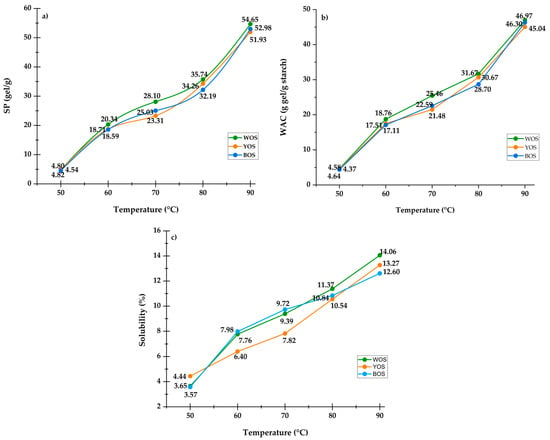
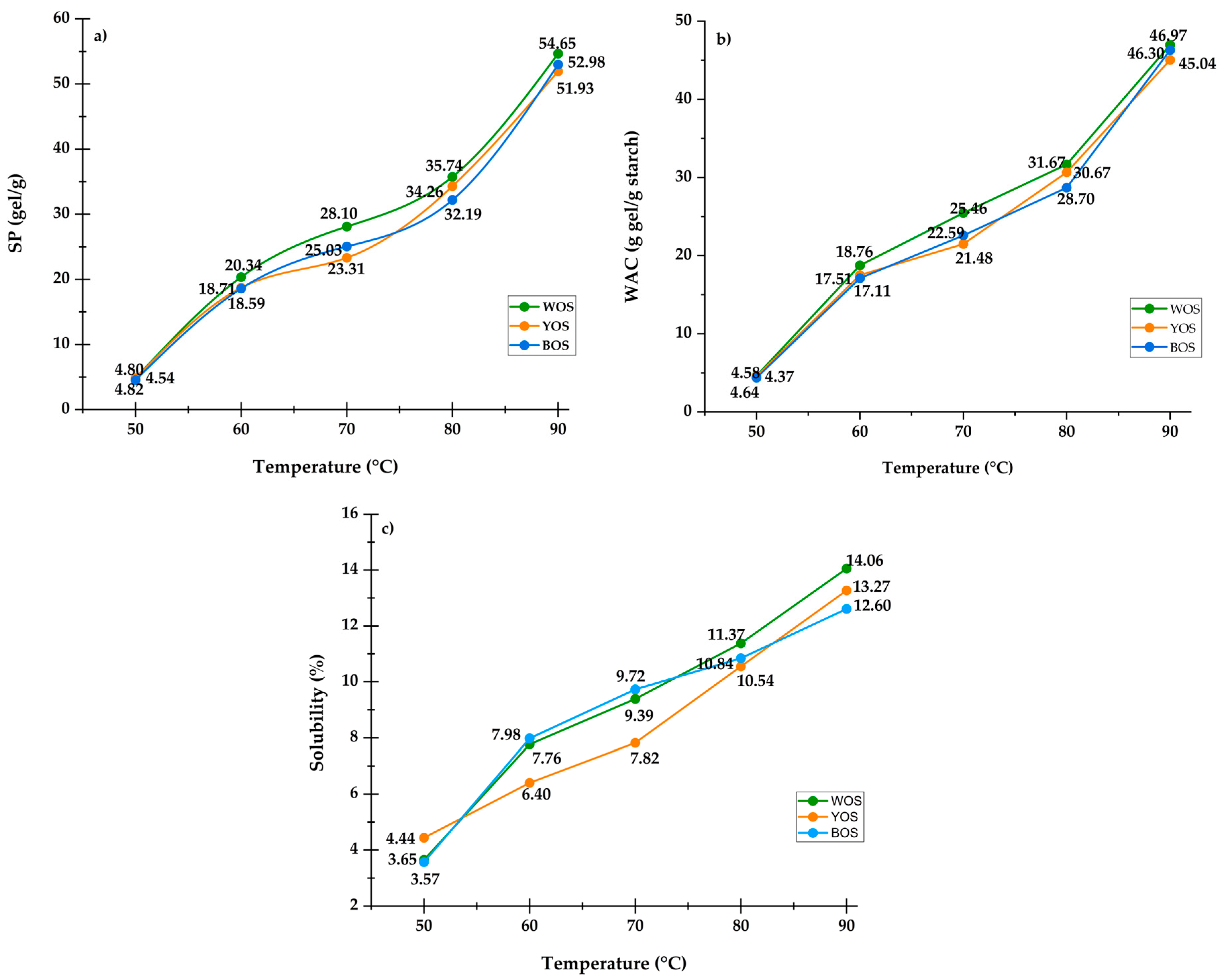
The SP, WAC, and WSI for oca starches are shown in Figure 4a–c. SP reflects the capacity of starch granules to absorb water and expand when heated above the gelatinization temperature. Figure 4a shows that SP increased from 4.80 to 51.94 g gel/g for YOS, 4.82 to 54.66 g gel/g for WOS, and 4.54 to 52.99 g gel/g for BOS in the 50–90 °C range, showing a sustained increase as gelatinization progresses. Variation in SP among samples is primarily associated with amylose/amylopectin ratios (Table 2). Higher amylopectin content favors water absorption and granule expansion due to its branched, flexible structure, enhancing hydration and thermal disorganization. Studies report that starches with higher amylopectin tend to exhibit greater swelling power [17,72,73,74].
Figure 4.
Techno-functional properties of oca starch of three varieties at different temperatures. (a) Swelling power, (b) water absorption capacity, and (c) solubility.
Similarly, WAC indicates the amount of water starch can absorb as the temperature increases [75]. Figure 4b shows that WAC progressively increased between 50 and 90 °C, reaching values from 4.38 to 46.98 g gel/g. This behavior is influenced by granule size (Table 1) and the presence of hydrophilic groups (Figure 2b). Smaller granules, with a higher amylopectin proportion, exhibit greater water retention than larger granules typical of amylose-rich structures. In addition, the number of hydrophilic groups in the starch matrix also significantly contributes to increased water absorption at elevated temperatures [30,76,77].
On the other hand, WSI indicates the ability of starch solids to disperse in aqueous solution during swelling while the temperature increases [78]. Figure 4c shows that WSI increased progressively with temperature from 50 to 90 °C, ranging from 4.44 to 13.27% for YOS, 3.65 to 14.06% for WOS, and 3.57 to 12.61% for BOS. These differences are due to the lower amylose content in oca starches (Table 2), as high-amylose starches have greater solubility because amylose solubilizes and migrates out of the granule during swelling [79]. This study demonstrated that amylopectin content is related to swelling power, water absorption capacity, and solubility index. High-quality starches exhibit high absorption capacity, low solubility, and high swelling power [80].
Based on the obtained results, the starch shows high potential for application as a thickening, binding, gelling, and stabilizing agent in food systems, due to its relatively high pH values and high water absorption capacity (WAC), properties that promote the formation of viscous and stable structures in food matrices [20,81].
3.6. Rheological Analysis
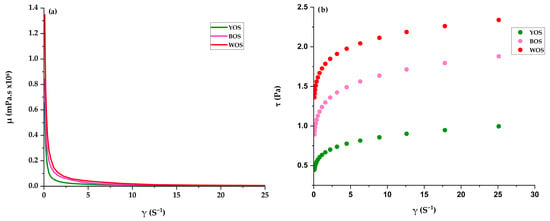
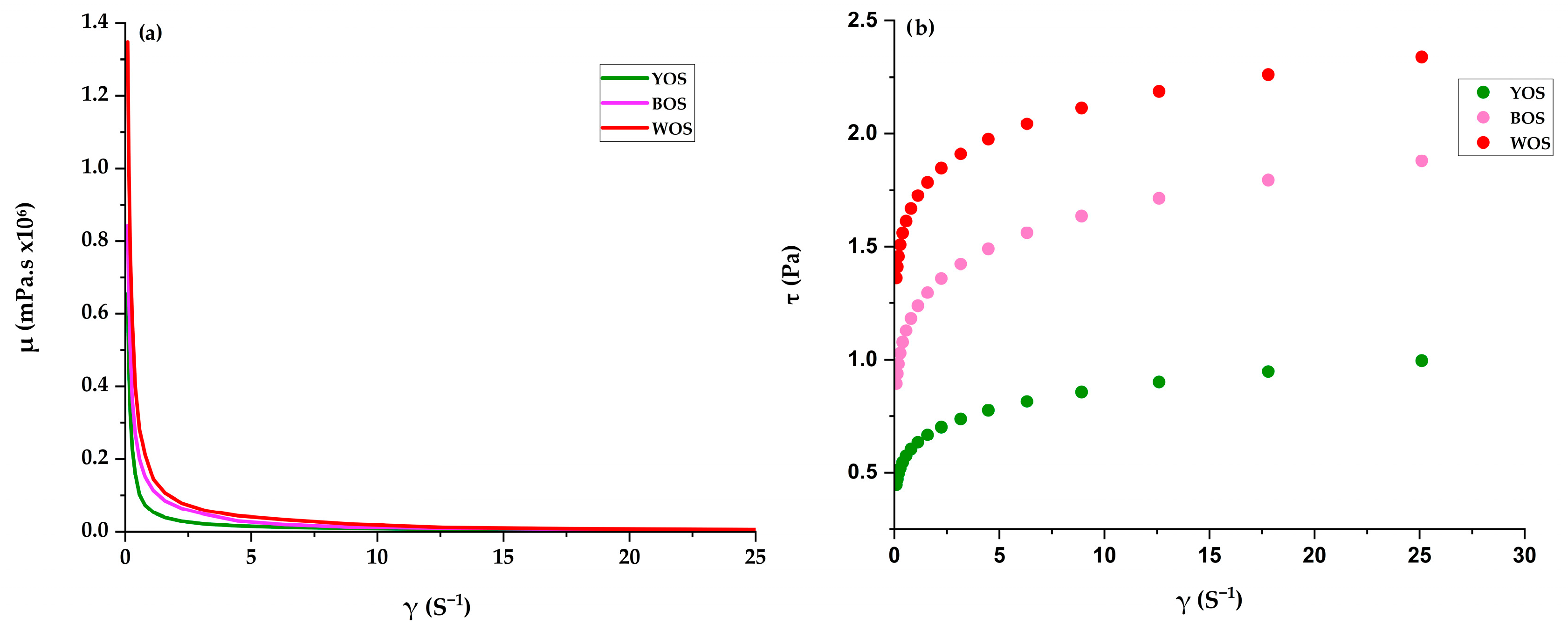
The rheological properties of oca starches were analyzed through their relationship with shear stress (τ) and apparent viscosity (μ) versus shear rate (γ), establishing the flow type of the system.
Apparent viscosity (Figure 5a) shows that oca starches exhibit pseudoplastic behavior, with viscosity decreasing as deformation rate increases. This pseudoplasticity is due to the progressive alignment and disordering of amylose and amylopectin chains under shear [82,83]. The higher viscosity of WOS compared to BOS and YOS may be attributed to its higher amylopectin content (Table 2), as this branched component favors the formation of more rigid molecular networks resistant to flow [82]. In contrast, the lower viscosity of WOS and YOS may be explained by higher amylose availability (Table 2), higher crystallinity, greater internal granule cohesion, or differences in granule structure that affect swelling capacity [17]. According to [83], variations in composition and granule size generate significant viscosity differences among starches.
Figure 5.
Rheological analysis of three varieties of oca starch: (a) viscosity vs. shear speed; (b) shear stress vs. shear speed.
Shear stress (Figure 5b) increased with shear rate for all samples, indicating pseudoplastic non-Newtonian behavior due to progressive disorganization of the granular structure under shear [83,84]. WOS showed the highest shear stress, indicating a more flow-resistant structure, as differences in granular integrity and molecular distribution generate variations in mechanical resistance during shear [85].
3.7. Thermal Stability
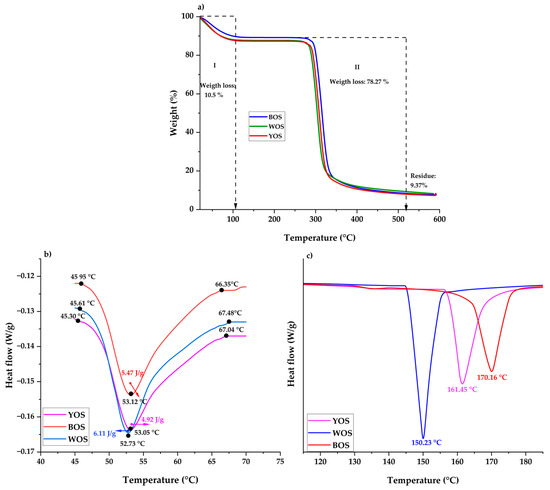
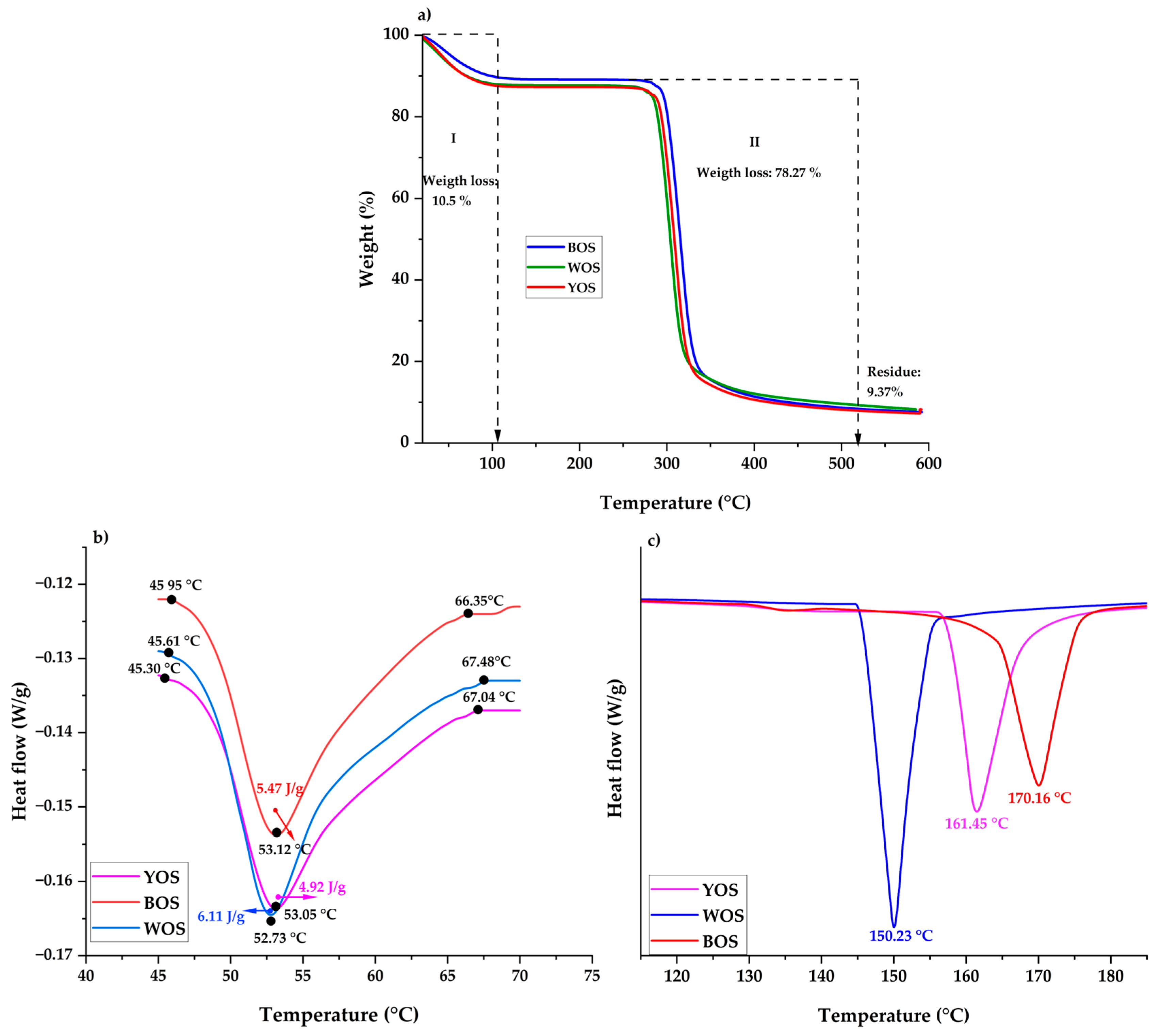
Starch mass loss was evaluated by Thermogravimetric Analysis (TGA), which showed two principal degradation stages below 600 °C (Figure 6a). In the first zone (first drop), initial starch mass loss occurred around 10.5% across a temperature range of 20 to 110.25 °C. This loss corresponds mainly to the elimination of free and weakly bound water molecules present in starch [86,87]. These molecules are released at relatively low temperatures because they maintain weak physical interactions with the polymer matrix [88]. Furthermore, mass remains constant from 110.25 °C to 265.45 °C, indicating that complex high-molecular-weight structures such as polysaccharides (amylose and amylopectin) continue to be present in starches without experiencing degradation, preserving their thermal integrity, as glycosidic bonds present stability in this interval.
Figure 6.
TGA and DSC thermograms of oca starch of three varieties in terms of (a) loss of mass; (b) gelatinization temperature; and (c) melting temperature.
Subsequently, a second zone (second drop) is observed, representing the major decomposition phase, with a mass loss of 78.27% over a temperature range of 265.45 °C to 525.65 °C. This stage undergoes major decomposition of the predominant compounds present in starch samples, such as carbohydrates (amylose and amylopectin). This decomposition initiates through rupture of α-(1 → 4) and α-(1 → 6) glycosidic bonds, followed by depolymerization and protein denaturation [89]. Above 525.65 °C, mass remained constant, leaving 9.37% as residue (ash) for the yellow, white, and black oca starches, respectively.
Differential Scanning Calorimetry (DSC) is fundamental for characterizing starch gelatinization, which is influenced by factors such as amylose/amylopectin content, granule size, crystallinity, and water interactions [34,35]. The thermograms in Figure 6b show changes during oca starch gelatinization. Onset gelatinization temperature (To) ranged from 45.30 to 45.95 °C, peak temperature (Tp) from 52.73 to 53.12 °C, and conclusion temperature (Tf) from 66.55 to 67.48 °C. Gelatinization enthalpy varied from 4.92 to 6.11 J/g. These values indicate lower gelatinization temperatures than those reported for other oca starches, with T0 49.5 °C, Tp 54.6 °C, and Tf 61.4 °C [90]. Potato starch showed T0 from 49.31 to 54.17 °C, Tp from 54.69 to 59.75 °C, and Tf from 60 to 66.28 °C, with an enthalpy range of 3.60 to 6.62 J/g [17].
On the other hand, gelatinization enthalpy (ΔH) is directly related to crystal concentration, reflecting progressive loss of molecular order [79]. Lower enthalpy indicates less energy required to initiate gelatinization, which may be associated with lower structural stability or lower granule crystallinity [91]. Enthalpy is also influenced by granule morphology and size [92,93,94].
Figure 6c shows an endothermic peak in the range of 150.23 to 170.16 °C, associated with the dissociation of amylose–lipid complexes or the melting of recrystallized amylose structures formed during retrogradation [95]. These structures exhibit a higher degree of order and thermal stability, and therefore require higher temperatures for their disruption. Furthermore, this behavior may be influenced by the amylose/amylopectin ratio and by the presence of components such as lipids or proteins, which promote the formation of more thermally stable structures [96,97]. Higher melting temperatures suggest greater thermal stability, whereas lower melting temperatures may indicate greater resistance to thermal decomposition [20,34].
4. Conclusions
The study of starch from three oca varieties enabled characterization of their properties, revealing significant differences among them. White oca starch (WOS) showed the highest water absorption capacity (46.98 g gel/g) and swelling power (54.66 g gel/g), suggesting higher amylopectin content (78.14%). In contrast, yellow oca starch (YOS) exhibited the highest amylose content (24.71%), resulting in lower swelling and solubility capacities. FTIR analysis confirmed the presence of characteristic polysaccharide functional groups in all evaluated starches, with variations in the intensities of the hydroxyl and carbonyl bands among varieties. SEM revealed oval to spherical starch granules with smooth surfaces; the white variety (WOS) exhibited the largest granules. Rheologically, all three varieties exhibited typical pseudoplastic behavior of non-Newtonian systems. XRD analysis revealed a B-type crystallinity pattern in all cases, characteristic of starches with more hydrated structures and less dense packing.
Overall, these results indicate that oca starches, particularly those from the white variety, exhibit functional properties suitable for specific applications in the food industry, such as thickening and texturizing agents in beverages, sauces, and gelled products. These findings contribute to the revalorization of oca as a strategic agroindustrial resource and support its incorporation into value chains with greater technological and economic impact.
Author Contributions
Conceptualization, C.P.-G., D.C.-Q. and F.T.-P.; methodology, C.P.-G., D.E.P.-G. and J.F.-A.; software, F.T.-P. and J.P.-G.; validation, C.A.L.-S. and D.E.P.-G.; formal analysis, C.P.-G. and J.F.-A.; investigation, C.P.-G., J.P.-G., J.F.-A. and J.P.G.; resources, C.P.-G. and F.T.-P.; data curation, C.P.-G.; writing—original draft preparation, C.P.-G., D.C.-Q. and D.E.P.-G.; writing—review and editing, C.P.-G., D.C.-Q. and C.A.L.-S.; visualization, C.A.L.-S.; supervision, F.T.-P.; project administration, C.P.-G.; funding acquisition, C.P.-G. and F.T.-P. All authors have read and agreed to the published version of the manuscript.
Funding
This manuscript was partially funded by the Vice-Rectorate for Research of the José María Arguedas National University.
Institutional Review Board Statement
Not applicable.
Data Availability Statement
The original contributions presented in this study are included in the article. Further inquiries can be directed to the corresponding authors.
Acknowledgments
The authors gratefully acknowledge the collaboration of the Laboratory for Research in Materials for Water Treatment (LIMTA), the Agro-industrial Research Laboratory (LIA), the Laboratory for Research in Nanomaterials (LINA), and the Vice-Rectorate for Research of the Universidad Nacional José María Arguedas. They also extend their gratitude to the Physics Laboratory of the Universidad Nacional Mayor de San Marcos, Peru. Likewise, to the rheology laboratory at the Universidad Nacional Intercultural de Quillabamba, Peru.
Conflicts of Interest
The authors declare no conflicts of interest.
References
- Visscher, A.M.; Vanek, S.; Huaraca, J.; Mendoza, J.; Ccanto, R.; Meza, K.; Olivera, E.; Scurrah, M.; Wellstein, C.; Bonari, G.; et al. Traditional soil fertility management ameliorates climate change impacts on traditional Andean crops within smallholder farming systems. Sci. Total Environ. 2024, 912, 168725. [Google Scholar] [CrossRef] [Scilit] [PubMed]
- Biduski, B.; da Silva, W.M.F.; Colussi, R.; Halal, S.L.d.M.E.; Lim, L.-T.; Dias, Á.R.G.; Zavareze, E.D.R. Starch hydrogels: The influence of the amylose content and gelatinization method. Int. J. Biol. Macromol. 2018, 113, 443–449. [Google Scholar] [CrossRef] [Scilit] [PubMed]
- Huang, H.-K.; Sheu, H.S.; Wei, T.C.; Jeng, U.S.; An, C.S.; Wei, R.W.; Kuei, F.L.; Chun, Y.C.; Shing, Y.C.; Hsi, M.L. Correlated changes in structure and viscosity during gelatinization and gelation of tapioca starch granules. IUCrJ 2014, 1, 418–428. [Google Scholar] [CrossRef] [Scilit] [PubMed]
- Fan, Y.; Picchioni, F. Modification of starch: A review on the application of “green” solvents and controlled functionalization. Carbohydr. Polym. 2020, 241, 116350. [Google Scholar] [CrossRef] [Scilit]
- Almeida, R.L.J.; Newton, C.S.; Vítor, F.F.J.; da Silva, G.M.; de Sousa Muniz, C.E.; da Silva Eduardo, R.; de Alcântara Ribeiro, V.H.; de Alcântara Silva, V.M.; de Almeida Mota, M.M. Effect of heat-moisture treatment on the thermal, structural and morphological properties of Quinoa starch. Carbohydr. Polym. Technol. Appl. 2022, 3, 100192. [Google Scholar] [CrossRef] [Scilit]
- Paternina-Contreras, A.L.; Andrade-Pizarro, R.D.; Figueroa-Flórez, J.A. Physical Modification of Starch in Plant-Based Flours: Structural, Physicochemical, and Pasting Property Changes and Potential Applications in Baked and Extruded Products. Compr. Rev. Food Sci. Food Saf. 2025, 24, e70184. [Google Scholar] [CrossRef] [Scilit]
- Hernández-Lauzardo, A.N.; Méndez-Montealvo, G.; del Valle, M.G.V.; Solorza-Feria, J.; Bello-Pérez, L.A. Isolation and Partial Characterization of Mexican Oxalis tuberosa Starch. Starch-Stärke 2004, 56, 357–363. [Google Scholar] [CrossRef] [Scilit]
- Valcárcel-Yamani, B.; Rondán-Sanabria, G.G.; Finardi-Filho, F. The physical, chemical and functional characterization of starches from Andean tubers: Oca (Oxalis tuberosa Molina), olluco (Ullucus tuberosus Caldas) and mashua (Tropaeolum tuberosum Ruiz & Pavón). Braz. J. Pharm. Sci. 2013, 49, 453–464. [Google Scholar] [CrossRef] [Scilit]
- Zhu, F.; Cui, R. Comparison of physicochemical properties of oca (Oxalis tuberosa), potato, and maize starches. Int. J. Biol. Macromol. 2020, 148, 601–607. [Google Scholar] [CrossRef] [Scilit]
- Zhang, C.; Xue, W.; Li, T.; Wang, L. Understanding the Relationship between the Molecular Structure and Physicochemical Properties of Soft Rice Starch. Foods 2023, 12, 3611. [Google Scholar] [CrossRef] [Scilit]
- Martínez, P.; Peña, F.; Bello-Pérez, L.A.; Núñez-Santiago, C.; Yee-Madeira, H.; Velezmoro, C. Physicochemical, functional and morphological characterization of starches isolated from three native potatoes of the Andean region. Food Chem. X 2019, 2, 100030. [Google Scholar] [CrossRef] [Scilit]
- Ji, Y.; Seetharaman, K.; White, P.J. Optimizing a Small-Scale Corn-Starch Extraction Method for Use in the Laboratory. Cereal Chem. 2004, 81, 55–58. [Google Scholar] [CrossRef] [Scilit]
- Saricoban, C.; Yilmaz, M.T. Modelling the Effects of Processing Factors on the Changes in Colour Parameters of Cooked Meatballs Using Response Surface Methodology. World Appl. Sci. J. 2010, 9, 14–22. [Google Scholar]
- Dome, K.; Podgorbunskikh, E.; Bychkov, A.; Lomovsky, O. Changes in the Crystallinity Degree of Starch Having Different Types of Crystal Structure after Mechanical Pretreatment. Polymers 2020, 12, 641. [Google Scholar] [CrossRef] [Scilit] [PubMed]
- Galicia, L.; Miranda, A.; Gutiérrez, M.G.; Custodio, O.; Rosales, A.; Ruiz, N.; Surles, R.; Palacios, N. Laboratorio de Calidad Nutricional de Maíz y Análisis de Tejido Vegetal. Protocolos de laboratorio; Centro Internacional de Mejoramiento de Maíz y Trigo: Texcoco, Mexico, 2012. [Google Scholar]
- Gani, A.; Nazia, S.; Rather, S.A.; Wani, S.; Shah, A.; Bashir, M.; Masoodi, F.; Gani, A. Effect of γ-irradiation on granule structure and physicochemical properties of starch extracted from two types of potatoes grown in Jammu & Kashmir, India. LTW-Food Sci. Technol. 2014, 58, 239–246. [Google Scholar]
- Choque-Quispe, D.; Gonzales, F.H.O.; Carranza-Oropeza, M.V.; Solano-Reynoso, A.M.; Ligarda-Samanez, C.A.; Palomino-Ríncón, W.; Choque-Quispe, K.; Torres-Calla, M.J. Physicochemical and technofunctional properties of high Andean native potato starch. J. Agric. Food Res. 2024, 15, 100955. [Google Scholar] [CrossRef] [Scilit]
- Chávez-Salazar, A.; Bello-Pérez, L.; Agama-Acevedo, E.; Castellanos-Galeano, F.J.; Álvarez-Barreto, C.I.; Pacheco-Vargas, G. Isolation and partial characterization of starch from banana cultivars grown in Colombia. Int. J. Biol. Macromol. 2017, 98, 240–246. [Google Scholar] [CrossRef] [Scilit]
- Quinto, D.A.; Cóndor, K.H.; Solano, M.Q.; Silva, C.E. Extracción y caracterización del almidón de tres variedades de quinua (Chenopodium quinoa Willd) negra collana, pasankalla roja y blanca junín. Rev. Soc. Química Perú 2015, 81, 44–54. [Google Scholar]
- Singh, N.; Singh, J.; Kaur, L.; Sodhi, N.S.; Gill, B.S. Morphological, thermal and rheological properties of starches from different botanical sources. Food Chem. 2003, 81, 219–231. [Google Scholar] [CrossRef] [Scilit]
- Julianti, E.; Rusmarilin, H.; Yusraini, E. Effect of Isolation Methods on Physicochemical Properties of Purple-fleshed Sweet Potato Starch. In Proceedings of the International Conference of Science, Technology, Engineering, Environmental and Ramification Researches (ICOSTEERR 2018), Medan, Indonesia, 18–19 October 2018; Volume 3, pp. 37–41. [Google Scholar]
- Prabha, V.; Dash, S.K.; Rayaguru, K.; Panda, M. Optimization of starch isolation process for sweet potato and characterization of the prepared starch. J. Food Meas. Charact. 2020, 14, 1520–1532. [Google Scholar] [CrossRef] [Scilit]
- Macdougall, D.B. 13—Colour Measurement of food: Principles and practice. In Colour Measurement: Principles, Advances and Industrial Applications; Woodhead Publishing: Cambridge, UK, 2010; pp. 312–342. [Google Scholar]
- Guo, J.; Kong, L.; Du, B.; Xu, B. Morphological and physicochemical characterization of starches isolated from chestnuts cultivated in different regions of China. Int. J. Biol. Macromol. 2019, 130, 357–368. [Google Scholar] [CrossRef] [Scilit]
- Cairone, F.; Carradori, S.; Locatelli, M.; Casadei, M.A. Reflectance colorimetry: A mirror for food quality—A mini review. Eur. Food Res. Technol. 2020, 246, 259–272. [Google Scholar] [CrossRef] [Scilit]
- Prieto-Santiago, V.; Cavia, M.M.; Alonso-Torre, S.R.; Carrillo, C. Relationship between color and betalain content in different thermally treated beetroot products. J. Food Sci. Technol. 2020, 57, 3305–3313. [Google Scholar] [CrossRef] [Scilit] [PubMed]
- Pandiselvam, R.; Mitharwal, S.; Rani, P.; Shanker, M.A.; Kumar, A.; Aslam, R.; Barut, Y.T.; Kothakota, A.; Rustagi, S.; Bhati, D.; et al. The influence of non-thermal technologies on color pigments of food materials: An updated review. Curr. Res. Food Sci. 2023, 6, 100529. [Google Scholar] [CrossRef] [Scilit] [PubMed]
- Bradley, R.L. Moisture and Total Solids Analysis. In Food Analysis, 4th ed.; Springer: Cham, Switzerland, 2010. [Google Scholar]
- Mathlouthi, M. Water content, water activity, water structure and the stability of foodstuffs. Food Control 2001, 12, 409–417. [Google Scholar] [CrossRef] [Scilit]
- Dergal, B. Química en Alimentos, 5th ed.; Pearson: London, UK, 2012. [Google Scholar]
- Fennema, O.R. Fenema Quimica de los Alimentos, 3rd ed.; Editorial Acribia, S.A.: Zaragoza, Spain, 2010. [Google Scholar]
- Vilgis, T.A. Soft matter food physics—The physics of food and cooking. Rep. Prog. Phys. 2015, 78, 124602. [Google Scholar] [CrossRef] [Scilit]
- Vaclavik, V.A.; Christian, E.W. Fundamentos de Ciencia de los Alimentos; Editorial Acribia, S.A.: Zaragoza, Spain, 2002. [Google Scholar]
- Hoover, R. Composition, molecular structure, and physicochemical properties of tuber and root starches: A review. Carbohydr. Polym. 2001, 45, 253–267. [Google Scholar] [CrossRef] [Scilit]
- Tester, R.F.; Debon, S.J. Annealing of starch—A review. Int. J. Biol. Macromol. 2000, 27, 1–12. [Google Scholar] [CrossRef] [Scilit]
- Furusawa, K.; Uchiyama, K. Collaborative studies of zeta-potential measurements and electrophoretic measurements using reference sample. Colloids Surface A Physicochem. Eng. Asp. 1998, 140, 217–226. [Google Scholar] [CrossRef] [Scilit]
- Yarce, M.M.; Rojas, C.S.; Zuleta, H.A.A. Modificacion de Almidon de Papa China (Colocasia esculenta L. Schoot) por Acetilacion; Universidad del Valle: Cali, Colombia, 2013. [Google Scholar]
- Bhattacharjee, S. DLS and zeta potential—What they are and what they are not? J. Control. Release 2016, 235, 337–351. [Google Scholar] [CrossRef] [Scilit]
- Tong, C.; Ma, Z.; Chen, H.; Gao, H. Toward an understanding of potato starch structure, function, biosynthesis, and applications. Food Front. 2023, 4, 980–1000. [Google Scholar] [CrossRef] [Scilit]
- Kaur, P.; Kaur, K.; Basha, S.J.; Kennedy, J.F. Current trends in the preparation, characterization and applications of oat starch—A review. Int. J. Biol. Macromol. 2022, 212, 172–181. [Google Scholar] [CrossRef] [Scilit] [PubMed]
- Al-Rabadi, G.J.; Gilbert, R.G.; Gidley, M.J. Effect of particle size on kinetics of starch digestion in milled barley and sorghum grains by porcine alpha-amylase. J. Cereal Sci. 2009, 50, 198–204. [Google Scholar] [CrossRef] [Scilit]
- Velasquez Barreto, F.F.; Bello-Pérez, L.A. Chemical, Structural, Technological Properties and Applications of Andean Tuber Starches: A Review. Food Rev. Int. 2021, 39, 1293–1308. [Google Scholar] [CrossRef] [Scilit]
- Lopez, S.H.; Vedia, J.F.Y.; Flores, V.C.; Portugal, P.M. Physicochemical characterization of dehydrated starches extracted from tubers from La Paz. Food Sci. Technol. 2025, 45, 486. [Google Scholar] [CrossRef] [Scilit]
- Kaur, L.; Singh, J.; McCarthy, O.J.; Singh, H. Physico-chemical, rheological and structural properties of fractionated potato starches. J. Food Eng. 2007, 82, 383–394. [Google Scholar] [CrossRef] [Scilit]
- Narváez-González, E.D.; Cárdenas, J.D.D.F.; Taba, S.; Tostado, E.C.; Peniche, R.Á.M. Effect of starch granule size on the thermal and pasting properties of maize. Rev. Fictotecnia Mex. 2007, 30, 269–277. [Google Scholar]
- Sodhi, N.S.; Singh, N. Morphological, thermal and rheological properties of starches separated from rice cultivars grown in India. Food Chem. 2003, 80, 99–108. [Google Scholar] [CrossRef] [Scilit]
- Ramírez, J.E.C. Caracterización estructural de Almidón Resistente Tipo V Obtenido por Extrusión. Bachelor’s Thesis, Peruvian Union University, Lima, Peru, 2020. [Google Scholar]
- Inkson, B. 2—Scanning electron microscopy (SEM) and transmission electron microscopy (TEM) for materials characterization. In Materials Characterization Using Nondestructive Evaluation (NDE) Methods; Woodhead Publishing: Cambridge, UK, 2016; pp. 17–43. [Google Scholar]
- Morocco, B.D.A. Extracción y Caracterización del Almidón de oca (Oxalis tuberosa) de la Variedad Kellu Kamusa. Bachelor’s Thesis, Universidad Peruana Unión, Lima, Peru, 2018. [Google Scholar]
- Dini, C.; Garzón, R.; Rosell, C.M. Breadmaking Potential of Andean Roots and Tuber Starches from Ahipa (Pachyrhizus ahipa), Oca (Oxalis tuberosa), and Arracacha (Arracacia xanthorrhiza). Starch-Stärke 2024, 77, 2400085. [Google Scholar] [CrossRef] [Scilit]
- Jingyi, Y.; Reddy, C.K.; Fan, Z.; Xu, B. Physicochemical and structural properties of starches from non-traditional sources in China. Food Sci. Hum. Wellness 2023, 12, 416–423. [Google Scholar] [CrossRef] [Scilit]
- Pacheco, M.T.; Moreno, F.J.; Moreno, R.; Villamiel, M.; Hernandez-Hernandez, O. Morphological, technological and nutritional properties of flours and starches from mashua (Tropaeolum tuberosum) and melloco (Ullucus tuberosus) cultivated in Ecuador. Food Chem. 2019, 301, 125268. [Google Scholar] [CrossRef] [Scilit]
- Hoover, R.; Hughes, T.; Chung, H.; Liu, Q.Q. Composition, molecular structure, properties, and modification of pulse starches: A review. Food Res. Int. 2010, 43, 399–413. [Google Scholar] [CrossRef] [Scilit]
- Jane, J.-L.; Kasemsuwan, T.; Leas, S.; Zobel, H.; Robyt, J.F. Anthology of Starch Granule Morphology by Scanning Electron Microscopy. Starc-Stärke 1994, 46, 121–129. [Google Scholar] [CrossRef] [Scilit]
- Monroy, Y.; Sandra, R.; García, M.A. Análisis reológico y microestructural de almidón de mandioca modificado con ultrasonido. In Proceedings of the XVI Congreso Argentino de Ciencia y Tecnología de Alimentos (CYTAL), Mar del Plata, Argentina, 18–20 September 2017. [Google Scholar]
- Jiang, Q.; Gao, W.; Shi, Y.; Li, X.; Wang, H.; Huang, L.; Xiao, P. Physicochemical properties and in vitro digestion of starches from different Dioscorea plants. Food Hydrocoll. 2013, 32, 432–439. [Google Scholar] [CrossRef] [Scilit]
- Wang, X.; Reddy, C.K.; Xu, B. A systematic comparative study on morphological, crystallinity, pasting, thermal and functional characteristics of starches resources utilized in China. Food Chem. 2018, 259, 81–88. [Google Scholar] [CrossRef] [Scilit] [PubMed]
- Buléon, A.; Colonna, P.; Planchot, V.; Ball, S. Starch granules: Structure; biosynthesis. Int. J. Biol. Macromol. 1998, 23, 85–112. [Google Scholar] [CrossRef] [Scilit]
- Zobel, H.F. Starch Crystal Transformations and Their Industrial Importance. Starch-Stärke 1988, 40, 1–7. [Google Scholar] [CrossRef] [Scilit]
- Domene-López, D.; García-Quesada, J.C.; Martin-Gullon, I.; Montalbán, M.G. Influence of Starch Composition and Molecular Weight on Physicochemical Properties of Biodegradable Films. Polymers 2019, 11, 1084. [Google Scholar] [CrossRef] [Scilit]
- Zhang, Z.; Tian, X.; Wang, P.; Jiang, H.; Li, W. Correction to “Compositional, Morphological, and Physiochemical Properties of Starches From Red Adzuki Bean, Chickpea, Faba Bean, and Baiyue Bean Grown in China”. Food Sci. Nutr. 2024, 7, 2485–2494. [Google Scholar] [CrossRef] [Scilit]
- Boudries, N.; Belhaneche, N.; Nadjemi, B.; Deroanne, C.; Mathlouthi, M.; Roger, B.; Sindic, M. Physicochemical and functional properties of starches from sorghum cultivated in the Sahara of Algeria. Carbohydr. Polym. 2009, 78, 475–480. [Google Scholar] [CrossRef] [Scilit]
- Lan, X.; Li, Y.; Xie, S.; Wang, Z. Ultrastructure of underutilized tuber starches and its relation to physicochemical properties. Food Chem. 2015, 188, 632–640. [Google Scholar] [CrossRef] [Scilit]
- Dankar, I.; Haddarah, A.; Omar, F.E.; Pujolà, M.; Sepulcre, F. Characterization of food additive-potato starch complexes by FTIR and X-ray diffraction. Food Chem. 2018, 260, 7–12. [Google Scholar] [CrossRef] [Scilit]
- Kizil, R.; Irudayaraj, J.; Seetharaman, K. Characterization of Irradiated Starches by Using FT-Raman and FTIR Spectroscopy. Agric. Food Chem. 2002, 50, 3912–3918. [Google Scholar] [CrossRef] [Scilit]
- Moreno, J.B. Briqueteado de Lignitos con Aditivos: Seguimiento Físico-Químico del Proceso. Ph.D. Thesis, Universidad de Zaragoza, Zaragoza, Spain, 2002. [Google Scholar]
- Hong, T.; Yin, J.-Y.; Nie, S.P.; Xie, M.Y. Applications of infrared spectroscopy in polysaccharide structural analysis: Progress, challenge and perspective. Food Chem. X 2021, 12, 100168. [Google Scholar] [CrossRef] [Scilit] [PubMed]
- Wiercigroch, E.; Szafraniec, E.; Czamara, K.; Pacia, M.Z.; Majzner, K.; Kochan, K.; Kaczor, A.; Baranska, M.; Malek, K. Raman and infrared spectroscopy of carbohydrates: A review. Spectrochim. Acta Part A Mol. Biomol. Spectrosc. 2017, 185, 317–335. [Google Scholar] [CrossRef] [Scilit] [PubMed]
- Awolu, O.O.; Odoro, J.W.; Adeloye, J.B.; Lawal, O.M. Physicochemical evaluation and Fourier transform infrared spectroscopy characterization of quality protein maize starch subjected to different modifications. J. Food Sci. 2020, 85, 3052–3060. [Google Scholar] [CrossRef] [Scilit] [PubMed]
- Becerril, M.T.; García, R.C.; Cruz, A.A. Obtaining and structural characterization and functional of acetylated starch of taro (Colocasia esculenta Schott). Rev. Mex. Cienc. Agrícolas 2015, 6, 905–912. [Google Scholar]
- Nagar, C.K.; Dash, S.K.; Rayaguru, K.; Pal, U.S.; Nedunchezhiyan, M. Isolation, characterization, modification and uses of taro starch: A review. Int. J. Biol. Macromol. 2021, 192, 574–589. [Google Scholar] [CrossRef] [Scilit]
- Lassoued, R.; Abderrabba, M.; Mejri, J.; Benahmed, W.N.; Benhmed, A.; Ferhi, M. Physicochemical, morphological and functional characteristics of starch isolated from Quercus ilex and Quercus coccifera. Emir. J. Food Agric. 2023, 35, 1–8. [Google Scholar] [CrossRef] [Scilit]
- Jan, K.N.; Panesar, P.S.; Rana, J.C.; Singh, S. Structural, thermal and rheological properties of starches isolated from Indian quinoa varieties. Int. J. Biol. Macromol. 2017, 102, 315–322. [Google Scholar] [CrossRef] [Scilit]
- Li, W.; Shan, Y.; Xiao, X.; Luo, Q.; Zheng, J.; Ouyang, S.; Zhang, G. Physicochemical Properties of A- and B-Starch Granules Isolated from Hard Red and Soft Red Winter Wheat. J. Agric. Food Chem. 2013, 61, 6477–6484. [Google Scholar] [CrossRef] [Scilit]
- Chiranthika, N.; Chandrasekara, A.; Gunathilake, K. Hysicochemical characterization of flours and starches derived from selected underutilized roots and tuber crops grown in Sri Lanka. Food Hydrocoll. 2022, 124, 107272. [Google Scholar] [CrossRef] [Scilit]
- Miranda, A.G.; Montañéz Soto, J.L.; Ruiz, I.G. Parcial caracterización de nuevos almidones obtenidos del tubérculo de camote del cerro (Dioscorea spp.). Rev. Iberoam. Tecnol. 2008, 9, 81–88. [Google Scholar]
- Martínez, P.; Málaga, A.; Betalleluz, I.; Ibarz, A.; Velezmoro, C. Caracterización funcional de almidones nativos obtenidos de papas (Solanum phureja) nativas peruanas. Sci. Agropecu. 2015, 6, 291–301. [Google Scholar] [CrossRef] [Scilit]
- Falade, K.O.; Christopher, A.S. Physical; functional, pasting and thermal properties of flours and starches of six Nigerian rice cultivars. Food Hydrocoll. 2015, 44, 478–490. [Google Scholar] [CrossRef] [Scilit]
- Anaya, D.G.M.; Santana, T.J.M.; Mancilla, C.L.A.; Verdugo, C.P.G.; García, G.G.; Núñez Colín, C.A.; Rodríguez Núñez, J.R. Physicochemical characterization of residual potato (Solanum tuberosum) starch recovered from the potato chips industry in Mexico. Biotecnia 2023, 25, 60–72. [Google Scholar]
- Samanez, C.A.L.; Quispe, D.C.; Ramos Pacheco, B.S. Propiedades Fisicoquímicas, Tecnofuncionales y Morfológicas de Almidones Extraídos de Clones de Papa Nativa (Solanum tuberosum) Cultivados en la Provincia de Andahuaylas; José María Arguedas National University: Andahuaylas, Peru, 2020. [Google Scholar]
- Otegbayo, B.; Oguniyan, D.; Akinwumi, O. Physicochemical and functional characterization of yam starch. Starch-Stärke 2014, 66, 235–250. [Google Scholar] [CrossRef] [Scilit]
- Dios-Avila, N.D.; Morales-Ovando, M.A.; Zamudio-Flores, P.B.; Bustillos-Rodríguez, J.C.; Ordóñez-García, M.; Dzul, K.B.M.; Romero-Cortes, T.; Tirado-Gallegos, J.M. Physicochemical; Structural; Thermal, and Rheological Properties of Mango Seed Starch from Five Cultivars. Polysaccharides 2024, 5, 872–891. [Google Scholar] [CrossRef] [Scilit]
- Kim, Y.; Yoo, S.H.; Park, K.H.; Shim, J.H.; Lee, S. Functional characterization of native starches through thermal and rheological analysis. Appl. Biol. Chem. 2012, 55, 413–416. [Google Scholar] [CrossRef] [Scilit]
- Wang, W.; Chen, W.; Yang, H.; Cui, M. Textural and rheological properties of potato starch as affected by amino acids. Int. J. Food Prop. 2018, 20, S3123–S3134. [Google Scholar] [CrossRef] [Scilit]
- Ang, C.L.; Matia-Merino, L.; Lim, K.; Goh, K.K.T. Molecular and physico-chemical characterization of de-structured waxy potato starch. Food Hydrocoll. 2021, 117, 106667. [Google Scholar] [CrossRef] [Scilit]
- Altayan, M.M.; Darouich, T.A.; Karabet, F. On the Plasticization Process of Potato Starch: Preparation and Characterization. Food Biophys. 2017, 12, 397–403. [Google Scholar] [CrossRef] [Scilit]
- Pooja, N.; Banik, S.; Chakraborty, I.; Sudeeksha, H.C.; Mal, S.S.; Srisungsitthisunti, P.; Patil, A.; Mahato, K.K.; Mazumder, N. Comparative analysis of biopolymer films derived from corn and potato starch with insights into morphological, structural and thermal properties. Discov. Sustain. 2024, 5, 467. [Google Scholar] [CrossRef] [Scilit]
- Liu, P.; Yu, L.; Liu, H.; Chen, L.; Li, L. Glass transition temperature of starch studied by a high-speed DSC. Carbohydr. Polym. 2009, 77, 250–253. [Google Scholar] [CrossRef] [Scilit]
- Gui, Y.; Zou, F.; Zhu, Y.; Li, J.; Wang, N.; Guo, L.; Cui, B. The structural, thermal, pasting and gel properties of the mixtures of enzyme-treated potato protein and potato starch. LWT 2022, 154, 112882. [Google Scholar] [CrossRef] [Scilit]
- Salmón, L.; Paucar, G.; Majerhua, N.; Jimenez, M.; Avellaneda, K. Estudios de las propiedades del almidón de oca (Oxalis tuberosa) y caracterización por FITR ATR. Investig. Apl. Innovación 2024, 17, 87–96. [Google Scholar]
- Zhang, H.; He, F.; Wang, T.; Chen, G. Thermal, pasting, and rheological properties of potato starch dual-treated with CaCl2 and dry heat. LWT 2021, 146, 111467. [Google Scholar] [CrossRef] [Scilit]
- Alvani, K.; Qi, X.; Tester, R.F.; Snape, C.E. Physico-chemical properties of potato starches. Food Chem. 2011, 125, 958–965. [Google Scholar] [CrossRef] [Scilit]
- Li, J.; Yang, N.; Tang, J.; Gui, Y.; Zhu, Y.; Guo, L.; Cui, B. The characterization of structural, thermal, pasting and gel properties of the blends of laccase- and tyrosinase-treated potato protein and starch. LWT 2022, 153, 112463. [Google Scholar] [CrossRef] [Scilit]
- Li, Z.; Wei, C. Morphology, structure, properties and applications of starch ghost: A review. Int. J. Biol. Macromol. 2020, 163, 2084–2096. [Google Scholar] [CrossRef] [Scilit]
- Zhou, B.; Chen, N.; Wua, Y.; Peng, X.; Hana, K.; Chen, Z.; Xu, M.; Liu, X. Starch-lipid complexes and their application: A review. Biol. Macromol. 2025, 310, 142928. [Google Scholar] [CrossRef] [Scilit] [PubMed]
- Jane, J.L.; Chen, Y.Y.; Lee, L.F.; McPherson, A.E.; Wong, K.S.; Radosavljevic, M.; Kasemsuwan, T. Effects of Amylopectin Branch Chain Length and Amylose Content on the Gelatinization and Pasting Properties of Starch. Cereal Chem. 1999, 75, 629–637. [Google Scholar] [CrossRef] [Scilit]
- Charlotte, E.A. Interactions between starch and lipids studied by DSC. Thermochim. Acta 1994, 246, 343–356. [Google Scholar] [CrossRef] [Scilit]

Disclaimer/Publisher’s Note: The statements, opinions and data contained in all publications are solely those of the individual author(s) and contributor(s) and not of MDPI and/or the editor(s). MDPI and/or the editor(s) disclaim responsibility for any injury to people or property resulting from any ideas, methods, instructions or products referred to in the content. |
© 2026 by the authors. Licensee MDPI, Basel, Switzerland. This article is an open access article distributed under the terms and conditions of the Creative Commons Attribution (CC BY) license.