


You are currently viewing a new version of our website. To view the old version click .

Polymers, Volume 12, Issue 10

October 2020 - 262 articles

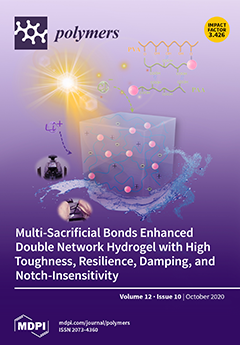
Cover Story: Engineering applications of hydrogels are generally limited by the common problem of their softness and brittleness. In this study, a composite double network ionic hydrogel (CDN-gel) was synthesized via a facile visible-light-trigger polymerization combined with salt impregnation. The excellent mechanical properties were lent to CDN-gel by the introduction of multi-sacrificial bonds. The CDN-gel has high toughness (48 MJ/m3), stretchability (700%), Young's modulus (3.5 MPa), and notch-insensitivity. The residual strain is <25% after stretch-releasing for 1000 cycles at a strain of 200%. The above properties are expected to expand the application of hydrogel in anti-fatigue and damping fields. View this paper.
  • Issues are regarded as officially published after their release is announced to the table of contents alert mailing list .
  • You may sign up for email alerts to receive table of contents of newly released issues.
  • PDF is the official format for papers published in both, html and pdf forms. To view the papers in pdf format, click on the "PDF Full-text" link, and use the free Adobe Reader to open them.

Articles (262)

  • Article
  • Open Access
21 Citations
5,574 Views
16 Pages

Study of High-Density Polyethylene (HDPE) Kinetics Modification Treated by Dielectric Barrier Discharge (DBD) Plasma

  • João Freire de Medeiros Neto,
  • Ivan Alves de Souza,
  • Michelle Cequeira Feitor,
  • Talita Galvão Targino,
  • Gutembergy Ferreira Diniz,
  • Maxwell Santana Libório,
  • Rômulo Ribeiro Magalhães Sousa and
  • Thercio Henrique de Carvalho Costa

21 October 2020

In this work, the plasma was used in the dielectric barrier discharge (DBD) technique for modifying the high-density polyethylene (HDPE) surface. The treatments were performed via argon or oxygen, for 10 min, at a frequency of 820 Hz, voltage of 20 k...

  • Article
  • Open Access
3 Citations
3,891 Views
13 Pages

Poly (Dimethylsiloxane) Coating for Repellency of Polar and Non-Polar Liquids

  • Hila Monder,
  • Leo Bielenki,
  • Hanna Dodiuk,
  • Anna Dotan and
  • Samuel Kenig

21 October 2020

The wettability of poly (dimethylsiloxane) (PDMS) coating on plasma-treated glass was studied at room temperature using polar and non-polar liquids. The wettability was investigated regarding the liquids’ surface tensions (STs), dielectric cons...

  • Article
  • Open Access
11 Citations
3,882 Views
18 Pages

21 October 2020

The covalent functionalization of graphene oxide (GO) surface with hyperbranched benzoxazine (BZ) structures has been achieved using poly(amidoamine) dendrimers (PAMAM) of different generations. By increasing the PAMAM generation, multiple benzoxazin...

  • Review
  • Open Access
128 Citations
11,826 Views
16 Pages

21 October 2020

Agriculture is an important sector of the economy, but this industry consumes significant amounts of water, which is a precious and limited natural resource. Irrigation techniques and efforts to mitigate water usage influence the growth, survival, an...

  • Article
  • Open Access
45 Citations
6,770 Views
17 Pages

21 October 2020

We successfully prepared two different classes of hypercrosslinked porous organic polymers (HPPs)—the tetraphenylethene (TPE) and (4-(5,6-Diphenyl-1H-Benzimidazol-2-yl)-triphenylamine (DPT) HPPs—through the Friedel−Crafts polymeriza...

  • Article
  • Open Access
18 Citations
6,164 Views
16 Pages

Laser-Induced Selective Electroless Plating on PC/ABS Polymer: Minimisation of Thermal Effects for Supreme Processing Speed

  • Karolis Ratautas,
  • Vytautas Vosylius,
  • Aldona Jagminienė,
  • Ina Stankevičienė,
  • Eugenijus Norkus and
  • Gediminas Račiukaitis

21 October 2020

The selective surface activation induced by laser (SSAIL) for electroless copper deposition on Polycarbonate/Acrylonitrile Butadiene Styrene (PC/ABS) blend is one of the promising techniques of electric circuit formation on free-shape dielectric surf...

  • Review
  • Open Access
56 Citations
8,251 Views
32 Pages

Comparative Study of Green and Synthetic Polymers for Enhanced Oil Recovery

  • Nasiru Salahu Muhammed,
  • Md. Bashirul Haq,
  • Dhafer Al-Shehri,
  • Mohammad Mizanur Rahaman,
  • Alireza Keshavarz and
  • S. M. Zakir Hossain

21 October 2020

Several publications by authors in the field of petrochemical engineering have examined the use of chemically enhanced oil recovery (CEOR) technology, with a specific interest in polymer flooding. Most observations thus far in this field have been ba...

  • Article
  • Open Access
72 Citations
7,780 Views
12 Pages

21 October 2020

Polyvinylidene difluoride (PVDF) and its copolymers are promising electroactive polymers showing outstanding ferroelectric, piezoelectric, and pyroelectric properties in comparison with other organic materials. They have shown promise for application...

  • Article
  • Open Access
10 Citations
3,575 Views
20 Pages

Radiation Processing and Characterization of Some Ethylene-propylene-diene Terpolymer/Butyl (Halobutyl) Rubber/Nanosilica Composites

  • Elena Manaila,
  • Anton Airinei,
  • Maria Daniela Stelescu,
  • Maria Sonmez,
  • Laurentia Alexandrescu,
  • Gabriela Craciun,
  • Daniela Pamfil,
  • Nicusor Fifere,
  • Cristian-Dragos Varganici and
  • Florica Doroftei
  • + 1 author

21 October 2020

Composites based on ethylene–propylene–diene terpolymer (EPDM), butyl/halobutyl rubber and nanosilica were prepared by melt mixing and subjected to different doses of electron beam irradiation. The effect of irradiation dose on the mechan...

  • Review
  • Open Access
15 Citations
5,411 Views
21 Pages

21 October 2020

Circular Intensity Differential Scattering (CIDS) provides a differential measurement of the circular right and left polarized light and has been proven to be a gold standard label-free technique to study the molecular conformation of complex biopoly...

of 27

Get Alerted

Add your email address to receive forthcoming issues of this journal.

XFacebookLinkedIn
Polymers - ISSN 2073-4360