Skip Content
You are currently on the new version of our website. Access the old version .

All Articles (30,564)

Polymer nanocomposites have been attracting significant interest over the last three decades. One of the most intriguing applications is related to the preparation of clay-filled nanocomposites based on rubber blend matrices. Although several studies already exist on the subject, there is limited information available regarding their rheological, thermal, and, particularly, damping behaviour of rubber blend systems. In this work, the rheological, viscoelastic, and thermal behaviour of a natural rubber/nitrile rubber (NR/NBR) blend nanocomposite containing organically modified nanoclay was systematically investigated, and the damping characteristics were also assessed. At a lower nanoclay concentration (5 phr), network formation through filler–filler and filler–polymer interactions led to partial immobilization of polymer chains, resulting in a pronounced increase in viscosity and enhanced viscoelastic response. In contrast, at higher nanoclay loading (10 phr), strong agglomeration of filler particles occurred, corresponding to a stacked clay morphology, which hindered effective filler–filler network formation and weakened filler–polymer interactions, leading to lower viscosity and reduced damping efficiency. The blend composition and filler content were found to significantly influence the investigated properties, especially the hysteresis loss and the thermal conductivity, which is explained by matrix–filler interactions and the resulting morphology of the system.

7 February 2026
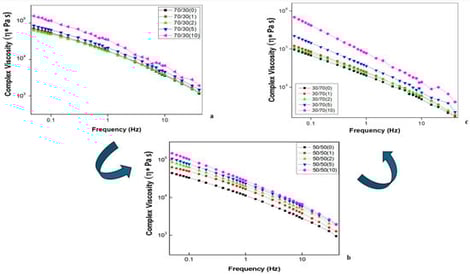
Frequency dependence curves of complex viscosity η* for 70/30 (a), 50/50 (b), and 30/70 (c) NR/NBR blends.

Hydrophobic Fibers with Hydrophilic Domains for Enhanced Fog Water Harvesting

  • Joanna Knapczyk-Korczak,
  • Katarzyna Marszalik and
  • Urszula Stachewicz
  • + 1 author

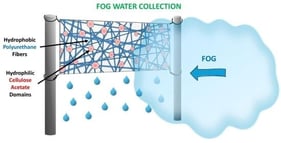
Fog water collectors (FWCs) present a sustainable solution for arid regions where fog is a primary water source. To improve their efficiency, we developed a durable and high-performance mesh composed of electrospun hydrophobic thermoplastic polyurethane (TPU) fibers combined with hydrophilic cellulose acetate (CA) microbeads. This hybrid design represents a novel biomimetic strategy, mimicking natural fog-harvesting mechanisms by optimizing wetting and drainage. Despite the significant reduction in average fiber diameter, the TPU-CA mesh maintained mechanical strength close to 1 MPa, comparable to pristine TPU. The introduction of hydrophilic domains into a hydrophobic fibrous network is a unique architectural approach that enhanced fog collection performance, achieving a high water harvesting rate of 127 ± 12 mg·cm−2·h−1. Remarkably, although the mesh remained predominantly hydrophobic, droplets shed completely from its vertical surface, exhibiting near-zero contact angle hysteresis. This synergistic wetting concept enables performance unattainable with conventional single-wettability meshes. Compared to single-material meshes, the TPU-CA hybrid showed nearly double the water collection efficiency. The innovative interplay between surface chemistry, microscale heterogeneity, and mechanical robustness is key to maximizing water capture and transport, offering a promising path for scalable, efficient FWCs in poor water-stressed regions.

6 February 2026

The concept of the work presents the (a) co-axial electrospinning of TPU and CA to produce (b) an electrospun hydrophobic fiber mesh from TPU with hydrophilic microbeads from CA capable of (c) harvesting water from fog.

Development of Sustainable Red Algae–Sisal Fiber Composite Films via Doctor Blading

  • Matthew Richards,
  • Joshua Baird and
  • Yanika Schneider
  • + 2 authors

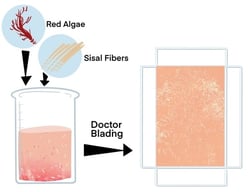
This study investigated the properties of red algae (RA) biocomposite films reinforced with natural sisal fibers and plasticized with glycerol. The polymer was extracted from locally sourced red seaweed and combined sisal fibers at varying fiber loadings (0–45 wt%) using the doctor blading technique. Composite films were analyzed using a variety of methods to evaluate the chemical composition, thermal behavior and mechanical performance. Infrared spectroscopy confirmed the presence of kappa-carrageenan as the dominant polysaccharide in the RA matrix, whereas elemental analysis verified the dilution of sulfur content and enrichment of carbon with increasing fiber incorporation. Thermal stability increased with fiber loading, peaking at 30 wt% sisal fiber before decreasing slightly at 45 wt% due to poor fiber dispersion. Mechanical testing demonstrated an optimal balance between strength and flexibility at 30 wt% sisal fiber, with a 37% increase in strength compared to the pure RA film. Overall, the findings demonstrate that sisal fiber reinforcement enhances the structural integrity and stability of RA-based films, supporting their potential as biodegradable alternatives to petroleum-based plastics.

6 February 2026

RA solution preparation method. Starting from RA raw seaweed (a), followed by grinding (b) and extracting (c) the polymer from RA seaweed in water. The final drying and grinding stages produced a solid polymer powder (d) used in subsequent film fabrication.

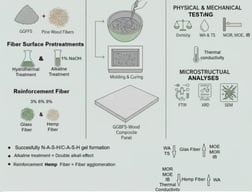
This study aims to optimize the physical, mechanical, and thermal properties of 100% Ground Granulated Blast Furnace Slag (GGBFS) based geopolymer wood-composite panels. Pine fibers were utilized as the primary reinforcement matrix, while glass and hemp fibers were introduced as secondary reinforcements at varying proportions (3%, 6%, 9% by weight). The research investigated the effects of fiber pretreatments (hot water vs. 1% NaOH) and reinforcement hybridization. Results indicate that GGBFS successfully geopolymerized, forming a hybrid N-A-S-H and C-A-S-H gel network. Quantitative analysis revealed that 9% glass fiber reinforcement yielded the highest mechanical performance, achieving a Modulus of Rupture (MOR) of 10.05 N/mm2 and Internal Bond (IB) strength of 1.32 N/mm2, alongside superior water resistance (1.0% Thickness Swelling). Conversely, while hemp fiber inclusion reduced mechanical strength (MOR: 5.77 N/mm2 at 9%), it significantly enhanced thermal insulation, reducing thermal conductivity to 0.10 W/m·K. It was observed that aggressive NaOH pretreatment caused alkali-induced degradation of pine fibers, negatively impacting the composite’s integrity compared to hot water treatment. This study demonstrates the feasibility of tailoring 100% slag-based geopolymer composites for either structural (glass-reinforced) or insulating (hemp-reinforced) applications using industrial by-products.

6 February 2026

SEM micrographs showing the morphology and dimensions of the softwood (pine) fibers.

News & Conferences

Issues

Open for Submission

Editor's Choice

Reprints of Collections

Advances in Biocompatible and Biodegradable Polymers, 4th Edition
Reprint

Advances in Biocompatible and Biodegradable Polymers, 4th Edition

Editors: José Miguel Ferri, Vicent Fombuena Borràs, María Fernanda López Pérez
Advances in Functional Polymers and Composites
Reprint

Advances in Functional Polymers and Composites

Editors: Bing Wang, Chenglong Guan, Lihua Zhan

Get Alerted

Add your email address to receive forthcoming issues of this journal.

XFacebookLinkedIn
Polymers - ISSN 2073-4360