


Abstract
The precipitation of nanoscale HfO2 plays a critical role in the high-temperature creep properties of Fe-Cr-Al electrical heating alloys. However, the atomic-scale initial nucleation and growth mechanisms remain unclear, hindering the precise design of precipitates based on Hf microalloying. In this study, classical molecular dynamics simulations implemented in LAMMPS were employed to investigate the formation and evolution of Hf-O clusters at 1773 K, 1873 K, and 2000 K. The Fe-Cr-Al-Hf-O system was described by hybrid potential functions, whose reliability was verified by lattice-parameter calculations in good agreement with literature values. The simulation results demonstrate that Hf atoms and O atoms attract each other, forming stable Hf-O clusters. At higher temperatures, the diffusion capabilities of Hf and O atoms are enhanced, the number of Hf-O bonds grows, and the size of the largest cluster expands, indicating that elevated temperatures promote cluster growth. The calculated diffusion activation energy of Hf and O atoms indicates that increasing temperature promotes O atom diffusion more significantly. Analysis of the cluster radius of pair gyration and average atomic energy reveals that Hf-O clusters formed at 1873 K exhibit more compact and stable structural characteristics. Radial distribution function analysis further revealed that the atomic arrangement of neighboring atoms in Hf-O clusters closely resembles the relaxed HfO2 crystal structure at the same temperature, indicating that Hf-O clusters serve as critical nucleation cores promoting the precipitation of HfO2 crystals. This study elucidates the dynamic formation mechanism and structural evolution of Hf-O clusters in Fe-Cr-Al alloys at the atomic scale, providing valuable guidance for the optimized design of precise control over HfO2 nanoprecipitates.
1. Introduction
Fe-Cr-Al electric heating alloy is widely used in industrial electric furnaces and various heating elements due to its high resistivity, excellent high-temperature resistance, corrosion resistance, and good mechanical properties at elevated temperatures [1,2,3]. In recent years, with the development of new materials and equipment manufacturing industries, Fe-Cr-Al electric heating alloy has demonstrated new and important application prospects in high-tech fields such as semiconductors, aerospace, and photovoltaics, becoming a key material for modern technological advancement. However, with the increasing demands of modern industry on the power density, operating temperature, and service reliability of electric heating elements, the limitations of traditional Fe-Cr-Al alloys have gradually become apparent: during prolonged high-temperature service, their matrix strength declines, making them prone to grain coarsening, high-temperature oxidation corrosion, and creep [4,5,6]. This can lead to sagging or fracture of the components, thereby compromising the stability and safety of heating systems. Therefore, enhancing the high-temperature creep resistance and microstructural stability of Fe-Cr-Al alloys has become a critical issue to be addressed in this field of material research.
To address the aforementioned challenges, introducing nanoscale second-phase particles for dispersion strengthening has proven to be an effective approach. By adding trace alloying elements to stabilize the microstructure, the stability of the microstructure and processing performance are optimized, thereby enhancing the mechanical properties and oxidation resistance of Fe-Cr-Al alloys under high-temperature environments to meet practical application requirements [7,8,9,10,11]. The Hf element and the Hf-O nanoparticles it forms demonstrate significant application potential. In Fe-Cr-Al alloys containing trace interstitial oxygen, the deliberate addition of Hf serves as a potent “oxygen trap,” preferentially binding with oxygen to form thermodynamically stable Hf-O clusters or HfO2 precipitates [12,13]. Experimental studies indicate that nanoprecipitates preferentially nucleate at crystal defects such as grain boundaries and dislocations. Through strong pinning effects, they effectively hinder grain boundary migration and dislocation slip, thereby significantly refining grains and enhancing the alloy’s high-temperature strength and creep resistance [14,15,16]. Peng [17] found that Hf atoms segregate at grain boundaries in Fe-Cr-Al alloys, impeding grain boundary migration, inhibiting recrystallized grain growth, pinning dislocations and grain boundaries, and promoting the formation of dislocation walls and subgrain boundaries to refine grains. Dou P. et al. [18,19] conducted phase analysis of oxides in Hf-doped Fe-Cr-Al-based ODS steels, revealing the formation of Y-Hf-O oxides in the matrix with significantly smaller sizes compared to most Y-Al-O particles. D. Pilone [20] discovered that Hf addition in Fe-Cr-Al alloys promotes an oxide layer pinning mechanism, forming fine multi-nucleated oxide structures that significantly improve oxide layer adhesion and demonstrate superior protective behavior under cyclic oxidation conditions, reducing oxide spallation. Daradkeh et al. [21] observed Hf segregation at Al2O3 grain boundaries, which reduces inward oxygen diffusion through grain boundary blocking effects and suppresses internal oxidation.
Although existing studies have confirmed the beneficial effects of Hf-O particle precipitation on the high-temperature properties of Fe-Cr-Al electric heating alloy, most research has focused on macroscopic performance characterization and post-heat-treatment microstructural observation. Techniques such as transmission electron microscopy (TEM) and atom probe tomography (APT) can provide nanoscale information on particle morphology, size, and chemical composition [22,23]. However, these experimental methods often struggle to capture the dynamic nucleation process of particles. Consequently, the atomic-scale precipitation mechanism of Hf-O particles in Fe-Cr-Al matrices—including key scientific issues such as the initial interaction between Hf and O atoms, nucleation kinetics of clusters, and early-stage evolution pathways—remains poorly understood. This lack of clarity has led to the optimization of Hf doping processes relying heavily on empirical trial and error, making precise control over precipitate phases difficult to achieve.
Molecular dynamics (MD) simulation serves as a powerful computational tool that enables real-time tracking of the precipitation evolution process of Hf-O particles at atomic scales and picosecond-nanosecond timeframes under varying temperature conditions, providing an intuitive and quantitative research approach for revealing precipitation mechanisms. Compared with experiments, MD simulations can not only significantly reduce research costs and shorten study cycles, but also simulate precipitation behaviors under extreme conditions through parameter adjustments, overcoming the limitations of experimental conditions. In recent years, significant progress has been made in applying molecular dynamics simulations to study nanoparticle precipitation behaviors in alloys. Liu et al. [24] employed MD to simulate the formation of Cr-N clusters in high-nitrogen austenitic stainless steel, revealing the mechanism of Cr-N clusters, which provides guidance for the optimal design of controlling Cr2N precipitation. Borovikov et al. [25] utilized MD to investigate the nucleation and growth processes of twins in nickel-based superalloys, demonstrating a qualitatively different twin nucleation and growth mechanism that can compete with the Kolbe mechanism. Tipeev et al. [26] studied the crystal nucleation and growth kinetics of aluminum through molecular dynamics simulations, bridging the gap between experiments, theory, and simulations in crystal nucleation and growth. Previous first-principles studies have also provided useful insight into the stability, bonding characteristics, and preferred geometries of small atomistic clusters and precursors. For example, Gueorguiev et al. [27] investigated silicon–metal clusters and showed that specific cluster sizes and geometries can exhibit enhanced local stability and characteristic bonding features. These studies provide a useful theoretical context for understanding the early-stage formation of Hf-O clusters in the present work. In light of this, this study aims to employ molecular dynamics simulation methods to systematically investigate the nucleation process of Hf-O clusters in Fe-Cr-Al alloys at temperatures of 1773 K, 1873 K, and 2000 K by constructing a multi-component Fe-Cr-Al-Hf-O atomic model. The findings will provide atomic-level theoretical insights for optimizing the Hf doping process and precisely controlling nano-precipitates in Fe-Cr-Al electrical heating alloy, facilitating the design and development of high-performance, long-life Fe-Cr-Al electrical heating materials.
2. Method
2.1. Interatomic Potential
In this study, all simulations were conducted using the parallel MD code of Large-scale Atomic/Molecular Massively Parallel Simulator (LAMMPS, version 2 August 2023) [28]. All atomic data during the simulation processes were output and visualized through the OVITO (version 3.13.1) software [29]. The key factor in molecular dynamics simulations is the interatomic potential between atoms. This study employs hybrid potential functions to describe the interactions among atoms in the Fe-Cr-Al-Hf-O system. The potential functions for Fe-Cr-Al were determined using the embedded atom method (EAM) interatomic potential [30]. Wang [31] utilized this potential function to investigate the influence of B2-NiAl phase volume fraction on the mechanical properties and deformation mechanisms of dual-phase FeNiAl alloys. The Tersoff potential was employed for interactions between Fe-O and O-O [32]. Jing [33] used this potential function to calculate lattice parameters of FeO, which showed excellent agreement with experimental data. The interactions between Al-Hf and Hf-Hf were described using the second nearest-neighbor modified embedded-atom method (2NN MEAM) potential [34], while the potentials for other atomic pairs (Hf-O, Al-O, Cr-O, Fe-Hf, Cr-Hf) were all modeled with the Lennard–Jones (LJ) potential. Das et al. [35] employed the LJ potential to describe the interatomic interactions in metal oxides Y2O3 and La2O3.
The specific LJ parameters used in the present work are listed in Table 1. For the Fe-Hf and Cr-Hf pairs, the LJ parameters were obtained from elemental parameters using the Lorentz-Berthelot combining rules [36]:
where and denote the LJ diameter and energy parameter.
Table 1.
Parameters of LJ potential in the simulation.
For the Hf-O, Cr-O, and Al-O pairs, LJ parameters were introduced as approximate cross-interaction terms within the present hybrid potential framework.
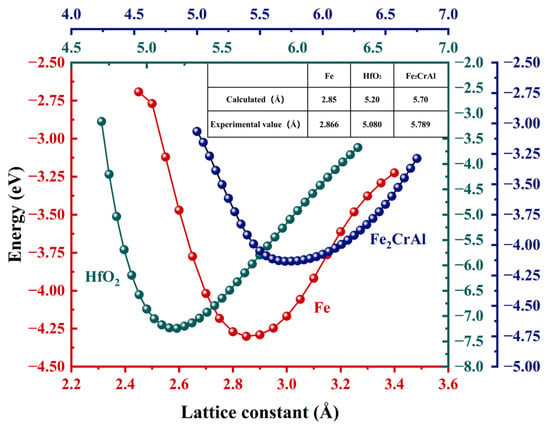
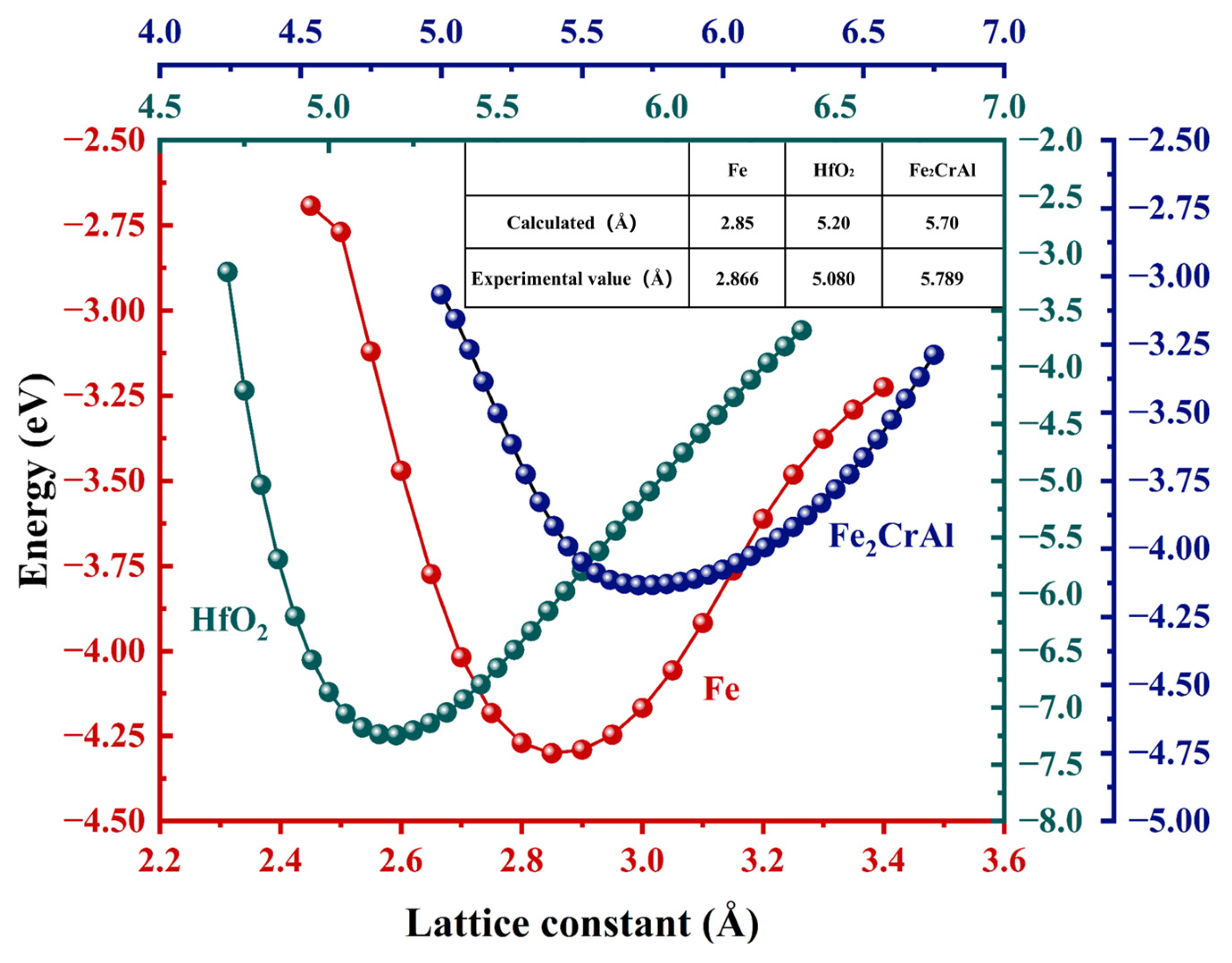
The lattice constants of Fe, Fe2CrAl, and HfO2 crystals were calculated using hybrid potential functions. As shown in Figure 1, the calculated values for Fe, Fe2CrAl, and HfO2 crystals (2.85 Å, 5.70 Å, and 5.20 Å) exhibit good agreement with the experimental values reported in the literature (2.866 Å, 5.7890 Å, and 5.080 Å) [39,40,41]. These comparisons indicate that the dominant Fe-Cr-Al matrix interactions and the key Hf-O-related structural features relevant to the present study are reasonably captured by the adopted hybrid potential. By contrast, the Cr-O and Al-O LJ interactions were included as auxiliary terms to provide a reasonable approximate description of these secondary interactions in the present simulation system.
Figure 1.
Comparison of lattice parameters: Ferrite, Fe2CrAl crystals and HfO2 crystals.
2.2. Simulation Process
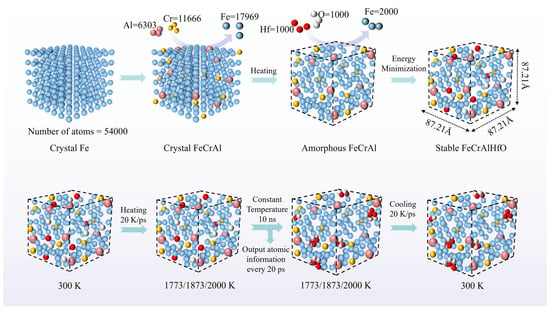
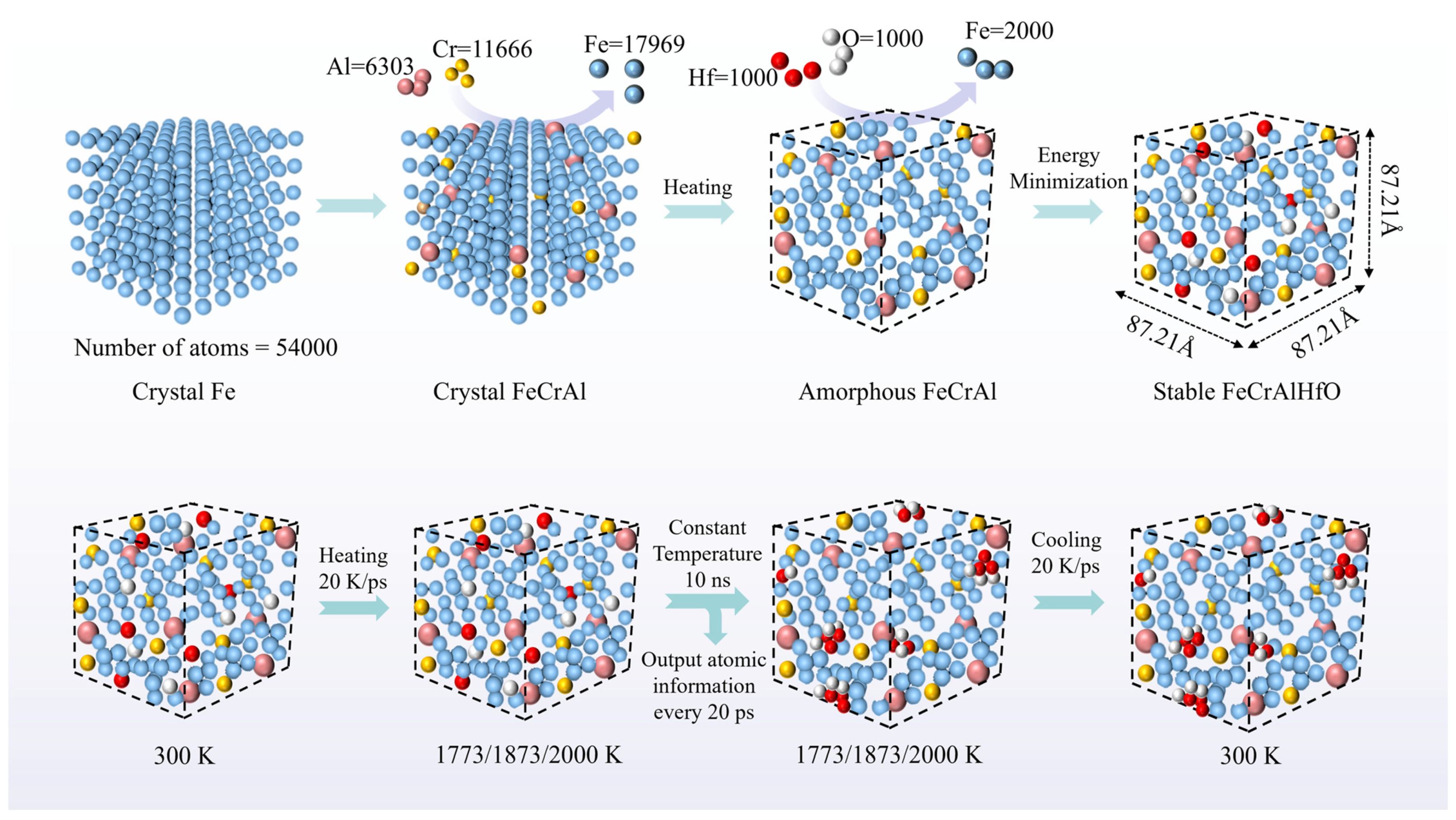
The segregation and precipitation behavior of Hf and O in the Fe-Cr-Al matrix leads to supersaturated concentrations of Hf and O atoms. The ratio of Hf and O atoms was set higher than that in actual Fe-Cr-Al alloys to examine the effects of segregation. In this study, an amorphous Fe-Cr-Al atomic system was established to simulate the disordered state of molten steel. Hf and O atoms are introduced through random atomic substitution. The specific process is illustrated as follows: First, a pure iron system with a body-centered cubic structure and a lattice constant of a = 2.866 Å is established, containing 54,000 Fe atoms. According to the composition of the Fe-Cr-Al electrical heating alloy (grade SGHYZ) from Beijing Shougang Gitane New Materials Company (Beijing, China), 11,666 Cr atoms (approximately 21.6% of the total atoms) and 6303 Al atoms (approximately 11.7% of the total atoms) are introduced via random atomic substitution. The Fe-Cr-Al atomic system is then heated from 300 K to 2000 K at a rate of 100 K ps−1, followed by isothermal relaxation at 2000 K for 5 ns to disrupt the crystalline structure, resulting in an amorphous Fe-Cr-Al atomic system. At this stage, 2000 Fe atoms (approximately 3.8% of the total atoms) were replaced with 1000 Hf atoms and 1000 O atoms (each accounting for about 1.9% of the total atoms). The system temperature was then reduced to 300 K at a cooling rate of 100 K ps−1, followed by energy minimization to obtain a relatively stable Fe-Cr-Al-Hf-O simulation system. The final dimensions of the entire simulation system measured 87.21 Å × 87.21 Å × 87.21 Å.
This simulation investigates the precipitation and evolution process of Hf-O clusters in Fe-Cr-Al alloys at temperatures of 1773 K, 1873 K, and 2000 K. These temperatures were selected to represent high-temperature molten-state conditions relevant to the melting and metallurgical processing of Fe-Cr-Al alloys. Moreover, the comparison among these temperatures helps clarify how temperature affects the growth behavior and structural stability of Hf-O clusters. Integration of the equations of motion was carried out using the velocity Verlet algorithm [42]. A Nose–Hoover thermostat [43] was employed to maintain thermal equilibrium. To minimize the influence of boundary conditions on simulation results, all simulation processes were set with periodic boundary conditions. To reduce the influence of temperature fluctuations on the simulation results, heating and cooling procedures were performed before and after the isothermal stage. First, the pre-constructed Fe-Cr-Al-Hf-O model was heated from 300 K to the target temperature (1773 K, 1873 K, or 2000 K) at a rate of 20 K ps−1 under the NPT ensemble. Then, to eliminate the influence of system size variation on subsequent cluster-size measurements, the simulation box dimensions were fixed and the system was relaxed for 10 ns under the NVT ensemble. During this stage, atomic information was recorded every 20 ps for subsequent structural analysis. Finally, after the isothermal simulation, the system was cooled from the target temperature back to 300 K at 20 K ps−1 under the NPT ensemble. The complete process described above is shown in Figure 2.
Figure 2.
Schematic diagram of the modeling and experimental process.
3. Results and Discussion
3.1. Analysis of Cluster Growth Process
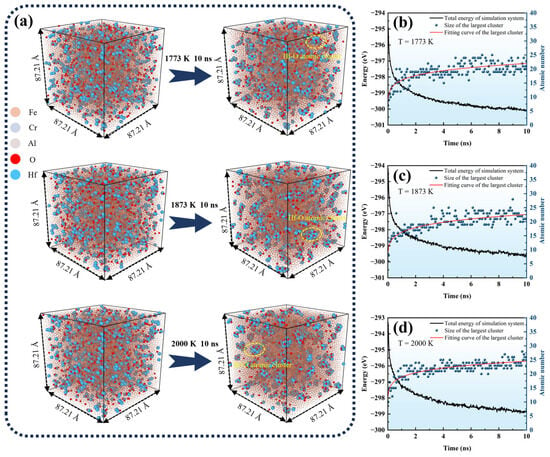
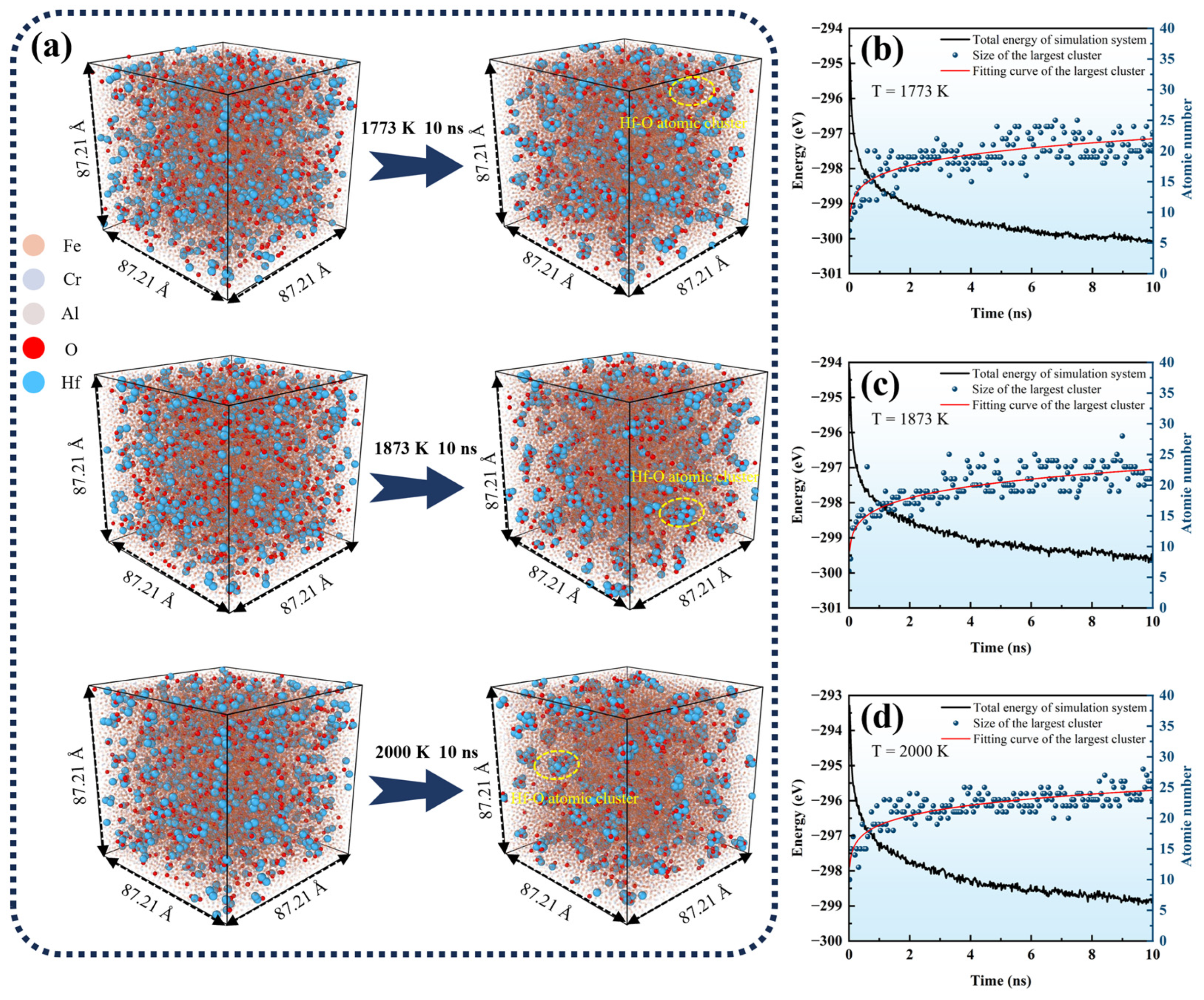
The simulation results were processed using OVITO visualization software to obtain atomic trajectories. The atomic snapshots at the initial and final stages of simulation under target temperatures (1773 K, 1873 K, 2000 K) are shown in Figure 3a. In the initial stage, atoms in the simulated system were uniformly distributed. After a 10 ns constant temperature process, Hf and O atoms exhibited significant aggregation, forming Hf-O bonded clusters. The maximum size of Hf-O clusters in the simulated system was statistically analyzed frame by frame, in Figure 3b–d. The maximum size of Hf-O clusters in the system fluctuated with an overall increasing trend over time, showing clear temperature dependence. At 1773 K, it grew from an initial 7 atoms to stabilize around 21 atoms; at 1873 K, from 6 atoms to 23 atoms; and at 2000 K, from 10 atoms to 25 atoms. During the first 0–2 ns of simulation, the maximum cluster size showed rapid growth from small initial sizes, with the fastest growth rate at 2000 K, followed by 1873 K, and the slowest at 1773 K. At high temperatures, the kinetic energy of atomic thermal motion is high, and the migration rates of Hf and O atoms are fast, making it easier to overcome the nucleation energy barrier and form initial clusters. As a result, the maximum cluster size grows rapidly. In the later growth stage (2–10 ns), the cluster size exhibits a steady growth trend with a smaller slope in the fitted curve. This is because the number of atoms in the simulated system is limited, and the growth of clusters consumes Hf and O atoms in the system, ultimately leading to a reduced growth rate of Hf-O clusters. Throughout the cluster size growth process, the total energy of the system continuously decreases with relaxation time and stabilizes.
Figure 3.
Growth behavior of Hf-O clusters (a) Atomic snapshots of the simulated system at 1773 K, 1873 K, and 2000 K; Maximum cluster and total system energy in simulated systems at various temperatures: (b) 1773 K (c) 1873 K (d) 2000 K.
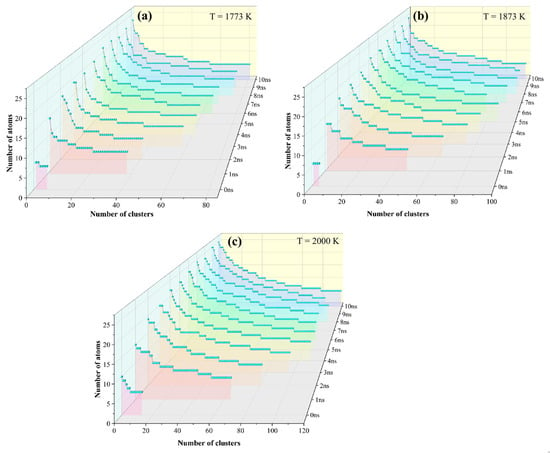
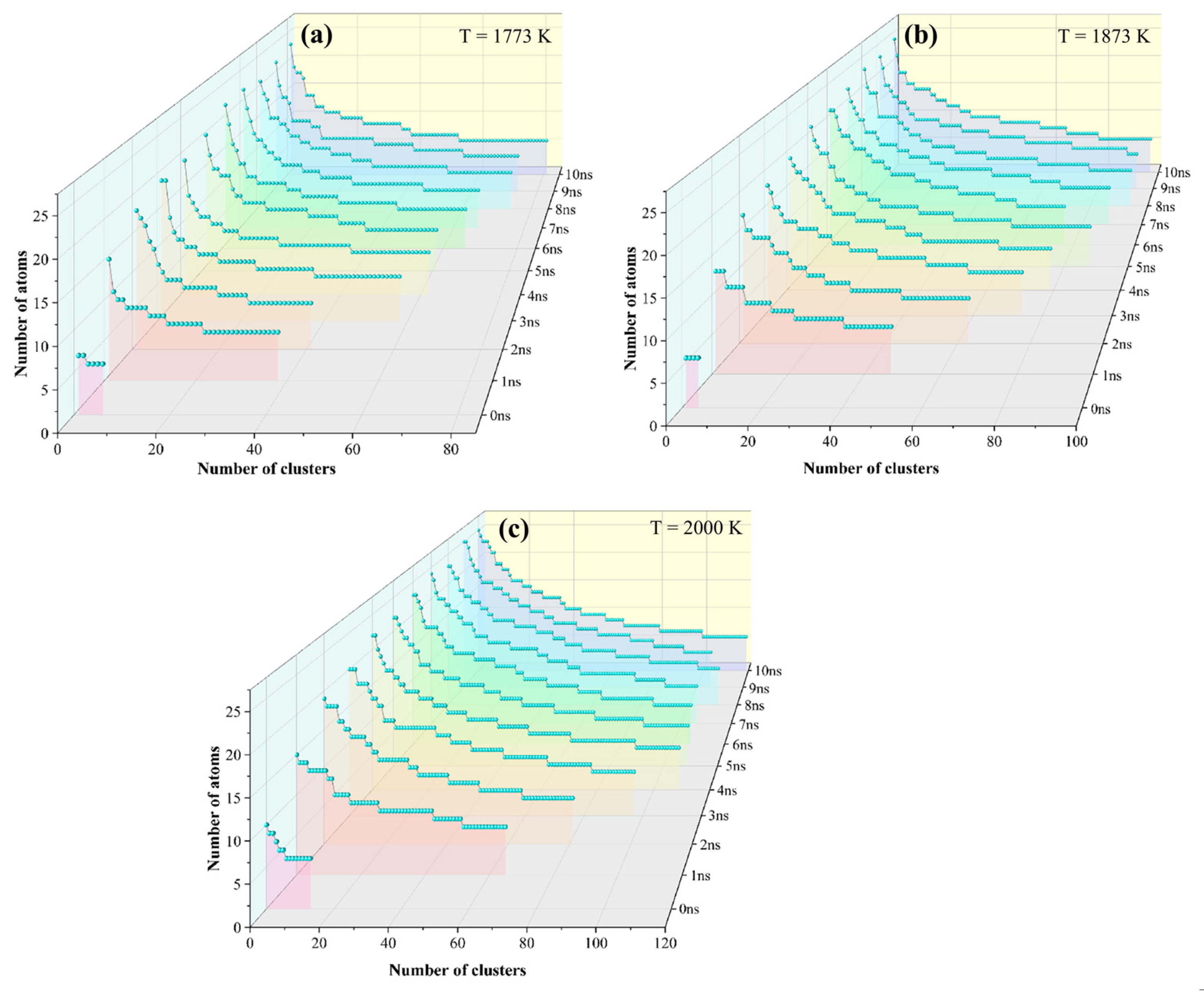
To investigate the cluster formation behavior in the entire system, we quantified the number of Hf-O clusters containing more than six atoms at each nanosecond interval from 0 ns to 10 ns under three different temperatures. As illustrated in Figure 4a–c, with increasing temperature, the size distribution range of clusters at each nanosecond progressively broadens. At 1773 K during 0–10 ns, the initial stage (0–2 ns) exhibits fewer clusters, but the quantity continuously increases with prolonged relaxation time, ultimately reaching approximately 80 clusters. Under 1873 K, the cluster growth rate exceeds that at 1773 K, resulting in a higher final cluster count (around 100). At 2000 K, the number of clusters remained consistently high throughout the relaxation process, reaching the maximum count of approximately 120 clusters, demonstrating the strong driving effect of high temperature on cluster growth. Moreover, the simulation system contained a significant quantity of smaller-sized clusters during the entire 2–10 ns period, with Hf-O clusters consisting of 6–10 atoms being predominant. Although the size of the largest Hf-O cluster tended to stabilize, Hf and O atoms continued to combine within the system as simulation time progressed, forming small-sized clusters.
Figure 4.
Statistics of the number of Hf-O clusters containing more than 6 atoms in the simulation system at each nanosecond moment for various temperatures (a) 1773 K (b) 1873 K (c) 2000 K. The colored planes are used only to distinguish the time slices from 0 to 10 ns.
3.2. Analysis of Coordination Number Changes and Bonding Patterns
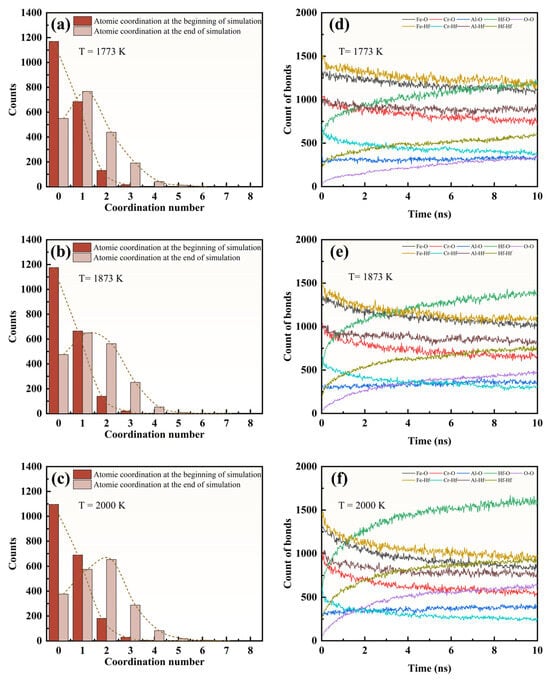
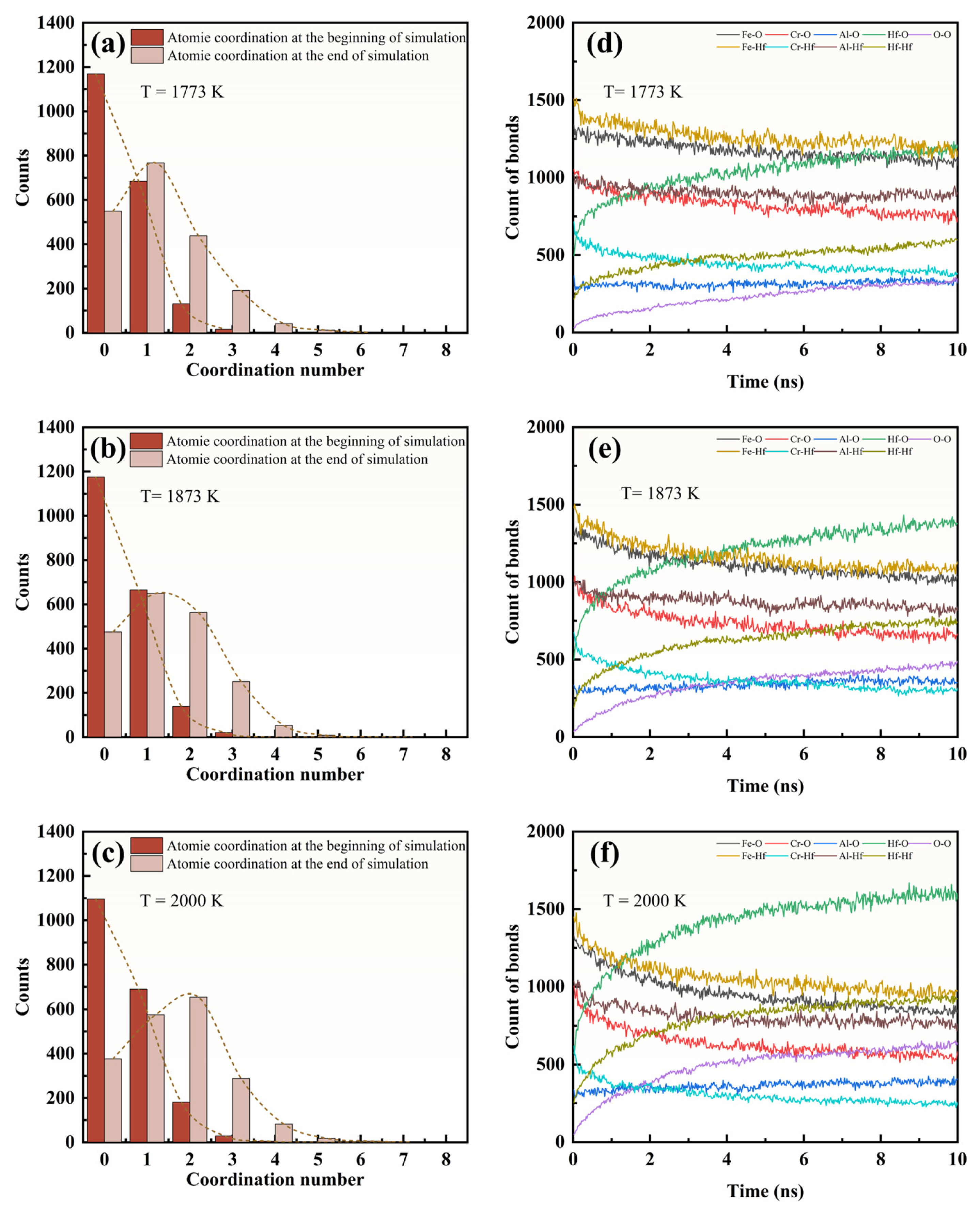
The agglomeration phenomenon of Hf atoms and O atoms in the simulated system was further characterized by calculating the coordination numbers of Hf and O atoms in the entire system before and after simulation. The results are shown in Figure 5a–c. At the initial simulation stage under temperatures of 1773 K, 1873 K, and 2000 K, the coordination numbers of Hf and O atoms in the entire system all exhibited a prominent peak at 0 coordination. The atomic density was already very low when the coordination number exceeded 2, indicating that most Hf and O atoms in the system existed in a “free state,” isolated and randomly distributed without forming stable bonds. When the simulation time reaches 10 ns, the coordination number distribution underwent significant changes. The peaks at 1773 K and 1873 K shifted to 1 coordination, while the peak at 2000 K shifted to 2 coordination. Under all three temperatures, the system showed a substantial decrease in 0 coordination and a notable increase in 2, 3, and 4 coordination. This suggests that stable cluster nuclei had formed and begun to grow. The shift in the coordination number peaks within the simulation system indicates that the atomic arrangement became more ordered, further confirming the formation of Hf-O clusters in the Fe-Cr-Al matrix.
Figure 5.
Coordination number of atoms at different temperatures: (a) 1773 K (b) 1873 K (c) 2000 K, where the dashed lines indicate the coordination-number distribution trend; count of bonds at different temperatures: (d) 1773 K (e) 1873 K (f) 2000 K.
The formation of atomic clusters is closely related to the formation and breaking of atomic bonds. Statistical analysis of various atomic bonds in the simulated system reveals that, as shown in Figure 5d–f, at temperatures of 1773 K, 1873 K, and 2000 K, the quantities of Hf-O, Hf-Hf, and O-O atomic bonds in the simulated system all exhibit a significant increase, with the number of Hf-O bonds showing the most pronounced rise. Meanwhile, the quantities of Fe-O, Cr-O, Fe-Hf, Cr-Hf, and Al-Hf atomic bonds all demonstrate a notable decrease, while the number of Al-O bonds does not show any significant change. Furthermore, as the temperature increases, the increase in the number of Hf-O bonds becomes more pronounced. Similar to the variation in cluster size, the trend in the number of atomic bonds also shows an initial sharp increase followed by gradual stabilization. In the early stages of the simulation, bond breakage in the system was pronounced, with a higher abundance of free Hf and O atoms, leading to greater aggregation probability. As bonding between atoms increased, Hf and O atoms were captured by Hf-O clusters and incorporated into them, resulting in a more gradual increase in the final number of atomic bonds.
As shown in Table 2, higher temperatures lead to more intense formation of Hf-O bonds and breakage of other bonds. This occurs because the system contains significantly higher proportions of Fe, Cr, and Al atoms compared to Hf and O atoms. In the initial simulation state, the proportions of Fe-O, Cr-O, Fe-Hf, Cr-Hf, and Al-Hf bonds are much greater than that of Hf-O bonds. When temperature increases, atoms gain sufficient energy to overcome bonding energies. The breakage rates of Fe-O, Cr-O, Fe-Hf, Cr-Hf, and Al-Hf bonds far exceed their reformation rates, resulting in more intense bond breakage. This process provides atomic sources for the substantial formation of Hf-O bonds, thereby facilitating Hf-O bond formation. This suggests that, although the rupture of initial local bonds requires energy and is necessary for atomic migration, the subsequent formation of Hf-O clusters is energetically more favorable than the persistence of the original local bonding environments. The variation in the number of interatomic bonds indicates that the interaction between Hf-O is stronger than that between Fe-O, Cr-O, Fe-Hf, Cr-Hf, and Al-Hf. Hf atoms and O atoms will break free from bonds with other atoms and diffuse. As an oxygen-affinitive element, Hf readily collides and combines with free atoms at temperatures between 1773 K and 2000 K to form Hf-O atomic pairs. The aggregation of Hf atoms drives the movement of O atoms, ultimately leading to the formation of Hf-O clusters.
Table 2.
Variation in the number of atomic bonds between the start and end of simulation at each temperature (Positive values indicate an increase, while negative values indicate a decrease).
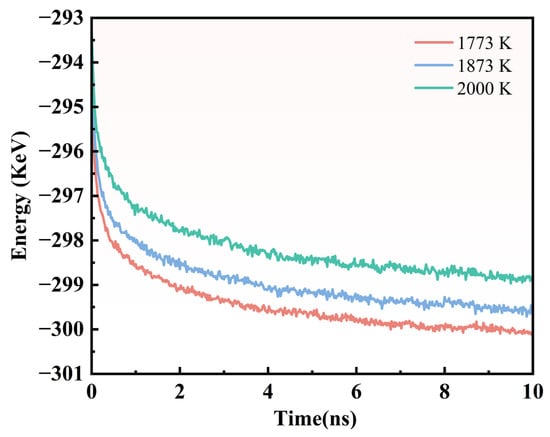
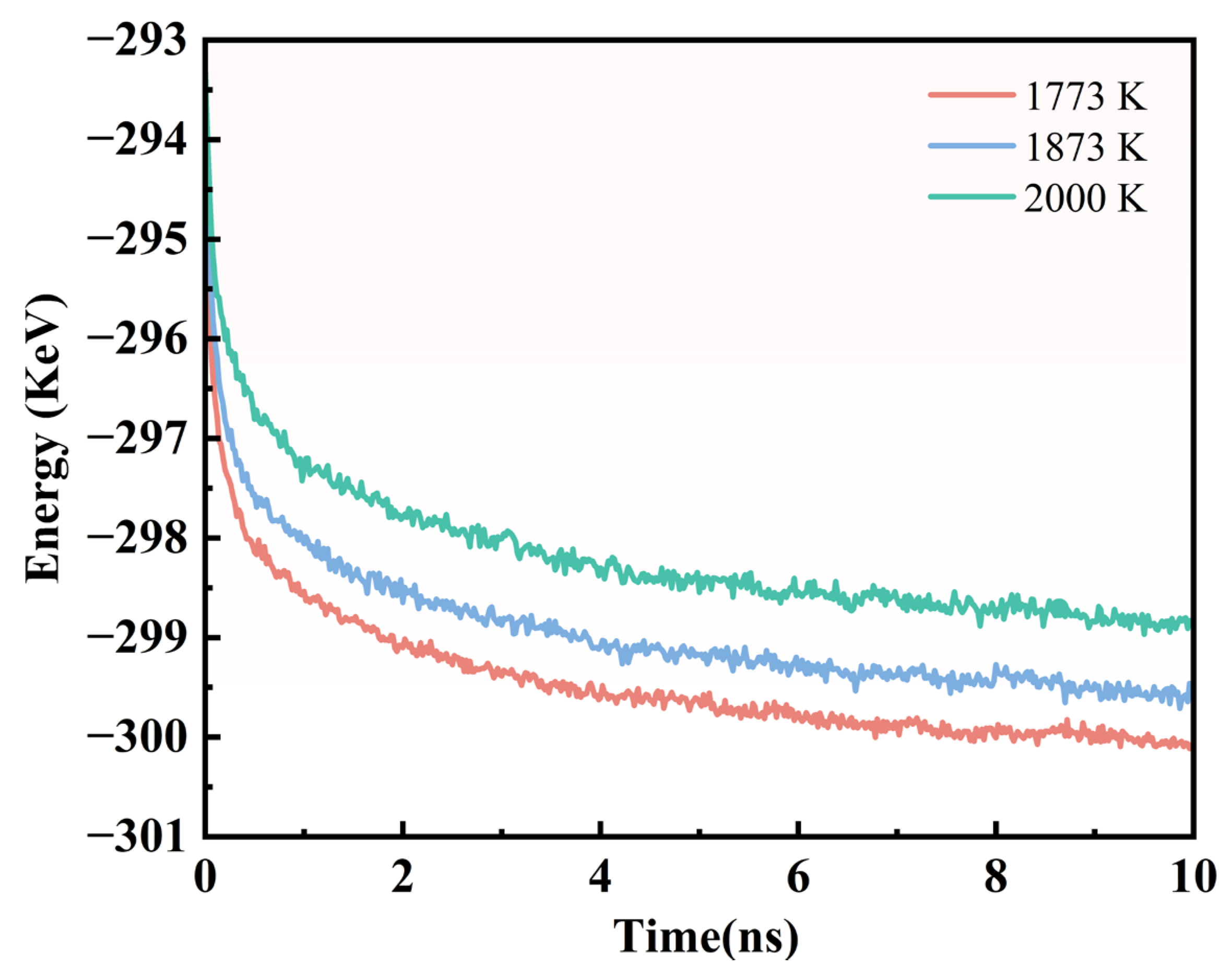
The curves depicting the relationship between the total energy of the simulated system and simulation time at 1773 K, 1873 K, and 2000 K are shown in Figure 6. The calculation results reveal that the total energy in the simulated system continuously decreases with increasing simulation time, exhibiting a trend consistent with the variation in the number of atomic bonds. It shows a rapid decline during the initial 2 ns, followed by a gradual decrease over the subsequent 8 ns of simulation time. As shown in Table 3, the increase in temperature leads to greater energy variations, confirming that bond breaking and recombination become more intense in the simulated system at elevated temperatures. Combined with the evolution of bond numbers and the continuous decrease in the total energy of the system, these results suggest that the formation of Hf-O, Hf-Hf, and O-O bonds is energetically favorable during relaxation, whereas the progressive reduction in Fe-O, Cr-O, Fe-Hf, Cr-Hf, and Al-Hf bonds indicates that these initial local bonding environments are gradually replaced during cluster formation. Among them, the marked increase in Hf-O bonds confirms that Hf-O interaction plays the dominant role in driving the nucleation and growth of the clusters. Therefore, the formation of Hf-O clusters in the Fe-Cr-Al matrix reflects the tendency of the system toward a more stable state.
Figure 6.
Simulation of system energy changes at temperatures of 1773 K, 1873 K, and 2000 K.
Table 3.
Energy variation in the simulated system at temperatures of 1773 K, 1873 K, and 2000 K.
3.3. Calculation of Hf and O Atomic Diffusion Capabilities
The formation of Hf-O clusters is essentially a process where Hf and O atoms collide and combine through diffusion in space. Atomic motion is the prerequisite for collisions to occur. Therefore, by analyzing the atomic diffusion behavior in the simulated system, we can explain the variation trends in cluster formation. In three-dimensional space, the diffusion coefficient () can be calculated from the mean square displacement () of particles using the following Einstein relation [44].
where is the number of spatial dimensions (in this study = 3), and represent the atomic position at time and the initial position, respectively.
where is the number of diffusing atoms in the system, is the mean square displacement. For sufficiently long simulation times, the diffusion coefficient can be approximated as one-sixth of the slope of the curve relating the of diffusing atoms to time [45].
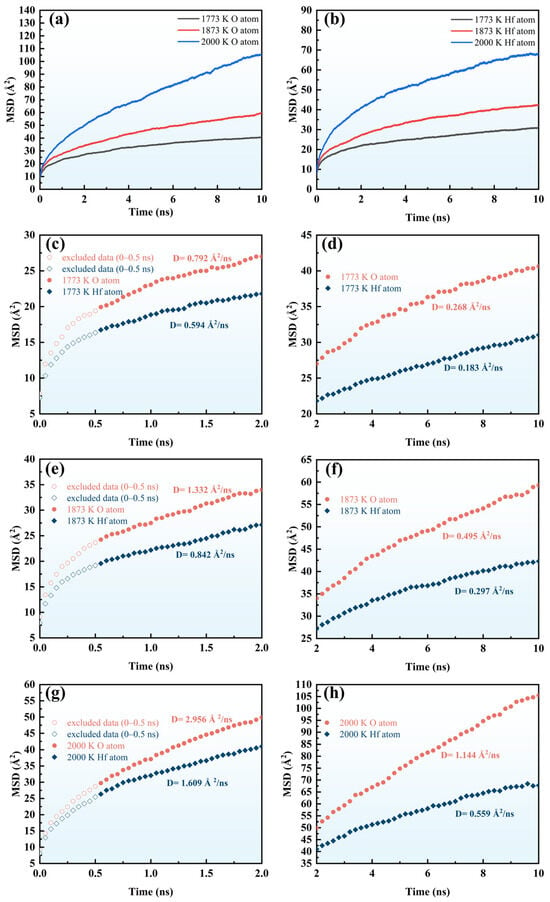
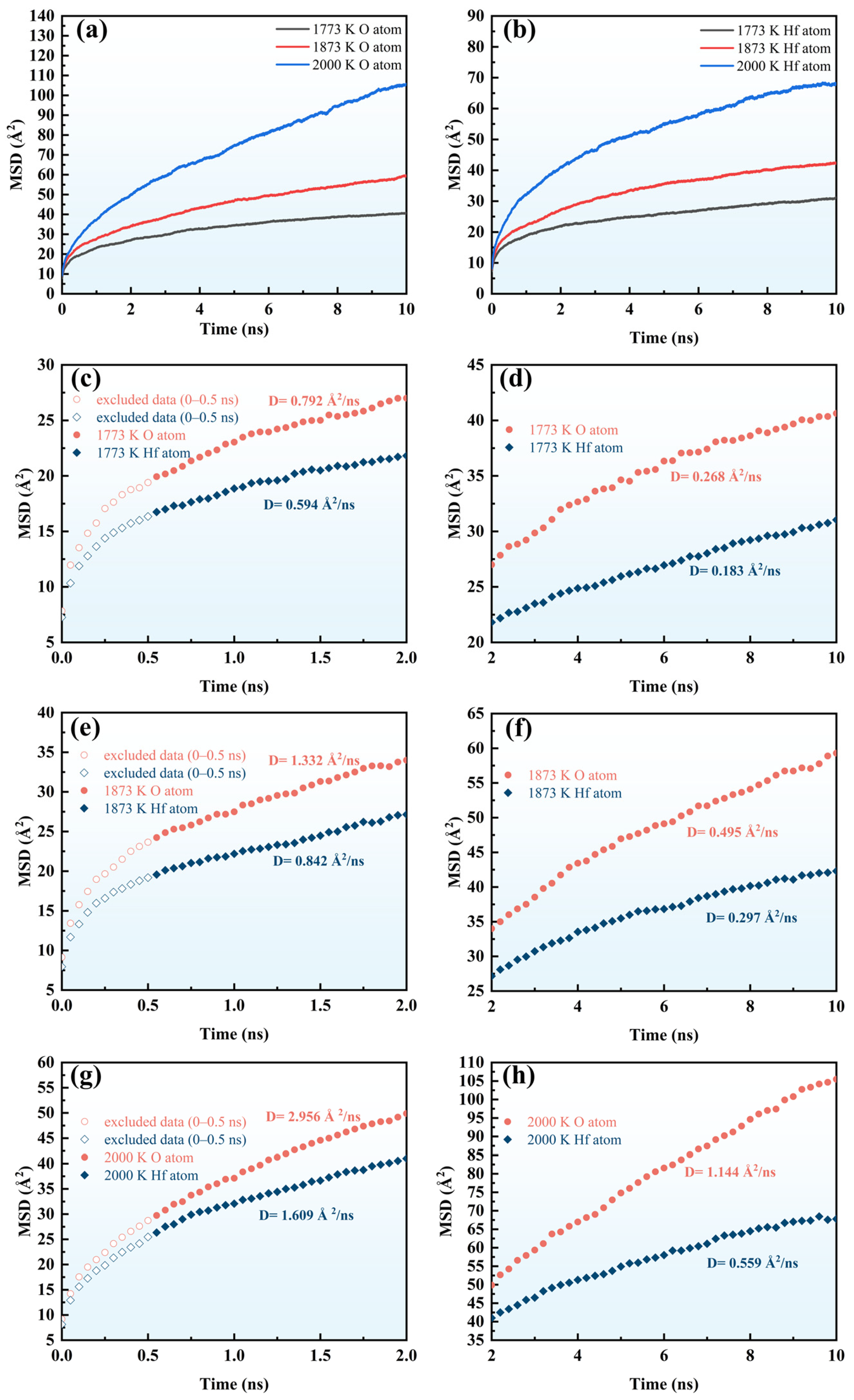
The of Hf and O atoms in the time range of 0–10 ns was calculated using LAMMPS simulation software at temperatures of 1773 K, 1873 K, and 2000 K, respectively, for further determination of the diffusion coefficients of Hf and O atoms at molten steel. In the present work, the and diffusion-coefficient analysis was mainly used to describe the overall migration behavior of Hf and O atoms during Hf-O cluster formation, rather than to provide an independent measurement of atomic diffusion unaffected by clustering. As shown in Figure 7a,b, the of Hf and O atoms exhibits a significant increasing trend with rising temperature, indicating that high temperatures provide Hf and O atoms with higher kinetic energy, resulting in more vigorous movement of Hf and O atoms. Throughout the entire simulation process, at 1773 K, the of O atoms in the system increased from 7.8 Å2 to 40.6 Å2, while the of Hf atoms increased from 7.3 Å2 to 31.0 Å2. At 1873 K, the of O atoms rose from 9.1 Å2 to 59.3 Å2, and the of Hf atoms increased from 7.9 Å2 to 42.3 Å2. At 2000 K, the of O atoms in the system grew from 9.2 Å2 to 105.5 Å2, and the of Hf atoms increased from 8.1 Å2 to 67.8 Å2. At the same temperature, the mean square displacement of O atoms is consistently higher than that of Hf atoms. This phenomenon indicates that O atoms, as interstitial atoms in the simulated system, exhibit more vigorous motion than Hf atoms, and possess stronger diffusion capability than Hf atoms. It demonstrates that the formation of Hf-O clusters in Fe-Cr-Al alloys is predominantly governed by the diffusion of O atoms.
Figure 7.
Mean square displacement during the 10 ns simulation at 1773 K, 1873 K, and 2000 K: (a) O atoms and (b) Hf atoms. Diffusion coefficients and mean square displacement of Hf and O atoms in the 0–2 ns stage: (c) 1773 K, (e) 1873 K, and (g) 2000 K; diffusion coefficients and mean square displacement of Hf and O atoms in the 2–10 ns stage: (d) 1773 K, (f) 1873 K, and (h) 2000 K. In panels (c,e,g), the hollow symbols indicate the data points in the 0–0.5 ns interval excluded from fitting, whereas the solid symbols indicate the data points used for fitting.
The increasing trend of the of Hf and O atoms is consistent with the previously observed variations in Hf-O cluster size and the number of Hf-O bonds over simulation time. During the 0–2 ns period, the of Hf and O atoms at all three temperatures exhibits nonlinear growth with time, indicating rapid atomic diffusion. In this phase, atomic collision probability is high, bond formation and rupture occur rapidly, and clusters demonstrate high growth rates. Between 2 and 10 ns, the limited number of Hf and O atoms in the simulated system leads to strengthened interatomic bonding forces when clusters reach certain sizes. Consequently, the diffusion capacity of Hf and O atoms decreases, their diffusion coefficients reduce, and collision reactions slow down, ultimately restricting the growth trend of Hf-O clusters throughout the simulation process. As shown in Figure 7c–h, Hf and O atoms exhibit unstable diffusion during the 0–0.5 ns stage. Therefore, when calculating the diffusion coefficients for O atoms and Hf atoms, data from the 0.5–2 ns and 2–10 ns periods were selected. At 1773 K, the diffusion coefficient of O atoms was 0.792 Å2 ns−1 in the 0.5–2 ns stage, while that of Hf atoms was 0.594 Å2 ns−1, resulting in a difference of 0.198 Å2 ns−1 between them. In the 2–10 ns stage, the diffusion coefficients of O and Hf atoms were 0.268 Å2 ns−1 and 0.183 Å2 ns−1, respectively, with a difference of 0.085 Å2 ns−1. At 1873 K, the difference in diffusion coefficients between Hf and O atoms was 0.490 Å2 ns−1 in the 0.5–2 ns stage and 0.198 Å2 ns−1 in the 2–10 ns stage. At 2000 K, the differences were 1.347 Å2 ns−1 and 0.585 Å2 ns−1 for the 0.5–2 ns and 2–10 ns stages, respectively. Under all three temperatures, the difference in diffusion coefficients between Hf and O atoms was significantly reduced in the 2–10 ns stage compared to the 0.5–2 ns stage. This indicates that during the 2–10 ns period, most free Hf and O atoms combined to form clusters, leading to similar diffusion capabilities for both types of atoms. However, as the temperature increases, the difference in diffusion coefficients between Hf atoms and O atoms increases within the 2–10 ns time range.
To further investigate the mechanism of this phenomenon, the diffusion energy barrier can be calculated from the temperature dependence of the diffusion coefficient according to the Arrhenius equation [46]:
where is the pre-exponential factor, is the Boltzmann constant (approximately 8.617 × 10⁻⁵ eV K−1), is the temperature, Equation (6) can be equivalently expressed in the form of an Arrhenius plot as follows:
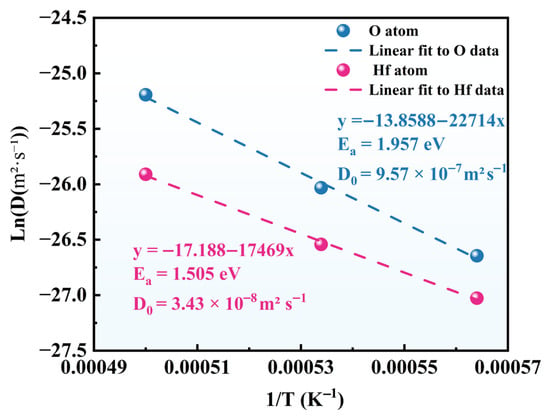
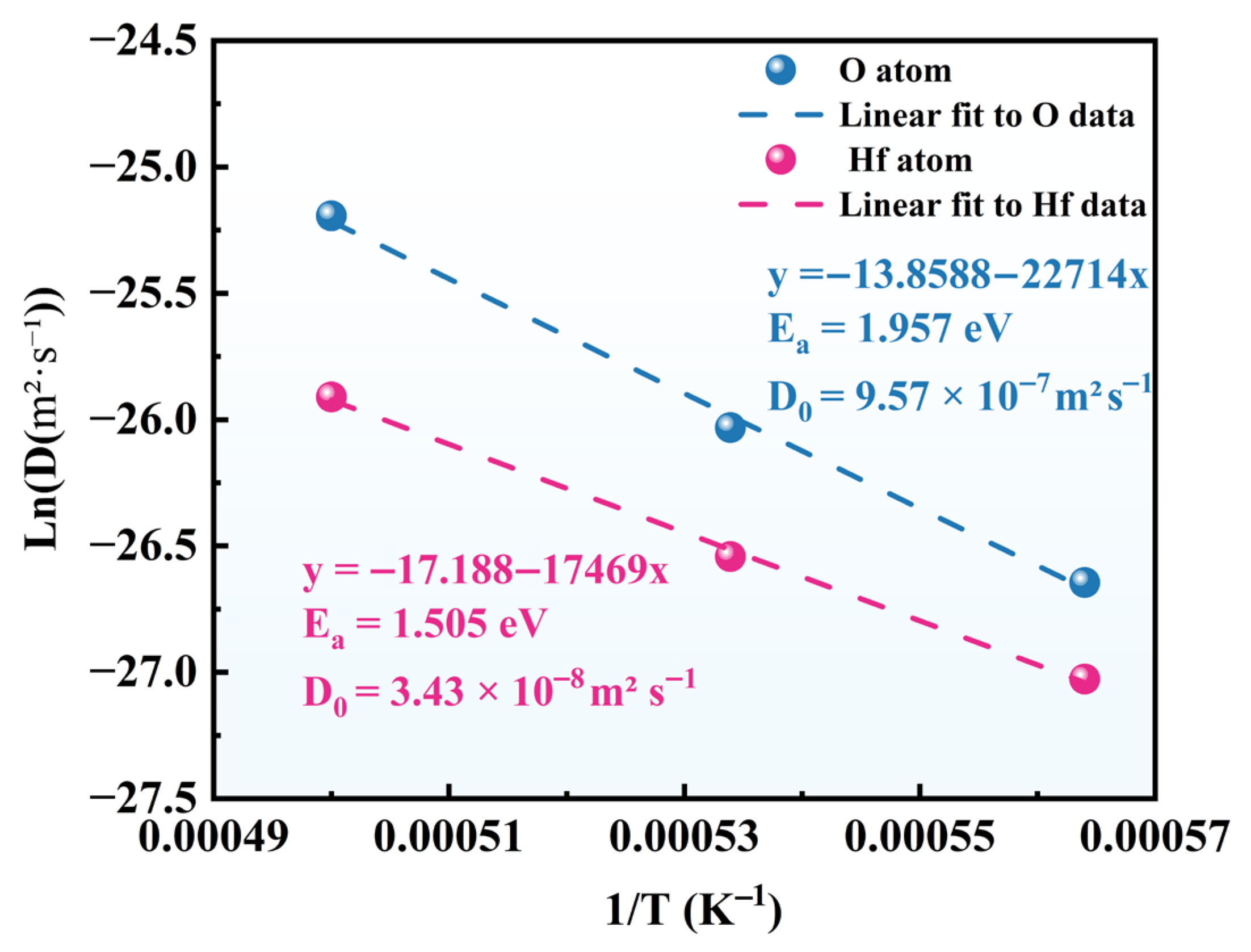
Use as the abscissa and as the ordinate. and represent the intercept and slope of the straight line, respectively. Based on these, the activation energy for diffusion and the pre-exponential factor can be calculated. During the first 2 ns of the simulation, Hf and O atoms rapidly combine, during which the mean square displacement exhibits a nonlinear increase, indicating unstable diffusion. In the 2–10 ns stage, clusters are essentially formed, and Hf and O atoms enter a steady-state diffusion phase, with the mean square displacement showing a linear and stable increase, reflecting the actual diffusion mechanism. Therefore, the diffusion coefficients of Hf and O atoms in the 2–10 ns stage at temperatures of 1773 K, 1873 K, and 2000 K were substituted into Equation (7) to obtain the Arrhenius plot, as shown in Figure 8. The diffusion energy barrier and pre-exponential factor for O atoms are 1.957 eV and 9.57 × 10⁻⁷ m2 s−1, respectively, while those for Hf atoms are 1.505 eV and 3.43 × 10⁻⁸ m2 s−1. The diffusion activation energy of O atoms (1.957 eV) is higher than that of Hf atoms (1.505 eV), indicating that O atoms require overcoming a higher energy barrier for diffusion in Fe-Cr-Al alloys compared to Hf atoms. This is because O atoms exhibit strong interactions with Fe, Cr, Al, and Hf atoms, and their diffusion necessitates breaking stronger bonds for migration. As interstitial atoms, oxygen atoms diffuse interstitially with a pre-exponential factor (9.57 × 10⁻⁷ m2 s−1) that is greater than that of hafnium atoms (3.43 × 10⁻⁸ m2 s−1). Due to their higher vibrational frequency and longer jump distance, oxygen atoms diffuse faster than hafnium atoms in the temperature range of 1773–2000 K.
Figure 8.
Arrhenius plot of Hf and O atoms.
According to the Arrhenius equation, temperature rise has a more significant impact on the diffusion of O atoms. Combined with the formation of Hf-O clusters and the bonding conditions in the simulated system, elevated temperature provides O atoms with higher kinetic energy, leading to severe breakage of Fe-O and Cr-O bonds. This results in continued diffusion of O atoms toward Hf atoms during the 2–10 ns simulation stage, forming small-sized Hf-O clusters and causing a substantial difference in diffusion coefficients between Hf and O atoms. Moreover, the high diffusion capability of Hf and O atoms at elevated temperatures provides the kinetic basis for their bond recombination, cluster growth, and structural ordering. This enables Hf and O atoms to overcome nucleation energy barriers more rapidly, thereby enhancing the degree of nucleation, growth, and coarsening.
3.4. Structure Analysis of Hf-O Clusters
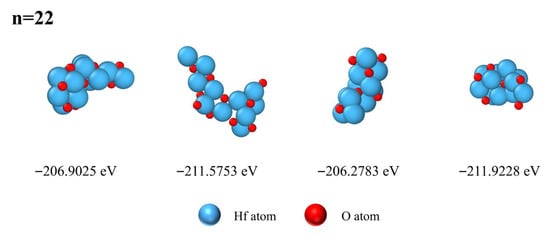
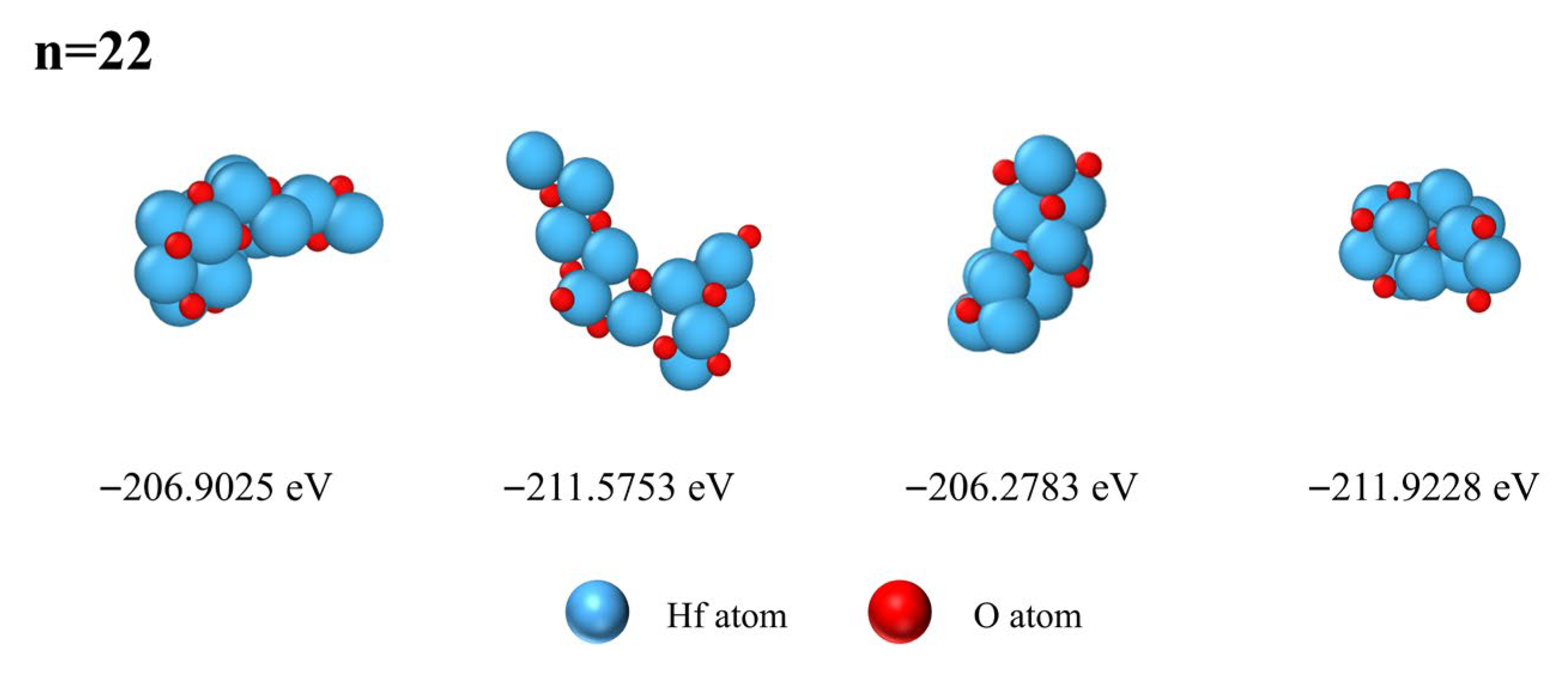
According to previous studies, the growth of cluster size exhibits a fluctuating upward trend. Consequently, a significant number of clusters with identical atomic counts are sampled during the process, yet these clusters display variations in energy. Figure 9 shows the atomic cluster with 22 atoms at a temperature of 1873 K. Although these clusters share the same number of atoms, their overall energies and shapes differ. Therefore, when analyzing the properties of Hf-O clusters, we only discuss the most thermodynamically stable configurations with the lowest energy.
Figure 9.
Structures and energies of different Hf-O clusters with atomic number = 22.
During the growth and nucleation process, free atoms often undergo structural transformations of clusters, which require a certain cluster size as support. To determine the structural transition size of Hf-O clusters, this study first calculated the radius of gyration () of Hf-O clusters using OVITO analysis software. only reflects the compactness of clusters without involving their morphology or atomic count. Here, a parameter considering the influence of atomic count is introduced. The relationship between and can be expressed as follows [47]:
where represents the total mass of the cluster. denotes the position of the cluster’s center of mass. and are the mass and position of each atom in the cluster, respectively. is the number of atoms.
In addition to eliminating the influence of cluster atomic numbers, we also need to exclude the effect of morphology. Therefore, a widely used formula is introduced to calculate sphericity [48]:
where is the sphericity, is the surface area of a perfect ball with the same volume as the cluster, and is the actual surface area of the cluster.
By calculating the above parameters, for radius of pair gyration () can be further corrected, and its derivation is as follows [49]:
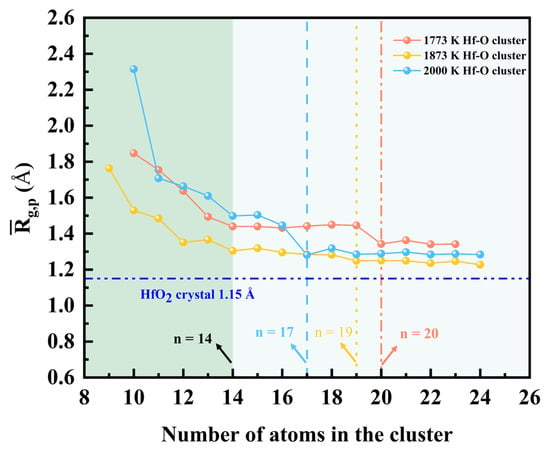
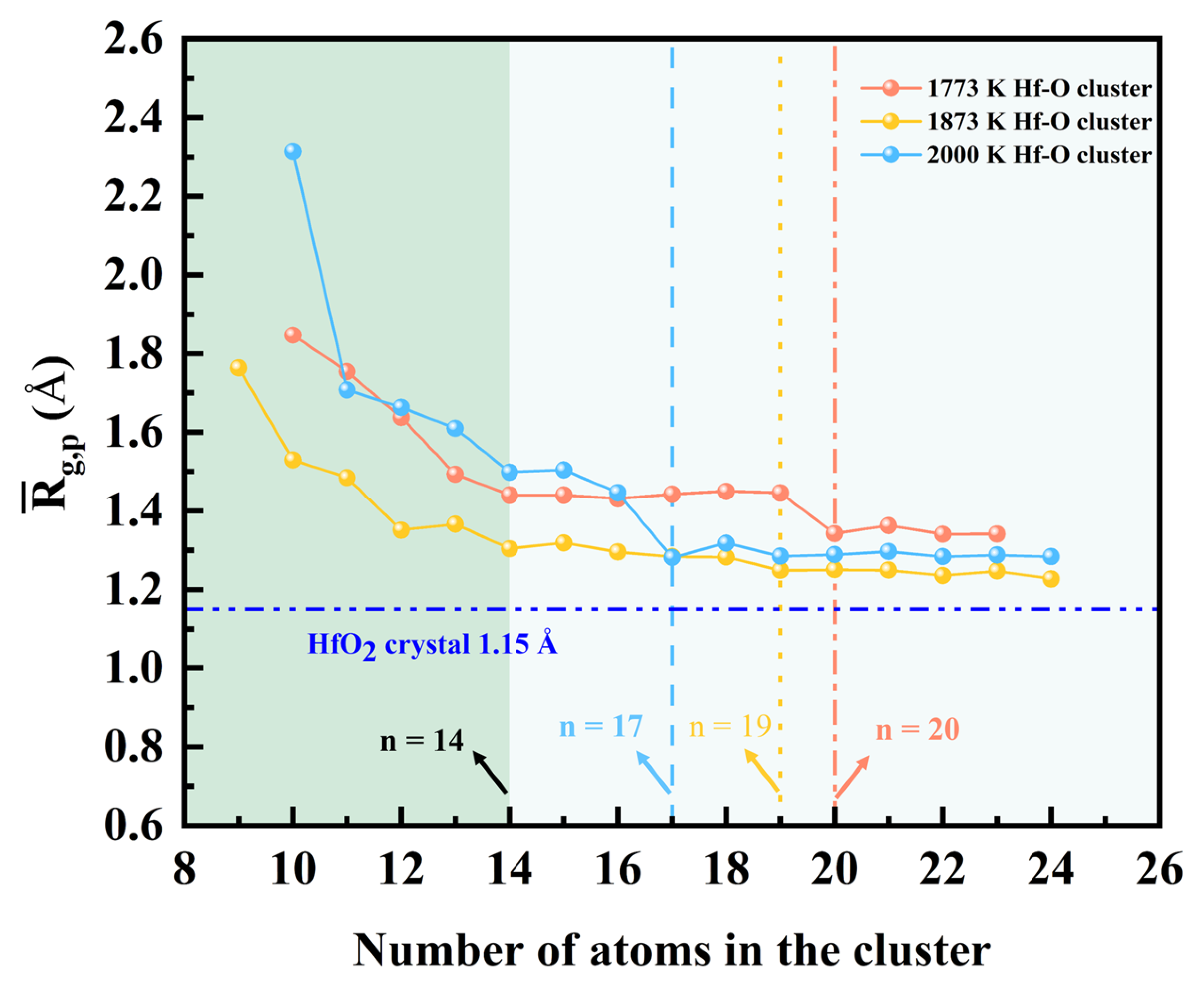
The magnitude of the values for clusters of different sizes can describe the compactness of clusters at that size. A smaller value indicates that the cluster becomes more compact, while a larger value suggests the cluster becomes looser. As shown in Figure 10, when the atomic number in the cluster is less than 14, the value gradually decreases with increasing atomic number, indicating that Hf and O atoms aggregate more closely, and Hf-O clusters begin to form. At temperatures of 1773 K, 1873 K, and 2000 K, the Hf-O clusters all undergo their first structural adjustment when the atomic number n reaches 14. The value rapidly decreases and then enters a stable phase, with the atomic cluster suddenly transforming into a more stable structure. At 1773 K, when the atomic number of Hf-O clusters ranges from 14 to 19, the value exhibits minor fluctuations but maintains a relatively stable average of approximately 1.441 Å. However, when the atomic number of Hf-O clusters reaches 20, the value shows another significant decrease, subsequently stabilizing around 1.347 Å. This indicates that the Hf-O clusters undergo a second structural adjustment. At 1873 K, after the first structural adjustment, when the atomic number of Hf-O clusters ranged from 14 to 18, the value stabilized around 1.297 Å. When the atomic number reached 19, the Hf-O clusters underwent a second structural adjustment, causing the value to slightly decrease and then stabilize around 1.243 Å. At 2000 K, following the first structural adjustment, when the atomic number of Hf-O clusters was between 14 and 16, the value stabilized around 1.483 Å. When the atomic number reached 17, the Hf-O clusters underwent a second structural adjustment, resulting in a significant decrease in the value, which then stabilized around 1.290 Å.
Figure 10.
The relationship between and the atom number of clusters.
At temperatures of 1773 K, 1873 K, and 2000 K, the Hf-O clusters all underwent their first structural adjustment when the atomic number n reached 14, followed by a second structural adjustment at = 20, 19, and 17, respectively. The higher the temperature, the smaller the cluster size at which the second structural adjustment of the Hf-O clusters occurred. This is because higher temperatures enhance the diffusion capabilities of Hf and O atoms, making it easier for Hf-O clusters to reorganize and adjust their structures. Conversely, lower temperatures reduce atomic mobility, requiring larger cluster sizes and longer durations for structural adjustments. It was found that after two structural adjustments, the value of Hf-O clusters reached its minimum of approximately 1.243 Å at 1873 K. This is because at 1773 K, the low migration rates of Hf and O atoms slowed down the kinetic processes, resulting in poorly structured Hf-O clusters. At 2000 K, enhanced thermal disturbances reduced the structural stability of Hf-O clusters. However, around 1873 K, Hf and O atoms possess sufficient migration capability while the temperature remains moderate, allowing the Hf-O clusters to fully relax into a highly compact structure. These results indicate that the thermal stability of Hf-O clusters is strongly temperature dependent, and that 1873 K provides a more favorable balance between cluster growth and structural stability among the three studied temperatures. As shown by the dark blue dashed line in Figure 10, the value of HfO2 crystal is 1.15 Å. Comparing the values of Hf-O clusters at three temperatures indicates that although all Hf-O clusters underwent multiple structural adjustments, none reached the crystalline level, and certain differences still exist.
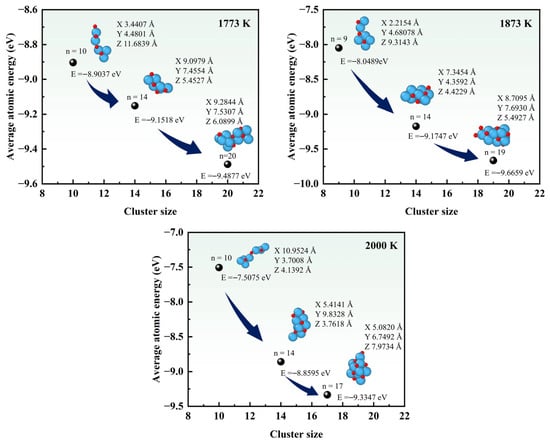
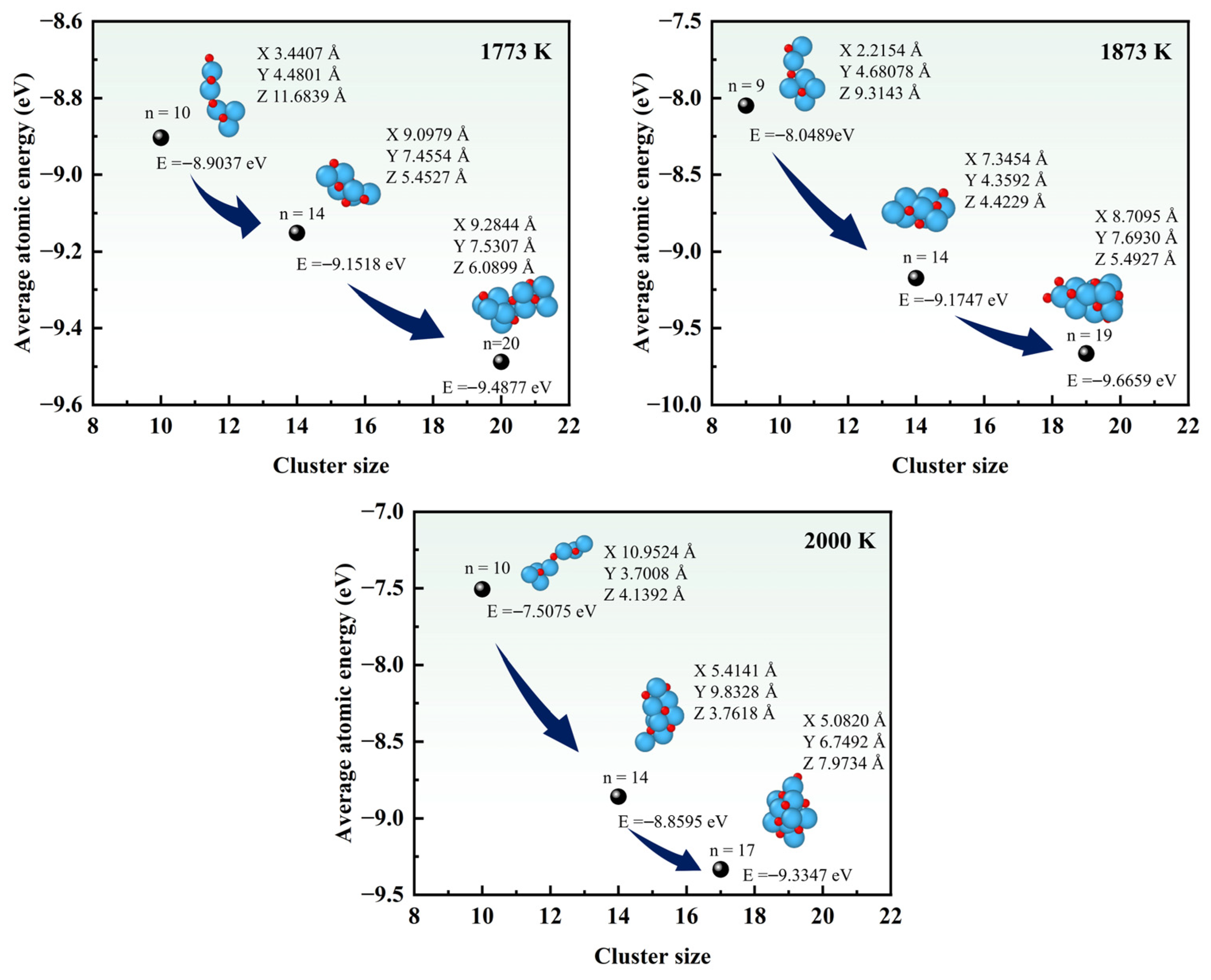
The average atomic energy can characterize the stability of clusters. According to the aforementioned simulation results, the average atomic energies and morphological dimensions of Hf-O clusters were calculated for the initial stage, first structural adjustment, and second structural adjustment at temperatures of 1773 K, 1873 K, and 2000 K, respectively, as shown in Figure 11. At 1773 K, 1873 K, and 2000 K, the Hf-O clusters in their initial state consist merely of a few loosely bonded Hf-O atomic pairs and individual Hf and O atoms. As the atomic number increases, the Hf-O clusters undergo structural adjustments, becoming more compact. The energy changes indicate that as the atomic number increases, the energy decreases, suggesting that the Hf-O clusters become more stable as they grow. This stability allows the Hf-O clusters to exist steadily within the Fe-Cr-Al matrix. Furthermore, it was observed that at 1873 K, when the Hf-O atomic cluster reaches 19 atoms, the cluster dimensions are 8.7095 Å × 7.6930 Å × 5.4928 Å, with an average atomic energy of −9.6659 eV. Compared to the final average atomic energies of Hf-O clusters at 1773 K and 2000 K, the clusters formed at 1873 K exhibit lower energy, resulting in more stable Hf-O clusters.
Figure 11.
Images, sizes, and average atomic energies of Hf-O clusters at temperatures of 1773 K, 1873 K, and 2000 K. The blue and red spheres represent Hf and O atoms, respectively, and the blue arrows indicate the evolution of cluster structure during growth.
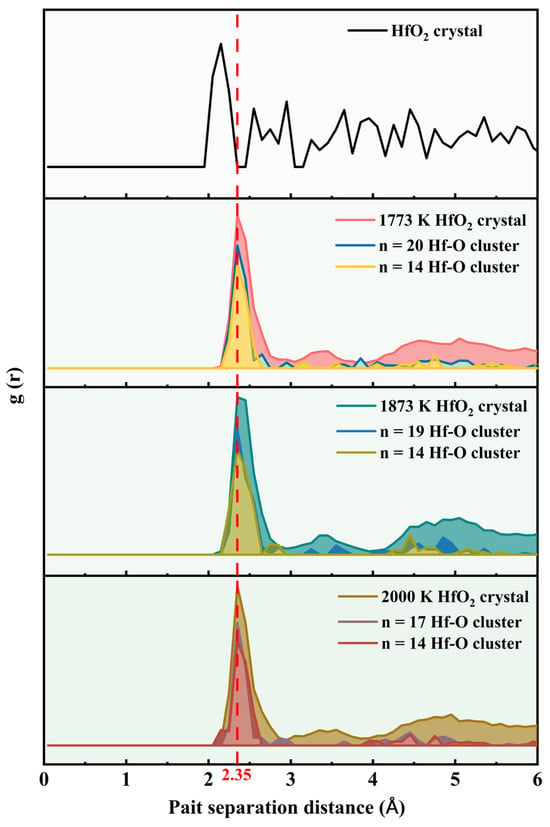
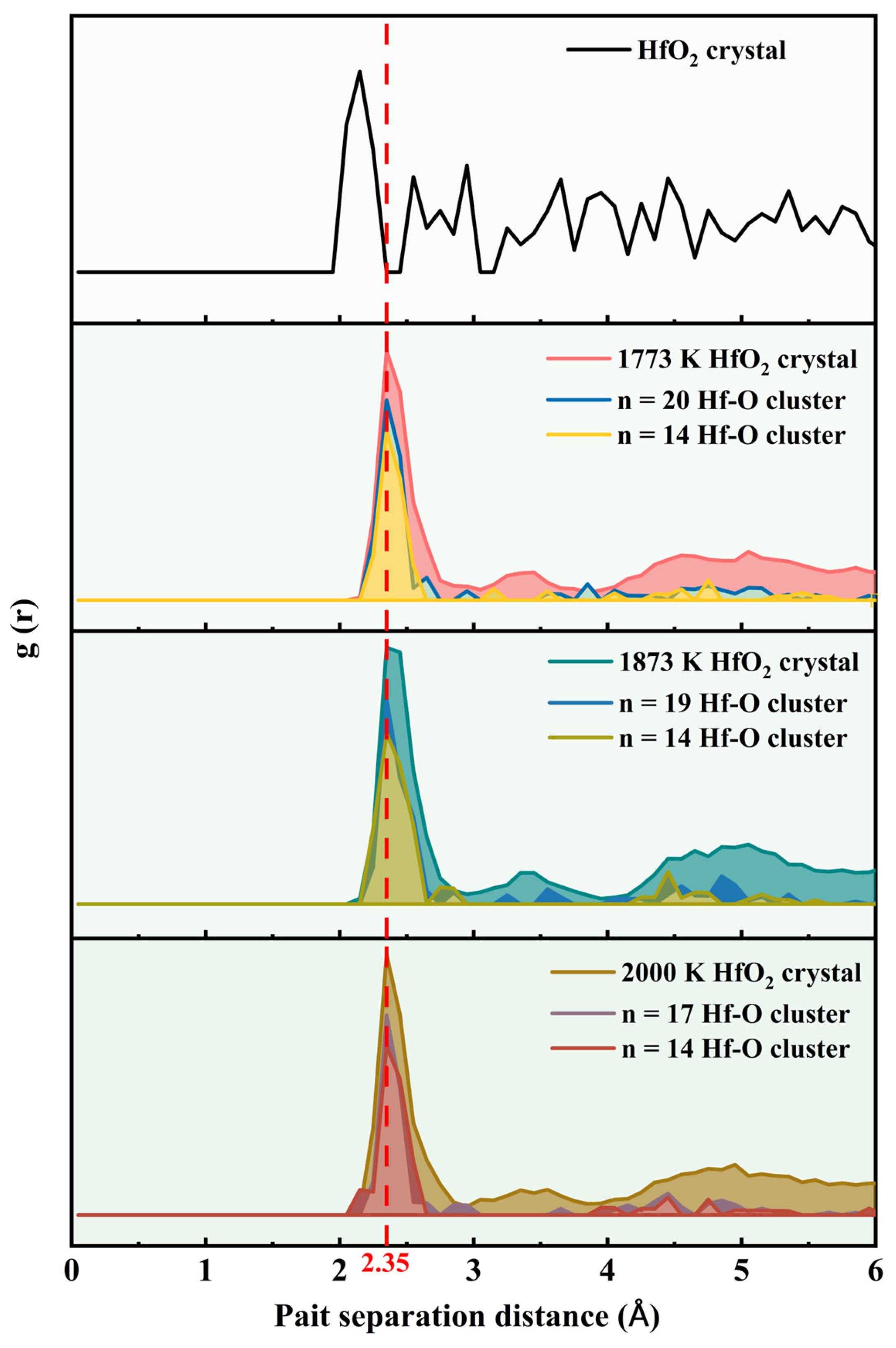
The analysis of the radius of pair gyration for the clusters clearly indicates that although the clusters formed by the aggregation of Hf and O atoms in the simulated Fe-Cr-Al alloys matrix are not crystalline in structure, they exhibit a tendency to transform into HfO2 crystals. To investigate this, we specifically calculated the radial distribution functions of Hf-O clusters with different sizes at temperatures of 1773 K, 1873 K, and 2000 K, as well as the radial distribution functions of HfO2 crystals at various temperatures, aiming to identify the connections between the clusters and the crystals. Figure 12 shows the calculated radial distribution function curves. It can be observed that crystalline HfO2 exhibits its first peak at 2.15 Å, along with other prominent peaks. However, when the HfO2 crystal is heated to 1773 K, 1873 K, and 2000 K followed by relaxation, the radial distribution function displays peak merging, with the first peak shifting to 2.35 Å. This indicates structural changes in the HfO2 crystal upon heating, which result from increased system energy and larger atomic amplitudes. The originally tightly and regularly arranged atoms deviate from their equilibrium positions, leading to peak broadening. By calculating the radial distribution functions of Hf-O clusters with atomic numbers 14 and 20 at 1773 K, those with atomic numbers 14 and 19 at 1873 K, and those with atomic numbers 14 and 17 at 2000 K, which represent two nodes of cluster structural adjustment, and comparing them with the radial distribution functions of HfO2 at corresponding temperatures, it was found that the first nearest neighbor peaks are all located at approximately 2.35 Å. The difference lies in that only the first nearest neighbor peak is prominent in the radial distribution functions of Hf-O clusters, while additional peaks exist in the radial distribution functions of HfO2. This indicates that the internal structure of stable Hf-O clusters tends to resemble the crystalline structure at the same temperature, where the Hf-O clusters are in an intermediate state transitioning toward crystallization. These clusters can serve as effective heterogeneous nucleation sites, guiding the subsequent crystallization of HfO2 nano-precipitates.
Figure 12.
Radial distribution function curves of Hf-O clusters and HfO2 crystals at temperatures of 1773 K, 1873 K, and 2000 K.
The two-step nucleation theory elucidates that cluster formation is a critical precursor stage to crystallization [50,51]. Furthermore, studies on the two-step nucleation mechanism of inclusions in steel indicate the existence of stable clusters within the steel matrix during thermal processes [52,53,54]. Combining these findings with the aforementioned simulation results, we propose that the nucleation of Hf-O clusters in Fe-Cr-Al alloys initially involves the aggregation of Hf and O atoms into dense clusters. Subsequently, these compact Hf-O atomic clusters serve as sites for the continuous accumulation of free Hf and O atoms. As the atomic clusters grow, they undergo multiple structural transformations until ultimately precipitating as HfO2 crystals upon reaching a critical size threshold.
4. Conclusions
This study employed molecular dynamics simulation methods to compare the calculated lattice constants of Fe, Fe2CrAl, and HfO2 crystals with experimental values from the literature. The high degree of agreement between the two sets of values verified the accuracy of the potential functions and the reliability of the simulation results. Building upon this foundation, the nucleation process of Hf-O clusters in Fe-Cr-Al alloys was investigated. Through studying the evolution of Hf-O clusters in the Fe-Cr-Al-Hf-O system at three specific temperatures (1773 K, 1873 K, and 2000 K), various conclusions are derived:
- (1)
- In Fe-Cr-Al alloys, Hf and O atoms attract each other, driving the aggregation of Hf and O atoms to form stable Hf-O clusters. As the temperature increases, the number of Hf-O bonds grows, the quantity of highly coordinated Hf and O atoms rises, and the size of the largest cluster expands, indicating that elevated temperatures promote cluster growth.
- (2)
- The calculated time-dependent variations in mean square displacement and diffusion coefficient indicate that the diffusion capabilities of Hf and O atoms decrease after forming Hf-O clusters, leading to a subsequent slowdown in collision reactions, thereby limiting the growth tendency of Hf-O clusters. As an interstitial atom, the diffusion activation energy of O atoms (1.957 eV) is higher than that of Hf atoms (1.505 eV), demonstrating that temperature elevation has a more pronounced promoting effect on O atom migration.
- (3)
- Analysis of the radius of pair gyration of clusters revealed that Hf-O clusters undergo multiple structural adjustments during growth, becoming more compact. At 1873 K, the restructured Hf-O clusters exhibit the smallest radius of pair gyration (approximately 1.243 Å) and the lowest average atomic energy (−9.6659 eV), indicating that this temperature range is more conducive to the formation of tightly structured and thermodynamically stable Hf-O clusters.
- (4)
- By comparing the radial distribution functions of Hf-O clusters with those of relaxed HfO2 crystals, it was found that the first nearest-neighbor peak positions for both are around 2.35 Å, indicating that the local atomic arrangement of stable Hf-O clusters has approached that of HfO2 crystal structures at the same temperature. This finding aligns with the two-step nucleation mechanism: first, Hf-O atomic clusters form as nuclei, which then adsorb more atoms and gradually become ordered, eventually evolving into precipitated HfO2 crystal phases.
Author Contributions
Conceptualization, Y.L. and G.W.; methodology, Y.L.; validation, Y.L., G.W. and K.T.; investigation, L.C.; resources, K.T.; data curation, Y.L.; writing—original draft preparation, Y.L.; writing—review and editing, G.W.; visualization, Y.L. and L.C.; supervision, G.W.; project administration, G.W. and G.L.; funding acquisition, G.W. and G.L. All authors have read and agreed to the published version of the manuscript.
Funding
This research was funded by the National Natural Science Foundation of China with Grant no. 52574381, and the Fundamental Research Funds for the Liaoning Universities Grant no. LJ222410146029.
Data Availability Statement
The original contributions presented in this study are included in the article. Further inquiries can be directed to the corresponding author.
Acknowledgments
The authors gratefully acknowledge the School of Materials and Metallurgy, University of Science and Technology Liaoning, and the Key Laboratory of Metallurgy Engineering Liaoning Province, University of Science and Technology Liaoning, for their support and for providing the experimental facilities used in this research. The authors also acknowledge the generous technical support and financial sponsorship provided by Shougang GITANE New Materials Co., Ltd.
Conflicts of Interest
Ke Tao and Gang Li were employed by Shougang GITANE New Materials Co., Ltd. The remaining authors declare that the research was conducted in the absence of any commercial or financial relationships that could be construed as a potential conflict of interest. The authors declare that this study received funding from Shougang GITANE New Materials Co., Ltd. The funder had the following involvement with the study: funding acquisition and project administration.
References
- Aghamiri, S.; Sowa, T.; Ukai, S.; Oono, N.; Sakamoto, K.; Yamashita, S. Microstructure and texture evolution and ring-tensile properties of recrystallized FeCrAl ODS cladding tubes. Mater. Sci. Eng. A 2020, 771, 138636. [Google Scholar] [CrossRef] [Scilit]
- He, Y.; Deng, Z.; Liu, J.; Yan, B.; Chen, C. Hot-deformation characteristics and dynamic softening of as-cast FeCrAl alloy. J. Mater. Res. Technol. 2020, 9, 6632–6641. [Google Scholar] [CrossRef] [Scilit]
- Xie, D.; Wei, B.; Wu, W.; Wang, J. Crystallographic Orientation Dependence of Mechanical Responses of FeCrAl Micropillars. Crystals 2020, 10, 943. [Google Scholar] [CrossRef] [Scilit]
- Fan, X.; Wang, F.; Wang, H.; Zhao, B.; Zhou, J.; Fan, B.; Dou, Y.; Li, R. Effect of Nb-Ti Double Microalloys on the Microstructure Control and Mechanical Properties of FeCrAl As-Cast Alloys. Metall. Mater. Trans. A 2025, 56, 1007–1023. [Google Scholar] [CrossRef] [Scilit]
- Dimyati, A.; Penkalla, H.; Untoro, P.; Naumenko, D.; Quadakkers, W.; Mayer, J. High-temperature oxidation of FeCrAl alloys: The effect of Mg incorporation into the alumina scale. Int. J. Mater. Res. 2003, 94, 180–187. [Google Scholar] [CrossRef] [Scilit]
- Wang, X.; Yin, Z.; Shen, X. Research Progress of ODS FeCrAl Alloys—A Review on Preparation, Microstructure, and Properties. Crystals 2026, 16, 23. [Google Scholar] [CrossRef] [Scilit]
- Lu, C.; Lu, Z.; Xie, R.; Li, Z.; Liu, C.; Wang, L. Effect of Y/Ti atomic ratio on microstructure of oxide dispersion strengthened alloys. Mater. Charact. 2017, 134, 35–40. [Google Scholar] [CrossRef] [Scilit]
- Edmondson, P.D.; Briggs, S.A.; Yamamoto, Y.; Howard, R.H.; Sridharan, K.; Terrani, K.A.; Field, K.G. Irradiation-enhanced α′ precipitation in model FeCrAl alloys. Scr. Mater. 2016, 116, 112–116. [Google Scholar] [CrossRef] [Scilit]
- Capdevila, C.; Aranda, M.; Rementería, R.; Chao, J.; Urones-Garrote, E.; Aldazabal, J.; Miller, M.K. Strengthening by intermetallic nanoprecipitation in Fe–Cr–Al–Ti alloy. Acta Mater. 2016, 107, 27–37. [Google Scholar] [CrossRef] [Scilit]
- Gussev, M.N.; Field, K.G.; Yamamoto, Y. Design, properties, and weldability of advanced oxidation-resistant FeCrAl alloys. Mater. Des. 2017, 129, 227–238. [Google Scholar] [CrossRef] [Scilit]
- Liu, N.; Cui, Y.; Zhang, Y.; Sun, L.; Chen, D.; Cao, X.; Zhang, Z. Effects of Zr addtion on recrystallization behaviors and mechanical properties of FeCrAl alloys. J. Mater. Res. Technol. 2023, 22, 393–402. [Google Scholar] [CrossRef] [Scilit]
- Han, X.; Meng, X.; Yang, Y.; Zhang, C.; Kimura, A. HRTEM studies on particles coherency and strengthening mechanism in FeCrAl ODS model alloys with addition of Zr/Hf. J. Alloys Compd. 2025, 1036, 181916. [Google Scholar] [CrossRef] [Scilit]
- Yang, T.-X.; Dou, P.; Li, Z.-X.; Xiao, X.-Y. Effects of Hf and/or Ti addition on the morphology, crystal, and metal/oxide interface structures of nanoparticles in FeCrAl-ODS steels. Vacuum 2024, 228, 113507. [Google Scholar] [CrossRef] [Scilit]
- Zhang, Q.; Hu, Y.; Yang, T.; Chen, H.; Ito, Y.; Egusa, D.; Abe, E.; Shi, Q.; Ji, G.; Cui, Y. Chemical Short-Range Ordering in Nanoprecipitates Modulates Planar Faults to Enhance Mechanical Properties. Nano Lett. 2025, 25, 8696–8703. [Google Scholar] [CrossRef] [Scilit]
- Yan, Y.-Q.; Cha, W.-H.; Liu, S.; Ma, Y.; Luan, J.-H.; Rao, Z.; Liu, C.; Shan, Z.-W.; Lu, J.; Wu, G. Ductilization of 2.6-GPa alloys via short-range ordered interfaces and supranano precipitates. Science 2025, 387, 401–406. [Google Scholar] [CrossRef] [Scilit] [PubMed]
- Han, X.Y.; Wang, J.J.; Tu, X.X.; Ma, S.G.; Zhao, D.; Jiao, Z.M.; Zhang, T.W.; Qiao, J.W.; Zhang, Y.; Wang, Z.H. Effect of nanoprecipitates on the formation of adiabatic shear band in high-entropy alloy. J. Mater. Sci. Technol. 2026, 256, 144–165. [Google Scholar] [CrossRef] [Scilit]
- Peng, X.C.; Luo, Y.W.; Guo, H.J.; Guo, J.; Zhang, X.F.; Li, G.; Li, H.L. Hf atomically modulated grain refinement of FeCrAl alloys. J. Alloys Compd. 2025, 1010, 177794. [Google Scholar] [CrossRef] [Scilit]
- Kimura, A.; Kasada, R.; Iwata, N.; Kishimoto, H.; Zhang, C.; Isselin, J.; Dou, P.; Lee, J.; Muthukumar, N.; Okuda, T. Development of Al added high-Cr ODS steels for fuel cladding of next generation nuclear systems. J. Nucl. Mater. 2011, 417, 176–179. [Google Scholar] [CrossRef] [Scilit]
- Dou, P.; Kimura, A.; Kasada, R.; Okuda, T.; Inoue, M.; Ukai, S.; Ohnuki, S.; Fujisawa, T.; Abe, F.; Jiang, S. TEM and HRTEM study of oxide particles in an Al-alloyed high-Cr oxide dispersion strengthened ferritic steel with Hf addition. J. Nucl. Mater. 2017, 485, 189–201. [Google Scholar] [CrossRef] [Scilit]
- Pilone, D.; Felli, F.; Bernabai, U. FeCrAl Alloys Produced by Roll-Bonding and Annealing of Al (RE)-Clad Stainless Steel: How Addition of Hf and Zr Affects their Oxidation Behaviour. Mater. Sci. Forum 2009, 604, 133–137. [Google Scholar] [CrossRef] [Scilit]
- Daradkeh, S.I.; Recalde, O.; Mousa, M.S.; Sobola, D.; Boll, T. Oxidation Behavior and Outward Diffusion of Al Along Oxide Grain Boundaries of FeCrAl Alloys Overdoped with Zr and Hf. High Temp. Corros. Mater. 2024, 101, 41–59. [Google Scholar] [CrossRef] [Scilit]
- Zhong, X.; Zhang, Q.; Ma, M.; Xie, J.; Wu, M.; Yan, Y.; Ren, S.; Liu, B. Mechanical properties and non-isothermal crystallization kinetics of novel Ti-based high-entropy bulk metallic glasses. J. Mater. Res. Technol. 2023, 23, 5939–5952. [Google Scholar] [CrossRef] [Scilit]
- Zhang, Y.; Miyamoto, G.; Furuhara, T. Atom probe compositional analysis of interphase precipitated nano-sized alloy carbide in multiple microalloyed low-carbon steels. Microsc. Microanal. 2019, 25, 447–453. [Google Scholar] [CrossRef] [Scilit] [PubMed]
- Liu, L.; Wang, G.; Xiao, Y.; Zhao, Z.; Yang, Z. Molecular dynamics simulation of Cr-N clusters formation in high nitrogen austenitic stainless steel. Scr. Mater. 2023, 227, 115309. [Google Scholar] [CrossRef] [Scilit]
- Borovikov, V.V.; Mendelev, M.I.; Smith, T.M.; Lawson, J.W. Molecular dynamics simulation of twin nucleation and growth in Ni-based superalloys. Int. J. Plast. 2023, 166, 103645. [Google Scholar] [CrossRef] [Scilit]
- Tipeev, A.; Zanotto, E.D. Crystal Nucleation and Growth Dynamics of Aluminum via Quantum-Accurate MD Simulations. Acta Mater. 2025, 296, 121245. [Google Scholar] [CrossRef] [Scilit]
- Gueorguiev, G.K.; Pacheco, J.; Stafström, S.; Hultman, L. Silicon–metal clusters: Nano-templates for cluster assembled materials. Thin Solid Films 2006, 515, 1192–1196. [Google Scholar] [CrossRef] [Scilit]
- Plimpton, S. Fast parallel algorithms for short-range molecular dynamics. J. Comput. Phys. 1995, 117, 1–19. [Google Scholar] [CrossRef] [Scilit]
- Stukowski, A. Visualization and analysis of atomistic simulation data with OVITO–the Open Visualization Tool. Model. Simul. Mater. Sci. Eng. 2009, 18, 015012. [Google Scholar] [CrossRef] [Scilit]
- Farkas, D.; Caro, A. Model interatomic potentials for Fe–Ni–Cr–Co–Al high-entropy alloys. J. Mater. Res. 2020, 35, 3031–3040. [Google Scholar] [CrossRef] [Scilit]
- Xiang, W.; Gui, Y.; Tang, X.; Lu, X.; Sheng, J.; Zhang, Z.; Ren, J. Molecular Dynamics Simulation of the Effect of B2-NiAl Phase Volume Fractions on Mechanical Properties and Deformation Mechanisms of Dual-Phase FeNiAl Alloys. Metals 2025, 15, 738. [Google Scholar] [CrossRef] [Scilit]
- Byggmästar, J.; Nagel, M.; Albe, K.; Henriksson, K.O.E.; Nordlund, K. Analytical interatomic bond-order potential for simulations of oxygen defects in iron. J. Phys. Condens. Matter 2019, 31, 215401. [Google Scholar] [CrossRef] [Scilit]
- Ma, J.; Ma, H.; Qi, C.; Liu, J.; Guo, W.; Liu, X.; Wen, X. Unveiling the Temperature-Driven Surface Morphology Evolution of Iron-Based Intermetallics: A Molecular Dynamics Perspective. J. Phys. Chem. C 2025, 129, 14530–14541. [Google Scholar] [CrossRef] [Scilit]
- Fereidonnejad, R.; Moghaddam, A.O.; Moaddeli, M. Modified embedded-atom method interatomic potentials for Al-Ti, Al-Ta, Al-Zr, Al-Nb and Al-Hf binary intermetallic systems. Comput. Mater. Sci. 2022, 213, 111685. [Google Scholar] [CrossRef] [Scilit]
- Das, B.; Sinha, S.K.; Patra, A.; Ghosh, A.; Kumar, S.; Choudhury, B.; Mindi, N.K. Microstructural and mechanical property enhancement of W–Zr alloys by nano-Al2O3, Y2O3, and La2O3 dispersions: A combined MD simulation and experimental approach. J. Alloys Compd. 2025, 1040, 183502. [Google Scholar] [CrossRef] [Scilit]
- Arkundato, A.; Monado, F.; Supeno; Misto; Su’ud, Z. Performance of the Fe-Ni-Cr steel alloy in high temperature molten liquid lead. J. Phys. Conf. Ser. 2019, 1170, 012010. [Google Scholar] [CrossRef] [Scilit]
- Halicioǧlu, T.; Pound, G. Calculation of potential energy parameters form crystalline state properties. Phys. Status Solidi 1975, 30, 619–623. [Google Scholar] [CrossRef] [Scilit]
- Rappé, A.K.; Casewit, C.J.; Colwell, K.S.; Goddard, W.A., III; Skiff, W.M. UFF, a full periodic table force field for molecular mechanics and molecular dynamics simulations. J. Am. Chem. Soc. 1992, 114, 10024–10035. [Google Scholar] [CrossRef] [Scilit]
- Wilburn, D.; Bassett, W. Hydrostatic compression of iron and related compounds; an overview. Am. Mineral. 1978, 63, 591–596. [Google Scholar]
- Umetsu, R.; Morimoto, N.; Nagasako, M.; Kainuma, R.; Kanomata, T. Annealing temperature dependence of crystal structures and magnetic properties of Fe2CrAl and Fe2CrGa Heusler alloys. J. Alloys Compd. 2012, 528, 34–39. [Google Scholar] [CrossRef] [Scilit]
- Seema, K.; Kumar, R. The structural and electronic properties of HfO2. AIP Conf. Proc. 2012, 1447, 1077–1078. [Google Scholar]
- Martys, N.S.; Mountain, R.D. Velocity Verlet algorithm for dissipative-particle-dynamics-based models of suspensions. Phys. Rev. E 1999, 59, 3733. [Google Scholar] [CrossRef] [Scilit]
- Evans, D.J.; Holian, B. The nose–hoover thermostat. J. Chem. Phys. 1985, 83, 4069–4074. [Google Scholar] [CrossRef] [Scilit]
- Einstein, A. Über die von der molekularkinetischen Theorie der Wärme geforderte Bewegung von in ruhenden Flüssigkeiten suspendierten Teilchen. Ann. Phys. 1905, 4, 549–560. [Google Scholar] [CrossRef] [Scilit]
- Wang, X.; Gao, X.; Jin, Y.; Zhang, Z.; Lai, Z.; Zhang, H.; Li, Y. Molecular Dynamics Simulation Research on Fe Atom Precipitation Behaviour of Cu-Fe Alloys during the Rapid Solidification Processes. Materials 2024, 17, 719. [Google Scholar] [CrossRef] [Scilit]
- Nandipati, G.; Senor, D.J.; Casella, A.M.; Soulami, A. Molecular dynamics study of interstitial He clusters in nickel. Nucl. Mater. Energy 2024, 41, 101733. [Google Scholar] [CrossRef] [Scilit]
- Gmachowski, L. Estimation of the dynamic size of fractal aggregates. Colloid Surf. A Physicochem. Eng. Asp. 2000, 170, 209–216. [Google Scholar] [CrossRef] [Scilit]
- Robert-Inacio, F.; Boschet, C.; Charollais, F.; Cellier, F. Polar studies of the sphericity degree of V/HTR nuclear fuel particles. Mater. Charact. 2006, 56, 266–273. [Google Scholar] [CrossRef] [Scilit]
- He, L.; Li, H.; Liang, M.; Zhang, W.; Han, K.; Zhai, Q. Characterization of structure evolution of Ti–O clusters in molten iron. Model. Simul. Mater. Sci. Eng. 2021, 29, 075006. [Google Scholar] [CrossRef] [Scilit]
- Myerson, A.S.; Trout, B.L. Nucleation from solution. Science 2013, 341, 855–856. [Google Scholar] [CrossRef] [Scilit] [PubMed]
- Wallace, A.F.; Hedges, L.O.; Fernandez-Martinez, A.; Raiteri, P.; Gale, J.D.; Waychunas, G.A.; Whitelam, S.; Banfield, J.F.; De Yoreo, J.J. Microscopic evidence for liquid-liquid separation in supersaturated CaCO3 solutions. Science 2013, 341, 885–889. [Google Scholar] [CrossRef] [Scilit] [PubMed]
- Wang, G.; Wang, Q.; Li, S.; Ai, X.; Fan, C. Evidence of multi-step nucleation leading to various crystallization pathways from an Fe-O-Al melt. Sci. Rep. 2014, 4, 5082. [Google Scholar] [CrossRef] [Scilit] [PubMed]
- Tian, J.; Shahzad, M.B.; Wang, W.; Yin, L.; Jiang, Z.; Yang, K. Role of Co in formation of Ni-Ti clusters in maraging stainless steel. J. Mater. Sci. Technol. 2018, 34, 1671–1675. [Google Scholar] [CrossRef] [Scilit]
- Wei, Z.; Sun, Y.; Hu, Y.; Peng, L.; Shi, J.; Shi, Y.; Chen, S.; Ma, Y. Influence of Yttria Nanoclusters on the Void Nucleation in BCC Iron During Multi-Axial Tensile Deformation: A Molecular Dynamics Simulation. Crystals 2025, 15, 476. [Google Scholar] [CrossRef] [Scilit]

Disclaimer/Publisher’s Note: The statements, opinions and data contained in all publications are solely those of the individual author(s) and contributor(s) and not of MDPI and/or the editor(s). MDPI and/or the editor(s) disclaim responsibility for any injury to people or property resulting from any ideas, methods, instructions or products referred to in the content. |
© 2026 by the authors. Licensee MDPI, Basel, Switzerland. This article is an open access article distributed under the terms and conditions of the Creative Commons Attribution (CC BY) license.