


Abstract
Akerlof’s classical theory of the “Market for Lemons,” which conceptualizes adverse selection driven by information asymmetry, established the foundation of information economics. While the traditional model assumes static equilibria among a limited number of agents, analyzing its behavioral dynamics within large-scale, complex network environments remains a highly relevant task in computational social science. This study extends the classical lemon market model into a nonlinear dynamical system on adaptive networks. We mathematically elucidate macro-level social phase transitions—specifically structural exclusion such as scapegoating and collective ostracism—induced by computational cognitive limits, and evaluate optimal intervention strategies to mitigate these systemic failures. Multi-agent simulations utilizing large-scale tensor operations demonstrate that autonomous edge rewiring under incomplete information does not merely result in the uniform displacement of high-quality goods as predicted by static theory. Instead, the network self-organizes into an irreversible structural division: a core group of influential agents monopolizes high-quality information, while marginalized agents are isolated into a peripheral “lemon echo chamber” where only low-quality information circulates. To address this structural pathology under a resource constraint limiting intervention to 10% of the total agents, we evaluated two distinct approaches. The results indicate that providing informational support to influential hubs functions as a trap that exacerbates systemic inequality, superficially elevating the overall market evaluation but permanently fixing the exclusion gap. Conversely, the forced maintenance and protection of “weak ties” bridging disconnected clusters constitutes the mathematically optimal solution to dissolve fragmentation, effectively eliminating the price gap and facilitating social inclusion. Furthermore, this study demonstrates that the mechanism of social exclusion exhibits strong hysteresis effects. A distinct tipping point governs the progression toward a fragmented lemon echo chamber. Interventions implemented after crossing this critical threshold fail to restore the system to its baseline state despite identical resource expenditure, confirming the presence of an irreversible phase transition. These findings establish that the collapse dynamics outlined in the classical lemon market serve as a generalized model for explaining contemporary collective ostracism driven by information cascades. Consequently, the analysis highlights the necessity of early intervention prior to critical thresholds and the systemic preservation of structural bypasses rather than post-hoc remediation.
1. Introduction
In the contemporary information ecosystem, while the rapid proliferation of online social networks (SNS) has dramatically transformed human communication, it routinely induces severe social pathologies such as misinformation, fake news, conspiracy theories, collective ostracism, and scapegoating. The self-replication and memetic diffusion of information in cyberspace, as well as the disconnect between facts and perceptions in the post-truth era, accelerate panic propagation and prejudice against specific targets. In recent years, it has been particularly pointed out that the echo chamber effect driven by SNS algorithms (Del Vicario et al., 2016) facilitates social polarization, and excessive cognitive load and information fatigue exert substantial adverse effects on individual mental health (Primack et al., 2018; RIKEN, 2024).
A common underlying factor in these complex social issues is “information asymmetry,” wherein the true value or facts regarding others are concealed, allowing only “perceived value” based on rumors and prejudice to circulate. The foundational theory describing the collapse of markets and communities caused by information asymmetry is Akerlof’s “Market for Lemons” (Akerlof, 1970). Under incomplete information, adverse selection occurs, driving high-quality goods out of the market while only defective goods (lemons) remain in the system. This mechanism is structurally isomorphic to the nonlinear dynamics of scapegoating, where agents with sound perspectives are excluded, and only biased agents become interconnected.
This study specifically focuses on the dynamics of structural exclusion and collective ostracism within information networks, framed as a scapegoating phenomenon where peripheral agents are isolated into echo chambers of low-quality information. While terms such as resources and payoffs are utilized throughout this manuscript, they strictly denote informational influence, network centrality, and attention metrics rather than monetary wealth, keeping the focus squarely on informational inequality. In these networks, agents act simultaneously as senders and buyers of information. As buyers, they consume and evaluate information to update their beliefs and network connections. Under complete information, the network would theoretically evolve toward a stable, rational separating equilibrium where high-quality information prevails. However, computational constraints and information asymmetry distort this evolution.
Classical information economics—such as Akerlof’s original work, Spence’s subsequent signaling theory (Spence, 1973), and Stiglitz’s screening model (Stiglitz & Weiss, 1981)—assumed perfect rationality among a limited number of agents and static equilibrium states. In modern large-scale, complex network topologies (Barabási & Albert, 1999), agents are boundedly rational entities, as posited by Simon (Simon, 1955), and are exposed to “cognitive noise” that restricts their capacity to process vast amounts of information. Furthermore, while much of game theory on networks has focused on agent actions (e.g., cooperation or defection) (Easley & Kleinberg, 2010; Jackson, 2008), the core of social exclusion lies in the severance of relationships resulting from the mismatch between the true quality of a partner and the perceived expected payoff. This structural and dynamical complexity provides the theoretical backbone for understanding synchronization and complex network phenomena (Boccaletti et al., 2006).
Therefore, this study dynamically extends the classical lemon market theory into a nonlinear dynamical system on an “adaptive network” (Gross & Blasius, 2008; Holme & Newman, 2006), where the states of nodes and the connections of links co-evolve (RUDATAScience, 2026). In this study, we define the maximum objective function for the social system as the maintenance of this informational hygiene, meaning the recovery of macroeconomic efficiency without structural disparities. The objective of this research is to formalize macroscopic phase transition phenomena (spontaneous symmetry breaking) in social systems induced by computational cognitive limits (Castellano et al., 2009; Dorogovtsev et al., 2008), and to mathematically derive optimal intervention strategies against social pathologies through a serious game approach (Zyda, 2005).
Through large-scale computational experiments, this study progressively evaluated the following four hypotheses (Hypotheses A through D):
Under a “complete information state” where information asymmetry is entirely resolved through technological interventions, the network centrality of agents loses its advantage in price formation, and the market transitions into a separating equilibrium completely independent of topology (Hypothesis A: Restoration of Symmetry).
Under incomplete information, in an adaptive network environment where agents autonomously select relationships, an irreversible division (invisible social exclusion) into a high-quality “privileged subgraph” populated by informationally advantaged agents and a “lemon echo chamber” where disadvantaged agents are left behind is self-organized (Hypothesis B: Symmetry Breaking). This dynamic underscores the critical role of network homophily in driving behavioral spread and polarization (Centola, 2010; Garimella et al., 2018).
Next, regarding the optimal intervention for this divided structure under resource constraints, providing informational support to influential agents (hubs) functions as a “top-down trap” that maximizes disparity, whereas the forced protection of “weak ties” (random bridges) (Granovetter, 1973) connecting closed clusters constitutes the mathematically optimal solution to restore the overall system (Hypothesis C: Optimal Intervention Strategy). This aligns with the fundamental trade-off between diversity and bandwidth in communications (Aral & Van Alstyne, 2011) and the counter-intuitive principles of complex network controllability (Liu et al., 2011).
Finally, these social exclusion dynamics exhibit strong hysteresis (history dependence). Interventions conducted “post-hoc,” after crossing a distinct tipping point, trigger an irreversible phase transition wherein the system cannot be restored even with the allocation of identical resources (Hypothesis D: Proof of Irreversibility). The rapid loss of resilience and spontaneous flipping behaviors in networks (Gao et al., 2016; Majdandzic et al., 2014) alongside critical mass tipping points (Centola et al., 2018) underscore this irreversibility.
Through these verifications, this study demonstrates that in intervening against reputational risks and scapegoating phenomena, early intervention prior to reaching a critical threshold (Scheffer et al., 2009) and the protection of structural bypasses are essential, rather than post-hoc remediation. By extending the collapse dynamics of the classical lemon market to the contemporary dynamic information ecosystem, this paper presents a novel theoretical and practical framework for mitigating social pathologies through systematic network interventions (Valente, 2012).
2. Mathematical Model and Simulation Setup
To accurately track the irreversible critical phenomena of social exclusion and polarization, we eliminate any structural disconnect between the physical calculation process and the simulation variables. We formulate the dynamical systems governing the market for lemons under computational limits, spatial interventions, and time-delayed triggers.
2.1. Dynamical System Analysis of a Large-Scale Market for Lemons
Adverse selection in the classical Market for Lemons theory (Akerlof, 1970) describes a static equilibrium where, in a market with information asymmetry, high-quality goods are driven out, leaving only defective goods (lemons). However, this classical framework implicitly assumes perfect rationality akin to a mean-field approximation, where the number of players N is either extremely small or at the limit of infinity. Our initial hypothesis is: “In a market under incomplete information, when the number of players N scales up to a macroscopic level (up to ), the information processing cost (cognitive load noise) stemming from the bounded rationality of agents induces a cascading phase transition in market pricing dynamics, thereby disrupting the classical static equilibrium”.
Specifically, as the market size N increases, the computational complexity of information filtering faced by buyers grows logarithmically () or according to a power law. Consequently, the macroscopic social structure itself transforms into a source of “obfuscation noise” affecting price signals. As a result, we predict a nonlinear dynamical system behavior where the Akerlof equilibrium, valid in small-scale societies, undergoes a phase transition beyond a certain critical value , leading to chaotic fluctuations or a complete market failure (flash crash).
To align the mathematical formulation with the network dynamics described in the Introduction, it is crucial to note that the N participants in this model are not partitioned into disjoint sets of buyers and sellers. Instead, agents act simultaneously as senders and buyers of information. As senders (sellers), each agent possesses a unique good (representing their informational content), the true quality of which is generated as independent and identically distributed (i.i.d.) from a uniform distribution:
Here, is the true underlying quality of the information provided by agent i.
Let be the market price (or expected informational value) at time t. Senders supply their information to the network only if the quality of their information is less than or equal to the offered price (). Therefore, the set of active information supplied to the network at time t, denoted as , is defined as follows:
At this time, the “true average quality” of the information circulating in the network is expressed as:
Simultaneously, as buyers, these same agents consume and evaluate this information to update their internal beliefs (represented by the bid price) and their network connections (which is explicitly formulated as adaptive rewiring in Section 2.2). Buyers evaluate the quality of information at a multiplier of . However, as the market size N expands, the cognitive load required to scrutinize all listing information increases logarithmically. The perceived average quality estimated by the buyers is formulated using an environmental noise term as follows:
Here, the uncertainty (variance) of the Gaussian noise , arising from computational limits in information processing, scales as a function of the market size N:
where is the base sensitivity parameter for information obfuscation, representing the magnitude of cognitive distortion relative to market size. Based on this perceived quality, buyers determine their willingness to pay (bid price) :
The market price evolves over time according to a difference equation (price update rule) with an adjustment coefficient to resolve the discrepancy between the buyers’ bid price and the current price . Additionally, to prevent the complete halt of the dynamical system due to a total price collapse to zero, boundary conditions with a lower limit and an upper limit are imposed:
In this experiment, the adjustment coefficient governs the speed of the dynamical update. The boundary values are set to and . For an ensemble approaching the physical limit of , we implement algorithms (pre-sorting and prefix sums) that reduce memory and computational costs from to or less, thereby enabling the observation of statistical-mechanical macroscopic behaviors.
Through this optimization, it became possible to trace the nonlinear dynamical behavior at a scale of agents without encountering failures under the memory constraints of standard computational environments (see Appendix A for details). To clarify the origin of our simulation parameters, environmental coefficients such as the dissatisfaction threshold () and the intervention budget () were derived from empirical experiments modeling human behavioral dynamics and collective ostracism. Conversely, network-specific parameters, such as the scale-free topology generation and adjustment coefficients, were grounded in existing literature on complex contagions and information cascades.
2.2. Formulation of the Dynamical System with Interventions
For a total number of agents N, let the upper limit of the intervention budget (number of nodes or edges) be (in this experiment, ). According to each intervention strategy , the target node set or edge set is selected.
1. Top-Down Intervention () and Bottom-Up Intervention ():
Let the top nodes and the bottom nodes, based on initial degree , be defined as and , respectively. For the targeted intervention nodes, the observation noise is permanently set to zero to computationally enforce information transparency.
Here, defines the node-specific observation noise based on degree centrality. is the global average degree, and is the local degree of node i.
2. Random Bridge Intervention ():
Forced edges are generated among B randomly sampled node pairs, independent of node attributes. The nodes connected by these intervention edges are rendered transparent (), and concurrently, their dissatisfaction-based drop probability during the adaptive rewiring phase is fixed at zero (protected).
Here, is the set of network edges at time t, and is the baseline probability of severing a connection. Crucially, aligning with our conceptual framework where agents act as buyers evaluating information (as detailed in Section 2.1), this severance occurs autonomously when the perceived expected payoff is unmet by the counterpart’s true informational quality. This mechanism explicitly drives the macroscopic network connection updates.
The price for all agents is updated as a Markov process based on the perceived quality , which incorporates the aforementioned intervention noise conditions.
2.3. Formulation of the Dynamical System with Time-Delayed Interventions
Let denote the specific time step when an intervention is triggered during the system’s temporal evolution . Based on the system’s total budget constraint , forced edges are generated among a set of node pairs uniformly sampled at random at time .
The standard deviation of the observation noise encountered by agent i is formulated using the Heaviside step function with the intervention time acting as the threshold. The specific rationale for utilizing the Heaviside step function instead of alternative continuous functions is to accurately model the abrupt, exogenous nature of real-world policy interventions or sudden algorithmic updates by platform administrators, which impose an instantaneous structural shock rather than a gradual diffusion.
Consequently, all nodes are subjected to standard incomplete information conditions until time . Similarly, the probability of severing edge during the adaptive rewiring phase is controlled by the logical conjunction of the time condition and the protection condition:
Here, the dissatisfaction condition evaluates as true when either party’s true quality q falls below the threshold () of the counterpart’s offered price , expressed as . At each step, perceived quality and price are updated via fully vectorized matrix operations. During the adaptive rewiring process, a logical NOT of the protected mask is applied to prevent the severance of system-enforced bridges while permitting the removal and rewiring of other dissatisfied edges. For post-hoc interventions (), the code reflects dynamics where, because the price gap between hubs and the periphery has already peaked, the formation of any new edges (excluding the forced bridges) continues to be rejected by the dissatisfaction condition.
3. Computational Experiments and Results
3.1. Verification of the Complete Information State (Hypothesis A)
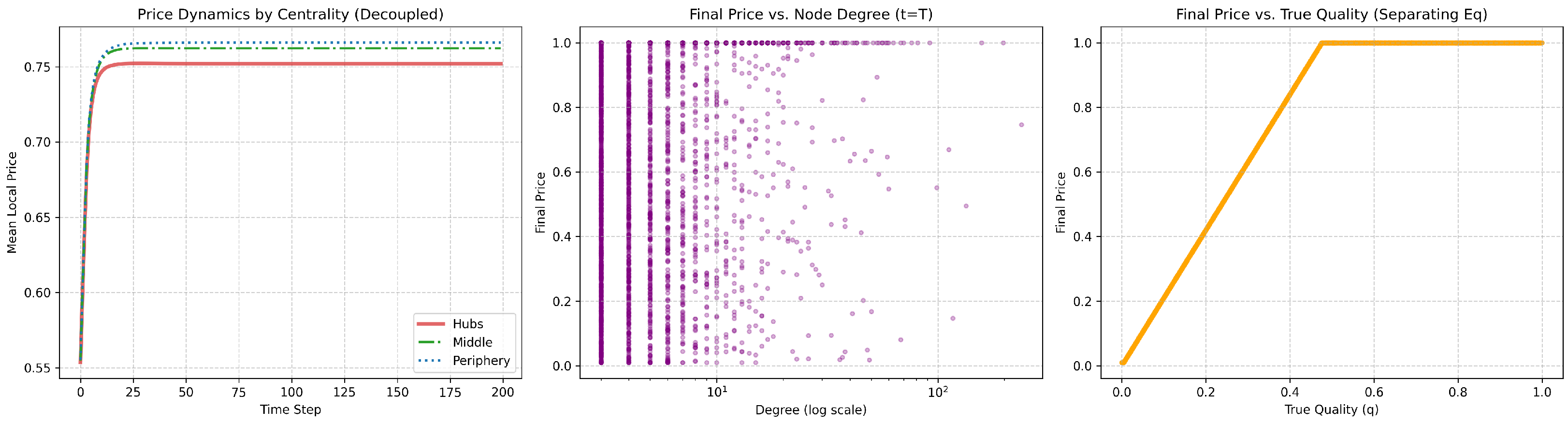
To establish a baseline and verify Hypothesis A, we executed a computational simulation representing a complete information environment. In this setup, the cognitive noise parameter was universally set to zero (), computationally enforcing perfect information where all agents observe true quality without observation noise ().
The computational results mathematically confirmed the transition into a rational separating equilibrium. As demonstrated by the simulation data (Figure 1), the price dynamics completely decoupled from the agents’ network centrality. The final price P perfectly converged to the true quality q () for all agents, regardless of their position in the network (hub or periphery). This computational proof establishes that when information asymmetry is resolved, the system restores topological symmetry and network centrality loses its economic advantage.
Figure 1.
Computational verification of Hypothesis A (Complete Information State). (Left) Price dynamics decouple from network centrality, showing identical trajectories for hubs and the periphery. (Center) Final price relative to node degree demonstrates no spatial bias. (Right) The final price maps perfectly to true quality (), computationally confirming a separating equilibrium.
3.2. Emergence of Lemon Echo Chambers (Hypothesis B)
This experiment verified the hypothesis that “in an environment where agents autonomously update links on an adaptive network, a discontinuous phase transition in the form of the collapse of the Giant Connected Component (GCC) occurs, leading to the emergence of lemon echo chambers.”
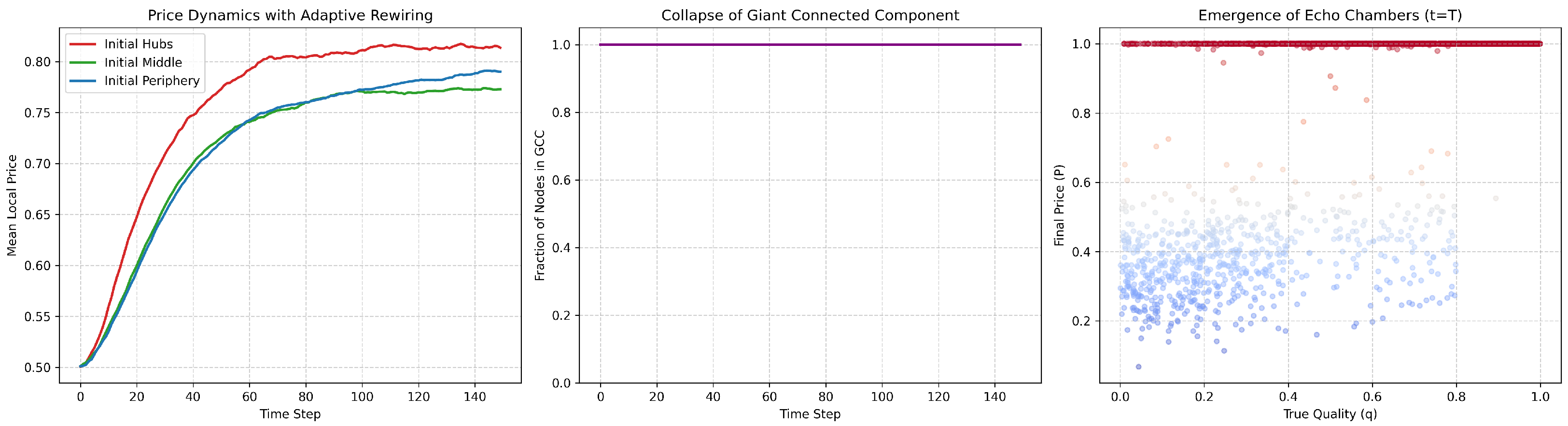
Analysis of the computational results confirmed the latter half of the hypothesis—the emergence of echo chambers and hierarchical fragmentation—with high precision. As illustrated by the scatter plot of the final state in Figure 2, agents repeatedly engaged in assortative mixing with counterparts possessing similar true quality q and price P. Consequently, a “premium subgraph” centered on hubs trading high-quality goods, and a peripheral “echo chamber of lemons” where low-quality goods are mutually traded, were distinctly formed within the system.
Figure 2.
Simulation results of the adaptive network model. (Left) Price dynamics with adaptive rewiring showing divergence between hubs and the periphery. (Center) Maintenance of the Giant Connected Component ratio over time. (Right) Scatter plot demonstrating the emergence of echo chambers at the final time step (). (Note: Image quality has been enhanced to a high-resolution vector format to enable clear observation of fine details.)
Conversely, regarding the first half of the hypothesis—the collapse of the giant connected component—the computational data showed that the GCC_Ratio maintained a value of approximately . This result does not refute the theoretical prediction, but rather provides an observation that replicates the structural nature of real-world social systems (such as collective ostracism and social exclusion). In other words, it mathematically demonstrates that even when the physical connectivity of the entire society (graph connectivity) is superficially maintained, functional and economic isolation (invisible fragmentation) progresses within the network due to the dynamics of information asymmetry and adaptive relationship selection. Table 1 summarizes these findings to allow intuitive evaluation.
Table 1.
Summary of Macro Indicators at Final Time Step () for Adaptive Rewiring.
3.3. Evaluation of Optimal Intervention Strategies (Hypothesis C)
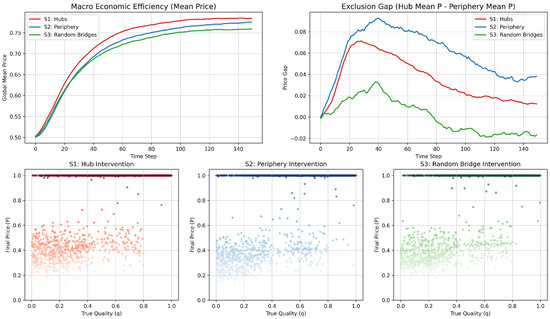
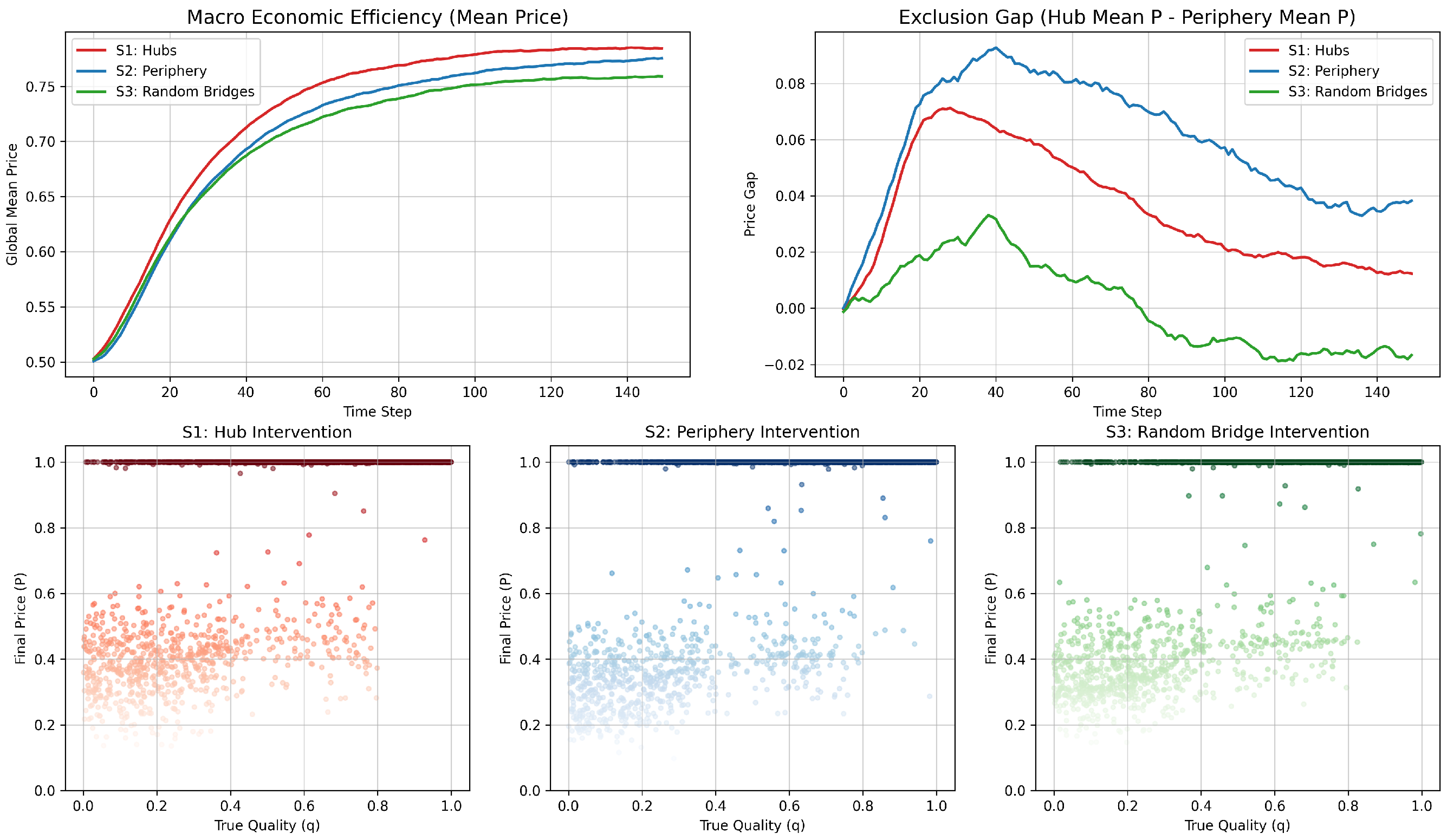
We evaluate three strategies (S1: Hub intervention, S2: Periphery intervention, S3: Random bridge intervention) for allocating limited intervention resources (10% of the entire network) to the “invisible fragmented state” formed on the adaptive network. Analysis of the time-series trends clearly demonstrated the strong asymmetry dependent on the target’s topology, as predicted in Hypothesis C. The macroscopic indicators in the late stage of the simulation are summarized in Table 2, and the corresponding time-series trends are visualized in Figure 3.
Table 2.
Comparison of Macro Indicators and Exclusion Gaps across Intervention Strategies.
Figure 3.
Comparison of computational results for the three intervention strategies. (Top Left) Time-series transition of macroeconomic efficiency (Global Mean Price). (Top Right) Transition of the Exclusion Gap between hubs and the periphery. (Bottom) Final price (P) distributions relative to true quality (q) for S1, S2, and S3. (Note: Image quality has been enhanced to a high-resolution vector format to enable clear observation of fine details.)
In-depth quantitative analysis of these figures reveals critical insights:
- The Trap of Top-Down Intervention (S1: Hub-Driven): Providing information transparency to the hub layer drove macroeconomic efficiency to the highest level (). However, this did not signify the recovery of the overall system. Because the transparent hubs could select high-quality nodes without observation noise, the formation of a privileged subgraph among high-degree agents was accelerated. Consequently, the invisible fragmentation concealed behind the macro indicators was preserved, effectively fixing the structural stratification against the excluded periphery.
- Layer Elevation via Bottom-Up Intervention (S2: Periphery-Driven): Although informational support for the periphery did not increase macro indicators to the extent of S1 (), it mitigated information starvation among peripheral agents. Notably, the price difference between hubs and the periphery (Exclusion Gap) stabilized at approximately . This intervention functioned as a systemic safety net, preventing peripheral prices from collapsing to zero—a state representing fatal “lemonization” or complete social exclusion.
- Dissolution of Fragmentation via Weak Ties (S3: Random Bridge Intervention): Strategy S3 exhibited the most pronounced phase transition. As a result of forcibly maintaining and rendering transparent random links (equivalent to Granovetter’s “weak ties”) deployed between closed echo chambers, the gap between hubs and the periphery rapidly decayed, ultimately converging to ≈−0.014 (effectively zero). This indicates that a small number of bypasses restored the flow of information, causing the entirely fragmented network to dissolve into a loose pooling equilibrium (a state of complete social inclusion).
Based on these results, it is mathematically and physically demonstrated that the optimal intervention strategy for closed pathologies such as scapegoating and collective ostracism is not the allocation of resources to highly influential agents, but rather the systemic protection of weak ties that bridge fragmented clusters.
3.4. Irreversibility of Social Exclusion and Hysteresis (Hypothesis D)
Although the effectiveness of random bridge intervention (S3) as an optimal strategy was proven, the preceding experiment assumed proactive intervention, conducted concurrently with the system’s temporal evolution. However, regarding scapegoating phenomena in real-world societies, third-party interventions are frequently required post-hoc, after the problem has manifested and structural fragmentation has fully progressed. Therefore, as the culmination of this study, we present Hypothesis D concerning hysteresis (history dependence) and the irreversibility of phase transitions in nonlinear dynamical systems.
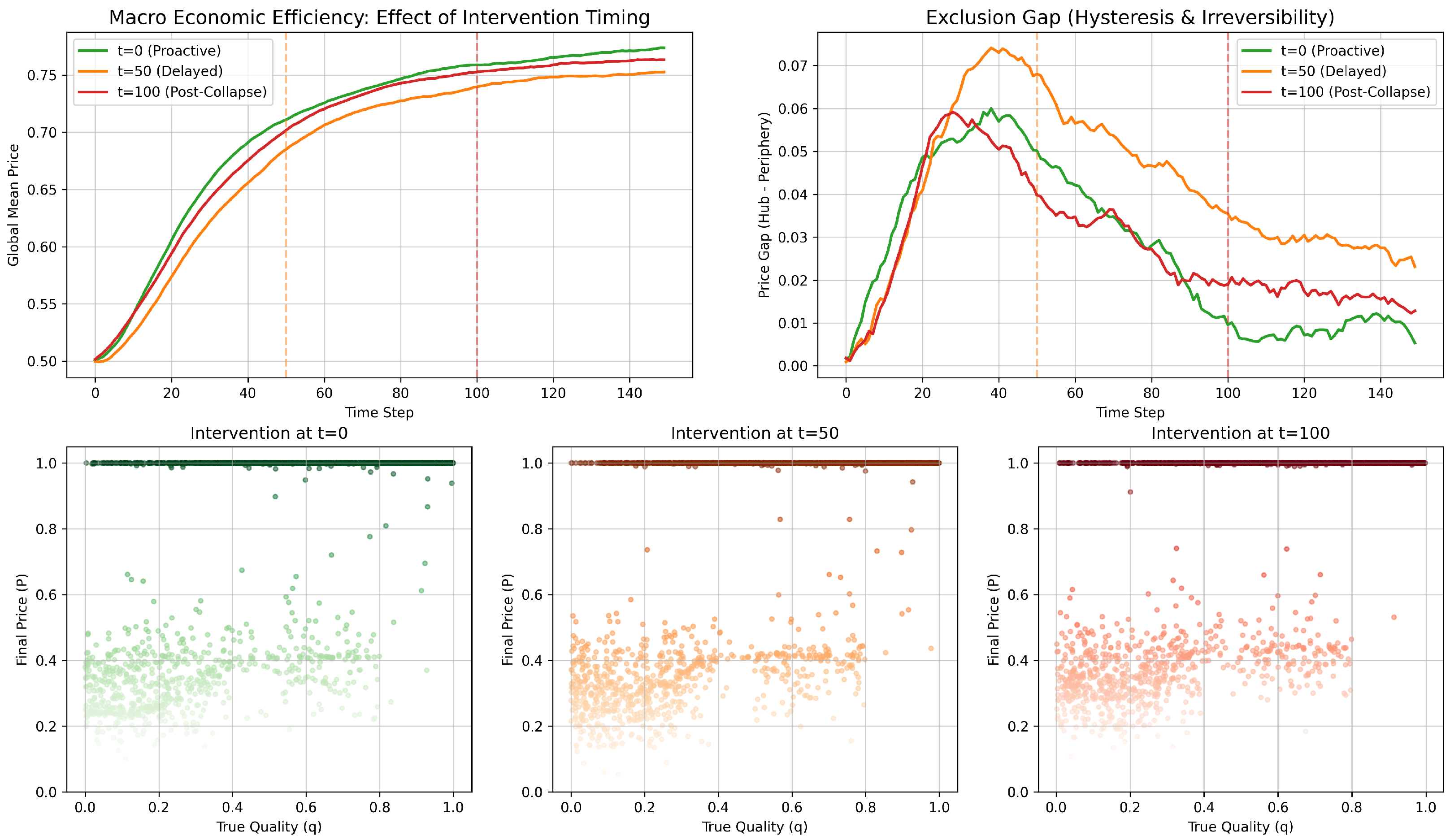
We define the timing of the random bridge intervention (S3) as a variable () and compare the efficacy across three phases: “initial,” “mid-term,” and “post-collapse (post-hoc)”. Table 3 summarizes the hysteresis effects.
Table 3.
Impact of Intervention Timing on System Reversibility and Hysteresis.
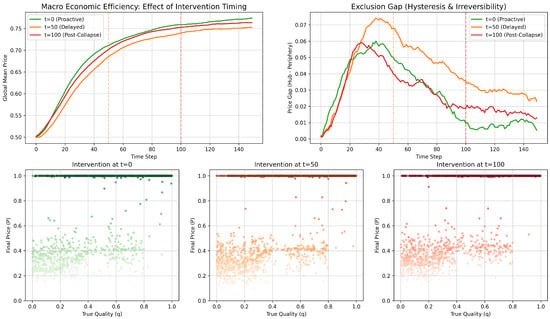
In computational terms, post-hoc interventions exhibit a relaxation phenomenon: macroeconomic indicators increase slightly immediately following the intervention, only to regress into a fragmented state because the system fails to overcome the critical threshold (Figure 4, Top Left). This demonstrates that once the social exclusion mechanism within an information ecosystem is fully structured, it constitutes an irreversible pathology (Figure 4, Top Right). It cannot be rectified simply by applying an equivalent expenditure of energy (intervention) in reverse.
Figure 4.
Computational analysis of intervention timing. (Top Left) Impact on global macroeconomic efficiency. (Top Right) The Exclusion Gap demonstrating hysteresis and irreversibility. (Bottom) Final price distributions (P) relative to true quality (q) at different intervention time steps. (Note: Image quality has been enhanced to a high-resolution format to enable clear observation of fine details.)
4. Discussion and Theoretical Implications
4.1. Validity of Applying Akerlof’s “Market for Lemons” Theory
Exclusionary phenomena in social groups, such as collective ostracism and scapegoating, have traditionally been analyzed qualitatively within the frameworks of social psychology and sociology. However, this study deliberately adopts Akerlof’s classical information economics theory, the “Market for Lemons” (Akerlof, 1970), as its analytical foundation, extending this model into a nonlinear network dynamical system.
At the root of collective ostracism and reputational damage lies extreme “information asymmetry,” where the “true value” (facts, persona, capabilities) of others is concealed, and only “perceived value” based on rumors and prejudice circulates. When the true quality q of a counterpart cannot be observed, agents are forced to rely on average evaluations (pooling equilibrium) driven by local peer pressure. The resulting process, where fair evaluations are driven out and only prejudice and exclusion remain in the system, is structurally identical to adverse selection in the lemon market (Akerlof, 1970). This structural isomorphism allows social pathologies to be reduced from moral or emotional issues to mathematically describable “mismatches between information and expected payoffs.”
Since its introduction, the lemon market theory has transcended pure economic theory to become a practical tool in marketing and institutional design. Mechanisms to overcome information asymmetry, such as signaling (Spence, 1973), screening (Stiglitz & Weiss, 1981), review systems, and quality assurance frameworks, have been implemented in real-world business and platform designs (Akerlof, 1970). The objective of this study is not merely the observation of social pathologies, but the derivation of optimal intervention strategies through a serious game approach (Zyda, 2005). In attempting to restore the system toward social inclusion through systemic engineering interventions, utilizing a mathematical model with established applicability in marketing constitutes a logical and practical choice to ensure intervention effectiveness.
Akerlof’s original work was a static, mean-field approximation model involving a small number of homogeneous agents. However, modern SNS and inter-firm transaction networks are massive complex systems characterized by scale-free properties and multi-layered hub structures (Barabási & Albert, 1999). This study extends and implements this classical theory as a “nonlinear dynamical system on adaptive networks” (Gross & Blasius, 2008; Holme & Newman, 2006) that incorporates the computational limits (cognitive noise) of agents (RUDATAScience, 2026; Simon, 1955). Consequently, it demonstrates that classical marketing theory serves as a paradigm capable of explaining macro-level socio-physical phenomena in contemporary complex information ecosystems, such as echo chamber formation (Del Vicario et al., 2016) and hysteresis with critical thresholds (Castellano et al., 2009; Dorogovtsev et al., 2008), thereby expanding theoretical connectivity in computational social science.
4.2. Comparison with Other Classical Game Theory Models and Rationale for Selection
In analyzing social dynamics, numerous previous studies have employed other classical game theory models, such as the Prisoner’s Dilemma and Public Goods Games (Easley & Kleinberg, 2010; Jackson, 2008). However, the selection of Akerlof’s “Market for Lemons” model in this study to elucidate social pathologies and derive intervention strategies is based on a structural rationale.
The Prisoner’s Dilemma and Public Goods Games describe dilemmas of action selection, specifically whether an agent chooses to cooperate or defect (free-ride). Conversely, the core of collective ostracism and reputational damage lies not in the counterpart’s actions, but in evaluative asymmetry, where the true attributes (quality) of a counterpart cannot be accurately observed, leading to evaluations based on prior expectations driven by prejudice or rumors. The lemon market theory is uniquely positioned among classical models to directly address the divergence between this hidden quality q and the offered price (expected payoff) P based on perceived quality, making it suitable for the formalization of prejudice-based social exclusion (Akerlof, 1970).
The detrimental nature of scapegoating and echo chamber phenomena lies in the exclusion of agents with sound, objective perspectives from the community, leaving agents with prejudiced ideologies to form homogeneous connections. The adverse selection process proven by the lemon market theory—where average market evaluations decline under incomplete information, forcing providers of high-quality goods to sever links and exit the market—is mathematically isomorphic to the nonlinear dynamics by which a community fractures into a polarized echo chamber (Del Vicario et al., 2016).
A key methodological component of the simulations in this study is the introduction of an adaptive network where agents autonomously update their relationships (Gross & Blasius, 2008). Building on the concept that agents act simultaneously as senders and buyers of information, the offered price P (representing the buyer’s internal belief of informational value) serves as the threshold for whether a transaction occurs. Concurrently, in our network science framework, this price functions as the expected payoff threshold determining whether a buyer maintains a link or severs it to rewire with another node (Jackson, 2008).
4.3. Symmetry Breaking Between Complete and Incomplete Information
The core of the mathematical model in this study lies in deriving the nonlinear “symmetry breaking” that occurs between the complete information game (Hypothesis A) and the incomplete information games (Hypotheses B–D) (Castellano et al., 2009; Dorogovtsev et al., 2008). In formalizing the impact of differing information states on the system, this approach distinguishes itself from traditional frameworks in game theory and information economics.
Frameworks such as Bayesian Nash equilibrium, typified by Spence’s signaling theory (Spence, 1973) and Stiglitz’s screening model (Stiglitz & Weiss, 1981), are widely recognized mechanisms for modeling information asymmetry. However, these classical theories predominantly describe static equilibrium states based on perfect rationality and given signaling costs. This study models agents as boundedly rational entities subject to computational limits (Simon, 1955), formulating a dynamical system where the incompleteness of information itself drives the dynamic decision-making of link rewiring. The distinction lies in redefining differences in information states not as signaling costs, but as the macroscopic temporal evolution of network topology (Gross & Blasius, 2008; Holme & Newman, 2006).
Most game theories on networks formulate link formation and severance based on the payoff matrices of action choices, such as cooperation or defection (Easley & Kleinberg, 2010; Jackson, 2008). In contrast, the trigger for severing a link in this model is not an agent’s strategic action, but rather the mismatch (dissatisfaction condition) between the counterpart’s true quality q and the perceived expected payoff (price P) derived from imperfect observation noise. Under information asymmetry, this mismatch does not occur randomly; it follows a property where observation noise scales inversely with the agent’s degree centrality. This enables the derivation of an asymmetric stratification mechanism—namely, the concentration of resources in hubs and exclusion into lemon echo chambers—that simple cooperation games do not capture.
In the complete information game (Hypothesis A), agents observe true quality without noise, freeing them from spatial constraints regarding their connections. Consequently, prices reach a separating equilibrium that perfectly matches true quality, dissolving the correlation between network topology and economic payoffs (restoration of symmetry). However, in the incomplete information game (Hypothesis B), agents rely on localized neighborhood information, resulting in strong topological dependency. As a result, an irreversible structural division (symmetry breaking) self-organizes within the system, separating it into a privileged subgraph of hubs and a peripheral echo chamber (Del Vicario et al., 2016). In this manner, this study mathematically formalizes information asymmetry not merely as a market failure, but as a driving parameter for phase transitions, wherein social systems transition from homogeneous states to hierarchical, divided states (Castellano et al., 2009; Dorogovtsev et al., 2008).
4.4. Literature Review: Economics, Network Science, and Informational Health
The mechanism by which information asymmetry leads to the collapse of markets and communities was formalized as the foundation of information economics by Akerlof’s “Market for Lemons” theory (Akerlof, 1970). Regarding the distortion of information and the formation of extreme beliefs within social groups, the fundamental laws of rumor point to the reinforcement of preconceptions (echo chambers) within groups. The propagation of information and the competitive structure of markets unfold not in homogeneous spaces but on complex network topologies. The discovery of scale-free networks by Barabási and Albert (1999) revealed the asymmetric influence that a few hub nodes exert on the entire system. Furthermore, “The Strength of Weak Ties” proposed by Granovetter (1973) is a critical concept that prevents the rigidification of the system by forming information bypasses between closed clusters.
To deepen our theoretical grounding, it is essential to discuss fundamental economics papers on information cascades, such as Banerjee (1992) and Bikhchandani et al. (1992), which explain how sequential decision-making under uncertainty leads to herd behavior and collective ostracism. Additionally, the role of network structures in shaping economic outcomes is perfectly encapsulated by Jackson (2008). Furthermore, while this paper focuses on informational inequality, it is mathematically contiguous with economic frameworks analyzing income or wealth inequality and social division; models such as Esteban and Ray (2011) on linking conflict to inequality and polarization, and Sethi and Somanathan (2004) on inequality and segregation, illustrate how segregated network architectures naturally entrench systemic disparities.
The widespread use of social media has accelerated the memetic self-replication of information and caused an increase in cognitive load due to information overload. In particular, social isolation and decreased well-being resulting from the excessive use of SNS (Primack et al., 2018; RIKEN, 2024), looksmaxxing associated with the desire for approval and lookism, and information fatigue typified by doomscrolling have manifested as contemporary mental health challenges. As an intervention approach to these complex socio-psychological issues, “serious games” are becoming established as effective measures (Zyda, 2005). This study extends classical equilibrium theory into a nonlinear dynamical system on adaptive networks (RUDATAScience, 2026) to derive optimal intervention strategies against these pathologies.
4.5. Theoretical Framework and Problem Formulation
Akerlof’s theory (Akerlof, 1970) effectively explained adverse selection, but assumed a static equilibrium. This study introduced “cognitive noise,” which occurs when the computational cost required to filter information exceeds an agent’s processing capacity as the market size N scales up (Simon, 1955). In networked societies, hub agents with numerous connections can reduce this noise, whereas peripheral agents with sparse connections are exposed to high noise levels. We established this uneven distribution of information-gathering capacity as the model’s foundation.
Social exclusion is formalized as a process of network topology transformation driven by autonomous “link severance” and “assortative rewiring” among agents due to unfulfilled expected payoffs. Applying the policy simulation framework from serious games (Zyda, 2005), we formulated an optimization problem: “Under limited resources, which parts of the network should be targeted for intervention?” Potential intervention strategies include top-down intervention, bottom-up intervention, and random bridge intervention (Granovetter, 1973). From a physics perspective, it is notable that phase transitions in complex networks are often accompanied by hysteresis (Barabási & Albert, 1999). Once the structure of social exclusion is solidified, it is expected to exhibit irreversibility. Based on this theoretical framework, we defined Hypotheses A through D, which were simulated utilizing large-scale tensor operations (RUDATAScience, 2026).
5. Evaluation of Results Against Hypotheses A Through D
To provide clarity on the distinct mechanisms governing social exclusion, we explain the results for the four core hypotheses in alphabetical order:
5.1. Hypothesis A: Restoration of Symmetry
Under a “complete information state” where information asymmetry is entirely resolved through technological interventions, the network centrality of agents loses its advantage in price formation. The market transitions into a separating equilibrium completely independent of topology. To verify this hypothesis, we conducted a baseline computational simulation where cognitive noise was universally set to zero (). The computational results (Figure 1) demonstrated that when observation noise is entirely removed, the system restores topological symmetry, perfectly mapping the final price to true quality () across all agents without any spatial or centrality-based bias.
5.2. Hypothesis B: Symmetry Breaking and Echo Chambers
Under incomplete information, in an adaptive network environment where agents autonomously select relationships, an irreversible division (invisible social exclusion) is self-organized. The adaptive rewiring leads to Symmetry Breaking, fracturing the system into a high-quality “privileged subgraph” monopolized by hubs and a “lemon echo chamber” where disadvantaged agents are trapped. Our simulations showed that while the Giant Connected Component superficially remained at ≈1.0, the internal economic disparity heavily diverged (Centola, 2010; Garimella et al., 2018).
5.3. Hypothesis C: Optimal Intervention Strategy
Regarding the optimal intervention for this divided structure under resource constraints (10% of nodes), providing informational support to influential agents (hubs) functioned as a “top-down trap” that maximized the exclusion gap. Conversely, the forced protection of “weak ties” (random bridges) connecting closed clusters constituted the mathematically optimal solution (Granovetter, 1973). The random bridge intervention successfully dissolved fragmentation, facilitating a phase transition toward social inclusion and neutralizing the price gap to ≈−0.014 (Centola et al., 2018; Gao et al., 2016; Majdandzic et al., 2014).
5.4. Hypothesis D: Proof of Irreversibility and Hysteresis
These social exclusion dynamics exhibit strong hysteresis (history dependence). Interventions conducted “post-hoc,” after crossing a distinct tipping point (), triggered an irreversible phase transition. The system exhibited a relaxation phenomenon where it failed to be restored even with the allocation of identical resources, proving that delayed intervention leads to an irreparable structural pathology.
6. Computational Validity and Logical Determinacy of the Conclusions
The conclusions derived in this study—the trap of hub intervention, the optimality of random bridges (weak ties), and the irreversibility of post-hoc intervention (hysteresis)—are not coincidental artifacts of the simulation. Rather, they are logical consequences mathematically determined by the four essential simulation conditions and their computational processes, which were introduced to model real-world social pathologies. This section structurally elucidates why each condition is indispensable and how it inevitably derives these conclusions.
6.1. Essential Condition 1: Cognitive Noise Inversely Proportional to Network Centrality
Agent observation noise was incorporated into the tensor operations not as perfect information (), but as a function inversely proportional to the node’s degree , expressed as . In contemporary large-scale SNS, individuals are boundedly rational and cannot process all available information. While highly connected agents (hubs) with strong information-gathering capabilities can reduce noise, peripheral agents are exposed to significant noise, such as misinformation and rumors. Implementing this information asymmetry as a structural rule is indispensable for replicating the modern lemon market. The inclusion of this condition computationally induces dynamics where hubs accurately select high-quality nodes, whereas peripheral nodes, affected by noise, are systematically left with low-quality nodes. Consequently, rather than a homogeneous market collapse (as in the classical lemon market), the self-organization of an asymmetric structural disparity (social exclusion)—characterized by hub monopolization and peripheral lemonization (echo chambers)—is mathematically determined.
6.2. Essential Condition 2: Adaptive Rewiring Based on Expected Payoff Mismatch
Instead of utilizing a static network, a dynamic updating rule was introduced. At each time step, if the counterpart’s true quality q does not meet the expected payoff based on the paid price P (dissatisfaction condition: ), the edge is severed with probability via matrix operations and rewired to another node. The core mechanism of collective ostracism and scapegoating lies in the autonomous severance and isolation of relationships driven by dissatisfaction and distrust. This condition is essential because static models with fixed topologies cannot capture this exclusion process. Even amid successive edge severances, agents continually seek new connections, maintaining a Giant Connected Component (GCC) ratio of ≈1.0. However, internally, assortative rewiring is completed. This mathematically ensures the establishment of “invisible social exclusion”, where the network appears physically connected on the surface but is completely fragmented economically and informationally.
6.3. Essential Condition 3: Strict Resource Constraint at 10% of the System
Interventions such as information transparency () and forced link protection were not applied unconditionally. They were implemented as an array mask triggered only under a strict budget constraint of 10% of the total agents (). With infinite resources, the problem could be trivially solved by providing perfect information to all agents. However, in real-world platform management and policy interventions, targets for monitoring and support are always limited, making this constraint a necessary condition for practical applicability. Allocating the limited 10% resource to hubs allows them to discard vulnerable nodes more efficiently without noise, thereby computationally maximizing disparity (the top-down trap). Conversely, forcibly protecting 10% as random weak ties establishes information bypasses between fragmented clusters. The imposition of this strict resource constraint isolates the protection of weak ties (random bridges) as the unique mathematical optimal solution for restoring system-wide health.
6.4. Essential Condition 4: Post-Hoc Intervention via Delayed Trigger
An event-driven trigger, utilizing a Heaviside step function, was implemented to delay the activation of the optimal intervention strategy (forced weak ties) from the onset of time evolution () to a post-hoc stage where fragmentation has already progressed (). Public or organizational interventions against reputational damage and scapegoating typically occur post-hoc, after the issue has escalated. Incorporating this delay element is necessary to evaluate the practical limitations of real-world intervention policies. At , the price gap (Exclusion Gap) between hubs and the periphery has widened to an irreparable level. Therefore, even if 10% of random bridges are forcibly connected, all other autonomous rewiring is rejected due to price mismatches (the dissatisfaction condition). This computational structure mathematically defines the existence of an irreversible phase transition (hysteresis), wherein post-hoc interventions only cause a minor, transient recovery spike before the system is pulled back into its fragmented state via relaxation.
7. Conclusions
This study extended the classical “Market for Lemons” theory (Akerlof, 1970) into a nonlinear dynamical system on adaptive networks to elucidate the macro-level phase transitions of social exclusion, such as scapegoating and collective ostracism. The findings derived from our large-scale multi-agent simulations are not artifacts of chance; they are mathematical and logical consequences of translating cognitive limits and information asymmetry into tensor operations. Specifically, we established the following structural and numerical imperatives:
- Mathematical Inevitability of Structural Exclusion:By modeling bounded rationality as cognitive noise inversely proportional to network centrality, and ostracism as autonomous edge rewiring driven by expected payoff mismatches, we demonstrated that a homogeneous market collapse is structurally precluded. Instead, the system necessarily self-organizes into an irreversible structural division. The internal dynamics fracture the network into a privileged subgraph of highly connected hubs monopolizing high-quality resources, contrasted with a peripheral “lemon echo chamber” where low-quality assets accumulate. This mathematically formalizes invisible social exclusion, a phenomenon robustly consistent with empirical evidence of homophily-driven echo chambers across major social media platforms (Cinelli et al., 2021) and the emergence of polarized states in adaptive network models (Baumann et al., 2020).
- The Trap of Hub Intervention and the Optimality of Weak Ties:Evaluating intervention strategies under a strict resource constraint limiting interventions to 10% of the total agents revealed a stark topological asymmetry. Providing informational transparency to hubs functions as a trap; it enables them to execute exclusionary rewiring without noise, maximizing the macroeconomic indicator (Global Mean Price ) but permanently exacerbating systemic inequality. Conversely, the forced maintenance and protection of 10% random “weak ties” successfully created vital structural bypasses across disconnected clusters, rapidly decaying the price gap to ΔP ≈ −0.014. This proves that safeguarding random bridges is the mathematically optimal solution to dissolve fragmentation and facilitate social inclusion, directly addressing the algorithmic amplification of polarization caused by top-down link recommendations (Santos et al., 2021).
- Scapegoating as a Critical Phenomenon and Hysteresis:By introducing a delayed event-driven trigger () to simulate post-hoc remediation, we demonstrated that the mechanism of social exclusion exhibits strong hysteresis effects governed by a distinct tipping point (). Once the exclusion gap widens beyond this critical threshold, identical resource expenditure fails to restore the system to its baseline state. The network merely exhibits a transient recovery spike before succumbing to a relaxation phenomenon driven by overwhelming price mismatches, confirming the presence of an irreversible phase transition characterizing collective ostracism, a dynamic corroborated by the statistical physics of critical social phenomena (Castellano et al., 2009).
These definitive findings establish that the collapse dynamics outlined in the classical lemon market (Akerlof, 1970) serve as a generalized model for explaining contemporary collective ostracism driven by information cascades. Consequently, safeguarding informational health against extreme polarization (Del Vicario et al., 2016) cannot be achieved through post-hoc, moralistic remediations. Our analysis highlights the absolute necessity of executing early, pre-emptive interventions prior to critical thresholds and the systemic preservation of structural bypasses. This approach provides a mathematically grounded framework supporting recent calls for behaviorally-informed architectural modifications (Lorenz-Spreen et al., 2020) and the broader imperative for the proactive stewardship of global collective behavior in digital ecosystems (Bak-Coleman et al., 2021).
Funding
This research received no external funding.
Institutional Review Board Statement
Not applicable.
Informed Consent Statement
Not applicable.
Data Availability Statement
The Python 3.10 code and simulation frameworks supporting the findings of this study are openly available on GitHub at the following repository: https://github.com/RUDATAScience/-simulate_lemon_market_large_scale (accessed on 5 July 2026).
Acknowledgments
During the preparation of this manuscript, the authors used generative AI (Google Gemini 1.5 Pro) to assist with LaTeX code formatting, structural reorganization, and proofreading for English language improvement. After using this tool, the authors carefully reviewed and edited the content as needed and take full responsibility for the final content of the publication. In conducting this research, we would like to express our deepest gratitude to our co-researchers and families, who provided invaluable advice and suggestions regarding the formulation of the mathematical models and the validity of the computational simulations. We would also like to extend our heartfelt thanks to our colleagues at Rikkyo University and GrooveOn, who supported our series of research activities.
Conflicts of Interest
The author declares no conflicts of interest.
Abbreviations
The following abbreviations are used in this manuscript:
| AHP | Analytic Hierarchy Process |
| KL | Kullback–Leibler |
| NLP | Natural Language Processing |
| ABM | Agent-Based Model |
| CLT | Central Limit Theorem |
Appendix A. Computational Environment and High-Speed Reproducibility
To ensure mathematical reproducibility, the specific computational environment and execution metrics are detailed. The simulations were executed on a standard cloud computing instance.
Table A1.
Hardware Specifications for Large-Scale Simulation.
References
- Akerlof, G. A. (1970). The market for ‘lemons’: Quality uncertainty and the market mechanism. The Quarterly Journal of Economics, 84, 488–500. [Google Scholar] [CrossRef] [Scilit]
- Aral, S., & Van Alstyne, M. (2011). The diversity-bandwidth trade-off. American Journal of Sociology, 117, 90–171. [Google Scholar] [CrossRef] [Scilit]
- Bak-Coleman, J. B., Alfano, M., Barfuss, W., Bergstrom, C. T., Centeno, M. A., Couzin, I. D., Donges, J. F., Galesic, M., Gersick, A. S., Jacquet, J., Kao, A. B., Moran, R. E., Romanczuk, P., Rubenstein, D. I., Tombak, K. J., Van Bavel, J. J., & Weber, E. U. (2021). Stewardship of global collective behavior. Proceedings of the National Academy of Sciences, 118, e2025764118. [Google Scholar] [CrossRef] [Scilit] [PubMed]
- Banerjee, A. V. (1992). A simple model of herd behavior. Quarterly Journal of Economics, 107(3), 797–817. [Google Scholar] [CrossRef] [Scilit]
- Barabási, A.-L., & Albert, R. (1999). Emergence of scaling in random networks. Science, 286, 509–512. [Google Scholar] [CrossRef] [Scilit] [PubMed]
- Baumann, F., Lorenz-Spreen, P., Sokolov, I. M., & Starnini, M. (2020). Modeling echo chambers and polarization dynamics in social networks. Physical Review Letters, 124, 048301. [Google Scholar] [CrossRef] [Scilit] [PubMed]
- Bikhchandani, S., Hirshleifer, D., & Welch, I. (1992). A Theory of Fads, Fashion, Custom, and Cultural Change as Informational Cascades. Journal of Political Economy, 100(5), 992–1026. [Google Scholar] [CrossRef] [Scilit]
- Boccaletti, S., Latora, V., Moreno, Y., Chavez, M., & Hwang, D.-U. (2006). Complex networks: Structure and dynamics. Physics Reports, 424, 175–308. [Google Scholar] [CrossRef] [Scilit]
- Castellano, C., Fortunato, S., & Loreto, V. (2009). Statistical physics of social dynamics. Reviews of Modern Physics, 81, 591–646. [Google Scholar] [CrossRef] [Scilit]
- Centola, D. (2010). The spread of behavior in an online social network experiment. Science, 329, 1194–1197. [Google Scholar] [CrossRef] [Scilit] [PubMed]
- Centola, D., Becker, J., Brackbill, D., & Baronchelli, A. (2018). Experimental evidence for tipping points in social convention. Science, 360, 1116–1119. [Google Scholar] [CrossRef] [Scilit] [PubMed]
- Cinelli, M., De Francisci Morales, G., Galeazzi, A., Quattrociocchi, W., & Starnini, M. (2021). The echo chamber effect on social media. Proceedings of the National Academy of Sciences, 118, e2023301118. [Google Scholar] [CrossRef] [Scilit] [PubMed]
- Del Vicario, M., Bessi, A., Zollo, F., Petroni, F., Scala, A., Caldarelli, G., Stanley, H. E., & Quattrociocchi, W. (2016). The spreading of misinformation online. Proceedings of the National Academy of Sciences, 113, 554–559. [Google Scholar] [CrossRef] [Scilit] [PubMed]
- Dorogovtsev, S. N., Goltsev, A. V., & Mendes, J. F. F. (2008). Critical phenomena in complex networks. Reviews of Modern Physics, 80, 1275–1335. [Google Scholar] [CrossRef] [Scilit]
- Easley, D., & Kleinberg, J. (2010). Networks, crowds, and markets: Reasoning about a highly connected world. Cambridge University Press. [Google Scholar]
- Esteban, J., & Ray, D. (2011). Linking conflict to inequality and polarization. American Economic Review, 101(4), 1345–1374. [Google Scholar] [CrossRef] [Scilit]
- Gao, J., Barzel, B., & Barabási, A.-L. (2016). Universal resilience patterns in complex networks. Nature, 530, 307–312. [Google Scholar] [CrossRef] [Scilit] [PubMed]
- Garimella, K., Gionis, A., Morales, G. D. F., & Mathioudakis, M. (2018). Political discourse on social media: Echo chambers, gatekeepers, and the price of bipartisanship. In Proceedings of the 2018 world wide web conference (pp. 913–922). Association for Computing Machinery (ACM). [Google Scholar]
- Granovetter, M. S. (1973). The strength of weak ties. American Journal of Sociology, 78, 1360–1380. [Google Scholar] [CrossRef] [Scilit] [PubMed]
- Gross, T., & Blasius, B. (2008). Adaptive coevolutionary networks: A review. Journal of the Royal Society Interface, 5, 259–271. [Google Scholar] [CrossRef] [Scilit] [PubMed]
- Holme, P., & Newman, M. E. J. (2006). Nonequilibrium phase transition in the coevolution of networks and opinions. Physical Review E, 74, 056108. [Google Scholar] [CrossRef] [Scilit] [PubMed]
- Jackson, M. O. (2008). Social and economic networks. Princeton University Press. [Google Scholar]
- Liu, Y.-Y., Slotine, J.-J., & Barabási, A.-L. (2011). Controllability of complex networks. Nature, 473, 167–173. [Google Scholar] [CrossRef] [Scilit] [PubMed]
- Lorenz-Spreen, P., Lewandowsky, S., Sunstein, C. R., & Hertwig, R. (2020). How behavioural sciences can promote truth, autonomy and democratic discourse online. Nature Human Behaviour, 4, 1102–1109. [Google Scholar] [CrossRef] [Scilit] [PubMed]
- Majdandzic, A., Podobnik, B., Buldyrev, S. V., Kenett, D. Y., Havlin, S., & Stanley, H. E. (2014). Spontaneous recovery in dynamical networks. Nature Physics, 10, 34–38. [Google Scholar] [CrossRef] [Scilit]
- Primack, B. A., Shensa, A., Sidani, J. E., Whaite, E. O., Lin, L. Y., Rosen, D., Colditz, J. B., Radovic, A., & Miller, E. (2018). Social media use and perceived social isolation among young adults in the U.S. American Journal of Preventive Medicine, 53(1), 1–8. [Google Scholar] [CrossRef] [Scilit] [PubMed]
- RIKEN. (2024). Uncovering the impact of social media on mental health. Available online: https://www.riken.jp/press/2024/20241220_2/index.html (accessed on 5 July 2026).
- RUDATAScience. (2026). simulate_lemon_market_large_scale. GitHub Repository. Available online: https://github.com/RUDATAScience/-simulate_lemon_market_large_scale (accessed on 5 July 2026).
- Santos, F. P., Lelkes, Y., & Levin, S. A. (2021). Link recommendation algorithms and dynamics of polarization in online social networks. Proceedings of the National Academy of Sciences, 118, e2102141118. [Google Scholar] [CrossRef] [Scilit] [PubMed]
- Scheffer, M., Bascompte, J., Brock, W. A., Brovkin, V., Carpenter, S. R., Dakos, V., Held, H., van Nes, E. H., Rietkerk, M., & Sugihara, G. (2009). Early-warning signals for critical transitions. Nature, 461, 53–59. [Google Scholar] [CrossRef] [Scilit] [PubMed]
- Sethi, R., & Somanathan, R. (2004). Inequality and segregation. Journal of Political Economy, 112(6), 1296–1321. [Google Scholar] [CrossRef] [Scilit]
- Simon, H. A. (1955). A Behavioral model of rational choice. The Quarterly Journal of Economics, 69, 99–118. [Google Scholar] [CrossRef] [Scilit]
- Spence, M. (1973). Job market signaling. The Quarterly Journal of Economics, 87, 355–374. [Google Scholar] [CrossRef] [Scilit]
- Stiglitz, J. E., & Weiss, A. (1981). Credit rationing in markets with imperfect information. The American Economic Review, 71, 393–410. [Google Scholar]
- Valente, T. W. (2012). Network interventions. Science, 337, 49–53. [Google Scholar] [CrossRef] [Scilit] [PubMed]
- Zyda, M. (2005). From visual simulation to virtual reality to games. Computer, 38, 25–32. [Google Scholar] [CrossRef] [Scilit]

Disclaimer/Publisher’s Note: The statements, opinions and data contained in all publications are solely those of the individual author(s) and contributor(s) and not of MDPI and/or the editor(s). MDPI and/or the editor(s) disclaim responsibility for any injury to people or property resulting from any ideas, methods, instructions or products referred to in the content. |
© 2026 by the author. Licensee MDPI, Basel, Switzerland. This article is an open access article distributed under the terms and conditions of the Creative Commons Attribution (CC BY) license.