


Abstract
Background: Standard consumer theory treats preferences as fixed primitives and demand as the solution to an individual optimisation problem; we instead model consumption styles as heritable strategies whose prevalence is shaped by selection and experimentation, and ask when status competition produces an over-consumption trap. Methods: We embed a reference-dependent payoff—private utility concave in own consumption, a positional benefit proportional to consumption relative to the social mean, a financial-fragility cost, and a loss-averse relative-deprivation term—into replicator–mutator dynamics over three strategies (frugal, balanced, conspicuous). Results: Status concern induces strategic complementarity, so that a rising consumption norm penalises moderate consumers and makes imitation self-reinforcing. For intermediate status weight, the system is bistable: an efficient balanced equilibrium and a Pareto-inferior conspicuous trap are separated by a tipping threshold, and the width of the bistable window equals the deprivation weight, producing hysteresis in the consumption norm. The trap persists even though the positional benefit nets to zero in any monomorphic state. Mutation—behavioural experimentation—shrinks the bistable window and can dissolve the lock-in. Conclusions: Reference-dependent demand is better captured by evolutionary dynamics than by static equilibrium, and positional externalities can lock a population into self-defeating over-consumption that interventions on the deprivation or fragility channel may unlock.
1. Introduction
The canonical theory of the consumer rests on two assumptions that the empirical literature has steadily eroded. The first is that preferences are fixed primitives, given prior to and independent of the social environment. The second is that observed demand is the outcome of an individual optimisation problem solved against those primitives. Yet a large body of evidence indicates that the utility a household derives from consumption depends not only on what it consumes in absolute terms but on how that consumption compares with the consumption of others (Veblen, 1899; Duesenberry, 1949; Hirsch, 1976; Frank, 1985; Frank et al., 2014). From Veblen’s account of conspicuous consumption (Veblen, 1899) to Duesenberry’s relative-income hypothesis (Duesenberry, 1949) and Hirsch’s analysis of positional goods (Hirsch, 1976), economists have repeatedly argued that consumption is, in part, a contest for relative standing.
If consumption is partly positional, two consequences follow that sit awkwardly with the standard framework. First, the object that enters utility—consumption relative to a moving social reference—is endogenous to the aggregate behaviour of the population, so a household’s best response depends on what everyone else is doing. Demand becomes a strategic object rather than a parametric one. Second, the resulting interaction has the structure of an externality: each household’s spending raises the reference point against which others measure themselves, and the private return to keeping up is purchased at a social cost that no single agent internalises (Frank, 1985; Frank et al., 2014). Frank et al. (2014) describe the macroscopic version of this mechanism as an expenditure cascade, in which spending at the top of the distribution shifts the consumption norms of those below.
This paper takes the positional view of consumption seriously and asks what it implies once we drop the assumption that consumers are fixed optimisers. We treat broad consumption styles—thrift, balanced spending, and conspicuous display—as strategies carried by households and transmitted through imitation, socialisation, and social learning. The prevalence of each style in the population is then governed not by a once-and-for-all equilibrium condition but by a dynamic in which strategies that yield higher payoffs spread at the expense of those that do not, subject to a steady trickle of experimentation. This is the logic of evolutionary game theory (Maynard Smith, 1982; Taylor & Jonker, 1978; Hofbauer & Sigmund, 1998; Page & Nowak, 2002), and the natural law of motion is the replicator–mutator equation (Page & Nowak, 2002; Komarova et al., 2001), which combines payoff-monotone selection with mutation between strategies.
The evolutionary reading of preferences is not merely a metaphor. A growing literature provides microfoundations for why relative concerns might be selected for in the first place: when resources, mates, or rank are allocated by relative position, organisms that care about relative standing out-reproduce those that do not, so positional preferences are an evolutionarily stable trait rather than a cognitive error (Robson, 2001; Robson & Samuelson, 2011; Rayo & Becker, 2007; Samuelson, 2004; Netzer, 2009). Robson and Samuelson (2011) survey the evolutionary foundations of preferences; Rayo and Becker (2007) show how relative, reference-dependent utility can emerge as an optimal incentive scheme designed by selection; and Samuelson (2004) derives relative-consumption effects from an information-based account of status. We do not rederive these foundations here. We take as given that consumers act as if they value relative consumption, and we study the population dynamics that this generates.
Our central question is the following. Under relative-consumption and status externalities, which consumption strategies become evolutionarily stable, and under what conditions does a population settle into a welfare-enhancing equilibrium rather than an over-consumption trap? By an over-consumption trap, we mean an evolutionarily stable state in which the prevailing strategy delivers lower material welfare to every household than an available alternative, yet no individual gains by deviating, because deviation forfeits relative standing.
We obtain four results. First, status concern makes the consumption game one of strategic complementarity: the relative payoff to conspicuous consumption is increasing in the share of the population that already consumes conspicuously, because a higher mean consumption deepens the relative deprivation of those who hold back (Proposition 1). Second, for an intermediate range of the status weight, the dynamics are bistable, with an efficient balanced equilibrium and a conspicuous trap, each locally stable and separated by an unstable threshold; the width of this bistable window is exactly the weight a household places on relative deprivation, which generates hysteresis in the social consumption norm (Proposition 2, Figure 1 and Figure 2). The bistability that drives our results operates on the balanced–conspicuous margin; the frugal strategy serves as the low-consumption reference that anchors the deprivation channel, and its evolutionary fate—domination by the balanced type under the baseline calibration—is itself one of the model’s outputs rather than an assumption. Third, the conspicuous trap is generically Pareto-inferior, because in any monomorphic state the positional benefit nets to zero—everyone is at the mean—so the only durable effects of an arms race in spending are the foregone private surplus and the financial fragility it leaves behind (Proposition 3). Fourth, on the balanced–conspicuous margin that governs the trap, mutation—interpreted as behavioural experimentation and imperfect transmission—narrows the bistable window and, beyond a critical rate, dissolves it; numerical integration of the full three-strategy dynamics confirms that the same conclusion carries over to the complete system (Proposition 4).
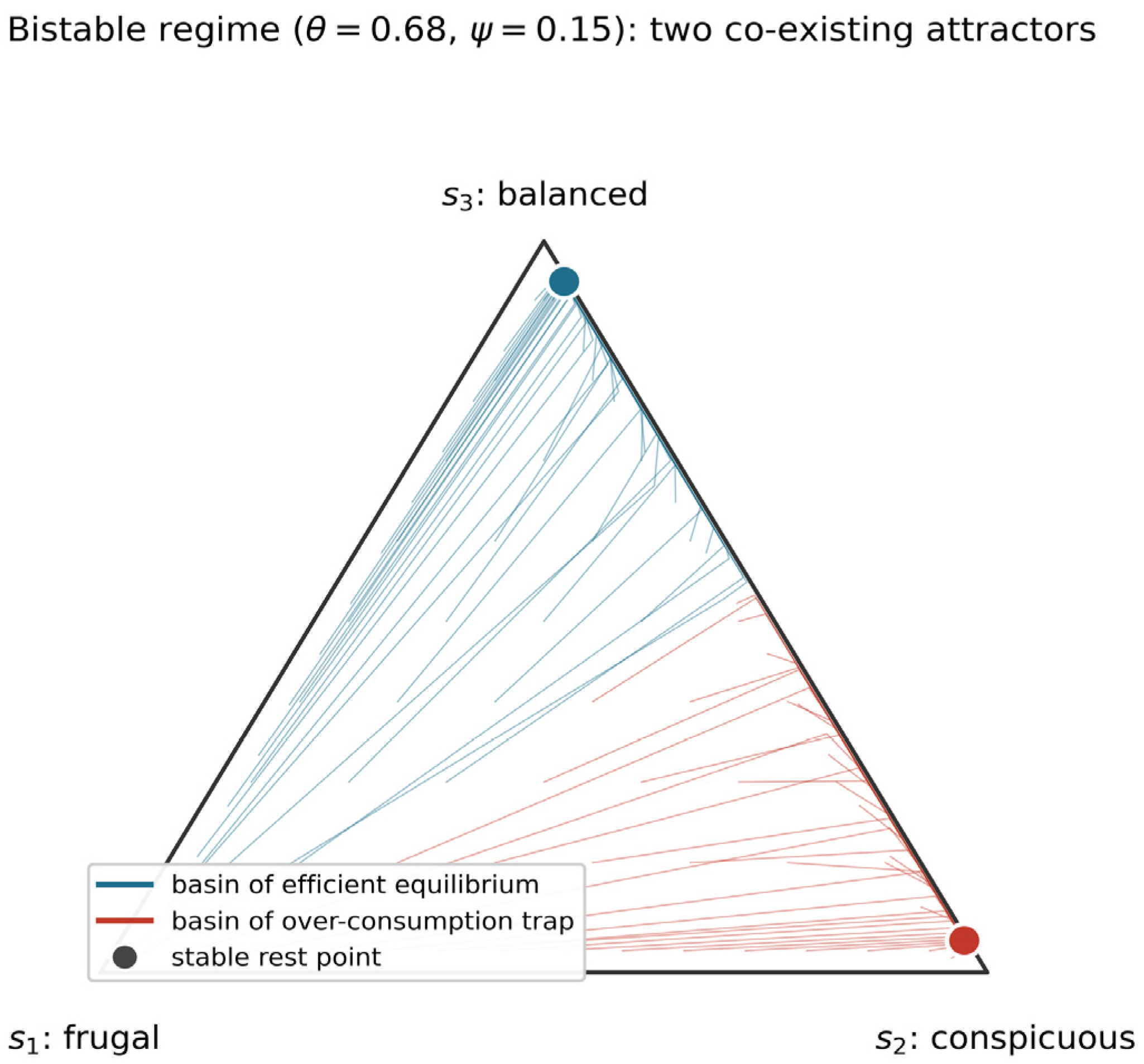
Figure 1.
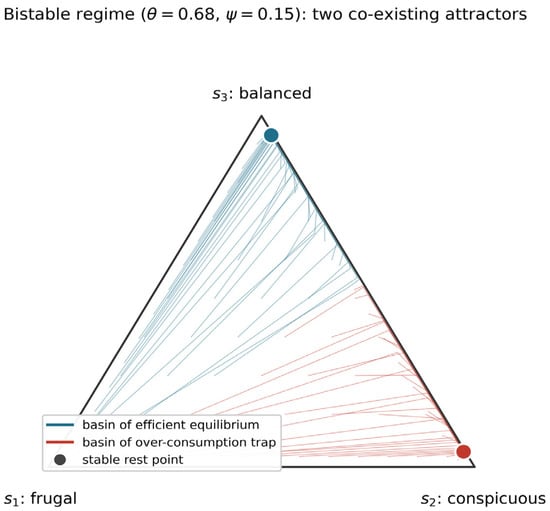
Phase portrait on the strategy simplex in the bistable regime (θ = 0.68, ψ = 0.15). Vertices correspond to monomorphic populations of frugal (s1), conspicuous (s2), and balanced (s3) households. Trajectories shaded by terminal basin: blue trajectories converge to the efficient balanced equilibrium, red trajectories to the over-consumption trap. The two basins are separated by an unstable threshold, so the long-run norm is history-dependent.
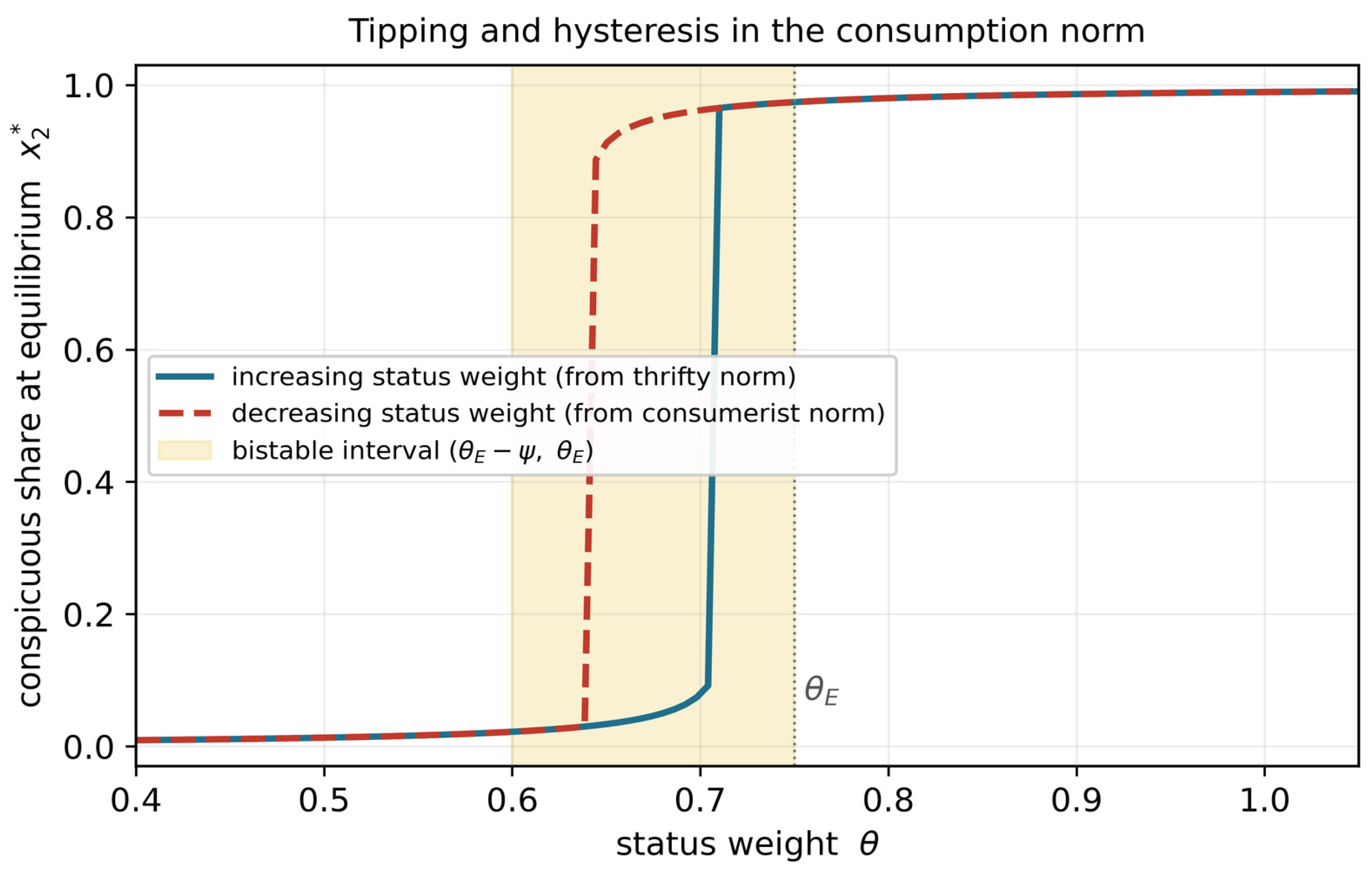
Figure 2.
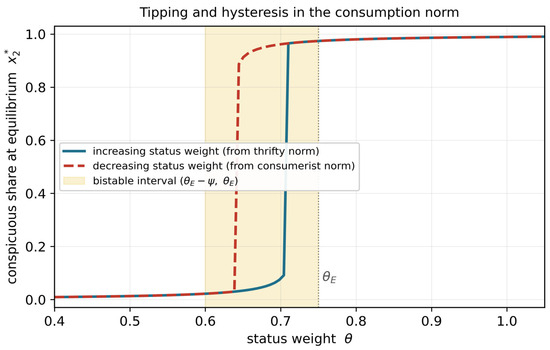
Tipping and hysteresis in the consumption norm. The equilibrium conspicuous share x2* is shown as the status weight θ is increased starting from a thrifty norm (solid) and decreased starting from a consumerist norm (dashed). The mismatch between the upward and downward jumps is a hysteresis loop; the shaded band is the analytic bistable interval (θE − ψ, θE).
This paper relates to three strands of work. It shares with the positional-goods literature (Veblen, 1899; Duesenberry, 1949; Hirsch, 1976; Frank, 1985, 2005; Frank et al., 2014) the premise that relative consumption matters but replaces the comparative-statics of a fixed game with explicit population dynamics. It shares with evolutionary and population-game theory (Maynard Smith, 1982; Taylor & Jonker, 1978; Hofbauer & Sigmund, 1998; Page & Nowak, 2002; Komarova et al., 2001; Sandholm, 2010) the dynamic apparatus, but applies it to a consumption externality rather than to abstract coordination or to biological contests. Additionally, it connects to the macroeconomics of habit formation and “catching up with the Joneses” (Abel, 1990; Carroll et al., 2000), where relative consumption shapes savings and asset prices, by supplying an evolutionary account of how a high-consumption norm can become entrenched.
2. Results
We analyse the dynamics in three steps. Section 2.1 isolates the balanced–conspicuous margin, where the action is, and establishes strategic complementarity. Section 2.2 derives the bistable regime and the over-consumption trap and shows that the trap is inefficient. Section 2.3 adds mutation and reports the full three-strategy phase portrait and the hysteresis it implies. Throughout, we use the calibration in Table 1, chosen to place the model squarely in the bistable regime; the calibration shifts the location of the bistable regime but not its existence, as we verify in the sensitivity analysis at the end of this section.
Table 1.
Baseline calibration. Consumption levels are expressed as fractions of income ($y = 1$). The fragility cost rises with the consumption–income ratio.
2.1. Strategic Complementarity on the Balanced–Conspicuous Margin
Consider the payoff difference between conspicuous and balanced consumption when the population is some mix of the two, with a frequency x2 of conspicuous consumers and 1 − x2 balanced. Mean consumption is = c3 + x2(c2 − c3), which rises with x2. Because the conspicuous level lies above the mean and the balanced level below it, the balanced household bears a deprivation cost ψ( − c3) that grows as conspicuous consumption spreads, while the conspicuous household bears none. Writing out Δπ = π2 − π3 and collecting terms gives a relative payoff that is affine and increasing in x2.
Proposition 1
(Strategic complementarity). On the balanced–conspicuous margin, the relative payoff to conspicuous consumption, Δπ(x2) = π2 − π3, is strictly increasing in the conspicuous share x2, with slope ψ(c2 − c3) > 0. Conspicuous consumption is therefore a strategic complement to itself: the more households consume conspicuously, the greater the incentive for any remaining household to do the same.
Proof.
With only strategies 2 and 3 present, = c3 + x2(c2 − c3) and c3 ≤ ≤ c2, so r2 = 0 and r3 = − c3 = x2(c2 − c3). Substituting into the fitness function, the positional terms contribute θ(c2 − c3) independently of x2, the private and fragility terms are constants, and the only state-dependent term is the deprivation borne by the balanced type. Hence Δπ() = A + ψ() x2, A = P(c2) − P(c3) + θ(c2 − c3) − φ(d2 − d3) is independent of x2. Since ψ > 0 and c2 > c3, the slope is positive. □
Proposition 1 is the engine of every subsequent result. It says that the consumption game is not one of substitutes—where a behaviour becomes less attractive as it becomes common—but one of complements, where adoption begets adoption. The economic content is the expenditure cascade of Frank et al. (2014) expressed at the level of payoffs: each additional conspicuous consumer raises the reference point, deepens the deprivation of the moderate majority, and thereby strengthens the case for joining in. Games of strategic complementarity typically admit multiple stable equilibria, and we turn to these now.
2.2. The Over-Consumption Trap and Its Inefficiency
Under the pure replicator dynamic (μ = 0) the stability of the two monomorphic states is governed by invasion conditions. A balanced population resists invasion by a rare conspicuous mutant when π2 < π3 evaluated at = c3, and a conspicuous population resists invasion by a rare balanced mutant when π3 < π2 evaluated at = c2. Define the critical status weight
at which a conspicuous mutant just breaks even against a balanced incumbent. The deprivation term shifts the reverse invasion condition by exactly ψ, which yields the following classification.
Proposition 2
(Bistability and the over-consumption trap). Under the pure replicator dynamic: (i) if θ < θE − ψ, the balanced state is the unique stable monomorphic equilibrium; (ii) if θ > θE, the conspicuous state is the unique stable monomorphic equilibrium; and (iii) if θE − ψ < θ < θE, both the balanced and the conspicuous states are locally stable and are separated by an unstable interior threshold. The bistable window has width ψ and is created entirely by the relative- deprivation term.
Proof.
A rare conspicuous mutant invades the balanced state iff P(c2) + θ(c2 − c3) − φd2 > P(c3) − φd3, i.e., iff θ > θE. A rare balanced mutant invades the conspicuous state iff P(c3) + θ(c3 − c2) − φd3 − ψ(c2 − c3) > P(c2) − φd2, which rearranges to θ < θE − ψ. For θ ∈ (θE − ψ, θE), neither monomorphic state can be invaded, so both are locally stable; by Proposition 1, the relative payoff is monotone in x2, so the interior rest point is unique and unstable, forming the boundary between the two basins of attraction. The window length is θE − (θE − ψ) = ψ. □
The classification is intuitive. When relative concern is weak (θ small), the fragility cost and the curvature of private utility keep the population at the balanced optimum. When relative concern is strong, conspicuous consumption invades any moderate norm, and the population is dragged to the high-consumption corner. In between lies a region of history dependence: the same fundamentals support either outcome, and which one prevails depends on where the population starts. The asymmetry that makes the window have positive width is the deprivation term. Entering the trap requires only that conspicuous consumption pay off against a moderate reference; escaping it requires a balanced deviator to accept a deprivation loss ψ(c2 − c3) while everyone else still consumes high. Loss-averse social comparison thus acts as a ratchet, making over-consumption norms easier to enter than to leave.
Before turning to the result, we briefly recall how to read a phase portrait on the strategy simplex, for the benefit of readers less familiar with the conventions of evolutionary game theory. Because the three strategy frequencies are non-negative and sum to one, every admissible population state corresponds to a unique point in an equilateral triangle (the two-dimensional simplex): each vertex is a monomorphic population in which all households use a single strategy, each edge is a population mixing the two strategies at its endpoints, and the interior contains all three strategies. A point’s proximity to a vertex measures the prevalence of that strategy. The curves are trajectories: starting from an initial composition, each traces how the population shares evolve under the replicator–mutator dynamics, with the arrow of time pointing from the initial condition toward the state it approaches. A point at which trajectories terminate is a stable rest point (an attractor); a population that begins in its basin of attraction—the set of initial conditions whose trajectories converge to it—will end up there. With this reading in mind, the phase portrait conveys at a glance both where the population settles and how its starting point determines which outcome prevails.
At the baseline calibration, θE = 0.75, and the bistable window is (0.60, 0.75). Figure 1 shows the three-strategy phase portrait at θ = 0.68, inside this window. Trajectories from a grid of initial conditions separate into two basins: one drains to the balanced vertex (the efficient norm) and the other to the conspicuous vertex (the trap). The frugal vertex attracts nothing—under this calibration, thrift is dominated by balanced consumption, since the balanced level already maximises private surplus and incurs only a small fragility cost. The evolutionary danger is therefore not insufficient thrift but the positional slide from sensible consumption into a status arms race. This makes explicit that the core analytical mechanism of the model is two-strategy in nature: the bistability, the tipping threshold, and the hysteresis all arise on the balanced–conspicuous margin, which is why Section 2.1 and Proposition 2 are stated in terms of those two strategies. We nonetheless retain the frugal strategy for two reasons. First, it is not redundant to the dynamics: as the lowest-consumption type, it sets the floor of the consumption distribution and so co-determines the mean consumption that every household compares itself against, anchoring the relative-deprivation channel ψri. Second, its evolutionary marginalisation is a substantive result rather than a modelling shortcut—the model endogenously selects against pure thrift, delivering the economically meaningful message that, under positional competition, the privately optimal balanced norm out-competes austerity, so the policy-relevant contest is between moderation and excess rather than between thrift and excess. Were the frugal type assumed away at the outset, this conclusion could not be stated.
The trap is not merely an alternative equilibrium; it is a worse one. Evaluate average fitness at each monomorphic state. Because everyone consumes the same amount, the positional term θ(ci − ) is identically zero, and the deprivation term vanishes as well: in equilibrium, no one is above or below the mean. What remains is the private payoff net of fragility.
Proposition 3
(Inefficiency of the trap). In any monomorphic state, the positional and deprivation terms are zero, so average fitness equals P(ci) − φ di. The conspicuous state is Pareto-inferior to the balanced state by [P(c3) − P(c2)] + φ(d2 − d3) = (c2 − c3)θE > 0 per household. Hence, whenever θ > θE − ψ, the conspicuous state is locally stable yet delivers strictly lower material welfare to every household than the balanced state it displaces.
Proof.
Monomorphism implies ci = and ri = 0, so πi = P(ci) − φ di. The welfare difference between the balanced and conspicuous states is [P(c3) − φ d3] − [P(c2) − φ d2], which equals (c2 − c3)θE by the definition of θE. The product is positive because c2 > c3 and θE > 0. Stability for θ > θE − ψ follows from Proposition 2. □
Proposition 3 is the welfare heart of the model. The positional benefit that motivates each individual to over-consume is a zero-sum transfer within the population: someone can only be above the mean if someone else is below it, and in a uniform population, no one is anywhere but at the mean. When the dust of the arms race settles, the positional gains have cancelled, and only the costs remain—the surplus foregone by consuming past the privately optimal level c*, and the financial fragility carried by a high-consumption lifestyle. At the baseline calibration, this loss is (c2 − c3)θE = 0.1875 per household, borne in full and compensated by nothing. The trap is a textbook positional externality (Frank, 1985, 2005; Frank et al., 2014), here arising endogenously as the stable outcome of an evolutionary process rather than being imposed by assumption.
2.3. Experimentation, Hysteresis, and Escape from the Trap
Real populations do not transmit behaviour perfectly. Households experiment, misread the norm, and occasionally adopt strategies for idiosyncratic reasons. Mutation captures this. With uniform mutation rate μ > 0, the monomorphic states are no longer rest points: the corners leak probability into the interior, and the stable states move slightly inside the simplex, sustaining a small minority of every strategy at all times. Two consequences follow.
First, mutation shrinks the bistable window. A constant inflow of conspicuous mutants makes the balanced state easier to destabilise, while a constant inflow of balanced mutants makes the trap easier to escape; both thresholds move inward. Beyond a critical mutation rate, the two stable branches merge in a saddle-node bifurcation, and bistability disappears, leaving a unique interior equilibrium that varies smoothly with the status weight. Experimentation, in other words, is an antidote to lock-in: a society that keeps a living memory of alternative consumption norms cannot be permanently trapped by history.
Proposition 4
(Mutation dissolves the trap on the balanced–conspicuous margin). Consider the dynamics restricted to the balanced–conspicuous edge of the simplex. For the uniform-mutation dynamic (9) on this edge, there exists a critical rate μ* > 0 such that for μ < μ* the bistable region persists as two near-corner attractors separated by an unstable interior rest point, whereas for μ > μ* the attractors merge and the equilibrium conspicuous share is a single-valued, increasing function of the status weight θ. The width of the bistable region is decreasing in μ.
Proof.
On the balanced–conspicuous edge the dynamic reduces to = β x2(1 − x2)Δπ(x2) + μ(1 − 2x2), a cubic in x2. At μ = 0, it has three roots in [0, 1] in the bistable regime (two stable, one unstable). The mutation term μ(1 − 2x2) is positive near x2 = 0 and negative near x2 = 1, displacing the two outer roots inward and the configuration toward x2 = 1/2. As μ rises, the upper stable root and the unstable root approach and annihilate in a saddle-node bifurcation at μ*, after which a single root remains. Monotonicity of the surviving root in θ follows from ∂Δπ/∂θ > 0. □
The restriction to the balanced–conspicuous edge in Proposition 4 is the natural one, since by Propositions 1 and 2 the bistability and the trap live entirely on that margin, with the frugal strategy evolutionarily dominated under the baseline calibration. The conclusion nonetheless extends to the full three-strategy system: numerical integration of dynamics on the complete simplex, from a grid of initial conditions and across the calibrations of the sensitivity analysis in Section 2.4, reproduces the same behaviour—two near-vertex attractors for small μ, collapsing to a single interior rest point once μ exceeds a critical value, with the bistable window shrinking monotonically in μ. The mutation inflow that the proof exploits on the edge acts identically on the interior of the simplex, displacing every monomorphic rest point toward the barycentre and eroding the basins of the corner attractors; the edge analysis therefore captures the mechanism that operates in the full system. A complete analytical treatment of the saddle-node bifurcation on the two-dimensional simplex is left for future work.
Second, the model exhibits hysteresis. Suppose the status weight θ drifts over time because advertising, credit availability, or social media intensifies or relaxes the salience of relative standing. Figure 2 traces the equilibrium conspicuous share as θ is raised from a thrifty norm and then lowered from a consumerist one. The two paths do not coincide. Raising θ leaves the population balanced until a high tipping point, at which it jumps to the trap; lowering θ again leaves the population trapped until a much lower point, at which it falls back. The gap between the two tipping points is the hysteresis loop, and its location brackets the analytic window (θE − ψ, θE); finite selection intensity and mutation move the observed jumps inward, as Proposition 4 predicts. One interpretation concerns the difficulty of reversal: within the model, an intervention that pushes θ back below the level at which the trap formed will not by itself undo the trap, because the system must be carried all the way to the lower tipping point before the norm reverts.
2.4. Robustness and Sensitivity
The baseline calibration in Table 1 was chosen to place the model inside the bistable regime, but the qualitative findings do not rely on those particular values; what they require are sign conditions on the parameters, which the analytics make explicit. Three structural facts hold for any admissible calibration. First, a non-degenerate bistable window exists whenever the deprivation weight is positive, ψ > 0, since by Proposition 2 its width equals ψ exactly; the window narrows as ψ → 0 and widens with stronger loss aversion but never vanishes for ψ > 0. Second, the critical status weight is strictly positive, θE > 0, whenever conspicuous over-consumption is privately costly—that is, whenever γ(c2 − c3)2 + φ(d2 − d3) > 0—which holds under the maintained assumptions γ, φ ≥ 0, d2 > d3, and c2 > c3. Third, the inefficiency of the trap, equal to (c2 − c3)θE per household by Proposition 3, is positive under the same conditions. Consequently, the existence of the trap, the hysteresis, and the welfare loss are robust features of the model rather than artefacts of the baseline numbers.
A one-at-a-time sensitivity check confirms this. Varying each key parameter by ±20% around its baseline shifts θE monotonically—rising in the private-payoff curvature γ, the fragility weight φ, and the conspicuous fragility cost d2, and falling as the conspicuous consumption level c2 moves further from the balanced optimum—while leaving the bistable window width fixed at ψ and the sign of the welfare gap unchanged. In every case, the regime is relocated along the θ-axis, but its structure is preserved: the calibration determines where the tipping threshold sits, not whether one exists.
3. Discussion
The model delivers a simple but consequential reorientation. Once consumption is positional and preferences are transmitted rather than fixed, the relevant object of analysis is not the consumer’s optimum but the population’s dynamics, and those dynamics can settle on outcomes that no benevolent planner and no individual household would choose. The over-consumption trap is stable not despite being collectively harmful but because the very feature that makes it harmful—the positional externality—is what makes deviation privately unprofitable. This is the evolutionary analogue of the prisoner’s dilemma that the positional-goods literature has long described in static terms (Hirsch, 1976; Frank, 1985, 2005; Frank et al., 2014), with the added structure that the dilemma has a basin of attraction and a tipping point.
Three features of the analysis deserve emphasis. The first is the special role of relative deprivation. The symmetric positional term θ determines whether a trap exists at all; the asymmetric deprivation term ψ determines how hard it is to escape, because it sets the width of the bistable window and hence the depth of the hysteresis. Policies and cultural shifts that reduce the sting of falling behind—by compressing visible consumption inequality, or by decoupling esteem from spending—act precisely on ψ and so on the escape margin, even if they leave the underlying status motive θ untouched.
The second is the dual role of fragility. The cost is what makes the trap materially costly and so underwrites Proposition 3; within the model, it also operates as a lever, since raising the private cost of high-consumption lifestyles increases θE and shrinks the region in which the trap can form. We emphasise, however, that fragility enters the model only in reduced form, as a strategy-specific parameter di, and is not derived from an explicit budget constraint, a borrowing technology, or a distribution of income. The link to credit and macroprudential policy should therefore be read as a suggestive interpretation of this comparative-static channel rather than as a direct policy recommendation: the model indicates that instruments which raise the private cost of over-consumption could, in principle, move the system away from the trap, but quantifying or designing such instruments would require the microfounded extension of di discussed below. With that caveat, the analysis offers one possible rationale for why measures bearing on household leverage and consumer credit might influence social consumption norms beyond their direct financial-stability role.
The third is the constructive part played by heterogeneity. In the deterministic limit, the population is condemned to whichever corner its history selects. Mutation—genuine behavioural diversity and experimentation—keeps minority strategies alive and, past a threshold, removes the trap entirely. A monoculture of consumption norms is fragile in a specific sense: it is precisely the absence of living alternatives that allows a self-defeating norm to persist.
It is worth being explicit about where the mechanism is likely to bite and where it is not, since the model’s assumptions delineate its domain of application. The construction is most relevant to consumption categories in which (i) the good is visible or socially legible, so that comparison with a reference is possible; (ii) relative standing, rather than intrinsic use, supplies a substantial part of the payoff; and (iii) consumption styles are transmitted socially, through imitation, advertising, or peer effects, rather than re-chosen from scratch each period. Positional or “Veblen” categories fit this description well—housing and neighbourhood, automobiles, apparel and luxury goods, weddings and other status-laden social events, and visible discretionary spending more broadly—and the expenditure-cascade evidence is drawn largely from exactly these domains (Frank et al., 2014). The framework is correspondingly less suited to necessities and to inconspicuous or habitual consumption (basic foodstuffs, utilities, routine health expenditure), where comparison plays little role and demand is governed by need and budget rather than by relative standing; there the positional weight θ is close to zero, the deprivation channel is inactive, and the model collapses to the balanced optimum with no scope for a trap. The same logic suggests that the construct should be applied to a specific, well-defined positional category rather than to aggregate consumption, and that empirical work would proceed category by category—for instance, by examining whether visible-consumption shares exhibit the history dependence and norm “stickiness” that the model predicts. We regard such case studies as a natural empirical companion to the theory developed here.
The model is deliberately stylised, and its limitations mark the natural next steps. Income is homogeneous; allowing a distribution of y would let the model speak to the expenditure-cascade evidence directly, since cascades operate through the interaction of inequality with positional concern (Frank et al., 2014). The reference is the global mean; local or network reference groups would replace the well-mixed assumption with comparisons among neighbours and could generate spatial patterns of consumption norms. Strategies are a fixed, discrete menu; a continuum of consumption levels with an adaptive dynamic would let the consumption norm itself evolve continuously rather than jump between poles. The fragility cost is reduced-form; embedding an explicit intertemporal budget constraint and a borrowing technology would tie di to primitives. None of these extensions, we conjecture, overturns the central mechanism—strategic complementarity from relative concern, asymmetry from loss-averse deprivation—but each would sharpen its quantitative reach.
Finally, the evolutionary framing should be read as a claim about transmission dynamics, not about biology. Households need not literally reproduce; strategies spread through imitation, advertising, and socialisation, for which payoff-monotone selection with mutation is a well-established reduced form (Hofbauer & Sigmund, 1998; Page & Nowak, 2002; Sandholm, 2010). What the framing buys is a disciplined account of how a consumption norm can become entrenched, why it can resist the very fundamentals that would seem to undermine it, and what kinds of intervention can dislodge it.
4. The Model
4.1. Strategies and the Consumption Space
Consider a large, well-mixed population of households, each endowed with the same income y, normalised to y = 1 so that consumption is measured in units of income. Each household adopts one of three pure consumption strategies, indexed i ∈ {1, 2, 3}:
Strategy s1 (frugal) prescribes a low consumption level c1; strategy s2 (conspicuous) prescribes a high level c2; and strategy s3 (balanced) prescribes an intermediate level c3, with c1 < c3 < c2. A strategy is thus a consumption style rather than a point chosen afresh each period; households inherit it through socialisation and revise it through imitation. The population state is the vector of frequencies x = (x1, x2, x3) on the unit simplex, with xi ≥ 0 and x1 + x2 + x3 = 1. The social reference is the mean consumption:
which every household takes as given but which is determined by the population’s composition. This is the channel through which individual choices interact.
4.2. Reference-Dependent Fitness
The payoff, or fitness, of a household following strategy i combines four economically distinct components:
Here, u(ci, , yi) is reference-dependent utility, di is a financial-fragility cost, ri is relative deprivation, and φ, ψ ≥ 0 are weights penalising fragility and deprivation, respectively. We specify the utility term as the sum of a private, non-positional component and a positional component:
The private component P captures the intrinsic, non-comparative benefit of consumption. It is concave and single-peaked at a privately optimal level c*, which is proportional to income; we use the quadratic form
so that γ > 0 controls the curvature and c* = yi with ∈ (0,1) the privately optimal consumption-to-income ratio. The balanced strategy is calibrated to this optimum, c3 = c*, so that a household consuming the balanced amount and ignoring relative standing would maximise its private surplus. The positional component θ(ci − ) rewards consuming above the social mean and penalises consuming below it; the status weight θ ≥ 0 measures the intensity of relative concern and is the key comparative-statics parameter of the model.
Relative deprivation captures the loss-averse, asymmetric side of social comparison (Frank, 1985; Yitzhaki, 1979; Runciman, 1966). A household suffers a deprivation cost only when it falls below the reference, and the magnitude of that shortfall is
Whereas the positional term θ(ci − ) is symmetric, the deprivation term ψri bites only on the downside; together they encode the familiar pattern in which gains in relative standing are pleasant, but losses are felt more sharply. Finally, di is a financial-fragility cost that rises with the consumption-to-income ratio: high-consumption lifestyles carry more leverage, less liquidity, and greater exposure to income shocks, so we order d1 < d3 < d2. The fragility cost is the model’s only purely private penalty for over-consumption and is what makes the conspicuous trap materially costly.
4.3. Replicator-Mutator Dynamics
Strategies spread according to their realised payoffs, tempered by experimentation. Let denote mean fitness,
and let μij ≥ 0 be the rate at which a household revising strategy i switches to strategy j by error or experimentation. The population evolves under the replicator–mutator equation (Page & Nowak, 2002; Komarova et al., 2001).
The first term is replicator selection scaled by selection intensity β > 0: strategies with above-average fitness gain frequency. The remaining terms are mutation, an inflow from other strategies, and an outflow to them. When mutation is uniform, μij = μ for all i ≠ j, the equation simplifies to
with n = 3 being the number of strategies. Setting μ = 0 recovers the pure replicator dynamic and lets us characterise evolutionarily stable strategies analytically; positive μ perturbs the rest points into the interior of the simplex and is studied in Section 2.3.
5. Conclusions
We have recast reference-dependent demand as an evolutionary process. Treating thrift, balanced spending, and conspicuous consumption as strategies governed by replicator–mutator dynamics, we showed that relative concern turns the consumption game into one of strategic complementarity, that this produces a bistable regime in which an efficient norm and an over-consumption trap coexist, that the trap is Pareto-inferior because positional gains cancel in equilibrium, and that the loss-averse deprivation term sets the width of the bistable window and hence the hysteresis that makes the trap sticky. Behavioural experimentation shrinks that window and can dissolve the trap. The upshot is that demand under status competition is better described by where a population has been than by where its fundamentals would place it. Within the model, this suggests that levers acting on the deprivation and fragility channels, rather than on the status motive itself, are a promising direction for counteracting self-defeating over-consumption—an interpretation whose practical force would depend on the microfounded extensions we have flagged as future work.
Funding
This research received no external funding.
Data Availability Statement
No new data were created in this study. The source code that generates the figures and the numerical results is available from the corresponding author on request.
Conflicts of Interest
The author declares no conflicts of interest.
References
- Abel, A. B. (1990). Asset prices under habit formation and catching up with the Joneses. American Economic Review, 80(2), 38–42. [Google Scholar]
- Carroll, C. D., Overland, J., & Weil, D. N. (2000). Saving and growth with habit formation. American Economic Review, 90(3), 341–355. [Google Scholar] [CrossRef] [Scilit]
- Duesenberry, J. S. (1949). Income, saving and the theory of consumer behavior. Harvard University Press. [Google Scholar]
- Frank, R. H. (1985). Choosing the right pond: Human behavior and the quest for status. Oxford University Press. [Google Scholar]
- Frank, R. H. (2005). Positional externalities cause large and preventable welfare losses. American Economic Review, 95(2), 137–141. [Google Scholar] [CrossRef] [Scilit]
- Frank, R. H., Levine, A. S., & Dijk, O. (2014). Expenditure cascades. Review of Behavioral Economics, 1(1–2), 55–73. [Google Scholar] [CrossRef] [Scilit]
- Hirsch, F. (1976). Social limits to growth. Harvard University Press. [Google Scholar]
- Hofbauer, J., & Sigmund, K. (1998). Evolutionary games and population dynamics. Cambridge University Press. [Google Scholar]
- Komarova, N. L., Niyogi, P., & Nowak, M. A. (2001). The evolutionary dynamics of grammar acquisition. Journal of Theoretical Biology, 209(1), 43–59. [Google Scholar] [CrossRef] [Scilit] [PubMed]
- Maynard Smith, J. (1982). Evolution and the theory of games. Cambridge University Press. [Google Scholar]
- Netzer, N. (2009). Evolution of time preferences and attitudes toward risk. American Economic Review, 99(3), 937–955. [Google Scholar] [CrossRef] [Scilit]
- Page, K. M., & Nowak, M. A. (2002). Unifying evolutionary dynamics. Journal of Theoretical Biology, 219(1), 93–98. [Google Scholar] [CrossRef] [Scilit]
- Rayo, L., & Becker, G. S. (2007). Evolutionary efficiency and happiness. Journal of Political Economy, 115(2), 302–337. [Google Scholar] [CrossRef] [Scilit] [PubMed]
- Robson, A. J. (2001). The biological basis of economic behavior. Journal of Economic Literature, 39(1), 11–33. [Google Scholar] [CrossRef] [Scilit]
- Robson, A. J., & Samuelson, L. (2011). The evolutionary foundations of preferences. In J. Benhabib, A. Bisin, & M. O. Jackson (Eds.), Handbook of social economics (Vol. 1A, pp. 221–310). North-Holland. [Google Scholar]
- Runciman, W. G. (1966). Relative deprivation and social justice. Routledge & Kegan Paul. [Google Scholar]
- Samuelson, L. (2004). Information-based relative consumption effects. Econometrica, 72(1), 93–118. [Google Scholar] [CrossRef] [Scilit]
- Sandholm, W. H. (2010). Population games and evolutionary dynamics. MIT Press. [Google Scholar]
- Taylor, P. D., & Jonker, L. B. (1978). Evolutionarily stable strategies and game dynamics. Mathematical Biosciences, 40(1–2), 145–156. [Google Scholar] [CrossRef] [Scilit]
- Veblen, T. (1899). The theory of the leisure class. Macmillan. [Google Scholar]
- Yitzhaki, S. (1979). Relative deprivation and the Gini coefficient. Quarterly Journal of Economics, 93(2), 321–324. [Google Scholar] [CrossRef] [Scilit]

Disclaimer/Publisher’s Note: The statements, opinions and data contained in all publications are solely those of the individual author(s) and contributor(s) and not of MDPI and/or the editor(s). MDPI and/or the editor(s) disclaim responsibility for any injury to people or property resulting from any ideas, methods, instructions or products referred to in the content. |
© 2026 by the author. Licensee MDPI, Basel, Switzerland. This article is an open access article distributed under the terms and conditions of the Creative Commons Attribution (CC BY) license.