


Abstract
We examine the moral dilemma of how autonomous vehicles (AVs) should be programmed to act in unavoidable crash scenarios involving trade-offs between saving one life and saving many. We report results from three experimental studies that investigate individuals’ preferences over alternative AV decision rules in stylized crash scenarios. Across designs, we find robust support for a probabilistic decision rule that assigns passengers and pedestrians equal ex ante chances of survival (a 50:50 rule). This preference persists across different framings and remains salient even when additional probabilistic options are introduced.
1. Introduction
Since the introduction of the trolley problem by Foot (1967), a vast interdisciplinary literature has examined moral dilemmas involving life-and-death trade-offs. Philosophers, psychologists, neuroscientists, and economists have all treated the problem as a useful lens for studying moral judgment and ethical reasoning (see, among many others, Bigman & Gray, 2020; Bonnefon et al., 2016; Greene, 2013; Kamm & Rakowski, 2015; Nyholm, 2018a; Shariff et al., 2017).
In recent years, these ethical questions have gained renewed importance in the context of autonomous vehicles (AVs). As self-driving technologies advance, the prospect that AVs may face unavoidable crash situations has sparked intense debate about how such systems should be programmed to make morally consequential decisions. A growing literature explores public attitudes toward AV ethics, including whether vehicles should prioritize passengers or pedestrians, minimize casualties, or follow alternative ethical principles (see, e.g., Awad et al., 2018, 2020a, 2020b; Goodall, 2014a, 2014b; Noothigattu et al., 2018, as well as the Moral Machine project: https://www.moralmachine.net (accessed on 2 February 2026)).
A central and influential finding in this literature is the tension between utilitarian judgments and self-protective preferences. For example, Bonnefon et al. (2016) report that participants in a series of large-scale online studies endorsed utilitarian AVs that minimize total casualties when evaluating policies in the abstract, yet preferred to ride in vehicles programmed to prioritize their own passengers. This apparent inconsistency highlights the complexity of public moral intuitions and raises challenges for the design of socially acceptable AV decision rules.
Beyond this paradox, recent work has also raised concerns about equality and fairness in AV ethics. The Moral Machine experiment documents systematic preferences to prioritize certain demographic groups over others under forced-choice conditions, which has prompted debate about whether such outcomes are compatible with widely held egalitarian values. In response, Bigman and Gray (2020) introduce an “equality-allowed” condition in which AVs are permitted to ignore demographic characteristics, and find that participants overwhelmingly favor equal treatment when this option is available. However, while this modification addresses discriminatory outcomes, it leaves open a crucial question: what concrete decision rule can ensure equal treatment when harm is unavoidable?
Existing studies largely stop short of specifying an operational mechanism that reconciles egalitarian principles with the practical realities of AV programming. Ignoring demographic characteristics alone does not resolve how a vehicle should act when saving one group necessarily entails sacrificing another. Motivated by this gap, we propose and study a simple but underexplored alternative: the use of randomization as a decision rule.
To ensure equal treatment by giving all individuals an equal chance of survival in unavoidable crash scenarios, we consider AVs programmed to follow a 50:50 randomization rule, rather than deterministically sacrificing either passengers or pedestrians. We ask whether people find such probabilistic decision rules morally acceptable, and whether they prefer them to deterministic victim-minimizing or self-protective strategies.
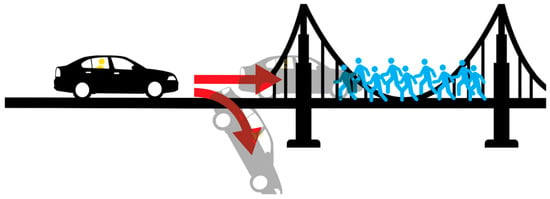
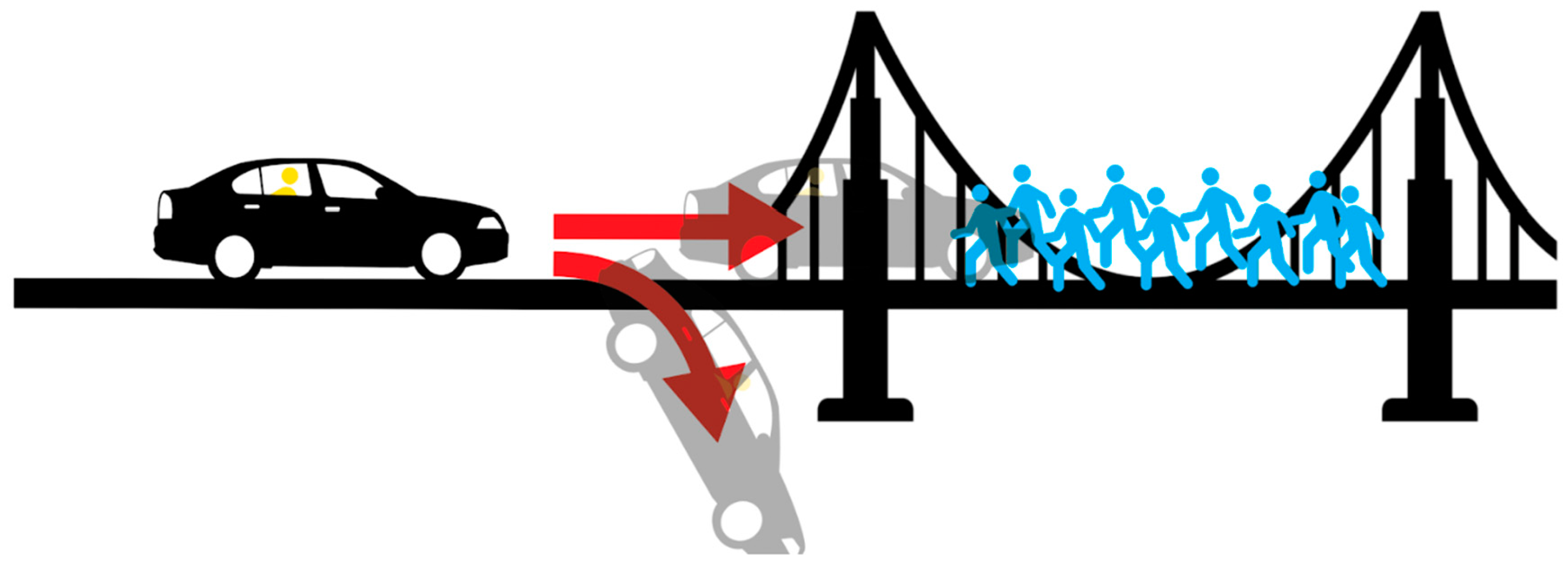
We investigate this question using a series of online experiments conducted on Amazon Mechanical Turk. Participants were presented with a stylized scenario in which a single passenger in an autonomous vehicle faces an unavoidable collision with nine pedestrians and were asked to evaluate alternative programming rules (See Figure 1):
Figure 1.
The question asked to participants in the study: A man is the sole passenger in an autonomous self-driving vehicle traveling at the speed limit approaching a main bridge. Suddenly, 9 pedestrians appear ahead, in the direct path of the car. The car could be programmed to do one of the following options. What is the moral course of action?
A man is the sole passenger in an autonomous self-driving vehicle traveling at the speed limit and approaching a bridge. Suddenly, nine pedestrians appear directly in the vehicle’s path. The car could be programmed to follow one of the following rules. What is the morally appropriate choice?
- No survival for the passenger.
- No survival for the nine pedestrians.
- A 50% chance of survival for the passenger and a 50% chance of survival for the nine pedestrians.
Across multiple experimental designs, we find robust evidence that many participants prefer the 50:50 randomization rule. This preference appears both when participants evaluate the scenario as impartial observers and when they imagine themselves as the passenger. Even when additional probabilistic options are introduced, equal-chance randomization remains highly salient, suggesting that considerations of fairness play a central role in moral evaluations of AV decision-making.
Throughout the paper, we distinguish between two conceptually distinct notions of fairness that are often conflated in discussions of AV ethics. The first is outcome-based fairness, closely aligned with utilitarian reasoning, which evaluates actions by the expected number of lives saved and therefore favors deterministic victim minimization. The second is procedural, or ex ante, fairness, which treats individuals as moral equals by assigning them equal chances of survival when harm is unavoidable. These principles come into direct conflict in scenarios such as a 50:50 lottery between saving one person and saving nine, where equal chances imply a lower expected number of survivors than a deterministic choice. Our study focuses on this normative tension and documents that many respondents systematically favor equal-chance procedures, consistent with philosophical arguments emphasizing fairness in tragic choices (e.g., Taurek’s coin-flip reasoning), rather than strict outcome maximization.
Finally, we emphasize that the crash scenarios studied here are intentionally stylized. By assuming inevitability of harm and binary outcomes, we abstract from many features of real-world traffic accidents, including probabilistic injuries, partial damage, evasive maneuvers, heterogeneous victims, and incomplete information. This abstraction is a methodological device commonly used in moral-dilemma research to isolate core ethical intuitions under extreme, no-win conditions. Our findings should therefore be interpreted as descriptive evidence about public moral intuitions and perceived legitimacy, rather than as direct prescriptions for AV control algorithms. How preferences evolve in more realistic and uncertain environments remains an important direction for future research.
In what follows, we describe the experimental design, present the results, and discuss their implications for ethical reasoning and policy debates surrounding autonomous vehicles.
2. Literature Review
Recent research on the ethics of autonomous vehicles (AVs) has increasingly emphasized the role of public moral preferences, legitimacy, and responsibility, alongside classical outcome-based considerations. Building on early trolley-style discussions, recent contributions highlight the limits of strict victim minimization and the importance of fairness, transparency, and social acceptance in ethical AV decision-making (Nyholm, 2018b; Nyholm & Smids, 2020). These works argue that ethical evaluation of AV behavior cannot be reduced to maximizing expected lives saved, but must also account for how decision rules are perceived and justified.
A growing empirical literature investigates how individuals evaluate AV decisions under different experimental designs, including variations in framing, realism, and contextual information. Geisslinger et al. (2023) provide a comprehensive review of moral preference studies and show that judgments depend critically on whether participants evaluate outcomes, actions, or institutional rules. Experimental work using immersive or high-fidelity environments further demonstrates that moral intuitions can vary with scenario realism and salience (Faulhaber et al., 2019; Sütfeld et al., 2017). Related research also links moral preferences to acceptance and adoption of AVs, emphasizing that perceived fairness and legitimacy play a central role in public support (Ng, 2024).
Despite this growing literature, randomization as an explicit decision rule has received surprisingly little direct attention. To our knowledge, only two prior studies address randomization directly. The first, by Bonnefon et al. (2016), briefly mentions randomization in a supplementary study but does not report detailed results, which prevents meaningful comparison with our findings. The second, by Bodenschatz et al. (2021), reports that approximately 67% of participants preferred deterministically saving two pedestrians rather than implementing a 50:50 randomization between one driver and the pedestrians. In contrast, our study considers a scenario with nine pedestrians, yet a majority of participants prefer the 50:50 randomization rather than always saving the pedestrians. This divergence is notable: if participants in Bodenschatz et al. (2021) preferred victim minimization over randomization when two pedestrians were at risk, one might expect an even stronger preference for deterministic saving when nine pedestrians are at risk. The fact that we observe the opposite pattern suggests that preferences over randomization are highly sensitive to how decision rules are framed and to the structure of the choice set. Understanding the sources of these conflicting findings represents an important direction for future research.
On the theoretical side, several recent contributions stress that responsibility for AV decisions necessarily remains with human and institutional actors, even when automated or probabilistic rules are employed. Himmelreich (2018) argues that appeals to automation or chance do not eliminate responsibility but instead relocate it to ex ante governance and institutional design. Similarly, Bonnefon et al. (2019) emphasize that engineers and regulators must consider how ethical rules are justified and communicated, not merely how they optimize outcomes.
Within this evolving literature, our study contributes by focusing explicitly on preferences over decision rules, rather than isolated outcomes, and by examining randomization as a principled procedural mechanism rather than an ad hoc compromise. By documenting robust support for equal-chance procedures across multiple experimental designs, and by revealing a striking divergence from prior findings on randomization, our results help clarify the normative and behavioral conditions under which procedural fairness may outweigh outcome-based victim minimization in unavoidable AV dilemmas.
3. Data
We conducted three online studies on Amazon Mechanical Turk (MTurk) between November 2021 and September 2023, with a total of 1666 U.S.-based participants. Each study presented participants with a moral dilemma involving autonomous vehicles (AVs) facing a collision scenario where the vehicle must choose between saving its passenger or a group of pedestrians. All surveys were created using Google Forms, and participants were compensated 25 cents for their participation. Demographic information, including age, gender, and education level, was collected at the end of each survey.
Our initial pool consisted of 2044 respondents. After removing submissions with duplicate MTurk worker IDs, the sample was reduced to 1898 respondents. We then excluded individuals who had participated in any previous run of the studies to ensure independent observations, yielding a final analytical sample of 1666 participants across Studies 1–3. Participation was restricted to U.S.-based MTurk workers with at least 100 previously completed HITs and a minimum approval rate of 50%. These qualifications were imposed to reduce the likelihood of low-quality or automated responses. In addition, each participant was subject to a 15-min time limit for completing the survey.
3.1. Study 1: Probabilistic or Deterministic?
In Study 1 (N = 513), participants were shown a scenario in which a self-driving car had to choose between saving its only passenger or nine pedestrians. A third option allowed the AV to randomize the outcome, giving each party a 50:50 chance of survival. Participants evaluated this dilemma from a neutral, observer perspective.
The participants were presented with the following scenario: A man is the sole passenger in an autonomous self-driving vehicle traveling at the speed limit approaching a main bridge. Suddenly, 9 pedestrians appear ahead in the direct path of the car. The car could be programmed to do one of the following options. What is the moral course of action?
- No survival for passenger.
- No survival for 9 pedestrians.
- 50% chance of survival for passenger; 50% chance of survival for 9 pedestrians.
3.2. Study 1: Robustness of the 50:50 Choice
We tested the robustness of the 50:50 preference to presentation order. Participants were randomly assigned to different treatments in which the three core options were shown in random order. This design helped us assess whether choice ordering influenced participants’ decisions. To implement randomization of choice order, separate Google Forms with different orderings were created. Participants arriving from MTurk were randomly assigned to one of these forms.
3.3. Study 2: Do Participants Prefer Fairness if They Are Passengers?
Study 2 (N = 441) used a similar setup, but asked participants to imagine themselves as the passenger in the vehicle. They were told that the AV could be programmed to always save the passenger, always save the pedestrians, or follow the 50:50 rule. This framing allowed us to test whether personal involvement shifted preferences.
The participants were presented with the following scenario: You are on the market looking to buy a new autonomous self-driving vehicle. The car could be programmed to do one of the following three options. In each scenario, 9 pedestrians suddenly appear in the direct path of the car and you are the sole passenger. Which car would you buy?
- No survival for 9 pedestrians.
- 50% chance of survival for you; 50% chance of survival for 9 pedestrians.
- No survival for you.
3.4. Study 3: Proportional Probabilities
In Study 3 (N = 712), participants were presented with a broader range of probabilistic options, including 90:10 and 10:90 rules in addition to the 50:50 and deterministic choices. This design allowed us to examine how participants responded to proportional survival probabilities.
The participants were presented with the following scenario: A man is the sole passenger in an autonomous self-driving vehicle traveling at the speed limit approaching a main bridge. Suddenly, 9 pedestrians appear ahead in the direct path of the car. The car could be programmed to do one of the following options. What is the moral course of action?
- No survival for passenger.
- No survival for 9 pedestrians.
- 50% chance of survival for passenger; 50% chance of survival for 9 pedestrians.
- 10% chance of survival for passenger; 90% chance of survival for 9 pedestrians.
- 90% chance of survival for passenger; 10% chance of survival for 9 pedestrians.
3.5. Study 3: Higher Skilled Individuals
In addition to collecting perceptions on AV programming, we collected additional data from a subset of participants (n = 451) who were asked 10 general knowledge and mathematics questions before being presented with the question on the morality of AV programming. In order to incentivize effort, each correct answer gave a participant a bonus payment of 10 cents. The average bonus earning was $0.62. 10 general knowledge and mathematics questions can be found in the Appendix A.
4. Results
4.1. Study 1: Probabilistic or Deterministic?
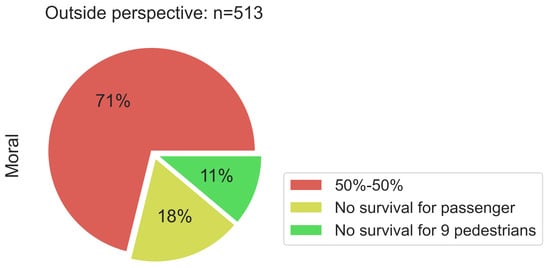
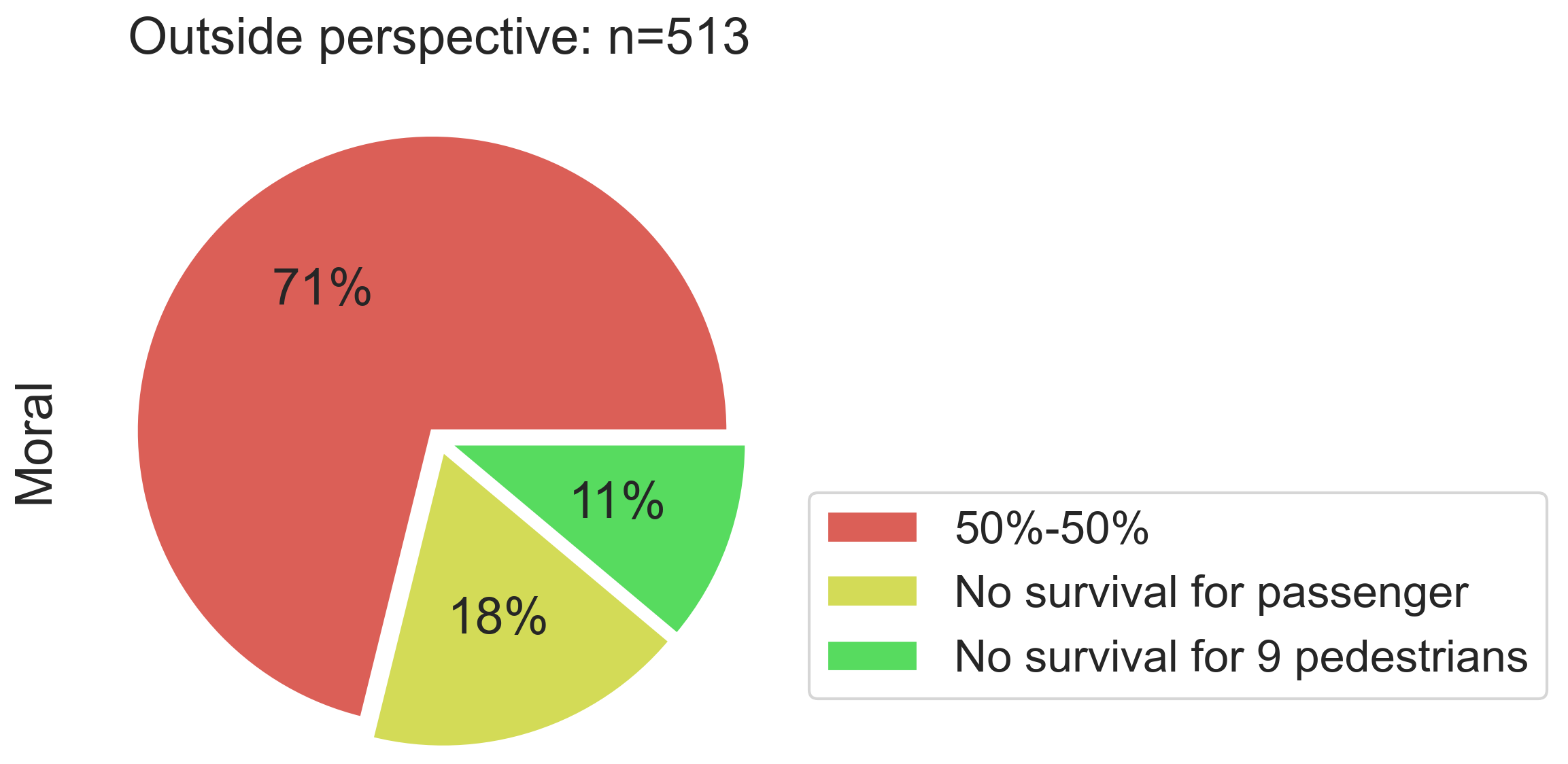
The results from the first study showed that a clear majority of 71% preferred the 50:50 rule compared to only 18% preferring to save the pedestrians and 11% preferring to save the passenger. See Figure 2. The significance of these results was reinforced when testing for different choice order, demonstrating that the 50:50 rule consistently remained the most popular option by far.
Figure 2.
Distribution of responses with three possible choices given to the participants.
4.2. Study 1: Robustness of the 50:50 Choice
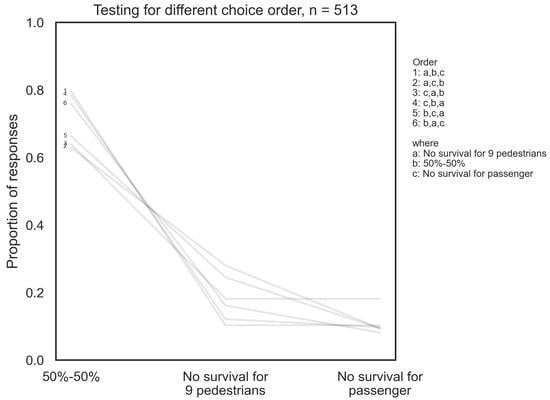
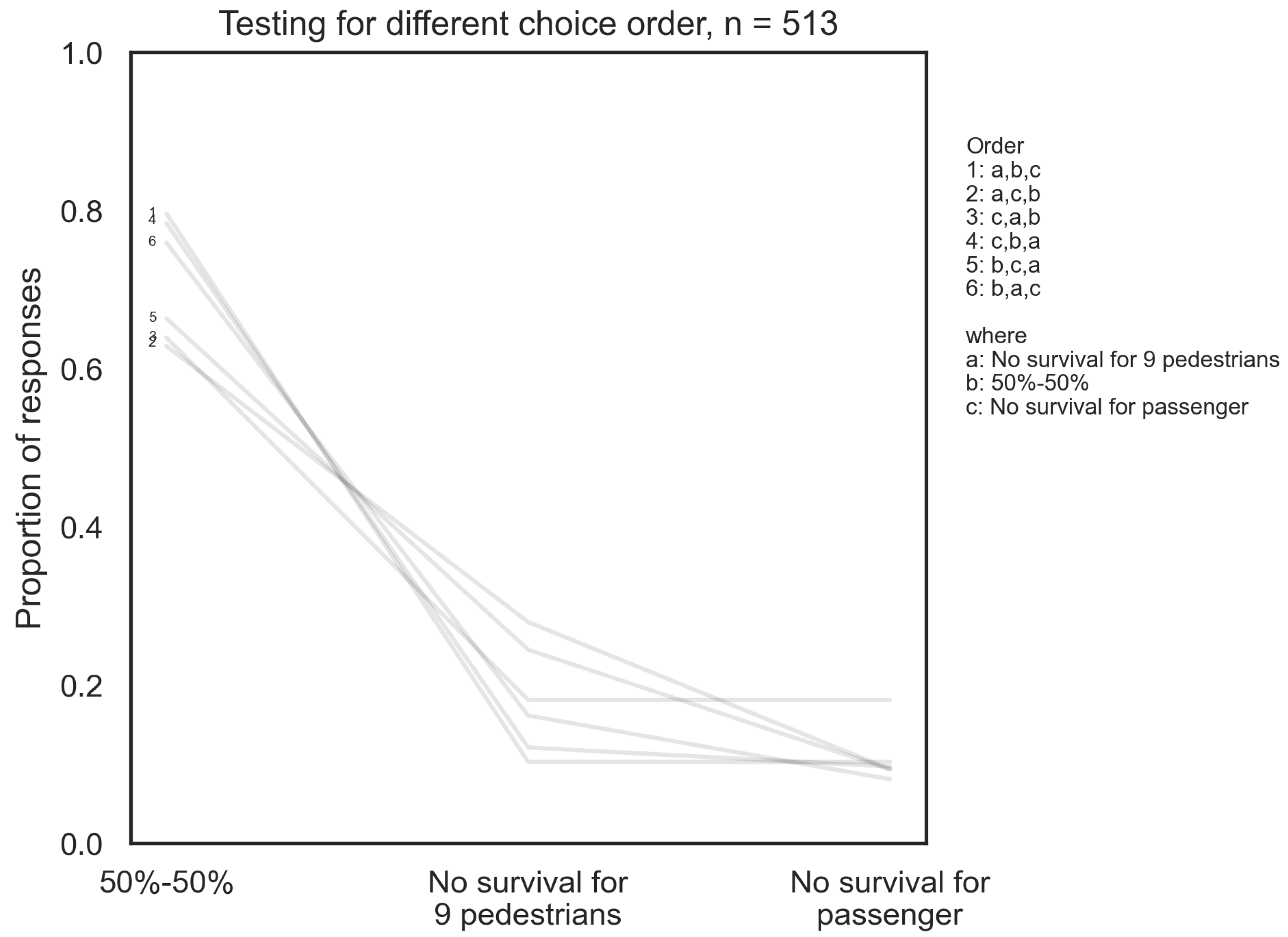
We tested the robustness of the 50:50 rule to its placement as the first, second, or third option presented to participants. We analyzed the variation of responses in six treatments, with each treatment representing a different ordering of the three possible responses and present the results in Figure 3. We find that option order has a statistically detectable, though modest, influence on choice shares . Table 1 shows that in every ordering the 50:50 option remains the top choice. Therefore, order effects do not overturn the substantive pattern of preferences.
Figure 3.
Variation in responses by order of choices presented. Each line represents the distribution of responses to a particular order. 50:50 option was the most preferred option among all choice orders.
Table 1.
Proportions and Wilson 95% confidence intervals by option ordering.
4.3. Study 2: Do Participants Prefer Fairness if They Are Passengers?
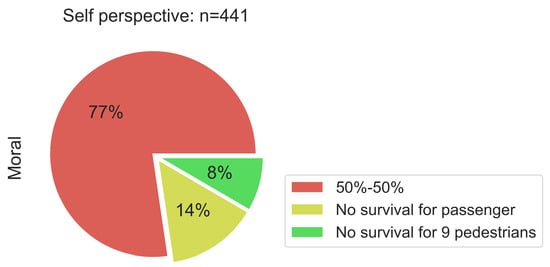
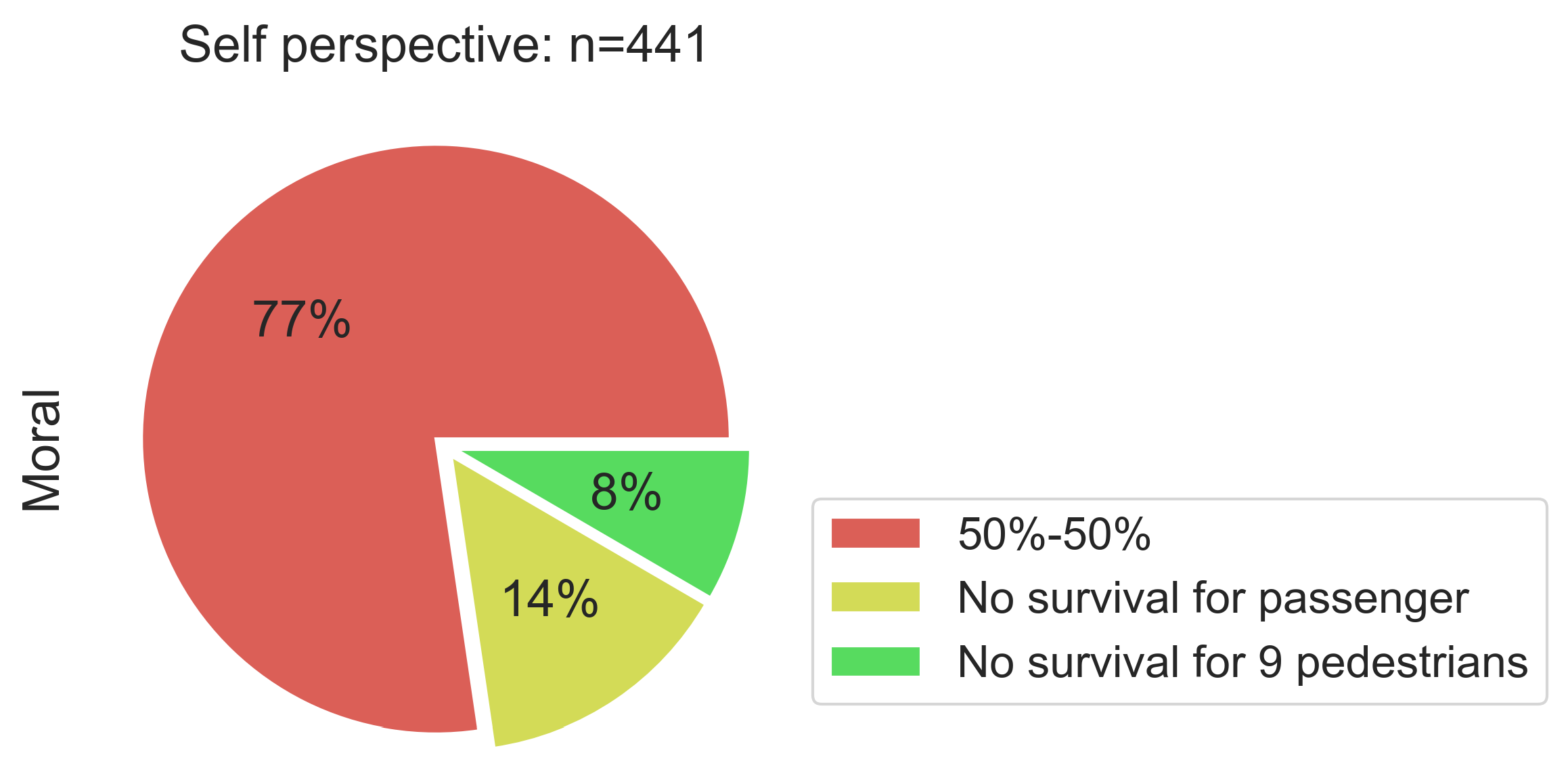
In the second study, an even greater majority of 77% preferred the 50:50 rule compared to only 14% preferring to save the pedestrians and 8% preferring to save the passenger. See Figure 4. To formally assess whether framing matters, we conduct a test comparing the distribution of rule families (probabilistic vs. deterministic) between Study 1 (observer) and Study 2 (self-passenger). The test yields
indicating a statistically detectable but small effect. Importantly, the direction of the association reinforces our interpretation: imagining oneself as the passenger increases the relative weight placed on probabilistic rules. While the effect size is modest, both framings continue to exhibit a clear preference for probabilistic decision rules.
Figure 4.
Distribution of responses with three possible choices given to the participants, but the participants are asked what type of programming they would prefer in their own AV. Values are rounded to the nearest whole number.
4.4. Study 3: Proportional Probabilities
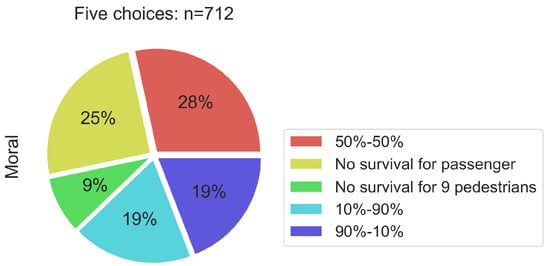
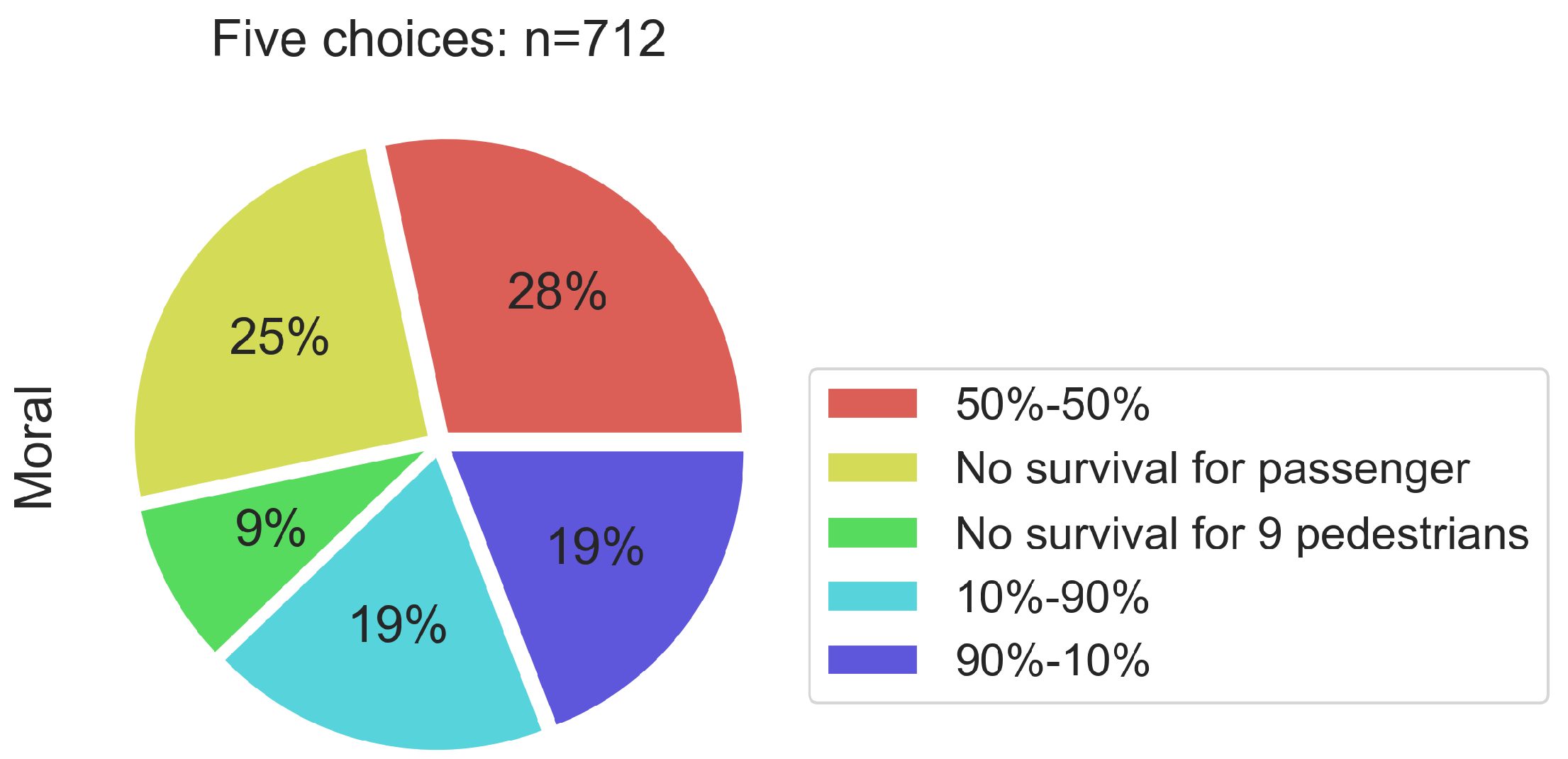
In the third study, 28% preferred the 50:50 rule, 25% preferred to save the pedestrians, 19% preferred the 90:10 rule in favor of the pedestrians, 19% preferred the 90:10 rule in favor of the passenger, and 9% preferred to save the passenger. See Figure 5. While the 50:50 rule remains the most popular option, it is not statistically dominant over other responses. We then formally test whether probabilistic rules as a class are preferred to deterministic rules. Aggregating across probabilistic options (50:50, 90:10, and 10:90), their combined share in Study 3 is 0.662. A binomial test strongly rejects equality with deterministic rules (). Thus, while the 50:50 option alone does not constitute a majority in Study 3, probabilistic decision rules clearly dominate the choice distribution.
Figure 5.
Distribution of responses with five possible choices given to the participants including probabilistic options.
4.5. Study 3: Exploratory Analysis for Higher Skilled Individuals
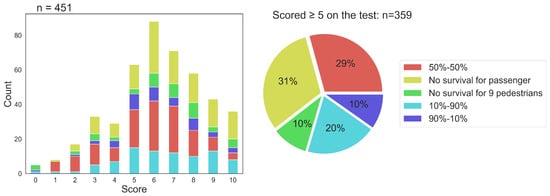
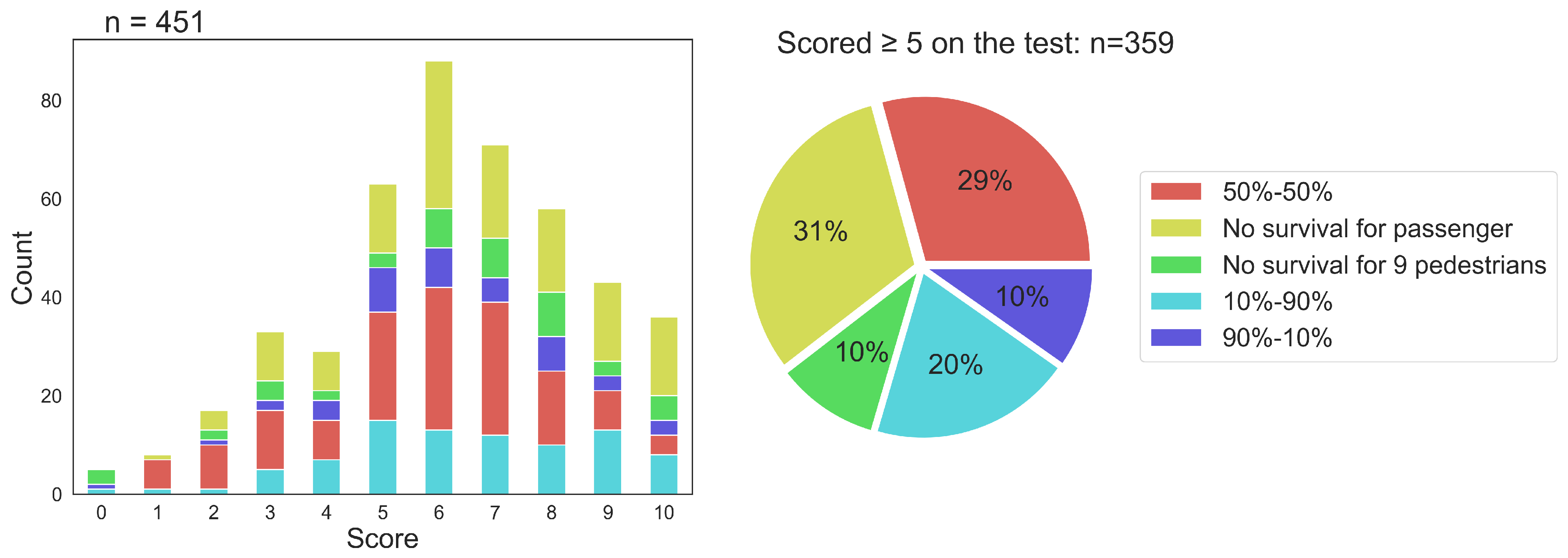
Restricting the sample to participants who scored at least 5 out of 10 on the general knowledge and mathematics test yields a more differentiated pattern of choices. In this subsample, 31% of respondents preferred deterministically sacrificing the passenger, while 29% selected the 50:50 randomization rule. Although the 10-item test is not intended as a comprehensive measure of ability, it serves as a coarse proxy for attentiveness and cognitive engagement in an online setting. The similarity of these shares suggests that support for probabilistic decision rules remains substantial among more engaged participants, even as outcome-based considerations become more prominent. Because this subgroup analysis is not a primary inferential test, it should be interpreted within an exploratory capacity. See Figure 6.
Figure 6.
Distribution of responses with five possible choices given to the participants, including probabilistic options.
The results from our Studies 1–3 are summarized in Table 1 and Table 2. In Studies 1 and 2, the confidence intervals for the 50:50 option lie well above those of the deterministic alternatives, supporting the claim that probabilistic rules are clearly favored under both observer and self-passenger framings. In Study 3, where the choice set expands to five options, the confidence intervals confirm that no single option reaches a majority, but that probabilistic options collectively account for the largest share.
Table 2.
Proportions and Wilson 95% confidence intervals across all studies.
Our Studies 1–3 emphasize the robust preference for probabilistic decision rules over deterministic ones across framings and robustness checks.
5. Discussion
Our findings highlight the complexity of moral reasoning in unavoidable crash scenarios and help clarify why existing studies on autonomous-vehicle (AV) ethics have produced seemingly conflicting results. A consistent theme in the literature is that individuals often endorse outcome-based principles, such as saving as many lives as possible, when evaluating policies in the abstract, while simultaneously favoring self-protective or fairness-based considerations when confronted with concrete decision rules. This tension underscores the difficulty of identifying a single ethical principle that commands universal acceptance.
Much of the prior empirical literature, including the Moral Machine studies and related work, focuses on outcome-based judgments, asking respondents to evaluate which group should be saved in a particular scenario. Within such designs, utilitarian victim minimization frequently emerges as the dominant criterion. By contrast, our experimental design explicitly elicits preferences over decision rules (deterministic versus probabilistic) rather than over outcomes alone. This distinction is theoretically important. When respondents are asked to choose a rule that will govern decisions ex ante, considerations of procedural fairness and legitimacy become more salient, even when they conflict with outcome maximization.
This framing difference helps explain why our results diverge from earlier findings, including those reported by Bonnefon et al. (2016) and in the Moral Machine project. In our studies, a majority of participants favor a 50:50 randomization rule that assigns passengers and pedestrians equal ex ante chances of survival. Importantly, this preference persists across observer and self-passenger perspectives and remains salient even when additional probabilistic options are introduced. These results suggest that many individuals regard randomization not as moral indifference, but as a principled way to respect the equal moral standing of persons when harm is unavoidable.
From a theoretical perspective, our findings align with philosophical arguments emphasizing procedural fairness in tragic choices. As famously argued by Taurek (1977), when it is impossible to save everyone, giving each person an equal chance of survival can be morally preferable to deterministic aggregation of lives. Our results provide empirical support for the relevance of this intuition in the context of AV ethics. At the same time, we emphasize that this does not imply a rejection of utilitarian reasoning per se. Rather, the evidence suggests that public moral judgments are sensitive to the level at which the ethical problem is posed: outcome evaluation versus rule selection.
Crucially, the differences between our findings and those of earlier studies should not be interpreted as contradictions. Instead, they reflect the activation of different normative dimensions, such as self-protection and victim minimization by different experimental designs. When randomization is presented explicitly as a coherent and impartial decision rule, many respondents appear willing to endorse it, even at the cost of lower expected numbers of lives saved. This helps explain why randomization has played a limited role in earlier studies where it was absent, implicit, or relegated to supplementary analyses.
Finally, the interpretation of our results must account for the deliberately stylized nature of the experimental scenarios. By assuming inevitability of harm and binary outcomes, we abstract from probabilistic injuries, partial damage, evasive maneuvers, heterogeneous victims, and uncertainty about consequences that characterize real-world traffic accidents. This abstraction follows a well-established tradition in moral-dilemma research and is intended to isolate core moral intuitions under extreme, no-win conditions. Preferences observed in such settings may not generalize directly to more realistic environments, where outcome-based considerations may gain weight as uncertainty and degrees of harm increase. Accordingly, our findings should not be interpreted as direct guidance for AV control algorithms, but rather as evidence about how individuals evaluate fairness, legitimacy, and responsibility in constrained moral dilemmas. These results provide a benchmark for future work that embeds procedural fairness considerations within richer, probabilistic, and context-sensitive models of autonomous-vehicle decision making.
6. Conclusions
We highlight a fundamental normative tension at the heart of autonomous-vehicle ethics: the conflict between outcome-based victim minimization and procedural fairness grounded in equal ex ante chances of survival. Our experimental results show that a substantial share of respondents consistently favor a 50:50 randomization rule, even when it leads to a lower expected number of lives saved, indicating that public moral intuitions often prioritize impartial procedures over aggregate welfare calculations in unavoidable crash scenarios. These findings should not be interpreted as denying the moral appeal or policy relevance of saving the greater number of lives; rather, they underscore that many individuals regard equal chances as a crucial component of fairness when all parties face grave harm. Importantly, adopting a randomized rule does not remove human or institutional responsibility for autonomous-vehicle design, since such procedures must be explicitly chosen, regulated, and publicly justified. Instead, randomization changes the nature of responsibility by avoiding deterministic sacrifice and by implementing an ex ante impartial rule that many perceive as more legitimate. By documenting these preferences, our contribution is primarily descriptive, but it also suggests that considerations of procedural fairness may play a central role in public acceptance and ethical evaluation of autonomous-vehicle policies alongside traditional welfare-based criteria.
Author Contributions
Conceptualization, A.M. and L.M.; Methodology, A.M., E.B. and L.M.; Software, E.B.; Formal analysis, A.M. and E.B.; Investigation, A.M., E.B. and L.M.; Resources, A.M.; Data curation, E.B.; Writing—original draft, A.M., E.B. and L.M.; Writing—review & editing, A.M. and E.B.; Supervision, A.M.; Project administration, A.M.; Funding acquisition, A.M. All authors have read and agreed to the published version of the manuscript.
Funding
This research was funded by the Grant Program at Moore School of Business.
Informed Consent Statement
Informed consent was obtained from all subjects involved in the study.
Data Availability Statement
The raw data supporting the conclusions of this article will be made available by the authors on request.
Acknowledgments
We would like to thank the editor and two anonymous reviewers for their constructive comments which significantly improved the paper.
Conflicts of Interest
The authors declare no conflicts of interest.
Appendix A
We conducted three studies on Amazon Mechanical Turk (MTurk) between November 2021 and September 2023 with a total of 1666 participants. Each study involved participants making decisions on self-driving car scenarios. All studies were programmed using Google Form survey software: https://docs.google.com/forms (accessed on 20 February 2022). Participants (who were U.S. residents) were compensated 25 cents for their participation. Basic demographic information, including age, gender, and education level, was collected.
In addition to collecting demographic information, a subset of participants (n = 451) was asked 10 general knowledge and mathematics questions before being presented with the question on the morality of AV programming. For each correct answer submitted, the participants received 10 cents to incentivize effort.
- Questions:
- When did George Washington become the president?
- (a)
- 1776
- (b)
- 1779
- (c)
- 1784
- (d)
- 1789
- (e)
- 1793
- What is the capital of Pennsylvania?
- (a)
- Albany
- (b)
- Harrisburg
- (c)
- Philadelphia
- (d)
- Pittsburgh
- (e)
- Richmond
- What is the capital of Florida?
- (a)
- Jacksonville
- (b)
- Miami
- (c)
- New Orleans
- (d)
- Tallahassee
- (e)
- Tampa
- Who was the 2nd President of the United States?
- (a)
- John Adams
- (b)
- Andrew Jackson
- (c)
- Thomas Jefferson
- (d)
- James Madison
- (e)
- James Monroe
- Worker A can do a piece of work in 15 days while B can do it in 10 days. How long will they take together to do it?
- (a)
- 2
- (b)
- 4
- (c)
- 6
- (d)
- 8
- (e)
- 10
- The average age of three boys is 25 years and their ages are in the proportion 3:5:7. Find the age of the youngest boy.
- (a)
- 6
- (b)
- 8
- (c)
- 12
- (d)
- 15
- (e)
- 18
- Martin is four times as old as his brother Luther at present. After 10 years he will be twice the age of his brother. Find Luther’s present age.
- (a)
- 3
- (b)
- 4
- (c)
- 5
- (d)
- 6
- (e)
- 7
- Difference between a number and its positive square root is 12. Find the number.
- (a)
- 12
- (b)
- 16
- (c)
- 24
- (d)
- 32
- (e)
- 64
- An item is originally priced at $80. A discount is given and the item is bought for $68. Estimate what percent of discount was received.
- (a)
- 10
- (b)
- 12
- (c)
- 15
- (d)
- 22
- (e)
- 32
- On a sports day, 161 students are in the playground. They are standing in 7 equal rows. How many students are in each row?
- (a)
- 35
- (b)
- 38
- (c)
- 41
- (d)
- 23
- (e)
- 27
References
- Awad, E., Dsouza, S., Kim, R., Schulz, J., Henrich, J., Shariff, A., Bonnefon, J.-F., & Rahwan, I. (2018). The moral machine experiment. Nature, 563(7729), 59–64. [Google Scholar] [CrossRef] [Scilit] [PubMed]
- Awad, E., Dsouza, S., Shariff, A., Rahwan, I., & Bonnefon, J.-F. (2020a). Crowdsourcing moral machines. Communications of the ACM, 63(3), 48–55. [Google Scholar] [CrossRef] [Scilit]
- Awad, E., Dsouza, S., Shariff, A., Rahwan, I., & Bonnefon, J.-F. (2020b). Universals and variations in moral decisions made in 42 countries by 70,000 participants. Proceedings of the National Academy of Sciences USA, 117(5), 2332–2337. [Google Scholar] [CrossRef] [Scilit] [PubMed]
- Bigman, Y. E., & Gray, K. (2020). Life and death decisions of autonomous vehicles. Nature, 579, E1–E2. [Google Scholar] [CrossRef] [Scilit] [PubMed]
- Bodenschatz, A., Uhl, M., & Walkowitz, G. (2021). Autonomous systems in ethical dilemmas: Attitudes toward randomization. Computers in Human Behavior Reports, 4, 100145. [Google Scholar] [CrossRef] [Scilit]
- Bonnefon, J.-F., Shariff, A., & Rahwan, I. (2016). The social dilemma of autonomous vehicles. Science, 352(6293), 1573–1576. [Google Scholar] [CrossRef] [Scilit] [PubMed]
- Bonnefon, J.-F., Shariff, A., & Rahwan, I. (2019). The trolley, the bull bar, and why engineers should care about the ethics of autonomous cars. Proceedings of the IEEE, 107(3), 502–504. [Google Scholar] [CrossRef] [Scilit]
- Faulhaber, A. K., Dittmer, A., Blind, F., Wächter, M. A., Timm, S., Sütfeld, L. R., Stephan, A., Pipa, G., & König, P. (2019). Human decisions in moral dilemmas are largely described by utilitarianism: Virtual car driving study provides guidelines for autonomous driving vehicles. Science and Engineering Ethics, 25(2), 399–418. [Google Scholar] [CrossRef] [Scilit] [PubMed]
- Foot, P. (1967). The problem of abortion and the doctrine of the double effect. Oxford Review, 5, 5–15. [Google Scholar]
- Geisslinger, M., Poszler, F., & Lienkamp, M. (2023). An ethical trajectory planning algorithm for autonomous vehicles. Nature Machine Intelligence, 5(2), 137–144. [Google Scholar] [CrossRef] [Scilit]
- Goodall, N. J. (2014a). Ethical decision making during automated vehicle crashes. Transportation Research Record, 2424(1), 58–65. [Google Scholar] [CrossRef] [Scilit]
- Goodall, N. J. (2014b). Machine ethics and automated vehicles. In G. Meyer, & S. Beiker (Eds.), Road vehicle automation (pp. 93–102). Springer International Publishing. [Google Scholar] [CrossRef] [Scilit]
- Greene, J. D. (2013). Moral tribes: Emotion, reason, and the gap between us and them. The Penguin Press. [Google Scholar]
- Himmelreich, J. (2018). Never mind the trolley: The ethics of autonomous vehicles in mundane situations. Ethical Theory and Moral Practice, 21(3), 669–684. [Google Scholar] [CrossRef] [Scilit]
- Kamm, F., & Rakowski, E. (2015). The trolley problem mysteries. Oxford University Press. Available online: https://books.google.com/books?id=7SWgCgAAQBAJ (accessed on 2 February 2026).
- Ng, Y.-L. (2024). Understanding passenger acceptance of autonomous vehicles through the prism of the trolley dilemma. International Journal of Human–Computer Interaction, 40(9), 2185–2194. [Google Scholar] [CrossRef] [Scilit]
- Noothigattu, R., Gaikwad, S., Awad, E., Dsouza, S., Rahwan, I., Ravikumar, P., & Procaccia, A. (2018). A voting-based system for ethical decision making. Proceedings of the AAAI Conference on Artificial Intelligence, 32(1). [Google Scholar] [CrossRef] [Scilit]
- Nyholm, S. (2018a). The ethics of crashes with self-driving cars: A roadmap, I. Philosophy Compass, 13(7), e12507. [Google Scholar] [CrossRef] [Scilit]
- Nyholm, S. (2018b). The ethics of crashes with self-driving cars: A roadmap II. Philosophy Compass, 13(7), e12506. [Google Scholar] [CrossRef] [Scilit]
- Nyholm, S., & Smids, J. (2020). Automated cars meet human drivers: Responsible human–robot coordination and the ethics of mixed traffic. Ethics and Information Technology, 22(4), 335–344. [Google Scholar] [CrossRef] [Scilit]
- Shariff, A., Bonnefon, J.-F., & Rahwan, I. (2017). Psychological roadblocks to the adoption of self-driving vehicles. Nature Human Behaviour, 1(10), 694–696. [Google Scholar] [CrossRef] [Scilit] [PubMed]
- Sütfeld, L. R., Gast, R., König, P., & Pipa, G. (2017). Using virtual reality to assess ethical decisions in road traffic scenarios: Applicability of value-of-life-based models and influences of time pressure. Frontiers in Behavioral Neuroscience, 11, 122. [Google Scholar] [CrossRef] [Scilit] [PubMed]
- Taurek, J. M. (1977). Should the numbers count? Philosophy & Public Affairs, 6(4), 293–316. [Google Scholar]

Disclaimer/Publisher’s Note: The statements, opinions and data contained in all publications are solely those of the individual author(s) and contributor(s) and not of MDPI and/or the editor(s). MDPI and/or the editor(s) disclaim responsibility for any injury to people or property resulting from any ideas, methods, instructions or products referred to in the content. |
© 2026 by the authors. Licensee MDPI, Basel, Switzerland. This article is an open access article distributed under the terms and conditions of the Creative Commons Attribution (CC BY) license.