


Abstract
Building Information Modeling (BIM) implementation is increasingly adopted in the architecture, engineering, and construction (AEC) industries. However, its integration into the academic curricula in developing countries remains limited. Therefore, this study aims to investigate the barriers to integrating BIM into the curricula of civil engineering in Jordanian higher education institutions (HEIs). A quantitative approach was used, including Exploratory Factor Analysis (EFA) and Partial Least Squares Structural Equation Modeling (PLS-SEM). The data was collected from 102 respondents, including industry professionals and academics. Six key barrier constructs were identified: support, standards, delivery, resources, knowledge, and infrastructure and security. Altogether, they explain 66.896% of the BIM integration barriers. The results of the structural model indicate that institutional and governmental support is the most critical barrier (β = 0.486), followed by the lack of standards (β = 0.206) and curriculum-delivery constraints (β = 0.166). Other barriers, including infrastructure and security-related factors, knowledge gaps, and resource limitations, were found to have statistically significant effects on BIM integration. The findings revealed that the barriers to integrating BIM into civil engineering curricula in Jordanian HEIs are institutional and systemic rather than purely technical or resource-based. This study contributes to the BIM education literature by developing one of the first empirically validated PLS-SEM models to investigate barriers to integrating BIM curriculum in Jordan and in developing countries. This research is distinct from previous descriptive studies by prioritizing the institutional, technical, and curricular barriers to the integration of BIM into civil engineering education. Practically, the research provides a specific roadmap for Jordan to integrate BIM into curricula through improving the collaboration between HEIs and the Jordan Engineering Association, strengthening the accreditation standards, enhancing the support of the government for digital construction education, and endorsing the partnerships between HEIs and the industry to align the graduates with the needs for digital transformation of the construction sector in Jordan.
1. Introduction
BIM has a significant impact on the operations and practices of the AEC industry. In the last few years, rapid BIM adoption has led to a profound digitalization of the construction industry [1]. Paradigm shifting from traditional 2D design approaches to more integrated, rich-information, and collaborative construction procurement processes is the core of BIM implementation [2]. Therefore, BIM is a comprehensive process integrating the project stages of design, construction, and operation through a shared digital environment [3,4]. Improved decision making, enhanced multidisciplinary collaboration, reduced cost overrun and rework, and improved sustainability and productivity are the main BIM attributes in the construction industry [4,5].
As BIM adoption worldwide has increased and become an international standard for construction projects, the need for prepared graduates who can work on BIM-based projects has become crucial. Moreover, the lack of personnel with BIM skills has been reported as a major obstacle to BIM implementation in the construction industry [6]. Therefore, higher education institutions (HEIs) are expected to incorporate BIM in their current curricula. In civil engineering programs, this means extending the program learning outcomes beyond traditional analytical and design skills to include information management, digital literacy, and teamwork within an integrated workflow [7]. Engineering schools worldwide have begun incorporating BIM into their curricula through collaborative design and simulation courses and project-based learning to increase graduates’ readiness for working in construction industry practices [8].
In Jordan, BIM implementation is at an early stage due to many barriers, including a lack of government support, high costs, the absence of BIM standards, inadequate awareness, limited training programs, and resistance to cultural change [1,9]. Strategic national intervention is required to overcome these barriers, as the Jordanian construction industry contributes significantly to the country’s economic growth [10].
From HEIs’ perspectives, the lack of BIM integration in engineering curricula has led to limited awareness of BIM applications, insufficient teaching plans, and inadequate BIM implementation plans to overcome these barriers [11]. In the context of Jordan, Bekr [12] has reported significant barriers to BIM implementation, including “lack of qualified staff to operate the software, difficulty in learning BIM and resistance to change”. Moreover, Hyarat [2] further investigated BIM implementation barriers among Jordanian AEC companies and reported that BIM awareness and technical knowledge, insufficient guidelines, the cost of training and software, and high upfront costs are the main barriers to BIM implementation in Jordan. Therefore, integrating BIM into university curricula, initiating BIM-based training programs, and providing government incentives are significant factors for successful BIM adoption in Jordan [12].
Despite the growing body of knowledge on BIM barriers in the Jordanian construction industry, a significant gap in understanding the barriers to integrating BIM in HEIs, specifically in the civil engineering program, remains. Several studies have investigated BIM barriers at the industry level [1,5,9,13,14,15,16]; however, no empirical research has examined BIM integration barriers and requirements in the educational sector. This gap is critical because successful BIM implementation in the construction industry relies on graduating competent students equipped with the required BIM skills and knowledge before they start their professional careers [11].
Moreover, despite growing research interest in BIM adoption in the Middle East and developing countries, most studies have focused on the barriers to BIM implementation in the construction industry. This has resulted in limited, mostly isolated research on the integration of BIM into HEI curricula. As a result, BIM education was described as rare, new, or in its infancy with significant gaps and ad hoc solutions [11,17,18,19,20,21,22]. Consequently, research has called for more comprehensive, region-specific investigation of BIM education [17,20,21,23,24,25,26,27].
The vast majority of previous BIM education studies relied on descriptive or qualitative approaches in developing countries. This study develops and validates a novel quantitative structural model which shows the barriers to BIM implementation in civil engineering programs in developing countries. EFA and PLS-SEM are used to identify and empirically test the interrelationships and the relative significance of the constructs of BIM integration barriers. Thus, this research contributes to the BIM education literature by providing one of the first empirically validated models for BIM integration in the civil engineering curriculum in the Middle East.
The focus of this study is Jordan because it represents the context of a developing country, where BIM implementation is still in its early stages despite increased awareness of digital transformation in the construction sector. Moreover, the higher education system in Jordan represents a relatively stable setting for exploratory research because of the absence of a national standard for BIM education, limited coordination between academia and industry, and a lack of institutional BIM implementation strategies, while ICT infrastructure and the higher education sector are relatively stable in comparison with other developing contexts.
Therefore, the aim of this study is to investigate the barriers to BIM integration in the curricula of civil engineering programs in Jordan. These insights can therefore provide decision-makers with guidance on curriculum development, strategic planning, and policy decisions in HEIs looking to prepare their students for the BIM-based construction industry [28].
2. Literature Review
2.1. BIM in Civil Engineering Profession
The civil engineering profession is centralized on applying scientific and mathematical knowledge to design, construct, and operate infrastructure, including buildings, roads, bridges, and utilities, to improve the quality of life and support human societies [28]. This profession requires highly qualified experts to serve and fulfill the community’s needs through ethical practices and technical competencies [29]. The modern civil engineering profession has faced several new challenges, including population growth, climate change, and technological innovation [30]. Therefore, becoming a technology innovator has been recognized as one of the profession’s main future visions [31].
The emergence of BIM as a transformative technology in the AEC industry has changed traditional approaches to delivering construction projects. BIM has been characterized by Hasnain [32] as “a technological revolution that provides civil engineers with a central digital means of managing their design, construction and facilities management tasks”. Purwanto et al. [33] have also indicated that BIM “revolutionized the construction industry by presenting a new approach to project design and construction” through delivering federated models that include integrated project data, 3D design, information on materials and construction schedules.
BIM implementation in the construction industry has significantly transformed the nature of design thinking and engineering skills within the profession of civil engineering through the integration of data-driven decision making, cloud-based collaboration, computational modeling and digital information management [34,35,36]. Traditionally, the practices in the civil engineering profession relied on fragmented 2D workflows and sequential project procurement processes. However, the BIM implementation has shifted the construction industry toward a collaborative, integrated digital environment, in which engineers need to work and coordinate across multiple disciplines, participate in data-driven decision making, and manage project information throughout the lifecycle of a project [37,38]. Consequently, the role of the civil engineers has shifted from drafting activities and isolated technical calculation toward system thinking, collaborative design, sustainability evaluation, constructability analysis and interdisciplinary coordination. This shift in the role of the civil engineer has impacted their expected competencies, such as collaborative communication skills, digital literacy, and an understanding of integrated project delivery processes, to work within a BIM-enabled workflow.
2.2. State of BIM in the Jordanian Construction Industry
There has been increased research attention in the literature on BIM implementation in the Jordanian construction industry, while many studies have reported limited BIM implementation and significant barriers. For instance, Matarneh and Hamed [39] found that “the adoption and implementation of BIM in Jordan is still in a very primitive phase”. Asaad et al. [40] also characterized the current BIM adoption in Jordan as “lagging behind”. Similarly Al-btoush and Al Btoosh [41] confirmed that the strategy for BIM implementation in Jordan among construction companies remains unclear, as the industry has not established mature implementation approaches. Lastly, Bekr et al. [12] reported that BIM implementation in the Jordanian construction project is generally low. The findings across the body of knowledge indicated that BIM adoption and implementation in Jordan remain in its early stages.
Furthermore, BIM implementation in the civil engineering field in Jordan has been very limited, with only a few real-world applications. Despite this, Al-shdiefat [13] has reported that significant benefits of BIM implementation in Jordan can be realized by reducing change-order costs, particularly in civil engineering projects. This impact can be achieved through better project visualization, improved drawing coordination and clash detection [13]. Another study reported that improving decision making throughout the life cycle of civil engineering projects is one of the main benefits of BIM implementation [42].
Despite the BIM implementation benefits to the construction industry, particularly to the civil engineering profession, various barriers to its implementation have been identified in the literature. For instance, Hyarat et al. [2] have reported five main barriers: “cost of training”, “cost of BIM software”, “insufficient BIM technical knowledge and awareness”, “lack of adequate BIM guidelines”, and “huge BIM upfront investment”. These findings align with the identified barriers by Matarneh and Hamed [1], namely the cost of implementation; culture and organizational change; insufficient BIM awareness and training; the lack of a BIM standard; and the absence of government incentives. Subsequently, Al-Btoush and Al Btoush [41] concluded that the BIM adoption and implementation strategy among Jordanian construction companies remains unclear due to several barriers, including a lack of BIM awareness, insufficient governmental support, the absence of specialists and training centers, and cost overruns. Finally, Bekr [12] found that the significant barriers affecting BIM implementation in Jordan are “lack of qualified staff to operate the software”, “difficulty learning BIM”, “the existing system fulfills the need”, “resistance to change” and “uncertainties concerning return on investment of BIM”.
One of the main barriers to the adoption of BIM in the Jordanian construction industry is insufficient awareness, technical knowledge, and training, leading to a shortage of qualified staff to operate BIM-based construction projects. To address the required technical skills and bridge the awareness gap for BIM adoption, incorporating BIM into HE curricula, particularly in civil engineering programs, has become increasingly important. Thus, “Introducing BIM in the university curriculum” has been identified by Bekr [12] as one of the most pertinent factors affecting BIM implementation in the Jordanian construction industry. Moreover, by integrating BIM into the curricula of HE civil engineering programs in Jordan, graduates will be equipped with the necessary BIM competencies, thereby eliminating the high cost of postgraduate training that currently deters construction companies from adopting and implementing BIM in Jordan [39]. Therefore, it is pertinent to explore BIM integration in Jordanian higher education. Thus, the focus of this research is to establish an empirical study on the barriers to BIM integration in HE programs in Jordan.
2.3. Barriers to BIM Integration into Curricula in HEIs
BIM integration into HE curricula is a global challenge, yet most prior studies have been conducted in developed countries, leaving a knowledge gap about the barriers to BIM integration in curricula at HEIs in developing nations. This could reveal barriers that cannot be addressed by strategies developed for more resource-rich contexts.
Although the broader literature on BIM implementation highlights institutional, organizational, and technical barriers within the construction industry, few studies have systematically examined how these barriers translate into HE curriculum integration. For instance, Babatunde et al. [23] identified 30 specific barriers to BIM integration in the curricula of undergraduate programs in quantity surveying in Nigerian universities using systematic analysis. Then, 17 out of 30 barriers were found to be significant, and these barriers were categorized into six main themes: “scale of culture change”, “lack of enabling environment”, “staff resistance and non-availability of industry expert”, “lack of accreditation standards and requirements”, “High cost of implementation” and “High security risk”. Therefore, this systematic method has revealed that barriers extend beyond simple resource limitations to include complex pedagogical, institutional, and industry-related factors.
In the context of Australian HE institutions, Casasayas et al. [43] investigated barriers to integrating BIM education into HE programs. This research has used a qualitative approach using semi-structured and structured interviews with key BIM educators in Australia. Various barriers (14 barriers) were identified and classified into four groups: curriculum and content; change management; disconnect with the industry; and educators’ problems.
Moreover, Correa et al. [26] investigated how BIM has impacted education globally, based on a questionnaire survey completed by 125 active researchers and professors and 5 semi-structured interviews. The major obstacles to incorporating BIM into the HE curriculum are faculty training, resource limitations, insufficient industry collaboration, and institutional resistance.
Despite the useful insights on BIM education barriers in HEIs globally, no empirical study has been conducted on barriers to incorporating BIM into HEIs in Jordan. Therefore, this research paves the way for a better understanding of the current situation regarding BIM implementation in civil engineering curricula and its barriers in Jordan and other developing countries. Table 1 compiles the barriers to BIM integration in HEI programs.

Table 1.
Barriers to integrating BIM in higher education curriculum adapted from [23].
3. Materials and Methods
The aim of this research is to investigate the barriers to BIM integration in the curricula of civil engineering programs in Jordan. The adopted procedure comprises three stages for conceptualizing the model. These stages are (i) determining the constructs of the model, (ii) classifying the constructs of the model, and (iii) defining the connections between the constructs of the model [49]. The study plan was adapted from Singh et al. [50] and Kineber et al. [51] and is shown in Figure 1. This figure describes the overall methodological framework adopted in this study. The process started with a comprehensive literature review to identify the barriers to BIM integration in developing countries. This was followed by questionnaire design and data collection from academics and industry professionals in Jordan. Then, the data were analyzed using EFA to identify the underlying constructs of the barriers, followed by PLS-SEM using the SmartPLS 4.0.9 version to evaluate the measurement and structural models.
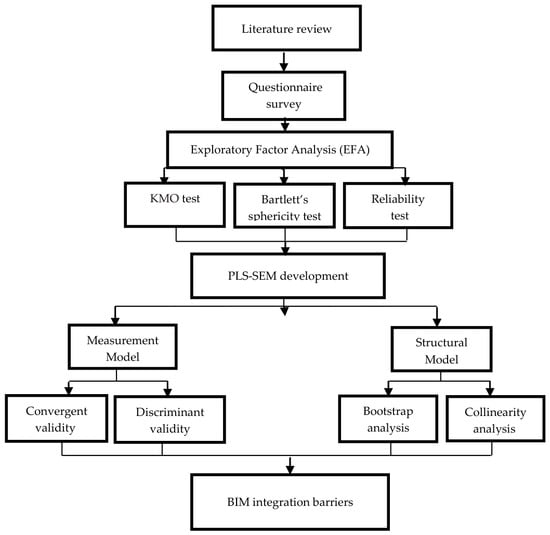
Figure 1.
Research design.
The questionnaire structure, including the barriers to BIM integration in Jordanian HEIs, was adapted from Babatunde et al. [23], which examined barriers to BIM integration in curricula in Nigerian universities. This study served as the methodological foundation because it is among the few to provide an empirical framework for addressing BIM integration barriers within HE curricula in developing countries. To ensure the questionnaire’s validity and clarity, the questions were reviewed informally by academics and industry professionals with BIM-related expertise. The wording, structure and relevance of the questionnaire items were then refined before the questionnaire was distributed electronically using Google Forms. A five-point Likert questionnaire was used, with responses ranging from 5 (very high) to 1 (very low). This type of questionnaire has been used in many construction management-based studies [52,53,54,55,56,57,58,59,60,61].
3.1. Respondents’ Profile
Since BIM phenomena are relatively new in Jordan, a stratified sampling approach was used to reach a specified subpopulation group. This sampling method has been used to obtain accurate and reliable data on BIM integration barriers in civil engineering programs in Jordanian HEIs. Respondents were selected based on their knowledge and experience on BIM integration in Jordanian HEIs. The inclusion of participants from both academics and industry professionals was intended to capture the practical and educational perspectives on BIM integration barriers in HEIs. The sampling size was identified based on the study objective. Yin has reported that sampling size for SEM analysis is considered satisfactory when exceeds 100 respondents. In this study, 102 completed questionnaires were received out of 150, indicating a 68% response rate, which is deemed to be satisfactory for this study. Those valid responses represent participants from the Jordanian construction industry and HEIs.
Since the BIM phenomenon is relatively new in Jordan, a stratified sampling approach was used to reach a specified subpopulation group [62]. This sampling method has been used to obtain accurate and reliable data on BIM integration barriers in civil engineering programs at Jordanian HEIs. Respondents were selected based on their knowledge and experience with BIM integration in Jordanian HEIs. The inclusion of participants from both academia and industry professionals was intended to capture the practical and educational perspectives on BIM integration barriers in HEIs. The sampling size was identified based on the study objective [63]. Yin [64] has reported that the sampling size for SEM analysis is considered satisfactory when it exceeds 100 respondents. In this study, 102 completed questionnaires were received out of 150, yielding a response rate of 68%, which is deemed satisfactory [65,66]. Those valid responses represent participants from the Jordanian construction industry and HEIs.
Table 2 presents the summary of respondents’ BIM-related characteristics and demographics. The findings possess varying sector representation, BIM awareness levels, perceptions of incorporating BIM into undergraduate civil engineering curricula, and the number of BIM courses undertaken. The comprehensiveness and reliability of the collected data are supported by the diversity of the respondents’ profiles.
Table 2.
Respondent profile and BIM-related characteristics.
Furthermore, the results show that respondents’ awareness of BIM concepts generally ranges from moderate to high, with positive perceptions of incorporating BIM into civil engineering curricula. Despite this, the number of previously undertaken BIM-based courses was relatively limited, indicating a gap between industry demand and BIM educational exposure within Jordanian HEIs.
3.2. Exploratory Factor Analysis
Using EFA, an experimental analysis was conducted to examine the barriers stated above by posting the questionnaire to experts in the Jordanian construction industry and lecturers/students at Jordanian HEIs. Sampling or observations of 150-300 are needed for EFA [67,68]. However, it has been argued that researchers showed only modest agreement regarding the appropriate sample size for factor analysis [69]. Thus, larger sample sizes are recommended, particularly as the number of variables included in the analysis increases [70]. Shen [71] stated that a range of 20 to 50 variables is appropriate for factor analysis.
Considering that when the number of variables exceeds this range, individual factors might not be appropriately determined, studies have suggested using a smaller number of variables when the sample size is sufficiently large [72,73]. Therefore, for the use of EFA and PLS-SEM in the context of exploratory research, the sample size in this study is considered acceptable. Studies have reported that respondent numbers should not be the sole criterion for evaluating sample adequacy in factor analysis; factor loadings, communalities, model complexity, and sampling adequacy indicators should also be considered [67,69]. In this study, despite the moderate sample size, the recommended threshold of 0.50 for all communalities was exceeded; the KMO value was excellent (0.917), and Bartlett’s Test of Sphericity was statistically significant, supporting the stability and suitability of the factor structure. Moreover, PLS-SEM is commonly considered suitable for exploratory and prediction-oriented research, including relatively small samples and complex models [74,75]. Despite this, the findings should be interpreted in light of the study’s exploratory nature, and broader institutional coverage and larger samples should be used in future research to validate them.
3.3. Analytical Method (Structured Equation Modelling)
The literature was assessed to identify barriers to integrating BIM in HEIs. Then, three models were identified and compared to determine the most effective alternative for BIM integration and to develop a model that supports it in Jordanian HEIs. These models are System Dynamics (SD), Structural Equation Modeling (SEM) and Multiple Linear Regression (MLR). Given the relationships among the latent variables, this study has not used a regression model. This is considered a significant limitation for applying such a model [76]. Moreover, because the survey data are not linked to a specific time period, SD could not be applied. Therefore, as the purpose of the analysis is to investigate the barriers to BIM integration in Jordanian HEIs and their impact on BIM implementation, this study has applied the SEM technique. This technique is appropriate for the analysis’s requirements, as it explains the relationships among multiple measurable and latent variables. Moreover, the SEM is considered an effective tool for tracking errors within variables [77]. It also incorporates random components and structural limits, as it is an equation-based method [78]. SEM is also known as a non-experimental research method, particularly when hypothesis-testing approaches are not well established, and it is widely used for parameter estimation and hypothesis testing [79]. Likewise, this method has been significantly developed over several decades, as evidenced by publications in journals such as the MIS Quarterly [74]. In addition, SEM is a well-established analytical approach in social science research [80].
This study has adopted the SEM method because it is widely used in construction research [81,82]. Also, this approach allows the simultaneous testing of multiple hypothesized relationships [83]. Moreover, the partial least squares (PLS) model has been used to establish relationships among BIM integration barriers. Furthermore, a hierarchical component model has been applied in this study, including the reflectively measured lower-order constructs through their indicators, while the BIM integration barriers (higher-order construct) are specified formatively by the six lower-order dimensions. PLS-SEM is a path modeling technique that links a set of dependent variables [84]. In PLS-SEM, the structural model creates the relationships among the constructs (BIM integration barriers), while the measurement model specifies the relationships between the constructs and their observed indicators [85].
The BIM integration barriers (a higher-order construct) are conceptualized in this study as a formative rather than a reflective construct. Support, Standards, Delivery, Resources, Knowledge, and Infrastructure & Security as the lower-order constructs illustrate the distinct dimensions, which collectively represent the overall BIM integration barriers in civil engineering curricula. These six dimensions are considered as causes of BIM integration barriers, not as interchangeable manifestations of a single underlying construct. This consideration is consistent with the theoretical assumption that constraints in curriculum delivery, lack of standards, deficiencies in institutional support, knowledge gaps, resource limitations, and Infrastructure & Security-related issues collectively lead to the overall level of BIM integration barriers. Therefore, the lower-order constructs were measured reflectively through their indicators, while the higher-order construct was specified formatively in the PLS-SEM model. Consequently, in line with hierarchical component modeling recommendations in PLS-SEM, discriminant validity was assessed only for the reflective lower-order constructs.
4. Results
4.1. Finding and Categorising the Model’s Constructs
The EFA has been used to examine the structure of barriers to BIM integration. Several commonly recognized measures of factorability were used in the analysis. The Kaiser–Meyer–Olkin Measure of Sampling Adequacy is commonly used to assess data suitability for factor analysis by examining whether the partial correlations between variables are sufficiently small [86,87]. The KMO value ranges from 0 to 1, with 0.6 as the minimum acceptable threshold for effective factor analysis [67].
Moreover, Bartlett’s Test of Sphericity is used to determine whether the correlation matrix differs from the identity matrix. Pallant [69] has emphasized that Bartlett’s Test is mandatory to confirm the suitability of the data for factor analysis, and a p-value below 0.05 indicates statistical significance [88].
The initial results for the BIM integration barriers showed that the KMO value was 0.917 (Table 3), indicating excellent sampling adequacy. Moreover, Bartlett’s Test of Sphericity was statistically significant (χ2(435) = 1911.992, p < 0.001), confirming that the data were appropriate for factor analysis. Furthermore, all diagonal values of the anti-image’s correlation matrix exceeded 0.5, resulting in the inclusion of all elements in the factor analysis.
Table 3.
KMO and Bartlett’s Test.
The communalities represent the variance in each variable explained by the extracted factors. Values below 0.3 generally show that a variable does not fit well within the factor solution. In the current analysis, all initial communalities exceeded the recommended threshold, suggesting that all variables contributed adequately to the factor structure. Moreover, all retained factor loadings exceeded the minimum acceptable threshold for exploratory factor analysis, as presented in Table 4.
Table 4.
Communalities.
The 30 barriers to BIM integration in civil engineering programs at Jordanian HEIs were analyzed using EFA. Figure 2 presents the scree plot obtained from EFA and shows a clear decline in eigenvalues after the sixth component, supporting the retention of six constructs with eigenvalues greater than 1. These six constructs explain 66.896% of the total variance, as shown in Table 5.
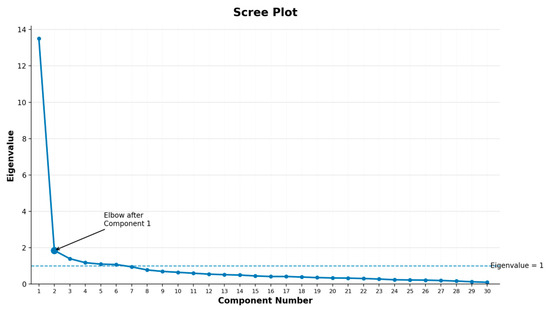
Figure 2.
Component analysis.
Table 5.
Total variance explained.
The statistical reliability of the factors extracted via EFA was assessed. The reliability of each factor (or group) was calculated based on the highest factor loading of the corresponding parameters within the matrix’s structure. It was indicated that the reliability test results are satisfactory (see Table 6). According to Nunnally [89], an acceptable value for Cronbach’s alpha is above 0.5 for newly developed dimensions, while values exceeding 0.6 are considered more reliable. Thus, the overall Cronbach’s alpha values are satisfactory, as they are greater than 0.6. Moreover, the inter-item correlations across all factors were above 0.3, indicating acceptable internal consistency [90].
Table 6.
Barriers of BIM integration in HEIs curricula factor loading groups.
Common Method Bias (CMB) Assessment
The possibility of CMB has been assessed because the data were collected using a single instrument (questionnaire) at one point in time. Therefore, Harman’s single-factor test was carried out by loading all measurement items into an unrotated exploratory factor analysis. The results in Table 5 show the first factor accounted for 44.946% of the total variance. This percentage is below the recommended threshold of 50%, illustrating that that CBM was not a serious concern in this research. Moreover, during the questionnaire design and data collection, a number of measurements were adopted to minimize response bias such as assuring the anonymity and confidentiality of respondents, using concise and clear wording and targeting academics and professionals with BIM related experience and knowledge.
The possibility of CMB has been assessed because the data were collected with a single instrument (questionnaire) at a single point in time. Therefore, Harman’s single-factor test was carried out by loading all measurement items into an unrotated exploratory factor analysis. The results in Table 5 show that the first factor accounts for 44.946% of the total variance. This percentage is below the recommended threshold of 50%, which illustrates that CBM was not a serious concern in this research [91]. Moreover, during the questionnaire design and data collection, a number of measurements were adopted to minimize response bias, such as assuring the anonymity and confidentiality of respondents, using concise and clear wording and targeting academics and professionals with BIM-related experience and knowledge.
4.2. Measurement Model
According to Hair Jr et al. [75], the measurement model evaluation requires the assessment of (i) indicator reliability, (ii) composite reliability, (iii) average variance extracted, and (iv) discriminant validity. In the present analysis, the PLS algorithm was used by performing the recommended settings, with 300 iterations [92], following the instructions proposed by Wong [93]. These settings included path weighting, a data matrix standardized to a mean of 0 and a variance of 1, a maximum of 300 iterations, an abort criterion of 10−5, and initial weights set to 1.0.
Indicators with external loading between 0.4 and 0.70 should generally be considered for removal if deleting the indicator results in a significant improvement in composite reliability and average variance extracted (AVE) [94]. However, as recommended by Hair Jr et al. [75], indicators with external loadings below 0.60 do not satisfy this requirement and should be excluded from further analysis. At this threshold, roughly half of the indicator’s variance is explained by its underlying construct, meaning the explained variance exceeds the error variance. Table 6 shows the external loadings of all variables in the measurement model. All external loadings exceed 0.6, which is considered acceptable.
Cronbach’s alpha is sensitive to the number of variables included in a construct. Therefore, the model’s internal consistency was also evaluated using composite reliability (CR), as suggested by Hair Jr et al. [75]. CR values above 0.70 are considered acceptable [75], while values greater than 0.60 may still be acceptable in exploratory research [93]. The recommended threshold for most external loadings was exceeded. However, given several indicators’ contributions to content validity and overall construct reliability, and the acceptable AVE values within the thresholds for exploratory research [95,96], indicators with loadings between 0.40 and 0.60 were retained (see Table 7).
Table 7.
The result of convergent validity.
Discriminant validity is established when each construct is clearly distinguishable from the other constructs in the model, indicating that it represents unique characteristics not captured by the remaining constructs [97]. This can be assessed using the approach proposed by Fornell and Larcker [98]. According to the Fornell–Larcker criterion, the square root of the average variance extracted for each construct should be greater than its correlations with the other latent constructs in the model [98]. The results supporting the discriminant validity of the measurement model are presented in Table 8 [99].
Table 8.
Correlation of latent variables and discriminant validity (Fornell–Larcker).
The Fornell–Larker criterion was used to assess the discriminant validity. BIM integration barriers, as a higher-order construct, were modeled formatively using low-order reflective dimensions; therefore, it was omitted from the discriminant validity assessment to prevent conceptual overlap with its constituent constructs. The square root of the AVE values for each reflective lower-order construct was generally higher than their inter-construct correlations, supporting acceptable discriminant validity [98,99]. Despite this, a relatively high correlation was observed between the Support and Standards constructs, indicating conceptual relatedness between the requirement of BIM standardization and institutional support mechanisms within the context of Jordanian higher education. However, as these constructs are theoretically distinct dimensions based on the conceptual framework and prior literature, they were retained.
4.3. Path Analysis
Path analysis (PA) is a linear statistical technique widely used in management and social sciences. This technique is an essential tool to examine multiple complex relationships simultaneously [67]. The first phase of SEM analysis is to assess the structural model and evaluate the relationships among the study constructs. After the measurement model is validated, the structural model becomes the focus of the next stage of analysis.
SEM analysis is utilized to detect and explain the relationships among the model’s variables. In particular, the connections between exogenous and endogenous variables are detailed in SEM [70,100]. The SEM evaluation is based on the overall fit of the model and the significance, size, and direction of the hypothesized relationships among variables [70]. The last stage includes testing and confirming the proposed analytical relationships in Figure 3. This figure shows the proposed PLS-SEM model used to evaluate the relationships between Delivery, Standards, Support, Infrastructure & Security and Knowledge (reflective lower-order constructs) and BIM integration barriers (the higher-order construct), which shaped the formative paths. Thus, the projected path coefficients illustrate the formation of each construct in the overall barriers to BIM integration construct.
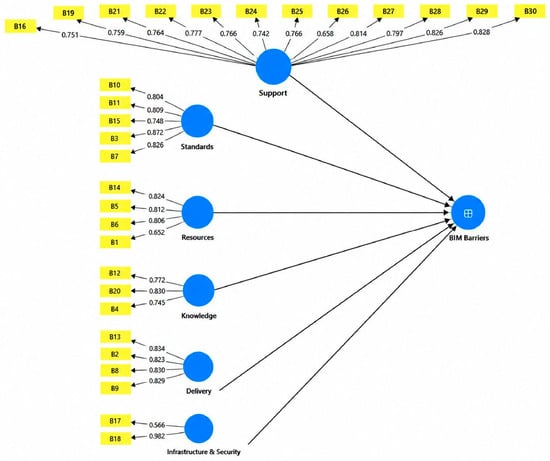
Figure 3.
SEM model.
The bootstrapping procedure consists of randomly resampling the original dataset to produce new samples of approximately the same size as the original dataset. This method is used to test the dataset’s consistency and statistical significance, while also computing the error of the path coefficients [101]. The standardized coefficients’ path (β) and p-values are presented in Table 8 to determine the significance of the hypothesized pathway. The results of the bootstrapping method are shown in Table 9 and Figure 4, including the model’s path p-values. Table 9 and Figure 4 indicate that all hypothesized paths are statistically significant (p < 0.05), with the Support construct showing the strongest effect on BIM integration barriers, and Infrastructure & Security making the weakest yet significant contribution.
Table 9.
Relative paths for the model.
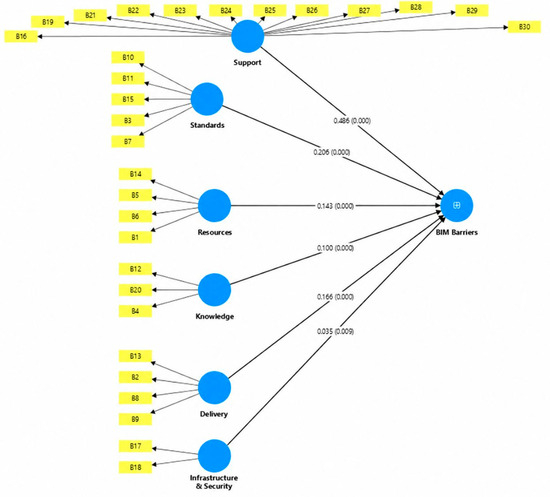
Figure 4.
Path model.
5. Discussion
The current study examined the barriers to incorporating BIM into civil engineering curricula in Jordanian universities using an integrated EFA and PLS-SEM approach. Given that BIM education research in the Jordanian context is exploratory and that knowledgeable respondents with BIM experience are limited, the adopted PLS-SEM approach was considered appropriate for exploratory model validation and theory development. Six underlying constructs from 30 barrier items, accounting for 66.896% of the total variance, were identified via exploratory factor analysis: Support, Standards, Delivery, Resources, Knowledge, and Infrastructure & Security. The structural model verified that all six constructs have a statistically significant positive influence on the BIM integration barriers. The suitability of the data for the factor analysis was verified by a KMO value of 0.917 and a significant Bartlett’s test of sphericity (x2(435) = 1911.992, p < 0.05), both surpassing the recommended thresholds [67,69]. In addition, the measurement model showed acceptable convergent validity (AVE > 0.50) and composite reliability (CR > 0.70) [75,98]. Discriminant validity, as assessed by the Fornell–Larcker criterion, was generally supported, although some conceptual overlap was observed between the Support and Standards constructs. The subsequent subsections discuss each construct based on its relative significance as determined by the path coefficients.
The findings indicate that the barriers to BIM integration in Jordanian HEIs are institutional and systemic rather than operational or technological. Despite the importance of available resources and technical knowledge, the dominance of standards and support constructs suggests that BIM integration is largely driven by broader governance environments in engineering education, i.e., institutional incentives, accreditation structures, policy direction, and mechanisms of coordination between universities and industry. This reveals the characteristics of higher education systems in developing countries, in which the transformation of the curricula is heavily dependent on regularity alignment and centralized institutional support rather than academic incentives. Therefore, the identified barriers should be interpreted as interconnected institutional constraints leading to the modernization of engineering education in universities.
5.1. Support (β = 0.486, p < 0.001)
In the Jordanian context, the support appeared to be the strongest construct of predicting BIM integration barriers in higher education, with a path coefficient of 0.486. This construct shows barriers correlated to institutional support, government guidance, higher-education institution management backing, and partnership with industry stakeholders. Its dominance underscores the key role of both institutional and governmental enablers in enabling the effective incorporation of BIM into academic programs. This finding aligns with the existing literature, which highlights coordinated government initiatives and institutional leadership as the most influential drivers of successful BIM incorporation, particularly in developing countries [102,103]. When compared with developed countries such as the United Kingdom, Singapore, and Finland [104], where BIM is effectively incorporated into universities, Jordan lacks a BIM mandate or a clear strategic plan, leading to the absence of external drive or structured guidance needed for curriculum transformation in higher education institutions.
The Support construct achieves its high status in Jordanian society because of the particular governance and financial systems which support higher education institutions. Jordanian universities operate through centralized systems that control both accreditation and curriculum approval processes, while requiring universities to follow national accreditation standards and ministry requirements for all major curriculum changes. The absence of national digital construction policies or BIM-related accreditation requirements has led to a lack of incentives for universities to redesign civil engineering curricula around BIM competencies. Moreover, many engineering faculties in Jordanian universities face financial constraints, leading to a prioritization of maintaining existing programs and meeting accreditation standards while pursuing their educational objectives. Therefore, BIM could be perceived as a high institutional risk because it requires ongoing funding for software, laboratories, staff development, and cross-departmental collaboration, without guaranteed regulatory or financial support. As a result, the institutional framework creates a situation that leads organizations to resist change, while it shows that support-related obstacles are the top factor predicting outcomes in the structural model.
The academic system in Jordanian engineering education may lead to resistance to BIM integration. Civil engineering programs in many developing countries maintain their focus on traditional technical teaching methods that follow discipline-specific guidelines through lecture-based instruction. However, implementing BIM technology requires educators to use teaching methods that encourage students to work together across different fields of study through project-based learning. As a result, faculty members may perceive BIM integration as an additional institutional burden rather than a natural extension of existing curricula, particularly when academic workload structures and promotion systems provide limited incentives for curriculum innovation, interdisciplinary teaching, or industry engagement. Consequently, this may explain that despite the increased awareness of BIM applications in the construction industry, universities continue to transform their BIM curricula at a slow pace.
Additionally, the support construct’s importance aligns with results from Australia [43], which suggest that universities are unable to manage the magnitude of change needed for effective BIM education without coordinated efforts from both government and industry. Similarly, Correa et al. [26] concluded that institutional resistance and limited industry commitment are among the main factors hindering BIM education globally. In Jordan, the lack of government support and established BIM standards, as well as weak collaboration between universities and industry, limit civil engineering departments’ ability to successfully initiate and sustain BIM adoption [1,2]. These conclusions suggest that a top-down enabling environment, categorized by clear policy guidance, dedicated funding, and formalized mechanisms for industry collaboration, is a key requirement for overcoming BIM integration barriers in Jordanian universities.
5.2. Standards (β = 0.206, p < 0.001)
The second most significant predictor is the Standards construct with a path coefficient of 0.206. This construct captures barriers related to the limitations of formal accreditation standards and guidelines for incorporating BIM into the current curriculum, opposing perspectives on whether BIM should be recognized as a process or only a tool, and the lack of clear guidance on the detailed content that should be included in BIM teaching. These findings highlight a common challenge in incorporating BIM within academic frameworks. In Nigeria, a study by Babatunde and Ekundayo [23] found that the absence of accreditation standards significantly reduces the incorporation of BIM into quantity surveying programs. The study also found that the lack of clear mandates from professional bodies leaves curriculum developers without a benchmark for BIM content and competency expectations.
Furthermore, countries that have established structured BIM-focused academic forums, such as the UK and Chile, have made substantial advancements in standardizing BIM curricula and aligning them with industry needs [105,106]. On the other hand, developing countries like Jordan have not established general BIM guidance and discipline-detailed educational guidelines. This could result in assigning individual academics, who may lack adequate expertise in the field, the overwhelming responsibility of defining BIM content [1]. The absence of a BIM standard in Jordan highlights the existing technical gap and the current state of digital governance in the construction sector. Therefore, there is still a lack of unified institutional coordination among professional associations, regulatory agencies, accreditation bodies, and universities in Jordan’s construction sector. Consequently, HEIs are operating without a national BIM competency framework for education, leading to fragmented curriculum development and a reliance on individual academic initiatives rather than a holistic national policy direction. This fragmented environment leads to inconsistency in teaching methods for BIM, while preventing the creation of sustainable educational programs that would support digital construction progress. The situation is made further complicated due to the lack of clarity toward the conceptualization of BIM by means of how it should be treated, whether as a software tool, a collaborative process, or a full project delivery system [38]. This finding suggests that establishing appropriate BIM educational standards through coordinated collaboration among various formal entities, such as the Jordanian Engineers Association, the Accreditation and Quality Assurance Commission, and international organizations such as buildingSMART, could provide a solid foundation for effective BIM curriculum development.
5.3. Delivery (β = 0.166, p < 0.001)
The third significant predictor is the Delivery construct with a path coefficient of 0.166. It underlines barriers associated with limited curriculum space, the need for innovative teaching methods, rigidity of program structures, and the difficulty of merging BIM’s multidisciplinary elements with existing courses. This aligns with the widely recognized challenge that traditional engineering programs are often designed around separate disciplines, which are inconsistent with BIM’s collaborative nature [37,38]. Furthermore, a study by Turk and Istenič-Starčič [107] concluded that traditional curricula need significant restructuring to implement BIM effectively. Consequently, the study proposed a “T-shaped curriculum” model where deep knowledge of a single discipline is combined with an extensive interdisciplinary understanding.
In the Jordanian context, civil engineering programs are typically categorized by rigid accreditation frameworks with limited flexibility, making it challenging to introduce dedicated BIM courses [1,2]. This underlines the critical role that delivery-related barriers play in shaping BIM integration difficulties. Similar outcomes have been concluded by Shibani et al. [25] in Morocco and Casasayas et al. [43] in Australia. Both studies stressed that overcrowded curricula and resistance to restructuring existing curricula are ongoing obstacles.
To address these challenges, several practical strategies have demonstrated success across different educational contexts, including adopting project-based learning methods, integrating BIM into existing courses rather than introducing standalone modules, and using capstone projects as effective platforms for BIM integration [7,8].
5.4. Resources (β = 0.143, p < 0.001)
The resources construct illustrates emerging barriers related to BIM’s resource-intensive nature. These barriers include the ongoing cost of software upgrades, limited IT infrastructure, and the need for specialized facilities. Moreover, such barriers are more prominent in developing countries, where HEIs often operate under significant financial constraints [54,108]. Despite the importance of resource-related barriers in obstructing BIM integration in Jordanian HEIs, their effect is relatively less than that of support and standards barriers. Subsequently, this indicates that, despite the need for adequate resources, the effectiveness of BIM integration also depends on institutional support and clear standards. This aligns with the outcomes of Kineber et al. [51] and Alhammadi et al. [60], who, using a similar PLS-SEM methodology, found that process- and institution-related barriers have a stronger impact than purely resource barriers in developing country contexts.
In practice, limited budgets hinder their capacity to invest in specialized computer infrastructure, continuous upgrading of BIM software, and the establishment of a BIM-based laboratory. However, the availability of BIM-based platforms and special licensing programs for academics, such as Autodesk’s free educational licenses, represents feasible avenues for minimizing these barriers, especially when effective institutional frameworks support their adoption [109].
5.5. Knowledge (β = 0.100, p < 0.001)
The knowledge construct illustrates arising barriers including the lack of qualified BIM instructors, the difficulty of educating lecturers, as the technology is rapidly evolving, the lack of ICT literacy and technical expertise of staff, and the need for students to have prior fundamental knowledge before undertaking a BIM course. Despite the effect of knowledge-related barriers being moderate, it remains statistically significant, indicating that they are not the primary barriers but still contribute meaningfully to the overall barriers. This finding is consistent with global evidence, which considers the lack of faculty capacity, skills, and training as one of the major barriers to BIM education [37,38,110]. In the Jordanian context, the limited number of qualified professionals is identified as a significant barrier to BIM implementation in the construction industry [12]. This limitation also extends to HEIs, as university lecturers are drawn from the same professional talent pool.
The continuous evolution of BIM technologies has posed a challenge for developing faculty competency in BIM, leading to the need for existing continuous professional development programs that many institutions in developing countries have struggled to maintain [43,82]. Globally, it was suggested that industry engagement, ongoing faculty training, and collaboration across institutions would help bridge the knowledge and skills gaps [26,111]. In the context of Jordan, creating partnerships with international and regional BIM-active institutions and establishing vendor-based training programs would pave the way to enhance BIM capacity among Jordanian academics.
5.6. Infrastructure & Security (β = 0.035, p = 0.005)
The Infrastructure & Security construct had the least impact, yet it was still statistically significant, on barriers to BIM integration. This construct encompasses challenges related to inadequate and unreliable power supply and heightened security risks. Although these factors appear to exert less influence in the Jordanian context compared to institutional and curriculum-related barriers, their statistical significance should not be underestimated. The relatively limited impact of this construct may be attributed to the fact that, while Jordan’s ICT infrastructure does not reach the level of highly developed nations, it remains comparatively more established than in several sub-Saharan African contexts, where unreliable electricity supply continues to be a major impediment to digital education and technology adoption [23,112].
Nevertheless, the continued statistical significance of Infrastructure & Security-related barriers indicates that challenges related to infrastructure reliability and cybersecurity awareness remain pressing in the Jordanian higher education context. This finding aligns with Oladapo [47] and Nakapan [46], who observed that in many developing contexts, even relatively minor infrastructure disruptions can disproportionately hinder technology-intensive educational activities. From a computer science perspective, the BIM platform has increasingly relied on collaborative digital workflows, distributed data environments, and cloud computing, elevating the importance of the resilience of digital infrastructure, interoperability, and cybersecurity within engineering education. Therefore, inadequate ICT infrastructure and insufficient cybersecurity preparedness could significantly impede the creation of BIM-enabled learning environments and digital collaboration processes in HEIs [113,114]. From a policy perspective, addressing these Infrastructure & Security-related barriers requires sustained investment in reliable ICT infrastructure across university campuses, alongside the development of institutional cybersecurity frameworks that actively support, rather than impede, the adoption of collaborative digital tools such as BIM platforms.
5.7. Comparative Analysis with International Contexts
In Jordan, the ranking of BIM integration barriers identified in this study showed that Support and Standards barriers were more critical than Resources, Knowledge, and Infrastructure & Security. These relationships were empirically quantified in this study using PLS-SEM, providing a structured basis for prioritizing interventions. The results suggest that, in Jordan, investing in resources or faculty development should come after strengthening institutional support and establishing clear BIM education standards by policymakers and university leaders, as any investments are unlikely to yield meaningful results without a solid institutional foundation.
The findings of this research indicate that Jordan is currently in its initial institutional phase of BIM development, where the main challenge is establishing an enabling institutional environment for digital transformation rather than pedagogical optimization. This consists of establishing national supportive policies, financial incentives, aligning accreditation, and collaborating between industry and academia.
Similar outcomes were observed in Yemen [115] and Palestine [116]. These similarities are related to a lack of governmental direction, limited collaboration between industry and academia and financial constraints. However, this study revealed that Jordan’s case shows greater dependence on centralized institutional governance and accreditation alignment than several comparable developing countries. Moreover, Jordan differs in having comparatively more stable ICT infrastructure and resilient institutional capacity, as in the developed model, Infrastructure & Security barriers scored the weakest link (β = 0.035). This is unlike several sub-Saharan African contexts [52,54], where ICT instability and power outages significantly hinder the implementation of digital education.
In contrast, this ranking provides important insights when compared with findings from developed countries. The main barriers in BIM education in developed regions such as Australia, the UK, and the Scandinavian countries are typically associated with curriculum development, teaching approaches, and the gap between industry and academia [26,43,48]. These challenges indicate that institutional structures and BIM standards are well established. Consequently, this indicates that common strategies employed in developed countries, which focus mainly on educational innovation, interdisciplinary integration, and strong industry collaboration, cannot be directly transferred to developing countries without first establishing the institutional conditions needed for their success [108]. Therefore, the main differences between the developed and developing countries in terms of BIM education pathways are the maturity of the digital and institutional construction eco-system associated with curriculum transformation. For instance, in developed countries, the integration of BIM has emerged within the existence of well-established regularity frameworks developed by national BIM enforcement, collaboration between industry and academia, stable financial support and developed accreditation systems. Therefore, interdisciplinary collaboration and pedagogical innovation are the focus of BIM education in developed nations.
5.8. Theoretical and Practical Implications
This study makes a significant theoretical contribution to BIM education research by delivering the first empirically validated PLS-SEM model of BIM integration barriers in higher education institutions in the Middle East. Existing research on BIM education barriers has mainly used qualitative and descriptive methods [23,26,43]. However, this study provided a quantitatively tested and structurally validated model that clarifies the relative importance and influence of different barrier categories by proposing a six-construct quantitative framework. The model’s robust descriptive and predictive power, along with the statistical significance of all six constructs and relationships, validates that BIM integration barriers in higher education institutions in developing countries are very complex and interconnected. These barriers collectively involve institutional, curricular, knowledge-based, and resource- and infrastructure-related dimensions, underlining the various challenges associated with BIM implementation in HEIs.
On the other hand, the findings of this study provide a clear order of practical priorities for civil engineering departments and higher education policymakers in Jordan. The strong influence of the Support construct (β = 0.486) suggests that the priority should be to develop a national BIM education strategy, ideally coordinated through collaboration among three main pillars: the Government, the Engineers Association, and industry stakeholders. This should be strengthened by developing BIM-related educational standards and accreditation requirements (Standards, β = 0.206), followed by delivery through curriculum restructuring to integrate BIM content into existing programs (Delivery, β = 0.166). In parallel, efforts should also focus on resource allocation (Resources, β = 0.143), faculty training and capacity building (Knowledge, β = 0.100), and infrastructure enhancement (Infrastructure & Security, β = 0.035). However, these measures are likely to have only a limited impact unless the key enabling conditions are first put in place.
6. Conclusions
This study provides a comprehensive empirical investigation of the barriers to BIM integration in civil engineering curricula at Jordanian HEIs. EFA and PLS-SEM were employed, yielding six interrelated constructs: Support, Standards, Delivery, Resources, Knowledge, and Infrastructure & Security. These constructs have shaped the BIM integration landscape in the HEIs. Institutional and governmental support was found to be the most influential barrier. This emphasizes the need to establish coordinated national strategies, university–industry collaboration, and policy frameworks. Moreover, the lack of existing BIM standards and accreditation guidelines has limited the curriculum development, while a rigid program structure has constrained the effective incorporation of interdisciplinary BIM concepts.
Technical knowledge and resource availability were found to be important. Despite this, their significance is second to institutional and systemic factors. This indicates that the training and infrastructure investments are inadequate without an enabling institutional and policy environment. Moreover, findings indicate that top-down interventions, such as developing national BIM education frameworks and enhancing institutional support, will significantly overcome current barriers.
From a theoretical perspective, this study advances BIM education research by establishing a validated structural model in a developing country context, thereby addressing a significant gap in the literature. In practice, this study provides a clear prioritization framework for academic institutions and policymakers to effectively integrate BIM and modernize engineering education, aligning it with industry demands.
Despite achieving the research aim and objectives, this study has limitations. Firstly, this research is context-specific to Jordanian HEIs, which may limit the generalizability of the findings to other developing countries. Secondly, a cross-sectional survey design was adopted, which captures perceptions at a single point in time, affecting the dynamic nature of curriculum development and BIM adoption. Furthermore, as this research is based on self-reported questionnaire data from the same respondents, some degree of common method bias could affect the results, despite the procedural and statistical measures used to reduce its effect. Thirdly, the sample size fulfilled the minimum requirements for exploratory PLS-SEM analysis. Despite this, the factor structure’s statistical generalizability and stability may be limited by the relatively moderate sample size relative to the 30 investigated variables. Therefore, the findings should be treated as exploratory rather than confirmatory. Lastly, the proposed PLS-SEM model focuses on investigating the direct relationships between the identified barriers to BIM integration and the higher-order BIM integration barriers construct. Consequently, potential mediating and moderating effects were not investigated, which could further explain the complexity of the transformation processes of the BIM curriculum.
These limitations lead to the following future work. Firstly, a similar study could be conducted across different regions and countries to validate the proposed model and investigate integration barriers in both developing and developed countries. Secondly, it is recommended to conduct longitudinal research to capture changes in the integration of BIM into HEIs’ civil engineering curricula over time, particularly in relation to industry practices and national policies. Thirdly, adopting a mixed-methods approach by combining qualitative analyses with interviews would provide in-depth insights into the processes of institutional decision making. Fourthly, larger samples across multiple institutions and regional contexts should be used to validate the proposed model. Lastly, despite the appropriateness of the relatively parsimonious model structure for the exploratory nature of the study and the available sample size, more advanced causal mechanisms, such as mediations and moderation effects on industry collaboration, the maturity of digital transformations, organizational culture, and institutional readiness, are encouraged.
Funding
This research received no external funding.
Institutional Review Board Statement
The study was conducted in accordance with the Declaration of Helsinki, and the protocol was approved by the Ethics Committee of Middle East University (Approval number 826-2025/2026) on [22 January 2026]. Informed consent for participation was obtained from all participants involved in the study.
Data Availability Statement
The raw data supporting the conclusions of this article will be made available by the author on request.
Acknowledgments
The author expresses his gratitude to the Middle East University in Amman, Jordan for providing financial support to cover the publication fees associated with this research article.
Conflicts of Interest
The author declares no conflicts of interest.
References
- Matarneh, R.; Hamed, S. Barriers to the Adoption of Building Information Modeling in the Jordanian Building Industry. Open J. Civ. Eng. 2017, 7, 325–335. [Google Scholar] [CrossRef]
- Hyarat, E.; Hyarat, T.; Al Kuisi, M. Barriers to the Implementation of Building Information Modeling among Jordanian AEC Companies. Buildings 2022, 12, 150. [Google Scholar] [CrossRef]
- Succar, B. Building Information Modelling Framework: A Research and Delivery Foundation for Industry Stakeholders. Autom. Constr. 2009, 18, 357–375. [Google Scholar] [CrossRef]
- Al-Btoush, M.; Bassam, A.; Khraisat, S.; Aldiabat Al-Btoosh, J.A.; Jasim, N.A.; Taiseer Rawashdeh, T.; Varouqaa, I.F. Building Information Modeling Capability in Mitigating Change Orders and Cost Overrun. J. Adv. Sci. Eng. Technol. 2024, 7, 63–90. [Google Scholar] [CrossRef]
- Alshdiefat, A.; Aziz, Z. Crucial Barriers of Building Information Modelling (BIM) in the Jordanian Construction Industry. Glob. J. Eng. Technol. Adv. 2020, 3, 20–30. [Google Scholar] [CrossRef]
- Subra, M.; Jrad, F.; Sanaa, A.M. Developing a Model to Improve the Efficiency of Maintenance Management for Service Buildings Using BIM and Power BI: A Case Study. Int. J. BIM Eng. Sci. 2024, 8, 18–30. [Google Scholar] [CrossRef]
- Lassen, A.K.; Hjelseth, E.; Tollnes, T. Enhancing Learning Outcomes by Introducing BIM in Civil Engineering Studies—Experiences from a University College in Norway. Int. J. Sustain. Dev. Plan. 2018, 13, 62–72. [Google Scholar] [CrossRef]
- Tsai, M.H.; Chen, K.L.; Chang, Y.L. Development of a Project-Based Online Course for BIM Learning. Sustainability 2019, 11, 5772. [Google Scholar] [CrossRef]
- Al-btoush, M.A.K.A.; Haron, A.T. Barriers and Challenges of Building Information Modelling Implementation in Jordanian Construction Industry. Glob. J. Eng. Sci. Res. Manag. 2017, 4, 9–20. [Google Scholar]
- Abu Qalbin, R.; Rabayah, H.; Darwish, M.; Abendeh, R. Assessment of Construction Risks in Projects Funded by External Sources in Jordan during the COVID-19 Pandemic. Buildings 2023, 13, 1885. [Google Scholar] [CrossRef]
- Kordi, N.E.; Zainuddin, N.I.; Taruddin, N.F.; Tengku Aziz, T.N.A.; Abdul Malik, A. A Study on Integration of Building Information Modelling (BIM) in Civil Engineering Curricular. In IOP Conference Series: Materials Science and Engineering; IOP Publishing: Bristol, UK, 2020; Volume 849. [Google Scholar]
- Bekr, G.A. Exploring barriers in implementing building information modeling: A preliminary study. In Proceedings of the International Structural Engineering and Construction, Valencia, Spain, 24–29 July 2017; Volume 4. [Google Scholar]
- Alshdiefat, A. Developing an Assessment Model for the Adoption of Building Information Modelling to Reduce the Cost of Change Orders in the Jordanian Construction Industry. Ph.D. Thesis, University of Salford Manchester, Salford, UK, 2017. [Google Scholar]
- Alhusban, M. Conceptual Procurement Framework for Building Information Modelling Uptake to Enhance Buildings’ Sustainability Performance in the Jordanian Public Sector. Ph.D. Thesis, University of Portsmouth, Portsmouth, UK, 2018. [Google Scholar]
- Alhusban, M.; Elghaish, F.; Hosseini, M.R.; Mayouf, M. Revamping Established Project Procurement Approaches to Support BIM Implementation. Smart Sustain. Built Environ. 2025, 14, 672–695. [Google Scholar] [CrossRef]
- Alhusban, M.; Nasereddin, M.; Alghossoon, A.; Hatamleh, M.T. A Hybrid Conceptual Procurement Framework for BIM Uptake to Enhance Buildings’ Sustainability Performance in the Jordanian Public Sector. Int. J. Build. Pathol. Adapt. 2025, 43, 93–116. [Google Scholar] [CrossRef]
- Hagan, D.E.; Aryanti, T.; Ilhamdaniah. Challenges of BIM Integration in Construction Education: The Ghanaian Perspective. ARTEKS J. Tek. Arsit. 2025, 10, 567–584. [Google Scholar] [CrossRef]
- Kim, K.P.; Freda, R.; Whang, S.W. Effective BIM Curriculum Development for Construction Management Program Transformation Through a Change Management Lens. Buildings 2025, 15, 2775. [Google Scholar] [CrossRef]
- Abbas, A.; Din, Z.; Farooqui, R. Integration of BIM in Construction Management Education: An Overview of Pakistani Engineering Universities. Procedia Eng. 2016, 145, 151–157. [Google Scholar] [CrossRef]
- Besné, A.; Pérez, M.Á.; Necchi, S.; Peña, E.; Fonseca, D.; Navarro, I.; Redondo, E. A Systematic Review of Current Strategies and Methods for BIM Implementation in the Academic Field. Appl. Sci. 2021, 11, 5530. [Google Scholar] [CrossRef]
- Arthur, S.L.; Byaruhanga, C.B.; Mubiru, J. Exploring BIM Implementation in Architectural, Engineering and Construction (AEC) Education in Uganda. East Afr. J. Eng. 2025, 8, 302–313. [Google Scholar] [CrossRef]
- Maya, R.; Raad, L.; Dlask, P. Incorporating BIM into the Academic Curricula of Faculties of Architecture within the Framework of Standards for Engineering Education. Int. J. BIM Eng. Sci. 2023, 6, 8–28. [Google Scholar] [CrossRef]
- Babatunde, S.O.; Ekundayo, D. Barriers to the Incorporation of BIM into Quantity Surveying Undergraduate Curriculum in the Nigerian Universities. J. Eng. Des. Technol. 2019, 17, 629–648. [Google Scholar] [CrossRef]
- Hagan, D.E.; Aryanti, T.; Saleh, I. Trends of BIM Integration in Construction Education: A Bibliometric-Based Visualization Analysis. ARTEKS J. Tek. Arsit. 2025, 10, 125–136. [Google Scholar] [CrossRef]
- Shibani, A.; Awwad, K.A.; Ghostin, M.; Siddiqui, K.; Sidqui, F. Investigating the Barriers of Building Information Modelling (BIM) Implementation in the Higher Education in Morocco. In Proceedings of the International Conference on Industrial Engineering and Operations Management, Virtual, 10–12 March 2020; Volume 0. [Google Scholar]
- Correa, S.D.; Turk, Ž.; Dujc, J. BIM Integration in Higher Education: A Global Assessment. J. Inf. Technol. Constr. 2025, 30, 1059–1079. [Google Scholar] [CrossRef]
- De Azevedo, V.F.B.; Lago, E.M.G.; Griz, C.; Gusmão, A.; Vasconcelos, B. Assessment of BIM Maturity in Civil Engineering Education: A Diagnostic Study Applied to the Polytechnic School of the University of Pernambuco in the Brazilian Context. Buildings 2026, 16, 221. [Google Scholar] [CrossRef]
- Tougwa, F.N. Some Major Challenges Faced by Civil Engineering Professionals in the Execution of Their Profession and the Impact of the Challenges to the Environment, Society and Economy of Developing Countries. Curr. Trends Civ. Struct. Eng. 2020, 5, 1–7. [Google Scholar] [CrossRef]
- Waisapi, J.Y. Profesionalisme Keinsinyuran. Formosa J. Soc. Sci. 2022, 1, 299–314. [Google Scholar] [CrossRef]
- Ramírez, F.; Seco, A. Civil Engineering at the Crossroads in the Twenty-First Century. Sci. Eng. Ethics 2012, 18, 681–687. [Google Scholar] [CrossRef]
- American Society of Civil Engineers. Achieving the Vision for Civil Engineering in 2025: A Roadmap for the Profession. In The Vision for Civil Engineering in 2025; ASCE: Reston, VA, USA, 2007. [Google Scholar]
- Hasnain, A. Building Information Modelling: Opportunities, Challenges, and Future Directions. Mesopotamian J. Civ. Eng. 2024, 2024, 1–9. [Google Scholar] [CrossRef]
- Purwanto, S.; Nungraha, A.R.; Harahap, M.A.K.; Fitri, I.I. Integration of Building Information Modelling (BIM) in Civil Engineering Project: A Literature Review. Indones. J. Eng. Educ. Technol. 2024, 2, 319–328. [Google Scholar] [CrossRef]
- Olanipekun, A.O.; Sutrisna, M. Facilitating Digital Transformation in Construction—A Systematic Review of the Current State of the Art. Front. Built Environ. 2021, 7, 660758. [Google Scholar] [CrossRef]
- Samuelson, O.; Stehn, L. Digital Transformation in Construction—A Review. J. Inf. Technol. Constr. 2023, 28, 385–404. [Google Scholar] [CrossRef]
- Nyqvist, R.; Peltokorpi, A.; Lavikka, R.; Ainamo, A. Building the Digital Age: Management of Digital Transformation in the Construction Industry. Constr. Manag. Econ. 2025, 43, 262–283. [Google Scholar] [CrossRef]
- Sacks, R.; Pikas, E. Building Information Modeling Education for Construction Engineering and Management. I: Industry Requirements, State of the Art, and Gap Analysis. J. Constr. Eng. Manag. 2013, 139, 04013016. [Google Scholar] [CrossRef]
- Abdirad, H.; Dossick, C.S. BIM Curriculum Design in Architecture, Engineering, and Construction Education: A Systematic Review. J. Inf. Technol. Constr. 2016, 21, 250–271. [Google Scholar]
- Matarneh, R.T.; Hamed, S.A. Exploring the Adoption of Building Information Modeling (BIM) in the Jordanian Construction Industry. J. Archit. Eng. Technol. 2017, 06, 189. [Google Scholar] [CrossRef]
- A KA Al-Btoush, M.; Al Btoosh, A.A. BIM Adoption Strategies—The Case of Jordan. Int. J. Civ. Eng. Technol. 2019, 10, 343–348. [Google Scholar]
- Qasem, D.A.; Hamad, E.A.H.M.; Gharaibeh, D.E.S.; Abu-khait, M.T.M.; Gharaibeh, M.M.F. Building Information Modelling (BIM) in Managing Construction Claims: Now and Beyond—A Review (Jordan Perspective). Int. J. Innov. Technol. Explor. Eng. 2020, 9, 1099–1115. [Google Scholar] [CrossRef]
- Casasayas, O.; Hosseini, M.R.; Edwards, D.J.; Shuchi, S.; Chowdhury, M. Integrating BIM in Higher Education Programs: Barriers and Remedial Solutions in Australia. J. Archit. Eng. 2021, 27, 05020010. [Google Scholar] [CrossRef]
- Huang, Y. A Review of Approaches and Challenges of BIM Education in Construction Management. J. Civ. Eng. Archit. 2018, 12, 401–407. [Google Scholar] [CrossRef]
- Ledda, A.; De Montis, A.; Serra, V.; Usai, E.; Calia, G. Integrating BIM Concepts in Academic Education: The Design of Rural Buildings and Landscapes. Buildings 2025, 15, 2276. [Google Scholar] [CrossRef]
- Nakapan, W. Challenge of Teaching BIM in the First Year of University. In Proceedings of the 20th Conference on Computer Aided Architectural Design Research in Asia (CAADRIA), Daegu, Republic of Korea, 20–23 May 2015. [Google Scholar]
- Oladapo, A.A. An Investigation into the Use of ICT in the Nigerian Construction Industry. Electron. J. Inf. Technol. Constr. 2007, 12, 261–277. [Google Scholar]
- Becerik-Gerber, B.; Gerber, D.J.; Ku, K. The Pace of Technological Innovation in Architecture, Engineering, and Construction Education: Integrating Recent Trends into the Curricula. Electron. J. Inf. Technol. Constr. 2011, 16, 411. [Google Scholar]
- Christensen, C.M. The Ongoing Process of Building a Theory of Disruption. J. Prod. Innov. Manag. 2006, 23, 39–55. [Google Scholar] [CrossRef]
- Singh, P.S.J.; Oke, A.E.; Kineber, A.F.; Olanrewaju, O.I.; Omole, O.; Samsurijan, M.S.; Ramli, R.A. A Mathematical Analysis of 4IR Innovation Barriers in Developmental Social Work—A Structural Equation Modeling Approach. Mathematics 2023, 11, 1003. [Google Scholar] [CrossRef]
- Kineber, A.F.; Othman, I.; Oke, A.E.; Chileshe, N.; Buniya, M.K. Impact of Value Management on Building Projects Success: Structural Equation Modeling Approach. J. Constr. Eng. Manag. 2021, 147, 04021011. [Google Scholar] [CrossRef]
- Kineber, A.F.; Oke, A.E.; Elseknidy, M.; Hamed, M.M.; Kayode, F.S. Barriers to the Implementation of Radio Frequency Identification (RFID) for Sustainable Building in a Developing Economy. Sustainability 2023, 15, 825. [Google Scholar] [CrossRef]
- Kineber, A.F.; Siddharth, S.; Chileshe, N.; Alsolami, B.; Hamed, M.M. Addressing of Value Management Implementation Barriers within the Indian Construction Industry: A PLS-SEM Approach. Sustainability 2022, 14, 16602. [Google Scholar] [CrossRef]
- Oke, A.E.; Kineber, A.F.; Akindele, O.; Ekundayo, D. Determining the Stationary Barriers to the Implementation of Radio Frequency Identification (RFID) Technology in an Emerging Construction Industry. J. Eng. Des. Technol. 2024, 22, 1894–1912. [Google Scholar] [CrossRef]
- Kineber, A.F.; Kissi, E.; Hamed, M.M. Identifying and Assessing Sustainability Implementation Barriers for Residential Building Project: A Case of Ghana. Sustainability 2022, 14, 15606. [Google Scholar] [CrossRef]
- Kineber, A.F.; Oke, A.; Aliu, J.; Hamed, M.M.; Oputu, E. Exploring the Adoption of Cyber (Digital) Technology for Sustainable Construction: A Structural Equation Modeling of Critical Success Factors. Sustainability 2023, 15, 5043. [Google Scholar] [CrossRef]
- M.Zamil, A.; Alhusban, M.; Abdulrahman, A. Investigating the Challenges of Value Management Adoption for Sustainable Construction Projects: A PLS-SEM Approach. Discov. Appl. Sci. 2025, 7, 1098. [Google Scholar] [CrossRef]
- Zamil, A.M.; Alhusban, M.; Alharkan, A.A.M. Exploring Value Management Implementation Activities for a Sustainable Building Project. Discov. Appl. Sci. 2025, 7, 1364. [Google Scholar] [CrossRef]
- Zamil, A.; Alhusban, M.; Alharkan, A. Modelling the Value Management Implementation Drivers for Sustainable Construction Projects. J. Des. Built Environ. 2025, 25, 85–106. [Google Scholar] [CrossRef]
- Alhammadi, Y.; Kineber, A.F.; Alhusban, M. Investigating Barriers to the Adoption of Energy Management Practices for Sustainable Construction Projects: SEM and ANN Approaches. Civ. Eng. J. 2024, 10, 1232–1253. [Google Scholar] [CrossRef]
- Kineber, A.F.; Oke, A.E.; Elshaboury, N.; Abunada, Z.; Elseknidy, M.; Zamil, A.; Alhusban, M.; Ilori, S.A. Agile Project Management for Sustainable Residential Construction: A Study of Critical Success Factors. Front. Built Environ. 2024, 10, 1442184. [Google Scholar] [CrossRef]
- Mohamad Ramly, Z.; Shen, G.Q.; Yu, A.T.W. Critical Success Factors for Value Management Workshops in Malaysia. J. Manag. Eng. 2015, 31, 05014015. [Google Scholar] [CrossRef]
- Badewi, A. Investigating Benefits Realisation Process for Enterprise Resource Planning Systems. Ph.D. Thesis, Cranfield University, Cranfield, UK, 2016. [Google Scholar]
- Aberdeen, T.; Yin, R.K. Case Study Research Design and Methods. Can. J. Action Res. 2013, 14, 69–71. [Google Scholar] [CrossRef]
- Kothari, C.R. Research Methodology Methods and Techniques, 2nd ed.; New Age International Limited Publishers: New Delhi, India, 2004; Volume 1999. [Google Scholar]
- Wahyuni, D. The Research Design Maze: Understanding Paradigms, Cases, Methods and Methodologies: Discovery Service for Univ of South Carolina. J. Appl. Manag. Account. Res. 2012, 10, 69–80. [Google Scholar]
- Tabachnick, B.G.; Fidell, L.S. Using Multivariate Statistics, 5th ed.; Pearson: Boston, MA, USA, 2007. [Google Scholar]
- Olanrewaju, O.I.; Chileshe, N.; Babarinde, S.A.; Sandanayake, M. Investigating the Barriers to Building Information Modeling (BIM) Implementation within the Nigerian Construction Industry. Eng. Constr. Archit. Manag. 2020, 27, 2931–2958. [Google Scholar] [CrossRef]
- Pallant, J. SPSS Survival Manual, 3rd ed.; Routledge: Abingdon, UK, 2005. [Google Scholar]
- Hair, J.F.; Black, W.C.; Babin, B.J.; Anderson, R.E. Multivariate Data Analysis; Cengage: Boston, MA, USA, 2010. [Google Scholar] [CrossRef]
- Shen, Q. Value Management in Hong Kong’s Construction Industry: Lessons Learned. In SAVE International Conference Proceeding; SAVE International: Northbrook, IL, USA, 1997; pp. 260–265. [Google Scholar]
- Ahadzie, D.K.; Proverbs, D.G.; Olomolaiye, P.O. Critical Success Criteria for Mass House Building Projects in Developing Countries. Int. J. Proj. Manag. 2008, 26, 675–687. [Google Scholar] [CrossRef]
- Kim, S.Y.; Lee, Y.S.; Nguyen, V.T.; Luu, V.T. Barriers to Applying Value Management in the Vietnamese Construction Industry. J. Constr. Dev. Ctries. 2016, 21, 55–80. [Google Scholar] [CrossRef]
- Ringle, C.M.; Sarstedt, M.; Straub, D.W. A Critical Look at the Use of PLS-SEM in MIS Quarterly. MIS Q. Manag. Inf. Syst. 2012, 36, 10–2307. [Google Scholar]
- Hair, J.F.; Tomas, H.G.; Ringle, C.M.; Marko, S. A Primer on Partial Least Squares Structural Equation Modeling (PLS-SEM). Int. J. Res. Method Educ. 2017, 38. [Google Scholar]
- Oke, A.E.; Tech, B.; Qs, M. Evaluation of the Administration of Construction Bonds in Lagos and Ondo States, Nigeria. Ph.D. Thesis, Federal University of Technology Akure, Abuja, Nigeria, 2015. [Google Scholar]
- Hui, E.C.M.; Zheng, X. Measuring Customer Satisfaction of FM Service in Housing Sector. Facilities 2010, 28, 306–320. [Google Scholar] [CrossRef]
- Zhang, Y.; Chen, N.; Du, W.; Li, Y.; Zheng, X. Multi-Source Sensor Based Urban Habitat and Resident Health Sensing: A Case Study of Wuhan, China. Build. Environ. 2021, 198, 107883. [Google Scholar] [CrossRef] [PubMed]
- Chen, H.; Liu, H.; Chu, X.; Zhang, L.; Yan, B. A Two-Phased SEM-Neural Network Approach for Consumer Preference Analysis. Adv. Eng. Inform. 2020, 46, 101156. [Google Scholar] [CrossRef]
- Yuan, K.H.; Wu, R.; Bentler, P.M. Ridge Structural Equation Modelling with Correlation Matrices for Ordinal and Continuous Data. Br. J. Math. Stat. Psychol. 2011, 64, 107–133. [Google Scholar] [CrossRef]
- Alkersh, M.; Alhusban, M. Exploring Value Management Implementation for Construction Project Success: A Case Study of Al Kharj City. Int. J. Adv. Sci. Eng. Inf. Technol. 2025, 15, 1788–1796. [Google Scholar] [CrossRef]
- Massoud, M.; Kineber, A.; Elshaboury, N.; Abunada, Z.; Arashpour, M.; Alatroush, M.; Mostafa, S.; Alhusban, M. Identifying and Assessing the Internet of Things Implementation Barriers for Sustainable Building Projects: SEM-ANN Approach. KSCE J. Civ. Eng. 2025, 30, 100310. [Google Scholar] [CrossRef]
- Bag, S.; Wood, L.C.; Xu, L.; Dhamija, P.; Kayikci, Y. Big Data Analytics as an Operational Excellence Approach to Enhance Sustainable Supply Chain Performance. Resour. Conserv. Recycl. 2020, 153, 104559. [Google Scholar] [CrossRef]
- Sarhadi, F.; Rad, V.B. The Structural Model for Thermal Comfort Based on Perceptions Individuals in Open Urban Spaces. Build. Environ. 2020, 185, 107260. [Google Scholar] [CrossRef]
- Sarstedt, M.; Ringle, C.M.; Smith, D.; Reams, R.; Hair, J.F. Partial Least Squares Structural Equation Modeling (PLS-SEM): A Useful Tool for Family Business Researchers. J. Fam. Bus. Strateg. 2014, 5, 105–115. [Google Scholar] [CrossRef]
- Chacón Vargas, J.R.; Moreno Mantilla, C.E.; de Sousa Jabbour, A.B.L. Enablers of Sustainable Supply Chain Management and Its Effect on Competitive Advantage in the Colombian Context. Resour. Conserv. Recycl. 2018, 139, 237–250. [Google Scholar] [CrossRef]
- Mickey, R.M.; Sharma, S. Applied Multivariate Techniques. J. Am. Stat. Assoc. 1997, 92, 384. [Google Scholar] [CrossRef]
- Tavakol, M.; Dennick, R. Making Sense of Cronbach’s Alpha. Int. J. Med. Educ. 2011, 2, 53–55. [Google Scholar] [CrossRef] [PubMed]
- Nunnally, J.C. Psychometric Theory, 3rd ed.; McGraw-Hill: New York, NY, USA, 1994. [Google Scholar]
- Field, A. Discovering Statistics Using IBM SPSS Statistics; Sage Publications Limited: Thousand Oaks, CA, USA, 2013; Volume 58. [Google Scholar]
- Kock, N. Common Method Bias in PLS-SEM: A Full Collinearity Assessment Approach. Int. J. e-Collab. 2015, 11, 1–10. [Google Scholar] [CrossRef]
- Khan, O.; Daddi, T.; Slabbinck, H.; Kleinhans, K.; Vazquez-Brust, D.; De Meester, S. Assessing the Determinants of Intentions and Behaviors of Organizations Towards a Circular Economy for Plastics. Resour. Conserv. Recycl. 2020, 163, 105069. [Google Scholar] [CrossRef]
- Wong, K.K.-K. Partial Least Squares Structural Equation Modeling (PLS-SEM) Techniques Using SmartPLS. Mark. Bull. 2013, 24, 1–32. [Google Scholar]
- Henseler, J.; Ringle, C.M.; Sinkovics, R.R. The Use of Partial Least Squares Path Modeling in International Marketing. In New Challenges to International Marketing; Advances in International Marketing; Emerald Group Publishing Limited: Bingley, UK, 2009; Volume 20. [Google Scholar] [CrossRef]
- Bag, S.; Wood, L.C.; Mangla, S.K.; Luthra, S. Procurement 4.0 and Its Implications on Business Process Performance in a Circular Economy. Resour. Conserv. Recycl. 2020, 152, 104502. [Google Scholar] [CrossRef]
- Zhu, X.; Zhang, P.; Wei, Y.; Li, Y.; Zhao, H. Measuring the Efficiency and Driving Factors of Urban Land Use Based on the DEA Method and the PLS-SEM Model—A Case Study of 35 Large and Medium-Sized Cities in China. Sustain. Cities Soc. 2019, 50, 101646. [Google Scholar] [CrossRef]
- Hair, J.F.; Ringle, C.M.; Sarstedt, M. Partial Least Squares Structural Equation Modeling: Rigorous Applications, Better Results and Higher Acceptance. Long Range Plan. 2013, 46, 1–12. [Google Scholar] [CrossRef]
- Fornell, C.; Larcker, D.F. Evaluating Structural Equation Models with Unobservable Variables and Measurement Error. J. Mark. Res. 1981, 18, 39–50. [Google Scholar] [CrossRef]
- Chin, W.W.; Newsted, P.R. Structural Equation Modeling Analysis with Small Samples Using Partial Least Square. Stat. Strateg. Small Sample Res. 1999, 1, 307–341. [Google Scholar]
- Ho, Y.S. Review of Second-Order Models for Adsorption Systems. J. Hazard. Mater. 2006, 136, 681–689. [Google Scholar] [CrossRef]
- Chin, W.W. Commentary: Issues and Opinion on Structural Equation Modeling. MIS Q. 1998, 22, vii–xvi. [Google Scholar] [CrossRef]
- Smith, P. BIM Implementation—Global Strategies. Procedia Eng. 2014, 85, 482–492. [Google Scholar] [CrossRef]
- Ullah, K.; Lill, I.; Witt, E. An Overview of BIM Adoption in the Construction Industry: Benefits and Barriers. In Emerald Reach Proceedings Series; Emerald Publishing Limited: Leeds, UK, 2019; Volume 2. [Google Scholar]
- Edirisinghe, R.; London, K. Comparative Analysis of International and National Level BIM Standardization Efforts and BIM adoption. In Proceedings of the 32nd CIB W78 Conference 2015, Eindhoven, The Netherlands, 27–29 October 2015. [Google Scholar]
- Banh, T. BIM Education—Global 2024 Update Report; ICIS: Sutton, UK, 2024. [Google Scholar]
- Shelbourn, M.; Macdonald, J.; McCuen, T.; Lee, S. Students’ Perceptions of BIM Education in the Higher Education Sector: A UK and US Perspective. Ind. High. Educ. 2017, 31, 293–304. [Google Scholar] [CrossRef]
- Turk, Ž.; Starčič, A.I. Toward Deep Impacts of BIM on Education. Front. Eng. Manag. 2020, 7, 81–88. [Google Scholar] [CrossRef]
- Mishra, A.; Hasan, A.; Jha, K.N. A Holistic Evaluation of BIM Implementation Barriers in the Indian Construction Industry: Pre- and Post-Adoption Perspectives. Int. J. Constr. Educ. Res. 2024, 20, 358–380. [Google Scholar] [CrossRef]
- Laovisutthichai, V.; Srihiran, K.; Lu, W. Towards Greater Integration of Building Information Modeling in the Architectural Design Curriculum: A Longitudinal Case Study. Ind. High. Educ. 2023, 37, 265–278. [Google Scholar] [CrossRef]
- Shin, Y.J.; Kang, E. From Tool-Based Training to Integrated Studios: A Review of BIM Education in Architecture. Buildings 2026, 16, 166. [Google Scholar] [CrossRef]
- Obi, L.I.; Omotayo, T.; Ekundayo, D.; Oyetunji, A.K. Enhancing BIM Competencies of Built Environment Undergraduates Students Using a Problem-Based Learning and Network Analysis Approach. Smart Sustain. Built Environ. 2024, 13, 217–238. [Google Scholar] [CrossRef]
- Aftab, U.; Jaleel, F.; Mansoor, R.; Haroon, M.; Aslam, M. Obstructions in BIM Implementation for Developing Countries—A Mini-Review. Eng. Proc. 2023, 45, 26. [Google Scholar] [CrossRef]
- Oesterreich, T.D.; Teuteberg, F. Understanding the Implications of Digitisation and Automation in the Context of Industry 4.0: A Triangulation Approach and Elements of a Research Agenda for the Construction Industry. Comput. Ind. 2016, 83, 121–139. [Google Scholar] [CrossRef]
- Lu, Q.; Xie, X.; Heaton, J.; Parlikad, A.K.; Schooling, J. From BIM Towards Digital Twin: Strategy and Future Development for Smart Asset Management. In Studies in Computational Intelligence; Springer: Cham, Switzerland, 2020; Volume 853. [Google Scholar]
- Al-sarafi, A.H.M.; Alias, A.H.; Shafri, H.Z.M.; Jakarni, F.M. Factors Affecting BIM Adoption in the Yemeni Construction Industry: A Structural Equation Modelling Approach. Buildings 2022, 12, 2066. [Google Scholar] [CrossRef]
- Ata, O.W.; Alsalfiti, M.S.; Rabaya, K.S. Building Information Modeling Adoption in the Palestinian Construction Industry: Influencing Factors, External Determinants, and Technology Acceptance. Int. J. Constr. Educ. Res. 2025, 21, 482–532. [Google Scholar] [CrossRef]
- Ozcan-Deniz, G.; Ozorhon, B.; Kaya, O.C. Building Information Modeling (BIM) Integration in Developing Countries: An in-Depth Examination of Adoption Factors from Public Clients’ Perspectives. Int. J. Archit. Comput. 2025, 23, 481–497. [Google Scholar] [CrossRef]
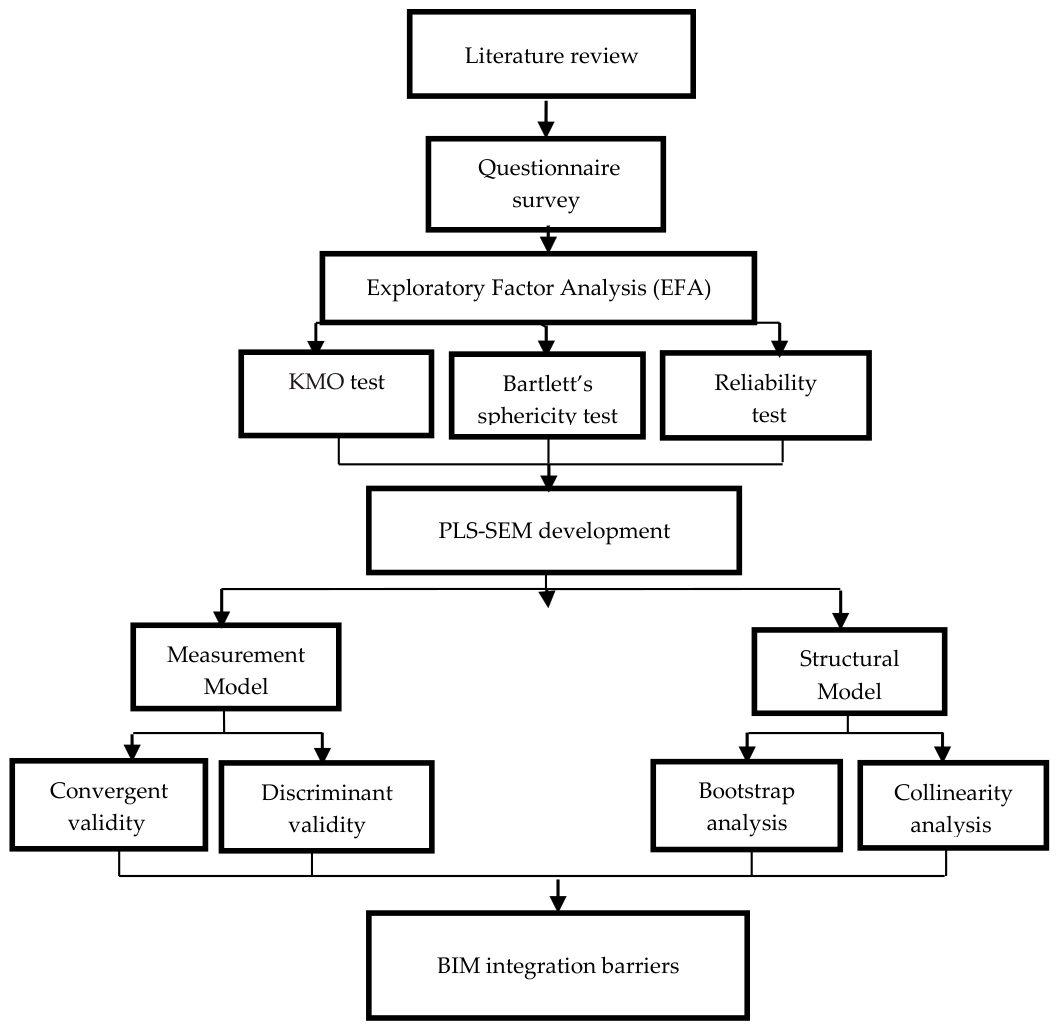
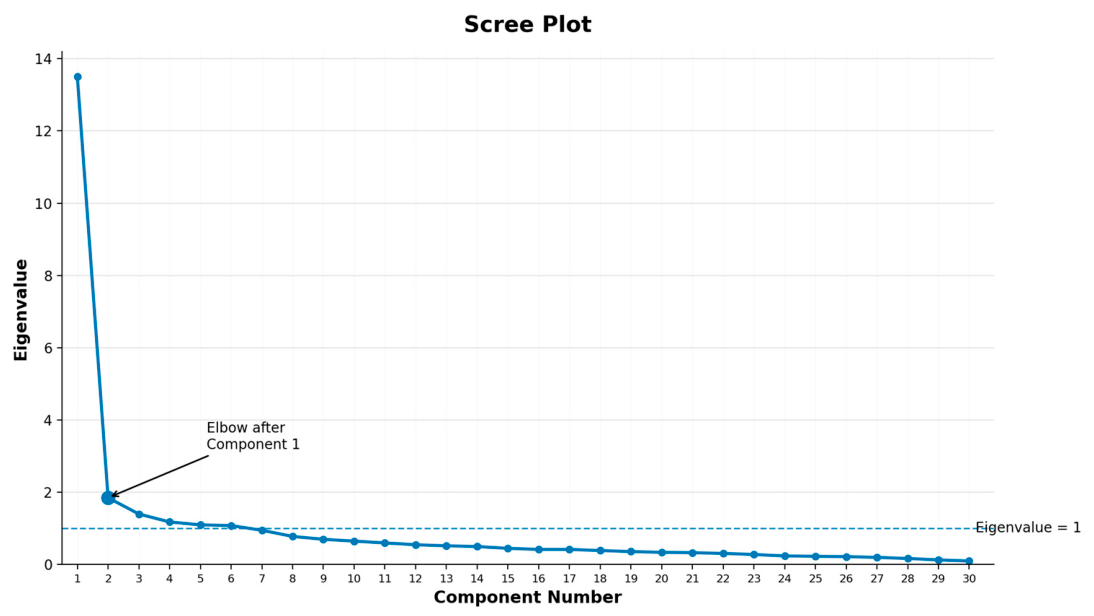
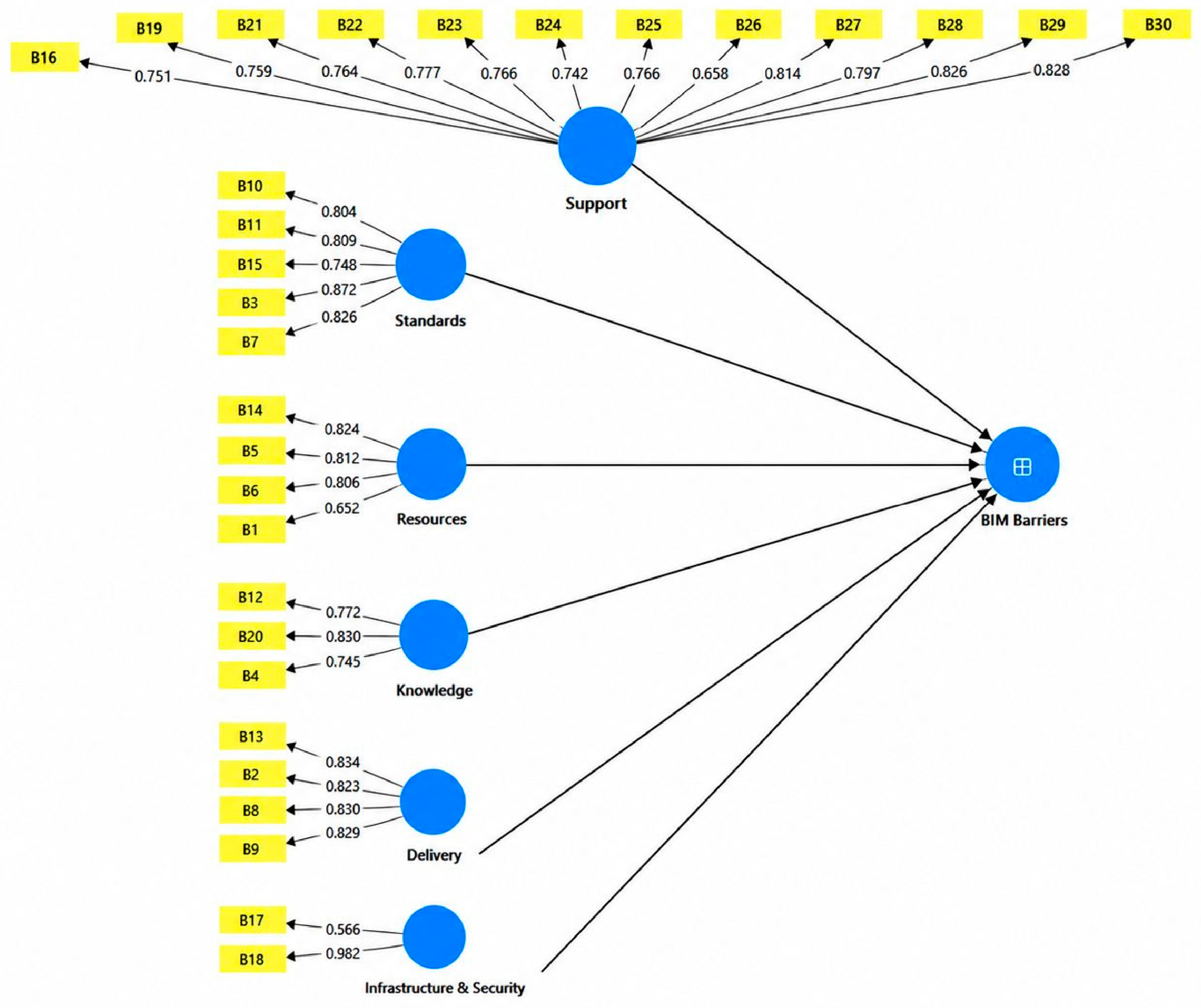
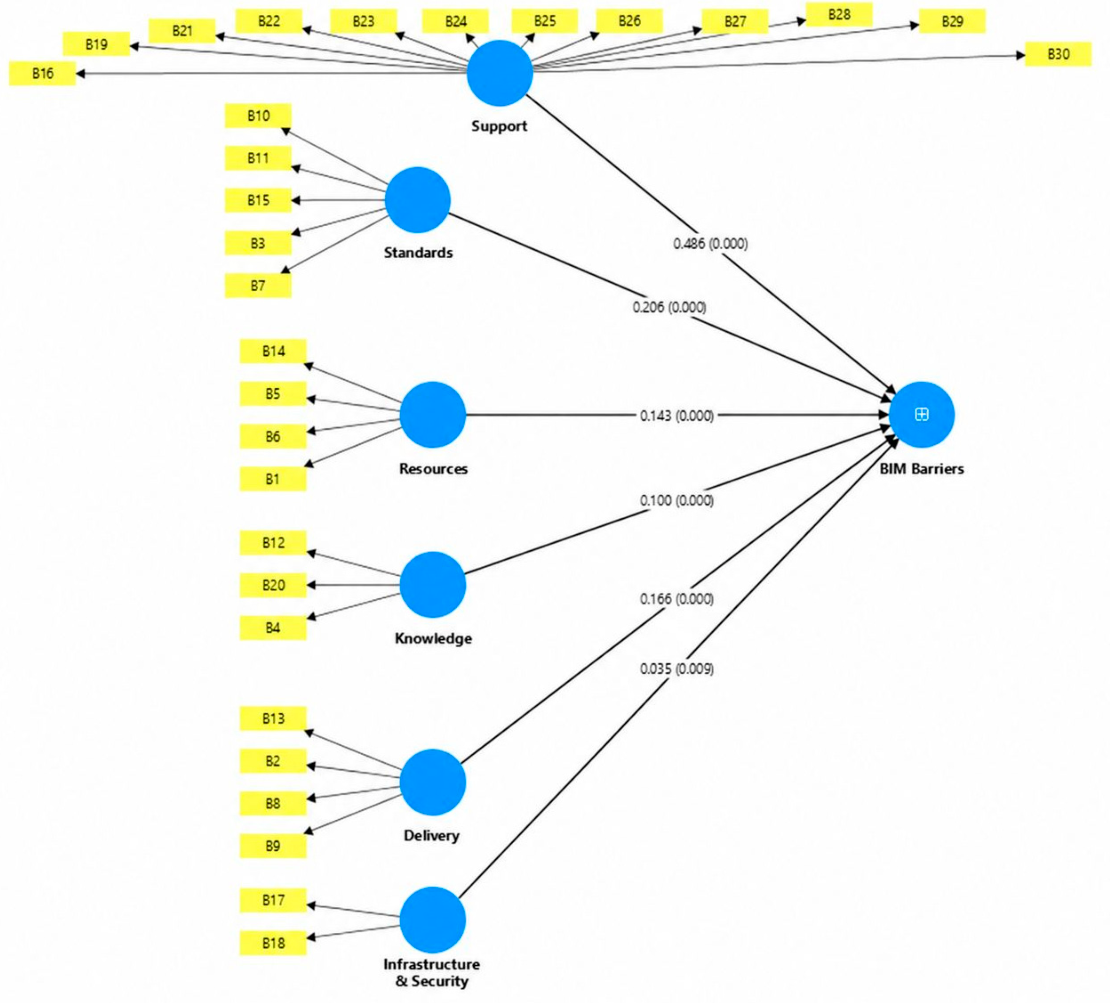
Disclaimer/Publisher’s Note: The statements, opinions and data contained in all publications are solely those of the individual author(s) and contributor(s) and not of MDPI and/or the editor(s). MDPI and/or the editor(s) disclaim responsibility for any injury to people or property resulting from any ideas, methods, instructions or products referred to in the content. |
© 2026 by the author. Licensee MDPI, Basel, Switzerland. This article is an open access article distributed under the terms and conditions of the Creative Commons Attribution (CC BY) license.