You are currently viewing a new version of our website. To view the old version click .
Computers
  • Review
  • Open Access

12 June 2025

Immersive, Secure, and Collaborative Air Quality Monitoring

and
Coimbra Institute of Engineering, Polytechnic University of Coimbra, 3045-093 Coimbra, Portugal
*
Author to whom correspondence should be addressed.
This article belongs to the Special Issue Harnessing the Blockchain Technology in Unveiling Futuristic Applications

Abstract

Air pollution poses a serious threat to both public health and the environment, contributing to millions of premature deaths worldwide each year. The integration of augmented reality (AR), blockchain, and the Internet of Things (IoT) technologies can provide a transformative approach to collaborative air quality monitoring (AQM), enabling real-time, transparent, and intuitive access to environmental data for community awareness, behavioural change, informed decision-making, and proactive responses to pollution challenges. This article presents a unified vision of the key elements and technologies to consider when designing such AQM systems, allowing dynamic and user-friendly immersive air quality data visualization interfaces, secure and trusted data storage, fine-grained data collection through crowdsourcing, and active community learning and participation. It serves as a conceptual basis for any design and implementation of such systems.

1. Introduction

Public health and environmental integrity can be seriously affected by air pollution, being responsible for millions of premature deaths each year, especially in low- and middle-income countries [1]. Beyond human concerns, air pollution globally impacts ecosystems and contributes to climate change through greenhouse gas emissions.
Therefore, air quality must absolutely be improved and preserved in order to promote healthier communities and the long-term preservation of environments, which requires environmental awareness and proactive action by governments, industry, and citizens. Air quality monitoring (AQM) is essential to support informed decision-making in this context. However, challenges still need to be addressed in several areas to realize its full potential, such as increasing transparency, reliability, accuracy, and accountability concerning the collection, storage, processing, and access to pollution data. For example, data sharing systems are often vulnerable to attacks and often lack the required trust, transparency, and interoperability with other data systems [2,3,4]. Furthermore, approaches to AQM, such as those based on the use of stationary pollution monitoring systems, often lack the granularity and flexibility required for fine-grained data collection, leaving gaps in the understanding of air quality within some areas and neighbourhoods [2].
Based on the challenges and limitations mentioned, it can be stated that the development of novel AQM solutions that are decentralized, accessible, collaborative, and interactive remains a relevant open issue that needs to be addressed. The goal is to stimulate participation in reliable and widespread monitoring efforts, even in resource-constrained areas, and to effectively use the data.
This article explores how augmented reality (AR), blockchain, and the Internet of Things (IoT) can be integrated into the design of such novel AQM solutions, particularly those that empower individuals to both contribute to and make use of air quality data. The paradigm of these new AQM systems should shift from merely informing to actively increasing awareness, promoting behavioural change, and raising engagement through intuitive, immersive, and geolocated visualizations. Rather than presenting a design specification or an implementation study, this article offers a conceptual and theoretical exploration that addresses the current fragmentation of air quality monitoring systems, in which diverse technologies are often considered in isolation. It proposes a unified vision of these technologies and lays the foundation for future interdisciplinary research and system development in immersive environmental monitoring enabled by community-driven trust via blockchain verification, immersive engagement through AR overlays mapped to geolocated data, and modular extensibility for combining diverse IoT sensing capabilities. To the best of our knowledge, after a full review of the relevant literature, no existing work has proposed integrating these three dimensions into a single AQM model.
The remainder of this article is organized as follows: Section 2 reviews related work, Section 3 presents the conceptual approach for the targeted type of collaborative AQM system, and, finally, Section 4 draws some conclusions.

3. Conceptual Collaborative Air Quality Monitoring System

Building on the previous discussion, the exercise proposed in this section is to define the key components of a robust conceptual collaborative AQM system, in which individuals concerned about air quality can collect and share environmental data. In this framework, those individuals (the users of the system) must be associated with the area they choose to monitor, contributing to an increasingly comprehensive map as new users join. The data, once collected, should be analyzed, processed, stored, and made publicly available. By combining this information with contextual data such as traffic and weather conditions, an ample understanding of air quality dynamics can be achieved, supporting informed decision-making and increasing environmental awareness.

3.1. Architecture

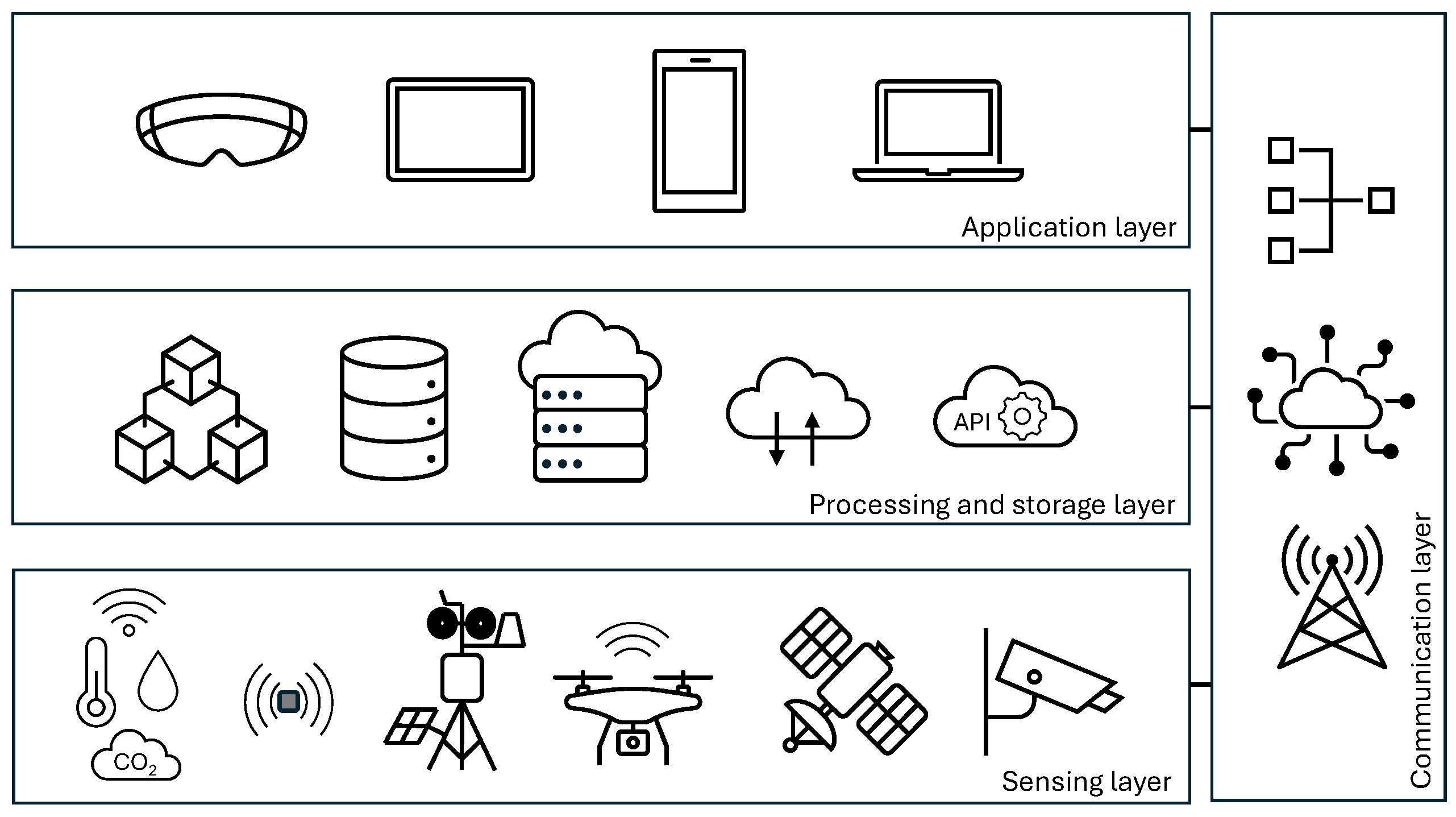
An AQM system with the intended characteristics can be represented as a layered architecture that integrates the technologies for data collection, transmission, storage, processing, and visualization. Thus, its key components, shown in Figure 1, are as follows:
Figure 1. Collaborative air quality monitoring system architecture.
  • Sensing layer (data collection):
    Crowdsourced IoT sensors carried or deployed by individuals;
    Mobile units attached to vehicles or personal devices to collect data;
    Stationary monitoring stations;
    Image-based methods through satellite imagery or street-level cameras can complement sensor data by providing spatial and temporal insight into air quality variations, increasing data granularity and filling gaps in areas where physical sensors may be sparse.
  • Communication layer (data transmission):
    The data collected can be transmitted in real time if it comes from a secure and validated source or stored for later transmission and processing if the data source has not yet been validated;
    Wireless transmission via technologies such as Wi-Fi for short-range coverage, LoRaWAN for long-range, low-power coverage, or cellular networks for long-range coverage.
  • Processing and storage layer:
    Secure storage on local servers or cloud platforms;
    Blockchain-based, cloud-based, and hybrid solutions to ensure data integrity and transparency, building trust.
  • Application layer (data visualization and interaction):
    User-friendly AR interfaces for immersive and geolocated insights, and as a fundamental means for committed engagement of individuals and communities in air quality awareness;
    Interactive data with intelligent analytical tools.
The proposed architecture integrates IoT, blockchain, and AR technologies, each of which contributes specific strengths to a transparent, inclusive and interactive AQM system. IoT technologies enable cost-effective, scalable, distributed, fine-grained environmental sensing. Blockchain ensures the trustworthiness and immutability of collected data, thereby addressing transparency and accountability issues. On the other hand, AR promotes user engagement by providing intuitive, geolocated visualization of air quality data, helping to translate abstract metrics into understandable insights. Any implementation of the proposed architecture may follow a structured, modular development strategy. Each phase can be developed and validated independently before full system integration, enabling iterative prototyping with manageable complexity.

3.2. System Components

The IoT sensors to be used should be low-cost and capable of accurately measuring key air pollutants such as carbon dioxide (CO2), nitrogen oxides (NOx), particulate matter (PM2.5), and ozone (O3). The choice of low-cost sensors is driven by the need for wide-spread adoption, flexibility, and scalability, enabling more comprehensive data collection by involving a larger number of users or communities. Ensuring accuracy in measuring pollutants is essential for reliable data, as these pollutants have significant health and environmental impacts. Therefore, balancing affordability with precision is critical to make the system effective and practical. The work of [32] lists several sensor modules as typical low-cost devices that meet the defined criteria (e.g., accuracy between ±15%) for monitoring pollutants such as PM2.5, O3, CO, and NO2 in the low-cost, IoT-based personal air quality monitor prototype it describes. In the same article, the authors also note that low-cost sensors require frequent calibration due to drift-related issues and can have slow response times. In [62], a comprehensive table reviewing various low-cost sensors used in air quality monitoring systems is provided.
Programmable boards (i.e., microcontrollers) are widely used to develop, evaluate, and demonstrate the feasibility of IoT systems. They function as IoT nodes or end devices, enabling sensor integration, data management, and communication handling. Their choice often depends on factors like cost, processing needs, and connectivity requirements. For example, [32] compares three programmable boards based on several key factors to design the prototype of a personal air quality monitor. The boards compared were Pycom FiPy, Arduino MKR WAN 1310, and AVR-IOT. Among other key factors for comparison, the authors used Wi-Fi, Lora, and Sigfox support, built-in GPS, deep sleep mode, and programming language. They chose the Pycom FiPy device due to the specific requirements of their project, including its integrated support for multiple communication protocols on-chip such as Lora, Sigfox, and Wi-Fi. Arduino Uno and Raspberry Pi must also be mentioned as boards commonly used in prototyping and implementing IoT air quality monitoring systems [34,63].
Although this article presents the system conceptually, any implementation and deployment would require consideration of specific issues and performance benchmarks. For example, gas sensors (e.g., for NO2 or CO) often require frequent calibration due to drift, are more sensitive to noise, and have slower response times [32]. Additionally, data fusion techniques such as temporal and/or spatial averaging can enhance signal robustness. Outlier detection and statistical smoothing can compensate for sensor inaccuracies and anomalies. Communication latency depends on the network technology. For example, while LoRaWAN offers long-range, low-bandwidth transmission with latencies in the hundreds of milliseconds, NB-IoT and Wi-Fi support higher throughput, but at the cost of increased power consumption. Energy usage is a limiting factor for mobile AR devices and IoT sensors, with practical deployments needing to balance measurement frequency, transmission rates, and battery life. These trade-offs must guide the design of future flexible, collaborative, and engaging AQM systems.
The system will also require a public blockchain network to store and validate the collected air quality data, ensuring transparency, immutability, and data integrity. Smart contracts will automate data validation and access control. To further enhance data integrity, cryptographic protocols will secure the transmission of data to the blockchain. However, blockchain is not suitable for directly storing large datasets. Therefore, decentralized data storage solutions like IPFS or a hybrid cloud approach will store large datasets, while blockchain will manage transaction data and reliably store metadata, hashes, or content identifiers. Additionally, blockchain will ensure support to verify the authenticity of devices and users. In summary, any implementation should adopt a hybrid architecture where sensor data is stored off-chain in distributed systems like IPFS or cloud infrastructure, while reference metadata is stored on-chain. It must be noted that effective management of the entire data lifecycle, encompassing storage, retrieval, archiving and deletion, is essential to ensure the long-term availability and integrity of system data. For instance, IPFS, being a decentralized and content-addressable file system, does not inherently guarantee data persistence. Stored content may be subject to local garbage collection unless it is explicitly pinned (i.e., excluded from garbage collection) by a hosting node or maintained through a dedicated pinning service. Without pinning, files may be removed from the network over time and become inaccessible.
While blockchain provides a tamper-proof ledger to validate and store sensor data, it does not protect against IoT vulnerabilities such as device spoofing, GPS spoofing, and sensor tampering. These remain open challenges in collaborative environmental sensing and must be addressed in any implementation through secure hardware, device authentication, and anomaly detection mechanisms. A threat model will be necessary to ensure resilience and trustworthiness in real-world deployments.
Although the proposed approach offers transparency and decentralization, its scalability depends on the performance of the underlying technologies. Public blockchains typically support limited transactions per second, which may create a bottleneck as the number of contributors or sensor updates increases. Similarly, IoT networks, especially those based on LPWAN protocols like LoRaWAN, may experience congestion or latency as the number of devices increases. Therefore, any implementation must consider scalability solutions such as the previously mentioned off-chain storage approach.
It should be noted that any implementation of community-driven AQM systems based on the proposed conceptual architecture must address critical aspects beyond technology, such as data governance, user consent, liability, and ethical data usage. Key issues include data ownership, responsibility for errors or misuse, and ensuring fair access. Transparent data-sharing policies, informed consent, anonymization, and governance frameworks will be crucial for public trust. Although blockchain can ensure traceability, broader institutional and legal mechanisms are needed to manage liability and oversight in real-world applications.
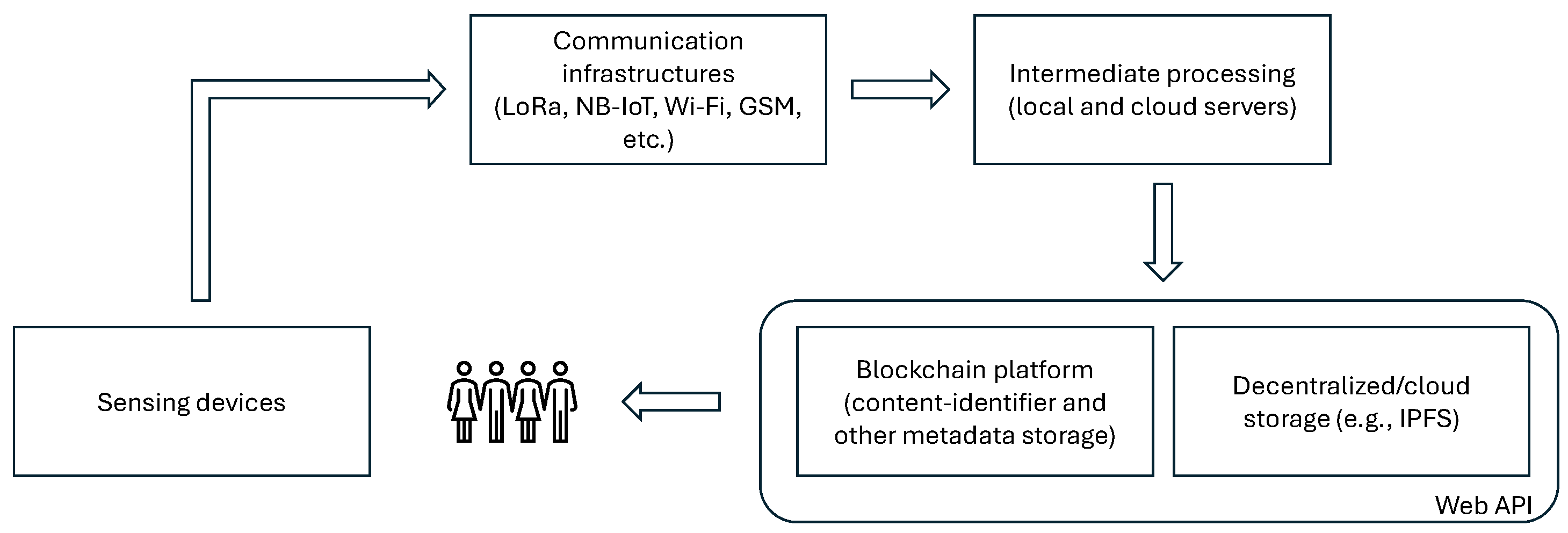
Following the data flow of a generalized architecture for distributed, collaborative, and trusted environmental sensing (Figure 2), sensor devices collect air quality data and transmit it over a communication network (e.g., LoRa, NB-IoT, Wi-Fi, GSM). The data is then routed through intermediate servers, either local or cloud-based, which perform some pre-processing tasks such as validation and filtering. Finally, it is stored in a decentralized/cloud database system with a unique content identifier (e.g., CID if IPFS is used) that is permanently recorded on the chosen blockchain platform to ensure integrity and traceability. The air quality data stored in the system can then be accessed by different stakeholders through appropriate API endpoints, including AR-based user interfaces for visualization. This architecture supports different types of sensors, network technologies, and processing infrastructures, resulting in flexibility combined with data integrity and trustworthiness. It supports transparent environmental monitoring with a verifiable data source, allowing access to historical air quality data via API endpoints while maintaining the integrity and auditability of the information.
Figure 2. Data flow of the generalized architecture for environmental sensing.
Figure 2 provides a conceptual, high-level view of the architecture’s data flow, abstracting implementation-level details. However, it is important to note that relevant performance parameters, such as timing constraints, communication bottlenecks, transaction throughput, data rates, and latency, depend on the specific implementation choices, including the communication protocol, hardware platform, blockchain solution, and AR rendering pipelines. While these aspects are beyond the scope of the article’s theoretical contribution, they are key areas for any research and implementation.
As a concrete implementation, low-cost sensors can be deployed using LoRa/LoRaWAN to transmit measurements over long distances with minimal power consumption. These sensors can connect to TTN, which manages device authentication, message routing, and application layer integration via MQTT (Message Queuing Telemetry Transport), which is a lightweight, publish–subscribe messaging protocol designed for low-bandwidth, high-latency, or unreliable networks, or via webhook endpoints that allow external services to push data to an application via HTTP as it becomes available. A backend ingestion service receives the TTN data, filters and formats it, stores the payloads in IPFS, and registers their CID and other relevant metadata on the selected blockchain platform.
For AR, the system should use smartphones or tablets as the primary hardware to display air quality data through AR overlays, though AR glasses and other wearable devices could provide a more immersive and handless experience, allowing users to monitor air quality while moving through their environment. It is important to note that different AR hardware platforms demand fundamentally distinct approaches to presentation, interaction, and visualization. Therefore, using multiple platforms simultaneously requires a coherent integration of these varied approaches.
The AR application should enable geolocated data visualization. To accomplish that, it must employ spatial computing to anchor AR pollutant representations more precisely in the user’s environment. To implement AR spatial anchoring (i.e., attaching virtual objects to fixed physical locations in the real world so that they appear consistently positioned even as the user moves around), it is essential to combine hardware such as depth sensors (e.g., LiDAR—Light Detection and Ranging), SLAM (Simultaneous Localization And Mapping)-capable cameras, and GPS (for outdoor use) with software frameworks like ARKit (iOS), ARCore (Android), Unity AR Foundation, or cloud-based solutions like Azure Spatial Anchors. These technologies rely on SLAM algorithms, plane detection (i.e., the detection of flat surfaces in the physical environment), and mesh reconstruction (i.e., creating a 3D model of the real-world environment by scanning and mapping its geometry) to understand and persistently map the physical environment. For cross-session and multi-user scenarios, cloud services such as ARCore Cloud Anchors, Azure Spatial Anchors, or Niantic’s VPS enable persistent, shareable anchors. Accurate anchoring also depends on spatial understanding techniques and may involve local serialization of environment maps or cloud-stored anchor IDs with associated metadata.
By using spatial mapping, the AR visualizations become more realistic and interactive, improving the user’s sense of immersion and engagement. Integration with GIS tools could also be used to ensure accurate mapping of air quality data in real time, with overlays showing pollutant levels and contextual information such as traffic and weather conditions. Three-dimensional models and heatmaps can be used to visually represent air quality, while GPS integration will ensure data is correctly located. For example, 3D models representing pollutant molecules, scaled and positioned in relation to their concentration levels, will provide spatial and conceptual context. Concurrently, heatmaps can display real-time pollutant concentrations, overlaid onto the user’s environment. These visualizations should be dynamically updated.
Although AR offers promising opportunities for immersive and geolocated data visualization, its real-world application, particularly outdoors, faces several challenges. These include device heterogeneity (e.g., varying sensor capabilities and display resolutions), high power consumption on mobile devices, and environmental factors, such as lighting conditions, obstructions (e.g., buildings and trees), and GPS inaccuracies, which can interfere with spatial anchoring and rendering stability. Any development and deployment of AR-enhanced AQM systems must carefully address these limitations.
The AR user interface must be intuitive and display clear air quality indicators to ensure ease of interaction, as a user-friendly and valuable experience is essential to prevent adoption resistance from the users. Therefore, usability principles (e.g., Nielsen’s Heuristics [64]) and user experience factors, such as attention overload and interaction simplicity, must be considered during development since they are essential for effective adoption and comprehension.
The system should include AR-based educational modules to teach users about air quality, pollution sources, and mitigation strategies, making abstract concepts more concrete and relatable to improve learning experience. Educational modules will be tailored for general-public audiences, according to their age, incorporating AR visualizations to explain the effects of different pollutants. Interactive scenarios, such as simulating the impact of reducing car traffic or planting trees, will be used to teach concepts of air quality management. Stakeholders include schools, environmental non-governmental organizations, municipal authorities, and citizen science groups. While the primary target users are environmentally conscious citizens, the system should be designed with scalability in mind, supporting broader applications such as community-driven environmental awareness campaigns and municipal planning initiatives.
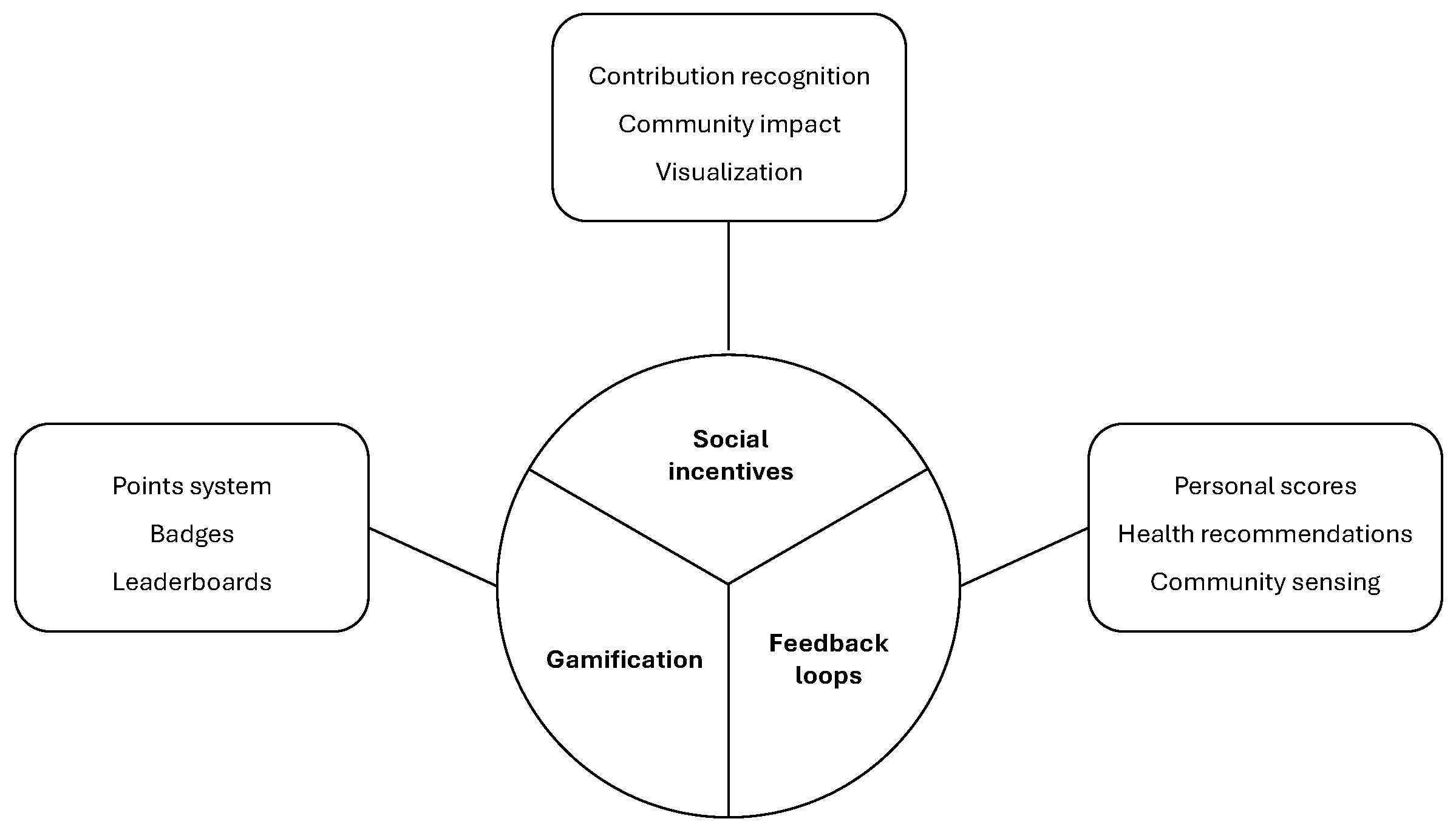
The system should support multi-user AR experiences, enabling communities to collaboratively monitor and discuss air quality. Multiple users can view and interact with the same AR visualizations simultaneously, raising collective awareness and action. This feature is particularly useful for educational purposes or community-led environmental initiatives. Real-world adoption of sensor-carrying or AR-interacting behaviour may suffer from participation fatigue or novelty decay. Therefore, the system should incorporate motivation strategies, such as gamification elements, into the AR experience to raise user engagement (Figure 3). For example, users can earn points or badges for monitoring air quality regularly, sharing data, or taking actions to reduce pollution in their area, encouraging sustained participation, and making the monitoring process more enjoyable.
Figure 3. Examples of motivational strategies for community sensing.
Since one of the goals of the system is to drive behavioural changes by making air quality data more tangible and actionable, it must have the ability to show the immediate impact of the users’ actions on local air quality. To assess the impact of user actions, the system must include in-app surveys and usage logs to monitor behavioural changes over time. For example, users who choose eco-friendly transportation options could receive feedback through reduced pollution indicators in the AR view. A combination of pre- and post-intervention questionnaires and semi-structured interviews should be used to evaluate learning outcomes and behavioural shifts. The AR interface should include AI algorithms based on air quality data and user preferences, location, and health data.

3.3. Implementation Considerations

This subsection outlines possible technological solutions and platforms that can be used to implement immersive, secure, and collaborative AQM systems based on the proposed conceptual framework. Future implementations should follow a structured, modular development strategy with the following global phases: conceptualization (e.g., environmental research, stakeholder analysis), system design, implementation, deployment (e.g., pilot testing), and evaluation (e.g., performance assessment, usability).
As shown in Figure 1, the conceptual layers of the proposed framework are as follows: sensing, communication, processing and data storage, and application. To some extent, each layer can be modelled, developed, and validated independently before full system integration, enabling iterative prototyping with manageable complexity.
For the sensing layer, low-cost sensors such as the MQ-135 (for gases like NO2 and CO2), SDS011 (for PM2.5), and MiCS-5524 (for multiple gases) can be integrated with microcontroller boards like Arduino MKR WAN 1310, Pycom FiPy, or Raspberry Pi. Many of these boards support important features such as low-power operation and built-in GPS, which can be critical for mobile sensing units. Programming can be carried out in diverse languages, such as C++ (Arduino IDE) and Python (Raspberry Pi). Data calibration and compensation algorithms can be implemented to address sensor drift and improve measurement accuracy.
For communication, LoRa/LoRaWAN and NB-IoT are examples of technologies that provide long-range, low-power data transmission, essential for outdoor deployments. MQTT or HTTP webhooks can be used for lightweight and scalable data streaming to backend systems. Other technologies, such as Wi-Fi, can complement these solutions in environments where high-bandwidth connectivity is feasible. For intermediate processing (see Figure 2), cloud-based IoT platforms such as Amazon’s AWS IoT Core and Microsoft’s Azure IoT Hub can offer device management and data ingestion capabilities.
The processing and data storage layer will adopt a hybrid approach; blockchain platforms such as Ethereum or Polygon will store immutable metadata and content hashes, while sensor data will be stored on the IPFS to ensure scalability and efficient data retrieval. Smart contracts (e.g., written in Solidity, a programming language) can automate data validation and access control. For development, frameworks like Truffle Suite and Hardhat (Ethereum) can be employed. For testing, solutions such as Rinkeby (Ethereum) and Polygon Mumbai Testnet can be used. Web interfaces for the processing and data storage layer can be developed using frameworks such as Flask, Django, and Spring Boot, while common database management systems can be used to store and manage data such as user account information.
To evaluate feasibility, tools such as ns-3 (Network Simulator 3) and OMNeT++ (Objective Modular Network Testbed in C++) can simulate communication latency and energy consumption across IoT networks, while blockchain testnets, a type of dedicated blockchain environment for development and testing purposes, can enable validation of smart contract execution and transaction throughput. Any pilot implementation will need to assess key factors such as latency in data transmission, energy consumption for battery-powered devices, and blockchain transaction throughput limitations. Scalability modelling should also explore how the system behaves with increasing numbers of participants and sensors, employing simulation tools or small-scale prototypes to benchmark performance under realistic conditions.
Finally, as previously mentioned, AR visualization and interaction in the application layer can be implemented using ARCore or ARKit for native AR development, or Unity’s AR Foundation for cross-platform AR experiences. These frameworks support spatial anchoring and SLAM for 3D overlays of air quality data. GIS data can be integrated through APIs like Google Maps or OpenStreetMap. Supported programming languages include Java/Kotlin for Android, Swift for iOS, and C# for Unity. Tools such as Unity’s Profiler will assist in measuring AR rendering performance.

4. Conclusions

The critical issue of air pollution was addressed in this article, highlighting its threat to public health and the environment, and the necessity of improved AQM for informed decision-making. It identified several key challenges with traditional AQM methods, including the lack of transparency, reliability, accuracy, accountability, and vulnerability in data sharing systems. Furthermore, conventional stationary monitoring stations are noted as being costly, lacking flexibility, and not providing fine-grained data across specific areas.
Recognizing the identified limitations, the article established the need for novel AQM solutions that are decentralized, accessible, collaborative, and interactive to stimulate wider participation and effective data utilization. Then, it explored how AR, blockchain, and IoT technologies can be used to offer an approach to developing such systems. This exploration includes a review of existing AQM techniques (sensor-based, image-based, stationary, and mobile), relevant communication technologies for IoT sensors (Wi-Fi, cellular, LPWAN like LoRa/LoRaWAN, NB-IoT, Sigfox), blockchain technology and its characteristics (security, decentralization, smart contracts, scalability challenges, use with IPFS), and applications of AR in environmental contexts. The limited existing work combining these three technologies for AQM was also noted.
Building on this review, the article presented a conceptual framework for a collaborative AQM system, detailing its layered architecture for data collection, transmission, processing, storage, and visualization/interaction. In the proposed approach, IoT sensors, particularly low-cost and mobile units, are leveraged for fine-grained, real-time, and flexible data collection, supporting crowdsourcing and enabling wider adoption and scalability. Blockchain technology is fundamental to ensuring the transparency, immutability, security, and trustworthiness of the collected data. AR provides a user-friendly and immersive interface for visualizing air quality data in a geolocated context, effectively enhancing user awareness, decision-making, and potential behavioural change. This integrated approach aims to empower individuals and communities, fostering greater awareness and active participation in environmental monitoring.
As a theoretical contribution, this article provides a unified conceptual basis upon which any implementation and validation can be built. Future work should extend it with detailed system design specifications, performance benchmarks, threat models, and mitigation strategies to address challenges related to the integrated technologies, such as inherent vulnerabilities and scalability limitations. Pilot deployments and user-centred studies will also be required to evaluate performance, usability, and impact in real-world contexts.
In conclusion, the implementation of systems based on the proposed approach can represent a significant step forward in the field of AQM. By combining the strengths of AR, blockchain, and IoT, the issue of air pollution can be effectively addressed, contributing to healthier communities and a more sustainable environment. As these technologies continue to evolve, their integration holds great promise for transforming how we monitor, understand, and respond to environmental challenges.

Author Contributions

Writing—original draft preparation, review, and editing, J.M. and N.C.M. All authors have read and agreed to the published version of the manuscript.

Funding

This research received no external funding.

Conflicts of Interest

The authors declare no conflicts of interest.

Abbreviations

The following abbreviations are used in this manuscript:
ARAugmented Reality
CIDContent Identifier
GISGeographic Information System
GPSGlobal Positioning System
HTTPHypertext Transfer Protocol
IoTInternet of Things
IPFSInterPlanetary File System
LiDAR Light Detection and Ranging
LoRaLong Range
LoRaWANLong Range, Wide-Area Network
LPWANLow-Power, Wide-Area Network
MQTTMessage Queuing Telemetry Transport
NB-IoTNarrowband IoT
P2PPeer-to-Peer
SLAMSimultaneous Localization and Mapping
TTNThe Things Network

References

  1. Academy of Science of South Africa; Brazilian Academy of Sciences; German National Academy of Sciences Leopoldina; U.S. National Academy of Medicine; U.S. National Academy of Sciences. Air Pollution and Health—A Science-Policy Initiative. Ann. Glob. Health 2019, 85, 140. [Google Scholar] [CrossRef] [PubMed]
  2. Lücking, M.; Kannengießer, N.; Kilgus, M.; Riedel, T.; Beigl, M.; Sunyaev, A.; Stork, W. The Merits of a Decentralized Pollution-Monitoring System Based on Distributed Ledger Technology. IEEE Access 2020, 8, 189365–189381. [Google Scholar] [CrossRef]
  3. Sofia, D.; Lotrecchiano, N.; Trucillo, P.; Giuliano, A.; Terrone, L. Novel Air Pollution Measurement System Based on Ethereum Blockchain. J. Sens. Actuator Netw. 2020, 9, 49. [Google Scholar] [CrossRef]
  4. M. Bublitz, F.; Oetomo, A.; Sahu, K.S.; Kuang, A.; Fadrique, L.X.; Velmovitsky, P.E.; Nobrega, R.M.; Morita, P.P. Disruptive Technologies for Environment and Health Research: An Overview of Artificial Intelligence, Blockchain, and Internet of Things. Int. J. Environ. Res. Public Health 2019, 16, 3847. [Google Scholar] [CrossRef]
  5. Elbestar, M.; Aly, S.G.; Ghannam, R. Advances in Air Quality Monitoring: A Comprehensive Review of Algorithms for Imaging and Sensing Technologies. Adv. Sens. Res. 2024, 3, 2300207. [Google Scholar] [CrossRef]
  6. Whitehill, A.R.; Lunden, M.; LaFranchi, B.; Kaushik, S.; Solomon, P.A. Mobile Air Quality Monitoring and Comparison to Fixed Monitoring Sites for Instrument Performance Assessment. Atmos. Meas. Tech. 2024, 17, 2991–3009. [Google Scholar] [CrossRef]
  7. Snyder, E.G.; Watkins, T.H.; Solomon, P.A.; Thoma, E.D.; Williams, R.W.; Hagler, G.S.; Shelow, D.; Hindin, D.A.; Kilaru, V.J.; Preuss, P.W. The changing paradigm of air pollution monitoring. Environ. Sci. Technol. 2013, 47, 11369–11377. [Google Scholar] [CrossRef]
  8. Morawska, L.; Thai, P.K.; Liu, X.; Asumadu-Sakyi, A.; Ayoko, G.; Bartonova, A.; Bedini, A.; Chai, F.; Christensen, B.; Dunbabin, M.; et al. Applications of low-cost sensing technologies for air quality monitoring and exposure assessment: How far have they gone? Environ. Int. 2018, 116, 286–299. [Google Scholar] [CrossRef]
  9. Marques, G.; Saini, J.; Dutta, M.; Singh, P.K.; Hong, W.-C. Indoor Air Quality Monitoring Systems for Enhanced Living Environments: A Review toward Sustainable Smart Cities. Sustainability 2020, 12, 4024. [Google Scholar] [CrossRef]
  10. Balasubramaniyan, C.; Manivannan, D. IoT enabled air quality monitoring system (AQMS) using raspberry Pi. Indian J. Sci. Technol. 2016, 9, 1–6. [Google Scholar] [CrossRef]
  11. Penza, M. Chapter 12 - Low-Cost Sensors for Outdoor Air Quality Monitoring. In Advanced Nanomaterials for Inexpensive Gas Microsensors; Llobet, E., Ed.; Micro and Nano Technologies; Elsevier: Amsterdam, The Netherlands, 2020; pp. 235–288. [Google Scholar] [CrossRef]
  12. Andrei, N.; Ioanid, A. Potential use of artificial intelligence and geospatial analysis in environmental monitoring: Air quality in a large city. In Proceedings of the International Conference of Management and Industrial Engineering, Singapore, 18–21 December 2023; Volume 11, pp. 369–376. [Google Scholar] [CrossRef]
  13. Asha, P.; Natrayan, L.; Geetha, B.T.; Beulah, J.; Sumathy, R.; Varalakshmi, G.; Neelakandan, S. IoT enabled environmental toxicology for air pollution monitoring using AI techniques. Environ. Res. 2022, 205, 112574. [Google Scholar] [CrossRef] [PubMed]
  14. Wardencki, W.; Katulski, R.J.; Stefański, J.; Namieśnik, J. The State of the Art in the Field of Non-Stationary Instruments for the Determination and Monitoring of Atmospheric Pollutants. Crit. Rev. Anal. Chem. 2008, 38, 259–268. [Google Scholar] [CrossRef]
  15. Pummakarnchana, O.; Tripathi, N.; Dutta, J. Air pollution monitoring and GIS modeling: A new use of nanotechnology based solid state gas sensors. Sci. Technol. Adv. Mater. 2005, 6, 251. [Google Scholar] [CrossRef]
  16. Castell, N.; Dauge, F.R.; Schneider, P.; Vogt, M.; Lerner, U.; Fishbain, B.; Broday, D.; Bartonova, A. Can commercial low-cost sensor platforms contribute to air quality monitoring and exposure estimates? Environ. Int. 2017, 99, 293–302. [Google Scholar] [CrossRef]
  17. Gerboles, M.; Spinelle, L.; Signorini, M. AirSensEUR: An open data/software/hardware multi-sensor platform for air quality monitoring. Part A: Sensor shield. In JRC Technical Report 2015; EUR 27469 EN; Publications Office of the European Union: Luxembourg, 2015. [Google Scholar] [CrossRef]
  18. Benabbas, A.; Geißelbrecht, M.; Nikol, G.M.; Mahr, L.; Nähr, D.; Steuer, S.; Wiesemann, G.; Müller, T.; Nicklas, D.; Wieland, T. Measure particulate matter by yourself: Data-quality monitoring in a citizen science project. J. Sens. Sens. Syst. 2019, 8, 317–328. [Google Scholar] [CrossRef]
  19. Nikzad, N.; Verma, N.; Ziftci, C.; Bales, E.; Quick, N.; Zappi, P.; Patrick, K.; Dasgupta, S.; Krueger, I.; Rosing, T.S.; et al. Citisense: Improving geospatial environmental assessment of air quality using a wireless personal exposure monitoring system. In Proceedings of the Conference on Wireless Health, San Diego, CA, USA, 23–25 October 2012; pp. 1–8. [Google Scholar] [CrossRef]
  20. Jerrett, M.; Arain, A.; Kanaroglou, P.; Beckerman, B.; Potoglou, D.; Sahsuvaroglu, T.; Morrison, J.; Giovis, C. A review and evaluation of intraurban air pollution exposure models. J. Expo. Sci. Environ. Epidemiol. 2005, 15, 185–204. [Google Scholar] [CrossRef] [PubMed]
  21. Zimmerman, N.; Presto, A.A.; Kumar, S.P.; Gu, J.; Hauryliuk, A.; Robinson, E.S.; Robinson, A.L. A machine learning calibration model using random forests to improve sensor performance for lower-cost air quality monitoring. Atmos. Meas. Tech. 2018, 11, 291–313. [Google Scholar] [CrossRef]
  22. Ashokkumar, S.; Elango, T.; Karthick, M.; Sowbharnika, P.; Bhaarathi SA, S.B. IoT and Blockchain Integration for Industrial Zone Monitoring. In Proceedings of the 2024 International Conference on Science Technology Engineering and Management (ICSTEM), Coimbatore, India, 26–27 April 2024; IEEE: New York, NY, USA, 2024; pp. 1–6. [Google Scholar] [CrossRef]
  23. Hassan, A.K.; Saraya, M.S.; Ali-Eldin, A.M.; Abdelsalam, M.M. Low-Cost IoT Air Quality Monitoring Station Using Cloud Platform and Blockchain Technology. Appl. Sci. 2024, 14, 5774. [Google Scholar] [CrossRef]
  24. Shelke, P.; Suryawanshi, T.; Siddiqui, E. Blockchain-Backed Air Quality Monitoring. In Proceedings of the 2024 ASU International Conference in Emerging Technologies for Sustainability and Intelligent Systems (ICETSIS), Manama, Bahrain, 28–29 January 2024; IEEE: New York, NY, USA, 2024; pp. 565–571. [Google Scholar] [CrossRef]
  25. Heo, G.; Doh, I. Blockchain and Differential Privacy-Based Data Processing System for Data Security and Privacy in Urban Computing. Comput. Commun. 2024, 222, 161–176. [Google Scholar] [CrossRef]
  26. Al-jarakh, T.E.; Hussein, O.A.; Al-azzawi, A.K.; Mosleh, M.F. Design and Implementation of IoT Based Environment Pollution Monitoring System: A Case Study of Iraq. In Proceedings of the IOP Conference Series: Materials Science and Engineering, Baghdad, Iraq, 21–22 December 2020; IOP Publishing: Bristol, UK, 2021; Volume 1105, p. 012037. [Google Scholar] [CrossRef]
  27. Jha, R.K. Air Quality Sensing and Reporting System Using IoT. In Proceedings of the 2020 Second International Conference on Inventive Research in Computing Applications (ICIRCA), Coimbatore, India, 15–17 July 2020; IEEE: New York, NY, USA, 2020; pp. 790–793. [Google Scholar] [CrossRef]
  28. Jánó, R.; Ilieş, A.I.; Şteţco, E.M.; Corches, C. IoT Devices for Monitoring and Analysing Air Quality in Urban Environments. In Proceedings of the 2024 IEEE 30th International Symposium for Design and Technology in Electronic Packaging (SIITME), Sibiu, Romania, 16–18 October 2024; IEEE: New York, NY, USA, 2024; pp. 45–49. [Google Scholar] [CrossRef]
  29. Ertürk, M.A.; Aydın, M.A.; Büyükakkaşlar, M.T.; Evirgen, H. A Survey on LoRaWAN Architecture, Protocol and Technologies. Future Internet 2019, 11, 216. [Google Scholar] [CrossRef]
  30. Hassan, M.B.; Ali, E.S.; Mokhtar, R.A.; Saeed, R.A.; Chaudhari, B.S. NB-IoT: Concepts, Applications, and Deployment Challenges. In LPWAN Technologies for IoT and M2M Applications; Elsevier: Amsterdam, The Netherlands, 2020; pp. 119–144. [Google Scholar] [CrossRef]
  31. Fourtet, C.; Ponsard, B. An Introduction to Sigfox Radio System. In LPWAN Technologies for IoT and M2M Applications; Elsevier: Amsterdam, The Netherlands, 2020; pp. 103–118. [Google Scholar] [CrossRef]
  32. McGrath, S.; Flanagan, C.; Zeng, L.; O’leary, C. IoT Personal Air Quality Monitor. In Proceedings of the 2020 31st Irish Signals and Systems Conference (ISSC), Letterkenny, Ireland, 11–12 June 2020; IEEE: New York, NY, USA, 2020; pp. 1–4. [Google Scholar] [CrossRef]
  33. Iqbal, M.; Abdullah, A.Y.M.; Shabnam, F. An Application Based Comparative Study of LPWAN Technologies for IoT Environment. In Proceedings of the 2020 IEEE Region 10 Symposium (TENSYMP), Dhaka, Bangladesh, 5–7 June 2020; IEEE: New York, NY, USA, 2020; pp. 1857–1860. [Google Scholar] [CrossRef]
  34. Jabbar, W.A.; Subramaniam, T.; Ong, A.E.; Shu’Ib, M.I.; Wu, W.; De Oliveira, M.A. LoRaWAN-Based IoT System Implementation for Long-Range Outdoor Air Quality Monitoring. Internet Things 2022, 19, 100540. [Google Scholar] [CrossRef]
  35. Muppalla, A.R.; Pathakoti, M.; Bothale, V.M.; Biswadip, G.; Sai, M.S.; Subramanian, V.; Rajan, K. Design and Implementation of IoT Solution for Air Pollution Monitoring. In Proceedings of the 2019 IEEE Recent Advances in Geoscience and Remote Sensing: Technologies, Standards and Applications (TENGARSS), Kochi, India, 17–20 October 2019; IEEE: New York, NY, USA, 2019; pp. 45–48. [Google Scholar] [CrossRef]
  36. Yesindan, R.; Sangiya, S.; Valluvan, R.; Mukunthan, T.; Ahilan, K.; Pravina, M. NB-AirStream: Advancing Air Quality Monitoring with LoRa and NB-IoT Integration. In Proceedings of the 2024 IEEE International Conference on Electronics, Computing and Communication Technologies (CONECCT), Bangalore, India, 12–14 July 2024; IEEE: New York, NY, USA, 2024; pp. 1–6. [Google Scholar] [CrossRef]
  37. Duangsuwan, S.; Takarn, A.; Jamjareegulgarn, P. A Development on Air Pollution Detection Sensors Based on NB-IoT Network for Smart Cities. In Proceedings of the 2018 18th International Symposium on Communications and Information Technologies (ISCIT), Bangkok, Thailand, 26–29 September 2018; IEEE: New York, NY, USA, 2018; pp. 313–317. [Google Scholar] [CrossRef]
  38. Brotzu, R.; Aru, P.; Fadda, M.; Giusto, D. Urban SigFox-Based Mobility System. In Proceedings of the 2021 IEEE International Symposium on Broadband Multimedia Systems and Broadcasting (BMSB), Chengdu, China, 4–6 August 2021; IEEE: New York, NY, USA, 2021; pp. 1–4. [Google Scholar] [CrossRef]
  39. Nakamoto, S. Bitcoin: A Peer-to-Peer Electronic Cash System; United States Sentencing Commission: Washington, DC, USA, 2008. [Google Scholar]
  40. Islam, S.; Islam, M.J.; Hossain, M.; Noor, S.; Kwak, K.-S.; Islam, S.R. A Survey on Consensus Algorithms in Blockchain-Based Applications: Architecture, Taxonomy, and Operational Issues. IEEE Access 2023, 11, 39066–39082. [Google Scholar] [CrossRef]
  41. Vaccargiu, M.; Tonelli, R. An Analysis of Decentralised Systems in Environment-Related Projects: Theoretical and Practical Perspective. Comput. Sci. 2024, 5, 354–370. [Google Scholar] [CrossRef]
  42. Wang, S.; Yuan, Y.; Wang, X.; Li, J.; Qin, R.; Wang, F.-Y. An Overview of Smart Contract: Architecture, Applications, and Future Trends. In Proceedings of the 2018 IEEE Intelligent Vehicles Symposium (IV), Changshu, China, 26–30 June 2018; IEEE: New York, NY, USA, 2018; pp. 108–113. [Google Scholar] [CrossRef]
  43. Chen, Z. Design, Development, and Deployment of Decentralized Applications. Appl. Comput. Eng. 2024, 48, 46–52. [Google Scholar] [CrossRef]
  44. Santos, A.F.; Marinho, J.; Bernardino, J. Blockchain-Based Loyalty Management System. Future Internet 2023, 15, 161. [Google Scholar] [CrossRef]
  45. Bhattacharya, P.; Saraswat, D.; Dave, A.; Acharya, M.; Tanwar, S.; Sharma, G.; Davidson, I.E. Coalition of 6G and Blockchain in AR/VR Space: Challenges and Future Directions. IEEE Access 2021, 9, 168455–168484. [Google Scholar] [CrossRef]
  46. Doan, T.V.; Psaras, Y.; Ott, J.; Bajpai, V. Toward Decentralized Cloud Storage with IPFS: Opportunities, Challenges, and Future Considerations. IEEE Internet Comput. 2022, 26, 7–15. [Google Scholar] [CrossRef]
  47. Pokrić, B.; Krčo, S.; Pokrić, M.; Knežević, P.; Jovanović, D. Engaging Citizen Communities in Smart Cities Using IoT, Serious Gaming and Fast Markerless Augmented Reality. In Proceedings of the 2015 International Conference on Recent Advances in Internet of Things (RIoT), Singapore, 7–9 April 2015; IEEE: New York, NY, USA, 2015; pp. 1–6. [Google Scholar] [CrossRef]
  48. Renault, S.; Feldmann, I.; Raes, L.; Silence, J.; Schreer, O. Dynamic Exposure Visualization of Air Quality Data with Augmented Reality. In Proceedings of the 10th International Conference on Geographical Information Systems Theory, Applications and Management (GISTAM), Angers, France, 2–4 May 2024; SciTePress: Setúbal, Portugal, 2024; pp. 120–127. [Google Scholar] [CrossRef]
  49. Sanità, M.; Fratini, J.; Muralikrishna, N.; Pierdicca, R.; Malinverni, E.S. Augmented Reality for Air Quality Monitoring: Case Study in the Marche Region (Italy). Int. Arch. Photogramm. Remote Sens. Spat. Inf. Sci. 2024, 48, 389–395. [Google Scholar] [CrossRef]
  50. Fiore, M.; Gattullo, M.; Mongiello, M.; Uva, A. Merging Blockchain and Augmented Reality for an Immersive Traceability Platform. In Proceedings of the 2024 IEEE Conference on Virtual Reality and 3D User Interfaces Abstracts and Workshops (VRW), Orlando, FL, USA, 16–21 March 2024; IEEE: New York, NY, USA, 2024; pp. 933–934. [Google Scholar] [CrossRef]
  51. Syed, T.A.; Jan, S.; Siddiqui, M.S.; Alzahrani, A.; Nadeem, A.; Ali, A.; Ullah, A. CAR-Tourist: An Integrity-Preserved Collaborative Augmented Reality Framework-Tourism as a Use-Case. Appl. Sci. 2022, 12, 12022. [Google Scholar] [CrossRef]
  52. Borges, H.; Andrade, D.; Silva, J.N.; Correia, M. TrustGlass: Human-Computer Trusted Paths with Augmented Reality Smart Glasses. In Proceedings of the 2023 IEEE 22nd International Conference on Trust, Security and Privacy in Computing and Communications (TrustCom), Exeter, UK, 1–3 November 2023; IEEE: New York, NY, USA, 2023; pp. 712–721. [Google Scholar] [CrossRef]
  53. Martins, N.C.; Araújo, T.; Marques, B.; Rafael, S.; Dias, P.; Santos, B.S. Navigating A(i)R Quality with Situated Visualization. In Proceedings of the 2024 28th International Conference Information Visualisation (IV), Coimbra, Portugal, 22–26 July 2024; IEEE: New York, NY, USA, 2024; pp. 31–38. [Google Scholar] [CrossRef]
  54. Fernandes, J.; Brandão, T.; Almeida, S.M.; Santana, P. An Educational Game to Teach Children about Air Quality Using Augmented Reality and Tangible Interaction with Sensors. Int. J. Environ. Res. Public Health 2023, 20, 3814. [Google Scholar] [CrossRef]
  55. Katsiokalis, M.; Tsekeri, E.; Lilli, A.; Gobakis, K.; Kolokotsa, D.; Mania, K. GoNature AR: Air Quality & Noise Visualization Through a Multimodal and Interactive Augmented Reality Experience. In Proceedings of the 2023 ACM International Conference on Interactive Media Experiences (IMX), Nantes, France, 12–15 June 2023; pp. 366–369. [Google Scholar] [CrossRef]
  56. Mathews, N.S.; Chimalakonda, S.; Jain, S. Air: An Augmented Reality Application for Visualizing Air Pollution. In Proceedings of the 2021 IEEE Visualization Conference (VIS), Orleans, LA, USA, 24–29 October 2021; IEEE: New York, NY, USA, 2021; pp. 146–150. [Google Scholar] [CrossRef]
  57. Rambach, J.; Lilligreen, G.; Schäfer, A.; Bankanal, R.; Wiebel, A.; Stricker, D. A Survey on Applications of Augmented, Mixed and Virtual Reality for Nature and Environment. In Virtual, Augmented and Mixed Reality; Chen, J.Y.C., Fragomeni, G., Eds.; Springer International Publishing: Cham, Switzerland, 2021; pp. 653–675. [Google Scholar] [CrossRef]
  58. Torres, N.G.; Campbell, P.E. Aire: Visualize Air Quality. In Proceedings of the ACM SIGGRAPH 2019 Appy Hour, Los Angeles, CA, USA, 28 July 2019; pp. 1–2. [Google Scholar] [CrossRef]
  59. Hiran, K.K.; Doshi, R.; Patel, M. Modern Technology in Healthcare and Medical Education: Blockchain, IoT, AR, and VR: Blockchain, IoT, AR, and VR; IGI Global: Hershey, PA, USA, 2024. [Google Scholar]
  60. Rane, N.; Choudhary, S.; Rane, J. Enhanced Product Design and Development Using Artificial Intelligence (AI), Virtual Reality (VR), Augmented Reality (AR), 4D/5d/6d Printing, Internet of Things (IOT), and Blockchain: A Review. SSRN Electron. J. 2023, 4644059. [Google Scholar] [CrossRef]
  61. Rane, N.; Choudhary, S.; Rane, J. Sustainable Tourism Development Using Leading-Edge Artificial Intelligence (AI), Blockchain, Internet of Things (IoT), Augmented Reality (AR) and Virtual Reality (VR) Technologies. SSRN Electron. J. 2023, 4642605. [Google Scholar] [CrossRef]
  62. Mokrani, H.; Lounas, R.; Bennai, M.T.; Salhi, D.E.; Djerbi, R. Air Quality Monitoring Using Iot: A Survey. In Proceedings of the 2019 IEEE International Conference on Smart Internet of Things (SmartIoT), Tianjin, China, 9–11 August 2019; IEEE: New York, NY, USA, 2019; pp. 127–134. [Google Scholar] [CrossRef]
  63. Nandanwar, H.; Chauhan, A. Iot Based Smart Environment Monitoring Systems: A Key to Smart and Clean Urban Living Spaces. In Proceedings of the 2021 Asian Conference on Innovation in Technology (ASIANCON), Pune, India, 27–29 August 2021; IEEE: New York, NY, USA, 2021; pp. 1–9. [Google Scholar] [CrossRef]
  64. Nielsen, J. Enhancing the Explanatory Power of Usability Heuristics. In Proceedings of the SIGCHI conference on Human Factors in Computing Systems, Boston, MA, USA, 24–28 April 1994; pp. 152–158. [Google Scholar] [CrossRef]
Disclaimer/Publisher’s Note: The statements, opinions and data contained in all publications are solely those of the individual author(s) and contributor(s) and not of MDPI and/or the editor(s). MDPI and/or the editor(s) disclaim responsibility for any injury to people or property resulting from any ideas, methods, instructions or products referred to in the content.

Article Metrics

Citations

Article Access Statistics

Multiple requests from the same IP address are counted as one view.