Apelin, a Circulating Biomarker in Cancer Evaluation: A Systematic Review


Abstract
Simple Summary
Abstract
1. Introduction
2. Methods
2.1. Literature Search Strategy
2.2. Study Inclusion and Exclusion Criteria
2.3. Data Extraction and Quality Assessment
3. Results
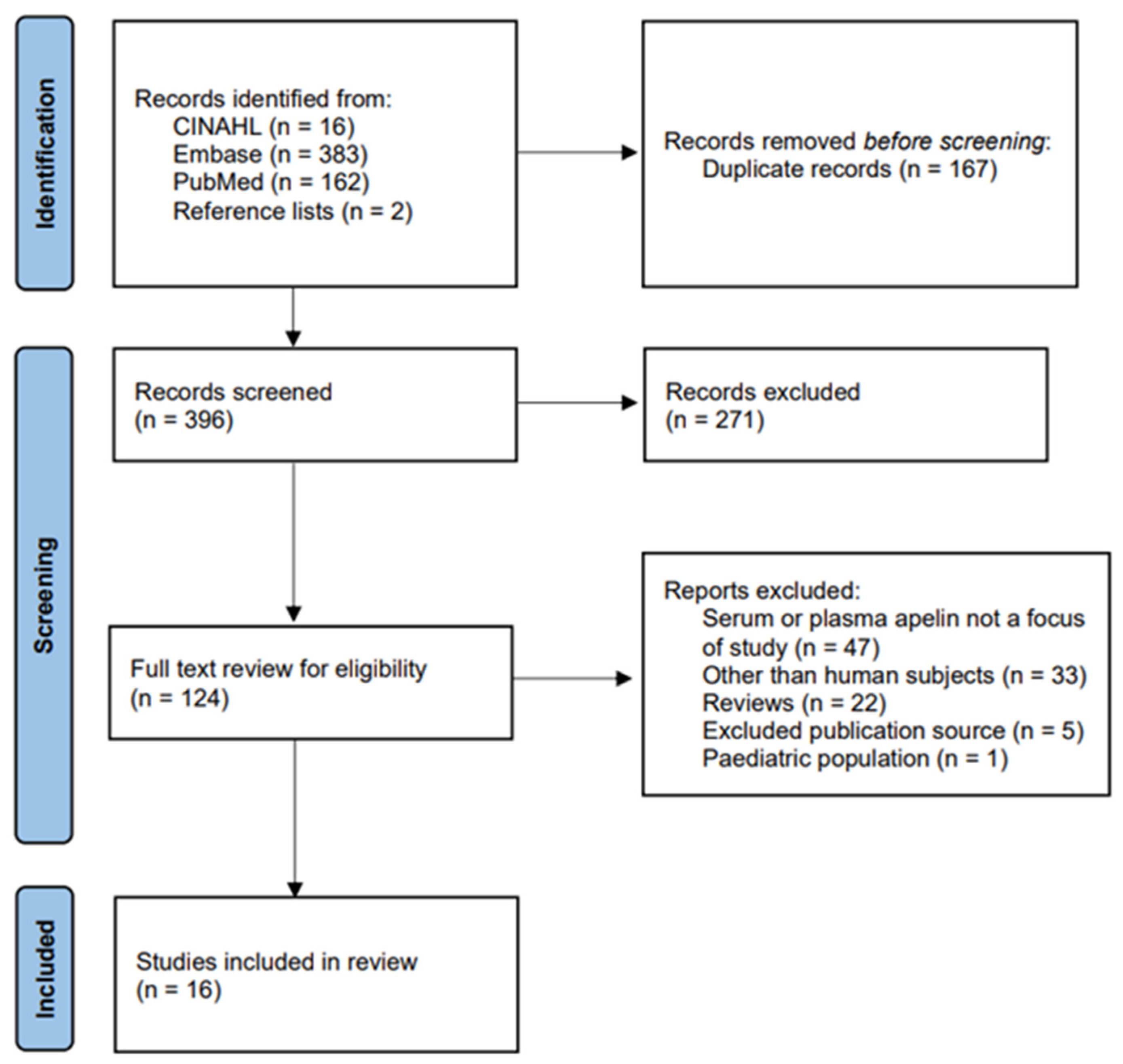
3.1. Search Results
3.2. Study Design and Sampling
3.3. Risk of Bias
3.4. Differences in Serum Apelin Levels among Cases and Controls
3.5. Demographic and Clinical Characteristics and Apelin Concentration
3.6. Associations between Apelin and Survival and Prognosis
3.7. Apelin Biomarker and Receiver Operating Characteristic (ROC) Curves Analysis
3.8. Serum vs. Tissue Apelin
4. Discussion
5. Conclusions
Author Contributions
Funding
Data Availability Statement
Conflicts of Interest
References
- Siegel, R.L.; Miller, K.D.; Fuchs, H.E.; Jemal, A. Cancer statistics. CA A Cancer J. Clin. 2022, 72, 7–33. [Google Scholar] [CrossRef]
- Hristova, V.A.; Chan, D.W. Cancer biomarker discovery and translation: Proteomics and beyond. Expert Rev. Proteom. 2019, 16, 93–103. [Google Scholar] [CrossRef] [PubMed]
- Umelo, I.A.; Costanza, B.; Castronovo, V. Innovative methods for biomarker discovery in the evaluation and development of cancer precision therapies. Cancer Metastasis Rev. 2018, 37, 125–145. [Google Scholar] [CrossRef] [PubMed]
- Tatemoto, K.; Hosoya, M.; Habata, Y.; Fujii, R.; Kakegawa, T.; Zou, M.X.; Kawamata, Y.; Fukusumi, S.; Hinuma, S.; Kitada, C.; et al. Isolation and characterization of a novel endogenous peptide ligand for the human APJ receptor. Biochem. Biophys. Res. Commun. 1998, 251, 471–476. [Google Scholar] [CrossRef] [PubMed]
- Wysocka, M.B.; Pietraszek-Gremplewicz, K.; Nowak, D. The role of apelin in cardiovascular diseases, obesity and cancer. Front. Physiol. 2018, 9, 557. [Google Scholar] [CrossRef]
- Gandham, R.; Sumathi, M.E.; Dayanand, C.D.; Sheela, S.R.; Kiranmayee, P. Apelin and its receptor: An overview. J. Clin. Diagn. Res. 2019, 13, BE01–BE06. [Google Scholar] [CrossRef]
- Japp, A.G.; Cruden, N.L.; Barnes, G.; van Gemeren, N.; Mathews, J.; Adamson, J.; Johnston, N.R.; Denvir, M.A.; Megson, I.L.; Flapan, A.D.; et al. Acute cardiovascular effects of apelin in humans: Potential role in patients with chronic heart failure. Circulation 2010, 121, 1818–1827. [Google Scholar] [CrossRef]
- Mughal, A.; O’Rourke, S.T. Vascular effects of apelin: Mechanisms and therapeutic potential. Pharmacol. Ther. 2018, 190, 139–147. [Google Scholar] [CrossRef]
- Neelakantan, D.; Dogra, S.; Devapatla, B.; Jaiprasart, P.; Mukashyaka, M.C.; Janknecht, R.; Dwivedi, S.K.D.; Bhattacharya, R.; Husain, S.; Ding, K.; et al. Multifunctional APJ pathway promotes ovarian cancer progression and metastasis. Mol. Cancer Res. 2019, 17, 1378–1390. [Google Scholar] [CrossRef]
- Berta, J.; Török, S.; Tárnoki-Zách, J.; Drozdovszky, O.; Tóvári, J.; Paku, S.; Kovács, I.; Czirók, A.; Masri, B.; Megyesfalvi, Z.; et al. Apelin promotes blood and lymph vessel formation and the growth of melanoma lung metastasis. Sci. Rep. 2021, 11, 5798. [Google Scholar] [CrossRef]
- Liu, L.; Yi, X.; Lu, C.; Wang, Y.; Xiao, Q.; Zhang, L.; Pang, Y.; Guan, X. Study progression of apelin/APJ Signaling and apela in different types of cancer. Front. Oncol. 2021, 11, 658253. [Google Scholar] [CrossRef] [PubMed]
- Antushevich, H.; Wójcik, M. Review: Apelin in disease. Clin. Chim. Acta 2018, 483, 241–248. [Google Scholar] [CrossRef] [PubMed]
- Masoumi, J.; Jafarzadeh, A.; Khorramdelazad, H.; Abbasloui, M.; Abdolalizadeh, J.; Jamali, N. Role of Apelin/APJ axis in cancer development and progression. Adv. Med. Sci. 2020, 65, 202–213. [Google Scholar] [CrossRef] [PubMed]
- Gourgue, F.; Derouane, F.; van Marcke, C.; Villar, E.; Dano, H.; Desmet, L.; Bouzin, C.; Duhoux, F.P.; Cani, P.D.; Jordan, B.F. Tumor apelin and obesity are associated with reduced neoadjuvant chemotherapy response in a cohort of breast cancer patients. Sci. Rep. 2021, 11, 9922. [Google Scholar] [CrossRef] [PubMed]
- Janssens, P.; de Loor, H.; Decuypere, J.-P.; Vennekens, R.; Llorens-Cortes, C.; Mekahli, D.; Bammens, B. On methods for the measurement of the apelin receptor ligand apelin. Sci. Rep. 2022, 12, 7763. [Google Scholar] [CrossRef]
- Page, M.J.; McKenzie, J.E.; Bossuyt, P.M.; Boutron, I.; Hoffmann, T.C.; Mulrow, C.D.; Shamseer, L.; Tetzlaff, J.M.; Akl, E.A.; Brennan, S.E.; et al. The PRISMA 2020 statement: An updated guideline for reporting systematic reviews. BMJ 2021, 372, n71. [Google Scholar] [CrossRef]
- Drukker, M.; Weltens, I.; van Hooijdonk, C.F.M.; Vandenberk, E.; Bak, M. Development of a methodological quality criteria list for observational studies: The observational study quality evaluation. Front. Res. Metr. Anal. 2021, 6, 675071. [Google Scholar] [CrossRef]
- Diakowska, D.; Markocka-Mączka, K.; Szelachowski, P.; Grabowski, K. Serum levels of resistin, adiponectin, and apelin in gastroesophageal cancer patients. Dis. Markers 2014, 2014, 619649. [Google Scholar] [CrossRef]
- Tulubas, F.; Mete, R.; Oznur, M.; Topcu, B. The role of adipocytokines in colon cancer and adenomas. J. Med. Biochem. 2014, 33, 135–142. [Google Scholar] [CrossRef][Green Version]
- Yang, L.; Su, T.; Lv, D.; Xie, F.; Liu, W.; Cao, J.; Sheikh, I.A.; Qin, X.; Li, L.; Chen, L. ERK1/2 mediates lung adenocarcinoma cell proliferation and autophagy induced by apelin-13. Acta Biochim Biophys. 2014, 46, 100–111. [Google Scholar] [CrossRef]
- Al-Harithy, R.; Al-Otaibi, W. Apelin-12 levels in obese patients with colon cancer. Int. J. Cancer Immunol. Immun. 2015, 1, 102. [Google Scholar]
- Lacquaniti, A.; Altavilla, G.; Picone, A.; Donato, V.; Chirico, V.; Mondello, P.; Aloisi, C.; Marabello, G.; Loddo, S.; Buemi, A.; et al. Apelin beyond kidney failure and hyponatremia: A useful biomarker for cancer disease progression evaluation. Clin. Exp. Med. 2015, 15, 97–105. [Google Scholar] [CrossRef] [PubMed]
- Altinkaya, S.O.; Nergiz, S.; Küçük, M.; Yüksel, H. Apelin levels are higher in obese patients with endometrial cancer. J. Obstet. Gynaecol. Res. 2015, 41, 294–300. [Google Scholar] [CrossRef] [PubMed]
- Feng, M.; Yao, G.; Yu, H.; Qing, Y.; Wang, K. Tumor apelin, not serum apelin, is associated with the clinical features and prognosis of gastric cancer. BMC Cancer 2016, 16, 794. [Google Scholar] [CrossRef]
- Maden, M.; Pamuk, O.N.; Pamuk, G.E. High apelin levels could be used as a diagnostic marker in multiple myeloma: A comparative study. Cancer Biomark 2016, 17, 391–396. [Google Scholar] [CrossRef]
- Salman, T.; Demir, L.; Varol, U.; Akyol, M.; Oflazoglu, U.; Yildiz, Y.; Taskaynatan, H.; Cengiz, H.; Guvendi, G.; Kucukzeybek, Y.; et al. Serum apelin levels and body composition changes in breast cancer patients treated with an aromatase inhibitor. J. Buon 2016, 21, 1419–1424. [Google Scholar]
- Ni, Y.; Liu, D.; Ge, G.; Zhu, Y.; Zhang, L. Apelin is a novel circulating biomarker for the diagnosis of lung cancer. Int. J. Clin. Exp. Pathol. 2017, 10, 5559–5565. [Google Scholar]
- Aktan, M.; Ozmen, H.K. A preliminary study of serum apelin levels in patients with head and neck cancer. Eurasian J. Med. 2019, 51, 57–59. [Google Scholar] [CrossRef]
- Diakowska, D.; Markocka-Mączka, K.; Nienartowicz, M.; Rosińczuk, J.; Krzystek-Korpacka, M. Assessment of apelin, apelin receptor, resistin, and adiponectin levels in the primary tumor and serum of patients with esophageal squamous cell carcinoma. Adv. Clin. Exp. Med. 2019, 28, 671–678. [Google Scholar] [CrossRef]
- Gholamnejad, M.; Meghrazi, K.; Akhgar, M.; Shaianmehr, M. The assessment of serum apelin-12 level in a variety of pulmonary malignancies in Smokers. Addict Health. 2019, 11, 93–99. [Google Scholar] [CrossRef]
- Podgórska, M.; Diakowska, D.; Pietraszek-Gremplewicz, K.; Nienartowicz, M.; Nowak, D. Evaluation of apelin and apelin receptor level in the primary tumor and serum of colorectal cancer patients. J. Clin. Med. 2019, 8, 1513. [Google Scholar] [CrossRef] [PubMed]
- Grupińska, J.; Budzyń, M.; Brzeziński, J.J.; Gryszczyńska, B.; Kasprzak, M.P.; Kycler, W.; Leporowska, E.; Iskra, M. Association between clinicopathological features of breast cancer with adipocytokine levels and oxidative stress markers before and after chemotherapy. Biomed. Rep. 2021, 14, 30. [Google Scholar] [CrossRef] [PubMed]
- Berta, J.; Hoda, M.A.; Laszlo, V.; Rozsas, A.; Garay, T.; Torok, S.; Grusch, M.; Berger, W.; Paku, S.; Renyi-Vamos, F.; et al. Apelin promotes lymphangiogenesis and lymph node metastasis. Oncotarget 2014, 5, 4426–4437. [Google Scholar] [CrossRef] [PubMed]


| Author/Year Study/Design Location | Purpose | Sample | Quality Assessment |
|---|---|---|---|
| Diakowska, et al., 2014 [18] Case–control Poland | To investigate the relationship between cachexia syndrome and serum resistin, adiponectin, and apelin in patients with gastroesophageal cancer | 145 Total 85 Gastroesophageal Cancer 39 Squamous cell carcinoma of the esophagus 22 Adenocarcinoma of the gastroesophageal junction 24 Gastric adenocarcinoma 60 healthy controls | 9/15 stars 0 vetoes Moderate |
| Tulubas, et al., 2014 [19] Case–control Turkey | To investigate the association of serum adipokines with colon cancer and bowel adenomas | 90 Total 30 Colon Cancer 30 Bowel adenomas 30 healthy controls | 10/15 stars 0 vetoes Moderate |
| Yang, et al., 2014 [20] Case–control China | To investigate the role of apelin in the cell proliferation and autophagy of lung adenocarcinoma | 20 Total 10 Lung cancer 10 Healthy controls | 6/14 stars 2 vetoes Low |
| Al-Harithy, et al., 2015 [21] Case–control Saudi Arabia | To evaluate serum concentrations of apelin-12 and its relationship to the metabolic profile of patients with colon cancer | 119 total 59 colon cancer 60 healthy controls | 11/15 stars 0 vetoes Moderate |
| Lacquaniti, et al., 2015 [22] Prospective case–cohort Italy | To examine the correlations between apelin expression and clinical outcomes in oncologic patients, such as cancer disease progression and patient survival | 130 Total 95 All cancers 32 Lung cancer 23 Gastrointestinal cancers 9 Breast and Gynecologic cancers 14 prostate cancer 35 healthy controls | 14/22 stars 0 vetoes Moderate |
| Altinkaya, et al., 2015 [23] Case–control Turkey | To investigate serum apelin levels in women with endometrial cancer and correlate apelin levels with tumor markers, metabolic profiles, and clinicopathologic features | 90 Total 46 Endometrial cancer 44 controls with uterine dysfunction | 12/14 stars 0 Vetoes High |
| Feng, et al., 2016 [24] Prospective case–cohort China | To study the association between apelin expression and the clinical features and postoperative prognosis in patients with gastric cancer | 351 Total 270 Gastric cancer 81 Controls with chronic gastritis | 10/19 stars 0 vetoes Low |
| Maden, et al., 2016 [25] Prospective case–cohort Turkey | To examine the association between apelin levels and clinical findings in multiple myeloma (MM) and Non-Hodgkin’s Lymphoma (NHL) | 79 Total 29 Multiple Myeloma 31 Non-Hodgkin’s Lymphoma 19 Healthy controls | 12/20 stars 0 vetoes Moderate |
| Salman, et al., 2016 [26] Case–control Turkey | To investigate changes in apelin levels in postmenopausal Breast Cancer patients receiving aromatase inhibitors | 60 Total 40 Breast cancer 20 Healthy controls | 10/22 stars 0 vetoes Low |
| Ni, et al., 2017 [27] Case–control China | To evaluate whether circulating apelin could act as a biomarker in lung cancer diagnosis | 186 Total 129 Lung cancer 57 Healthy controls | 10/15 stars 0 vetoes Moderate |
| Aktan, et al., 2019 [28] Prospective case–cohort Turkey | To investigate whether there was a variety in serum apelin levels between patients with head and neck cancer (HNC) and a healthy control group and to compare the serum apelin levels before and after radiotherapy | 52 Total 22 Head and Neck Cancer 30 Healthy controls | 10/22 stars 0 vetoes Low |
| Diakowska, et al., 2019 [29] Case–control Poland | To evaluate the mRNA expression and protein levels of apelin, the apelin receptor, resistin, and adiponectin in esophageal squamous cell carcinoma | 80 total 53 cases of Esophageal Squamous Cell Carcinoma 20 Cachexia 33 No cachexia 27 healthy controls | 10/14 stars 0 vetoes Moderate |
| Gholamnejad, et al., 2019 [30] Case–control Iran | To evaluate the amount of serum apelin in smokers without cancer and the correlation of apelin with the types of lung cancer found in smokers | 124 Total 4 Non-smoker lung patients 59 smoker lung cancer patients 12 adenocarcinoma 22 squamous cell carcinoma 8 small cell carcinoma 17 other types of carcinoma 61 Controls
| 7/15 stars 0 vetoes Low |
| Podgόrska, et al., 2019 [31] Case–control Poland | To perform a quantitative analysis of apelin and its receptor expression in colorectal cancer patients | 83 total: 56 patients with colorectal cancer 27 healthy controls | 8/15 stars 0 vetoes Moderate |
| Berta, et al., 2021 [10] Case–control Sweden | To investigate the role of apelin in the growth of melanoma lung metastasis | 61 total 40 patients with melanoma 21 healthy controls | 9/15 stars 0 vetoes Moderate |
| Grupińska, et al., 2021 [32] Pre-post test without control Poland | To investigate levels of biomarkers associated with oxidative stress and adipokines in breast cancer patients with different clinical features and analyze the effect of chemotherapy on their concentrations. | 60 total 60 patients with breast cancer | 6/8 criteria 3 unknown Low |
| Author (Year) | Apelin Measure | Quality of Assay | Group (n) Comparisons | Apelin Levels (ng/mL or pg/mL or ng/L) | (p < 0.5) |
|---|---|---|---|---|---|
| Diakowska, et al., 2014 [18] | Serum Unknown isoform | Sensitivity:0.09 ng/mL Intraassay CV: 5–10% Inter-assay CV: <15% | GEC/cachexia (44): HC (60) GEC/non-cachectic (41): HC (60) ESCC (39): GADCA (46) | 855 ± 195: 635 ± 365 820 ± 211: 635 ± 365 886 ± 127: 836 ± 118 pg/mL | p = 0.014 ns ns |
| Tulubas, et al., 2014 [19] | Serum Unknown isoform | Minimum detectible level: 0.6 ng/mL | Colon Adenoma (30): HC (30): CC (30) | 2.88 ± 0.48: 2.98 ± 0.66: 1.63 ± 0.37 ng/mL | p < 0.000 |
| Yang, et al., 2014 [20] | Plasma Unknown isoform | No information provided | Lung cancer (20): HC (10) | 370:200 ng/mL | p < 0.05 |
| Al-Harithy, et al., 2015 [21] | Serum Apelin-12 | Apelin-12 enzyme immunoassay kit Analytical range: 0.0–100 ng/mL | Obese male CC: Non-obese CC: Obese control Obese controls: Obese female CC | 0.85: 0.35/0.29: 0.72/0.57 0.72/0.57: 0.26 ng/mL | |
| Lacquaniti, et al., 2015 [22] | Serum Unknown Isoform | No information provided | Baseline-Various cancers (95): HC (30) Cancer progression after 24 mths: Cancer progression (41): No progression (54) | 532.5: 231 717.4: 392.1 pg/mL | p < 0.0001 |
| Altinkaya, et al., 2015 [23] | Serum Apelin-36 | Intraassay CV: <10%, Interassay CV: <12% Detection range: 37.04–3000 pg/mL | Endometrial cancer (46): HC (44) | 215.1: 177.3 pg/mL | p < 0.002 |
| Feng, et al., 2016 [24] | Serum Apelin-12 | Sensitivity: 0.05 ng/mL Intraassay CV: <5% Interassay CV: <10% | Gastric cancer: Chronic gastritis | 2.84 ± 1.13: 2.52 ± 0.78 ng/mL | ns |
| Maden, et al., 2016 [25] | Plasma Unknown isoform | No information provided | MM (29): NHL (31) MM (29): HC (19) NHL (31): HC (19) | 1.99: 0.56 1.99: 0.42 0.56: 0.42 ng/mL | p < 0.001 p < 0.001 ns |
| Salman, et al., 2016 [26] | Serum Apelin-36 | Interassay CV: <12% Intraassay CV: <10% | Breast cancer (40): HC (20) | N/A | p < 0.0001 |
| Ni, et al., 2017 [27] | Plasma Unknown isoform | No information provided | HC (57): Lung Cancer (129) | 750: 550 ng/mL | p < 0.0001 |
| Aktan, et al., 2019 [28] | Serum Apelin-36 | Interassay CV: <12% Intraassay CV: <10% Minimum detection limit: 0.07 ng/mL Analytical range: 0–100 ng/mL | HNC (22): HC (30) Pre-RT (22): Post-RT (22) | 1.66: 0.53 1.66: 1.51 ng/mL | p < 0.001 ns |
| Diakowska, et al., 2019 [29] | Serum Unknown isoform | sensitivity: 2.63 pg/mL intra-assay CV: <10%, inter-assay CV: <12% | ESCC (53): HC (27) Ca w/ cachexia (20): Ca w/o cachexia (33) | 746.7: 570 907.6: 671.7 pg/mL | p = 0.036 p = 0.006 |
| Gholamnejad, et al., 2019 [30] | Serum Apelin-12 | sensitivity: 4.47 ng/L, assay range: 10–4000 ng/L, intraassay CV: <8%, inter-assay CV: <10% | Lung SCC: Lung ADCA: SCLC: Other lung carcinoma Smokers w/no cancer: Smokers w/ lung cancer | 2205.54: 1088.00: 797.25: 1000.37 2142.20: 1461.92 ng/L | p < 0.05 p < 0.05 |
| Podgόrska, et al., 2019 [31] | Serum Apelin-36 | Sensitivity: 2.63 pg/mL | CRC (56): HC (27) | N/A | |
| Berta, et al., 2021 [10] | Plasma Apelin-36 | No information provided | Melanoma (40): HC (21) | 1.46: 0.77 ng/mL | p = 0.0011 |
| Grupińska, et al., 2021 [32] | Serum Unknown isoform | No information provided | Breast ca (60) HER2+ (20):HER2-–(40) | 1.58:1.16 ng/mL | p = 0.002 |
| Author/Year | Data of Interest Collected | Key Findings |
|---|---|---|
| Diakowska, et al., 2014 [18] | Serum apelin Demographics BMI Tumor histology and TNM staging | Serum apelin is not correlated with sex, age, BMI Serum apelin is not associated with tumor histology, TNM stage, tumor stage (T), lymph node metastasis, or distant metastasis |
| Tulubas, et al., 2014 [19] | Serum apelin BMI | No correlation between serum apelin and BMI |
| Al-Harithy, et al., 2015 [21] | Serum apelin Duke’s classification, metastasis, tumor size Demographics BMI/anthropomorphic measurements | Obese males show an inverse relationship between serum apelin and stages Obese men with colon cancer with higher serum apelin than obese women with colon cancer In non-obese males, serum apelin correlated with BMI |
| Lacquaniti, et al., 2015 [22] | Serum apelin Demographics BMI TNM staging | Apelin is positively correlated with BMI, but not correlated with gender. Serum apelin differs between staging groups, increasing with increasing stage, and between those with and without metastases. |
| Altinkaya, et al., 2015 [23] | Serum apelin Demographics BMI Tumor characteristics | Apelin is not associated with age Serum apelin is higher in obese compared to non-obese women with endometrial cancer; in healthy controls, apelin levels of obese compared to non-obese were similar Apelin positively correlated with BMI Serum apelin inversely correlated with FIGO stage but not tumor grade or size |
| Feng, et al., 2016 [24] | Serum apelin Demographics Tumor size, differentiation, TNM stage, lymph node metastasis, distant metastasis | Serum apelin is not correlated with gender or age Serum apelin is higher in cases with lymph node metastasis, but is not correlated with tumor size, tumor differentiation, and distant metastasis. |
| Maden, et al., 2016 [25] | Plasma apelin Tumor staging | NHL showed a negative correlation between apelin and stage, apelin decreased in advanced stages |
| Salman, et al., 2016 [26] | Serum apelin BMI/Body composition | Cases with reduced apelin levels after 12 months of follow-up had decreased waist-hip ratio and fat mass compared to those with higher levels |
| Ni, et al., 2017 [27] | Plasma apelin Demographics Histological tumor classification, stage, metastasis | Serum apelin is lower in cases with metastasis compared to controls No association of apelin with histological classification, tumor stage, age, and gender |
| Aktan, et al., 2019 [28] | Serum apelin Treatment | No significant difference in apelin levels before and after radiotherapy |
| Diakowska, et al., 2019 [29] | Serum apelin Demographics TNM staging, tumor size, lymph node metastasis, distant metastasis | No association between serum apelin and age and gender Apelin is positively associated with TNM stage, but not associated with lymph node metastasis, distant metastasis or tumor size |
| Podgórska, et al., 2019 [31] | Serum apelin BMI Tumor Characteristics | No association between serum apelin and BMI Serum apelin is higher in those with more advanced TNM stages and those with lymph node metastasis and distant metastasis |
| Berta, et al., 2021 [10] | Plasma Apelin Demographics | No correlation between apelin level and age |
| Grupińska, et al., 2021 [32] | Serum apelin Demographics BMI Tumor characteristics Treatment | No correlation of apelin with age, BMI, or adipose tissue contentApelin is not associated with tumor size, histopathological grade, and lymph node metastasis No significant change to apelin after treatment with chemotherapy |
| First Author (Year) | ||||||||
|---|---|---|---|---|---|---|---|---|
| Diakowska, et al., 2014 [18] | Tulubas, et al., 2014 [19] | Al-Harithy, et al., 2015 [21] | Lacquaniti, et al., 2015 [22] | Altinkaya, et al., 2015 [23] | Salman, et al., 2016 [26] | Maden, et. al., 2016 [25] | ||
| Variables/Cancer | Gastroesophageal | Colon | Colon | Multiple | Endometrial | Breast | MM/NHL | |
| Hemoglobin | - | + * | 0 ** | + NHL | ||||
| Lymphocytes | 0 | |||||||
| Thrombocytes | 0 | |||||||
| Total Protein | 0 | 0 | ||||||
| Albumin | 0 | + * | 0 ** | |||||
| hsCRP | + | |||||||
| Creatinine | 0 | |||||||
| eGFR | + | |||||||
| Uric Acid | - * | 0 ** | ||||||
| LDH | - MM | |||||||
| Total Cholesterol | 0 | U | + * | 0 ** | 0 | + | ||
| Triglycerides | 0 | 0 | 0 | 0 | ||||
| HDL | 0 | 0 | 0 | |||||
| LDL | 0 | U | 0 | |||||
| Fasting insulin | + | |||||||
| Fasting glucose | 0 | 0 | 0 | |||||
| Phosphate | - * | 0 ** | ||||||
| Potassium | - * | 0 ** | ||||||
| Sodium | - | |||||||
| Calcium | 0 | |||||||
| IgM | - MM | |||||||
| IgA | 0 MM | |||||||
| IgG | 0 MM | |||||||
| Author/Year | Purpose of Analysis | Optimal Cutoff Concentration | AUC | Sensitivity | Specificity |
|---|---|---|---|---|---|
| Lacquaniti, et al., 2015 [22] | To find the best cutoff values capable of identifying the progression of oncologic disease | Serum Apelin unknown isoform 610 pg/mL | 0.97 (95% CI: 0.91–0.99) | 92.7 | 94.4 |
| Altinkaya, et al., 2015 [23] | To find the optimal cutoff points of apelin measurements for diagnosis of endometrial cancer | Serum Apelin-36 160 pg/mL | 0.676 (95%CI: 0.567–0.786) | 87.0 | 43.2 |
| Maden, et al., 2016 [25] | To find the optimal cutoff point for diagnosis of MM | Plasma Apelin unknown isoform 0.827 ng/mL | 0.842 (95%CI: 0.739–0.945) | 76 | 86 |
| Ni, et al., 2017 [27] | To find the optimal cutoff point for diagnosis of lung cancer | Plasma Apelin unknown isoform 6.85 ng/mL | 77.7 (CI not provided) | 84.2 | 71.4 |
Publisher’s Note: MDPI stays neutral with regard to jurisdictional claims in published maps and institutional affiliations. |
© 2022 by the authors. Licensee MDPI, Basel, Switzerland. This article is an open access article distributed under the terms and conditions of the Creative Commons Attribution (CC BY) license (https://creativecommons.org/licenses/by/4.0/).
Share and Cite
Grinstead, C.; Yoon, S. Apelin, a Circulating Biomarker in Cancer Evaluation: A Systematic Review. Cancers 2022, 14, 4656. https://doi.org/10.3390/cancers14194656
Grinstead C, Yoon S. Apelin, a Circulating Biomarker in Cancer Evaluation: A Systematic Review. Cancers. 2022; 14(19):4656. https://doi.org/10.3390/cancers14194656
Chicago/Turabian StyleGrinstead, Christina, and Saunjoo Yoon. 2022. "Apelin, a Circulating Biomarker in Cancer Evaluation: A Systematic Review" Cancers 14, no. 19: 4656. https://doi.org/10.3390/cancers14194656
APA StyleGrinstead, C., & Yoon, S. (2022). Apelin, a Circulating Biomarker in Cancer Evaluation: A Systematic Review. Cancers, 14(19), 4656. https://doi.org/10.3390/cancers14194656