A Scoping Review of Microsimulation Models on Obesity-Related Policy Evaluation



Abstract
1. Introduction
2. Materials and Methods
2.1. Search Strategy
2.2. Eligibility Criteria
2.3. Data Extraction
2.4. Study Quality Assessment
3. Results
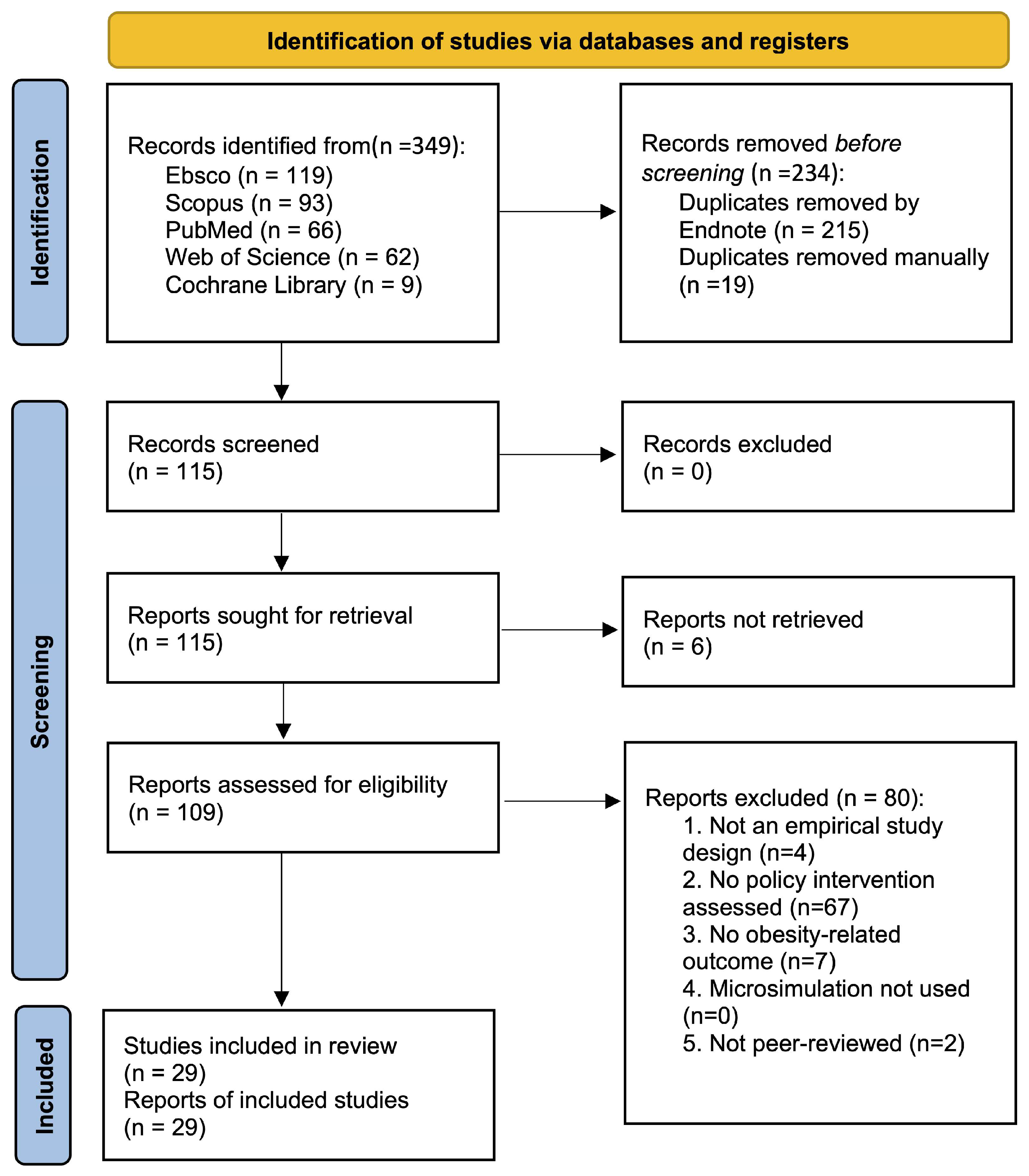
3.1. Study Selection and Quality Assessment
3.2. Structure and Scope of Modeled Nutrition Policy Interventions
3.2.1. Policy Intervention Levels
3.2.2. Policy Settings by Countries
3.2.3. Policy Mechanism and Policy Intent
3.2.4. Behavioral Dose–Response Models
3.3. Equity Considerations in Model Design and Reporting
3.4. Modeling Frameworks Across Microsimulation Studies
3.4.1. Model Design and Data Inputs
Time Horizon
Starting Cohort Generation
Classification of Study Populations and Obesity Definitions
3.4.2. Modeling of Obesity in Microsimulation Studies
Obesity Modeling Equations
- Dynamic energy-balance (biophysical) models.Models such as the Hall equation and the NIH Body Weight Model describe the body weight as the outcome of a dynamic energy-balance system. Persistent gaps between energy intake and expenditure drive predictable changes in fat and lean mass, modeled through differential equations that adjust energy expenditure as body composition evolves [28,29]. These models capture metabolic adaptation alongside changes in diet composition and physical activity, allowing policy simulations to translate shifts in energy balance into continuous weight or BMI trajectories linked to downstream health and cost outcomes [28,29].
- Empirical regression BMI-transition models.Instead of modeling physiology, these approaches estimate changes in BMI statistically using longitudinal or repeated cross-sectional data. Linear or log-BMI regressions, including GAMLSS specifications, are commonly applied. They can be calibrated directly to survey data and capture subgroup heterogeneity, though at the cost of physiological realism.
- Pediatric energy-balance growth models. Biophysical models represented by the Hall–Butte equations extend the adult energy-balance models to reflect the metabolic demands of growth in children and/or adolescents. They are typically aligned with WHO (2007) or CDC (2000) growth standards to reflect developmental energy needs [30]. By explicitly modeling the accrual of fat and lean tissue and distinguishing normal growth from excess weight gain, these models generate BMI-for-age trajectories under nutritional, physical activity, or school-based interventions [30].
- Empirical growth-trajectory models. These models estimate changes in BMI distribution over time using large, nationally representative datasets, emphasizing empirically derived trajectories of weight change rather than physiological mechanisms. In most of the included studies, this approach was implemented within the CHOICES microsimulation model, which utilizes the Ward et al. (2017) quantile BMI growth equations [31] to create hypothetical cohorts and project population-level changes in obesity prevalence under various policy scenarios. In contrast, Study 19 used the Osteoarthritis Policy (OAPol) Model, which represents the progression and treatment of knee osteoarthritis while incorporating the influence of obesity on disease development and quality of life.
Calibration
3.4.3. Sensitivity and Uncertainty Analyses
4. Discussion
4.1. Policy Settings and Coverage of Modeled Nutrition Policies
4.2. Cost-Effectiveness Considerations and Limitations
4.3. Equity Evaluation Framework in Obesity-Related Nutrition Policy Models
4.4. Time Horizon, Methodological Diversity, Data Transparency, and Policy Feasibility
4.4.1. Time Horizon
4.4.2. Methodological Diversity for Obesity Modeling
4.4.3. Data Reliability and Missing Data Handling
4.4.4. Policy Feasibility and Public Acceptability
4.5. Practical Implications and Dissemination and Implementation of Microsimulation Models
4.6. Practical Implications and Dissemination and Implementation of Microsimulation Models
4.6.1. Limitations Related to Causal Evidence and Quality Assessment
4.6.2. Limitations Related to the Empirical Basis of Model Parameters
5. Conclusions
Author Contributions
Funding
Institutional Review Board Statement
Informed Consent Statement
Data Availability Statement
Acknowledgments
Conflicts of Interest
Abbreviations
| DOCM | U.S. Diabetes, Obesity, and Cardiovascular Disease Microsimulation |
| CHOICES | Childhood Obesity Intervention Cost-Effectiveness Study |
| CVD-PREDICT | Cardiovascular Disease Policy Model for Risk, Events, Detection, Interventions, Costs, and Trends |
| SSBs | Sugar-sweetened beverages |
| SES | Socioeconomic Status |
| SNAP | Supplemental Nutrition Assistance Program |
| IOTF | International Obesity Task Force |
Appendix A

| PubMed | ||
|---|---|---|
| No. | Search Terms | Results |
| 1 | (microsimulation[tiab] OR “micro-simulation”[tiab] OR “micro simulation”[tiab]) AND (overweight[tiab] OR overweight[mh] OR obesity[tiab] OR obesity[mh] OR obese[tiab] OR adiposity[tiab] OR adiposity[mh] OR adipose[tiab] OR “body mass index”[tiab] OR “body mass index”[mh] OR BMI[tiab] OR “body weight”[tiab] OR “body weight”[mh] OR “waist circumference”[tiab] OR “waist circumference”[mh] OR “waist to hip”[tiab] OR “waist-to-hip”[tiab] OR “waist-hip”[tiab] OR “waist-hip”[mh] OR “waist hip”[tiab] OR “body fat”[tiab] OR “adipose tissue”[mh] OR “excess weight”[tiab]) AND (policy[tiab] OR policy[mh] OR policies[tiab] OR program[tiab] OR program[mh] OR programs[tiab]) | 66 |
| Web of Science | ||
| No. | Search Terms | Results |
| 1 | AB = (microsimulation OR “micro-simulation” OR “micro simulation”) AND AB = (overweight OR obesity OR obese OR adiposity OR adipose OR “body mass index” OR bmi OR “body weight” OR “waist circumference” OR “waist circumference” OR “waist to hip” OR “waist-to-hip” OR “waist-hip” OR “waist hip” OR “body fat” OR “adipose tissue” OR “excess weight”) AND AB= (policy OR policies OR program OR programs) | 58 |
| 2 | TI = (microsimulation OR “micro-simulation” OR “micro simulation”) AND TI = (overweight OR obesity OR obese OR adiposity OR adipose OR “body mass index” OR bmi OR “body weight” OR “waist circumference” OR “waist circumference” OR “waist to hip” OR “waist-to-hip” OR “waist-hip” OR “waist hip” OR “body fat” OR “adipose tissue” OR “excess weight”) AND TI = (policy OR policies OR program OR programs) | 4 |
| 3 | #1 AND #2 | 62 |
| Cochrane Library | ||
| No. | Search Terms | Results |
| 1 | microsimulation OR “micro-simulation” OR “micro simulation” in Title Abstract Keyword | 199 |
| 2 | overweight OR obesity OR obese OR adiposity OR adipose OR “body mass index” OR BMI OR “body weight” OR “waist circumference” OR “waist circumference” OR “waist to hip” OR “waist-to-hip” OR “waist-hip” OR “waist hip” OR “body fat” OR “adipose tissue” OR “excess weight” in Title Abstract Keyword | 174,711 |
| 3 | policy OR policies OR program OR programs in Title Abstract Keyword | 190,908 |
| 4 | MeSH descriptor: [Obesity] explode all trees | 21,563 |
| 5 | MeSH descriptor: [Adiposity] explode all trees | 1129 |
| 6 | MeSH descriptor: [Body Mass Index] explode all trees | 14,128 |
| 7 | MeSH descriptor: [Body Weight] explode all trees | 40,767 |
| 8 | MeSH descriptor: [Waist Circumference] explode all trees | 1480 |
| 9 | MeSH descriptor: [Waist-Hip Ratio] explode all trees | 350 |
| 10 | #2 OR #4 OR #5 OR #6 OR #7 OR #8 OR #9 | 178,664 |
| 11 | MeSH descriptor: [Policy] explode all trees | 3361 |
| 12 | MeSH descriptor: [Program] explode all trees | 0 |
| 13 | #3 OR #11 OR #12 | 192,160 |
| 14 | #1 AND #10 AND #13 | 9 |
| Scopus | ||
| No. | Search Terms | Results |
| 1 | TITLE-ABS (microsimulation OR “micro-simulation” OR “micro simulation”) AND TITLE-ABS (overweight OR obesity OR obese OR adiposity OR adipose OR “body mass index” OR bmi OR “body weight” OR “waist circumference” OR “waist circumference” OR “waist to hip” OR “waist-to-hip” OR “waist-hip” OR “waist hip” OR “body fat” OR “adipose tissue” OR “excess weight”) AND TITLE-ABS (policy OR policies OR program OR programs) | 93 |
| Ebsco | ||
| No. | Search Terms | Results |
| 1 | AB (microsimulation OR “micro-simulation” OR “micro simulation”) AND AB (overweight OR obesity OR obese OR adiposity OR adipose OR “body mass index” OR bmi OR “body weight” OR “waist circumference” OR “waist circumference” OR “waist to hip” OR “waist-to-hip” OR “waist-hip” OR “waist hip” OR “body fat” OR “adipose tissue” OR “excess weight”) AND AB (policy OR policies OR program OR programs) | 116 |
| 2 | TI (microsimulation OR “micro-simulation” OR “micro simulation”) AND TI (overweight OR obesity OR obese OR adiposity OR adipose OR “body mass index” OR bmi OR “body weight” OR “waist circumference” OR “waist circumference” OR “waist to hip” OR “waist-to-hip” OR “waist-hip” OR “waist hip” OR “body fat” OR “adipose tissue” OR “excess weight”) AND TI (policy OR policies OR program OR programs) | 3 |
| 3 | #1 AND #2 | 119 |
Appendix B
| Study IDs | Author, Year, Reference | Nutrition Policy |
|---|---|---|
| S1 | Basto-Abreu et al. (2024) [36] | Mexico’s national ban on nonessential energy-dense foods and beverages (NEDFBs) in schools |
| S2 | Kenney et al. (2024) [37] | 2009 national revision of the WIC food package |
| S3 | Lee et al. (2024) [35] | A hypothetical statewide $0.02-per-ounce excise tax on sugar-sweetened beverages in California |
| S4 | Emmert-Fees et al. (2023) [38] | National SSB taxation policies in Germany (20% ad valorem tax, an extended tax covering fruit juice, and a tiered levy designed to incentivize product reformulation toward lower sugar content) |
| S5 | Kim et al. (2023) [21] | National Produce Prescription Program |
| S6 | Poole et al. (2023) [39] | School-based BMI report cards (BMI feedback letters to parents/guardians) |
| S7 | Wang et al. (2023) [40] | National Produce Prescription Program |
| S8 | An et al. (2022) [41] | SSB Warning Labels; Restaurant Menu Labeling Regulations |
| S9 | Grummon and Golden (2022) [12] | Minimum Price Law (MPL) for SSBs; Excise Tax on SSBs |
| S10 | Thomas et al. (2022) [42] | Transport for London (TfL) Advertising Restrictions on High Fat, Salt and Sugar (HFSS) Products |
| S11 | Choi et al. (2021) [43] | Restriction on the purchase of SSBs using SNAP benefits |
| S12 | Kabiri et al. (2021) [44] | Nationwide Anti-Obesity Medication Uptake Scenario (hypothetical 100% uptake) |
| S13 | Kenney et al. (2021) [45] | Eliminating the Tax Deductibility of Food and Beverage Advertising to Children; Home Visiting Program to Reduce Television Viewing; WIC Motivational Interviewing to Reduce Television Time; Fit5Kids Child Care Curriculum to Reduce Television Time at Home; Policy to Limit Non-Educational Television in Licensed Early Care and Education (ECE) Settings |
| S14 | Rasella et al. (2021) [24] | Basic Income (yearly): the policy provides a universal €100 yearly transfer to all individuals without eligibility requirements; Basic Income (Monthly): the policy provides a universal €100 monthly transfer to all individuals, simulating a stronger income-support effect. Poverty Reduction (yearly): The policy grants €100 yearly per household member to families with per capita incomes below €500 per month; Poverty Reduction (monthly): The policy grants €100 monthly per household member to families with per capita incomes below €500 per month. New-Borns Benefits (yearly): the policy provides €500 yearly for each child under one year old in households with equivalized income below €500 per month; New-Borns Benefits (monthly): the policy provides €500 monthly for each child under one year old in households with equivalized income below €500 per month. Child Benefit (yearly): the policy provides €500 yearly for each child under five years old in households with an equivalized income below €500 per month; Child Benefit (monthly): the policy provides €500 monthly for each child under five years old in households with an equivalized income below €500 per month. |
| S15 | Shangguan et al. (2021) [46] | National Salt and Sugar Reduction Initiative (NSSRI) Voluntary Sugar Reduction Policy |
| S16 | Basu et al. (2020) [47] | Workplace Ban on SSB Sales |
| S17 | Liu et al. (2020) [48] | U.S. Federal Menu Calorie Labeling Law (National Menu Labeling Policy, Section 4205 of the Affordable Care Act, implemented in 2018) |
| S18 | Russell-Fritch et al. (2020) [49] | Supplemental Nutrition Assistance Program Education (SNAP-Ed) |
| S19 | Smith et al. (2020) [50] | Funding an Intensive Diet and Exercise (D+E) Program for Overweight and Obese Patients with Knee Osteoarthritis (OA) |
| S20 | Grummon et al. (2019) [51] | National SSB health warning policy |
| S21 | Kenney et al. (2019) [52] | Water Jets Installation: installs chilled dispensers on school lunch lines to promote water intake and prevent obesity; Grab a Cup, Fill It Up!: adds cup dispensers and signage near fountains to encourage drinking water; Portable Water Dispensers + Promotion: provides portable water jugs with cups and promotion; Bottle-less Water Coolers + Promotion: installs filtered coolers with promotional activities to increase water consumption. |
| S22 | Long et al. (2019) [53] | SSB Excise Tax; SNAP SSB Restriction Policy |
| S23 | Choi et al. (2017) [54] | Fruit and Vegetable (FV) Purchase Subsidy under SNAP |
| S24 | Cradock et al. (2017) [55] | Active Physical Education (Active PE): A state-level policy requiring that at least 50% of PE class time in public K–8 schools be spent in moderate-to-vigorous physical activity. Active Recess: A district-level voluntary program that increases children’s physical activity during recess through structured play, playground markings, and portable equipment. Active School Day: A district-level policy mandating at least 150 min of physical activity per week during the school day through PE, recess, or classroom activity breaks. Healthy Afterschool: A state-level voluntary recognition program that trains and rewards afterschool programs for adopting healthy eating and physical activity practices. New Afterschool Programs: A federally and state-funded initiative providing free, two-hour afterschool sessions in Title I schools with 80 min of supervised physical activity and academic enrichment. Hip Hop to Health, Jr.: A state regulatory policy requiring early childhood education staff to complete structured physical activity promotion training using the Hip Hop to Health, Jr. curriculum. |
| S25 | Pitt and Bendavid (2017) [56] | Hypothetical increase in the retail price of meat |
| S26 | Chen et al. (2016) [57] | Digital Intensive Behavioral Counseling (IBC) Program—Modeled after the National Diabetes Prevention Program (NDPP) |
| S27 | Gortmaker et al. (2015) [34] | SSB Excise Tax; Elimination of the Tax Deductibility for Advertising Unhealthy Foods to Children; Nutrition Standards for All Foods and Beverages Sold in Schools (“Smart Snacks in School”); Restaurant menu calorie labeling; Nutrition standards for school meals; Early Care and Education (NAP SACC) improvements; Increased access to adolescent bariatric surgery |
| S28 | Kristensen et al. (2014) [58] | Strengthening and expanding federally funded afterschool programs to promote physical activity; A national $0.01 per ounce excise tax on SSB; A ban on fast-food television advertising directed at children aged 12 and under |
| S29 | Basu et al. (2013) [59] | Disincentives for SSBs: SSB Ban, SSB tax; Incentives for Fruits and Vegetables: Produce Subsidy, Produce Reward; General SNAP Benefit Increases: Equal-Budget Increase, “Food Stamp Cycle” Change Scenario |
Appendix C
| No. | Criterion | Ideal Benchmark (Score = 0–2) |
|---|---|---|
| 1 | Research question clarity and theoretical alignment | Research question is explicitly stated, relevant to obesity or nutrition policy, and conceptually grounded in a causal or theoretical framework linking: policy → diet/behavior → BMI → outcomes. |
| 2 | Model choice justification | Model type is clearly justified and appropriate for reflecting policy effects over time and population heterogeneity. |
| 3 | Representativeness and heterogeneity of data sources | Data are nationally or regionally representative and capture essential heterogeneity by age, sex, socioeconomic status, race or ethnicity, and region. |
| 4 | Data reliability and missing data handling | Data sources are validated and well-documented, with clear discussion of limitations and appropriate handling of missing data or bias. |
| 5 | High-quality evidence-based parameters | Intervention effects and key parameters are derived from systematic reviews, meta-analyses, or high-quality empirical estimates with defined uncertainty. |
| 6 | Model structure transparency | The model’s components, transition logic, and core equations are clearly described or publicly documented for reproducibility. |
| 7 | Calibration and validation | The model is calibrated to observed data and externally validated against independent datasets, with quantitative goodness-of-fit or validation metrics reported. |
| 8 | Policy definition and justification | The policy intervention is precisely defined, empirically supported, and realistic in its implementation context. |
| 9 | Time horizon adequacy | The simulation horizon extends sufficiently (≥ 10 years) to capture long-term or lifetime policy effects and align with decision-making cycles. |
| 10 | Dynamic effects | The model distinguishes short-, medium-, and long-term effects and accounts for potential non-linear or saturation dynamics in BMI or behavior change. |
| 11 | Assumptions, transparency, and testing | Key assumptions are explicitly stated, evidence-based, and tested through sensitivity or scenario analyses. |
| 12 | Equity analysis | The model examines heterogeneity in impacts across population subgroups (e.g., socioeconomic status, race/ethnicity) and reports equity-related outcomes. |
| 13 | Cost-effectiveness comprehensiveness | Cost analysis includes both direct (healthcare) and indirect (societal or productivity) costs, with transparent and realistic cost estimates. |
| 14 | Policy-relevant outcomes | Outputs include policy-actionable metrics such as BMI trajectories, obesity prevalence, QALYs, cases prevented, and cost per QALY. |
| 15 | Sensitivity analyses | The study conducts probabilistic or deterministic analyses to test how varying key assumptions affect model outcomes. |
| 16 | Uncertainty characterization | The study identifies and qualitatively discusses parameter, structural, and scenario uncertainties, explaining how these may influence interpretation and confidence in results. |
| 17 | Reproducibility and transparency | The model code or detailed documentation is available or accessible, and all assumptions and limitations are clearly stated. |
| 18 | Conflict-of-interest disclosure | Funding sources and potential conflicts of interest are fully disclosed, and analytical independence is maintained. |
| 19 | Ethical statement | The study clearly states its ethical approval or exemption status, confirms the use of de-identified or publicly available data, and describes consent or data-handling procedures in accordance with institutional and national ethical standards. |
| 20 | Implementation feasibility | Potential barriers, scalability, and administrative considerations for implementing the policy are discussed. |
| 21 | Policy acceptability | The study considers the policy’s acceptability to key stakeholders, policymakers, and the public, supported by evidence or contextual reasoning. |
| Criterion | S1 | S2 | S3 | S4 | S5 | S6 | S7 | S8 | S9 | S10 | S11 | S12 | S13 | S14 | S15 | S16 | S17 | S18 | S19 | S20 | S21 | S22 | S23 | S24 | S25 | S26 | S27 | S28 | S29 |
|---|---|---|---|---|---|---|---|---|---|---|---|---|---|---|---|---|---|---|---|---|---|---|---|---|---|---|---|---|---|
| Research question clarity and theoretical alignment | 2 | 2 | 2 | 2 | 2 | 2 | 2 | 2 | 2 | 2 | 2 | 2 | 2 | 2 | 2 | 2 | 2 | 2 | 2 | 2 | 2 | 2 | 2 | 2 | 2 | 2 | 2 | 2 | 2 |
| Model choice justification | 2 | 2 | 2 | 2 | 2 | 2 | 2 | 2 | 2 | 2 | 2 | 2 | 2 | 2 | 2 | 2 | 2 | 2 | 2 | 2 | 2 | 2 | 2 | 2 | 2 | 2 | 2 | 2 | 2 |
| Representativeness and heterogeneity of data sources | 2 | 2 | 2 | 2 | 2 | 2 | 2 | 2 | 2 | 2 | 2 | 2 | 2 | 2 | 2 | 2 | 2 | 2 | 2 | 2 | 2 | 2 | 2 | 2 | 2 | 2 | 2 | 2 | 2 |
| Data reliability and missing data handling | 2 | 1 | 1 | 1 | 2 | 2 | 2 | 2 | 1 | 2 | 1 | 1 | 1 | 1 | 2 | 2 | 1 | 1 | 1 | 2 | 1 | 1 | 1 | 1 | 1 | 2 | 2 | 1 | 2 |
| High-quality evidence-based parameters | 2 | 2 | 2 | 2 | 2 | 2 | 2 | 2 | 2 | 2 | 2 | 2 | 2 | 1 | 2 | 2 | 2 | 1 | 2 | 2 | 2 | 2 | 2 | 2 | 2 | 2 | 2 | 2 | 2 |
| Model structure transparency | 2 | 2 | 2 | 2 | 2 | 2 | 2 | 2 | 2 | 2 | 2 | 2 | 2 | 2 | 2 | 2 | 2 | 2 | 2 | 2 | 2 | 2 | 2 | 2 | 2 | 2 | 2 | 2 | 2 |
| Calibration and validation | 2 | 1 | 1 | 2 | 2 | 1 | 2 | 1 | 1 | 1 | 2 | 1 | 2 | 1 | 2 | 1 | 2 | 1 | 2 | 2 | 1 | 1 | 2 | 1 | 2 | 1 | 1 | 1 | 2 |
| Policy definition and justification | 2 | 2 | 2 | 2 | 2 | 2 | 2 | 2 | 2 | 2 | 2 | 2 | 2 | 2 | 2 | 2 | 2 | 2 | 2 | 2 | 2 | 2 | 2 | 2 | 2 | 2 | 2 | 2 | 2 |
| Time horizon adequacy | 0 | 2 | 2 | 2 | 2 | 2 | 2 | 2 | 1 | 2 | 2 | 2 | 2 | 1 | 2 | 2 | 2 | 2 | 1 | 1 | 2 | 2 | 2 | 2 | 2 | 2 | 1 | 2 | 2 |
| Dynamic effects | 2 | 1 | 2 | 2 | 2 | 1 | 2 | 2 | 2 | 2 | 2 | 2 | 2 | 2 | 2 | 1 | 2 | 1 | 2 | 1 | 1 | 1 | 2 | 1 | 2 | 2 | 1 | 1 | 2 |
| Assumptions, transparency, and testing | 2 | 2 | 2 | 2 | 2 | 2 | 2 | 2 | 2 | 2 | 2 | 1 | 2 | 2 | 2 | 2 | 2 | 2 | 2 | 2 | 2 | 2 | 2 | 2 | 2 | 2 | 2 | 2 | 2 |
| Equity analysis | 2 | 2 | 2 | 1 | 2 | 2 | 2 | 2 | 2 | 2 | 2 | 1 | 1 | 1 | 2 | 2 | 2 | 1 | 0 | 2 | 1 | 1 | 2 | 0 | 2 | 1 | 0 | 2 | 1 |
| Cost-effectiveness comprehensiveness | 0 | 2 | 1 | 2 | 1 | 2 | 2 | 1 | 0 | 2 | 0 | 1 | 2 | 1 | 2 | 2 | 2 | 0 | 1 | 0 | 2 | 2 | 2 | 2 | 0 | 2 | 1 | 1 | 2 |
| Policy-relevant outcomes | 2 | 2 | 2 | 2 | 2 | 2 | 2 | 2 | 2 | 2 | 2 | 2 | 2 | 2 | 2 | 2 | 2 | 2 | 2 | 2 | 2 | 2 | 2 | 2 | 2 | 2 | 2 | 2 | 2 |
| Sensitivity analyses | 2 | 1 | 2 | 2 | 2 | 2 | 2 | 2 | 2 | 2 | 2 | 0 | 2 | 2 | 2 | 2 | 2 | 2 | 2 | 2 | 2 | 2 | 2 | 2 | 2 | 2 | 2 | 1 | 2 |
| Uncertainty characterization | 2 | 2 | 2 | 2 | 2 | 2 | 2 | 2 | 2 | 2 | 2 | 1 | 2 | 2 | 2 | 2 | 2 | 2 | 1 | 2 | 2 | 2 | 2 | 2 | 2 | 1 | 2 | 1 | 2 |
| Reproducibility and transparency | 2 | 2 | 1 | 2 | 2 | 2 | 2 | 1 | 1 | 1 | 2 | 1 | 1 | 2 | 2 | 2 | 1 | 2 | 2 | 1 | 1 | 1 | 2 | 1 | 1 | 1 | 1 | 1 | 1 |
| Conflict-of-interest disclosure | 2 | 2 | 2 | 2 | 2 | 2 | 2 | 2 | 2 | 2 | 2 | 2 | 2 | 2 | 2 | 2 | 2 | 2 | 2 | 2 | 2 | 2 | 2 | 2 | 2 | 2 | 2 | 2 | 2 |
| Ethical statement | 2 | 2 | 2 | 2 | 2 | 2 | 2 | 2 | 2 | 2 | 2 | 1 | 2 | 2 | 2 | 1 | 2 | 2 | 1 | 2 | 2 | 2 | 2 | 2 | 2 | 2 | 1 | 1 | 2 |
| Implementation feasibility | 2 | 2 | 2 | 2 | 1 | 1 | 2 | 1 | 1 | 1 | 1 | 1 | 2 | 1 | 2 | 2 | 2 | 1 | 1 | 1 | 2 | 2 | 1 | 2 | 1 | 2 | 2 | 2 | 1 |
| Policy acceptability | 1 | 1 | 1 | 1 | 1 | 1 | 2 | 1 | 1 | 1 | 1 | 1 | 1 | 1 | 2 | 1 | 1 | 1 | 1 | 1 | 2 | 2 | 1 | 1 | 1 | 2 | 2 | 2 | 1 |
| Sum Score | 37 | 37 | 37 | 39 | 39 | 38 | 42 | 36 | 34 | 38 | 37 | 30 | 38 | 34 | 42 | 38 | 39 | 33 | 33 | 35 | 37 | 37 | 39 | 35 | 36 | 38 | 34 | 34 | 38 |
| Quality Rating | G | G | G | G | G | G | G | G | F | G | G | F | G | F | G | G | G | F | F | F | G | G | G | F | G | G | F | F | G |
References
- Obesity and Overweight. Available online: https://www.who.int/news-room/fact-sheets/detail/obesity-and-overweight (accessed on 23 October 2025).
- Emmerich, S.D.; Fryar, C.D.; Stierman, B.; Ogden, C.L. Obesity and Severe Obesity Prevalence in Adults: United States, August 2021–August 2023; National Center for Health Statistics: Hyattsville, MD, USA, 2024.
- Okunogbe, A.; Nugent, R.; Spencer, G.; Powis, J.; Ralston, J.; Wilding, J. Economic Impacts of Overweight and Obesity: Current and Future Estimates for 161 Countries. BMJ Glob. Health 2022, 7, e009773. [Google Scholar] [CrossRef] [PubMed]
- Crosbie, E.; Gomes, F.S.; Olvera, J.; Patiño, S.R.-G.; Hoeper, S.; Carriedo, A. A Policy Study on Front–of–Pack Nutrition Labeling in the Americas: Emerging Developments and Outcomes. Lancet Reg. Health 2023, 18, 100400. [Google Scholar] [CrossRef] [PubMed]
- Lan, X.; Sulaiman, N. Public Policies on Obesity: A Literature Review of Global Challenges and Response Strategies. Cureus 2024, 16, e62758. [Google Scholar] [CrossRef] [PubMed]
- Levy, D.T.; Mabry, P.L.; Wang, Y.C.; Gortmaker, S.; Huang, T.T.-K.; Marsh, T.; Moodie, M.; Swinburn, B. Simulation Models of Obesity: A Review of the Literature and Implications for Research and Policy. Obes. Rev. 2011, 12, 378–394. [Google Scholar] [CrossRef]
- Mertens, E.; Genbrugge, E.; Ocira, J.; Peñalvo, J.L. Microsimulation Modeling in Food Policy: A Scoping Review of Methodological Aspects. Adv. Nutr. 2022, 13, 621–632. [Google Scholar] [CrossRef]
- Bhatia, A.; Smetana, S.; Heinz, V.; Hertzberg, J. Modeling Obesity in Complex Food Systems: Systematic Review. Front. Endocrinol. 2022, 13, 1027147. [Google Scholar] [CrossRef]
- Smith, N.R.; Grummon, A.H.; Ng, S.W.; Wright, S.T.; Frerichs, L. Simulation Models of Sugary Drink Policies: A Scoping Review. PLoS ONE 2022, 17, e0275270. [Google Scholar] [CrossRef]
- Study Quality Assessment Tools | NHLBI, NIH. Available online: https://www.nhlbi.nih.gov/health-topics/study-quality-assessment-tools (accessed on 9 November 2025).
- Husereau, D.; Drummond, M.; Augustovski, F.; De Bekker-Grob, E.; Briggs, A.H.; Carswell, C.; Caulley, L.; Chaiyakunapruk, N.; Greenberg, D.; Loder, E.; et al. Consolidated Health Economic Evaluation Reporting Standards 2022 (CHEERS 2022) Statement: Updated Reporting Guidance for Health Economic Evaluations. MDM Policy Pract. 2022, 7, 23814683211061097. [Google Scholar] [CrossRef]
- Grummon, A.H.; Golden, S.D. Sugar-Sweetened Beverage Pricing Policies: Simulation of Minimum Price Laws and Taxes in New York City. Am. J. Prev. Med. 2022, 62, e159–e168. [Google Scholar] [CrossRef]
- Creedy, J. Survey Reweighting for Tax Microsimulation Modelling. In Studies on Economic Well-Being: Essays in the Honor of John P. Formby; Emerald Group Publishing Limited: Leeds, UK, 2004; pp. 229–249. [Google Scholar]
- World Health Organization. Physical Status: The Use and Interpretation of Anthropometry. Report of a WHO Expert Committee; WHO Technical Report Series; 854; World Health Organization: Geneva, Switzerland, 1995; pp. 1–452. [Google Scholar]
- Garvey, W.T.; Mechanick, J.I.; Brett, E.M.; Garber, A.J.; Hurley, D.L.; Jastreboff, A.M.; Nadolsky, K.; Pessah-Pollack, R.; Plodkowski, R. American Association of Clinical Endocrinologists and American College of Endocrinology Comprehensive Clinical Practice Guidelines for Medical Care of Patients with Obesity. Endocr. Pract. 2016, 22, 1–203. [Google Scholar] [CrossRef]
- Apovian, C.M.; Aronne, L.J.; Bessesen, D.H.; McDonnell, M.E.; Murad, M.H.; Pagotto, U.; Ryan, D.H.; Still, C.D. Pharmacological Management of Obesity: An Endocrine Society Clinical Practice Guideline. J. Clin. Endocrinol. Metab. 2015, 100, 342–362. [Google Scholar] [CrossRef] [PubMed]
- Cole, T.J.; Bellizzi, M.C.; Flegal, K.M.; Dietz, W.H. Establishing a Standard Definition for Child Overweight and Obesity Worldwide: International Survey. BMJ 2000, 320, 1240. [Google Scholar] [CrossRef] [PubMed]
- Kuczmarski, R.J. 2000 CDC Growth Charts for the United States: Methods and Development; Department of Health and Human Services, Centers for Disease Control and Prevention, National Center for Health Statistics: Atlanta, GA, USA, 2002.
- De Onis, M.; Onyango, A.W.; Borghi, E.; Siyam, A.; Nishida, C.; Siekmann, J. Development of a WHO Growth Reference for School-Aged Children and Adolescents. Bull. World Health Organ. 2007, 85, 660–667. [Google Scholar] [CrossRef] [PubMed]
- Ward, Z.J.; Barrett, J.L.; Cradock, A.L.; Dupuis, R.; Lee, M.M.; Long, M.W.; Musicus, A.A.; Gortmaker, S.L. Childhood Obesity Intervention Cost-Effectiveness Study (CHOICES) Microsimulation Model Technical Documentation: Details on Model Parameters (CHOICES v4.6.1). March 2023. Available online: https://choicesproject.org/wp-content/uploads/2023/03/CHOICES-Model-Technical-Documentation-v4.6.1.pdf (accessed on 18 December 2025).
- Kim, D.D.; Wang, L.; Lauren, B.N.; Liu, J.; Marklund, M.; Lee, Y.; Micha, R.; Mozaffarian, D.; Wong, J.B. Development and Validation of the US Diabetes, Obesity, Cardiovascular Disease Microsimulation (DOC-M) Model: Health Disparity and Economic Impact Model. Med. Decis. Mak. 2023, 43, 930–948. [Google Scholar] [CrossRef]
- Pandya, A.; Sy, S.; Cho, S.; Alam, S.; Weinstein, M.C.; Gaziano, T.A. Validation of a Cardiovascular Disease Policy Microsimulation Model Using Both Survival and Receiver Operating Characteristic Curves. Med. Decis. Mak. 2017, 37, 802–814. [Google Scholar] [CrossRef]
- Wu, G.; Heppenstall, A.; Meier, P.; Purshouse, R.; Lomax, N. A Synthetic Population Dataset for Estimating Small Area Health and Socio-Economic Outcomes in Great Britain. Sci. Data 2022, 9, 19. [Google Scholar] [CrossRef]
- Rasella, D.; Richiardi, L.; Brachowicz, N.; Jara, H.X.; Hanson, M.; Boccia, D.; Richiardi, M.G.; Pizzi, C. Developing an Integrated Microsimulation Model for the Impact of Fiscal Policies on Child Health in Europe: The Example of Childhood Obesity in Italy. BMC Med. 2021, 19, 310. [Google Scholar] [CrossRef]
- CDC 2000 CDC Growth Charts: Features and Data. Available online: https://www.cdc.gov/growth-chart-training/hcp/overview/features-and-data.html (accessed on 27 October 2025).
- Centers for Disease Control and Prevention. Child and Teen BMI Categories; CDC: Atlanta, GA, USA, 2024.
- Shamah-Levy, T.; Cuevas-Nasu, L.; Romero-Martínez, M.; Gómez-Humaran, I.M.; Ávila-Arcos, M.A.; Rivera, J.A. Nutrition Status of Children, Teenagers, and Adults from National Health and Nutrition Surveys in Mexico from 2006 to 2020. Front. Nutr. 2021, 8, 777246. [Google Scholar] [CrossRef]
- Hall, K.D. Predicting Metabolic Adaptation, Body Weight Change, and Energy Intake in Humans. Am. J. Physiol.-Endocrinol. Metab. 2010, 298, E449–E466. [Google Scholar] [CrossRef]
- Hall, K.D.; Sacks, G.; Chandramohan, D.; Chow, C.C.; Wang, Y.C.; Gortmaker, S.L.; Swinburn, B.A. Quantification of the Effect of Energy Imbalance on Bodyweight. Lancet 2011, 378, 826–837. [Google Scholar] [CrossRef]
- Hall, K.D.; Butte, N.F.; Swinburn, B.A.; Chow, C.C. Dynamics of Childhood Growth and Obesity: Development and Validation of a Quantitative Mathematical Model. Lancet Diabetes Endocrinol. 2013, 1, 97–105. [Google Scholar] [CrossRef] [PubMed]
- Ward, Z.J.; Long, M.W.; Resch, S.C.; Giles, C.M.; Cradock, A.L.; Gortmaker, S.L. Simulation of Growth Trajectories of Childhood Obesity into Adulthood. N. Engl. J. Med. 2017, 377, 2145–2153. [Google Scholar] [CrossRef] [PubMed]
- Hall, K.D.; Guo, J. Obesity Energetics: Body Weight Regulation and the Effects of Diet Composition. Gastroenterology 2017, 152, 1718–1727. [Google Scholar] [CrossRef]
- Ward, Z.J.; Bleich, S.N.; Cradock, A.L.; Barrett, J.L.; Giles, C.M.; Flax, C.; Long, M.W.; Gortmaker, S.L. Projected U.S. State-Level Prevalence of Adult Obesity and Severe Obesity. N. Engl. J. Med. 2019, 381, 2440–2450. [Google Scholar] [CrossRef] [PubMed]
- Gortmaker, S.L.; Wang, Y.C.; Long, M.W.; Giles, C.M.; Ward, Z.J.; Barrett, J.L.; Kenney, E.L.; Sonneville, K.R.; Afzal, A.S.; Resch, S.C.; et al. Three Interventions That Reduce Childhood Obesity Are Projected To Save More Than They Cost To Implement. Health Aff. 2015, 34, 1932–1939. [Google Scholar] [CrossRef]
- Lee, M.M.; Barrett, J.L.; Kenney, E.L.; Gouck, J.; Whetstone, L.M.; McCulloch, S.M.; Cradock, A.L.; Long, M.W.; Ward, Z.J.; Rohrer, B. A Sugar-Sweetened Beverage Excise Tax in California: Projected Benefits for Population Obesity and Health Equity. Am. J. Prev. Med. 2024, 66, 94–103. [Google Scholar] [CrossRef]
- Basto-Abreu, A.; Carnalla, M.; Reyes-Sánchez, F.; Reyes-García, A.; Haby, M.M.; Junquera-Badilla, I.; Sartoris-Ayala, L.; Rivera, J.A.; Popkin, B.M.; Barrientos-Gutiérrez, T. Predicted Impact of Banning Nonessential, Energy-Dense Food and Beverages in Schools in Mexico: A Microsimulation Study. PLoS Med. 2024, 21, e1004394. [Google Scholar] [CrossRef]
- Kenney, E.L.; Lee, M.M.; Barrett, J.L.; Ward, Z.J.; Long, M.W.; Cradock, A.L.; Williams, D.R.; Gortmaker, S.L. Cost-Effectiveness of Improved WIC Food Package for Preventing Childhood Obesity. Pediatrics 2024, 153, e2023063182. [Google Scholar] [CrossRef]
- Emmert-Fees, K.M.; Amies-Cull, B.; Wawro, N.; Linseisen, J.; Staudigel, M.; Peters, A.; Cobiac, L.J.; O’Flaherty, M.; Scarborough, P.; Kypridemos, C. Projected Health and Economic Impacts of Sugar-Sweetened Beverage Taxation in Germany: A Cross-Validation Modelling Study. PLoS Med. 2023, 20, e1004311. [Google Scholar] [CrossRef]
- Poole, M.K.; Gortmaker, S.L.; Barrett, J.L.; McCulloch, S.M.; Rimm, E.B.; Emmons, K.M.; Ward, Z.J.; Kenney, E.L. The Societal Costs and Health Impacts on Obesity of BMI Report Cards in US Schools. Obesity 2023, 31, 2110–2118. [Google Scholar] [CrossRef]
- Wang, L.; Lauren, B.N.; Hager, K.; Zhang, F.F.; Wong, J.B.; Kim, D.D.; Mozaffarian, D. Health and Economic Impacts of Implementing Produce Prescription Programs for Diabetes in the United States: A Microsimulation Study. J. Am. Heart Assoc. 2023, 12, e029215. [Google Scholar] [CrossRef] [PubMed]
- An, R.; Zheng, J.; Xiang, X. Projecting the Influence of Sugar-Sweetened Beverage Warning Labels and Restaurant Menu Labeling Regulations on Energy Intake, Weight Status, and Health Care Expenditures in US Adults: A Microsimulation. J. Acad. Nutr. Diet. 2022, 122, 334–344. [Google Scholar] [CrossRef] [PubMed]
- Thomas, C.; Breeze, P.; Cummins, S.; Cornelsen, L.; Yau, A.; Brennan, A. The Health, Cost and Equity Impacts of Restrictions on the Advertisement of High Fat, Salt and Sugar Products across the Transport for London Network: A Health Economic Modelling Study. Int. J. Behav. Nutr. Phys. Act. 2022, 19, 93. [Google Scholar] [CrossRef] [PubMed]
- Choi, S.E.; Wright, D.R.; Bleich, S.N. Impact of Restricting Sugar-Sweetened Beverages from the Supplemental Nutrition Assistance Program on Children’s Health. Am. J. Prev. Med. 2021, 60, 276–284. [Google Scholar] [CrossRef]
- Kabiri, M.; Sexton Ward, A.; Ramasamy, A.; Kee, R.; Ganguly, R.; Smolarz, B.G.; Zvenyach, T.; Baumgardner, J.R.; Goldman, D.P. Simulating the Fiscal Impact of Anti-Obesity Medications as an Obesity Reduction Strategy. Inq. J. Health Care Organ. Provis. Financ. 2021, 58, 0046958021990516. [Google Scholar] [CrossRef]
- Kenney, E.L.; Mozaffarian, R.S.; Long, M.W.; Barrett, J.L.; Cradock, A.L.; Giles, C.M.; Ward, Z.J.; Gortmaker, S.L. Limiting Television to Reduce Childhood Obesity: Cost-Effectiveness of Five Population Strategies. Child. Obes. 2021, 17, 442–448. [Google Scholar] [CrossRef]
- Shangguan, S.; Mozaffarian, D.; Sy, S.; Lee, Y.; Liu, J.; Wilde, P.E.; Sharkey, A.L.; Dowling, E.A.; Marklund, M.; Abrahams-Gessel, S.; et al. Health Impact and Cost-Effectiveness of Achieving the National Salt and Sugar Reduction Initiative Voluntary Sugar Reduction Targets in the United States: A Microsimulation Study. Circulation 2021, 144, 1362–1376. [Google Scholar] [CrossRef]
- Basu, S.; Jacobs, L.M.; Epel, E.; Schillinger, D.; Schmidt, L. Cost-Effectiveness Of A Workplace Ban On Sugar-Sweetened Beverage Sales: A Microsimulation Model: A Simulation Model Estimates the Employee Health and Health Care Spending Impacts of a Workplace Ban on Sugar-Sweetened Beverage Sales. Health Aff. 2020, 39, 1140–1148. [Google Scholar] [CrossRef]
- Liu, J.; Mozaffarian, D.; Sy, S.; Lee, Y.; Wilde, P.E.; Abrahams-Gessel, S.; Gaziano, T.; Micha, R. FOOD-PRICE (Policy Review and Intervention Cost-Effectiveness) Project. Health and Economic Impacts of the National Menu Calorie Labeling Law in the United States: A Microsimulation Study. Circ. Cardiovasc. Qual. Outcomes 2020, 13, e006313. [Google Scholar] [CrossRef]
- Russell-Fritch, J.; Cohen, D.A.; Caldwell, J.I.; Kuo, T. Simulating the Impact of Health Behavior Interventions in the SNAP-Ed Population. Prev. Med. Rep. 2020, 20, 101257. [Google Scholar] [CrossRef]
- Smith, K.C.; Losina, E.; Messier, S.P.; Hunter, D.J.; Chen, A.T.; Katz, J.N.; Paltiel, A.D. Budget Impact of Funding an Intensive Diet and Exercise Program for Overweight and Obese Patients with Knee Osteoarthritis. ACR Open Rheumatol. 2020, 2, 26–36. [Google Scholar] [CrossRef] [PubMed]
- Grummon, A.H.; Smith, N.R.; Golden, S.D.; Frerichs, L.; Taillie, L.S.; Brewer, N.T. Health Warnings on Sugar-Sweetened Beverages: Simulation of Impacts on Diet and Obesity among US Adults. Am. J. Prev. Med. 2019, 57, 765–774. [Google Scholar] [CrossRef] [PubMed]
- Kenney, E.L.; Cradock, A.L.; Long, M.W.; Barrett, J.L.; Giles, C.M.; Ward, Z.J.; Gortmaker, S.L. Cost-Effectiveness of Water Promotion Strategies in Schools for Preventing Childhood Obesity and Increasing Water Intake. Obesity 2019, 27, 2037–2045. [Google Scholar] [CrossRef] [PubMed]
- Long, M.W.; Polacsek, M.; Bruno, P.; Giles, C.M.; Ward, Z.J.; Cradock, A.L.; Gortmaker, S.L. Cost-Effectiveness Analysis and Stakeholder Evaluation of 2 Obesity Prevention Policies in Maine, US. J. Nutr. Educ. Behav. 2019, 51, 1177–1187. [Google Scholar] [CrossRef]
- Choi, S.E.; Seligman, H.; Basu, S. Cost Effectiveness of Subsidizing Fruit and Vegetable Purchases through the Supplemental Nutrition Assistance Program. Am. J. Prev. Med. 2017, 52, e147–e155. [Google Scholar] [CrossRef]
- Cradock, A.L.; Barrett, J.L.; Kenney, E.L.; Giles, C.M.; Ward, Z.J.; Long, M.W.; Resch, S.C.; Pipito, A.A.; Wei, E.R.; Gortmaker, S.L. Using Cost-Effectiveness Analysis to Prioritize Policy and Programmatic Approaches to Physical Activity Promotion and Obesity Prevention in Childhood. Prev. Med. 2017, 95, S17–S27. [Google Scholar] [CrossRef]
- Pitt, A.; Bendavid, E. Effect of Meat Price on Race and Gender Disparities in Obesity, Mortality and Quality of Life in the US: A Model-Based Analysis. PLoS ONE 2017, 12, e0168710. [Google Scholar] [CrossRef]
- Chen, F.; Su, W.; Becker, S.H.; Payne, M.; Castro Sweet, C.M.; Peters, A.L.; Dall, T.M. Clinical and Economic Impact of a Digital, Remotely-Delivered Intensive Behavioral Counseling Program on Medicare Beneficiaries at Risk for Diabetes and Cardiovascular Disease. PLoS ONE 2016, 11, e0163627. [Google Scholar] [CrossRef]
- Kristensen, A.H.; Flottemesch, T.J.; Maciosek, M.V.; Jenson, J.; Barclay, G.; Ashe, M.; Sanchez, E.J.; Story, M.; Teutsch, S.M.; Brownson, R.C. Reducing Childhood Obesity through US Federal Policy: A Microsimulation Analysis. Am. J. Prev. Med. 2014, 47, 604–612. [Google Scholar] [CrossRef]
- Basu, S.; Seligman, H.; Bhattacharya, J. Nutritional Policy Changes in the Supplemental Nutrition Assistance Program: A Microsimulation and Cost-Effectiveness Analysis. Med. Decis. Mak. 2013, 33, 937–948. [Google Scholar] [CrossRef]

| Modeling Domain | Component | Sub-Component | Description | Study IDs |
|---|---|---|---|---|
| Policy Intervention Levels | National | — | Policies implemented at the national scale and modeled using nationally representative data to assess population-wide effects. | S1, S2, S4, S5, S7, S8, S11–15, S17, S20, S21, S23–29 |
| State/Regional | — | Policies introduced at the state, provincial, or regional level (excluding cities) are modeled with parameters reflecting regional characteristics and baseline differences. | S3, S6, S22, S10, S13, S18,S24 | |
| Local/Institutional | — | Policies implemented within cities, communities, or institutions are modeled using empirical data from local programs or evaluations. | S9, S13, S16, S19, S24, S27 | |
| Policy Settings | United States | — | — | S2, S3, S5–9, S11–13, S15–29 |
| United Kingdom | — | — | S10 | |
| Mexico | — | — | S1 | |
| Italy | — | — | S14 | |
| Germany | — | — | S4 | |
| Policy Domain | Policy Mechanism | Fiscal Policies | Use taxes, subsidies, or price adjustments to shift purchasing behavior and reduce demand for unhealthy foods or beverages. | S3, S4, S9, S13, S14, S22, S23, S25, S27, S28, S29 |
| Information and Marketing Regulations | Modify how nutrition and marketing information is presented to shape consumer awareness and food choices. | S8, S10, S17, S20, S27, S28 | ||
| Setting-Based Policies | Establish food and nutrition standards within schools, workplaces, or other institutions to improve the eating environment. | S1, S6, S8, S13, S15, S16, S21, S24, S27, S28 | ||
| Food System and Assistance Program Reforms | Reform food assistance or procurement systems to improve access to and quality of healthy foods. | S2, S11, S13, S18, S22, S23, S29 | ||
| Clinical and Healthcare System Policies | Integrate nutrition counseling, medical treatment, or preventive care into healthcare delivery to address diet-related risks. | S5, S7, S12, S13, S19, S26, S27 | ||
| Policy Intent | Reduce Unhealthy Dietary Patterns | Limit consumption of high-sugar, high-fat, or high-salt products through fiscal, regulatory, or environmental controls. | S1, S3, S4, S8–11, S13, S15, S16, S20, S22, S25, S27, S28, S29 | |
| Promote Healthy Dietary Patterns | Increase access to and affordability of nutritious foods such as fruits, vegetables, and whole grains. | S2, S5, S23, S27, S29 | ||
| Support Informed Dietary Choices | Improve transparency and empower consumers by providing clear, accurate, and accessible nutrition information. | S6, S17, S20, S27–28 | ||
| Address Dietary Disparities and Food Insecurity | Reduce inequities in healthy food access and alleviate food insecurity in low-income or vulnerable groups. | S2, S5, S11, S13, S14, S22, S23, S29 | ||
| Supplementary Behavioral Interventions for Nutrition | Encourage voluntary behavior changes in diet and physical activity to complement structural policies. | S13, S18, S24, S27–28 | ||
| Clinical Nutrition Interventions | Expand clinical programs that deliver dietary, pharmacologic, or therapeutic care to prevent or manage nutrition-related diseases. | S5, S7, S12, S19, S26, S27 | ||
| Behavioral Dose–Response | Market Incentives And Consumption Adjustment | Price Elasticity Effect | ΔC = εₚ × (ΔP/P0); Consumption change (ΔC) in response to price variation (ΔP); εₚ = own-price elasticity. | S3, S4, S9, S11, S22–23, S25, S27–29 |
| Substitution or Income Adjustment | ΔCᵢ = Σⱼ εᵢⱼ × (ΔPⱼ/Pⱼ); Cross-category consumption shift from substitution or income effects | S3, S4, S9, S11, S22, S23, S25, S27-S29 | ||
| Information Exposure—Decision Change | Labeling or Information Response | ΔI = α × ΔInfo; Behavioral shift linked to increased information salience (ΔInfo) | S6, S8, S17, S20, S27 | |
| Marketing or Setting Response | ΔE = β × ΔM; Change in behavior (ΔE) following reduction or modification of marketing exposure (ΔM); β derived from policy evaluations such as advertising bans or school-setting standards. | S1, S2, S8, S10, S13, S15, S16, S20, S24, S27, S28 | ||
| Behavioral Maintenance and Compensation Over Time | Compensatory Offset | ΔNet = ΔGross × (1 − θ); Net effect after partial behavioral compensation; θ = fraction of offset. Applied in caloric-compensation or substitution modeling. | S1, S4, S8–11, S16, S17, S20 | |
| Adherence/Persistence Decay | ; Decline in behavioral adherence with time; λ = attrition rate. Used for participation-dependent programs. | S12, S18, S19, S26–28 | ||
| Equity Evaluation Framework | Differential Exposure | — | Stratified baseline risks and behaviors across socioeconomic and demographic variables to reflect unequal exposure to policy-relevant risk factors and conditions. | S1–18, S20, S21, S23, S25, S27–29 |
| Equity Metric | Absolute Inequality Measures | Quantify absolute gaps in health outcomes across socioeconomic and demographic groups. Common metrics include Slope Index of Inequality (SII), Concentration Index (absolute version), and Population-attributable risk differences. | S10 | |
| Relative Inequality Measures | Assess relative disparities in outcomes between the most and least advantaged groups. Common metrics include the Relative Index of Inequality (RII), Concentration Index (relative version), and top-to-bottom outcome ratios. | — | ||
| Equity-Adjusted Cost-Effectiveness | Integrate efficiency and fairness by evaluating how costs and benefits vary across population subgroups. Common approaches include Net Monetary Benefit (NMB) or Equally Distributed Equivalent (EDE) frameworks, often stratified by income or IMD quintiles. | — | ||
| Subgroup Disaggregation for Outcome | Report health and economic outcomes by socioeconomic and demographic subgroup, identifying who benefits most without summarizing inequality in a single index. | S1–17, S19, S20, S21, S23, S25–26, S28–29 | ||
| Equity Sensitivity Analysis | — | Stratified or scenario-based modeling varying intervention efficacy or reach by sex or socioeconomic status to assess distributional robustness. | S1, S5, S10, S25, S29 |
| Modeling Domain | Component | Sub-Component | Description | Study IDs |
|---|---|---|---|---|
| Model Design | Model Type | Dynamic, stochastic, individual-level, state-transition | These models simulate how individuals move between health states over successive time steps. They incorporate stochastic variation to reflect uncertainty and population heterogeneity, allowing dynamic changes in risk factors and outcomes over time. | S1–24, S26–28 |
| Static, deterministic, individual-level microsimulation | These models simulate outcomes for a fixed population of individuals over time using predefined equations without probabilistic state transitions to project how continuous variables such as BMI or mortality evolve deterministically in response to policy-driven changes. | S25 | ||
| Dynamic, stochastic, individual-level microsimulation model(non-Markov) | This model simulates individual behaviors and outcomes over time using stochastic variation to capture uncertainty and heterogeneity, allowing dynamic changes in diet, BMI, and disease risk across the simulated population. | S29 | ||
| Model Framework | Dynamics of Childhood Growth and Obesity (DCGO) | Simulates patterns of growth, energy balance, and weight change in childhood to estimate long-term obesity trajectories and related health outcomes. | S1 | |
| CHOICES microsimulation | Evaluates the population-level and economic impacts of obesity prevention policies using U.S. demographic and behavioral data. | S2, S3, S6, S13, S21, S22, S24, S27 | ||
| IMPACTNCD (Germany) | Projects future noncommunicable disease incidence and mortality based on changes in diet, BMI, and metabolic risk factors over time. | S4 | ||
| US Diabetes, Obesity, CVD Microsimulation (DOCM) | Integrates metabolic and cardiovascular pathways to estimate how body weight and risk factors jointly affect disease progression and costs. | S5, S7 | ||
| SPHR diabetes prevention microsimulation model(adapted for London) | Assesses the potential long-term health and fiscal outcomes of diabetes prevention interventions implemented in local public health systems. | S10 | ||
| The Health Economics Medical Innovation Simulation (THEMIS) | Models the lifetime health, productivity, and healthcare costs associated with obesity-related diseases and medical innovation in U.S. populations. | S12 | ||
| Microsimulation for Income and Child Health (MICH) model | Examines how household income dynamics and social policy scenarios influence child growth, obesity risk, and health inequalities. | S14 | ||
| CVD-PREDICT | Estimates cardiovascular morbidity, mortality, and cost outcomes using evolving metabolic risk profiles that include BMI, blood pressure, and cholesterol. | S15, S17 | ||
| Future Americans Model (FAM) | Forecasts future population health, functional status, and healthcare expenditures under alternative obesity and chronic disease scenarios. | S18 | ||
| Osteoarthritis Policy (OAPol) model | Represents the progression and treatment of knee osteoarthritis while accounting for the influence of obesity on disease development and quality of life. | S19 | ||
| Obesity-Related Behavior (ORB) model | Simulates how changes in children’s diet, physical activity, and policy-driven behavioral environments affect BMI trajectories, obesity prevalence, and disparities across demographic subgroups over time. | S28 | ||
| IHS Life Sciences US Diabetes/Obesity Microsimulation model. | Simulates how changes in body weight affect biomarkers, chronic disease progression, and medical expenditures over time in nationally representative U.S. populations. | S26 | ||
| Unnamed model | A customized microsimulation framework was developed to project obesity-related health and economic outcomes for a defined population. | S8, S9, S11, S16, S20, S23, S25, S29 | ||
| Time Horizon | Short-term (<5 years) | Focuses on immediate program implementation and behavioral responses before measurable population health changes occur. | S1, S19, S14 | |
| Mid-term (5–10 years) | Examines gradual changes in weight status, metabolic risk, and intermediate health or cost outcomes. | S7, S9, S14, S17, S19, S20 | ||
| Long-term (≥10 years, including lifetime) | Assesses the sustained health, economic, and distributional consequences of obesity prevention policies as risk and disease accumulate over time. | S2–8, S10–18, S21–29 | ||
| Data Inputs | Starting Cohort Generation | Survey-weighted resampling | Researchers use sampling weights, stratification, and primary sampling unit (PSU) to perform repeated sampling, typically through bootstrap or jackknife procedures, to ensure that model estimation or simulation maintains population representativeness and appropriately propagates sampling uncertainty [13]. | S1, S5, S7, S8, S10, S11, S13, S15–17, S20 |
| Synthetic cohort generation | Synthetic cohort generation refers to creating a cohort of simulated individuals from cross-sectional or multi-source data through statistical matching, imputation, or microsimulation methods to approximate longitudinal population trajectories when real follow-up data are unavailable. | S2–4, S6, S9, S11, S12, S14, S15, S18, S19, S21–29 | ||
| Age Group | Adults only | Adults are defined as individuals aged 18 years and older. | S4, S5, S7–9, S12, S15, S17–20, S25, S26, S29 | |
| Children/adolescents only | Children/adolescents are defined as ages < 19 years; the 18–19 overlap is handled by classifying studies as child/adolescent when the population is predominantly <19 or uses BMI-for-age metrics, otherwise as adult. | S1, S2, S6, S11, S13, S14, S21, S24, S28 | ||
| Mixed | / | S3, S10, S16, S22, S23, S27 | ||
| Obesity Outcome Specification | Definition of Adult Obesity | WHO adult BMI classification (1995) | Defines adult obesity based on body mass index (BMI), with thresholds of ≥25 kg/m2 for overweight and ≥30 kg/m2 for obesity [14]. | S3–5, S7–10, S12, S15–20, S22, S23, S25–27, S29 |
| Adults with BMI ≥ 27 kg/m2 with at least one obesity-associated comorbid condition (e.g., hypertension or type 2 diabetes) are eligible for anti-obesity pharmacotherapy [15,16]. | S12 | |||
| Definition of Children and Adolescents’ Obesity | International Obesity Task Force (IOTF) BMI cut-offs | Provides age- and sex-specific BMI thresholds for children and adolescents derived from international growth reference data, linking child BMI percentiles to the adult cut-offs of 25 kg/m2 and 30 kg/m2 for overweight and obesity [17]. | S14 | |
| CDC 2000 growth charts (ages 2–19 years) | Classifies overweight and obesity in U.S. children and adolescents based on BMI-for-age percentiles, with overweight defined as ≥85th to <95th percentile and obesity as ≥95th percentile relative to the 2000 CDC reference population [18]. | S2, S3, S6, S11, S13, S21, S24, S27, S28, S22 | ||
| WHO 2007 Growth Reference for School-Aged Children and Adolescents | WHO defines overweight as >+1 SD and obesity as >+2 SD on BMI-for-age, aligned to adult BMI 25 and 30 at 19 years [19]. | S1 | ||
| Functional role of obesity in the model | Direct outcome | Obesity is modeled as a direct outcome when the simulation explicitly tracks changes in body weight or BMI over time in response to policy interventions, treating obesity itself as the primary endpoint of interest. | S1–3, S6, S8, S9, S11, S13, S14, S20–22, S25, S27, S28 | |
| Immediate outcome | Obesity is treated as an immediate outcome when it functions as an intermediate health state through which policies influence subsequent disease or cost outcomes within the model. | S4, S5, S7, S10, S12, S15–19, S23–24, S26, S29 | ||
| Obesity Modeling Equation | Dynamic Energy-Balance (Biophysical) Models | Hall model; NIH Body Weight Model; Dynamic energy-balance differential equations | Mechanistic energy-balance frameworks linking sustained caloric imbalance to adaptive fat- and lean-mass changes over time, forming the physiological core of weight-change modeling. | S8–11, S17, S20, S23, S25, S29 |
| Empirical-Regression BMI Transition Models | Linear or log-BMI regression; Quantile regression; GAMLSS BMI functions | BMI change is estimated using statistical or semi-parametric regression models based on longitudinal or repeated cross-sectional data, without relying on underlying metabolic equations. | S4, S5, S7, S12, S14–16, S18, S26, S28 | |
| Pediatric Energy-Balance Growth Models | Hall–Butte pediatric energy-balance equations; WHO (2007)/CDC (2000) z-score curves | Biophysical growth models combining metabolic adaptation with age- and sex-specific energy requirements to simulate BMI-for-age trajectories in children and adolescents. | S1, S11 | |
| Empirical Growth-Trajectory Models | Empirically derived BMI trajectories (CHOICES, Ward et al.). | Empirical cohort-fitted growth-curve models projecting BMI percentiles through quantile regression or observed secular trends rather than energy-balance equations. | S2, S3, S6, S13, S19, S22, S24, S27 | |
| Core obesity-Modeling Structure | Parameter Calibration | Survey-weighted calibration | Model inputs and baseline BMI distributions aligned with nationally representative survey data to preserve population structure and sampling variance. | S1–17, S19–29 |
| Regression-fit calibration | Parameters of BMI or risk equations fitted directly to cohort or clinical data using flexible regression methods or standardized epidemiologic risk functions (e.g., Framingham). | S5, S10, S12, S14, S17, S18, S23, S26 | ||
| Cross-cohort calibration | Model trajectories are jointly calibrated or validated against multiple cohort datasets or independent risk-model predictions to ensure external consistency. | S6 | ||
| External data matching | Predictive performance is evaluated by comparing simulated and observed outcomes using quantitative fit metrics such as O/E ratios, RMSE, Brier score, or c-statistics. | S5, S7, S11, S15, S25, S29 | ||
| Sensitivity and uncertainty analysis | Probabilistic Sensitivity Analysis (PSA) | — | Uncertainty quantified through Monte Carlo or second-order simulations, assigning probability distributions to intervention effects, BMI transitions, and model parameters. Results reported as 95% uncertainty or confidence intervals for BMI or obesity prevalence outcomes. | S1–11, S13–18, S20–24, S27, S29 |
| Deterministic/One-way Sensitivity Analysis | Intervention effect size | Tested alternative magnitudes of intervention impact on energy intake or BMI. | S1, S5, S7, S10–13, S16, S18–21, S27–28 | |
| Caloric compensation | Examined the degree to which individuals regain calories or weight through physiological or behavioral compensation (e.g., 0–30% caloric regain). | S1, S8, S9, S17, S20 | ||
| Policy coverage and compliance | Varied the proportion of the population reached or compliant with the intervention (e.g., 30–100% participation or implementation coverage). | S1, S2, S7, S9, S11, S15, S21, S23, S24, S28 | ||
| Duration and sustainability of BMI effects | Tested alternative assumptions about how long BMI or weight changes persist before partial or full rebound | S10, S11, S18–20, S23, S25–26 | ||
| Policy design parameter (tax rate, pass-through, lag time) | Evaluated variation in policy design elements such as excise-tax rate, price pass-through, or the lag between dietary change and BMI response. | S3, S4, S9, S13, S14, S23, S25, S27–29 | ||
| Dietary replacement | Assessed how replacing restricted items (e.g., SSBs) with alternative foods or beverages alters total energy intake and BMI trajectories. | S4, S11, S16, S23, S25 |
Disclaimer/Publisher’s Note: The statements, opinions and data contained in all publications are solely those of the individual author(s) and contributor(s) and not of MDPI and/or the editor(s). MDPI and/or the editor(s) disclaim responsibility for any injury to people or property resulting from any ideas, methods, instructions or products referred to in the content. |
© 2025 by the authors. Licensee MDPI, Basel, Switzerland. This article is an open access article distributed under the terms and conditions of the Creative Commons Attribution (CC BY) license.
Share and Cite
Cao, Z.; Fang, Y.; Wang, C.; An, R. A Scoping Review of Microsimulation Models on Obesity-Related Policy Evaluation. Nutrients 2026, 18, 73. https://doi.org/10.3390/nu18010073
Cao Z, Fang Y, Wang C, An R. A Scoping Review of Microsimulation Models on Obesity-Related Policy Evaluation. Nutrients. 2026; 18(1):73. https://doi.org/10.3390/nu18010073
Chicago/Turabian StyleCao, Zhixin, Yue Fang, Chenyu Wang, and Ruopeng An. 2026. "A Scoping Review of Microsimulation Models on Obesity-Related Policy Evaluation" Nutrients 18, no. 1: 73. https://doi.org/10.3390/nu18010073
APA StyleCao, Z., Fang, Y., Wang, C., & An, R. (2026). A Scoping Review of Microsimulation Models on Obesity-Related Policy Evaluation. Nutrients, 18(1), 73. https://doi.org/10.3390/nu18010073