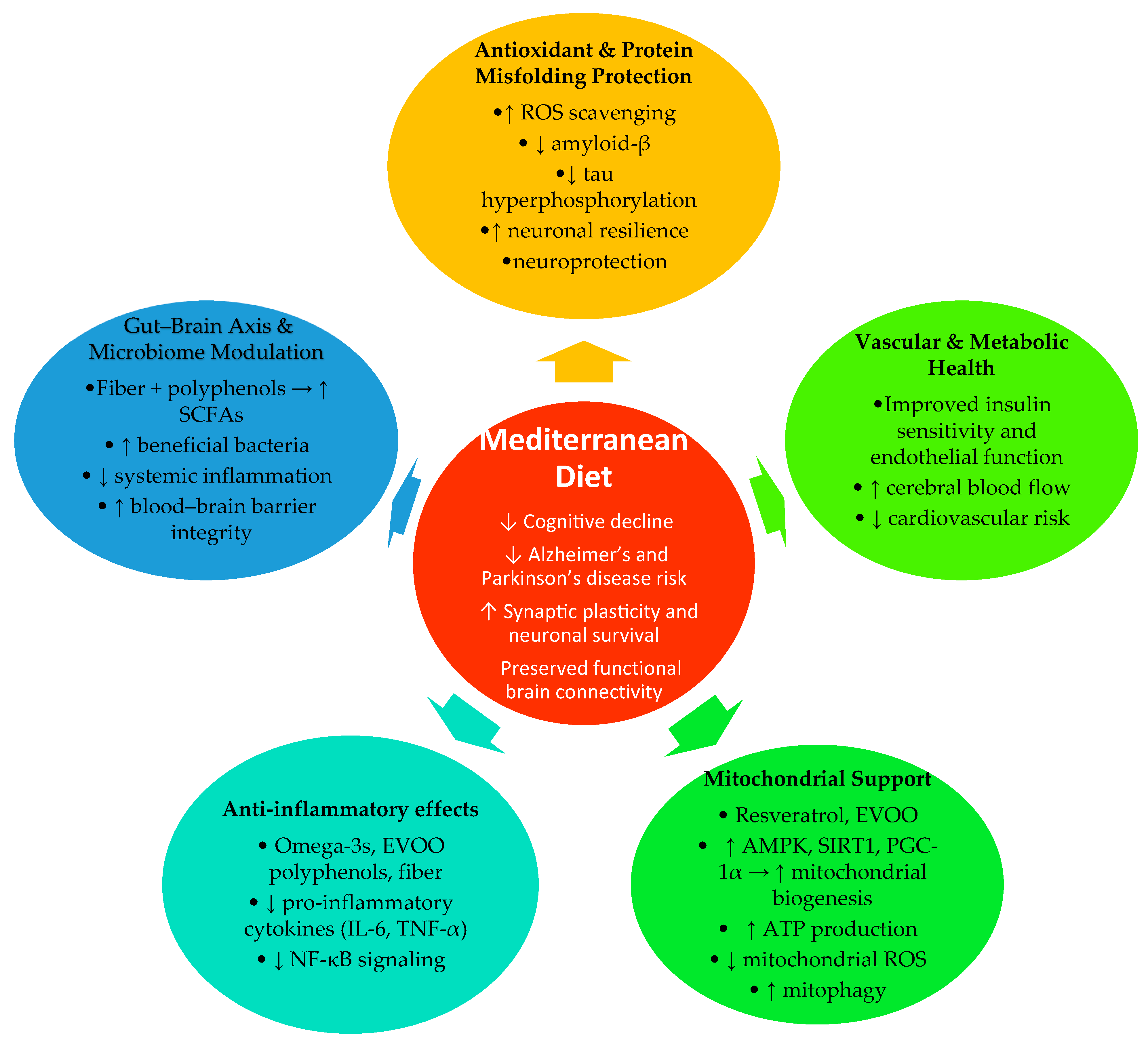
Mediterranean Diet, Polyphenols, and Neuroprotection: Mechanistic Insights into Resveratrol and Oleuropein
 , , ,
, , ,  , , , ,
 Highlights
Abstract
1. Introduction
2. Methods
2.1. Literature Search
2.2. Inclusion Criteria
- Population: Human studies related to neurodegenerative diseases or cognitive decline.
- Intervention/exposure: Examination of the Mediterranean diet as a whole or its key bioactive components [e.g., resveratrol, oleuropein, other polyphenols].
- Outcomes: Incidence or progression of neurodegenerative diseases, changes in cognitive function, or biomarkers [e.g., oxidative stress, inflammatory markers, amyloid and tau pathology].
- Study types: Randomized controlled trials (RCTs), prospective and retrospective cohort studies, and cross-sectional studies, but not experimental [in vivo or in vitro] research.
2.3. Exclusion Criteria
- Publications without original data [editorials, letters, conference abstracts].
- Studies not related to neurodegenerative diseases or cognitive outcomes.
- Studies investigating isolated nutrients outside the context of the Mediterranean diet.
- Animal or other preclinical studies.
2.4. Data Extraction and Synthesis
- Epidemiological associations between the Mediterranean diet and cognitive decline or neurodegenerative diseases.
- Findings from clinical trials of Mediterranean diet-based interventions.
- Mechanistic insights focusing on polyphenols, particularly resveratrol and oleuropein.
- Remaining knowledge gaps and directions for future research.
2.5. Quality Assessment and Limitations
2.6. Aim of the Review
3. Mechanistic Basis: How the Mediterranean Diet May Slow Neurodegeneration
3.1. Anti-Inflammatory Effects
3.2. Antioxidant Effects and Protection Against Protein Misfolding
3.3. Support of Mitochondrial Function
3.4. Improvement of Vascular and Metabolic Health
3.5. Gut–Brain Axis and Microbiome Modulation
4. Polyphenols as Key Mediators
4.1. Resveratrol
4.2. Olive Oil Polyphenols and Their Neuroprotective Effects
4.3. Other Polyphenols and Bioactive Compounds in the Mediterranean Diet
5. Mediterranean Diet and Neurodegeneration: Epidemiological Evidence
5.1. Cognitive Decline and Global Cognitive Performance
5.2. The Mediterranean Diet and the Risk of Alzheimer’s Disease: Summary of Epidemiological Evidence
5.3. Mediterranean Diet and Parkinson’s Disease Risk
6. Cognitive Effects of Trans-Resveratrol
7. Olive Oil-Derived Polyphenols and Their Role in Cognitive Health
7.1. Cognitive Outcomes in MCI and Mild AD Populations Following Olive Oil or Olive Extract Interventions
7.2. Olive Oil Polyphenols and Cognitive Function: Evidence from Mediterranean Diet Studies
8. Non-Olive Polyphenols and Cognitive Function: Evidence from Flavonoids, Catechins, and Cocoa Flavanols
9. Discussion and Conclusions
Author Contributions
Funding
Institutional Review Board Statement
Informed Consent Statement
Data Availability Statement
Conflicts of Interest
References
- Gao, Y.; Liu, X. Secular Trends in the Incidence of and Mortality Due to Alzheimer’s Disease and Other Forms of Dementia in China From 1990 to 2019: An Age-Period-Cohort Study and Joinpoint Analysis. Front. Aging Neurosci. 2021, 13, 709156. [Google Scholar] [CrossRef]
- 2024 Alzheimer’s disease facts and figures. Alzheimer’s Dement. 2024, 20, 3708–3821. [CrossRef]
- Scarmeas, N.; Stern, Y.; Tang, M.X.; Mayeux, R.; Luchsinger, J.A. Mediterranean diet and risk for Alzheimer’s disease. Ann. Neurol. 2006, 59, 912–921. [Google Scholar] [CrossRef]
- Peng, S.; Liu, P.; Wang, X.; Li, K. Global, regional and national burden of Parkinson’s disease in people over 55 years of age: A systematic analysis of the global burden of disease study, 1991–2021. BMC Neurol. 2025, 25, 178. [Google Scholar] [CrossRef]
- Xu, L.; Wang, Z.; Li, Q. Global trends and projections of Parkinson’s disease incidence: A 30-year analysis using GBD 2021 data. J. Neurol. 2025, 272, 286. [Google Scholar] [CrossRef]
- Arroyo-Pacheco, N.; Sarmiento-Blanco, S.; Vergara-Cadavid, G.; Castro-Leones, M.; Contreras-Puentes, N. Monoclonal therapy with lecanemab in the treatment of mild Alzheimer’s disease: A systematic review and meta-analysis. Ageing Res. Rev. 2025, 104, 102620. [Google Scholar] [CrossRef] [PubMed]
- Sugandhi, V.V.; Gadhave, D.G.; Ugale, A.R.; Kulkarni, N.; Nangare, S.N.; Patil, H.P.; Rath, S.; Saxena, R.; Lavate, A.; Patel, A.T.; et al. Advances in Alzheimer’s therapy: Exploring neuropathological mechanisms to revolutionize the future therapeutic landscape. Ageing Res. Rev. 2025, 109, 102775. [Google Scholar] [CrossRef] [PubMed]
- Preethy, H.A.; Rajendran, K.; Sukumar, A.J.; Krishnan, U.M. Emerging paradigms in Alzheimer’s therapy. Eur. J. Pharmacol. 2024, 981, 176872. [Google Scholar] [CrossRef]
- Fekete, M.; Balazs, P.; Lehoczki, A.; Forrai, J.; Dosa, N.; Fazekas-Pongor, V.; Feher, A.; Madarasz, B.; Varga, J.T. The role of gut microbiome and its modification while regulating the defence mechanisms, particularly in severe COVID-19 cases. Med. Int. Rev. 2023, 30, 154–166. [Google Scholar]
- Fekete, M.; Szarvas, Z.; Fazekas-Pongor, V.; Feher, A.; Csipo, T.; Forrai, J.; Dosa, N.; Peterfi, A.; Lehoczki, A.; Tarantini, S. Nutrition strategies promoting healthy aging: From improvement of cardiovascular and brain health to prevention of age-associated diseases. Nutrients 2022, 15, 47. [Google Scholar] [CrossRef]
- Rodríguez-Morató, J.; Xicota, L.; Fitó, M.; Farré, M.; Dierssen, M.; de la Torre, R. Potential role of olive oil phenolic compounds in the prevention of neurodegenerative diseases. Molecules 2015, 20, 4655–4680. [Google Scholar] [CrossRef]
- Ontario, M.L.; Siracusa, R.; Modafferi, S.; Scuto, M.; Sciuto, S.; Greco, V.; Bertuccio, M.P.; Trovato Salinaro, A.; Crea, R.; Calabrese, E.J.; et al. Potential prevention and treatment of neurodegenerative disorders by olive polyphenols and hidrox. Mech. Ageing Dev. 2022, 203, 111637. [Google Scholar] [CrossRef]
- Grabska-Kobylecka, I.; Szpakowski, P.; Krol, A.; Ksiazek-Winiarek, D.; Kobylecki, A.; Glabinski, A.; Nowak, D. Polyphenols and Their Impact on the Prevention of Neurodegenerative Diseases and Development. Nutrients 2023, 15, 3454. [Google Scholar] [CrossRef]
- Nagpal, D.; Nema, S.; Nagpal, S.; Pandey, M.M.; Kaushik, D.; Kathuria, H. Management and Prevention of Neurodegenerative Disorders: Can Antioxidant-Rich Dietary Interventions Help? Antioxidants 2025, 14, 1078. [Google Scholar] [CrossRef]
- Fekete, M.; Varga, P.; Ungvari, Z.; Fekete, J.T.; Buda, A.; Szappanos, A.; Lehoczki, A.; Mozes, N.; Grosso, G.; Godos, J.; et al. The role of the Mediterranean diet in reducing the risk of cognitive impairement, dementia, and Alzheimer’s disease: A meta-analysis. Geroscience 2025, 47, 3111–3130. [Google Scholar] [CrossRef]
- Dilmore, A.H.; Martino, C.; Neth, B.J.; West, K.A.; Zemlin, J.; Rahman, G.; Panitchpakdi, M.; Meehan, M.J.; Weldon, K.C.; Blach, C.; et al. Effects of a ketogenic and low-fat diet on the human metabolome, microbiome, and foodome in adults at risk for Alzheimer’s disease. Alzheimer’s Dement. 2023, 19, 4805–4816. [Google Scholar] [CrossRef] [PubMed]
- Agarwal, P.; Leurgans, S.E.; Agrawal, S.; Aggarwal, N.T.; Cherian, L.J.; James, B.D.; Dhana, K.; Barnes, L.L.; Bennett, D.A.; Schneider, J.A. Association of Mediterranean-DASH Intervention for Neurodegenerative Delay and Mediterranean Diets With Alzheimer Disease Pathology. Neurology 2023, 100, e2259–e2268. [Google Scholar] [CrossRef] [PubMed]
- Hoscheidt, S.; Sanderlin, A.H.; Baker, L.D.; Jung, Y.; Lockhart, S.; Kellar, D.; Whitlow, C.T.; Hanson, A.J.; Friedman, S.; Register, T.; et al. Mediterranean and Western diet effects on Alzheimer’s disease biomarkers, cerebral perfusion, and cognition in mid-life: A randomized trial. Alzheimer’s Dement. 2022, 18, 457–468. [Google Scholar] [CrossRef]
- Roman, G.C.; Jackson, R.E.; Gadhia, R.; Roman, A.N.; Reis, J. Mediterranean diet: The role of long-chain omega-3 fatty acids in fish; polyphenols in fruits, vegetables, cereals, coffee, tea, cacao and wine; probiotics and vitamins in prevention of stroke, age-related cognitive decline, and Alzheimer disease. Rev. Neurol. 2019, 175, 724–741. [Google Scholar] [CrossRef]
- Power, R.; Prado-Cabrero, A.; Mulcahy, R.; Howard, A.; Nolan, J.M. The Role of Nutrition for the Aging Population: Implications for Cognition and Alzheimer’s Disease. Annu. Rev. Food Sci. Technol. 2019, 10, 619–639. [Google Scholar] [CrossRef] [PubMed]
- Berti, V.; Walters, M.; Sterling, J.; Quinn, C.G.; Logue, M.; Andrews, R.; Matthews, D.C.; Osorio, R.S.; Pupi, A.; Vallabhajosula, S.; et al. Mediterranean diet and 3-year Alzheimer brain biomarker changes in middle-aged adults. Neurology 2018, 90, e1789–e1798. [Google Scholar] [CrossRef] [PubMed]
- Morris, M.C.; Tangney, C.C.; Wang, Y.; Sacks, F.M.; Bennett, D.A.; Aggarwal, N.T. MIND diet associated with reduced incidence of Alzheimer’s disease. Alzheimer’s Dement. 2015, 11, 1007–1014. [Google Scholar] [CrossRef] [PubMed]
- Gu, Y.; Luchsinger, J.A.; Stern, Y.; Scarmeas, N. Mediterranean diet, inflammatory and metabolic biomarkers, and risk of Alzheimer’s disease. J. Alzheimers Dis. 2010, 22, 483–492. [Google Scholar] [CrossRef]
- Trabado-Fernandez, A.; Garcia-Colomo, A.; Cuadrado-Soto, E.; Peral-Suarez, A.; Salas-Gonzalez, M.D.; Lorenzo-Mora, A.M.; Aparicio, A.; Delgado-Losada, M.L.; Maestu-Unturbe, F.; Lopez-Sobaler, A.M. Association of a DASH diet and magnetoencephalography in dementia-free adults with different risk levels of Alzheimer’s disease. Geroscience 2024, 47, 1747–1759. [Google Scholar] [CrossRef]
- Lehoczki, A.; Csípő, T.; Lipécz, Á.; Major, D.; Fazekas-Pongor, V.; Csík, B.; Mózes, N.; Fehér, Á.; Dósa, N.; Árva, D.; et al. Western Diet and Cognitive Decline: A Hungarian Perspective-Implications for the Design of the Semmelweis Study. Nutrients 2025, 17, 2446. [Google Scholar] [CrossRef]
- Gardener, S.; Gu, Y.; Rainey-Smith, S.R.; Keogh, J.B.; Clifton, P.M.; Mathieson, S.L.; Taddei, K.; Mondal, A.; Ward, V.K.; Scarmeas, N.; et al. Adherence to a Mediterranean diet and Alzheimer’s disease risk in an Australian population. Transl. Psychiatry 2012, 2, e164. [Google Scholar] [CrossRef]
- Ungvari, Z.; Fekete, M.; Varga, P.; Fekete, J.T.; Buda, A.; Szappanos, A.; Lehoczki, A.; Mozes, N.; Grosso, G.; Menyhart, O.; et al. Impact of adherence to the Mediterranean diet on stroke risk. Geroscience 2025, 47, 3565–3581. [Google Scholar] [CrossRef]
- Vinciguerra, F.; Graziano, M.; Hagnäs, M.; Frittitta, L.; Tumminia, A. Influence of the mediterranean and ketogenic diets on cognitive status and decline: A narrative review. Nutrients 2020, 12, 1019. [Google Scholar] [CrossRef] [PubMed]
- Ungvari, Z.; Fekete, M.; Fekete, J.T.; Grosso, G.; Ungvari, A.; Gyorffy, B. Adherence to the Mediterranean diet and its protective effects against colorectal cancer: A meta-analysis of 26 studies with 2,217,404 participants. Geroscience 2025, 47, 1105–1121. [Google Scholar] [CrossRef]
- Godos, J.; Scazzina, F.; Paterno Castello, C.; Giampieri, F.; Quiles, J.L.; Briones Urbano, M.; Battino, M.; Galvano, F.; Iacoviello, L.; de Gaetano, G.; et al. Underrated aspects of a true Mediterranean diet: Understanding traditional features for worldwide application of a “Planeterranean” diet. J. Transl. Med. 2024, 22, 294. [Google Scholar] [CrossRef]
- Godos, J.; Grosso, G.; Ferri, R.; Caraci, F.; Lanza, G.; Al-Qahtani, W.H.; Caruso, G.; Castellano, S. Mediterranean diet, mental health, cognitive status, quality of life, and successful aging in southern Italian older adults. Exp. Gerontol. 2023, 175, 112143. [Google Scholar] [CrossRef]
- Godos, J.; Castellano, S.; Ferri, R.; Caraci, F.; Lanza, G.; Scazzina, F.; Alanazi, A.M.; Marx, W.; Galvano, F.; Grosso, G. Mediterranean diet and chronotype: Data from Italian adults and systematic review of observational studies. Exp. Gerontol. 2023, 181, 112284. [Google Scholar] [CrossRef]
- Marventano, S.; Godos, J.; Platania, A.; Galvano, F.; Mistretta, A.; Grosso, G. Mediterranean diet adherence in the Mediterranean healthy eating, aging and lifestyle (MEAL) study cohort. Int. J. Food Sci. Nutr. 2018, 69, 100–107. [Google Scholar] [CrossRef] [PubMed]
- Grosso, G.; Pajak, A.; Mistretta, A.; Marventano, S.; Raciti, T.; Buscemi, S.; Drago, F.; Scalfi, L.; Galvano, F. Protective role of the Mediterranean diet on several cardiovascular risk factors: Evidence from Sicily, southern Italy. Nutr. Metab. Cardiovasc. Dis. 2014, 24, 370–377. [Google Scholar] [CrossRef] [PubMed]
- Grosso, G.; Mistretta, A.; Marventano, S.; Purrello, A.; Vitaglione, P.; Calabrese, G.; Drago, F.; Galvano, F. Beneficial effects of the Mediterranean diet on metabolic syndrome. Curr. Pharm. Des. 2014, 20, 5039–5044. [Google Scholar] [CrossRef]
- Grosso, G.; Mistretta, A.; Frigiola, A.; Gruttadauria, S.; Biondi, A.; Basile, F.; Vitaglione, P.; D’Orazio, N.; Galvano, F. Mediterranean diet and cardiovascular risk factors: A systematic review. Crit. Rev. Food Sci. Nutr. 2014, 54, 593–610. [Google Scholar] [CrossRef]
- Guasch-Ferré, M.; Willett, W.C. The Mediterranean diet and health: A comprehensive overview. J. Intern. Med. 2021, 290, 549–566. [Google Scholar] [CrossRef]
- Madarász, B.; Fazekas-Pongor, V.; Szarvas, Z.; Fekete, M.; Varga, J.T.; Tarantini, S.; Csiszar, A.; Lionetti, V.; Tabák, A.G.; Ungvari, Z. Survival and longevity of European rulers: Geographical influences and exploring potential factors, including the Mediterranean diet—A historical analysis from 1354 to the twentieth century. GeroScience 2024, 46, 3801–3818. [Google Scholar] [CrossRef]
- Gensous, N.; Garagnani, P.; Santoro, A.; Giuliani, C.; Ostan, R.; Fabbri, C.; Milazzo, M.; Gentilini, D.; di Blasio, A.M.; Pietruszka, B.; et al. One-year Mediterranean diet promotes epigenetic rejuvenation with country- and sex-specific effects: A pilot study from the NU-AGE project. Geroscience 2020, 42, 687–701. [Google Scholar] [CrossRef] [PubMed]
- Dobreva, I.; Marston, L.; Mukadam, N. Which components of the Mediterranean diet are associated with dementia? A UK Biobank cohort study. Geroscience 2022, 44, 2541–2554. [Google Scholar] [CrossRef]
- Tognon, G.; Rothenberg, E.; Eiben, G.; Sundh, V.; Winkvist, A.; Lissner, L. Does the Mediterranean diet predict longevity in the elderly? A Swedish perspective. Age 2011, 33, 439–450. [Google Scholar] [CrossRef] [PubMed]
- Ni, J.; Hernández-Cacho, A.; Nishi, S.K.; Babio, N.; Belzer, C.; Konstati, P.; Vioque, J.; Corella, D.; Castañer, O.; Vidal, J.; et al. Mediterranean diet, gut microbiota, and cognitive decline in older adults with obesity/overweight and metabolic syndrome: A prospective cohort study. BMC Med. 2025, 23, 669. [Google Scholar] [CrossRef]
- Baur, J.A.; Sinclair, D.A. Therapeutic potential of resveratrol: The in vivo evidence. Nat. Rev. 2006, 5, 493–506. [Google Scholar] [CrossRef] [PubMed]
- Pervaiz, S. Resveratrol: From grapevines to mammalian biology. FASEB J. 2003, 17, 1975–1985. [Google Scholar] [CrossRef]
- Murtaza, G.; Latif, U.; Najam-Ul-Haq, M.; Sajjad, A.; Karim, S.; Akhtar, M.; Hussain, I. Resveratrol: An active natural compound in red wines for health. J. Food Drug Anal. 2013, 21, 12. [Google Scholar]
- Omar, S.H. Oleuropein in olive and its pharmacological effects. Sci. Pharm. 2010, 78, 133. [Google Scholar] [CrossRef]
- Calabro, A.; Aiello, A.; Silva, P.; Caruso, C.; Candore, G.; Accardi, G. Geroprotective applications of oleuropein and hydroxytyrosol through the hallmarks of ageing. Geroscience 2025. [Google Scholar] [CrossRef]
- Terracina, S.; Petrella, C.; Francati, S.; Lucarelli, M.; Barbato, C.; Minni, A.; Ralli, M.; Greco, A.; Tarani, L.; Fiore, M.; et al. Antioxidant Intervention to Improve Cognition in the Aging Brain: The Example of Hydroxytyrosol and Resveratrol. Int. J. Mol. Sci. 2022, 23, 15674. [Google Scholar] [CrossRef]
- Wiedenhoeft, T.; Tarantini, S.; Nyul-Toth, A.; Yabluchanskiy, A.; Csipo, T.; Balasubramanian, P.; Lipecz, A.; Kiss, T.; Csiszar, A.; Csiszar, A.; et al. Fusogenic liposomes effectively deliver resveratrol to the cerebral microcirculation and improve endothelium-dependent neurovascular coupling responses in aged mice. Geroscience 2019, 41, 711–725. [Google Scholar] [CrossRef]
- Toth, P.; Tarantini, S.; Springo, Z.; Tucsek, Z.; Gautam, T.; Giles, C.B.; Wren, J.D.; Koller, A.; Sonntag, W.E.; Csiszar, A.; et al. Aging exacerbates hypertension-induced cerebral microhemorrhages in mice: Role of resveratrol treatment in vasoprotection. Aging Cell 2015, 14, 400–408. [Google Scholar] [CrossRef]
- Toth, P.; Tarantini, S.; Tucsek, Z.; Ashpole, N.M.; Sosnowska, D.; Gautam, T.; Ballabh, P.; Koller, A.; Sonntag, W.E.; Csiszar, A.; et al. Resveratrol treatment rescues neurovascular coupling in aged mice:role of improved cerebromicrovascular endothelial function and down-regulation of NADPH oxidas. Am. J. Physiol. Heart Circ. Physiol. 2014, 306, H299–H308. [Google Scholar] [CrossRef]
- Carrizzo, A.; Puca, A.; Damato, A.; Marino, M.; Franco, E.; Pompeo, F.; Traficante, A.; Civitillo, F.; Santini, L.; Trimarco, V.; et al. Resveratrol improves vascular function in patients with hypertension and dyslipidemia by modulating NO metabolism. Hypertension 2013, 62, 359–366. [Google Scholar] [CrossRef]
- Li, H.; Yan, Z.; Zhu, J.; Yang, J.; He, J. Neuroprotective effects of resveratrol on ischemic injury mediated by improving brain energy metabolism and alleviating oxidative stress in rats. Neuropharmacology 2011, 60, 252–258. [Google Scholar] [CrossRef] [PubMed]
- Mattison, J.A.; Wang, M.; Bernier, M.; Zhang, J.; Park, S.S.; Maudsley, S.; An, S.S.; Santhanam, L.; Martin, B.; Faulkner, S.; et al. Resveratrol prevents high fat/sucrose diet-induced central arterial wall inflammation and stiffening in nonhuman primates. Cell Metab. 2014, 20, 183–190. [Google Scholar] [CrossRef] [PubMed]
- Jeon, B.T.; Jeong, E.A.; Shin, H.J.; Lee, Y.; Lee, D.H.; Kim, H.J.; Kang, S.S.; Cho, G.J.; Choi, W.S.; Roh, G.S. Resveratrol attenuates obesity-associated peripheral and central inflammation and improves memory deficit in mice fed a high-fat diet. Diabetes 2012, 61, 1444–1454. [Google Scholar] [CrossRef]
- Ghanim, H.; Sia, C.L.; Korzeniewski, K.; Lohano, T.; Abuaysheh, S.; Marumganti, A.; Chaudhuri, A.; Dandona, P. A resveratrol and polyphenol preparation suppresses oxidative and inflammatory stress response to a high-fat, high-carbohydrate meal. J. Clin. Endocrinol. Metab. 2011, 96, 1409–1414. [Google Scholar] [CrossRef] [PubMed]
- Abraham, J.; Johnson, R.W. Consuming a diet supplemented with resveratrol reduced infection-related neuroinflammation and deficits in working memory in aged mice. Rejuvenation Res. 2009, 12, 445–453. [Google Scholar] [CrossRef]
- Bernier, M.; Wahl, D.; Ali, A.; Allard, J.; Faulkner, S.; Wnorowski, A.; Sanghvi, M.; Moaddel, R.; Alfaras, I.; Mattison, J.A.; et al. Resveratrol supplementation confers neuroprotection in cortical brain tissue of nonhuman primates fed a high-fat/sucrose diet. Aging 2016, 8, 899–916. [Google Scholar] [CrossRef]
- Ungvari, Z.; Sonntag, W.E.; de Cabo, R.; Baur, J.A.; Csiszar, A. Mitochondrial Protection by Resveratrol. Exerc. Sport. Sci. Rev. 2011, 39, 128–132. [Google Scholar] [CrossRef]
- Yousuf, S.; Atif, F.; Ahmad, M.; Hoda, N.; Ishrat, T.; Khan, B.; Islam, F. Resveratrol exerts its neuroprotective effect by modulating mitochondrial dysfunctions and associated cell death during cerebral ischemia. Brain Res. 2009, 1250, 242–253. [Google Scholar] [CrossRef]
- Ungvari, Z.; Labinskyy, N.; Mukhopadhyay, P.; Pinto, J.T.; Bagi, Z.; Ballabh, P.; Zhang, C.; Pacher, P.; Csiszar, A. Resveratrol attenuates mitochondrial oxidative stress in coronary arterial endothelial cells. Am. J. Physiol. Heart Circ. Physiol. 2009, 297, H1876–H1881. [Google Scholar] [CrossRef]
- Lagouge, M.; Argmann, C.; Gerhart-Hines, Z.; Meziane, H.; Lerin, C.; Daussin, F.; Messadeq, N.; Milne, J.; Lambert, P.; Elliott, P.; et al. Resveratrol improves mitochondrial function and protects against metabolic disease by activating SIRT1 and PGC-1alpha. Cell 2006, 127, 1109–1122. [Google Scholar] [CrossRef] [PubMed]
- Butt, M.S.; Tariq, U.; Naz, A.; Rizwan, M. Neuroprotective effects of oleuropein: Recent developments and contemporary research. J. Food Biochem. 2021, 45, e13967. [Google Scholar] [CrossRef]
- Gonçalves, M.; Vale, N.; Silva, P. Neuroprotective effects of olive oil: A comprehensive review of antioxidant properties. Antioxidants 2024, 13, 762. [Google Scholar] [CrossRef]
- Di Risola, D. Use of Olive Oil Polyphenols to Counteract Neuroinflammation and Neurodegenerative Diseases. 2023. Available online: https://iris.uniroma1.it/handle/11573/1693261 (accessed on 11 October 2025).
- Rogina, B.; Tissenbaum, H.A. SIRT1, resveratrol and aging. Front. Genet. 2024, 15, 1393181. [Google Scholar] [CrossRef]
- Price, N.L.; Gomes, A.P.; Ling, A.J.; Duarte, F.V.; Martin-Montalvo, A.; North, B.J.; Agarwal, B.; Ye, L.; Ramadori, G.; Teodoro, J.S.; et al. SIRT1 is required for AMPK activation and the beneficial effects of resveratrol on mitochondrial function. Cell Metab. 2012, 15, 675–690. [Google Scholar] [CrossRef] [PubMed]
- Danz, E.D.; Skramsted, J.; Henry, N.; Bennett, J.A.; Keller, R.S. Resveratrol prevents doxorubicin cardiotoxicity through mitochondrial stabilization and the Sirt1 pathway. Free Radic. Biol. Med. 2009, 46, 1589–1597. [Google Scholar] [CrossRef] [PubMed]
- Dasgupta, B.; Milbrandt, J. Resveratrol stimulates AMP kinase activity in neurons. Proc. Natl. Acad. Sci. USA 2007, 104, 7217–7222. [Google Scholar] [CrossRef]
- Micheli, L.; Bertini, L.; Bonato, A.; Villanova, N.; Caruso, C.; Caruso, M.; Bernini, R.; Tirone, F. Role of hydroxytyrosol and oleuropein in the prevention of aging and related disorders: Focus on neurodegeneration, skeletal muscle dysfunction and gut microbiota. Nutrients 2023, 15, 1767. [Google Scholar] [CrossRef]
- Gomes, B.A.Q.; Silva, J.P.B.; Romeiro, C.F.R.; Dos Santos, S.M.; Rodrigues, C.A.; Gonçalves, P.R.; Sakai, J.T.; Mendes, P.F.S.; Varela, E.L.P.; Monteiro, M.C. Neuroprotective mechanisms of resveratrol in Alzheimer’s disease: Role of SIRT1. Oxidative Med. Cell. Longev. 2018, 2018, 8152373. [Google Scholar] [CrossRef]
- Wieckowska-Gacek, A.; Mietelska-Porowska, A.; Wydrych, M.; Wojda, U. Western diet as a trigger of Alzheimer’s disease: From metabolic syndrome and systemic inflammation to neuroinflammation and neurodegeneration. Ageing Res. Rev. 2021, 70, 101397. [Google Scholar] [CrossRef] [PubMed]
- Heneka, M.T.; Carson, M.J.; El Khoury, J.; Landreth, G.E.; Brosseron, F.; Feinstein, D.L.; Jacobs, A.H.; Wyss-Coray, T.; Vitorica, J.; Ransohoff, R.M.; et al. Neuroinflammation in Alzheimer’s disease. Lancet Neurol. 2015, 14, 388–405. [Google Scholar] [CrossRef]
- Sanfilippo, C.; Castrogiovanni, P.; Vinciguerra, M.; Imbesi, R.; Ulivieri, M.; Fazio, F.; Blennow, K.; Zetterberg, H.; Di Rosa, M. A sex-stratified analysis of neuroimmune gene expression signatures in Alzheimer’s disease brains. Geroscience 2023, 45, 523–541. [Google Scholar] [CrossRef]
- Kellogg, C.M.; Pham, K.; Machalinski, A.H.; Porter, H.L.; Blankenship, H.E.; Tooley, K.B.; Stout, M.B.; Rice, H.C.; Sharpe, A.L.; Beckstead, M.J.; et al. Microglial MHC-I induction with aging and Alzheimer’s is conserved in mouse models and humans. Geroscience 2023, 45, 3019–3043. [Google Scholar] [CrossRef]
- Pollicino, F.; Veronese, N.; Dominguez, L.J.; Barbagallo, M. Mediterranean diet and mitochondria: New findings. Exp. Gerontol. 2023, 176, 112165. [Google Scholar] [CrossRef]
- Gundogdu, A.; Nalbantoglu, O.U. The role of the Mediterranean diet in modulating the gut microbiome: A review of current evidence. Nutrition 2023, 114, 112118. [Google Scholar] [CrossRef] [PubMed]
- Itsiopoulos, C.; Mayr, H.L.; Thomas, C.J. The anti-inflammatory effects of a Mediterranean diet: A review. Curr. Opin. Clin. Nutr. Metab. Care 2022, 25, 415–422. [Google Scholar] [CrossRef]
- Camargo, A.; Delgado-Lista, J.; Garcia-Rios, A.; Cruz-Teno, C.; Yubero-Serrano, E.M.; Perez-Martinez, P.; Gutierrez-Mariscal, F.M.; Lora-Aguilar, P.; Rodriguez-Cantalejo, F.; Fuentes-Jimenez, F.; et al. Expression of proinflammatory, proatherogenic genes is reduced by the Mediterranean diet in elderly people. Br. J. Nutr. 2012, 108, 500–508. [Google Scholar] [CrossRef]
- Tsigalou, C.; Konstantinidis, T.; Paraschaki, A.; Stavropoulou, E.; Voidarou, C.; Bezirtzoglou, E. Mediterranean Diet as a Tool to Combat Inflammation and Chronic Diseases. An Overview. Biomedicines 2020, 8, 201. [Google Scholar] [CrossRef] [PubMed]
- Ionescu-Tucker, A.; Cotman, C.W. Emerging roles of oxidative stress in brain aging and Alzheimer’s disease. Neurobiol. Aging 2021, 107, 86–95. [Google Scholar] [CrossRef]
- Sen, A.; Hongpaisan, J. Hippocampal microvasculature changes in association with oxidative stress in Alzheimer’s disease. Free Radic. Biol. Med. 2018, 120, 192–203. [Google Scholar] [CrossRef] [PubMed]
- Cheignon, C.; Tomas, M.; Bonnefont-Rousselot, D.; Faller, P.; Hureau, C.; Collin, F. Oxidative stress and the amyloid beta peptide in Alzheimer’s disease. Redox Biol. 2018, 14, 450–464. [Google Scholar] [CrossRef]
- Mota, S.I.; Costa, R.O.; Ferreira, I.L.; Santana, I.; Caldeira, G.L.; Padovano, C.; Fonseca, A.C.; Baldeiras, I.; Cunha, C.; Letra, L.; et al. Oxidative stress involving changes in Nrf2 and ER stress in early stages of Alzheimer’s disease. Biochim. Biophys. Acta 2015, 1852, 1428–1441. [Google Scholar] [CrossRef] [PubMed]
- Dai, J.; Jones, D.P.; Goldberg, J.; Ziegler, T.R.; Bostick, R.M.; Wilson, P.W.; Manatunga, A.K.; Shallenberger, L.; Jones, L.; Vaccarino, V. Association between adherence to the Mediterranean diet and oxidative stress. Am. J. Clin. Nutr. 2008, 88, 1364–1370. [Google Scholar] [CrossRef]
- Ambring, A.; Friberg, P.; Axelsen, M.; Laffrenzen, M.; Taskinen, M.R.; Basu, S.; Johansson, M. Effects of a Mediterranean-inspired diet on blood lipids, vascular function and oxidative stress in healthy subjects. Clin. Sci. 2004, 106, 519–525. [Google Scholar] [CrossRef] [PubMed]
- Tosti, V.; Bertozzi, B.; Fontana, L. Health Benefits of the Mediterranean Diet: Metabolic and Molecular Mechanisms. J. Gerontol. A Biol. Sci. Med. Sci. 2018, 73, 318–326. [Google Scholar] [CrossRef]
- Chatzianagnostou, K.; Del Turco, S.; Pingitore, A.; Sabatino, L.; Vassalle, C. The Mediterranean Lifestyle as a Non-Pharmacological and Natural Antioxidant for Healthy Aging. Antioxidants 2015, 4, 719–736. [Google Scholar] [CrossRef]
- Silva, P.; Vauzour, D. Wine polyphenols and neurodegenerative diseases: An update on the molecular mechanisms underpinning their protective effects. Beverages 2018, 4, 96. [Google Scholar] [CrossRef]
- Prajapati, S.K.; Shah, R.; Alford, N.; Mishra, S.P.; Jain, S.; Hansen, B.; Sanberg, P.; Molina, A.J.A.; Yadav, H. The Triple Alliance: Microbiome, Mitochondria, and Metabolites in the Context of Age-Related Cognitive Decline and Alzheimer’s Disease. J. Gerontol. A Biol. Sci. Med. Sci. 2023, 78, 2187–2202. [Google Scholar] [CrossRef]
- Agnihotri, A.; Aruoma, O.I. Alzheimer’s Disease and Parkinson’s Disease: A Nutritional Toxicology Perspective of the Impact of Oxidative Stress, Mitochondrial Dysfunction, Nutrigenomics and Environmental Chemicals. J. Am. Coll. Nutr. 2020, 39, 16–27. [Google Scholar] [CrossRef]
- Long, A.N.; Owens, K.; Schlappal, A.E.; Kristian, T.; Fishman, P.S.; Schuh, R.A. Effect of nicotinamide mononucleotide on brain mitochondrial respiratory deficits in an Alzheimer’s disease-relevant murine model. BMC Neurol. 2015, 15, 19. [Google Scholar] [CrossRef] [PubMed]
- McManus, M.J.; Murphy, M.P.; Franklin, J.L. The mitochondria-targeted antioxidant MitoQ prevents loss of spatial memory retention and early neuropathology in a transgenic mouse model of Alzheimer’s disease. J. Neurosci. 2011, 31, 15703–15715. [Google Scholar] [CrossRef] [PubMed]
- Corral-Debrinski, M.; Horton, T.; Lott, M.T.; Shoffner, J.M.; McKee, A.C.; Beal, M.F.; Graham, B.H.; Wallace, D.C. Marked changes in mitochondrial DNA deletion levels in Alzheimer brains. Genomics 1994, 23, 471–476. [Google Scholar] [CrossRef] [PubMed]
- Villavicencio Tejo, F.; Quintanilla, R.A. Contribution of the Nrf2 Pathway on Oxidative Damage and Mitochondrial Failure in Parkinson and Alzheimer’s Disease. Antioxidants 2021, 10, 1069. [Google Scholar] [CrossRef]
- Brahadeeswaran, S.; Lateef, M.; Calivarathan, L. An insight into the molecular mechanism of mitochondrial toxicant-induced neuronal apoptosis in Parkinson’s disease. Curr. Mol. Med. 2022, 23, 63–75. [Google Scholar]
- Lopert, P.; Patel, M. Mitochondrial mechanisms of redox cycling agents implicated in Parkinson’s disease. J. Neural Transm. 2016, 123, 113–123. [Google Scholar] [CrossRef]
- Pszczolowska, M.; Walczak, K.; Miskow, W.; Mroziak, M.; Chojdak-Lukasiewicz, J.; Leszek, J. Mitochondrial disorders leading to Alzheimer’s disease-perspectives of diagnosis and treatment. Geroscience 2024, 46, 2977–2988. [Google Scholar]
- Chen, Y.; Zhang, Y.; Yang, H.; Li, H.; Zhou, L.; Zhang, M.; Wang, Y. Associations of sugar-sweetened, artificially sweetened, and naturally sweet juices with Alzheimer’s disease: A prospective cohort study. Geroscience 2024, 46, 1229–1240. [Google Scholar] [CrossRef]
- Caplliure-Llopis, J.; Peralta-Chamba, T.; Carrera-Julia, S.; Cuerda-Ballester, M.; Drehmer-Rieger, E.; Lopez-Rodriguez, M.M.; de la Rubia Orti, J.E. Therapeutic alternative of the ketogenic Mediterranean diet to improve mitochondrial activity in Amyotrophic Lateral Sclerosis (ALS): A Comprehensive Review. Food Sci. Nutr. 2020, 8, 23–35. [Google Scholar] [CrossRef]
- Amick, K.A.; Mahapatra, G.; Bergstrom, J.; Gao, Z.; Craft, S.; Register, T.C.; Shively, C.A.; Molina, A.J.A. Brain region-specific disruption of mitochondrial bioenergetics in cynomolgus macaques fed a Western versus a Mediterranean diet. Am. J. Physiol. Endocrinol. Metab. 2021, 321, E652–E664. [Google Scholar] [CrossRef]
- Nani, A.; Murtaza, B.; Sayed Khan, A.; Khan, N.A.; Hichami, A. Antioxidant and Anti-Inflammatory Potential of Polyphenols Contained in Mediterranean Diet in Obesity: Molecular Mechanisms. Molecules 2021, 26, 985. [Google Scholar] [CrossRef]
- Zang, M.; Xu, S.; Maitland-Toolan, K.A.; Zuccollo, A.; Hou, X.; Jiang, B.; Wierzbicki, M.; Verbeuren, T.J.; Cohen, R.A. Polyphenols stimulate AMP-activated protein kinase, lower lipids, and inhibit accelerated atherosclerosis in diabetic LDL receptor-deficient mice. Diabetes 2006, 55, 2180–2191. [Google Scholar] [CrossRef]
- Sorrenti, V.; Benedetti, F.; Buriani, A.; Fortinguerra, S.; Caudullo, G.; Davinelli, S.; Zella, D.; Scapagnini, G. Immunomodulatory and Antiaging Mechanisms of Resveratrol, Rapamycin, and Metformin: Focus on mTOR and AMPK Signaling Networks. Pharmaceuticals 2022, 15, 912. [Google Scholar] [CrossRef]
- Yao, Q.; Wu, Q.; Xu, X.; Xing, Y.; Liang, J.; Lin, Q.; Huang, M.; Chen, Y.; Lin, B.; Chen, W. Resveratrol Ameliorates Systemic Sclerosis via Suppression of Fibrosis and Inflammation Through Activation of SIRT1/mTOR Signaling. Drug Des. Devel Ther. 2020, 14, 5337–5348. [Google Scholar] [CrossRef]
- Yao, Y.; Zhu, J.; Qin, S.; Zhou, Z.; Zeng, Q.; Long, R.; Mao, Z.; Dong, X.; Zhao, R.; Zhang, R.; et al. Resveratrol induces autophagy impeding BAFF-stimulated B-cell proliferation and survival by inhibiting the Akt/mTOR pathway. Biochem. Pharmacol. 2022, 202, 115139. [Google Scholar] [CrossRef]
- Biala, A.; Tauriainen, E.; Siltanen, A.; Shi, J.; Merasto, S.; Louhelainen, M.; Martonen, E.; Finckenberg, P.; Muller, D.N.; Mervaala, E. Resveratrol induces mitochondrial biogenesis and ameliorates Ang II-induced cardiac remodeling in transgenic rats harboring human renin and angiotensinogen genes. Blood Press 2010, 19, 196–205. [Google Scholar] [CrossRef] [PubMed]
- Csiszar, A.; Labinskyy, N.; Pinto, J.T.; Ballabh, P.; Zhang, H.; Losonczy, G.; Pearson, K.; de Cabo, R.; Pacher, P.; Zhang, C.; et al. Resveratrol induces mitochondrial biogenesis in endothelial cells. Am. J. Physiol. Heart Circ. Physiol. 2009, 297, H13–H20. [Google Scholar] [CrossRef] [PubMed]
- Hyatt, J.K.; de Cabo, R.; Mattison, J.A. Resveratrol Blunts Mitochondrial Loss in Slow and Mixed Skeletal Muscle Phenotypes of Non-Human Primates following a Long-Term High Fat/Sugar Diet. J. Diet. Suppl. 2022, 20, 563–581. [Google Scholar] [CrossRef] [PubMed]
- Bertelli, A.A.; Baccalini, R.; Battaglia, E.; Falchi, M.; Ferrero, M.E. Resveratrol inhibits TNF alpha-induced endothelial cell activation. Therapie 2001, 56, 613–616. [Google Scholar]
- Csiszar, A.; Smith, K.; Labinskyy, N.; Orosz, Z.; Rivera, A.; Ungvari, Z. Resveratrol attenuates TNF-{alpha}-induced activation of coronary arterial endothelial cells: Role of NF-{kappa}B inhibition. Am. J. Physiol. 2006, 291, H1694–H1699. [Google Scholar]
- Gracia-Sancho, J.; Villarreal, G., Jr.; Zhang, Y.; Garcia-Cardena, G. Activation of SIRT1 by resveratrol induces KLF2 expression conferring an endothelial vasoprotective phenotype. Cardiovasc. Res. 2009, 85, 514–519. [Google Scholar] [CrossRef]
- Manna, S.K.; Mukhopadhyay, A.; Aggarwal, B.B. Resveratrol suppresses TNF-induced activation of nuclear transcription factors NF-kappa B, activator protein-1, and apoptosis: Potential role of reactive oxygen intermediates and lipid peroxidation. J. Immunol. 2000, 164, 6509–6519. [Google Scholar] [CrossRef]
- Chen, M.L.; Yi, L.; Jin, X.; Liang, X.Y.; Zhou, Y.; Zhang, T.; Xie, Q.; Zhou, X.; Chang, H.; Fu, Y.J.; et al. Resveratrol attenuates vascular endothelial inflammation by inducing autophagy through the cAMP signaling pathway. Autophagy 2013, 9, 2033–2045. [Google Scholar] [CrossRef]
- Silva-Soto, M.; Carrillo-Fernández, P.; Saez Lancellotti, E.T.; Medina-Jiménez, E.; Mogaburo Alba, J.F.; Catena-Granados, N.; López-Carmona, M.D.; Pérez-Belmonte, L.M.; Prieto Lain, N.; Gómez Hernández, A.I.; et al. Extra Virgin Olive Oil Phenolic Compounds: Modulating Mitochondrial Function and Protecting Against Chronic Diseases-A Narrative Review. Nutrients 2025, 17, 1443. [Google Scholar] [CrossRef] [PubMed]
- Csiszar, A.; Tarantini, S.; Fulop, G.A.; Kiss, T.; Valcarcel-Ares, M.N.; Galvan, V.; Ungvari, Z.; Yabluchanskiy, A. Hypertension impairs neurovascular coupling and promotes microvascular injury: Role in exacerbation of Alzheimer’s disease. Geroscience 2017, 39, 359–372. [Google Scholar] [CrossRef] [PubMed]
- Girouard, H.; Iadecola, C. Neurovascular coupling in the normal brain and in hypertension, stroke, and Alzheimer disease. J. Appl. Physiol. (1985) 2006, 100, 328–335. [Google Scholar] [CrossRef] [PubMed]
- Kisler, K.; Nelson, A.R.; Montagne, A.; Zlokovic, B.V. Cerebral blood flow regulation and neurovascular dysfunction in Alzheimer disease. Nat. Rev. Neurosci. 2017, 18, 419–434. [Google Scholar] [CrossRef]
- Nicolakakis, N.; Hamel, E. Neurovascular function in Alzheimer’s disease patients and experimental models. J. Cereb. Blood Flow. Metab. 2011, 31, 1354–1370. [Google Scholar] [CrossRef]
- Tarantini, S.; Fulop, G.A.; Kiss, T.; Farkas, E.; Zolei-Szenasi, D.; Galvan, V.; Toth, P.; Csiszar, A.; Ungvari, Z.; Yabluchanskiy, A. Demonstration of impaired neurovascular coupling responses in TG2576 mouse model of Alzheimer’s disease using functional laser speckle contrast imaging. Geroscience 2017, 39, 465–473. [Google Scholar] [CrossRef]
- Zlokovic, B.V. Neurovascular pathways to neurodegeneration in Alzheimer’s disease and other disorders. Nat. Rev. Neurosci. 2011, 12, 723–738. [Google Scholar] [CrossRef]
- Martire, S.; Fuso, A.; Mosca, L.; Forte, E.; Correani, V.; Fontana, M.; Scarpa, S.; Maras, B.; d’Erme, M. Bioenergetic Impairment in Animal and Cellular Models of Alzheimer’s Disease: PARP-1 Inhibition Rescues Metabolic Dysfunctions. J. Alzheimers Dis. 2016, 54, 307–324. [Google Scholar] [CrossRef]
- Misiak, B.; Leszek, J.; Kiejna, A. Metabolic syndrome, mild cognitive impairment and Alzheimer’s disease--the emerging role of systemic low-grade inflammation and adiposity. Brain Res. Bull. 2012, 89, 144–149. [Google Scholar] [CrossRef]
- van Dinther, M.; Voorter, P.H.M.; Zhang, E.; van Kuijk, S.M.J.; Jansen, J.F.A.; van Oostenbrugge, R.J.; Backes, W.H.; Staals, J. The neurovascular unit and its correlation with cognitive performance in patients with cerebral small vessel disease: A canonical correlation analysis approach. Geroscience 2024, 46, 5061–5073. [Google Scholar] [CrossRef] [PubMed]
- Fang, X.; Border, J.J.; Rivers, P.L.; Zhang, H.; Williams, J.M.; Fan, F.; Roman, R.J. Amyloid beta accumulation in TgF344-AD rats is associated with reduced cerebral capillary endothelial Kir2.1 expression and neurovascular uncoupling. Geroscience 2023, 45, 2909–2926. [Google Scholar] [CrossRef] [PubMed]
- Ungvari, A.; Nyul-Toth, A.; Patai, R.; Csik, B.; Gulej, R.; Nagy, D.; Shanmugarama, S.; Benyo, Z.; Kiss, T.; Ungvari, Z.; et al. Cerebromicrovascular senescence in vascular cognitive impairment: Does accelerated microvascular aging accompany atherosclerosis? Geroscience 2025, 47, 5511–5524. [Google Scholar] [CrossRef] [PubMed]
- Gulej, R.; Nyul-Toth, A.; Csik, B.; Petersen, B.; Faakye, J.; Negri, S.; Chandragiri, S.S.; Mukli, P.; Yabluchanskiy, A.; Conley, S.; et al. Rejuvenation of cerebromicrovascular function in aged mice through heterochronic parabiosis: Insights into neurovascular coupling and the impact of young blood factors. Geroscience 2024, 46, 327–347. [Google Scholar] [CrossRef]
- Gulej, R.; Nyul-Toth, A.; Csik, B.; Patai, R.; Petersen, B.; Negri, S.; Chandragiri, S.S.; Shanmugarama, S.; Mukli, P.; Yabluchanskiy, A.; et al. Young blood-mediated cerebromicrovascular rejuvenation through heterochronic parabiosis: Enhancing blood-brain barrier integrity and capillarization in the aged mouse brain. Geroscience 2024, 46, 4415–4442. [Google Scholar] [CrossRef]
- Carluccio, M.A.; Siculella, L.; Ancora, M.A.; Massaro, M.; Scoditti, E.; Storelli, C.; Visioli, F.; Distante, A.; De Caterina, R. Olive oil and red wine antioxidant polyphenols inhibit endothelial activation: Antiatherogenic properties of Mediterranean diet phytochemicals. Arterioscler. Thromb. Vasc. Biol. 2003, 23, 622–629. [Google Scholar] [CrossRef]
- Rallidis, L.S.; Lekakis, J.; Kolomvotsou, A.; Zampelas, A.; Vamvakou, G.; Efstathiou, S.; Dimitriadis, G.; Raptis, S.A.; Kremastinos, D.T. Close adherence to a Mediterranean diet improves endothelial function in subjects with abdominal obesity. Am. J. Clin. Nutr. 2009, 90, 263–268. [Google Scholar] [CrossRef]
- Shannon, O.M.; Mendes, I.; Kochl, C.; Mazidi, M.; Ashor, A.W.; Rubele, S.; Minihane, A.M.; Mathers, J.C.; Siervo, M. Mediterranean Diet Increases Endothelial Function in Adults: A Systematic Review and Meta-Analysis of Randomized Controlled Trials. J. Nutr. 2020, 150, 1151–1159. [Google Scholar] [CrossRef]
- Torres-Pena, J.D.; Garcia-Rios, A.; Delgado-Casado, N.; Gomez-Luna, P.; Alcala-Diaz, J.F.; Yubero-Serrano, E.M.; Gomez-Delgado, F.; Leon-Acuna, A.; Lopez-Moreno, J.; Camargo, A.; et al. Mediterranean diet improves endothelial function in patients with diabetes and prediabetes: A report from the CORDIOPREV study. Atherosclerosis 2018, 269, 50–56. [Google Scholar] [CrossRef] [PubMed]
- Torres-Pena, J.D.; Rangel-Zuniga, O.A.; Alcala-Diaz, J.F.; Lopez-Miranda, J.; Delgado-Lista, J. Mediterranean Diet and Endothelial Function: A Review of its Effects at Different Vascular Bed Levels. Nutrients 2020, 12, 2212. [Google Scholar] [CrossRef] [PubMed]
- Yubero-Serrano, E.M.; Fernandez-Gandara, C.; Garcia-Rios, A.; Rangel-Zuniga, O.A.; Gutierrez-Mariscal, F.M.; Torres-Pena, J.D.; Marin, C.; Lopez-Moreno, J.; Castano, J.P.; Delgado-Lista, J.; et al. Mediterranean diet and endothelial function in patients with coronary heart disease: An analysis of the CORDIOPREV randomized controlled trial. PLoS Med. 2020, 17, e1003282. [Google Scholar] [CrossRef]
- Nicholson, S.K.; Tucker, G.A.; Brameld, J.M. Effects of dietary polyphenols on gene expression in human vascular endothelial cells. Proc. Nutr. Soc. 2008, 67, 42–47. [Google Scholar] [CrossRef]
- Ou, H.C.; Chou, F.P.; Sheen, H.M.; Lin, T.M.; Yang, C.H.; Huey-Herng Sheu, W. Resveratrol, a polyphenolic compound in red wine, protects against oxidized LDL-induced cytotoxicity in endothelial cells. Clin. Chim. Acta Int. J. Clin. Chem. 2006, 364, 196–204. [Google Scholar] [CrossRef]
- Wallerath, T.; Deckert, G.; Ternes, T.; Anderson, H.; Li, H.; Witte, K.; Forstermann, U. Resveratrol, a polyphenolic phytoalexin present in red wine, enhances expression and activity of endothelial nitric oxide synthase. Circulation 2002, 106, 1652–1658. [Google Scholar] [CrossRef] [PubMed]
- Zou, J.G.; Wang, Z.R.; Huang, Y.Z.; Cao, K.J.; Wu, J.M. Effect of red wine and wine polyphenol resveratrol on endothelial function in hypercholesterolemic rabbits. Int. J. Mol. Med. 2003, 11, 317–320. [Google Scholar] [CrossRef]
- Bhatt, S.R.; Lokhandwala, M.F.; Banday, A.A. Resveratrol prevents endothelial nitric oxide synthase uncoupling and attenuates development of hypertension in spontaneously hypertensive rats. Eur. J. Pharmacol. 2011, 667, 258–264. [Google Scholar] [CrossRef]
- Chow, S.E.; Hshu, Y.C.; Wang, J.S.; Chen, J.K. Resveratrol attenuates oxLDL-stimulated NADPH oxidase activity and protects endothelial cells from oxidative functional damages. J. Appl. Physiol. 2007, 102, 1520–1527. [Google Scholar] [CrossRef]
- Csiszar, A.; Pinto, J.T.; Gautam, T.; Kleusch, C.; Hoffmann, B.; Tucsek, Z.; Toth, P.; Sonntag, W.E.; Ungvari, Z. Resveratrol Encapsulated in Novel Fusogenic Liposomes Activates Nrf2 and Attenuates Oxidative Stress in Cerebromicrovascular Endothelial Cells From Aged Rats. J. Gerontol. A Biol. Sci. Med. Sci. 2014, 70, 303–313. [Google Scholar] [CrossRef]
- Moon, S.O.; Kim, W.; Sung, M.J.; Lee, S.; Kang, K.P.; Kim, D.H.; Lee, S.Y.; So, J.N.; Park, S.K. Resveratrol suppresses tumor necrosis factor-alpha-induced fractalkine expression in endothelial cells. Mol. Pharmacol. 2006, 70, 112–119. [Google Scholar] [CrossRef]
- Pendurthi, U.R.; Rao, L.V. Resveratrol suppresses agonist-induced monocyte adhesion to cultured human endothelial cells. Thromb. Res. 2002, 106, 243–248. [Google Scholar] [CrossRef]
- Micek, A.; Godos, J.; Giampieri, F.; Battino, M.; Quiles, J.L.; Del Rio, D.; Mena, P.; Caruso, G.; Frias-Toral, E.; Azpíroz, I.D.; et al. The effect of anthocyanins and anthocyanin-rich foods on cognitive function: A meta-analysis of randomized controlled trials. GeroScience 2025. [Google Scholar] [CrossRef]
- Ungvari, Z.; Bagi, Z.; Feher, A.; Recchia, F.A.; Sonntag, W.E.; Pearson, K.; de Cabo, R.; Csiszar, A. Resveratrol confers endothelial protection via activation of the antioxidant transcription factor Nrf2. Am. J. Physiol. Heart Circ. Physiol. 2010, 299, H18–H24. [Google Scholar] [CrossRef]
- Xia, N.; Daiber, A.; Habermeier, A.; Closs, E.I.; Thum, T.; Spanier, G.; Lu, Q.; Oelze, M.; Torzewski, M.; Lackner, K.J.; et al. Resveratrol reverses endothelial nitric-oxide synthase uncoupling in apolipoprotein E knockout mice. J. Pharmacol. Exp. Ther. 2010, 335, 149–154. [Google Scholar] [CrossRef]
- Stromsnes, K.; Mas-Bargues, C.; Gambini, J.; Gimeno-Mallench, L. Protective Effects of Polyphenols Present in Mediterranean Diet on Endothelial Dysfunction. Oxid. Med. Cell Longev. 2020, 2020, 2097096. [Google Scholar] [CrossRef]
- Wang, L.; Hu, W.; Dong, F.; Sheng, C.; Wu, J.; Han, Y.; Jiang, J.; Alzheimer’s Disease Neuroimaging, I.; Weiner, M.W.; Aisen, P.; et al. Dynamic proportional loss of functional connectivity revealed change of left superior frontal gyrus in subjective cognitive decline: An explanatory study based on Chinese and Western cohorts. Geroscience 2025, 47, 5619–5634. [Google Scholar] [CrossRef] [PubMed]
- Garcia-Colomo, A.; Lopez-Sanz, D.; Carrasco-Gomez, M.; Ramirez-Torano, F.; Alfonsin, S.; Spuch, C.; Comis-Tuche, M.; Maestu, F. Plasma p-tau231 and NfL differently associate with functional connectivity patterns in cognitively unimpaired individuals. Geroscience 2025. [Google Scholar] [CrossRef]
- Zhang, H.; Cao, P.; Mak, H.K.F.; Hui, E.S. The structural-functional-connectivity coupling of the aging brain. Geroscience 2024, 46, 3875–3887. [Google Scholar] [PubMed]
- Williamson, J.N.; James, S.A.; Mullen, S.P.; Sutton, B.P.; Wszalek, T.; Mulyana, B.; Mukli, P.; Yabluchanskiy, A.; Alzheimer’s Disease Neuroimaging Initiative Consortium; Yang, Y. Sex differences in interacting genetic and functional connectivity biomarkers in Alzheimer’s disease. Geroscience 2024, 46, 6071–6084. [Google Scholar] [CrossRef]
- Williamson, J.; James, S.A.; Mukli, P.; Yabluchanskiy, A.; Wu, D.H.; Sonntag, W.; Alzheimer’s Disease Neuroimaging Initiative, C.; Yang, Y. Sex difference in brain functional connectivity of hippocampus in Alzheimer’s disease. Geroscience 2024, 46, 563–572. [Google Scholar] [CrossRef]
- Garcia-Colomo, A.; Nebreda, A.; Carrasco-Gomez, M.; de Frutos-Lucas, J.; Ramirez-Torano, F.; Spuch, C.; Comis-Tuche, M.; Bruna, R.; Alfonsin, S.; Maestu, F. Longitudinal changes in the functional connectivity of individuals at risk of Alzheimer’s disease. Geroscience 2024, 46, 2989–3003. [Google Scholar] [CrossRef]
- Kraft, J.N.; Hausman, H.K.; Hardcastle, C.; Albizu, A.; O’Shea, A.; Evangelista, N.D.; Boutzoukas, E.M.; Van Etten, E.J.; Bharadwaj, P.K.; Song, H.; et al. Task-based functional connectivity of the Useful Field of View (UFOV) fMRI task. Geroscience 2023, 45, 293–309. [Google Scholar] [CrossRef] [PubMed]
- Garcia-Casares, N.; Bernal-Lopez, M.R.; Roe-Vellve, N.; Gutierrez-Bedmar, M.; Fernandez-Garcia, J.C.; Garcia-Arnes, J.A.; Ramos-Rodriguez, J.R.; Alfaro, F.; Santamaria-Fernandez, S.; Steward, T.; et al. Brain Functional Connectivity Is Modified by a Hypocaloric Mediterranean Diet and Physical Activity in Obese Women. Nutrients 2017, 9, 685. [Google Scholar] [CrossRef]
- Karavasilis, E.; Balomenos, V.; Christidi, F.; Velonakis, G.; Angelopoulou, G.; Yannakoulia, M.; Mamalaki, E.; Drouka, A.; Brikou, D.; Tsapanou, A.; et al. Mediterranean diet and brain functional connectivity in a population without dementia. Front. Neuroimaging 2024, 3, 1473399. [Google Scholar] [CrossRef] [PubMed]
- Witte, A.V.; Kerti, L.; Margulies, D.S.; Floel, A. Effects of resveratrol on memory performance, hippocampal functional connectivity, and glucose metabolism in healthy older adults. J. Neurosci. 2014, 34, 7862–7870. [Google Scholar] [CrossRef]
- Nagpal, R.; Neth, B.J.; Wang, S.; Craft, S.; Yadav, H. Modified Mediterranean-ketogenic diet modulates gut microbiome and short-chain fatty acids in association with Alzheimer’s disease markers in subjects with mild cognitive impairment. EBioMedicine 2019, 47, 529–542. [Google Scholar] [CrossRef]
- Abreu, M.T.; Devkota, S.; Issokson, K. A Mediterranean Diet for Crohn’s Disease: Embracing Colorful Diversity to Improve the Microbiome. Gastroenterology 2025, 168, 872–874. [Google Scholar] [CrossRef]
- Abrignani, V.; Salvo, A.; Pacinella, G.; Tuttolomondo, A. The Mediterranean Diet, Its Microbiome Connections, and Cardiovascular Health: A Narrative Review. Int. J. Mol. Sci. 2024, 25, 4942. [Google Scholar] [CrossRef]
- Jennings, A.; Kuhn, T.; Bondonno, N.P.; Waniek, S.; Bang, C.; Franke, A.; Kassubek, J.; Muller, H.P.; Both, M.; Weber, K.S.; et al. The gut microbiome modulates associations between adherence to a Mediterranean-style diet, abdominal adiposity, and C-reactive protein in population-level analysis. Am. J. Clin. Nutr. 2024, 119, 136–144. [Google Scholar] [CrossRef] [PubMed]
- Kranyak, A.; Haran, K.; Smith, P.; Johnson, C.; Liao, W.; Bhutani, T. The Mediterranean Diet as a Potential Solution to the Gut Microbiome Dysbiosis in Psoriasis Patients. J. Psoriasis Psoriatic Arthritis 2024, 9, 69–81. [Google Scholar] [CrossRef]
- Ticinesi, A.; Nouvenne, A.; Cerundolo, N.; Parise, A.; Mena, P.; Meschi, T. The interaction between Mediterranean diet and intestinal microbiome: Relevance for preventive strategies against frailty in older individuals. Aging Clin. Exp. Res. 2024, 36, 58. [Google Scholar] [CrossRef]
- Vazquez-Cuesta, S.; Lozano Garcia, N.; Rodriguez-Fernandez, S.; Fernandez-Avila, A.I.; Bermejo, J.; Fernandez-Aviles, F.; Munoz, P.; Bouza, E.; Reigadas, E. Impact of the Mediterranean Diet on the Gut Microbiome of a Well-Defined Cohort of Healthy Individuals. Nutrients 2024, 16, 793. [Google Scholar] [CrossRef]
- Chen, J.Y.; Zhu, Q.; Zhang, S.; OuYang, D.; Lu, J.H. Resveratrol in experimental Alzheimer’s disease models: A systematic review of preclinical studies. Pharmacol. Res. 2019, 150, 104476. [Google Scholar] [CrossRef] [PubMed]
- Albani, D.; Polito, L.; Signorini, A.; Forloni, G. Neuroprotective properties of resveratrol in different neurodegenerative disorders. Biofactors 2010, 36, 370–376. [Google Scholar] [CrossRef] [PubMed]
- Bartra, C.; Yuan, Y.; Vuraic, K.; Valdes-Quiroz, H.; Garcia-Baucells, P.; Slevin, M.; Pastorello, Y.; Sunol, C.; Sanfeliu, C. Resveratrol Activates Antioxidant Protective Mechanisms in Cellular Models of Alzheimer’s Disease Inflammation. Antioxidants 2024, 13, 177. [Google Scholar] [CrossRef]
- Liu, X.; Baxley, S.; Hebron, M.; Turner, R.S.; Moussa, C. Resveratrol Attenuates CSF Markers of Neurodegeneration and Neuroinflammation in Individuals with Alzheimer’s Disease. Int. J. Mol. Sci. 2025, 26, 5044. [Google Scholar] [CrossRef] [PubMed]
- Liu, Y.; Dong, Y.; Cao, Z.; Ji, Y.; Cheng, X.; Zheng, X. The Multi-Dimensional Action Map of Resveratrol Against Alzheimer’s Disease: Mechanism Integration and Treatment Strategy Optimization. Nutrients 2025, 17, 3451. [Google Scholar] [CrossRef]
- Patel, S.; Thornton, A.; Parmar, M.S. Resveratrol’s Multifaceted Potential in Alzheimer’s Disease: Insights from Preclinical and Clinical Evidence. Mol. Neurobiol. 2025, 62, 16229–16260. [Google Scholar] [CrossRef] [PubMed]
- Puranik, N.; Kumari, M.; Tiwari, S.; Dhakal, T.; Song, M. Resveratrol as a Therapeutic Agent in Alzheimer’s Disease: Evidence from Clinical Studies. Nutrients 2025, 17, 2557. [Google Scholar] [CrossRef]
- Surya, K.; Rathinam, A.; Abubakkar, M.N.; Jayachandran, K.S.; Kandasamy, M.; Anusuyadevi, M. Resveratrol mitigates activated astrocytes and microglia preventing Alzheimer’s Disease (AD) progression and facilitates neuronal communication in Amyloid-beta25-35 induced rat model for AD: A special emphasis on non-neuronal involvement in AD pathophysiology. Psychopharmacology 2025, 242, 2529–2545. [Google Scholar]
- Tao, G.; Wang, X.; Wang, J.; Ye, Y.; Zhang, M.; Lang, Y.; Ding, S. Dihydro-resveratrol ameliorates NLRP3 inflammasome-mediated neuroinflammation via Bnip3-dependent mitophagy in Alzheimer’s disease. Br. J. Pharmacol. 2025, 182, 1005–1024. [Google Scholar] [CrossRef]
- Wicinski, M.; Domanowska, A.; Wodkiewicz, E.; Malinowski, B. Neuroprotective Properties of Resveratrol and Its Derivatives-Influence on Potential Mechanisms Leading to the Development of Alzheimer’s Disease. Int. J. Mol. Sci. 2020, 21, 2749. [Google Scholar] [PubMed]
- Wang, Z.G.; Yang, C.; Zhu, B.; Hua, F. AMPK-dependent autophagic activation is probably involved in the mechanism of resveratrol exerting therapeutic effects for Alzheimer’s disease. Rejuvenation Res. 2015, 18, 101–102. [Google Scholar] [CrossRef]
- Surya, K.; Manickam, N.; Jayachandran, K.S.; Kandasamy, M.; Anusuyadevi, M. Resveratrol Mediated Regulation of Hippocampal Neuroregenerative Plasticity via SIRT1 Pathway in Synergy with Wnt Signaling: Neurotherapeutic Implications to Mitigate Memory Loss in Alzheimer’s Disease. J. Alzheimers Dis. 2023, 94, S125–S140. [Google Scholar]
- Rege, S.D.; Geetha, T.; Griffin, G.D.; Broderick, T.L.; Babu, J.R. Neuroprotective effects of resveratrol in Alzheimer disease pathology. Front. Aging Neurosci. 2014, 6, 218. [Google Scholar] [CrossRef]
- Martin, I. Resveratrol for Alzheimer’s disease? Sci. Transl. Med. 2017, 9, eaam6055. [Google Scholar] [CrossRef] [PubMed]
- Marambaud, P.; Zhao, H.; Davies, P. Resveratrol promotes clearance of Alzheimer’s disease amyloid-beta peptides. J. Biol. Chem. 2005, 280, 37377–37382. [Google Scholar] [CrossRef]
- Arbo, B.D.; Andre-Miral, C.; Nasre-Nasser, R.G.; Schimith, L.E.; Santos, M.G.; Costa-Silva, D.; Muccillo-Baisch, A.L.; Hort, M.A. Resveratrol Derivatives as Potential Treatments for Alzheimer’s and Parkinson’s Disease. Front. Aging Neurosci. 2020, 12, 103. [Google Scholar]
- Capiralla, H.; Vingtdeux, V.; Zhao, H.; Sankowski, R.; Al-Abed, Y.; Davies, P.; Marambaud, P. Resveratrol mitigates lipopolysaccharide- and Aβ-mediated microglial inflammation by inhibiting the TLR4/NF-κB/STAT signaling cascade. J. Neurochem. 2012, 120, 461–472. [Google Scholar] [CrossRef] [PubMed]
- Yang, X.; Xu, S.; Qian, Y.; Xiao, Q. Resveratrol regulates microglia M1/M2 polarization via PGC-1α in conditions of neuroinflammatory injury. Brain Behav. Immun. 2017, 64, 162–172. [Google Scholar] [CrossRef]
- Huang, T.C.; Lu, K.T.; Wo, Y.Y.; Wu, Y.J.; Yang, Y.L. Resveratrol protects rats from Aβ-induced neurotoxicity by the reduction of iNOS expression and lipid peroxidation. PLoS ONE 2011, 6, e29102. [Google Scholar] [CrossRef] [PubMed]
- Venigalla, M.; Sonego, S.; Gyengesi, E.; Sharman, M.J.; Münch, G. Novel promising therapeutics against chronic neuroinflammation and neurodegeneration in Alzheimer’s disease. Neurochem. Int. 2016, 95, 63–74. [Google Scholar] [CrossRef]
- Spanier, G.; Xu, H.; Xia, N.; Tobias, S.; Deng, S.; Wojnowski, L.; Forstermann, U.; Li, H. Resveratrol reduces endothelial oxidative stress by modulating the gene expression of superoxide dismutase 1 (SOD1), glutathione peroxidase 1 (GPx1) and NADPH oxidase subunit (Nox4). J. Physiol. Pharmacol. 2009, 60, 111–116. [Google Scholar]
- Wang, X.; Ma, S.; Yang, B.; Huang, T.; Meng, N.; Xu, L.; Xing, Q.; Zhang, Y.; Zhang, K.; Li, Q.; et al. Resveratrol promotes hUC-MSCs engraftment and neural repair in a mouse model of Alzheimer’s disease. Behav. Brain Res. 2018, 339, 297–304. [Google Scholar] [CrossRef] [PubMed]
- Tajes, M.; Gutierrez-Cuesta, J.; Folch, J.; Ortuño-Sahagun, D.; Verdaguer, E.; Jiménez, A.; Junyent, F.; Lau, A.; Camins, A.; Pallàs, M. Neuroprotective role of intermittent fasting in senescence-accelerated mice P8 (SAMP8). Exp. Gerontol. 2010, 45, 702–710. [Google Scholar] [CrossRef]
- Imamura, H.; Yamaguchi, T.; Nagayama, D.; Saiki, A.; Shirai, K.; Tatsuno, I. Resveratrol Ameliorates Arterial Stiffness Assessed by Cardio-Ankle Vascular Index in Patients With Type 2 Diabetes Mellitus. Int. Heart J. 2017, 58, 577–583. [Google Scholar] [CrossRef]
- Moussa, C.; Hebron, M.; Huang, X.; Ahn, J.; Rissman, R.A.; Aisen, P.S.; Turner, R.S. Resveratrol regulates neuro-inflammation and induces adaptive immunity in Alzheimer’s disease. J. Neuroinflammation 2017, 14, 1. [Google Scholar] [CrossRef]
- Thordardottir, S.; Kinhult Ståhlbom, A.; Almkvist, O.; Thonberg, H.; Eriksdotter, M.; Zetterberg, H.; Blennow, K.; Graff, C. The effects of different familial Alzheimer’s disease mutations on APP processing in vivo. Alzheimers Res. Ther. 2017, 9, 9. [Google Scholar] [CrossRef]
- Jimenez-Lopez, C.; Carpena, M.; Lourenço-Lopes, C.; Gallardo-Gomez, M.; Lorenzo, J.M.; Barba, F.J.; Prieto, M.A.; Simal-Gandara, J. Bioactive compounds and quality of extra virgin olive oil. Foods 2020, 9, 1014. [Google Scholar] [CrossRef] [PubMed]
- Silenzi, A.; Giovannini, C.; Scazzocchio, B.; Varì, R.; D’Archivio, M.; Santangelo, C.; Masella, R. Extra virgin olive oil polyphenols: Biological properties and antioxidant activity. In Pathology; Elsevier: Amsterdam, The Netherlands, 2020; pp. 225–233. [Google Scholar]
- Rodríguez-López, P.; Lozano-Sanchez, J.; Borrás-Linares, I.; Emanuelli, T.; Menéndez, J.A.; Segura-Carretero, A. Structure–biological activity relationships of extra-virgin olive oil phenolic compounds: Health properties and bioavailability. Antioxidants 2020, 9, 685. [Google Scholar] [CrossRef] [PubMed]
- Abuznait, A.H.; Qosa, H.; Busnena, B.A.; El Sayed, K.A.; Kaddoumi, A. Olive-oil-derived oleocanthal enhances β-amyloid clearance as a potential neuroprotective mechanism against Alzheimer’s disease: In vitro and in vivo studies. ACS Chem. Neurosci. 2013, 4, 973–982. [Google Scholar] [CrossRef]
- Zhao, Y.T.; Zhang, L.; Yin, H.; Shen, L.; Zheng, W.; Zhang, K.; Zeng, J.; Hu, C.; Liu, Y. Hydroxytyrosol alleviates oxidative stress and neuroinflammation and enhances hippocampal neurotrophic signaling to improve stress-induced depressive behaviors in mice. Food Funct. 2021, 12, 5478–5487. [Google Scholar] [CrossRef]
- Martínez-Lapiscina, E.H.; Clavero, P.; Toledo, E.; Estruch, R.; Salas-Salvadó, J.; San Julián, B.; Sanchez-Tainta, A.; Ros, E.; Valls-Pedret, C.; Martinez-Gonzalez, M. Mediterranean diet improves cognition: The PREDIMED-NAVARRA randomised trial. J. Neurol. Neurosurg. Psychiatry 2013, 84, 1318–1325. [Google Scholar] [CrossRef]
- Tsolaki, M.; Lazarou, E.; Kozori, M.; Petridou, N.; Tabakis, I.; Lazarou, I.; Karakota, M.; Saoulidis, I.; Melliou, E.; Magiatis, P. A Randomized Clinical Trial of Greek High Phenolic Early Harvest Extra Virgin Olive Oil in Mild Cognitive Impairment: The MICOIL Pilot Study. J. Alzheimers Dis. 2020, 78, 801–817. [Google Scholar] [CrossRef]
- Di Meo, F.; Valentino, A.; Petillo, O.; Peluso, G.; Filosa, S.; Crispi, S. Bioactive Polyphenols and Neuromodulation: Molecular Mechanisms in Neurodegeneration. Int. J. Mol. Sci. 2020, 21, 2564. [Google Scholar] [CrossRef]
- Bellavite, P. Neuroprotective Potentials of Flavonoids: Experimental Studies and Mechanisms of Action. Antioxidants 2023, 12, 280. [Google Scholar] [CrossRef] [PubMed]
- Ramezani, M.; Meymand, A.Z.; Khodagholi, F.; Kamsorkh, H.M.; Asadi, E.; Noori, M.; Rahimian, K.; Shahrbabaki, A.S.; Talebi, A.; Parsaiyan, H.; et al. A role for flavonoids in the prevention and/or treatment of cognitive dysfunction, learning, and memory deficits: A review of preclinical and clinical studies. Nutr. Neurosci. 2023, 26, 156–172. [Google Scholar] [CrossRef]
- Gardener, H.; Caunca, M.R. Mediterranean Diet in Preventing Neurodegenerative Diseases. Curr. Nutr. Rep. 2018, 7, 10–20. [Google Scholar] [CrossRef]
- Stepaniak, U.; Grosso, G.; Polak, M.; Gradowicz-Prajsnar, B.; Kozela, M.; Bobak, M.; Sanchez-Niubo, A.; Stefler, D.; Haro, J.M.; Pająk, A. Association between dietary (poly)phenol intake and the ATHLOS Healthy Ageing Scale in the Polish arm of the HAPIEE study. Geroscience 2025, 47, 3241–3253. [Google Scholar] [CrossRef] [PubMed]
- Flensted-Jensen, M.; Weinreich, C.M.; Kleis-Olsen, A.S.; Hansen, F.; Skyggelund, N.S.; Pii, J.R.; Whitlock, R.; Abrahamsen, M.B.; Petersen, T.I.; Karlsen, A.; et al. Effects of resistance-based training and polyphenol supplementation on physical function, metabolism, and inflammation in aging individuals. Geroscience 2025. [Google Scholar] [CrossRef]
- Landsberger, T.; Amit, I.; Alon, U. Geroprotective interventions converge on gene expression programs of reduced inflammation and restored fatty acid metabolism. Geroscience 2024, 46, 1627–1639. [Google Scholar] [CrossRef] [PubMed]
- Heredia-Molina, R.F.; Riestra-Ayora, J.I.; Vasallo, I.J.T.; Sanz-Fernández, R.; Sánchez-Rodríguez, C. Sirtuins mediate the reduction of age-related oxidative damage in the cochlea under a cocoa-rich diet. Geroscience 2025. [Google Scholar] [CrossRef] [PubMed]
- Gkotzamanis, V.; Panagiotakos, D. Dietary interventions and cognition: A systematic review of clinical trials. Psychiatriki 2020, 31, 248–256. [Google Scholar] [CrossRef]
- Daffner, K.R. Promoting successful cognitive aging: A comprehensive review. J. Alzheimer’s Dis. 2010, 19, 1101–1122. [Google Scholar] [CrossRef]
- Trichopoulou, A.; Kyrozis, A.; Rossi, M.; Katsoulis, M.; Trichopoulos, D.; La Vecchia, C.; Lagiou, P. Mediterranean diet and cognitive decline over time in an elderly Mediterranean population. Eur. J. Nutr. 2015, 54, 1311–1321. [Google Scholar] [CrossRef] [PubMed]
- Bhushan, A.; Fondell, E.; Ascherio, A.; Yuan, C.; Grodstein, F.; Willett, W. Adherence to Mediterranean diet and subjective cognitive function in men. Eur. J. Epidemiol. 2018, 33, 223–234. [Google Scholar] [CrossRef]
- Haring, B.; Wu, C.; Mossavar-Rahmani, Y.; Snetselaar, L.; Brunner, R.; Wallace, R.B.; Neuhouser, M.L.; Wassertheil-Smoller, S. No Association between Dietary Patterns and Risk for Cognitive Decline in Older Women with 9-Year Follow-Up: Data from the Women’s Health Initiative Memory Study. J. Acad. Nutr. Diet. 2016, 116, 921–930.e921. [Google Scholar] [CrossRef]
- Glans, I.; Sonestedt, E.; Nägga, K.; Gustavsson, A.M.; González-Padilla, E.; Borne, Y.; Stomrud, E.; Melander, O.; Nilsson, P.M.; Palmqvist, S.; et al. Association Between Dietary Habits in Midlife With Dementia Incidence Over a 20-Year Period. Neurology 2023, 100, e28–e37. [Google Scholar]
- Tsivgoulis, G.; Judd, S.; Letter, A.J.; Alexandrov, A.V.; Howard, G.; Nahab, F.; Unverzagt, F.W.; Moy, C.; Howard, V.J.; Kissela, B. Adherence to a Mediterranean diet and risk of incident cognitive impairment. Neurology 2013, 80, 1684–1692. [Google Scholar] [CrossRef]
- Hosking, D.E.; Eramudugolla, R.; Cherbuin, N.; Anstey, K.J. MIND not Mediterranean diet related to 12-year incidence of cognitive impairment in an Australian longitudinal cohort study. Alzheimer’s Dement. 2019, 15, 581–589. [Google Scholar] [CrossRef]
- Tor-Roca, A.; Sánchez-Pla, A.; Korosi, A.; Pallàs, M.; Lucassen, P.J.; Castellano-Escuder, P.; Aigner, L.; González-Domínguez, R.; Manach, C.; Carmona, F. A Mediterranean Diet-Based Metabolomic Score and Cognitive Decline in Older Adults: A Case–Control Analysis Nested within the Three-City Cohort Study. Mol. Nutr. Food Res. 2023, 68, e2300271. [Google Scholar] [CrossRef]
- Feng, Y.; Wang, J.; Zhang, R.; Wang, Y.; Wang, J.; Meng, H.; Cheng, H.; Zhang, J. Mediterranean diet related to 3-year incidence of cognitive decline: Results from a cohort study in Chinese rural elders. Nutr. Neurosci. 2024, 27, 1351–1362. [Google Scholar] [CrossRef]
- Chan, R.; Chan, D.; Woo, J. A cross sectional study to examine the association between dietary patterns and cognitive impairment in older Chinese people in Hong Kong. J. Nutr. Health Aging 2013, 17, 757–765. [Google Scholar] [CrossRef]
- Allcock, L.; Mantzioris, E.; Villani, A. Adherence to a Mediterranean Diet is associated with physical and cognitive health: A cross-sectional analysis of community-dwelling older Australians. Front. Public Health 2022, 10, 1017078. [Google Scholar] [CrossRef]
- Valls-Pedret, C.; Sala-Vila, A.; Serra-Mir, M.; Corella, D.; de la Torre, R.; Martínez-González, M.; Martínez-Lapiscina, E.H.; Fitó, M.; Pérez-Heras, A.; Salas-Salvadó, J.; et al. Mediterranean Diet and Age-Related Cognitive Decline: A Randomized Clinical Trial. JAMA Intern. Med. 2015, 175, 1094–1103. [Google Scholar] [CrossRef]
- Anastasiou, C.A.; Yannakoulia, M.; Kosmidis, M.H.; Dardiotis, E.; Hadjigeorgiou, G.M.; Sakka, P.; Arampatzi, X.; Bougea, A.; Labropoulos, I.; Scarmeas, N. Mediterranean diet and cognitive health: Initial results from the Hellenic Longitudinal Investigation of Ageing and Diet. PLoS ONE 2017, 12, e0182048. [Google Scholar] [CrossRef]
- Olsson, E.; Karlström, B.; Kilander, L.; Byberg, L.; Cederholm, T.; Sjögren, P. Dietary patterns and cognitive dysfunction in a 12-year follow-up study of 70 year old men. J. Alzheimers Dis. 2015, 43, 109–119. [Google Scholar] [CrossRef] [PubMed]
- Roberts, R.O.; Geda, Y.E.; Cerhan, J.R.; Knopman, D.S.; Cha, R.H.; Christianson, T.J.; Pankratz, V.S.; Ivnik, R.J.; Boeve, B.F.; O’Connor, H.M.; et al. Vegetables, unsaturated fats, moderate alcohol intake, and mild cognitive impairment. Dement. Geriatr. Cogn. Disord. 2010, 29, 413–423. [Google Scholar] [CrossRef] [PubMed]
- Scarmeas, N.; Stern, Y.; Mayeux, R.; Manly, J.J.; Schupf, N.; Luchsinger, J.A. Mediterranean diet and mild cognitive impairment. Arch. Neurol. 2009, 66, 216–225. [Google Scholar] [CrossRef] [PubMed]
- Nicoli, C.; Galbussera, A.A.; Bosetti, C.; Franchi, C.; Gallus, S.; Mandelli, S.; Marcon, G.; Quadri, P.; Riso, P.; Riva, E.; et al. The role of diet on the risk of dementia in the oldest old: The Monzino 80-plus population-based study. Clin. Nutr. 2021, 40, 4783–4791. [Google Scholar] [CrossRef]
- de Crom, T.O.E.; Mooldijk, S.S.; Ikram, M.K.; Ikram, M.A.; Voortman, T. MIND diet and the risk of dementia: A population-based study. Alzheimers Res. Ther. 2022, 14, 8. [Google Scholar] [CrossRef]
- Mamalaki, E.; Charisis, S.; Anastasiou, C.A.; Ntanasi, E.; Georgiadi, K.; Balomenos, V.; Kosmidis, M.H.; Dardiotis, E.; Hadjigeorgiou, G.; Sakka, P.; et al. The Longitudinal Association of Lifestyle with Cognitive Health and Dementia Risk: Findings from the HELIAD Study. Nutrients 2022, 14, 2818. [Google Scholar] [CrossRef]
- Shannon, O.M.; Ranson, J.M.; Gregory, S.; Macpherson, H.; Milte, C.; Lentjes, M.; Mulligan, A.; McEvoy, C.; Griffiths, A.; Matu, J. Mediterranean diet adherence is associated with lower dementia risk, independent of genetic predisposition: Findings from the UK Biobank prospective cohort study. BMC Med. 2023, 21, 1–13. [Google Scholar] [CrossRef] [PubMed]
- Gu, Y.; Nieves, J.W.; Stern, Y.; Luchsinger, J.A.; Scarmeas, N. Food combination and Alzheimer disease risk: A protective diet. Arch. Neurol. 2010, 67, 699–706. [Google Scholar] [CrossRef]
- Kheirouri, S.; Valiei, F.; Taheraghdam, A.-A. Association of plant-rich dietary patterns of mediterranean and MIND with risk of alzheimer disease. Human. Nutr. Metab. 2024, 37, 200283. [Google Scholar] [CrossRef]
- Charisis, S.; Ntanasi, E.; Yannakoulia, M.; Anastasiou, C.A.; Kosmidis, M.H.; Dardiotis, E.; Hadjigeorgiou, G.; Sakka, P.; Veskoukis, A.S.; Kouretas, D.; et al. Plasma GSH levels and Alzheimer’s disease. A prospective approach.: Results from the HELIAD study. Free Radic. Biol. Med. 2021, 162, 274–282. [Google Scholar] [CrossRef]
- Calil, S.R.B.; Brucki, S.M.D.; Nitrini, R.; Yassuda, M.S. Adherence to the Mediterranean and MIND diets is associated with better cognition in healthy seniors but not in MCI or AD. Clin. Nutr. ESPEN 2018, 28, 201–207. [Google Scholar] [CrossRef]
- Agarwal, P.; Wang, Y.; Buchman, A.S.; Holland, T.M.; Bennett, D.A.; Morris, M.C. MIND Diet Associated with Reduced Incidence and Delayed Progression of ParkinsonismA in Old Age. J. Nutr. Health Aging 2018, 22, 1211–1215. [Google Scholar] [CrossRef] [PubMed]
- Alcalay, R.N.; Gu, Y.; Mejia-Santana, H.; Cote, L.; Marder, K.S.; Scarmeas, N. The association between Mediterranean diet adherence and Parkinson’s disease. Mov. Disord. 2012, 27, 771–774. [Google Scholar] [CrossRef]
- Maraki, M.I.; Yannakoulia, M.; Stamelou, M.; Stefanis, L.; Xiromerisiou, G.; Kosmidis, M.H.; Dardiotis, E.; Hadjigeorgiou, G.M.; Sakka, P.; Anastasiou, C.A.; et al. Mediterranean diet adherence is related to reduced probability of prodromal Parkinson’s disease. Mov. Disord. 2019, 34, 48–57. [Google Scholar] [CrossRef] [PubMed]
- Maraki, M.I.; Yannakoulia, M.; Xiromerisiou, G.; Stefanis, L.; Charisis, S.; Giagkou, N.; Kosmidis, M.H.; Dardiotis, E.; Hadjigeorgiou, G.M.; Sakka, P.; et al. Mediterranean diet is associated with a lower probability of prodromal Parkinson’s disease and risk for Parkinson’s disease/dementia with Lewy bodies: A longitudinal study. Eur. J. Neurol. 2023, 30, 934–942. [Google Scholar] [CrossRef]
- Yin, W.; Löf, M.; Pedersen, N.L.; Sandin, S.; Fang, F. Mediterranean Dietary Pattern at Middle Age and Risk of Parkinson’s Disease: A Swedish Cohort Study. Mov. Disord. 2021, 36, 255–260. [Google Scholar] [CrossRef]
- Molsberry, S.; Bjornevik, K.; Hughes, K.C.; Healy, B.; Schwarzschild, M.; Ascherio, A. Diet pattern and prodromal features of Parkinson disease. Neurology 2020, 95, e2095–e2108. [Google Scholar] [CrossRef]
- Xu, S.; Li, W.; Di, Q. Association of Dietary Patterns with Parkinson’s Disease: A Cross-Sectional Study Based on the United States National Health and Nutritional Examination Survey Database. Eur. Neurol. 2023, 86, 63–72. [Google Scholar] [CrossRef]
- Keramati, M.; Kheirouri, S.; Etemadifar, M. Dietary approach to stop hypertension (DASH), but not Mediterranean and MIND, dietary pattern protects against Parkinson’s disease. Food Sci. Nutr. 2024, 12, 943–951. [Google Scholar] [CrossRef]
- Okubo, H.; Miyake, Y.; Sasaki, S.; Murakami, K.; Tanaka, K.; Fukushima, W.; Kiyohara, C.; Tsuboi, Y.; Yamada, T.; Oeda, T.; et al. Dietary patterns and risk of Parkinson’s disease: A case-control study in Japan. Eur. J. Neurol. 2012, 19, 681–688. [Google Scholar] [CrossRef]
- Strikwerda, A.J.; Dommershuijsen, L.J.; Ikram, M.K.; Voortman, T. Diet Quality and Risk of Parkinson’s Disease: The Rotterdam Study. Nutrients 2021, 13, 3970. [Google Scholar] [CrossRef] [PubMed]
- Zhang, X.; Xu, J.; Liu, Y.; Chen, S.; Wu, S.; Gao, X. Diet Quality is Associated with Prodromal Parkinson’s Disease Features in Chinese Adults. Mov. Disord. 2022, 37, 2367–2375. [Google Scholar] [CrossRef]
- Kennedy, D.O.; Wightman, E.L.; Reay, J.L.; Lietz, G.; Okello, E.J.; Wilde, A.; Haskell, C.F. Effects of resveratrol on cerebral blood flow variables and cognitive performance in humans: A double-blind, placebo-controlled, crossover investigation. Am. J. Clin. Nutr. 2010, 91, 1590–1597. [Google Scholar] [CrossRef] [PubMed]
- Wightman, E.L.; Reay, J.L.; Haskell, C.F.; Williamson, G.; Dew, T.P.; Kennedy, D.O. Effects of resveratrol alone or in combination with piperine on cerebral blood flow parameters and cognitive performance in human subjects: A randomised, double-blind, placebo-controlled, cross-over investigation. Br. J. Nutr. 2014, 112, 203–213. [Google Scholar] [CrossRef]
- Wong, R.H.; Raederstorff, D.; Howe, P.R. Acute Resveratrol Consumption Improves Neurovascular Coupling Capacity in Adults with Type 2 Diabetes Mellitus. Nutrients 2016, 8, 425. [Google Scholar] [CrossRef] [PubMed]
- Evans, H.M.; Howe, P.R.; Wong, R.H. Effects of Resveratrol on Cognitive Performance, Mood and Cerebrovascular Function in Post-Menopausal Women; A 14-Week Randomised Placebo-Controlled Intervention Trial. Nutrients 2017, 9, 27. [Google Scholar] [CrossRef]
- Wightman, E.L.; Haskell-Ramsay, C.F.; Reay, J.L.; Williamson, G.; Dew, T.; Zhang, W.; Kennedy, D.O. The effects of chronic trans-resveratrol supplementation on aspects of cognitive function, mood, sleep, health and cerebral blood flow in healthy, young humans. Br. J. Nutr. 2015, 114, 1427–1437. [Google Scholar] [CrossRef]
- Huhn, S.; Beyer, F.; Zhang, R.; Lampe, L.; Grothe, J.; Kratzsch, J.; Willenberg, A.; Breitfeld, J.; Kovacs, P.; Stumvoll, M.; et al. Effects of resveratrol on memory performance, hippocampus connectivity and microstructure in older adults—A randomized controlled trial. Neuroimage 2018, 174, 177–190. [Google Scholar] [CrossRef]
- Thaung Zaw, J.J.; Howe, P.R.; Wong, R.H. Sustained cerebrovascular and cognitive benefits of resveratrol in postmenopausal women. Nutrients 2020, 12, 828. [Google Scholar] [CrossRef] [PubMed]
- Zaw, J.J.T.; Howe, P.R.; Wong, R.H. Long-term effects of resveratrol on cognition, cerebrovascular function and cardio-metabolic markers in postmenopausal women: A 24-month randomised, double-blind, placebo-controlled, crossover study. Clin. Nutr. 2021, 40, 820–829. [Google Scholar]
- Turner, R.S.; Thomas, R.G.; Craft, S.; Van Dyck, C.H.; Mintzer, J.; Reynolds, B.A.; Brewer, J.B.; Rissman, R.A.; Raman, R.; Aisen, P.S. A randomized, double-blind, placebo-controlled trial of resveratrol for Alzheimer disease. Neurology 2015, 85, 1383–1391. [Google Scholar] [CrossRef]
- Köbe, T.; Witte, A.V.; Schnelle, A.; Tesky, V.A.; Pantel, J.; Schuchardt, J.-P.; Hahn, A.; Bohlken, J.; Grittner, U.; Flöel, A. Impact of resveratrol on glucose control, hippocampal structure and connectivity, and memory performance in patients with mild cognitive impairment. Front. Neurosci. 2017, 11, 105. [Google Scholar] [CrossRef]
- Gu, J.; Li, Z.; Chen, H.; Xu, X.; Li, Y.; Gui, Y. Neuroprotective effect of trans-resveratrol in mild to moderate Alzheimer disease: A randomized, double-blind trial. Neurol. Ther. 2021, 10, 905–917. [Google Scholar] [CrossRef] [PubMed]
- Zhu, C.W.; Grossman, H.; Neugroschl, J.; Parker, S.; Burden, A.; Luo, X.; Sano, M. A randomized, double-blind, placebo-controlled trial of resveratrol with glucose and malate (RGM) to slow the progression of Alzheimer’s disease: A pilot study. Alzheimer’s Dement. Transl. Res. Clin. Interv. 2018, 4, 609–616. [Google Scholar] [CrossRef]
- Lee, J.; Torosyan, N.; Silverman, D.H. Examining the impact of grape consumption on brain metabolism and cognitive function in patients with mild decline in cognition: A double-blinded placebo controlled pilot study. Exp. Gerontol. 2017, 87, 121–128. [Google Scholar] [CrossRef]
- Scholey, A.; Benson, S.; Stough, C.; Stockley, C. Effects of resveratrol and alcohol on mood and cognitive function in older individuals. Nutr. Aging 2014, 2, 133–138. [Google Scholar] [CrossRef]
- Moran, C.; Scotto di Palumbo, A.; Bramham, J.; Moran, A.; Rooney, B.; De Vito, G.; Egan, B. Effects of a Six-Month Multi-Ingredient Nutrition Supplement Intervention of Omega-3 Polyunsaturated Fatty Acids, vitamin D, Resveratrol, and Whey Protein on Cognitive Function in Older Adults: A Randomised, Double-Blind, Controlled Trial. J. Prev. Alzheimers Dis. 2018, 5, 175–183. [Google Scholar] [CrossRef] [PubMed]
- Wong, R.H.; Berry, N.M.; Coates, A.M.; Buckley, J.D.; Bryan, J.; Kunz, I.; Howe, P.R. Chronic resveratrol consumption improves brachial flow-mediated dilatation in healthy obese adults. J. Hypertens. 2013, 31, 1819–1827. [Google Scholar] [CrossRef]
- Dimitriadis, S.I.; Lyssoudis, C.; Tsolaki, A.C.; Lazarou, E.; Kozori, M.; Tsolaki, M. Greek high phenolic early harvest extra virgin olive oil reduces the over-excitation of information-flow based on Dominant Coupling Mode (DoCM) model in patients with mild cognitive impairment: An EEG resting-state validation approach. J. Alzheimer’s Dis. 2021, 83, 191–207. [Google Scholar]
- Kaddoumi, A.; Denney, T.S., Jr.; Deshpande, G.; Robinson, J.L.; Beyers, R.J.; Redden, D.T.; Praticò, D.; Kyriakides, T.C.; Lu, B.; Kirby, A.N.; et al. Extra-Virgin Olive Oil Enhances the Blood-Brain Barrier Function in Mild Cognitive Impairment: A Randomized Controlled Trial. Nutrients 2022, 14, 5102. [Google Scholar] [CrossRef]
- Loukou, S.; Papantoniou, G.; Pantazaki, A.; Tsolaki, M. The Role of Greek Olive Leaf Extract in Patients with Mild Alzheimer’s Disease (the GOLDEN Study): A Randomized Controlled Clinical Trial. Neurol. Int. 2024, 16, 1247–1265. [Google Scholar] [CrossRef]
- Marianetti, M.; Pinna, S.; Venuti, A.; Liguri, G. Olive polyphenols and bioavailable glutathione: Promising results in patients diagnosed with mild Alzheimer’s disease. Alzheimers Dement. 2022, 8, e12278. [Google Scholar] [CrossRef]
- Mazza, E.; Fava, A.; Ferro, Y.; Rotundo, S.; Romeo, S.; Bosco, D.; Pujia, A.; Montalcini, T. Effect of the replacement of dietary vegetable oils with a low dose of extravirgin olive oil in the Mediterranean Diet on cognitive functions in the elderly. J. Transl. Med. 2018, 16, 10. [Google Scholar] [CrossRef]
- Valls-Pedret, C.; Lamuela-Raventós, R.M.; Medina-Remón, A.; Quintana, M.; Corella, D.; Pintó, X.; Martínez-González, M.; Estruch, R.; Ros, E. Polyphenol-rich foods in the Mediterranean diet are associated with better cognitive function in elderly subjects at high cardiovascular risk. J. Alzheimers Dis. 2012, 29, 773–782. [Google Scholar] [CrossRef]
- Andreu-Reinón, M.E.; Chirlaque, M.D.; Gavrila, D.; Amiano, P.; Mar, J.; Tainta, M.; Ardanaz, E.; Larumbe, R.; Colorado-Yohar, S.M.; Navarro-Mateu, F.; et al. Mediterranean Diet and Risk of Dementia and Alzheimer’s Disease in the EPIC-Spain Dementia Cohort Study. Nutrients 2021, 13, 700. [Google Scholar]
- Bajerska, J.; Woźniewicz, M.; Suwalska, A.; Jeszka, J. Eating patterns are associated with cognitive function in the elderly at risk of metabolic syndrome from rural areas. Eur. Rev. Med. Pharmacol. Sci. 2014, 18, 3234–3245. [Google Scholar]
- Talhaoui, A.; Aboussaleh, Y.; Bikri, S.; Rouim, F.Z.; Ahami, A. The relationship between adherence to a Mediterranean diet and cognitive impairment among the elderly in Morocco. Acta Neuropsychol. 2023, 21, 125–138. [Google Scholar] [CrossRef]
- Martínez-Lapiscina, E.H.; Clavero, P.; Toledo, E.; San Julián, B.; Sanchez-Tainta, A.; Corella, D.; Lamuela-Raventós, R.M.; Martínez, J.A.; Martínez-Gonzalez, M. Virgin olive oil supplementation and long-term cognition: The PREDIMED-NAVARRA randomized, trial. J. Nutr. Health Aging 2013, 17, 544–552. [Google Scholar] [CrossRef]
- Galbete, C.; Toledo, E.; Toledo, J.B.; Bes-Rastrollo, M.; Buil-Cosiales, P.; Marti, A.; Guillén-Grima, F.; Martínez-González, M.A. Mediterranean diet and cognitive function: The SUN project. J. Nutr. Health Aging 2015, 19, 305–312. [Google Scholar] [CrossRef]
- Kesse-Guyot, E.; Andreeva, V.A.; Lassale, C.; Ferry, M.; Jeandel, C.; Hercberg, S.; Galan, P. Mediterranean diet and cognitive function: A French study. Am. J. Clin. Nutr. 2013, 97, 369–376. [Google Scholar] [CrossRef]
- Fischer, K.; Melo van Lent, D.; Wolfsgruber, S.; Weinhold, L.; Kleineidam, L.; Bickel, H.; Scherer, M.; Eisele, M.; van den Bussche, H.; Wiese, B.; et al. Prospective Associations between Single Foods, Alzheimer’s Dementia and Memory Decline in the Elderly. Nutrients 2018, 10, 852. [Google Scholar] [CrossRef]
- Kesse-Guyot, E.; Fezeu, L.; Andreeva, V.A.; Touvier, M.; Scalbert, A.; Hercberg, S.; Galan, P. Total and specific polyphenol intakes in midlife are associated with cognitive function measured 13 years later. J. Nutr. 2012, 142, 76–83. [Google Scholar] [CrossRef] [PubMed]
- Samieri, C.; Sun, Q.; Townsend, M.K.; Rimm, E.B.; Grodstein, F. Dietary flavonoid intake at midlife and healthy aging in women. Am. J. Clin. Nutr. 2014, 100, 1489–1497. [Google Scholar] [CrossRef] [PubMed]
- Shishtar, E.; Rogers, G.T.; Blumberg, J.B.; Au, R.; Jacques, P.F. Long-term dietary flavonoid intake and change in cognitive function in the Framingham Offspring cohort. Public Health Nutr. 2020, 23, 1576–1588. [Google Scholar] [CrossRef]
- Morris, M.C.; Wang, Y.; Barnes, L.L.; Bennett, D.A.; Dawson-Hughes, B.; Booth, S.L. Nutrients and bioactives in green leafy vegetables and cognitive decline: Prospective study. Neurology 2018, 90, e214–e222. [Google Scholar] [CrossRef]
- Devore, E.E.; Kang, J.H.; Breteler, M.M.; Grodstein, F. Dietary intakes of berries and flavonoids in relation to cognitive decline. Ann. Neurol. 2012, 72, 135–143. [Google Scholar] [CrossRef]
- Krikorian, R.; Boespflug, E.L.; Fleck, D.E.; Stein, A.L.; Wightman, J.D.; Shidler, M.D.; Sadat-Hossieny, S. Concord grape juice supplementation and neurocognitive function in human aging. J. Agric. Food Chem. 2012, 60, 5736–5742. [Google Scholar] [CrossRef]
- Shishtar, E.; Rogers, G.T.; Blumberg, J.B.; Au, R.; Jacques, P.F. Long-term dietary flavonoid intake and risk of Alzheimer disease and related dementias in the Framingham Offspring Cohort. Am. J. Clin. Nutr. 2020, 112, 343–353. [Google Scholar] [CrossRef] [PubMed]
- Pervin, M.; Unno, K.; Takagaki, A.; Isemura, M.; Nakamura, Y. Function of Green Tea Catechins in the Brain: Epigallocatechin Gallate and its Metabolites. Int. J. Mol. Sci. 2019, 20, 3630. [Google Scholar] [CrossRef] [PubMed]
- Mandel, S.A.; Avramovich-Tirosh, Y.; Reznichenko, L.; Zheng, H.; Weinreb, O.; Amit, T.; Youdim, M.B. Multifunctional activities of green tea catechins in neuroprotection. Modulation of cell survival genes, iron-dependent oxidative stress and PKC signaling pathway. Neurosignals 2005, 14, 46–60. [Google Scholar] [CrossRef]
- Musial, C.; Kuban-Jankowska, A.; Gorska-Ponikowska, M. Beneficial Properties of Green Tea Catechins. Int. J. Mol. Sci. 2020, 21, 1744. [Google Scholar] [CrossRef]
- Baba, Y.; Inagaki, S.; Nakagawa, S.; Kaneko, T.; Kobayashi, M.; Takihara, T. Effect of daily intake of green tea catechins on cognitive function in middle-aged and older subjects: A randomized, placebo-controlled study. Molecules 2020, 25, 4265. [Google Scholar] [CrossRef]
- Ide, K.; Yamada, H.; Takuma, N.; Kawasaki, Y.; Harada, S.; Nakase, J.; Ukawa, Y.; Sagesaka, Y.M. Effects of green tea consumption on cognitive dysfunction in an elderly population: A randomized placebo-controlled study. Nutr. J. 2015, 15, 49. [Google Scholar] [CrossRef]
- Mastroiacovo, D.; Kwik-Uribe, C.; Grassi, D.; Necozione, S.; Raffaele, A.; Pistacchio, L.; Righetti, R.; Bocale, R.; Lechiara, M.C.; Marini, C. Cocoa flavanol consumption improves cognitive function, blood pressure control, and metabolic profile in elderly subjects: The Cocoa, Cognition, and Aging (CoCoA) Study—A randomized controlled trial. Am. J. Clin. Nutr. 2015, 101, 538–548. [Google Scholar] [CrossRef]
- Desideri, G.; Kwik-Uribe, C.; Grassi, D.; Necozione, S.; Ghiadoni, L.; Mastroiacovo, D.; Raffaele, A.; Ferri, L.; Bocale, R.; Lechiara, M.C. Benefits in cognitive function, blood pressure, and insulin resistance through cocoa flavanol consumption in elderly subjects with mild cognitive impairment: The Cocoa, Cognition, and Aging (CoCoA) study. Hypertension 2012, 60, 794–801. [Google Scholar] [CrossRef] [PubMed]
- Calabrò, R.S.; De Cola, M.C.; Gervasi, G.; Portaro, S.; Naro, A.; Accorinti, M.; Manuli, A.; Marra, A.; De Luca, R.; Bramanti, P. The efficacy of cocoa polyphenols in the treatment of mild cognitive impairment: A retrospective study. Medicina 2019, 55, 156. [Google Scholar] [CrossRef] [PubMed]
- Moreira, A.; Diógenes, M.J.; De Mendonça, A.; Lunet, N.; Barros, H. Chocolate consumption is associated with a lower risk of cognitive decline. J. Alzheimer’s Dis. 2016, 53, 85–93. [Google Scholar] [CrossRef]


| Diet | Main Food Groups | Key Nutrients/Bioactive Compounds | Health Effects/Targets | Notes/Emphasis |
|---|---|---|---|---|
| Mediterranean (MedDiet) | Fruits, vegetables, legumes, whole grains, nuts, extra virgin olive oil (EVOO), moderate fish and poultry, small amounts of red wine | Monounsaturated fatty acids (MUFA), omega-3 fatty acids, polyphenols (resveratrol, oleuropein, oleocanthal), antioxidants, vitamins (C, E), minerals (Mg, K) | Cardiovascular health, reduced oxidative stress, neuroprotection, cognitive function support | Plant-based emphasis, EVOO as main fat source, regular fish intake, moderate meat consumption, heart-healthy fatty acid profile |
| DASH (Dietary Approaches to Stop Hypertension) | Vegetables, fruits, whole grains, low-fat dairy, fish, poultry, nuts, legumes | Potassium, calcium, magnesium, fiber, low saturated fat, moderate protein | Blood pressure reduction, cardiovascular risk reduction, metabolic health improvement | Low sodium, limited added sugar and processed foods, nutrient-dense, balanced macro- and micronutrients |
| MIND (Mediterranean-DASH Intervention for Neurodegenerative Delay) | Fruits (especially berries), vegetables (especially leafy greens), whole grains, nuts, legumes, olive oil, fish, moderate poultry, small amounts of red wine | MUFA, omega-3, polyphenols, antioxidants, vitamins (folate, B6, B12, C, E) | Neuroprotection, reduced risk of Alzheimer’s disease, slower cognitive decline | Combines features of MedDiet and DASH, emphasis on berries and leafy greens, limited red meat, butter, sweets |
| Western diet | Processed meats, red meat, refined grains, sugary foods and beverages, high-fat dairy, fried foods | High saturated fat, trans fat, added sugar, low fiber, vitamin and mineral deficiencies | Increased cardiometabolic risk, insulin resistance, obesity, inflammation | High-calorie, low plant-based nutrient intake, low antioxidant and micronutrient content, risk factor for chronic diseases |
| Study (Author, Year) | Design | N | Population | Exposure/Intervention | Outcome(s) | Key Findings |
|---|---|---|---|---|---|---|
| Haring et al., 2016 [210] | Prospective cohort, 9 y | 6425 | Postmenopausal women aged 65–79 y | Dietary patterns (aMED, HEI, DASH) | Cognitive decline, MCI | No significant association with MedDiet. |
| Hosking et al., 2019 [213] | Prospective cohort, 12 y | 1220 | Older adults (age ~ 62) | MIND vs. MedDiet adherence | Cognitive impairment (MCI, AD/VaD) | MIND diet associated with 19% lower odds of MCI/dementia (53% reduction in highest tertile). |
| Olsson et al., 2015 [220] | Prospective cohort, 12 y | 1038 | 70-year-old men | Mediterranean-like diet | Dementia, cognitive impairment | No significant association; possible protective trend for CI (OR = 0.32). |
| Tsivgoulis et al., 2013 [212] | Prospective cohort, 4 y | 17,478 | Adults without CI; 45–98 y | MedDiet adherence (0–9) | Cognitive impairment | Higher adherence reduced CI risk (OR = 0.87); effect stronger in non-diabetics. |
| Trichopoulou et al., 2015 [208] | Prospective cohort, 7–17 y | 401 | Elderly men (n = 144) and women (n = 257), mean age 74 y | MedDiet adherence (MDS 0–9) | Cognitive decline (MMSE) | Higher MDS → lower cognitive decline (MDS 6–9: OR 0.46 mild, 0.34 substantial); strongest in ≥75 y; vegetables and healthy fats most protective. |
| Bhushan et al., 2018 [209] | Prospective cohort, long-term | 27,842 | Adult men (mean age 64.4 y) | MedDiet score | Subjective cognitive function | Highest adherence linked to lower odds of poor SCF (OR = 0.64). |
| Tor-Roca et al., 2023 [214] | Nested case–control, 12 y | 840 | Older adults free of dementia | Metabolomic MedDiet score | Cognitive decline | Higher MDMS linked to lower odds of decline (OR = 0.90). |
| Feng et al., 2024 [215] | Prospective cohort, 3 y | 3961 | Rural elderly ≥ 65 y | MedDiet adherence (MEDAS) | Cognitive decline (MMSE drop ≥2) | High adherence reduced decline (β = −0.020), significant in women; beans, fish, cooked vegetables protective. |
| Allcock et al., 2022 [217] | Cross-sectional | 294 | Age 70.4 ± 6.2, 68% female | MEDAS | Cognitive risk (AD8), functional ability (iADL) | Higher adherence improved function (β = 0.172) and reduced cognitive risk (β = −0.134); not significant in cognitively intact adults. |
| Chan et al., 2013 [216] | Cross-sectional | 3670 | Older Chinese adults ≥ 65 y | Dietary patterns (MDS, factor analysis) | Cognitive impairment (CSI-D) | In women, “vegetables-fruits” (OR 0.73) and “snacks-drinks-milk” patterns (OR 0.65) reduced CI risk; no effect in men. |
| Godos et al., 2023 [31] | Cross-sectional | 883 | Middle-aged and older adults (55–75 y) | MedDiet adherence (FFQ quartiles) | Cognitive status, mental health, QoL, successful aging | Highest adherence reduced cognitive impairment (OR = 0.19), depressive symptoms (OR = 0.19), improved QoL (OR = 14.04) and successful aging (OR = 1.65). |
| Martínez-Lapiscina et al., 2013 [196] | RCT, 6.5 y | 522 (cognitive testing)/1055 total | Older adults at high cardiovascular risk, mean age 74.6, 44.6% men | MedDiet + EVOO or Nuts vs. low-fat diet | Global cognition (MMSE, Clock Drawing) | Both interventions improved MMSE and CDT scores compared with control. |
| Roberts et al., 2010 [221] | Cross-sectional | 1233 | U.S. adults aged 70–89 y | Mediterranean diet components | Mild cognitive impairment | High vegetable intake (OR = 0.66) and favorable unsaturated/saturated fat ratio (OR = 0.52) associated with lower MCI risk. |
| Study (Author, Year) | Design | N | Population | Exposure/Intervention | Outcome(s) | Key Findings |
|---|---|---|---|---|---|---|
| de Crom et al., 2022 [224] | Prospective cohort (Rotterdam Study) | 5375/2861 | Adults ≥ 55 y, Netherlands | MIND diet adherence | All-cause dementia | Higher MIND adherence associated with lower dementia risk (HR 0.76–0.85); associations attenuated over time. |
| Gu et al., 2010 [23] | Prospective cohort | 1219 | Older adults ≥ 65 y, non-demented | Mediterranean diet (MeDi score) | Alzheimer’s disease | Higher MeDi adherence reduced AD risk by 34%; associated with lower hsCRP, not mediated by biomarkers. |
| Morris et al., 2015 [22] | Prospective cohort | 923 | Adults 58–98 y | MIND, Mediterranean, DASH diets | Alzheimer’s disease | Higher MIND adherence lowered AD risk (HR 0.47–0.65); MeDi and DASH protective only in highest tertiles. |
| Scarmeas et al., 2009 [222] | Prospective cohort | 1875 (1393 cognitively normal; 482 MCI) | Multiethnic older adults; 76.9 (6.5) y | Mediterranean diet adherence (0–9 scale) | Incidence of MCI and progression MCI → AD | Higher MeDi adherence reduced MCI risk (HR 0.72) and MCI → AD conversion (HR 0.52); dose–response trend observed. |
| Gardener et al., 2012 [26] | Cross-sectional (AIBL Study) | 970 (723 HC, 98 MCI, 149 AD) | Older adults: 149 AD, 98 MCI, 723 healthy controls | Mediterranean diet adherence (0–9 scale, FFQ-based) | AD and MCI status, MMSE change | Lower MeDi adherence in AD and MCI vs. controls (p < 0.001, p < 0.05). Higher adherence linked to less MMSE decline over 18 months. |
| Nicoli et al., 2021 [223] | Population-based cross-sectional and longitudinal study (Monzino 80-plus) | 1390 (cross-sectional); 512 (longitudinal) | Adults ≥ 80 y, Varese province, Italy | Mediterranean diet adherence and components (FFQ-based tertiles) | Prevalent and incident dementia | Higher MeDi adherence and greater intake of fruits, vegetables, legumes, and total food associated with lower dementia prevalence and incidence (HR ≈ 0.66–0.68). Reverse causality possible. |
| Glans et al., 2023 [211] | Prospective cohort (Malmö Diet and Cancer Study) | 28,025 | Adults born 1923–1950, Sweden | Conventional dietary recommendations; modified Mediterranean diet | All-cause dementia, AD, VaD, CSF Aβ42 | Neither adherence to conventional diet nor modified Mediterranean diet was associated with lower risk of all-cause dementia, AD, VaD, or Aβ accumulation over ~20 years follow-up. |
| Mamalaki et al., 2022 [225] | Prospective cohort (HELIAD Study) | 1018 | Adults ≥ 65 y, Greece | Total Lifestyle Index (Mediterranean diet, physical activity, sleep, daily activities) | Cognitive decline and dementia | Higher TLI associated with slower cognitive decline and lower dementia risk (0.5% less decline/year per unit; 0.2% reduced dementia risk/year per unit); sleep was the exception. |
| Shannon et al., 2023 [226] | Prospective cohort (UK Biobank) | 60,298 | Dementia-free adults at baseline (mean age 63.8 y), followed for mean 9.1 years | Mediterranean diet adherence (MEDAS and PYRAMID scores) | Incident all-cause dementia | Higher MeDi adherence associated with lower dementia risk (MEDAS HR 0.77; PYRAMID HR 0.86); effect independent of genetic risk. |
| Gu et al., 2010 [227] | Prospective cohort | 2148 | Community-dwelling elderly ≥ 65 y, New York | Dietary pattern derived from AD-related nutrients (RRR-based) | Incident Alzheimer’s disease | Highest adherence to protective dietary pattern (nuts, fish, vegetables, fruits, poultry; low red/high-fat meat, butter) associated with lower AD risk (HR 0.62; 95% CI 0.43–0.89). |
| Kheirouri et al., 2024 [228] | Case–control | 89 (60 AD, 29 healthy) | Older adults with AD and age-matched healthy controls | MIND and Mediterranean (MeDi) dietary patterns | Alzheimer’s disease | Higher MIND adherence associated with 40% lower AD risk per unit increase; MeDi pattern showed a non-significant 14% risk reduction; MIND and MeDi scores not strongly correlated with MMSE scores. |
| Charisis et al., 2021 [229] | Prospective cohort (HELIAD) | 391 | Non-demented older adults ≥ 64 y, Greece | Baseline plasma glutathione (GSH) | Incident Alzheimer’s disease, cognitive decline | Highest GSH tertile had 70% lower AD risk vs. lowest; slower executive function decline over ~3 years; dose–response trend observed. |
| Calil et al., 2018 [230] | Cross-sectional | 96 | Elderly ≥60 years (NC, MCI, AD), neurology outpatient clinic, Brazil | Mediterranean and MIND diet adherence | Cognitive performance (MMSE, BCSB) | Higher adherence linked to better cognition only in healthy controls; no effect in MCI or AD. |
| Study (Author, Year) | Design | N | Population | Exposure/Intervention | Outcome(s) | Key Findings |
|---|---|---|---|---|---|---|
| Agarwal et al., 2018 [231] | Prospective cohort | 706 | Older adults (59–97 y), free of parkinsonism | MIND, Mediterranean, DASH | Incident parkinsonism | MIND diet inversely associated with parkinsonism (HR = 0.89; 95% CI 0.83–0.96); Mediterranean diet marginally protective; DASH not associated. |
| Alcalay et al., 2012 [232] | Case–control | 455 | PD: 68.2 ± 11.0 yrs; Controls: 72.4 ± 9.6 yrs | Mediterranean diet (9-point scale) | PD status, age at onset | Higher adherence linked to lower PD odds (OR = 0.86; 95% CI 0.77–0.97; p = 0.01) and later onset. |
| Keramati et al., 2024 [238] | Cross-sectional | 170 | Patients: 60.8 ± 9.8 yrs; Controls: 60.4 ± 9.8 yrs | DASH, Mediterranean, MIND | PD risk and severity (UPDRS) | DASH inversely associated with PD risk (OR = 0.86; 95% CI 0.75–0.98); Mediterranean and MIND not significant. |
| Maraki MI et al., 2019 [233] | Population cohort | 1731 | Older adults (≥65 y, Greece) | Mediterranean diet (0–55 score) | Prodromal PD probability | Higher adherence reduced pPD probability (p < 0.001); 2% lower risk per unit increase; top quartile ~21% lower probability. |
| Maraki MI et al., 2023 [234] | Longitudinal cohort | 1047 | Older adults (≥65 y, Greece) | Mediterranean diet (0–55 score) | Prodromal PD/PD–DLB incidence | Higher adherence reduced pPD progression (β = −0.003; p = 0.010) and PD/DLB risk (HR = 0.91; 95% CI 0.82–1.00; p = 0.044). |
| Molsberry S et al., 2020 [236] | Prospective cohort | 17,400 (completed secondary screening) | Middle-aged and older adults, female nurses (NHS) and male health professionals (HPFS), without PD | Alternate Mediterranean diet (aMED), AHEI | Prodromal PD features | High aMED/AHEI adherence linked to fewer prodromal features (OR = 0.82 for ≥3 vs. 0 features). |
| Okubo H et al., 2012 [239] | Case–control | 617 | Japanese adults PD Cases: 68.5 ± 8.6; Controls: 66.6 ± 8.5 y | Dietary patterns (factor analysis) | PD risk | “Healthy” pattern (vegetables, fish, fruit) inversely related to PD (OR = 0.54; 95% CI 0.32–0.92). |
| Strikwerda AJ et al., 2021 [240] | Prospective cohort | 9414 | Dutch adults, PD-free at baseline; Median 62.2 y (IQR 58–70) | Mediterranean diet, Dutch diet quality | Incident PD | Mediterranean pattern suggested lower PD risk (HR = 0.89; 95% CI 0.74–1.07), though not significant. |
| Xu S et al., 2023 [237] | Cross-sectional (NHANES 2015–2018) | 5824 (91 PD cases) | U.S. adults ≥ 50 y | Mediterranean and Western patterns | PD diagnosis | Mediterranean diet reduced PD odds (OR = 0.78; 95% CI 0.65–0.93); Western pattern increased odds (OR = 2.19). |
| Yin W et al., 2021 [235] | Prospective cohort | 47,128 | Swedish women; Mean 39.7 at enrollment; follow-up from age 50 | Mediterranean dietary pattern (MDP) | Incident PD | High adherence inversely associated (HR = 0.54; 95% CI 0.30–0.98); each unit ↑ in MDP → 29% lower PD risk ≥ 65 y. |
| Zhang X et al., 2022 [241] | Cross-sectional (from ongoing prospective cohorts) | 71,640 | Chinese adults; Mean 50.8 ± ~14 years | aMED, mAHEI | Prodromal PD features | Higher mAHEI linked to lower odds of ≥2 prodromal features (OR = 0.64; 95% CI 0.49–0.85; p = 0.003); aMED marginally inverse (OR = 0.74). |
| Study (Author, Year) | Design | N | Population | Exposure/Intervention | Outcome(s) | Key Findings |
|---|---|---|---|---|---|---|
| Kennedy et al., 2010 [242] | Randomized, double-blind, placebo-controlled, crossover trial | 22 | Healthy adult men (mean age 24.8 y) | Single oral doses of trans-resveratrol (250 mg and 500 mg) vs. placebo | Cerebral blood flow (NIRS), cognitive performance | Dose-dependent increases in cerebral blood flow and oxygen extraction in the frontal cortex; no significant cognitive effects; plasma metabolites confirmed absorption. |
| Wightman et al., 2014 [243] | Randomized, double-blind, placebo-controlled, crossover trial | 23 | Healthy adults (mean age 21 y; 4 males, 19 females) | Single doses of trans-resveratrol (250 mg) alone or with piperine (20 mg) vs. placebo | Cerebral blood flow (NIRS), cognitive performance, mood, blood pressure | Co-supplementation with piperine enhanced resveratrol-induced cerebral blood flow during cognitive tasks; no significant cognitive, mood, or blood pressure effects; similar plasma metabolite levels suggest improved bioefficacy without altered bioavailability. |
| Wong et al., 2016 [244] | Randomized, placebo-controlled, crossover trial | 36 | Adults (40–80 yrs) with type 2 diabetes mellitus | Single doses of resveratrol (0, 75, 150, 300 mg) at weekly intervals | Cerebrovascular responsiveness (CVR) to cognitive and hypercapnic stimuli; cognitive performance; plasma resveratrol levels | A single 75 mg dose significantly improved neurovascular coupling and multi-tasking performance; effects correlated with plasma resveratrol, indicating improved cerebral perfusion and acute cognitive benefit in T2DM. |
| Witte et al., 2014 [157] | Randomized, placebo-controlled, parallel-group trial | 46 | Healthy overweight older adults (50–75 yrs) | 200 mg/day resveratrol for 26 weeks vs. placebo | Memory performance, hippocampal functional connectivity, glucose and lipid metabolism | Improved word retention and hippocampal connectivity, reduced HbA1c and body fat; memory and connectivity changes correlated with HbA1c improvements, suggesting enhanced glucose metabolism and neuroplasticity. |
| Evans et al., 2017 [245] | Randomized, double-blind, placebo-controlled intervention trial | 79 | Postmenopausal women (45–85 yrs) | 75 mg trans-resveratrol twice daily vs. placebo | Cognitive performance, cerebrovascular responsiveness (CVR), mood | Increased CVR (+17%) to hypercapnic and cognitive stimuli; improved verbal memory and overall cognitive performance correlated with CVR enhancement. |
| Wightman et al., 2015 [246] | Randomized, double-blind, placebo-controlled, parallel-group trial | 46 | Healthy young adults (18–30 yrs) | 500 mg trans-resveratrol for 28 days vs. placebo | Cognitive performance, cerebral blood flow (NIRS, TCD), mood, sleep, health | Chronic resveratrol modulated cerebral blood flow acutely (day 1) and increased diastolic BP after 28 days. Minimal cognitive effects; slight improvement in 3-Back task and reduced fatigue, suggesting mild psychophysiological benefit. |
| Huhn et al., 2018 [247] | Randomized, double-blind, placebo-controlled trial | 60 | Healthy older adults (60–79 yrs) | Resveratrol 200 mg/day for 26 weeks vs. placebo | Memory (CVLT, ModBent), hippocampal connectivity/microstructure, blood biomarkers | No significant verbal memory improvement; trend for preserved pattern recognition memory. Exploratory changes in body fat, glucose, inflammatory markers, and hippocampal microstructure. |
| Thaung Zaw et al., 2020 [248] | Randomized, double-blind, placebo-controlled trial | 129 | Postmenopausal women (45–85 yrs) | 75 mg trans-resveratrol twice daily for 12 months vs. placebo | Cognitive performance, cerebral blood flow, CVR, cardiometabolic markers | Resveratrol improved overall cognitive performance (p < 0.001) and attenuated decline in CVR to cognitive stimuli (p = 0.038). Long-term supplementation shows sustained cerebrovascular and cognitive benefits. |
| Thaung Zaw et al., 2021 [249] | Randomized, double-blind, placebo-controlled, crossover trial | 125 | Postmenopausal women (45–85 yrs) | 75 mg trans-resveratrol twice daily for 12 months, then crossover | Cognitive performance, CBFV, CVR, cardiometabolic markers | Improved overall cognition by 33% (d = 0.17, p = 0.005), greater verbal memory in ≥65 yr; secondary outcomes also improved, supporting long-term cerebrovascular/cognitive benefits. |
| Turner et al., 2015 [250] | Randomized, double-blind, placebo-controlled, multicenter phase 2 trial | 119 | Patients with mild to moderate Alzheimer’s disease | Oral resveratrol 500 mg/day, titrated up to 1000 mg twice daily for 52 weeks vs. placebo | CSF and plasma Aβ40/42, tau, phospho-tau181, MRI brain volume, safety/tolerability | Resveratrol and metabolites were detectable in plasma and CSF, indicating BBB penetration. Treatment slowed decline in CSF and plasma Aβ40 vs. placebo but increased brain volume loss. |
| Köbe et al., 2017 [251] | Randomized, double-blind, placebo-controlled interventional study | 40 | Patients with mild cognitive impairment (50–80 yrs) | Resveratrol 200 mg/day for 26 weeks vs. placebo (olive oil) | Glucose control (HbA1c), hippocampal volume, microstructure, RSFC, memory performance | Resveratrol reduced HbA1c moderately (d = 0.66), increased RSFC between right anterior hippocampus and right angular cortex (p < 0.001), and preserved left anterior hippocampus volume (d = 0.68). |
| Gu et al., 2021 [252] | Randomized, double-blind trial | 30 | Patients with mild to moderate Alzheimer’s disease | Trans-resveratrol 500 mg/day orally for 52 weeks vs. placebo | Plasma and CSF Aβ40/Aβ42, brain volume (MRI), CSF MMP-9 | Trans-resveratrol prevented decline in CSF and plasma Aβ40 seen in placebo (p < 0.05), reduced CSF MMP-9 levels by 46% (p = 0.033), and reduced brain volume loss compared with placebo (p = 0.011). |
| Zhu et al., 2018 [253] | Randomized, double-blind, placebo-controlled pilot trial | 39 | Patients with mild to moderate Alzheimer’s disease | Resveratrol with glucose and malate (RGM: 5 mg resveratrol + 5 g glucose + 5 g malate) twice daily for 12 months vs. placebo | ADAS-cog, MMSE, ADCS-ADL, NPI | RGM was safe and well-tolerated. Trends toward less cognitive and functional decline compared with placebo were observed, but differences were not statistically significant. Larger trials needed to assess efficacy. |
| Moussa et al., 2017 [189] | Retrospective analysis of a 52-week randomized, double-blind, placebo-controlled trial | 38 (subset) | Mild to moderate Alzheimer’s disease (CSF Aβ42 <600 ng/mL) | Resveratrol up to 1 g orally twice daily vs. placebo | CSF and plasma biomarkers (MMPs, cytokines), MMSE, ADL scores | Resveratrol reduced CSF MMP9, modulated neuroinflammation, increased adaptive immunity markers (MDC, IL-4, FGF-2), and attenuated declines in MMSE, ADL, and CSF Aβ42 levels. Suggests SIRT1-mediated neuroprotective effects. |
| Moran et al., 2018 [256] | Randomized, double-blind, controlled trial | 37 | Older adults (68–83 yrs) with normal cognition | Daily multi-ingredient supplement for 6 months: 3000 mg omega-3 PUFAs (DHA + EPA), 10 μg vitamin D3, 150 mg resveratrol, 8 g whey protein vs. placebo | Cognitive function (executive function, memory, attention, sensorimotor speed), Stroop Color-Word Test | Overall cognitive performance did not significantly differ from placebo; intervention improved Stroop Color-Word completion time at 3- and 6-month follow-ups, suggesting limited domain-specific benefit from multi-nutrient supplementation in healthy older adults. |
| Scholey et al., 2014 [255] | Double-blind, balanced, crossover trial | 16 | Older adults (mean 70.4 yrs) | 100 mL red wine vs. same wine enriched with 200 mg resveratrol | Cognitive performance (Serial Threes, Serial Sevens, RVIP), mental fatigue, serum resveratrol | Resveratrol-enriched wine improved Serial Sevens performance; red wine alone improved Serial Threes. Serum resveratrol metabolites confirmed absorption. Suggests differential cognitive effects of resveratrol vs. alcohol; replication with inert control needed |
| Wong et al., 2013 [257] | Randomized, double-blind, placebo-controlled crossover trial | 28 | Healthy obese adults (BMI 33.3 ± 0.6 kg/m2) | Daily 75 mg trans-resveratrol for 6 weeks vs. placebo | Brachial artery flow-mediated dilatation (FMD), blood pressure, arterial compliance, Stroop test | Chronic resveratrol increased FMD by 23% vs. placebo (p = 0.021); acute dose after chronic supplementation enhanced FMD by 35%. |
| Study (Author, Year) | Population (n) | Exposure/Intervention | Control/Comparator | Duration | Main Findings |
|---|---|---|---|---|---|
| Tsolaki et al., 2020 [197] | MCI (n = 50; 54 randomized, 50 completed) | Greek High Phenolic Early Harvest EVOO (50 mL/day) + MeDi | Moderate Phenolic EVOO 50 mL/day + MeDi; MeDi alone | 12 mo | HP-EH-EVOO improved MMSE, ADAS-Cog, Digit Span, Letter Fluency vs. MP-EVOO and MeDi (p < 0.01–0.05); benefits observed independent of APOEε4 status. |
| Dimitriadis et al., 2021 [258] | MCI (n = 43; MeDi 14, MP-EVOO 16, HP-EH-EVOO 13) | Greek High Phenolic Early Harvest EVOO (HP-EH-EVOO, 50 mL/day) + MeDi | Moderate Phenolic EVOO 50 mL/day + MeDi; MeDi alone | 12 mo | HP-EH-EVOO reduced EEG over-excitation (ΔNI), decreased theta/beta ratio, altered EEG power spectrum, and improved integrated dynamic functional connectivity vs. MP-EVOO and MeDi (p < 0.001–0.0001). |
| Kaddoumi et al., 2022 [259] | MCI (n = 25; EVOO 13, ROO 12) | Extra Virgin Olive Oil (EVOO, 30 mL/day, 1200 mg/kg polyphenols; rich in oleocanthal 621 mg/kg and oleacein 344 mg/kg) | Refined Olive Oil (ROO, 30 mL/day, 0 polyphenols) | 6 mo | EVOO reduced BBB permeability, enhanced resting-state functional connectivity, improved task-based fMRI activation, and improved CDR and behavioral scores. ROO improved CDR and task activation but did not affect BBB or connectivity. Both EVOO and ROO lowered plasma Aβ42/Aβ40 and p-tau/t-tau ratios. |
| Loukou et al., 2024 [260] | Mild AD (n = 55) | Olive leaf extract beverage (oleuropein 2–4 g/100 g) + MeDi | MeDi only | 6 mo | OLE prevented MMSE decline and improved ADAS-Cog and functional scores. |
| Marianetti et al., 2022 [261] | Mild AD (n = 18; crossover) | Oleuropein 80 mg + S-acetyl glutathione 50 mg b.i.d. | No treatment (crossover) | 6 mo active/6 mo washout | Stabilized or improved cognition (MMSE +8%, FAB +28%, NPI −46%, p < 0.01); supports antioxidant–antiamyloid synergy. |
| Mazza et al., 2018 [262] | Elderly (n = 180) | MedDiet + EVOO 20–30 g/day (replacing all vegetable oils) | MedDiet only | 12 mo | ADAS-Cog improved more in EVOO group (−3.0 ± 0.4 vs. −1.6 ± 0.4; p = 0.024); suggests short-term neuroprotective effect of low-dose EVOO. |
| Study (Author, Year) | Population (n) | Exposure/Intervention | Control/Comparator | Duration | Main Findings |
|---|---|---|---|---|---|
| Martínez-Lapiscina et al., 2013 [267] | Elderly, high vascular risk (n = 522) | MedDiet + EVOO or MedDiet + Nuts | Low-fat control diet | 6.5 y | MedDiet + EVOO improved MMSE (+0.62, p = 0.005) and CDT (+0.51, p = 0.001); MedDiet + Nuts also improved cognition (MMSE +0.57, CDT +0.33, p < 0.05) vs. control. |
| Valls-Pedret et al., 2012 [263] | Elderly, high cardiovascular risk (n = 447) | Mediterranean diet with polyphenol-rich foods (olive oil, nuts, wine, coffee, walnuts) | Observational comparison | Cross-sectional | Higher polyphenol intake and urinary polyphenols associated with better cognitive function (MMSE, verbal memory, working memory; p < 0.05). |
| Valls-Pedret et al., 2015 [218] | Elderly, high cardiovascular risk (n = 447) | MedDiet + EVOO (1 L/wk) or MedDiet + Nuts (30 g/d) | Low-fat control diet | Median 4.1 y | MedDiet + EVOO improved RAVLT (p = 0.049) and Color Trail Test 2 (p = 0.04); MedDiet + Nuts improved memory composite (p = 0.04); EVOO group improved frontal and global cognition vs. controls (p = 0.003–0.005). |
| Anastasiou et al., 2017 [219] | Greek elderly (n = 1865; mean age 73 y) | Adherence to Mediterranean diet (MedDietScore 0–55) | Lower adherence | Cross-sectional baseline | Each 1-unit MedDietScore increase linked to 10% lower odds of dementia. Higher adherence associated with better memory, language, visuospatial, and composite cognition; strongest for memory. Fish and non-refined cereals particularly beneficial. |
| Andreu-Reinón et al., 2021 [264] | EPIC-Spain Dementia Cohort: 16,160 adults (age 30–70) | MedDiet adherence (rMED 0–18) | Lower adherence | Mean 21.6 ± 3.4 y | High rMED adherence associated with 20% lower risk of dementia (HR = 0.80). Each 2-point rMED increment reduced risk by 8% (HR = 0.92, p = 0.021). Stronger effects in women (non-AD dementia) and low-education participants. |
| Galbete et al., 2015 [268] | 823 Spanish adults (mean age 62 ± 6 y) | MedDiet adherence (Trichopoulou 0–9 score) | Lower adherence | Mean 6–8 y | Higher MedDiet adherence linked to smaller cognitive decline (TICS-m difference −0.56 points, 95% CI −0.99 to −0.13). Protective effect was small but present. |
| Kesse-Guyot et al., 2013 [269] | 3083 French adults (mean age 52 y baseline, 65 y cognitive eval) | MedDiet adherence (MDS 0–9; MSDPS 0–100) | Lower adherence | 13 y | Overall, no significant association with cognition. Small effects for phonemic fluency and backward digit span; low MDS linked to lower composite cognition only in manual workers. No interaction with education. |
| Fischer et al., 2018 [270] | 2622 German adults aged 75+ (418 incident AD cases) | Single foods: red wine, white wine, coffee, green tea, olive oil, fresh fish, fruits/vegetables, red meat and sausages | Lower or no intake | 10 y | Only higher red wine intake associated with lower AD incidence, but only in men (HR = 0.82). In women, higher red wine linked to higher AD risk (HR = 1.15) and higher white wine intake with memory decline. No other foods protective. Gender-specific effects noted; APOE ε4 considered. |
| Talhaoui et al., 2023 [266] | 172 elderly Moroccans (56.4% men) | MedDiet adherence (7 main foods + 3 less frequent foods); Olive oil separately analyzed | Lower/no adherence | Cross-sectional | Overall MedDiet adherence not associated with lower cognitive impairment risk (ORa = 0.928, 95% CI (0.831–1.037). Only olive oil protective (ORa = 0.882, 95% CI (0.815–0.953). CI more frequent in women, low education, low FFM, high BMI/fat mass, low PA. |
| Bajerska et al., 2014 [265] | Polish elderly >60 y, high metabolic syndrome risk, rural | MedDiet adherence; frequency of vegetables, fish, olive/rapeseed oil | Lower adherence/lower food frequency | Cross-sectional | Higher MedDiet adherence and olive/fish/vegetable intake linked to better global cognition, visual memory, attention, and executive function. |
Disclaimer/Publisher’s Note: The statements, opinions and data contained in all publications are solely those of the individual author(s) and contributor(s) and not of MDPI and/or the editor(s). MDPI and/or the editor(s) disclaim responsibility for any injury to people or property resulting from any ideas, methods, instructions or products referred to in the content. |
© 2025 by the authors. Licensee MDPI, Basel, Switzerland. This article is an open access article distributed under the terms and conditions of the Creative Commons Attribution (CC BY) license (https://creativecommons.org/licenses/by/4.0/).
Share and Cite
Fekete, M.; Jarecsny, T.; Lehoczki, A.; Major, D.; Fazekas-Pongor, V.; Csípő, T.; Lipécz, Á.; Szappanos, Á.; Pázmándi, E.M.; Varga, P.; et al. Mediterranean Diet, Polyphenols, and Neuroprotection: Mechanistic Insights into Resveratrol and Oleuropein. Nutrients 2025, 17, 3929. https://doi.org/10.3390/nu17243929
Fekete M, Jarecsny T, Lehoczki A, Major D, Fazekas-Pongor V, Csípő T, Lipécz Á, Szappanos Á, Pázmándi EM, Varga P, et al. Mediterranean Diet, Polyphenols, and Neuroprotection: Mechanistic Insights into Resveratrol and Oleuropein. Nutrients. 2025; 17(24):3929. https://doi.org/10.3390/nu17243929
Chicago/Turabian StyleFekete, Mónika, Tamás Jarecsny, Andrea Lehoczki, Dávid Major, Vince Fazekas-Pongor, Tamás Csípő, Ágnes Lipécz, Ágnes Szappanos, Eszter Melinda Pázmándi, Péter Varga, and et al. 2025. "Mediterranean Diet, Polyphenols, and Neuroprotection: Mechanistic Insights into Resveratrol and Oleuropein" Nutrients 17, no. 24: 3929. https://doi.org/10.3390/nu17243929
APA StyleFekete, M., Jarecsny, T., Lehoczki, A., Major, D., Fazekas-Pongor, V., Csípő, T., Lipécz, Á., Szappanos, Á., Pázmándi, E. M., Varga, P., & Varga, J. T. (2025). Mediterranean Diet, Polyphenols, and Neuroprotection: Mechanistic Insights into Resveratrol and Oleuropein. Nutrients, 17(24), 3929. https://doi.org/10.3390/nu17243929