


Social Media Usage and Advertising Food-Related Content: Influence on Dietary Choices of Gen Z

 ,
,  , and
, and Highlights
- Platform Impact: YouTube and Instagram are the primary drivers of food-related content consumption.
- The Content-BMI Link: While total screen time did not directly correlate with BMI, exposure to advertisements for ready-to-eat foods and food delivery platforms showed a significant association.
- Triggered Cravings: Frequent engagement with appetitive food imagery on Pinterest and Instagram was linked to stronger craving responses and impulse-driven ordering.
Abstract
1. Introduction
2. Materials and Methods
2.1. Study Design
2.2. Sample and Sampling Procedure
2.3. Ethical Considerations
2.4. Study Procedure
2.4.1. Questionnaire
2.4.2. Measures
- Social media usage, and food content and digital marketing (social media marketing) exposure.
- The participants were asked to report on their use of social media, the hours spent daily on social media, the place where they use social media, and the frequency with which they use social media per day.
- Social media platforms where they frequently see food advertisements and content (Instagram, Facebook, YouTube, Pinterest, Snapchat, Twitter, and others).
- Dietary habits.
- Dietary habits were assessed using a pre-tested, self-administered questionnaire adapted from the World Health Organization’s Global School-based Student Health Survey [22]. Items covered meal patterns (meals per day, breakfast consumption, snacking, and hunger between meals) and behaviours related to ordering food after viewing social-media content.
- Appetite responses to 12 food images were measured using a 100 mm Visual Analogue Scale (VAS), with scores summarized as mean ± SD and categorized into low, moderate, or high hunger levels.
- Background information.
- In addition to these questions, students were asked about their disease history, gender, educational level as well as their occupation. Their anthropometric measurements of height and weight were taken.
- Perceived hunger scores.
- The perceived hunger levels were measured using the Visual Analogue Scale.
2.5. Data Analysis
3. Results
3.1. Background Information
3.2. Eating Patterns
3.3. Social Media Usage
3.4. Interaction with Food Content on Social Media
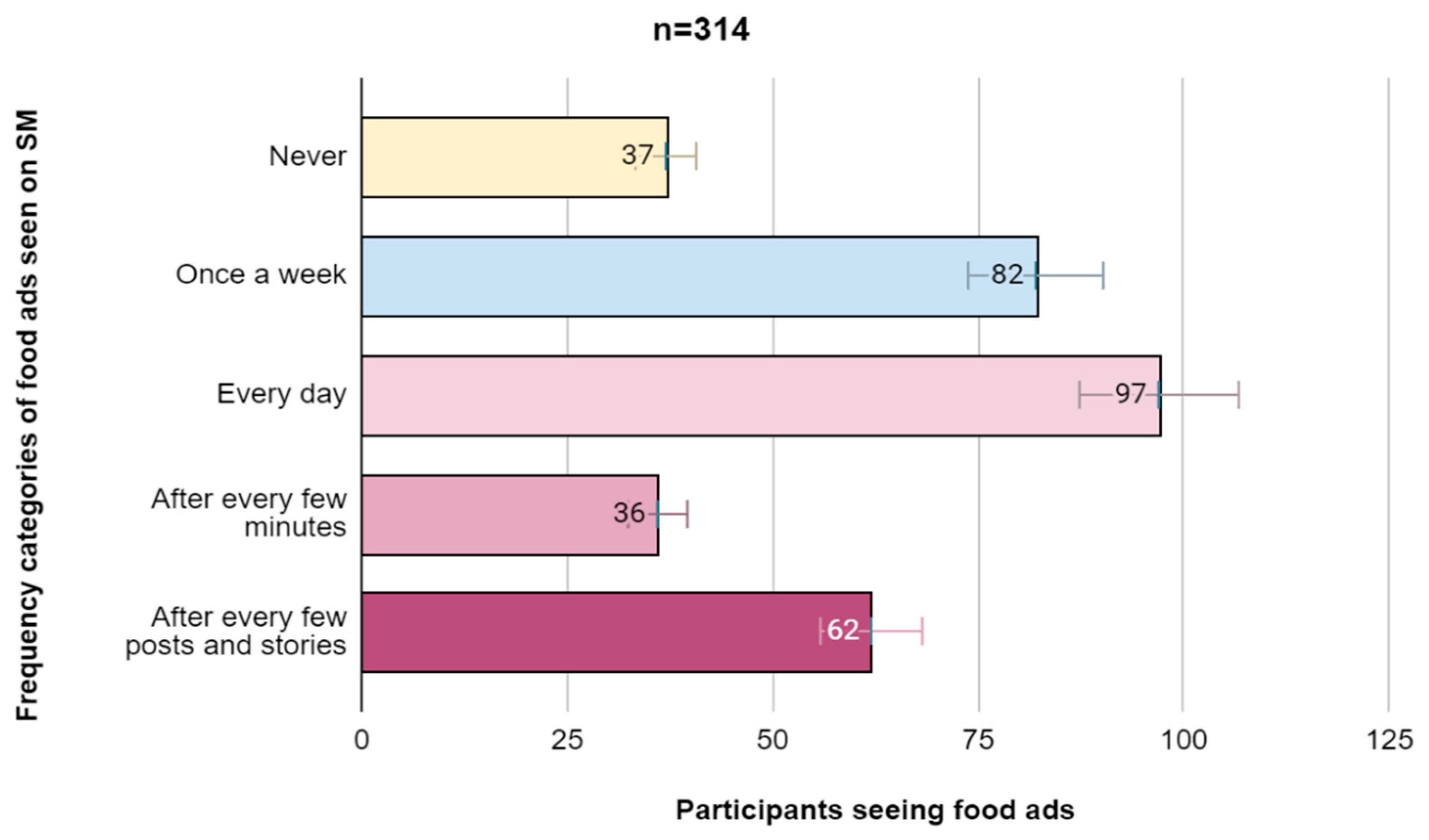
3.5. Frequency of Food Advertisements Seen on Social Media
3.6. Types of Food Advertisements Seen on Social Media
3.7. Association Between Social Media Exposure and Ordering Behaviour
4. Discussion
5. Conclusions
Supplementary Materials
Author Contributions
Funding
Institutional Review Board Statement
Informed Consent Statement
Data Availability Statement
Acknowledgments
Conflicts of Interest
Abbreviations
| AD | Advertisement |
| BMI | Body Mass Index |
| RTE | Ready-to-eat |
| VAS | Visual Analogue Scale |
References
- Digital 2024: India. Available online: https://datareportal.com/reports/digital-2024-india (accessed on 17 February 2025).
- The 2024 Social Media Content Strategy Report. Available online: https://sproutsocial.com/insights/data/2024-social-content-strategy-report/ (accessed on 17 February 2025).
- Social Media Usage Statistics by Age. Available online: https://www.oberlo.com/statistics/social-media-usage-statistics-by-age (accessed on 17 February 2025).
- Defining Generations: Where Millennials End and Generation Z Begins. Available online: https://www.pewresearch.org/short-reads/2019/01/17/where-millennials-end-and-generation-z-begins/ (accessed on 17 February 2025).
- Social Media Users Statistics in India 2025. Available online: https://www.grabon.in/indulge/tech/social-media-statistics/ (accessed on 17 February 2025).
- Key Facts about Social Media Marketing in 2024. Available online: https://timesofindia.indiatimes.com/blogs/digital-mehta/key-facts-about-social-media-marketing-in-2024/ (accessed on 17 February 2025).
- Nestlé Group’s Marketing and Administration Expenses Worldwide from 2015 to 2024. Available online: https://www.statista.com/statistics/685708/nestle-group-marketing-spend/ (accessed on 17 February 2025).
- Harris, J.L.; Graff, S.K. Protecting children from harmful food marketing: Options for local government to make a difference. Prev. Chronic Dis. 2011, 8, A92. [Google Scholar] [PubMed]
- Visual Cues in Digital Marketing: What They Are and How to Use Them. Available online: https://www.nutshell.com/blog/visual-cues-in-digital-marketing-what-they-are-and-how-to-use-them (accessed on 17 February 2025).
- Cleobury, L.; Tapper, K. Reasons for eating ‘unhealthy’ snacks in overweight and obese males and females. J. Hum. Nutr. Diet. 2014, 27, 333–341. [Google Scholar] [CrossRef] [PubMed]
- Influencer Marketing in the Food Industry: The Who, The What, and The ROI. Available online: https://www.flaminjoy.com/blog/influencer-marketing-food-industry-roi/ (accessed on 17 February 2025).
- Mejova, Y.; Abbar, S.; Haddadi, H. Fetishizing Food in Digital Age: #foodporn Around the World. In Proceedings of the International AAAI Conference on Web and Social Media, Virtual, 7–10 June 2021; PKP Publishing: Vancuver, BC, USA, 2021; Volume 10, pp. 250–258. [Google Scholar] [CrossRef]
- Robinson, T.N.; Banda, J.A.; Hale, L.; Lu, A.S.; Fleming-Milici, F.; Calvert, S.L.; Wartella, E. Screen Media Exposure and Obesity in Children and Adolescents. Pediatrics 2017, 140, S97–S101. [Google Scholar] [CrossRef] [PubMed]
- Hernández, B.; Gortmaker, S.L.; Colditz, G.A.; Peterson, K.E.; Laird, N.M.; Parra-Cabrera, S. Association of obesity with physical activity, television programs and other forms of video viewing among children in Mexico city. Int. J. Obes. 1999, 23, 845–854. [Google Scholar] [CrossRef] [PubMed]
- Food Delivery App Revenue and Usage Statistics. 2025. Available online: https://www.businessofapps.com/data/food-delivery-app-market/ (accessed on 17 February 2025).
- Most Popular Food Delivery Companies across India as of April 2023. Available online: https://www.statista.com/statistics/1149293/india-popular-food-delivery-apps/ (accessed on 17 February 2025).
- The Shaping of Social Media Algorithms on User Behavior. Available online: https://encyclopedia.pub/entry/57094 (accessed on 17 February 2025).
- Naslund, J.A.; Bondre, A.; Torous, J.; Aschbrenner, K.A. Social Media and Mental Health: Benefits, Risks, and Opportunities for Research and Practice. J. Technol. Behav. Sci. 2020, 5, 245–257. [Google Scholar] [CrossRef] [PubMed]
- Friedman, V.J.; Wright, C.J.C.; Molenaar, A.; McCaffrey, T.; Brennan, L.; Lim, M.S.C. The Use of Social Media as a Persuasive Platform to Facilitate Nutrition and Health Behavior Change in Young Adults: Web-Based Conversation Study. J. Med. Internet Res. 2022, 24, e28063. [Google Scholar] [CrossRef] [PubMed]
- Patwardhan, V.; Mallya, J.; S, K.; Kumar, D. Influence of social media on young adults’ food consumption behavior: Scale development. Cogent Soc. Sci. 2024, 10, 2391016. [Google Scholar] [CrossRef]
- Gates, M.L.; Wilkins, T.; Ferguson, E.; Walker, V.; Bradford, R.K.; Yoo, W. Gender and race disparities in weight gain among offenders prescribed antidepressant and antipsychotic medications. Health Justice 2016, 4, 6. [Google Scholar] [CrossRef] [PubMed]
- Global School-Based Student Health Survey. Available online: https://www.who.int/teams/noncommunicable-diseases/surveillance/systems-tools/global-school-based-student-health-survey (accessed on 17 February 2025).
- Reents, J.; Seidel, A.K.; Wiesner, C.D.; Pedersen, A. The Effect of Hunger and Satiety on Mood-Related Food Craving. Front. Psychol. 2020, 11, 568908. [Google Scholar] [CrossRef] [PubMed]
- Paoli, A.; Mancin, L.; Bianco, A.; Thomas, E.; Mota, J.F.; Piccini, F. Ketogenic Diet and Microbiota: Friends or Enemies? Genes 2019, 10, 534. [Google Scholar] [CrossRef] [PubMed]
- Vermeir, I.; Roose, G. Visual Design Cues Impacting Food Choice: A Review and Future Research Agenda. Foods 2020, 9, 1495. [Google Scholar] [CrossRef] [PubMed]
- Molenaar, A.; Saw, W.Y.; Brennan, L.; Reid, M.; Lim, M.S.C.; McCaffrey, T.A. Effects of Advertising: A Qualitative Analysis of Young Adults’ Engagement with Social Media About Food. Nutrients 2021, 13, 1934. [Google Scholar] [CrossRef] [PubMed]
- Filippone, L.; Shankland, R.; Hallez, Q. The relationships between social media exposure, food craving, cognitive impulsivity and cognitive restraint. J. Eat. Disord. 2022, 10, 184. [Google Scholar] [CrossRef] [PubMed]
- Baquedano, C.; Martinez-Pernia, D.; Soto, V.; Rivera-Rei, Á.; Zepeda, A.; Vasquez-Rosati, A.; Guzmán-Lavín, E.J.; Ugarte, C.; Cepeda-Benito, A.; Lopez, V.; et al. The Power of Food Advertisements: A Brief Mindfulness Instruction Does Not Prevent Psychophysiological Responses Triggered by Food Ads. Brain Sci. 2025, 15, 240. [Google Scholar] [CrossRef] [PubMed]
- van den Akker, K.; Stewart, K.; Antoniou, E.E.; Palmberg, A.; Jansen, A. Food Cue Reactivity, Obesity, and Impulsivity: Are They Associated? Curr. Addict. Rep. 2014, 1, 301–308. [Google Scholar] [CrossRef]
- Boyland, E.; Tatlow-Golden, M. Exposure, Power and Impact of Food Marketing on Children: Evidence Supports Strong Restrictions. Eur. J. Risk Regul. 2017, 8, 224–236. [Google Scholar] [CrossRef]
- Tsochantaridou, A.; Sergentanis, T.N.; Grammatikopoulou, M.G.; Merakou, K.; Vassilakou, T.; Kornarou, E. Food Advertisement and Dietary Choices in Adolescents: An Overview of Recent Studies. Children 2023, 10, 442. [Google Scholar] [CrossRef] [PubMed]


| Variable | Mean ± SD | n (%) | Boys (n = 146) | Girls (n = 168) | p-Value * |
|---|---|---|---|---|---|
| Age (In years) | 19.7 ± 1.50 | 314 | 19.7 ± 1.48 | 19.69 ± 1.49 | 0.025 * |
| <20 | 162 (51.5%) | 40 (27.3%) | 62 (36.9%) | ||
| ≥20 | 152 (48.4%) | 122 (83.5%) | 106 (63%) | ||
| Occupation | - | 314 | 0.560 | ||
| Student | 287 (91.4%) | 132 (90.4%) | 155 (92.3%) | ||
| Professional | 27 (8.6%) | 14 (9.6%) | 13 (7.7%) | ||
| Highest Educational Qualification | - | 314 | 0.752 | ||
| Higher Secondary | 215 (68.5%) | 103 (70.5%) | 112 (66.7%) | ||
| Bachelor’s Degree | 94 (29.9%) | 41 (28.1%) | 53 (31.5%) | ||
| Master’s Degree | 5 (1.6%) | 2 (1.4%) | 3 (1.8%) | ||
| BMI in kg/m2 (Asian cutoffs) | 22.36 ± 4.41 | 314 | 23.52 ± 4.43 | 21.04 ± 4.44 | 0.000 * |
| Underweight (>18.5 kg/m2) | 48 (15.3%) | 11 (7.5%) | 37 (22%) | ||
| Normal (18.5–24.9 kg/m2) | 140 (44.6%) | 62 (42.5%) | 78 (46.4%) | ||
| Overweight/Probes/Obese (>25 kg/m2) | 126 (40.1%) | 73 (50%) | 53 (31.5%) | ||
| Disease History | 146 | 168 | - | ||
| No Disease history | 300 (95.5%) | 146 | 168 | ||
| Hyperthyroidism | 1 (0.3%) | 142 (97.3%) | 158 (94%) | ||
| Kidney Disease | 2 (0.6%) | 0 (0%) | 1 (0.6%) | ||
| Migraine | 2 (0.6%) | 2 (1.4%) | 0 (0%) | ||
| PCOS | 8 (2.5%) | 0 (0%) | 8 (4.8%) |
| Variable | Total n (%) | p-Value |
|---|---|---|
| Meals per day | ||
| Three meals | 153 (48.7%) | >0.05 |
| More than three meals | 73 (23.2%) | |
| Breakfast consumption | ||
| Does not consume breakfast | 157 (50%) | >0.05 |
| Consumes breakfast sometimes | 87 (27.7%) | |
| Hunger feelings | ||
| Regularly feels hungry at mealtimes | 136 (43.3%) | >0.05 |
| Sometimes feels hungry other than meals | 109 (34.7%) |
| Variable | n% | Boys (146) | Girls (168) | p-Value |
|---|---|---|---|---|
| Follow food content creators | 0.452 | |||
| Yes | 162 (51.6%) | 74 (50.7%) | 78 (46.4%) | |
| No | 152(48.4%) | 72 (49.3%) | 90 (53.6%) | |
| Feel like ordering food after watching AD/content | 0.425 | |||
| Yes | 171 (54.5%) | 70 (47.9%) | 73 (43.5%) | |
| No | 143 (45.5%) | 76 (52.1%) | 95 (56.5%) | |
| Feeling hungry and ordering right away | 0.009 * | |||
| Yes | 158 (50.3%) | 84 (57.5%) | 72 (42.9%) | |
| No | 156 (49.7%) | 62 (42.5%) | 96 (57.1%) | |
| Attracted to food on social media | 0.546 | |||
| Yes | 89 (28.3%) | 47 (32.2%) | 46 (27.4%) | |
| No | 93 (29.7%) | 42 (28.8%) | 77 (28%) | |
| Sometimes | 132 (42.0%) | 57 (39.0%) | 75(44.6%) | |
| Love food advertisements | 0.009 * | |||
| Yes | 194 (61.8%) | 67 (45.9%) | 53 (31%) | |
| No | 120 (38.2%) | 79 (54.1%) | 115 (68.5%) | |
| Like viewing food advertisements/pictures posted by others | 0.019 * | |||
| No | 76 (24.2%) | 45 (30.8%) | 31 (18.5%) | |
| Yes | 131 (41.7%) | 51 (34.9%) | 80 (47.6%) | |
| Sometimes | 107 (34.1%) | 50 (34.2%) | 57 (33.9%) | |
| Food content creators/bloggers followed on social media | 0.185 | |||
| None of the above | 139 (44.3%) | 72 (49.3%) | 67 (39.9%) | |
| Food bloggers and influencers | 89 (28.3%) | 38 (26%) | 52 (31%) | |
| Chefs | 52 (16.6%) | 14 (9.6%) | 11 (6.5%) | |
| All types of food creators | 180 (57.3%) | 22 (15.1%) | 38 (22.6%) |
| Variable | n (%) | Underweight | Normal | Overweight/Obese | p-Value |
|---|---|---|---|---|---|
| Chocolate | 0.266 | ||||
| No | 169 (53.8%) | 31 (64.6%) | 73 (52.1%) | 65 (51.6%) | |
| Yes | 145 (46.2%) | 17 (35.4%) | 67 (47.9%) | 61 (48.4%) | |
| Fast Food chain | 0.063 | ||||
| No | 112 (35.7%) | 24 (50%) | 49 (35%) | 39 (31%) | |
| Yes | 202 (64.3%) | 25 (50%) | 91 (65%) | 87 (69%) | |
| Food delivery platforms | 0.004 * | ||||
| No | 102 (32.5%) | 27 (56.2%) | 41 (29.3%) | 34 (27%) | |
| Yes | 212 (65.5%) | 21 (43.8%) | 99 (70.7%) | 92 (73%) | |
| RTE Foods | 0.004 * | ||||
| No | 203 (64.6%) | 41 (85.4%) | 87 (62.1%) | 75 (59.5%) | |
| Yes | 111 (35.4%) | 79 (14.6%) | 53 (37.1%) | 51 (40.5%) |
| Predictor Variable | Statistical Tests | Result | p-Value | Interpretation |
|---|---|---|---|---|
| Frequency of AD × Ordering after AD | Chi-square | χ2 = 6.99 | 0.136 | Not significant |
| Sex × Ordering after AD | Chi-square | χ2 = 0.63 | 0.425 | Not significant |
| VAS craving score (ordering vs. not ordering) | Independent t-test | Difference = 0.30 | <0.001 | Ordering group had higher cravings |
| VAS × Age category | One way ANOVA | F = 0.14 | 0.706 | No difference across age |
| BMI category: Ordering food after AD | Logistic regression | BMI Category 3 OR = 2.09 | 0.043 | Higher BMIs are more likely to order after ADs |
Disclaimer/Publisher’s Note: The statements, opinions and data contained in all publications are solely those of the individual author(s) and contributor(s) and not of MDPI and/or the editor(s). MDPI and/or the editor(s) disclaim responsibility for any injury to people or property resulting from any ideas, methods, instructions or products referred to in the content. |
© 2025 by the authors. Licensee MDPI, Basel, Switzerland. This article is an open access article distributed under the terms and conditions of the Creative Commons Attribution (CC BY) license (https://creativecommons.org/licenses/by/4.0/).
Share and Cite
Nandwani, R.; Mahajan, A.; Chan, V.W.K.; Chui, K.T.; Muley, A.S.; Lo, K.K.H. Social Media Usage and Advertising Food-Related Content: Influence on Dietary Choices of Gen Z. Nutrients 2025, 17, 3930. https://doi.org/10.3390/nu17243930
Nandwani R, Mahajan A, Chan VWK, Chui KT, Muley AS, Lo KKH. Social Media Usage and Advertising Food-Related Content: Influence on Dietary Choices of Gen Z. Nutrients. 2025; 17(24):3930. https://doi.org/10.3390/nu17243930
Chicago/Turabian StyleNandwani, Rashi, Anu Mahajan, Vicky Wai Ki Chan, Kwok Tai Chui, Arti S. Muley, and Kenneth Ka Hei Lo. 2025. "Social Media Usage and Advertising Food-Related Content: Influence on Dietary Choices of Gen Z" Nutrients 17, no. 24: 3930. https://doi.org/10.3390/nu17243930
APA StyleNandwani, R., Mahajan, A., Chan, V. W. K., Chui, K. T., Muley, A. S., & Lo, K. K. H. (2025). Social Media Usage and Advertising Food-Related Content: Influence on Dietary Choices of Gen Z. Nutrients, 17(24), 3930. https://doi.org/10.3390/nu17243930


