Different Paths, One Goal: Milk Ladders in IgE- and Non-IgE-Mediated Cow’s Milk Protein Allergy—A Narrative Review



Abstract
1. Introduction
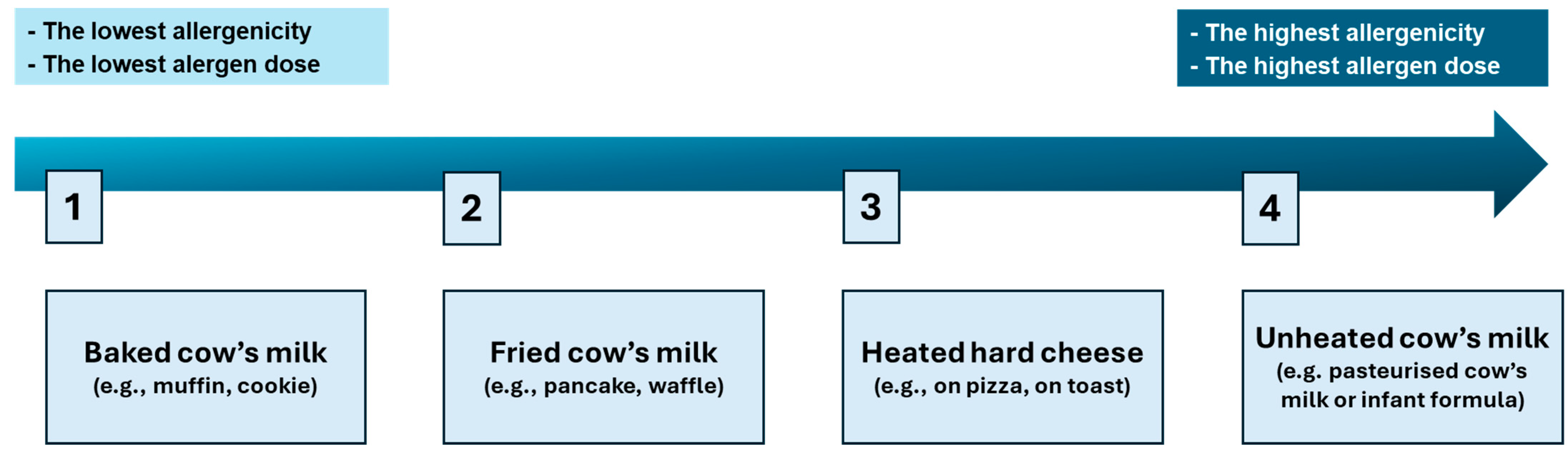
2. From Baked to Unheated Cow’s Milk—Mechanism Underlying Reduced Allergenicity in the Milk Ladder
3. From Non-IgE to IgE-Mediated Cow’s Milk Allergy—Evolving Concepts of the Milk Ladder
3.1. Efficacy/Effectiveness of Milk Ladder in Children with IgE-Mediated CMPA
3.1.1. Evidence on Efficacy (Randomized Controlled Trials)
3.1.2. Evidence on Effectiveness (Observational Studies)

| First Author Year, Country | Design, Sample Size | Child Population | Intervention Group | Control Group | Primary Outcome | Results |
|---|---|---|---|---|---|---|
| Randomized Controlled Trials | ||||||
| Esmaeilzadeh 2018, Iran [21] | RCT n = 84 | Children aged 6–36 months with IgE-mediated CMPA who passed baked milk OFC. | Consumed BM in the form of a muffin for 6 months and then baked cheese in the form of pizza for another 6 months. | A strict avoidance of cow’s milk for 1 year. | Proportion tolerating baked milk and passing unheated milk OFC (240 mL or at least 8–10 g skim milk) at month 12. | Higher tolerance rate in the intervention group vs. control group (88.1% vs. 66.7%, p = 0.018). |
| Nowak-Wegrzyn 2018, USA [22] | RCT n = 85 | Children aged 4–10 years with IgE-mediated CMPA who tolerated BM. Only non-reactive children were randomized to the escalation program. | A structured BM escalation program over a 36-month period, with OFCs every 6 months with more allergenic forms of milk (MAFM; muffin → pizza → rice pudding → unheated milk). | A structured BM escalation tried more allergenic (less heat-denatured) forms of milk (MAFM) food challenges with up-dosing every 12 months. | The odds ratio for progression to tolerance of MAFM in the subjects randomized to escalate their dose every 6 months versus those randomized to escalate every 12 months. | No difference in tolerance between 6- and 12-month groups (OR = 0.77, 95% CI, 0.31 to 1.94). Overall, 48% achieved tolerance to unheated milk by month 36. |
| d’Art 2022, Ireland [20] | RCT n = 60 | Infants aged <12 months diagnosed with IgE-mediated CMPA. | A single dose of fresh cow’s milk of elicited dose (ED05, 0.5 mg milk protein) followed by the 12-step MAP ML implementation at home. | Routine care, before using the 12-step MAP ML implementation at home. | MAP milk ladder level achieved at 6 months post-randomization. A progressor was defined as reaching step 6 (of 12, lasagne) or higher at 6 months. | Higher proportion of infants reached ≥step 6 of the ML in the intervention group vs. control at 6 months (73% vs. 50%, p = 0.048, n = 57) and at 12 months (86% vs. 75%). At 12 months, more children completed the ML in the intervention group vs. control (65% vs. 35%, p = 0.03). |
| Case-control studies | ||||||
| Dunlop 2018, USA [24] | Case-control study (with matched retrospective control group) n = 206 | Patients aged 4 months–20 years (median 6.8 years) with IgE-mediated CMPA who underwent BM OFC between 2009 and 2014 and had ≥24 months of follow-up. | Those who passed the BM OFC were instructed to begin home-based introduction following the four-step ML. Group 1: Passed BM OFC—ML introduction. Group 2: Failed BM OFC—ML introduction. | Group 3: Failed BM OFC—strict avoidance. | Number of children tolerant to BM (muffin), lesser BM (pancake/waffle), baked cheese, and direct milk at final follow-up. | Group 1: 54% tolerated direct milk, 19% avoided milk. Group 2: 29% progressed to direct milk, 38% avoided all milk. Group 3: 10% progressed to direct milk, 85% avoided milk. |
| Efron 2018, Israel [26] | Case-control study n = 110 | Children aged 1–4 years with IgE-mediated CMPA, treated between 2011 and 2016, who passed BM OFC. | Structured four-step ML protocol with supervised OFCs and 3-month intervals between consecutive steps. | A strict milk avoidance until 4 years old. | Age at resolution of CMPA (tolerance to 250 mL raw milk) and proportion of children achieving this tolerance. | Median age of CMPA resolution was lower in the intervention vs. control group (36 vs. 96 months, p < 0.001). At last follow-up, more children in the intervention group tolerated unheated milk (86% vs. 52%, p = 0.003). |
| Trujillo 2024, Ireland, Spain [23] | Case-control study (analysis of two cohorts) n = 341 | Children with IgE-mediated CMPA (immediate cutaneous, gastrointestinal, respiratory, or systemic [anaphylaxis] symptoms; SPT ≥ 3 mm or sIgE > 0.35 kU/L), treated between 2011–2020. | Gradual home introduction of BM products following the 12-step IFAN ML, with regular symptom monitoring and allergology follow-up (Irish cohort). | A strict milk avoidance and re-assessment of tolerance development each 6–12 months (Spanish group). | Successful reintroduction of CMPs, defined as daily intake of >150 mL fresh pasteurized cow’s milk (4.5 g milk protein) without symptoms. | Successful milk reintroduction: 86.6% in the ML group (148/171) vs. 61% in the strict avoidance group (122/200); The ML group was 3.67 times more likely to succeed (p < 0.001). |
| Case-series | ||||||
| Kim 2011, USA [13] | Case-series study * n = 148 | Children aged 0.5–21 years with IgE-mediated CMPA. | BM-tolerant subjects (n = 65) consumed BM products daily; after 6 months were challenged with baked cheese, and baked cheese–tolerant children were subsequently challenged with unheated milk. | BM-reactive subjects (n = 23) avoided all milk forms and were re-challenged 6 months after the initial test. | Outcomes of children incorporating baked milk products into their diets. | BM-tolerant: 39 (60%) tolerated unheated milk, 18 (28%) tolerated BM/baked cheese, 8 (12%) continued strict avoidance. BM-reactive: 2 (9%) tolerated unheated milk, 3 (13%) tolerated BM/baked cheese, 78% continued strict avoidance. |
| Ball 2021, UK [27] | Retrospective case-series n = 86 | Children aged ≥12 months and <3 years with IgE-mediated CMPA, treated between 2012–2017. | Gradual home introduction of BM products following the four-step ML, with regular symptom monitoring and allergology follow-up every 4–6 months (four visits planned in total). | - | Efficacy and safety of the home-based ML protocol assessed by tolerance acquisition and occurrence of allergic reactions. Tolerance evaluated using a 7-point ML-based scale (0 = no tolerance, 6 = normal diet). | After four reviews, 8 patients still not tolerating most dairy products; 7 lost to follow-up. Allergic symptoms in 81/189 (43%) dietetic reviews, 65 (80%) related to ML. |
| Gallagher ** 2024, Ireland [15] | Retrospective case-series n = 171 | Children aged <3 years with IgE-mediated CMPA (symptoms of IgE-mediated allergy, SPT ≥ 3 mm with negative control 0 mm and/or sIgE > 0.35 kUA/L), treated between 2011–2021. | The 12-step ML (modified iMAP ML). | - | Introduction of unrestricted cow’s milk or raw egg, defined as a daily intake of >150 mL cow’s milk (≈4.5 g milk protein) or >30 g raw egg (e.g., meringue, mayonnaise) without symptoms. | Completion of ML: 77.8% of children with anaphylaxis and 88.9% without; OR = 0.438 (95% CI: 0.169–1.133). |
| Wiszniewska ** 2025, Poland [25] | Retrospective case-series n = 15 | “High-risk” children with IgE-mediated CMPA (confirmed by positive milk OFC and/or sIgE, and/or SPT), defined as having asthma, anaphylaxis or severe allergic symptoms, sIgE ≥ 15 kUA/L, and/or SPT wheal > 8 mm. | Gradual introduction of BM products using a 5-step ML (modified iMAP). Step 1 (muffin) performed as hospital-based OFC; subsequent steps performed as home reintroduction or additional OFCs, with home introduction safety assessed individually. | - | Number of children with treatment success, defined as negative OFC with raw pasteurized/modified cow’s milk (120–240 mL) or one soft-boiled/lightly scrambled egg (unrestricted intake). | Development of tolerance: 5/15 (33%) achieved tolerance to unheated milk; 11/15 (73%) to BM. No anaphylaxis occurred during hospital-based OFCs. |
3.2. Milk Ladder in the Scientific Organizations Statements
4. Milk Ladders—A Need for Standardization
4.1. National Milk Ladders Protocols
Milk Ladder Duration
- History of allergic reaction;
- Child’s age;
- Type of CMPA;
- Severity of symptoms;
- Practical considerations such as parents’ level of anxiety and preferences.
5. Milk Ladder in IgE-Mediated CMPA in Clinical Practice
5.1. Patients Selection—For Who?
- Have not experienced recent severe anaphylaxis upon minimal exposure;
- Are clinically stable (e.g., well-controlled asthma, absence of active atopic dermatitis), without a very high level of specific IgE to CMPs (e.g., casein < 0.54 kU/L);
- Do not have other severe food allergies;
- Have caregivers who are trained to recognize and manage mild allergic reactions and have access to rescue medications.
- The child’s age and oral-motor development, ensuring readiness and safety for the introduction of new textures and foods (see Section 5.2).
5.2. Age of Reintroduction—When?
5.3. Home Reintroduction Versus Hospital Oral Food Challenge—Where?
- A history of anaphylaxis, particularly to baked milk or at a very low threshold;
- Suspected or confirmed asthma or recurrent wheezing;
6. Implementation of the Milk Ladder—Barriers and Facilitators
6.1. Food Aversion
6.2. Parental Anxiety
6.3. Lack of Standardized Milk Ladder Protocol
- Variability in recipe composition and allergen contentThe recipes used in the available milk ladders (Table 3) differ considerably in ingredient composition and proportions. The total CMP content per step also varies between protocols, making it difficult to compare clinical outcomes or define universal tolerance thresholds.
- Differences in heat processing and matrix effectsVariations in processing time and temperature, flour type (wheat vs. gluten-free), fat content, and moisture influence the degree of milk protein denaturation and matrix effects, thereby substantially altering the allergenicity of tested product.
- Inconsistent portion sizes and CMP contentMany protocols do not specify the exact amount of cow’s milk protein per serving (e.g., mg of CMP per step). The absence of analytical verification of CMP content limits clinical safety assurance and hinders consistent interpretation of outcomes, particularly in children with IgE-mediated CMPA.
- Lack of standardized criteria for continuation/discontinuation of milk ladderProgression through the milk ladder may be based on fixed time intervals (e.g., 3–7 days per step) or on tolerance criteria. The absence of unified success parameters contributes to significant variability in clinical practice.
- Inconsistent patient selection criteria and safety thresholdsNo consensus exists on criteria defining high-risk CMPA phenotypes (e.g., age < 6 years, specific IgE levels, SPT wheal size, or anaphylaxis history). This gap leads to heterogeneity in efficacy and safety outcomes. Some centers limit milk ladder use to low-risk children, whereas others initiate it in high-risk groups under close supervision.
- Limited reproducibility across studies and settingsInconsistencies in protocols, study design, patient selection, and outcome reporting impede comparison and meta-analytical synthesis. Consequently, the available evidence remains insufficient to support high-certainty clinical recommendations.
- Lack of validated biomarkers of tolerance progressionCurrent milk ladder protocols lack standardized immunological markers (e.g., specific IgE, IgG4, basophil activation tests) that could help predict a child’s clinical response to various forms of heated milk-containing foods.
7. Impact of Food Composition and Processing on Milk Allergenicity
7.1. Milk-Containing Baked Products
7.2. Fermented Products
8. Shaping the Future of Milk Ladders: Standardization and Innovation
8.1. Commercially Available Foods
8.2. Omalizumab
8.3. Low-Dose Early Exposure
8.4. Milk Ladder Based on Measured Levels of CMPs in Foods
9. Conclusions
Author Contributions
Funding
Institutional Review Board Statement
Conflicts of Interest
Abbreviations
| ARFID | Avoidant/Restrictive Food Intake Disorder |
| BM | baked milk |
| CI | confidence interval |
| CMPA | cow’s milk protein allergy |
| CMPs | cow’s milk proteins |
| DRACMA | Diagnosis and Rationale for Action against Cow’s Milk Allergy |
| EAACI | European Academy of Allergy and Clinical Immunology |
| ELISA | enzyme-linked immunosorbent assay |
| EoE | eosinophilic esophagitis |
| ESPGHAN | European Society for Paediatric Gastroenterology, Hepatology and Nutrition |
| FDA | Food and Drug Administration |
| FPE | food protein-induced enteropathy |
| FPIAP | food protein-induced allergic proctocolitis |
| FPIES | food protein-induced enterocolitis syndrome |
| GPIFN | General Practitioners Infant Feeding Network |
| IFAN | Irish Food Allergy Network |
| iMAP | international Milk Allergy in Primary Care |
| IgE | immunoglobulin E |
| MAFM | more allergic form of milk |
| MAP | Milk Allergy in Primary Care |
| ML | milk ladder |
| NICE | National Institute for Health and Care Excellence |
| NSAID | non-steroidal anti-inflammatory drug |
| OFC | oral food challenge |
| OIT | oral immunotherapy |
| OR | odds ratio |
| PRACTALL | practical allergy consensus (joint EAACI/AAAAI recommendations) |
| RCT | randomized controlled trial |
| sIgE | specific immunoglobulin E |
| SPT | skin prick test |
| UHT | ultra-high temperature |
| WAO | World Allergy Organization |
References
- Schoemaker, A.A.; Sprikkelman, A.B.; Grimshaw, K.E.; Roberts, G.; Grabenhenrich, L.; Rosenfeld, L.; Siegert, S.; Dubakiene, R.; Rudzeviciene, O.; Reche, M.; et al. Incidence and natural history of challenge-proven cow’s milk allergy in European children—EuroPrevall birth cohort. Allergy 2015, 70, 963–972. [Google Scholar] [CrossRef]
- Spolidoro, G.C.I.; Amera, Y.T.; Ali, M.M.; Nyassi, S.; Lisik, D.; Ioannidou, A.; Rovner, G.; Khaleva, E.; Venter, C.; van Ree, R.; et al. Frequency of food allergy in Europe: An updated systematic review and meta-analysis. Allergy 2023, 78, 351–368. [Google Scholar] [CrossRef] [PubMed]
- Vandenplas, Y.; Broekaert, I.; Domellöf, M.; Indrio, F.; Lapillonne, A.; Pienar, C.; Ribes-Koninckx, C.; Shamir, R.; Szajewska, H.; Thapar, N.; et al. An ESPGHAN Position Paper on the Diagnosis, Management, and Prevention of Cow’s Milk Allergy. J. Pediatr. Gastroenterol. Nutr. 2024, 78, 386–413. [Google Scholar] [CrossRef]
- Meyer, R.; Venter, C.; Bognanni, A.; Szajewska, H.; Shamir, R.; Nowak-Wegrzyn, A.; Fiocchi, A.; Vandenplas, Y. World Allergy Organization (WAO) Diagnosis and Rationale for Action against Cow’s Milk Allergy (DRACMA) Guideline update—VII—Milk elimination and reintroduction in the diagnostic process of cow’s milk allergy. World Allergy Organ. J. 2023, 16, 100785. [Google Scholar] [CrossRef] [PubMed]
- Vandenplas, Y.; Meyer, R.; Nowak-Wegrzyn, A.; Salvatore, S.; Venter, C.; Vieira, M.C. The Remaining Challenge to Diagnose and Manage Cow’s Milk Allergy: An Opinion Paper to Daily Clinical Practice. Nutrients 2023, 15, 4762. [Google Scholar] [CrossRef]
- Pérez-Codesido, S.; Grifol-Clar, E.; Petrone, M.B.; Malumbres, M.G.; Garban, P.A.; Tejedor-Alonso, M.A. Frequency of fatal and recurrent anaphylaxis due to COW’S milk: A systematic review and meta-analysis of observational studies. Pediatr. Allergy Immunol. 2023, 34, e13977. [Google Scholar] [CrossRef]
- NIAID-Sponsored Expert Panel; Boyce, J.A.; Assa’ad, A.; Burks, A.W.; Jones, S.M.; Sampson, H.A.; Wood, R.A.; Plaut, M.; Cooper, S.F.; Fenton, M.J.; et al. Guidelines for the diagnosis and management of food allergy in the United States: Report of the NIAID-sponsored expert panel. J. Allergy Clin. Immunol. 2010, 126 (Suppl. 6), S1–S58. [Google Scholar] [CrossRef]
- Groetch, M.; Venter, C.; Meyer, R. Clinical Presentation and Nutrition Management of Non-IgE-Mediated Food Allergy in Children. Clin. Exp. Allergy 2025, 55, 213–225. [Google Scholar] [CrossRef]
- Dziechciarz, P.; Stróżyk, A.; Horvath, A.; Cudowska, B.; Jedynak-Wąsowicz, U.; Mól, N.; Jarocka-Cyrta, E.; Zawadzka-Krajewska, A.; Krauze, A. Nutritional status and feeding difficulties in children up to 2 years of age with cow’s milk allergy. J. Pediatr. Gastroenterol. Nutr. 2024, 79, 131–139. [Google Scholar] [CrossRef] [PubMed]
- Ercan, N.; Tel Adıgüzel, K. Effect of early childhood cow’s milk elimination diet on eating behaviours, nutrition and growth status at age 2-6 years. J. Hum. Nutr. Diet. 2022, 35, 300–309. [Google Scholar] [CrossRef]
- Meyer, R.; Groetch, M.; Santos, A.; Venter, C. The evolution of nutritional care in children with food allergies—With a focus on cow’s milk allergy. J. Hum. Nutr. Diet. 2025, 38, e13391. [Google Scholar] [CrossRef]
- Cronin, C.; Ramesh, Y.; De Pieri, C.; Velasco, R.; Trujillo, J. ‘Early Introduction’ of Cow’s Milk for Children with IgE-Mediated Cow’s Milk Protein Allergy: A Review of Current and Emerging Approaches for CMPA Management. Nutrients 2023, 15, 1397. [Google Scholar] [CrossRef]
- Kim, J.S.; Nowak-Węgrzyn, A.; Sicherer, S.H.; Noone, S.; Moshier, E.L.; Sampson, H.A. Dietary baked milk accelerates the resolution of cow’s milk allergy in children. J. Allergy Clin. Immunol. 2011, 128, 125–131.e2. [Google Scholar] [CrossRef]
- Venter, C.; Brown, T.; Meyer, R.; Walsh, J.; Shah, N.; Nowak-Węgrzyn, A.; Chen, T.-X.; Fleischer, D.M.; Heine, R.G.; Levin, M.; et al. Better recognition, diagnosis and management of non-IgE-mediated cow’s milk allergy in infancy: iMAP-an international interpretation of the MAP (Milk Allergy in Primary Care) guideline. Clin. Transl. Allergy 2017, 7, 26. [Google Scholar] [CrossRef] [PubMed]
- Gallagher, A.; Cronin, C.; Heng, T.A.; McKiernan, A.; Tobin, C.; Flores, L.; McGinley, A.M.; Loughnane, C.; Velasco, R.; Hourihane, J.O.; et al. Dietary Advancement Therapy Using Milk and Egg Ladders Among Children With a History of Anaphylaxis. J. Allergy Clin. Immunol. Pract. 2024, 12, 2135–2143. [Google Scholar] [CrossRef] [PubMed]
- Venter, C.; Meyer, R.; Ebisawa, M.; Athanasopoulou, P.; Mack, D.P. Food allergen ladders: A need for standardization. Pediatr. Allergy Immunol. 2022, 33, e13714. [Google Scholar] [CrossRef] [PubMed]
- Venter, C.; Brown, T.; Shah, N.; Walsh, J.; Fox, A.T. Diagnosis and management of non-IgE-mediated cow’s milk allergy in infancy—A UK primary care practical guide. Clin. Transl. Allergy 2013, 3, 23. [Google Scholar] [CrossRef]
- Athanasopoulou, P.; Deligianni, E.; Dean, T.; Dewey, A.; Venter, C. Use of baked milk challenges and milk ladders in clinical practice: A worldwide survey of healthcare professionals. Clin. Exp. Allergy 2017, 47, 430–434. [Google Scholar] [CrossRef]
- Anagnostou, A.; Mack, D.P.; Johannes, S.; Shaker, M.; Abrams, E.M.; DeSanto, K.; Greenhawt, M. The Safety and Efficacy of Baked Egg and Milk Dietary Advancement Therapy: A Systematic Review and Meta-Analysis. J. Allergy Clin. Immunol. Pract. 2024, 12, 2468–2480. [Google Scholar] [CrossRef]
- d’Art, Y.M.; Forristal, L.; Byrne, A.M.; Fitzsimons, J.; van Ree, R.; DunnGalvin, A.; Hourihane, J.O.B. Single low-dose exposure to cow’s milk at diagnosis accelerates cow’s milk allergic infants’ progress on a milk ladder programme. Allergy 2022, 77, 2760–2769. [Google Scholar] [CrossRef]
- Esmaeilzadeh, H.; Alyasin, S.; Haghighat, M.; Nabavizadeh, H.; Esmaeilzadeh, E.; Mosavat, F. The effect of baked milk on accelerating unheated cow’s milk tolerance: A control randomized clinical trial. Pediatr. Allergy Immunol. 2018, 29, 747–753. [Google Scholar] [CrossRef]
- Nowak-Wegrzyn, A.; Lawson, K.; Masilamani, M.; Kattan, J.; Bahnson, H.T.; Sampson, H.A. Increased Tolerance to Less Extensively Heat-Denatured (Baked) Milk Products in Milk-Allergic Children. J. Allergy Clin. Immunol. Pract. 2018, 6, 486–495.e5. [Google Scholar] [CrossRef]
- Trujillo, J.; Cronin, C.; Heng, T.A.; Flores, L.; McGinley, A.M.; Gallagher, A.; Muñoz, C.; Velasco, R.; Hourihane, J. A retrospective comparison of IgE-mediated cow’s milk protein allergy management strategies in pediatric cohorts. Pediatr. Allergy Immunol. 2024, 35, e14195. [Google Scholar] [CrossRef]
- Dunlop, J.H.; Keet, C.A.; Mudd, K.; Wood, R.A. Long-Term Follow-Up After Baked Milk Introduction. J. Allergy Clin. Immunol. Pract. 2018, 6, 1699–1704. [Google Scholar] [CrossRef]
- Wiszniewska, D.; Stróżyk, A.; Horvath, A. Safety and effectiveness of milk and egg ladders in children with IgE-mediated food allergy—A case series. J. Pediatr. Gastroenterol. Nutr. 2025, 81, 331–338. [Google Scholar] [CrossRef]
- Efron, A.; Zeldin, Y.; Gotesdyner, L.; Stauber, T.; Segal, R.M.; Binson, I.; Dinkin, M.; Dinkowitz, L.; Shahar, D.; Deutch, M.; et al. A Structured Gradual Exposure Protocol to Baked and Heated Milk in the Treatment of Milk Allergy. J. Pediatr. 2018, 203, 204–209.e2. [Google Scholar] [CrossRef]
- Ball, H.B.; Luyt, D. Home-based cow’s milk reintroduction using a milk ladder in children less than 3 years old with IgE-mediated cow’s milk allergy. Clin. Exp. Allergy 2019, 49, 911–920. [Google Scholar] [CrossRef] [PubMed]
- National Institute for Health and Care Excellence: Guidelines. Food Allergy in Under 19s: Assessment and Diagnosis: Clinical Guideline; National Institute for Health and Care Excellence (NICE): London, UK, 2011. [Google Scholar]
- Brückner, A.; Funk-Wentzel, P.; Kahle, J.; Hompes, S. Milk ladder as a therapeutic option for cow’s milk allergy: Proposal for a step-by-step plan for cow’s milk introduction in cow’s milk allergy. Allergol. Select. 2023, 7, 116–121. [Google Scholar] [CrossRef] [PubMed]
- Fox, A.; Brown, T.; Walsh, J.; Venter, C.; Meyer, R.; Nowak-Wegrzyn, A.; Levin, M.; Spawls, H.; Beatson, J.; Lovis, M.-T.; et al. An update to the Milk Allergy in Primary Care guideline. Clin. Transl. Allergy 2019, 9, 40. [Google Scholar] [CrossRef] [PubMed]
- Santos, A.F.; Riggioni, C.; Agache, I.; Akdis, C.A.; Akdis, M.; Alvarez-Perea, A.; Alvaro-Lozano, M.; Ballmer-Weber, B.; Barni, S.; Beyer, K.; et al. EAACI guidelines on the management of IgE-mediated food allergy. Allergy 2025, 80, 14–36. [Google Scholar] [CrossRef]
- Meyer, R.; Lozinsky, A.C.; Fleischer, D.M.; Vieira, M.C.; Du Toit, G.; Vandenplas, Y.; Dupont, C.; Knibb, R.; Uysal, P.; Cavkaytar, O.; et al. Diagnosis and management of Non-IgE gastrointestinal allergies in breastfed infants—An EAACI Position Paper. Allergy 2020, 75, 14–32. [Google Scholar] [CrossRef] [PubMed]
- Ramakrishna, S.H.; Shah, N.; Acharyya, B.C.; Durairaj, E.; Verma, L.; Sankaranarayanan, S.; Wadhwa, N.; Venter, C. The Need for Culturally Appropriate Food Allergy Management Strategies: The Indian Milk Ladder. Nutrients 2023, 15, 3921. [Google Scholar] [CrossRef] [PubMed]
- Chomyn, A.; Chan, E.S.; Yeung, J.; Cameron, S.; Chua, G.T.; Leek, T.K.V.; A Williams, B.; Soller, L.; Abrams, E.M.; Mak, R.; et al. Safety and effectiveness of the Canadian food ladders for children with IgE-mediated food allergies to cow’s milk and/or egg. Allergy Asthma Clin. Immunol. 2023, 19, 94. [Google Scholar] [CrossRef] [PubMed]
- Luyt, D.; Ball, H.; Makwana, N.; Green, M.R.; Bravin, K.; Nasser, S.M.; Clark, A.T. BSACI guideline for the diagnosis and management of cow’s milk allergy. Clin. Exp. Allergy 2014, 44, 642–672. [Google Scholar] [CrossRef]
- Cerecedo, I.; López-Picado, A.; Hernández-Núñez, M.G.; A Rubio-Herrera, M.; de la Hoz, B.; Infante, S.; Vázquez-Cortés, S.; Ruano, F.J.; Gómez-Traseira, C.; Freundt-Serpa, N.P.; et al. Milk Ladder for Reintroduction of Cow’s Milk in Infants With IgE-Mediated Cow’s Milk Allergy: Version Adapted to the Spanish Population. J. Investig. Allergol. Clin. Immunol. 2024, 34, 51–53. [Google Scholar] [CrossRef]
- Chomyn, A.; Chan, E.S.; Yeung, J.; Leek, T.K.V.; Williams, B.A.; Soller, L.; Abrams, E.M.; Mak, R.; Wong, T. Canadian food ladders for dietary advancement in children with IgE-mediated allergy to milk and/or egg. Allergy Asthma Clin. Immunol. 2021, 17, 83. [Google Scholar] [CrossRef]
- Vassilopoulou, E.; McMilin, C.; Venter, C. Mediterranean Milk Ladder: Integrating a Healthy Eating Plan While Reintroducing Cow’s Milk. Children 2023, 10, 234. [Google Scholar] [CrossRef]
- Buyuktiryaki, B.; Soyer, O.; Yazici, D.; Bingol, G.; Can, C.; Nacaroglu, H.T.; Bingol, A.; Yilmaz, E.A.; Aydogan, M.; Sackesen, C. Milk ladder: Who? When? How? Where? With the lowest risk of reaction. Front. Allergy 2024, 5, 1516774. [Google Scholar] [CrossRef]
- Wiszniewska, D.; Horvath, A.; Stróżyk, A.; Nowak-Wegrzyn, A.; Grzela, K.; Szajewska, H. Effectiveness and safety of the four-step versus six-step milk ladder in children with IgE-mediated cow’s milk protein allergy: Protocol for an open-label randomised controlled trial. BMJ Open 2025, 15, e098314. [Google Scholar] [CrossRef]
- Hicks, A.; Fleischer, D.; Venter, C. The future of cow’s milk allergy—Milk ladders in IgE-mediated food allergy. Front. Nutr. 2024, 11, 1371772. [Google Scholar] [CrossRef] [PubMed]
- De Vlieger, L.; Nuyttens, L.; Matton, C.; Diels, M.; Verelst, S.; Leus, J.; Coppens, K.; Sauer, K.; Dilissen, E.; Coorevits, L.; et al. Guided Gradual Egg-Tolerance Induction in Hen’s Egg Allergic Children Tolerating Baked Egg: A Prospective Randomized Trial. Front. Allergy 2022, 3, 886094. [Google Scholar] [CrossRef] [PubMed]
- Yamamoto-Hanada, K.; Koplin, J.J.; Groetch, M.; du Toit, G.; Ohya, Y. Preventing Food Allergy by Early Food Introduction: East Meets West with the ‘Lack Dual-Allergen Exposure Theory’. J. Allergy Clin. Immunol. Pract. 2025; Online ahead of print. [Google Scholar] [CrossRef]
- Chua, G.T.; Chan, E.S.; Yeung, J.; Cameron, S.B.; Soller, L.; Williams, B.A.; Chomyn, A.; Leek, T.K.V.; Abrams, E.M.; Mak, R.; et al. Patient selection for milk and egg ladders using a food ladder safety checklist. Allergy Asthma Clin. Immunol. 2022, 18, 51. [Google Scholar] [CrossRef]
- Nowak-Wegrzyn, A.; Bloom, K.A.; Sicherer, S.H.; Shreffler, W.G.; Noone, S.; Wanich, N.; Sampson, H.A. Tolerance to extensively heated milk in children with cow’s milk allergy. J. Allergy Clin. Immunol. 2008, 122, 342–347.e2. [Google Scholar] [CrossRef]
- Sampson, H.A.; Arasi, S.; Bahnson, H.T.; Ballmer-Weber, B.; Beyer, K.; Bindslev-Jensen, C.; Bird, J.A.; Blumchen, K.; Davis, C.; Ebisawa, M.; et al. AAAAI-EAACI PRACTALL: Standardizing oral food challenges-2024 Update. Pediatr. Allergy Immunol. 2024, 35, e14276. [Google Scholar] [CrossRef] [PubMed]
- Upton, J.E.M.; Wong, D.; Nowak-Wegrzyn, A. Baked milk and egg diets revisited. Ann. Allergy Asthma Immunol. 2024, 132, 328–336.e5. [Google Scholar] [CrossRef] [PubMed]
- Dupont, C. How to reintroduce cow’s milk? Pediatr. Allergy Immunol. 2013, 24, 627–632. [Google Scholar] [CrossRef]
- Nocerino, R.; Mercuri, C.; Bosco, V.; Giordano, V.; Simeone, S.; Guillari, A.; Rea, T. Development and Management of Avoidant/Restrictive Food Intake Disorder and Food Neophobia in Pediatric Patients with Food Allergy: A Comprehensive Review. Nutrients 2024, 16, 3034. [Google Scholar] [CrossRef]
- Katzman, D.K.; Guimond, T.; Spettigue, W.; Agostino, H.; Couturier, J.; Norris, M.L. Classification of Children and Adolescents With Avoidant/Restrictive Food Intake Disorder. Pediatrics 2022, 150, e2022057494. [Google Scholar] [CrossRef]
- Knibb, R.C.; Jones, C.J.; Herbert, L.J.; Screti, C. Psychological support needs for children with food allergy and their families: A systematic review. Pediatr. Allergy Immunol. 2024, 35, e14108. [Google Scholar] [CrossRef]
- Knibb, R.C.; Wooding, E.L.; Padley, H.; Petrides, C.; Gourgey, R.; Aston, A.; Michaelis, L.J.; Ludman, S. Psychology Provision for People With Food Allergy: A Survey of UK Healthcare Professionals and Psychologists. Clin. Exp. Allergy 2024, 54, 933–935. [Google Scholar] [CrossRef]
- Westwell-Roper, C.; To, S.; Andjelic, G.; Lu, C.; Lin, B.; Soller, L.; Chan, E.S.; Stewart, S.E. Food-allergy-specific anxiety and distress in parents of children with food allergy: A systematic review. Pediatr. Allergy Immunol. 2022, 33, e13695. [Google Scholar] [CrossRef] [PubMed]
- Gibson, V.; Ullman, A.; Takashima, M.; Koplin, J. Barriers and Enablers of Dietary Reintroduction Following Negative Oral Food Challenge: A Scoping Review. J. Allergy Clin. Immunol. Pract. 2025, 13, 851–860.e7. [Google Scholar] [CrossRef]
- Xu, Y.; Zhang, F.; Mu, G.; Zhu, X. Effect of lactic acid bacteria fermentation on cow milk allergenicity and antigenicity: A review. Compr. Rev. Food Sci. Food Saf. 2024, 23, e13257. [Google Scholar] [CrossRef]
- Bavaro, S.L.; De Angelis, E.; Barni, S.; Pilolli, R.; Mori, F.; Novembre, E.M.; Monaci, L. Modulation of Milk Allergenicity by Baking Milk in Foods: A Proteomic Investigation. Nutrients 2019, 11, 1536. [Google Scholar] [CrossRef] [PubMed]
- Wang, Z.; Ma, S.; Sun, B.; Wang, F.; Huang, J.; Wang, X.; Bao, Q. Effects of thermal properties and behavior of wheat starch and gluten on their interaction: A review. Int. J. Biol. Macromol. 2021, 177, 474–484. [Google Scholar] [CrossRef]
- Lanser, B.; Rabinovitch, N.; Gelfand, E.; Hauk, P. The Risk of Failing Oral Food Challenge to Baked Egg and Milk Increases with Wheat Flour Replacers. J. Allergy Clin. Immunol. 2016, 137, AB136. [Google Scholar] [CrossRef]
- Zhang, Z.; Xu, Y.; Li, X.; Chi, L.; Li, Y.; Xu, C.; Mu, G.; Zhu, X. Modulating Whey Proteins Antigenicity with Lactobacillus delbrueckii subsp. bulgaricus DLPU F-36 Metabolites: Insights from Spectroscopic and Molecular Docking Studies. J. Agric. Food Chem. 2024, 72, 15198–15212. [Google Scholar] [CrossRef]
- Ahrens, B.; de Oliveira, L.C.L.; Grabenhenrich, L.; Schulz, G.; Niggemann, B.; Wahn, U.; Beyer, K. Individual cow’s milk allergens as prognostic markers for tolerance development? Clin. Exp. Allergy 2012, 42, 1630–1637. [Google Scholar] [CrossRef]
- Yang, J.; Kuang, H.; Xiong, X.; Li, N.; Song, J. Alteration of the allergenicity of cow’s milk proteins using different food processing modifications. Crit. Rev. Food Sci. Nutr. 2024, 64, 4622–4642. [Google Scholar] [CrossRef]
- de Jong, N.W.; van Splunter, M.E.; Emons, J.A.; Hettinga, K.A.; Gerth van Wijk, R.; Wichers, H.J.; Savelkoul, H.F.; Sprikkelman, A.B.; van Neerven, R.J.; Liu, L.; et al. Introduction of Heated Cow’s Milk Protein in Challenge-Proven Cow’s Milk Allergic Children: The iAGE Study. Nutrients 2022, 14, 629. [Google Scholar] [CrossRef] [PubMed]
- Zuberbier, T.; Wood, R.A.; Bindslev-Jensen, C.; Fiocchi, A.; Chinthrajah, R.S.; Worm, M.; Deschildre, A.; Fernandez-Rivas, M.; Santos, A.F.; Jaumont, X.; et al. Omalizumab in IgE-Mediated Food Allergy: A Systematic Review and Meta-Analysis. J. Allergy Clin. Immunol. Pract. 2023, 11, 1134–1146. [Google Scholar] [CrossRef] [PubMed]
- Bognanni, A.; Firmino, R.T.; Arasi, S.; Chu, D.K.; Chu, A.W.; Waffenschmidt, S.; Agarwal, A.; Dziechciarz, P.; Horvath, A.; Mihara, H.; et al. World Allergy Organization (WAO) Diagnosis and Rationale for Action against Cow’s Milk Allergy (DRACMA) guideline update—XIII—Oral immunotherapy for CMA—Systematic review. World Allergy Organ. J. 2022, 15, 100682. [Google Scholar] [CrossRef]
- Corcoran, A.; d’Art, Y.; Byrne, A.; Hourihane, J.O. Five-Year Follow-Up Study of Single Dose Challenges in the Diagnosis and Management of Cow’s Milk Allergy in Infants. Allergy 2025, 80, 2931–2933. [Google Scholar] [CrossRef]
- Simmons, R.; Vennard, T.R.; Gaygadzhiev, Z.; Cano, N.; Gray, M.A.; Meyer, R.; Venter, C. Characterizing detectable milk protein allergens β-casein and β-lactoglobulin in milk ladder foods. Pediatr. Allergy Immunol. 2025, 36, e70230. [Google Scholar] [CrossRef] [PubMed]

| Organization | Statements |
|---|---|
| GPIFN and MAP 2019 [30] |
|
| NICE 2019 [28] |
|
| WAO DRACMA 2023 [4] |
|
| ESPGHAN 2024 [3] |
|
| EAACI 2024 [31,32] |
|
| Milk Ladder Protocol (Country) | Year | No of Steps | Reintroduced Foods | Foods Number per Step | Allergen Dose Specified (Initial → Final) |
|---|---|---|---|---|---|
| MAP and iMAP Milk Ladders | |||||
| MAP (UK) [17] | 2013 | 12 | Malted milk biscuits, Garibaldi biscuits/digestives, muffins/cupcakes, pancakes, Shepherd’s pie, lasagne, mini pizza, milk chocolate, yoghurt, cheese, sterilized milk, pasteurized milk | 1 | Yes, 95 mg → 7.2 g |
| iMAP (UK) [14] | 2017 | 6 | Cookies/biscuits, muffins, pancakes, cheese, yoghurt, pasteurized milk | 1 | Yes, 35 mg → 6.9 g |
| National Adaptation of the MAP/iMAP Milk Ladders | |||||
| BSACI (UK) [35] | 2014 | 4 | Biscuits, cakes, muffin, waffles, scotch pancakes, butter, margarine, cheese powder flavouring, custard, cheese sauce, pizza, rice pudding, chocolate, chocolate coated items, fermented desserts, yogurt, fromage frais, ice cream, mousse, pasteurised milk | Multiple | No |
| Canadian Milk Ladder (Canada) [37] | 2021 | 4 | Muffins/cupcakes, cookies, pancakes/crepes, waffles, pizza, boiled milk, cheese, yoghurt, ice cream, milk | 2–4 | No |
| Indian Milk Ladder (India) [33] | 2023 | 6 | Marie biscuit, Maida Diamond Biscuit, milk cookies, halwa, ragi sari/kanji with milk, ragi dosa, rava idli, gulab jamun (dry), rasagullah, rice Kheer, paneer, shrikand or yoghurt, milk | 2–4 | Yes, 50 mg → 8.68 g |
| Mediterranean Milk Ladder (Greece) [38] | 2023 | 7 | Beef burgers, oat cookies with olive oil, sweet whole wheat muffins with berries or raisins, whole wheat savoury muffins, mediterranean type pureed potato, crepes with whole wheat flour, bread with cheese, olives, and tomato, lentil burger with cheese, rice pudding, bechamel, yogurt, cocoa-banana ice-cream, avocado-cocoa mousse | 1 | Yes, 70 mg → 3.2 g |
| Spanish (Spain) [36] | 2023 | 4 | Cookies, muffins, sweet pancakes, salted pancakes, croquettes, bechamel, Spanish omelette, banana puree, fillings for stew, French omelette, yoghurt, milk | 1–6 | Yes, 95 mg → 6.2 g |
| German (Germany) [29] | 2023 | 6 | Pastry, rusk, muffin, pancake, pizza, rice pudding, cheese, yoghurt, milk | 1–3 | Yes, 8 mg → 7 g |
| Turkish (Turkey) [39] | 2024 | 4 | Biscotti twice baked cake, baked cake variations (muffins, biscuits), pancake, crepe, waffle, yoghurt in soup (Yayla soup), Tarhana soup, pizza, yoghurt, cheese (curd cheese, quark cheese, labneh cheese), pudding, mousse, ice cream, whipped cream, milk | 1–3 | Yes, 85 mg → not reported |
| Organization | Time for Cow’s Milk Re-Challenge to Test for Acquired Tolerance |
|---|---|
| NICE 2019 [28] | ≥6 mo. of elimination diet or at 9–12 month of age |
| GPIFN and MAP 2019 [30] | ≥6 mo. of elimination diet or at 9–12 month of age (whichever is reached first) |
| WAO DRACMA 2023 [4] | ≥6 mo. of elimination diet or up to 9–12 month of age (whichever is reached first) |
| ESPGHAN 2024 [3] | ≥6 mo. of elimination diet or at 12 month of age |
| Aspect | Hospital-Based Oral Food Challenge | Home-Based Reintroduction |
|---|---|---|
| Supervision |
|
|
| Emergency Support |
|
|
| Monitoring and Documentation |
|
|
| Cofactors Management |
|
|
| Patient Selection |
|
|
| Advantages |
|
|
| Limitations |
|
|
| Ingredient | Mechanistic Effect | Presumable Impact on CMPs Allergenicity | Comments |
|---|---|---|---|
| Wheat flour | Forms gluten–starch matrix during baking | Major reduction in β-lactoglobulin allergenicity (>95%) | Preferred matrix in baked milk challenges |
| Gluten-free flours | Lack of gluten, less stable matrix | Less protein denaturation; higher residual allergenicity | Outcomes are less predictable; children tolerating muffins with wheat flour may react to muffins with gluten-free flour |
| Fruits | Lower pH and introduce polyphenols | May reduce IgE binding but excess moisture can limit denaturation | Effect depends on fruit type |
| Sugars | Participate in Maillard reactions | Usually reduce IgE binding but may create neoepitopes | Controlled sugar levels are important |
| Fats | Stabilize proteins via hydrophobic interactions | Can preserve allergenic epitopes | Standardize fat content for reproducibility |
Disclaimer/Publisher’s Note: The statements, opinions and data contained in all publications are solely those of the individual author(s) and contributor(s) and not of MDPI and/or the editor(s). MDPI and/or the editor(s) disclaim responsibility for any injury to people or property resulting from any ideas, methods, instructions or products referred to in the content. |
© 2025 by the authors. Licensee MDPI, Basel, Switzerland. This article is an open access article distributed under the terms and conditions of the Creative Commons Attribution (CC BY) license (https://creativecommons.org/licenses/by/4.0/).
Share and Cite
Wiszniewska, D.; Stróżyk, A.; Horvath, A.; Sybilski, A.J. Different Paths, One Goal: Milk Ladders in IgE- and Non-IgE-Mediated Cow’s Milk Protein Allergy—A Narrative Review. Nutrients 2025, 17, 3816. https://doi.org/10.3390/nu17243816
Wiszniewska D, Stróżyk A, Horvath A, Sybilski AJ. Different Paths, One Goal: Milk Ladders in IgE- and Non-IgE-Mediated Cow’s Milk Protein Allergy—A Narrative Review. Nutrients. 2025; 17(24):3816. https://doi.org/10.3390/nu17243816
Chicago/Turabian StyleWiszniewska, Daria, Agata Stróżyk, Andrea Horvath, and Adam J. Sybilski. 2025. "Different Paths, One Goal: Milk Ladders in IgE- and Non-IgE-Mediated Cow’s Milk Protein Allergy—A Narrative Review" Nutrients 17, no. 24: 3816. https://doi.org/10.3390/nu17243816
APA StyleWiszniewska, D., Stróżyk, A., Horvath, A., & Sybilski, A. J. (2025). Different Paths, One Goal: Milk Ladders in IgE- and Non-IgE-Mediated Cow’s Milk Protein Allergy—A Narrative Review. Nutrients, 17(24), 3816. https://doi.org/10.3390/nu17243816