


Abstract
Agricultural economic resilience plays a pivotal role in the integrated development of agriculture and rural areas, and carries great significance for ensuring national food security and advancing sustainable agricultural development in the context of complex risks and challenges. Using panel data covering 41 cities in the Yangtze River Delta region from 2011 to 2023, this paper empirically investigates the impact mechanism of fiscal support for agriculture on agricultural economic resilience. The results demonstrate that fiscal support for agriculture in the Yangtze River Delta exerts a significant positive effect on agricultural economic resilience, especially with a pronounced promoting influence on resistance capacity. Mechanism analysis indicates that fiscal support for agriculture indirectly affects agricultural economic resilience through channels including agricultural industrial agglomeration and the urban–rural income gap. Accordingly, to strengthen agricultural economic resilience, it is necessary to optimize the allocation and expenditure structure of fiscal funds, adopt differentiated strategies with dynamic and timely adjustments, allocate funds to boost agricultural industrial agglomeration, enhance investment in human capital to narrow the urban–rural income gap, and facilitate sustainable agricultural development.
1. Introduction
Food security is a cornerstone of national stability, and China has long prioritized this agenda, consistently elevating the enhancement of agricultural economic resilience to a top strategic priority for advancing coordinated regional economic development and addressing national food security challenges amid complex risk environments. The Proposal of the Central Committee of the Communist Party of China on Formulating the 15th Five-Year Plan for National Economic and Social Development [1], adopted at the Fourth Plenary Session of the 20th Central Committee, dedicates a specific section to the deployment of agricultural and rural modernization, explicitly identifying building a strong agricultural nation as the core objective and outlining strategic tasks including consolidating the foundation of food security, upgrading agricultural quality and efficiency, fostering new quality productive forces in agriculture, and strengthening policy safeguards for supporting agriculture and benefiting farmers; notably, the Proposal emphasizes the improvement of a diversified investment framework with fiscal support as the cornerstone, which provides a fundamental guarantee for the high-quality development of agriculture. As one of China’s most economically vibrant and open regions, the Yangtze River Delta has faced increasingly prominent challenges in recent years amid rapid industrialization and urbanization, such as the outflow of agricultural production factors, mounting pressure on the agricultural ecological environment, and amplified risks from market fluctuations, and consequently, internal and external shocks to the agricultural economy have become normalized and increasingly complex. Specifically, the Yangtze River Delta’s agricultural economy has recently exhibited a structural contradiction of “slowing growth coupled with risk accumulation”: traditional factor input-driven growth has seen diminishing marginal returns (reflected in the slowing growth of agricultural added value), while disturbances to the agricultural system are characterized by “high frequency, multiple hazards, and chain transmission” due to extreme climates, market volatility, and policy adjustments, and this paradox of “low-level equilibrium alongside high risk exposure” exposes structural deficiencies in the system’s resistance, recoverability, and adaptability, underscoring the need to adopt a resilience framework to explore its adaptive mechanisms in response to uncertain shocks. Against this backdrop, agricultural economic resilience—defined as the core capacity to withstand shocks, restore stability, and achieve transformative development—has emerged as a critical issue for ensuring the high-quality development of regional agriculture and offers a novel analytical perspective for addressing the challenges of agricultural modernization within the context of “large-country smallholder farming” in China.
Agricultural economic resilience has three core characteristics: first, resistance, which refers to the ability of the system to maintain basic functions under external shocks; second, recovery, which denotes the capacity to rapidly restore stability after disturbances; third, adaptability, which represents the capability to realize structural upgrading through adaptive adjustment. These three capacities are interrelated and dynamically evolving, jointly forming the internal mechanism of agricultural economic resilience. As the core capability of agricultural systems to address uncertain shocks, agricultural economic resilience has become a research hotspot in academia in recent years. This concept originates from the extension of resilience theory into the economic field, emphasizing the resistance, adaptability and recovery capacity demonstrated by agriculture when confronted with external disturbances such as natural risks and market fluctuations [2]. Scholars have explored resilience from diverse perspectives. Holling [3], from an ecological viewpoint, defined resilience as the ability of a system to absorb external shocks and sudden disruptions while retaining its stable structure and functions. Martin [4] integrated this ecological resilience concept into the analytical framework of regional economic recession, and dynamically measured its evolution through four dimensions: resistance, recovery, renewal and reorientation. Such evolutionary logic of “resistance–recovery–renewal–reorientation” provides a sound theoretical basis for understanding the dynamic process of agricultural economic resilience from passive response to active transformation. Methodologically, the mixed research approach proposed by Meuwissen et al. [5] has gained growing attention: quantitative methods contribute to identifying regular patterns and causal linkages, whereas qualitative methods enable the capture of contextual knowledge and stakeholder perceptions, thus yielding more in-depth interpretations. The application of this systematic and mixed-method approach helps to evaluate both “specified resilience” to known challenges and “general resilience” to unknown uncertainties at the same time. With the increasing complexity of the global environment, strengthening agricultural economic resilience carries important practical urgency for buffering external shocks and sustaining the stability of agricultural systems.
Currently, China’s overall level of agricultural economic resilience remains relatively low, as it faces multiple risk shocks and exhibits complex dynamic characteristics shaped by a variety of factors. From the perspective of the resilience mechanism, these influencing factors act on different dimensions of resilience by either enhancing the system’s buffering capacity, improving the efficiency of resource allocation, or exerting network externalities. Air pollution [6], digital inclusive finance [7], the two-way flow of urban and rural populations [8], and crop diversification [9] all exert significant impacts on agricultural economic resilience. From the perspective of regional disparities, although China’s agricultural economic resilience presents an overall upward trend, significant gaps persist both between regions and within regions [10]. Meanwhile, air pollution exerts sustained pressure on agricultural economic resilience by weakening agriculture’s risk resistance and recovery capacities [6]. In contrast, diversified agricultural ecosystems significantly enhance the system’s adaptability to climate fluctuations by improving biodiversity and optimizing soil and water resource management [11], and their resilience-enhancing effects prove particularly critical in ecologically vulnerable areas or regions prone to extreme climates.
The Yangtze River Delta encompasses both high-income provinces such as Shanghai, Jiangsu, and Zhejiang, and Anhui Province, which is currently in a rapid development stage. This development gradient provides a “natural laboratory” for observing the differential effects of identical policies across varying economic foundations. From a global perspective, this “leader–follower” regional structure is not unique to China. Similar characteristics can be observed in the development gaps between Eastern and Western Europe within the European Union, as well as the development disparities within ASEAN [12,13]. The case of the Yangtze River Delta can provide Chinese experience for understanding the coordination of regional agricultural policies in transition economies. From the perspective of fiscal resource allocation, the Yangtze River Delta shows an obvious pattern of “input differentiation and resilience gradient”. Developed regions have a sound agricultural support system, while Anhui and northern Anhui face fiscal constraints. The spatial divergence indicates that the relationship between fiscal support for agriculture and resilience is not linear but moderated by regional development, factor endowment and institutional environment. International studies suggest that the effect of agricultural fiscal support depends on development stage and institutional quality [14,15], and the differences within the Yangtze River Delta provide micro evidence. This empirical context thus motivates our core research questions: What mechanisms does fiscal support for agriculture act on agricultural economic resilience? Are there structural differences under different development levels? Answering these questions is important for optimizing policies and narrowing regional resilience gaps. As the most powerful tool for government resource allocation, fiscal policy has emerged as a crucial lever for cultivating and enhancing agricultural economic resilience [16]. It rectifies market failures through direct investment, subsidies, and other means, forming a comprehensive system that includes capital investment, guidance of socialized funds, and rural poverty alleviation [17]. Agricultural fiscal expenditure exerts negative impacts on agricultural green total factor productivity by expanding local production scales and increasing pollution emissions [18]. In contrast, agricultural fiscal support effectively promotes the integrated development of rural primary, secondary, and tertiary industries as well as value chain extension by driving industrial innovation, facilitating factor circulation, and optimizing resource allocation [19], with its role in promoting industrial integration proving particularly prominent in major agricultural provinces and central regions. The effects of fiscal support for agriculture exhibit regional heterogeneity [20]. Furthermore, the effectiveness of fiscal policies supporting agriculture is highly dependent on regional development levels, with the path of influencing income disparity through human capital being particularly distinct in developed eastern regions [21], where spatial spillover effects are also notably apparent [22]. Within the Yangtze River Delta itself, the varying levels of rural revitalization across different regions highlight the urgency and importance of exploring how fiscal policies supporting agriculture can be precisely targeted to enhance agricultural economic resilience across the entire region [23].
In summary, existing literature has achieved substantial progress in exploring the influencing factors of agricultural economic resilience; however, research on the impact of agricultural fiscal support on agricultural economic resilience remains relatively scarce. First, most existing studies on agricultural economic resilience focus on the national or single-province level, lacking in-depth analysis of regional differences—especially the unique “high-input, high-risk” pattern of agricultural development in the Yangtze River Delta. Second, in terms of factor analysis, existing literature mainly focuses on the direct effects of agricultural fiscal support on agricultural output and farmers’ income, while insufficient attention has been paid to how fiscal support affects the three core dimensions of agricultural economic resilience (resistance, recovery, and adaptability) through channels such as food security, industrial agglomeration, and urban–rural income gap adjustment. Therefore, based on panel data of 41 cities in the Yangtze River Delta from 2011 to 2023, this paper constructs a three-dimensional resilience evaluation system covering resistance, recovery, and adaptability, to explore the impact mechanism of fiscal support for agriculture on agricultural economic resilience. This study aims to provide empirical evidence for policy optimization and resilience improvement. The research framework of this paper is as follows: first, through theoretical analysis, we sort out the mechanism by which fiscal support for agriculture affects agricultural economic resilience and propose corresponding research hypotheses; second, based on panel data, we design variables and models to conduct benchmark regression, mechanism tests, and heterogeneity analysis; finally, based on the empirical results, we draw conclusions and put forward targeted suggestions for optimizing fiscal support policies and improving agricultural economic resilience combined with the agricultural development practice of the Yangtze River Delta.
2. Theoretical Analysis and Research Hypotheses
2.1. Direct Impact of Fiscal Support for Agriculture on Agricultural Economic Resilience
As the comprehensive capability of the agricultural system to resist external risks—such as climate shocks and market volatility—and to achieve recovery, reconstruction, and transformative adaptation, the enhancement of agricultural economic resilience relies on the synergistic development of multi-agent vitality, efficient resource allocation, and sustainable development models. Within the framework of classical agricultural support theory, agricultural fiscal support is widely acknowledged as a crucial tool for stabilizing income fluctuations and ensuring food supply security. However, in practical application, without scientific design and targeted implementation, agricultural fiscal support may conversely weaken this resilience through multiple pathways.
Based on existing research findings, fiscal support for agriculture exerts a multi-dimensional and multi-pathway impact on the agricultural economic resilience. Specifically, by facilitating the circulation of production factors and optimizing the utilization of rural resources, it enhances the overall adaptability and recovery capacity of the agricultural system, laying a solid foundation for industrial integration and value chain extension [19]. It further shapes the system’s long-term adaptive and transformative capacity by driving green technological innovation and improving scale efficiency. Meanwhile, fiscal support for agriculture exerts a significant positive impact on agricultural carbon productivity, with its core mechanism lying in promoting agricultural technological innovation and enhancing the efficiency of large-scale operations [24]. However, if fiscal expenditures remain focused on stimulating the expansion of traditional agricultural output, the expanded production scale may lead to increased pollution emissions. This not only exerts a significant direct inhibitory effect on local agricultural green total factor productivity but also generates negative spatial spillover effects on neighboring areas [18]. This highlights the crucial role of policy orientation in determining the “quality” of agricultural economic resilience.
In summary, fiscal support for agriculture exerts a significant direct impact on agricultural economic resilience through three core channels, namely, resource injection, structural optimization, and green driving, and this effect is achieved via multiple pathways, including enhancing financial accessibility and factor mobility, promoting the integration of the three rural industries and value chain extension, and encouraging green technology innovation; the intensity and direction of this impact are jointly moderated by key contextual factors, such as the type of policy instrument, the level of support, and regional development characteristics, exhibiting complex non-linear relationships and spatial heterogeneity, and as crucial moderating variables, the selection of policy instruments and their alignment with regional contexts ultimately determine the efficacy of the direct impact; specifically, input subsidies designed to incentivize production factor investment have a significantly stronger effect on improving production efficiency and resilience than output subsidies [25], but if fiscal support is excessively and persistently focused on the simple expansion of production scale, it may directly inhibit agricultural green total factor productivity by increasing pollution emissions [18], thereby weakening the system’s long-term green resilience; furthermore, fund allocation must be highly compatible with regional endowments—its promoting effect on industrial integration is most prominent in central China and major agricultural provinces [19], its positive impact on green transition is more evident in central and western regions, and its role in enhancing resilience through technological innovation is stronger in economically less developed areas [26]—and this indicates that a “one-size-fits-all” policy divorced from regional realities or imbalanced fund allocation will not only fail to maximize resilience enhancement but may also exacerbate developmental imbalances, ultimately hindering the overall improvement of agricultural economic resilience across the entire region.
Based on the analysis above, this study proposes Hypothesis 1:
H1:
Fiscal support for agriculture has a significant enhancing effect on agricultural economic resilience.
2.2. The Indirect Impact of Fiscal Support for Agriculture on Agricultural Economic Resilience
2.2.1. Analysis of the Transmission Pathway via the Level of Agricultural Industrial Agglomeration
The Impact of Fiscal Support for Agriculture on the Level of Agricultural Industrial Agglomeration: Fiscal support for agriculture is a core policy instrument that effectively drives the development of agricultural industrial agglomeration. By providing subsidies to new-type business entities, constructing infrastructure for industrial parks, and fostering regional public brands, it significantly reduces production and transaction costs. This, in turn, encourages the concentration of key production factors—including capital, technology, and talent—in advantageous regions, thereby exerting a strong driving force on the spatial agglomeration of the agricultural industry. However, once the industrial agglomeration reaches a relatively mature stage, policy priorities should be timely shifted from “scale expansion” to “quality improvement”. More emphasis should be placed on technology spillovers, industrial chain synergy, and green development to avoid homogeneous competition and excessive resource load. In summary, scientifically designed and dynamically optimized agricultural fiscal policies can continuously provide core momentum for agricultural industrial agglomeration and support its healthy and long-term development.
The Impact of Agricultural Industrial Agglomeration on Agricultural Economic Resilience: Agricultural industrial agglomeration systematically influences agricultural economic resilience through multiple mechanisms. The economies of scale generated by agglomeration can lower production and transaction costs, thereby enhancing the buffering capacity against market fluctuations. The social network effect fosters the formation of an “agricultural economic community,” optimizing the efficiency of resource allocation. The knowledge spillover effect accelerates the diffusion of technological innovation, improving the system’s adaptability, with this effect being more pronounced in non-major agricultural cities and regions in the early stages of agglomeration [27]. From the perspective of transmission pathways, agricultural technical efficiency is an important channel through which industrial agglomeration affects resilience—specialized division of labor and machinery substitution promote improvements in technical efficiency, which in turn enhances economic resilience [28]. Spatially, agricultural industrial agglomeration exhibits positive spillover effects, promoting resilience enhancement through regional synergy, but it may also generate a siphoning effect that inhibits the development of neighboring areas [29]. The relationship between the two exhibits an inverted U-shaped pattern. Therefore, agricultural industrial agglomeration not only enhances resource allocation efficiency but also optimizes agricultural economic resilience through multi-dimensional mechanisms within a dynamic process. However, it is also necessary to balance scale with sustainability to achieve high-quality agricultural development.
Based on the analysis above, this study proposes Hypothesis 2:
H2:
Fiscal support for agriculture enhances agricultural economic resilience by promoting the level of agricultural industrial agglomeration.
2.2.2. Analysis of the Transmission Pathway via the Urban–Rural Income Gap
The Impact of Fiscal Support for Agriculture on the Urban–Rural Income Gap: As a crucial policy instrument for the government’s direct intervention in agricultural and rural development, a core objective of fiscal support for agriculture is to increase rural residents’ income and thereby narrow the long-standing urban–rural income gap. The direct pathway is manifested in that increased public agricultural expenditure can effectively alleviate urban–rural income inequality, particularly in less developed regions. By establishing fiscal incentive mechanisms to guide county-level financial institutions to increase agricultural credit supply, it significantly enhances farmers’ access to finance and promotes labor migration and human capital investment, thus directly helping increase rural residents’ income [20]. The indirect pathway is more critical and sustainable: fiscal support for agriculture helps narrow the urban–rural gap by promoting the improvement of agricultural green total factor productivity. Research confirms that improving agricultural green total factor productivity has a more significant and enduring positive impact on narrowing the urban–rural income gap than directly increasing expenditures [30]. However, the impact mechanism of fiscal support for agriculture on the urban–rural income gap is complex, moderated by multiple factors including the expenditure structure, regional characteristics, and complementary policies. While it can directly promote farmers’ income growth, excessive subsidies may inhibit labor mobility, widen the marginal productivity gap of capital between urban and rural areas, and exacerbate the outflow of rural funds, forming a vicious cycle of “increased subsidies—expanded outflow—widened gap,” resulting in a “U-shaped” relationship between the two. Therefore, the impact of fiscal support for agriculture on the urban–rural income gap is the result of the synergistic effect of multiple mechanisms. Maximizing benefits in the future requires optimizing the expenditure structure, strengthening incentives for labor mobility, and implementing regionally differentiated policies [31,32].
The Impact of the Urban–Rural Income Gap on Agricultural Economic Resilience: The urban–rural income gap is directly linked to the stability of the agricultural production system and its regulatory capacity to cope with internal and external shocks by altering the labor structure, social stability, and the investment and consumption capacity in rural areas, thereby profoundly affecting the resilience pattern of the agricultural economy. Theoretical analysis indicates that a widening urban–rural income gap directly reduces agricultural economic resilience. This may be because the income gap leads to the transfer of rural labor to urban areas, reducing the supply of agricultural labor and investment willingness, thereby weakening agriculture’s resistance and adaptive capacity [33]. Rural digitalization can indirectly enhance agricultural resilience by narrowing the urban–rural income gap. Digital means such as e-commerce platforms and digital inclusive finance can alleviate information asymmetry, increase farmers’ income, and thereby strengthen agriculture’s transformative capacity and sustainability [34]. Furthermore, the outflow of agricultural labor is often driven by the urban–rural income gap. This phenomenon exacerbates farmland abandonment, especially in areas with low prices for farmland elements, further reducing agricultural economic resilience and highlighting the indirect pathway through which the income gap affects resilience via labor allocation [35]. Overall, the urban–rural income gap not only directly constrains agricultural resilience but also generates negative spillover effects through intermediary mechanisms such as labor loss and inefficient resource allocation, while digitalization policies may play a moderating role.
Based on the analysis above, this study proposes Hypothesis 3:
H3:
Fiscal support for agriculture enhances agricultural economic resilience by narrowing the urban–rural income gap.
3. Research Design
3.1. Model Specification
3.1.1. Baseline Regression Model
To examine the impact of fiscal support for agriculture on agricultural economic resilience, this paper establishes the following baseline regression model:
Among them, , , and represent agricultural economic resilience, fiscal support for agriculture, and the control variables, respectively; i and t denote city and year, respectively; is the constant term; and are coefficients used to identify the impact of fiscal support for agriculture and the control variables on agricultural economic resilience; and represent city fixed effects and year fixed effects, respectively; and ε is the random error term.
3.1.2. Mechanism Testing Models
To further investigate the impact mechanism of fiscal support for agriculture on agricultural economic resilience, and in accordance with the recommendations for transmission mechanism studies proposed by Jiang Ting [36], this paper constructs the following mechanism effect models:
Among these, represents the mechanism variable, denotes the constant term, and and are coefficients. The meanings of the remaining variables are consistent with those in Equation (1).
3.2. Variable Selection
3.2.1. Dependent Variable
Agricultural Economic Resilience (aer): Based on the relevant definition of agricultural economic resilience and following the approach of Hao and Tan [2], indicators are selected from three dimensions—resistance, recovery, and adaptability—to measure it. The level of agricultural economic resilience is calculated using the entropy method, as detailed in Table 1.
Table 1.
The Measurement Indicator System for Agricultural Economic Resilience.
Table 1 adopts a four-level indicator system. Agricultural economic resilience serves as the target layer. Resistance, resilience, and adaptability are the first-level indicators, corresponding to the three theoretical dimensions of agricultural economic resilience: resistance capacity, recovery capacity, and renewal capacity, respectively. The second-level indicators are the specific measurement indicators for each dimension, and the third-level indicators present the calculation methods. Specifically, resistance focuses on the production foundation and risk-resistant capacity; resilience emphasizes income security and infrastructure support; and adaptability highlights scientific and technological innovation and public service drivers.
3.2.2. Explanatory Variable
Fiscal Support for Agriculture (policy): Fiscal expenditure on agriculture refers to various types of fiscal funds allocated by the government to support agricultural production, rural development, and farmers’ income growth. This specifically includes expenditures related to agricultural and rural development, such as agricultural production subsidies, agricultural infrastructure construction, agricultural science and technology services, rural social programs, rural ecological protection, and poverty alleviation. In this paper, the level of fiscal support for agriculture is represented by the proportion of fiscal expenditure on agriculture to the total agricultural output value for the 41 cities in the Yangtze River Delta. This measure directly and effectively reflects the government’s support for the agricultural sector and captures the level of fiscal support for agriculture.
3.2.3. Control Variables
With reference to the approaches of Du Jiating et al. [37], Wang Shaohua et al. [38] and Liu Xinyi et al. [39], the control variables selected for this study are as follows: agricultural mechanization input (machine), measured by the total power of agricultural machinery; economic development level (eco), measured by the regional GDP per capita; grain production scale (gps), measured by the sown area of grain crops. The Digital Inclusive Finance index (dif) is also included as a control variable. Meanwhile, as the digital inclusive finance index (dif) is derived from the index report issued by the Institute of Digital Finance, Peking University, and measures regional financial inclusion from three dimensions (breadth of coverage, depth of use, and digitization level), and its role in agricultural financing and risk prevention is closely related to agricultural economic resilience, this paper includes it as a control variable.
3.2.4. Mechanism Variables
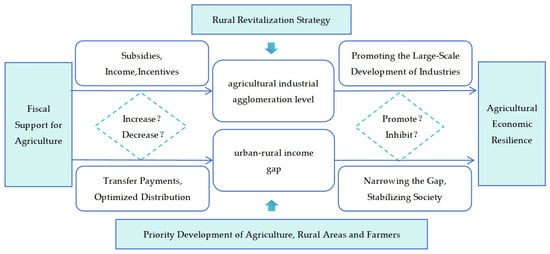
Fiscal support for agriculture reduces agricultural production costs through subsidies and infrastructure investment, inducing agricultural operators to concentrate in advantageous regions and form specialized spatial agglomeration. This further enhances system resilience via the mechanisms of labor pool sharing, localization of intermediate inputs, and risk sharing. Meanwhile, fiscal support for agriculture raises the relative income level of rural residents through transfer payments and production subsidies, optimizes the urban–rural income distribution structure, and strengthens rural social stability and development inclusiveness, thereby improving social resilience.
This study selects the agricultural industrial agglomeration level (lq) and the urban–rural income gap (gap) as the mechanism variables. The agricultural industrial agglomeration level is measured based on the location quotient (lq) index, and the urban–rural income gap is measured by the ratio of per capita disposable income of urban residents to that of rural residents (see Figure 1).
Figure 1.
Impact Mechanism Diagram. Note: Solid arrows denote causal transmission between variables; dotted-line diamonds represent impact effect judgment (increase/decrease, promotion/inhibition); colors are for visual differentiation only with no extra semantic meaning.
3.3. Data Sources and Preliminary Statistical Analysis
The paper employs panel data from 41 cities in the Yangtze River Delta for the period 2011–2023 for empirical analysis. The sample fully covers all core regions of the “three provinces and one municipality” comprising Shanghai, Jiangsu, Zhejiang, and Anhui. It includes not only megacities and regional central cities but also agriculture-dominated counties such as Dangshan. These regions exhibit significant heterogeneity in agricultural resource endowments, fiscal support for agriculture, and levels of economic development. This enables a comprehensive and objective depiction of the diversity characteristics of the agricultural economy in the Yangtze River Delta, ensuring the regional representativeness of the sample and the reliability of statistical inferences. The relevant data were obtained from sources including the China Statistical Yearbook [40], provincial and municipal statistical yearbooks [41], and the CEI database [42]. For a small number of missing data points, the linear interpolation method was used for imputation. Following the data processing approach of Hu Nan et al. [43], both the explanatory and dependent variables were multiplied by 100. Based on the above data, descriptive statistical analysis was conducted on all relevant variables, with the specific results presented in Table 2. The descriptive statistical analysis in this study has three core values: first, it depicts the distribution characteristics of core variables such as agricultural economic resilience and fiscal support for agriculture in 41 cities of the Yangtze River Delta from 2011 to 2023 through indicators including mean, standard deviation and extreme values, laying a data foundation for empirical analysis; second, it verifies the rationality of data processing and sample selection by checking extreme values, excluding the interference of extreme values; third, it provides a realistic basis for model setting, heterogeneity analysis and moderating effect tests according to the dispersion degree and value range of variables, improving the interpretability of regression results.
Table 2.
Descriptive Statistics.
4. Empirical Analysis
4.1. Analysis of Baseline Regression Results
The results of the variance inflation factor (VIF) show that the VIF values of all variables are less than 10, indicating no multicollinearity and a solid foundation for regression analysis [44]. Columns (1) to (5) of Table 3 present benchmark regressions with stepwise addition of control variables. Column (1) only includes fiscal support for agriculture, with a coefficient of 0.015 (10% significance). Economically, the coefficient of 0.015 for fiscal support for agriculture indicates that fiscal agricultural input has a marginally increasing effect on agricultural economic resilience—this small but statistically significant coefficient reflects the cumulative nature of fiscal policy’s role in stabilizing agricultural production and enhancing risk resistance, as agricultural resilience is a long-term dynamic indicator that cannot be drastically improved by short-term fiscal input, which preliminarily validates Hypothesis 1.
Table 3.
Baseline Regression Results.
After adding agricultural mechanization input, economic development level and digital inclusive finance index in Columns (2)–(4), the core coefficient stabilizes at 0.016 (5% significance), proving the positive effect of fiscal support for agriculture is robust. The 0.001-point marginal rise confirms fiscal input’s practical economic significance for the Delta’s integrated agricultural–industrial system. Column (5) incorporates grain production scale (gps), with the core coefficient remaining 0.016 (5% significance) and gps’s coefficient at 0.080 (significant positive). For the Delta—a key grain hub in eastern China—this coefficient means grain scale expansion strengthens material reserve capacity and supply chain stability, a critical driver of regional agricultural resilience. Notably, agricultural mechanization input and economic development level also show positive coefficients, consistent with theoretical expectations. The model’s R2 rises notably, verifying the reliability of the benchmark results and Hypothesis 1.
A comparative analysis validates our regional findings: our fiscal support coefficient aligns with Du Jiating et al. [37]’s national positive effect conclusion but is slightly lower, due to the Delta’s market-oriented agriculture where fiscal support plays a supplementary role. Li Jing et al. [19]’s finding that fiscal support drives rural three-industry integration resonates with our context—the Delta’s high industrial integration means fiscal input boosts resilience via both direct production support and indirect industrial linkage optimization. Our gps coefficient (0.080) also reflects the Delta’s uniqueness: scale expansion has a more pronounced resilience effect here than in less industrialized regions, consistent with Li Jing et al. [19]’s scale effect conclusion for economically advanced areas.
4.2. Robustness Tests
To verify the robustness of the regression results presented earlier, this paper conducted robustness tests using the following three approaches, as shown in Table 4.
Table 4.
Robustness Tests.
First, excluding the pandemic years: The COVID-19 pandemic, as a major public health emergency, may have introduced short-term effects specific to that period into the relationship between fiscal support for agriculture and agricultural economic resilience observed in the baseline regression. Therefore, to test the reliability of the core findings, the years 2020 and 2021 (the pandemic period) were excluded from the sample for re-estimation, in order to isolate the exogenous shock of the pandemic and its associated policy interferences on the agricultural economy. As shown in column (1) of Table 4, after excluding the impact of the pandemic, fiscal support for agriculture continues to exert a significant enhancing effect on agricultural economic resilience.
Second, controlling for geographic characteristics: Given that different cities vary in their natural endowments and locational conditions, and to control for the potential influence of time-varying geographic factors on agricultural economic resilience, this paper follows the approach of Shao Shuai et al. [45]. To avoid multicollinearity, the time trend variable was first centralized. Subsequently, interaction terms between city latitude/longitude and the centralized time trend were constructed and included in the model for estimation. As shown in column (2) of Table 4, after controlling for geographic influences, the estimated results remain statistically significant, confirming the robustness of the baseline regression conclusions.
Third, adjusting the sample period: To further test the robustness of the baseline findings, the sample was narrowed to the period 2014–2020. This period is characterized by stable rural reform policies, deepening regional integration in the Yangtze River Delta, and consistent statistical standards. Focusing on this timeframe helps mitigate potential interferences from initial policy pilots at the beginning of the period or strategic shifts toward its end, thereby enhancing the reliability of the conclusions. As shown in column (3) of Table 4, the impact of fiscal support for agriculture on agricultural economic resilience remains significant at the 1% level, indicating that the core finding is robust.
4.3. Heterogeneity Analysis
4.3.1. Heterogeneity Analysis Based on Different Indicators
Given that agricultural economic resilience is a composite concept encompassing three dimensions—resistance, recovery, and adaptability—the impact of fiscal support for agriculture may vary in its effect on the resilience levels represented by different indicators. Therefore, this study further conducts estimations by disaggregating these indicators. The specific results are presented in Table 5. The regression results show that, regarding the resistance dimension, the impact of fiscal support for agriculture on agricultural economic resilience is significantly positive. This indicates that fiscal support has a significant enhancing effect on resilience in terms of resistance. However, its effects on the recovery and adaptability dimensions are not statistically significant. This suggests that while fiscal funds effectively strengthen the foundation of agricultural production and stabilize grain output, the funds tend to favor large-scale operations while neglecting the production needs of smallholder farmers. Moreover, subsidy dependence drives up factor costs. Simultaneously, due to insufficient scale and precision of capital investment, it is difficult to promote agricultural technological upgrades and the transformation of rural functions. Consequently, the funds fail to effectively translate into systemic adaptive capacity, and the impact of fiscal support on agricultural economic resilience does not fully materialize in these dimensions.
Table 5.
Heterogeneity Analysis.
4.3.2. Heterogeneity Analysis Based on City Tier
To examine whether the impact of fiscal support for agriculture on agricultural economic resilience exhibits heterogeneity across city tiers, this study refers to the 2025 China New First-Tier Cities Charm Rankingby Yicai and categorizes the 41 cities in the Yangtze River Delta into two groups, namely, first- and second-tier cities, and third- and fourth-tier cities, for an inter-group coefficient difference test. The results show that the Chow test is passed, indicating a significant structural break between cities of different tiers. Further analysis reveals that the regression results for first- and second-tier cities are significantly positive at the 5% level, while those for third- and fourth-tier cities do not pass the significance test. This reflects that first- and second-tier cities, leveraging their more comprehensive infrastructure and higher resource allocation efficiency, effectively realize the positive enhancing effect of fiscal support on agricultural economic resilience. In contrast, third- and fourth-tier cities, constrained by conditions such as their industrial base and factor endowments, have not yet manifested the promotive effect of agricultural support funds.
4.4. Mechanism Test
This study adopts the research approach proposed by Jiang Ting [31] for identification and testing. Regarding agricultural industrial agglomeration, existing literature suggests its positive contribution to agricultural resilience. As shown in column (1) of Table 6, fiscal support for agriculture exhibits a coefficient of 0.002 on the level of agricultural industrial agglomeration, which is statistically significant at the 1% level. This result supports the mechanism that fiscal support enhances agricultural economic resilience by promoting agglomeration within the agricultural sector, thereby confirming Hypothesis 2. Furthermore, to verify the nonlinear effect of agricultural industrial agglomeration, we adopt a threshold regression model with 300 bootstrap replications. The results show a significant single threshold effect. When agglomeration is below this value, fiscal support for agriculture has no significant positive impact on agricultural economic resilience. When agglomeration exceeds the threshold, the positive effect becomes significant. This suggests that the impact of fiscal support depends on the degree of industrial agglomeration, which provides a nonlinear explanation for regional differences in policy effects (see Table 7).
Table 6.
Mechanism Test.
Table 7.
Threshold Effect Results.
Conversely, concerning the urban–rural income gap, column (2) of Table 6 indicates that fiscal support for agriculture has a significantly positive effect on the income gap at the 5% level, suggesting that such support inadvertently widens the disparity between urban and rural incomes, which in turn dampens agricultural economic resilience—a finding contrary to initial expectations. Drawing on existing studies, this outcome may be attributed to several factors. First, fiscal funds allocated to agriculture may be insufficient in scale, poorly structured, and utilized inefficiently, with potential issues of misappropriation or embezzlement, compounded by inadequate monitoring and performance evaluation mechanisms. Moreover, a portion of these expenditures may exhibit a “de-agriculturalization” tendency, effectively flowing into non-agricultural sectors or administrative costs, thereby boosting urban incomes more than rural ones and exacerbating the income gap. Second, agricultural subsidies may induce a dependency effect, reducing some farmers’ initiative and pursuit of efficiency. Third, given the relatively inelastic demand for agricultural products, increased supply driven by fiscal support could trigger a “good harvest, low price” effect, shifting the welfare gains from agricultural output growth toward the urban sector. Consequently, in practice, fiscal support policies have yet to effectively mitigate the urban–rural income gap and have instead exerted a negative influence on agricultural economic resilience.
Notably, our findings on the mediating role of the urban–rural income gap contrast with the provincial-level conclusions of Du Jiating et al. [37], who document that fiscal agricultural support raises rural household income and thus enhances agricultural resilience. This divergence arises from spatial scale effects: provincial aggregated data obscures intra-provincial fiscal expenditure structural imbalances in the Yangtze River Delta, where local fiscal support is skewed toward urban and industrial sectors with limited spillover effects to rural areas, overlooking city-level income distribution disparities. Du Jiating et al. [37] emphasize macro transmission channels such as rural income growth and agricultural technological innovation, whereas our urban-level analysis identifies industrial agglomeration and income distribution as the salient mediating factors, which further demonstrates the spatial scale dependence of the mechanisms underlying fiscal agricultural support for agricultural resilience
5. Conclusions and Suggestions
5.1. Conclusions
Based on panel data from 41 cities in the Yangtze River Delta region spanning 2011 to 2023, this study constructs an indicator system to measure agricultural economic resilience from three dimensions—resistance, recovery, and adaptability. Employing a two-way fixed effects model and a mechanism analysis model, this study systematically examines the impact of agricultural fiscal support on agricultural economic resilience, as well as its underlying mechanisms and spatial heterogeneity. On this basis, the study empirically analyzes the influence of agricultural fiscal support on agricultural economic resilience and its transmission pathways, and draws the following conclusions:
(1) Fiscal support for agriculture significantly boosts agricultural economic resilience. Benchmark regression using the two-way fixed effects model shows that the core variable (policy) has a coefficient of 0.016, significant at the 5% level, indicating that each 1-unit increase in fiscal support for agriculture raises the agricultural economic resilience index by 0.016 units, reflecting its direct and sustained supporting role. Robustness tests, including excluding epidemic years, controlling for geographical characteristics, and adjusting the sample period, confirm that the sign and significance of the core coefficient remain stable, verifying the reliability of the conclusion. (2) Fiscal support for agriculture exhibits dimensional and regional heterogeneity in its impact on agricultural economic resilience. In terms of dimensions, fiscal support has a significantly positive coefficient of 0.011 for resistance, directly enhancing the agricultural system’s ability to withstand natural and market risks through infrastructure investment and disaster subsidies. However, its effects on recovery and adaptability are insignificant, as post-disaster recovery and industrial restructuring require long-term factor accumulation, leading to limited short-term policy effects. Regionally, the coefficient is 0.026 and significant at the 5% level in first- and second-tier cities due to better supporting facilities and industrial foundations. In third- and fourth-tier cities, the coefficient is only 0.005 and insignificant owing to lower technological levels and inefficient factor allocation. (3) Fiscal support affects agricultural resilience through heterogeneous mechanisms, and control variables show differential impacts. It has a significantly positive coefficient of 0.002 (1% level) for agricultural industrial agglomeration, improving resilience through economies of scale and technology spillovers. A single threshold value of 0.0950 exists: the positive effect becomes significant only when agglomeration exceeds this value. However, fiscal support has a significant coefficient of 0.001 (1% level) for the urban–rural income gap, which may hinder agricultural resilience. At the control variable level, agricultural mechanization input and economic development level have significantly positive coefficients, which improve agricultural system stability by raising production efficiency and providing financial and technical support. Digital inclusive finance presents a significantly negative coefficient, indicating a short-term structural crowding-out effect on agricultural resilience. Grain production scale is significantly positive, providing a material guarantee for the agricultural system to resist risks.
5.2. Suggestions
Based on the above research conclusions, this paper proposes the following policy recommendations.
First, maintain sustained funding and improve the expenditure structure. In light of the impact of fiscal support for agriculture on agricultural economic resilience, it is recommended that, on the one hand, the continuity and stability of fiscal investment in agriculture be ensured to consolidate the foundation for high-quality agricultural development. On the other hand, efforts should be made to optimize the expenditure structure. Excessive subsidies in traditional planting and breeding sectors should be reduced to avoid generating “subsidy dependency” among operational entities. Instead, greater investment should be directed toward emerging fields such as high-value-added, green and digital agriculture, so as to promote the diversification of the industrial structure. Meanwhile, a transparent supervision mechanism for the use of subsidy funds should be established to improve fund utilization efficiency and address the coexistence of “insufficient investment” and “severe wastage”. In this way, the positive role of fiscal support for agriculture can be fully utilized to enhance agricultural economic resilience and support the sustainable development of agriculture.
Second, strengthen industrial agglomeration effects and build resilience networks. Currently, China’s agricultural industrial layout still suffers from fragmentation, short supply chains and weak coordination. To address these problems, fiscal support policies for agriculture should focus on cultivating and strengthening agricultural industrial clusters. It is recommended to establish special guiding funds to support the development of modern agricultural industrial parks, processing and logistics parks, and industrial alliances in major production regions, while improving public infrastructure including cold chain storage facilities and information platforms. Funding should be prioritized to incentivize leading enterprises to establish close benefit-sharing mechanisms with cooperatives and farmers, promoting unified technical standards and joint brand building. Through fiscal leverage, factor agglomeration, industrial chain extension and functional integration can be effectively guided, ultimately forming a regionally integrated and resilient agricultural industrial ecosystem.
Third, enhance human capital investment and urban–rural factor mobility to solidify the foundation of resilience. The widening urban–rural income gap undermines agricultural economic resilience through pathways such as labor loss and inefficient resource allocation. In this regard, fiscal support for agriculture should primarily focus on rural human capital development, including projects such as vocational education and digital skills training, to enhance the adaptability and innovation capacity of the agricultural workforce. At the same time, supporting reforms should be deepened to dismantle institutional barriers such as household registration and land policies, thereby promoting the two-way flow of talent, capital, and technology between urban and rural areas. By supporting rural digital transformation, the outflow of high-quality agricultural labor due to income disparities can be mitigated, agricultural production entities stabilized, and the system’s capacity to withstand risks strengthened, thereby enhancing agricultural economic resilience.
Author Contributions
Conceptualization, Z.J. and W.Z.; methodology, Z.J. and W.Z.; validation, Z.J.; formal analysis, Z.J. and W.Z.; Project administration, W.Z.; supervision, W.Z.; Writing—original draft: Z.J.; Writing—review and editing: Z.J. and W.Z. All authors have read and agreed to the published version of the manuscript.
Funding
This research was supported by the Anhui Philosophy and Social Sciences Planning Project (AHSKY2024D100).
Institutional Review Board Statement
Not applicable.
Informed Consent Statement
Not applicable.
Data Availability Statement
The data presented in this study are available on request from the corresponding author.
Conflicts of Interest
The authors declare no conflicts of interest.
References
- The State Council of the People’s Republic of China. Outline of the 15th Five-Year Plan for National Economic and Social Development of the People’s Republic of China (2026–2030); Central People’s Government of the People’s Republic of China: Beijing, China, 2026. [Google Scholar]
- Hao, A.M.; Tan, J.Y. Mechanism and Effect Measurement of Agricultural Resilience Empowered by Rural Industrial Integration. J. Agrotech. Econ. 2023, 7, 88–107. [Google Scholar]
- Holling, C.S. Resilience and Stability of Ecological Systems. Annu. Rev. Ecol. Syst. 1973, 4, 1–23. [Google Scholar] [CrossRef] [Scilit]
- Martin, R. Regional Economic Resilience, Hysteresis and Recessionary Shocks. J. Econ. Geogr. 2012, 12, 1–32. [Google Scholar] [CrossRef] [Scilit]
- Meuwissen, M.P.M.; Feindt, P.H.; Spiegel, A.; Termeer, C.J.A.M.; Mathijs, E.; De Mey, Y.; Finger, R.; Balmann, A.; Wauters, E.; Urquhart, J.; et al. A Framework to Assess the Resilience of Farming Systems. Agric. Syst. 2019, 176, 102656. [Google Scholar] [CrossRef] [Scilit]
- Ye, X.; Zhou, J.; Zhang, Y.; Zang, D. Air Pollution and Agricultural Economic Resilience in China: The Moderating Role of Environmental Regulation. Agriculture 2025, 15, 1256. [Google Scholar] [CrossRef] [Scilit]
- Wu, Y.; Zhang, J. Digital Inclusive Finance and Rural Households’ Economic Resilience. Financ. Res. Lett. 2025, 74, 106706. [Google Scholar] [CrossRef] [Scilit]
- Qiao, J.; Li, X. The Differential Effects of Bidirectional Urban-Rural Mobility on Agricultural Economic Resilience: Evidence from China. Sustainability 2025, 17, 7692. [Google Scholar] [CrossRef] [Scilit]
- Lin, B.B. Resilience in Agriculture through Crop Diversification: Adaptive Management for Environmental Change. Bioscience 2011, 61, 183–193. [Google Scholar] [CrossRef] [Scilit]
- Jiang, H.; Zhang, C.; Jiang, H.P. Impact Effects and Mechanisms of Agricultural Economic Resilience on High-Quality Agricultural Development in China. Agric. Econ. Manag. 2022, 1, 20–32. [Google Scholar]
- Altieri, M.A.; Nicholls, C.I.; Henao, A.; Lana, M.A. Agroecology and the Design of Climate Change-Resilient Farming Systems. Agron. Sustain. Dev. 2015, 35, 869–890. [Google Scholar] [CrossRef] [Scilit]
- OECD. Agricultural Policy Monitoring and Evaluation 2021: Addressing the Challenges Facing Food Systems; OECD Publishing: Paris, France, 2021. [Google Scholar] [CrossRef] [Scilit]
- World Bank. The Changing Wealth of Nations 2018; World Bank: Washington, DC, USA, 2018. [Google Scholar]
- Fan, S.; Rao, N. Public Spending in Developing Countries: Trends, Determination, and Impact; EPTD Discussion Papers; IFPRI: Washington, DC, USA, 2003. [Google Scholar]
- Martin, R.L.; Sunley, P. Regional economic resilience: Evolution and evaluation. In Handbook of Regional Economic Resilience; Bristow, G., Healy, A., Eds.; Edward Elgar Publishing: Cheltenham, UK, 2020; pp. 10–35. [Google Scholar]
- Liu, T.Q.; Song, J.J. Paths, Problems and Countermeasures of Fiscal Support for Agriculture Policies Boosting Rural Revitalization. Econ. Rev. J. 2020, 6, 55–60. [Google Scholar]
- Luo, D.; Jiao, J. An Empirical Study on the Impact of National Fiscal Support for Agriculture Funds on Farmers’ Income. Issues Agric. Econ. 2014, 35, 48–53. [Google Scholar]
- Wang, S.; Zhu, J.; Wang, L.; Zhong, S. The Inhibitory Effect of Agricultural Fiscal Expenditure on Agricultural Green Total Factor Productivity. Sci. Rep. 2022, 12, 18740. [Google Scholar] [CrossRef] [Scilit]
- Li, J.; Liu, H.; Chang, W.Y. Evaluating the Effect of Fiscal Support for Agriculture on Three-Industry Integration in Rural China. Agriculture 2024, 14, 0912. [Google Scholar] [CrossRef] [Scilit]
- Tang, L.; Sun, S. Fiscal Incentives, Financial Support for Agriculture, and Urban-Rural Inequality. Int. Rev. Financ. Anal. 2022, 80, 102057. [Google Scholar] [CrossRef] [Scilit]
- Wang, W.B. Fiscal Support for Agriculture, Human Capital and Urban-Rural Residents’ Income Gap. J. China Univ. Geosci. Soc. Sci. Ed. 2023, 23, 109–125. [Google Scholar]
- Jiang, T.B.; Lü, D.Y.; Ma, G.Q. Fiscal Bias, Rural Labor Transfer and Urban-Rural Income Gap. J. Agro-For. Econ. Manag. 2023, 22, 213–223. [Google Scholar]
- Chen, J.L.; Lin, Y.; Shi, H.H. Comprehensive Evaluation of Rural Revitalization Development Level in the Yangtze River Delta Region. East China Econ. Manag. 2020, 34, 16–22. [Google Scholar]
- Xu, N.; Zhang, W.; Li, H.; Chen, W. Fiscal Support and Carbon Productivity of Agriculture—Empirical Evidence from China. Energy Environ. 2024, 35, 2451–2475. [Google Scholar] [CrossRef] [Scilit]
- Mamun, A. Impact of Farm Subsidies on Global Agricultural Productivity. Agric. Econ. 2024, 55, 12823. [Google Scholar] [CrossRef] [Scilit]
- Wan, Q.; Chao, R.; Li, J.; Khan, N. Toward a Sustainable Agricultural System in China: Exploring the Nexus between Agricultural Science and Technology Innovation, Agricultural Resilience and Fiscal Policies Supporting Agriculture. Front. Sustain. Food Syst. 2024, 8, 1390014. [Google Scholar] [CrossRef] [Scilit]
- Li, Y.S.; Yan, F.X. Research on the Impact of Agricultural Industrial Agglomeration on Agricultural Economic Resilience: Evidence from 77 Prefecture-Level Cities in the Middle and Lower Reaches of the Yangtze River. J. Agrotech. Econ. 2025, 4, 38–53. [Google Scholar]
- Xue, X.D.; Wen, Y.Y. The Impact of Agricultural Industrial Agglomeration on Agricultural Eco-Efficiency in the Yellow River Basin: An Empirical Study Based on PCA-DEA and Panel Tobit Model. Chin. J. Agric. Resour. Reg. Plan. 2023, 44, 150–160. [Google Scholar]
- Yin, X.Y.; Jia, X.J.; Li, D.M. The Impact of Agricultural Industrial Agglomeration on Agricultural Green Total Factor Productivity: From the Perspective of Spatial Spillover Effect. Chin. J. Agric. Resour. Reg. Plan. 2022, 43, 110–119. [Google Scholar]
- Lu, Y.; Zhong, B.; Fang, Q. Research on Fiscal Support for Agriculture, Green Agricultural Productivity, and the Urban–Rural Income Gap: A PVAR Approach. Sustainability 2025, 17, 5443. [Google Scholar] [CrossRef] [Scilit]
- Yang, S.Y.; Ding, L.L. Fiscal Support for Agriculture and the Urban-Rural Dual Income Structure. Study Explor. 2020, 5, 148–155. [Google Scholar]
- Li, M.; Li, H.; Liu, C.K. Fiscal Support for Agriculture Expenditure, Rural Capital Outflow and Urban-Rural Residents’ Income Gap. Inq. Into Econ. Issues 2023, 1, 159–175. [Google Scholar]
- Liu, L.C.; Li, X. Digital Inclusive Finance and Agricultural Economic Resilience: An Empirical Test Based on Spatial Spillover and Threshold Effects. J. Chongqing Univ. Technol. Soc. Sci. 2024, 38, 107–122. [Google Scholar]
- Yu, L.Y.; Shi, C.Y.; Yang, X.; Mu, Y.Y. The Impact Mechanism of Rural Digitalization on China’s Agricultural Resilience: An Empirical Study Based on Coupling Coordination Degree and Mediating Effect Model. J. China Agric. Univ. 2023, 28, 308–320. [Google Scholar]
- Zhu, M.; Gong, W.G. The Impact of Agricultural Labor Outflow on Cultivated Land Abandonment and Its Formation Mechanism. Economist 2023, 9, 119–128. [Google Scholar]
- Jiang, T. Mediating Effects and Moderating Effects in Causal Inference Empirical Research. China Ind. Econ. 2022, 5, 100–120. [Google Scholar]
- Du, J.T.; Liu, Q.; Gu, Q.N. Can Fiscal Support for Agriculture Enhance Agricultural Development Resilience?—A Study Based on the Perspective of Static Verdoorn’s Law. Stat. Res. 2025, 42, 99–111. [Google Scholar]
- Wang, S.H.; Li, Q.Y.; Zhang, W. Statistical Test on the Impact Effect of Green Finance on Rural Economic Resilience. Stat. Decis. 2025, 41, 139–144. [Google Scholar]
- Liu, X.Y.; Zhang, W.; Zhang, Y. Digital Inclusive Finance Driving the Integrated Development of Rural Industries: Effect Evaluation and Mechanism Test. J. Shanghai Lixin Univ. Account. Financ. 2021, 33, 35–50. [Google Scholar]
- National Bureau of Statistics of China. China Statistical Yearbook 2024; China Statistics Press: Beijing, China, 2024. Available online: https://www.stats.gov.cn/sj/ndsj/2024/indexch.htm (accessed on 15 December 2025).
- Various Provincial and Municipal Bureaus of Statistics. Provincial and Municipal Statistical Yearbooks; China Statistics Press: Beijing, China, 2010–2023. Available online: http://www.stats.gov.cn (accessed on 15 December 2025).
- State Information Center. CEInet Statistical Database (CEI); State Information Center: Beijing, China, 2024; Available online: http://db.cei.cn (accessed on 18 December 2025).
- Hu, N.; Xue, F.J.; Wang, H.N. Does Managerial Myopia Affect Corporate Long-Term Investment? Based on Text Analysis and Machine Learning. Manag. World 2021, 37, 139–156. [Google Scholar]
- Hill, R.C.; Griffiths, W.E.; Lim, G.C. Principles of Econometrics, 5th ed.; Wiley: Hoboken, NJ, USA, 2018. [Google Scholar]
- Shao, S.; Ge, L.M.; Zhu, J.L. How Can Humanity and Nature Coexist Harmoniously: Environmental Regulation and Environmental Welfare Performance from the Perspective of Geographical Factors. Manag. World 2024, 40, 119–146. [Google Scholar]

Disclaimer/Publisher’s Note: The statements, opinions and data contained in all publications are solely those of the individual author(s) and contributor(s) and not of MDPI and/or the editor(s). MDPI and/or the editor(s) disclaim responsibility for any injury to people or property resulting from any ideas, methods, instructions or products referred to in the content. |
© 2026 by the authors. Licensee MDPI, Basel, Switzerland. This article is an open access article distributed under the terms and conditions of the Creative Commons Attribution (CC BY) license.