


Abstract
As private landownership becomes increasingly fragmented and socially diverse, understanding how new types of landowners interact with wildlife and engage in management practices is essential for achieving landscape-scale conservation outcomes. This issue has taken on renewed urgency in the post-pandemic era, as amenity migration expanded beyond the traditionally studied ultra-wealthy purchasers of large ranches to include a broader socioeconomic spectrum acquiring small-acreage properties. This shift has introduced a more heterogeneous population of land stewards, many operating with limited financial, technical, and institutional resources in highly fragmented landscapes. This paper examines the intersection of sociodemographic change and private land conservation, focusing on the implications of amenity migration for wildlife management in rural private ecosystems. Through an integrative review of the amenity migration literature informed by a PRISMA-based search and screening protocol, we show that although wildlife is frequently referenced in this literature, wildlife management is rarely examined as an intentional and coordinated social–ecological practice. We argue that the implications of contemporary amenity migration for wildlife management extend beyond individual landowners to include institutional systems, shifting community dynamics, and cross-boundary governance challenges that shape wildlife outcomes across private landscapes. Recognizing the post-pandemic transformation of rural landownership is therefore essential for aligning conservation resources and institutional support systems with emerging patterns of private land stewardship.
1. Introduction
Wildlife ecosystem management entails the restoration and maintenance of ecological balance while addressing both wildlife conservation and human needs [1]. Contemporary natural resource managers increasingly recognize the critical role that human activities play in the conservation, preservation, and long-term sustainability of such ecosystems [2]. In eastern U.S. states, where most of the land is under private ownership, the responsibility for maintaining wildlife health and ensuring ecosystem sustainability primarily rests with private landowners. Over time, public policies and governmental agencies have established working relationships with what we refer to as long-term ‘traditional landowners’, offering regulatory frameworks, technical expertise, financial incentives, and strategic guidance. These efforts have been instrumental in integrating conservation objectives into private land management plans, thereby advancing ecosystem stewardship. Yet the effectiveness of these efforts depends on social-ecological alignment; programs must match not only ecological conditions but also evolving landowner identities, knowledge systems, and the institutional environments in which management occurs [3].
Over the past several decades, natural areas worldwide have been experiencing significant population shifts, characterized by population movements from urban to rural areas that bring new and different actors in comparison to the long-term rural population [4,5]. First studied in the United States during the 1970s, this phenomenon, known as amenity migration, involves individuals relocating to reorient their lives around nature and the perceived benefits this creates [6,7,8]. Amenity migration is driven by a combination of push factors (e.g., reasons to escape urban life) and pull factors (e.g., reasons to seek out rural environments), mediated by contemporary macro social conditions such as the commodification of rural land for its aesthetic value, advancements in telecommunications, and transgenerational transfer of wealth [9]. These factors have contributed to the expansion of amenity migration over time.
Critically, this expansion represents a significant transformation. When interpreted through a social-ecological systems (SES) perspective, these changes are not merely demographic shifts but reconfigurations of coupled human–environment systems in which landowners, institutions, and ecological processes interact across scales [10,11]. New populations bring distinct values, expectations, and management capacities that alter the institutional, social, and ecological foundations upon which wildlife depends [4,12,13]. SES frameworks emphasize that ecological outcomes emerge from the alignment or misalignment among land-use decisions, governance arrangements, and biophysical dynamics [14]. Viewing amenity migration through this lens, therefore, positions wildlife management not only as an ecological concern but as an institutional and relational process shaped by changing patterns of landownership and community composition.
Existing scholarship has documented multiple pathways through which amenity migration reshapes ecological conditions on private lands. For example, ref. [6], one of the most widely cited syntheses of the ecological implications of amenity migration, provides a comprehensive international review highlighting impacts related to land subdivision, habitat fragmentation, altered disturbance regimes, and changing human–environment interactions. Within this body of work, wildlife is typically framed marginally, rather than as the focus of intentional wildlife management by landowners or communities. While this literature clearly establishes that amenity migration matters for wildlife, it also underscores the limited attention given to how changing landownership patterns, values, and community dynamics shape wildlife management practices and cross-boundary stewardship on private lands.
Accordingly, despite extensive scholarship on amenity migration and its ecological consequences, how this process reshapes wildlife management on private lands remains poorly understood. Accordingly, the goal of this review is to assess how wildlife management, where it is present, has been examined within the amenity migration literature, to identify emerging themes and critical gaps in both research and practice. Based on such analysis, we offer a call for action framed around a social-ecological perspective in which landowners, institutions, and ecosystems reciprocally interact and are accounted for.
2. Materials and Methods
Literature Review Approach and Search Strategy
This study employs an integrative narrative review of the amenity migration literature in rural and working landscapes. Domain familiarity developed through long-term scholarly engagement informed interpretation of the literature, while study identification followed a structured search and screening procedure to ensure transparent coverage. Rather than relying solely on database retrieval to define the field, the review combines systematic search protocols with contextual knowledge of foundational scholarship to evaluate the extent to which wildlife management has been explicitly examined within this literature.
To assess the extent to which wildlife management appears within database-indexed scholarship on amenity migration, a structured validation search was conducted following PRISMA 2020 reporting guidelines [15]. Literature searches were conducted using three complementary platforms: ScienceDirect, Web of Science, and Google Scholar. ScienceDirect and Web of Science were used to capture peer-reviewed literature indexed in major multidisciplinary databases, while Google Scholar was included to broaden coverage across interdisciplinary scholarship that may not be fully captured in traditional indexing systems. Scopus was not included in the search process because institutional access to that database was not available at the time of the review.
Searches were performed using the following Boolean search string, applied to titles, abstracts, and keywords when available:
(“amenity migration” OR “lifestyle migration” OR “exurban development” OR “rural in-migration” OR “counterurbanization”) AND (“wildlife” OR “wildlife management” OR “stewardship” OR “private land conservation”).
The ScienceDirect and Web of Science searches yielded a combined set of records that were exported and consolidated with results obtained from Google Scholar. Because Google Scholar indexes a substantially broader and less standardized body of literature, screening was conducted using relevance-ranked results. Records were reviewed sequentially until topical saturation was reached. During the screening process, it became evident that beyond the first 20 pages of relevance-ranked results, retrieved records no longer included studies meaningfully related to both amenity migration and wildlife. This threshold therefore reflects relevance saturation within the search results rather than an arbitrary cutoff.
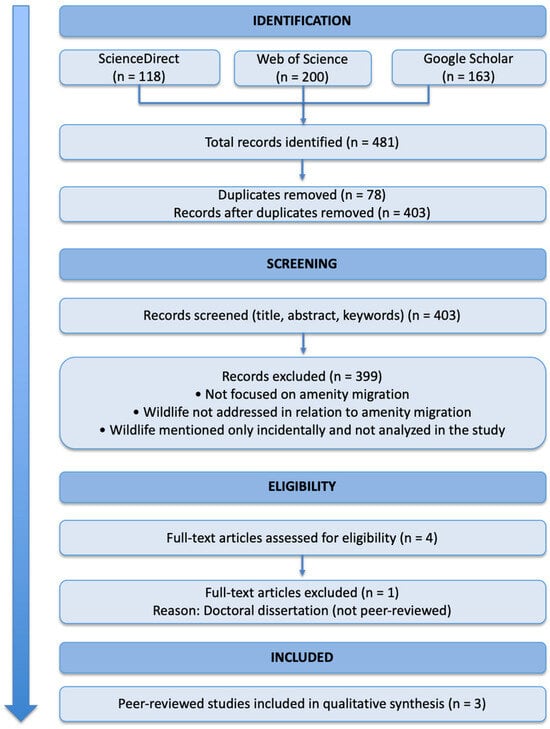
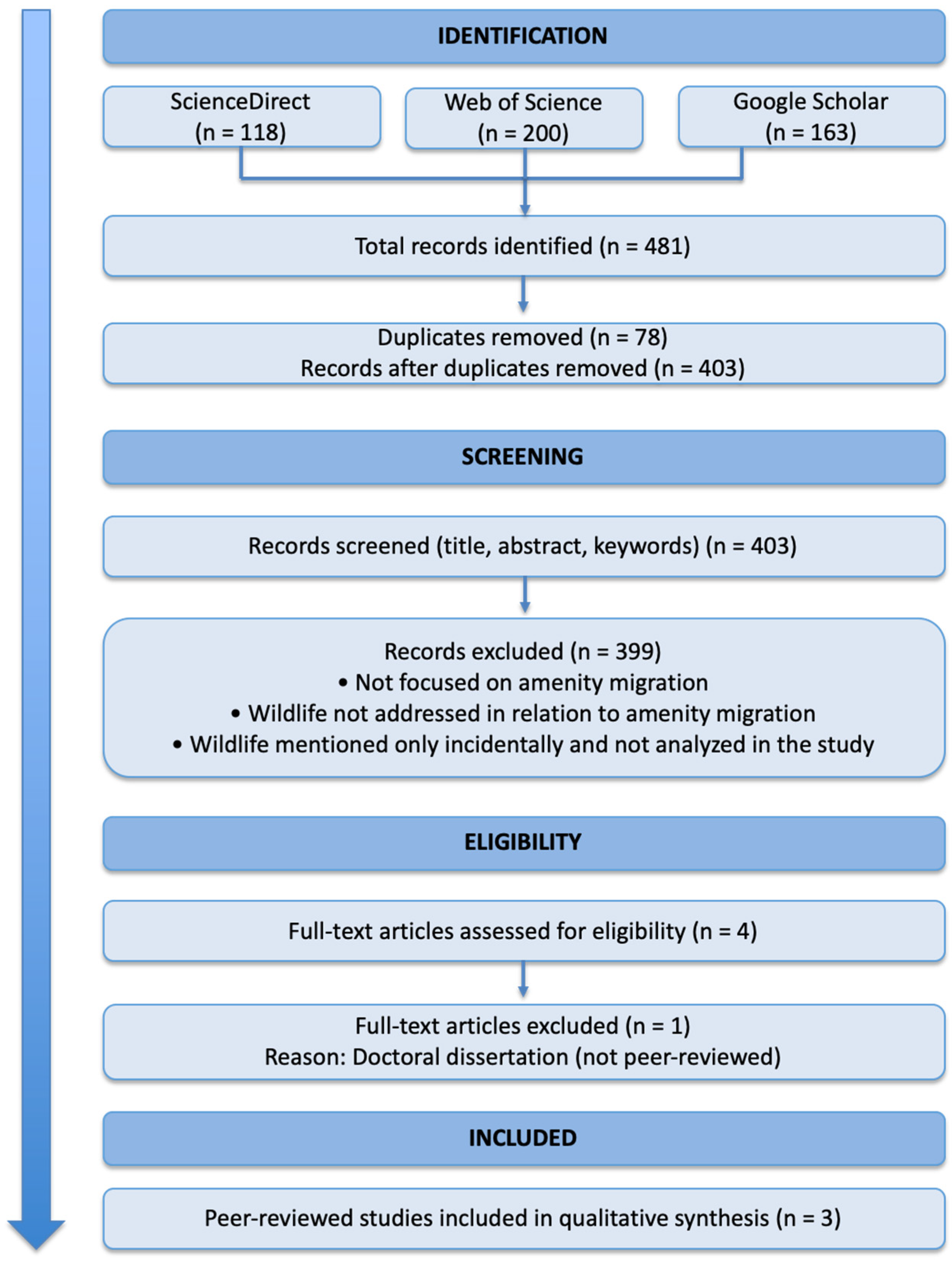
All records were exported and consolidated into a single database, resulting in an initial dataset of retrieved records (n = 481), including ScienceDirect (n = 118), Web of Science (n = 200), and Google Scholar (n = 163). Duplicate detection identified and removed 78 repeated entries across databases, resulting in 403 unique records. Screening was conducted manually through sequential review of titles, abstracts, and keywords for each record.
During screening, records were evaluated to determine whether they examined the relationship between amenity migration and wildlife. Records were excluded when they met one of three predefined criteria: (1) the study did not focus on amenity migration or closely related rural in-migration processes (e.g., lifestyle migration, exurban development, rural in-migration, counterurbanization); (2) wildlife was not addressed in relation to amenity migration; or (3) wildlife was mentioned only incidentally and not analytically examined within the study. Applying these criteria resulted in the exclusion of 399 records.
Four articles remained and were assessed in full text for eligibility. During the eligibility stage, one record was excluded because it consisted of a doctoral dissertation that was not peer-reviewed. Consequently, three peer-reviewed studies were included in the final PRISMA sample used for qualitative synthesis.
Following this process, three peer-reviewed studies were included in the PRISMA sample used for qualitative synthesis (Figure 1). The small number of eligible studies reflects the limited extent to which wildlife management has been explicitly examined within the amenity migration literature when strict search criteria requiring explicit reference to wildlife are applied. This outcome, therefore, serves as an empirical indicator of the conceptual gap examined in this review.
Figure 1.
PRISMA flow diagram.
The PRISMA-based search was used as a structured validation step to assess the extent to which wildlife and wildlife management are explicitly represented within database-indexed amenity migration scholarship. To complement this validation step and ensure conceptual coverage of the field, additional peer-reviewed articles were incorporated through systematic reference tracing and established foundational literature in amenity migration scholarship. Identification of these studies was informed not only by citation tracing but also by the authors’ long-standing familiarity with the amenity migration literature developed through decades of scholarly engagement with this field. This familiarity allowed the review to incorporate influential and foundational contributions that shape the conceptual development of amenity migration research but may not always be captured through keyword-based database searches alone, particularly in interdisciplinary studies where terminology and indexing practices vary across fields.
Accordingly, the PRISMA sample was used to evaluate the explicit representation of wildlife management within the literature, while the broader corpus provided the interpretive context necessary for the integrative synthesis. The final qualitative analysis therefore draws on both the studies identified through the structured database search and additional foundational scholarship incorporated through reference tracing, resulting in a total of 33 articles included in the interpretive review.
To analyze how wildlife is conceptualized within the amenity migration literature, the review first defines wildlife management and then classifies studies according to their dominant analytical framing. For the purposes of this review, wildlife management is defined as the set of stewardship, land-use, and governance practices intended to influence wildlife populations or habitat conditions on private lands. This definition includes actions such as habitat restoration, vegetation or disturbance management, population management, hunting or harvest regulation, conservation incentive programs, and other institutional or landowner practices aimed at shaping wildlife populations and habitat quality.
To classify how wildlife was treated in the amenity migration literature, each study was coded according to the dominant analytical framing of wildlife within the article [16]. Coding focused on the primary way wildlife was conceptualized in the study’s research questions, analytical discussion, and conclusions, rather than on incidental references to wildlife within the text. This approach allowed the review to distinguish between studies in which wildlife appeared as a contextual feature of rural landscapes and those in which wildlife was examined as an explicit object of management or governance.
Studies were classified into four framing categories (F1–F4). F1 (Amenity) included studies in which wildlife was discussed primarily as an aesthetic, recreational, or symbolic attribute associated with rural landscapes and amenity-based migration. In these studies, wildlife was typically referenced as part of the experiential or lifestyle qualities that attract migrants to rural areas, such as opportunities for wildlife viewing, hunting, or the presence of charismatic species that enhance the perceived value of the landscape.
F2 (Ecological outcome) included studies in which wildlife appeared as a consequence of land-use change, habitat fragmentation, residential development, or other ecological processes associated with demographic or landscape transformation. In this framing, wildlife is treated as an indicator of ecological change, with research focusing on how amenity migration alters habitat conditions, species distributions, or ecological processes rather than on the management decisions of landowners or institutions.
F3 (Values/attitudes) included studies examining landowner environmental values, conservation orientations, or attitudes toward wildlife. This body of work often documents pro-environmental beliefs, support for wildlife protection, or tolerance toward particular species. However, these studies typically focus on perceptions, motivations, or attitudinal orientations and do not analyze concrete management practices or governance arrangements through which wildlife populations or habitats are actively managed.
F4 (Managed system) was assigned only when wildlife management was explicitly examined as an intentional practice or governance process. Studies were classified in this category when they analyzed landowner management decisions, habitat management actions, institutional programs, or cross-boundary governance arrangements intended to influence wildlife populations or habitat conditions. This category therefore captures research that treats wildlife management as a coordinated social–ecological process rather than as an amenity, ecological outcome, or attitudinal orientation.
Classification was based on the dominant analytical emphasis of each article. Studies that mentioned wildlife management only in passing, in aspirational terms, or as a general conservation objective were not coded as F4 unless management practices or governance processes were empirically examined.
3. Results
3.1. Scope of the Literature and Wildlife Framings
Following the literature identification process described above, the results draw on a total of 33 amenity migration studies included in the interpretive review (Table 1). Of these, three studies were identified through the PRISMA-based database search that explicitly examined wildlife within amenity migration scholarship, while an additional thirty studies were incorporated through reference tracing and established foundational literature to provide a broader conceptual context for the field.
Table 1.
Amenity-migration studies reviewed and classification of wildlife framing. Studies were classified based on whether wildlife was mentioned, the dominant way wildlife was framed, and whether wildlife management practices or governance processes were explicitly analyzed. Framing reflects the primary emphasis of each study.
The search process did not restrict studies by geographic region; however, many of the studies identified were conducted in the United States, reflecting the historical development of amenity migration scholarship in North America. The literature also includes research from other regions such as Australia and parts of Europe where similar socio-ecological dynamics have been documented.
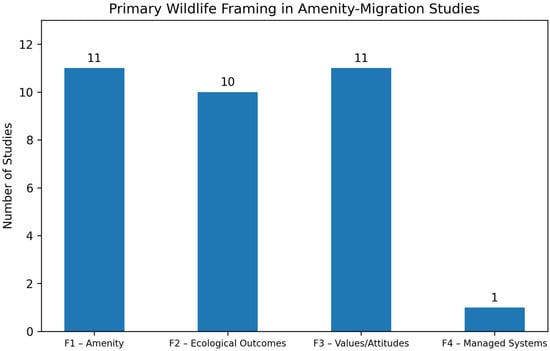
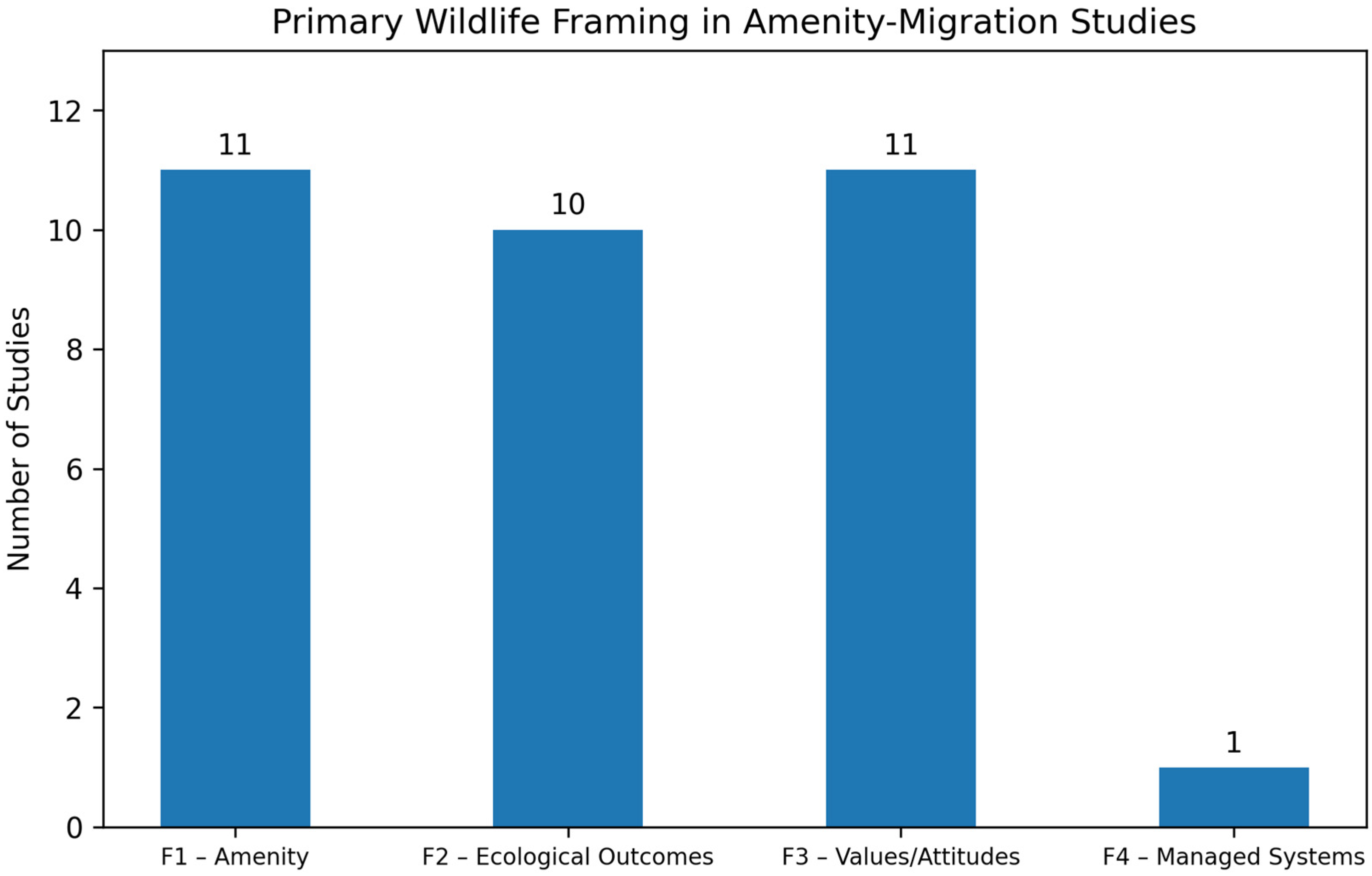
Most studies framed wildlife either as an amenity associated with rural landscapes (F1; n = 11), as an ecological outcome of land-use and demographic change (F2; n = 10) (Figure 1). Additionally, another subset treated wildlife as a conservation value or attitudinal concern (F3; n = 11), typically documenting pro-environmental orientations or support for wildlife protection without examining specific management actions (Figure 2). These themes will be discussed in more detail in the following section.
Figure 2.
Primary wildlife framings in the amenity migration literature. Bars indicate the number of amenity migration studies in which wildlife is framed primarily as an amenity (F1), an ecological outcome of land-use change (F2), or a conservation value or attitude (F3). One study framed wildlife as a managed social-ecological system (F4).
Notably, only one amenity-migration study framed wildlife as a managed social-ecological system (F4; Figure 2). Where wildlife management was mentioned, it was typically referenced in general or aspirational terms rather than evaluated empirically. We treated ‘wildlife management analyzed’ as distinct from wildlife framing; a study could reference management or hold attitudes about management without empirically evaluating practices, decisions, or governance outcomes.
Taken together, these patterns indicate that the amenity migration literature primarily treats wildlife as something appreciated, indirectly affected, or valued, while rarely examining it as a coordinated management process. This distribution reveals a gap between the well-documented demographic and ecological transformations associated with amenity migration and the limited attention given to wildlife management on private lands. The findings provide the empirical basis for understanding why amenity migration presents distinct challenges for wildlife stewardship in contemporary fragmented working landscapes.
These results summarize how wildlife has been framed across the amenity migration literature, revealing consistent patterns in emphasis and only minimal treatment of wildlife as an intentionally managed Social-ecological system. The following section moves beyond these numerical patterns to contextualize and elaborate the themes identified above, situating them within the social-demographic and land-use transformations that characterize amenity migration and clarifying why certain framings have prevailed while wildlife management has remained marginal as an analytical focus.
3.2. Wildlife Framings in the Amenity Migration Literature
As shown in the quantified Section 3 above, across the literature reviewed, wildlife appears frequently but unevenly, and rarely as the central focus of management. Four dominant ways of framing wildlife emerge. First, wildlife is framed as a valued amenity that attracts migrants to rural landscapes (~33% of the cases). In this framing, wildlife is appreciated for its aesthetic, recreational, or symbolic value, reinforcing motivations for rural relocation and nature-oriented lifestyles [4,6,17,23,25,26]. Wildlife is treated primarily as a desirable part of the landscape experience rather than as a system requiring active stewardship or coordinated management.
Second, wildlife is presented as an ecological outcome of amenity-driven land-use change (30% of the cases). Numerous studies document how subdivision, residential development, and changing land uses associated with amenity migration affect habitat fragmentation, disturbance regimes, and species distributions [12,18,20,41]. In this framing, wildlife is positioned as a recipient of indirect impacts, with limited attention to how landowner decisions or management practices shape these outcomes.
Third, some scholarship frames wildlife as a desired conservation goal (~33% of the cases), emphasizing pro-environmental values, positive attitudes toward biodiversity, and support for wildlife-friendly policies among amenity migrants [5,27,28]. While this literature highlights conservation-oriented intentions, it does not examine how such values translate into concrete management actions, particularly in fragmented, privately owned landscapes.
Finally, and most notably, wildlife is framed as a managed social-ecological system shaped by landowner practices, institutional relationships, and cross-boundary coordination in only one study (3% of the cases). In that instance [14], wildlife management is examined as an intentional and relational process embedded within broader governance and outreach dynamics.
All remaining studies either treat wildlife as an ecological outcome of land-use change or focus primarily on landowner values and attitudes without analyzing coordinated management decisions. This concentration reveals a critical gap between the well-documented ecological consequences of amenity migration and the limited attention given to wildlife management as an intentional, collective practice on private lands. The extremely limited sustained engagement with governance processes and adaptive management is particularly consequential in the post-COVID-19 context, where the rapid expansion of amenity-driven ownership intensifies the need for coordinated stewardship across fragmented landscapes. Because wildlife populations move across property boundaries, fragmented private landscapes depend on coordination among heterogeneous landowners and institutions. Without examining management as a collective process, existing research cannot adequately explain how amenity migration alters habitat stewardship, management effectiveness, or long-term ecological outcomes.
4. Discussion
4.1. Contextualizing Amenity Migration for Wildlife Management: From High-Amenity Ranches to Small-Acreage Working Lands
Our literature review found a marginal connection between the amenity migration phenomenon and the wildlife literature. Critical to understanding the intersection of these studies is the contemporary context in which they take place, which is detailed in this section, and which was present in much of the literature analyzed.
Amenity migration was long understood as a movement of affluent urban residents seeking large, aesthetically striking properties in high amenity rural settings such as mountain valleys, coastlines, and lakesides [17]. These early patterns concentrated newcomers in expansive scenic landscapes and reinforced the notion of amenity migration as a lifestyle choice for the privileged [42]. Specifically, within working lands, this population appropriates large contiguous ranches owned by individuals with considerable financial resources, supporting the hiring of professional managers, investment in infrastructure, and the implementation of coordinated grazing, vegetation, and fire management at scales conducive to ecological coherence [18,19,20]. These ultra-wealthy amenity migrants often struggle with issues of identity, cultural integration, and community acceptance; however, unlike the post COVID-19 amenity migrants discussed here, they generally did not face constraints related to financial resources, land management coherence afforded by large landholdings, or access to the expertise and tools needed to implement large-scale stewardship [17,18,19,20,21].
The COVID-19 pandemic catalyzed a dramatic shift that democratized and diffused amenity migration into ordinary working lands, most of which takes place in small-sized properties [5,43]. As a result, contemporary amenity migration increasingly involves the purchase of small-acreage parcels, often under 50 acres, by a broader socioeconomic spectrum [5], taking place in highly fragmented landscapes. Such land fragmentation is driven by the combined effects of population growth and outward urban expansion, rising land values associated with non-agricultural demand, declining agricultural profitability, aging farmers and ranchers, and the high costs of intergenerational land transfer, which together incentivize the subdivision of large rural parcels and the conversion of working lands to residential, recreational, or other non-agricultural uses [44,45]. As ranches subdivide into smaller parcels, economically viable ranching becomes increasingly difficult, encouraging amenity- and consumption-oriented land uses and reshaping the economic, ecological, and social functioning of rural working landscapes [5,14,22,45].
From previous work on land fragmentation, we know that this phenomenon complicates the coordination of stewardship practices, reduces the continuity of grazing and vegetation management, and introduces mismatches between ecological processes and the scales at which individual landowners make decisions [45,46,47,48]. In turn, the capacity for effective cross-boundary action, whether related to wildfire mitigation, invasive species control, water management, or wildlife habitat conservation, is diminished [45,49,50]. Fragmentation also places greater demands on institutional actors, who must engage with a larger and more heterogeneous landowner base while attempting to maintain ecological coherence across landscapes that no longer function as unified management units [5].
While the parcelization literature showcases the spatial transformation and consequences on working lands, the amenity migration literature denotes a social transformation in that space. In states like Texas, where land is predominantly privately owned, amenity migration is evident in regions undergoing the above-mentioned parcelization, making small-sized properties readily available to amenity migrants [5,44,51,52]. For instance, according to the Texas Land Trends Fragmentation Risk Index developed by the Texas A&M Natural Resources Institute [44], the region encompassed by the so-called Texas Triangle, which includes counties within and surrounding the metropolitan areas of Austin, San Antonio, Houston, and Dallas/Fort Worth, experiences high levels of land fragmentation due to urban expansion pressure. On the ground, both news media [51,52] and the academic literature [5,53,54,55] highlight the growing prominence of amenity migrants post COVID-19 in multiple parts of the United States. Extension and conservation staff also often describe amenity migrants (referred to by them as “exurban landowners”) as their main clientele [5,14,43]. Subsequently, management becomes dispersed across a diverse set of owners with varying experience, values, and objectives [5,14,45].
Although no national dataset directly counts amenity migrants, numerous studies have quantified the phenomenon indirectly by linking net in-migration to amenity-rich counties. These analyses consistently show that rural counties with higher natural amenity scores have experienced disproportionately higher population growth since the 1970s, underscoring the substantial and measurable role of amenities in driving demographic change across the United States. For example, McGranahan [56] found that from 1970 to 1996, nonmetropolitan counties with high natural amenity rankings grew by 20 percent compared to only 1 percent growth in low-amenity counties, a pattern confirmed in subsequent national and regional studies [23,24,57]. Taken together, from national migration patterns to Texas parcelization trends and the observed presence of amenity migrants on the ground, the evidence makes clear that amenity migration is not a marginal phenomenon but a central force shaping rural change.
Despite the prominence of amenity migration and its recorded social and ecological implications [6,17], little has been said about the relationship between amenity migration and wildlife management. While existing evidence shows that amenity migrants often express strong pro-environmental values and favorable attitudes toward wildlife, including higher tolerance of predators and support for wildlife-friendly policies [27], values alone rarely translate into effective management. Land stewardship practices depend heavily on knowledge, institutional incentives, and community norms [58,59,60]. Although many amenity migrants espouse conservation values and intend to manage their properties in ecologically beneficial ways [28], their views of nature and property goals do not always align with the practical requirements for creating and maintaining functional wildlife habitats.
It is also increasingly clear that amenity migrants are far from a uniform group. Research highlights meaningful variation in their socioeconomic backgrounds, land-use goals, and environmental identities [43]. Some newcomers pursue ecological restoration or native landscaping, while others prioritize scenic aesthetics, passive nature enjoyment, hobby agriculture, recreational amenities, or privacy. Additional distinctions appear among retirees, remote workers, investors, part-time residents, and those seeking alternative lifestyles. These diverse orientations shape how landowners perceive wildlife, what they consider desirable habitat conditions, and their willingness or capacity to engage in active management. Many newcomers engage more with the idea of appreciating nature than with the hands-on practices required to maintain it [6,29], underscoring the importance of tailoring outreach, incentives, and conservation strategies to this heterogeneity.
Further, well-documented limitations in ecological knowledge and land management expertise among amenity migrants frequently hinder the translation of their values and goals into effective stewardship practices [5,30,31]. These challenges are often compounded by the social disconnect that they experience with long-term ranchers and community residents, whose land-use traditions, cultural norms, and expectations for good stewardship frequently differ from those of the amenity migrants, leading to mistrust and limited opportunities for knowledge exchange [5,13,18,19].
4.2. Explaining the Rare Existence of Wildlife Management in the Literature
The contemporary transformation of rural landownership described above helps explain why wildlife has remained marginal as a management domain within the amenity migration literature. As shown in the Results, most studies frame wildlife as an amenity (F1), an ecological outcome of land-use change (F2), or a conservation value or attitude (F3), while only one study treats wildlife as an intentionally managed social-ecological system (F4). Interpreting this distribution of framings, therefore, requires examining how prevailing analytical traditions and structural research conditions have shaped what scholars have observed, and what they have overlooked.
The limited presence of wildlife as a managed social-ecological system likely reflects the populations historically examined within amenity migration scholarship. Much of the literature has focused either on tourism-oriented residential landscapes or on high-amenity ranch ownership. In both contexts, land use is often experienced as consumption, identity expression, or investment rather than as day-to-day stewardship practice. Where management occurs, it is frequently outsourced to hired professionals or buffered by financial capacity, making decision processes difficult to observe in household-level research. Consequently, studies have tended to document motivations, values, and landscape impacts rather than coordinated management behavior.
In contrast, post-COVID-19 amenity migrants to working lands operate under conditions in which management cannot be externalized. Limited financial capacity, small parcel size, and dependence on institutions require landowners to personally interpret ecological feedbacks and make ongoing decisions about land use. Under these conditions, wildlife becomes part of a negotiated social-ecological practice rather than an amenity, outcome, or attitude. The scarcity of F4, therefore, likely reflects the empirical visibility of management within previously studied populations rather than the absence of stewardship itself.
As a consequence, the literature has tended to represent wildlife primarily as a scenic or experiential feature rather than as a coordinated management domain. When wildlife is consistently analyzed as an amenity or landscape attribute, it becomes positioned as something to be experienced or valued, not something requiring ongoing coordination across properties and institutions. Although the literature does not directly measure landowner cognition, this analytical emphasis may indirectly reinforce a consumption-oriented understanding of nature by foregrounding appreciation and impact while backgrounding governance and deliberate management. In this way, wildlife appears as part of rural scenery rather than as a system requiring cross-boundary stewardship.
Consistent with this pattern, structural characteristics of contemporary amenity migration also limit the visibility of wildlife management as an explicit domain of study. The increasing prevalence of absentee and part-time ownership complicates sustained engagement among landowners, neighboring properties, and conservation agencies, reducing opportunities for collaborative planning, monitoring, and adaptive management. Wildlife-related practices on small and heterogeneous properties are often informal, embedded in household decision-making, and dispersed across fragmented landscapes. This “black box” of private land stewardship poses methodological challenges for researchers and helps explain why migration scholarship more readily documents attitudes and land-use change than coordinated wildlife management practices.
These visibility challenges are compounded by scale mismatches. The predominance of small-acreage parcels in post-pandemic amenity migration creates misalignment between ecological processes and the social and institutional arrangements through which management is coordinated. Many wildlife and conservation programs were historically calibrated for larger, production-oriented holdings, often requiring minimum acreage thresholds, long-term commitments, or technical capacities that do not align with fragmented ownership. When stewardship occurs across numerous small parcels embedded within broader ecological systems, effective management depends on coordination among neighboring landowners, agencies, and monitoring efforts rather than on individual properties alone. These structural dynamics complicate both empirical analysis and institutional support of wildlife as a managed social-ecological system.
Taken together, the extremely limited presence of F4 appears to reflect the interaction between research visibility and evolving landownership configurations. The literature’s emphasis on amenity values and ecological outcomes intersects with fragmented, heterogeneous ownership patterns that make coordinated management difficult to observe empirically. Recognizing this interplay is essential for understanding why wildlife management remains marginal as an analytical focus within amenity migration scholarship and for identifying pathways toward more integrated social-ecological research and institutional design.
4.3. Implications for Wildlife Management in Fragmented Landscapes
These patterns of population focus and visibility have important implications for how wildlife management is understood in fragmented landscapes. The findings indicate that wildlife management has not been absent from the amenity migration literature, but it has rarely been examined as a coordinated social-ecological process. Only one study analyzed wildlife within a framework linking landowner practices, social networks, institutional relationships, and cross-boundary dynamics, while most studies positioned wildlife as an amenity, an ecological consequence, or a value orientation. Together, these patterns suggest that the governance dimensions of wildlife stewardship are emerging but have not yet developed into a sustained line of inquiry.
This distinction matters because wildlife populations operate across property boundaries [61,62,63], whereas much amenity-migration research remains oriented toward individual motivations, landscape change, or attitudinal orientations. As a result, the literature explains why demographic change occurs and what ecological patterns emerge, but it rarely explains how management is coordinated or why stewardship succeeds or fails in fragmented ownership contexts. The issue is therefore not solely ecological knowledge or landowner concern, but limited analytical attention to the coordination mechanisms through which management actually operates [6,19,32,64].
Framing wildlife as a managed social-ecological system shifts the analytical focus from explaining how migration changes landscapes to examining how heterogeneous landowners, agencies, organizations, and knowledge networks coordinate management and monitoring across shared ecological processes. This includes consideration of ethical standards guiding wildlife control and intervention, which are increasingly emphasized in applied management contexts [65]. Developing this perspective is essential for understanding contemporary working landscapes, where amenity-driven ownership restructures not only land cover but also authority, information exchange, and the capacity for collective action [10,11,58].
Under this perspective, ecological consequences often attributed to amenity migration—land-use change, residential development, and fragmentation [33]—can be understood as outcomes of interacting governance, decision-making, and feedback processes rather than solely demographic change. Wildlife persistence depends on cumulative actions across multiple properties, meaning that landscape-level outcomes emerge from many small decisions made under varying levels of knowledge, coordination, and institutional support [61,62,63]. Even modest differences in management practices can therefore produce significant ecological consequences.
Accordingly, understanding amenity migrants becomes central to wildlife conservation in privately owned landscapes. Research attention must move beyond documenting amenities and attitudes toward examining how management practices are coordinated and how knowledge and feedback circulate across heterogeneous landownerships. Without this shift, the literature can describe why people move and how landscapes change, but cannot adequately explain how wildlife stewardship is achieved in fragmented systems. At the same time, because stewardship outcomes depend on interactions among neighboring landowners, agencies, and knowledge networks, the challenge is not borne by new landowners alone. Effective wildlife management requires shared responsibility across institutions and communities that must adapt to support coordination, learning, and collective action under changing ownership patterns.
4.4. Institutional and Relational Barriers to Coordinated Wildlife Management
As amenity migration diversifies ownership and reduces parcel size, particularly among landowners with limited land management experience and ecological knowledge, the assumptions embedded in traditional wildlife management institutions become increasingly misaligned with contemporary management contexts, while the growing social heterogeneity of landowners also weakens shared norms, trust, and coordination necessary for cross-boundary stewardship [5,6,30,32].
Amenity migrants’ knowledge and expertise gaps and learning opportunity barriers can lead to unintended ecological consequences, including the spread of encroaching woody vegetation such as mesquite and juniper, which proliferate under poorly informed management [66]. Resulting shifts in plant communities alter the structure and function of working lands by reducing native grass cover, elevating fire risk, expanding bare ground, and disrupting ecological processes [67,68]. Together, these dynamics illustrate that amenity migration is not merely a demographic trend, but a driver of systemic ecological change whose implications extend well beyond individual properties.
Translating this motivation into ecological outcomes requires institutions and long-term landowners to recognize and address the barriers faced by this increasingly influential population. Even when motivated, many amenity migrants lack the labor, time, or financial resources needed to implement best practices consistently, particularly on parcels with degraded infrastructure or long-standing management challenges [5]. The rapid subdivision of rural lands intensifies these constraints by creating a mosaic of ownerships with diverse goals and inconsistent approaches to management [19,69]. In landscapes where wildlife regularly moves across property boundaries, this variability produces management mismatches that fragment habitat and reduce continuity [70]. These challenges are further compounded by institutional arrangements designed for large, production-oriented operations. Many existing programs, incentives, and outreach models do not align with the needs or capacities of small-acreage amenity landowners, resulting in an institutional mismatch that constrains effective habitat restoration [6,30,32]. Addressing these structural barriers is essential if wildlife agencies are to work effectively in the increasingly complex socioecological contexts of rural regions.
4.5. A Call for Action: Leveraging Amenity Migration for Wildlife Stewardship
Amenity migrants, despite their varied backgrounds and frequent lack of ecological training, represent one of the most significant new opportunities for advancing wildlife conservation on private lands. Many arrive with strong conservation-oriented identities and an intrinsic desire to protect wildlife, restore habitat, and care for the land [5,6,14,17]. Their value systems often emphasize biodiversity, ecological health, and the aesthetic qualities of landscapes, distinguishing them from production-oriented landowners whose stewardship decisions are shaped in part by economic considerations [6,17]. Importantly, amenity migrants tend to be highly receptive to learning [5,14,30,31]. Many participate in workshops, native plant courses, and habitat certification programs, and report a strong willingness to adopt new management practices when provided with guidance [14,71]. Their openness to innovation, combined with relatively high volunteerism, makes them strong candidates for participation in collaborative conservation networks [17]. Numerous examples show that with appropriate support, amenity migrants can contribute meaningfully to habitat restoration [21,28,34,35,72]. Their expanding peer networks, both local and digital, further strengthen these opportunities by accelerating the spread of stewardship ideas across fragmented landscapes [5,14].
Meeting these emerging dynamics requires strategic adaptation by wildlife agencies, conservation organizations, and local networks. Agencies will need to develop extension models that reflect smaller parcel sizes, diverse motivations, and novice landowners. Approaches such as personalized site visits, tailored stewardship plans, and microgrants for habitat improvements can significantly enhance landowner participation. Programs such as Texas Parks and Wildlife’s Landowner Incentive Program [73] demonstrate the potential of targeted support to empower individuals while advancing broader conservation goals. Collaborative structures that bring together traditional producers and amenity migrants, such as wildlife cooperatives, watershed groups, and land trusts, are equally important. These networks foster mutual learning, reduce social divides, build trust, and create shared stewardship norms capable of coordinating management across fragmented properties [74,75]. Strengthening these cooperative arrangements is increasingly urgent as wildlife conservation becomes more dependent on the ability of institutions to coordinate action across diverse landowner identities and small-acreage landscapes.
While much of the empirical discussion in this paper draws on U.S. examples, similar institutional and landowner dynamics have been documented internationally. In Australia, lifestyle-oriented rural landownership associated with amenity migration has reshaped stewardship practices and land management priorities, highlighting comparable challenges in engaging small-acreage owners in natural resource management beyond production systems [36]. In Europe, voluntary agri-environmental measures under the Common Agricultural Policy (CAP) provide incentives for landowners to protect rural landscapes, flora, and fauna, illustrating institutional efforts to align land management with conservation goals across diverse ownership contexts. Programs such as the Tir Gofal scheme in Wales further exemplify how incentive-based stewardship agreements can structure wildlife and habitat management among private landholders. These international cases suggest that the institutional misalignment and fragmented management issues identified in the U.S. context reflect broader global challenges when addressing wildlife management under patterns of amenity migration and landscape fragmentation.
Despite these efforts, important research gaps remain. No study has yet examined this phenomenon across multiple regions or scales; existing work remains limited to a single context. Addressing this gap will require interdisciplinary research integrating ecological monitoring, landowner behavior analysis, institutional evaluation, and cross-boundary governance. Comparative studies between traditional and amenity landowners can help identify differences in motivations, land ethics, and management effectiveness. Just as importantly, research must attend to heterogeneity within the amenity migrant population itself. Socioeconomic position, education, age, migration history, and cultural background all influence stewardship engagement in ways that remain poorly understood.
A limitation of the present review is that the literature search relied primarily on English-language publications indexed in major academic databases. As a result, relevant studies published in other languages may not have been captured, particularly in regions where amenity migration dynamics are also emerging. Future research would benefit from incorporating multilingual scholarship to provide a more comprehensive understanding of how these processes unfold across different global contexts.
As private landownership patterns continue to shift, these questions become increasingly important for designing inclusive, adaptive, and ecologically effective wildlife management strategies. Ultimately, recognizing amenity migration as a profound socioecological force, rather than merely a demographic trend, is essential for sustaining wildlife across today’s increasingly complex rural landscapes. Addressing these gaps is essential if wildlife conservation is to remain viable in landscapes increasingly shaped by amenity-driven landownership change.
5. Conclusions
This review examined the intersection of amenity migration and wildlife management on private lands, synthesizing scholarship across rural studies, natural resource management, and conservation. While amenity migration has been widely documented as a driver of demographic change, land-use transformation, and shifting landowner values, our review shows that wildlife management has received remarkably little explicit attention within this body of work. Where wildlife does appear, it is most often framed as an amenity, an ecological outcome of land-use change, or a general conservation goal, rather than as a managed social-ecological system, with only one study adopting this perspective shaped by landowner practices, community dynamics, and institutional arrangements. As amenity migration continues to expand, research is needed to clarify how amenity migrants’ constraints, goals, and capacities can be leveraged, and, where necessary, guided, to support effective wildlife management and broader sustainability outcomes.
This review also contributes to social–ecological systems perspectives by clarifying how amenity migration reshapes key components of private-land governance systems. In particular, the influx of amenity migrants alters the composition, identities, and motivations of landowners while simultaneously transforming the institutional landscape through which wildlife management occurs. New landowners often engage differently with conservation programs, agencies, and management networks, thereby reshaping patterns of participation, information exchange, and coordination. At the same time, amenity migration reconfigures the relational dynamics among amenity migrants, longtime landowners, other local residents, and conservation agencies, influencing trust, collaboration, and the willingness to coordinate management across property boundaries. These social and institutional changes interact with ecological feedbacks produced by shifting land uses and stewardship priorities across fragmented landscapes. Viewed through this lens, amenity migration represents not only a demographic change but a restructuring of the actor–institution–ecosystem relationships that shape wildlife management outcomes on private lands.
This gap has important applied implications for sustainability. As private land ownership becomes increasingly fragmented and socially heterogeneous, wildlife outcomes depend not only on ecological conditions but also on how landowners learn, coordinate, and engage in stewardship across property boundaries. Addressing this challenge requires moving beyond institutional and programmatic approaches alone to more fully recognize the interactional and relational processes through which collective capacity for wildlife management emerges within communities. In increasingly fragmented landscapes, amenity migrants will require support to navigate knowledge gaps, institutional misfit, and relational challenges with other landowners. When such support is in place, ecological outcomes, including wildlife conservation, can be strengthened alongside the economic and social-cultural dimensions of changing working lands.
By clarifying how wildlife has been conceptualized in the amenity migration literature and identifying key gaps, this review provides a foundation for future research and institutional adaptation. Advancing wildlife conservation in amenity-driven landscapes will require greater attention to landowner learning, community relationships, and cross-boundary collaboration, as well as governance approaches that support these processes over time. Together, these insights highlight the need to better align wildlife management with the social realities of contemporary private-land systems to achieve durable conservation outcomes.
Author Contributions
Conceptualization, D.M.-C. and T.J.W.; writing—original draft preparation, D.M.-C., T.J.W. and C.V.; writing—review and editing, D.M.-C., T.J.W. and C.V.; funding acquisition, D.M.-C. and T.J.W. All authors have read and agreed to the published version of the manuscript.
Funding
This research was funded by USDA NRCS, grant number NR237442XXXXC017 and the College of Agriculture and Life Sciences, Texas A&M University Rangeland Ecology & Management Research Funding.
Institutional Review Board Statement
Not Applicable.
Informed Consent Statement
Not Applicable.
Data Availability Statement
Data are contained within the article.
Acknowledgments
We sincerely thank the reviewers for their thoughtful and constructive feedback, which greatly strengthened the manuscript.
Conflicts of Interest
The authors declare no conflicts of interest.
References
- Adams, L.W.; Van Druff, L.W.; Luniak, M. Managing Urban Habitats and Wildlife. Tech. Wildl. Investig. Manag. 2005, 714–739. [Google Scholar]
- Bennett, N.J.; Roth, R.; Klain, S.C.; Chan, K.; Christie, P.; Clark, D.A.; Cullman, G.; Curran, D.; Durbin, T.J.; Epstein, G. Conservation Social Science: Understanding and Integrating Human Dimensions to Improve Conservation. Biol. Conserv. 2017, 205, 93–108. [Google Scholar] [CrossRef] [Scilit]
- du Toit, J.T.; Cross, P.C.; Valeix, M. Managing the Livestock–Wildlife Interface on Rangelands. In Rangeland Systems: Processes, Management and Challenges; Springer International Publishing: Cham, Switzerland, 2017; pp. 395–425. [Google Scholar]
- Moss, L.A.G.; Glorioso, R.S. Global Amenity Migration. Transforming Rural Culture, Economy & Landscape; New Ecology Press: Boston, MA, USA, 2014. [Google Scholar]
- Matarrita-Cascante, D.; Veintimilla, C.; Brooke, C.; Treadwell, M.; Castro, C. Amenity Migration for Land Stewardship: Getting to Know the New Faces in Ranching. Rangelands 2025, 47, 151–160. [Google Scholar] [CrossRef] [Scilit]
- Abrams, J.B.; Gosnell, H.; Gill, N.J.; Klepeis, P.J. Re-Creating the Rural, Reconstructing Nature: An International Literature Review of the Environmental Implications of Amenity Migration. Conserv. Soc. 2012, 10, 270–284. [Google Scholar] [CrossRef] [Scilit]
- Krannich, R.S.; Luloff, A.E.; Field, D.R. People, Places and Landscapes: Social Change in High Amenity Rural Areas; Springer Science & Business Media: Berlin/Heidelberg, Germany, 2011; ISBN 978-94-007-1263-8. [Google Scholar]
- Lekies, K.S.; Matarrita-Cascante, D.; Schewe, R.; Winkler, R. Amenity Migration in the New Global Economy: Current Issues and Research Priorities. Soc. Nat. Resour. 2015, 28, 1144–1151. [Google Scholar] [CrossRef] [Scilit]
- Cortes, G.; Matarrita-Cascante, D.; Rodriguez, M.F. International Amenity Migration: Implications for Integrated Community Development Opportunities. In Rural Wealth Creation as a Sustainable Economic Development Strategy; Routledge: Oxford, UK, 2017; pp. 85–102. [Google Scholar]
- Ostrom, E. Understanding Institutional Diversity; Princeton University Press: Princeton, NJ, USA, 2005. [Google Scholar]
- Ostrom, E. A general framework for analyzing sustainability of social-ecological systems. Science 2009, 325, 419–422. [Google Scholar] [CrossRef] [Scilit]
- Hansen, A.J.; Knight, R.L.; Marzluff, J.M.; Powell, S.; Brown, K.; Gude, P.H.; Jones, K. Effects of Exurban Development on Biodiversity: Patterns, Mechanisms, and Research Needs. Ecol. Appl. 2005, 15, 1893–1905. [Google Scholar] [CrossRef] [Scilit]
- Yung, L.; Belsky, J.M. Private Property Rights and Community Goods: Negotiating Landowner Cooperation Amid Changing Ownership on the Rocky Mountain Front. Soc. Nat. Resour. 2007, 20, 689–703. [Google Scholar] [CrossRef] [Scilit]
- Matarrita-Cascante, D.; McCord, S.; Landaverde, R.; Veintimilla, C. Beyond the Productivist Ideal: Understanding the Drivers of Land Stewardship Among Amenity Migrants Transforming Agrifood Systems in Rangelands. Agric. Hum. Values 2026, 43, 20. [Google Scholar] [CrossRef] [Scilit]
- Page, M.J.; McKenzie, J.E.; Bossuyt, P.M.; Boutron, I.; Hoffmann, T.C.; Mulrow, C.D.; Shamseer, L.; Tetzlaff, J.M.; Akl, E.A.; Brennan, S.E.; et al. The PRISMA 2020 statement: An updated guideline for reporting systematic reviews. BMJ 2021, 372, n71. [Google Scholar] [CrossRef] [Scilit]
- Schreier, M. Qualitative Content Analysis in Practice; SAGE Publications Ltd.: London, UK, 2012; ISBN 978-1-84920-592-4. [Google Scholar]
- Gosnell, H.; Abrams, J. Amenity Migration: Diverse Conceptualizations of Drivers, Socioeconomic Dimensions, and Emerging Challenges. GeoJournal 2011, 76, 303–322. [Google Scholar] [CrossRef] [Scilit]
- Gosnell, H.; Travis, W.R. Ranchland Ownership Dynamics in the Rocky Mountain West. Rangel. Ecol. Manag. 2005, 58, 191–198. [Google Scholar] [CrossRef] [Scilit]
- Gosnell, H.; Haggerty, J.H.; Travis, W.R. Ranchland Ownership Change in the Greater Yellowstone Ecosystem, 1990–2001: Implications for Conservation. Soc. Nat. Resour. 2006, 19, 743–758. [Google Scholar] [CrossRef] [Scilit]
- Haggerty, J.H.; Epstein, K.; Gosnell, H.; Rose, J.; Stone, M. Rural Land Concentration & Protected Areas: Recent Trends from Montana and Greater Yellowstone. Soc. Nat. Resour. 2022, 35, 692–700. [Google Scholar] [CrossRef] [Scilit]
- Epstein, K.; Haggerty, J.H.; Gosnell, H. With, Not for, Money: Ranch Management Trajectories of the Super-Rich in Greater Yellowstone. Ann. Am. Assoc. Geogr. 2022, 112, 432–448. [Google Scholar]
- Lopez, A.; Barrientos, D. Updates and Trends in Landowner Demographics and Their Relationship with Wildlife Management: A Texas Landowner Survey Report; Texas A&M Natural Resources Institute: College Station, TX, USA, 2024. [Google Scholar]
- Hjerpe, E.; Hussain, A.; Holmes, T. Amenity Migration and Public Lands: Rise of the Protected Areas. Environ. Manag. 2020, 66, 56–71. [Google Scholar] [CrossRef] [Scilit]
- Hjerpe, E.; Armatas, C.A.; Haefele, M. Amenity-Based Development and Protected Areas in the American West. Land Use Policy 2022, 116, 106064. [Google Scholar] [CrossRef] [Scilit]
- Kruger, L.E.; Mazza, R.; Stiefel, M. Amenity Migration, Rural Communities, and Public Lands. In Forest Community Connections; Taylor & Francis Group: Abingdon, UK, 2008; p. 292. ISBN 978-1-936331-45-1. [Google Scholar]
- Dearien, C.; Rudzitis, G.; Hintz, J. The Role of Wilderness and Public Land Amenities in Explaining Migration and Rural Development in the American Northwest. In Green GP Deller SC Marcouiller DW Amenities Rural Development: Theory Methods Public Policy; Edward Elgar Publishing: Cheltenham, UK, 2005; pp. 113–128. [Google Scholar]
- Clendenning, G.; Field, D.R.; Kapp, K.J. A Comparison of Seasonal Homeowners and Permanent Residents on Their Attitudes toward Wildlife Management on Public Lands. Hum. Dimens. Wildl. 2005, 10, 3–17. [Google Scholar] [CrossRef] [Scilit]
- Emmet Jones, R.; Mark Fly, J.; Talley, J.; Ken Cordell, H. Green Migration into Rural America: The New Frontier of Environmentalism? Soc. Nat. Resour. 2003, 16, 221–238. [Google Scholar] [CrossRef] [Scilit]
- Hurst, Z.; Kreuter, U. Place-Based Identities of Landowners: Implications for Wildlife Conservation. Soc. Nat. Resour. 2021, 34, 659–680. [Google Scholar] [CrossRef] [Scilit]
- Meadows, J.; Emtage, N.; Herbohn, J. Engaging Australian Small-Scale Lifestyle Landowners in Natural Resource Management Programmes—Perceptions, Past Experiences and Policy Implications. Land Use Policy 2014, 36, 618–627. [Google Scholar] [CrossRef] [Scilit]
- Ikutegbe, V.; Gill, N.; Klepeis, P. Same but Different: Sources of Natural Resource Management Advice for Lifestyle Oriented Rural Landholders. J. Environ. Plan. Manag. 2015, 58, 1530–1543. [Google Scholar] [CrossRef] [Scilit]
- Argent, N.; Tonts, M.; Jones, R.; Holmes, J. Amenity-Led Migration in Rural Australia: A New Driver of Local Demographic and Environmental Change? In Demographic Change in Australia’s Rural Landscapes: Implications for Society and the Environment; Springer: Berlin/Heidelberg, Germany, 2010; pp. 23–44. [Google Scholar]
- Post, C.W. Heritage, Amenity, and the Changing Landscape of the Rural American West. J. Cult. Geogr. 2013, 30, 328–355. [Google Scholar] [CrossRef] [Scilit]
- Klepeis, P.; Gill, N.; Chisholm, L. Emerging Amenity Landscapes: Invasive Weeds and Land Subdivision in Rural Australia. Land Use Policy 2009, 26, 380–392. [Google Scholar] [CrossRef] [Scilit]
- Sorice, M.G.; Conner, J.R.; Kreuter, U.P.; Wilkins, R.N. Centrality of the Ranching Lifestyle and Attitudes Toward a Voluntary Incentive Program to Protect Endangered Species. Rangel. Ecol. Manag. 2012, 65, 144–152. [Google Scholar] [CrossRef] [Scilit]
- Gill, N.; Klepeis, P.; Chisholm, L. Stewardship among lifestyle oriented rural landowners. J. Environ. Plan. Manag. 2010, 53, 317–334. [Google Scholar] [CrossRef] [Scilit]
- Cooke, B.; Lane, R. How do amenity migrants learn to be environmental stewards of rural landscapes? Landsc. Urban Plan. 2015, 134, 43–52. [Google Scholar] [CrossRef] [Scilit]
- Evans, M.J.; Nielsen, C.K.; Humberg, L.A.; Vercauteren, K.C. Exurban Land Use Facilitates Human–Black Bear Conflicts. J. Wildl. Manag. 2014, 78, 1477–1485. [Google Scholar] [CrossRef] [Scilit]
- Storm, D.J.; Nielsen, C.K.; Schauber, E.M.; Woolf, A. Deer–Human Conflict and Hunter Access in an Exurban Landscape. Hum.–Wildl. Confl. 2007, 1, 53–59. [Google Scholar]
- Harden, C.P.; Woolf, A.; Roseberry, J.L.; Wentworth, J.M. Influence of exurban development on hunting opportunity, hunter distribution, and harvest efficiency of white-tailed deer. Wildl. Soc. Bull. 2005, 33, 233–242. [Google Scholar] [CrossRef] [Scilit]
- Gillon, C. Amenity Migrants, Animals and Ambivalent Natures: More-than-Human Encounters at Home in the Rural Residential Estate. J. Rural. Stud. 2014, 36, 262–272. [Google Scholar] [CrossRef] [Scilit]
- Winkler, R.L.; Matarrita-Cascante, D. Exporting Consumption: Lifestyle Migration and Energy Use. Glob. Environ. Change 2020, 61, 102026. [Google Scholar] [CrossRef] [Scilit]
- Veintimilla, C.; Matarrita-Cascante, D.; Treadwell, M.; Brooke, C. From Consumers to Stewards: Understanding the Spectrum of Amenity Migrants. Soc. Nat. Resour. 2025; in press. [CrossRef] [Scilit]
- Texas A&M Natural Resources Institute. Featured Map: Fragmentation Risk Index. Available online: https://nri.tamu.edu/blog/2020/march/featured-map-fragmentation-risk-index/ (accessed on 6 March 2020).
- Kjelland, M.E.; Kreuter, U.P.; Clendenin, G.A.; Wilkins, R.N.; Wu, X.B.; Afanador, E.G.; Grant, W.E. Factors related to spatial patterns of rural land fragmentation in Texas. Environ. Manag. 2007, 40, 231–244. [Google Scholar] [CrossRef] [Scilit]
- Cumming, G.S.; Cumming, D.H.; Redman, C.L. Scale Mismatches in Social-Ecological Systems: Causes, Consequences, and Solutions. Ecol. Soc. 2006, 11, 14. [Google Scholar] [CrossRef] [Scilit]
- Poiani, K.A.; Richter, B.D.; Anderson, M.G.; Richter, H.E. Biodiversity Conservation at Multiple Scales: Functional Sites, Landscapes, and Networks. BioScience 2000, 50, 133–146. [Google Scholar] [CrossRef] [Scilit]
- Wiens, J.A. Spatial Scaling in Ecology. Funct. Ecol. 1989, 3, 385–397. [Google Scholar] [CrossRef] [Scilit]
- Fernandez-Gimenez, M.E.; Ballard, H.L.; Sturtevant, V.E. Adaptive Management and Social Learning in Collaborative and Community-Based Monitoring: A Study of Five Community-Based Forestry Organizations in the Western USA. Ecol. Soc. 2008, 13, 4. [Google Scholar] [CrossRef] [Scilit]
- Wilmer, H.; Derner, J.D.; Fernández-Giménez, M.E.; Briske, D.D.; Augustine, D.J.; Porensky, L.M. Collaborative Adaptive Rangeland Management Fosters Management-Science Partnerships. Rangel. Ecol. Manag. 2018, 71, 646–657. [Google Scholar] [CrossRef] [Scilit]
- Brown, S. Texas Rural Land Sales Spike with Pandemic. Dallas Morning News, 30 March 2021.
- Martin, F. Pandemic Drives Rural Land Sales in Texas. Available online: https://www.houstonpublicmedia.org/articles/news/business/2021/04/01/394764/pandemic-pushes-rural-land-sales-in-texas/ (accessed on 15 December 2025).
- Haslag, P.; Weagley, D. From L.A. to Boise: How Migration Has Changed During the COVID-19 Pandemic. J. Financ. Quant. Anal. 2024, 59, 2068–2098. [Google Scholar] [CrossRef] [Scilit]
- Petersen, J.K.; Winkler, R.L.; Mockrin, M.H. Changes to Rural Migration in the COVID-19 Pandemic. Rural Sociol. 2024, 89, 130–155. [Google Scholar] [CrossRef] [Scilit]
- Theophilus, A.; Ulrich-Schad, J.; Flint, C.; Epperson, E. Amenity Migration and Community Wellbeing in Washington’s Kittitas County Post-COVID-19 Pandemic. Rural Sociol. 2025, 90, 3–22. [Google Scholar] [CrossRef] [Scilit]
- McGranahan, D.A. Natural Amenities Drive Rural Population Change. Available online: https://ageconsearch.umn.edu/record/33955/ (accessed on 15 December 2025).
- Cordell, H.K. Natural Amenities and Rural Population Migration; General Technical Report; US Forest Service Research and Development: Washington, DC, USA, 2011.
- Ostrom, E. Governing the Commons: The Evolution of Institutions for Collective Action; Cambridge University Press: Cambridge, UK, 1990; ISBN 978-0-521-40599-7. [Google Scholar]
- Briske, D.D. Conservation Benefits of Rangeland Practices: Assessment, Recommendations, and Knowledge Gaps; USDA: Washington, DC, USA, 2011.
- Sayre, N.F. Viewpoint: The Need for Qualitative Research to Understand Ranch Management. J. Range Manag. 2004, 57, 668–674. [Google Scholar] [CrossRef] [Scilit]
- Fahrig, L. Effects of Habitat Fragmentation on Biodiversity. Annu. Rev. Ecol. Evol. Syst. 2003, 34, 487–515. [Google Scholar] [CrossRef] [Scilit]
- Lindenmayer, D.; Hobbs, R.J.; Montague-Drake, R.; Alexandra, J.; Bennett, A.; Burgman, M.; Cale, P.; Calhoun, A.; Cramer, V.; Cullen, P.; et al. A Checklist for Ecological Management of Landscapes for Conservation. Ecol. Lett. 2008, 11, 78–91. [Google Scholar] [CrossRef] [Scilit]
- Opdam, P.; Steingröver, E.; van Rooij, S. Ecological Networks: A Spatial Concept for Multi-Actor Planning of Sustainable Landscapes. Landsc. Urban Plan. 2006, 75, 322–332. [Google Scholar] [CrossRef] [Scilit]
- Gooden, J.; Moir, F.C. Consensus, Clusters, and Trade-Offs in Wildlife-Friendly Ranching: An Advance Analysis of Stakeholder Goals in Northern Mexico. Biol. Conserv. 2019, 236, 443–451. [Google Scholar] [CrossRef] [Scilit]
- Draper, C.; Fenwick, N.; Lombard, A.; Cartwright, B.; Dubois, S.; Carter, S.; Baker, L.; Fraser, D.; Grogan, A.; Baker, S. International Consensus Principles for Ethical Wildlife Control. Conserv. Biol. 2017, 31, 753–760. [Google Scholar] [CrossRef] [Scilit]
- Murray, M.H.; Becker, D.J.; Hall, R.J.; Hernandez, S.M. Wildlife Health and Supplemental Feeding: A Review and Management Recommendations. Biol. Conserv. 2016, 204, 163–174. [Google Scholar] [CrossRef] [Scilit]
- Van Auken, O.W. Causes and Consequences of Woody Plant Encroachment into Western North American Grasslands. J. Environ. Manag. 2009, 90, 2931–2942. [Google Scholar] [CrossRef] [Scilit]
- Archer, S.; Schimel, D.S.; Holland, E.A. Mechanisms of Shrubland Expansion: Land Use, Climate or CO2? Clim. Change 1995, 29, 91–99. [Google Scholar] [CrossRef] [Scilit]
- Majumdar, I.; Teeter, L.; Butler, B. Characterizing Family Forest Owners: A Cluster Analysis Approach. For. Sci. 2008, 54, 176–184. [Google Scholar] [CrossRef] [Scilit]
- Sorice, M.G.; Kreuter, U.P.; Wilcox, B.P.; Fox, W.E. Classifying Land-Ownership Motivations in Central, Texas, USA: A First Step in Understanding Drivers of Large-Scale Land Cover Change. J. Arid Environ. 2012, 80, 56–64. [Google Scholar] [CrossRef] [Scilit]
- Jacobson, S.K.; McDuff, M.D.; Monroe, M.C. Conservation Education and Outreach Techniques; Oxford University Press: Oxford, UK, 2015; ISBN 978-0-19-871668-6. [Google Scholar]
- Brunson, M.W.; Huntsinger, L. Ranching as a Conservation Strategy: Can Old Ranchers Save the New West? Rangel. Ecol. Manag. 2008, 61, 137–147. [Google Scholar]
- Texas Parks and Wildlife Department [TPWD]. Landowner Incentive Program. Available online: https://tpwd.texas.gov/landwater/land/private/lip/ (accessed on 22 April 2025).
- Olliff, T.; Mordecai, R.; Cakir, J.; Thatcher, B.S.; Tabor, G.M.; Finn, S.P.; Morris, H.; Converse, Y.; Babson, A.; Monahan, W.B.; et al. Landscape Conservation Cooperatives: Working Beyond Boundaries to Tackle Large-Scale Conservation Challenges. Georg. Wright Forum 2016, 33, 149–162. [Google Scholar]
- Plummer, R.; Armitage, D.R. Charting the New Territory of Adaptive Co-Management: A Delphi Study. Ecol. Soc. 2007, 12, 10. [Google Scholar] [CrossRef] [Scilit]

Disclaimer/Publisher’s Note: The statements, opinions and data contained in all publications are solely those of the individual author(s) and contributor(s) and not of MDPI and/or the editor(s). MDPI and/or the editor(s) disclaim responsibility for any injury to people or property resulting from any ideas, methods, instructions or products referred to in the content. |
© 2026 by the authors. Licensee MDPI, Basel, Switzerland. This article is an open access article distributed under the terms and conditions of the Creative Commons Attribution (CC BY) license.