


Abstract
Generative artificial intelligence (AI) is rapidly reshaping higher education, yet the social pathways that trigger intensive use and may evolve into dependency remain insufficiently understood. This study examines how social drivers shape sustainable AI usage and the potential progression toward dependency. We surveyed 965 university students and analyzed the data using partial least squares structural equation modeling (PLS-SEM). The findings show that social factors, including fear of missing out, word-of-mouth, and subjective norms, primarily influence AI usage through trust in AI. AI usage has a limited direct effect on dependency, whereas dependency is more strongly associated with psychological evaluations of AI benefits, including perceived competence enhancement and perceived intelligence of AI systems. These results support a staged sociotechnical account of AI engagement and point to sustainability-relevant implications for responsible AI integration in higher education (Sustainable Development Goal 4), including trust calibration, competence building, and safeguards against over-reliance that may undermine long-term learning outcomes.
1. Introduction
The landscape of higher education is rapidly transforming through the digitalization of learning management systems, digital libraries, and artificial intelligence tools for learning, assessment, and academic support [1,2]. Early adopters benefit from personalization, timely feedback, and increased productivity of faculty and students [3,4,5,6]. In parallel, increased use of AI tools for the generation of ideas, drafting, and problem-solving results in concerns about being over-reliant on such tools, which may threaten autonomy, self-regulation, and critical thinking, which are core objectives of higher education [3]. Two explanatory mechanisms can account for this concern, at least in part. Cognitive offloading may generally promote the externalization of memory, information search, and reasoning to external agents, but not practice opportunities that help foster durable learning [7,8,9]. Automation bias may lead individuals to uncritically accept AI outputs, particularly when they are incomplete or incorrect [10,11]. Together, these concerns point to the need to investigate not only why students use AI but also how their usage patterns can devolve into dependence that minimizes independent and reflective thinking [12,13].
While research on AI in education is rapidly developing, the bulk of the literature focuses on technology and addresses perceived usefulness and ease of use, while failing to examine the social and psychological processes that lead to use and even dependence. Prior reviews and research ignore social influences, such as peer effects and perceived norms, though these factors serve as antecedents to technology acceptance and continued use [14,15,16]. In addition, the subject of trust has been inconsistently treated in the literature, despite strong evidence that trust serves as a facilitator of social information about reliance on automation and the interaction between humans and AI systems [17,18]. Finally, integrated explanations rarely link usage to downstream cognitive appraisals, such as feeling a greater sense of competence and a perception of greater intelligence in the system, which both further reinforce reliance and create a precondition for it [19,20]. In sum, the field still lacks an integrated model linking social influence, the development of trust, cognitive appraisal, continued use, and the risks associated with dependence in educational settings.
This study addresses these limitations by proposing and testing a theoretically integrated model that draws on self-determination theory (SDT), theory of planned behavior (TPB), the Unified Theory of Acceptance and Use of Technology (UTAUT), trust in automation (TIA), and the Computers-As-Social-Actors (CASAs) [14,16,18,19,20]. We test whether social drivers shape students’ use of AI through trust in AI, and whether cognitive appraisals explain how use consolidates into dependency. Because student experiences with AI are not purely behavioral, we also assess how students weigh benefits and risks in their academic activities, balancing perceived gains in efficiency and feedback against concerns about accuracy, over-reliance, and reduced independent thinking [12,17].
In higher education, sustained learning capacity, academic integrity, and equitable access to quality instruction are long-term outcomes that can be strengthened or weakened by how AI is adopted and governed. By modeling how social pressures shape trust, use intensity, and potential dependency, this study contributes evidence that can inform responsible and sustainable AI use in learning environments (e.g., aligning AI-enabled practices with Sustainable Development Goal 4 on quality education). We therefore emphasize intervention points (trust calibration, competence support, and reflective use policies) that help preserve durable learning gains while leveraging AI benefits. We also expand the literature review to include recent sustainability-oriented discussions of AI use in education [21].
Guided by this framework, the study poses three research questions. (I) Do social drivers influence students’ use of AI tools and their potential dependency? (II) Through what pathways do social drivers shape usage and dependency in academic settings? (III) How do students perceive the balance between AI benefits and dependency risks in their academic activities?
2. Theoretical Framework
Recent developments in educational AI tools indicate that a multi-faceted theoretical approach is required to understand current student use of these tools and how this evolves into over-dependence on them. This study employs a synthesis of five complementary frameworks rather than a single framework to develop a multifaceted understanding of AI tool use in higher education. Thus, SDT, TPB, UTAUT, TIA, and CASA paradigms will each yield a particular aspect of their relationships to one another, each of which has been used to capture specific psychological or sociotechnical aspects of technology use, including intrinsic motivation, cognitive constructs, social influence, and human–machine interaction. In this way, these areas are synthesized into an integrative construct that encapsulates both the cognitive dimensions (internal factors such as motivation, trust, and cognitive constructs) and sociotechnical (external factors such as social influence or technological freedom of use, such as the position of AI technologies) to the over-dependent aspects of AI adoption and thus increase in dependency.
2.1. Self-Determination Theory (SDT)
Self-determination theory (SDT) explains why students persist in learning behaviors when needs for autonomy, competence, and relatedness are supported. In this study, SDT informs the post-usage cognitive appraisal stage by linking repeated AI use to perceived competence gains that can motivate continued reliance [19,21].
2.2. Theory of Planned Behavior (TPB)
Theory of planned behavior (TPB) clarifies how intentions emerge from attitudes, subjective norms, and perceived behavioral control. Here, TPB primarily motivates the inclusion of subjective norms as a social driver that shapes trust and use decisions [14,15].
2.3. Unified Theory of Acceptance and Use of Technology (UTAUT)
UTAUT consolidates key technology-acceptance determinants (performance expectancy, effort expectancy, facilitating conditions, and social influence). We use UTAUT to position AI usage as a behavior shaped by the social environment, while extending beyond initial adoption to dependency-related outcomes [1,22].
2.4. Trust in Automation (TIA)
Trust in automation theory emphasizes that trust is a prerequisite for appropriate reliance on automated systems. Accordingly, trust in AI is modeled as a central mediator through which social drivers translate into usage intensity and, potentially, dependency [17,18,23].
2.5. Computers-As-Social-Actors (CASAs)
CASAs propose that users apply interpersonal rules to human-like technologies. This perspective supports why conversational AI can elicit anthropomorphic perceptions (e.g., perceived intelligence), which may strengthen reliance and contribute to dependency [20,24].
2.6. An Integrative Sociotechnical Perspective on AI Use and Dependency
By combining SDT, TPB, UTAUT, TIA, and CASA, we present a coherent framework for student–AI interactions in higher education. SDT explains motivational foundations by showing how autonomy, competence, and relatedness need guide engagement. TPB and UTAUT explain decision-making processes and the influence of environmental factors by linking key concepts attitude, norms, perceived control, usefulness, ease of use, and facilitating conditions to actual adoption and continued use. TIA shows how calibrated trust transforms initial interest into appropriate or inappropriate reliance on the AI as an information resource. CASA presents the look from the perspective of interaction between humans and AI, showing how social presence and anthropomorphic cues shape behaviors that go beyond instrumental reasons. Integration is essential in modeling, as AI principally involves psychological and sociotechnical factors, including motivation, cognition, trust, social influence, design features, and context.
This framework builds on previous studies in an organized manner by describing how initial use can lead to dependency. The theoretical components of social motives and utility beliefs enhance initial usage, as theorized by constructs such as TPB and UTAUT (upper levels of measurement). Next, trust is the mediator between ongoing usage of the technologies influenced by TIA theory (middle measurements). Continuing the model, perceived increases in competence and perceptions of the AI’s intelligence or social presence reflect the effects theorized by SDT and CASA (lower-level measurements). This can also lead to a spiral variance towards dependency on the AI app. The two-pronged explanation links variables influencing initial adoption of AI apps, which likely have long-term implications, an area lacking in single-construct studies. To avoid overlapping of theory, the constructs operate at varying levels of explanation: SDT, motivational; TPB, social and volitional; UTAUT, technological; TIA, trust appraisal and risk; CASA, intercultural. The result is a 360-degree view of how and why students decide to use AI, and how that use leads to habits and ultimately to over-dependence. This overall view lends itself to intervention programs that broaden students’ end-use of AI while protecting their independence of thought and critical thinking skills.
2.7. Staged Model Logic and Theoretical Mapping
Building on the integrative perspective above, we frame AI engagement as a staged process as follows: (1) social initiation (FoMO, WOM, subjective norms), (2) trust formation (trust in AI), (3) usage intensity (AI usage), (4) cognitive appraisal (perceived competence and perceived intelligence), and (5) dependency (AI dependency). Consistent with current higher education contexts, we treat AI not only as a voluntary tool but also as an increasingly embedded infrastructure; therefore, sustainability-focused governance should prioritize calibrated trust and reflective use practices to prevent over-reliance while preserving durable learning outcomes. Table 1 summarizes the theoretical lenses, constructs, and the staged model components.
Table 1.
Mapping theoretical lenses to constructs and staged model components.
2.8. Conceptual Model and Hypothesis Development
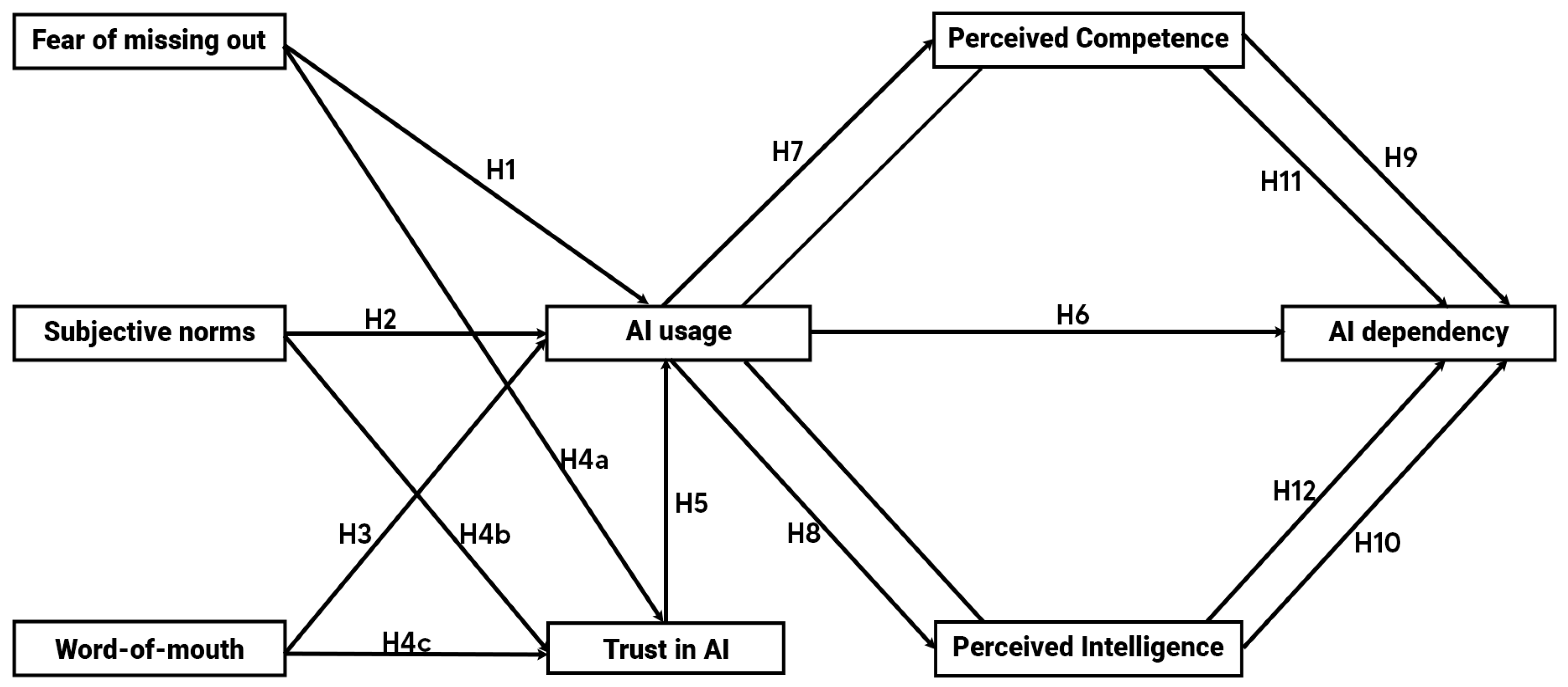
This study proposes an integrated framework, grounded in established theories, to explain students’ AI use and potential dependency. The social drivers include FoMO from SDT, WOM as developed in diffusion and electronic WOM research, the UTAUT social-influence stream, and SN from the TPB and UTAUT. These drivers are hypothesized to shape TAI, which is grounded in TIA and, in turn, promotes AI use. Sustained engagement is further shaped by cognitive appraisals, namely PI informed by CASA and PC from SDT. The model, therefore, tests pathways from the social drivers, through TAI, to intention and use, and from use to dependency, both directly and indirectly via PI and PC.
2.8.1. Fear of Missing Out (FoMO) and AI Usage
FoMO describes the constant feeling folks experience that others are having fun or rewarding experiences while they are not. FoMO is prevalent in today’s interconnected world, such as on social media, but can extend beyond that [24]. There are opportunities students may feel anxious about when using AI-assisted tools, and how their peers may use tools that potentially widen the academic gap; FoMO would be exacerbated as reliance on previously utilized AI tools increases [25]. FoMO pushes people to seek out engagement to alleviate the feeling of being left out, often through technology. FoMO can lead to initial engagement with technology and facilitate immediate potential benefits; however, prolonged use may be associated with anxiety, lack of sleep, and short- to long-term dependence [26]. In student-specific contexts, FoMO may arise from a desire for competence, a lack of rewards and opportunities, and a lack of relatedness, i.e., missing out on social connections with peers [27].
H1.
FoMO positively influences students’ AIU.
2.8.2. Word of Mouth (WOM) and AI Usage
WOM refers to positive or negative statements made about a product by existing or potential users of that product [28]. Electronic WOM on social media and review sites spreads quickly, exerting a strong influence on how individuals evaluate new technology. The characteristics of a review, such as currency, clarity, relevance, and volume, affect whether a consumer will incorporate information into their buying decision [29,30]. AI tools like ChatGPT4 are designed for personalized assistance and ease of use, which entice users to share positive experiences with others and, in turn, encourage them to use the product [31]. Among unfamiliar technology, we often trust opinion leaders and peers as sources of information. Recommendations have strong effects on technology adoption and may transcend cultural and regional lines [32,33].
H2.
WOM positively influences students’ AIU.
2.8.3. Subjective Norms (SNs) and AI Usage
According to [14], SN refers to the perceived social norm for carrying out a given behavior. The various models and theories that apply to the areas of adoption, knowledge diffusion, and TAM initially focused on technical parameters (e.g., relative advantage, perceived usefulness), whilst later forms came to cover social parameters. In educational settings, SN refers to students’ acceptance of new technology [34]. Information from the areas of e-commerce and education shows that friends, family members, lecturers, and peers influence their acceptance of technology [35,36,37]. Students from collectivist cultures who experienced normative social pressures showed increased acceptance of technologies under external social pressure [38].
H3.
SN positively influences students’ AIU.
2.8.4. Trust in AI as a Mediator of Social Influences on AI Usage
TAI is defined as the assumption that a particular AI system will operate dependably, provide accurate and relevant outputs or decisions, and behave aligned with users’ objectives [39]. A stronger sense of TAI reduces perceived risk, increases performance expectations, and subsequently motivates the adoption and continued use of AI in educational contexts [40]. Social signals influence TAI as follows: (i) FoMO can operate as social proof of the reliability of the tool [23]; (ii) SN reinforce TAI when trusted professors or peers promote use of the system [41,42]; and (iii) positive WOM boosts credibility and alleviates concerns of potential users [43]. Based on this argument, the model presumes that TAI mediates the effects of FoMO, SN, and WOM on AI use.
H4a.
TAI mediates the relationship between FoMO and AIU.
H4b.
TAI mediates the relationship between WOM and AIU.
H4c.
TAI mediates the relationship between SNs and AIU.
2.8.5. Trust in AI and AI Usage
Trust positively influences use. Students’ trust in an AI tool leads them to engage with it out of personal desire and motivation rather than through social influence [44]. This trust decreases perceived risk, enhances performance expectancy, and increases preference for personal autonomy, all of which contribute to adoption [39]. The trend in the literature remains consistent: trust is a significant factor influencing the adoption of AI tools in educational contexts [7,22].
H5.
TAI has a positive influence on AIU.
In line with human-automation research, we treat trust as a mediating belief state; peer signals and perceived norms first inform beliefs about system reliability, which subsequently determine the intensity of use [17,18,45].
2.8.6. AI Usage and AI Dependency (AID)
AIU describes the intensity and frequency with which students interact with AI-based tools for their learning practices and serves as a behavioral indicator in acceptance models [46]. More and more students are using large language models and intelligent tutoring systems for a variety of activities, from composing to receiving feedback. An increasing level of engagement could create dependence: Media Dependency Theory argues that dependence emerges when media satisfy important functional and informational needs [47]; routine use can lead to habit formation wherein students experience a pattern of completing workflows only if AI is employed [48]; and social cognitive theory suggests that positive reinforcement (e.g., better marks, efficient workflow) will increase repetition [49]. Research indicates a growing reliance on generative AI for educational purposes [50].
H6.
AIU has a positive influence on students’ AID.
2.8.7. AI Usage and Perceived Competence (PC)
PC represents students’ belief in their ability to successfully use AI to complete academic tasks. When interactions with AI lead to repeated, successful experiences, they offer students mastery experiences and build PC, thereby improving self-efficacy [51,52]. Iterative use provides immediate feedback that incrementally builds competence and confidence [53,54]. The highest level of competence satisfaction is associated with deeper engagement, as expected based on SDT [55].
H7.
AIU positively influences PC.
2.8.8. AI Usage and Perceived Intelligence (PI)
PI refers to users’ assessment of an AI system’s cognitive abilities, accuracy, contextual understanding, adaptability, and language fluency [56]. Through repeated use, students observe personalized, context-sensitive responses and may attribute human-like intelligence [20]. Observing coherent, adaptive outputs reinforces the belief that the AI is “learning,” elevating perceptions of system-level intelligence [57].
H8.
AIU positively influences PI.
2.8.9. Perceived Competence and AI Dependency
Students are more likely to use AI tools when they believe they can successfully accomplish tasks and achieve results [19,58]. AI competence has been associated with task accomplishment, problem solving, and digital literacy [54]. Students’ feelings of competence with AI tools also lead to longer use and, therefore, greater reliance on the tools for learning and productivity [52].
H9.
PC has a positive influence on students’ AID.
2.8.10. Perceived Intelligence and AI Dependency
Intelligent systems, defined as systems that produce correct, personalized, and contextually appropriate responses, foster trust and stimulate anthropomorphism [59,60]. As with other technologies, the PI of AI systems allows students to delegate cognitive work and depend on these systems more. Research indicates that when the line between intelligent systems and the student blurs, this perception of over-dependence can occur, in which learning context and overly favorable features may erode self-regulation [61,62].
H10.
PI has a positive influence on students’ AID.
2.8.11. Perceived Competence as a Mediator
Ryan and Deci’s SDT and its sub-theory, Cognitive Evaluation Theory, state that satisfying the need for competence through mastery experiences drives intrinsic motivation to engage in behavior [55]. AI technologies offer opportunities to reduce the cognitive burden of existing provider practices through task automation, reduced cognitive effort, and personalized performance feedback that drives perceptions of efficiency and perceived mastery [63,64].
When students have repeated successful experiences interacting with an AI, their beliefs increasingly focus on their ability to enact outcomes with the AI, thereby increasing their perceived competence. Perception also develops not just in adoption, but in dependency as well. Specifically, students who perceive their academic success as enabled by AI technologies are likely to prefer using AI technologies within workflows, thereby creating and maintaining patterns of dependency [65,66]. Therefore, PC is a mediating variable in the relationship between AI use and dependency.
H11.
PC mediates the relationship between AIU and AID.
2.8.12. Perceived Intelligence as a Mediator
As students have more opportunities for AI interaction, their perceptions of intelligence will increase, as will their confidence and trust in later outputs [67,68]. Since students perceive AIs as quite intelligent, they will use them as trusted aides in their studies. These perceptions promote flow and bonding, being the two components that lead to habitual (and possibly excessive) use [69,70].
PI, to a certain extent, also mediates the relationship between AI use and dependency, depending on the extent to which it affects students’ cognitive strategies. When students repeatedly use AI, their subjective competencies rise, which may decrease independent effort and cause them to offload reasoning or decision-making onto the AI system. This dependency normalizes over time, creating a compounding cycle in which students begin to trust, or rely on, AI’s intelligence, with greater trust increasing the dependency [71,72].
H12.
PI mediates the relationship between AIU and AID.
2.8.13. AI Dependency
AI dependency is behavioral reliance on AI tools to accomplish academic tasks [9]. However, this dependence is more than repeated use of AI tools; it includes cognitive offloading, less self-regulation, and emotional attachment to AI. Students who are already dependent on AI may find it increasingly challenging to operate without it, which may increase productivity with AI but reduce critical and independent thinking in learning [73]. The result may be increased productivity, but dependency remains a danger, with overdependence on the AI tool or system and cognate avoidance activities leading to the degradation of important knowledge, skills, or identity as a learner [21,74]. If validated psychometrically, AID captures a post-adoption reliance domain (behavioral and cognitive dependence) that is distinct from AI use intensity. If it is not validated (for example, it overlaps with AI usage), it likely captures high-frequency or habitual use rather than dependency per se. The hypotheses tested in the structural model are summarized in Table 2.
Table 2.
Summary of hypotheses tested in the structural model.
2.8.14. Research Model
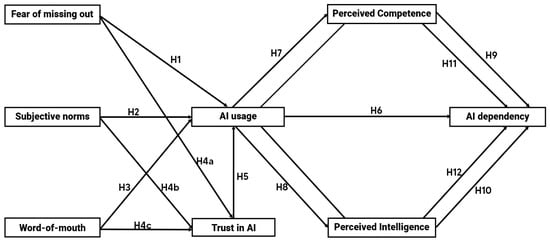
The research model in Figure 1 extends existing technology-acceptance frameworks by incorporating social, cognitive, and behavioral dimensions that influence not just the intention to adopt AI, but also the psychological patterns that may lead to dependency.
Figure 1.
Proposed research model and hypothesized relationships.
3. Materials and Methods
This section describes the study design, sampling, measurement instrument, and analysis approach used to test the proposed staged model from social drivers to AI dependency.
3.1. Design and Sampling
The study employed a cross-sectional survey design in a higher education setting. The target sample consisted of undergraduate and graduate students from universities in North Cyprus. Inclusion required respondents to self-report prior academic use of AI tools so they could meaningfully evaluate the constructs. Ethical clearance was obtained from the Ethics Committee of Cyprus International University. Participation was voluntary and anonymous, and informed consent was obtained on the first page of the questionnaire prior to participation regarding any questions. No incentives were offered, and participants could withdraw at any time without penalty. We used convenience sampling across multiple recruitment channels (course mailing lists/Moodle, social media, and campus events) and applied purposive eligibility screening to include only enrolled North Cyprus University students who reported prior academic use of AI tools. The recruitment phase extended from 10 April to 28 September 2025. There were a total of 1017 submissions. Following the data quality pre-registered screening program (poor attention or logic-check failure, straight-lining, near-zero within-scale variance), there were 965 complete cases. This gave an effective rate of 94.9 percent.
Bias Risk
Given the non-probability (convenience and purposive) sampling approach and voluntary participation, the study may be exposed to selection and coverage biases. Students who are more digitally confident, who already use generative AI frequently, or who hold stronger attitudes toward AI may have been more likely to participate, while those with limited connectivity or lower AI familiarity may be under-represented. To reduce this risk, the survey link was distributed across multiple universities, faculties, and year levels, and data collection remained open for an extended period to maximize reach. Eligibility screening ensured that only currently enrolled higher education students with relevant AI learning exposure were included, and incomplete or inconsistent submissions were removed during data cleaning.
Non-response and reporting biases are also plausible in self-administered surveys, particularly for constructs related to reliance and dependency where respondents may provide socially desirable answers. To mitigate these risks, the questionnaire emphasized anonymity and confidentiality, and participants were informed that there were no right or wrong responses. Items were adapted from validated scales, pretested for clarity, and presented in separate blocks to minimize priming effects. As an additional diagnostic, multicollinearity checks indicated acceptable variance inflation factors (VIF < 5), reducing concerns that inflated correlations drive the structural estimates. Nonetheless, because the data are cross-sectional and self-reported, the findings should be interpreted as associative and may not fully generalize beyond the study context.
3.2. Questionnaire Design and Data Collection
All latent variables were measured with validated multi-item Likert scales (1 = strongly disagree to 5 = strongly agree) adapted to the academic AI context [4,40,75,76,77,78,79,80,81]. The constructs included FoMO, SN, WOM, TAI, AIU, PC, PI, and AID. Content validity was supported through expert review and a pilot test to refine wording and response formatting. Items were organized by construct block and randomized within blocks to reduce method artifacts. The instrument enforced completeness to minimize missing data. To limit common method bias, we implemented procedural remedies including psychological separation of predictors and outcomes, variation in scale anchors where appropriate, and assurances of anonymity. Prior to modeling, we inspected item distributions and identified outliers and confirmed that retained cases met completeness thresholds.
The questionnaire consisted of two sections. Eight demographic questions recorded basic characteristics. Thirty-five statements measured the study’s constructs: FoMO, SN, WOM, TAI, AIU, PC, PI, and AID. Items were adapted from previously validated scales and adjusted for context. Items sample included FoMO (e.g., “I fear that other students using AI tools are gaining more advantages than I am.”); WOM (e.g., “I have been encouraged to use AI tools because of positive feedback from friends or classmates.”); subjective norms (e.g., “People who are important to me think I should rely on AI tools for learning.”); trust in AI (e.g., “When my classmates or teachers recommend an AI tool, I’m more likely to trust it.”); AI usage (e.g., “I use AI tools to improve my efficiency and academic performance.”); perceived competence (e.g., “When I interact with AI tools, I feel competent in my academic abilities.”); perceived intelligence (e.g., “AI tools provide accurate and reliable information that I depend on.”); AI dependency (e.g., “I feel uncomfortable working on academic tasks without using AI tools.”). The full questionnaire is provided as the Supplementary Material (File S1). Feedback was collected via a 5-point Likert scale, with responses ranging from 1 (strongly disagree) to 5 (strongly agree). The instrument was developed with expert input and piloted with a small group of students before full deployment to refine wording and establish face validity.
3.3. Data Analysis
The analyses used both descriptive statistics in SPSS v20 and partial least squares structural equation modeling (PLS SEM; SmartPLS v4). A variance-based estimator was appropriate given the model’s multiple mediators and indirect paths, as well as the difficulty of the data’s underlying normality. This accords with methodological recommendations for analyzing prediction-related research on complex models [82,83]. Bootstrapping with 5000 resamples was used to estimate direct, indirect, and total effects, with bias-corrected confidence intervals. The indicator reliability satisfied the recommended levels of all retained loadings ≥ 0.70. Measures of internal consistency were satisfactory (Cronbach’s alpha ≥ 0.75; composite reliability ≥ 0.85). The convergent validity was confirmed by the AVE which was ≥0.58. Discriminant validity was upheld by both Fornell-Larcker and HTMT. The square root of the AVE was greater than the inter-construct correlations, and HTMT was less than 0.90 for all pairs. An inspection of the cross-loadings revealed one item of trust in AI (TA4) that cross-loaded distinctly on another measure, and this was deleted before estimation of the structural model in order to preserve the discriminant validity of the indicators. The multicollinearity was satisfactory at both the indicator and construct levels (VIF < 5).
Prior to analysis, responses were screened for completeness and response quality. Cases with substantial missing data were excluded; because the survey enforced item completion, missingness was rare and primarily reflected early termination. We removed submissions showing inattentive response patterns such as straight-lining across items or unusually low within-construct variance, and we checked for logical inconsistencies across related items (e.g., indicating no AI use while endorsing high-frequency AI usage statements). Range checks confirmed all values fell within the 1–5 Likert scale. Where minor item-level missingness remained, SmartPLS handled it using its default settings; we also verified that key results were stable under listwise deletion. Collinearity diagnostics (inner VIF) were inspected to reduce bias from multicollinearity. These steps yielded the final analytic sample reported in Section 4.
4. Results
This section reports descriptive characteristics of respondents, evaluates the measurement model (reliability, convergent and discriminant validity), and then tests the structural model and hypotheses using PLS-SEM.
4.1. Descriptive Statistics
Following data cleaning, the analytic sample included 965 usable responses from students at North Cyprus universities. Participants were 61.3% male, and 75.5% were aged 17–25 years. Most were undergraduates (68.4%), and nearly half studied engineering or technology (46.5%). Reported AI use was frequent (54.0% daily; 26.5% weekly), while self-rated familiarity was mainly beginner (46.6%) or intermediate (41.1%). The most common reasons for using AI were to improve academic performance (32.8%) and to try new technology (32.2%). These patterns indicate a young, STEM-leaning cohort with broad exposure to AI but modest self-assessed proficiency, in which peer influence (26.2%) is sizable relative to instructor recommendations (8.9%), foreshadowing social mechanisms that appear later in the structural model. The overall descriptive statistics are as recorded in Table 3.
Table 3.
Descriptive statistics of respondents’ demographic characteristics.
4.2. Measurement Model
Measurement model evaluation followed standard PLS-SEM guidance, assessing internal consistency (Cronbach’s alpha and composite reliability), convergent validity (AVE and loadings), and discriminant validity (Fornell-Larcker and HTMT).
4.2.1. Reliability and Convergent Validity
Reliability and convergent validity for the constructs in the study are presented in Table 4. The appropriateness of the measurement is confirmed, as each standardized factor loading has adequate indicator reliability, exceeding the acceptable cut-off of 0.70. The lowest standardized factor loading was 0.733, thereby indicating reliability for the constructs in the study. The Cronbach’s alpha values ranged from 0.747 to 0.884 and were all in excess of the widely accepted cut-off of 0.70, indicating internal consistency reliability for the constructs in the study. The appropriateness of reliability also extends to the composite reliability (CR), which ranged from 0.851 to 0.912 and exceeded the acceptable cut-off of 0.70, thereby providing further evidence of their reliability. The average variance extracted (AVE) values ranged from 0.582 to 0.665 and exceeded the agreement cut-off of 0.50, thereby providing evidence of adequate convergent validity for the constructs in the study. All constructs met or exceeded normed psychometric levels. Collectively, these results indicate that it is appropriate to proceed to structural tests without concerns about reliability or convergent validity.
Table 4.
Reliability measures for the measurement model.
4.2.2. Discriminant Validity
The test of discriminant validity was achieved through the use of the Fornell-Larcker criterion and the Heterotrait-Monotrait Ratio (HTMT). The results of the Fornell-Larcker criterion indicated that the square root of the average variance extracted (AVE) of each construct was greater than its correlations with the other constructs, thus confirming discriminant validity. The results of the HTMT analysis supported this finding, with HTMT values overall below the more conservative cut-off of 0.90 (ranging from 0.456 (TAI-FoMO) to 0.892 (AIU-TAI)). While the rather high HTMT between AIU and TAI is expectant, due to their theoretical proximity, namely the factor of trust which is the key motivator for willingness to engage in behavioral use, it must be emphasized that this remained below 0.90. Collectively, the results of the Fornell-Larcker criterion, HTMT and cross loadings further endorse the finding that the constructs in the study model are empirically distinct and theoretically coherent (Table 5).
Table 5.
Fornell-Larcker criterion and HTMT ratios.
4.3. Structural Model
Structural model assessment focused on the model’s explanatory and predictive capability using the coefficient of determination (R2) and Stone–Geisser’s predictive relevance (Q2), together with overall model fit indices. As shown in Table 6, all endogenous constructs exceeded the recommended R2 threshold (>0.10) and showed predictive relevance (Q2 > 0) (R2: AID = 0.559; AIU = 0.601; PC = 0.488; PI = 0.470; TAI = 0.436; Q2: AID = 0.494; AIU = 0.502; PC = 0.463; PI = 0.455; TAI = 0.426); the global fit indices also met common cutoffs (SRMR = 0.049 < 0.08; NFI = 0.936 > 0.90).
Table 6.
Coefficient of determination (R2) and (Q2) and model fit (SRMR-NFI).
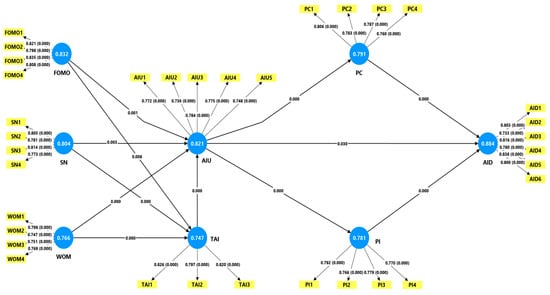
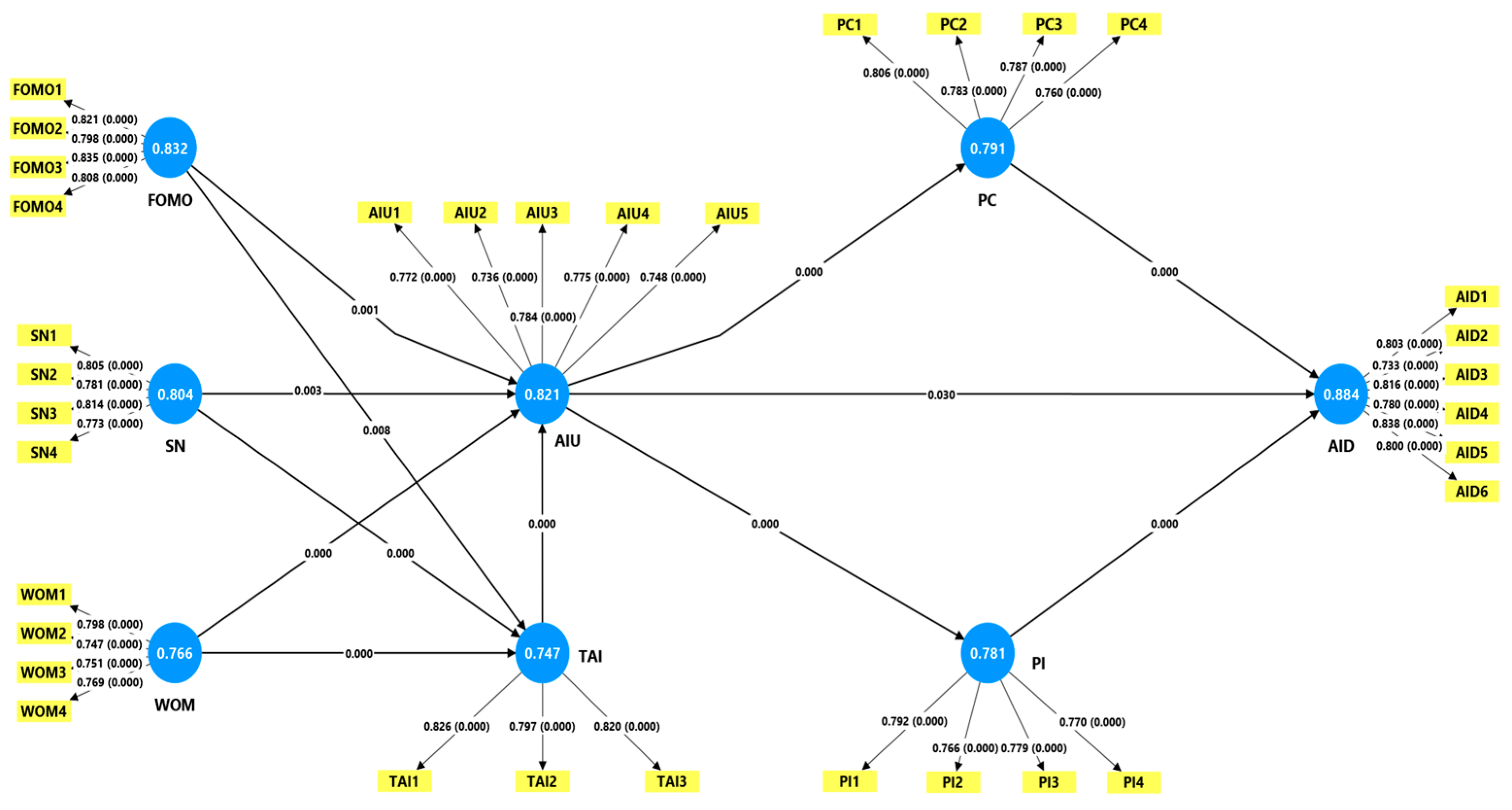
The hypotheses were evaluated using PLS-SEM. Figure 2 presents the structural model, Table 6 summarizes the structural model’s explanatory and predictive quality and model fit, and Table 7 reports the hypothesis testing results.
Figure 2.
Path analysis.
Table 7.
Results of hypothesis testing.
Hypothesis Testing Results
The structural model was estimated via PLS-SEM using 5000 bootstrap resamples. Standardized path coefficients (β), t-values, and p-values indicate strong overall support for the proposed framework in which social influence and trust shape AI usage (AIU), and cognitive appraisals, namely perceived competence (PC) and perceived intelligence (PI), shape AI dependency (AID). Consistent with H1 to H3, Fear of Missing Out (FoMO) (β = 0.138, p = 0.001), subjective norms (SNs) (β = 0.136, p = 0.003), and Word-of-Mouth (WOM) (β = 0.236, p < 0.001) each exert significant direct effects on AIU, with WOM emerging as the strongest social predictor. As anticipated in H5, trust in AI (TAI) is the most proximal determinant of usage (β = 0.400, p < 0.001), exceeding the impact of any single social driver and underscoring the centrality of credibility judgments for translating intention into behavior.
The mediation analyses for H4a–H4c clarify how social signals translate into use. A substantial share of social influence operates through trust. Decomposing effects show that the total influence of FoMO on AIU is 0.187, of which 0.049 is indirect through TAI, corresponding to 26.2 percent mediation. For SN, the total is 0.218, with 0.082 indirect, corresponding to 37.6 percent mediation. For WOM, the total is 0.399, with an indirect effect of 0.163, corresponding to 40.9 percent mediation. These proportions indicate that peer conversations and perceived expectations do not merely nudge behavior. They legitimize AI through elevated trust, which then amplifies subsequent use. In practical terms, TAI functions as the mechanism that converts diffuse social pressure and peer discourse into sustained behavioral engagement, rather than serving as a simple correlate of adoption.
Turning to the dependencies, H6-H12 reveal that usage alone is an insufficient explanation. The direct path from AIU to AID is positive yet modest (β = 0.102, p = 0.030). By contrast, the cognitive routes are substantively large. Frequent, successful use strongly heightens PC (β = 0.699, p < 0.001) and PI (β = 0.686, p < 0.001), and both appraisals, in turn, predict dependency (PC → AID: β = 0.334, p < 0.001; PI → AID: β = 0.400, p < 0.001). The indirect effects from use to dependency via PC (β = 0.233, p < 0.001) and via PI (β = 0.274, p < 0.001) exceed the direct effect, which establishes that reliance is driven primarily by belief change rather than by usage frequency alone. Summing components, the total effect of AIU on AID is 0.609, of which 83.3 percent ((0.233 + 0.274)/0.609) is mediated through PC and PI. Moreover, PI is a slightly stronger predictor of dependency than PC, suggesting that attributions about the system’s intelligence marginally outweigh self-efficacy-based gains in sustaining reliance. This nuance aligns with trust in automation’s calibration of reliance and with CASA’s perspectives on social presence and anthropomorphism, increasing deference to machine output.
These results jointly delineate a serial mechanism that separates adoption from over-reliance on theoretical grounds. Social cues increase trust, trust increases usage, and repeated successful use reshapes appraisals of competence and intelligence, which, in turn, increases dependency. Adoption is predominantly a social and trust process, with approximately 26 to 41 percent of social effects on use transmitted through trust, which pinpoints TAI as the gateway that converts peer talk and norms into actual behavior. Dependency is predominantly a cognitive process, with roughly five-sixths of dependency linkage use carried by PC and PI, indicating that repeated successful use reshapes appraisals and thereby normalizes reliance. Together, these findings address the editor’s request by explicating the mediation pathways and cognitive mechanisms with effect decompositions and relative magnitudes, while also offering a precise theoretical integration in which social influence builds trust that facilitates adoption, and usage builds appraisals that foster dependency.
5. Discussion
This study extends current theory on students’ adoption and dependence on generative AI by illuminating a sequential mechanism: social influence builds trust, trust drives use, and use alters cognitive appraisals, thereby leading to dependence. Importantly, it is not merely that students adopt AI because peers encourage them, but that peers legitimize AI and reduce perceived risk, thereby fostering trust. Our results show that word-of-mouth and subjective norms do predict use, but a sizable portion of their impact is channeled through trust; effect decompositions suggest that roughly one-quarter to two-fifths of the influence of social factors operates indirectly via trust. This finding aligns with emerging evidence that trust is pivotal in generative-AI adoption [7,84]. Wang and colleagues’ mixed-methods study found that trust in generative AI significantly predicts behavioral intention, with its effect mediated by reliance and resistance. Similarly, Shahzad et al. reported that ChatGPT awareness influences adoption intention through perceived ease of use, usefulness, and intelligence, and that trust moderates those relationships [7]. Our work elaborates on these findings by placing trust as the conversion mechanism through which social signals shape behavior: students may feel FoMO or observe widespread endorsement, but they commit to use only when the system is perceived as trustworthy.
A second theoretical contribution is the separation of adoption from dependency and the identification of cognitive appraisals as the main engine of reliance. The direct link from use to dependency in our model was small; most of the effect flowed through perceived competence and perceived intelligence. In other words, perceived competence reflects students’ self-efficacy in using AI, whereas perceived intelligence reflects the extent to which students attribute human-like cognitive capability to the AI system. This suggests that students become dependent not simply because they use AI often but because their use reshapes their beliefs about their own abilities and the system’s capabilities. This view resonates with self-determination theory, which posits that perceived competence drives continued engagement, and with research showing that perceived intelligence of AI tutors can increase engagement and learning interest [50]. Ref. [50] found that AI instructors’ self-disclosure raised students’ emotional attachment, learning interest, and knowledge gain. To compound the issue, dependency on AI is directly associated with negative academic variables. Abbas et al. showed that students who frequently use ChatGPT exhibit increased procrastination, memory loss, and reduced academic performance [85]. Thus, these results, in concern with our mediation effects, show that the perception of AI benefits can create a feedback loop that leads to dependency and hinders independent problem-solving.
Third, the findings underscore the ambivalent role of anthropomorphism in shaping cognitive appraisals. Anthropomorphic cues such as conversational tone or self-disclosure can increase perceived intelligence and emotional attachment [50], but they may also encourage uncritical acceptance. Placani’s essay warns that anthropomorphism can exaggerate AI capabilities and distort moral judgements [86]. Our results show that perceived intelligence is slightly more influential than perceived competence in predicting dependency. This suggests that when students see an AI tool as “smart,” they may defer to it even when their own competence has improved. The finding integrates the Computers-as-Social-Actors (CASAs) paradigm, which holds that users apply social heuristics to AI, with trust-in-automation research that stresses calibration. AI systems designed with human-like cues must therefore balance engagement benefits with mechanisms to prevent over-trust.
Finally, by bringing together constructs from self-determination theory, CASA, uses-and-gratifications, the theory of planned behavior, UTAUT, and trust in automation, this study provides a unified explanation of how social and psychological factors operate at different stages of AI adoption and dependency. It corroborates recent work showing that subjective norms are not always strong predictors of AI adoption [87]. In their extended technology acceptance model with 943 students, Ursavas and colleagues found that attitudes, usefulness, and self-efficacy predicted behavioral intention, whereas subjective norms had limited influence. Our results refine that picture by showing that, while normative pressures matter, they matter principally by shaping trust. Further, research on teachers’ trust in AI-powered educational technology suggests that perceived benefits and concerns, rather than demographics, determine trust [88]. This supports our inference that students’ trust similarly depends on balancing perceived advantages against risks. Thus, successful integration of AI in education requires not only promoting adoption but also safeguarding against dependency through critical appraisal and trust calibration.
5.1. Implications
Pedagogical design should foster trust calibration rather than unbridled enthusiasm. From a sustainability (SDG 4) perspective, these recommendations support responsible AI integration by strengthening learning quality and autonomy while reducing the risk of over-reliance. Embedding short reflection logs in assignments where students document what AI produced, what they retained, and why it can encourage mindful use and help maintain autonomy. Rotating peer verification groups to review sources and assumptions can harness the positive aspects of word of mouth while moderating risk. Sequencing tasks so that students first plan or outline without AI, then move to assisted phases, can preserve core skills. Institutions should provide AI literacy programs that explain system operations, common failure modes, and ethical considerations, and set discipline-specific boundaries for acceptable use. Attention to anthropomorphic cues is also needed: while conversational interfaces can enhance engagement, clear prompts and feedback should remind users to verify outputs and recognize AI limitations.
5.2. Limitations and Future Research
The research relies on self-reported, cross-sectional data from universities in North Cyprus. Self-reports may be influenced by social desirability and recall bias, and cross-sectional designs do not permit causal inference and may inflate mediation effects. The sampling frame may limit generalizability to other similar cultural, institutional contexts. Future studies should employ longitudinal or experimental designs to determine the directional nature of the proposed pathways. The modified measure of dependency should support additional validation across disciplines, genders, and cultural contexts. Additional variables, such as prior experience, personality characteristics, and institutional or organizational policies, may moderate adoption and dependency, which should be included in subsequent models. Also, since AI tools are evolving rapidly, future work should address how trust, attitudes, self-regulation, and dependency co-evolve, and the efficacy of interventions (e.g., trust-calibration reminders or AI-off checkpoints) to avoid undermining critically engaged use.
6. Conclusions
Using survey data from 965 university students in North Cyprus and PLS-SEM, this study tested a staged model linking social drivers (FoMO, WOM, and SN) to TAI, AIU, and AID. The results show that FoMO, WOM, and SN significantly predict AIU and that a substantial share of these social effects operates through TAI. TAI is the strongest proximal determinant of AIU.
AIU is driven primarily by post-usage cognitive appraisals rather than usage frequency alone. AIU strongly increases PC and PI, and both appraisals significantly predict dependency; the indirect pathways via PC and PI exceed the direct AI usage–dependency link. PI exerts a slightly stronger effect than PC, indicating that attributing high intelligence to the system is a key mechanism that sustains reliance.
These findings distinguish adoption from dependency and identify leverage points for responsible and sustainable AI integration in higher education. Trust calibration and verification practices address the gateway from social influence to sustained use, while instructional design that preserves independent problem-solving and metacognitive monitoring addresses the pathway from use to dependency. In SDG 4 terms, sustainable AI-enabled learning requires governance that maintains learning autonomy and critical thinking while leveraging AI for academic support.
Supplementary Materials
The following supporting information can be downloaded at https://www.mdpi.com/article/10.3390/su18031598/s1, The full questionnaire is provided as the Supplementary Material (File S1).
Author Contributions
Conceptualization, A.M.K. and K.J.; Data Curation, A.M.K. and K.J.; Formal Analysis, A.M.K. and K.J.; Investigation, A.M.K. and K.J.; Methodology, A.M.K. and K.J.; Project Administration, A.M.K. and K.J.; Resources, A.M.K. and K.J.; Software, A.M.K. and K.J.; Supervision, A.M.K. and K.J.; Validation, A.M.K. and K.J.; Visualization, A.M.K. and K.J.; Writing—Original Draft, A.M.K. and K.J.; Writing—Review and Editing, A.M.K. and K.J. All authors have read and agreed to the published version of the manuscript.
Funding
This research received no funding.
Institutional Review Board Statement
The study was conducted in accordance with the Declaration of Helsinki and approved by the Ethics Committee of Cyprus International University (EKK24-25/09/03, 16 April 2025).
Informed Consent Statement
Informed consent was obtained from all subjects involved in the study.
Data Availability Statement
The data presented in this study are available on request from the corresponding author. The data are not publicly available due to privacy or ethical restrictions.
Acknowledgments
The authors express their sincere gratitude to the university students who volunteered for this research and shared their valuable experiences with the use of artificial intelligence in higher education. Special appreciation is also extended to academic colleagues and institutional administrators in North Cyprus who facilitated data collection and provided constructive feedback on the study design. The authors further acknowledge insightful discussions with peers specializing in educational technology and digital trust, which helped enhance the theoretical and analytical rigor of this study.
Conflicts of Interest
The authors declare no conflicts of interest.
Abbreviations
The following abbreviations are used in this manuscript:
| AI | Artificial intelligence |
| AID | AI dependency |
| AIU | AI usage |
| AVE | Average variance extracted |
| CASA | Computers-as-social-actors |
| CR | Composite reliability |
| FoMO | Fear of missing out |
| HTMT | Heterotrait–monotrait ratio |
| PC | Perceived competence |
| PI | Perceived intelligence |
| PLS-SEM | Partial least squares structural equation modeling |
| SDT | Self-determination theory |
| SN | Subjective norms |
| SPSS | Statistical Package for the Social Sciences |
| TAI | Trust in AI |
| TAM | Technology acceptance model |
| TIA | Trust in automation |
| TPB | Theory of planned behavior |
| UTAUT | Unified theory of acceptance and use of technology |
| VIF | Variance inflation factor |
| WOM | Word of mouth |
References
- Abdullah, H.; Sahudin, Z.; Zahidah Bahrudin, N.; Bujang, I.; Khalid, K. Determinants of Educational Technology Acceptance: An Integration of TAM and UTAUT. Asian J. Univ. Educ. (AJUE) 2023, 19, 638–650. [Google Scholar] [CrossRef] [Scilit]
- Huang, R.; Spector, J.M.; Yang, J. Systems Perspective of Educational Technology. In Educational Technology; Lecture Notes in Educational Technology; Springer: Singapore, 2019; pp. 65–76. [Google Scholar] [CrossRef] [Scilit]
- Wach, K.; Duong, C.D.; Ejdys, J.; Kazlauskaitė, R.; Korzynski, P.; Mazurek, G.; Paliszkiewicz, J.; Ziemba, E. The Dark Side of Generative Artificial Intelligence: A Critical Analysis of Controversies and Risks of ChatGPT. Entrep. Bus. Econ. Rev. 2023, 11, 7–30. [Google Scholar] [CrossRef] [Scilit]
- Capinding, A.T. Development and Validation of Instruments for Assessing the Impact of Artificial Intelligence on Students in Higher Education. Int. J. Educ. Methodol. 2024, 10, 197–211. [Google Scholar] [CrossRef] [Scilit]
- Chu, H.C.; Hwang, G.H.; Tu, Y.F.; Yang, K.H. Roles and Research Trends of Artificial Intelligence in Higher Education: A Systematic Review of the Top 50 Most-Cited Articles. Australas. J. Educ. Technol. 2022, 38, 22–42. [Google Scholar]
- Al-Zahrani, A.M.; Alasmari, T.M. Exploring the Impact of Artificial Intelligence on Higher Education: The Dynamics of Ethical, Social, and Educational Implications. Humanit. Soc. Sci. Commun. 2024, 11, 912. [Google Scholar] [CrossRef] [Scilit]
- Shahzad, M.F.; Xu, S.; Javed, I. ChatGPT Awareness, Acceptance, and Adoption in Higher Education: The Role of Trust as a Cornerstone. Int. J. Educ. Technol. High. Educ. 2024, 21, 46. [Google Scholar] [CrossRef] [Scilit]
- Hua, S.; Jin, S.; Jiang, S. The Limitations and Ethical Considerations of ChatGPT. Data Intell. 2025, 6, 201–239. [Google Scholar] [CrossRef] [Scilit]
- Zhai, C.; Wibowo, S.; Li, L.D. The Effects of Over-Reliance on AI Dialogue Systems on Students’ Cognitive Abilities: A Systematic Review. Smart Learn. Environ. 2024, 11, 28. [Google Scholar] [CrossRef] [Scilit]
- Parasuraman, R.; Riley, V. Humans and Automation: Use, Misuse, Disuse, Abuse. Hum. Factors 1997, 39, 230–253. [Google Scholar] [CrossRef] [Scilit]
- Bhullar, P.S.; Joshi, M.; Chugh, R. ChatGPT in Higher Education—A Synthesis of the Literature and a Future Research Agenda. Educ. Inf. Technol. 2024, 29, 21501–21522. [Google Scholar] [CrossRef] [Scilit]
- Kasneci, E.; Sessler, K.; Küchemann, S.; Bannert, M.; Dementieva, D.; Fischer, F.; Gasser, U.; Groh, G.; Günnemann, S.; Hüllermeier, E.; et al. ChatGPT for Good? On Opportunities and Challenges of Large Language Models for Education. Learn. Individ. Differ. 2023, 103, 102274. [Google Scholar] [CrossRef] [Scilit]
- Risko, E.F.; Gilbert, S.J. Cognitive Offloading. Trends Cogn. Sci. 2016, 20, 676–688. [Google Scholar] [CrossRef] [Scilit]
- Ajzen, I. The Theory of Planned Behavior. Organ. Behav. Hum. Decis. Process. 1991, 50, 179–211. [Google Scholar] [CrossRef] [Scilit]
- Cheung, C.M.K.; Thadani, D.R. The Impact of Electronic Word-of-Mouth Communication: A Literature Analysis and Integrative Model. Decis. Support Syst. 2012, 54, 461–470. [Google Scholar] [CrossRef] [Scilit]
- Venkatesh, V.; Morris, M.G.; Davis, G.B.; Davis, F.D. User Acceptance of Information Technology: Toward A Unified View1. Manag. Inf. Syst. Q. 2003, 27, 425–478. [Google Scholar] [CrossRef] [Scilit]
- Glikson, E.; Woolley, A.W. Human Trust in Artificial Intelligence: Review of Empirical Research. Acad. Manag. Ann. 2020, 14, 627–660. [Google Scholar] [CrossRef] [Scilit]
- Lee, J.D.; See, K.A. Trust in Automation: Designing for Appropriate Reliance. Hum. Factors 2004, 46, 50–80. [Google Scholar] [CrossRef] [Scilit] [PubMed]
- Deci, E.L.; Ryan, R.M. The “What” and “Why” of Goal Pursuits: Human Needs and the Self-Determination of Behavior. Psychol. Inq. 2000, 11, 227–268. [Google Scholar] [CrossRef] [Scilit]
- Nass, C.; Moon, Y. Machines and Mindlessness: Social Responses to Computers. J. Soc. Issues 2000, 56, 81–103. [Google Scholar] [CrossRef] [Scilit]
- Jurišević, N.; Nikolić, N.; Nemś, A.; Gordić, D.; Rakić, N.; Končalović, D.; Kocsis, D. Bridging LLMs, Education, and Sustainability: Guiding Students in Local Community Initiatives. Sustainability 2025, 17, 10148. [Google Scholar] [CrossRef] [Scilit]
- Ayanwale, M.A.; Ndlovu, M. Investigating Factors of Students’ Behavioral Intentions to Adopt Chatbot Technologies in Higher Education: Perspective from Expanded Diffusion Theory of Innovation. Comput. Hum. Behav. Rep. 2024, 14, 100396. [Google Scholar] [CrossRef] [Scilit]
- Li, H. I Cannot Miss It for the World: The Relationship Between Fear of Missing out (FOMO) and Acceptance of ChatGPT. Basic Appl. Soc. Psychol. 2024, 46, 285–294. [Google Scholar] [CrossRef] [Scilit]
- Oberst, U.; Wegmann, E.; Stodt, B.; Brand, M.; Chamarro, A. Negative Consequences from Heavy Social Networking in Adolescents: The Mediating Role of Fear of Missing Out. J. Adolesc. 2017, 55, 51–60. [Google Scholar] [CrossRef] [Scilit]
- Elhai, J.D.; Levine, J.C.; Alghraibeh, A.M.; Alafnan, A.A.; Aldraiweesh, A.A.; Hall, B.J. Fear of Missing out: Testing Relationships with Negative Affectivity, Online Social Engagement, and Problematic Smartphone Use. Comput. Hum. Behav. 2018, 89, 289–298. [Google Scholar] [CrossRef] [Scilit]
- Dempsey, A.E.; O’Brien, K.D.; Tiamiyu, M.F.; Elhai, J.D. Fear of Missing out (FoMO) and Rumination Mediate Relations between Social Anxiety and Problematic Facebook Use. Addict. Behav. Rep. 2019, 9, 100150. [Google Scholar] [CrossRef] [Scilit]
- Yang, X.; Song, B.; Chen, L.; Ho, S.S.; Sun, J. Technological Optimism Surpasses Fear of Missing out: A Multigroup Analysis of Presumed Media Influence on Generative AI Technology Adoption across Varying Levels of Technological Optimism. Comput. Hum. Behav. 2025, 162, 108466. [Google Scholar] [CrossRef] [Scilit]
- Farzin, M.; Fattahi, M. EWOM through Social Networking Sites and Impact on Purchase Intention and Brand Image in Iran. J. Adv. Manag. Res. 2018, 15, 161–183. [Google Scholar] [CrossRef] [Scilit]
- Filieri, R.; McLeay, F. E-WOM and Accommodation. J. Travel Res. 2014, 53, 44–57. [Google Scholar] [CrossRef] [Scilit]
- Erkan, I.; Evans, C. The Influence of EWOM in Social Media on Consumers’ Purchase Intentions: An Extended Approach to Information Adoption. Comput. Hum. Behav. 2016, 61, 47–55. [Google Scholar] [CrossRef] [Scilit]
- Xu, S.; Khan, K.I.; Shahzad, M.F. Examining the Influence of Technological Self-Efficacy, Perceived Trust, Security, and Electronic Word of Mouth on ICT Usage in the Education Sector. Sci. Rep. 2024, 14, 16196. [Google Scholar] [CrossRef] [Scilit] [PubMed]
- Goyette, I.; Ricard, L.; Bergeron, J.; Marticotte, F. E-WOM Scale: Word-of-Mouth Measurement Scale for e-Services Context. Can. J. Adm. Sci. 2010, 27, 5–23. [Google Scholar] [CrossRef] [Scilit]
- Huete-Alcocer, N. A Literature Review of Word of Mouth and Electronic Word of Mouth: Implications for Consumer Behavior. Front. Physiol. 2017, 8, 1256. [Google Scholar] [CrossRef] [Scilit] [PubMed]
- Al Kurdi, B.; Alshurideh, M.; Nuseir, M.; Aburayya, A.; Salloum, S.A. The Effects of Subjective Norm on the Intention to Use Social Media Networks: An Exploratory Study Using PLS-SEM and Machine Learning Approach. Adv. Intell. Syst. Comput. 2021, 1339, 581–592. [Google Scholar] [CrossRef] [Scilit]
- Aslam, W.; Ahmed Siddiqui, D.; Arif, I.; Farhat, K. Chatbots in the Frontline: Drivers of Acceptance. Kybernetes 2023, 52, 3781–3810. [Google Scholar] [CrossRef] [Scilit]
- Martin, T. A Literature Review on The Technology Acceptance Model. Int. J. Acad. Res. Bus. Soc. Sci. 2022, 12, 2702–2727. [Google Scholar] [CrossRef] [Scilit] [PubMed]
- Osakwe, C.N.; Hudik, M.; Říha, D.; Stros, M.; Ramayah, T. Critical Factors Characterizing Consumers’ Intentions to Use Drones for Last-Mile Delivery: Does Delivery Risk Matter? J. Retail. Consum. Serv. 2022, 65, 102865. [Google Scholar] [CrossRef] [Scilit]
- Lee, C.B.P.; Wan, G. Including Subjective Norm and Technology Trust in the Technology Acceptance Model: A Case of E-Ticketing in China. Data Base Adv. Inf. Syst. 2010, 41, 40–51. [Google Scholar] [CrossRef] [Scilit]
- Nazaretsky, T.; Mejia-Domenzain, P.; Swamy, V.; Frej, J.; Käser, T. The Critical Role of Trust in Adopting AI-Powered Educational Technology for Learning: An Instrument for Measuring Student Perceptions. Comput. Educ. Artif. Intell. 2025, 8, 100368. [Google Scholar] [CrossRef] [Scilit]
- Abdelkader, O.A. ChatGPT’s Influence on Customer Experience in Digital Marketing: Investigating the Moderating Roles. Heliyon 2023, 9, e18770. [Google Scholar] [CrossRef] [Scilit]
- Gong, Z.; Han, Z.; Li, X.; Yu, C.; Reinhardt, J.D. Factors Influencing the Adoption of Online Health Consultation Services: The Role of Subjective Norm, Trust, Perceived Benefit, and Offline Habit. Front. Public Health 2019, 7, 286. [Google Scholar] [CrossRef] [Scilit] [PubMed]
- Liu, N. Exploring the Factors Influencing the Adoption of Artificial Intelligence Technology by University Teachers: The Mediating Role of Confidence and AI Readiness. BMC Psychol. 2025, 13, 311. [Google Scholar] [CrossRef] [Scilit]
- Sudaryanto, S.; Hanim, A.; Rosediana Dewi, I.; Kartikasari, A.D.; Rusdiyanto, R. The Mediating Effect of Customer Trust of E-WOM and Online Customer Reviews Impacting Purchase Decision of Household Electronic Products at a Marketplace: Evidence from Indonesia. Cogent Bus. Manag. 2025, 12, 2503093. [Google Scholar] [CrossRef] [Scilit]
- McGrath, M.J.; Lack, O.; Tisch, J.; Duenser, A. Measuring Trust in Artificial Intelligence: Validation of an Established Scale and Its Short Form. Front. Artif. Intell. 2025, 8, 1582880. [Google Scholar] [CrossRef] [Scilit]
- Hoff, K.A.; Bashir, M. Trust in Automation. Hum. Factors 2015, 57, 407–434. [Google Scholar] [CrossRef] [Scilit] [PubMed]
- Morales-García, W.C.; Sairitupa-Sanchez, L.Z.; Morales-García, S.B.; Morales-García, M. Development and Validation of a Scale for Dependence on Artificial Intelligence in University Students. Front. Educ. 2024, 9, 1323898. [Google Scholar] [CrossRef] [Scilit]
- Ball-Rokeach, S.J.; Defleur, M.L. A Dependency Model of Mass-Media Effects. Commun. Res. 1976, 3, 3–21. [Google Scholar] [CrossRef] [Scilit]
- Zaman, S.U.; Ali, S.S.; Alam, S.H.; Kamal, M.H. Assessing Student’s Behavioral Intentions Towards AI Based Learning Tools. J. Asian Dev. Stud. 2025, 14, 656–672. [Google Scholar] [CrossRef] [Scilit]
- Bandura, A. Human Agency in Social Cognitive Theory. Am. Psychol. 1989, 44, 1175–1184. [Google Scholar] [CrossRef]
- Zhang, S.; Zhao, X.; Nan, D.; Kim, J.H. Beyond Learning with Cold Machine: Interpersonal Communication Skills as Anthropomorphic Cue of AI Instructor. Int. J. Educ. Technol. High. Educ. 2024, 21, 27. [Google Scholar] [CrossRef] [Scilit]
- Locke, E.A. Book Review Self-Efficacy: The Exercise of Control. Child Dev. 2008, 72, 801–804. [Google Scholar]
- Hatlevik, O.E. Examining the Relationship between Teachers’ Self-Efficacy, Their Digital Competence, Strategies to Evaluate Information, and Use of ICT at School. Scand. J. Educ. Res. 2017, 61, 555–567. [Google Scholar] [CrossRef] [Scilit]
- Grolnick, W.S.; Raftery-Helmer, J.N. Contexts Supporting Self-Regulated Learning at School Transitions. In Self-Regulated Learning Interventions with At-Risk Youth: Enhancing Adaptability, Performance, and Well-Being; American Psychological Association: Washington, DC, USA, 2015; pp. 251–276. [Google Scholar] [CrossRef] [Scilit]
- Ahn, Y.H.; Oh, E.Y. Effects of the International Training Program for Enhancing Intelligent Capabilities through Blended Learning on Computational Thinking, Artificial Intelligence Competencies, and Core Competencies for the Future Society in Graduate Students. Appl. Sci. 2024, 14, 991. [Google Scholar] [CrossRef] [Scilit]
- Ryan, R.M.; Deci, E.L. Intrinsic and Extrinsic Motivations: Classic Definitions and New Directions. Contemp. Educ. Psychol. 2000, 25, 54–67. [Google Scholar] [CrossRef] [Scilit]
- Balakrishnan, J.; Dwivedi, Y.K. Conversational Commerce: Entering the next Stage of AI-Powered Digital Assistants. Ann. Oper. Res. 2021, 333, 653–687. [Google Scholar] [CrossRef] [Scilit]
- Nguyen, Q.N.; Ta, A.; Prybutok, V. An Integrated Model of Voice-User Interface Continuance Intention: The Gender Effect. Int. J. Hum. Comput. Interact. 2019, 35, 1362–1377. [Google Scholar] [CrossRef] [Scilit]
- Luo, Y.; Lin, J.; Yang, Y. Students’ Motivation and Continued Intention with Online Self-Regulated Learning: A Self-Determination Theory Perspective. Z. Erzieh. 2021, 24, 1379–1399. [Google Scholar] [CrossRef] [Scilit]
- Epley, N.; Waytz, A.; Cacioppo, J.T. On Seeing Human: A Three-Factor Theory of Anthropomorphism. Psychol. Rev. 2007, 114, 864–886. [Google Scholar] [CrossRef] [Scilit]
- Chen, J.V.; Yen, D.C.; Pornpriphet, W.; Widjaja, A.E. E-Commerce Web Site Loyalty: A Cross Cultural Comparison. Inf. Syst. Front. 2014, 17, 1283–1299. [Google Scholar] [CrossRef] [Scilit]
- Prentice, C.; Dominique Lopes, S.; Wang, X. The Impact of Artificial Intelligence and Employee Service Quality on Customer Satisfaction and Loyalty. J. Hosp. Mark. Manag. 2020, 29, 739–756. [Google Scholar] [CrossRef] [Scilit]
- Chuah, S.H.W.; Aw, E.C.X.; Yee, D. Unveiling the Complexity of Consumers’ Intention to Use Service Robots: An FsQCA Approach. Comput. Hum. Behav. 2021, 123, 106870. [Google Scholar] [CrossRef] [Scilit]
- Zhang, Q.; Liao, G.; Ran, X.; Wang, F. The Impact of AI Usage on Innovation Behavior at Work: The Moderating Role of Openness and Job Complexity. Behav. Sci. 2025, 15, 491. [Google Scholar] [CrossRef] [Scilit]
- Liu, Y.; Li, Y.; Song, K.; Chu, F. The Two Faces of Artificial Intelligence (AI): Analyzing How AI Usage Shapes Employee Behaviors in the Hospitality Industry. Int. J. Hosp. Manag. 2024, 122, 103875. [Google Scholar] [CrossRef] [Scilit]
- Bergdahl, N.; Sjöberg, J. Attitudes, Perceptions and AI Self-Efficacy in K-12 Education. Comput. Educ. Artif. Intell. 2025, 8, 100358. [Google Scholar] [CrossRef] [Scilit]
- Samimi Dehkordi, S.; Radević, I.; Černe, M.; Božič, K.; Lamovšek, A. The Three-Way Interaction of Autonomy, Openness to Experience, and Techno-Invasion in Predicting Employee Creativity. J. Creat. Behav. 2025, 59, e679. [Google Scholar] [CrossRef] [Scilit]
- Ma, N.; Khynevych, R.; Hao, Y.; Wang, Y. Effect of Anthropomorphism and Perceived Intelligence in Chatbot Avatars of Visual Design on User Experience: Accounting for Perceived Empathy and Trust. Front. Comput. Sci. 2025, 7, 1531976. [Google Scholar] [CrossRef] [Scilit]
- Skulmowski, A. Placebo or Assistant? Generative AI Between Externalization and Anthropomorphization. Educ. Psychol. Rev. 2024, 36, 58. [Google Scholar] [CrossRef] [Scilit]
- Zhou, T.; Zhang, C. Examining Generative AI User Intermittent Discontinuance from a C-A-C Perspective. Int. J. Hum. Comput. Interact. 2025, 41, 6377–6387. [Google Scholar] [CrossRef] [Scilit]
- Balakrishnan, J.; Abed, S.S.; Jones, P. The Role of Meta-UTAUT Factors, Perceived Anthropomorphism, Perceived Intelligence, and Social Self-Efficacy in Chatbot-Based Services? Technol. Forecast. Soc. Change 2022, 180, 121692. [Google Scholar] [CrossRef] [Scilit]
- Wei, X.; Wang, L.; Lee, L.K.; Liu, R. The Effects of Generative AI on Collaborative Problem-Solving and Team Creativity Performance in Digital Story Creation: An Experimental Study. Int. J. Educ. Technol. High. Educ. 2025, 22, 23. [Google Scholar] [CrossRef] [Scilit]
- Moore, L.J.; Gerlich, M. AI Tools in Society: Impacts on Cognitive Offloading and the Future of Critical Thinking. Societies 2025, 15, 6. [Google Scholar] [CrossRef] [Scilit]
- Yavich, R. Will the Use of AI Undermine Students Independent Thinking? Educ. Sci. 2025, 15, 669. [Google Scholar] [CrossRef] [Scilit]
- Yankouskaya, A.; Liebherr, M.; Ali, R. Can ChatGPT Be Addictive? A Call to Examine the Shift from Support to Dependence in AI Conversational Large Language Models. Hum.-Centric Intell. Syst. 2025, 5, 77–89. [Google Scholar] [CrossRef] [Scilit]
- Jierasup, S.; Leelasantitham, A. A Change from Negative to Positive of Later Adoption Using the Innovation Decision Process to Imply Sustainability for HR Chatbots of Private Companies in Thailand. Sustainability 2024, 16, 5641. [Google Scholar] [CrossRef] [Scilit]
- Jo, H. Understanding AI Tool Engagement: A Study of ChatGPT Usage and Word-of-Mouth among University Students and Office Workers. Telemat. Inform. 2023, 85, 102067. [Google Scholar] [CrossRef] [Scilit]
- Kong, S.C.; Yang, Y.; Hou, C. Examining Teachers’ Behavioural Intention of Using Generative Artificial Intelligence Tools for Teaching and Learning Based on the Extended Technology Acceptance Model. Comput. Educ. Artif. Intell. 2024, 7, 100328. [Google Scholar] [CrossRef] [Scilit]
- Osemeahon, O.S.; Agoyi, M. Linking FOMO and Smartphone Use to Social Media Brand Communities. Sustainability 2020, 12, 2166. [Google Scholar] [CrossRef] [Scilit]
- Mohd Rahim, N.I.; Iahad, N.A.; Yusof, A.F.; Al-Sharafi, M.A. AI-Based Chatbots Adoption Model for Higher-Education Institutions: A Hybrid PLS-SEM-Neural Network Modelling Approach. Sustainability 2022, 14, 12726. [Google Scholar] [CrossRef] [Scilit]
- Xia, Q.; Chiu, T.K.F.; Lee, M.; Sanusi, I.T.; Dai, Y.; Chai, C.S. A Self-Determination Theory (SDT) Design Approach for Inclusive and Diverse Artificial Intelligence (AI) Education. Comput. Educ. 2022, 189, 104582. [Google Scholar] [CrossRef] [Scilit]
- Yao, X.; Xi, Y. Pathways Linking Expectations for AI Chatbots to Loyalty: A Moderated Mediation Analysis. Technol. Soc. 2024, 78, 102625. [Google Scholar] [CrossRef] [Scilit]
- Hair, J.F.; Risher, J.J.; Sarstedt, M.; Ringle, C.M. When to Use and How to Report the Results of PLS-SEM. Eur. Bus. Rev. 2019, 31, 2–24. [Google Scholar] [CrossRef] [Scilit]
- Henseler, J.; Ringle, C.M.; Sinkovics, R.R. The Use of Partial Least Squares Path Modeling in International Marketing. Adv. Int. Mark. 2009, 20, 277–319. [Google Scholar] [CrossRef] [Scilit]
- Wang, C.; Wang, H.; Li, Y.; Dai, J.; Gu, X.; Yu, T. Factors Influencing University Students’ Behavioral Intention to Use Generative Artificial Intelligence: Integrating the Theory of Planned Behavior and AI Literacy. Int. J. Hum. Comput. Interact. 2025, 41, 6649–6671. [Google Scholar] [CrossRef] [Scilit]
- Abbas, M.; Jam, F.A.; Khan, T.I. Is It Harmful or Helpful? Examining the Causes and Consequences of Generative AI Usage among University Students. Int. J. Educ. Technol. High. Educ. 2024, 21, 10. [Google Scholar] [CrossRef] [Scilit]
- Placani, A. Anthropomorphism in AI: Hype and Fallacy. AI Ethics 2024, 4, 691–698. [Google Scholar] [CrossRef] [Scilit]
- Ursavaş, Ö.F.; Yalçın, Y.; İslamoğlu, H.; Bakır-Yalçın, E.; Cukurova, M. Rethinking the Importance of Social Norms in Generative AI Adoption: Investigating the Acceptance and Use of Generative AI among Higher Education Students. Int. J. Educ. Technol. High. Educ. 2025, 22, 38. [Google Scholar] [CrossRef] [Scilit]
- Viberg, O.; Cukurova, M.; Feldman-Maggor, Y.; Alexandron, G.; Shirai, S.; Kanemune, S.; Wasson, B.; Tømte, C.; Spikol, D.; Milrad, M.; et al. What Explains Teachers’ Trust in AI in Education Across Six Countries? Int. J. Artif. Intell. Educ. 2024, 35, 1288–1316. [Google Scholar] [CrossRef] [Scilit]

Disclaimer/Publisher’s Note: The statements, opinions and data contained in all publications are solely those of the individual author(s) and contributor(s) and not of MDPI and/or the editor(s). MDPI and/or the editor(s) disclaim responsibility for any injury to people or property resulting from any ideas, methods, instructions or products referred to in the content. |
© 2026 by the authors. Licensee MDPI, Basel, Switzerland. This article is an open access article distributed under the terms and conditions of the Creative Commons Attribution (CC BY) license.