


Abstract
As climate-related risks pose a serious threat to corporate economic activities, a growing number of firms are recognizing the need to take action to address climate change. Drawing on the attention-based view and legitimacy theory, we investigated how CEO temporal focus congruence influences corporate carbon emission performance and the moderating role of CEO power. Analyzing a sample of 2191 Chinese A-share manufacturing listed firms from 2010 to 2022 and employing polynomial regression with response surface analysis, we find that congruence between CEO past and future focus enhances carbon emission performance more effectively than incongruence, and this effect is more pronounced when CEOs are highly focused on both the past and the future. Moreover, CEO power reinforces the positive effect of CEO temporal focus congruence. These effects are particularly pronounced in non-state-owned enterprises, high-tech firms, and eastern China. Our findings contribute to the literature on temporal focus, the attention-based view, and corporate sustainability by highlighting the importance of CEO temporal cognition in shaping corporate responses to climate change.
1. Introduction
Climate change is one of the most pressing global challenges of our era, and its escalating threats are profoundly reshaping corporate operations [1]. In this context, growing pressure from regulators, investors, consumers, and other stakeholders has pushed firms toward adopting strategies aimed at reducing carbon emissions [2,3,4]. Consequently, enhancing corporate carbon emission performance (CEP) has become a critical strategic imperative [5]. Hisense, a leading Chinese multinational home appliance manufacturer, aims to achieve operational carbon neutrality by 2050. Corporate carbon emissions management requires long-term strategic planning and ongoing initiatives that largely depend on CEOs’ decision-making processes [6]. CEOs who focus on past experiences and future trends influence resource allocation and the balance between short- and long-term interests, profoundly impacting the firm’s carbon footprint.
While existing empirical management studies on temporal focus and corporate carbon emissions have made important contributions, there are shortcomings in at least two respects. First, research on carbon emissions has primarily focused on external perspectives, emphasizing the influence of institutional pressure and stakeholder expectations [3,4,7]. Although a few studies have examined the impact of executive characteristics such as gender, regulatory focus, and social networks [8,9,10], few have directly linked CEO temporal focus to corporate carbon emissions. Second, most studies focus on the impact of a single temporal orientation on corporate sustainability [11,12]. When CEOs simultaneously focus on both the past and future, they not only mitigate the inherent limitations of a single time focus but may also generate synergistic advantages [13,14,15]. Nevertheless, our understanding of how CEO temporal focus combinations influence carbon emissions is limited.
To fill these gaps, we investigate how the (in)congruence between CEO past and future focus shapes carbon emission performance. Furthermore, CEO attention allocation is shaped by organizational structure [16]. As a structural element, CEO power directly shapes the prioritization of strategic issues, resource allocation authority, and capacity for decision implementation [17,18]. Therefore, we explored the moderating role of CEO power in this relationship. Based on this, we ask the following: (1) How does CEO past and future focus congruence (vs. incongruence) affect corporate carbon emission performance, and does high-level congruence outperform low-level congruence? (2) How does CEO power condition the extent to which temporal focus congruence is translated into carbon mitigation action?
Drawing upon the attention-based view [16] and legitimacy theory [19], we propose that the congruence of CEO past and future foci influences carbon emission performance through two mechanisms. Internally, it enables CEOs to effectively identify climate risks and opportunities, optimize long-term resource allocation, and promote substantive emission-reduction actions. Externally, it helps firms gain stakeholder recognition and secure environmental legitimacy, thus creating favorable external conditions for sustained decarbonization efforts. Moreover, under conditions of congruence, we posit that high-level congruence engenders superior CEP compared with low-level congruence. Critically, the translation of temporal focus congruence into organizational carbon reduction actions is highly contingent on a CEO’s level of power within the organization. When CEO power is substantial, high-level congruence can be more effectively translated into organizational action, significantly enhancing the CEP. Conversely, when CEO power is limited, the positive effect of congruence on carbon performance significantly diminishes.
This study contributes to the literature in several ways. First, our findings expand research on temporal focus. Unlike prior studies that predominantly examine a single temporal focus [12], we demonstrate that CEOs who attend to both the past and future are more conducive to enhancing CEP. Second, our results enrich the micro-level cognitive foundation of carbon emissions antecedents. While the existing literature largely investigates external drivers [7], we adopt a temporal perspective to reveal how CEO temporal attention shapes CEP. Third, grounded in the attention-based view and legitimacy theory, we explain how temporal focus congruence influences carbon emission performance through two mechanisms. This not only advances theoretical dialogue but also provides a foundation for future research. Finally, our study offers practical guidance to CEOs and firms seeking to reduce emissions. When sufficiently empowered, CEOs can more effectively achieve their corporate environmental responsibility goals by balancing their temporal attention.
2. Theoretical Background and Hypotheses
2.1. Theoretical Background
The attention-based view posits that executive attention, as a scarce resource, critically shapes corporate decision-making behavior [16]. This process can be viewed as noticing, interpreting, and acting on the information. As a firm’s strategic decision maker, the CEO’s attentional focus determines which strategic issues and solutions gain prominence and shape corresponding organizational responses [20,21,22,23,24]. In the context of a low-carbon transition, carbon emissions have emerged as a vital strategic concern for firms [5]. CEO temporal focus, as a form of attention allocation across temporal dimensions, affects the intensity of attention, interpretive framing, and responsive actions toward carbon emission issues.
Legitimacy theory posits that, within an institutional environment shaped by social norms, values, and belief systems, firms obtain legitimacy only when their actions are perceived as appropriate and desirable. In other words, stakeholders must recognize and accept firm behavior [19]. In the context of climate change, carbon emissions reduction has become a central vehicle through which firms acquire environmental legitimacy. CEOs’ attention allocation influences whether firms effectively respond to the pressure [12]. A past focus helps review historical carbon performance, while a future focus guides long-term low-carbon planning. When CEOs integrate past and future focus, they can translate legitimacy expectations into coherent strategies.
2.2. Literature Review
Existing research has systematically examined the determinants of corporate carbon emissions at three levels: the external environment, organization, and individual. At the external level, factors such as institutional pressure [3], government subsidies [25], and climate policy uncertainty [7] influence corporate emission reduction behaviors through regulatory constraints and market incentives. At the organizational level, corporate climate governance [26], board diversity [27], and artificial intelligence [28] play critical roles in shaping carbon emission decisions. At the individual level, prior studies have focused on CEO characteristics and cognitive orientations (e.g., female CEOs and CEO regulatory focus), suggesting that top managers’ perceptions and interpretations of environmental pressures exert a significant influence on corporate emission reduction decisions [8,9]. However, this literature has largely overlooked temporal attention allocation as a cognitive factor influencing corporate carbon emissions.
Early research on CEO temporal focus primarily concentrated on the effects of a single temporal focus on strategy formulation and implementation [29,30,31,32]. These studies define CEO temporal focus as the extent to which CEOs orient their attention toward the past, present, or future [33,34]. Specifically, past focus (PA) reflects a concern for previous events, enabling CEOs to review strategies, analyze historical data, and draw lessons [35]. However, excessive emphasis on the past can lead to conservatism and resistance to innovative strategies [36]. Conversely, future focus (FU) emphasizes trends, opportunities, and threats, and encourages proactive strategy development and innovation [37]. Nevertheless, CEOs who focus overly on the future may neglect experiential learning and exhibit excessive optimism regarding future decisions. Building on this line of work, Back et al. [38], drawing on paradox theory, argue that past and future foci can coexist within individuals, and that each entails distinct strengths and limitations. Their findings show that CEOs who simultaneously attend to the past and future are more likely to facilitate strategic change. As sustainability issues have gained increasing prominence, research on temporal focus has extended to the environmental domain. Prior studies indicate that CEO future focus significantly promotes sustainability initiatives, whereas past and present focus exert inhibitory effects [11,12]. However, these studies have largely examined the effects of single temporal foci on sustainability outcomes and neglected the role of different configurations of temporal focus. Accordingly, we aim to investigate how combinations of past and future focus influences corporate carbon reduction.
2.3. Hypotheses Development
2.3.1. CEO Temporal Focus Congruence and Corporate Carbon Emission Performance
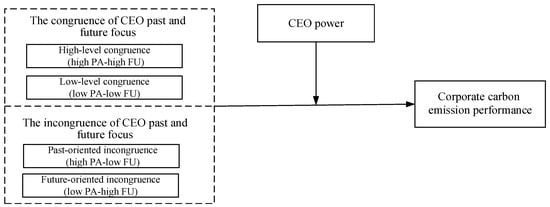
Drawing on the attention-based view and legitimacy theory, we contend that the congruence between CEO past and future focus affects corporate carbon emissions through two complementary pathways. On the one hand, such congruence mitigates managerial short-termism and improves the allocation of strategic resources, thereby fostering sustained carbon reduction efforts. On the other hand, the congruence facilitates stakeholder recognition and environmental legitimacy, ultimately leading to superior carbon emissions performance.
CEOs exhibiting congruent past and future foci simultaneously are better positioned to integrate historical experiences with future trends, mitigating the limitations of a single temporal perspective [38]. When confronted with environmental issues, they will not only pay attention to lessons learned from prior efforts in energy efficiency and pollution treatment, but also allocate attention to emerging trends in green industrial transformation and the growing demand for low-carbon products. This comprehensive cognition helps reduce susceptibility to myopic decision making, enabling the precise assessment of climate-related risks and opportunities. It encourages sustained resource allocation for emission reduction activities with long-term benefits, providing intrinsic motivation for continuous carbon reduction [39]. For instance, in CATL, a leading firm in China’s new energy industry, the CEO has integrated past technological experience with forward-looking industry trends to sustain investment in low-carbon technologies and green manufacturing. Moreover, strategic coherence between the CEO’s past actions and future commitments sends credible and responsible signals to external stakeholders (e.g., investors, regulators, and the public). Such coherence strengthens environmental legitimacy, reduces the risk of greenwashing accusations, and facilitates access to critical legitimacy resources such as green financing and policy support. In turn, these external resources alleviate short-term performance pressures on CEOs, enabling a greater willingness to invest in long-term carbon reduction initiatives.
By contrast, the incongruence between CEO past and future focus (i.e., an imbalanced state) impedes improvements in corporate carbon performance. Under such incongruence, a CEO’s decision-making framework is likely to be one-sided. Specifically, past-dominant CEOs (high PA-low FU) may be overly anchored in past successes or failures [40], neglecting emerging low-carbon opportunities. This leads to insufficient corporate investment in emission reduction and missed transformation opportunities. Future-dominant CEOs (low PA-high FU) may set idealized carbon emission targets, underestimating the complex challenges posed by organizational inertia and established infrastructure constraints. This leads to the misallocation of resources and implementation inefficiencies, hindering improvements in carbon emission performance. Moreover, such incongruence weakens the credibility of firms’ environmental commitments, hinders the attainment of external legitimacy, and consequently hampers sustained corporate engagement in emission-reduction efforts.
Hypothesis 1.
The congruence of CEO past and future focus is positively correlated with corporate carbon emission performance.
2.3.2. The Level of Congruence: High PA-High FU vs. Low PA-Low FU
While Hypothesis 1 posits that congruence is generally beneficial compared to incongruence, the level at which this congruence occurs likely matters. We compared the states of congruence: high and low. We argue that CEOs with high levels of congruence have richer cognitive resources (deep historical knowledge and a strong future vision) to effectively address the complexities of carbon emission reduction.
When CEOs have high-level congruence, their focus on the past mitigates the potential overaggressive tendencies associated with a strong future focus. At the same time, the focus on the future can compensate for the potential inertia and lack of action linked to a strong past focus [14]. CEOs, through the complementary strengths of their past and future focus, have powerful synergy in information capturing, interpretation, and action transformation [38] and significantly improve corporate carbon performance. Specifically, CEOs with high PA-high FU pay close attention to established successful practices in energy conservation and pollution control, as well as to capture industry trends in low-carbon technology innovation. This not only helps firms accurately grasp climate-related risks and opportunities but also enables them to fully mobilize and integrate existing resources to reduce carbon emissions by applying cleaner energy and improving production processes [41]. By contrast, low-level congruence reflects a CEO’s insufficient cognitive engagement with both the past and future [38]. This implies that the CEO neither systematically reflects on the historical experience nor engages in proactive planning for future trends. While balanced, the overall low level of temporal engagement suggests limited cognitive resources allocated to deep strategic thinking about long-term issues such as carbon emissions. This insufficiency may prevent CEOs from identifying climate-related opportunities and effectively leveraging organizational resources to transform them into action, ultimately hindering substantive improvements in carbon emission performance.
Hypothesis 2.
Compared with a CEO with low past and future focus (low-level congruence), a CEO with high past and future focus (high-level congruence) is more positively associated with corporate carbon emission performance.
2.3.3. The Moderating Effect of CEO Power
The attention-based view posits that managers’ attention within organizations is not randomly distributed but is shaped by formal organizational structure, role authority, and power systems [16]. This structural distribution principle determines how managers allocate resources and sustain their attention toward strategic issues. As a structural element, power directly influences managers’ selection of strategic issues, allocation of resources, and capacity for decision making [17,18,42]. Therefore, we contend that when CEO power is high, the congruence between past and future focus can be more effectively transformed into carbon emission reduction initiatives, significantly enhancing corporate carbon performance. By contrast, under low CEO power, the positive effect of such congruence on carbon performance is significantly attenuated.
Specifically, highly empowered CEOs can exert greater dominance in setting strategic priorities and allocating resources [18], reinforcing the positive relationship between temporal focus congruence and carbon emission performance. They are able to embed carbon neutrality targets into the corporate core agenda, driving firms to pursue low-carbon transitions proactively [43]. This conveys a clear and consistent long-term commitment to external stakeholders, thus strengthening the legitimacy of climate governance. Simultaneously, powerful CEOs are more inclined to consistently allocate budgets and key talent toward carbon management [17,44]. This ensures that attention to past decarbonization experience and forward-looking sustainability visions translates into concrete decarbonization actions, ultimately enhancing carbon emission performance. In contrast, CEOs with lower levels of power are often constrained by limited decision-making authority [18] when advancing decarbonization strategies. Even when CEOs prioritize both historical experience and future goals, they struggle to overcome short-term performance pressures from finance departments or resistance to process changes in production units. This results in insufficient resource allocation and organizational commitment to low-carbon strategies. Consequently, such structural constraints prevent the translation of cognitive congruence into substantive reduction actions, thereby limiting the improvements in carbon emission performance.
Hypothesis 3.
CEO power strengthens the positive effect of the congruence between CEO past and future focus (high-level congruence) on corporate carbon emission performance.
The research framework is shown in Figure 1.
Figure 1.
Theoretical framework.
3. Methods
3.1. Data and Sample
We used a sample of A-share listed manufacturing firms in China from 2010 to 2022. We selected this period because the Chinese government explicitly set targets for controlling greenhouse gas emissions in 2010, and subsequently introduced a series of policy initiatives to promote green and low-carbon development. As a major source of carbon emissions, the manufacturing sector has become a central focus of regulatory oversight and plays a critical role in advancing energy conservation, emission reduction, and green transformation initiatives.
We applied the following screening criteria to ensure data reliability and suitability for our study: (1) we excluded firms in the financial industry because of their unique accounting practices and regulatory environment; (2) we excluded firms classified as being in financial distress and those that have been delisted given their abnormal financial conditions and distinct regulatory constraints; and (3) we excluded samples with missing data for any variables used in our analysis. After applying these criteria, our final sample comprised 15,591 firm-year observations from 2191 firms.
Our data were primarily obtained from the CSMAR database, corporate annual reports, and China Environmental Statistical Yearbook. CEO temporal focus was measured based on textual analysis of the Management Discussion and Analysis (MD&A) sections of annual reports, as detailed in Section 3.2.2. Corporate carbon emission performance data were sourced from the carbon neutrality dataset provided by the CSMAR database. Firm-level characteristics and CEO attributes were collected from the CSMAR database. The environmental regulation data were extracted from the China Environmental Statistical Yearbook.
3.2. Variables
3.2.1. Dependent Variable
Our dependent variable was corporate carbon emission performance. Following prior studies [45], we measured CEP as the natural logarithm of operating revenue per unit of carbon emissions. In general, the lower the carbon emissions and the higher the revenue generated per unit of carbon, the better the firm’s carbon performance. Owing to the lack of mandatory carbon disclosure requirements in China, we do not have direct access to firm-level carbon emissions. Therefore, consistent with recent studies [46], we adopted an industry-level proxy to estimate firm-level carbon emissions. The specific estimation approach is shown in Equations (1) and (2). In addition, we conducted robustness checks using carbon emission intensity as an alternative dependent variable.
where CEPi denotes the carbon emission performance of firm i and CCEi represents the carbon emissions of firm i. BRi and BCi refer to the operating revenues and operating expenses of firm i, respectively. CEindustry denotes the industry’s carbon emissions and BCindustry denotes its operating expenses.
3.2.2. Independent Variable
The independent variable was CEO temporal focus. Following prior research [36,37,38,40], we used computer-aided text analysis (CATA) of the MD&A section of firms’ annual reports to measure CEO temporal focus. MD&A texts typically include the CEO’s retrospective assessment of the firm’s performance in the previous year as well as prospective discussions on future goals and strategic outlook. As such, these narratives reflect the CEO’s perspectives, personal style, and areas of strategic emphasis, making them a valuable source for inferring temporal orientation.
Given the linguistic and contextual differences between Chinese and English texts, we could not directly apply the existing temporal focus dictionaries developed for English texts. Therefore, we followed the procedure outlined by Chen et al. [47] and developed a Chinese temporal focus dictionary through a multistep process comprising 30 past-oriented terms (e.g., review, before), 28 present-oriented terms (e.g., current, now), and 41 future-oriented terms (e.g., long-term, vision). The detailed construction process and complete list of terms are presented in Appendix A.1 Table A1. Building on this dictionary, we converted the MD&A sections into plain-text format and conducted word segmentation using the JIEBA Python library (version 0.42.1). We then counted the occurrences of past-, present-, and future-related words using text mining techniques. To account for variations in text length, we calculated the proportion of these words in each MD&A text. The higher the value of this metric, the greater the CEO’s focus on the past, present, or future.
Several supplementary analyses were conducted to ensure the reliability and validity of the measures. First, we employed the internal consistency reliability method to explore the persistence of CEO temporal focus indicators in the time dimension and calculated Cronbach’s alpha coefficients for past, present, and future focus across the study period (2010–2022). The results showed high internal consistency reliability, with alpha values of 0.859, 0.849, and 0.861 for past, present, and future foci, respectively. Second, following established practices [48,49], we assessed the correlations between CEO temporal focus and other CEO attributes, including demographic features (age and tenure) and psychological traits (regulatory focus). The average correlation was 0.084, and no correlation exceeded 0.15. These results offer additional evidence of discriminant validity by demonstrating that our measures are distinct from those used in previous studies.
3.2.3. Moderator Variable
The moderating variable was CEO power (Power). Following Finkelstein’s [50] categorization, we divided CEO power into four dimensions: structural power, expert power, ownership power, and prestige power. Specifically, structural power includes whether the CEO serves as a board chair and whether they are an internal director. Expert power encompasses whether the CEO holds a senior professional title and if their tenure exceeds the industry median. Ownership power includes whether the CEO holds shares in the focal firm and whether the proportion of institutional ownership is below the industry median. Prestige power includes whether the CEO holds a master’s degree or higher and whether they work part-time outside the organization. We conducted principal component analysis on these eight dummy variables to construct a composite index of CEO power, with higher scores indicating greater power.
3.2.4. Control Variables
In line with prior research, we incorporated controls for firm characteristics, CEO attributes, and external environmental factors. At the firm level, we controlled for firm size (Size), leverage (Lev), Tobin’s Q (TobinQ), firm age (FirmAge), and cash flow ratio (CashFlow). At the CEO level, we not only introduced demographic variables such as CEO gender (Gender), CEO age (Age), and CEO tenure (Tenure) but also further controlled for CEO change (Change) and CEO present focus (PF). This is because CEO change often entails a shift in management priorities and may lead to adjustments in strategic direction, thus impacting the stability of corporate decarbonization decisions. Present-oriented focus captures short-term managerial attention and urgency that can covary with both past and future focus and the firm’s decarbonization outcomes. Controlling for the present focus helps isolate the unique effect of the past-future congruence net of concurrent short-term orientation. Additionally, we accounted for external environmental factors by including environmental uncertainty (EU) and environmental regulation (ER), which may shape corporate carbon emission outcomes. The measures of the control variables are provided in Appendix A.2 Table A2.
3.3. Model Setting
Following Back et al. [38], we employ polynomial regression and response surface analysis to examine the congruence effects between CEO past and future focus. The polynomial regression model can be expressed as follows.
In this equation, CEPit represents corporate carbon emission performance, PAit represents CEO past focus, FUit represents CEO future focus, Control represents the control variables, Year and Industry represent year- and industry-fixed effects, respectively, and εit is an error term. We mean-centered the variables PA and FU prior to analysis to mitigate the potential impact of multicollinearity.
Following prior research [51,52], we calculated the slopes and curvatures of the congruence and incongruence lines using the coefficients from polynomial regression. To provide a more intuitive understanding of the effects of congruence, we plotted three-dimensional response surface graphs using the regression results. Rather than directly interpreting the individual regression coefficients, our analysis focused on specific curves on the response surface. The response surface included the line of congruence (PA = FU) and line of incongruence (PA = −FU). The former captures the degree of congruence between the two predictor variables.
By substituting PA = FU into the regression equation, we obtained the following curve along the line of congruence.
Along this line, the slope is calculated as a1 = b1 + b2, and the curvature is a2 = b3 + b4 + b5. Hypothesis 2 is supported if a1 is significantly positive and a2 is not significant. If a2 is significant, further comparisons are required.
Similarly, by substituting PA = −FU, we derive the curve along the line of incongruence.
Along this line, the slope is a3 = b1 − b2 and the curvature is a4 = b3 − b4 + b5. Hypothesis 1 is supported if a4 is significantly negative, indicating an inverted U-shaped relationship.
We also tested the moderating role of CEO power in this relationship. In polynomial regression, a statistically significant increase in the R2 value of the regression equation after including the interaction terms between the moderating and explanatory variables indicates the presence of significant moderation effects. The model is specified as follows.
In this equation, Powerit represents CEO power. To precisely compare whether the moderating variable exhibits significant differences under high versus low conditions, we split the sample at the moderator’s median value into high and low subgroups, following Busenbark et al. [53]. We then performed Chow’s tests to determine the differences in the coefficients between these subgroups.
4. Results
4.1. Descriptive Statistics and Correlation Analysis
The descriptive statistics and correlation coefficients are reported in Appendix A.3 Table A3. The mean value and standard deviation of CEP are 1.492 and 1.134, respectively, indicating significant variation in corporate carbon emission performance. The mean values for CEO past and future focus are 0.320 and 0.806, respectively, suggesting that CEOs in our sample tend to be more future-oriented. Correlation analysis reveals that CEO past and future focus are positively correlated with CEP (r = 0.112 and r = 0.157, p < 0.01). This provides preliminary evidence that a CEO’s temporal orientation might influence carbon emission performance. Furthermore, CEO power positively affects CEP (r = 0.147, p < 0.010).
4.2. Hypothesis Tests
Table 1 displays the results of the polynomial regression analysis. Model 1 adds only the control variables, providing a baseline for comparison. Model 2 introduces PA and FU, whereas Model 3 adds the interaction terms (PA2, PA×FU, and FU2). The coefficients of the control variables are largely consistent with the prior expectations. In particular, firm size, Tobin’s Q, and cash flow are positively related to carbon emission performance, while CEO present focus does not exhibit a significant effect. One possible explanation is that given the long-term nature of decarbonization, focusing solely on the present may be insufficient to improve CEP.
Table 1.
Results for the main and moderating effects.
The results for Model 3 in Table 1 exhibit a significantly negative curvature (a4 = −0.196, p < 0.050), providing support for Hypothesis 1. This finding suggests that corporate carbon performance improves as the congruence between CEO past and future focus increases. Model 3 also reveals a significantly positive slope (a1 = 0.108, p < 0.010) and negative curvature (a2 = −0.258, p < 0.010). Because this curvature is significant, we further compared the magnitudes of the dependent variables at high and low points along the congruence line. The results demonstrate that the high PA-high FU configuration yields significantly greater effects than the low PA-low FU configuration, supporting Hypothesis 2.
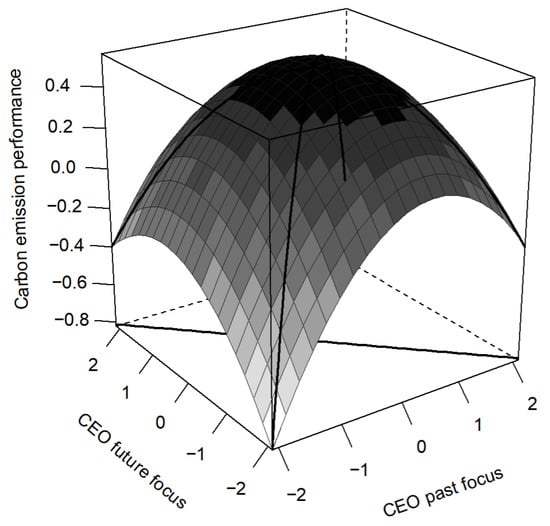
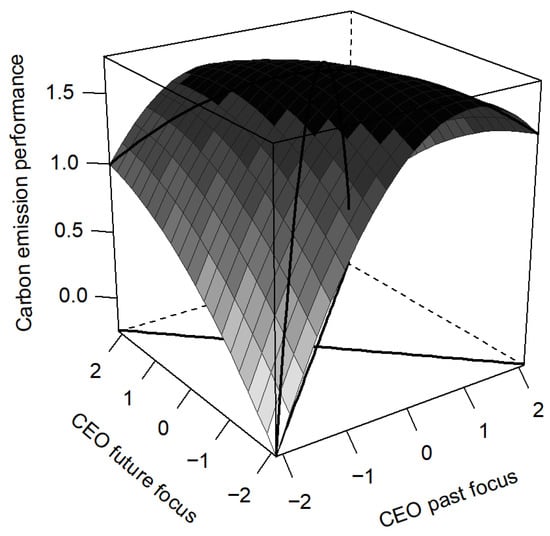
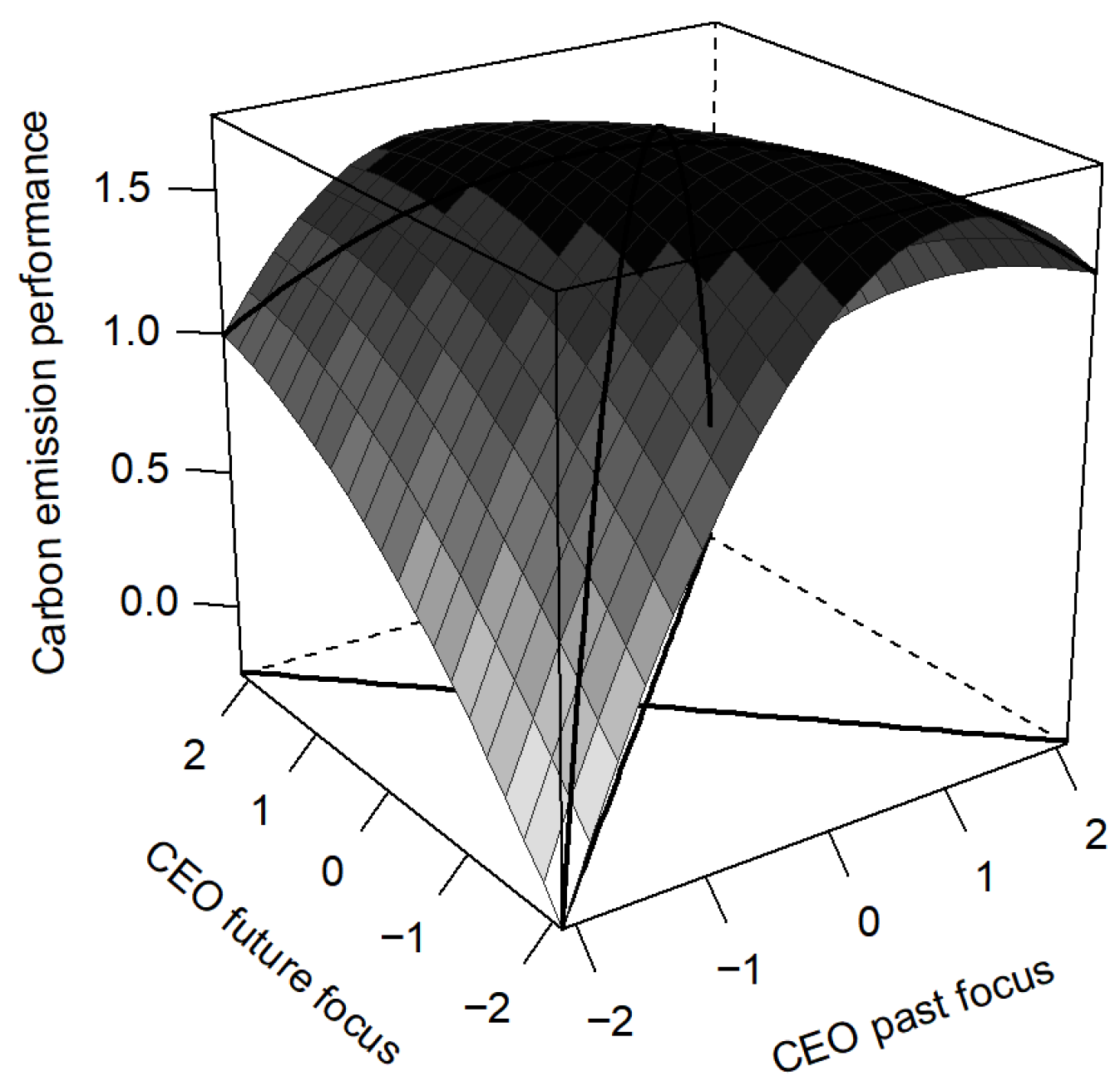
To further illustrate the congruence effects, we plotted a three-dimensional response surface graph (Figure 2). The inverted U-shaped curve of the incongruence line visually confirms that a balance between the CEO’s past and future focus improves corporate carbon emission performance. Moreover, as shown in Figure 2, the front region of the curve (representing low congruence) is lower than the back region (representing high congruence), providing additional evidentiary support for Hypothesis 2.
Figure 2.
Three-dimensional response surface depicting the relationship between the congruence of CEO past and future focus and corporate carbon emission performance.
The inclusion of CEO power and its interaction terms with PA, FU, PA2, PA×FU, and FU2 significantly improve the model’s explanatory power (ΔR2 = 0.001, p < 0.010), indicating that CEO power plays a significant moderating role in this relationship. While the incremental variance explained by the interaction block is modest, such magnitudes are common in moderation tests in large-sample archival studies, with extensive fixed effects and high baseline explanatory power.
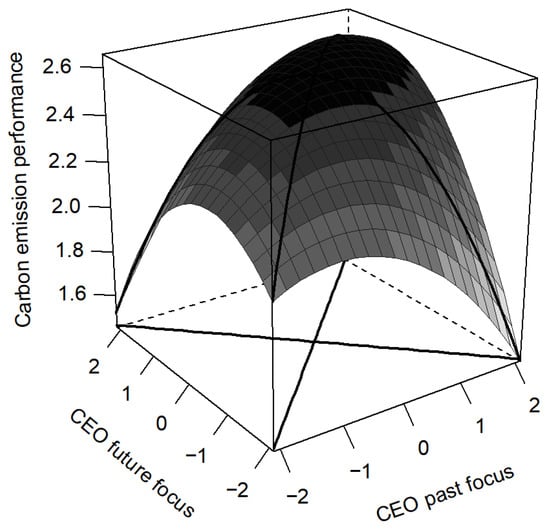
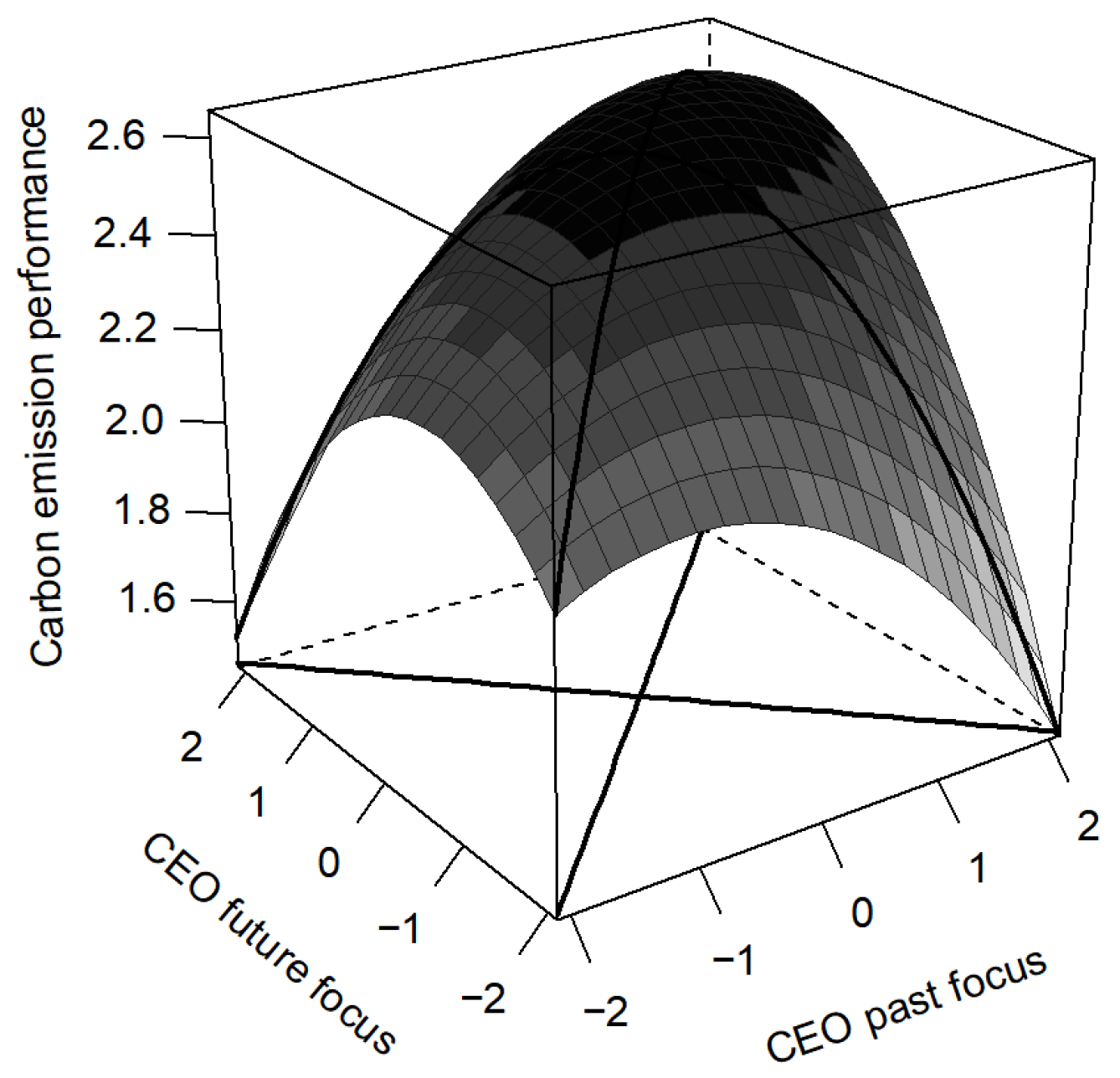
To further examine the moderating effect, we split the sample into low and high CEO power groups based on the median value and computed the slope and curvature of the congruence and incongruence lines under each condition. Models 4 and 5 in Table 1 report these results. In the low-power subgroup (Model (4)), the curvature of the incongruence line is not significant (a4 = −0.122, p > 0.100). However, in the high-power subgroup (Model (5)), the incongruence line exhibits a significantly negative curvature (a4 = −0.257, p < 0.050), the slope of the congruence line is significantly positive, and the curvature is not significant (a1 = 0.106, p < 0.010; a2 = −0.077, p > 0.100). A Chow test confirmed a significant difference between the polynomial regression coefficients of the two groups (p < 0.001). In addition, we plotted three-dimensional surface graphs under low and high power conditions, as shown in Figure 3 and Figure 4. When CEO power is high, the curvature along the incongruence line is more sharply negative, and the slope along the congruence line becomes more upward sloping, supporting Hypothesis 3.
Figure 3.
Moderating effects of low CEO power.
Figure 4.
Moderating effects of high CEO power.
4.3. Endogeneity and Robustness Checks
4.3.1. Endogeneity Tests
To address potential endogeneity concerns, we employed three methods. First, considering the omission of important variables and reverse causality, we used the instrumental variable (IV) approach, utilizing the two-year moving average of CEO past and future focus as instrumental variables. These instruments are expected to correlate with the endogenous variables but are unlikely to directly affect CEP, satisfying the exogeneity requirement. The IV regression results for Model 3 in Appendix A.4 Table A4 are consistent with the core findings and further support Hypotheses 1 and 2.
Second, our study may have suffered from sample selection bias. We addressed this potential bias using the Heckman selection model. We first estimated the probability of corporate carbon disclosure using a probit model and calculated the Inverse Mills Ratio (IMR). We then included the IMR in the polynomial regression model. Model 4 in Appendix A.4 Table A4 presents the results of the Heckman model. The significant coefficient of IMR (p < 0.100) suggests the presence of sample selection bias. After controlling for this bias, the results remain robust, providing further support for Hypotheses 1 and 2.
Finally, endogeneity may arise from the matching process between the CEO’s temporal orientation and firm’s strategic needs. Specifically, CEOs likely self-select firms whose strategic context aligns with their temporal preferences, whereas firms preferentially hire CEOs whose time focus matches their current strategic posture. To mitigate this potential bias, we followed the approach of Nadkarni and Chen [40]. We regressed the CEO’s temporal focus on a set of contemporaneous firm-level variables. These include firm size, Tobin’s Q, firm age, leverage, CEO duality, and board size. The regression coefficients of the statistically significant predictors are then used to generate the predicted CEO temporal focus scores for each observation. These predicted scores were incorporated into our main regression models as controls for endogenous matching effects. The results of Model 5 in Appendix A.4 Table A4 indicate that the direction of the coefficients and the significance level of the CEO’s temporal focus congruence on CEP remain consistent with our primary findings.
4.3.2. Robustness Checks
We conducted several robustness checks to ensure the reliability of our empirical findings. First, we re-estimated our models using a subsample spanning 2011 to 2020 to mitigate potential biases related to the initial sample period. The results presented in Model 1 in Appendix A.5 Table A5 are consistent with our main conclusions. Second, we replaced the manufacturing sample with Chinese A-share listed firms. The results reported in Model 2 in Appendix A.5 Table A5 further support the primary findings. Third, we included industry × year fixed effects to further control for unobserved heterogeneity across sectors and over time. Model 3 in Appendix A.5 Table A5 shows that the main results remain robust. Fourth, we excluded firms with less than four years of data to ensure that the results were not driven by short panel observations. The results presented in Model 4 in Appendix A.5 Table A5 are consistent with our hypotheses. Fifth, we employed carbon emission intensity as an alternative dependent variable. Carbon emission intensity is defined as the amount of carbon emissions per unit of firm revenue and serves as an inverse measure of carbon emission performance. Theoretically, this is the reciprocal of the carbon emission performance metric used in our main analyses (i.e., revenue per unit of carbon emissions). Accordingly, if the baseline results hold, we would expect the explanatory variable to exhibit a statistically significant effect in the opposite direction when emission intensity is used as the outcome variable. As shown in Model 5 in Appendix A.5 Table A5, the results reveal a significant U-shaped curve for the incongruence line. The congruence line exhibits a negative slope, supporting our primary contention. Finally, to address potential lagged effects, we re-estimated our models with the independent and control variables lagged by one year. The results presented in Model 6 in Appendix A.5 Table A5 remain robust.
4.4. Heterogeneity Analysis
Private firms typically exhibit greater operational flexibility and place a stronger emphasis on profit maximization in their decision-making. By contrast, state-owned enterprises (SOEs) are often influenced by multiple objectives in resource allocation, which may lead to different strategic priorities compared to non-SOEs. Accordingly, we divided the sample into SOEs and non-SOEs. As shown in Models 1 and 2 in Appendix A.6 Table A6, in the non-SOE group, the congruence between CEO past and future focus significantly enhances CEP (a4 = −0.186, p < 0.100), whereas this facilitating effect is not significant in the SOE group (a4 = −0.167, p > 0.100). These findings suggest that the flexibility and efficiency orientation of non-SOEs facilitates the effective implementation of strategies, allowing the positive effects of CEO temporal focus congruence to be effectively realized. In contrast, the institutional structure and multifaceted objectives of SOEs may constrain the influence of CEO temporal focus on carbon performance.
In high-tech industries, firms operate in environments characterized by rapid technological change and intense competition, necessitating swift adaptation and continuous innovation to maintain competitiveness. By contrast, non-high-tech industries typically experience slower rates of technological advancement, more rigid resource allocation, and more conservative strategic adjustments. Accordingly, we divided the sample into high-tech and non-high-tech industry groups. As shown in Models 3 and 4 in Appendix A.6 Table A6, the congruence between CEO past and future focus has a particularly pronounced positive effect on CEP in high-tech industries. However, this facilitating effect is not significant in non-high-tech industries. One possible explanation is that high-tech industries require firms to respond quickly to environmental changes, efficiently integrate technological resources, and engage in green innovation proactively. In such dynamic contexts, CEOs who effectively balance historical experience with the long-term future are more likely to recognize the importance of low-carbon development. They strategically allocate organizational resources to key carbon reduction pathways such as energy efficiency improvement and smart manufacturing, thereby enhancing carbon performance.
Accounting for regional development heterogeneity, we further divided the sample into firms located in the eastern and central-western regions. The results, as shown in Models 5 and 6 of Appendix A.6 Table A6, indicate that the positive effect of CEO past and future focus congruent on CEP is more pronounced in the eastern region, while the effect is not significant in the central-western regions. This discrepancy may stem from the fact that the eastern region typically benefits from more developed market mechanisms, robust green financing channels, and advanced technological infrastructure. Such favorable conditions provide the necessary resource support for CEOs to translate their strategic intent into concrete decarbonization actions. For example, firms in this region are better positioned to secure financing and adopt clean technologies.
5. Discussion
Our study explores the effect of CEO temporal focus (in)congruence on carbon emission performance, an essential yet understudied aspect in the context of escalating global climate concerns. We found that the congruence of CEO past and future focus is positively related to corporate carbon emission performance. CEOs with high levels of congruence (high PA-high FU) are more conducive to enhancing corporate carbon performance than CEOs with low levels of congruence (low PA-low FU). This effect is primarily achieved through two mechanisms: internally, the consistency reduces short-sighted decision-making and enhances resource allocation efficiency, driving continuous emissions reductions; externally, a consistent time narrative strengthens corporate environmental legitimacy, motivating firms to achieve superior carbon emission performance. Furthermore, our results demonstrate that CEO power reinforces the positive effect of CEO temporal focus congruence on carbon emission performance. This means that powerful CEOs can more efficiently translate their time concerns into mitigation actions (e.g., low-carbon technological innovations), which can enhance the effectiveness of emission reductions.
5.1. Theoretical Contribution
Our findings contribute to the literature in three ways. First, our study enriches antecedent research on corporate carbon emissions performance by highlighting the role of temporal cognition. While existing studies predominantly focus on how CEO characteristics influence carbon reduction efforts [9], we highlight the factors driving temporal cognition. Our findings reveal the critical function of CEO temporal cognition in shaping corporate sustainability practices. This offers new insights into the intrinsic drivers of corporate carbon mitigation behavior. Furthermore, we provide empirical micro-foundational support for the multilevel framework proposed by Slawinski et al. [54], uncovering the cognitive underpinnings of organizational (in)action in response to climate change.
Second, our study extends the temporal focus literature by examining the role of temporal orientation within the context of China’s carbon emissions. Prior research has largely suggested that CEO past focus tends to inhibit environmental investment, whereas a future focus facilitates such investment [12]. This view implicitly assumes that different temporal foci operate independently. Our findings challenge this assumption by demonstrating that past and future focus can coexist and complement each other. Specifically, we find that among Chinese manufacturing firms, the congruence between CEO past and future focus is positively associated with carbon emission performance, with CEO power acting as a positive moderator of this relationship. These results deepen our understanding of how CEO cognitive characteristics interact with power dynamics to shape organizational responses to climate change and provide a theoretical foundation for research on temporal orientation.
Finally, our study systematically integrates the attention-based view with legitimacy theory to explain how temporal focus congruence influences carbon emission performance through internal managerial and external legitimacy mechanisms. Whereas prior research has predominantly focused on a single temporal focus, we emphasize the synergistic effects of CEO past and future focus. We reveal that temporal focus congruence mitigates managerial myopia, optimizes long-term resource allocation, and ultimately enhances carbon emission performance. This discovery offers a new perspective for the attention-based view. Furthermore, based on legitimacy theory, we reveal that temporal focus congruence facilitates corporate recognition from stakeholders, thereby strengthening environmental legitimacy. This finding enriches the micro-level perspective on legitimacy construction processes.
5.2. Managerial Implications
Our findings offer a practical playbook for navigating the complexities of corporate decarbonization. Corporate carbon emissions represent a slow-moving strategic outcome shaped by long-term investments, technological lock-in, and organizational practices. As a result, even relatively minor shifts in managerial attention can yield significant cumulative emission reductions over time.
First, our study calls for a fundamental shift in how boards select and evaluate CEOs in an era of climate action. The traditional emphasis on a strong historical track record or a compelling future vision is insufficient. Our results show that the most effective leaders are those who can integrate the two. Therefore, boards should incorporate consistent temporal cognition into CEO selection criteria. They can assess candidates’ temporal orientation through due diligence and interviews to select the most suitable top managers for the organization. Specifically, during background checks and evaluations, boards may focus on examining verifiable behaviors from candidates’ prior roles, such as their demonstrated time horizon in public statements or decision-making practices. Furthermore, boards may employ behavioral interview questions to explore how candidates have transformed past failures into strategic successes and utilize scenario-based tasks to evaluate their ability to navigate future disruptions.
Second, the findings provide clear guidance for CEO strategic empowerment. Our research demonstrates that CEO power is not an impediment to be feared but a catalyst to be leveraged, especially when driving large-scale changes such as decarbonization. This underscores the necessity of appointing CEOs with a balanced temporal orientation and equipping them with sufficient authority to implement long-term sustainability strategies. This includes providing structural authority over key resources, budgets for low-carbon technologies, and discretion to make bold decisions. Such an alignment of authority with responsibility is essential for firms seeking to convert ambitious climate commitment into measurable outcomes. However, empowerment must also be coupled with accountability. To mitigate the risk of unchecked power, boards should establish complementary governance mechanisms. This could involve creating a dedicated board-level climate or sustainability committee to monitor the progress against clear carbon reduction milestones. This ensures that the CEO’s power is channeled productively to achieve the firm’s strategic sustainability objectives, providing a framework for what might be termed accountable empowerment.
Finally, the government can guide CEOs’ attention allocation through differentiated policy instrument portfolios, facilitating corporate carbon emission performance improvement. In particular, the government should encourage manufacturing firms to place greater emphasis on the long-term strategic planning of carbon emissions. By regularly publishing climate policy reports, industry decarbonization roadmaps, and transition risk warning lists, CEOs can develop clear expectations for low-carbon transition and integrate emission reduction targets into their core strategic agendas. Meanwhile, the government could enhance green infrastructure and establish low-carbon technology public platforms, thereby reducing the uncertainties and costs associated with implementing corporate mitigation strategies.
5.3. Limitations and Future Directions
Our study had several limitations. First, following previous studies [36,38], we employed computer-aided text analysis to deduce the signs of CEO time cognition from MD&A. While this approach is widely adopted, it has limitations in fully capturing the temporal focus. On the one hand, MD&A texts primarily reflect managerial narratives in a formal reporting context, which may not fully capture CEOs’ cognitive traits and behavioral tendencies in a broader context. On the other hand, our keyword list may not be fully comprehensive and may potentially miss some relevant terms. Therefore, we encourage future research to integrate multiple data sources (e.g., CEO public speeches, earnings call transcripts, and social media content) or employ more advanced machine learning techniques (e.g., large language models) to construct alternative indicators. This approach helps mitigate potential biases associated with single data sources and dictionary methods, providing a more comprehensive measure of CEO temporal focus.
Second, owing to the limitations of data acquisition, we used industry-level carbon emissions data as a proxy for firm-level emissions. Although this method provides a convenient way to assess corporate carbon emissions, we recognize that it may not fully capture the true variation in CEP. As carbon emission disclosure practices continue to improve in China, future research could leverage more reliable emission data to further validate the robustness of our results.
Third, studies conducted in different geographic regions may yield valuable insights, as cultural factors can significantly influence the allocation of temporal attention [55]. Our study may not be generalizable beyond the context of Chinese-listed firms because of potential differences in institutional and cultural backgrounds. Future research could explore these relationships in other institutional settings (e.g., the United States and India) to enhance their generalizability.
Author Contributions
Writing—original draft, Q.M.; data curation, W.Y.; writing—review and editing, J.W. All authors have read and agreed to the published version of the manuscript.
Funding
This research was supported by the National Natural Science Foundation of China under Grant 71972094, Fundamental Research Funds for the Central Universities under Grant 2025lzujbkyxs003 and AI+ Philosophy and Social Sciences Special Project of Lanzhou University under Grant LZUAIYJZD09.
Institutional Review Board Statement
Not applicable.
Informed Consent Statement
Not applicable.
Data Availability Statement
The original contributions presented in this study are included in the article. Further inquiries can be directed to the corresponding author.
Conflicts of Interest
The authors declare no conflicts of interest.
Appendix A
Appendix A.1
The construction of CEO temporal focus dictionary proceeded as follows. First, we identified the initial seed words based on definitions, scales, and dictionaries of temporal focus from prior research. Second, we manually analyzed a subset of MD&A texts to identify high-frequency words related to past, present, and future orientations in the Chinese context, which were added to the seed words. Third, we used word-embedding models (word2vec) to generate a list of synonyms and related words for each seed word. Fourth, we screened the expanded word list to eliminate irrelevant, ambiguous, and repetitive words. Finally, we invited three independent researchers to review and validate the final word list to ensure the reliability of our classification. Table A1 presents the final keyword list for CEO temporal focus in the Chinese context.
Table A1.
CEO temporal focus words.
Appendix A.2
Table A2 reports the measurements of all control variables used in the analyses.
Table A2.
Measures of the control variables.
Appendix A.3
Table A3 provides descriptive statistics and correlation coefficients.
Table A3.
Descriptive statistics and correlation coefficients.
Appendix A.4
Table A4 presents the results of the endogeneity analyses.
Table A4.
Results of endogeneity analysis.
Appendix A.5
Table A5 reports the results of robustness tests.
Table A5.
Results of robustness tests.
Appendix A.6
Table A6 provides the results of heterogeneity analysis.
Table A6.
Results of heterogeneity analysis.
References
- Howard-Grenville, J.; Buckle, S.J.; Hoskins, B.J.; George, G. Climate change and management. Acad. Manag. J. 2014, 57, 615–623. [Google Scholar] [CrossRef] [Scilit]
- Flammer, C.; Toffel, M.W.; Viswanathan, K. Shareholder activism and firms’ voluntary disclosure of climate change risks. Strateg. Manag. J. 2021, 42, 1850–1879. [Google Scholar] [CrossRef] [Scilit]
- Dhanda, K.K.; Sarkis, J.; Dhavale, D.G. Institutional and stakeholder effects on carbon mitigation strategies. Bus. Strategy Environ. 2022, 31, 782–795. [Google Scholar] [CrossRef] [Scilit]
- Roemer, N.; Souza, G.C.; Troester, C.; Voigt, G. Offset or reduce: How should firms implement carbon footprint reduction initiatives? Prod. Oper. Manag. 2023, 32, 2940–2955. [Google Scholar] [CrossRef] [Scilit]
- Zhang, Q.; Wong, C.W.; Klassen, R. Carbon neutrality: Operations management research opportunities. J. Oper. Manag. 2024, 70, 344–354. [Google Scholar] [CrossRef] [Scilit]
- Mahran, K.; Elamer, A.A. Chief Executive Officer (CEO) and corporate environmental sustainability: A systematic literature review and avenues for future research. Bus. Strategy Environ. 2024, 33, 1977–2003. [Google Scholar] [CrossRef] [Scilit]
- Zhao, L.; Liu, Z.; Xie, C.; Chen, X. Climate policy uncertainty and corporate carbon performance: Evidence from transportation enterprises. J. Environ. Manag. 2025, 390, 126346. [Google Scholar] [CrossRef] [Scilit] [PubMed]
- Wagner, A.; Fischer-Kreer, D. The role of CEO regulatory focus in increasing or reducing corporate carbon emissions. Bus. Strategy Environ. 2024, 33, 1051–1065. [Google Scholar] [CrossRef] [Scilit]
- Harakati, R.; Ghazouani, I.; Hlioui, Z. CEO gender and climate change commitment: The mediating effect of environmental regulation perception. Corp. Soc. Responsib. Environ. Manag. 2024, 31, 4630–4650. [Google Scholar] [CrossRef] [Scilit]
- Li, P.; Lin, Z.; Peng, B.; Du, H. Do CEOs’ social networks affect carbon emissions in China? The moderating role of CEO reputation. Int. Rev. Econ. Financ. 2023, 88, 1122–1137. [Google Scholar] [CrossRef] [Scilit]
- Fehre, K.; Oehmichen, J.; Steinberg, P.J.; Widmann, B. The time for the future is now: CEO temporal focus and firms’ identification and interpretation of grand challenges-The example of water scarcity. J. Clean. Prod. 2023, 406, 137041. [Google Scholar] [CrossRef] [Scilit]
- Zhao, J.; Wang, X.; Yao, X. Yesterday, today, and tomorrow: CEO temporal focus and firms’ ESG investments. Manag. Organ. Rev. 2025, 1–47. [Google Scholar] [CrossRef] [Scilit]
- Miron-Spektor, E.; Gino, F.; Argote, L. Paradoxical frames and creative sparks: Enhancing individual creativity through conflict and integration. Organ. Behav. Hum. Decis. Process. 2011, 116, 229–240. [Google Scholar] [CrossRef] [Scilit]
- Freeney, Y.; van der Werff, L.; Collings, D.G. I left Venus and came back to Mars: Temporal focus congruence in dyadic relationships following maternity leave. Organ. Sci. 2021, 33, 1773–1793. [Google Scholar] [CrossRef] [Scilit]
- Wolfe, M.T.; Guedes, M.J.; Patel, P.C.; Wiklund, J. On an even keel: Temporal balance, ADHD, and self-employment. J. Bus. Res. 2025, 195, 115373. [Google Scholar] [CrossRef] [Scilit]
- Ocasio, W. Towards an attention-based view of the firm. Strateg. Manag. J. 1997, 18, 187–206. [Google Scholar] [CrossRef] [Scilit]
- Walls, J.L.; Berrone, P. The power of one to make a difference: How informal and formal CEO power affect environmental sustainability. J. Bus. Ethics 2017, 145, 293–308. [Google Scholar] [CrossRef] [Scilit]
- Ozgen, S.; Mooney, A.; Zhou, Y. CEO power: A review, critique, and future research directions. J. Manag. 2025, 51, 132–171. [Google Scholar] [CrossRef] [Scilit]
- Suchman, M.C. Managing legitimacy: Strategic and institutional approaches. Acad. Manag. Rev. 1995, 20, 571–610. [Google Scholar] [CrossRef] [Scilit]
- Eklund, J.C.; Mannor, M.J. Keep your eye on the ball or on the field? Exploring the performance implications of executive strategic attention. Acad. Manag. J. 2021, 64, 1685–1713. [Google Scholar] [CrossRef] [Scilit]
- Joseph, J.; Wilson, A.J. The growth of the firm: An attention-based view. Strateg. Manag. J. 2018, 39, 1779–1800. [Google Scholar] [CrossRef] [Scilit]
- Ocasio, W. Attention to attention. Organ. Sci. 2011, 22, 1286–1296. [Google Scholar] [CrossRef] [Scilit]
- Ocasio, W.; Joseph, J. An attention-based theory of strategy formulation: Linking micro- and macro perspectives in strategy processes. Strategy Process 2005, 22, 39–61. [Google Scholar] [CrossRef] [Scilit]
- Eklund, J.; Raj, M.; Eggers, J. Attention focus and new opportunities: The moderating role of managerial attention to alternative issues. Organ. Sci. 2025, 36, 21–39. [Google Scholar] [CrossRef] [Scilit]
- Gerarden, T.D. Demanding innovation: The impact of consumer subsidies on solar panel production costs. Manag. Sci. 2023, 69, 7799–7820. [Google Scholar] [CrossRef] [Scilit]
- Bui, B.; Houqe, M.N.; Zaman, M. Climate governance effects on carbon disclosure and performance. Br. Account. Rev. 2020, 52, 100880. [Google Scholar] [CrossRef] [Scilit]
- Kyaw, K.; Treepongkaruna, S.; Jiraporn, P. Board gender diversity and environmental emissions. Bus. Strategy Environ. 2022, 31, 2871–2881. [Google Scholar] [CrossRef] [Scilit]
- Luqman, A.; Zhang, Q.; Talwar, S.; Bhatia, M.; Dhir, A. Artificial intelligence and corporate carbon neutrality: A qualitative exploration. Bus. Strategy Environ. 2024, 33, 3986–4003. [Google Scholar] [CrossRef] [Scilit]
- Ortiz-de-Mandojana, N.; Bansal, P.; Alberto Aragon-Correa, J. Older and wiser: How CEOs’ time perspective influences long-term investments in environmentally responsible technologies. Br. J. Manag. 2019, 30, 134–150. [Google Scholar] [CrossRef] [Scilit]
- Lin, Y.; Shi, W.; Prescott, J.E.; Yang, H. In the eye of the beholder: Top managers’ long-term orientation, industry context, and decision-making processes. J. Manag. 2019, 45, 3114–3145. [Google Scholar] [CrossRef] [Scilit]
- Ye, P.; O’Brien, J.; Carnes, C.M.; Hasan, I. The influence of bondholder concentration and temporal orientation on investments in R&D. J. Manag. 2021, 47, 683–715. [Google Scholar] [CrossRef] [Scilit]
- Choi, J.J.; Kim, J.; Shenkar, O. Temporal orientation and corporate social responsibility: Global evidence. J. Manag. Stud. 2023, 60, 82–119. [Google Scholar] [CrossRef] [Scilit]
- Shipp, A.J.; Edwards, J.R.; Lambert, L.S. Conceptualization and measurement of temporal focus: The subjective experience of the past, present, and future. Organ. Behav. Hum. Decis. Process. 2009, 110, 1–22. [Google Scholar] [CrossRef] [Scilit]
- Shipp, A.J.; Gabriel, A.S.; Lambert, L.S. Profiles in time: Understanding the nature and outcomes of profiles of temporal focus. J. Appl. Psychol. 2022, 107, 1640–1654. [Google Scholar] [CrossRef] [Scilit]
- Nadkarni, S.; Chen, T.; Chen, J. The clock is ticking! Executive temporal depth, industry velocity, and competitive aggressiveness. Strateg. Manag. J. 2016, 37, 1132–1153. [Google Scholar] [CrossRef] [Scilit]
- Gamache, D.L.; McNamara, G. Responding to bad press: How CEO temporal focus influences the sensitivity to negative media coverage of acquisitions. Acad. Manag. J. 2019, 62, 918–943. [Google Scholar] [CrossRef] [Scilit]
- Desjardine, M.R.; Shi, W. How temporal focus shapes the influence of executive compensation on risk taking. Acad. Manag. J. 2021, 64, 265–292. [Google Scholar] [CrossRef] [Scilit]
- Back, P.; Rosing, K.; Dickler, T.A.; Kraft, P.S.; Bausch, A. CEOs’ temporal focus, firm strategic change, and performance: Insights from a paradox perspective. Eur. Manag. J. 2020, 38, 884–899. [Google Scholar] [CrossRef] [Scilit]
- Saether, E.A.; Eide, A.E.; Bjorgum, O. Sustainability among Norwegian maritime firms: Green strategy and innovation as mediators of long-term orientation and emission reduction. Bus. Strategy Environ. 2021, 30, 2382–2395. [Google Scholar] [CrossRef] [Scilit]
- Nadkarni, S.; Chen, J. Bridging yesterday, today, and tomorrow: CEO temporal focus, environmental dynamism, and rate of new product introduction. Acad. Manag. J. 2014, 57, 1810–1833. [Google Scholar] [CrossRef] [Scilit]
- Todaro, N.M.; Testa, F.; Daddi, T.; Iraldo, F. The influence of managers’ awareness of climate change, perceived climate risk exposure and risk tolerance on the adoption of corporate responses to climate change. Bus. Strategy Environ. 2021, 30, 1232–1248. [Google Scholar] [CrossRef] [Scilit]
- Wang, G.; DeGhetto, K.; Ellen, B.P.; Lamont, B.T. Board antecedents of CEO duality and the moderating role of country-level managerial discretion: A meta-analytic investigation. J. Manag. Stud. 2019, 56, 172–202. [Google Scholar] [CrossRef] [Scilit]
- Khuong, N.V.; Tai, V.T.T.; Anh, L.H.T. The mediating role of financial reporting quality in the relationship between CEO power and carbon emission disclosures: Evidence from vietnamese companies. Bus. Strategy Environ. 2025, 34, 4048–4071. [Google Scholar] [CrossRef] [Scilit]
- Luong, H.; Kumarasiri, J.; Gunasekarage, A. CEO power and carbon emissions management: Australian evidence. Bus. Strategy Environ. 2025, 34, 2239–2272. [Google Scholar] [CrossRef] [Scilit]
- Chen, C.M. Supply chain strategies and carbon intensity: The roles of process leanness, diversification strategy, and outsourcing. J. Bus. Ethics 2017, 143, 603–620. [Google Scholar] [CrossRef] [Scilit]
- Wang, Z.; Fu, H.; Ren, X. Political connections and corporate carbon emission: New evidence from Chinese industrial firms. Technol. Forecast. Soc. Change 2023, 188, 122326. [Google Scholar] [CrossRef] [Scilit]
- Chen, D.; Hu, N.; Liang, P.; Swink, M. Understanding the impact of trade policy effect uncertainty on firm-level innovation investment. J. Oper. Manag. 2024, 70, 316–340. [Google Scholar] [CrossRef] [Scilit]
- Harrison, J.S.; Thurgood, G.R.; Boivie, S.; Pfarrer, M.D. Measuring CEO personality: Developing, validating, and testing a linguistic tool. Strateg. Manag. J. 2019, 40, 1316–1330. [Google Scholar] [CrossRef] [Scilit]
- Gamache, D.L.; Neville, F.; Bundy, J.; Short, C.E. Serving differently: CEO regulatory focus and firm stakeholder strategy. Strateg. Manag. J. 2020, 41, 1305–1335. [Google Scholar] [CrossRef] [Scilit]
- Finkelstein, S. Power in top management teams: Dimensions, measurement, and validation. Acad. Manag. J. 1992, 35, 505–538. [Google Scholar] [CrossRef]
- Edwards, J.R.; Parry, M.E. On the use of polynomial regression equations as an alternative to difference scores in organizational research. Acad. Manag. J. 1993, 36, 1577–1613. [Google Scholar] [CrossRef] [Scilit]
- Edwards, J.R.; Cable, D.M. The value of value congruence. J. Appl. Psychol. 2009, 94, 654. [Google Scholar] [CrossRef] [Scilit]
- Busenbark, J.R.; Bundy, J.; Chin, M.K. Director departure following political ideology (in)congruence with an incoming CEO. Strateg. Manag. J. 2023, 44, 1698–1732. [Google Scholar] [CrossRef] [Scilit]
- Slawinski, N.; Pinkse, J.; Busch, T.; Banerjee, S.B. The role of short-termism and uncertainty avoidance in organizational inaction on climate change: A multi-level framework. Bus. Soc. 2017, 56, 253–282. [Google Scholar] [CrossRef] [Scilit]
- Shipp, A.J.; Aeon, B. Temporal focus: Thinking about the past, present, and future. Curr. Opin. Psychol. 2019, 26, 37–43. [Google Scholar] [CrossRef] [Scilit] [PubMed]

Disclaimer/Publisher’s Note: The statements, opinions and data contained in all publications are solely those of the individual author(s) and contributor(s) and not of MDPI and/or the editor(s). MDPI and/or the editor(s) disclaim responsibility for any injury to people or property resulting from any ideas, methods, instructions or products referred to in the content. |
© 2026 by the authors. Licensee MDPI, Basel, Switzerland. This article is an open access article distributed under the terms and conditions of the Creative Commons Attribution (CC BY) license.