1. Introduction
The transportation sector is at the forefront of international efforts toward a sustainable energy transition, driven by the urgent need to reduce greenhouse gas emissions. The transportation sector is among the highest energy-consuming industries, contributing significantly to CO
2 emissions and almost one-third of global final energy consumption, particularly in high-income countries [
1]. Despite improvements in energy efficiency in some sectors, overall energy demand for transport continues to rise due to growing mobility demands, expanding logistics networks, and the use of fossil fuels as a primary energy source. These dynamics underscore the need for systemic innovation at the intersection of energy policy and mobility, posing a significant obstacle to decarbonization strategies [
2].
Energy efficiency, zero emissions, and low environmental impact are key goals for future transportation systems; ideally, these should be achieved without sacrificing accessibility or economic competitiveness. Radical technological changes are necessary to achieve these goals, particularly those that decouple transportation from fossil fuels and integrate renewable energy sources more broadly [
3]. Hyperloop technology, as a concept for ultrafast terrestrial mobility, is increasingly being considered in this context. This is due to its impact on energy consumption and efficiency in long-distance travel, as well as its potential to revolutionize passenger and freight transport [
4,
5].
Innovative transportation solutions employ a diverse range of technologies designed to reduce CO
2 emissions and enhance energy efficiency. Key among these are electric and autonomous vehicles equipped with advanced energy management and route optimization systems, which dramatically reduce energy consumption, thereby minimizing waste from energy sources and exhaust emissions. Trucking and maritime transport are increasingly experimenting with hydrogen propulsion technologies as one of several low-emission alternatives to conventional fuels, particularly in segments where electrification remains challenging [
6]. The aviation industry is developing aviation biofuels and hybrid electric aircraft, which can dramatically reduce the carbon footprint of this type of transportation [
7]. Renewable energy-powered urban rail and tram systems are becoming increasingly important in urban areas, contributing to the decarbonization of public transport [
8]. Furthermore, demand for passenger cars could be declining, while ultra-light electric urban vehicles, such as e-bikes and e-scooters, are gaining popularity. The Hyperloop project has garnered increasing attention and prominence in the scientific and technical communities in recent years, and research on this technology is advancing rapidly, indicating the growing potential of this groundbreaking transportation solution for the future [
9].
Using magnetic levitation to propel the capsules through low-pressure vacuum tubes, the Hyperloop system can reach speeds of up to 1200 km/h while significantly reducing rolling resistance and aerodynamic drag. Compared to traditional forms of transportation, this special configuration provides considerably lower energy consumption per pkm. Current projections suggest that Hyperloop systems could operate with an energy intensity of just 10–50 Wh/pkm, which is significantly lower than commercial aviation and high-speed rail [
10]. Furthermore, regenerative braking technology lowers operating costs and net energy demand while increasing energy efficiency [
11]. Hyperloop’s compatibility with renewable energy systems is one of its most promising features. Energy-sufficient infrastructure can be built using integrated solar panels, wind farms, or hydrogen storage [
12]. In this sense, Hyperloop contributes to energy security, diversification, and a broader transition to clean and decentralized energy systems, while also addressing the need for decarbonization. These features make Hyperloop an innovation in transport and energy, highly compatible with national and European energy transition initiatives.
Janić [
5] indicates that the total energy consumption of Hyperloop capsules increases linearly with the distance of the journey. Hyperloop is more energy-efficient than air passenger transport and some intercity rail systems, particularly over longer distances and with higher passenger loads. Furthermore, the energy efficiency of Hyperloop can be improved by increasing passenger capacity, optimizing propulsion and levitation, and utilizing low-emission energy sources, e.g., solar panels, which can reduce CO
2 emissions. Walker [
13] also highlights the potential of powering the Hyperloop with renewable energy, suggesting that the system could be self-sufficient. However, such an approach is likely unrealistic in regions with higher latitudes or less sunny climates, such as the UK.
However, beyond technical potential, public opinion, political will, and social engagement will be crucial for the successful implementation of Hyperloop. According to recent research, public acceptance is crucial for the widespread adoption of energy-efficient and low-carbon technologies, particularly in areas with significant infrastructure impacts and high social visibility [
14,
15]. Public support influences policy direction, investment attractiveness, and whether innovations become widely accepted and commercially viable. Even the most energy-efficient technologies may encounter opposition or be omitted from political priorities in the absence of social legitimacy [
16].
Although public opinion is crucial for the energy transition and for emerging concepts like Hyperloop—particularly in terms of how societies perceive them and their role in transforming transportation—little is known about how people view new low-emission transport technologies from an energy and environmental perspective. Previous research has primarily examined public acceptance of more mature sustainable transport technologies, such as electric, hydrogen, and autonomous vehicles, identifying factors including perceived safety, affordability, trust in technology, and environmental awareness as key determinants of adoption [
17,
18]. Studies have also shown that acceptance is strongly influenced by socio-cultural context, with factors such as institutional trust, environmental concern, and familiarity with innovation playing important roles [
19,
20]. However, empirical evidence remains limited when it comes to emerging concepts like Hyperloop, particularly regarding how societies perceive their energy efficiency, ecological benefits, and alignment with broader sustainability transitions. Most studies to date have focused on Western European or Asian contexts, leaving Central and Eastern Europe underexplored in this regard [
21].
These differences stem from the region’s distinctive developmental trajectory and socio-technical conditions. Central and Eastern European (CEE) countries, including Poland, have historically relied on coal-based energy systems, which have shaped both public discourse and institutional approaches to decarbonization. The legacy of centralized planning and delayed infrastructure modernization has contributed to uneven public trust in large-scale technological projects and a cautious approach toward disruptive innovations. Moreover, limited exposure to advanced transport systems, combined with relatively lower levels of public participation in energy and infrastructure decision-making, affects how citizens perceive and evaluate new low-emission technologies. These contextual factors make the CEE region a particularly relevant case for studying the social acceptance of emerging sustainable transport solutions, such as the Hyperloop.
Moreover, most current research focuses on technological or financial feasibility, often overlooking the complex aspects of social acceptance, including environmental awareness and concern, emotional readiness, perceived usefulness, and the values associated with innovation. There is a lack of reliable information on how different demographic groups evaluate innovative transportation technologies in terms of their environmental potential, usefulness, and overall societal demand for innovation. This is particularly evident in Poland, where systemic decarbonization is ongoing, and public discussion about advanced transportation systems is limited.
This study, which examines public awareness and acceptance of the Hyperloop concept in Poland, focuses on perceptions of environmental and energy issues, thereby filling a gap in the existing literature. The study examines the attitudes of different demographic groups to better understand how energy issues and sustainability values shape public opinion, unlike previous studies that lacked demographic diversity. Integrating public perceptions with energy innovations in the transportation sector contributes to the study’s knowledge base. Although Hyperloop has often been analyzed from a technical or infrastructure perspective, the study highlights how public openness and environmental expectations significantly impact the feasibility of implementing energy-efficient transportation systems. This study expands our understanding of the social factors that facilitate or hinder the implementation of innovative low-carbon technologies by situating public opinion within the broader context of sustainable mobility and energy transition, particularly in the under-researched region of Central and Eastern Europe. Policymakers and industry stakeholders seeking to link technological progress with social support and long-term sustainability goals will find this contribution particularly relevant.
The article follows a conventional structure typical of empirical research papers, comprising the following sections: Introduction, Literature Review, Methods, Results, Discussion, and Conclusions.
3. Research Design and Methods
3.1. Research Gap and Research Questions
Using five key dimensions—(1) general openness to new transportation technologies, (2) awareness of the Hyperloop concept, (3) perceived need for innovation in the transportation sector, (4) individual willingness to use such a system, and (5) environmental expectations related to future mobility solutions—this study presents a survey-based assessment of public awareness and acceptance of Hyperloop in Poland to bridge this gap. The study aims to nuance public attitudes toward energy-efficient transportation innovations and their perceived role in achieving technological and environmental progress by capturing these interconnected elements.
These insights are crucial for policymakers, investors, and technology developers aiming to align social values and sustainability goals with the expansion of transportation infrastructure. In addition to guiding more targeted policy interventions and communication campaigns, a deeper understanding of societal readiness can support national decarbonization efforts by enhancing the credibility and long-term sustainability of energy-resilient solutions, such as Hyperloop.
This study aims to fill this gap by examining public awareness and acceptance of the Hyperloop concept in Poland, with a focus on environmental and energy perceptions. Using a survey-based methodology, the study examines the level of familiarity with the technology, perceived risks and benefits, and overall willingness to support its development. The study analyzed data from various demographic groups to determine how energy concerns, sustainability values, and technological optimism influence public attitudes toward energy. This contrasts with much of the literature, which does not differentiate attitudes based on demographic groups. The findings aim to guide information initiatives, investment plans, and policies to promote inclusive and energy-efficient transportation transformations.
3.2. Research Sample
The survey produced 1000 responses from adults in Poland. Consistent with the analytic plan, cases with missing values on key outcomes were removed listwise, leaving 974 observations for inferential analyses. The age range was from 18 to 80 years (M = 47.7, SD = 15.1). The sample was 51.6% women and 48.4% men. By age band, the percentages were 6.3% for the 18–24 age group, 17.4% for the 25–34 age group, 20.8% for the 35–44 age group, 17.8% for the 45–54 age group, 22.3% for the 55–64 age group, and 15.4% for the 65+ age group. Educational attainment was 35.7% below secondary, 37.1% secondary, and 27.2% higher. Place of residence comprised 44.3% rural/small towns (≤20 k), 22.5% mid-sized cities (20–100 k), and 33.2% large cities (>100 k). Employment status included 57.1% in regular employment (including self-employment), 7.4% in part-time/contract work, 27.6% retirees/pensioners, 3.0% unemployed, 1.8% students/pupils, with the remainder on parental/other leave. For the cohort structure, 27.7% were Baby Boomers (born 1945–1964), 29.9% were Generation X (born 1965–1981), 25.5% were Generation Y (born 1982–1994), and 16.9% were Generation Z (born 1995–2007). These distributions provide adequate heterogeneity for the planned subgroup comparisons.
3.3. Data Collection Method and Statistical Analysis
The measurement strategy employed a combination of binary and ordinal indicators. Awareness of the Hyperloop concept was assessed using a simple yes/no question (auditory). This allowed for a clear distinction between respondents who were familiar with and those who were unfamiliar with Hyperloop technology. The remaining four constructs—general attitudes toward next-generation transportation technologies, perceived need for innovation, willingness to use Hyperloop, and environmental expectations—were measured using a 5-point Likert scale, ranging from 1 (negative/strongly disagree) to 5 (positive/strongly agree). This design captured not only the direction but also the intensity of opinions. Data were collected in June 2025 using the CAWI technique. An external professional research agency distributed a standardized online questionnaire to members of a nationwide panel of adult Polish residents (aged 18 and above). A total of 1000 responses were collected, of which 974 were retained after quality checks (including consistency in completion time and detection of patterned responses). The sample was obtained from an online research panel and should be treated as a convenience sample. It is not fully representative of the Polish population. Post-stratification weights were not applied, as the study’s aim was not to generate population estimates but to conduct descriptive and comparative analyses across respondent subgroups. Therefore, the findings should be interpreted as reflecting patterns within the surveyed sample rather than precise population parameters.
During data preparation, we standardized labels, created age bands and generational groups, harmonized place-of-residence and employment categories, and retained the binary awareness indicator. Likert variables were treated as ordinal (not interval). Missing data were handled by deletion.
Descriptive statistics are presented in a manner that balances statistical rigour with interpretability. Medians and interquartile ranges (IQRs) are provided for Likert scores, supplemented with simplified three-column distributions (1–2 negative, 3 neutral, 4–5 positive) to enhance readability. Proportions of awareness were calculated with 95% Wilson confidence intervals to ensure accurate coverage.
Awareness was cross-tabulated with demographic variables to examine group differences and was tested using Pearson’s χ2 for multilevel tables and Fisher’s exact test for 2 × 2 comparisons (gender). Effect sizes were presented using Cramér’s V to ensure a consistent measure of the association’s strength. For Likert scores, nonparametric Kruskal–Wallis omnibus tests were used for group comparisons, which are appropriate for ordinal data and robust to non-normal or unequal variances. When significant effects were detected, post hoc Mann–Whitney tests with Holm’s correction were used, and Cliff’s delta was used to indicate both the magnitude and direction of the differences.
Associations between the four Likert constructs were further analyzed using Spearman’s rank correlation (ρ), which reflects monotonic relationships without assuming linearity. Inferential statistics were performed with α = 0.05 (two-sided). However, emphasis was placed on reporting effect sizes and confidence intervals to avoid overreliance on p-values and to emphasize the significance of the results.
Effect sizes were interpreted using conventional benchmarks. For Cramér’s V, values around 0.10, 0.30, and 0.50 were regarded as small, medium, and large, respectively. For Cliff’s δ, values of approximately 0.15, 0.33, and 0.47 were taken to indicate small, medium, and large effects, respectively. For Spearman’s ρ, values around 0.10, 0.30, and 0.50 were interpreted as small, medium, and large associations.
Each of these four constructs was measured using a single self-report item rather than a multi-item scale, reflecting the need to maintain a concise questionnaire suitable for an online panel. While single-item indicators can capture clear, concrete attitudes, they generally provide lower reliability and are more susceptible to random measurement error than multi-item scales. All responses were self-reported and may have been influenced by social desirability or acquiescence bias, which should be considered when interpreting the results.
Respondents who indicated they were unfamiliar with Hyperloop technology were provided with a clear and concise explanation before taking the survey. In addition to the text, respondents were also shown a simple illustration of the Hyperloop tunnel, capsule, and low-pressure environment to ensure a clear understanding of the concept.
5. Discussion
This study aimed (in line with the research objectives) to assess public awareness and acceptance of Hyperloop technology in Poland, with a particular focus on perceptions related to energy and the environment. The study’s findings confirm the overall positive willingness of Polish society to adopt transport innovations, which constitutes a significant contribution to the literature on acceptance in the Central and Eastern European region. The results demonstrate that acceptance of Hyperloop is not merely a reaction to technical promises but stems from a “coherent mechanism” of attitudes, in which openness to innovation, the perceived need for transport modernization, and ecological expectations reinforce one another.
This pattern of acceptance highlights that the implementation of sustainable transport innovations within the energy transition depends not only on technical feasibility but also on psychological and social factors.
Public openness to the Hyperloop system is primarily influenced by technological knowledge, the perceived need for innovation, and ecological sensitivity.
The environmental perspective—especially the reduction in emissions and the pursuit of more sustainable forms of transportation—emerges as a significant driver of social acceptance. However, the concept itself remains burdened with significant uncertainty regarding the actual costs, capacity, and operational safety.
Some groups exhibit low technological awareness or reluctance toward radical innovations, underscoring the need for targeted informational and educational activities [
37]. Moreover, given the very low level of general awareness of Hyperloop (only 15% of respondents), it can be assumed that part of the declared positive attitude is not based on a thorough understanding of the technology, but rather on general innovation optimism and positive associations related to ecology and speed. Such “acceptance based on low awareness” is an important factor that should be analyzed in future models, as it may potentially distort the relationship between actual knowledge and willingness to adopt innovation.
Our findings largely align with previous studies, which have shown generally positive attitudes toward next-generation transport technologies [
19,
20]. At the same time, the relatively small effect of age and generation contrasts with prior work that reported stronger cohort differences, which may indicate increasing uniformity of perceptions in the Polish context.
Surprisingly, environmental beliefs show very limited variation across demographic groups [
38]. These observations suggest that environmental arguments may currently resonate more broadly than in previous years, which has implications for communication strategies promoting sustainable transport.
To answer the research questions regarding public attitudes toward next-generation transport technologies and the factors shaping the acceptance of Hyperloop, the following summary conclusions based on the research findings and their discussion are presented:
The findings indicate that the general public’s attitude toward next-generation transport technologies, including Hyperloop, is generally positive.
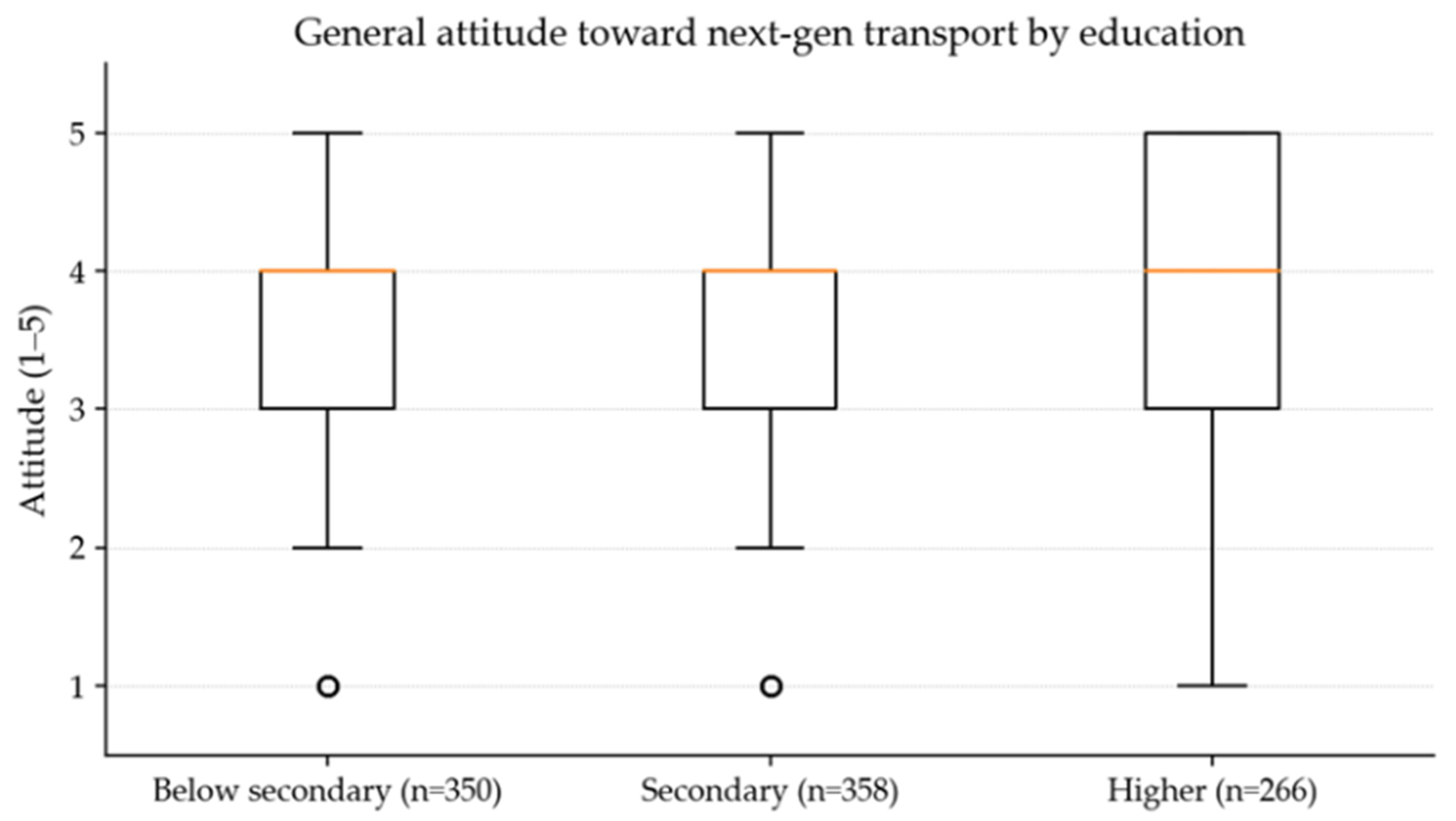
Although small differences were observed between social groups, these were minor in magnitude. Overall, this suggests that positive attitudes toward innovative transport technologies are broadly shared across the population, with only modest variation by socio-demographic characteristics.
In the context of existing literature, the results of the present study confirm that the general public holds a positive attitude toward next-generation transport technologies, including Hyperloop, with relatively small differences between social groups. Consistent with previous studies [
19,
20,
39,
40], demographic factors such as gender and age have a limited influence on attitudes, whereas education level and place of residence appear to play a more significant role. Our findings further extend these insights by highlighting the importance of individual knowledge about the technology, as well as perceived benefits and risks, in shaping acceptance of innovative transportation solutions. Thus, the current results not only corroborate prior research but also identify additional factors that contribute to public attitudes toward the Hyperloop.
Public attitudes toward modern transportation technologies vary across socio-demographic groups. Research indicates that younger individuals and those with higher levels of education are more likely to adopt innovative transportation solutions, as they tend to have a greater appreciation for technological advancements and their potential benefits [
41].
The results indicate that the general public’s attitude toward next-generation technologies, including Hyperloop, is positive, with minor differences between social groups. Similar conclusions are drawn from the study by Abouelel et al. [
20], who found that the Hyperloop was frequently chosen in the study sample. The attributes of the service itself, such as travel time, cost, and safety, were more crucial than most demographic characteristics. The authors noted that while income, a driver’s licence, and access to a car influenced transportation choices, other variables, including gender, played a lesser role in shaping these choices. Notably, the study showed that psychological factors—such as openness to new technologies and self-confidence—differentiated attitudes toward Hyperloop more strongly than standard demographic characteristics. This suggests that positive attitudes are generally prevalent, and intergroup differences are relatively limited.
A study in the Netherlands by Planing et al. [
19] found similarly positive overall acceptance of the Hyperloop. However, attitudes also differed by gender and age, with men and younger individuals being more likely to accept the technology. Furthermore, prior knowledge of the Hyperloop concept was shown to increase acceptance.
A study of Kang et al. [
39] conducted among 600 residents of Busan, South Korea, found that perceived risk plays a key role in shaping public support for Hyperloop development. The study also examined whether age, gender, and level of knowledge about Hyperloop trains could moderate the relationship between perceived risk and support for this mode of transportation. The results indicated that higher perceived risk significantly decreased support for Hyperloop development. Age and gender were not found to be significant moderators, while knowledge about Hyperloop strengthened the relationship between perceived risk and support and was itself a positive predictor of support. These findings have substantial implications for city policymakers and public transportation planners seeking to implement Hyperloop services in metropolitan areas.
Another study by Kang [
40] indicates that the development of hyperloop infrastructure in Korea, despite massive investment, could bring significant benefits to local communities; however, it also raises questions about public acceptance of the technology. A study conducted among 592 residents of Gyeongnam Province examined how the perceived benefits of hyperloop influence perceptions, the value attributed to the technology, support for the project, and intention to use hyperloop trains. The results showed that higher perceived benefits translate into a more positive image and higher value for hyperloop among residents, which in turn increases their support for the development of this infrastructure and their willingness to use it. These findings offer valuable insights into the public’s perceptions of innovative transportation technologies, supporting decision-makers in planning and communicating hyperloop projects in urban areas.
- 2.
“What is the current level of public awareness of Hyperloop technology, and which demographic groups are more or less aware?”
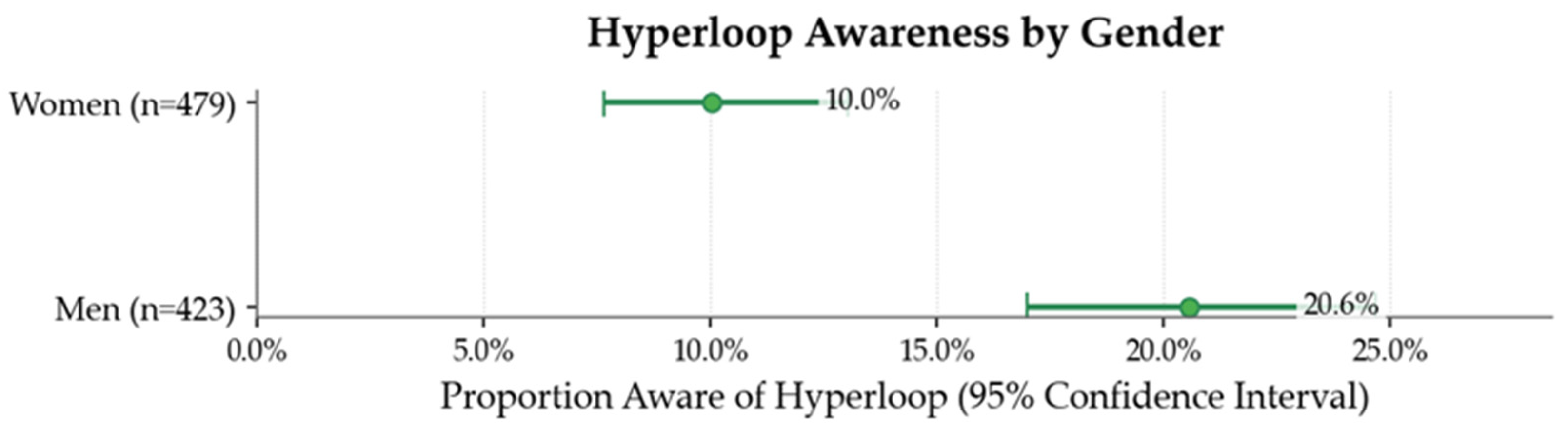
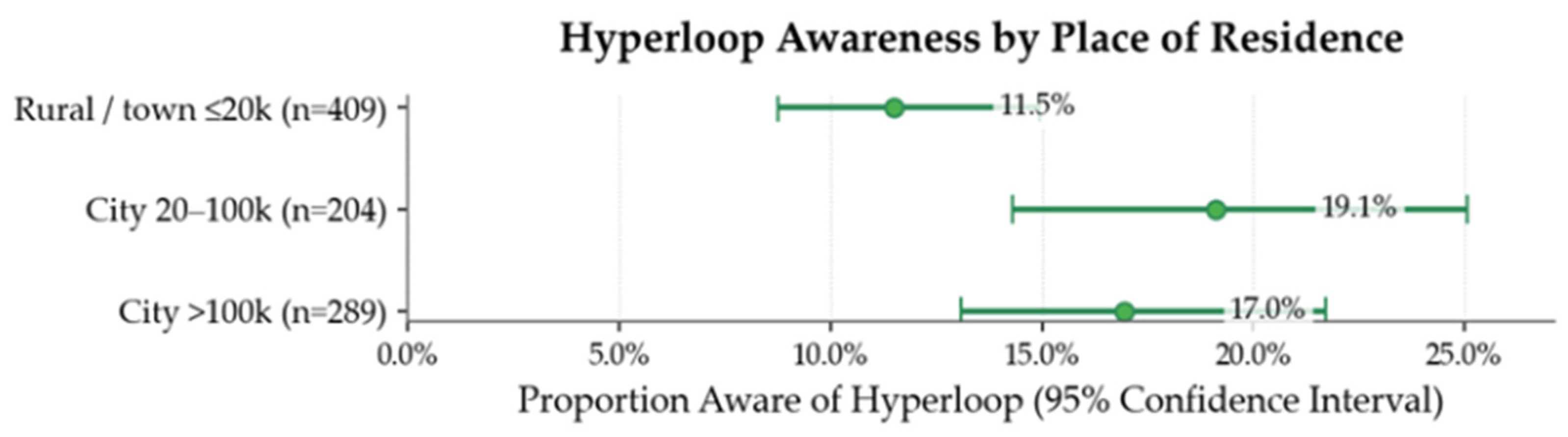
The results show that awareness of Hyperloop technology in the general population is relatively low, varying by age, gender, education, and place of residence. A similar pattern is observed in the study by Abouelela et al. [
20], in which as many as 70% of respondents had heard of Hyperloop, but only 9% declared extensive knowledge about it. Furthermore, men demonstrated significantly greater familiarity with and interest in this technology than women, which is reflected in our results. However, the authors emphasize that their study sample comprised primarily young and well-educated participants, meaning that awareness levels are likely even lower in the broader population.
Previous research by Planing et al. [
19] indicates that more than half of respondents (55.8%) had never heard of Hyperloop. It also found that those with prior knowledge were significantly more likely to accept the technology. The authors suggest that expanding knowledge (e.g., through visualizations or VR experiences) may foster acceptance.
At the same time, research [
42] indicates that social media, particularly YouTube content, plays a significant role in shaping trust in Hyperloop and intentions to use this technology. A study conducted with 760 participants in a video experiment demonstrated that trust transfers from the accounts presented in the videos to perceptions of the Hyperloop transportation system, which in turn increases the intention to travel by this mode. Attitudes toward Hyperloop mediated the relationship between trust in video content, perceived risk, and travel intention. These results underscore the importance of awareness of technology and trust in information sources in shaping public perceptions of innovative transportation modes.
- 3.
“How do perceptions of the need for innovation in the transport sector influence public willingness to adopt Hyperloop technology?”
The results demonstrate that the perceived need for innovation in the transport sector clearly increases the willingness to use Hyperloop. The stronger the belief that transport requires modernization, the greater the openness to adopting new solutions.
Our own research confirmed that the perceived need for innovation in the transportation sector strengthens the willingness to accept Hyperloop. According to Abouelel et al. [
20], this mechanism is reflected in the degree of positive attitudes toward new technologies and willingness to use them (affinity for technology)—respondents who were more open to new solutions were more likely to declare their willingness to choose Hyperloop. The authors also showed that user self-confidence was a significant factor in early adoption of this technology. This indicates that both the subjective assessment of the need for modernization and individual psychological predispositions shape social readiness to use modern means of transportation.
Comparing with other studies in this area [
19], it is essential to note that performance expectancy was identified as a significant predictor of acceptance—that is, benefits such as speed, comfort, and environmental advantages. This finding is consistent with current research, which suggests that a belief in the need for innovation is associated with high expectations regarding the performance of new technology.
- 4.
“What is the relationship between environmental expectations and the willingness to use Hyperloop as a sustainable transport solution?”
Respondents who perceive potential environmental benefits are more likely to declare their willingness to adopt Hyperloop as a sustainable mode of transportation, as confirmed by the moderate positive correlation between these variables (ρ = 0.57,
p < 0.001; see
Table 4). This finding indicates that environmental awareness and perceived ecological advantages significantly contribute to public readiness to adopt low-carbon mobility solutions. Notably, these pro-environmental beliefs are widely shared and do not vary substantially across demographic groups, suggesting that environmental sensitivity represents a broadly common value in shaping attitudes toward next-generation transport technologies.
The relationship between environmental expectations and willingness to use the Hyperloop as a sustainable mode of transportation largely depends on environmental awareness and concern. Exposure to sustainable practices and an understanding of the benefits of reducing carbon dioxide emissions are crucial in this context. Tanwir and Hamzah [
43] indicate that the greater an individual’s environmental knowledge, the more likely they are to use eco-friendly transportation alternatives. This means that increased awareness of the negative environmental impact of traditional transportation increases the willingness to implement innovative, energy-efficient solutions, such as the Hyperloop, that reduce carbon footprints. Furthermore, Waqas et al. [
38] emphasize that environmental concern mediates the acceptance of sustainable transportation options. Research shows that individuals aware of the environmental and social benefits of sustainable transportation, as well as the problems associated with traffic and pollution, are more likely to support eco-friendly innovations. Consequently, higher environmental expectations are associated with greater willingness to use the Hyperloop as an energy-efficient and eco-friendly mode of transportation.
Our research demonstrates that positive environmental expectations associated with Hyperloop are closely linked to willingness to use this technology. Other findings [
20] confirm the importance of this issue, with approximately 60% of respondents citing environmental impact as an essential factor when choosing a mode of transportation. Furthermore, in their literature review, the authors emphasized that Hyperloop is perceived as an energy-efficient, quiet, and low-emission solution. Although environmental considerations were not explicitly incorporated into choice models, the researchers suggest that communicating the potential environmental benefits can significantly increase public acceptance of this mode of transportation.
Planing et al. [
19] confirm that expected environmental friendliness (sustainability) is a performance expectancy and significantly increases Hyperloop acceptance. However, the authors note that safety factors (perceived danger—e.g., fear of technology failure, lack of windows, or low-pressure environments) may simultaneously weaken the willingness to use.
- 5.
“How do environmental perceptions, general attitudes, and perceived need interact in shaping public acceptance of Hyperloop technology?”
The study demonstrates that acceptance of Hyperloop results from the interplay of several key factors. A general positive attitude toward technology is the most critical element that directly influences readiness to adopt it, as confirmed by a strong positive correlation between attitude and willingness (ρ = 0.74,
p < 0.001; see
Table 4). At the same time, the perceived need for innovation in transportation (ρ = 0.57,
p < 0.001) and environmental expectations (ρ = 0.57,
p < 0.001) reinforce this attitude, creating a coherent mechanism that fosters acceptance. Therefore, the more respondents perceive the need for modernization and the environmental potential of Hyperloop, the stronger their positive attitudes, which then translate into openness to this technology.
Research findings indicate that Hyperloop acceptance is not driven by a single factor but rather a combination of several elements: a generally positive attitude toward the technology, a belief in the need for innovation in transportation, and expectations related to environmental benefits. Similar conclusions were reached by Abouelela et al. [
20], who noted that respondents’ choices depended not only on the characteristics of the service itself, such as travel time, cost, and safety, but also on psychological attitudes—openness to new solutions or concerns about innovation. The authors also indicated that individual characteristics, such as gender and self-confidence, played a role in early adoption. All of this demonstrates that Hyperloop acceptance is shaped by a complex interplay of beliefs, experiences, and expectations, which mutually reinforce one another, increasing the willingness to use this technology.
Comparatively, previous results [
19] suggest that the Hyperloop acceptance model is primarily explained by two factors: performance expectancy (benefits, including speed, comfort, and environmental aspects) and perceived danger (safety concerns). Thus, positive attitudes stemming from expected benefits are crucial; however, interactions may be limited by safety concerns. This extends our conclusion by adding the risk dimension as a counterbalancing factor.
Meanwhile, another study [
44] indicates that Hyperloop promotional videos can influence travellers’ pro-environmental behaviour and their willingness to use this technology as a sustainable transportation option. The results showed that awareness of the issue, a sense of responsibility, and attitudes toward travel play a role in shaping pro-environmental intentions. The study highlights the importance of the perception of Hyperloop’s environmental value in shaping public acceptance of modern transportation.
6. Conclusions
The results of this study show that Polish society is generally favourable to next-generation energy-efficient transportation technologies, such as Hyperloop. This is indicated by positive ratings across all survey dimensions: attitudes, perceived need for innovation, willingness to use rail, and environmental expectations. Furthermore, it is noticeable that willingness to use Hyperloop strongly depends on general attitudes toward innovation and, to a lesser extent, on perceived environmental benefits and the need for changes in transportation. Therefore, greater emphasis could be placed on increasing awareness of the energy efficiency and positive environmental impact of this mode of transportation.
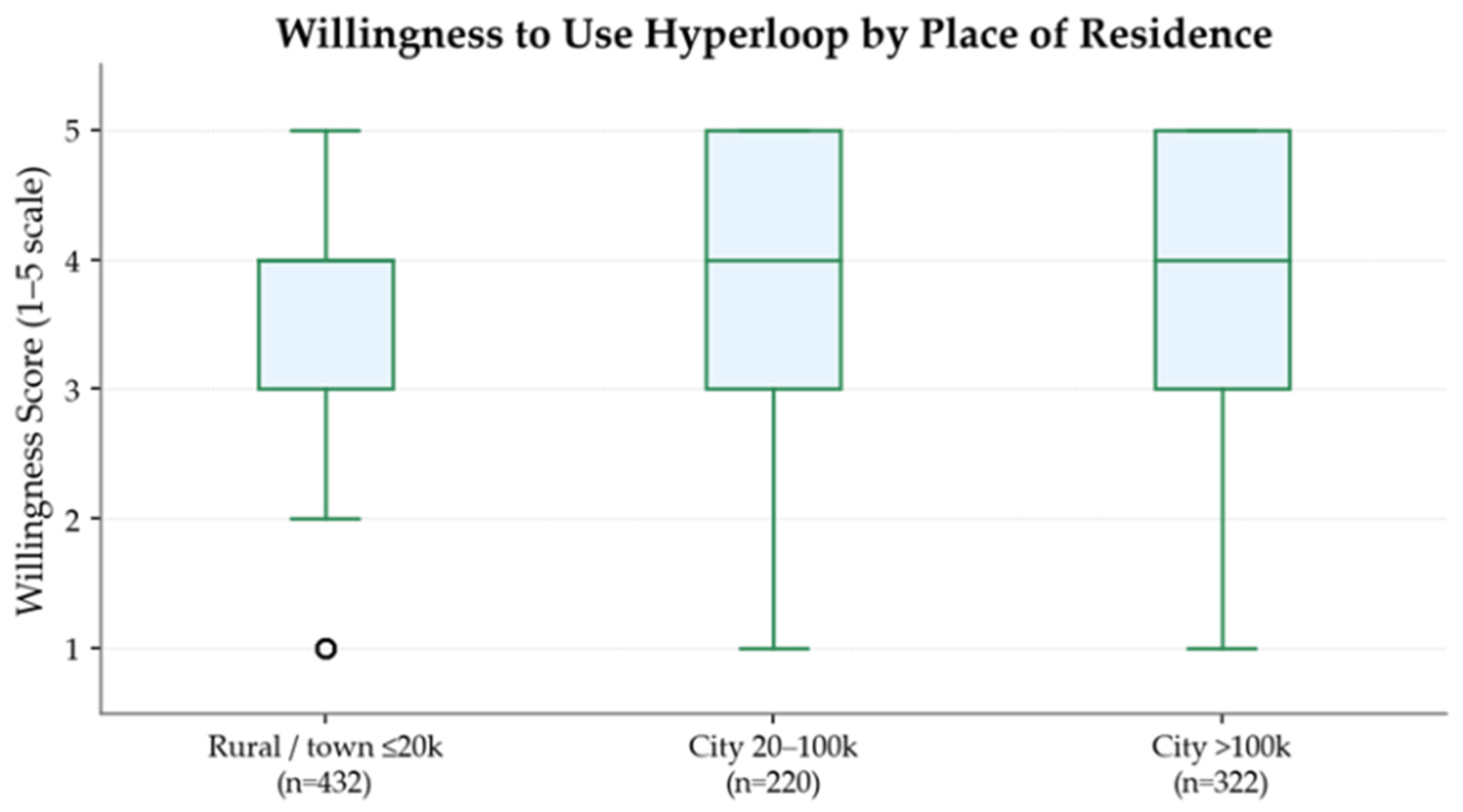
Poles are favourably disposed toward next-generation transport, with medians at 4 for attitude, need, willingness, and environmental expectations, and 15% already recognize Hyperloop by name. Segmentation is present but modest: education and urbanicity consistently predict more positive attitudes, stronger perceived need, and greater willingness (KW p < 0.05; ε2 small; post hoc δ ≈ 0.10–0.16). Willingness is tightly coupled with general attitude and moderately with need and eco (all ρ significant), suggesting a coherent acceptance structure.
For policy and communication, the most significant gains likely come from awareness building (especially among women, older adults, rural/small-town residents, and the unemployed) and from messages that frame Hyperloop within broader innovation needs and environmental expectations. Effects are statistically reliable yet small, advising proportionate expectations and targeted, equity-minded outreach.
No study is free from limitations. First, the sample was not designed to be nationally representative. The study used a quota-based online panel rather than a probability sample. As a result, the findings cannot be fully generalized to the entire Polish adult population. Next, the current study has at least several significant research limitations. This cross-sectional design makes it impossible to capture changes in attitudes toward the hyperloop over time. Future research should therefore replicate and extend these findings in longitudinal studies. Furthermore, the study relies on respondents’ subjective opinions, which may bias responses toward socially desirable outcomes or conceal a lack of subject knowledge. A specific limitation may also be the lack of comparison between Hyperloop and other means of transport, such as high-speed rail or air transport, which would allow for a more comprehensive assessment of its advantages. A key limitation is the omission of measures for risk perception (e.g., perceived safety, comfort, and consequences of failure) and cost expectations (e.g., ticket price, value of time, and cost relative to alternatives). These are well-known, critical determinants of technology adoption, and their absence limits the explanatory power of the current correlational models. It should be noted that this study was conducted without parallel measurements of acceptance and preference for existing transportation alternatives (i.e., high-speed rail, air travel, or intercity buses). This prevents a direct assessment of the relative advantage of Hyperloop technology in the eyes of respondents compared to currently available options. In the context of the Diffusion of Innovations Theory, relative advantage is a key factor in the adoption of new technology. Therefore, it would be worthwhile to further investigate the comparison with other modes of transportation to assess the competitive advantage of Hyperloop in the transportation market.
The authors would also like to suggest directions for future research in this area. Firstly, future studies employing probability sampling or post-stratification weighting would enable population-level inference. To deepen the research, a triangulation method is planned, combining quantitative and qualitative research approaches. This will help expand on the current study, which captured general trends and statistical differences in attitudes toward the Hyperloop system based on demographic characteristics. However, this quantitative research did not provide insight into the motivations, concerns, or uncertainties that respondents had when providing their answers, which could be further explored in a qualitative study, such as through in-depth interviews. This seems particularly important for capturing differences in Hyperloop acceptance across demographic groups. Future quantitative research will also extend the present findings by developing multivariable models to more accurately predict Hyperloop acceptance. This is essential for understanding the complex interplay of factors. Crucially, these models will integrate measures of perceived risk (safety, comfort, and system failure) and cost expectations (e.g., fare sensitivity and time-saving valuation) to assess their moderating and mediating roles alongside general attitude, perceived need, and environmental beliefs. Including these dimensions will significantly enhance the predictive and explanatory power of the acceptance model. Therefore, it is expected that the use of triangulation will enhance data consistency, as interpretations and assessments from qualitative research will further strengthen the results of the statistical analysis of quantitative data. This is also important for capturing the motivations, concerns, and uncertainties (including safety fears and cost sensitivity) that underpin the quantitative responses, especially among less-aware or more cautious demographic groups.





 ,
,