
Article

Research on Wetland Fine Classification Based on Remote Sensing Images with Multi-Temporal and Feature Optimization

1
School of Intelligent Science and Information Engineering, Shenyang University, Shenyang 110044, China
2
College of Life Science and Bioengineering, Shenyang University, Shenyang 110044, China
*
Author to whom correspondence should be addressed.
Sustainability 2025, 17(24), 10900; https://doi.org/10.3390/su172410900 (registering DOI)
Submission received: 4 November 2025 / Revised: 1 December 2025 / Accepted: 2 December 2025 / Published: 5 December 2025

Abstract

Wetlands, known as “the kidney of the Earth”, serve as critical ecological carriers for global sustainable development. The fine classification of wetlands is crucial to their utilization and protection. Wetland fine-scale classification based on remote sensing imagery has long been challenged by disturbances such as clouds, fog, and shadows. Simultaneously, the confusion of spectral information among land cover types remains a primary factor affecting classification accuracy. To address these challenges, this paper proposes a fine classification model of wetlands in remote sensing images based on multi-temporal data and feature optimization (CMW-MTFO). The model is divided into three parts: (1) a multi-satellite and multi-temporal remote sensing image fusion module; (2) a feature optimization module; and (3) a feature classification network module. Multi-satellite multi-temporal image fusion compensates for information gaps caused by cloud cover, fog, and shadows, while feature optimization reduces spectral characteristics prone to confusion. Finally, fine classification is completed using the feature classification network based on deep learning. Using coastal wetlands in Liaoning Province, China, as the experimental area, this study compares the CMW-MTFO with several classical wetland classification methods, non-feature-optimized classification, and single-temporal classification. Results show that the proposed model achieves an overall classification accuracy of 98.31% for Liaoning wetlands, with a Kappa coefficient of 0.9795. Compared to the classic random forest method, classification accuracy and Kappa coefficient improved by 11.09% and 0.1286, respectively. Compared to non-feature-based classification, classification accuracy increased by 1.06% and Kappa coefficient by 1.18%. Compared to the best classification performance using single-temporal images, the proposed method achieved a 1.81% increase in classification accuracy and a 2.19% increase in Kappa value, demonstrating the effectiveness of the model approach.

1. Introduction

Wetlands are rich in natural resources and play a role in water conservation, climate regulation and biodiversity protection. The ecological value, vulnerability and utilization patterns of different types of wetlands vary greatly. For example, “riverine wetlands” need to focus on protecting water quality and hydrological connectivity, “mudflat wetlands” need to be protected from extensive reclamation, and “marsh wetlands” need to be controlled from over-exploitation. Rapid urbanization has led to a series of environmental problems, including a reduction in wetland ecosystems, degradation of inland water resources, depletion of groundwater resources, and accelerated soil erosion [1]. Ramsar Convention the 15th Conference of the Parties (COP15) pointed out in the Global Wetland Outlook 2025 [2], over the past 50–60 years, approximately 65% of the intertidal mudflats in China’s Yellow Sea have disappeared due to land reclamation and the wetland area in the Sanjiang Plain has decreased by approximately 2.77 million hectares due to the conversion of large quantities of wetlands into farmland. Wetland ecosystems are facing challenges such as human activities and over-exploitation of resources [3], so strengthening the protection of wetlands is an important step to promote the realization of sustainable development goals (SDGs). The fine classification of wetlands can clarify the distribution range and boundaries of various types of wetlands, which is of great significance for the management, protection and restoration of wetlands. Accurate and timely monitoring of wetlands has become a global emergency according to SDG 6.6.1 [4].
It is difficult to meet the requirements of fine classification of wetlands by traditional survey methods. Remote sensing technology has the characteristics of a large detection range, high precision and rapid access to information, which can effectively reduce the workload of field surveys and statistics and lower the cost. At present, both optical remote sensing images and radar remote sensing images are widely used in wetland classification research [5,6,7].
Existing methods for fine classification of wetlands based on remotely sensed images are divided into the following categories: pixel-based classification methods [8,9], object-oriented classification methods [10,11,12,13], and deep learning-based methods [14,15,16,17]. Image-based classification methods are methods that classify each image based on its spectral features. Khan et al. [8] used a pixel-based machine learning classification method to finely classify New Zealand wetland areas by integrating satellite imagery and geospatial imagery. Norris et al. [9] found that pixel-based classification methods are more suitable for the classification of Canadian wetlands, providing support for the classification of relatively understudied wetlands along the Atlantic coast of Canada. However, these pixel-based classification methods are prone to produce “salt and pepper noise” and cannot effectively utilize spatial structural relationships and contextual information. Object-oriented classification methods usually pre-segment the image into individual objects and classify each object by analyzing its spectral, texture, and contextual information and other features. Object-oriented classification methods are more popular when the size of the segmented objects is much larger than the spatial resolution, which is more common in drone image applications with extremely high spatial resolution. Liu et al. [10] used an object-oriented classification method based on color enhancement to classify coastal wetlands, emphasizing the role of color information in the classification of vegetation communities. The object-oriented classification method can effectively distinguish patches similar to wetlands. Gao et al. [11] improved the accuracy of vegetation classification in coastal wetlands by incorporating phenology metrics based on an object-oriented approach. Luo et al. [12] used an object-oriented random forest and migration learning approach to provide effective support for large-scale wetlands in transboundary watersheds. However, the object-oriented classification method is limited by the segmentation scale, and it uses the object spectral mean as the feature, ignoring the spectral heterogeneity within the object, which also makes the classification accuracy low. Zhang et al. [13] used an object-oriented image analysis method to classify mangroves and produced the 2018 Chinese mangrove dataset through cross-validation by three interpreters and field verification. Both image element-based and object-oriented classification methods require manual selection and calculation of features such as spectral and texture features for classification. In remote sensing image classification, remote sensing images contain a large amount of information, which can be extracted spectral features, texture features and other rich features, which are very effective for fine classification of wetlands by combining multidimensional features. Wetlands are mainly composed of vegetation and water bodies, and the corresponding type indices of vegetation, red edges and water bodies help wetland identification. Radar image vegetation structure information is sensitive and plays an important role in water body information extraction. For example, Xing et al. [18] performed wetland classification based on the features of Sentinel-1 and Sentinel-2 images, which proved that the red edge index and spectral features were the most important for wetland classification. Munizaga et al. [19] enabled RF’s ability to distinguish land cover when applied to high resolution images by combining spectral features, texture features and topographic information. Liu et al. [20] extracted optimal features such as spectral features, shape features, texture features, and index features based on the Zhuhai No. 1 image, and used machine learning methods to significantly improve wetland classification.
Although the above shallow learning algorithms have achieved better results in wetland classification, the classification ability of such shallow learning algorithms is more limited with the increase in the number of training samples and sample types. In wetland classification research, there is still room for improvement in the classification accuracy of such methods compared with deep learning-based methods. Deep learning methods can use both spectral information and spatial context information to automatically learn complex features in the image to improve classification accuracy. Morgan et al. [14] verified that the U-Net deep learning method outperforms other machine learning methods in classifying salt marshes. Yang et al. [16] generated a simulated image similar to the training image with limited data and used the simulated image consisting of a multiscale spectral feature extraction module and a two-branch network consisting of a 3DCNN and Transformer-based encoder module to improve the generalization performance of mixed vegetation classification for coastal wetlands. Asif et al. [17] classified Danish wetlands using FCN, U-Net, and DeepLabV3+, and DeeplabV3+ had the highest OA of 80.9%. Yang et al. [21] compared 12 classic CNN models and found that the classification results of the DenseNet model were basically consistent with the classification results of the GLC_FCS30 product. Luo et al. [15] proposed a HyperBCS network for wetland classification, which had the highest accuracy compared to other methods such as 2D and 3DCNN, up to 98.29% and 96.82%. Pixel-based classification methods, object-oriented classification methods and deep learning methods have all achieved relatively superior results. However, the traditional methods have limitations in feature expression ability, and the deep learning-based wetland classification study fails to fully utilize the multi-dimensional information in remote sensing images.
In response to the problem that the fine classification of wetlands based on remote sensing images has always been interfered by clouds, fog, shadows, etc., and the spectral information of ground objects is confused, this study constructed a wetland classification model based on multi-temporal remote sensing image features based on Sentinel-2 multispectral remote sensing image data and MERIT_DEM image data. This method combines the growth characteristics of wetland vegetation, the rich spectral information of remote sensing images and the powerful classification and recognition capabilities of deep learning to enhance the separability of ground objects and improve classification accuracy. It also analyzes the ability of high-dimensional features to enhance deep learning classification performance and the impact of multi-temporal imagery on wetland classification accuracy.
(1)
A multi-satellite and multi-temporal remote sensing image fusion module is proposed, in which the fused information can not only fill the gaps in remote sensing image data that are susceptible to interference by clouds, fog, shadows, etc., and ensure the integrity of the information, but also obtain the data of “high spatial resolution + rich spectral and texture”, and also incorporate the information of seasonal color changes in wetlands into the features, so that the differentiation of wetland areas is increased. It can also incorporate the seasonal color change information of wetlands into the features and increase the differentiation of wetland areas. This will improve the accuracy of regional classification.
(2)
The proposed Feature Optimization Module reduces the information that causes confusion between features and the duplicated features, reduces the data dimensions, and avoids the interference of “dimensional catastrophe” on the model. By filtering the key features, the amount of data to be processed by the model is significantly reduced, and the consumption of hardware resources is lowered, so that the model can be trained and classified faster.

2. Materials and Methods

2.1. Methods

In this paper, a fine classification model of wetlands in remote sensing images based on multi-temporal data and feature optimization is constructed. The multi-satellite and multi-temporal remote sensing image fusion module is used to process multi-temporal Sentinel-2 images and DEM data, and the Feature Optimization Module and Feature Classification Network Module are introduced to form a complete CMW-MTFO, which improves the accuracy of the wetland classification and significantly reduces the amount of data that needs to be processed by the model. The CMW-MTFO is shown in Figure 1.

2.1.1. Multi-Satellite and Multi-Temporal Remote Sensing Image Fusion Module

The multi-satellite multi-temporal remote sensing images mainly come from the Sentinel-2 image data of the Copernicus Dataspace Ecosystem (https://dataspace.copernicus.eu/explore-data, accessed on 5 March 2025) and the MERIT_DEM data developed by the Yamazaki Dai Laboratory of the University of Tokyo (http://hydro.iis.u-tokyo.ac.jp/~yamadai/MERIT_DEM/, accessed on 10 March 2025) [22].
The Sentinel 2 mission consists of twin satellites 180° out of phase and operating in the same orbit, and is designed to achieve a high revisit frequency, with a revisit cycle of up to five days at the equator. Among them, Level-2A products is an orthoimage atmospherically corrected, Surface Reflectance product. The L2A algorithm, jointly developed by the German Aerospace Center (DLR) and Telepazio (Rome, Italy), relies on the Sen2Cor algorithm, which is a combination of state-of-the-art atmospheric corrections tailored specifically for the Sentinel 2 environment, and a scene classification module. In addition to surface reflectance imagery, the L2A class outputs three additional imagery products: Aerosol Optical Thickness (AOT) map, a Water Vapor (WV) map and a Scene Classification (SCL) map. All L2A and products are geo-aligned using UTM/WGS84 projection.
Sentinel-2 is equipped with an MSI sensor with a spatial resolution of 10–60 m. It can acquire multispectral images in 13 bands, including three vegetation red-edge bands. The DEM data mainly describes the regional geomorphological patterns of the spatial distribution, which is important data for representing the global topography, and can extract features such as terrain elevation as well as slope aspect. MERIT_DEM data are developed by SRTM3 v2.1 and AW3D-30m v1 removing multiple error components such as absolute bias scattering noise, streak noise, etc., which can enhance the wetland classification application.
In this paper, we choose Sentinel-2 L2A class multispectral image data with less than 30% cloud coverage, which are images that have been atmospherically corrected for surface reflectance. Zhao et al. [23] pointed out that the vegetation senescence season ends in late March and the greening season ends in November, so we selected images from these two time points as data sources. We also selected images from June and September for experiments to explore the impact of multi-temporal images on classification accuracy in wetland vegetation research. The details information of Sentinel-2 data collection is shown in Table 1.
All downloaded Sentinel-2 images and DEM data were completely resampled to a spatial resolution of 10 m to ensure that the resolution of all bands in the image remained consistent. The Sentinel-2 images were also mosaicked to produce a complete image covering the entire study area. The combination of different bands was used to extract remote sensing features that can effectively differentiate between various types of features (e.g., water bodies and vegetation, etc.). Through the layer stacking method, the multiple remote sensing features extracted are integrated into a new multi-temporal multi-source feature dataset, where each feature is treated as an independent band in the dataset, and the remote sensing data with multi-dimensional feature information is constructed.

2.1.2. Feature Optimization Module

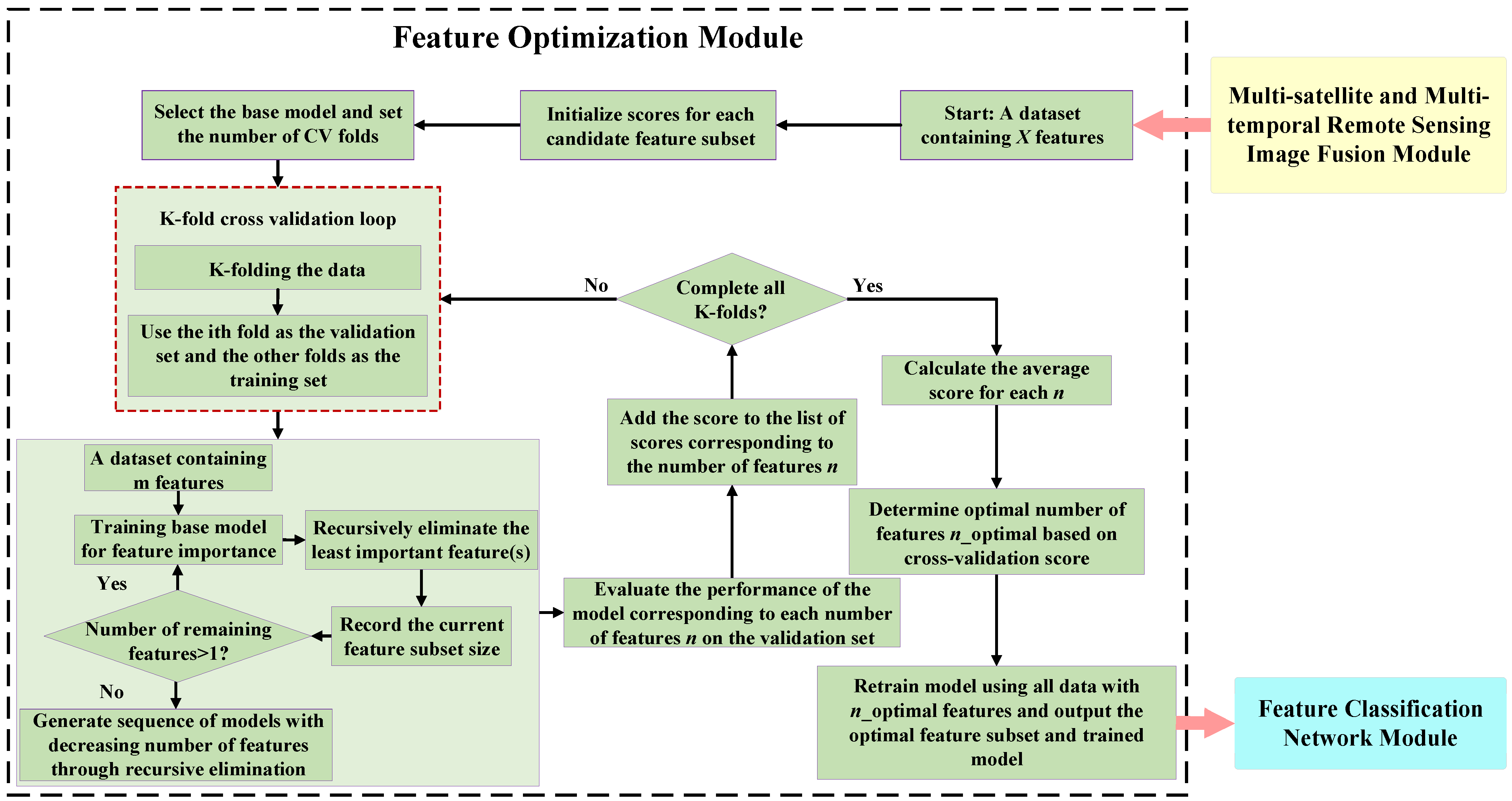
In this paper, a feature dataset is constructed based on 154 features extracted from Sentinel-2 and DEM data, respectively. When a large number of features are used for modeling, problems such as redundancy of information will occur, and not all features can effectively improve the classification accuracy. To avoid this problem and effectively improve classification accuracy, we used Recursive Feature Elimination with Cross-Validation (RFECV) to select the best features for image dimensionality reduction. RFECV is a method for selecting the best feature subset. As shown in Figure 2, firstly, Pearson correlation analysis was performed on the original features to eliminate the highly correlated features to reduce the redundant information. Afterwards, recursive feature elimination and cross-validation evaluation were performed on the remaining features using RFECV, and the data were divided into training and validation sets through K-fold cross-validation. RF is selected as the base model for RFECV, and a subset of current features is used to train the model and calculate feature importance. Continuously iterate the feature dataset, removing one of the least important features in each round of iteration, and so on until all feature screening is completed. By comparing the cross-validation results of different feature subsets, the feature subset size with the highest average score is selected as the optimal number of features. Finally, the filtered optimal feature subset is used to retrain the model to obtain the feature subset with the best classification effect [24].

2.1.3. Feature Classification Network Module

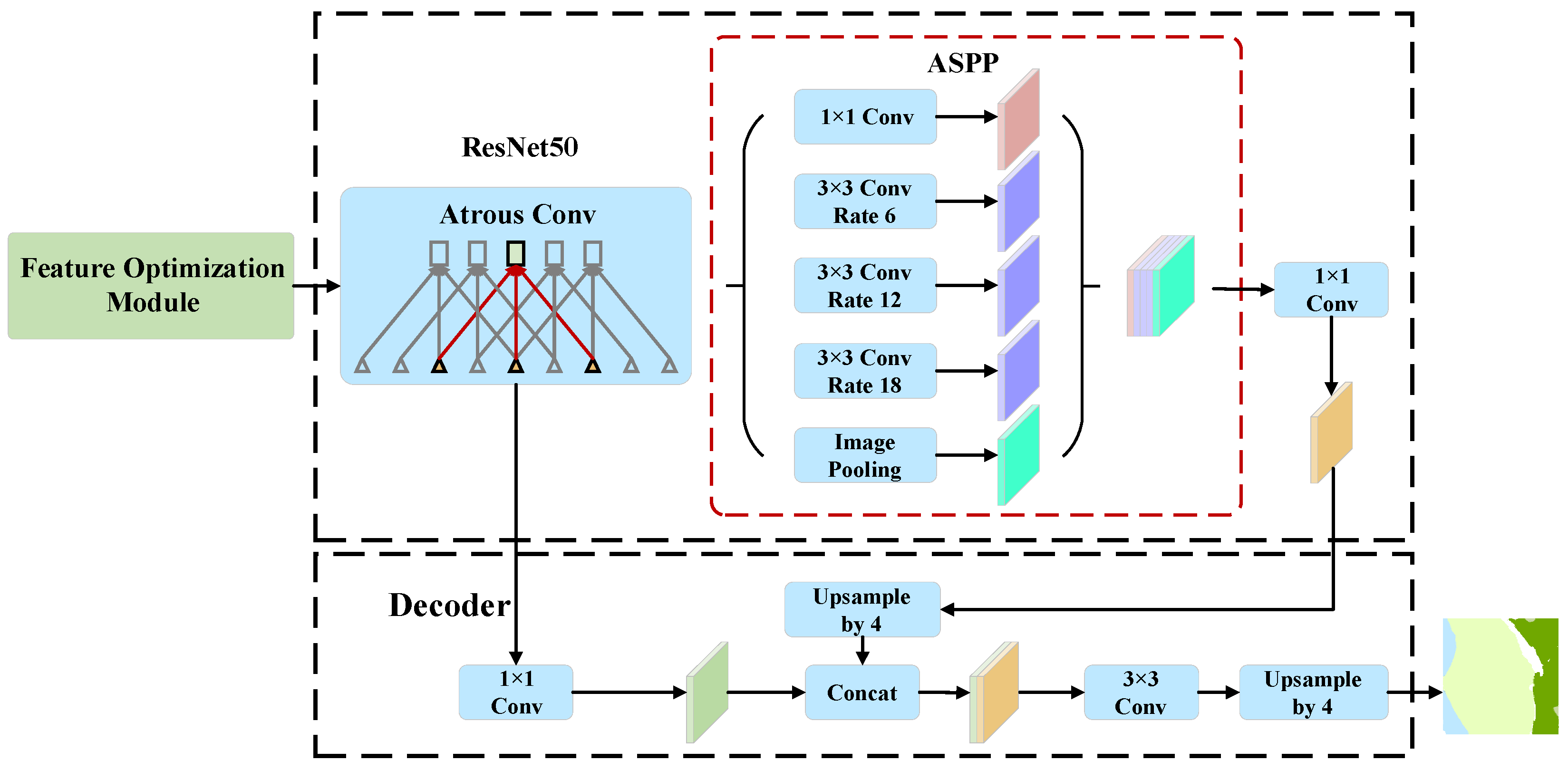
The DeepLab [25] family of networks is a deep learning network model introduced by Google dedicated to the semantic segmentation of images, which is capable of obtaining clear boundaries of target features. As shown in Figure 3, DeepLabV3+ [26] consists of two parts: an encoder and a decoder. In the encoder part, the input image is first extracted through the backbone network ResNet50 to extract multi-level feature images, where high-level features such as semantics and categories are passed through the Astrous Spatial Pyramid Pooling module to obtain multi-scale context information. The multi-scale feature maps are spliced and then subjected to 1 × 1 convolution for dimensionality reduction. In the decoder part, the high-level features are first bilinearly upsampled to make their resolution consistent with low-level features such as color and texture. Then, the low-level feature image extracted by the backbone network ResNet50 is adjusted to have the number of channels through 1 × 1 convolution to facilitate splicing with the high-level feature map, while retaining the low-level and high-level feature information. The fused feature image is subjected to finer feature extraction by 3 × 3 convolution. Finally, the resolution of the feature map is restored by bilinear interpolation to refine the boundary information of different targets in the feature image [27]. DeepLabv3+ is one of the leading general-purpose segmentation networks, which can achieve strong segmentation performance [28]. In this model, DeepLabv3+ is chosen as the backbone method for the feature classification network.

2.2. Case Study

2.2.1. Study Area

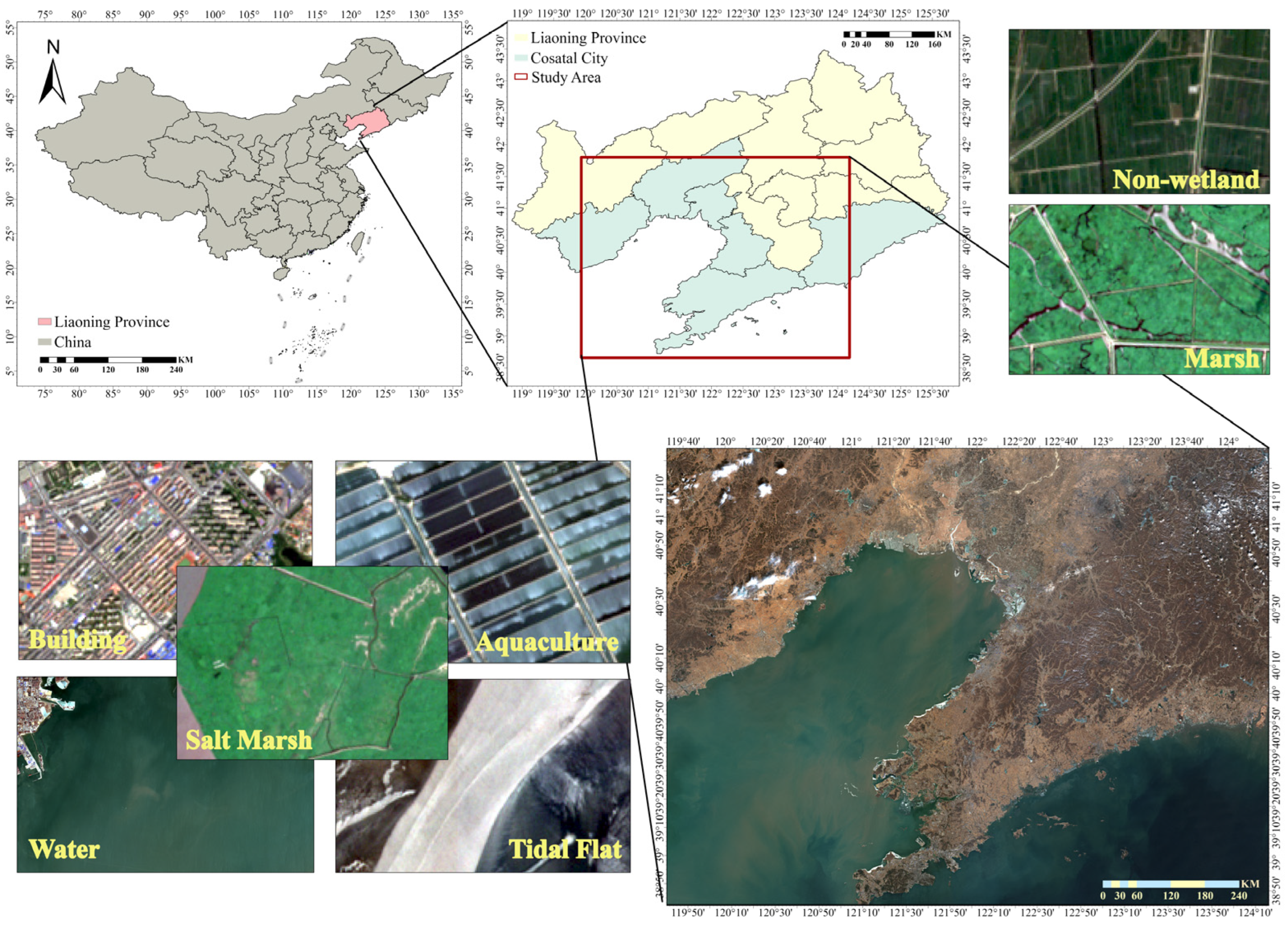
In this study, the coastal area of Liaoning Province, China, was selected as the study area, whose geographic coordinates range from 118°53′ to 125°46′ E longitude and 38°43′ to 43°26′ N latitude, and the detailed geographic location is shown in Figure 4. The region has a warm-temperate continental monsoon climate, with a windy and dry spring, a hot and rainy summer, a cold and rainy autumn, and a cold and dry winter, with an average annual temperature of about 10.3 °C and an average annual precipitation of 883 m [29]. Liaoning Province has flat terrain, fertile soil, sufficient water resources, and rich wetland resources. It is characterized by a large area, a wide range of types, a wide distribution, and rich biodiversity [30]. The total area of wetlands in the province is about 19.16 million square meters, of which coastal wetlands account for a prominent proportion, covering a wide range of types such as mudflats, salt marshes, and waters, mainly distributed in the Liaohe River Plain and offshore waters, with an average value of plant carbon sink capacity of up to 1.77 kg/(m2-a) [31].The area of salt marsh wetland in Liaohe estuarine wetland ranks first in China [32].

2.2.2. Wetland Category

With reference to the Ramsar Convention and the other relevant literature, combined with the actual situation of the coastal area of Liaoning Province [20,33], the wetland classification scheme of this paper was developed, which contains seven types, namely salt marsh, herbaceous marsh, mudflat, water body, breeding land, construction land and non-wetland, as shown in Table 2. Using ArcGIS Pro 3.0 software, 1050 sample points were selected and the category attributes of each point were determined based on the multi-temporal fusion images.
In this study, the collected Sentinel 2 multi-temporal images and sample points were used to generate a dataset for the coastal area of Liaoning Province. The dataset was expanded to 15,620 images of size 256 × 256 by data enhancement means such as panning, rotating and scaling. In constructing the classification system, this study referred to the wetland dataset GWL_FCS30 Global Wetland Open Dataset [34] (https://essd.copernicus.org/articles/15/265/2023/, accessed on 22 November 2024), which was produced using Landsat and Sentinel-1 satellite data, and which has a refined classification system, which can provide important support for wetland management. Finally, a unified manual digital annotation of the Liaoning Province coastal wetland image dataset was performed using AnyLabeling (https://github.com/CVHub520/X-AnyLabeling, accessed on 22 November 2024), an open-source image annotation software developed based on Python (https://www.python.org/, accessed on 22 November 2024) [35].

2.2.3. Experimental Environment

We used Pycharm software (2023.2.1) to build a deep learning network based on the Pytorch (2.4.1+cu124) framework. Models were trained on a 64-bit Windows 10 system with an Intel(R) Xeon(R) E5-2620 v4 processor (CPU) and a 12 GB NVIDIA TITAN XP memory graphics processor (GPU). The hyper-parameters are set as follows: the Adam algorithm is chosen for the model optimizer algorithm, the initial learning rate is set to 0.0001, the loss function uses CrossEntropyLoss with category weights, the Epoch is set to 100, the Batch Size is set to 12, and the ratio of the training set to the test set is 8:2.

2.2.4. Accuracy Assessment

To verify the accuracy of the CMW-MTFO in this paper, we use the following evaluation metrics. Confusion matrix is an important tool to evaluate the performance of the model. Based on the confusion matrix, OA (Overall Accuracy), Kappa coefficient (Kappa) and Average Accuracy are calculated, respectively, to evaluate the classification performance of the experimental method. The Kappa coefficient measures the consistency between the observed and expected classification results and is used to evaluate the classification accuracy. OA denotes the proportion of correctly classified pixels to the total pixels. AA denotes the average value of accuracy for each category. In this paper, Kappa coefficient, OA and AA are used to analyze the performance of the seven designed schemes.
O A = 1 N c = 1 C l c c
A A = c = 1 C l c c N c C
K a p p a = N c = 1 C l c c c = 1 C 1 l c c + 1 l c + 1 c N 2 c = 1 C 1 l c c + 1 l c + 1 c
where N represents the total number of pixels in the sample, N c refers to the number of pixels of the category c in the classification result, l c c denotes the number of correctly predicted sample pixels in the category c , C is total number of categories, l c c + 1 denotes the number of sample pixels misclassified by category c as category c + 1 , and l c + 1 c denotes the number of sample pixels misclassified by category c + 1 as category c .

2.2.5. Experimental Scheme Settings

In order to verify the effectiveness of this paper’s method, CMW-MTFO, to improve the classification accuracy of wetlands, as well as the role of multi-temporal remote sensing images in CMW-MTFO, the following experimental scheme is set up to verify the coastal wetlands in Liaoning Province as an example, as shown in Table 3.
Scheme ①: Fine classification of coastal wetlands based on CMW-MTFO. We used the method of this paper to classify coastal wetlands in Liaoning Province and select ResNet18 [36], CoAtNet [37], ViT [38], RF [39] and SVM [40], which have excellent performance in the classification field, as the comparison models.
Scheme ②: Coastal wetland classification based on non-optimal features using DeepLab V3+. Wetland classification is performed using a remote sensing dataset with 154 features combined with DeepLab V3+.
Scheme ③: Classification of coastal wetlands based on four deep learning models for ordinary RGB images. Classification of coastal wetlands using June single-time-phase color remote sensing images.
Scheme ④: March single-temporal coastal wetland classification based on DeepLab V3+. Wetland classification is performed based on March single-temporal remote sensing images and DeepLab V3+ using single-temporal optimized features.
Scheme ⑤: June single-temporal coastal wetland classification based on DeepLab V3+. Wetland classification is performed based on June single-temporal remote sensing images and DeepLab V3+ using single-temporal optimized features.
Scheme ⑥: September single-temporal coastal wetland classification based on DeepLab V3+. Wetland classification is performed based on September single-temporal remote sensing images and DeepLab V3+ using single-temporal optimized features.
Scheme ⑦: November single-temporal coastal wetland classification based on DeepLab V3+. Wetland classification was performed based on the single-temporal remote sensing images in November and using single-temporal optimal features combined with DeepLabV3+.
Among them, the effectiveness of the CMW-MTFO model of this paper’s method for fine classification of coastal wetlands is verified by comparing Scheme ① with Scheme ② and Scheme ① with Scheme ③. The influence of multi-temporal images on improving the accuracy of wetland classification is discussed by comparing Scheme ① with Schemes ④–⑦.

3. Results

3.1. Feature Optimization Results

The spectral features of this paper selected 11 spectral bands of Sentinel-2 images (blue, green, red, red edge, near infrared, and shortwave infrared). Optical vegetation indices derived from remotely sensed images are widely used to monitor vegetation dynamics, which describe the characteristics of remotely sensed vegetation [41]. In this study, the following vegetation indices were selected including the following: Soil-Adjusted Vegetation Index (SAVI), Optimized Soil-Adjusted Vegetation Index (OSAVI), Non-Photosynthetic Vegetation Index 2 (NPV2), Normalized Difference Senescent Vegetation Index (NDSVI), Normalized Difference Water Index (NDWI), Normalized Difference Vegetation Index Red Edge (NDVIre), Normalized Difference Vegetation Index (NDVI), Modified Soil-Adjusted Vegetation Index (MSAVI), Modified Normalized Difference Water Index (MNDWI), Modified Normalized Difference Water Index 2 (MNDWI), Land Surface Water Index (LSWI), Enhanced Vegetation Index (EVI), and Enhanced Vegetation Index2 (EVI2).
Texture features can capture the spatial grey-scale information and structural features in the image very well. It has a good separation effect on features that are spectrally similar but have more obvious texture differences, and is one of the important features for improving classification accuracy [42]. This paper selects bands B8, B4, B3, and B2 from the Sentinel-2 image to generate the mean, variance, and homogeneity texture features in the Gray-Level Co-occurrence Matrix (GLCM). The mean extracted from the GLCM reflects the regularity of the texture, the variance reflects the average deviation of the random variable, and the homogeneity describes the spatial distribution of the gray levels in the image [43]. Elevation features and slope features were extracted as Terrain features by using the DEM data, and they are important for distinguishing tidally influenced wetland types [44]. The formula and description of each feature indicator are shown in Table 4.
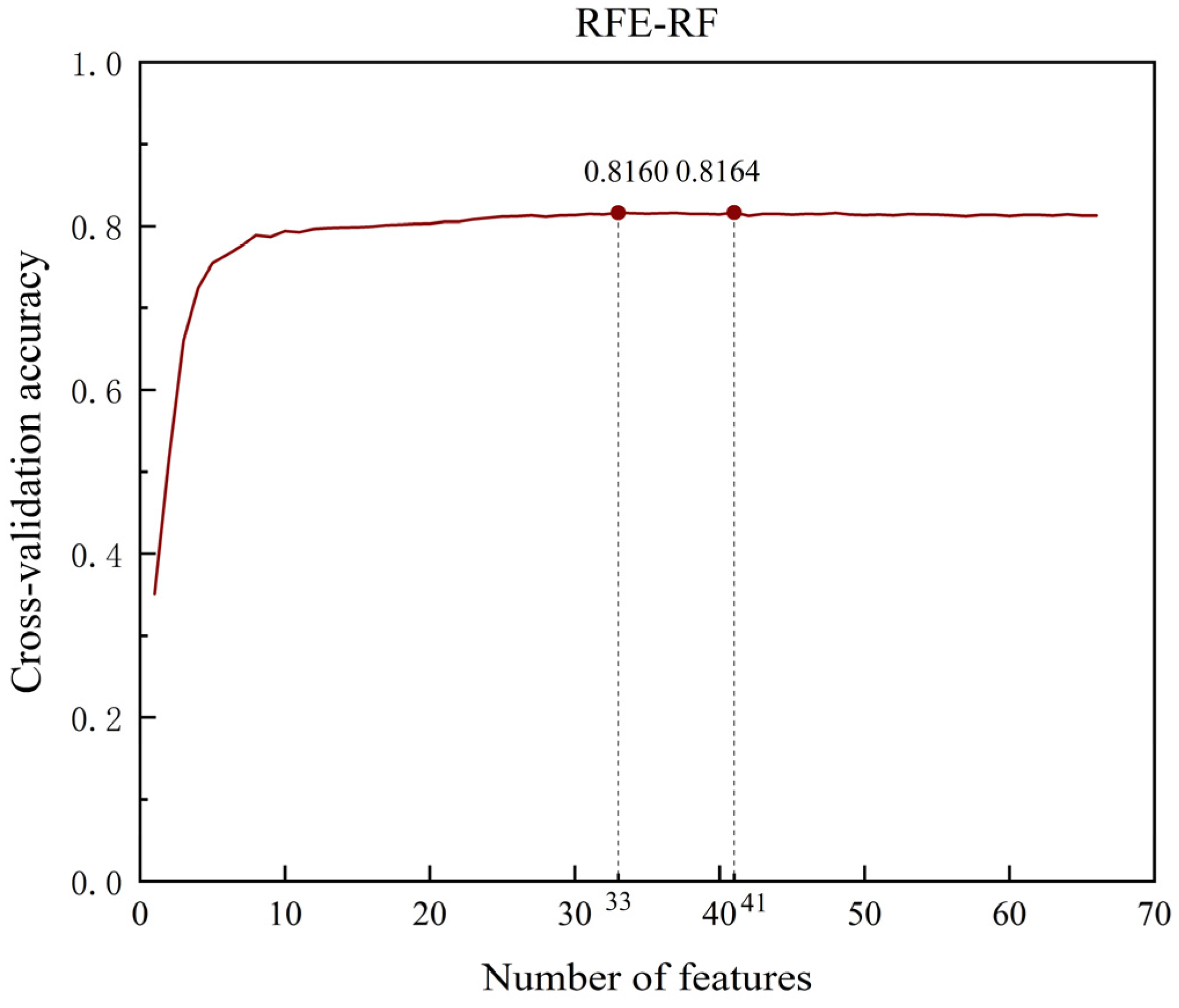
The 154 remote sensing feature data generated by the Multi-satellite and Multi-temporal Remote Sensing Image Fusion Module are input into the CMW-MTFO feature selection module, and the feature optimization results are shown in Figure 5. At the beginning stage, the cross-validation accuracy rate rises with the increase in the number of features, and when the number of features reaches 8, the accuracy rate shows a fluctuating state and rises slowly, and finally reaches the highest accuracy rate of 81.64% at 41 features. Too many features will cause information redundancy, so the accuracy rate will gradually decrease after exceeding the peak point. When 33 features are selected based on the feature optimization module, the model accuracy can reach 81.60%. After this point, the model performance begins to saturate, with the addition of new features contributing very little and erratically to the margins. Compared to the peak point 41 in the number of features, the number of features increases by 8, but the average accuracy improves by only 0.04%. Therefore, 33 features are finally selected to construct the optimal feature image dataset for subsequent research.
As shown in Table 5, the optimal feature subset selected by the CMW-MTFO Feature Optimization Module includes 12 spectral features, 15 vegetation index features, 4 texture features and 2 terrain features. Among them, the B9 band and B12 (SWIR2) contribute more to the wetland extraction in the study area. Compared with the other three types of features, texture features are relatively insensitive to the wetland extraction in the study area.

3.2. Evaluation of the Effectiveness and Accuracy of Wetland Classification Based on CMW-MTFO

In order to validate the recognition performance of the proposed method CMW-MTFO, ResNet18 [36], CoAtNet [37], ViT [38], RF [39] and SVM [40] are selected to compare with the proposed method, as shown in Table 6. The OA of CMW-MTFO and the other three deep learning models in classifying the coastal wetlands in Liaoning Province are more than 97%, which are 98.31%, 97.20%, 97.42%, and 97.58%. The Kappa coefficient of the wetland classification model based on CMW-MTFO is 0.9795, and its classification performance is the best among all six methods, with improvements of 1.35%, 1.08%, and 0.89%, respectively, compared with the other three deep learning methods. The overall accuracies of the two (usually pixel-based) conventional machine learning methods RF and SVM are 87.22% and 67.96%, respectively. The CMW-MTFO method proposed in this study relies on the advantages of the CNN-based DeepLabV3+ architecture in extracting spatial context information, and achieves a significant performance improvement, with its OA improved by 11.09% and 30.35% compared to RF and SVM, respectively. RF has a Kappa coefficient of 0.8509, while the SVM model has the worst performance with a Kappa coefficient of 0.6262.
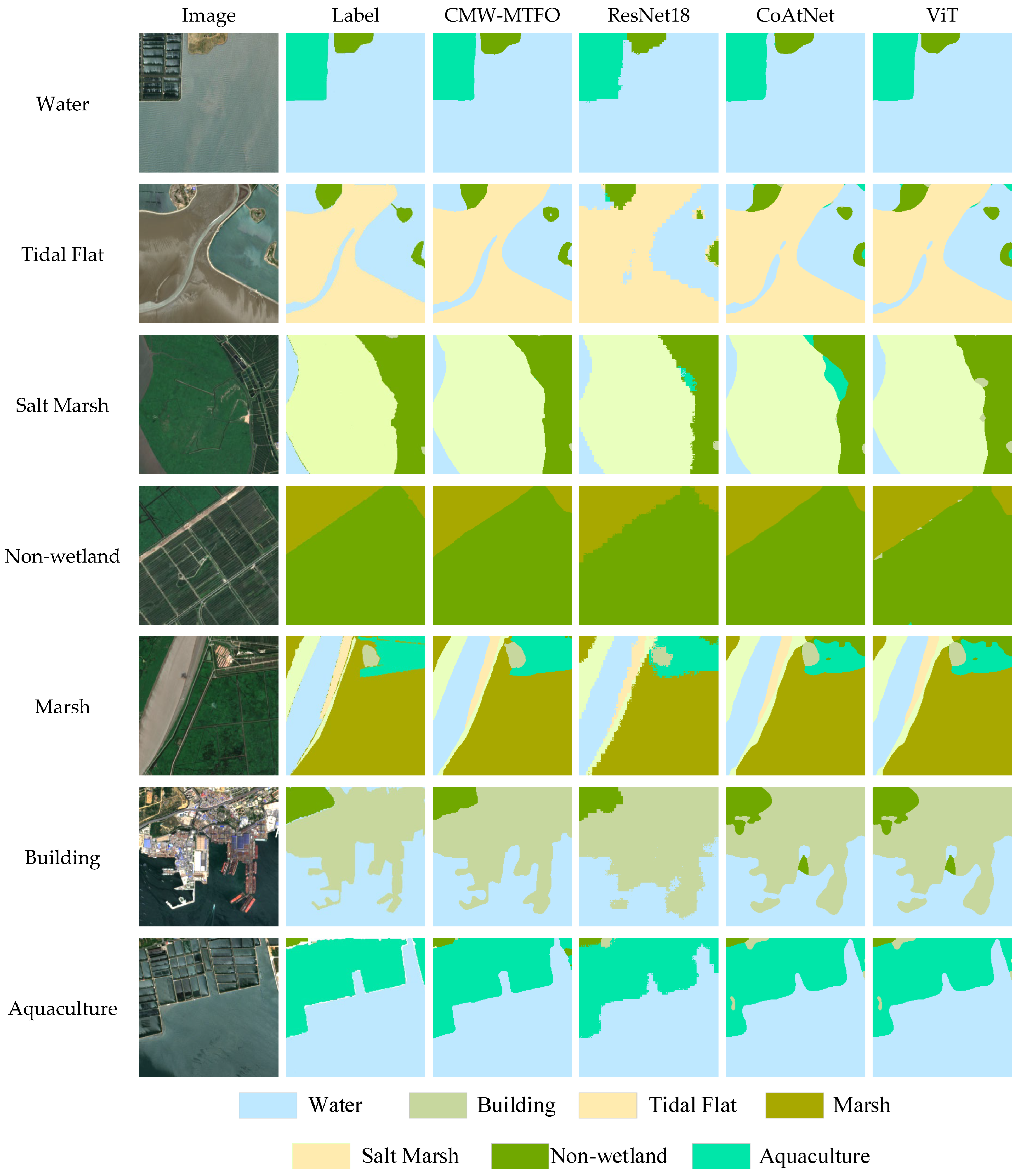
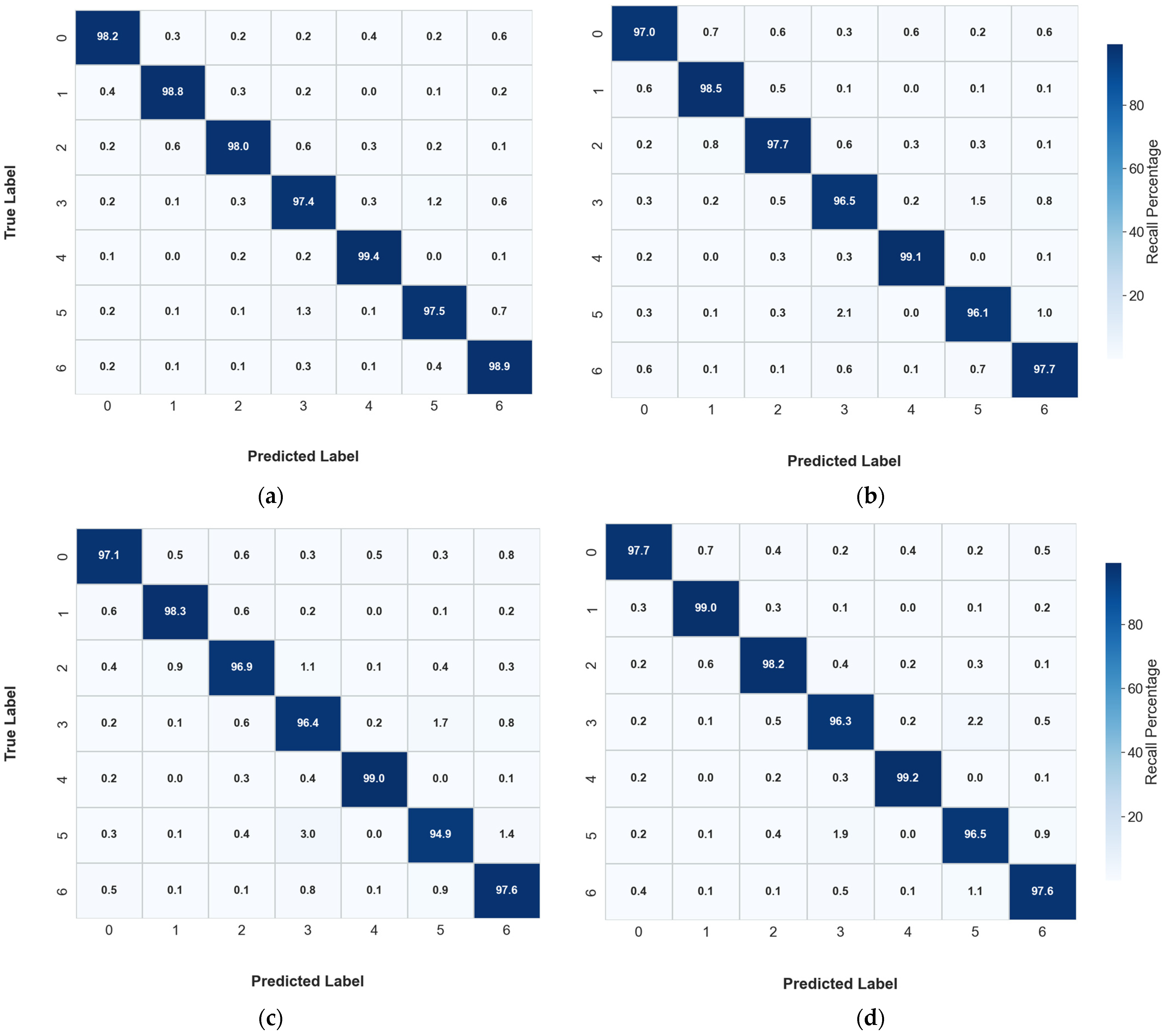
The confusion matrix for the seven land cover types in coastal wetlands of Liaoning Province, based on the CMW-MTFO wetland classification model, is shown in Figure 6. The classification accuracy is presented in Table 7. The model has the highest classification accuracy for herbaceous marsh, with its OA reaching 99.36%. Among all wetland classification models, the classification performance for herbaceous marsh was the highest among all feature classes. The ViT-based wetland classification model outperformed the other models in the recognition task of mudflats and salt marshes. Among the four deep learning models, the two feature categories of non-wetland and building land have the lowest classification accuracy, which may be due to the fact that these two categories cover more information and are more mixed with other features. The SVM-based wetland classification model provides poorer classification results for salt marshes, non-wetlands, constructed land and aquaculture ponds, with the classification accuracy of salt marshes being only around 50%. The results of the four deep learning methods were visualized in order to visually compare the performance of the different models, as shown in Figure 7. Comparative analysis shows that the prediction results of the CMW_MTFO method proposed in this paper are the closest to the actual situation. The specific manifestations are as follows: (1) Thanks to the superior boundary processing capability of deeplabv3+, CMW-MTFO is able to accurately recognize narrow areas; (2) ResNet18 performs poorly in category boundary recognition and is weakest in classifying narrow regions; (3) CoAtNet and ViT exist to misclassify water as non-wetland.

3.3. Impact of Feature Optimization Module in CMW-MTFO to Improve Wetland Classification Accuracy

As shown in Table 8, the results of Scheme ③ (plain RGB images) for coastal wetland classification based on four deep learning models show that the DeepLabV3+ model has the highest classification accuracy of 96.53%. In this paper, the method CMW-MTFO effectively guides the model to focus on these features for classification by artificially extracting handcrafted features and optimizing them. The CMW-MTFO method results in a 1.78% improvement in accuracy compared to using only normal RGB color images. In addition, the Feature Optimization Module brings significant accuracy improvements to the other three deep learning methods: a 5.43% improvement in CoAtNet accuracy, a 3.45% improvement in resnet18 accuracy, and the largest improvement in ViT at 9.42%. As shown in Table 9, the results of this paper’s CMW-MTFO are compared with the DeepLabV3+-based non-preferred feature classification results in Scheme ②: the overall accuracy of the non-preferred features is 97.25%, and the Kappa coefficient is 0.9677. By adding the Feature Optimization Module, the CMW-MTFO’s overall accuracy is further improved by 1.06%, and the Kappa coefficient increases by 0.0118. This fully illustrates that the feature optimization module enables the model to focus on the most discriminative features, effectively improving the classification ability of the deep learning model.

3.4. Comparison of Wetland Classification Results Based on Multi-Temporal and Single-Temporal Images

As shown in Table 5, based on the results of the Feature Optimization Module in the CMW-MTFO, 11 and 9 features of the June and September images were included in the subset of the selected features, and the number of the two accounted for 60% of the number of all the selected features. This is closely related to the growth cycle of the vegetation; June and September are the peak growth periods of the green vegetation, and the spectral features are distinctive. In contrast, the vegetation in March has just entered the growth period and is in the stage of gradual emergence, while in November it has entered the decline period, and the spectral difference in the vegetation in these two months is weaker than that in June and September, which leads to a relatively low level of feature differentiation.
Based on this, we investigated the impact of multi-temporal imagery on classification accuracy, setting up schemes ③–⑥ using single-temporal imagery for comparison. As shown in Table 10, the classification accuracy using the single-temporal image preferred features in June and September is higher, at 96.50% and 96.36%, respectively. The results are consistent with the results of the multi-temporal preferred features showing that the spectral information of the June and September images has a greater effect on the wetland classification accuracy. Comparison of the classification results between CMW-MTFO and the four single-temporal images reveals that the fine classification of wetlands based on the feature optimization of multi-temporal images by the method of this paper can effectively improve the accuracy of wetlands, and the accuracy is improved by 3.64%, 1.81%, 1.95% and 2.23%, respectively.

4. Conclusions

Aiming at solving the problem of complex wetland ecosystems and the difficulty of monitoring wetland distribution, this paper proposes a fine classification model of wetlands in remote sensing images based on multi-temporal data and feature optimization. The model contains three modules: (1) a Multi-satellite and Multi-temporal Remote Sensing Image Fusion Module; (2) a Feature Optimization Module; and (3) a Feature Classification Network Module. In order to prove the effectiveness of the model, this paper takes the coastal wetland in Liaoning Province, China, as the study area, fuses Sentinel-2 and MERIT_DEM multi-temporal remote sensing image data, and selects 33 features preferable from 154 features, and conducts experiments with DeepLabV3+ as the backbone of the feature classification model. Experimental results: (1) The CMW-MTFO-based wetland classification model has an overall accuracy of 98.31% and a Kappa coefficient of 0.9795 for the classification of wetlands in Liaoning Province. (2) Classification accuracy improved by 1.06% compared to the non-featured preferred scheme, with the Kappa coefficient increasing by 0.118. (3) Compared with the wetland classification of the four single-temporal images, respectively, the incorporation of multi-temporal information improves the model classification accuracy by 1.81–3.64%. The effectiveness of the present model is proved.

Author Contributions

D.X.: data collection, methodology, software, validation, writing—original draft, investigation. W.W.: conceptualization, funding acquisition, methodology, project administration, writing—review and editing. Y.M.: validation. D.F.: investigation. All authors have read and agreed to the published version of the manuscript.

Funding

This work was supported by the National Natural Science Foundation of China (No.61991413); the Northeast Geological S&T Innovation Center of China Geological Survey (No.QCJJ2023-49); and the Natural Science Foundation of Liaoning Province of China (No.2023-MS-322).

Institutional Review Board Statement

Not applicable.

Informed Consent Statement

Not applicable.

Data Availability Statement

The original contributions presented in this study are included in the article. Further inquiries can be directed to the corresponding author.

Acknowledgments

The authors wish to express their sincere gratitude to the reviewers and editors for their insightful comments, which significantly contributed to improving this paper.

Conflicts of Interest

The authors declare that they have no known competing financial interest or personal relationships that could have appeared to influence the work reported in this paper. The authors declare no conflicts of interest.

References

  1. Mumtaz, M.; Jahanzaib, S.H.; Hussain, W.; Khan, S.; Youssef, Y.M.; Qaysi, S.; Abdelnabi, A.; Alarifi, N.; Abd-Elmaboud, M.E. Synergy of Remote Sensing and Geospatial Technologies to Advance Sustainable Development Goals for Future Coastal Urbanization and Environmental Challenges in a Riverine Megacity. ISPRS Int. J. Geo-Inf. 2025, 14, 30. [Google Scholar] [CrossRef]
  2. Convention on Wetlands. Global Wetland Outlook 2025: Valuing, Conserving, Restoring and Financing Wetlands; Secretariat of the Convention on Wetlands: Gland, Switzerland, 2025. [Google Scholar]
  3. Big Earth Data in Support of the Sustainable Development Goals—Special Report for a Decade of the SDGs; CBAS: Beijing, China, 2025. [CrossRef]
  4. Global-Scale Sustainable Development Scientific Monitoring Report (2025) A Decade; CBAS: Beijing, China, 2025. [CrossRef]
  5. Moreno, G.M.d.S.; de Carvalho Júnior, O.A.; de Carvalho, O.L.F.; Andrade, T.C. Deep semantic segmentation of mangroves in Brazil combining spatial, temporal, and polarization data from Sentinel-1 time series. Ocean Coast. Manag. 2023, 231, 106381. [Google Scholar] [CrossRef]
  6. Wu, R.; Wang, J. Identifying Coastal Wetlands Changes Using a High-Resolution Optical Images Feature Hierarchical Selection Method. Appl. Sci. 2022, 12, 8297. [Google Scholar] [CrossRef]
  7. Xie, Y.; Rui, X.; Zou, Y.; Tang, H.; Ouyang, N. Mangrove monitoring and extraction based on multi-source remote sensing data: A deep learning method based on SAR and optical image fusion. Acta Oceanol. Sin. 2024, 43, 110–121. [Google Scholar] [CrossRef]
  8. Khan, M.S.I.; Vega-Corredor, M.C.; Wilson, M.D. Mapping Wetlands with High-Resolution Planet SuperDove Satellite Imagery: An Assessment of Machine Learning Models Across the Diverse Waterscapes of New Zealand. Remote Sens. 2025, 17, 2626. [Google Scholar] [CrossRef]
  9. Norris, G.S.; LaRocque, A.; Leblon, B.; Barbeau, M.A.; Hanson, A.R. Comparing Pixel- and Object-Based Approaches for Classifying Multispectral Drone Imagery of a Salt Marsh Restoration and Reference Site. Remote Sens. 2024, 16, 1049. [Google Scholar] [CrossRef]
  10. Liu, Y.; Zhang, Y.; Zhang, X.; Che, C.; Huang, C.; Li, H.; Peng, Y.; Li, Z.; Liu, Q. Fine-Scale Classification of Dominant Vegetation Communities in Coastal Wetlands Using Color-Enhanced Aerial Images. Remote Sens. 2025, 17, 2848. [Google Scholar] [CrossRef]
  11. Gao, Y.; Hu, Z.; Wang, Z.; Shi, Q.; Chen, D.; Wu, S.; Gao, Y.; Zhang, Y. Phenology Metrics for Vegetation Type Classification in Estuarine Wetlands Using Satellite Imagery. Sustainability 2023, 15, 1373. [Google Scholar] [CrossRef]
  12. Luo, K.; Samat, A.; Van De Voorde, T.; Jiang, W.; Li, W.; Abuduwaili, J. An automatic classification method with weak supervision for large-scale wetland mapping in transboundary (Irtysh River) basin using Sentinel 1/2 imageries. J. Environ. Manag. 2025, 380, 124969. [Google Scholar] [CrossRef] [PubMed]
  13. Zhang, T.; Hu, S.; He, Y.; You, S.; Yang, X.; Gan, Y.; Liu, A. A Fine-Scale Mangrove Map of China Derived from 2-Meter Resolution Satellite Observations and Field Data. ISPRS Int. J. Geo-Inf. 2021, 10, 92. [Google Scholar] [CrossRef]
  14. Morgan, G.R.; Wang, C.; Li, Z.; Schill, S.R.; Morgan, D.R. Deep Learning of High-Resolution Aerial Imagery for Coastal Marsh Change Detection: A Comparative Study. ISPRS Int. J. Geo-Inf. 2022, 11, 100. [Google Scholar]
  15. Luo, J.; He, Z.; Lin, H.; Wu, H. Biscale Convolutional Self-Attention Network for Hyperspectral Coastal Wetlands Classification. IEEE Geosci. Remote Sens. Lett. 2024, 21, 6002705. [Google Scholar] [CrossRef]
  16. Yang, M.; Qin, J.; Wang, X.; Gu, Y. Research on the Wetland Vegetation Classification Method Based on Cross-Satellite Hyperspectral Images. J. Mar. Sci. Eng. 2025, 13, 801. [Google Scholar] [CrossRef]
  17. Asif, M.R. Benchmarking Deep Learning for Wetland Mapping in Denmark Using Remote Sensing Data. IEEE J. Sel. Top. Appl. Earth Obs. Remote Sens. 2025, 18, 11953–11962. [Google Scholar] [CrossRef]
  18. Xing, H.; Niu, J.; Feng, Y.; Hou, D.; Wang, Y.; Wang, Z. A coastal wetlands mapping approach of Yellow River Delta with a hierarchical classification and optimal feature selection framework. CATENA 2023, 223, 106897. [Google Scholar] [CrossRef]
  19. Munizaga, J.; García, M.; Ureta, F.; Novoa, V.; Rojas, O.; Rojas, C. Mapping Coastal Wetlands Using Satellite Imagery and Machine Learning in a Highly Urbanized Landscape. Sustainability 2022, 14, 5700. [Google Scholar] [CrossRef]
  20. Liu, Y.; Liu, K.; Cao, J. Classification of coastal wetlands in the Pearl River Estuary using Zhuhai-1 hyperspectral imagery and XGBoost algorithm. Bull. Surv. Mapp. 2023, 12, 136–141. [Google Scholar]
  21. Yang, R.; Luo, F.; Ren, F.; Huang, W.; Li, Q.; Du, K.; Yuan, D. Identifying Urban Wetlands through Remote Sensing Scene Classification Using Deep Learning: A Case Study of Shenzhen, China. ISPRS Int. J. Geo-Inf. 2022, 11, 131. [Google Scholar]
  22. Yamazaki, D.; Ikeshima, D.; Tawatari, R.; Yamaguchi, T.; O’Loughlin, F.; Neal, J.C.; Sampson, C.C.; Kanae, S.; Bates, P.D. A high-accuracy map of global terrain elevations. Geophys. Res. Lett. 2017, 44, 5844–5853. [Google Scholar] [CrossRef]
  23. Zhao, C.; Jia, M.; Wang, Z.; Mao, D.; Wang, Y. Toward a better understanding of coastal salt marsh mapping: A case from China using dual-temporal images. Remote Sens. Environ. 2023, 295, 113664. [Google Scholar]
  24. Zhao, J.; Wang, Z.; Zhang, Q.; Niu, Y.; Lu, Z.; Zhao, Z. A novel feature selection criterion for wetland mapping using GF-3 and Sentinel-2 Data. Ecol. Indic. 2025, 171, 113146. [Google Scholar] [CrossRef]
  25. Chen, L.-C.; Papandreou, G.; Kokkinos, I.; Murphy, K.; Yuille, A.L. DeepLab: Semantic Image Segmentation with Deep Convolutional Nets, Atrous Convolution, and Fully Connected CRFs. IEEE Trans. Pattern Anal. Mach. Intell. 2016, 40, 834–848. [Google Scholar] [CrossRef]
  26. Chen, L.-C.; Zhu, Y.; Papandreou, G.; Schroff, F.; Adam, H. Encoder-Decoder with Atrous Separable Convolution for Semantic Image Segmentation. In Proceedings of the Computer Vision—ECCV 2018, Munich, Germany, 8–14 September 2018; Ferrari, V., Hebert, M., Sminchisescu, C., Weiss, Y., Eds.; Springer: Munich, Germany, 2018; Volume 11211, pp. 833–851. [Google Scholar]
  27. Li, Y.; Deng, T.; Fu, B.; Lao, Z.; Yang, W.; He, H.; Fan, D.; He, W.; Yao, Y. Evaluation of Decision Fusions for Classifying Karst Wetland Vegetation Using One-Class and Multi-Class CNN Models with High-Resolution UAV Images. Remote Sens. 2022, 14, 5869. [Google Scholar] [CrossRef]
  28. Yu, L.; Zeng, Z.; Liu, A.; Xie, X.; Wang, H.; Xu, F.; Hong, W. A Lightweight Complex-Valued DeepLabv3+ for Semantic Segmentation of PolSAR Image. IEEE J. Sel. Top. Appl. Earth Obs. Remote Sens. 2022, 15, 930–943. [Google Scholar]
  29. Chen, X.; Zhan, Z.; Gong, Y.; Guo, C.; Zhang, M. Analysis of Influence Factors of Typical Salt Vegetation Degradation in Tidal Wetland of Liaohe River Estuary. Yellow River 2022, 44, 81–85. [Google Scholar]
  30. Chen, K.; Cong, P.; Qu, L.; Liang, S.; Sun, Z. Annual variation of the landscape pattern in the Liao River Delta wetland from 1976 to 2020. Ocean Coast. Manag. 2022, 224, 106175. [Google Scholar]
  31. Wu, Y.; Song, S.; Zhao, J.; Zhang, F.; An, W.; Zhang, G. Assessment of Carbon Density in Typical Areas of Coastal Salt Marshes: A Case Study of Liaohe Estuary in the Bohai Sea. Guangxi Sci. 2025, 32, 59–67. [Google Scholar]
  32. Hu, J.; Tang, S.; Yuan, K.; Xie, S.; Zhou, K.; Yu, H. Fine classification mapping of Liaohe Estuary Wetland based on Google Earth Engine and dense time series information. Remote Sens. Technol. Appl. 2025, 40, 647–658. [Google Scholar]
  33. Cui, L.; Zhang, J.; Wu, Z.; Xun, L.; Wang, X.; Zhang, S.; Bai, Y.; Zhang, S.; Yang, S.; Liu, Q. Superpixel segmentation integrated feature subset selection for wetland classification over Yellow River Delta. Environ. Sci. Pollut. Res. 2023, 30, 50796–50814. [Google Scholar] [CrossRef] [PubMed]
  34. Zhang, X.; Liu, L.; Zhao, T.; Chen, X.; Lin, S.; Wang, J.; Mi, J.; Liu, W. GWL_FCS30: A global 30 m wetland map with a fine classification system using multi-sourced and time-series remote sensing imagery in 2020. Earth Syst. Sci. Data 2023, 15, 265–293. [Google Scholar]
  35. Wang, X.; Wang, L.; Tian, J.; Shi, C. Object-based spectral-phenological features for mapping invasive Spartina alterniflora. Int. J. Appl. Earth Obs. Geoinf. 2021, 101, 102349. [Google Scholar] [CrossRef]
  36. He, K.; Zhang, X.; Ren, S.; Sun, J. Deep Residual Learning for Image Recognition. In Proceedings of the 2016 IEEE Conference on Computer Vision and Pattern Recognition (CVPR), Las Vegas, NV, USA, 26 June–1 July 2016; IEEE: Las Vegas, NV, USA, 2016; pp. 770–778. [Google Scholar]
  37. Dai, Z.; Liu, H.; Le, Q.V.; Tan, M. CoAtNet: Marrying Convolution and Attention for All Data Sizes. In Proceedings of the Advances in Neural Information Processing Systems, Virtual, 14 December 2021; Volume 34, pp. 3965–3977. [Google Scholar]
  38. Khan, S.; Naseer, M.; Hayat, M.; Zamir, S.W.; Khan, F.S.; Shah, M. Transformers in Vision: A Survey. ACM Comput. Surv. 2022, 54, 1–41. [Google Scholar] [CrossRef]
  39. Breiman, L. Random Forests. Mach. Learn. 2001, 45, 5–32. [Google Scholar]
  40. Hearst, M.A.; Dumais, S.T.; Osuna, E.; Platt, J.; Scholkopf, B. Support vector machines. IEEE Intell. Syst. Their Appl. 1998, 13, 18–28. [Google Scholar]
  41. Zeng, Y.; Hao, D.; Huete, A.; Dechant, B.; Berry, J.; Chen, J.M.; Joiner, J.; Frankenberg, C.; Bond-Lamberty, B.; Ryu, Y.; et al. Optical vegetation indices for monitoring terrestrial ecosystems globally. Nat. Rev. Earth Environ. 2022, 3, 477–493. [Google Scholar] [CrossRef]
  42. He, G.; Li, S.; Huang, C.; Xu, S.; Li, Y.; Jiang, Z.; Xu, J.; Yang, F.; Wan, W.; Zou, Q.; et al. Comparison of Algorithms and Optimal Feature Combinations for Identifying Forest Type in Subtropical Forests Using GF-2 and UAV Multispectral Images. Forests 2024, 15, 1327. [Google Scholar] [CrossRef]
  43. Ke, L.; Zhang, S.; Lu, Y.; Lei, N.; Yin, C.; Tan, Q.; Wang, L.; Liu, D.; Wang, Q. Classification of Wetlands in the Liaohe Estuary Based on MRMR-RF-CV Feature Preference of Multisource Remote Sensing Images. IEEE J. Sel. Top. Appl. Earth Obs. Remote Sens. 2025, 18, 6116–6133. [Google Scholar] [CrossRef]
  44. Miao, J.; Wang, J.; Zhao, D.; Shen, Z.; Xiang, H.; Gao, C.; Li, W.; Cui, L.; Wu, G. Modeling strategies and influencing factors in retrieving canopy equivalent water thickness of mangrove forest with Sentinel-2 image. Ecol. Indic. 2024, 158, 111497. [Google Scholar]
Figure 1. Fine Classification Model of Wetlands in Remote Sensing Images Based on Multi-Temporal Data and Feature Optimization.
Sustainability 17 10900 g001
Figure 2. The workflow of Feature Optimization Module.
Sustainability 17 10900 g002
Figure 3. DeepLabV3+ Network Architecture Diagram.
Sustainability 17 10900 g003
Figure 4. The location of Study Area and wetland category.
Sustainability 17 10900 g004
Figure 5. Feature selection results.
Sustainability 17 10900 g005
Figure 6. Confusion Matrix for Wetland Target Features Based on Optimized Feature Subset (a): CMW-MTFO, (b): ResNet18, (c): CoAtNet, (d): ViT; Class 0: Water, Class 1: Tidal Flat, Class 2: Salt Marsh, Class 3: Non-wetland, Class 4: Marsh, Class 5: Building, Class 6: Aquaculture.
Sustainability 17 10900 g006
Figure 7. Classification results of land features based on four deep learning algorithms.
Sustainability 17 10900 g007
Table 1. Collecting Sentinel-2 data source details.
Satellite/SensorData LevelTimeBand SpectrumSpatial
Resolution
Sentinel-2A/MSIL2A6 March 2024
24 June 2024
22 September 2024
21 November 2024
B2 (Blue)
B3 (Green)
B4 (Red)
B5 (RedEdge1)
B6 (RedEdge2)
B7 (RedEdge3)
B8 (NIR)
B8A (NIRNarrow)
B9 (Water)
B11 (SWIR1)
B12 (SWIR2)
0.458~0.523 μm
0.543~0.578 μm
0.650~0.680 μm
0.698~0.713 μm
0.733~0.748 μm
0.773~0.793 μm
0.785~0.900 μm
0.855~0.875 μm
0.935~0.955 μm
1.565~1.655 μm
2.100~2.280 μm
10 m
10 m
10 m
20 m
20 m
20 m
10 m
20 m
60 m
20 m
20 m
Sentinel-2B/MSIL2A8 March 2024
26 June 2024
24 September 2024
23 November 2024
Table 2. Classification and Description of Wetlands in Liaoning Province.
ClassDescriptionImage Sample
Salt MarshLocated in the coastal intertidal zone, the vegetation is dominated by Phragmites Australis and Suaeda Salsa, influenced by tidal action.Sustainability 17 10900 i001
MarshHerbaceous plants growing in freshwater.Sustainability 17 10900 i002
Tidal FlatCoastal tidal inundation zones, including intertidal mudflats, rocky areas and sandy sections with less than 10% vegetation cover.Sustainability 17 10900 i003
WaterIncluding rivers, lakes, estuarine waters, reservoirs, and oceans.Sustainability 17 10900 i004
AquacultureCoastal areas with regular shapes, such as fish ponds and shrimp ponds.Sustainability 17 10900 i005
BuildingIncluding industrial land, towns and ports, etc.Sustainability 17 10900 i006
Non-wetlandIncluding arable land, farmland, irrigated arable land and other non-wetland areas.Sustainability 17 10900 i007
Table 3. Experimental Scheme.
SchemeComposition CharacteristicsNumber of FeaturesClass
Multi-temporal optimal feature subset33Multi-
temporal
Spectral Bands+ Vegetation Indices+ Texture Features+ Terrain Features154
RGB color images3Single-
temporal
Optimal Feature Subset for March10
Optimal Feature Subset for June19
Optimal Feature Subset for September17
Optimal Feature Subset for November11
Table 4. Feature Information and Formulas.
Feature ClassFull NameFeature
Abbreviation
Formula
Spectral
Bands
BandBB9, B8A, B8, B7, B6, B5, B4, B3, B2, B12, B11
Vegetation
Indices
Normalized Difference Water IndexNDWI(B3 − B8)/(B3 + B8)
Normalized Difference Vegetation IndexNDVI(B8 − B4)/(B8 + B4)
Enhanced Vegetation IndexEVI2.5 × (B8 − B4)/(B8 + 6.0 × B4 − 7.5 × B2 + 1)
Enhanced Vegetation Index 2EVI22.5 × (B8 − B4)/(B8 + 2.4 × B4 + 1)
Soil Adjusted Vegetation IndexSAVI1.5 × (B8 − B4)/(B8 + B4 + 0.5)
Optimized Soil Adjusted Vegetation IndexOSAVI(B8 − B4)/(B8 + B4 + 0.16)
Modified Soil Adjusted Vegetation IndexMSAVI(2 × B8 + 1 − sqrt((2 × B8 + 1)^2−8 × (B8 − B4)))/2
Normalized Difference Vegetation
Index red-edge 1
NDVIre1(B8 − B5)/(B8 + B5)
Normalized Difference Vegetation Index red-edge 2NDVIre2(B8 − B6)/(B8 + B6)
Normalized Difference Vegetation Index red-edge 3NDVIre3(B8 − B7)/(B8 + B7)
Modified Normalized Difference Water IndexMNDWI(B3 − B11)/(B3 + B11)
Modified Normalized Difference Water Index 2MNDWI2(B3 − B12)/(B3 + B12)
Land Surface Water IndexLSWI(B8 − B11)/(B8 + B11)
Nonphotosynthetic Vegetation Index-2NPV2(B11 − B12)/(B11 + B12)
Normalized Difference Senescent Vegetation IndexNDSVI(B11 − B4)/(B11 + B4)
Texture FeaturesMean- M e a n = i , y = 0 N 1 i G L C M i , j
VarianceVar V a r i a n c e = i , y = 0 N 1 i M e a n 2 G L C M i , j
HomogeneityHomo H o m o = i , y = 1 N 1 G L C M ( i , j ) 1 + i j
Terrain FeaturesElevation-Altitude
Slope-Slope
Table 5. Optimal feature details.
Feature ClassOptimal Feature
Spectral
Bands
B9_3, B9_6, B12_6, B9_9, B4_6, B5_6, B12_3, B5_9, B12_9, B3_11, B9_11, B12_11
Vegetation
Indices
EVI_6, NDSVI_9, NPV2_9, NPV2_11, NDSVI _6, NPV2_6, SAVI_9, SAVI_3, NPV2_3, EVI_9, NDSVI _11, NDVIre2_6, EVI_3, NDVIre3_6, SAVI_11
Texture FeaturesVar_B8_6, Homo_B8_6, Var_B4_9, Homo_B4_9
Terrain FeaturesDEM, Slope
Feature names are formed by combining the feature with the month, e.g., B9_3 denotes the B9 band extracted from March imagery, while EVI_6 denotes the EVI extracted from June imagery.
Table 6. Accuracy Comparison of Wetland Classification Models Based on CMW-MTFO.
ModelOA (%)Kappa
CMW-MTFO98.310.9795
CoAtNet97.200.9660
ResNet1897.420.9687
ViT97.580.9706
RF87.220.8509
SVM67.960.6262
Table 7. Accuracy of wetland feature objects based on optimal feature subsets.

ModelCMW-MTFOResNet18CoAtNetViTRFSVM
Class
Water98.2097.0197.1197.6889.0375.51
Tidal Flat98.8198.5498.3299.0488.0072.53
Salt Marsh97.9697.1096.7498.2082.4651.83
Non-wetland97.4396.5094.9296.2779.1962.94
Marsh99.3699.1497.8099.2495.7983.21
Building97.4896.0994.1896.4985.1465.99
Aquaculture98.9197.7596.3197.6591.1463.04
Table 8. Comparison of multi-temporal optimal feature subsets based on four deep learning models with RGB color image classification.
TypeCMW-MTFORGB Color Images

Model
OA (%)KappaOA (%)Kappa
CMW-MTFO/DeepLabV3+98.310.979596.530.9578
CoAtNet97.200.966091.770.9003
ResNet1897.420.968793.970.9268
ViT97.580.970688.160.8567
Table 9. Comparison of CMW-MTFO Model with Non-Optimal Feature-Based Coastal Wetland Classification Using DeepLabV3+.
ModelCMW-MTFONon-Preferred Features
OA(%)98.3197.25
Kappa0.97950.9677
Table 10. Comparison of Accuracy Between CMW-MTFO and Single-Temporal Images.
ModelCMW-MTFOMarch
Single-Temporal
June
Single-Temporal
September
Single-Temporal
November
Single-Temporal
OA (%)98.3194.6796.5096.3696.08
Kappa0.97950.93540.95760.95580.9525
Disclaimer/Publisher’s Note: The statements, opinions and data contained in all publications are solely those of the individual author(s) and contributor(s) and not of MDPI and/or the editor(s). MDPI and/or the editor(s) disclaim responsibility for any injury to people or property resulting from any ideas, methods, instructions or products referred to in the content.