


Abstract
This study examines how government policy tools shape consumer adoption of battery electric vehicles (BEVs) in Taiwan. By extending the Technology Acceptance Model (TAM) focusing on three external government policy factors—legislative direction, monetary incentives, and usage-based benefits—this study uses two factors, including perceived usefulness (PU) and perceived ease of use (PEOU), to evaluate behavioral intention to use (BI), or purchase, BEVs. Utilizing PLS-SEM, survey data from 238 respondents were analyzed. The results suggest that legislative direction had no significant impact on PU or PEOU, while monetary incentives influenced only PEOU. In contrast, usage-based benefits strongly predicted both PU and PEOU. In addition, PU also partially mediates the relationship between PEOU and BI. These findings extend the TAM by situating public policy as a measurable driver of technology adoption, especially in the case of BEVs. For Taiwan, the results suggest that governmental policies focused on increased visibility and accessibility are more attractive than abstract regulatory frameworks in encouraging BEV adoption.
1. Introduction
Following the Paris Agreement in 2015 and increasing concern regarding climate issues, battery electric vehicles (BEVs) have risen in popularity as an alternative to traditional internal combustion vehicles. With the transportation sector representing approximately 23% of emissions across the EU, the debate surrounding how to best transition to a sustainable, high-performing alternative has contributed to the popularity of BEVs [1]. Indeed, since 2018, BEV sales have exceeded 1 million units, becoming the world’s fastest-growing form of sustainable transportation [2,3]. Following the European Union’s ban on combustion engines by 2035, major world powers like the US and China have also seen a rise in government support for BEV production and subsidies [4]. The US, for example, has passed a multitude of bills dedicated to EV-specific manufacturing facilities, including over USD 83 billion in loans, grants, and tax credits [5]. Developing nations have also made significant efforts focused on infrastructure and regulatory frameworks surrounding the expansion of BEV use and production, with their respective governments heavily encouraging BEV adoption [6,7]. In general, there is a global shift towards sustainable transportation, as the question of how to best transition to a carbon-neutral transportation sector has now become the driver of significant technological advancements in many countries [1,7,8].
Though smaller in scale, the Taiwanese government has also embraced BEVs’ role in reducing carbon emissions and fossil fuel dependence. With a goal of net-zero emissions by 2050, legislative support, such as financial subsidies, usage-based incentives, and other forms of long-term environmental policies, has been widely adopted to encourage the purchase of BEVs. For example, Taiwan’s Ministry of Transportation and Communications (MOTC) has been actively supporting the expansion of the BEV sector through installing 4000 units of charging infrastructure across Taiwan [9]. In fact, BEV purchases grew significantly in 2024, with a total of 38,000 registrations, accounting for nearly 33% of the domestic automobile market [10,11]. Taiwan, thus, is keeping pace with the global race toward sustainable transportation, positioning its BEV policies within the wider international community. This alignment not only underscores Taiwan’s commitment to sustainability goals but also situates its policy frameworks within ongoing global debates regarding its competitiveness in the global transition to net-zero economies [9].
Despite these positive trends, limited academic research has explored how Taiwanese consumers respond to these policies. The majority of existing research predominantly focuses on broad factors such as the general perception of BEVs’ relation to environmental awareness and infrastructural access [12,13]. As Nan Li’s 2016 paper identifies, net emissions will decrease with the rise in BEVs in Taiwan, confirming the potential environmental benefits of BEV adoption [12]. This corroborates existing research showing there are clear environmental benefits to BEVs, but the mechanisms through which government policies influence consumer decisions remain underexplored. Even additional research that focuses on BEV adoption by applying theoretical models like the Technology Acceptance Model (TAM) neglects to consider the influence of specific public policy mandates [14]. As a result, we still know relatively little about how government interventions such as subsidies or legislation influence consumer intention to purchase BEVs. Only by understanding these mechanisms can Taiwan achieve its goal of net-zero emissions by 2050.
To better analyze these relationships, this study uses Fred Davis’s 1989 Technology Acceptance Model as a means to better understand BEV adoption [15]. Given that the TAM is predominantly used to ascertain the likelihood of technology adoption based on perceived ease of use and perceived usefulness, incorporating government policy as a direct factor allows for a more nuanced understanding of consumer behavior in the context of BEVs. In particular, rather than treating government policy as a background factor, this study directly integrates specific policy instruments, including financial subsidies and legislative direction, into the TAM structure as independent variables. Therefore, Taiwan’s market offers a unique perspective on the efficiency of such policy goals. Taiwan’s risk-averse culture, growing BEV sector, and increased emphasis on environmental goals make it an ideal context to examine how legislation relates to vehicle adoption. Ultimately, through a more policy-focused research goal, this study aims to integrate Taiwan’s BEV policy tools into the TAM framework, thereby examining how government-driven factors specifically affect consumer purchase intentions towards BEVs. By incorporating exogenous policy factors into a model traditionally reserved for technological interactions, this study offers more data-driven insight for government and BEV marketers seeking to align incentive structures with consumer psychology.
2. Literature Review and Hypotheses Development
2.1. Theoretical Basis and Related Works
As BEVs become increasingly central to global decarbonization strategies, considerable research has been conducted to better understand factors that influence consumer adoption. Aspects such as environmental motivations, cost, or other technological features, such as charging infrastructure, have all been found to influence purchasing behavior [8]. Recent research has turned to a variety of theoretical models to understand how consumer psychology or citizen behavior influences BEV adoption [16].
Originally developed by Fred Davis in 1989, TAM posits that two primary beliefs—perceived usefulness (PU) and perceived ease of use (PEOU)—drive an individual’s attitude toward adopting technology. This, in turn, influences their behavioral intention to use it (BI). This model has been widely applied in multiple areas, such as medical technologies, e-commerce, smart energy systems, and more [17]. Perceived usefulness measures the extent to which consumers believe owning BEVs will provide practical benefits. This can be measured through cost savings, including fuel cost, maintenance, and futureproofing, or whether users are confident that BEVs align with future long-term government policy directions. This includes governmental goals to phase out internal combustion engines or to increase taxes on non-electric vehicles. The term perceived ease of use describes how simple users believe BEVs are to operate [18]. In the context of government policy, this is influenced by both the accessibility of government support programs for BEVs and infrastructure like charging stations. Indeed, several studies have shown that PU and PEOU may predict consumers’ intention to purchase BEVs [19]. Though Sithanant et al. [16] use a variation in TAM, it establishes a correlation between aspects like pricing structure, charging infrastructure, and more, to BEV adoption. In short, various studies suggest that users are more likely to adopt BEVs when they believe the vehicles will be useful (e.g., cost-effective, environmentally friendly) and easy to use (e.g., accessible charging, user-friendly driving experience).
Despite its widespread use, the majority of TAM-based, BEV-focused studies focus primarily on environmental concerns or infrastructural changes while neglecting the influence of public policy as an external factor. This is significant as government policy directly shapes consumer decision-making by altering cost–benefit perceptions for consumers while framing BEV adoption as a socially desirable behavior [20]. Government policy, therefore, functions as a form of normative and informational signaling, as the establishment of long-term regulatory frameworks, such as fuel economy standards or commitments to carbon neutrality, thus assures buyers that BEVs will align with policy goals, securing long-term value and compliance benefits, thereby strengthening perceived usefulness. However, legislative impacts also depend heavily on public visibility and policy trust; as such, their influence may vary across different cultural contexts. Consumer brand engagement is heavily correlated with cultural marketing; thus, government or industry messaging must be clear to allow the general populace to familiarize themselves with emerging technologies like BEVs [21].
Furthermore, financial incentives provided by government entities, such as subsidies, tax breaks, free or discounted charging, as well as non-financial incentives, like carpool lane access or future gasoline bans, have all been shown to influence adoption rates [22]. In a study across 32 European countries, there is a statistically significant trend of BEV sales increasing with every increase in charging infrastructure and financial subsidies [23]. In Taiwan, the government has introduced a range of subsidies and legislative signals to encourage BEV adoption. Individuals who purchase BEV replacements for their conventional vehicles can receive up to TWD 200,000 in subsidies, contributing to a trend of a significant increase in BEV adoption [24,25]. However, few studies explicitly examine whether this is due to government incentives in accordance with the belief structures outlined by the TAM [13]. In cases where such distinctions are made, rarely are public policy variables prioritized and isolated from environmental or infrastructural ones.
Pandak et al. [26] examine government incentives as an affecting role in BEV adoption, but their study not only used the Theory of Planned Behavior as their theoretical framework, it was also conducted in Malaysia, where the policy and market conditions differ significantly. In addition, research has also been conducted on the role of subsidies in mainland China’s BEV market, but the research is also less relevant when considering purchase intentions specifically [27]. Zhang & Chang [28] observe legislation as a factor influencing BEV adoption, but not only do they have a limited demographic, they also combine the research with environmental concerns, and less so on specific policy angles. This is problematic as there are a variety of related incentives when considering government policy, and they cannot be treated as a singular variable. Therefore, a gap remains in applying TAM to directly assess how specific government interventions—such as subsidies and legislative mandates—affect PU, PEOU, and ultimately BI in Taiwan’s unique policy environment [29].
This study addresses that gap by integrating government financial and legislative policy tools directly into the TAM framework. It also critically examines how each policy dimension interacts with consumer perception mechanisms. It contributes to the literature by situating public policy as a measurable, external driver of perceived ease of use and usefulness. With government policy broken down into three distinct areas: legislative direction (LD), monetary incentives (MI), and usage-based benefits (UB), examined from a government-focused lens, this study aims to offer a more comprehensive behavioral model for understanding how government actions influence consumer intentions in the transition to sustainable transportation [30,31,32]. Indeed, legislative direction provides consumers long-term assurance and regulatory certainty; monetary incentives lower the psychological and financial barriers to adopt BEVs, and usage-based benefits provide consumers with the tangible benefits to translate policy into everyday advantages, thus contributing to the perceived convenience and usability of BEVs. The exclusion of other potential policy factors, such as infrastructure development or environmentalism, was therefore intentional, as these elements operate through different behavioral channels that are less applicable to this model’s focus.
2.2. Conceptual Framework and Hypotheses Development
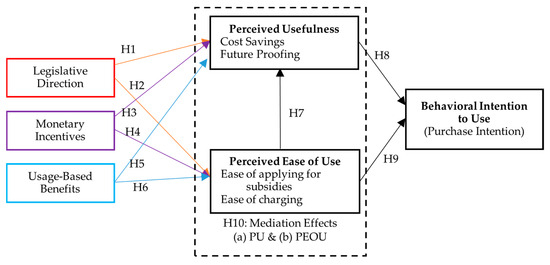
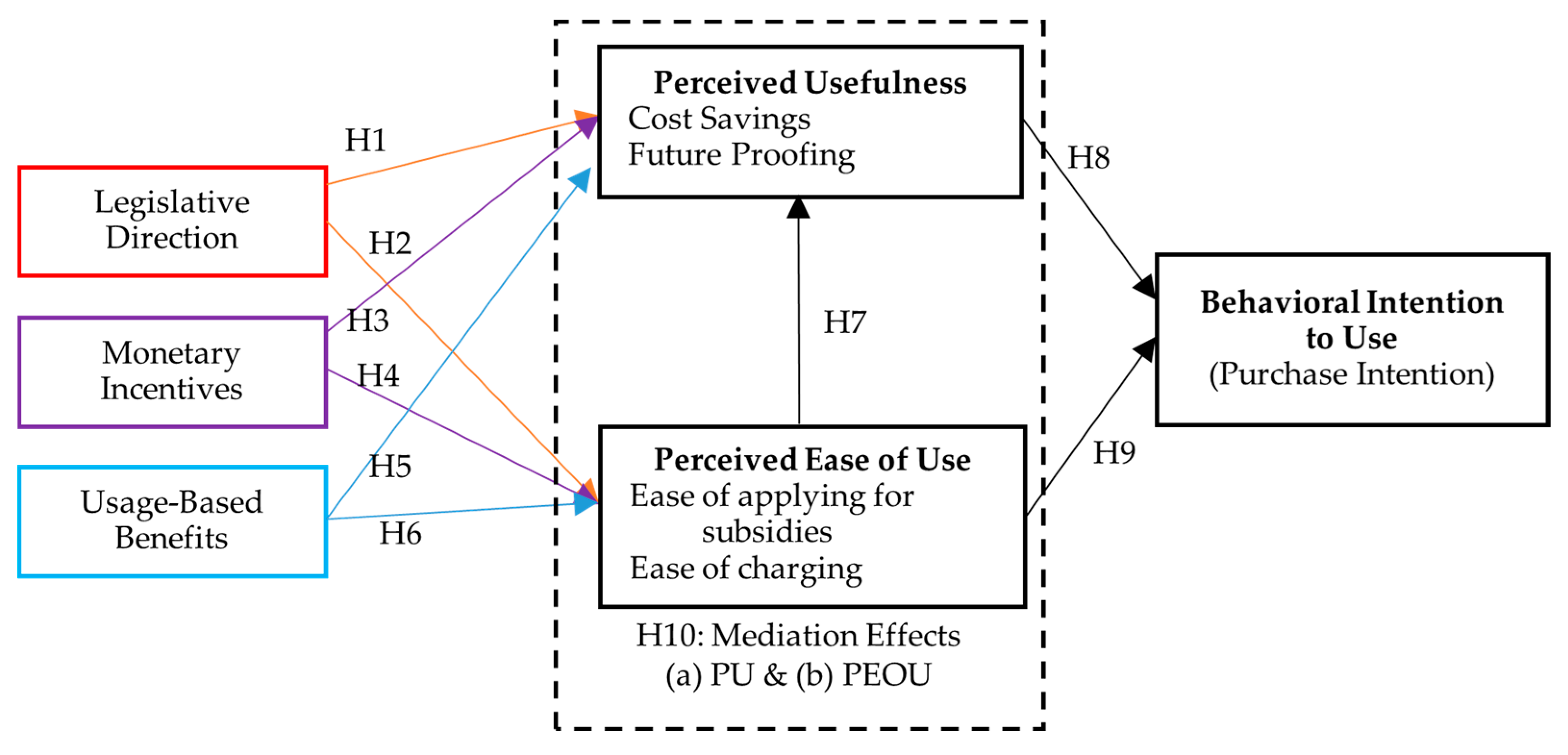
This framework, displayed in Figure 1, represents the proposed relationships and hypotheses based on the TAM and previous research on the relationship between government policy and BEV adoption.
Figure 1.
The conceptual framework.
Several studies suggest that legislative direction, such as zero-emission mandates, phase-out policies for internal combustion engines, etc., incentivized consumers to purchase BEVs, as they are perceived to be more useful [33]. Additionally, policy direction not only provides regulatory certainty but can also simplify consumer adoption by establishing supportive infrastructure and streamlined processes [24]. For instance, government-mandated charging station expansion and standardization reduce the complexity of owning and operating BEVs. When regulations make subsidy applications and charging procedures simpler, consumers perceive the technology as easier to use. Moreover, by setting regulatory standards and mandating infrastructure expansion, legislation can simplify the adoption process, thereby enhancing PEOU. However, the magnitude of this effect depends on consumers’ trust and awareness of such policies. Thus, the hypotheses are formed as follows:
H1.
LD positively affects PU.
H2.
LD positively affects PEOU.
Monetary incentives, such as subsidies, tax exemptions, and reduced registration fees, directly reduce the purchase cost of BEVs. Purchasing a car is a major long-term investment; therefore, factors like reduced costs and increased accessibility are positively correlated with purchase intention. [30]. The ability to access monetary incentives affects consumers’ perception of how easy it is to use a product. Factors like streamlined subsidy application processes, increased transparency in the process may all contribute to perceived ease of use. This increases PU by making BEVs financially rational compared to gasoline alternatives; therefore, the psychological barrier associated with purchasing such vehicles decreases, improving PEOU as well. Moreover, frameworks such as loss aversion and perceived value theory also support this relationship, as individuals respond strongly to visible cost reductions, especially those that are government-mandated. [34]. Thus, the hypotheses are formed as follows:
H3.
MI positively affects PU.
H4.
MI positively affects PEOU.
Usage-based benefits such as reduced tolls, preferential parking, and discounted charging rates provide multiple advantages to BEV owners. These benefits not only reduce long-term ownership costs but also increase the convenience and functional value of BEVs [29]. Prior research confirms that consumers value usefulness based on operational benefits over time. Operational incentives can also lower the perceived difficulty of adopting BEVs. Driving benefits, discounted electricity costs, and better long-term investment make BEVs perceptually good long-term investments. Prior research corroborates that when users experience fewer operational obstacles, they are more likely to consider the product easier to use and adopt [31]. Incentives are closely tied to daily use, so operational rewards elevate PU by improving the perceived functional value of BEVs. These benefits reinforce PU by demonstrating that BEVs yield continual cost and convenience improvements, and they strengthen PEOU by making ownership easier and more rewarding in daily life. Self-determination theory thus further suggests that repeated positive experiences increase intrinsic motivation and habit formation, which may explain the link between UB and PEOU [35]. Thus, the hypotheses are formed as follows:
H5.
UB positively affects PU.
H6.
UB positively affects PEOU.
When consumers find BEVs easy to operate, whether through simplified applications or increased accessibility to charging stations, they are more likely to view BEVs as valuable. For example, if charging is convenient and accessible, the perceived benefit also extends beyond convenience, often over to cost and time saving, etc., reinforcing usefulness [36]. In short, if something is considered easy to use, it tends to be deemed useful. Thus, the hypothesis is formed as follows:
H7.
PEOU positively affects PU.
Multiple studies have shown that factors such as perceived ease of use and perceived usefulness may influence behavioral intention. Prior studies highlight that such factors are among the most significant predictors of behavioral intention, as they reassure consumers that there will be tangible, long-term benefits for their investment. In this context, perceiving BEVs as valuable and easy to use leads to greater willingness to purchase. The appeal of BEVs increases when consumers understand their advantages, leading to increased purchase intention [37]. Thus, the hypotheses are formed as follows:
H8.
PU positively affects BI.
H9.
PEOU positively affects BI.
Finally, because TAM posits internal belief structures that mediate external influences, this study also considers that PU and PEOU act as mediators between government policy variables (LD, MI, and UB) and BI to adopt BEVs. In other words, policies influence behavior primarily through altering users’ cognitive evaluations of usefulness and ease of use. This theoretical extension situates government policy not merely as background context but as an integral psychological determinant of technology adoption. That is, government policy factors are expected to influence adoption intention essentially through their indirect effects on PU and PEOU. Thus, the hypothesis is formed as follows:
H10.
PU and PEOU have mediation effects between government policy variables and BI.
3. Methodology
3.1. Questionnaire Design
The quantitative questionnaire for this study was structured into two main sections. Section 1 gathered essential demographic data, including gender, age, and awareness of environmental and government policies related to electric vehicles. Section 2 focused on measuring key constructs relevant to government policy influence on BEV purchase intentions, including LD, MI, UB, PU, PEOU, and BI. Each construct was operationalized through multiple items adapted and refined from prior research to ensure validity and relevance to the Taiwanese context. The measurement of LD was completed through the 3 items referred to in the studies [30,37,38]. The measurement of MI was completed through the 3 items referred to in the studies [22,23]. The measurement of UB was completed through the 3 items referred to in the studies [31,32]. The measurement of PEOU was completed through the 3 items referred to in the studies [15,37,39]. The measurement of PU was completed through the 3 items referred to in the studies [15,39]. The measurement of BI was completed through the 3 items referred to in the studies [26,32,40]. Prior to the formal data collection, three academic experts and practitioners familiar with this field were invited to review the survey items. Minor revisions were made to wording for clarity and contextual relevance to Taiwan’s BEV policies. The revised instrument was then pretested with 30 respondents from the target population to confirm item comprehensibility. Feedback indicated no significant issues, confirming that the questionnaire in this study has satisfactory face and content validity.
All measurement items were evaluated with a five-point Likert scale, with options that ranged from “Strongly disagree” (1) to “Strongly agree” (5). This scaling allows participants to express nuanced degrees of agreement, which is crucial for capturing varied perceptions and attitudes towards government policies and electric vehicle adoption. The Likert format is especially effective for examining consumer beliefs and behavioral intentions, as it provides a comprehensive view of respondents’ intensity of opinions. Self-assessment is a valuable way of ascertaining consumer understanding, as the decision to purchase BEVs is also based on individual evaluation. Therefore, despite each participant’s evaluation being subjective, the questionnaire reveals their mental calculus and understanding of government policies in relation to BEV adoption, which is the goal of this study. The full list of questionnaire items and their respective constructs is provided in Appendix A.
3.2. Data Collection and Data Analysis
The data for this study were collected between July and September 2025 via an online questionnaire based on a non-probability convenience and purposive sampling method. Although this approach does not guarantee a statistically representative sample of the entire population, it ensured the inclusion of respondents familiar with BEV-related government incentives, which highlights the representativeness of the recruited sample and aligns with the objectives of this study. Respondents were recruited via online platforms, including Facebook EV community groups, LINE forums, and regional EV associations across Taiwan. An effort was made to include both urban and rural respondents by using a variety of region-specific EV forums to account for regional disparities. Respondents included individuals across Taiwan who were somewhat aware of government policies related to BEV adoption, regardless of whether they had personally driven or purchased a BEV. Understanding of EVs was self-assessed using a 5-point Likert scale questionnaire in the Demographics section of the study. This information is useful regardless of differing degrees of understanding amongst participants, as individual perception of EV understanding is one of the main drivers of consumer purchase. Overall, the study ensured that there was a wide range of individuals with differing levels of understanding who could provide nuanced evaluations of how legislative direction, subsidies, and usage-based incentives affect their likelihood of future BEV adoption.
We used PLS-SEM to analyze the data because it is a multivariate technique that can simultaneously examine the relationship between multiple variables, especially in research with smaller sample sizes [41]. PLS-SEM does not need to assume normal distribution of indicators, making it more appropriate than covariance-based SEM (CB-SEM) in this context. PLS-SEM is also suitable for exploratory research, such as the extended TAM in this study, by incorporating exogenous policy variables (LD, MI, and UB), which aligns with the objectives of explaining and predicting consumer purchase intentions for BEVs. The analysis involved two stages: First, assessing the statistical model for validity and reliability using Cronbach’s α, factor loadings, composite reliability, and average variance extracted (AVE). Second, testing the structural model by examining path coefficients and the significance of hypothesized relationships. We further evaluated the quality of the model using R2 and Q2 values to assess explanatory and predictive power. Finally, we conducted mediation analysis to determine whether PU and PEOU mediated the effects of government policy variables, and whether PEOU mediated the effect of PU on potential BEV adopters. This approach provides a robust framework for examining how government policy tools interact with TAM variables to shape consumer behavioral intentions in Taiwan’s BEV market.
4. Results
4.1. Sample Profile
The final sample was composed of 238 respondents, representing a diverse demographic across age, gender, and background. Of the total respondents, approximately 25 (10.5%) were between 18 and 25 years old, 74 (31.1%) were between 26 and 35 years old, 51 (21.4%) were between 36 and 45 years old, 42 (17.6%) were between 46 and 55 years old, and 46 (19.4%) were above 55. The gender distribution included 95 females (40%) and 143 males (60%) participants. Given the diverse range of demographics, the sample provides meaningful insight into Taiwan’s potential BEV adopters across all sectors. In terms of respondents’ self-assessed level of understanding of BEVs, 140 participants (58.8%) rated themselves as having a high level of knowledge (scores of 4 or 5 on the Likert scale); whereas 60 participants (25.2%) rated themselves as having a fair level of understanding (score of 3 on the Likert scale); and 38 (16%) participants rated themselves as having little understanding of BEVs (scores of 2 on the Likert scale).
4.2. Measurement Model
The reliability and validity of the measurement model were assessed using SmartPLS 3.0 software, and the results are summarized in Table 1. All the constructs included achieved Cronbach’s α values above 0.70, rho_A values above 0.7, and composite reliability (CR) values exceeding 0.80, demonstrating strong reliability and internal consistency. Average variance values (AVE) also exceed 0.6, demonstrating good convergent validity.
Table 1.
Construct evaluation based on the measurement model.
Given that all constructs were measured using self-reported Likert-scale items in a single questionnaire, several procedural remedies, including both ex-ante and post hoc, were employed to address common method bias (CMB). For ex-ante, we ensured respondent anonymity and confidentiality to minimize evaluation apprehension and randomized item order across constructs to reduce pattern responses. For post hoc, variance inflation factors (VIFs) were examined within SmartPLS, and all values were below the threshold of 3, further supporting the absence of multicollinearity. In addition, there was no significant difference in mean scores between the first 30% and the last 30% respondents since the three-month data collection window (July–September 2025) provided sufficient temporal coverage to capture diverse respondent groups, eliminating the influence of nonresponse bias.
Furthermore, as shown in Table 2, all Heterotrait–Monotrait (HTMT) ratios were also below the conservative 0.85 threshold. The square root of the AVE for each construct was higher than the correlation coefficient of other constructs, satisfying the Fornell–Larcker criterion and establishing discriminant validity. This result confirms that the measurement model is reliable, ensuring the validity of the findings.
Table 2.
Correlation, HTMT ratio, and discriminant validity.
4.3. Structural Model
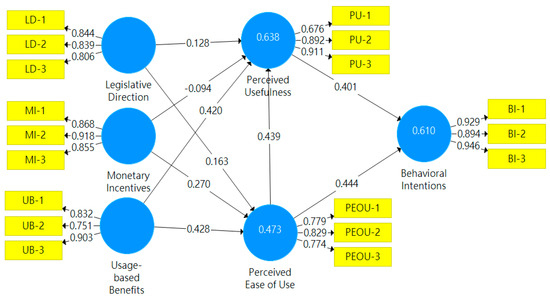
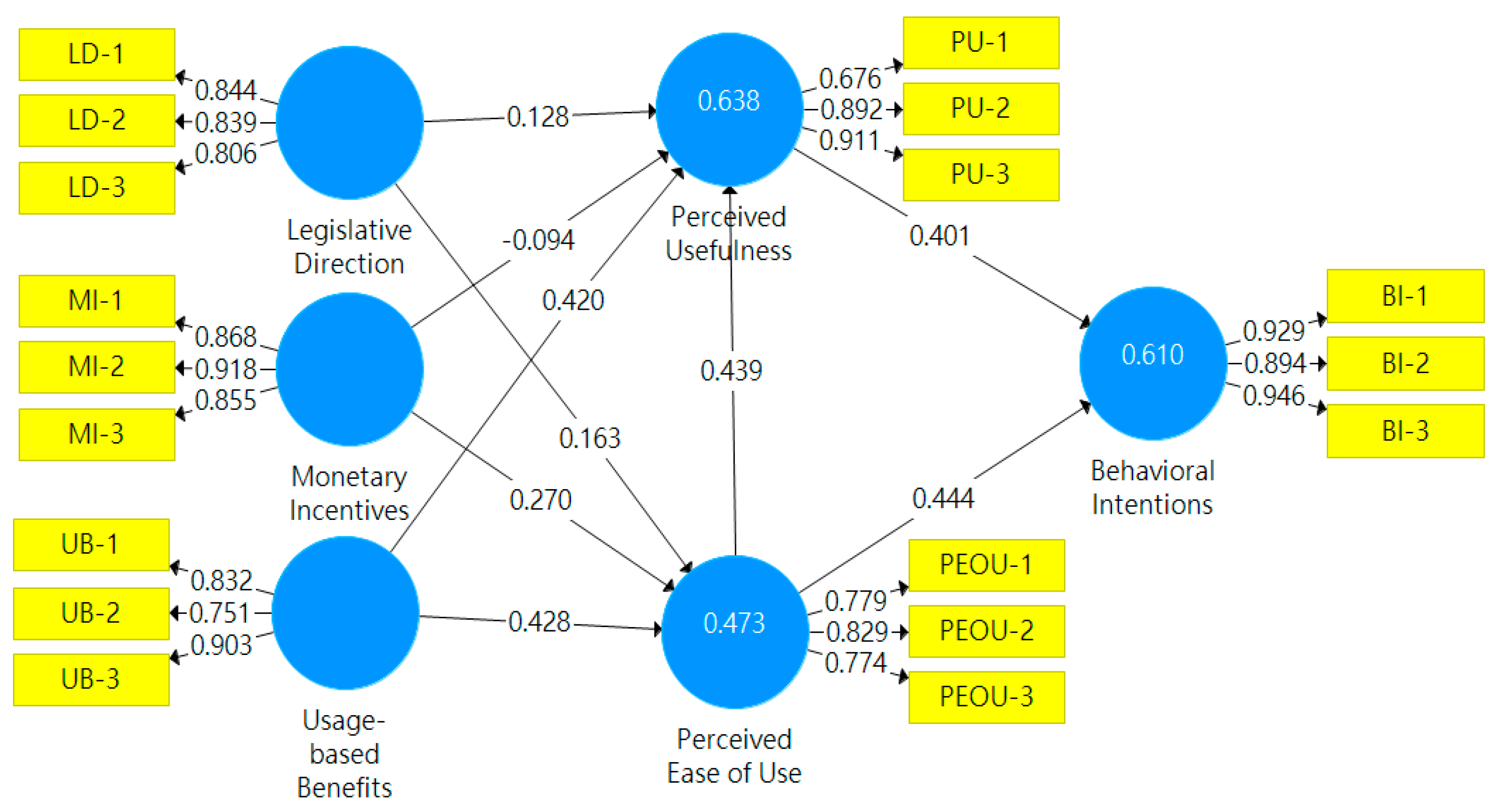
We then examined the relationships between each construct and its predictive power through path coefficients and R2 values, as illustrated in Figure 2. Figure 2 presents the model results, while Table 3 presents the coefficients, standard errors (SE), t-values, and p-values. Paths were deemed significant if t > 1.96 and p < 0.05. The results were: LD does not affect PU (β = 0.128); LD does not affect PEOU (β = 0.163); MI does not affect PU (β = −0.094); MI positively affects PEOU (β = 0.27); UB positively affects PU (β = 0.42); UB positively affects PEOU (β = 0.428); PEOU positively affects PU (β = 0.439); PU positively affects BI (β = 0.401); and PEOU positively affects BI (β = 0.444). The hypotheses H1- H3 are not supported as their p-values exceed 0.05. The hypotheses H4–H9 were found to be significant.
Figure 2.
PLS-SEM results of path coefficient, R2, and standardized factor loadings.
Table 3.
PLS-SEM results of hypothesis verification.
As displayed by Table 4, the R2 value for PEOU is 0.473, suggesting that in 47.3% of instances, the variables, including legislative direction, monetary incentives, and usage-based benefits, explained the variance in the data. Likewise, the R2 value for PU and BI is 0.638 and 0.610, respectively. This indicates that in over 60% of the cases, variance in either perceived ease of use or BI can be explained by our model. Because all the variables in the suggested model have a Q2 value greater than 0.2, it demonstrates that the proposed model possesses sufficient predictive relevance [41]. Overall, the data suggest that our model effectively captures the drivers behind BEV adoption.
Table 4.
PLS-SEM results of R2 and Q2 values.
Moreover, a priori power analysis was conducted using G*Power 3.1 to determine the minimum sample size required for multiple linear regression (testing the combined effect of LD, MI, UB, PU, and PEOU on BI). Using the F-tests with α = 0.05, desired power = 0.80, and a medium effect size (Cohen’s f2 = 0.1), the required sample size was 134. Thus, the valid sample of 238 exceeds the required sample and provides adequate power to detect medium effects in a multiple regression. Given the observed R2 value for BI (0.610), the sample size is also sufficient to detect the effects reported.
4.4. Mediation Analysis
Table 5 summarizes the mediation effects examined in our model. The results indicate that PEOU mediates the relationship between MI and BI, along with between UB and BI, with the indirect effect being 0.12 and 0.19, respectively. Similarly, PU mediates the relationship between UB and BI, at 0.169. Given that PEOU directly affects BI at 0.444, the relationship between PEOU and BI is only partially mediated by PU, with an indirect effect of 0.176 and total effect of 0.62.
Table 5.
Mediation analysis results.
4.5. Discussion of Findings
The result of the study demonstrates the differing levels of influence public policy tools have on consumer attitudes towards BEV adoption in Taiwan. Our study found that LD did not affect either PU or PEOU, rejecting hypotheses H1 and H2. This suggests that though legislative directions likely influence consumers, they do not translate to tangible consumer perceptions of BEV value or usability. This may be because individuals who are familiar with BEV use may not keep up with ever-evolving government regulations. Legislation may seem too abstract, distant, or oriented towards industry compliance rather than individuals. Additionally, BEV regulations and policies are rarely considered major voting issues in Taiwan, so, understandably, legislation does not translate to increased BEV adoption due to less visibility. Though this rejects the study [20] establishing a positive correlation between government incentives to behavioral intent to purchase, as established in this paper’s literature review, the regulatory sphere and visibility of legislative goals in terms of environmental protections differ when it comes to Malaysia versus Taiwan [26]. This may also reflect Taiwan’s informational environment, where legislation is often considered abstract or slow to implement, and therefore less salient in everyday decision-making processes compared to tangible incentives. In contrast, societies with higher institutional trust or more visible forms of policy implementation, such as those in Europe, like Germany and Norway, may exhibit stronger behavioral responses to legislative cues, as they are often more visibly promoted [2]. Yet, it remains that this finding highlights a problematic gap between government policies and real-world impact, highlighting the importance of communicating and promoting policy.
Interestingly, the effect of monetary incentives on PEOU and PU was mixed. While the influence of monetary incentives was not statistically significant in the case of PU, with rejection of H3, it did influence perceived ease of use, supporting H4. This indicates that the ability to access monetary incentives does not play a significant role in BEV adoption. Instead, factors like subsidies and tax exemptions may lead consumers to believe that BEVs are convenient to acquire and operate, though these incentives alone may not convince them of BEVs’ long-term benefits. Indeed, this finding supports previous studies [17,21] on how monetary incentives, like subsidies, can accelerate BEV adoption. It is not a core factor as BEV markets can sustain regardless of such incentives [22,27]. These findings highlight a crucial gap: while monetary benefits lower barriers to BEV adoption, they may not necessarily translate to BEVs becoming a good long-term investment to consumers, unless such benefits are paired with additional operational advantages. These insights highlight an actionable opportunity for policymakers to focus on enhancing the visibility of legislative direction by translating legislation into more consumer-facing signals. Publicized deadlines for phasing out combustion engines, increasing discussions on net-zero goals, and transparent subsidy portals or applications may all contribute to better awareness and ease of BEV adoption.
Usage-based benefits, by contrast, reflect a strong positive correlation with both perceived usefulness (supporting H5) and perceived ease of use (supporting H6). These results underscore how consumers place weight on everyday tangible benefits, such as reduced tolls, preferential parking, and discounted charging rates. UB directly impacts consumer experience by lowering ongoing costs and reducing operational difficulties, not only making BEVs more convenient but also enhancing their perceived functional value. This may explain why the influence of UB is so strong: consumers can easily connect factors like discounted electricity rates or parking benefits with their daily lives [3]. These consumers lack an intuitive understanding of the long-term cost savings by BEVs compared to traditional gasoline vehicles; thus, usage-based benefits that are more proximate to them have a clear and significant impact on the attractiveness of BEVs [30].
Similarly, the perception that products are useful and easy to use, given all the contributions from each factor, drives consumer purchase intentions. This is confirmed by the strong correlation between H8 and H9. This aligns with the TAM, which consistently identifies perceived usefulness as an influential determinant of technology adoption, in this case, BEVs. In short, both H8 and H9 explain how policy measures are most effective when they translate to tangible improvements in perceived utility, subsequently leading to purchase intention.
Indeed, the mediation analysis further clarifies how policy effects are translated through TAM constructs. PEOU exhibits partial mediation through PU, with both direct and indirect paths influencing BI. This demonstrates the ease of use, not only incentivizing BEV adoption alone but also enhancing the perception of usefulness. This highlights how consumers recognize both the intrinsic value of usability, along with the added benefits it brings to perceived usefulness, suggesting that policies designed to make BEVs easier to adopt, such as standardizing charging infrastructure or simplifying the process of applying for subsidies, are particularly impactful given how they improve multiple consumer perceptions.
5. Conclusions, Implications, Limitations, and Future Directions
5.1. Conclusions
This study examines how different government policy mechanisms, including legislative direction, monetary incentives, and usage-based benefits, affect consumer perceptions of BEVs and, ultimately, their purchase intentions. Building on the TAM framework, our results establish a clear correlation between direct, tangible benefits and the likelihood of technology adoption. While monetary incentives and usage-based benefits do influence PEOU and PU, legislative direction alone was seen to have little influence on consumer attitudes [11]. This suggests that broad regulatory frameworks proposed by governments do not translate to real-world impact.
Our statistical models reinforce this conclusion. The R2 values for PEOU (0.473) and PU (0.638) demonstrate that government policies and operational benefits account for substantial portions of the variance in consumer perceptions. Moreover, mediation analysis confirmed that PEOU has both direct and indirect effects on BI through PU, underscoring the dual role of ease of use in shaping consumer adoption. Though this reflects conclusions from past studies related to technology adaptation, it could also suggest, in the context of BEVs, that ease of use may carry greater weight than previously assumed, given the operational complexities of new technologies.
Where our findings differ from other studies is in the effect of legislative direction. Research [30] suggests that a clear regulatory framework and governmental support can positively shape consumers’ purchase intentions [38]. Broadbent et al. [27] further suggest that appropriate legislation, in particular, fuel efficiency standards or other climate goals, can affect the adoption rate. However, this study found no measurable effect, indicating that in Taiwan at least, legislative frameworks do not impact consumers who seem to prioritize more immediate, experience-based benefits when purchasing EVs. Given that much of past research has been conducted in other countries, such as the EU, consumer priorities and the way governments market their regulations may greatly differ, thus influencing the results. Considering the limited influence of monetary incentives and the influence of usage-based benefits, our findings suggest that while the TAM construct remains central, the degree of influence varies. The key here is to identify adjustments to policy to make incentives for BEV adoption equal across the board.
The Taiwanese government has indeed invested significant effort into promoting BEV adoption, but these efforts appear to be misaligned with consumer priorities [10]. Legislative direction and subsidies, while structurally important, are not sufficiently visible or accessible to the average consumer. Many potential adopters remain unaware of the subsidies available or are uncertain about how to apply for them, which weakens the intended impact of such policies. Increasing accessibility through targeted campaigns, clearer communication, and greater visibility at the point of purchase could bridge this gap. If consumers can clearly connect government policies with everyday benefits, adoption is more likely to accelerate. This shift is especially timely, as public awareness of environmental regulation and climate concerns grows, suggesting that Taiwan has an opportunity to not only refine its policies but also to position itself as a leader in sustainable mobility in the region.
However, other constructs, including monetary incentives and usage-based benefits, have a statistically significant correlation with BEV adoption. Indeed, these findings are consistent with general research conducted in the European Union, Malaysia, and Thailand on the effect of government financial subsidies on purchase intention, which likewise highlights how financial subsidies may drive consumer adoption decisions [23,25,26]. In the case of Taiwan, the results suggest that while legislative measures may provide long-term structural direction, it is the tangible and immediate financial advantages that most directly affect consumer behavioral intention. To maximize policy impact, Taiwan must not only continue with programs guaranteeing effective subsidies but also ensure that they are widely accessible.
5.2. Implications
The findings carry significant implications for both legislators and industries. First, the strong and consistent effects of usage-based benefits highlight the importance of designing policies that provide clear, practical advantages for consumers, such as access to charging infrastructure, toll exemptions, and parking privileges. A key problem with government support is a lack of public awareness of these benefits [26]. Thus, these measures will not only improve perceptions of ease of use but also reinforce the perceived utility of BEVs. The success of BEVs in many countries, like the US and UK, is contingent upon increased supportive infrastructure. Most comparative studies indicate that in countries with clear policy communication, such as Norway, legislative clarity exerts a more direct influence on adoption behavior. Messaging to combat issues like purchase price, range anxiety, or battery performance has greatly contributed to the EU’s adoption of BEVs [3]. The more visible and accessible such changes are, the more likely citizens are to be aware of BEVs as a convenient alternative to traditional cars. To start, governments could consider working with gas stations to increase the number of BEV charging stations so consumers can be assured that electric charging locations are as widely accessible as gasoline. In Taiwan, these efforts could also be strengthened through the country’s high levels of youth engagement with environmental activism. Younger generations who are already active in sustainability initiatives represent a key demographic for promoting BEV visibility and normalizing green practices, like the purchase of BEVs.
Second, the partial mediation results show that policy measures can influence adoption both directly and indirectly, suggesting that effective strategies must work on multiple psychological levels: improving the experience of use while simultaneously reinforcing the functional value of BEVs. This means that interventions should not only reduce friction in the adoption process—for example, by streamlining charging, offering user-friendly mobile applications, or simplifying subsidy claim procedures—but also strengthen perceptions that BEVs deliver long-term practical benefits. Therefore, a dual-layered policy design has the potential to generate compounding effects: the easier BEVs feel to use, the more useful they appear, and the more willing consumers are to adopt them [22].
Third, the absence of impact from legislative direction suggests that top-down regulations, in isolation, are insufficient to shift consumer behavior. While legislation sets the structural framework for BEV adoption, it does not appear to resonate with consumers unless it translates into changes they directly encounter in their daily routines. This divergence from prior research indicates that broad mandates, such as emissions targets or fleet conversion requirements, may lack salience for individual consumers unless paired with visible, user-facing measures. For instance, a government ban on internal combustion vehicles by 2035 may generate headlines, but it will not alter adoption patterns unless consumers simultaneously experience policy benefits—like lower charging costs, priority traffic lanes, or guaranteed access to parking [13,14]. In this sense, legislation is necessary but not sufficient: it must operate in tandem with tangible, ground-level policies that make BEVs both convenient and rewarding to own.
Finally, for BEV companies, the results highlight the value of aligning marketing goals and consumer engagement with more visible policy benefits. Key issues that consumers are concerned with, for example, emphasizing the convenience of charging stations, operational savings, and government subsidies, may increase consumer awareness and purchase intention. Industries ought to leverage government incentives as their marketing and branding tools, reinforcing BEV’s appeal as both practical and rational investments. Should governments fail at adequately promoting BEV policies, industries can therefore play a compensatory role by promoting these advantages directly to consumers. By translating abstract and less-known policy benefits as part of their marketing strategy, BEV manufacturers can not only benefit from the increased demand but also help bridge the gap between government policy and consumer purchase of BEVs, contributing to the nation’s transition towards a more sustainable transportation sector [21].
There remains a hopeful trend: growing public awareness of environmental issues and increased willingness to adopt BEVs provide ample ground for governments to better establish effective policies [10]. Well-communicated and easily accessible incentive, therefore, has the potential to align consumer priorities with sustainability goals. If policymakers succeed in bridging the gap between structural regulation and consumer experience, it will be much easier for Taiwan, and even other countries or regions, to accelerate their rates of BEV adoption.
5.3. Limitations and Future Directions
There are a few limitations within this study. First, the analysis was largely reliant on consumer perceptions rather than observed behavior, which may introduce self-reporting bias. Different individuals may have different perceptions of what is considered knowledgeable. Second, though the model explained significant variance in PEOU and PU, by focusing on three government policy tools, other psychological and contextual factors, such as environmental awareness, technological literacy, or cultural attitudes, were not incorporated as moderating variables. Including such factors in future studies could therefore clarify the conditions under which policy tools most effectively contribute to consumer adoption of BEVs.
Future research could extend these findings in several directions. First, cross-country comparative research would also provide a valuable test of the model’s generalizability. For instance, comparing Taiwan’s BEV adoption with that of South Korea or Japan can narrow down the extent of cultural values or institutional trust in relation to the efficacy of policy incentives. Such moderating variables can provide a more nuanced view of the relationship between policy incentives, perceived usefulness, and behavioral intention. Second, this study aims to extend TAM to incorporate specific government policy tools. Performing sensitivity analyses or subgroup comparisons (e.g., by age, income, or prior exposure to BEVs) could contribute to enhancing the credibility of findings and demonstrating robustness against sampling bias; however, conducting multiple subgroup analyses may shift the focus from validating the extended model to exploring demographic effects. Future research could address these issues by collecting larger and more stratified samples to enable multigroup or moderation analyses, enhancing the understanding of contextual differences in BEVs adoption behavior. Third, a larger sample size and longitudinal research could allow us to better track changes in perception and adoption over time, to ascertain whether policy adjustments provide better incentives. This would be valuable as it could capture how perceptions evolve as Taiwan’s BEV policies mature and infrastructures expand.
Finally, this study contributes to the overall understanding of policy-driven behavioral intention towards BEV adoption. By demonstrating how specific government mechanisms can be empirically modeled within an extended TAM framework, the study provides a unique perspective on the discussion surrounding sustainability practices in Taiwan’s transportation sector. Addressing the directions above in future research will thus enhance the practical implications for both policymakers and stakeholders within the BEV industry.
Author Contributions
Conceptualization, C.-M.T., C.-M.Y. and V.H.; Methodology, C.-M.T. and C.-M.Y.; Validation, C.-M.T.; Formal analysis, C.-H.Y.; Investigation, C.-H.Y. and V.H.; Data curation, V.H.; Writing—original draft, C.-H.Y. and V.H.; Writing—review & editing, C.-M.T. and C.-M.Y.; Supervision, C.-M.Y.; Project administration, C.-M.T. All authors have read and agreed to the published version of the manuscript.
Funding
This research received no external funding.
Institutional Review Board Statement
Our study is an anonymous, non-interactive, and non-interventional research conducted in a public setting. Any specific individual cannot be identified from the questionnaire data collected. This study is waived for ethical review by Department of Health, Executive Yuan due to local legislation (Medical Affairs No. 1010265079 of the Department of Health).
Informed Consent Statement
Informed consent for participation was obtained from all subjects involved in the study.
Data Availability Statement
The data presented in this study are available on request from the corresponding author.
Conflicts of Interest
The authors declare no conflict of interest.
Appendix A. Questionnaire Items
| Construct | Items | |
| LD | LD-1 | I am familiar with Taiwan’s plans to phase out gasoline-powered vehicles in the coming years. |
| LD-2 | I expect Taiwan to enforce stricter regulations regarding gasoline powered vehicles in the future | |
| LD-3 | I have heard of Taiwan’s goal to fully transition to electric vehicles by a certain year (e.g., 2050). | |
| MI | MI-1 | I am familiar with the Taiwanese government’s subsidies for purchasing electric vehicles. |
| MI-2 | I know the eligibility criteria for receiving government subsidies when purchasing an electric vehicle. | |
| MI-3 | I actively follow updates or changes in government financial policies related to EVs. | |
| UB | UB-1 | I would be more likely to buy a BEV if I could receive priority parking or driving privileges. |
| UB-2 | I believe EV owners receive more usage benefits compared to gasoline car owners in Taiwan. | |
| UB-3 | I believe EV-specific privileges help justify the purchase of a BEV even if the price is higher. | |
| PEOU | PEOU-1 | It is easy to find public EV charging stations near my home or workplace. |
| PEOU-2 | Owning a BEV is simpler than owning a gasoline vehicle due to service options and government support (eg: tax breaks). | |
| PEOU-3 | The process of applying for EV subsidies is straightforward and convenient. | |
| PU | PU-1 | I believe government subsidies reduce the total cost of owning a BEV. |
| PU-2 | Thanks to current government policies, a BEV is a more sensible investment than a gasoline car in the short-term (eg: initial fuel cost advantage). | |
| PU-3 | Because of government support, I believe I would get more long-term value from owning a BEV (eg: home charging convenience). | |
| BI | BI-1 | I am likely to purchase an electric vehicle in the future. |
| BI-2 | Even if a BEV is more expensive than a gasoline car, government support makes me more willing to buy it. | |
| BI-3 | I would recommend buying a BEV to my family and friends. |
References
- Liu, F.; Shafique, M.; Luo, X. Unveiling the Determinants of Battery Electric Vehicle Performance: A Systematic Review and Meta-Analysis. Commun. Transp. Res. 2024, 4, 100148. [Google Scholar] [CrossRef] [Scilit]
- Hertzke, P.; Müller, N.; Schenk, S.; Wu, T. The Global Electric-Vehicle Market Is Amped up and on the Rise|McKinsey. Available online: https://www.mckinsey.com/industries/automotive-and-assembly/our-insights/the-global-electric-vehicle-market-is-amped-up-and-on-the-rise (accessed on 24 July 2025).
- Neves, S.A.; Marques, A.C. What Has Driven the Adoption of BEV and PHEV in the EU? Res. Transp. Bus. Manag. 2025, 60, 101331. [Google Scholar] [CrossRef] [Scilit]
- European Parliament EU. Ban on the Sale of New Petrol and Diesel Cars from 2035 Explained. Available online: https://www.europarl.europa.eu/topics/en/article/20221019STO44572/eu-ban-on-sale-of-new-petrol-and-diesel-cars-from-2035-explained (accessed on 19 July 2025).
- Lepre, N.; Burget, S.; Gabriel, N.U.S. Investments in Electric Vehicle Manufacturing; Atlas Public Policy: Washington, DC, USA, 2023. [Google Scholar]
- Shamsuddoha, M.; Nasir, T. The Road Ahead for Hybrid or Electric Vehicles in Developing Countries: Market Growth, Infrastructure, and Policy Needs. World Electr. Veh. J. 2025, 16, 180. [Google Scholar] [CrossRef] [Scilit]
- Dua, R. Net-Zero Transport Dialogue: Emerging Developments and the Puzzles They Present. Energy Sustain. Dev. 2024, 82, 101516. [Google Scholar] [CrossRef] [Scilit]
- Fan, B.; Wen, Z.; Qin, Q. Competition and Cooperation Mechanism of New Energy Vehicle Policies in China’s Key Regions. Humanit. Soc. Sci. Commun. 2024, 11, 1640. [Google Scholar] [CrossRef] [Scilit]
- Myslinski, A. Taiwan’s EV Infrastructure Stuck in Neutral. Taiwan Bus. Top. 2024. Available online: https://topics.amcham.com.tw/2024/04/taiwans-ev-infrastructure-stuck-in-neutral/ (accessed on 19 July 2025).
- Armstrong, N. Bold Drives Toward an All-Electric Mobility Era. Taiwan Bus. Top. 2025. Available online: https://topics.amcham.com.tw/2025/05/bold-drives-toward-an-all-electric-mobility-era/ (accessed on 19 July 2025).
- Registration Report Analysis–2024 December Taiwan Car Market. Available online: https://www.autofuture.tw/EN/articles/detail?id=478 (accessed on 1 November 2025).
- Li, N.; Chen, J.-P.; Tsai, I.-C.; He, Q.; Chi, S.-Y.; Lin, Y.-C.; Fu, T.-M. Potential Impacts of Electric Vehicles on Air Quality in Taiwan. Sci. Total Environ. 2016, 566–567, 919–928. [Google Scholar] [CrossRef] [Scilit] [PubMed]
- Shen, Y.-S.; Huang, G.-T.; Chang-Chien, C.-L.; Huang, L.H.; Kuo, C.-H.; Hu, A.H. The Impact of Passenger Electric Vehicles on Carbon Reduction and Environmental Impact under the 2050 Net Zero Policy in Taiwan. Energy Policy 2023, 183, 113838. [Google Scholar] [CrossRef] [Scilit]
- Pai, F.-Y.; Shih, Y.-J.; Chuang, Y.-C.; Yeh, T.-M. Supporting Environment Sustainability: Purchasing Intentions Relating to Battery Electric Vehicles in Taiwan. Sustainability 2023, 15, 16786. [Google Scholar] [CrossRef] [Scilit]
- Davis, F. Perceived Usefulness, Perceived Ease of Use, and User Acceptance of Information Technology. MIS Q. 1989, 13, 319–340. [Google Scholar] [CrossRef] [Scilit]
- Lee, Y.; Kozar, K.; Larsen, K. The Technology Acceptance Model: Past, Present, and Future. ResearchGate 2003, 12, 50. [Google Scholar] [CrossRef] [Scilit]
- Vankatesh, V.; Davis, F. A Theoretical Extension of the Technology Acceptance Model: Four Longitudinal Field Studies. ResearchGate 2000, 46, 186–204. [Google Scholar] [CrossRef] [Scilit]
- Dziak, M. Technology Acceptance Model (TAM)|Research Starters|EBSCO Research. Available online: https://www.ebsco.com (accessed on 19 July 2025).
- Shanmugavel, N.; Micheal, M. Exploring the Marketing Related Stimuli and Personal Innovativeness on the Purchase Intention of Electric Vehicles through Technology Acceptance Model. Clean. Logist. Supply Chain 2022, 3, 100029. [Google Scholar] [CrossRef] [Scilit]
- Jiang, M.; Zhou, F.; Peng, L.; Wan, D.; Jiang, M.; Zhou, F.; Peng, L.; Wan, D. A Study of the Social Identity of Electric Vehicle Consumers from a Social Constructivism Perspective. World Electr. Veh. J. 2025, 16, 403. [Google Scholar] [CrossRef] [Scilit]
- Mittal, G.; Bansal, R. Driving Force Behind Consumer Brand Engagement: The Metaverse. In Cultural Marketing and Metaverse for Consumer Engagement; IGI Global: Hershey, PA, USA,, 2025; pp. 164–181. [Google Scholar]
- Roberson, L.; Helveston, J.P. Not All Subsidies Are Equal: Measuring Preferences for Electric Vehicle Financial Incentives. Environ. Res. Lett. 2022, 17, 084003. [Google Scholar] [CrossRef] [Scilit]
- Münzel, C.; Plötz, P.; Sprei, F.; Gnann, T. How Large Is the Effect of Financial Incentives on Electric Vehicle Sales?—A Global Review and European Analysis. Energy Econ. 2019, 84, 104493. [Google Scholar] [CrossRef] [Scilit]
- Wang, L. Electric Vehicle Sales in Taiwan to Rise 31% This Year: ITRI–Taipei Times. Available online: https://www.taipeitimes.com/News/biz/archives/2022/11/08/2003788463 (accessed on 19 July 2025).
- Rahmawati, R.; Suryani, E.; Mudjahidin; Chou, S.-Y.; Yu, T.H.-K.; Hendrawan, R.A. Driving Toward a Green Future: A System Dynamics Modeling of Electric Vehicle Market Share in Taiwan. Procedia Comput. Sci. 2024, 234, 1642–1649. [Google Scholar] [CrossRef] [Scilit]
- Pandak, I.; Piaralal, S.K.; Rethina, V. Investigating the Moderating Role of Government Incentive Policy on Consumer Adoption of Battery Electric Vehicles (BEV) in Malaysia. Int. J. Acad. Res. Bus. Soc. Sci. 2024, 14, 901–917. [Google Scholar] [CrossRef] [Scilit]
- Li, L.; Guo, S.; Cai, H.; Wang, J.; Zhang, J.; Ni, Y. Can China’s BEV Market Sustain without Government Subsidies?: An Explanation Using Cues Utilization Theory. J. Clean. Prod. 2020, 272, 122589. [Google Scholar] [CrossRef] [Scilit]
- Zhang, X.; Chang, M. Applying the Extended Technology Acceptance Model to Explore Taiwan’s Generation Z’s Behavioral Intentions toward Using Electric Motorcycles. Sustainability 2023, 15, 3787. [Google Scholar] [CrossRef] [Scilit]
- Woo, J.; Magee, C. Forecasting the Value of Battery Electric Vehicles Compared to Internal Combustion Engine Vehicles: The Influence of Driving Range and Battery Technology. Int. J. Energy Res. 2020, 44, 6483–6501. [Google Scholar] [CrossRef] [Scilit]
- Fontaínhas, J.; Cunha, J.; Ferreira, P. Is Investing in an Electric Car Worthwhile from a Consumers’ Perspective? Energy 2016, 115, 1459–1477. [Google Scholar] [CrossRef] [Scilit]
- Weldon, P.; Morrissey, P.; O’Mahony, M. Long-Term Cost of Ownership Comparative Analysis between Electric Vehicles and Internal Combustion Engine Vehicles. Sustain. Cities Soc. 2018, 39, 578–591. [Google Scholar] [CrossRef] [Scilit]
- Brückmann, G.; Bernauer, T. An Experimental Analysis of Consumer Preferences towards Public Charging Infrastructure. Transp. Res. Part Transp. Environ. 2023, 116, 103626. [Google Scholar] [CrossRef] [Scilit]
- Broadbent, G.H.; Drozdzeweki, D.; Metternicht, G. Electric Vehicle Adoption: An Analysis of Best Practice and Pitfalls for Policy Making from Experiences of Europe and the US. ResearchGate 2018, 12, e12358. [Google Scholar] [CrossRef] [Scilit]
- Misra, S.; Pedada, K.; Sinha, A. A Theory of Marketing’s Contribution to Customers’ Perceived Value. J. Creat. Value 2022, 8, 239496432211181. [Google Scholar] [CrossRef] [Scilit]
- Xie, Y.; Zhou, R.; Chan, A.H.S. Motivation to Interaction Media: The Impact of Automation Trust and Self-Determination Theory on Intention to Use the New Interaction Technology in Autonomous Vehicles. ResearchGate 2025, 14, 1078438. [Google Scholar] [CrossRef] [Scilit] [PubMed]
- Wolbertus, R.; van den Hoed, R. Fast Charging Systems for Passenger Electric Vehicles. World Electr. Veh. J. 2020, 11, 73. [Google Scholar] [CrossRef] [Scilit]
- Alshurideh, M.T.; Alzoubi, H.M.; Kurdi, B.A.; Hamadneh, S.; Ahmed, G.; Al-Sulaiti, K.; Bataineh, A.Q.; Alquqa, E.K.; Ozturk, I. Consumer and Economic Influences on Electric Vehicle Adoption: The Mediating Role of Attitudes and the Moderating Effect of Demographics. Int. J. Energy Econ. Policy 2025, 15, 214–229. [Google Scholar] [CrossRef] [Scilit]
- Laan, T.; Jain, P. Support for Electric Vehicles and Electricity; India’s Energy Transition, International Institute for Sustainable Development (IISD): Winnipeg, MB, Canada, 2019; pp. 9–14. [Google Scholar]
- Bektaş, B.C.; Alçura, G.A. Understanding Electric Vehicle Adoption in Türkiye: Analyzing User Motivations Through the Technology Acceptance Model. Sustainability 2024, 16, 9439. [Google Scholar] [CrossRef] [Scilit]
- Dutta, B.; Hwang, H.-G. Consumers Purchase Intentions of Green Electric Vehicles: The Influence of Consumers Technological and Environmental Considerations. Sustainability 2021, 13, 12025. [Google Scholar] [CrossRef] [Scilit]
- Hair, J.F.; Risher, J.J.; Sarstedt, M.; Ringle, C.M. When to Use and How to Report the Results of PLS-SEM. Eur. Bus. Rev. 2019, 31, 2–24. [Google Scholar] [CrossRef] [Scilit]

Disclaimer/Publisher’s Note: The statements, opinions and data contained in all publications are solely those of the individual author(s) and contributor(s) and not of MDPI and/or the editor(s). MDPI and/or the editor(s) disclaim responsibility for any injury to people or property resulting from any ideas, methods, instructions or products referred to in the content. |
© 2025 by the authors. Licensee MDPI, Basel, Switzerland. This article is an open access article distributed under the terms and conditions of the Creative Commons Attribution (CC BY) license (https://creativecommons.org/licenses/by/4.0/).