The Role of Generative AI in Architecture Education from Students’ Perspectives—A Cross-Sectional Descriptive and Correlational Study


Abstract
1. Introduction
- To explore the level of architecture students’ awareness and perception regarding GAI in terms of knowledge toward GAI, AI ethical awareness, perceived GAI benefits, and perceived GAI challenges;
- To explore the role of GAI in architecture education by investigating how knowledge toward GAI, GAI ethical awareness, perceived GAI benefits, and perceived GAI challenges contribute to developing skills; and
- To explore the role of GAI in architecture education by investigating the impact of knowledge toward GAI, GAI ethical awareness, perceived GAI benefits, and perceived GAI challenges contribute to enhancing behavioral intention toward GAI.
2. Literature Review
2.1. Behavioral Intention Toward GAI
2.2. Skills Development
2.3. Knowledge Toward GAI
2.4. GAI Ethical Awareness
2.5. Perceived GAI Benefits
2.6. Perceived GAI Challenges
2.7. Benefits–Challenges Trade-Offs
3. Theoretical Background
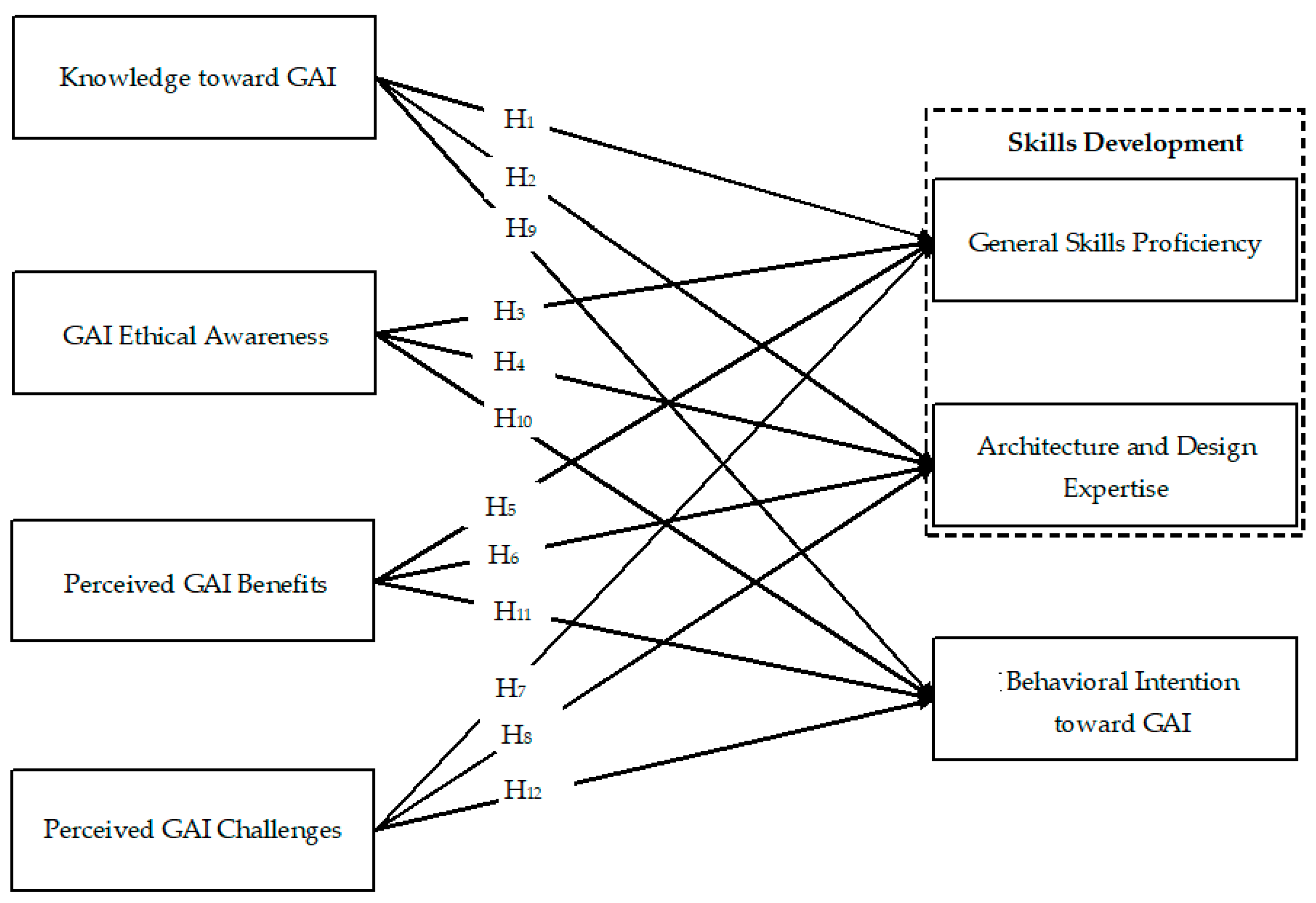
3.1. Impact of Knowledge Toward GAI on Skills Development
3.2. Impact of AI Ethical Awareness on Skills Development
3.3. Impact of Perceived GAI Benefits on Skills Development
3.4. Impact of Perceived GAI Challenges on Skills Development
3.5. Impact of Knowledge Toward GAI on Behavioral Intention Toward GAI
3.6. Impact of GAI Ethical Awareness on Behavioral Intention Toward GAI
3.7. Impact of Perceived GAI Benefits on Behavioral Intention Toward GAI
3.8. Impact of Perceived GAI Challenges on Behavioral Intention Toward GAI
4. Materials and Methods
4.1. Research Approach and Design
4.2. Sample and Sampling Method
4.3. Measurement Instruments
- Educational background: University name, Year of study
- AI proficiency and experience: Proficiency in using digital tools (e.g., AutoCAD, Rhino, Revit) (Beginner/Intermediate/Advanced/Expert), Usage of GAI technologies (e.g., ChatGPT, Large Language Models, Foundation Models) (Never/Rarely/Sometimes/Often/Always)
- Knowledge toward GAI (6 items)
- GAI Ethical Awareness (3 items)
- Perceived GAI Benefits (7 items)
- Perceived GAI Challenges (9 items)
- General Skills Proficiency (15 items)
- Architecture and Design Expertise (9 items)
- Behavioral intention toward GAI (8 items)
4.4. Pilot Study
4.5. Data Analysis
4.6. Ethical Considerations
5. Results
5.1. Composition of Educational Level and Technological Proficiency
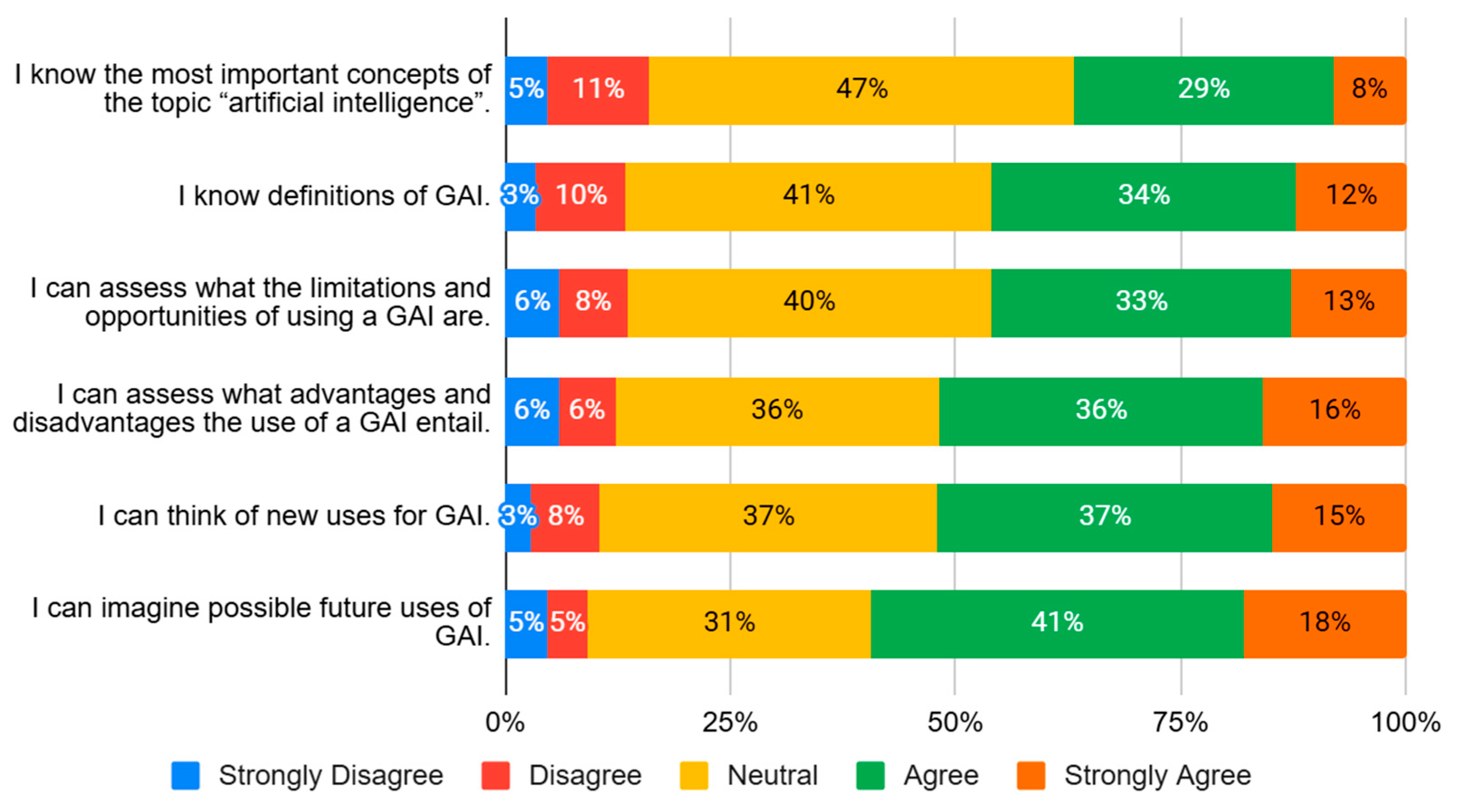
5.2. Knowledge Toward GAI
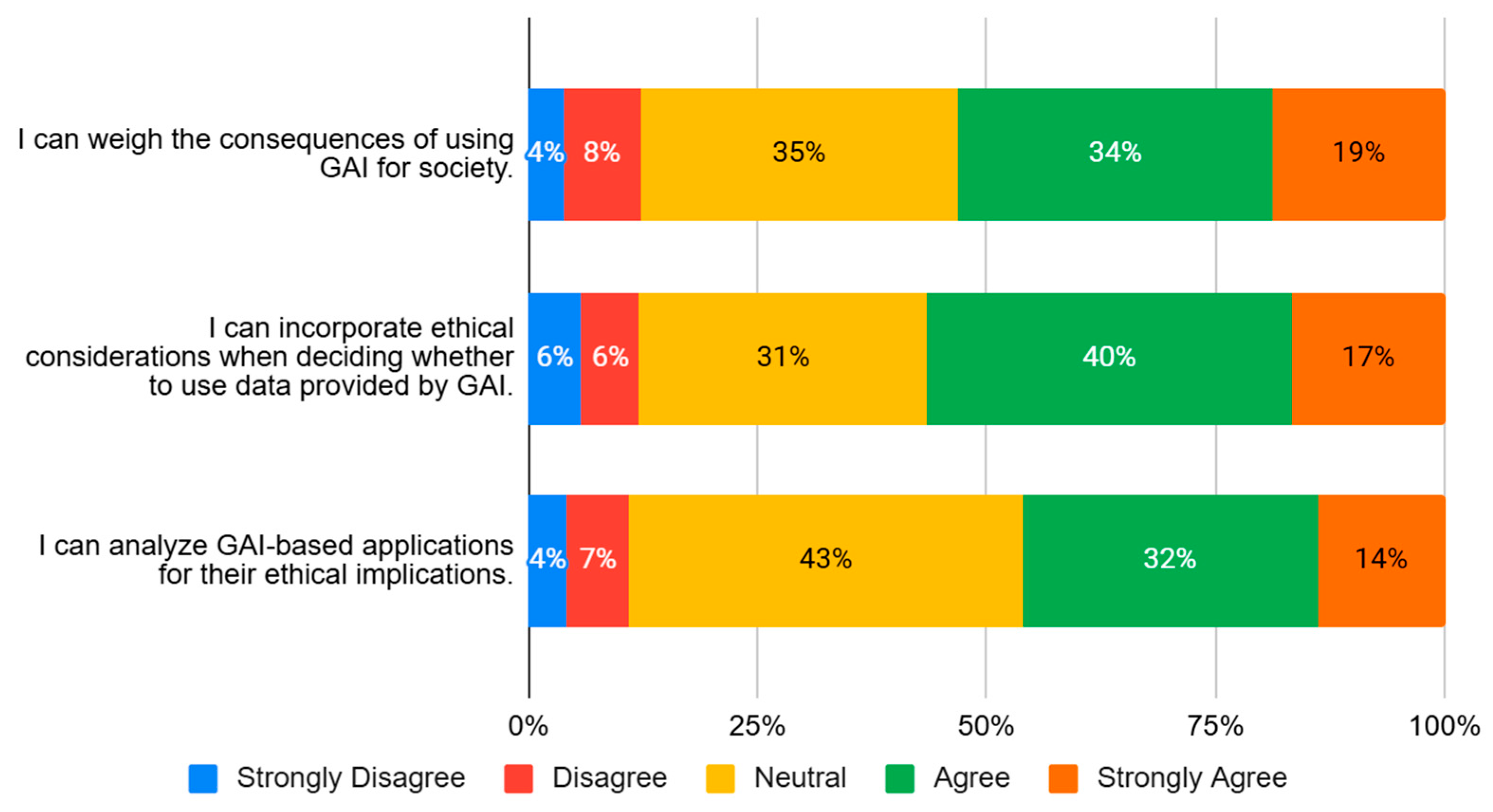
5.3. GAI Ethical Awareness
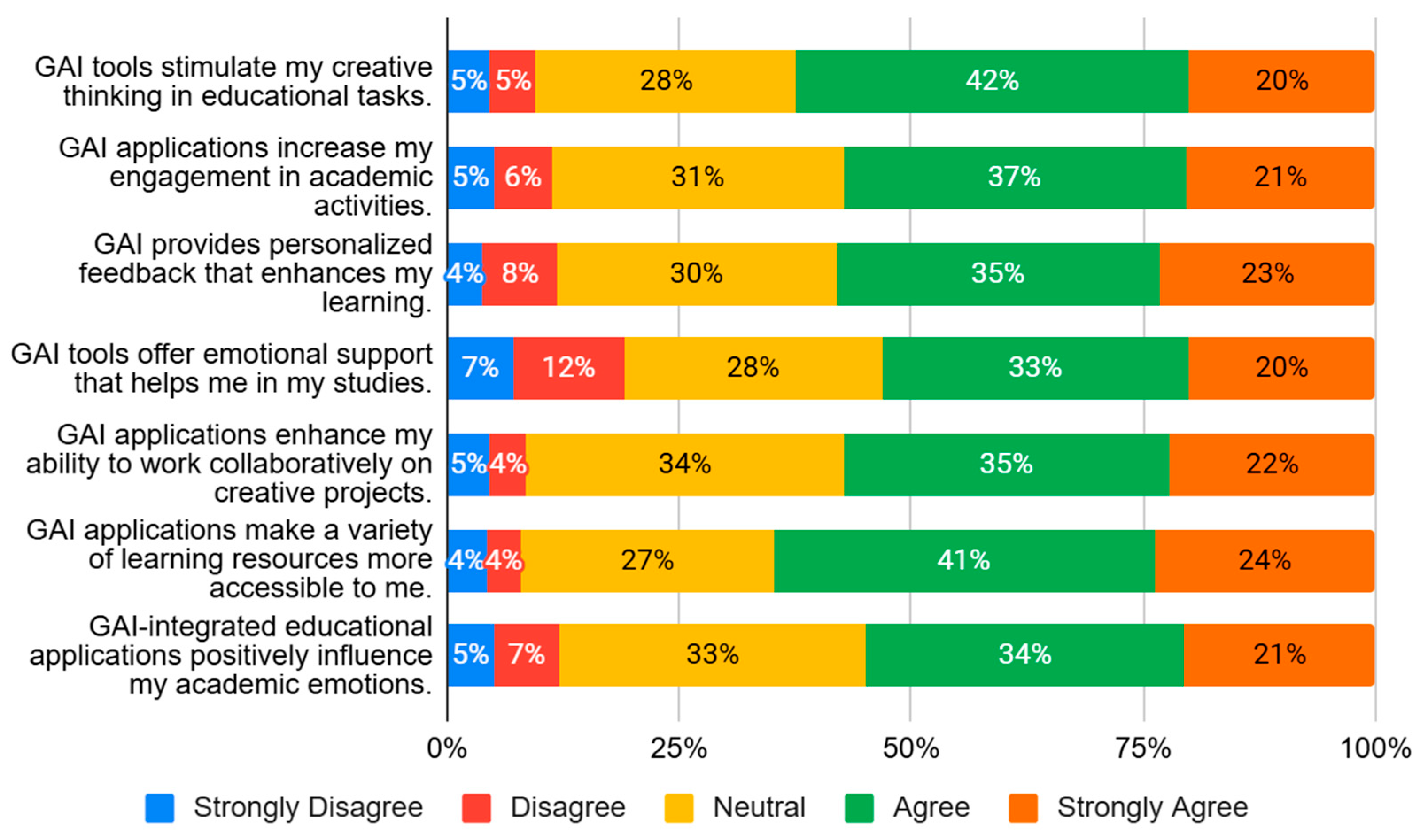
5.4. Perceived GAI Benefits
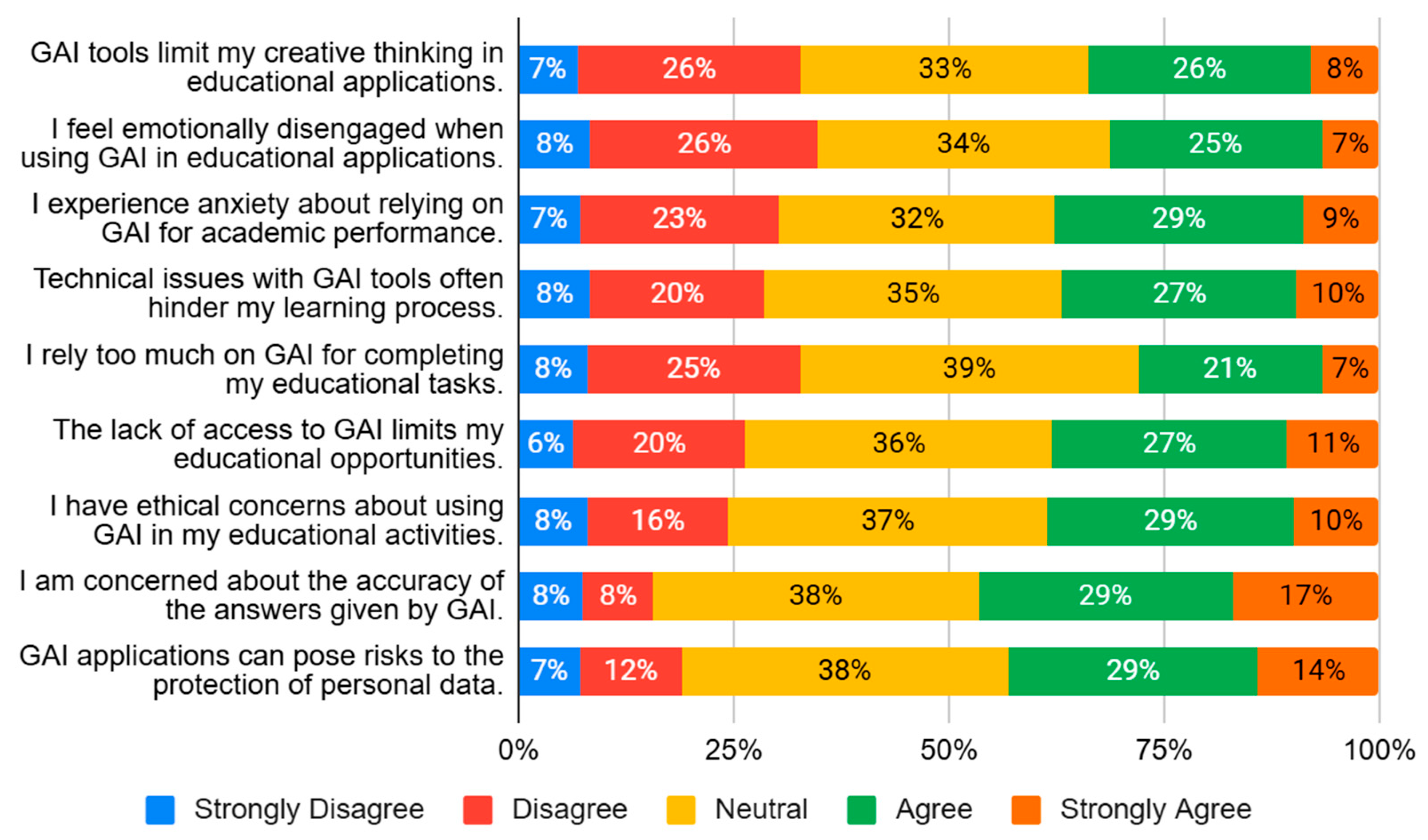
5.5. Perceived GAI Challenges
5.6. Exploratory Factor Analysis
5.7. Confirmatory Factor Analysis
5.8. Descriptive Statistics
5.9. Pearson’s Correlation Analysis
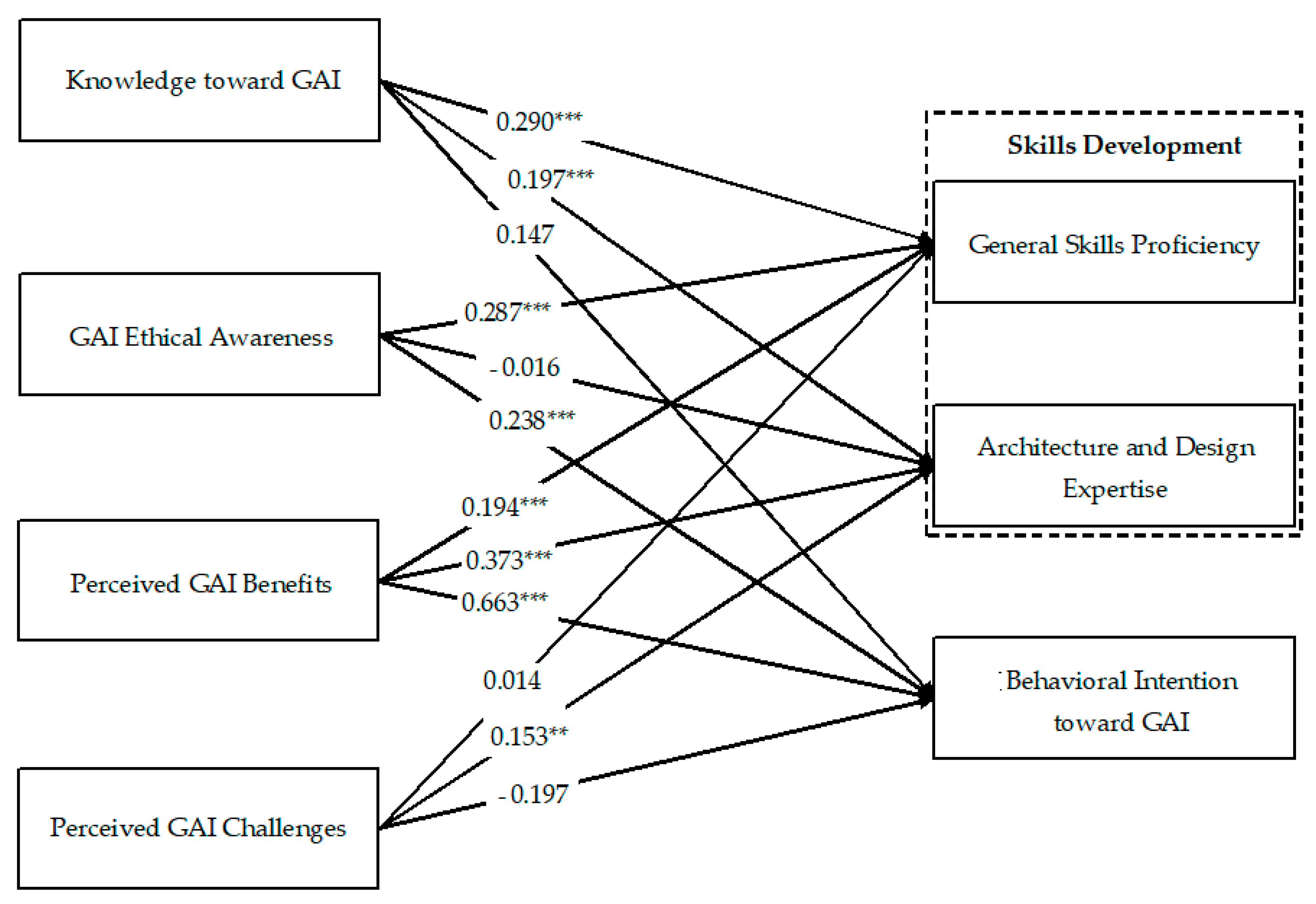
5.10. Path Analysis—Structural Equation Analysis (SEM)
6. Discussion
6.1. Key Study Findings
6.2. Theoretical and Practical Implications
6.3. Limitations and Suggestions for Future Research
7. Conclusions
Author Contributions
Funding
Institutional Review Board Statement
Informed Consent Statement
Data Availability Statement
Acknowledgments
Conflicts of Interest
Abbreviations
| GAI | Generative Artificial Intelligence |
| AECO | Architecture, Engineering, Construction, and Operations |
| EFA | Exploratory Factor Analysis |
| CFA | Confirmatory Factor Analysis |
| CB-SEM | Covariance-Based Structural Equation Modeling |
| χ2/df | chi-square statistic/degree of freedom |
| CFI | Comparative Fix Index |
| GFI | Goodness-of-Fit Index |
| AGFI | Adjusted Goodness-of-Fit Index |
| TLI | Tucker–Lewis Index |
| SRMR | Standardized Root Mean Square Residual |
| RMSEA | Root Mean Square Error of Approximation |
Appendix A. Survey Title: The Role of Generative AI in Architecture Education
- What is your year of study?
- 1st Year
- 2nd Year
- 3rd Year
- 4th Year
- Post-Graduate
- Have you ever used generative AI technologies (e.g., ChatGPT, Large Language Models, Foundation models)?
- Never
- Rarely
- Sometimes
- Often
- Always
- What is your level of proficiency in using digital tools (e.g., AutoCAD, Rhino, Revit)?
- Beginner
- Intermediate
- Advanced
- Expert
| Strongly Disagree | Disagree | Neutral | Agree | Strongly Agree | |
| Willingness to use Generative AI | |||||
| I envision integrating generative AI into my teaching and learning practices in the future. | |||||
| Students must learn how to use generative AI well for their careers. | |||||
| I believe generative AI can improve my digital competence. | |||||
| I believe generative AI can help me save time. | |||||
| I believe generative AI can provide me with unique insights and perspectives that I may not have thought of myself. | |||||
| I think generative AI can provide me with personalized and immediate feedback and suggestions for my assignments. | |||||
| I think generative AI is a great tool as it is available 24/7. | |||||
| I think generative AI is a great tool for student support services due to anonymity. | |||||
| Knowledge toward Generative AI | |||||
| I know the most important concepts of the topic “artificial intelligence”. | |||||
| I know definitions of artificial intelligence. | |||||
| I can assess what the limitations and opportunities of using an AI are. | |||||
| I can assess what advantages and disadvantages the use of an artificial intelligence entails. | |||||
| I can think of new uses for AI. | |||||
| I can imagine possible future uses of AI. | |||||
| Generative AI Ethics | |||||
| I can weigh the consequences of using AI for society. | |||||
| I can incorporate ethical considerations when deciding whether to use data provided by an AI. | |||||
| I can analyze AI-based applications for their ethical implications. | |||||
| General Skills Proficiency | |||||
| I have good collaboration and interactive skills. | |||||
| I am a confident user of information and communication technology. | |||||
| I work well in a team. | |||||
| I always share knowledge and experiences with other team members. | |||||
| I can assess situations, identify problems, determine root cause and evaluate. | |||||
| I am fully capable of utilizing research knowledge at work. | |||||
| I can comprehend and comply with work rules and regulations and the firm dynamics. | |||||
| I can select goal-relevant activities, | |||||
| I can manage time to handle multiple tasks and projects at once. | |||||
| I can set up and manage the budget of the projects. | |||||
| I can accept and apply criticism to improve my work with a positive attitude. | |||||
| I can adapt to changing circumstances and environments. | |||||
| I can take on board new ideas and concepts. | |||||
| I can communicate and work with people from different cultural backgrounds and countries. | |||||
| I have strong leadership skills. | |||||
| I am fully capable of exhibiting competence, respect, and appropriate behavior. | |||||
| Architectural and Design Expertise | |||||
| My knowledge in architectural and design field is updated and optimal. | |||||
| I am fully capable of developing or reviewing programming phase and design phase standards in compliance with codes and client’s requirements. | |||||
| I am fully capable of assessing environmental, social, economic conditions of the site/building. | |||||
| I have full control and updated architectural and design software skills. | |||||
| I can effectively establish preliminary project scope, budget, and scheduling. | |||||
| I can effectively coordinate architectural, structural, mechanical, civil, and electrical drawings. | |||||
| I am fully capable of performing life cycle cost analysis of selected building elements. | |||||
| I can conduct thorough on-site observation. | |||||
| I am fully aware of potential sustainable solutions and application. | |||||
| Generative AI-related Benefits | |||||
| Generative AI tools stimulate my creative thinking in educational tasks. | |||||
| Generative AI applications increase my engagement in academic activities. | |||||
| Generative AI provides personalized feedback that enhances my learning. | |||||
| Generative AI tools offer emotional support that helps me in my studies. | |||||
| Generative AI applications enhance my ability to work collaboratively on creative projects. | |||||
| Generative AI applications make a variety of learning resources more accessible to me. | |||||
| Generative AI-integrated educational applications positively influence my academic emotions. | |||||
| Generative AI-related Challenges | |||||
| Generative AI tools limit my creative thinking in educational applications. | |||||
| I feel emotionally disengaged when using generative AI in educational applications. | |||||
| I experience anxiety about relying on generative AI for academic performance. | |||||
| Technical issues with generative AI tools often hinder my learning process. | |||||
| I rely too much on generative AI for completing my educational tasks. | |||||
| The lack of access to generative AI limits my educational opportunities. | |||||
| I have ethical concerns about using generative AI in my educational activities. | |||||
| I am concerned about the accuracy of the answers given by generative AI. | |||||
| Generative AI applications can pose risks to the protection of personal data. | |||||
References
- Ronge, R.; Maier, M.; Rathgeber, B. Towards a Definition of Generative Artificial Intelligence. Philos. Technol. 2025, 38, 31. [Google Scholar] [CrossRef]
- Mittal, U.; Sai, S.; Chamola, V.; Sangwan, D. A Comprehensive Review on Generative AI for Education. IEEE Access 2024, 12, 142733–142759. [Google Scholar] [CrossRef]
- Ng, D.T.K.; Chan, E.K.C.; Lo, C.K. Opportunities, Challenges and School Strategies for Integrating Generative AI in Education. Comput. Educ. Artif. Intell. 2025, 8, 100373. [Google Scholar] [CrossRef]
- Liu, M.; Ren, Y.; Nyagoga, L.M.; Stonier, F.; Wu, Z.; Yu, L. Future of Education in the Era of Generative Artificial Intelligence: Consensus among Chinese Scholars on Applications of ChatGPT in Schools. Future Educ. Res. 2023, 1, 72–101. [Google Scholar] [CrossRef]
- Lee, S.; Kang, S. The Influence of Generative AI with Prompt Engineering on Creative Design in Architectural Education. J. Asian Archit. Build. Eng. 2025, 1, 1–16. [Google Scholar] [CrossRef]
- Onatayo, D.; Onososen, A.; Oyediran, A.O.; Oyediran, H.; Arowoiya, V.; Onatayo, E. Generative AI Applications in Architecture, Engineering, and Construction: Trends, Implications for Practice, Education & Imperatives for Upskilling—A Review. Architecture 2024, 4, 877–902. [Google Scholar] [CrossRef]
- Oliveira, K.K.D.S.; De Souza, R.A.C. Digital Transformation towards Education 4.0. Inform. Educ. 2021, 21, 283–309. [Google Scholar] [CrossRef]
- Rane, N. Role of ChatGPT and Similar Generative Artificial Intelligence (AI) in Construction Industry. SSRN J. 2023. [Google Scholar] [CrossRef]
- Oppenlaender, J. A Taxonomy of Prompt Modifiers for Text-to-Image Generation. arXiv 2022, arXiv:2204.13988. [Google Scholar] [CrossRef]
- Korzynski, P.; Mazurek, G.; Krzypkowska, P.; Kurasinski, A. Artificial Intelligence Prompt Engineering as a New Digital Competence: Analysis of Generative AI Technologies Such as ChatGPT. Entrep. Bus. Econ. Rev. 2023, 11, 25–37. [Google Scholar] [CrossRef]
- Moreno, C.; Olbina, S.; Issa, R.R. BIM Use by Architecture, Engineering, and Construction (AEC) Industry in Educational Facility Projects. Adv. Civil Eng. 2019, 2019, 1392684. [Google Scholar] [CrossRef]
- Martínez-Ventura, J.; de-Miguel-Arbonés, E.; Sentieri-Omarrementería, C.; Galan, J.; Calero-Llinares, M. A Tool to Assess Architectural Education from the Sustainable Development Perspective and the Students’ Viewpoint. Sustainability 2021, 13, 9596. [Google Scholar] [CrossRef]
- Qian, W.; Yang, F.; Mei, H.; Li, H. Artificial Intelligence-Designer for High-Rise Building Sketches with User Preferences. Eng. Struct. 2023, 275, 115171. [Google Scholar] [CrossRef]
- Okagbue, E.F.; Ezeachikulo, U.P.; Akintunde, T.Y.; Tsakuwa, M.B.; Ilokanulo, S.N.; Obiasoanya, K.M.; Ilodibe, C.E.; Ouattara, C.A.T. A Comprehensive Overview of Artificial Intelligence and Machine Learning in Education Pedagogy: 21 Years (2000–2021) of Research Indexed in the Scopus Database. Social Sci. Humanit. Open 2023, 8, 100655. [Google Scholar] [CrossRef]
- Alshahrani, A.; Mostafa, A.M. Enhancing the Use of Artificial Intelligence in Architectural Education—Case Study Saudi Arabia. Front. Built Environ. 2025, 11, 1610709. [Google Scholar] [CrossRef]
- Cocho-Bermejo, A. Artificial Intelligence and Architectural Design before Generative AI: Artificial Intelligence Algorithmics Approaches 2000–2022 in Review. Eng. Rep. 2025, 7, e70114. [Google Scholar] [CrossRef]
- Iranmanesh, A.; Lotfabadi, P. Critical Questions on the Emergence of Text-to-Image Artificial Intelligence in Architectural Design Pedagogy. AI Soc. 2025, 40, 3557–3571. [Google Scholar] [CrossRef]
- Ishizawa, T. Architectural Informatics Self-Hackathon Workshop—Reassessing Professional Essence through Generic and Generative Artificial Intelligence. Int. J. Archit. Comput. 2025, 14780771251335108. [Google Scholar] [CrossRef]
- Huh, M.B.; Miri, M.; Tracy, T. Students’ Perceptions of Generative AI Image Tools in Design Education: Insights from Architectural Education. Educ. Sci. 2025, 15, 1160. [Google Scholar] [CrossRef]
- Memon, S.A.; Shehata, W.; Rowlinson, S.; Sunindijo, R.Y. Generative Artificial Intelligence in Architecture, Engineering, Construction, and Operations: A Systematic Review. Buildings 2025, 15, 2270. [Google Scholar] [CrossRef]
- Dullinja, E.; Jashanica, K. Examining the Knowledge Level and Opinions of Architecture Students about Artificial Intelligence. Social Sci. Humanit. Open 2025, 12, 101720. [Google Scholar] [CrossRef]
- Ng, S.-L.; Ho, C.-C. Generative AI in Education: Mapping the Research Landscape through Bibliometric Analysis. Information 2025, 16, 657. [Google Scholar] [CrossRef]
- Zahra, S.; Samra, M.; El Gizawi, L. Working toward Advanced Architectural Education: Developing an AI-Based Model to Improve Emotional Intelligence in Education. Buildings 2025, 15, 356. [Google Scholar] [CrossRef]
- Aloshan, M. Sustainable Environmental Design: Evaluating the Integration of Sustainable Knowledge in Saudi Arabian Architectural Programs. Discov. Sustain. 2024, 5, 176. [Google Scholar] [CrossRef]
- Hegazy, I. Strategic Environmental Assessment for Sustainable Coastal Zone Management in Saudi Arabia, Aligning with Vision 2030. J. Umm Al-Qura Univ. Eng. Archit. 2024, 15, 624–636. [Google Scholar] [CrossRef]
- Amaral, R.E.C.; Brito, J.; Buckman, M.; Drake, E.; Ilatova, E.; Rice, P.; Sabbagh, C.; Voronkin, S.; Abraham, Y.S. Waste Management and Operational Energy for Sustainable Buildings: A Review. Sustainability 2020, 12, 5337. [Google Scholar] [CrossRef]
- Alhassan, A.A.; McCluskey, A.; Alfaris, A.; Strzepek, K. Scenario Based Regional Water Supply and Demand Model: Saudi Arabia as a Case Study. Int. J. Environ. Sci. Dev. 2016, 7, 46–51. [Google Scholar] [CrossRef]
- Alqarawy, A.M.; Kamis, A.S.; BaSahi, J.M.; Al Saud, M.I. Building a System Dynamics Model to Achieve Optimal Economic Efficiency of Groundwater Use, Case Study: Wadi Al-Dawasir, Saudi Arabia. JKAU Met. Sci. 2019, 28, 71–87. [Google Scholar] [CrossRef]
- AlGhamdi, A. Saudi Arabia Energy Report; King Abdullah Petroleum Studies and Research Center: Riyadh, Saudi Arabia, 2020. [Google Scholar]
- Felimban, A.; Prieto, A.; Knaack, U.; Klein, T.; Qaffas, Y. Assessment of Current Energy Consumption in Residential Buildings in Jeddah, Saudi Arabia. Buildings 2019, 9, 163. [Google Scholar] [CrossRef]
- Johnston, H.; Wells, R.F.; Shanks, E.M.; Boey, T.; Parsons, B.N. Student Perspectives on the Use of Generative Artificial Intelligence Technologies in Higher Education. Int. J. Educ. Integr. 2024, 20, 2. [Google Scholar] [CrossRef]
- Smolansky, A.; Cram, A.; Raduescu, C.; Zeivots, S.; Huber, E.; Kizilcec, R.F. Educator and Student Perspectives on the Impact of Generative AI on Assessments in Higher Education. In Proceedings of the Tenth ACM Conference on Learning @ Scale, Copenhagen, Denmark, 20–22 July 2023; ACM: New York, NY, USA, 2023; pp. 378–382. [Google Scholar]
- Kizilcec, R.F.; Huber, E.; Papanastasiou, E.C.; Cram, A.; Makridis, C.A.; Smolansky, A.; Zeivots, S.; Raduescu, C. Perceived Impact of Generative AI on Assessments: Comparing Educator and Student Perspectives in Australia, Cyprus, and the United States. Comput. Educ. Artif. Intell. 2024, 7, 100269. [Google Scholar] [CrossRef]
- Haroud, S.; Saqri, N. Generative AI in Higher Education: Teachers’ and Students’ Perspectives on Support, Replacement, and Digital Literacy. Educ. Sci. 2025, 15, 396. [Google Scholar] [CrossRef]
- Almassaad, A.; Alajlan, H.; Alebaikan, R. Student Perceptions of Generative Artificial Intelligence: Investigating Utilization, Benefits, and Challenges in Higher Education. Systems 2024, 12, 385. [Google Scholar] [CrossRef]
- Naseri, R.N.N.; Syahrivar, J.; Saari, I.S.; Yahya, W.K.; Muthusamy, G. The Development of Instruments to Measure Students’ Behavioural Intention towards Adopting Artificial Intelligence (AI) Technologies in Educational Settings. In Proceedings of the 2024 5th International Conference on Artificial Intelligence and Data Sciences (AiDAS), Bangkok, Thailand, 3–4 September 2024; IEEE: New York, NY, USA, 2024; pp. 227–232. [Google Scholar]
- Olugbara, C.T.; Imenda, S.N.; Olugbara, O.O.; Khuzwayo, H.B. Moderating Effect of Innovation Consciousness and Quality Consciousness on Intention-Behaviour Relationship in E-Learning Integration. Educ. Inf. Technol. 2020, 25, 329–350. [Google Scholar] [CrossRef]
- Xin, B.; Zhang, C.; Peng, W. When Technical Literacy Backfires: Rethinking Employee Acceptance of Generative AI via Extended UTAUT. Int. J. Hum.–Comput. Interact. 2025, 1–22. [Google Scholar] [CrossRef]
- Zhao, L.; Rahman, M.H.; Yeoh, W.; Wang, S.; Ooi, K.-B. Examining Factors Influencing University Students’ Adoption of Generative Artificial Intelligence: A Cross-Country Study. Stud. High. Educ. 2024, 1–23. [Google Scholar] [CrossRef]
- Venkatesh, V.; Morris, M.; Davis, G.; Davis, F. User Acceptance of Information Technology: Toward a Unified View. MIS Q. 2003, 27, 425–478. [Google Scholar] [CrossRef]
- Al Darayseh, A. Acceptance of Artificial Intelligence in Teaching Science: Science Teachers’ Perspective. Comput. Educ. Artif. Intell. 2023, 4, 100132. [Google Scholar] [CrossRef]
- Cotronei-Baird, V.S. Academic Hindrances in the Integration of Employability Skills Development in Teaching and Assessment Practice. High. Educ. 2020, 79, 203–223. [Google Scholar] [CrossRef]
- Salleh, R.; Yusof, M.A.M.; Memom, M.A. Attributes of Graduate Architects: An Industry Perspectives. Social. Sci. 2016, 11, 551–556. [Google Scholar]
- Tuononen, T.; Hyytinen, H.; Kleemola, K.; Hailikari, T.; Männikkö, I.; Toom, A. Systematic Review of Learning Generic Skills in Higher Education—Enhancing and Impeding Factors. Front. Educ. 2022, 7, 885917. [Google Scholar] [CrossRef]
- Abowardah, E.; Labib, W.; Fallatah, S.A.; Abdelsattar, A.; Atyah, R. Employability Skills in Architecture and Design: Toward Bridging the Gap between Academia and Practice for Saudi Women Employees. Int. J. Archit. Res. 2024, 18, 592–611. [Google Scholar] [CrossRef]
- Daryono, R.W.; Hariyanto, V.L.; Usman, H.; Sutarto, S. Factor Analysis: Competency Framework for Measuring Student Achievements of Architectural Engineering Education in Indonesia. Res. Eval. Educ. 2020, 6, 98–108. [Google Scholar] [CrossRef]
- Khodeir, L.M.; Nessim, A.A. Changing Skills for Architecture Students Employability: Analysis of Job Market versus Architecture Education in Egypt. Ain Shams Eng. J. 2020, 11, 811–821. [Google Scholar] [CrossRef]
- Chand, P.K.; Kumar, A.S.; Mittal, A. Emotional Intelligence and Its Relationship to Employability Skills and Employer Satisfaction with Fresh Engineering Graduates. Int. J. Qual. Res. 2019, 13, 735–752. [Google Scholar] [CrossRef]
- Lang, Q.; Wang, M.; Yin, M.; Liang, S.; Song, W. Transforming Education with Generative AI (GAI): Key Insights and Future Prospects. IEEE Trans. Learn. Technol. 2025, 18, 230–242. [Google Scholar] [CrossRef]
- Khlaif, Z.N.; Salameh, N.; Ajouz, M.; Mousa, A.; Itmazi, J.; Alwawi, A.; Alkaissi, A. Using Generative AI in Nursing Education: Students’ Perceptions. BMC Med. Educ. 2025, 25, 926. [Google Scholar] [CrossRef]
- Mousavi Baigi, S.F.; Sarbaz, M.; Ghaddaripouri, K.; Ghaddaripouri, M.; Mousavi, A.S.; Kimiafar, K. Attitudes, Knowledge, and Skills towards Artificial Intelligence among Healthcare Students: A Systematic Review. Health Sci. Rep. 2023, 6, e1138. [Google Scholar] [CrossRef]
- Almogren, A.S. Developing a New Model of Using Artificial Intelligence and Postmodern Arts in Visual Arts and Design Courses (VADC) among University Students. IEEE Access 2025, 1. [Google Scholar] [CrossRef]
- Ali, J.; Madni, S.H.H.; Jahangeer, M.S.I.; Danish, M.A.A. IoT Adoption Model for E-Learning in Higher Education Institutes: A Case Study in Saudi Arabia. Sustainability 2023, 15, 9748. [Google Scholar] [CrossRef]
- Fareed, M.W.; Bou Nassif, A.; Nofal, E. Exploring the Potentials of Artificial Intelligence Image Generators for Educating the History of Architecture. Heritage 2024, 7, 1727–1753. [Google Scholar] [CrossRef]
- Kong, S.C.; Zhu, J. Developing and Validating an Artificial Intelligence Ethical Awareness Scale for Secondary and University Students: Cultivating Ethical Awareness through Problem-Solving with Artificial Intelligence Tools. Comput. Educ. Artif. Intell. 2025, 9, 100447. [Google Scholar] [CrossRef]
- Jin, Y.; Yan, L.; Echeverria, V.; Gašević, D.; Martinez-Maldonado, R. Generative AI in Higher Education: A Global Perspective of Institutional Adoption Policies and Guidelines. Comput. Educ. Artif. Intell. 2025, 8, 100348. [Google Scholar] [CrossRef]
- Aad, S.S.; Hardey, M. Ethical Considerations for GAI in Education: Ensuring a Human-Centered Approach. In After Generative AI; Emerald Publishing Limited: Leeds, UK, 2025; pp. 119–141. ISBN 978-1-83549-949-8. [Google Scholar]
- Holmes, W.; Porayska-Pomsta, K.; Holstein, K.; Sutherland, E.; Baker, T.; Shum, S.B.; Santos, O.C.; Rodrigo, M.T.; Cukurova, M.; Bittencourt, I.I.; et al. Ethics of AI in Education: Towards a Community-Wide Framework. Int. J. Artif. Intell. Educ. 2022, 32, 504–526. [Google Scholar] [CrossRef]
- Tzimas, D.; Demetriadis, S. Ethical Issues in Learning Analytics: A Review of the Field. Educ. Tech. Res. Dev. 2021, 69, 1101–1133. [Google Scholar] [CrossRef]
- Dahabiyeh, L.; Taha, N.; Thneibat, M.; Bhat, M.A. Privacy Awareness in Generative AI: The Case of ChatGPT. Interact. Technol. Smart Educ. 2025. [Google Scholar] [CrossRef]
- Yan, L.; Sha, L.; Zhao, L.; Li, Y.; Martinez—Maldonado, R.; Chen, G.; Li, X.; Jin, Y.; Gašević, D. Practical and Ethical Challenges of Large Language Models in Education: A Systematic Scoping Review. Brit J. Educ. Tech. 2024, 55, 90–112. [Google Scholar] [CrossRef]
- Elrawy, S.; Wagdy, B. Perceptions of Generative AI in the Architectural Profession in Egypt: Opportunities, Threats, Concerns for the Future, and Steps to Improve. AI Soc. 2025, 40, 4235–4263. [Google Scholar] [CrossRef]
- Ceylan, S. Artificial Intelligence in Architecture: An Educational Perspective. In Proceedings of the 13th International Conference on Computer Supported Education, Virtual Event, 23–25 April 2021; pp. 100–107. [Google Scholar]
- Nermen, M.M.; Nevine, G.G. Artificial Intelligence in Architecture: Integration into Architectural Design Process. Eng. Res. J. 2024, 181, 1–16. [Google Scholar] [CrossRef]
- Zhou, X.; Zhang, J.; Chan, C. Unveiling Students’ Experiences and Perceptions of Artificial Intelligence Usage in Higher Education. J. Univ. Teach. Learn. Pract. 2024, 21, 126–145. [Google Scholar] [CrossRef]
- Imoh, S.I. Artificial Intelligence in Education: History, Roles, Benefits, Challenges of Implementing, Examples, and It Future Implications; Springer: Cham, Switzerland, 2023. [Google Scholar]
- Chandrasekera, T.; Hosseini, Z.; Perera, U. Can Artificial Intelligence Support Creativity in Early Design Processes? Int. J. Archit. Comput. 2025, 23, 122–136. [Google Scholar] [CrossRef]
- Hegazy, M.; Saleh, A. Evolution of AI Role in Architectural Design: Between Parametric Exploration and Machine Hallucination. MSA Eng. J. 2023, 2, 262–288. [Google Scholar] [CrossRef]
- Albaghajati, Z.M.; Bettaieb, D.M.; Malek, R.B. Exploring Text-to-Image Application in Architectural Design: Insights and Implications. Archit. Struct. Constr. 2023, 3, 475–497. [Google Scholar] [CrossRef]
- Bengio, Y.; Mindermann, S.; Privitera, D.; Besiroglu, T.; Bommasani, R.; Casper, S.; Choi, Y.; Fox, P.; Garfinkel, B.; Goldfarb, D.; et al. International AI Safety Report. arXiv 2025, arXiv:2501.17805. [Google Scholar] [PubMed]
- Ge, S.; Park, T.; Zhu, J.-Y.; Huang, J.-B. Expressive Text-to-Image Generation with Rich Text. In Proceedings of the 2023 IEEE/CVF International Conference on Computer Vision (ICCV), Paris, France, 1–6 October 2023; IEEE: New York, NY, USA, 2023; pp. 7511–7522. [Google Scholar]
- Wang, P.; Liu, T.; Yang, Y.; Xiang, X. Optimizing Self-regulated Learning: A Mixed-methods Study on GAI ’s Impact on Undergraduate Task Strategies and Metacognition. Brit J. Educ. Tech. 2025, bjet.70018. [Google Scholar] [CrossRef]
- Koroleva, D.; Jogezai, N. The Desire Path: Unleashing Expectations, Discussing Apprehensions, and Proposing a Way Forward for GAI Use in Higher Education. Inf. Learn. Sci. 2025, 126, 110–131. [Google Scholar] [CrossRef]
- Wu, H.; Li, D.; Mo, X. Understanding GAI Risk Awareness among Higher Vocational Education Students: An AI Literacy Perspective. Educ. Inf. Technol. 2025, 30, 14273–14304. [Google Scholar] [CrossRef]
- Bandura, A. Self-Efficacy: Toward a Unifying Theory of Behavioral Change. Psychol. Rev. 1977, 84, 191–215. [Google Scholar] [CrossRef] [PubMed]
- Dweck, C.; Yeager, D. Global Mindset Initiative Introduction: Envisioning the Future of Growth Mindset Research in Education. SSRN J. 2021. [Google Scholar] [CrossRef]
- Wolcott, M.D.; McLaughlin, J.E.; Hann, A.; Miklavec, A.; Beck Dallaghan, G.L.; Rhoney, D.H.; Zomorodi, M. A Review to Characterise and Map the Growth Mindset Theory in Health Professions Education. Med. Educ. 2021, 55, 430–440. [Google Scholar] [CrossRef] [PubMed]
- Feng, Y.; Wang, Y.; Liang, C.; Lu, L.; Xie, C. The Effect of Digitalization on the Career Intentions of Nursing Students: A Cross-Sectional Study. Nurse Educ. Pract. 2023, 71, 103726. [Google Scholar] [CrossRef]
- Chan, C.K.Y.; Hu, W. Students’ Voices on Generative AI: Perceptions, Benefits, and Challenges in Higher Education. Int. J. Educ. Technol. High. Educ. 2023, 20, 43. [Google Scholar] [CrossRef]
- Abuadas, M.; Albikawi, Z.; Rayani, A. The Impact of an AI-Focused Ethics Education Program on Nursing Students’ Ethical Awareness, Moral Sensitivity, Attitudes, and Generative AI Adoption Intention: A Quasi-Experimental Study. BMC Nurs. 2025, 24, 720. [Google Scholar] [CrossRef]
- Migdadi, M.K.; Oweidat, I.A.; Alosta, M.R.; Al-Mugheed, K.; Saeed Alabdullah, A.A.; Farghaly Abdelaliem, S.M. The Association of Artificial Intelligence Ethical Awareness, Attitudes, Anxiety, and Intention-to-Use Artificial Intelligence Technology among Nursing Students. Digit. Health 2024, 10, 20552076241301958. [Google Scholar] [CrossRef]
- Lingard, L. Writing with ChatGPT: An Illustration of Its Capacity, Limitations & Implications for Academic Writers. Perspect. Med. Educ. 2023, 12, 261–270. [Google Scholar] [CrossRef]
- Chellakkannu, S. Embracing Generative AI in Design: Practical Implementations. In Artificial Intelligence and Its Practical Applications in the Digital Economy; Elhadj, Y.M., Nanne, M.F., Koubaa, A., Meziane, F., Deriche, M., Eds.; Lecture Notes in Networks and Systems; Springer Nature: Cham, Switzerland, 2024; Volume 862, pp. 189–206. ISBN 978-3-031-71428-3. [Google Scholar]
- Loh, E.K.Y. What We Know about Expectancy-Value Theory, and How It Helps to Design a Sustained Motivating Learning Environment. System 2019, 86, 102119. [Google Scholar] [CrossRef]
- Shifa, S.; Javaid, H.A.; Khalid, S.; Shafiq, F. How AI Can Facilitate Continuous Education and Skills Development for Adults throughout Their Careers. Crit. Rev. Soc. Sci. Stud. 2025, 3, 3252–3267. [Google Scholar] [CrossRef]
- Warschauer, M.; Tseng, W.; Yim, S.; Webster, T.; Jacob, S.; Du, Q.; Tate, T. The Affordances and Contradictions of AI-Generated Text for Writers of English as a Second or Foreign Language. J. Second Lang. Writ. 2023, 62, 101071. [Google Scholar] [CrossRef]
- Lubowitz, J.H. ChatGPT, an Artificial Intelligence Chatbot, Is Impacting Medical Literature. Arthrosc. J. Arthrosc. Relat. Surg. 2023, 39, 1121–1122. [Google Scholar] [CrossRef]
- Khan, N.; Khan, Z.; Koubaa, A.; Khan, M.K.; Salleh, R.B. Global Insights and the Impact of Generative AI-ChatGPT on Multidisciplinary: A Systematic Review and Bibliometric Analysis. Connect. Sci. 2024, 36, 2353630. [Google Scholar] [CrossRef]
- Wang, C.; Wang, H.; Li, Y.; Dai, J.; Gu, X.; Yu, T. Factors Influencing University Students’ Behavioral Intention to Use Generative Artificial Intelligence: Integrating the Theory of Planned Behavior and AI Literacy. Int. J. Hum.–Comput. Interact. 2025, 41, 6649–6671. [Google Scholar] [CrossRef]
- Chai, C.S.; Lin, P.-Y.; Jong, M.S.-Y.; Dai, Y.; Chiu, T.K.F.; Qin, J. Perceptions of and Behavioral Intentions towards Learning Artificial Intelligence in Primary School Students. Educ. Technol. Soc. 2021, 24, 89–101. [Google Scholar]
- Al Omari, O.; Alshammari, M.; Al Jabri, W.; Al Yahyaei, A.; Aljohani, K.A.; Sanad, H.M.; Al-Jubouri, M.B.; Bashayreh, I.; Fawaz, M.; ALBashtawy, M.; et al. Demographic Factors, Knowledge, Attitude and Perception and Their Association with Nursing Students’ Intention to Use Artificial Intelligence (AI): A Multicentre Survey across 10 Arab Countries. BMC Med. Educ. 2024, 24, 1456. [Google Scholar] [CrossRef]
- Lee, M.-C. Factors Influencing the Adoption of Internet Banking: An Integration of TAM and TPB with Perceived Risk and Perceived Benefit. Electron. Commer. Res. Appl. 2009, 8, 130–141. [Google Scholar] [CrossRef]
- Liao, C.; Chen, J.-L.; Yen, D.C. Theory of Planning Behavior (TPB) and Customer Satisfaction in the Continued Use of e-Service: An Integrated Model. Comput. Hum. Behav. 2007, 23, 2804–2822. [Google Scholar] [CrossRef]
- Kwak, Y.; Ahn, J.-W.; Seo, Y.H. Influence of AI Ethics Awareness, Attitude, Anxiety, and Self-Efficacy on Nursing Students’ Behavioral Intentions. BMC Nurs. 2022, 21, 267. [Google Scholar] [CrossRef]
- Kim, J.; Merrill, K.; Xu, K.; Sellnow, D.D. My Teacher Is a Machine: Understanding Students’ Perceptions of AI Teaching Assistants in Online Education. Int. J. Hum.–Comput. Interact. 2020, 36, 1902–1911. [Google Scholar] [CrossRef]
- Sahoo, A.K.; Dash, A.; Nayak, P. Perceived Risk and Benefits of E-Health Consultation and Their Influence on User’s Intention to Use. J. Sci. Technol. Policy Manag. 2024, 15, 1577–1594. [Google Scholar] [CrossRef]
- Al-Rahmi, W.M.; Yahaya, N.; Aldraiweesh, A.A.; Alamri, M.M.; Aljarboa, N.A.; Alturki, U.; Aljeraiwi, A.A. Integrating Technology Acceptance Model With Innovation Diffusion Theory: An Empirical Investigation on Students’ Intention to Use e-Learning Systems. IEEE Access 2019, 7, 26797–26809. [Google Scholar] [CrossRef]
- Wardat, S.; Akour, M. Teachers’ Use of Generative AI in Jordanian Universities: Practices and Perceptions. Forum Linguist. Stud. 2025, 7, 90–102. [Google Scholar] [CrossRef]
- Golda, A.; Mekonen, K.; Pandey, A.; Singh, A.; Hassija, V.; Chamola, V.; Sikdar, B. Privacy and Security Concerns in Generative AI: A Comprehensive Survey. IEEE Access 2024, 12, 48126–48144. [Google Scholar] [CrossRef]
- Chowdhury, S.; Budhwar, P.; Wood, G. Generative Artificial Intelligence in Business: Towards a Strategic Human Resource Management Framework. Br. J. Manag. 2024, 35, 1680–1691. [Google Scholar] [CrossRef]
- Vázquez-Madrigal, C.; García-Rubio, N.; Triguero, Á. Generative Artificial Intelligence in Education: Risks and Opportunities. In Teaching Innovations in Economics; Valls Martínez, M.D.C., Montero, J., Eds.; Springer Nature: Cham, Switzerland, 2024; pp. 233–254. ISBN 978-3-031-72548-7. [Google Scholar]
- Restrepo, P. Automation: Theory, Evidence, and Outlook. Annu. Rev. Econ. 2024, 16, 1–25. [Google Scholar] [CrossRef]
- Kang, H. Sample Size Determination and Power Analysis Using the G*Power Software. J. Educ. Eval. Health Prof. 2021, 18, 17. [Google Scholar] [CrossRef]
- Asad, M.M.; Aijaz, A. Influence of ChatGPT and Generative AI on Continuous Learning and Skill Enhancement in Education 4.0: Contextual Insights from the Higher Education of Pakistan. TQM J. 2025. [Google Scholar] [CrossRef]
- Banh, L.; Strobel, G. Generative Artificial Intelligence. Electron. Mark. 2023, 33, 63. [Google Scholar] [CrossRef]
- Chiu, T.K.F. Future Research Recommendations for Transforming Higher Education with Generative AI. Comput. Educ. Artif. Intell. 2024, 6, 100197. [Google Scholar] [CrossRef]
- Khlaif, Z.N.; Alkouk, W.A.; Salama, N.; Abu Eideh, B. Redesigning Assessments for AI-Enhanced Learning: A Framework for Educators in the Generative AI Era. Educ. Sci. 2025, 15, 174. [Google Scholar] [CrossRef]
- Ooi, K.-B.; Tan, G.W.-H.; Al-Emran, M.; Al-Sharafi, M.A.; Capatina, A.; Chakraborty, A.; Dwivedi, Y.K.; Huang, T.-L.; Kar, A.K.; Lee, V.-H.; et al. The Potential of Generative Artificial Intelligence across Disciplines: Perspectives and Future Directions. J. Comput. Inf. Syst. 2025, 65, 76–107. [Google Scholar] [CrossRef]
- Pesovski, I.; Santos, R.; Henriques, R.; Trajkovik, V. Generative AI for Customizable Learning Experiences. Sustainability 2024, 16, 3034. [Google Scholar] [CrossRef]
- Ruiz-Rojas, L.I.; Acosta-Vargas, P.; De-Moreta-Llovet, J.; Gonzalez-Rodriguez, M. Empowering Education with Generative Artificial Intelligence Tools: Approach with an Instructional Design Matrix. Sustainability 2023, 15, 11524. [Google Scholar] [CrossRef]
- Simelane, P.M.; Kittur, J. Use of Generative Artificial Intelligence in Teaching and Learning: Engineering Instructors’ Perspectives. Comp. Applic Eng. 2025, 33, e22813. [Google Scholar] [CrossRef]
- Pallant, J. SPSS Survival Manual: A Step by Step Guide to Data Analysis Using IBM SPSS, 7th ed.; Routledge: New York, NY, USA, 2020; ISBN 978-1-003-11745-2. [Google Scholar]
- Blunch, N. Introduction to Structural Equation Modelling Using SPSS and AMOS; SAGE Publications, Ltd.: London, UK, 2008; ISBN 978-1-4129-4557-8. [Google Scholar]
- Hair, J.F.; Hult, G.T.M.; Ringle, C.M.; Sarstedt, M. A Primer on Partial Least Squares Structural Equation Modeling (PLS-SEM). In Handbook of Market Research; Homburg, C., Klarmann, M., Vomberg, A., Eds.; SAGE Publications: London, UK, 2022; pp. 587–632. ISBN 978-3-319-57411-0. [Google Scholar]
- Fornell, C.; Larcker, D.F. Evaluating Structural Equation Models with Unobservable Variables and Measurement Error. J. Mark. Res. 1981, 18, 39–50. [Google Scholar] [CrossRef]
- Byrne, B.M. Structural Equation Modeling with AMOS: Basic Concepts, Applications, and Programming; Routledge: New York, NY, USA, 2010. [Google Scholar]
- Hair, J.F.; Black, W.C.; Babin, B.J.; Anderson, R.E. (Eds.) Multivariate Data Analysis, 7th ed.; Prentice Hall: Upper Saddle River, NJ, USA, 2010. [Google Scholar]
- Onwezen, M.C.; Antonides, G.; Bartels, J. The Norm Activation Model: An Exploration of the Functions of Anticipated Pride and Guilt in pro-Environmental Behaviour. J. Econ. Psychol. 2013, 39, 141–153. [Google Scholar] [CrossRef]
- Jin, S.; Tu, H.; Li, J.; Fang, Y.; Qu, Z.; Xu, F.; Liu, K.; Lin, Y. Enhancing Architectural Education through Artificial Intelligence: A Case Study of an AI-Assisted Architectural Programming and Design Course. Buildings 2024, 14, 1613. [Google Scholar] [CrossRef]



| Author(s) and Year | Focus Area | Methodology/ Approach | Context/Population | Key Findings/Contributions | References |
|---|---|---|---|---|---|
| Naseri et al. (2024) | Behavioral intention toward adopting AI in education | Instrument development; quantitative survey | Students in educational settings | Developed a validated instrument to measure students’ AI adoption intention. | [36] |
| Olugbara et al. (2020) | E-learning adoption and behavioral intention | Quantitative (SEM analysis) | Higher education | Innovation and quality consciousness moderate intention–behavior relationships. | [37] |
| Xin et al. (2025) | Employee acceptance of generative AI | Extended UTAUT model | Corporate context | Technical literacy can reduce acceptance when fear of replacement is high. | [38] |
| Zhao et al. (2024) | University students’ adoption of generative AI | Cross-country quantitative study | Higher education | Cultural and contextual differences affect GAI adoption factors. | [39] |
| Venkatesh et al. (2003) | IT acceptance models (UTAUT) | Theoretical synthesis | General IT users | Proposed the Unified Theory of Acceptance and Use of Technology (UTAUT). | [40] |
| Al Darayseh (2023) | AI acceptance among science teachers | Survey research | Teachers (science education) | Teachers show positive attitudes but limited practical knowledge of AI in teaching. | [41] |
| Cotronei-Baird (2020) | Employability skills integration in teaching | Qualitative study | Higher education | Identified barriers to integrating employability skills into curricula. | [42] |
| Salleh et al. (2016) | Employability attributes of architects | Industry-based survey | Architecture graduates | Found mismatch between academic and industry expectations. | [43] |
| Tuononen et al. (2022) | Learning generic skills in higher education | Systematic review | Higher education | Identified enhancers and barriers to developing transferable skills. | [44] |
| Abowardah et al. (2024) | Employability skills for Saudi women in architecture | Mixed methods | Architecture and design sector | Proposed framework bridging academia and professional practice. | [45] |
| Daryono et al. (2020) | Competency framework for architectural education | Factor analysis | Indonesia | Developed competency measurement framework. | [46] |
| Khodeir & Nessim (2020) | Employability skills gap in architecture | Comparative analysis | Egyptian context | Revealed gap between job market and education outcomes. | [47] |
| Chand et al. (2019) | Emotional intelligence and employability | Quantitative | Engineering graduates | Positive relationship between emotional intelligence and employability. | [48] |
| Lang et al. (2025) | Transforming education with Generative AI | Review and foresight analysis | Higher education | Outlined GAI’s transformative pedagogical potential. | [49] |
| Khlaif et al. (2025) | Generative AI in nursing education | Survey research | Nursing students | Positive perceptions with ethical concerns about misuse. | [50] |
| Mousavi Baigi et al. (2023) | AI literacy among healthcare students | Systematic review | Health sciences | Found major gaps in AI-related knowledge and skills. | [51] |
| Almogren (2025) | AI and postmodern arts in design education | Model development | Visual arts and design | Proposed AI integration model for creative learning. | [52] |
| Dullinja & Jashanica (2025) | Architecture students’ AI knowledge | Quantitative | Architecture students | Moderate awareness and positive attitudes toward AI. | [21] |
| Ali et al. (2023) | IoT adoption in e-learning | Case study | Saudi universities | Developed IoT adoption model emphasizing readiness. | [53] |
| Fareed et al. (2024) | AI image generators for architecture education | Exploratory study | Architecture education | Demonstrated AI tools’ potential in visual learning of architectural history. | [54] |
| Kong & Zhu (2025) | AI ethical awareness scale | Scale development | Secondary and university students | Developed validated scale for AI ethical awareness. | [55] |
| Jin et al. (2025) | Institutional adoption of generative AI | Global policy review | Universities worldwide | Analyzed policies and adoption guidelines for GAI. | [56] |
| Aad & Hardey (2025) | Ethics of GAI in education | Theoretical discussion | Education sector | Proposed human-centered ethical framework. | [57] |
| Holmes et al. (2022) | Ethics of AI in education | Framework development | Educational research community | Outlined a community-based ethical framework. | [58] |
| Tzimas & Demetriadis (2021) | Ethical issues in learning analytics | Systematic review | Learning analytics field | Mapped key ethical issues and strategies. | [59] |
| Dahabiyeh et al. (2025) | Privacy awareness with ChatGPT | Case study | Higher education users | Found low privacy awareness regarding generative AI use. | [60] |
| Yan et al. (2024) | Ethical challenges of LLMs in education | Systematic scoping review | Higher education | Identified ethical and practical challenges in GAI adoption. | [61] |
| Elrawy & Wagdy (2025) | Perceptions of GAI in architecture | Survey research | Architectural professionals | Found both optimism and concerns for future AI use. | [62] |
| Ceylan (2021) | AI in architectural education | Conceptual paper | Architecture students | Explored integration challenges and opportunities of AI in curricula. | [63] |
| Nermen & Nevine (2024) | AI integration in architectural design | Empirical analysis | Architecture education | Showed AI’s potential in enhancing creativity. | [64] |
| Zhou et al. (2024) | Students’ perceptions of AI in higher education | Survey | University students | Identified key themes in AI-supported learning experiences. | [65] |
| Imoh (2023) | AI in education overview | Conceptual review | General education | Summarized AI’s roles, challenges, and future implications. | [66] |
| Chandrasekera et al. (2025) | AI support for creativity in design | Experimental study | Early design process | Demonstrated AI’s potential to boost creative exploration. | [67] |
| Hegazy & Saleh (2023) | Evolution of AI in architecture | Analytical review | Architectural design | Traced AI evolution from parametric to generative tools. | [68] |
| Albaghajati et al. (2023) | Text-to-image AI in architecture | Experimental study | Architectural visualization | Evaluated creative and practical implications of AI image tools. | [69] |
| Bengio et al. (2025) | Global AI safety report | Expert report | Global AI governance | Provided recommendations for safe AI implementation. | [70] |
| Ge et al. (2023) | Expressive text-to-image generation | Technical paper | Computer vision field | Improved expressive quality of AI-generated images. | [71] |
| Wang et al. (2025) | GAI and self-regulated learning | Mixed methods | Undergraduate students in Eastern China | GAI improved metacognition and task management. | [72] |
| Koroleva & Jogezai (2025) | Expectations and apprehensions of GAI use | Thematic analysis of interviews | Higher education faculty | Revealed mixed perceptions and called for balanced AI use. | [73] |
| Wu et al. (2025) | GAI risk awareness and AI literacy | Questionnaire | Vocational students | Found low awareness and emphasized AI literacy education. | [74] |
| University | Sample Size |
|---|---|
| Faculty of Architecture and Design at Prince Sultan University—Saudi Arabia | 80 |
| Egypt-Japan University of Science and Technology—Egypt | 80 |
| British University in Egypt—Egypt | 79 |
| Variables | Categories | Frequency | Percentage |
|---|---|---|---|
| Current Year of Study | 1st Year | 52 | 21.8% |
| 2nd Year | 80 | 33.5% | |
| 3rd Year | 52 | 21.7% | |
| 4th Year | 52 | 21.7% | |
| Post-Graduate | 3 | 1.3% | |
| Usage of GAI technologies | Never | 12 | 5.0% |
| Rarely | 33 | 13.8% | |
| Sometimes | 92 | 38.5% | |
| Often | 63 | 26.4% | |
| Always | 39 | 16.3% | |
| Level of Proficiency in using Digital Tools | Beginner | 48 | 20.1% |
| Intermediate | 95 | 39.7% | |
| Advanced | 88 | 36.8% | |
| Expert | 8 | 3.3% |
| Factor 1: General Skills Proficiency | Factor 2: Behavioral Intention Toward GAI | Factor 3: Architecture and Design Expertise | Factor 4: Perceived GAI Challenges | Factor 5: Perceived GAI Benefits | Factor 6: Knowledge Toward GAI | Factor 7: GAI Ethical Awareness | |
|---|---|---|---|---|---|---|---|
| W1 | 0.728 | ||||||
| W2 | 0.714 | ||||||
| W3 | 0.735 | ||||||
| W4 | 0.668 | ||||||
| W5 | 0.659 | ||||||
| W6 | 0.702 | ||||||
| W7 | 0.671 | ||||||
| W8 | 0.728 | ||||||
| K1 | 0.674 | ||||||
| K2 | 0.759 | ||||||
| K3 | 0.752 | ||||||
| K4 | 0.630 | ||||||
| K5 | 0.572 | ||||||
| K6 | 0.555 | ||||||
| AI.E1 | 0.584 | ||||||
| AI.E2 | 0.616 | ||||||
| AI.E3 | 0.579 | ||||||
| GSP1 | 0.670 | ||||||
| GSP2 | 0.645 | ||||||
| GSP3 | 0.699 | ||||||
| GSP4 | 0.722 | ||||||
| GSP5 | 0.663 | ||||||
| GSP6 | 0.673 | ||||||
| GSP7 | 0.730 | ||||||
| GSP8 | 0.674 | ||||||
| GSP9 | 0.634 | ||||||
| GSP10 | 0.658 | ||||||
| GSP11 | 0.661 | ||||||
| GSP12 | 0.667 | ||||||
| GSP13 | 0.698 | ||||||
| GSP14 | 0.601 | ||||||
| GSP15 | 0.715 | ||||||
| ADP1 | 0.618 | ||||||
| ADP2 | 0.702 | ||||||
| ADP3 | 0.648 | ||||||
| ADP4 | 0.741 | ||||||
| ADP5 | 0.831 | ||||||
| ADP6 | 0.795 | ||||||
| ADP7 | 0.852 | ||||||
| ADP8 | 0.764 | ||||||
| ADP9 | 0.643 | ||||||
| AI.B1 | 0.616 | ||||||
| AI.B2 | 0.676 | ||||||
| AI.B3 | 0.680 | ||||||
| AI.B4 | 0.682 |
| Variables | Items | M (SD) | SFL | α | CR | AVE | MSV |
|---|---|---|---|---|---|---|---|
| Behavioral Intention toward GAI | W1 | 3.73 (1.030) | 0.841 | 0.946 | 0.946 | 0.690 | 0.654 |
| W2 | 3.85 (1.125) | 0.825 | |||||
| W3 | 3.69 (1.201) | 0.830 | |||||
| W4 | 4.10 (1.057) | 0.823 | |||||
| W5 | 3.76 (1.101) | 0.826 | |||||
| W6 | 3.79 (1.050) | 0.825 | |||||
| W7 | 3.90 (1.060) | 0.816 | |||||
| W8 | 3.70 (1.090) | 0.857 | |||||
| Knowledge toward GAI | K1 | 3.26 (0.932) | 0.728 | 0.896 | 0.897 | 0.593 | 0.486 |
| K2 | 3.41 (0.942) | 0.832 | |||||
| K3 | 3.39 (0.996) | 0.788 | |||||
| K4 | 3.50 (1.022) | 0.765 | |||||
| K5 | 3.53 (0.932) | 0.754 | |||||
| K6 | 3.64 (0.98) | 0.748 | |||||
| GAI Ethical Awareness | AI.E1 | 3.56 (1.008) | 0.847 | 0.890 | 0.891 | 0.731 | 0.486 |
| AI.E2 | 3.55 (1.029) | 0.872 | |||||
| AI.E3 | 3.45 (0.953) | 0.845 | |||||
| General Skills Proficiency | GSP1 | 3.85 (0.880) | 0.778 | 0.949 | 0.949 | 0.553 | 0.466 |
| GSP2 | 3.81 (0.916) | 0.751 | |||||
| GSP3 | 3.85 (0.904) | 0.746 | |||||
| GSP4 | 3.92 (0.923) | 0.733 | |||||
| GSP5 | 3.90 (0.837) | 0.759 | |||||
| GSP6 | 3.89 (0.851) | 0.756 | |||||
| GSP7 | 3.89 (0.866) | 0.766 | |||||
| GSP8 | 3.92 (0.845) | 0.741 | |||||
| GSP9 | 3.86 (0.841) | 0.707 | |||||
| GSP10 | 3.91 (0.896) | 0.744 | |||||
| GSP11 | 3.91 (0.841) | 0.719 | |||||
| GSP12 | 3.95 (0.827) | 0.734 | |||||
| GSP13 | 4.00 (0.922) | 0.745 | |||||
| GSP14 | 3.76 (0.847) | 0.725 | |||||
| GSP15 | 4.01 (0.992) | 0.747 | |||||
| Perceived GAI Benefits | AI.B1 | 3.66 (0.967) | 0.829 | 0.945 | 0.946 | 0.716 | 0.654 |
| AI.B2 | 3.53 (1.005) | 0.880 | |||||
| AI.B3 | 3.62 (0.968) | 0.870 | |||||
| AI.B4 | 3.41 (1.014) | 0.770 | |||||
| AI.B5 | 3.35 (1.035) | 0.877 | |||||
| AI.B6 | 3.26 (1.098) | 0.835 | |||||
| AI.B7 | 3.23 (1.122) | 0.855 | |||||
| Perceived GAI Challenges | AI.C1 | 3.44 (1.111) | 0.761 | 0.936 | 0.949 | 0.619 | 0.096 |
| AI.C2 | 3.67 (1.024) | 0.787 | |||||
| AI.C3 | 3.68 (0.998) | 0.821 | |||||
| AI.C4 | 3.62 (1.036) | 0.789 | |||||
| AI.C5 | 3.67 (1.041) | 0.795 | |||||
| AI.C6 | 3.49 (1.153) | 0.750 | |||||
| AI.C7 | 3.68 (1.015) | 0.820 | |||||
| AI.C8 | 3.77 (0.991) | 0.787 | |||||
| AI.C9 | 3.58 (1.047) | 0.744 | |||||
| Architectural and Design Expertise | ADP1 | 3.04 (1.064) | 0.723 | 0.943 | 0.942 | 0.644 | 0.307 |
| ADP2 | 2.95 (1.054) | 0.804 | |||||
| ADP3 | 3.08 (1.066) | 0.750 | |||||
| ADP4 | 3.10 (1.088) | 0.820 | |||||
| ADP5 | 2.94 (1.021) | 0.836 | |||||
| ADP6 | 3.16 (1.064) | 0.823 | |||||
| ADP7 | 3.16 (1.068) | 0.834 | |||||
| ADP8 | 3.41 (1.098) | 0.856 | |||||
| ADP9 | 3.32 (1.083) | 0.766 |
| Variables | 1 | 2 | 3 | 4 | 5 | 6 | 7 | |
|---|---|---|---|---|---|---|---|---|
| 1 | Perceived GAI Challenges | 0.784 | ||||||
| 2 | Behavioral Intention toward GAI | 0.219 | 0.830 | |||||
| 3 | Knowledge toward GAI | 0.179 | 0.576 | 0.770 | ||||
| 4 | GAI Ethical Awareness | 0.308 | 0.642 | 0.697 | 0.855 | |||
| 5 | General Skills Proficiency | 0.224 | 0.640 | 0.646 | 0.683 | 0.744 | ||
| 6 | Perceived GAI Benefits | 0.239 | 0.809 | 0.480 | 0.535 | 0.558 | 0.846 | |
| 7 | Architectural and Design Expertise | 0.310 | 0.439 | 0.404 | 0.386 | 0.501 | 0.554 | 0.802 |
| Fix Index | Recommended Value | Measurement Model | Structural Model |
|---|---|---|---|
| Chi-square (χ2) | N/A | 2536.747 | 2.023 |
| Degree of Freedom (df) | N/A | 1515 | 1 |
| p-value | >0.050 | 0.000 | 0.003 |
| χ2/df | <3 | 1.674 | 2.023 |
| CFI | >0.900 | 0.908 | 0.989 |
| GFI | >0.900 | 0.903 | 0.989 |
| AGFI | >0.800 | 0.877 | 0.906 |
| RMSEA | <0.080 | 0.053 | 0.074 |
| SRMR | <0.080 | 0.061 | 0.010 |
| TLI | >0.900 | 0.0903 | 0.972 |
| Variables | M | SD | Skewness | Kurtosis |
|---|---|---|---|---|
| Knowledge toward GAI | 3.56 | 0.800 | 1.007 | −0.475 |
| GAI Ethical Awareness | 3.55 | 0.897 | 0.580 | −0.586 |
| Perceived GAI Benefits | 3.63 | 0.907 | 0.577 | −0.613 |
| Perceived GAI Challenges | 3.09 | 0.881 | 0.145 | −0.121 |
| General Skills Proficiency | 3.81 | 0.802 | 2.177 | −1.127 |
| Architectural and Design Expertise | 3.47 | 0.868 | 0.089 | −0.447 |
| Behavioral Intention toward GAI | 3.82 | 0.931 | 1.076 | −1.046 |
| Variables | 1 | 2 | 3 | 4 | 5 | 6 | 7 | ||
|---|---|---|---|---|---|---|---|---|---|
| 1 | Behavioral Intention toward GAI | r | 1 | ||||||
| p-value | |||||||||
| 2 | Knowledge toward GAI | r | 0.541 *** | 1 | |||||
| p-value | <0.001 | ||||||||
| 3 | GAI Ethical Awareness | r | 0.589 *** | 0.630 *** | 1 | ||||
| p-value | <0.001 | <0.001 | |||||||
| 4 | General Skills Proficiency | r | 0.610 *** | 0.596 *** | 0.627 *** | 1 | |||
| p-value | <0.001 | <0.001 | <0.001 | ||||||
| 5 | Architectural and Design Expertise | r | 0.429 *** | 0.385 *** | 0.375 *** | 0.505 *** | 1 | ||
| p-value | <0.001 | <0.001 | <0.001 | <0.001 | |||||
| 6 | Perceived GAI Benefits | r | 0.760 *** | 0.447 *** | 0.492 *** | 0.528 *** | 0.534 *** | 1 | |
| p-value | <0.001 | <0.001 | <0.001 | <0.001 | <0.001 | ||||
| 7 | Perceived GAI Challenges | r | 0.210 *** | 0.177 ** | 0.286 *** | 0.219 *** | 0.289 *** | 0.227 *** | 1 |
| p-value | <0.001 | 0.006 | <0.001 | 0.001 | <0.001 | <0.001 |
| H | Path | Estimate | S.E. | C.R. | p | Supported | ||
|---|---|---|---|---|---|---|---|---|
| H1 | Knowledge toward GAI | → | General Skills Proficiency | 0.290 *** | 0.081 | 3.569 *** | <0.001 | Yes |
| H2 | Knowledge toward GAI | → | Architectural and Design Expertise | 0.197 * | 0.096 | 2.046 * | 0.041 | Yes |
| H3 | GAI Ethical Awareness | → | General Skills Proficiency | 0.287 *** | 0.069 | 4.157 *** | <0.001 | Yes |
| H4 | GAI Ethical Awareness | → | Architectural and Design Expertise | −0.016 | 0.081 | −0.202 | 0.840 | No |
| H5 | Perceived GAI Benefits | → | General Skills Proficiency | 0.194 *** | 0.051 | 3.820 *** | <0.001 | Yes |
| H6 | Perceived GAI Benefits | → | Architectural and Design Expertise | 0.373 *** | 0.066 | 5.666 *** | <0.001 | Yes |
| H7 | Perceived GAI Challenges | → | General Skills Proficiency | 0.014 | 0.044 | 0.310 | 0.757 | No |
| H8 | Perceived GAI Challenges | → | Architectural and Design Expertise | 0.153 ** | 0.056 | 2.745 ** | 0.006 | Yes |
| H9 | Knowledge toward GAI | → | Behavioral Intention toward GAI | 0.147 | 0.083 | 1.760 | 0.078 | No |
| H10 | GAI Ethical Awareness | → | Behavioral Intention toward GAI | 0.238 *** | 0.071 | 3.328 *** | <0.001 | Yes |
| H11 | Perceived GAI Benefits | → | Behavioral Intention toward GAI | 0.663 *** | 0.065 | 10.192 *** | <0.001 | Yes |
| H12 | Perceived GAI Challenges | → | Behavioral Intention toward GAI | −0.023 | 0.047 | −0.495 | 0.621 | No |
Disclaimer/Publisher’s Note: The statements, opinions and data contained in all publications are solely those of the individual author(s) and contributor(s) and not of MDPI and/or the editor(s). MDPI and/or the editor(s) disclaim responsibility for any injury to people or property resulting from any ideas, methods, instructions or products referred to in the content. |
© 2025 by the authors. Licensee MDPI, Basel, Switzerland. This article is an open access article distributed under the terms and conditions of the Creative Commons Attribution (CC BY) license (https://creativecommons.org/licenses/by/4.0/).
Share and Cite
Labib, W.; Abdelsattar, A.; Abowardah, E.; Abdelalim, M.; Mahmoud, H. The Role of Generative AI in Architecture Education from Students’ Perspectives—A Cross-Sectional Descriptive and Correlational Study. Sustainability 2025, 17, 10029. https://doi.org/10.3390/su172210029
Labib W, Abdelsattar A, Abowardah E, Abdelalim M, Mahmoud H. The Role of Generative AI in Architecture Education from Students’ Perspectives—A Cross-Sectional Descriptive and Correlational Study. Sustainability. 2025; 17(22):10029. https://doi.org/10.3390/su172210029
Chicago/Turabian StyleLabib, Wafa, Amal Abdelsattar, Eman Abowardah, Marwa Abdelalim, and Hatem Mahmoud. 2025. "The Role of Generative AI in Architecture Education from Students’ Perspectives—A Cross-Sectional Descriptive and Correlational Study" Sustainability 17, no. 22: 10029. https://doi.org/10.3390/su172210029
APA StyleLabib, W., Abdelsattar, A., Abowardah, E., Abdelalim, M., & Mahmoud, H. (2025). The Role of Generative AI in Architecture Education from Students’ Perspectives—A Cross-Sectional Descriptive and Correlational Study. Sustainability, 17(22), 10029. https://doi.org/10.3390/su172210029