Multidimensional Significance Analysis of Factors Influencing College Students’ Innovation and Entrepreneurship in the New Era

Abstract
1. Introduction
2. Analysis of the Current Status and Challenges in College Student Innovation and Entrepreneurship
2.1. Landscape of College Student Innovation and Entrepreneurship
2.2. Challenges in Advancing Innovation and Entrepreneurship Education for College Students
- Individual-level barriers: At the individual level, inadequate practical experience, limited social capital, and disciplinary knowledge gaps emerge as critical risk factors in entrepreneurial endeavors [19,20]. Many students exhibit low engagement in innovation activities, treating entrepreneurship courses merely as a means to earn course credits rather than recognizing their role in cultivating core competencies like problem-solving and risk management. Additionally, insufficient pre-venture market research and a failure to navigate the “student-to-entrepreneur” identity transition often lead to operational inefficiencies and eventual business collapse. These deficits reflect a broader gap between academic learning and the pragmatic skills required for startup sustainability;
- Institutional-level deficiencies: China’s entrepreneurship education, though nascent, struggles with structural weaknesses. Most universities offer fragmented, lecture-based programs lacking integrated curricula, thereby failing to foster a culture of innovation. A key misalignment lies in viewing “starting a business” as the sole metric of educational success, rather than prioritizing mindset development and skill-building as foundational goals. The scarcity of specialized faculty—many instructors lack real-world entrepreneurial experience—and inadequate access to resources like makerspaces and incubators further limit students’ ability to translate ideas into viable ventures. This institutional inertia hinders the formation of a supportive ecosystem for iterative learning and risk-taking;
- Societal-level frictions. While national policies such as the Guiding Opinions on Deepening Entrepreneurship Education Reform (2019) provide strategic support [21,22,23], implementation challenges persist. Venture capitalists often shy away from student-led startups, citing concerns about inexperience and high failure rates, creating a funding gap in early-stage development [24,25]. Moreover, regional policy inconsistencies—characterized by overlapping regulations and unclear support mechanisms—introduce administrative hurdles, particularly in lower-tier cities. These frictions undermine the scalability of innovative projects, highlighting the need for harmonized policies that bridge policy intent with on-the-ground execution.
3. Investigation of Actual Cases of College Students’ Innovation and Entrepreneurship
4. Significance Analysis of Influencing Factors of College Students’ Innovation and Entrepreneurship
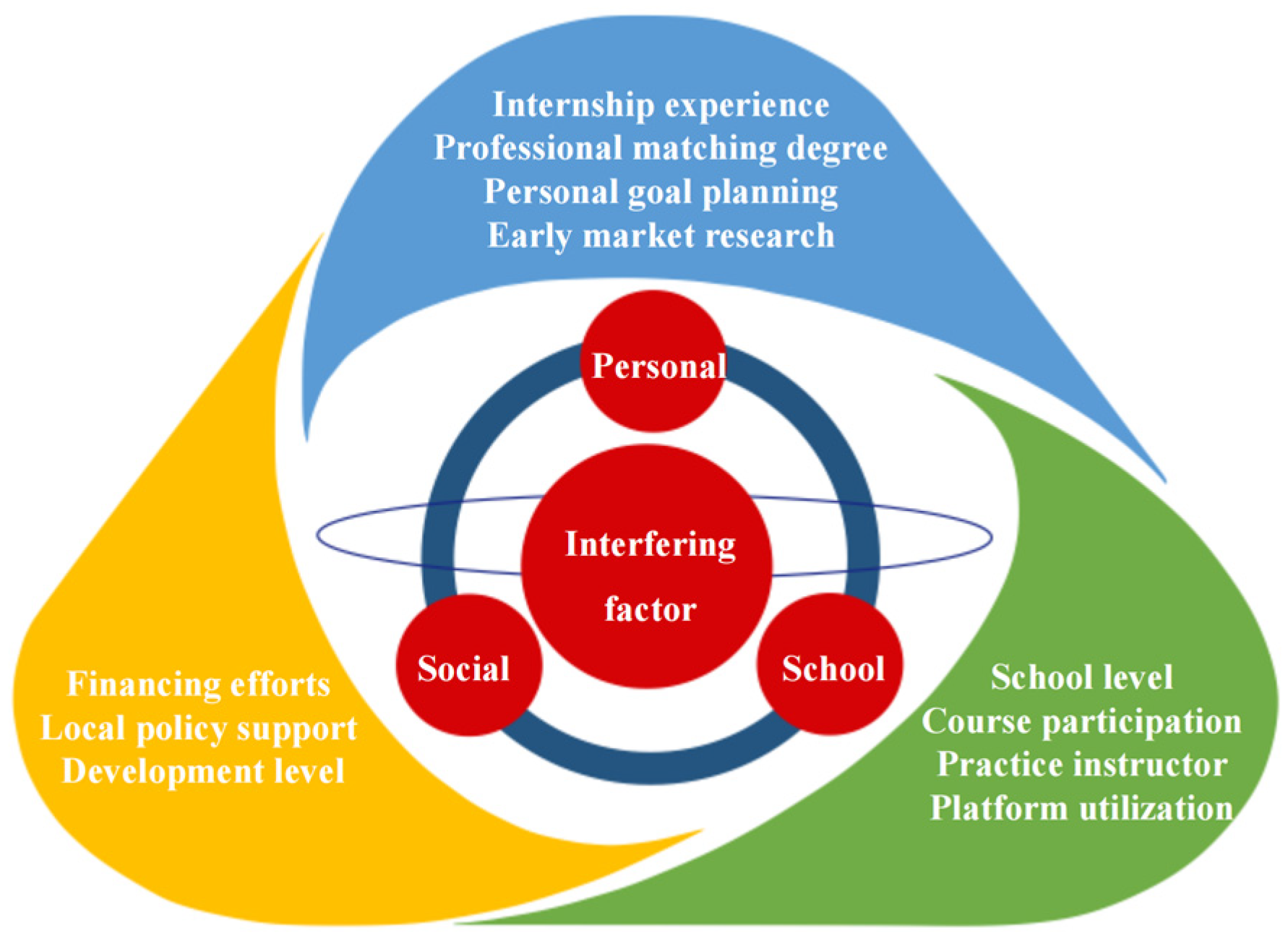
4.1. Development of the Influencing Factors Framework
- Personal factors: The success of innovation and entrepreneurship projects depends on the efforts of individuals and teams, as well as accurate timing. Before launching the project, whether the students have firm personal goals and a hard-working spirit, whether they can complete the role transformation in the entrepreneurial process, whether the market research is detailed, whether the business plan is professional, etc., will determine whether they can quickly turn the business opportunities into advantages in the future, so as to establish the enterprise management mode with great vitality and seize the market opportunities, laying a solid foundation for the success of entrepreneurship;
- School factor: Colleges and universities play an important role in the process of college students carrying out mass innovation and entrepreneurship projects. As an important front for the construction of innovation and entrepreneurship culture, the development of mass innovation and entrepreneurship courses in colleges and universities will determine the degree of college students’ understanding of the meaning of innovation and entrepreneurship, the professional courses and professional tutors set up, and the establishment of mass innovation and entrepreneurship platforms, such as makerspaces and entrepreneurship incubation bases closely connected with the society. It will promote the transformation of innovation and entrepreneurship education from the classroom to practice and improve the feasibility of college students to convert theory into practice;
- Social factors. National and regional policy support can help college students to their own direction, which is the first guarantee for college students to carry out innovation and entrepreneurship projects. Savings and financing by college students’ entrepreneurial team members and their friends and relatives alone may not be able to support the expansion of the project scale, which reduces the sustainable development ability of college students’ entrepreneurship. However, the input of social resources is a major boost to the process of college students’ innovation and entrepreneurship. These resources not only include human, material, and financial resources, but also include the potential resource pool formed by the surrounding resources with utilization value.
4.2. Mechanism for Evaluating Influencing Factor Significance
4.3. SPSS-Based Model Construction for Significance Analysis
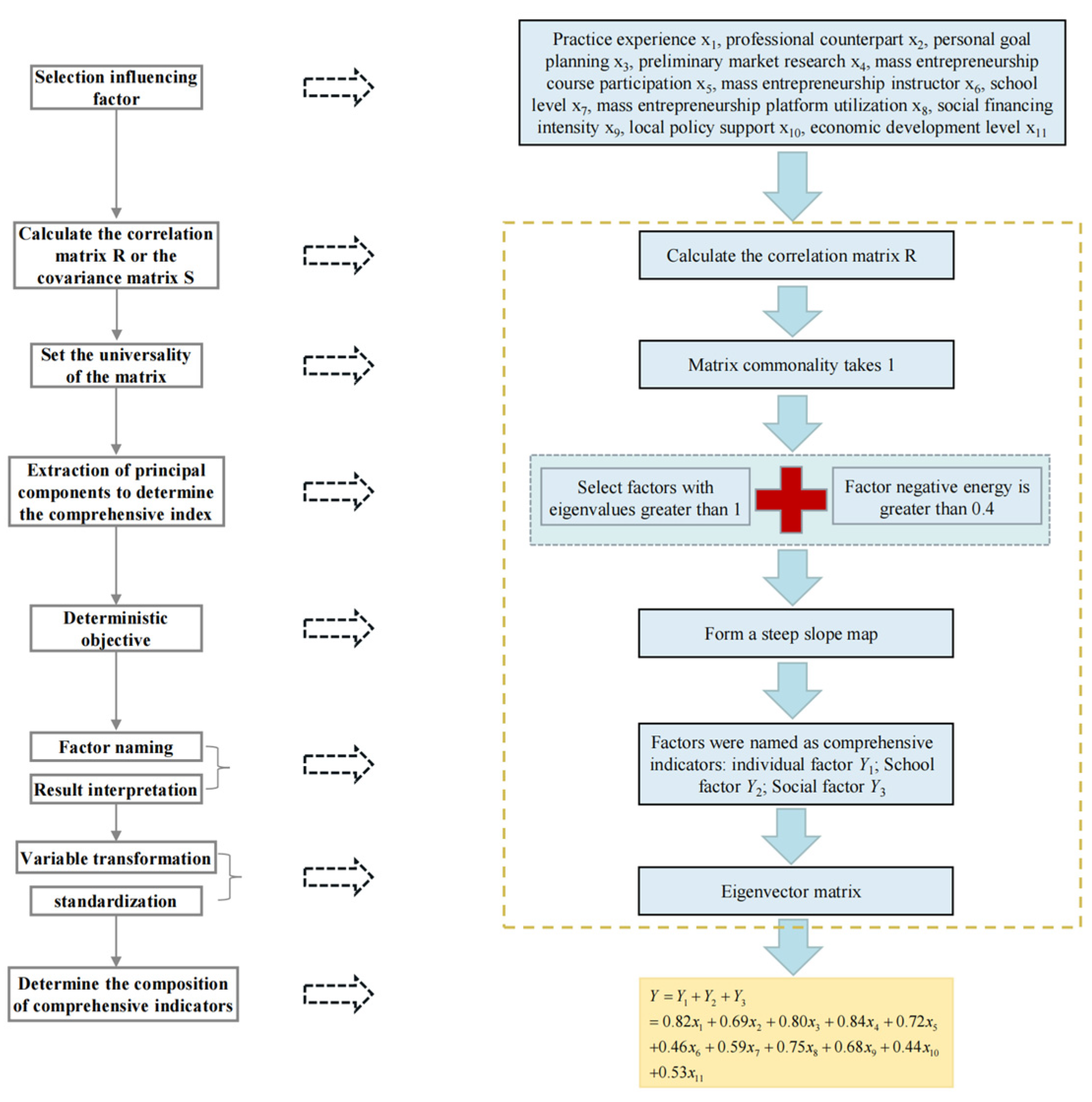
- Data standardization: Using the correlation coefficient matrix to normalize variables across different scales, addressing the heteroscedasticity in factor measurements;
- Eigenvalue extraction: Identifying principal components with eigenvalues > 1 to ensure the retention of factors explaining significant variance. The analysis yielded a KMO value of 0.78 and a significant Bartlett’s test of sphericity (p < 0.001), confirming the suitability of PCA. Three principal components were extracted, explaining 78.5% of the total variance, including 42.3% for individual factors (Y1), 23.1% for institutional factors (Y2), and 13.1% for societal factors (Y3);
- Factor-loading interpretation: Assessing the strength of variable relationships with extracted components, enabling categorization into composite indices (e.g., Individual Factor Y1, Institutional Factor Y2, Societal Factor Y3).
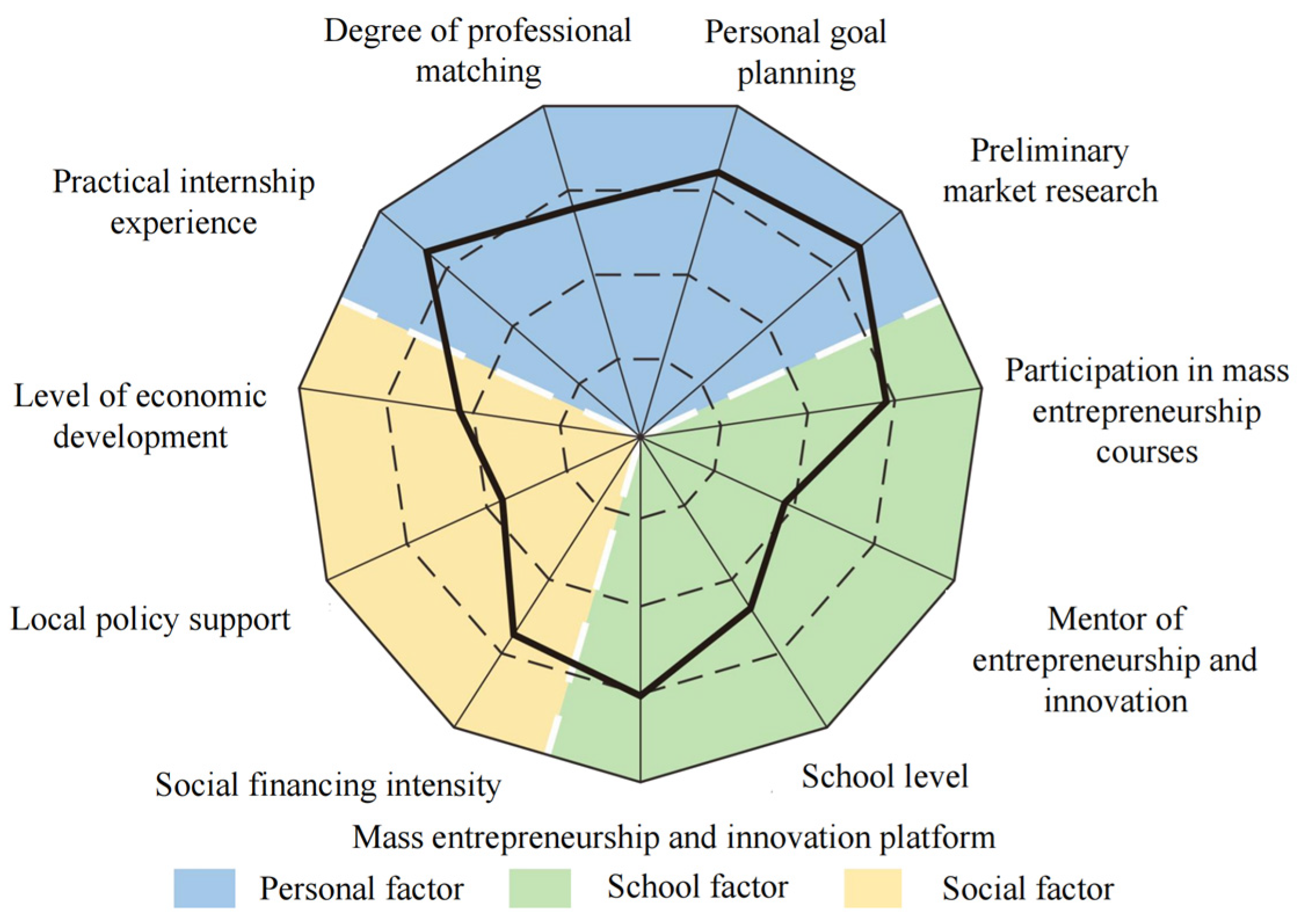
- Individual factors (Y1): Among individual-level determinants, practical internship experience (r = 0.82), personal goal planning (r = 0.80), and pre-market research (r = 0.84) emerge as the strongest predictors of risk mitigation. These factors enhance students’ critical thinking and analytical skills, enabling them to identify market gaps, develop viable business models, and navigate operational challenges. In contrast, disciplinary alignment (r = 0.69) demonstrates a moderate association, indicating that, while domain knowledge is valuable, it is overshadowed by proactive preparatory actions in reducing risk;
- Institutional factors (Y2): Institutional inputs such as entrepreneurship course participation (r = 0.72) and university platform utilization (r = 0.75) significantly correlate with lower risk levels, reflecting their role in fostering innovation capabilities and interpersonal networks. Conversely, faculty mentorship (r = 0.46) and institutional prestige (r = 0.59) show weaker effects, suggesting that experiential learning opportunities are more impactful than symbolic resources like university reputation. Active engagement with campus innovation ecosystems directly enhances students’ ability to translate academic knowledge into practical ventures;
- Societal factors (Y3): At the societal level, social financing intensity (r = 0.68) emerges as the primary driver of risk reduction, providing essential capital for scaling operations and sustaining momentum. While local policy support (r = 0.44) and economic development level (r = 0.53) exhibit weaker correlations, they still contribute by creating enabling environments for startups. Increased access to external funding directly improves venture sustainability, addressing a common bottleneck in student-led enterprises.
5. Conclusions and Prospect
Author Contributions
Funding
Institutional Review Board Statement
Informed Consent Statement
Data Availability Statement
Conflicts of Interest
Appendix A

| No | Innovators | Entrepreneurship Process and Results | No | Innovators | Entrepreneurship Process and Results |
|---|---|---|---|---|---|
| 1 | Chen Sheng | Graduated from Peking University, adopted the “company + farmer cooperation” business model, and created the pork brand “No. 1 Tuzhu”, with a turnover of over CNY 200 million. | 50 | Xiuming Jiang | A postgraduate student from Chang’an University, in 2020, founded Xi’an Saistebo Environmental Protection Technology Co., Ltd. in China and won the bronze award in the provincial college students’ innovation and Entrepreneurship competition. |
| 2 | Qili Hu | Graduated from Wuhan Textile University, set up a training school for college students and the campus market to provide computer training for college students. | 51 | Wang Bo | A doctoral student at Chang’an University, co-founded two companies, with an annual turnover of more than CNY 1.2 million, and applied for 3 invention patents. |
| 3 | Liqun Tao | Graduated from Zhejiang University, established “Xintian Bakery and Cake Shop”, created a new business model, and created a mid-to-high-end cake brand in Shaoxing, China. | 52 | Wang Zhe | A graduate student of Chang’an University, Xi’an Sanaisi Surveying and Mapping Technology Co., Ltd. in China. was established in 2020 with a registered capital of CNY 300,000 and applied for 4 invention patents. |
| 4 | Wang Xing | Graduated from Tsinghua University, returned to China to start a business after studying in the United States, and initially founded several SNS websites, including “Fanfou” and “Meituan”. | 53 | Jiuyuan Li | Graduate student of Chang’an University, head of Xi’an Zhiruisi Surveying and Mapping Technology Co., Ltd., China mainly engaged in surveying and mapping services, disaster monitoring, etc. |
| 5 | Zhang Dai | During college, he developed a set of online communities “Discuz!”. After graduation, he established Kangsheng Chuangxiang Technology Co., Ltd., in China which was later acquired by Tencent. | 54 | Rudie Zhang | A graduate student of Chang’an University registered and established Xi’an Digital Twin Transportation Technology Co., Ltd., in China 2019, and won the third prize in the BIM Huichuang Cup in Shaanxi Province. |
| 6 | Jundong Qian | Graduated from Chang’an University, registered and founded Sanrenxing Advertising Media Co., Ltd., in China. when he was an undergraduate and is currently the vice chairman of the National University Student Entrepreneurship Alliance. | 55 | Xiaotong Xu | A graduate student of Chang’an University registered and established Shaanxi Haorong Biotechnology Co., Ltd., in China 2019, with a registration cost of CNY 1 million, and is continuing to start a business. |
| 7 | Mingping Yang | Established an online and offline super classroom serving primary and middle school students, with monthly sales of more than CNY 2 million. | 56 | Zhao Di | A graduate student of Chang’an University registered and established Xi’an Rusuo Coffee Catering Service Co., Ltd., in China 2018, and continues to start a business. |
| 8 | Shu Yi | Graduated from the School of Economics and Management of Sichuan Normal University, established Limei Interactive Advertising Co., Ltd., in China responsible for the operation and management of Limei Technology. | 57 | Zhong Ming | Graduated from Tongji University with a major in architecture, he started his own business in 2002, and the company was awarded “National Excellent Private Design Enterprise in Survey and Design Industry”, in China and so on. |
| 9 | Guo Jun | Graduated from the Bioengineering Department of Zhengzhou University, researched and developed fertilizers fermented by excellent strains, turned waste into treasure, and founded Lotte Biotechnology Co., Ltd. | 58 | Sanchang Luo | Graduated from Dianchi College of Yunnan University, founded “Luo Xiaoman Brown Sugar Mantou”, and won the gold medal in the third national “Internet +” Innovation and Entrepreneurship Competition. |
| 10 | Chen Shi | Established Xingcan Cultural and Creative Studio, and the business scope continued to expand, and the business was expanded outside the province. The company’s profit reached CNY 1.5 million. | 59 | Guo Qing | Master of Architecture, Chang’an University, once worked at Zhongxia Architectural Design and Research Institute and established Xi’an Sifang Architectural Hand-painted Design Co., Ltd., in China. |
| 11 | Liu Fu | Graduated from Qingdao University of Technology, he used his professional advantages to establish a home improvement company, and gradually transformed into a construction company after business expansion. | 60 | Dai Kun | Graduated from Chang’an University majoring in Architecture, founded Juqimeiye Housing Technology Development Co., Ltd., in China to promote American living culture and lifestyle. |
| 12 | Zhenhua Zhang | Graduated from Huazhong Agricultural University, established Inner Mongolia Huameng Agriculture and Animal Husbandry Development Co., Ltd.,in China and developed new varieties of alfalfa suitable for my country’s environment | 61 | Zhong Bo | Graduated from the University of Electronic Science and Technology of China, founded XGIMI Technology in 2013, won the Grand Slam of the World Industrial Design Award, and won the “National Model Worker” in 2020. |
| 13 | Huijie Wang | Graduated from Hubei Institute of Automobile Industry, founded the dot studio, with an income of more than CNY 100,000 in half a year, and a 100% pass rate for students in art examinations. | 62 | TianYu Zhang | Graduated from Xidian University with a bachelor’s degree, founded Xiamen Nisshin Kei and Fibocom, and obtained a master’s degree from Cheung Kong Graduate School in 2010. |
| 14 | Mingyong Nie | Graduated from Qingdao University of Technology, established New Field Information Technology Co., Ltd., in China and opened up a new e-commerce market through a cross-industry alliance. | 63 | JiangBing Xie | Master of Donghua University, Ph.D. of the University of California, USA, founded Aibo Medical and is currently the vice chairman of the Ophthalmology Branch of the China Medical Equipment Association. |
| 15 | Tianyi Zhang | Graduated from Peking University, established the “Funiutang” Changde rice noodle shop, and was received by the Prime Minister of the country. The company’s market value is hundreds of millions. | 64 | JiQiao Liao | A doctoral student of Central South University registered in Hunan Boyun High-Tech Co., Ltd., in China and enjoys special allowances from the Hunan Provincial Government. |
| 16 | Xuhao Zhang | Graduated from Shanghai Jiaotong University, he developed the first online food-ordering platform “Eleme”, which has a market share of over 60% and a market value of over USD 4.5 billion. | 65 | BiWang Jiang | Bachelor of Peking University, Ph.D. of the State University of New York. Established Navitas Technology, in Shanghai China the only company in the world that produces monodisperse silica gel chromatography packing materials on a large scale. |
| 17 | Zhaoxin Ma | Graduated from Chang’an University. During his university period, he began to organize a team to conduct research and development in related fields of the Internet of Things and established Hengtai Network Technology Co., Ltd., in China. | 66 | ZhenGuo Li | Graduated from Lanzhou University, registered his own company in 2000, which is the beginning of Longji shares, and has been included in the Forbes rich list many times. |
| 18 | Changsheng Qiu | Graduated from East China Jiaotong University, established an online store using the business management model of large-scale businesses, and developed four online stores, with an annual income of more than CNY 5 million. | 67 | ZhenYuan Zhao | Graduated from Xi’an Jiaotong University, established the Eleventh Design and Research Institute Co., Ltd., in China of Information Industry Electronics, and became a nationally registered trademark. |
| 19 | Yuanhao Weng | Graduated from Zhejiang A&F University for Microbiology, he mastered the technology of breeding succulents and established a succulent planting base when he worked in a succulent cultivation company. | 68 | YeShen Liang | Graduated from Chang’an University, registered and established Xi’an Shahai Voice Art and Culture Communication Co., Ltd., in China in 2017, with an annual turnover of CNY 300,000. |
| 20 | Fan Wei | Graduated from Huazhong University of Science and Technology, founded Haha Farm Company, and continuously expanded the scale of the company, and the company’s valuation was dozens of times that of before. | 69 | YiShi He | Graduated from Chang’an University, registered and established Xi’an Zhongtuo Mingguang Technology Co., Ltd. in 2014, now holds shares in two companies, and continues to start a business. |
| 21 | AnXin Huang | Graduated from Yunnan University of Finance and Economics, he established Yunnan Kingkerry Education Information Consulting Co., Ltd., in China and is currently a member of the Kunming Youth Joint Committee. | 70 | Su Ying | Graduated from Chang’an University, registered and established Qiulin Branch of Heilongjiang China Travel International Travel Agency Co., Ltd., in China and continued to start a business. |
| 22 | Leo Chen | Graduated from Nanyang Technological University in Singapore, he founded Jumei, with sales of CNY 20 million in the same year and a market value of more than USD 3.5 billion. | 71 | LeLin Chen | Graduated from Chang’an University, participated in the National Innovation and Entrepreneurship Competition many times, and won awards. In 2017, he registered Xi’an Amou Electronic Intelligent Technology Co., Ltd. |
| 23 | XuNan Wang | When he graduated from university, he took a fancy to the potential business opportunities in WeChat Bao and founded the Fushun Micro Times Marketing Planning Studio. | 72 | YanLin Jin | Graduated from Chang’an University, registered and established Xi’an Gangyi Jianzhuo Culture Media Co., Ltd., in China 2018. |
| 24 | Liu Pan | Graduated from the School of Business Administration of Hunan University, he created a new steamed bun catering brand—Sichuan Baocunchang Catering Management Co., Ltd., in China. | 73 | YiYang Zheng | A student of Chang’an University registered and established Xi’an Knockout Technology Co., Ltd., in China and settled in the Maker Space of Chang’an University. The company is currently in business. |
| 25 | Lu Jun | Graduated from Tsinghua University with a master’s degree in economics, he opened a personal website “Huayunfang” with the entrepreneurial team and then developed it into the FANSO company in China. | 74 | XinQiang Weng | Graduated from the China University of Geosciences, he and his classmates co-founded a cultural communication company that undertakes table advertisements in colleges and universities, and later founded Yunxi Youpin Wuweiguo Professional Cooperative in China. |
| 26 | Jerry Yang | Graduated from Stanford University and studied for a Ph.D. in electrical engineering, he founded Yahoo! in Sunnyvale USA and was listed on NASDAQ. | 75 | WenQiang Li | Graduated from Lanzhou University of Arts and Sciences, established Gansu Donghong Culture Media Co., Ltd. in China 2018, and settled in the “Yanyuan Micro Forest” maker space. |
| 27 | HongYun Qiu | Graduated from the Department of Materials of Tsinghua University, founded “Beijing Shimeile Technology Development Co., Ltd.”in China, and successively obtained huge venture capital from “Shanghai 100” and “Aokema”. | 76 | ZhaoYu Sun | Graduated from Northeastern University, established Shenyang Yanye Technology Co., Ltd. in China It has successively won second place in the International Financial Fintech Innovation and Entrepreneurship Competition and the Bronze Award in the “Internet +” National Competition. The company’s cumulative sales reached 13.01 million. |
| 28 | XingDong Fang | Graduated from Xi’an Jiaotong University, Ph.D. from Tsinghua University, the first to establish the “Blog China” project, known as the “Father of Chinese Blogs”. | 77 | HanTong Liu | Graduated from Northeastern University, established Shenyang Borui Future Technology Co., Ltd.,in China Benxi Branch, and won many honors, such as the Bronze Award in the “Creating Youth” National Competition. |
| 29 | Lei Jun | Graduated from the Department of Computer Science of Wuhan University, he founded Sanse Company. In 2011, he officially took over Jinshan Software. He is currently the chairman of Xiaomi Technology Co., Ltd.in China and the chairman of Beijing Jinshan Software Co., Ltd. in China | 78 | YongFei Wang | Doctor of the South China University of Technology registered and established Guangzhou Jinci Haina New Material Technology Co., Ltd.in China 2018, successfully developed a variety of high-end magnetic core products, and won many honors, such as top 10 entrepreneurial heroes of college students. |
| 30 | Jiang Lei | Graduated from the Materials Department of Tsinghua University, contacted foreign brands, established Tiexue.com, and became the starting point of military e-commerce, covering more than 33 million users monthly. | 79 | HongQiong Fu | A doctoral candidate at Southwest Petroleum University founded Sichuan Annuosi Oil and Gas Energy Technology Co., Ltd.in China 2017. |
| 31 | Robin Li | Graduated from Peking University, he first created ESP technology and returned to China to found Baidu, which has become the world’s largest Chinese search engine. | 80 | HaoXuan Li | Graduated from Xi’an Jiaotong University, the founder of Xi’an Shuize Power Technology Co., Ltd.,in China was selected into the 2020 Forbes China Under 30 Elite List. |
| 32 | ZhengYi Shu | Graduated from Xi’an Polytechnic University. In 2007, he and his classmates raised CNY 78,000 to start a company, mainly engaged in domain name registration, website construction, and development projects. | 81 | HaoChong Wang | Graduated from Xi’an Jiaotong University, and served as CEO of Xi’an Zhentai Intelligent Technology Co., Ltd. in China, one of the top ten in the smart medical industry in China. |
| 33 | Yang | It is an entrepreneurial activity to run intercity chartered cars for college students, but due to the lack of necessary legal reserves, resulting in the need to compensate passengers for their losses, making it difficult to defend their rights. | 82 | JieFu Xiao | Graduated from Liuzhou Vocational and Technical College, founded Guangxi Yulin Xinrong Clothing Co., Ltd. in China, with an annual output value of CNY 71.55 million. |
| 34 | YingYing Ding | Graduated from Shenyang Institute of Chemical Technology, majoring in information management, and set up a wedding company with his classmates. In the end, due to a lack of market competitiveness, the business failed. | 83 | MengYuan Yu | Graduated from Fuzhou University, founded Fuzhou Lengyi New Material Technology Co., Ltd. in China to help Guangze County get rid of poverty accurately, and the per capita annual income increased by CNY 16,000 to 20,000. |
| 35 | Chen Hui | The architecture of Northwest Institute of Architectural Engineering, registered Beijing Dongyi Risheng Decoration Co., Ltd. in China, and is currently a member of the Youth Federation of the Central State Organ. | 84 | HaiBo Chen | Doctor of Zhejiang University of Technology, established Haisheng Technology in 2017, realizing the transformation of SmFeN plastic magnetic material from the laboratory to the market, breaking the market blockade. |
| 36 | XiaoBo Zhang | Graduated from Chang’an University in Architecture, founded Sichuan Zhongtai United Design Co., Ltd. | 85 | JiChen Liu | Graduated from Tsinghua University, developed the WeChat mini-program “ Clean Your Plate Campaign” and was selected as one of the 17 young leaders of the United Nations Sustainable Development Goals. |
| 37 | XiaoHong Chen | Graduated from Chang’an University in Architecture, one of the founders of Glodon, and serves as the legal representative of Beijing YuXuxi Cultural and Creative Co., Ltd. in China. | 86 | YongBao Jin | Graduated from Anhui Vocational College of Finance and Trade, established Anhui Jinshang Trading Co., Ltd. in China to help fight poverty, and won honors as the most beautiful poverty alleviation person. |
| 38 | Li Tong | Graduated from Chang’an University in Architecture, established Shanghai China Construction Architectural Design Institute Co., Ltd. in China Xi’an Branch in 2013, and served as the legal person. | 87 | RuiDong Niu | Graduated from Jiangsu University, established Zhenjiang Hongbaotu Information Technology Co., Ltd. in China in 2015. |
| 39 | JingJun Shen | Graduate student of Chang’an University, registered Xi’an Changtong Data Technology Co., Ltd. in China during school, with 10 employees at the time of graduation, with a graduation income of 300,000. | 88 | XiangYu Han | Graduated from Xidian University, the founder of Xi’an Miaosi Zhiyin Information Technology Co., Ltd. in China, won the gold medal in the 2020 “Challenge Cup” national competition. |
| 40 | ChangLu Cai | Graduate student of Chang’an University registered Xi’an Lvke Construction Technology Co., Ltd. in China, the company had 9 employees when it graduated, and its graduation income was 450,000. The company continues to operate. | 89 | QiGong Sun | Doctor of Xidian University, established Yingzhuo Hotel Management Co., Ltd. in China and Zhuoju Future Intelligent Technology Co., Ltd. in China, and was awarded the most innovative enterprise in 2019. |
| 41 | JingHua Chen | Graduated from the Resource College of Chang’an University, he founded Xi’an Youzhi Jiaofu Culture Co., Ltd. in China, with an annual turnover of CNY 1.2 million, providing jobs for 26 college students. | 90 | ZhiDa Feng | Graduated from Jiangsu University, founded Jiachuang Network Technology Co., Ltd. in China, and established 6 data processing centers and 1 overseas data processing base, with a revenue of 15 million. |
| 42 | YiKai Wang | Graduate student of Chang’an University, registered Vi-show studio during school and later registered Xi’an Qisheng Culture Media Co., Ltd. in China. | 91 | Li Li | Doctor of Chongqing University founded Yunwei Technology in 2011 and won many honors such as “Top Ten Typical Youth Entrepreneurs” in China in 2014. |
| 43 | YiBo Lyu | Graduate student of Chang’an University registered Xixian New District CyberShuoke Technology Co., Ltd. in China during graduate school, and the company continues to operate at present. | 92 | LingQiang Bai | A postgraduate student at Chang’an University, registered and established Shaanxi Zhiluhui Transportation Technology Co., Ltd. in China, obtained 17 patents and published 7 SCI papers. |
| 44 | JianTao Zhu | Graduate student of Chang’an University, registered Shaanxi Suzi Zhiyue Culture Media Co., Ltd. in China during school, with a graduation income of CNY 70,000. | 93 | JunPei Li | Doctor of the University of Science and Technology of China, founded Caihua Technology Co., Ltd. in China, and launched an environmentally friendly dye product that broke the monopoly of foreign countries. |
| 45 | YongFu Cai | Graduate student of Chang’an University registered Xi’an Micron Disaster Prevention Technology Co., Ltd. in China during the graduate student period. | 94 | BoQiang Wu | Graduated from Chengdu University, founded “Brothers Training School” in 2005, and Chengdu Haiyi Electromechanical Equipment Co., Ltd. in China 2009. |
| 46 | Du Yuan | Graduate student of Chang’an University, registered Xi’an Beidou Zhonglian Information Technology Co., Ltd. in China during school, with a graduation income of 600,000. | 95 | XueYing Zhang | Graduated from Heilongjiang University and founded Harbin Yuetai Technology Development Co., Ltd. in China 2020, the company’s output value exceeded CNY 47 million. |
| 47 | Zhang Bin | A postgraduate student at Chang’an University, established Xi’an Yingwopu Zhilian Technology Co., Ltd. in China, and won the special prize of the 13th “Challenge Cup” Shaanxi Province. | 96 | Zhang Hao | Graduated from Wuhan Engineering University, registered Wuhan Dangxia Time Culture and Creativity Co., Ltd. in China. The company’s turnover in 2018 was about CNY 1.2 million. |
| 48 | HaoXiu Liu | A postgraduate student at Chang’an University, established Hangzhou Gotwis Technology Co., Ltd. in China, and won the 2020 World Intelligent Driving Challenge Award. | 97 | MingHuan Chen | Graduated from Hubei University of Technology, Shanshui Qianxing Technology Co., Ltd. in China was established in 2019 with an annual income of 6 million. |
| 49 | JinXi Li | Graduated from Shandong University of Traditional Chinese Medicine, started the “Zhenaitang” project in 2016, with an average monthly sales of hundreds of thousands of yuan, and won the Top Ten Entrepreneurial Stars of Shandong University Students. | 98 | TengYu Lin | A doctoral student at Tsinghua University, achieved a breakthrough in the innovation of new graphene water purification technology, was the founder of Hongrun Qingyuan, and was selected into the 2021 Forbes China Under 30 list. |
| Factor | Personal Factor | School Factor | Social Factor | ||||||||||||||||||||||
|---|---|---|---|---|---|---|---|---|---|---|---|---|---|---|---|---|---|---|---|---|---|---|---|---|---|
| Practical Internship Experience | Degree of Professional Matching | Personal Goal Planning | Preliminary Market Research | Participation in Mass Entrepreneurship Courses | Mentor of Entrepreneurship and Innovation | School Level | Use of Mass Entrepreneurship and Innovation Platforms | Social Financing Intensity | Local Policy Support | Level of Economic Development | |||||||||||||||
| Case | Yes | No | Yes | No | Yes | No | Yes | No | Yes | No | Yes | No | Study Abroad | Double Class | Ordinary School | Yes | No | Yes | No | Yes | No | Municipality Directly Under the Central Government | Provincial Capital | Other | |
| 1 | ● | ● | ● | ● | ● | ● | ● | ● | ● | ● | ● | ||||||||||||||
| 2 | ● | ● | ● | ● | ● | ● | ● | ● | ● | ● | ● | ||||||||||||||
| 3 | ● | ● | ● | ● | ● | ● | ● | ● | ● | ● | ● | ||||||||||||||
| 4 | ● | ● | ● | ● | ● | ● | ● | ● | ● | ● | ● | ||||||||||||||
| 5 | ● | ● | ● | ● | ● | ● | ● | ● | ● | ● | ● | ||||||||||||||
| 6 | ● | ● | ● | ● | ● | ● | ● | ● | ● | ● | ● | ||||||||||||||
| 7 | ● | ● | ● | ● | ● | ● | ● | ● | ● | ● | ● | ||||||||||||||
| 8 | ● | ● | ● | ● | ● | ● | ● | ● | ● | ● | ● | ||||||||||||||
| 9 | ● | ● | ● | ● | ● | ● | ● | ● | ● | ● | ● | ||||||||||||||
| 10 | ● | ● | ● | ● | ● | ● | ● | ● | ● | ● | ● | ||||||||||||||
| 11 | ● | ● | ● | ● | ● | ● | ● | ● | ● | ● | ● | ||||||||||||||
| 12 | ● | ● | ● | ● | ● | ● | ● | ● | ● | ● | ● | ||||||||||||||
| 13 | ● | ● | ● | ● | ● | ● | ● | ● | ● | ● | ● | ||||||||||||||
| 14 | ● | ● | ● | ● | ● | ● | ● | ● | ● | ● | ● | ||||||||||||||
| 15 | ● | ● | ● | ● | ● | ● | ● | ● | ● | ● | ● | ||||||||||||||
| 16 | ● | ● | ● | ● | ● | ● | ● | ● | ● | ● | ● | ||||||||||||||
| 17 | ● | ● | ● | ● | ● | ● | ● | ● | ● | ● | ● | ||||||||||||||
| 18 | ● | ● | ● | ● | ● | ● | ● | ● | ● | ● | ● | ||||||||||||||
| 19 | ● | ● | ● | ● | ● | ● | ● | ● | ● | ● | ● | ||||||||||||||
| 20 | ● | ● | ● | ● | ● | ● | ● | ● | ● | ● | ● | ||||||||||||||
| 21 | ● | ● | ● | ● | ● | ● | ● | ● | ● | ● | ● | ||||||||||||||
| 22 | ● | ● | ● | ● | ● | ● | ● | ● | ● | ● | ● | ||||||||||||||
| 23 | ● | ● | ● | ● | ● | ● | ● | ● | ● | ● | ● | ||||||||||||||
| 24 | ● | ● | ● | ● | ● | ● | ● | ● | ● | ● | ● | ||||||||||||||
| 25 | ● | ● | ● | ● | ● | ● | ● | ● | ● | ● | ● | ||||||||||||||
| 26 | ● | ● | ● | ● | ● | ● | ● | ● | ● | ● | ● | ||||||||||||||
| 27 | ● | ● | ● | ● | ● | ● | ● | ● | ● | ● | ● | ||||||||||||||
| 28 | ● | ● | ● | ● | ● | ● | ● | ● | ● | ● | ● | ||||||||||||||
| 29 | ● | ● | ● | ● | ● | ● | ● | ● | ● | ● | ● | ||||||||||||||
| 30 | ● | ● | ● | ● | ● | ● | ● | ● | ● | ● | ● | ||||||||||||||
| 31 | ● | ● | ● | ● | ● | ● | ● | ● | ● | ● | ● | ||||||||||||||
| 32 | ● | ● | ● | ● | ● | ● | ● | ● | ● | ● | ● | ||||||||||||||
| 33 | ● | ● | ● | ● | ● | ● | ● | ● | ● | ● | ● | ||||||||||||||
| 34 | ● | ● | ● | ● | ● | ● | ● | ● | ● | ● | ● | ||||||||||||||
| 35 | ● | ● | ● | ● | ● | ● | ● | ● | ● | ● | ● | ||||||||||||||
| 36 | ● | ● | ● | ● | ● | ● | ● | ● | ● | ● | ● | ||||||||||||||
| 37 | ● | ● | ● | ● | ● | ● | ● | ● | ● | ● | ● | ||||||||||||||
| 38 | ● | ● | ● | ● | ● | ● | ● | ● | ● | ● | ● | ||||||||||||||
| 39 | ● | ● | ● | ● | ● | ● | ● | ● | ● | ● | ● | ||||||||||||||
| 40 | ● | ● | ● | ● | ● | ● | ● | ● | ● | ● | ● | ||||||||||||||
| 41 | ● | ● | ● | ● | ● | ● | ● | ● | ● | ● | ● | ||||||||||||||
| 42 | ● | ● | ● | ● | ● | ● | ● | ● | ● | ● | ● | ||||||||||||||
| 43 | ● | ● | ● | ● | ● | ● | ● | ● | ● | ● | ● | ||||||||||||||
| 44 | ● | ● | ● | ● | ● | ● | ● | ● | ● | ● | ● | ||||||||||||||
| 45 | ● | ● | ● | ● | ● | ● | ● | ● | ● | ● | ● | ||||||||||||||
| 46 | ● | ● | ● | ● | ● | ● | ● | ● | ● | ● | ● | ||||||||||||||
| 47 | ● | ● | ● | ● | ● | ● | ● | ● | ● | ● | ● | ||||||||||||||
| 48 | ● | ● | ● | ● | ● | ● | ● | ● | ● | ● | ● | ||||||||||||||
| 49 | ● | ● | ● | ● | ● | ● | ● | ● | ● | ● | ● | ||||||||||||||
| 50 | ● | ● | ● | ● | ● | ● | ● | ● | ● | ● | ● | ||||||||||||||
| 51 | ● | ● | ● | ● | ● | ● | ● | ● | ● | ● | ● | ||||||||||||||
| 52 | ● | ● | ● | ● | ● | ● | ● | ● | ● | ● | ● | ||||||||||||||
| 53 | ● | ● | ● | ● | ● | ● | ● | ● | ● | ● | ● | ||||||||||||||
| 54 | ● | ● | ● | ● | ● | ● | ● | ● | ● | ● | ● | ||||||||||||||
| 55 | ● | ● | ● | ● | ● | ● | ● | ● | ● | ● | ● | ||||||||||||||
| 56 | ● | ● | ● | ● | ● | ● | ● | ● | ● | ● | ● | ||||||||||||||
| 57 | ● | ● | ● | ● | ● | ● | ● | ● | ● | ● | ● | ||||||||||||||
| 58 | ● | ● | ● | ● | ● | ● | ● | ● | ● | ● | ● | ||||||||||||||
| 59 | ● | ● | ● | ● | ● | ● | ● | ● | ● | ● | ● | ||||||||||||||
| 60 | ● | ● | ● | ● | ● | ● | ● | ● | ● | ● | ● | ||||||||||||||
| 61 | ● | ● | ● | ● | ● | ● | ● | ● | ● | ● | ● | ||||||||||||||
| 62 | ● | ● | ● | ● | ● | ● | ● | ● | ● | ● | ● | ||||||||||||||
| 63 | ● | ● | ● | ● | ● | ● | ● | ● | ● | ● | ● | ||||||||||||||
| 64 | ● | ● | ● | ● | ● | ● | ● | ● | ● | ● | ● | ||||||||||||||
| 65 | ● | ● | ● | ● | ● | ● | ● | ● | ● | ● | ● | ||||||||||||||
| 66 | ● | ● | ● | ● | ● | ● | ● | ● | ● | ● | ● | ||||||||||||||
| 67 | ● | ● | ● | ● | ● | ● | ● | ● | ● | ● | ● | ||||||||||||||
| 68 | ● | ● | ● | ● | ● | ● | ● | ● | ● | ● | ● | ||||||||||||||
| 69 | ● | ● | ● | ● | ● | ● | ● | ● | ● | ● | ● | ||||||||||||||
| 70 | ● | ● | ● | ● | ● | ● | ● | ● | ● | ● | ● | ||||||||||||||
| 71 | ● | ● | ● | ● | ● | ● | ● | ● | ● | ● | |||||||||||||||
| 72 | ● | ● | ● | ● | ● | ● | ● | ● | ● | ● | ● | ||||||||||||||
| 73 | ● | ● | ● | ● | ● | ● | ● | ● | ● | ● | ● | ||||||||||||||
| 74 | ● | ● | ● | ● | ● | ● | ● | ● | ● | ● | ● | ||||||||||||||
| 75 | ● | ● | ● | ● | ● | ● | ● | ● | ● | ● | ● | ||||||||||||||
| 76 | ● | ● | ● | ● | ● | ● | ● | ● | ● | ● | ● | ||||||||||||||
| 77 | ● | ● | ● | ● | ● | ● | ● | ● | ● | ● | ● | ||||||||||||||
| 78 | ● | ● | ● | ● | ● | ● | ● | ● | ● | ● | ● | ||||||||||||||
| 79 | ● | ● | ● | ● | ● | ● | ● | ● | ● | ● | ● | ||||||||||||||
| 80 | ● | ● | ● | ● | ● | ● | ● | ● | ● | ● | ● | ||||||||||||||
| 81 | ● | ● | ● | ● | ● | ● | ● | ● | ● | ● | ● | ||||||||||||||
| 82 | ● | ● | ● | ● | ● | ● | ● | ● | ● | ● | ● | ||||||||||||||
| 83 | ● | ● | ● | ● | ● | ● | ● | ● | ● | ● | ● | ||||||||||||||
| 84 | ● | ● | ● | ● | ● | ● | ● | ● | ● | ● | ● | ||||||||||||||
| 85 | ● | ● | ● | ● | ● | ● | ● | ● | ● | ● | ● | ||||||||||||||
| 86 | ● | ● | ● | ● | ● | ● | ● | ● | ● | ● | ● | ||||||||||||||
| 87 | ● | ● | ● | ● | ● | ● | ● | ● | ● | ● | ● | ||||||||||||||
| 88 | ● | ● | ● | ● | ● | ● | ● | ● | ● | ● | ● | ||||||||||||||
| 89 | ● | ● | ● | ● | ● | ● | ● | ● | ● | ● | ● | ||||||||||||||
| 90 | ● | ● | ● | ● | ● | ● | ● | ● | ● | ● | ● | ||||||||||||||
| 91 | ● | ● | ● | ● | ● | ● | ● | ● | ● | ● | ● | ||||||||||||||
| 92 | ● | ● | ● | ● | ● | ● | ● | ● | ● | ● | ● | ||||||||||||||
| 93 | ● | ● | ● | ● | ● | ● | ● | ● | ● | ● | ● | ||||||||||||||
| 94 | ● | ● | ● | ● | ● | ● | ● | ● | ● | ● | ● | ||||||||||||||
| 95 | ● | ● | ● | ● | ● | ● | ● | ● | ● | ● | ● | ||||||||||||||
| 96 | ● | ● | ● | ● | ● | ● | ● | ● | ● | ● | ● | ||||||||||||||
| 97 | ● | ● | ● | ● | ● | ● | ● | ● | ● | ● | ● | ||||||||||||||
| 98 | ● | ● | ● | ● | ● | ● | ● | ● | ● | ● | ● | ||||||||||||||
References
- Li, K.Q. Speech at the Opening Ceremony of the 12th Summer Davos Forum. Pract. Foreign Econ. Relat. Trade 2018, 358, 4–7. [Google Scholar]
- Kakouris, A.; Dermatis, Z.; Liargovas, P. Educating potential entrepreneurs under the perspective of Europe 2020 plan. Bus. Entrep. J. 2016, 5, 7–24. [Google Scholar]
- Wang, J.; Wang, X.; Weng, Z.; Wei, Y.; Han, D.; Gong, C. Implementation Path Exploration of Innovation and Entrepreneurship Education Reform under the Background of “New Engineering”. Adv. Appl. Sociol. 2022, 12, 102–111. [Google Scholar] [CrossRef]
- Bandera, C.; Eminen, A.; Passerini, K.; Pon, K. Cross-Cultural Entrepreneurship Education: Localization Amidst Globalization. In Annals of Entrepreneurship Education and Pedagogy; Edward Elgar Publishing: Cheltenham, UK, 2018; pp. 99–122. [Google Scholar]
- Yang, J. Current Situation, Problems and Countermeasures of College Graduates’ Innovation and Entrepreneurship Under the COVID-19 Epidemic. Available online: https://dxs.moe.gov.cn/zx/a/fdy_bjtj_yrjy/220112/1738278.shtml (accessed on 21 March 2025).
- Wei, M.Y. Analysis of Current Situation and Influencing Factors of College Students’ Innovation and Entrepreneurship. Available online: http://m.xuexila.com/chuangyee/c225938.html (accessed on 21 March 2025).
- Yu, P. The evolution trend, driving factors and effectiveness impact of college students’ entrepreneurial willingness. Foreign Econ. Manag. 2023, 45, 38–52. [Google Scholar]
- Peng, Z.X.; Lu, G.S.; Kang, F. The influence of individual and social environment factors on college students’ entrepreneurial intention. Res. High. Educ. Eng. 2012, 4, 75–82. [Google Scholar]
- Sichuan Provincial People’s Government. The Entrepreneurship of Sichuan College Students Is Mainly Restricted by Five Factors. Available online: https://www.sc.gov.cn/10462/10464/10465/10574/2015/7/16/10343781.shtml (accessed on 21 March 2025).
- Yong, Z.; Renlian, L.; Saragih, M.Y. The current situation, hot spot, and frontier of the research on the employment pressure of college students in China (quantitative visualization analysis based on CNKI core literature library in 2002–2019). Br. Int. Linguist. Arts Educ. (BIoLAE) J. 2020, 2, 738–746. [Google Scholar] [CrossRef]
- Zheng, X.; Xiao, B.; Ma, H. Research on the impact mechanism of opportunity resource integration on enterprise performance. Chin. J. Manag. 2022, 19, 1608–1616. [Google Scholar]
- Xu, N.; Huo, K. Analysis and enlightenment research on the educational experience of innovation and entrepreneurship in universities in developed countries. Theory Pract. Innov. Entrep. 2022, 5, 91–94. [Google Scholar]
- Knowles Training Institute. Entrepreneurship Education in Singapore: Curriculum Design and Industry Integration. Available online: https://knowlesti.sg/entrepreneur-courses-in-singapore/ (accessed on 21 March 2025).
- Ju, Y.P.; Chen, Y.Y. The Proportion of College Students’ Entrepreneurship Rose Steadily in 5 Years. People’s Daily, 22 September 2017. [Google Scholar]
- Max Research Institute; Wang, B.Q.; Wu, Y.L.; Wang, M.P. Chinese 4-Year College Graduates’ Employment Annual Report (2021); Social Sciences Academic Press (CHINA): Beijing, China, 2021. [Google Scholar]
- Office of the Working Group on the Outline of the National Medium and Long-Term Education Reform and Development Plan. National Medium and Long Term Education Reform and Development Plan (2010–2020); Central Government of China: Beijing, China, 2010. [Google Scholar]
- General Office of the State Council. Circular on Disseminating the Third Batch of Reform Measures for Supporting Innovation; Gazette of the State Council of the People’s Republic of China: Beijing, China, 2020; pp. 18–21. [Google Scholar]
- State Council. Opinions on Promoting High-Quality Development of Innovation and Entrepreneurship and Creating an Upgraded Version of “Mass Entrepreneurship and Innovation”. In China Enterprise Reform and Development 2018 Blue Book; China Enterprise Reform and Development Research Association: Beijing, China, 2019; p. 11. [Google Scholar]
- General Office of the State Council. Notice on Promoting and Supporting Innovation-Related Reform Measures; State Council Bulletin of the People’s Republic of China: Beijing, China, 2017; pp. 16–18. [Google Scholar]
- Li, J.P. Analysis on the Status and Countermeasures of College and University Students’ Innovation and Entrepreneurship in China. Innov. Sci. Technol. 2018, 18, 61–63. [Google Scholar]
- An, Y. Four Major Problems of College Students’ Entrepreneurship to Be Solved. People’s Daily, 8 January 2018. [Google Scholar]
- Wang, Y.H. Synergetic Strategies in College Students’ Innovation and Entrepreneurship: A Case Study of Nanjing University. Master’s Thesis, Nanjing University, Nanjing, China, 2019. [Google Scholar]
- Xu, J.Y. Research on Government Service Measures for University Students’ Entrepreneurship. Master’s Thesis, East China University of Political Science and Law, Shanghai, China, 2013. [Google Scholar]
- Liu, G. Research on the Effectiveness Evaluation of College Students’ Entrepreneurship Policy. Ph.D. Dissertation, Tianjin University, Tianjin, China, 2016. [Google Scholar]
- Zhang, L.; Wang, L.X. An Empirical Study on the Current Employment and Entrepreneurship of College Students. Educ. Res. Mon. 2011, 11, 48–51. [Google Scholar]
- Zhu, F.F.; You, Y.; Ding, X.H. Investigation and Analysis of College Students’ Self-Employment and Practical Work in Colleges and Universities. Educ. Res. Mon. 2017, 1, 76–83. [Google Scholar]
- Sheng, H.M. Research on the Values of Innovation and Entrepreneurship of College Students in the New Era. Master’s Thesis, Northeast Normal University, Changchun, China, 2020. [Google Scholar]
- Li, X.G. Research on Mechanism and Path of the Impact of Innovation and Entrepreneurship Education on College Students’ Entrepreneurial Intention. Ph.D. Dissertation, University of International Business and Economics, Beijing, China, 2020. [Google Scholar]
- Hu, B. Report on College Students Entrepreneurship Education and Practice in China; China Renmin University Press: Beijing, China, 2020. [Google Scholar]
- Li, H. Research on the Training Strategy of “One Core and Five Abilities” for College Students under the Background of Double-Creation Education. Way Success 2021, 34, 4–6. [Google Scholar]


| TIME | 2020 | 2019 | 2018 | 2017 | 2016 | 2015 | |
|---|---|---|---|---|---|---|---|
| Destination | |||||||
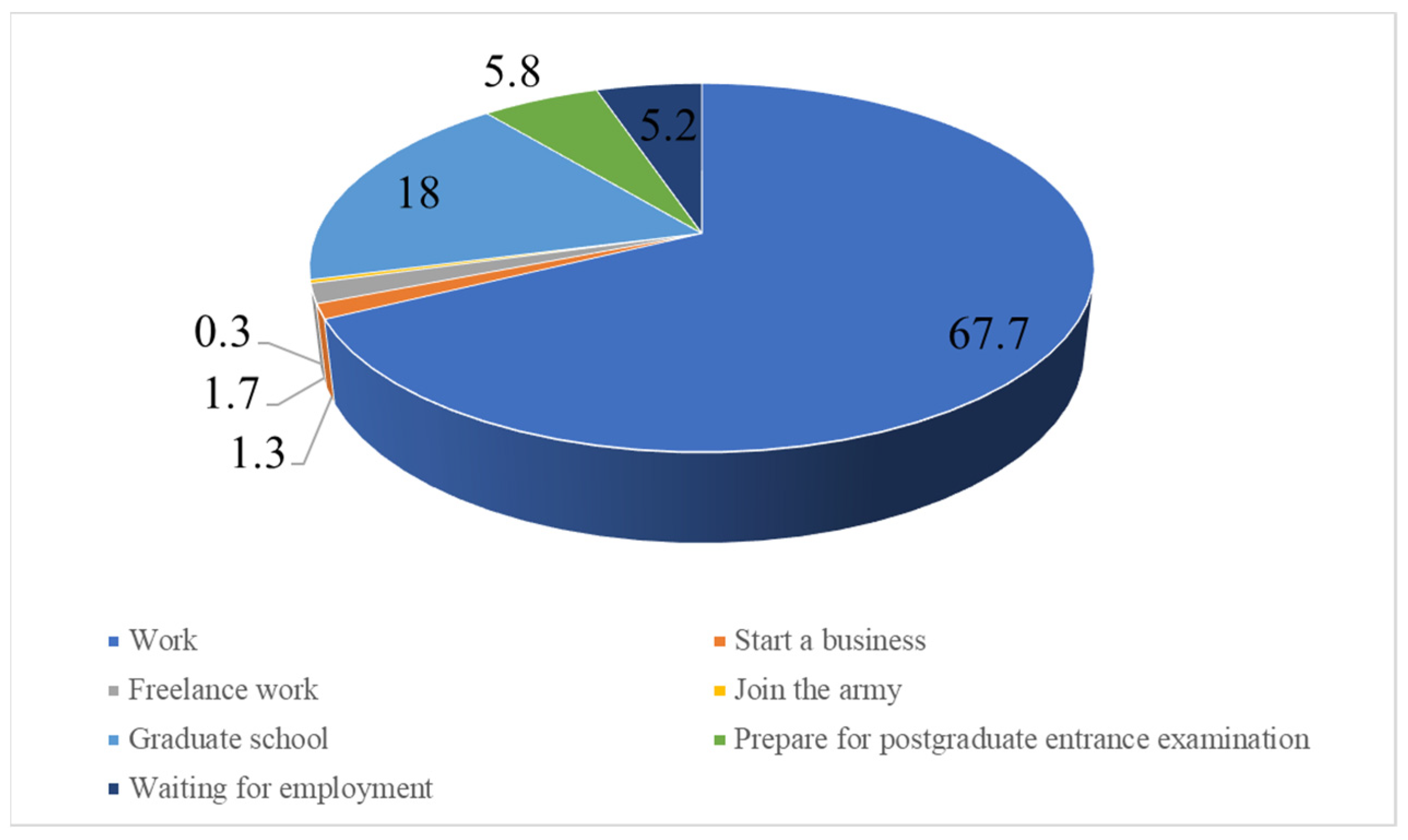
| Work | 67.7 | 71.9 | 73.6 | 74.4 | 75.1 | 75.2 | |
| Start a business | 1.3 | 1.6 | 1.8 | 1.9 | 2.1 | 2.1 | |
| Freelance work | 1.7 | - | - | - | - | - | |
| Join the army | 0.3 | 0.2 | 0.3 | 0.3 | 0.4 | 0.5 | |
| Graduate school | 18.0 | 17.4 | 16.8 | 16.4 | 15.5 | 15.6 | |
| Prepare for postgraduate entrance examination | 5.8 | 4.5 | 3.3 | 2.7 | 2.3 | 2.1 | |
| Waiting for employment | 5.2 | 4.4 | 4.2 | 4.3 | 4.6 | 4.5 | |
| Variable | Individual Factors | Institutional Factors | Societal Factors |
|---|---|---|---|
| Practical internship experience | 0.82 | 0.15 | 0.08 |
| Degree of professional matching | 0.69 | 0.22 | 0.11 |
| Personal goal planning | 0.8 | 0.18 | 0.14 |
| Preliminary market research | 0.84 | 0.12 | 0.09 |
| Participation in mass entrepreneurship courses | 0.19 | 0.72 | 0.21 |
| Mentor of entrepreneurship and innovation | 0.15 | 0.46 | 028 |
| School level | 0.23 | 0.59 | 0.17 |
| Mass entrepreneurship and innovation platform | 0.11 | 0.75 | 0.24 |
| Social financing intensity | 0.10 | 0.18 | 0.68 |
| Local policy support | 0.14 | 0.25 | 0.44 |
| Level of economic development | 0.09 | 0.16 | 0.53 |
Disclaimer/Publisher’s Note: The statements, opinions and data contained in all publications are solely those of the individual author(s) and contributor(s) and not of MDPI and/or the editor(s). MDPI and/or the editor(s) disclaim responsibility for any injury to people or property resulting from any ideas, methods, instructions or products referred to in the content. |
© 2025 by the authors. Licensee MDPI, Basel, Switzerland. This article is an open access article distributed under the terms and conditions of the Creative Commons Attribution (CC BY) license (https://creativecommons.org/licenses/by/4.0/).
Share and Cite
Liu, P.; Liu, X. Multidimensional Significance Analysis of Factors Influencing College Students’ Innovation and Entrepreneurship in the New Era. Sustainability 2025, 17, 6467. https://doi.org/10.3390/su17146467
Liu P, Liu X. Multidimensional Significance Analysis of Factors Influencing College Students’ Innovation and Entrepreneurship in the New Era. Sustainability. 2025; 17(14):6467. https://doi.org/10.3390/su17146467
Chicago/Turabian StyleLiu, Peng, and Xi Liu. 2025. "Multidimensional Significance Analysis of Factors Influencing College Students’ Innovation and Entrepreneurship in the New Era" Sustainability 17, no. 14: 6467. https://doi.org/10.3390/su17146467
APA StyleLiu, P., & Liu, X. (2025). Multidimensional Significance Analysis of Factors Influencing College Students’ Innovation and Entrepreneurship in the New Era. Sustainability, 17(14), 6467. https://doi.org/10.3390/su17146467