


Abstract
The Malaysian construction sector registers higher fatal accidents than the manufacturing sector even though the latter has the highest cases of accidents. There is a need to implement effective safety risk management. The main objective of this study is to explore the moderating effect of risk level of accidents on mitigation measures implemented. For this purpose, the factors causing safety risks and the practical measures taken by contractors to mitigate these risks were identified, in addition to the operationalization of the likelihood and severity of accidents using suitable rating scales. Descriptive analysis shows that a fall-related accident is the most likely and the most severe safety risk at high risk level. Results from multivariate analysis using SmartPLS 4 show that safety risks have a significant positive relationship with mitigation measures, and risk level actually heightens this relationship. As a result, the practical measures implemented on construction sites to mitigate the impacts of accidents may be inadequate unless the moderating effect of risk level is considered during the planning, design, and management of construction safety. Therefore, mitigation measures taken by the contractors must take into account the types of factors causing safety risks, as well as the likelihood and severity of these factors.
Keywords:
accidents; likelihood; mitigation measures; risk level; safety risks; severity; SmartPLS 4 1. Introduction
According to [1], risk is defined as the “combination of the likelihood of occurrence of a work-related hazardous event or exposure(s) and the severity of injury and ill-health that can be caused by the event or exposures”. In addition, [2] defines “a risk as the potential of a situation or event to impact on the achievement of specific objectives”. Risks are found in any business undertaking. As a result, incidents are bound to happen in any occupation of any sector which affects its smooth operation.
The construction industry is well-known for its complexity, dynamic nature, uniqueness, and diverse environments which could create uncertainty and challenges because the works involved nowadays could be high in the sky, deep underground, below water level, or across the sea which often involve adverse surroundings and situations. According to [3], risk may appear in any form and at any stage of the construction process. A construction site is thus full of hazards due to many people working in various activities and the use of heavy materials and moving machineries. Hence, the construction industry is highly prone to various factors which could cause safety risks. Therefore, implementing safety risk management in the industry is essential in anticipation of the unpredictable nature of safety risks with the objectives to mitigate or manage their impacts. Table 1 summarises the occupational accident statistics released by [4]. Among the industrial sectors listed, the construction sector registers the highest number of fatal accidents with an average of 89 cases per year over seven years compared to the manufacturing sector, even though the latter has the highest rate of accidents with an average of 3355 cases/year from 2015–2021, which is almost 14 times higher than the construction industry.
Table 1.
Occupational accident statistics in Malaysia from 2015–2021.
Common safety risks in the construction industry, such as fall from height, being struck by a moving object, or workers being buried in a landslide can be significantly reduced if not eliminated by introducing safety management. Therefore, it should be taken as a critical element for creating value and thus increasing a project’s overall performance in terms of time, quality, and cost [5]. Realistically, achieving comprehensive and effective safety management is a challenge to all project managers because they must anticipate the risks that may occur and the resulting consequences. However, it has been found that the level of safety management practices in Malaysia construction companies is relatively low because of the lack of knowledge and understanding on the subject [5]. According to [6], most construction companies in Malaysia fail to implement a systematic process of risk management. It has been found that safety risks could be accepted, transferred, and mitigated by implementing a systematic process in safety management.
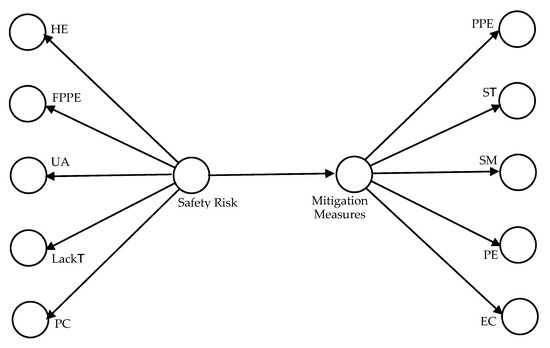
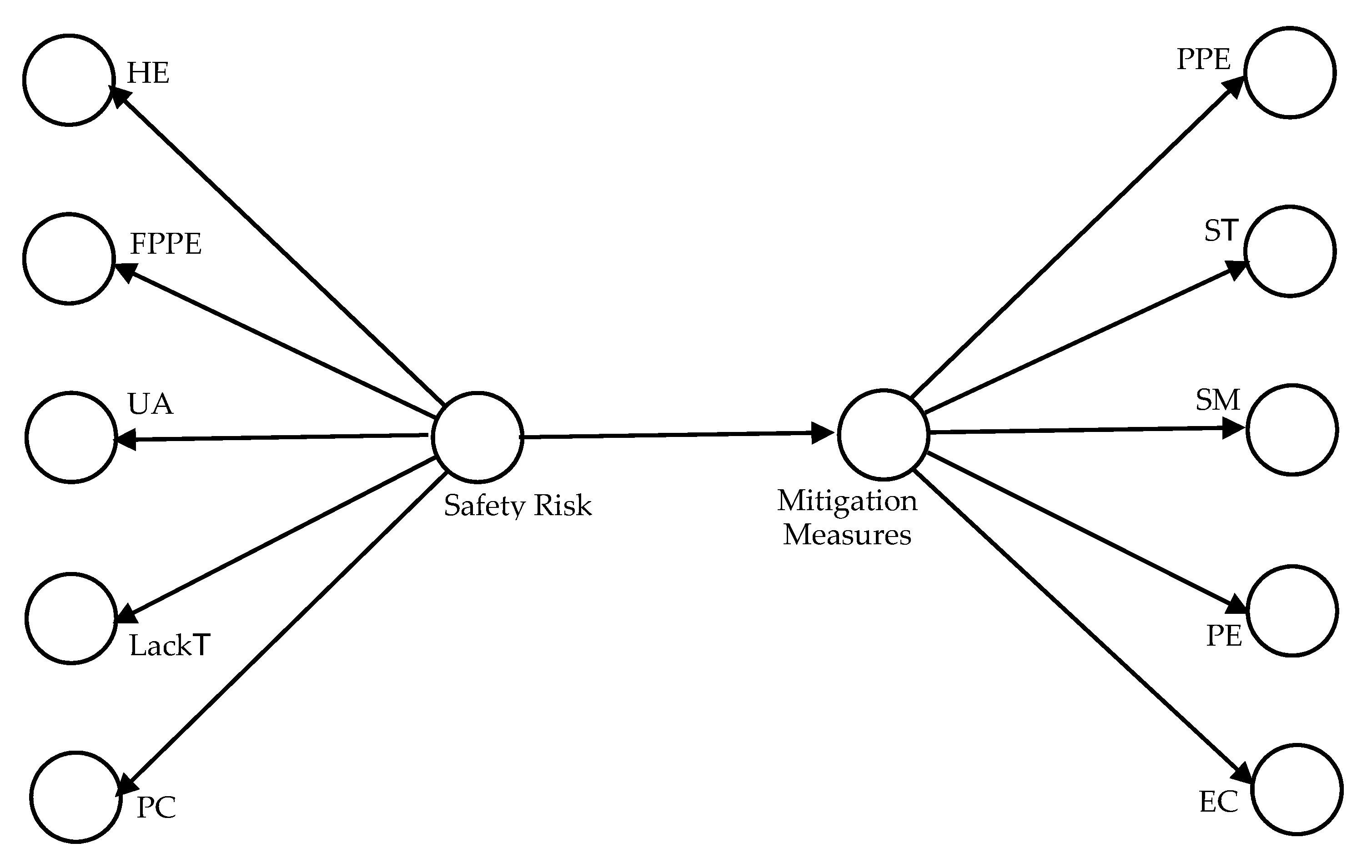
To address the lack of knowledge and understanding on safety management practices, this study set out to investigate the relationship between safety risks (SR) and the mitigation measures (MM) implemented to mitigate the impacts of these risks, as shown in Figure 1. It is hypothesised that there is a positive relationship between SR and MM. To achieve this purpose, this study aims to: (a) determine the likelihood and severity of commonly-occurred fatal construction accidents; (b) identify the factors causing safety risks; (c) identify the practical measures taken by contractors to mitigate or manage these safety risks; and (d) explore the moderating effect of likelihood and severity, in terms of risk level, on the mitigation measures implemented using the PLS-SEM technique.
Figure 1.
Path model on the relationship between safety risks and mitigation measures.
Likelihood and severity are expected to affect the relationship depicted in Figure 1. Inherent in any risk are the likelihood of an accident to happen and the severity of its impact when it happens. According to [7], risk increases when the probability of an incident occurring increases or the severity of injury increases. The more likely it is for an accident to occur, and the more severe the accident, the higher the risk level. Hence, these twin characteristics of risks, working hand in hand, will determine the risk level of an accident which is given by “risk level = likelihood × severity”. The moderating effect of risk level on the relationship can be quantified by examining the R-squared value and path coefficient between these two constructs when risk level acts as a moderator between safety risks and mitigation measures.
2. Literature Review
Any industry which wants to succeed must operate safely, dependably, and on a long term basis [8]. Risks that have not been identified and managed will undoubtedly threaten a project’s objectives, resulting in high cost and schedule overruns [9]. To accomplish this goal, the industry must first identify the dangers and assess the risks connected with them. If an industry could identify and categorise risks before the commencement of a project, they would be able to improve risk management and avoid any potential losses.
2.1. Commonly-Occurred Fatal Construction Accidents
Ref. [10] conducted a study in the United States based on the OSHA fatalities data from 1980, 1985, and 1990. They concluded that fall-related, struck-by, electrocution, and being caught in-between are the most common forms of accidents. Table 2 shows the statistics from 2016 to 2020 on the various types of fatal construction accidents provided by [11], where nearly 50% of the fatal accidents that happened were due to workers falling from height. Other studies have also revealed that fall-related accidents are the most common fatal construction accidents [12,13,14,15], including in China [16].
Table 2.
Commonly-occurred fatal construction accidents.
2.1.1. Fall-Related Accident
Fall-related accidents are the most common type of safety risk not only in Malaysia but also in many other countries such as the United States, China, the United Kingdom, Spain, Korea, Singapore and Taiwan [15]. When compared to other forms of safety risks in the construction industry, fall-related accidents are believed to have the highest frequency of occurrence [17]. Any object that might cause a person to lose their balance and fall is considered to be a danger while working four feet or more above the ground. The majority of workplace accidents involve falling from a working platform, scaffolding, ladder, or structure. As a result, falls from height are still much more common in construction accidents than in other kinds of accidents [18].
2.1.2. Struck-by Accident
Being struck by any objects or equipment is known to be one of the factors that led to fatal injuries and deaths in the Malaysian construction industry from 2010 to 2018 [15]. A struck-by accident happens when a worker encounters any moving, dropping, or rolling material or object forcibly [19]. It shall also include incidents where the workers on-site or in public get hit by any falling material, moving vehicle, or machinery [20].
- (a)
- Struck by a Swinging or Slipping Object
When materials are mechanically raised, there is a possibility that they may swing and harm the employees below. As the weight is lifted, the materials may swing, twist, or spin in their respective positions. This movement has the potential to catch employees off guard, and they may be struck by the swinging load. Windy circumstances are particularly dangerous since the weight will swing more widely. If the worker is hit from behind and falls to another level, the worker may receive even more severe injuries. This is dependent on where the worker is positioned and the power behind the weight [21].
- (b)
- Struck by a Rolling Object
When an object is rolling, moving, or sliding on the same level as the worker, this is referred to as being struck by a rolling object. Incidents when the worker is hit or run over by a moving vehicle without being trapped beneath it, as well as incidents where the worker is struck by a sliding item or piece of equipment on the same level, are included under this category [22].
- (c)
- Struck by Falling Object
Injuries sustained as a result of being struck by a falling object or equipment occurred when the source of the injury is falling from a higher to a lower level. This includes instances in which the injured person is crushed, pinned, or caught under an object falling from a higher to a lower level [22].
2.1.3. Drowning and Asphyxiation
Drowning is considered as the world’s third highest factor causing fatal injury or death [15]. Drowning occurs when a person dies as a result of suffocation caused by a liquid that limits or blocks oxygen intake into the human body from the air, resulting in asphyxia [12]. Asphyxiation, on the other hand, is a situation comparable to drowning in which insufficient oxygen occurs in the human body as a result of poor breathing as a result of working in a confined space or drowning [23].
2.1.4. Buried
Accidents may happen when construction workers are found buried due to cave-in or collapse of earth during or after excavation work [24]. The author of [25] reported the occurrence of a gruesome work accident which led to the death of a construction worker after he was buried alive under a landslide.
2.1.5. Electrocution
Generally, an electrical hazard refers to the risk of getting burned, electrocution, shock, arc flash, or other injury due to exposure to a lethal amount of electrical energy. Burns could be defined as injuries due to contact or exposure to electricity, arc flash, or thermal contact, while shock often results when the human body reflex responds to the passage of electric current [26].
2.1.6. Road Accident
Road accident is one of the safety risks in the Malaysian construction industry. According to the Department of Occupational Safety and Health [11], a truck driver died in a road accident due to a malfunctioning blinker at a sharp bend. Road accidents could also happen due to the vehicle’s brake failure and hydroplaning. “Increasing number of highway construction zones” in highway construction projects have disrupted regular traffic flows which could cause traffic safety problems and accidents [27].
2.1.7. Caught in-between Accidents
Caught in-between accidents occurred when two or more objects or components of an object are caught, squeezed, compressed, crushed, or pinched between one’s body [13]. There are times when a construction worker is too focused on their own tasks and fails to see caught in-between hazards, such as standing between a heavy machine, such as a trailer and a forklift, or an immovable structure, such as a brick wall [28]. According to [29], incidents involving being squashed or crushed between rolling, sliding, or shifting things are also regarded as one of the most common forms of accidents in the construction industry.
2.1.8. Fire or Explosion
The potential danger of fire outbreak is particularly severe on many construction sites, especially during those high-risk activities such as hot work that generates heat, sparks or flame, or even overheating of the plants and equipment [30]. In fact, fire would easily break out with the presence of sufficient oxygen, fuel, and a source of ignition arising from hot work, overheating plant and equipment, smoking, faulty electrical installation, bonfires or arson [31].
The occurrence of explosions in construction sites, in fact, is not so frequent, but such risks will lead to significant consequences: not only defects on the structure but also the potential loss of a worker’s life. There was a case of explosion in 2017 at a Malaysian MRT construction site caused by an old bomb from the Second World War, which resulted in the death of one construction worker while another two were critically injured [32].
2.1.9. Insect Pest
According to [11], there was one worker who died after been stung by hornets at the Sarawak construction site. The employer was required to conduct HIRARC to identify such a risk and provide risk control measures such as destroying the honeycomb to prevent the safety risk from happening.
2.2. Factors Influencing Safety Risks
Accidents may happen on a construction site due to many reasons [33]. There are many heavy plants, heavy materials, rough terrains, and people working at high places. As a result, a construction site is a high-risk place.
2.2.1. Human Errors
Human errors, no matter how minor, may occasionally have a domino effect, resulting in enormous economic or life loss [34]. Human errors are often related with improper attitude, inadequate tools used, body effort and lack of experience [35]. Human errors are considered to be the main cause of fall-related accidents. The contributing factors to fall-related accidents include human errors and inappropriate use of a control [36]. Workers’ negligence in judgement accounts for approximately one-third of the fall accidents [37].
2.2.2. Failure to Use Personal Protective Equipment (PPE)
Every year, a large number of construction workers are killed or seriously harmed due to the improper usage and wearing of personal protective equipment (PPE) [38]. According to statistics from throughout the globe, 2 million individuals are predicted to be disabled each year as a result of work-related accidents, with 25% or more of those injuries occurring to the head, eyes, hands, and feet [39]. This is due to a lack of knowledge and use of safety equipment, such as hard safety helmets, which are only worn by 16% of those who have had occupational head injuries [40]. In addition, 23% of employees who had worn safety boots suffered from foot injuries. Moreover, 40 percent of those who had suffered from eye injuries had worn eye protection [39]. According to statistics, although there is no assurance that personal safety equipment can prevent incidents resulting in injuries from occurring, it may at least minimise the likelihood of such an incident occurring [41]. Ref. [42] believed that precise safety applications may help to minimise construction site accidents, as well as production costs, productivity development and profitability. Most significantly, he added, lives could be saved.
2.2.3. Unsafe Act and Site Condition
The major fundamental factors of accident cases are unsafe acts and site circumstances [43]. In total, 99% of construction safety risks are caused by either risky conduct or unsafe conditions, or both of these factors together [44]. These are regarded as the primary causes of all forms of construction safety risks. Unsafe activities are defined as the misuse of safety procedures, which increases the likelihood of an accident occurring on the construction site [13]. An unsafe site condition is a physical condition or environment that is surrounded by possible risks and might be the cause of a site accident [19]. The dangerous act mostly deals with hazardous equipment or unsafe methods, such as working without safety devices, equipment failure, inappropriate work process, worker knowledge level, and failure to follow work procedures [19]. Unsafe circumstances, on the other hand, include missing or inadequate guardrails on platforms, malfunctioning tools and equipment, fire dangers, a bad fire alarm system, a lack of housekeeping, poor climatic conditions, excessive noise, and insufficient light to operate.
2.2.4. Lack of Progressive Training
To prevent safety risks on construction sites, proper training is required. Safety risks sometimes occur when employers fail to provide sufficient training and knowledge on how to carry out the job. One of the problems in safety practices is the lack of budget allocation on safety management. The employers and workers need to attend safety training to improve their skills and enhance their safety awareness. However, the cost for attending the training course is high. Therefore, the company needs to allocate more budgets on safety to provide safety equipment, training, and other measures to enhance the safety awareness of the construction workers [45]. Safety training is a method of improving construction workers’ safety that focuses on the efficacy of the instructional delivery method. Effectiveness is connected to the level of understanding of instruction and may be enhanced by improving the instructional delivery method [46].
According to [47], most of the larger companies subcontract most of their work, which results in a lack of workforce development and training. However, safety risks may occur at any time. Employees bear the danger of being hurt while doing their jobs. A substantial amount of responsibility is placed on the skilled construction worker. As a consequence, the construction worker must be exceptionally brilliant and well-trained. Adequate safety training assists in improving proficiency and lowering the occurrence of safety risks [46]. In summary, employees involved in high-risk activity must have access to training content at all times.
2.2.5. Poor Communication
The term “communication” refers to the act of sending and receiving information from one person to another in a way that both parties can understand [48]. Some common poor communication examples on construction sites include language barrier, miscommunication and misunderstanding, and failure in conveying message. The construction industry relies heavily on communication, and there is a need for every firm or professional to get their messages through. Construction communication has gotten more difficult since the number of parties engaged has increased substantially, including developers, subcontractors, investors, members of the general public, and government organisations participating in the process [49]. In the construction sector, bad communication may occur on a big or small scale. In large-scale cases of bad communication, disagreements between construction partners lead to project failure, while small-scale cases of poor communication inside the company lead to delays, injuries, accidents and blunders [50]. A lack of project information, such as lack of timely information, poor project documentation, inaccessibility of project information, and unavailability of crucial information, could lead to performance deficiency and unproductive practitioners [51].
Most of the construction workers in Malaysia are from different ethnic backgrounds, as well as from different countries such as Indonesia, Myanmar, Thailand, Vietnam and Bangladesh. The majority of them do not speak or comprehend the language of the locals. This has made it difficult to communicate with each other. Messages may not be sent or received in a timely manner, which might lead to an increase in the number of deaths and injuries on the construction site [52]. For instance, there is a case in Malaysia where the workers were unable to speak English and their employer had to translate all of the information concerning the construction projects. Although the scaffolding at the building site was partly removed, the employer neglected to inform the workers that it could not be used due of the scaffolding’s dismantled status [53].
2.3. Practical Measures Taken by Contractors
When a risk event is identified and assessed, a decision must be made concerning which response is appropriate for the specific event. The risk responses can be considered in terms of elimination, control at source, minimization, and the use of appropriate personal protective equipment [54].
2.3.1. Personal Protective Equipment (PPE)
Death and injury always happen at the construction site due to failure to wear the PPE provided and ineffective usage of PPE. To mitigate the safety risk in the Malaysian construction industry, wearing PPE while working on the construction site is necessary. PPE serves to keep workers safe in the workplace by shielding them from possible dangers [55]. There are many types of PPE, such as safety helmets, ear protection, high visibility clothing, safety footwear, safety harnesses, etc. [56]. A severe accident can be avoided if the construction labourer is wearing PPE.
Aside from that, employers must consider the physical dimensions of individual employees, such as their body size and gender, while preparing PPE for them. PPE must be adjustable so that when problems emerge, the advice provided must take into consideration any medical conditions. The method, instruction, and training of PPE must be supplied by the employer to all personnel on the construction site in order to prevent accidents [45].
Ref. [57] stated that one of the fundamental steps or mandatory requirements that the construction company must provide for employees before beginning work is teaching them to use PPE at the construction site. Furthermore, training is provided to employees to ensure that they are well-equipped with the knowledge to carry out work on the construction site with minimum safety hazards [58]. Training would be effective if there were two main methods: informational-based training and a hands-on approach in which workers would have to try the PPE on their own in order for the workers to gain a better understanding and awareness of the PPE [59]. For example, the construction company would have to prepare a test or observe the use of the PPE at the construction site for a period of time before the workers are qualified in having full awareness of all of the aspects that are present in the PPE at the construction site [60].
Ref. [60] mentioned that PPE awareness involves choosing the appropriate and relevant PPE suitable of minimising the safety hazards that are threatening the employees’ health and safety. Safety masks, safety gloves, and protective gear must be provided for construction workers engaged in jobs such as welding in order to protect them from splatters of molten metal, as well as any other particles that may come into contact with their skin [61].
Maintenance and supervision of the PPE is also critical at construction sites. As a result, PPE must be of high quality and perform consistently in order to minimise the risks that construction workers face on-site [62]. Workers and their supervisors must continually inspect their PPE to verify that it is functioning properly. In order to keep the PPE in excellent working order and ready for use by the various site employees, workers must be aware of the various procedures for checking and maintaining the PPE.
2.3.2. Safety and Health Training
Safety and health training is essential in the construction industry’s safety management practices, which are commonly acknowledged as standard performance. Safety and health training in the construction site usually include the safety measures training, machinery operator training, working at height training, and the others. Aside from that, safety and health training are essential for occupational health and safety programmes in order to improve the attitudes, abilities, and knowledge of new construction employees and spot accidents on the construction site [63]. Ref. [64] found safety and health training is one of the four interrelated dimensions in a safety programme, in addition to management commitment and employee involvement, worksite analysis, hazard prevention and control systems.
One of the current challenges in the Malaysian construction industry is the lack of knowledge and skills of foreign workers, since most of these foreign workers originate from various countries with poor skilled labour and a lack of training. When foreign migrant workers came to Malaysia, they did not attend the safety and health training provided by the relevant government agencies, which led to an increase in accidents on the construction site [65]. There is thus a need for foreign migrant workers to attend safety training package in order to address the higher accident rates than the local skilled workers [66].
The majority of foreign workers lack knowledge and awareness since they did not attend safety training. It is critical that the content of training uses more illustrations to explain it in order to increase worker safety awareness [67]. Workers will be able to understand and know how to manage the machine more effectively if the training techniques use animation to display and explain the processes of operating machines [68].
2.3.3. Safety Meeting
A safety meeting is one of the ways that will be used to offer an opportunity for all parties participating in the construction team to introduce and discuss the precautionary safety concerns linked to safety and health on the construction site. Before beginning work, a safety meeting must be held to ensure that all personnel are on the same page and may review the previously provided information [69]. A safety meeting is an important aspect of developing a workers’ safety culture in order to reduce accidents on the construction site [45].
Before beginning a new project, kick-off meetings should be held to discuss the risks and hazards, how to select and utilise personal protective equipment (PPE), safety precautions, and safe work procedures that will be implemented at each stage of construction [70].
2.3.4. Proper Equipment
The construction company is responsible for supplying employees with suitable equipment and a safe working environment in order to properly implement the construction site safety culture among workers [40]. Poorly maintained equipment and machinery may result in significant injuries and fatalities. It is critical to offer suitable equipment and machinery that is in excellent working order. Machines must be serviced on a regular basis to guarantee proper operation. Even just a tiny piece of the tools also need to be handled well when carrying out the job in a construction site as it may extremely reduce the opportunity for injury or the fatality of a construction worker. Scaffolding, for example, must be built in the proper manner to provide construction workers safe access to the other level of the structure. As a result, the employer must provide enough equipment at all times while complying with OSHA’s safety regulations [28].
2.3.5. Promote Effective Communication
Promoting effective communication on-site by all construction parties is needed to prevent accidents from happening. In order to avoid workplace accidents, workers, supervisors, managers, contractors, and everyone on-site should be encouraged to communicate with each other and with the employer [71]. Good and concise communication emphasising safety issues shall be practiced among everyone in the construction site so that any misfortune may be avoided [72]. Ref. [73] found that it is important to promote safety communication among construction workers because this will encourage workers to participate actively in providing and receiving safety information.
Poor and ineffective communication can be due to many factors. Ref. [74] identified 33 factors which are responsible for poor communication in the construction industry. Of the 30 factors identified, [51] has categorized them under four dimensions, namely, organizational and management factors, behavioural and cultural factors, project information factors, and technology and method factors. A high accident rate has been found to be one of the impacts of poor and ineffective communication by [50,74].
3. Methodology
This study used the quantitative research approach for data collection and analyses.
3.1. Research Design
In this study, partial least squares structural equation modelling (PLS-SEM) using SmartPLS 4 software [75] was employed as the multivariate analysis technique to explore the moderating effect of risk level on mitigation measures taken. Hence, a survey questionnaire is suitable for data collection as long as the measurement scales are equidistant. The basic conceptual model used for this study is shown in Figure 1: the safety risks construct is conceptualized as a second order hierarchical latent construct consisting of five categories of factors causing safety risks, and the mitigation measures construct is conceptualized as a second order hierarchical latent construct also consisting of five categories of mitigation measures.
Sampling
The respondents, purposively selected for this study, comprised personnel working in the construction industry from the Klang Valley, Malaysia. Three hundred (300) copies of questionnaires prepared in Google Forms were distributed through emails and WhatsApp messenger to the respondents from June 2022 to August 2022. A total of 83 completed questionnaires were received with no missing data, giving a response rate of nearly 28%.
3.2. Research Instrument
The questionnaire consists of four main sections with closed-ended questions as explained below.
3.2.1. Demographic Information
This section is designed to collect the demographic information of respondents such as education level, current practice and the total number of years of working experience, types of projects involved in, and familiarity with management of safety risks.
3.2.2. Likelihood and Severity of Commonly-Encountered Accidents
This section consists of a list of nine commonly-occurred fatal construction accidents listed in Table 2. The respondents were requested to rate the likelihood and severity of these safety risks based on their opinions and experiences according to 5-point rating scales as shown in Table 3.
Table 3.
Rating scales for likelihood and severity of commonly-occurred accidents.
3.2.3. Factors Influencing Safety Risks
This section contains 18 questions grouped under five categories of factors influencing safety risks. The respondents were requested to rate these factors measured on a 5-point Likert scale from ‘1 = strongly disagree’, ‘2 = disagree’, ‘3 = neutral’, ‘4 = agree’ to ‘5 = strongly agree’ based on their opinion and experiences.
3.2.4. Practical Measures Taken
This section contains 20 questions grouped under five categories of practical measures taken to mitigate safety risks. The respondents were requested to rate the importance of these practical measures measured on a 5-point Likert scale from ‘1 = not important at all’, ‘2 = slightly important’, ‘3 = moderately important’, ‘4 = important’ to ‘5 = very important’ based on their opinion and experiences.
4. Results
4.1. Descriptive Analysis
Table 4 presents the demographic information of the 83 respondents who participated in the questionnaire survey. Out of the 83 questionnaires received, 62 of the respondents are working in consultancy firms, while 21 respondents are from contractor companies. Of the 83 respondents, 62 of them have more than 2 years of working experience. In terms of educational background, 72 of them have at least a bachelor’s degree and above. Of the 83 respondents who participated in the questionnaire survey, 77 of them indicated they are familiar with safety risks. In terms of projects involved, 36 respondents mentioned they are involved with main building works, whereas 47 of the respondents mentioned they are involved in infrastructure works, including highway and railway projects.
Table 4.
Demographic information of respondents.
4.1.1. Likelihood and Severity of Commonly-Occurred Fatal Construction Accidents
Table 5 displays the results for the likelihood of fatal construction accidents commonly happening in the Malaysian construction industry, with fall-related accidents having the highest mean value of 3.96, and insect pest as a safety risk having the lowest mean value of 3.18. The overall mean value is 3.57. In Table 5, the indicators for this construct have skewness values ranging from −0.108 to −1.072, and kurtosis values ranging from −1.322 to 0.292, showing that these indicators do not depart from the normality requirements according to Brown (cited in [76]).
Table 5.
Likelihood of commonly-occurred fatal construction accidents (n = 83).
Table 6 displays the results for the severity of the same fatal construction accidents commonly happening in the Malaysian construction industry, with fall-related accidents as the highest mean value of 4.18, and insect pest as a safety risk as the lowest mean value of 3.19. The overall mean value is 3.73. In Table 6, the indicators for this construct have skewness values ranging from −1.532 to −0.362, and kurtosis values ranging from −1.140 to 1.722, showing that these indicators, too, do not depart from the normality requirements according to Brown (cited in [76]).
Table 6.
Severity of commonly-occurred fatal construction accidents (n = 83).
4.1.2. Factors Influencing Safety Risks
Table 7 displays the results for the 18 indicators operationalizing the five categories of factors influencing safety risks, with unsafe act and site condition having the highest overall mean value of 4.31, and human error having the lowest overall mean value of 3.97. In Table 7, the indicators for this construct have skewness values ranging from −2.017 to 0.159, and kurtosis values ranging from −1.116 to 6.395, showing that these indicators do not depart from the normality requirements according to Brown (cited in [76]).
Table 7.
Factors influencing safety risks (n = 83).
4.1.3. Mitigation Measures Taken
Table 8 displays the results for the 20 indicators operationalizing the five categories of mitigation measures, with proper equipment having the highest overall mean value of 4.47, and safety meeting having the lowest overall mean value of 4.30. In Table 8, the indicators for this construct have skewness values ranging from −3.752 to 1.025, and kurtosis values ranging from −0.993 to 19.0722, showing that only one indicator, that is PPE1, departs from the normality requirements according to Brown (cited in [76]).
Table 8.
Practical measures taken to mitigate safety risks (n = 83).
4.2. Structural Equation Modeling
The Mann–Whitney U tests carried out earlier showed that there were no significant differences between the two subgroups, namely 62 respondents from consultant practices and 21 respondents from contractor companies for all the indicators of the twelve constructs. The raw data for these two subgroups were then combined to test the conceptual model shown in Figure 1. SmartPLS 4 software [75] was employed for partial least squares structural equation modelling (PLS-SEM) purposes. The 2-step procedure recommended by [77] was adopted for assessments of the measurement models and structural model.
4.2.1. Assessment of Measurement Models
The following are the quality criteria adopted for assessment of the measurement models in Figure 1:
- Internal consistency reliability: A construct with high Cronbach’s alpha value indicates the indicators have similar range and meaning [78];
- Composite reliability (CR): Values greater than 0.60 are acceptable in exploratory study [79];
- Indicator reliability: Loading values equal to and greater than 0.4 are acceptable if the sum of loadings results in higher loading scores, contributing to AVE scores of greater than 0.5 [80];
- Convergent validity: In order to achieve adequate convergent validity, each construct should account for at least 50% of the average variance explained (AVE ≥ 0.50) [81,82,83];
- Rho_A: The reliability of rho_A usually lies between Cronbach’s alpha and composite reliability [84];
- Discriminant validity: The square root of AVE of a construct should be larger than the correlations between the construct and other constructs in the model [82]. According to [85], HTMT.90 value of 0.90 indicates that there is a problem of discriminant validity. Using cross loadings to assess discriminant validity, each indicator should load high on its own construct but low on other constructs. Cross loadings of <0.1 should be deleted [86].
Figure 1 is a higher component model (HCM) with two second-order hierarchical latent constructs. Hence, two-stage HCM analysis, a combination of repeated indicators approach and the use of latent variable scores is needed [87]. First stage analysis shows the following two indicators have to be removed for the lower order component models to achieve quality criteria, namely:
- (a)
- Indicator PPE1 which has cross loadings of <0.10 needs to be removed for the PPE construct to achieve an AVE value > 0.50;
- (b)
- Indicator HE3 which has cross loadings < 0.10 needs to be removed even though the AVE value for the HE construct > 0.50.
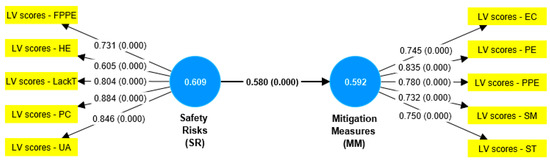
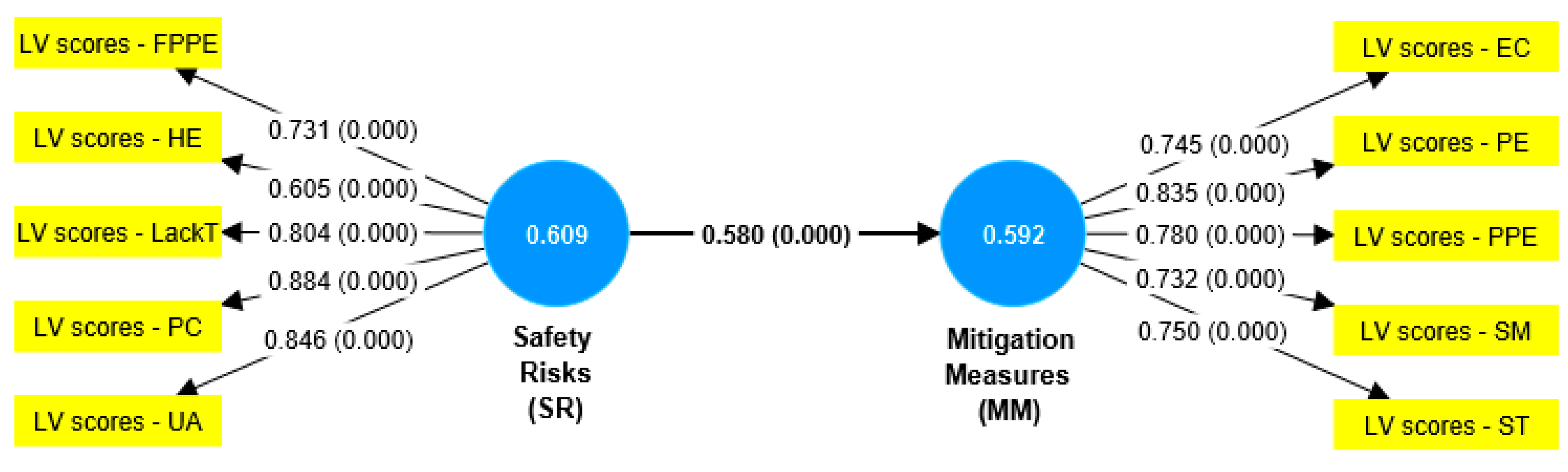
In the second stage analysis, the latent variable scores from the first stage serve as the manifest variables in the higher order component models. The AVE values for safety risks construct and mitigation measures construct together with the outer loadings, path coefficient, and p values are displayed in Figure 2.
Figure 2.
Higher order components with AVE values, path coefficients, and p values (n = 83).
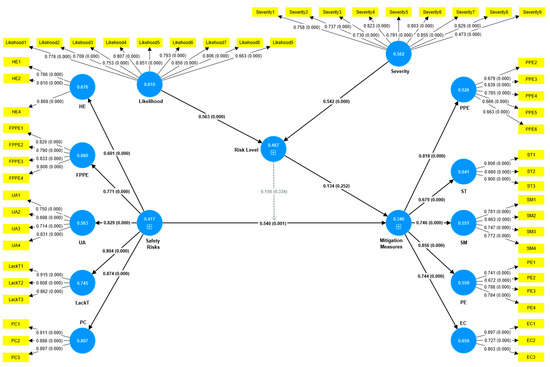
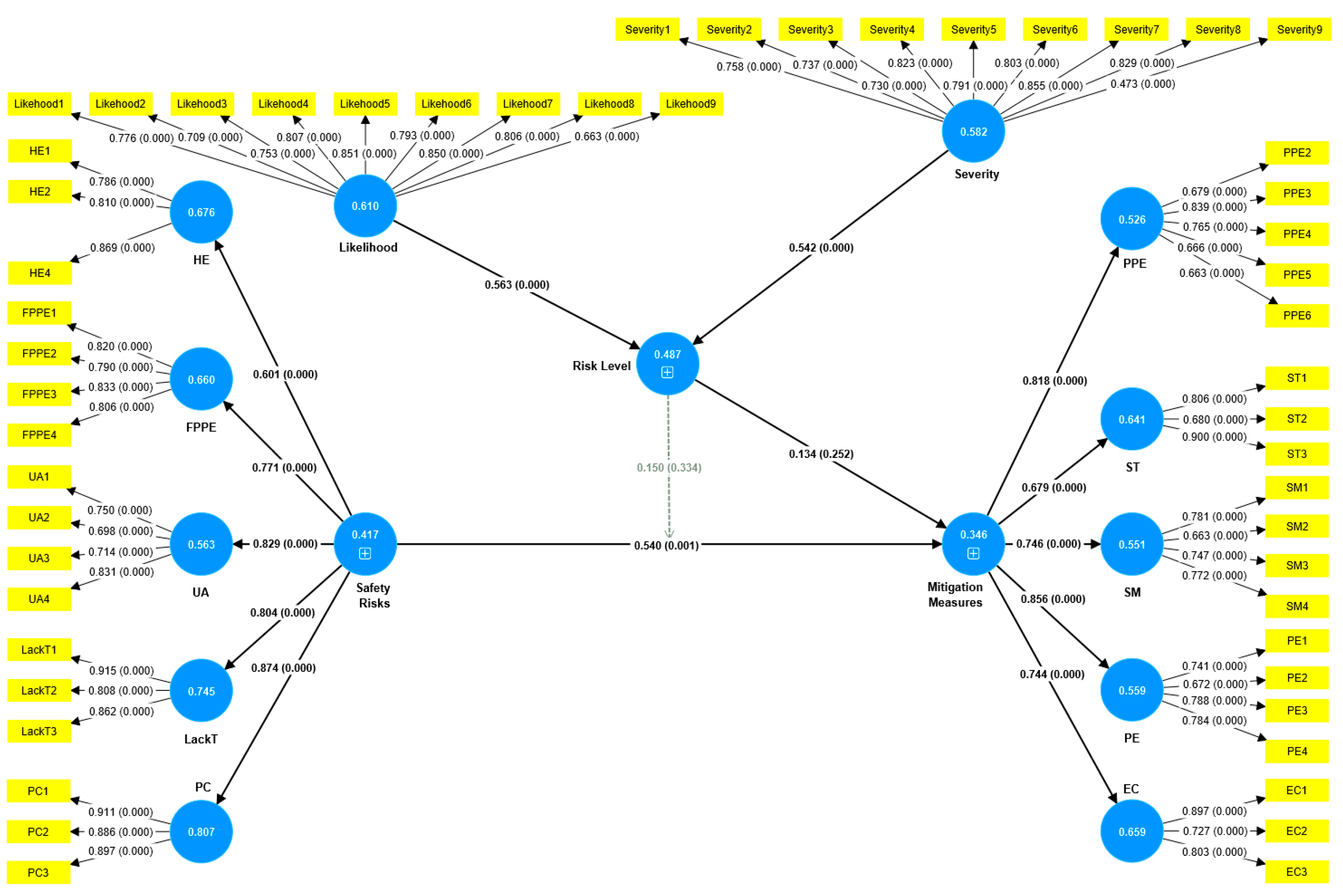
The moderating effect of likelihood and severity is investigated with risk level as a second order hierarchical construct as shown in Figure 3, which gives the graphical output from first stage analysis. The AVE values of lower order constructs for safety risks, mitigation measures and risk level together with the outer loadings, path coefficient and p values are presented together.
Figure 3.
AVE values, path coefficients, and p values from first stage analysis (n = 83).
The assessment results for lower order components from first stage analysis are summarised in Table 9. Based on the quality criteria given earlier, the lower order components achieve convergent validity with AVE > 0.50 for all the twelve constructs, indicator reliability with outer loadings ranging from 0.473 to 0.915, as well as construct reliability and validity with Cronbach’s alpha, Rho A and Rho C values well above 0.700.
Table 9.
Assessment results for lower order components from first stage analysis (n = 83; CI = 95%).
Table 10 shows the lower order components do not have any problem with discriminant validity because there is no HTMT.90 value which is more than 0.90. In addition, Table 11 shows the lower order components achieve satisfactory discriminant validity too because the square root of AVE (along the diagonal) is larger than the correlation (off diagonal) for all the lower order components.
Table 10.
Discriminant validity for lower order components using HTMT ratio of correlation.
Table 11.
Discriminant validity for lower order components using Fornell and Larcker criterion.
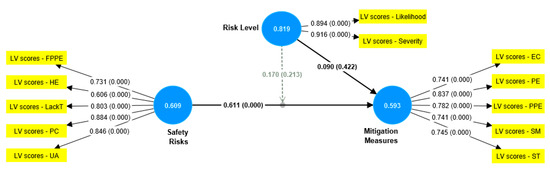
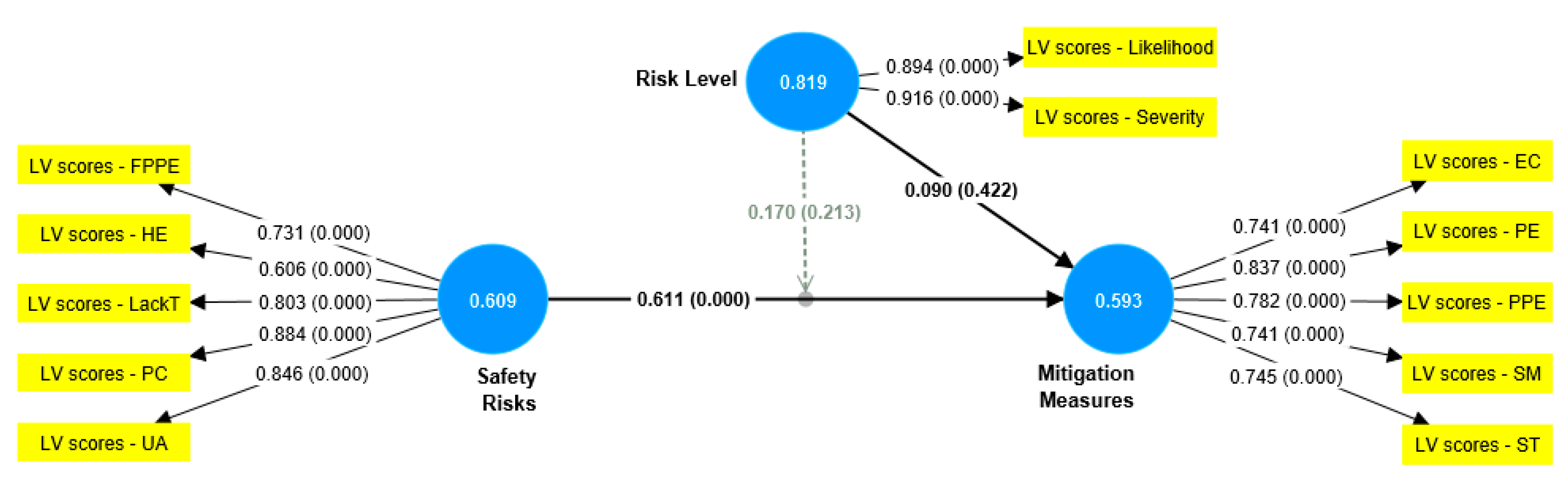
In the second stage analysis for the moderating effect of risk level, the latent variable (LV) scores for safety risks, mitigation measures, and risk level from the first stage analysis serve as the manifest variables in the higher order components. The graphical output for second stage analysis is shown in Figure 4, where the AVE values for safety risks, mitigation measures, and risk level together with the outer loadings, path coefficient, and p values are presented.
Figure 4.
AVE values, path coefficients and p values from second stage analysis (n = 83).
The assessment results for higher order components from second stage analysis are summarised in Table 12. Based on the quality criteria given earlier, the higher order components achieve convergent validity with AVE > 0.50, indicator reliability with outer loadings ranging from 0.731 to 0.916, as well as construct reliability and validity with Cronbach’s alpha, Rho A and Rho C values well above 0.700.
Table 12.
Assessment results of higher order components (n = 83; CI = 95%).
Table 13 shows the higher order components have no problem with discriminant validity because there is no HTMT.90 value which is more than 0.90. In addition, Table 14 shows the higher order components achieve satisfactory discriminant validity as well because the square root of AVE (along the diagonal) is larger than the correlation (off diagonal) for all the constructs.
Table 13.
Discriminant validity of higher order components using HTMT ratio.
Table 14.
Discriminant validity of higher order components using Fornell and Larcker criterion.
4.2.2. Assessment of Structural Model
The following are the criteria adopted to assess the higher component model shown in Figure 4:
Standardised root mean square residual (SRMR): A value less than 0.10 is considered a good fit [88].
Normed fit index (NFI): A value above 0.9 usually represents acceptable fit [89].
The assessment results for model fit of higher component model are summarised in Table 15, showing the higher component model has a good fit with SRMR = 0.094. However, the NFI value < 0.90.
Table 15.
Assessment results of structural model (n = 83; CI = 95%).
4.3. Moderating Effect of Risk Level
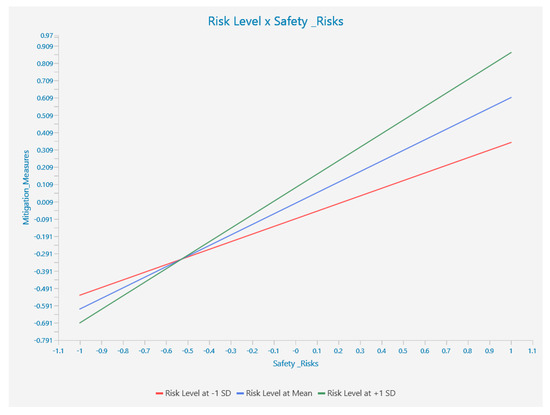
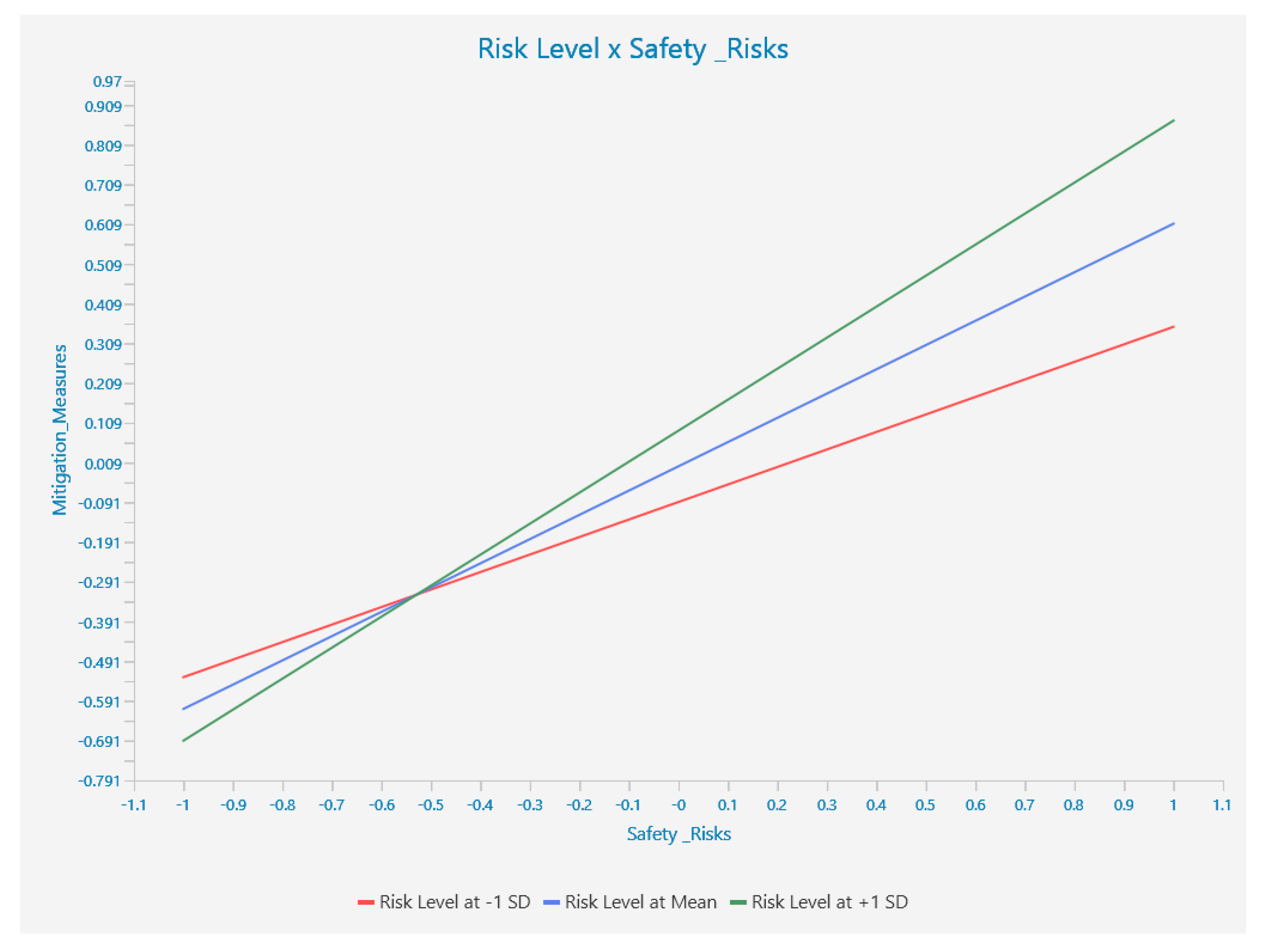
Table 16 summarises the results obtained in second stage analyses for Figure 2 and Figure 4. Without risk level as a moderator in Figure 2, the main effect between safety risks and mitigation measures is β = 0.580 (p < 0.001) as shown in Figure 2, with R2 = 0.337 (p < 0.001) and effect size = 0.508 (p < 0.05). With risk level as a moderator in Figure 4, the simple effect is β = 0.611 (p < 0.001), with R2 = 0.368 (p < 0.001) and effect size = 0.339 (p > 0.05). The path coefficient β increased to 0.611 from 0.580, which is an increase of 5.3% and the R2 value increased to 0.368 from 0.337, which is an increase of 9.2%. The strength of the relationship between safety risks and mitigation measures increases when the risk level increases in the presence of risk level as a moderator. This is illustrated by the interaction plot shown in Figure 5. The effect size is 0.038 (p > 0.05), which is small according to [90].
Table 16.
Moderating effect of risk level on mitigation measures (n =83, CI = 95%).
Figure 5.
Interaction plot showing the moderating effect of risk level.
5. Discussion
Table 17 displays the results for composite reliability and validity of the initial conceptual model which consists of all the indicators identified for this research which are presented in Table 5, Table 6, Table 7 and Table 8. The results show that the measurement instrument used for data collection has a high internal consistency reliability with all the values well above 0.707. With the deletion of two indicators, namely HE3 and PPE1, the results in Table 9 show that the measurement instrument is further improved with good indicator reliability, adequate convergent validity, and adequate discriminant validity.
Table 17.
Composite reliability and validity of lower order components.
The risk levels for the nine commonly-occurred fatal construction accidents presented in Table 5 and Table 6 were calculated and the values are presented in Table 18. The results show that fall-related accident is at a high risk level, confirming the finding from earlier studies which mentioned falling from height is the number one killer in the Malaysian construction industry [11,12,13,14,15,16]. All the other types of safety risks are in the medium risk levels, with insect pest as a safety risk having the lowest risk level score. Table 18 also summarises the ranking for all the nine commonly-occurred safety risks measured in terms of mean likelihood score, mean severity score and risk level. The results show that fall-related accident remains at the top, signifying that fall-related accidents are highly risky and the most likely and severe risk to happen at the construction site; fatal accidents due to insect pest is at the bottom of the ranking, confirming the data from [11].
Table 18.
Risk levels of commonly-occurred fatal construction accidents.
Table 19 summarises that rankings for all the 18 indicators or factors of the five construction safety risks mitigation measures. The results show that 15 factors have mean scores well above 4, with the top 5 factors being failure to use safety helmets, unsafe equipment, improper work procedure, employers failing to provide sufficient training, and hazardous environment. Only three factors have mean scores slightly lower than 4, and they are improper attitude, lack of budget allocation on safety management, and inadequate tools used. In terms of overall mean value, the ranking for the five construction safety risks in descending order are: unsafe act and site condition, failure to use PPE, poor communication, lack of progressive training, and human error.
Table 19.
Ranking of factors influencing safety risks.
Table 20 summarises the rankings for all the 20 indicators or factors of the five construction mitigation measures. The results show that all the 20 factors have mean scores well above 4, with the top 6 factors being the use of safety helmet, supplying employees with suitable equipment, safety measures training, safety harnesses, discussion on the precautionary safety concerns, and rapid communication such as walkie-talkies. All the five construction mitigation measures have overall mean values between 4.30–4.47. The construct on proper equipment has the highest overall mean score, and the measurement indicators correspond to control the risks at the source and to design of safe work systems to minimise risks.
Table 20.
Ranking of practical measures taken to mitigate safety risks.
The goodness of fit (GoF) for the path model can be determined manually by using the formula GoF = [(mean R2) × (mean AVE)]1/2 [91]. Based on the R2 value of 0.368 and mean AVE value of 0.674 for risk level, safety risks and mitigation measures constructs in Table 12, the GoF for the path model is found to be (0.368 × 0.674)1/2 = 0.497, which is greater than 0.36 for large fit [92]. It can be concluded that the GoF for the model shown in Figure 4 is large for global PLS model validity.
6. Conclusions
This study investigated the moderating effect of risk level on mitigation measures implemented due to the numerous factors causing safety risks. In Table 16, the results for Figure 2 show that safety risks have a significant positive relationship with mitigation measures with β = 0.580, and p < 0.001. The effect size is large with f2 = 0.508, and p < 0.05.
Safety risks has significant positive relationship with mitigation measures with β = 0.611, p < 0.001. The effect size is medium with f2 = 0.339, p > 0.05.
Risk level has a positive but insignificant relationship with mitigation measures with β = 0.090, p > 0.05. The effect size is negligible with f2 = 0.009, p > 0.05.
The interaction term, risk level × safety risks has a positive but insignificant relationship with mitigation measures with β = 0.170, p > 0.05. The effect size is small with f2 = 0.038, p > 0.05.
The results for Figure 4 show that the relationship between safety risks and mitigation measures increases in the presence of risk level as a moderator with path coefficient β = 0.611, and p < 0.001. The interaction plot in Figure 5 actually illustrates that the relationship between safety risks and mitigation measures is further heightened in the presence of risk level as a moderator. Because of the positive moderating effect (β = 0.170), the relationship between safety risks and mitigation measures becomes stronger with higher levels of risk level. Even though the effect size of the interaction term (f2 = 0.038) is small, under severe situations such as incidents that are categorized as ‘Acts of God’, the sudden surge in risk level would result in an immediate change in β value. Therefore, it is imperative to consider these extreme situations in the planning, design, and management of construction safety because the consequential impacts of these sudden and unexpected incidents could be disastrous, thereby disrupting the continuity of construction works.
It is important to note that uncertainty and severity are intrinsic/inherent properties of safety risks. Mitigation measures are put into place to eliminate the likelihood of safety risks from happening, and to reduce the severity and impacts of these safety risks when they actually happen, which could lead to the loss of lives and hence emotional sufferings, damage to property, disruptions to on-going works, stop-work orders, liquidated ascertained damages and litigation cases. The mitigation measures implemented should always consider the moderating effect of risk level of safety risks which may cause the practical measures implemented on construction sites to be inadequate. The effect of risk level is higher when either the likelihood or severity, or both, are higher. Therefore, mitigation measures taken by the contractors must always take into account the types of factors causing safety risks, as well as the uncertainty or likelihood and severity of these factors for the sustainability of development projects. According to [7], the likelihood of incidents and their severity could be reduced by conducting effective pre-job safety analyses.
The findings from this study have practical values in view of Section 15 in the Occupational Safety and Health Act 1994, which states “it shall be the duty of every employer and every self-employed person to ensure, so far as is practicable, the safety, health and welfare at work of all his employees”. The term ‘practicable’ should consider the following aspects, namely: “(a) the severity of the hazard or risk in question, (b) the state of knowledge about the hazard or risk and any way of removing or mitigating the hazard or risk, (c) the availability and suitability of ways to remove or mitigate the hazard or risk, and (d) the cost of removing or mitigating the hazard or risk” [93]. In this study, numerous factors which influence or cause safety risks were identified and presented in Table 7; some of the practical measures which can be implemented to mitigate or manage these safety risks in order to reduce their impacts were presented in Table 8. The author of [94] asserted that all the factors that influence safety on construction projects should be identified and categorized in order to prepare a construction accident causation framework which maps out these factors in terms of originating influences, shaping factors and immediate factors so that a comprehensive plan for training, awareness and monitoring can be prepared. The mitigation measures implemented should be able to manage or mitigate the impacts from accidents which are categorized as high-risks. This study also has academic value in applying the PLS-SEM method to analyse the data collected from the Malaysian construction industry. For generalization purposes, further research with larger sample size using the same technique should be replicated to provide additional evidence on the effects of likelihood and severity on mitigation measures taken for safety risks.
Author Contributions
Conceptualization, M.K.S. and W.C.Y.; methodology, M.K.S. and W.C.Y.; validation, W.C.Y. and M.K.S.; formal analysis, M.K.S. and W.C.Y.; investigation, M.K.S. and O.Q.J.; resources, M.K.S. and O.Q.J.; data curation, M.K.S. and O.Q.J.; writing—original draft preparation, M.K.S., W.C.Y. and O.Q.J.; writing—review and editing, W.C.Y. and M.K.S.; funding acquisition, W.C.Y. All authors have read and agreed to the published version of the manuscript.
Funding
MPOB-UKM Endowment Chair, Research Grant number: EP-2019-054, financed the APC.
Institutional Review Board Statement
Not applicable.
Informed Consent Statement
All subjects who took part in the study provided informed consent.
Data Availability Statement
On request, the corresponding author will provide the data that back up the study’s conclusions.
Acknowledgments
Special appreciation to the research assistant as well as the participants who contributed considerable time and effort to the success of this study.
Conflicts of Interest
The authors declare no conflict of interest.
References
- ISO 45001:2018; Occupational Health and Safety Management Systems—Requirements with Guidance for Use. International Organization for Standardization: Geneva, Switzerland, 2018.
- What Is Risk Management? Available online: https://www.apm.org.uk/resources/ (accessed on 14 November 2022).
- Chinn, S. 8 Construction Risk Facing the Construction Industry and How to Reduce. Available online: https://esub.com/blog/8-construction-risks-facing-the-construction-industry-and-how-to-reduce/ (accessed on 1 March 2022).
- Department of Occupational Safety and Health. Occupational Accident Statistics. Available online: https://www.dosh.gov.my/index.php/statistic-v/occupational-accident-statistics (accessed on 7 November 2022).
- Kang, B.G.; Fazlie, M.A.; Goh, B.H.; Song, M.K.; Zhang, C. Current practice of risk management in the Malaysia construction industry–the process and tools/techniques. Int. J. Struct. Civ. Eng. Res. 2015, 4, 371–377. [Google Scholar] [CrossRef] [Scilit]
- Qazi, A.; Quigley, J.; Dickson, A.; Kirytopoulos, K. Project complexity and risk management (PROCRIM): Towards modelling project complexity driven risk paths in construction projects. Int. J. Proj. Manag. 2016, 34, 1183–1198. [Google Scholar] [CrossRef] [Scilit]
- Colin, M. Incident prevention tools: Incident investigations and pre-job safety analyses. Int. J. Min. Sci. Technol. 2017, 27, 635–640. [Google Scholar]
- Purohit, D.P.; Siddiqui, N.A.; Nandan, A.; Yadav, B.P. Hazard identification and risk assessment in construction industry. Int. J. Appl. Eng. Res. 2018, 13, 7639–7667. [Google Scholar]
- Goh, C.S.; Rahman, H.A. The identification and management of major risks in the Malaysian construction industry. J. Constr. Dev. Ctries. 2013, 18, 19–32. [Google Scholar]
- Hinze, J.; Russell, D.B. Analysis of fatalities recorded by OSHA. J. Constr. Eng. Manag. 1995, 121, 209–214. [Google Scholar] [CrossRef] [Scilit]
- Fatal Accident Case. Available online: https://www.dosh.gov.my/index.php/fatal-accident-case-1 (accessed on 28 February 2022).
- Williams, O.S.; Hamid, R.A.; Misnan, M.S. Analysis of fatal building construction accidents: Cases and causes. J. Multidiscip. Eng. Sci. Technol. 2017, 4, 8030–8040. [Google Scholar]
- Hamid, A.R.A.; Azmi, M.R.A.N.; Aminudin, E.; Jaya, R.P.; Zakaria, R.; Zawawi, A.M.M.; Yahya, K.; Haron, Z.; Yunus, R.; Saar, C.C. Causes of fatal construction accidents in Malaysia. IOP Conf. Ser. Earth Environ. Sci. 2019, 220, 012044. [Google Scholar] [CrossRef] [Scilit]
- Halim, N.N.A.A.; Jaafar, M.H.; Kamaruddin, M.A.; Kamaruzaman, N.A.; Singh, P.J. The causes of Malaysian construction fatalities. J. Sustain. Sci. Manag. 2020, 15, 236–256. [Google Scholar] [CrossRef] [Scilit]
- Darda’u Rafindadi, A.; Napiah, M.; Othman, I.; Mikic, M.; Al-Ashmori, Y.Y. Rate of occurrence of fatal accidents in Malaysian construction industry after BIM implementation. Int. J. Eng. Manag. Res. 2020, 10, 49–76. [Google Scholar] [CrossRef] [Scilit]
- Shao, B.; Hu, Z.; Liu, Q.; Chen, S.; He, W. Fatal accident patterns of building construction activities in China. Saf. Sci. 2019, 111, 253–263. [Google Scholar] [CrossRef] [Scilit]
- Zahrizan, Z.; Mohamen Ali, N.; Haron, A.T.; Marshall-Ponting, A.; Hamid, Z.A. Exploring the adoption of building information modelling (BIM) in the Malaysian construction industry: A qualitative approach. Int. J. Res. Eng. Technol. 2013, 2, 384–395. [Google Scholar]
- Zaini, N.Z.M.; Salleh, M.A.M.; Hasmori, M.F.; Abas, N.H. Effect of accident due to fall from height at construction sites in Malaysia. IOP Conf. Ser. Earth Environ. Sci. 2020, 498, 012106. [Google Scholar] [CrossRef] [Scilit]
- Hamid, A.R.A.; Majid, M.Z.A.; Singh, B. Causes of accidents at construction sites. Malays. J. Civ. Eng. 2008, 18, 242–259. [Google Scholar]
- Hinze, J.; Pedersen, C.; Fredley, J. Identifying root causes of construction injuries. J. Constr. Eng. Manag. 1998, 124, 67–71. [Google Scholar] [CrossRef] [Scilit]
- Ahmed, S. Causes and effects of accident at construction site: A study for the construction industry in Bangladesh. Int. J. Sustain. Constr. Eng. Technol. 2019, 10, 18–40. [Google Scholar]
- Fatal Construction Work Accident: Injuries from Being Struck by Object. Available online: https://www.kenallenlaw.com/2020/12/fatal-construction-work-accident-injuries-from-being-struck-by-object/ (accessed on 8 March 2022).
- Ballowe, P.L. Fatal Construction Accidents Categorized as “Other”; University of Florida: Gainesville, FL, USA, 2008. [Google Scholar]
- Tözer, K.D.; Çelik, T.; Gürcanli, G.E. Classification of construction accidents in Northern Cyprus. Tek. Dergi 2018, 29, 8295–8316. [Google Scholar] [CrossRef] [Scilit]
- Zack, J. Construction Worker Buried Alive under Landslide. Available online: https://www.thestar.com.my/news/nation/2020/07/21/construction-worker-buried-alive-under-landslide (accessed on 2 March 2020).
- Occupational Safety and Health Administration. Construction Focus Four: Electrocution Hazards; Department of Labor: Washington, DC, USA, 2011.
- Li, Y.; Bai, Y. Comparison of characteristics between fatal and injury accidents in the highway construction zones. Saf. Sci. 2008, 46, 646–660. [Google Scholar] [CrossRef] [Scilit]
- Lee, B.L.C.; Chen, J.C.; Fo, K.W. Accidents in construction sites: A study on the causes and preventive approaches to mitigate accident rate. INTI J. 2018, 1, e2600-7920. [Google Scholar]
- Occupational Safety and Health Administration. Construction Focus Four: Caught-In or—Between Hazards; Department of Labor: Washington, DC, USA, 2011.
- Ayob, A.; Shaari, A.A.; Zaki, M.F.M.; Munaaim, M.A.C. Fatal occupational injuries in the Malaysian construction sector–causes and accidental agents. IOP Conf. Ser. Earth Environ. Sci. 2018, 140, 012095. [Google Scholar] [CrossRef] [Scilit]
- Health and Safety Executive. Fire Safety in Construction—Guidance for Clients, Designers and Those Managing and Carrying Out Construction Work Involving Significant Fire Risks; HSE: Sudbury, ON, Canada, 2010.
- Zack, J. Construction Worker Succumbs to Injuries after Bandar Malaysia Explosion. Available online: https://www.thestar.com.my/news/nation/2017/10/11/construction-worker-succumbs-to-injuries-after-bandar-malaysia-explosion (accessed on 2 March 2020).
- Rahman, H.A.; Wang, C.; Loo, S.C. Risk Management in Construction Industry; University of Malaya Press: Kuala Lumpur, Malaysia, 2015. [Google Scholar]
- Jiskani, I.M.; da Silva, J.M.N.; Chalgri, S.R.; Behrani, P.; Lu, X.; Manda, E. Mine health and safety: Influence of psychosocial factors on musculoskeletal disorders among miners in Pakistan. Int. J. Min. Miner. Eng. 2020, 11, 152–167. [Google Scholar] [CrossRef] [Scilit]
- Dekker, S.W.A. Reconstructing human contributions to accidents: The new view on error and performance. J. Saf. Res. 2002, 33, 371–385. [Google Scholar] [CrossRef] [Scilit] [PubMed]
- Huang, X.; Hinze, J. Analysis of construction worker fall accidents’. J. Constr. Eng. Manag. 2003, 129, 262–271. [Google Scholar] [CrossRef] [Scilit]
- Haron, A.T. Organisational Readiness to Implement Building Information Modelling: A Framework for Design Consultants in Malaysia. Ph.D. Thesis, University of Salford, Manchester, UK, 2013. [Google Scholar]
- Goh, K.C.; Goh, H.H.; Omar, M.F.; Toh, T.C.; Zin, A.A.M. Accidents preventive practice for high-rise construction. In MATEC Web of Conferences; EDP Sciences: Les Ulis, France, 2016; Volume 47, p. 04004. [Google Scholar]
- Herzberg, C.; Rödel, H.; Engelmann, E. New shielding protective equipment for live working. Int. J. Cloth. Sci. Technol. 2013, 13, 301–308. [Google Scholar] [CrossRef] [Scilit]
- Aziz, N.A.A.; Nordin, R.M.; Ismail, Z.; Yunus, J. Identifying Factors and Impacts of Occupational Safety and Health (OSH) towards Work Accident in Achieving Sustainable Construction. Available online: http://www.mgbc.org.my/Downloads/08052018_MUIGBC2018_E-PROCEEDING_PAPER/20180508_1_Theory_Technology_Practice_of_Green_Building/3_Identifying_Factors_and_Impacts_of_Occupational_Safety_and_Helath_Towards_Work_Accident.pdf (accessed on 3 March 2022).
- Hrynyk, R.; Frydrych, I. Study on textile assemblies with aluminized basalt fabrics destined for protective gloves. Int. J. Cloth. Sci. Technol. 2015, 27, 705–719. [Google Scholar] [CrossRef] [Scilit]
- Ahmad, R. Best Practices in Safety Management for Conventional Civil Construction Industry in Malaysia. Ph.D. Thesis, University Teknologi Malaysia, Johor Bahru, Malaysia, 2008. [Google Scholar]
- Holt, A.S.J. Principles of Construction Safety; Blackwell Publishing: Hoboken, NJ, USA, 2005. [Google Scholar]
- Ridley, J.; Channing, J. Safety at Work; Elsevier Ltd.: Oxford, UK, 2008. [Google Scholar]
- Tan, C.K.; Razak, N.A. Case studies on the safety management at construction site. J. Sustain. Sci. Manag. 2014, 9, 90–108. [Google Scholar]
- Ahn, S.; Kim, T.; Park, Y.J.; Kim, J.M. Improving effectiveness of safety training at construction worksite using 3D BIM simulation. Adv. Civ. Eng. 2020, 2020, 2473138. [Google Scholar] [CrossRef] [Scilit]
- Hassan, W.; Razi, A.; Qamar, R.; Jaffir, R.; Suhail, S. The effect of training on employee retention. Glob. J. Manag. Bus. Res. 2013, 12, 17–20. [Google Scholar]
- Jones, K. 6 Keys to Better Construction Communication. Available online: https://www.constructconnect.com/blog/6-keys-better-construction-communication (accessed on 29 March 2022).
- Tam, C.M. Use of the internet to enhance construction communication: Total information transfer system. Int. J. Proj. Manag. 1999, 17, 107–111. [Google Scholar] [CrossRef] [Scilit]
- Gamil, Y.; Abdul Rahman, I. Identification of causes and effects of poor communication in construction industry: A theoretical review. Emerg. Sci. J. 2017, 1, 239–247. [Google Scholar] [CrossRef] [Scilit]
- Gamil, Y.; Abd Rahman, I. Studying the relationship between causes and effects of poor communication in construction projects using PLS-SEM approach. J. Facil. Manag. 2021; ahead of print. [CrossRef] [Scilit]
- Hoezen, M.E.L.; Reymen, I.M.M.J.; Dewulf, G.P.M.R. The problem of communication in construction. In Proceedings of the Adaptables 2006, International Conference on Adaptable Building Structures, Eindhoven, The Netherlands, 3–5 July 2006. [Google Scholar]
- Valitherm, A. Communication barrier in Malaysia construction sites. Int. J. Educ. Res. 2014, 2, 1–10. [Google Scholar]
- International Labour Office. Guidelines on Occupational Safety and Health Management Systems ILO-OSH 2001, 2nd ed.; International Labour Office: Geneva, Switzerland, 2009. [Google Scholar]
- The Importance of Personal Protective Equipment (PPE). Available online: https://www.danielsinsuranceinc.com/the-importance-of-personal-protective-equipment-ppe/ (accessed on 9 March 2022).
- Healthy Working Lives. Personal Protective Equipment (PPE). Available online: https://www.healthyworkinglives.scot/workplace-guidance/safety/personal-protective-equipment/Pages/types-of-ppe.aspx (accessed on 9 March 2022).
- Mitchell, S.J.; Braithwaite, G.R. Perceptions of safety and offshore helicopter travel. Int. J. Energy Sect. Manag. 2008, 2, 479–498. [Google Scholar] [CrossRef] [Scilit]
- Smith, T.D.; DeJoy, D.M. Safety climate, safety behaviors and line-of-duty injuries in the fire service. Int. J. Emerg. Serv. 2014, 3, 49–64. [Google Scholar] [CrossRef] [Scilit]
- Cooper, M. Current issues in health and safety training in the UK. J. Eur. Ind. Train. 1998, 22, 354–361. [Google Scholar] [CrossRef] [Scilit]
- Cheng, E.W.; Li, H.; Fang, D.P.; Xie, F. Construction safety management: An exploratory study from China. Constr. Innov. 2004, 4, 229–241. [Google Scholar] [CrossRef] [Scilit]
- Riaz, Z.; Parn, E.; Edwards, D.; Arslan, M.; Shen, C.; Mora, F. BIM and sensor-based data management system for construction safety monitoring. J. Eng. Des. Technol. 2017, 15, 738–753. [Google Scholar] [CrossRef] [Scilit]
- Low, S.P.; Sua, C.S. The maintenance of construction safety: Riding on ISO 9000 quality management systems. J. Qual. Maint. Eng. 2000, 6, 28–44. [Google Scholar]
- Lakhiar, M.T.; Lakhiar, M.T.; Abdullah, A.H. Occupational health and safety performance in high-rise building projects in Pakistan: A systematic literature review. Oper. Res. Eng. Sci. Theory Appl. 2021, 4, 99–114. [Google Scholar] [CrossRef] [Scilit]
- Buniya, M.K.; Othman, I.; Durdyev, S.; Sunindijo, R.Y.; Ismail, S.; Kineber, A.F. Safety program elements in the construction industry: The case of Iraq. Int. J. Environ. Res. Public Health 2021, 18, 411. [Google Scholar] [CrossRef] [Scilit]
- Marhani, M.A.; Adnan, H.; Baharuddin, H.E.; Esa, M.R.; Hassan, A.A. Dependency of foreign workers in Malaysian construction industry. Built Environ. J. 2012, 9, 39–50. [Google Scholar]
- Vignoli, M.; Nielsen, K.; Guglielmi, D.; Mariani, M.G.; Patras, L.; Peiró, J.M. Design of a safety training package for migrant workers in the construction industry. Saf. Sci. 2021, 136, 105124. [Google Scholar] [CrossRef] [Scilit]
- Ismail, R.B.; Palliyaguru, R.; Karunasena, G.; Othman, N.A. Health and safety (H&S) challenges confronted by foreign workers in the Malaysian construction industry: A background study. In Proceedings of the WCS 2018: Built Asset Sustainability: Rethinking Design, Construction and Operations, The 7th World Construction Symposium 2018, Galadari Hotel, Colombo, Sri Lanka, 29 June–1 July 2018; pp. 277–2873. [Google Scholar]
- Mahdi, M.Z.; Jamaludin, K.R. Occupational stress management among SU-30MKM maintenance personnel in Gong Kedak Air Base. In Proceedings of the 1st Master Project Symposium on Occupational Safety and Health, Universiti Teknologi Malaysia, Kuala Lumpur, Malaysia, 13–15 December 2016. [Google Scholar]
- The Importance of Safety Meetings. Available online: https://smallbusiness.chron.com/importance-safety-meetings-78270.html (accessed on 29 March 2022).
- Olson, R.; Varga, A.; Cannon, A.; Jones, J.; Gilbert-Jones, I.; Zoller, E. Toolbox talks to prevent construction fatalities: Empirical development and evaluation. Saf. Sci. 2016, 86, 122–131. [Google Scholar] [CrossRef] [Scilit]
- Asnicar, S. Need for Effective Communication in Construction. Available online: https://www.whitecardonline.com.au/blog/white-card/need-for-effective-communication-in-construction/ (accessed on 29 March 2022).
- 10 Essential Construction Communication Skills for Your Team. Available online: https://www.bigrentz.com/blog/communication-in-construction (accessed on 29 March 2022).
- Pandit, B.; Albert, A.; Patil, Y.; Al-Bayati, A.J. Fostering safety communication among construction workers: Role of safety climate and crew-level cohesion. Int. J. Environ. Res. Public Health 2019, 16, 71. [Google Scholar] [CrossRef] [Scilit] [PubMed]
- Suleiman, A. Causes and effects of poor communication in the construction industry in the MENA region. J. Civ. Eng. Manag. 2022, 28, 365–376. [Google Scholar] [CrossRef] [Scilit]
- SmartPLS 4. Available online: https://www.smartpls.com (accessed on 31 October 2022).
- Griffin, M.M.; Steinbrecher, T.D. Large-scale datasets in special education research. Int. Rev. Res. Dev. Disabil. 2013, 45, 155–183. [Google Scholar]
- Henseler, J.; Ringle, C.M.; Sinkovics, R.R. The use of partial least squares path modeling in international marketing. In New Challenges to International Marketing; Emerald Publishing Limited: Bingley, UK, 2009; Volume 20, pp. 277–319. [Google Scholar]
- Cronbach, L.J. Test validation. In Educational Measurement, 2nd ed.; Thorndike, R., Ed.; American Council on Education: Washington, DC, USA, 1971. [Google Scholar]
- Gefen, D.; Straub, D.W.; Boudreau, M.C. Structural equation modeling and regression: Guidelines for research practice. Commun. Assoc. Inf. Syst. 2000, 4, 1–79. [Google Scholar] [CrossRef] [Scilit]
- Hulland, J. Use of partial least squares (PLS) in strategic management research: A review of four recent studies. Strateg. Manag. J. 1999, 20, 195–204. [Google Scholar] [CrossRef]
- Bagozzi, R.P.; Yi, Y. On the evaluation of structural equation models. J. Acad. Mark. Sci. 1988, 16, 74–94. [Google Scholar] [CrossRef]
- Fornell, C.; Larcker, D.F. Evaluating structural equation models with unobservable variables and measurement error. J. Mark. Res. 1981, 18, 39–50. [Google Scholar] [CrossRef] [Scilit]
- Hair, J.F.; Gabriel, M.; Patel, V. AMOS covariance-based structural equation modeling (CB-SEM): Guidelines on its application as a marketing research tool. Braz. J. Mark. 2014, 13, 44–55. [Google Scholar]
- Henseler, J.; Ringle, C.M.; Sarstedt, M. Testing measurement invariance of composites using partial least squares. Int. Mark. Rev. 2016, 33, 405–431. [Google Scholar] [CrossRef] [Scilit]
- Gold, A.H.; Malhotra, A.; Segars, A.H. Knowledge management: An organizational capabilities perspective. J. Manag. Inf. Syst. 2001, 18, 185–214. [Google Scholar] [CrossRef] [Scilit]
- Chin, W.W. The partial least squares approach for structural equation modeling. In Modern Methods for Business Research; Marcoulides, G.A., Ed.; Lawrence Erlbaum Associates Publishers: Mahwah, NJ, USA, 1998; pp. 295–336. [Google Scholar]
- Hair, J.F., Jr.; Hult, G.T.M.; Ringle, C.M.; Sarstedt, M. A Primer on Partial Least Squares Structural Equation Modeling (PLS-SEM), 2nd ed.; Sage Publications: Thousand Oaks, CA, USA, 2017. [Google Scholar]
- Hu, L.T.; Bentler, P.M. Fit indices in covariance structure modeling: Sensitivity to underparameterized model misspecification. Psychol. Methods 1998, 3, 424–453. [Google Scholar] [CrossRef]
- Bentler, P.M.; Bonett, D.G. Significance tests and goodness of fit in the analysis of covariance structures. Psychol. Bull. 1980, 88, 588–606. [Google Scholar] [CrossRef]
- Cohen, J. Statistical Power Analysis for the Behavioral Sciences, 2nd ed.; Lawrence Erlbaum: Hillsdale, MI, USA, 1988. [Google Scholar]
- Coughlan, J.M.M. Structural equation modelling: Guidelines for determining model fit. Electron. J. Bus. Res. Methods 2008, 6, 53–60. [Google Scholar]
- Wetzels, M.; Odekerken-Schröder, G.; Van Oppen, C. Using PLS path modeling for assessing hierarchical construct models: Guidelines and empirical illustration. MIS Q. 2009, 33, 177–195. [Google Scholar] [CrossRef] [Scilit]
- Department of Occupational Safety and Health. Guidelines on Occupational Safety and Health Act 1994 (Act 514); Ministry of Human Resources: Johor Bahru, Malaysia, 2006.
- Muñoz-La Rivera, F.; Mora-Serrano, J.; Oñate, E. Factors Influencing Safety on Construction Projects (fSCPs): Types and Categories. Int. J. Environ. Res. Public Health 2021, 18, 0884. [Google Scholar] [CrossRef] [Scilit]

Disclaimer/Publisher’s Note: The statements, opinions and data contained in all publications are solely those of the individual author(s) and contributor(s) and not of MDPI and/or the editor(s). MDPI and/or the editor(s) disclaim responsibility for any injury to people or property resulting from any ideas, methods, instructions or products referred to in the content. |
© 2023 by the authors. Licensee MDPI, Basel, Switzerland. This article is an open access article distributed under the terms and conditions of the Creative Commons Attribution (CC BY) license (https://creativecommons.org/licenses/by/4.0/).