

Synthesizing Sustainability Considerations through Educational Interventions


Abstract
1. Introduction
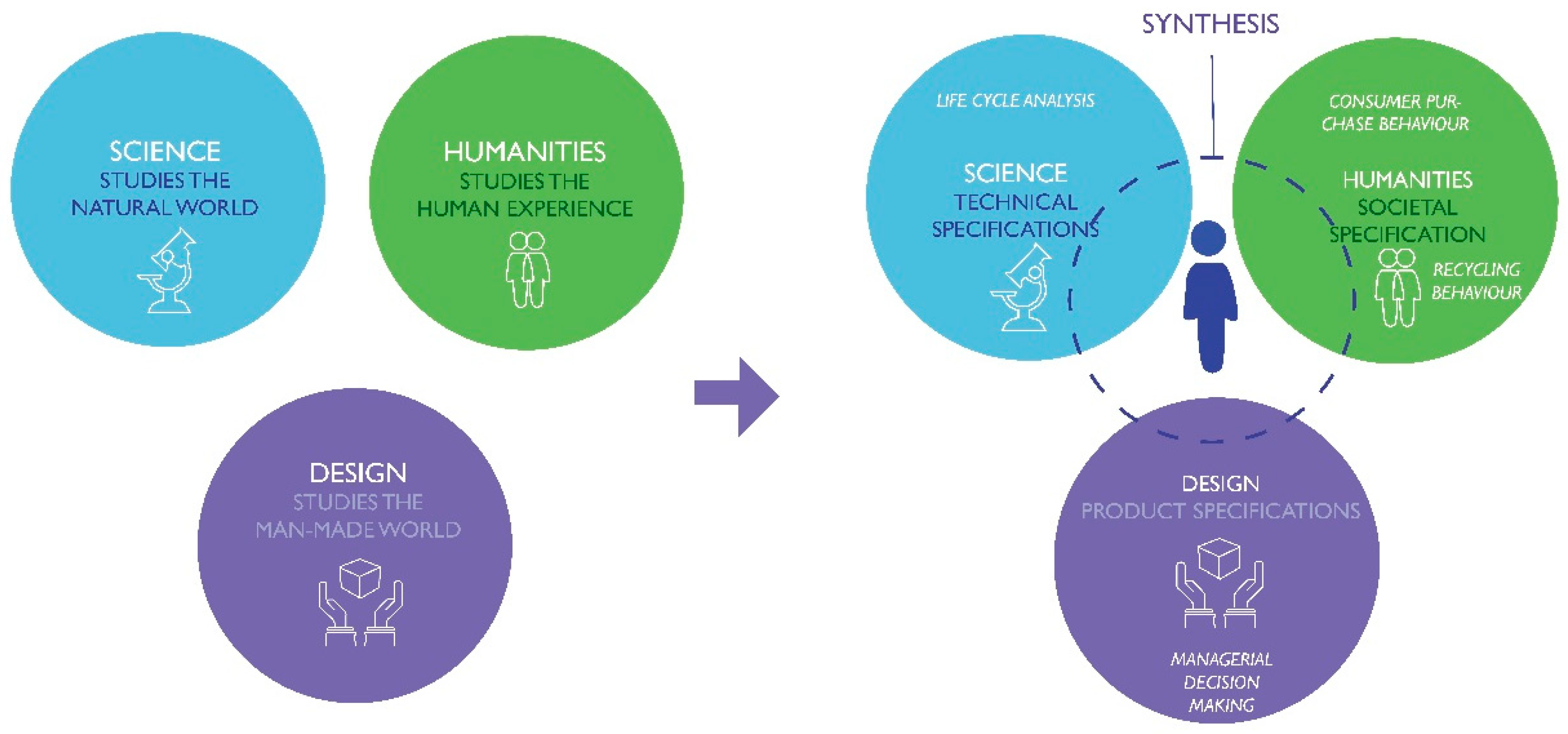
2. Design Synthesis
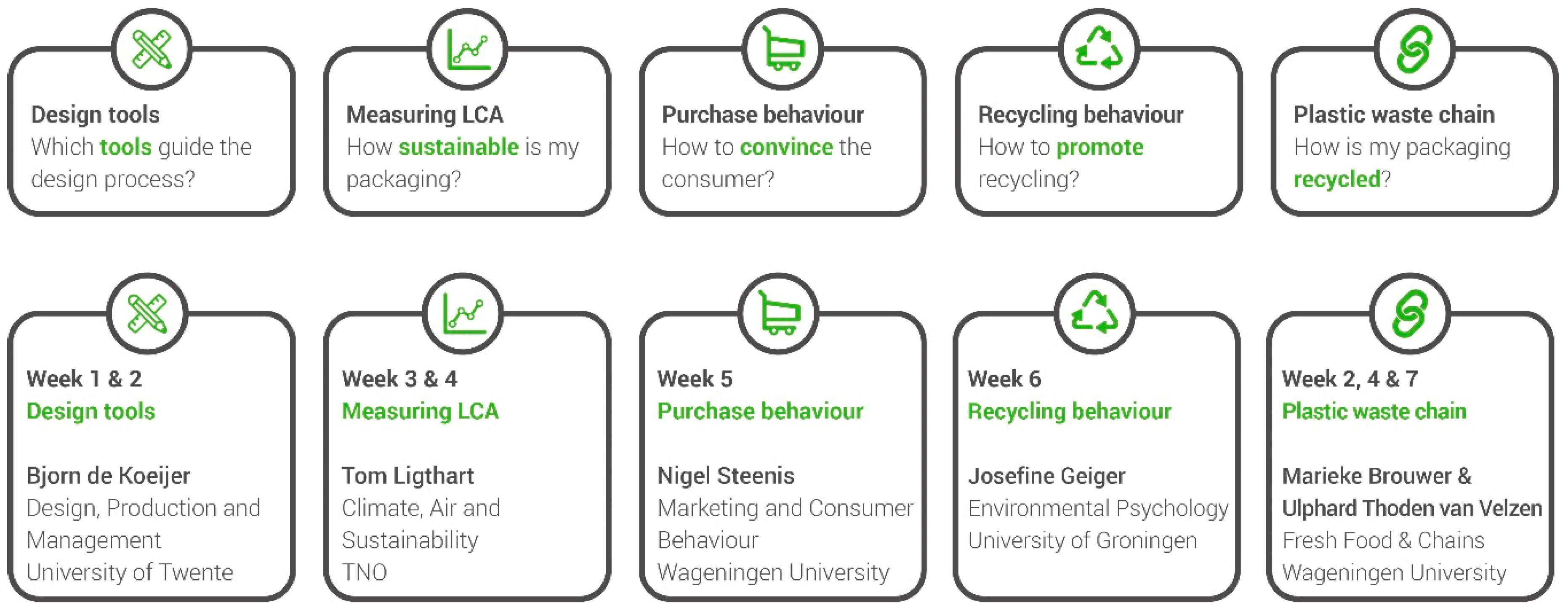
3. Educational Module
4. Results
4.1. Introspective Analysis
4.2. Expert Analysis
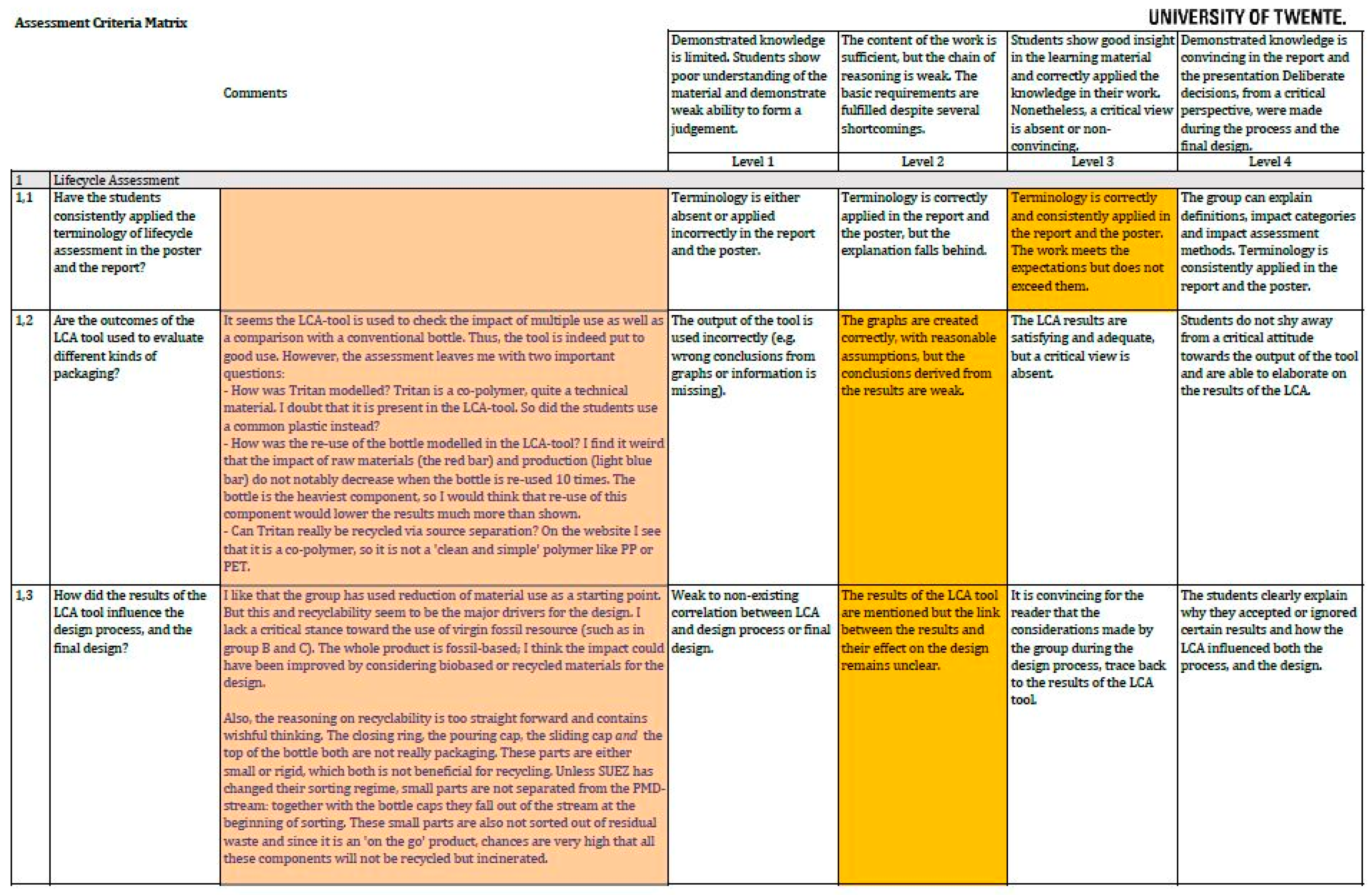
- Level 1—demonstrated knowledge is limited. Students show poor understanding of the material and demonstrate weak ability to form a judgement.
- Level 2—The content of the work is sufficient, but the chain of reasoning is weak. The basic requirements are fulfilled despite several shortcomings.
- Level 3—Students show good insight in the learning material and correctly applied the knowledge in their work. Nonetheless, a critical view is absent or non-convincing.
- Level 4—Demonstrated knowledge is convincing in the report and the presentation. Deliberate decisions, from a critical perspective, were made during the process and the final design.
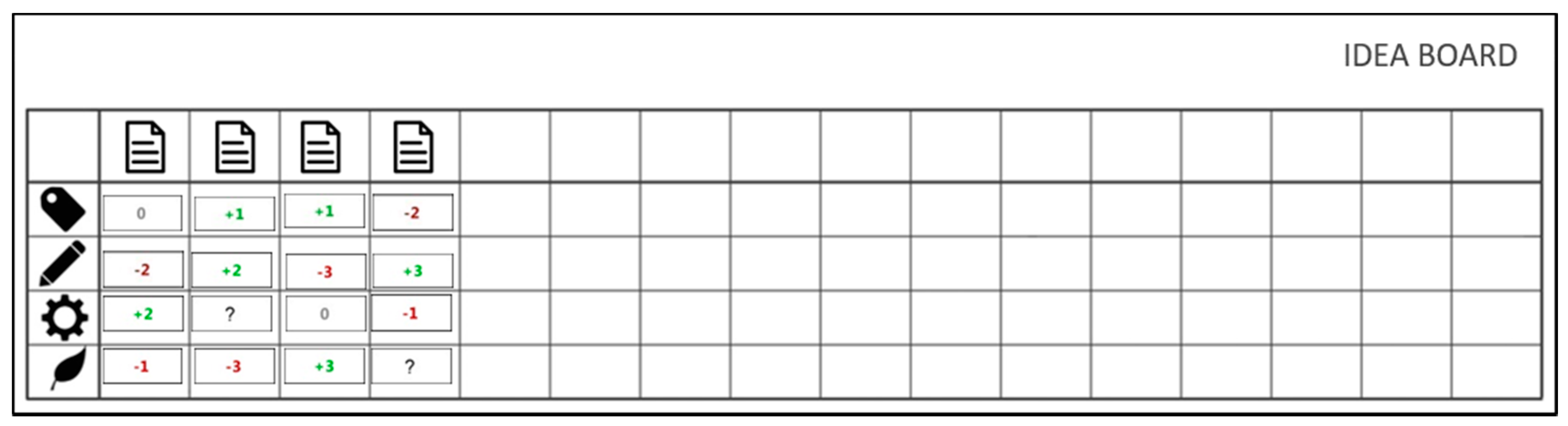
5. Design Game
5.1. Team Dynamics
- Project manager. This role mainly targets overall project governance, business case feasibility, and overall (estimated) project and product/packaging costs;
- Marketer. Focusing on the alignment of development decisions with commercial issues and market request (“voice of the consumer”);
- Packaging designer. Key focus on the graphical design and the overall appearance of the packaging design concepts;
- Packaging engineer. This role covers the structural development and the technical requirements of the packaging design concepts;
- Sustainability guardian. The sustainability guardian focuses on the structured implementation of sustainability considerations in the development processes.
The Sustainability Guardian
5.2. Gaming Process
5.3. Findings
5.3.1. Team A
5.3.2. Team B
5.3.3. Team C
6. Discussion
7. Conclusions
Author Contributions
Funding
Acknowledgments
Conflicts of Interest
Appendix A

| Classification of Learning Objective | Total | Design Models | Consumer Purchasing Behavior | Plastic Recycling Chain | Life Cycle Analysis | Recycling Behavior |
|---|---|---|---|---|---|---|
| Applying | 13 | 4 | 3 | 1 | 2 | 3 |
| Understanding | 27 | 3 | 5 | 5 | 8 | 6 |
| Remembering | 23 | 4 | 4 | 7 | 3 | 5 |
| No observation of an increase in knowledge | 12 | 4 | 3 | 2 | 2 | 1 |
| Total | 75 | 15 | 15 | 15 | 15 | 15 |
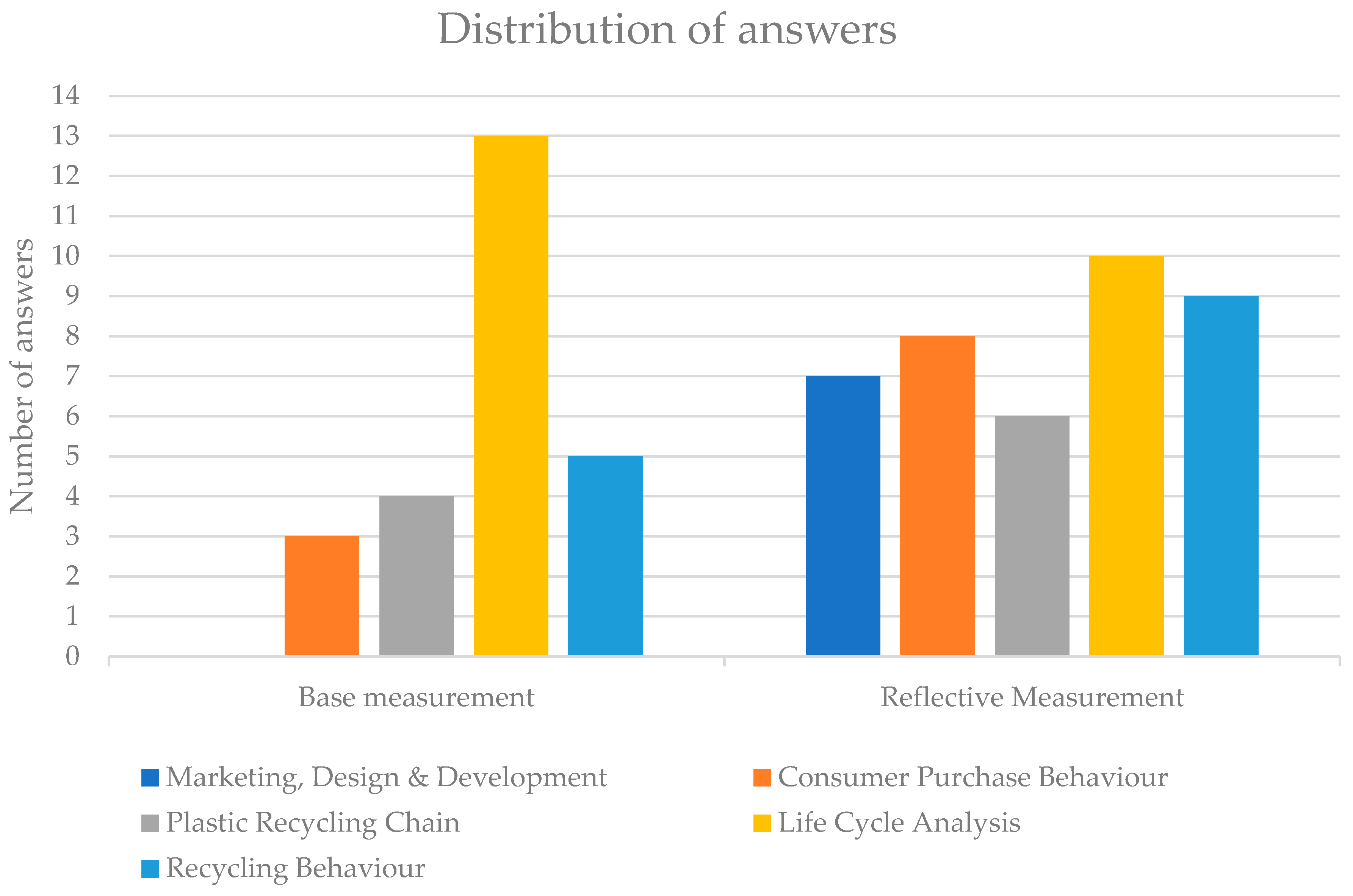
| Base measurement comments | 25 | 0 | 3 | 4 | 13 | 5 |
Appendix B
| Unconscious Competence | Conscious Competence | Conscious Incompetence | Unconscious Incompetence | |||||
|---|---|---|---|---|---|---|---|---|
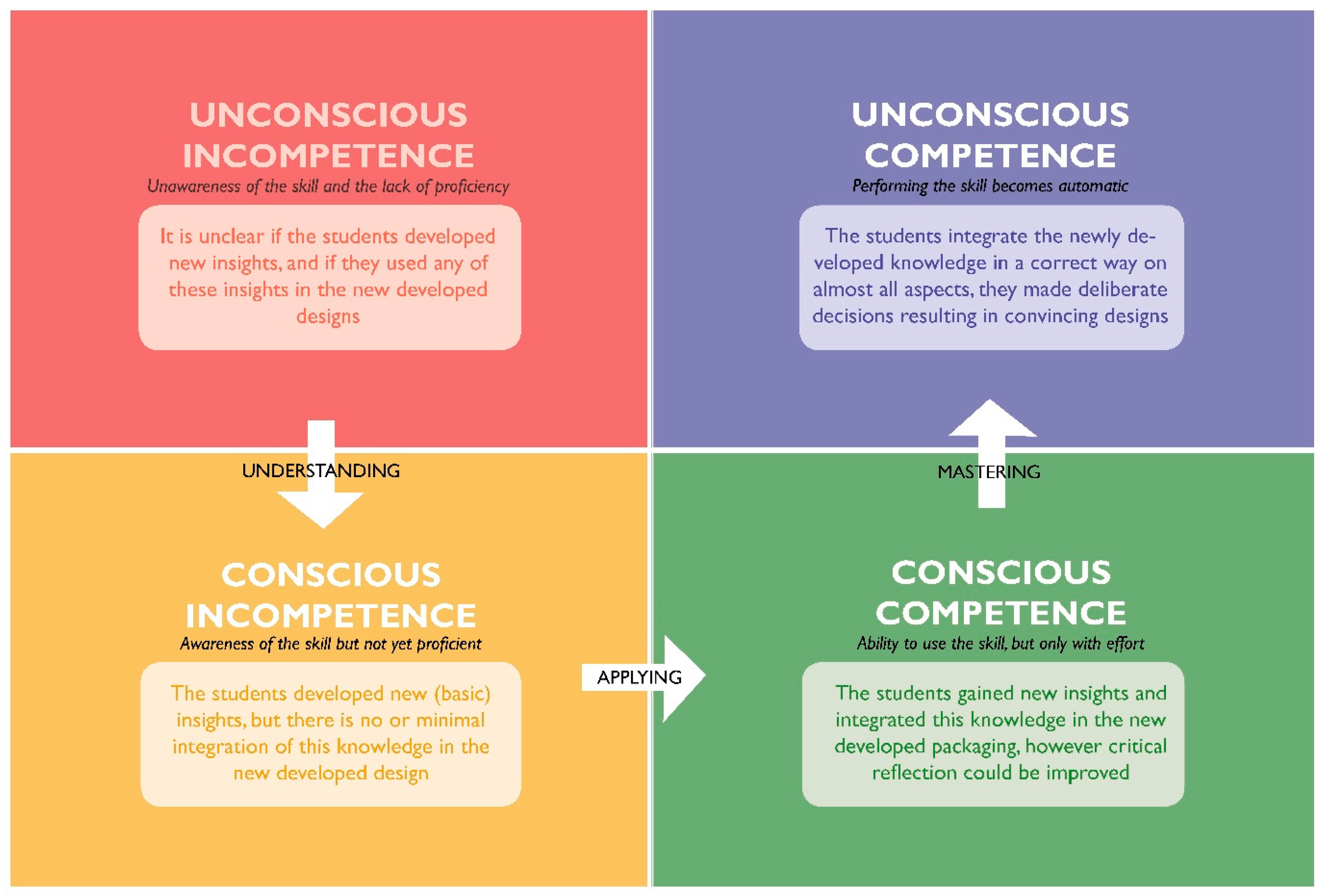
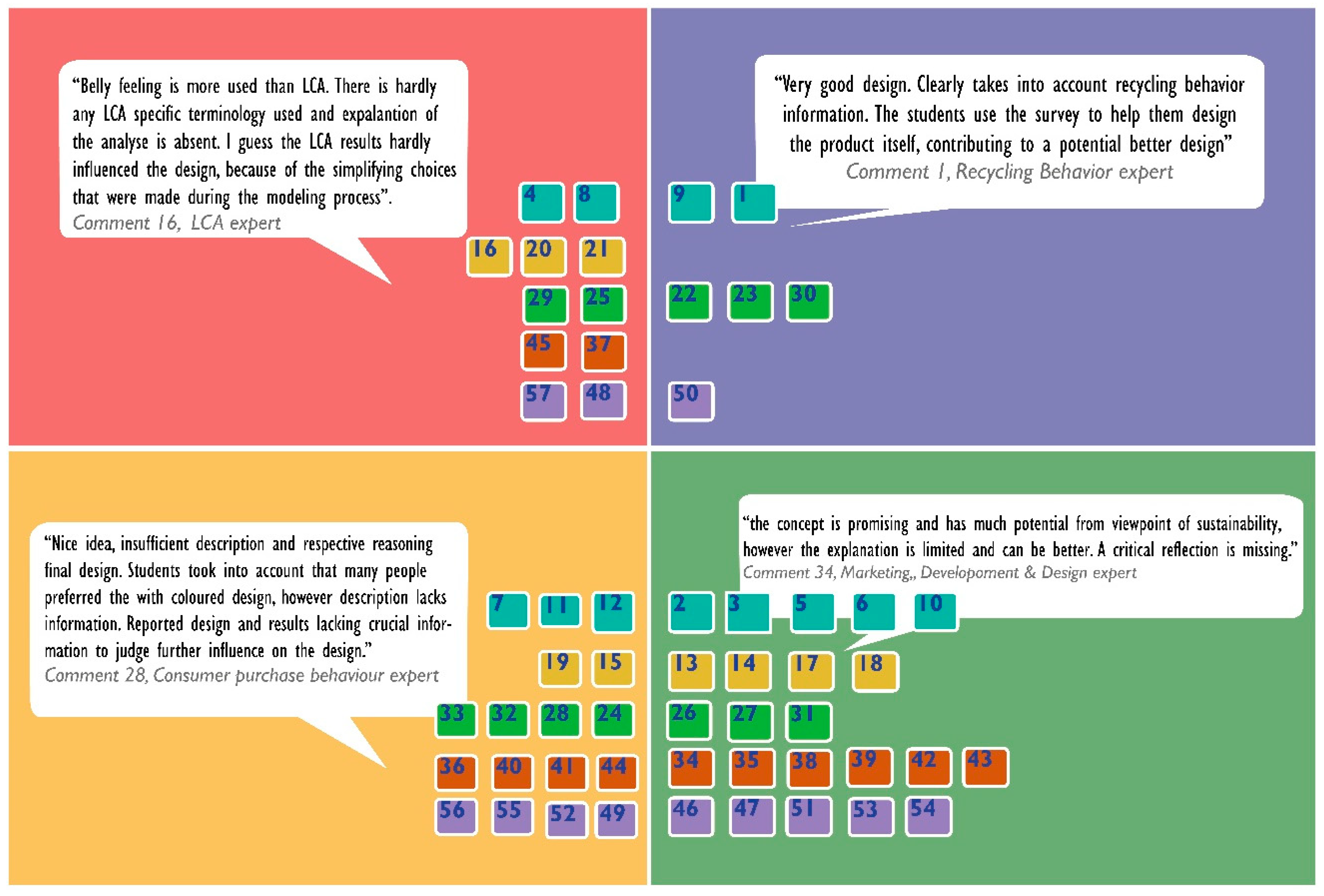
| The students integrate the newly developed knowledge in a correct way on almost all aspects, they made deliberate decisions resulting in convincing designs | The students gained new insights and integrated this knowledge in the new developed packaging, however critical reflection could be improved | The students developed new (basic) insights, but there is no or minimal integration of this knowledge in the new developed design | It is unclear if the students develop new insights, and if they used any of these insights in the new developed designs | |||||
| Overall comments refer to the final judgement, while specific comments refer to the specific questions derived from the learning objectives per perspective (Table A3) | Overall comments refer to the final judgement, while specific comments refer to the specific questions derived from the learning objectives per perspective (Table A3) | Overall comments refer to the final judgement, while specific comments refer to the specific questions derived from the learning objectives per perspective (Table A3) | Overall comments refer to the final judgement, while specific comments refer to the specific questions derived from the learning objectives per perspective (Table A3) | |||||
| Quote No. | Complete Comment and Color | Initials Perspective | Quotes (Derived from the Comments) | Terminology (Verbs, Nouns, Adjectives) | Design | |||
| 1 | OVERALL: Very good design. Cleary takes into account the recycling behavior information. SPECIFIC: 1. The students included key questions to improve their design. These questions were derived from some of the most relevant features of the product. 2. The explanation is clear. The students use the survey to help them design the product itself, contributing to a potential better design. | RB1 | Very good design. Clearly takes into account recycling behavior information. The students use the survey to help them design the product itself, contributing to a potential better design | very good, clearly takes into account, include key questions to improve their design, relevant features, explanation is clear, contributing to a potential better design | B | |||
| 2 | OVERALL: Very good design. It would have been nice to include recycling information as specific inputs for the design. SPECIFIC: 1. The students used the empirical evidence in a way that consolidates their design, taking advantage of the information they collected. 2. The students used the collected information as a way of confirming their design instead of using it as a intrinsic part of the design itself. | RB1 | very good design. Would have been nice to include recycling information. The students used the empirical evidence in a way that consolidates their design, taking advantage of the information they collected. | very good design, would have been nice, consolidates their design, taking advantage, used the information, confirming their design | A | |||
| 3 | OVERALL: Good design. The project adapts some features of the design following the evidence. SPECIFIC: 1. The students used their findings as part of their design, allowing them to propose a potentially more successful design. However, the complexity of the design undervalues some important factors predicting recycling behavior, such as self-efficacy, given that it is a fairly complex design to use. 2. The final design has specific been specifically influenced by the findings of the students. They include specific information regarding how the evidence influenced the design itself. | RB1 | Good design, adapts some features following evidence. Students used their findings as part of their design, allowing them to propose a potentially more successful design. However, the complexity of the design undervalues some important factors predicting recycling behavior. Final design includes information regarding how the evidence influenced the design itself. | adapts some, following evidence, used their findings, potentially more successful design, complexity undervalues important factors, specifically influenced by findings, | D | |||
| 4 | OVERALL: There is no clarification regarding the use of actual recycling behavior in the design. SPECIFIC: 1. The students do not include information on how the have used evidence-based information (collected by them or using established theories) to design the product. They rely completely on the local garbage management center. By doing so, they failed in some of the objectives of the commissioning company. 2. The students used a recycling behavior concept (i.e., simplicity on recycling) as one of the core ideas to design the product itself. However, they failed to support this approach, not showing what is the evidence behind the specific proposal. | RB1 | there is no clarification regarding the use of actual recycling behavior. Students do not include information on how they have used evidence-based information to design the product. | no clarification, do not include, rely completely on, failed in some of the objectives, failed to support, not showing the evidence | C | |||
| 5 | OVERALL: No comments SPECIFIC: 1.x 2. Clear and very good reasoning on certain design choices (material, cap, label, recycle logo); good to see that there is also focus on sustainability and not only on information provision. Students assume that people will separate label from bottle while disposing the package, i doubt that if there is no information provided on it on the package. | RB2 | clear and very good reasoning on certain design choices. Students assume that people will separate label form bottle, I doubt that if there is no information provided on it | clear, very good reasoning, assume, doubt | B | |||
| 6 | OVERALL: No comments SPECIFIC: 1. Does not contain a report, so cannot judge reasoning. This is a pity, because the design looks promising (texture and shape to remind people of nature, recycled paper label). Yet, in the poster, the designers seem very focused on the sustainability aspect which seems to be important with regard to recycling. Interestingly, they don’t focus on consumers recycling behavior but on post recycling. Some elaboration would have been interesting. This was only part of the assignment. I do not see a relation with ’the busy consumers being on the go’. 2.x | RB2 | Seem to focus on the sustainability aspect, interestingly, they don’t focus on consumers recycling behavior but on post recycling. Some elaboration would have been interesting. | seem to be important, some elaboration would have been interesting, do not see relation | C | |||
| 7 | OVERALL: It is a different and creative approach to sustainable packages; however, this package requires time to prepare: people have to fill the bottle with the cap and then look for a nearby water source. To me, this is very inconvenient for a busy consumer on the go. In addition, the separate caps result in lot of waste. SPECIFIC: 1.x 2.x | RB2 | different creative approach, however, this package requires time to prepare: filling is very inconvenient for a busy consumer on the go. Separate caps result in lot of waste | requires time to prepare, very inconvenient | D | |||
| 8 | OVERALL: Assignment looks not fully understood as the students do not provide any information on their reasoning with regard to recycling. Materials in the end not very different from normal packages (only the way to seal it). One could argue that the aim of Zonnatura is communicated through the non-bleached material but would have been nice to read about it (package also does not contain info on what product is inside the package). The way the packaging is sealed now is not convenient for the busy consumer on to go. They elaborate on the current situation with regard to recycling bins, which is important, but focus was on design. SPECIFIC: 1. x 2. Students understood well that recycling labels are not very effective in promoting recycling behavior and therefore did not focus on this but rather on the sustainable look which can promote recycling behavior. Students should have elaborated on this reasoning a bit more as they now do not provide any information on this. | RB2 | students understood well that recycling labels are not effective but should have elaborated on this reasoning a bit more. Assignment looks not fully understood as the students do not provide any information on their reasoning with regard to recycling | not focus on this, should have elaborated more, assignment looks not fully understood, do not provide any information, does not contain info | A | |||
| 9 | OVERALL: Design clearly based on consumer recycling behavior, as shown by the results from the survey. The design also clearly states its recycling goals on main features of the design, making it more likely for consumer to recycle the product. Also, easy to reuse and take on-the-go. SPECIFIC: 1.x 2.x | RB3 | The design also clearly states it’s recycling goals on main features of the design | clearly states, shown by results | B | |||
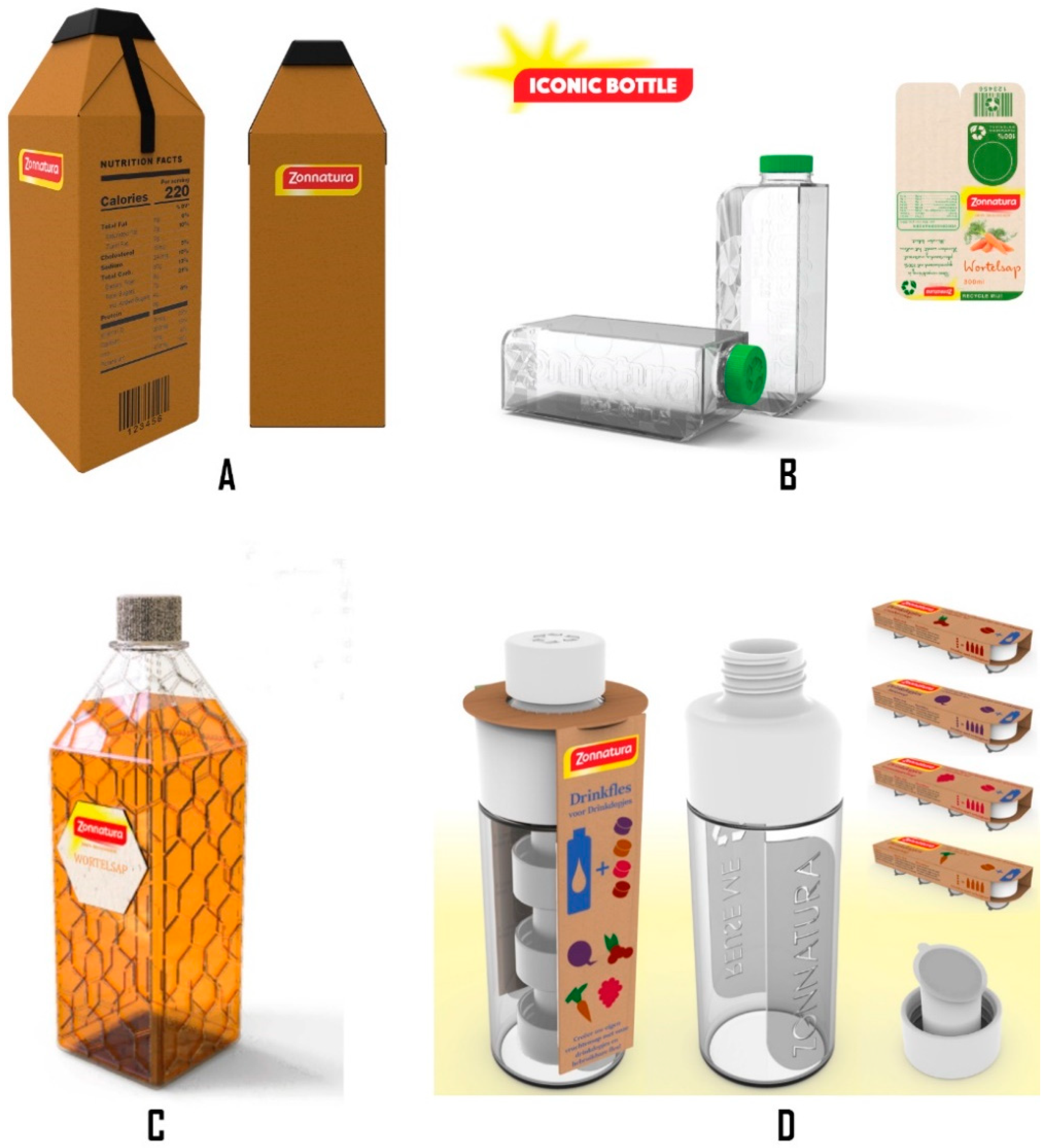
| 10 | OVERALL: Design D is clever and well thought through, regarding all the different steps consumers could take to make most of the product. Having refills for the content of the bottle might indeed make consumers more likely to reuse the bottle, which tops the idea of group B. Also, it clearly states the recycling goal and how to use it, to its consumer. However, these steps might be just too much for the consumer to actually make them more likely to recycle the bottle. In the paper, I did not find a clear reasoning as to why the students think this might work. Hence, I am not sure whether this will work. If it does, it is great. SPECIFIC: 1.x 2. Understanding of consumers perspective is sufficient but figures in the paper are unclear/reasoning is lacking. | RB3 | clever, well thought through, it might make consumers more likely to reuse the bottle, however steps might be just too much for consumer, | clever, well thought through, but did not find clear reasoning | D | |||
| 11 | OVERALL: Natural looking and easy to recycle for the consumer. Apparently, a clear recycle-icon was incorporated in the design (as was not clear from the poster). So clearly the consumers recycling behavior is taken into account. However, as they also state in their report, people indeed might not recycle paper waste on-the-go as much. Also, they might not take a cardboard bottle that is hard to seal without spilling its contents on-the-go. Therefore, somewhat less likely to be recycled by the consumer than the previous designs. SPECIFIC: 1. X 2. x | RB3 | Apparently a clear recycle-icon was incorporated in the design, however people indeed might not recycle paper waste on-the-go as much | is taken into account, however, might not be recycled. less likely to be recycled | A | |||
| 12 | OVERALL: Design C also has a natural look. Making people feel more connected to the natural content of the bottle. In this regard, it is probably the best of all designs. Also, it is easy to recycle, since it’s consumer can throw away the entire bottle at one (they do not have to separate the different parts). However, the fact that they should recycle, is not explicitly made clear to the consumer on the design itself. This might be pivotal for consumers to know. Unfortunately, there was no report to explain their reasoning. SPECIFIC: 1. No report 2. No report | RB3 | Natural look is probably best of all designs. However, the fact that they should recycle, is not explicitly made clear to the consumer on the design itself. This might be pivotal for consumers to know. Unfortunately, there was no report to explain their reasoning. | not explicitly made clear, this might be pivotal, no report explaining reasoning | C | |||
| 13 | OVERALL: Although the explanation is poor, it is clear that the students have done quite some LCA work to come to their final design. SPECIFIC: 1. There is a correct use of terminology, but the explanation of used methods, units of the results, etc. falls behind. 2. The reader is not taken by the hand when looking at the results. Only the results that can be seen in the graphs are listed, but the interpretation or description of the implications is poor. 3. Although the explanation is poor, it is clear that the students have done a series of analyses to come to their final design | LCA1 | Although the explanation is poor, it is clear that the students have done quite some LCA work. There is a correct use of terminology, but the explanation of used methods falls behind | explanation is poor, quite some LCA work, correct use of terminology, explanation falls behind, not taken by the hand, interpretation is poor, have done series of analyses | B | |||
| 14 | OVERALL: More or less clear how choices were made, but unfortunately a detailed report is lacking SPECIFIC: 1.x 2.x 3.x | LCA1 | more or less clear how choices were made, but detailed report is lacking | more or less clear, detailed report lacking | C | |||
| 15 | OVERALL: Due to the poor explanation, it is not clear to the reader whether the LC analyses that were performed have influenced the choice of materials and other design choices, or that ’belly feeling’ was playing a major part here. SPECIFIC: 1. There is a correct use of terminology, but the explanation of results falls behind. Only highlights / conclusions are presented as results. 2. The reader is not taken by the hand when looking at the results. Only the results that can be seen in the graphs are listed, but the interpretation or description of the implications is poor. 3. Due to the poor explanation, it is not clear to the reader whether the LC analyses that were performed have influenced the choice of materials and other design choices, or that ’belly feeling’ was playing a major part here. | LCA1 | It is not clear whether the LC analyses have influenced the choice of materials or that belly feeling was playing a major part here. | poor explanation, not clear whether the LC analysis have influenced, belly feeling, correct use of terminology, explanation falls behind, not taken by the hand, interpretation is poor. | D | |||
| 16 | OVERALL: It looks as if ’belly feeling’ is more used than LCA in the sustainable choices made. SPECIFIC: 1. There is hardly any LCA specific terminology used. Explanation of the analyses or results is absent. Graphs are too small to be read. 2. The reader is not taken by the hand when looking at the results. Explanation of the analyses or results is absent. Graphs are too small to be read. 3. I guess the LCA results hardly influenced the design, because of the simplifying choices that were made during the modeling process (no cap, no band). | LCA1 | belly feeling is more used than LCA. There is hardly any LCA specific terminology used and explanation of the analysis is absent. I guess the LCA results hardly influenced the design, because of the simplifying choices that were made during the modeling process. | belly feeling more used than LCA, hardly any LCA terminology, explanation is absent, not taken by the hand, simplifying choices during process | A | |||
| 17 | OVERALL: Good thinking both on material selection (bio-based) and design for recycling (best of all groups). Nice that the label design contains ample information about the material origin and recyclability of the product. The source of the bio-based material could be discussed better; there are quite unfavorable or even unsustainable bio-based materials. SPECIFIC: 1. Almost. The statement "There is still no special collection system for bio plastics in the Netherlands. This does not have to be a problem. It is possible to process bio-plastics in the current recycling systems." is not entirely true: - The group should have used the term ’bio-based plastics’ - bio-based PET is from a biotic resource, but has exactly the same chemical properties as fossil-based PET. Therefore, the bio-PET is well suited for the common recycling routes of PET. So yes, there is no problem, but the explanation is not correct. 2. Yes. But the discussion of results is limited. Also, I feel that the group could have added a comparison with (for instance) more materials than PET alone. PET is however the most relevant comparison. Also, I think showing the results with the endpoint method or circular economy approach would have been beneficial for the selection of bio-based PET. 3. It is curious that bio-based PET has a higher score than virgin PET in the LCA-tool. TNO should have a critical look at the background data. I suspect land use for the bio-based materials is the culprit. Also, TNO should think again about using the very outdated shadow prices as weighting method for student applications. This way, students might learn that virgin fossil materials are better than renewable materials of which the sourcing and production process can be optimized in the future. I applaud the students that they have followed their common sense and went forward with bio-based materials. The reasoning is a crooked, though: "the [environmental!] costs are higher (...) but bio-PET is much better for the environment (...)". This is of course false interpretation of the results. The students could have improved the report by stating that sourcing of the bio-based material is key. The biomass should not be a food-product (such as corn). | LCA2 | good thinking both on material selection and design for recycling. Nice that the label design contains ample information about recyclability. The source of bio-based materials could be discussed better. | good thinking, best of all groups, nice, could be discussed better | B | |||
| 18 | OVERALL: Nice that the group has taken reduction of material use as a starting point. This always is the best way to decrease the environmental impact. Too bad though that all parts are made of virgin fossil-based plastics. And the pouring cap is almost as heavy as a common 500ml PET bottle. So good thinking in the basis, but the design could be improved environmentally even further. SPECIFIC: 1. x 2. It seems the LCA-tool is used to check the impact of multiple use as well as a comparison with a conventional bottle. Thus, the tool is indeed put to good use. However, the assessment leaves me with two important questions: - How was Tritan modelled? Tritan is a co-polymer, quite a technical material. I doubt that it is present in the LCA-tool. So, did the students use a common plastic instead? - How was the re-use of the bottle modelled in the LCA-tool? I find it weird that the impact of raw materials (the red bar) and production (light blue bar) do not notably decrease when the bottle is re-used 10 times. The bottle is the heaviest component, so I would think that re-use of this component would lower the results much more than shown. - Can Tritan really be recycled via source separation? On the website I see that it is a co-polymer, so it is not a ’clean and simple’ polymer like PP or PET. So, it is not a critical view I am lacking, but I am lacking explanations to the use of the tool. 3. I like that the group has used reduction of material use as a starting point. But this and recyclability seem to be the major drivers for the design. I lack a critical stance toward the use of virgin fossil resource (such as in group B and C). The whole product is fossil-based; I think the impact could have been improved by considering bio based or recycled materials for the design. Also, the reasoning on recyclability is too straight forward and contains wishful thinking. The closing ring, the pouring cap, the sliding cap and the top of the bottle both are not really packaging. These parts are either small or rigid, which both is not beneficial for recycling. Unless SUEZ has changed their sorting regime, small parts are not separated from the PMD-stream: together with the bottle caps they fall out of the stream at the beginning of sorting. These small parts are also not sorted out of residual waste and since it is an ’on the go’ product, chances are very high that all these components will not be recycled but incinerated. | LCA2 | nice that the group has taken reduction of material use as a starting point. This always is the best way. Too bad though that all parts are made out of virgin fossil-based plastics. Good thinking in the basis, but design could be improved. | nice, best way, too bad though, good thinking in basis, could be improved | D | |||
| 19 | OVERALL: The use of recycled PET as a basis is nice and the product seems almost perfectly designed for recycling (just lose the stick-on label). But since there is no report, the statements based on LCA-results cannot be checked. Also, where would all the recycled PET come from? SPECIFIC: 1. The terminology that is used, is used correctly, but there is little to no explanation of the statements. This is a pity, because the poster is quite good. There is one faulty statement: "this bottle can be thrown in the trashcan and the recycling scheme will do the rest". Residual waste is only separated in parts of NL, where no source separation program is set up. In the case that sorting out of mixed residual waste is done, not all PET bottles will in practice be sorted (’nascheidingsrendement’). And then, even when a PET bottle is sorted out of the residual waste, the bottle may be too contaminated to process. So, especially when ’on-the-go’, the bottle will be thrown in the residual waste and therefore will not be automatically recycled. But since Group B made a similar statement, I think this is due to misinformation during the course. I do not hold this against the students. 2. It seems so from the poster, but I lack visual results (graphs) and a discussion of results. Information to back the statements such as ’recycled PET has the lowest environmental impact’ is missing. The choice for PP cap is made ’because it is easiest to recycle’, but this is not supported by results. 3. Unclear. From the poster it becomes clear that LCA results did have an influence. But it is not clear how the results have shaped the decision-making process. The lack of a report with a little bit more background information is a real pity, because I know that choice for rPET is environmentally OK. | LCA2 | pet as a basis is nice, seems almost perfectly designed, however statements cannot be checked. | nice, seem almost perfectly designed for recycling, no report, cannot be checked. | C | |||
| 20 | OVERALL: Both on resource selection and on recyclability, the group could have been more critical. Not all design decisions are explained environmentally, such as the choice for neoprene for the lid. The result is a common beverage carton. SPECIFIC: 1. The poster and report contain virtually no terminology. Results are displayed (not really readable) but not really discussed. On the poster it says ’sustainable’ twice, but it incorrectly: - It is not explained why this packaging is sustainable. - The origin of the paper fibres is not touched upon; the aluminium and plastic layers in bev.cartons are not sustainable at all. 2. Difficult to judge, since the graphs are not readible in the report. From the titles and units, it seems that the graphs are created correctly. I lack a critical view on the use of beverage carton with alu foil. 3. It does not become clear what the decisive reason is for selecting beverage carton as a material. I see that the ’own pack’ is compared with virgin aluminium and virgin PET bottles. But what about bio based materials? The material choice for the neoprene lid is not explained. Results of the assessment with Edupack are not reported, which is an important omission in the report. I doubt that a neoprene cap has a lower impact than a similar cap made of common plastic, like PP or HDPE. I lack a discussion and a critical view on recyclability. On the poster, it is stated ’the package will be recycled’ and ’recycling when possible’. But the aluminum and plastic layers in the beverage cartons will not be recycled: recycling of bev.cartons occurs at paper recycling plants. Also, it is an ’on-the-go’ product. Bev.cartons that are thrown in the residual waste, which often is the case when ’on the go’, will not be separated from the waste and will thus not be recycled. | LCA2 | both on resource selection and recyclability the group could have been more critical | could have been more critical, not all decisions are explained | A | |||
| 21 | OVERALL: Not sure if the carton includes a plastic layer too (next to aluminium [poster]; report says no Al-layer??): is the neoprene band only a seal? LCA report: only a carton layer. This will not meet the functional requirements! SPECIFIC: 1.x 2.x | LCA3 | not sure if the carton includes a plastic layer, report says no, will not meet functional req. | not sure, will not meet functional requirements | A | |||
| 22 | OVERALL: The main positive aspect of this design is that it takes into account the relationship product-packaging. In the moment of choice, transportation, storage until the moment of consumption the product and the packaging are considered combined, as an overall so it is important to take into account the product-packaging combination, as did in this design. The sustainability of the packaging is also clearly communicated to the consumers that understand the reusability of the bottle. The originality also attracts the consumers that are willing to try it. SPECIFIC: 1. The idea is original and explained in lots of details. Sustainability will be clearly perceived as well as convenience. 2.x | CPB1 | The sustainability of the packaging is also clearly communicated to the consumers that understand the reusability of the bottle. Sustainability will be clearly perceived as well as convenience. | main positive aspect, takes into account, clearly communicated, attracts, explained in lot of details, sustainability will be clearly perceived | D | |||
| 23 | OVERALL: The positive aspect of this design is that the sustainability is clearly communicated to the consumer that is aware of that in the moment of choice. Moreover, the green color of the lid is an effective cue in evoking the benefit of sustainability. In the label there is a representation of the product that will form expectations about the content to consumers. So, consumers will make inferences about the product from the packaging design. Labels and information on the bio-based bottle communicate the sustainability and the original shape attract the consumer. SPECIFIC: 1. Good link packaging cues-consumers perception. Examples are provided and explained in a convincing way. Sustainability is communicated as well as convenience. 2. In general I consider the report a good and complete tool to understand the packaging design. | CPB1 | positive aspect of this design is that the sustainability is clearly communicated to the consumer. Moreover, the green color of the lid is an effective cure. Labels and information on the bio-based bottle communicate the sustainability and the original shape attract the consumer | positive, clearly communicated, effective cue, good link packaging cues - consumer perception, examples are provided and explained, Good report. | B | |||
| 24 | OVERALL: Through the cue of the packaging the consumers will perceive the naturalness of the product and the packaging, this represent a positive aspect of this design. Little information is provided to consumers (little label) so the link with the product and consequently the mental categorization are not taken into account. The convenience also tradeoff with sustainability in this case. In the mind of consumers an increase in sustainability is perceived as a decrease in convenience. In this design with the strange shape this is the risk. SPECIFIC: 1. The assessment of this design is limited to the poster, so not comparable with the other designs. 2. x | CPB1 | consumers will perceive the naturalness of the product, however little information are provided to consumers, so the link with the mental categorization are not taken into account. Decrease in convenience | Little information, not taken into account, decrease in convenience, assessment is limited to poster, not comparable | C | |||
| 25 | OVERALL: The choice of the material (paper) is the only aspect that makes this packaging perceived as sustainable. The sustainability is indeed not really communicated to consumers with other packaging cues, except by the material. The tradeoff between sustainability and attractiveness is also not really well balanced. For many consumers sustainability is not an important benefit for their choice, so the design should also be attractive and stands out from the shelf of the store (trigger the attention). Moreover, no link with the product content is made so consumers will have difficulties in categorizing the product-packaging combinations since the packaging cues do not form any expectations. How consumers will recognize the healthy alternative to soft drink from the packaging? Remember that the packaging is also called the "silent salesman". SPECIFIC: 1. The integration of the results from the survey in the packaging design is mostly done and correct. Sometimes the line of reasoning would require more details and analytical insights. 2. the reasoning is clear but some aspects of the survey are not taken into account in the design (convenience covered by the question 2 and 5 suggests that some improvements could be made in the design). | CPB1 | the sustainability is indeed not really communicated with other packaging cues, except by material. Tradeoff between sustainability & attractiveness is also not well balanced. | only aspect, sustainability not really communicated, not well balanced, difficulties in categorizing, do not form any expectations. Integration of results is done and correct, Line of reasoning require more details, clear, not taken into account, | A | |||
| 26 | OVERALL: best consumer-oriented co-creation efforts. SPECIFIC 1. Students did vary quite well the design features to figure out how single features will contribute to consumer perception. Students took the insights they gained to decide on final design features to increase perceived sustainability. However, features do not vary systematically (no experimental design with all possible combinations) & some conclusions should not be made; for instance, it cannot be concluded which of the features increases (perceived) recyclability, as e.g., done for "label without glue". Likely the additional recycling logo on the lid is largely responsible for higher ratings for bottle 3 in qu. 1 and 4, and the glueless label might not make a difference. Also, all bottles have the recycling logo not he bottles, so why conclude an effect for this feature? 2. students took insights into account for the final design to be perceived more sustainable. As they found that the plant imprint as well as a green lid was perceived more sustainable, they implemented these features. They also implemented the features, they found to be affecting recycling behavior and thus supports the more sustainable end-life-option. However, the conclusion mainly states the interpretation of results, and more elaboration on conclusions for the design could have been provided in the text. | CPB2 | best consumer oriented, students took insights into account for the final design to be perceived more sustainable. However, the conclusion mainly states the interpretation of results, and more elaboration on conclusions for the design could have been provided. | best consumer oriented, vary quite well, contribute to consumer perception, took the insights, do not vary systematically, some conclusion should not be made, took insights into account, they implemented these features, more elaboration could have been provided | B | |||
| 27 | OVERALL: material used is perceived as sustainable, could more use insights in determining the final design. SPECIFIC: 1. Students did take into account asking how potential customers view their design. However, features of interest could have been varied more systematically between designs shown, to be able to relate answers to features. It would have been advised to standardize alternatives more regarding features not of interest, e.g., info given on the pack (as brand, name product etc.) as well as content (e.g., not water vs juice) (e.g., asking to disregard brand or color seems less helpful, as this will not be possible, as it (unconsciously) will have an influence anyway).2. insights could have been used more critically to give input for a possible redesign (e.g., regarding the lid as people were not sure about performance here). In the discussion Students summarize insights, state it is important that sustainable products are bought and then argue for their design. However little connection is made from insights to final design, rather it is argued to keep the initial design, e.g., as it is more sustainable than with plastic cap, even though consumers do not really acknowledge this difference (table 2 Qu. 1) or care about it (part 2, qu.3) | CPB2 | material used is perceived as sustainable, could more use insights in determining the final design. Students did take into account how potential customers view their design. However, insights could have been used more critically. However little connection is made from insights to final design. | could use more insights, did not take into account, could have been varied more, could have been sed more critically, summarize insights, state importance, little connection is made from insights to final. | A | |||
| 28 | OVERALL: nice idea, insufficient description of consumer insights and respective reasoning for final design. SPECIFIC: 1. Students took into account that many people preferred the white colored design. However, description lacks a lot of information. Report of the alternatives (as e.g., on poster) given to consumers is poor and thus hard to reconstruct the decision made. Besides color, it is mentioned that the (working) system is most important to be clear, but no info on experimental/question design and results regarding this crucial feature could be found! 2. Information provided on the conducted consumer study is insufficient. Only color is taken into account. Reported design and results are lacking crucial information needed to judge further influence on design. | CPB2 | nice idea, insufficient description and respective reasoning final design. Students took into account that many people preferred the with colored design, however description lacks information. Reported design and results lacking crucial information to judge further influence on the design. | nice idea, insufficient description and reasoning, took into account, however lacks information, information provided is insufficient, lacking crucial information. | D | |||
| 29 | OVERALL: little info provided, no apparent consumer co-creation. SPECIFIC: 1. no report; based on poster students did not include a focus group or similar consumer technique in their developmental process and so did not involve the actual consumer int he design process. The label is recycled paper to increase sustainability perceived, however, this label is neglectable compared to the main plastic body which sustainable material is apparently not communicated to consumers. 2. no report; again, the only thing described is the choice of the label material with regard to perceived sustainability; "we keep the shape of a bottle" is fine but not really taking perception revolving sustainability or convenience into account | CPB2 | little info provided, no apparent consumer co-creation. Did not include a focus group. The label is recycled paper to increase sustainability perceived, however this label is neglectable compared to the main plastic body which sustainable material is apparently not communicated to consumers. | little info provided, no consumer co creation, did not include, did not involve the actual consumer, label is neglectable compared to main body, not communicated to consumers, no report, not really taking into account | C | |||
| 30 | OVERALL: Report is missing. Nice design with clear and convincing justifications in the poster. SPECIFIC: 1. x 2.x | CPB3 | nice design with clear and convincing justifications | nice, clear and convincing justifications | C | |||
| 31 | OVERALL: Nice try. The sustainable look may influence people to buy the bottle but there are some information missing (e.g., quantity, type of juice…). It is also unclear how people will manage to drink the juice on the go in a convenient way. SPECIFIC: 1. x 2.x | CBP3 | nice try, sustainable look may influence people to buy the bottle, however it is unclear how people will manage to drink the juice on the go in a convenient way. | nice try, may influence, some information missing, unclear how | A | |||
| 32 | OVERALL: Pretty design, nice label with a lot of information regarding sustainability. Bio-based is not always considered a more sustainable alternative by consumers. Also, the appearance of the bottle (shiny thick plastic) does not denote sustainability. SPECIFIC: 1. x 2.x | CBP3 | Pretty design, nice label with a lot of info regarding sustainability. However, the appearance of the bottle (shiny thick plastic) does not denote sustainability | pretty, lot of information regarding sustainability, appearance does not denote sustainability | B | |||
| 33 | OVERALL: It is not an on the go bottle (you have to wash it before you use it). It is likely that the concentrates will not be considered as healthy options by consumers. The design is pretty, and it is true that it is truly more sustainable to sell an empty bottle. However, consumers might not perceive it as such. SPECIFIC: 1. x 2.x | CBP3 | the design is pretty, and it is true that it is truly more sustainable to sell an empty bottle, however, consumers might not perceive it as such. | not, not be considered as healthy, design is pretty, is truly more sustainable, however consumers might not perceive | D | |||
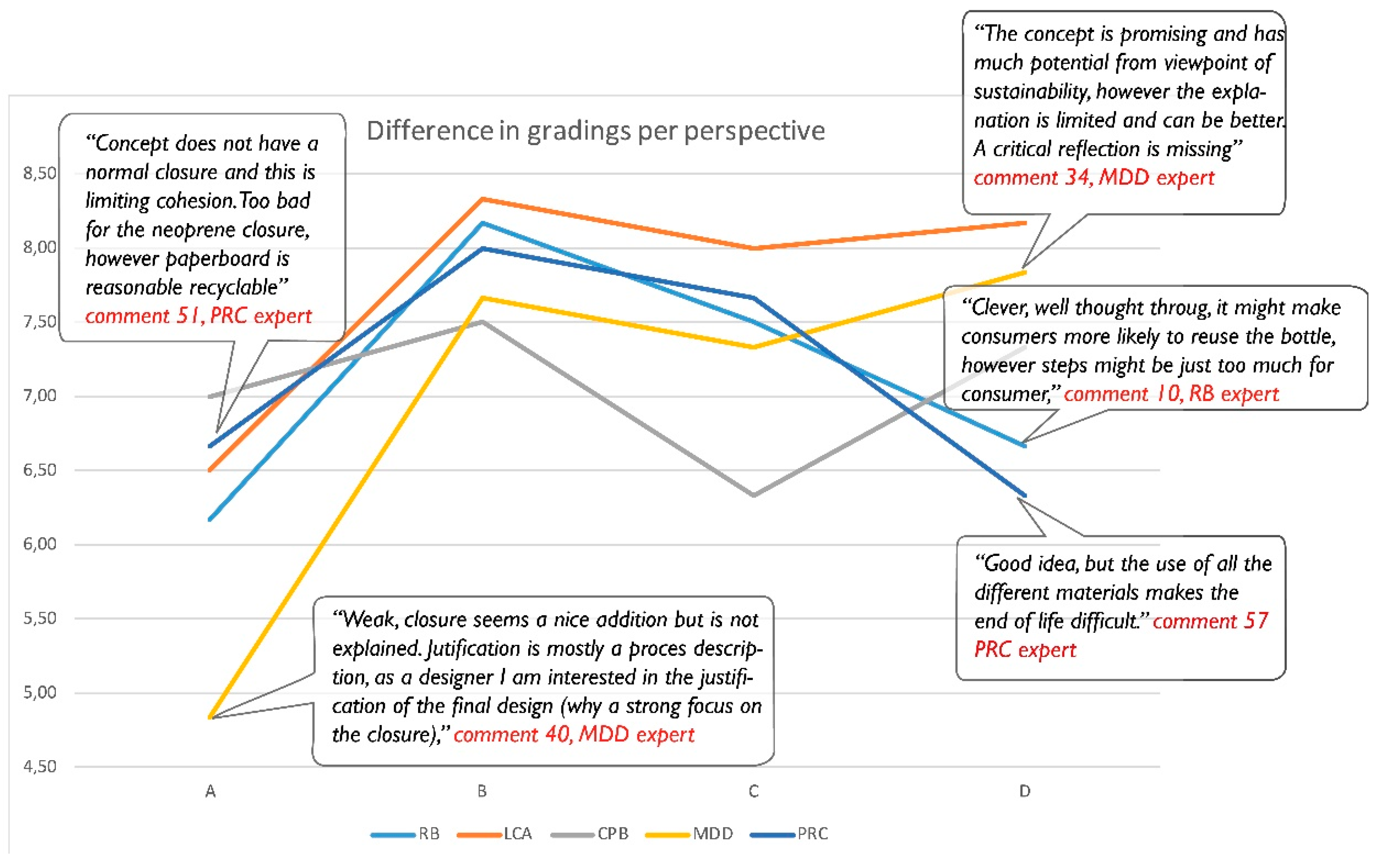
| 34 | OVERALL: The concept is promising and has much potential from viewpoint of sustainability SPECIFIC 1. The concept shows possible savings without knowing about the packaging details. Therefore, this design is great. The explanation is limited and can be better. A critical reflection is missing. 2. The roles are not explained in the report although the approach was wide, as the topics that have been taken up show. A reflection is missing. | MDD1 | the concept is promising and has much potential from viewpoint of sustainability, however the explanation is limited and can be better. A critical reflection is missing. | Promising, potential, possible savings, design is great, explanation is limited, critical reflection is missing | D | |||
| 35 | OVERALL: Approach looks rather ok. Clear choices. Question is if bio-PET and bio-PE are more sustainable and if they are not solutions based on food sources. How about the label? This is not clear. SPECIFIC: 1. Clear choices made on base of insights in the chain and by using the tool properly. 2. The roles were explained in the beginning of the report very well. It looks like the roles made making choices more rational. | MDD1 | approach looks rather ok, clear choices, question is if bio pet and bio PE are more sustainable. | looks rather ok, clear choices, based on insights, question is if, this is not clear, using tool properly | B | |||
| 36 | OVERALL: Approach looks good, but it is not easy to get rPET for bottles although there are developments going on. The company has to be active to be sure to get food-safe rPET. The honeycomb will not save much space, is it? SPECIFIC: 1. No report, only a poster. Choices have been made about many issues. The explanation is very limited. 2. The roles are not explained at the poster. | MDD1 | approach looks good, but it is not easy to get rPET for bottles. The explanation is very limited | approach looks good, no report, explanation very limited, are not explained | C | |||
| 37 | OVERALL: What are the gains? It is still a beverage carton. The cap is replaced by neoprene, not a very sustainable plastic. Carton appearance looks sustainable. SPECIFIC:1. Sustainability issues are taken up isolated from the role they play in the chain, from the environmental load in the chain and without looking at the product-packaging combination (taking out aluminum would mean that the shelf life is gone, and product loss can increase). Because of a lack of a wide approach the design is not very good. 2. The topics are taken up very isolated. They tried to integrate them, but they did not succeed in this. The report is a process description on a level that does not give insight in the ration behind the choices, but more in the thoughts of the participants | MDD1 | because of the lack of a wide approach the design is not very good. They tried to integrate topics, but they did not succeed in this. (The report is a process description on a level that does not give insight in the ration behind the choices, but more in the thoughts of the participants) | still, lack of approach, design is not very good, did not succeed, level that does not give insight in choices. | A | |||
| 38 | OVERALL: Overall description and justification the best. Nice solution direction, concentrating the core product. However, not a new direction, your main competitor immediately becomes Karvan Cevitam. And their concept is better suited for on-the-go. The traditional cups with seal do not seem tailored towards this use scenario. As far as sustainability goes: the overall assumption (implicitly made?) seems to be that a refillable drinking bottle is more sustainable than pet-variants of for instance Spa? Potentially problematic: a drinking bottle is not part of the portfolio of a (on-the-go) supermarket. SPECIFIC: 1. Concepts! Analysis! A design brief! You’re the first to do that! Good introduction! A short but solid overall design justification. What I mis is the transition of the concepts and the final design. Why was concept 1 chosen? You could use the requirements for such an assessment. 2. You seem to have done it (table on page 7 lists the roles) but there is no description, no consequences. | MDD2 | Overall description and justification the best. Nice solution, concentrating the core product, however not a new direction (traditional cups with seal do not seem tailored towards use scenario). | justification the best, nice solution, not a new direction, potentially problematic, good, solid overall design justification, miss, | D | |||
| 39 | OVERALL: Best on different disciplines. Marketing-wise a nice touch incorporating the logo in the shape. Does come with engineering challenges. Sustainable justification choices are current way of working. It does not communicate sustainability. SPECIFIC: 1. Choices and considerations are listed. There is no chain of reasoning, no concept description, no trade-offs, no interrelations. 2. Nice overall description of the different roles/ perspectives. No follow-through on the actual usage in the design process, and linkage to the concept, for instance via requirements is absent. | MDD2 | Best on different disciplines. Sustainable justification choices are current way of working. Choices and considerations are listed, however there is no chain of reasoning. | best on different disciplines, not communicate sustainability, no chain of reasoning, no tradeoffs, nice overall description, no follow through, absent | B | |||
| 40 | OVERALL: Weak, closure aspect seems a nice addition but is not explained. Not new, only the cap seems a new addition? Not much content on the poster. Concept not suitable for on the go, no branding, might be a deliberate decision but there is no justification for that. Design tool is a process description instead of design justification. SPECIFIC: 1. The justification is mostly a process description of what you’ve done. As a designer I’m interested in the justification of the final design. There is no total concept description, no justification of choices. Why the strong focus on the closure? The weight alone of the cardboard is reason enough to consider it. You seem to choose a standard multi-layer for your pack: why? What justifies the use of aluminum in this? There is no justification on the appearance, the layout. The different perspectives for the closure are a nice aspect, these aspects read as requirements, which are an indispensable aspect in evaluating design concepts. 2. For the closure, nicely done. For the rest, and more strategic choices: absent. | MDD2 | Weak, closure seems a nice addition but is not explained. Justification is mostly a process description, as a designer I am interested in the justification of the final design (why a strong focus on the closure) | weak, not explained, not new, no justification of choices | A | |||
| 41 | OVERALL: Promising poster but no justification and content. Complete design proposal on poster. Shape with sharp corners is challenging. The honeycomb is a nice touch, but it interferes with the main category: drinks. Sustainable direction strongest of the four groups. SPECIFIC 1. report not available, based on poster: no. 2. Report not available, based on poster: no | MDD2 | Promising poster, but no justification. Shape with sharp corners is challenging. Sustainable direction strongest of the four groups. | Promising, no justification, challenging, nice, interferes | C | |||
| 42 | OVERALL: Design fits with the brand, the reuse aspect is taken into account in the material usage. Although it doesn’t do any good for the recycling (tritan PC). Bit of a copycat (Dopper), but added a nice touch with the logo and cap with syrup. The artwork cardboard is not a label with adhesive, which makes it easy to remove. But is it still a packaging? Or is it a product? It is a round packaging/product, which fits in the existing packaging portfolio of Zonnatua. Also, the artwork meets the looks. SPECIFIC: 1.x 2.x | MDD3 | Design fits the brand; the reuse aspect is taken into account in the material usage. Although it doesn’t do any good for the recycling (tritan PC). Artwork cardboard is not a label with adhesive, which makes it easy to remove. However bit of a copycat (Dopper), is it still a packaging or is it a product | fits, considered, doesn’t do any good, copycat, nice touch, easy to, is it still a packaging, meets the looks | D | |||
| 43 | OVERALL: Nice look, and good thoughts about the material usage and communication towards consumer. But doesn’t seem to fit in the current packaging portfolio of Zonnatura. The shape of the logo is taken over in the bottle, which I like. But it takes more material to make the bottle square, which is unnecessary, taken in account Zonnatura wants to lower the environmental impact. The material is very transparent, so it will be hard to apply recycled content in the bottle. Most of the packaging (containers and bottles) of Zonnatura are round shaped instead of square shaped. This packaging doesn’t fit with the existing packaging portfolio. They communicate very clearly about the recyclability of the bottle, to influence and inform the consumer about what to do with the bottle after usage. SPECIFIC: 1. the report is missing the critical reflection on their design. 2.x | MDD3 | Nice look and good thoughts about the material usage and communication towards consumers, however, does not seem to fit in the current packaging portfolio of Zonnatura. They communicate very clearly about the recyclability of the bottle, to influence and inform the consumer about what to doe with the bottle after usage. Report is missing the critical reflection on their design. | nice look, good thoughts, doesn’t seem to fit, communicate very clear about recyclability, missing critical reflection, takes more material, | B | |||
| 44 | OVERALL: Nice look, and good thoughts about the material usage and communication towards consumer. But doesn’t seem to fit in the current packaging portfolio of Zonnatura. I like the added structure for extra strength / less material usage. They took an structure which comes from nature. That fits in the Zonnatura brand. But alike packaging B: It takes more material to make the bottle square, which is unnecessary, taken in account Zonnatura want the packaging to be low in environmental impact. It is very transparent, so it will be hard to apply recycled content in the bottle. Most of the packaging (containers and bottles) are round shaped instead of square. So it doesn’t fit with the existing packaging portfolio. SPECIFIC: 1. x 2. x | MDD3 | Nice look and good thoughts about the material usage. However it takes more material to make the bottle square, which is unnecesary. It is very transparant, so it will be hard to apply recycled content in the bottle. | nice look, good thoughts, doesn’t seem to fit, I like, takes more material, does not fit | C | |||
| 45 | OVERALL: Did not take in account properly the packaging needs to be resealable and watertight. And there is used a lot of unnecessary material for this product. the report is poor in explanations. I don’t recognize the artwork similarity to existing packaging of Zonnatura. Square, not watertight which is not convenient for on-the-go. Nonlogical material choice (usage of cardboard). Most of the packaging (containers and bottles) are round shaped instead of square. So, it doesn’t fit with the existing packaging portfolio. SPECIFIC: 1. No overview of the in-between results of the design process. 2. The conclusions of all the considerations are missing | MDD3 | Did not take into account the packaging needs to be resealable and water tight and there is used a lot of unnecessary material. Nonlogical material choice (usage of cardboard) and form, most of the packaging are round shaped instead of square | did not take into account properly, lot of unnecessary material, poor in explanation, conclusions are missing, Nonlogical material choice | A | |||
| 46 | OVERALL: Simple design, very effective for recycling. SPECIFIC: 1. Very limited text, but conclusion is correct. Not sure if they are lucky with this or that this is a truly educated analysis. 2. Basically, they choose a simple material combination, commonly used in the market. The effect of out-door-usage (and thus limited collection) has not been taken into account. Alternatives (liked drinking cardboard) have not been assessed. | PRC1 | Simple design, very effective for recycling. Very limited text, but conclusion is correct, not sure if they are lucky with this or that this is a truly educated analysis. | simple, very effective for recycling, limited, correct, not sure if they are lucky or a truly educated analysis, have not been assessed. | C | |||
| 47 | OVERALL: Well thought of out-door-usage. Some issues in recycling though. SPECIFIC: 1. They consider the out-of-home-usage much better than the other groups. The use of small parts could be an issue in sorting. The biggest part is made from tritan. This will not be recycled as it will not be recognized by our sorting installation or it will be taken out by the recyclers to prevent pollution. 2. They have made re-use more important than recycling, which is good, especially for out-of-home-usage. | PRC1 | Well thought of outdoor usage, some issues in recycling though. Use of small parts could be an issue in sorting. The biggest part (tritan) will not be recycled. They have made re-use more important than recycling, which is good, especially for out of home usage. | well thought off, some issues, could be an issue, not be recycled and recognized | D | |||
| 48 | OVERALL: Good design, but too much material and no use of recycled plastics. SPECIFIC: 1. They assume that when the material is going in the residual waste, it will end up in the sorting just as it would when putting it in the PMD. This is not correct, and especially for out-of-home-products essential to understand. 2. Why did they not suggest the usage of recycled PET over bio-PET? The biggest issue (out-of-home-usage) is underestimated. This has a big influence on the recyclability and hence the design. Alternatives (drinking cardboard?) has not been considered. Not sure if they have thought about laser-printing on the bottle instead of additional material (cardboard sleeve). | PRC1 | Good design, but too much material and no use of recycled plastics. The biggest issue (out of home usage) is underestimated, this has a big influence on the recyclability and hence the design. | good design, too much material, no use of recycled plastics, assume, not correct, essential to understand, not suggest, biggest issue is underestimated (out of home usage), has not been considered. | B | |||
| 49 | OVERALL: Could work, but not with neoprene. SPECIFIC: 1. Clear understanding of most of the issues in the recycling chain of drinking cardboards. However, recyclers will not be too happy with the usage of neoprene as this might end up in the plastic-recycling and block extrusion lines and/or influence the quality of the recyclate. 2. Not clearly explained how the decision for a drinking cardboard over for instance a PET-bottle was made. With the drinking cardboard, you will always end up incinerating the cap and liner. With a PET bottle with PP cap this would not be the case. | PRC1 | could work, but not with neoprene. Clear understanding of most of the issues in the recycling chain of drinking cardboard, however recyclers will not be to apply with the usage of neoprene as this might end up in the plastic recycling and block extrusion lines or influence the quality of the recyclate. | could work, not with neoprene, clear understanding of most issues, not be happy, not clearly explained | A | |||
| 50 | OVERALL: Not best idea but most developed. For group B there is good cohesion, so this concept would have a high score. Goed te recyclen materialen, prima maar niet exceptioneel [good recyclability but not exceptional] SPECIFIC: 1.x.2.x | PRC2 | Not best idea but most developed. There is good cohesion, so this concept would have a high score | not best, most developed, good cohesion, high score, good to recycle, not exceptional | B | |||
| 51 | OVERALL: Will never be a drinking carton again. Concept A does not have a normal closure, and this is limiting cohesion. Jammer van het neopreen, paperboard laminaat is redelijk te recyclen [Unfortunate choice for neoprene, paperboard laminate is reasonably recyclable] SPECIFIC: 1.x.2.x | PRC2 | concept does not have a normal closure, and this is limiting cohesion. Too bad for the neoprene closure, however paperboard is reasonable recyclable | never be, limiting, too bad, reasonably recyclable | A | |||
| 52 | OVERALL: too many small objects. Concept D is too complicated and therefore lacks cohesion. Te veel verschillende materialen, losse delen. Op deze manier worden doppen niet gerecycled (te klein). [Too many different materials, loose parts. This way, the caps will not be recycled [they are too small)] SPECIFIC: 1.x 2.x | PRC2 | Concept is to complicated and therefore lacks cohesion. Cap will not be recycled | to many objects, too complicated, lacks cohesion | D | |||
| 53 | OVERALL: best idea but no report! Concept C would become the second but there is no report. Zelfde materialen als C maar nu ook rPET toegepast! [Same materials used as concept C, but now rPET is also applied!] SPECIFIC: 1. x 2. x | PRC2 | best idea, but there is not report | best idea, no report | C | |||
| 54 | OVERALL: Most recyclable. SPECIFIC: 1. They have basic knowledge and do not elaborate too much on it. 2. They made a design change to the label that has great influence on the recyclability of the other materials. | PRC3 | most recyclable, they made a design change to the label that has great influence on the recyclability | most recyclable, basic knowledge, not elaborate too much, great influence on recyclability | B | |||
| 55 | OVERALL: Is recyclable, except the lid, which is not designed for recycling. SPECIFIC: 1. They have basic knowledge and do not elaborate too much on it. 2. They did not do much of a change to their initial idea. | PRC3 | is recyclable, except the lid. They did not do much of a change to their initial idea | is recyclable, not designed for recycling, basic knowledge, not elaborate too much, do not change | A | |||
| 56 | OVERALL: Is well recyclable, but it feels like a lucky shot. SPECIFIC: 1. Very limited information 2. Very limited information | PRC3 | is well recyclable, but feels like a lucky shot | feels like a lucky shot, very limited information | C | |||
| 57 | OVERALL: Good idea, but the use of all the different materials makes the end of life difficult. SPECIFIC: 1. Very limited knowledge of the recycling processes. 2. No evidence of any changes. | PRC3 | Good idea, but the use of all the different materials makes the end of life difficult. | good idea, end of life difficult, very limited knowledge, no evidence | D | |||
Appendix C
| Life cycle analysis (LCA) | |
| 1.1 | Have the students consistently applied the terminology of lifecycle assessment in the poster and the report? |
| 1.2 | Are the outcomes of the LCA tool used to evaluate different kinds of packaging? |
| 1.3 | How did the results of the LCA tool influence the design process, and the final design? |
| Consumer purchase behavior (CPB) | |
| 2.1 | How well do the students show understanding of the expected behavior of consumers regarding sustainable purchasing? |
| 2.2 | How did consumer purchasing behavior, regarding sustainability, influence the final design? |
| Recycling behavior (RB) | |
| 3.1 | How well do the students show understanding of the expected behavior of consumers regarding recycling? |
| 3.2 | How did consumer recycling behavior influence the final design? |
| Plastic Recycling chain (PRC) | |
| 4.1 | How well do the students show understanding of the recycling process? |
| 4.2 | How did the plastic recycling chain influence the final design? |
| Marketing, Design & Development (MDD) | |
| 5.1 | Do the students provide an overview of the choices, considerations, criteria, and trade-offs made during the design process? |
| 5.2 | How well are the different stakeholders, and their interests, within a design team described in the report? |
References
- World Commission on Environment and Development. Our Common Future; Oxford University Press: Oxford, UK, 1987. [Google Scholar]
- United Nations General Assembly. World Summit Outcome, Resolution A/60/1; United Nations General Assembly: New York, NY, USA, 2005. [Google Scholar]
- De Koeijer, B.; De Lange, J.; Wever, R. Desired, Perceived, and Achieved Sustainability: Trade-Offs in Strategic and Operational Packaging Development. Sustainability 2017, 9, 1923. [Google Scholar] [CrossRef] [Scilit]
- Peck, T. Bottle Deposit Charge Needed to Save Oceans from Plastic Waste, Says MPs. Available online: https://www.independent.co.uk/news/uk/politics/plastic-pollution-oceans-waste-bottle-deposit-charge-mary-creagh-a8123366.html (accessed on 22 December 2017).
- Gabbatiss, J. Tesco to Ban Non-Recyclable Plastic Packaging by 2019. Available online: https://www.independent.co.uk/news/business/tesco-ban-non-recyclable-plastic-packaging-2019-single-use-bags-a8365976.html (accessed on 23 May 2018).
- Ten Klooster, R. Packaging Design: A Methodical Development and Simulation of the Design Process; Delft University of Technology: Delft, The Netherlands, 2002. [Google Scholar]
- Bramklev, C. Towards Integrated Product and Package Development. Ph.D. Thesis, Lund University, Lund, Sweden, 2007. [Google Scholar]
- Lutters, D.; Ten Klooster, R. Functional requirement specification in the packaging development chain. CIRP Ann. Manuf. Technol. 2008, 57, 145–148. [Google Scholar] [CrossRef] [Scilit]
- Selke, S.E.M. Green packaging. In Green Technologies in Food Production and Processing; Boye, J.I., Arcand, Y., Eds.; Springer: New York, NY, USA, 2012; pp. 443–468. [Google Scholar]
- Ellen MacArthur Foundation. Towards the Circular Economy; Ellen MacArthur Foundation Publishing: Cowes, UK, 2012; Volume 1. [Google Scholar]
- McDonough, W.; Braungart, M. Cradle to Cradle: Remaking the Way We Make Things; North Point Press: New York, NY, USA, 2002. [Google Scholar]
- McDonough, W.; Braungart, M. The Upcycle: Beyond Sustainability—Designing for Abundance; North Point Press: New York, NY, USA, 2013. [Google Scholar]
- Byggeth, S.; Hochschorner, E. Handling trade-offs in Ecodesign tools for sustainable product development and procurement. J. Clean. Prod. 2006, 14, 1420–1430. [Google Scholar] [CrossRef] [Scilit]
- Fitzgerald, D.P.; Herrmann, J.W.; Schmidt, L.C. A Conceptual Design Tool for Resolving Conflicts Between Product Functionality and Environmental Impact. J. Mech. Des. 2010, 132, 091006. [Google Scholar] [CrossRef] [Scilit]
- Lofthouse, V. Ecodesign tools for designers: Defining the requirements. J. Clean. Prod. 2006, 14, 1386–1395. [Google Scholar] [CrossRef] [Scilit]
- Blumenfeld, P.; Soloway, E.; Marx, R.; Krajcik, J.; Guzdial, M.; Palincsar, A. Motivating project-based learning: Sustaining the doing, supporting the learning. Educ. Psychol. 1991, 26, 369–398. [Google Scholar] [CrossRef] [Scilit]
- Jensen, B.B.; Schnack, K. The Action Competence Approach in Environmental Education. Environ. Educ. Res. 1997, 3, 163–178. [Google Scholar] [CrossRef] [Scilit]
- Lewis, H. Designing for Sustainability. In Packaging for Sustainability; Verghese, K., Lewis, H., Fitzpatrick, L., Eds.; Springer: London, UK, 2012; pp. 41–106. [Google Scholar]
- Jedlicka, W.; Amel, E.L.; Baumeister, D. Packaging Sustainability: Tools, Systems and Strategies for Innovative Package Design; Wiley: New York, NY, USA, 2008. [Google Scholar]
- Lewis, H.; Verghese, K.; Fitzpatrick, L. Evaluating the sustainability impacts of packaging: The plastic carry bag dilemma. Packag. Technol. Sci. 2010, 23, 145–160. [Google Scholar] [CrossRef] [Scilit]
- De Lange, J.; Oude Luttikhuis, E.; Ten Klooster, R.; Lutters, E. Towards integrating sustainability in the development of product/packaging combinations. In Proceedings of the 23rd CIRP Design Conference, Bochum, Germany, 11–13 March 2013; pp. 855–864. [Google Scholar]
- Nordin, N.; Selke, S. Social aspect of sustainable packaging. Packag. Technol. Sci. 2010, 23, 317–326. [Google Scholar] [CrossRef] [Scilit]
- Mulder-Nijkamp, M.; De Koeijer, B.; Torn, I.A.R. Implementing Sustainability Considerations in Packaging Design Curricula. In Proceedings of the 21st IAPRI World Conference on Packaging, Zhuhai, China, 19–22 June 2018; pp. 834–841. [Google Scholar]
- Cross, N. Designerly ways of knowing. Des. Stud. 1982, 3, 221–227. [Google Scholar] [CrossRef] [Scilit]
- Buijs, J. Modelling Product Innovation Processes, from Linear Logic to Circular Chaos. Creat. Innov. Manag. 2003, 12, 76–93. [Google Scholar] [CrossRef] [Scilit]
- Pahl, G.; Beitz, W.; Feldhusen, J.; Grote, K.-H. Engineering Design: A Systematic Approach, 3rd ed.; Springer: London, UK, 2007. [Google Scholar]
- Dorst, K. The core of ‘design thinking’and its application. Des. Stud. 2011, 32, 521–532. [Google Scholar] [CrossRef] [Scilit]
- Deutz, P.; McGuire, M.; Neighbour, G. Eco-design practice in the context of a structured design process: An interdisciplinary empirical study of UK manufacturers. J. Clean. Prod. 2013, 39, 117–128. [Google Scholar] [CrossRef] [Scilit]
- Wever, R.; Vogtländer, J. Design for the Value of Sustainability. In Handbook of Ethics, Values, and Technological Design; Van den Hoven, J., Vermaas, P.E., Van de Poel, I., Eds.; Springer: Dordrecht, The Netherlands, 2014; pp. 513–549. [Google Scholar]
- Svanes, E.; Vold, M.; Møller, H.; Pettersen, M.K.; Larsen, H.; Hanssen, O.J. Sustainable Packaging Design: A Holistic Methodology for Packaging Design. Packag. Technol. Sci. 2010, 23, 161–175. [Google Scholar] [CrossRef] [Scilit]
- Oude Luttikhuis, E.J.; De Lange, J.; Lutters, E.; Ten Klooster, R. Using actor networks in decision making during content-packaging development. Procedia CIRP 2014, 15, 419–424. [Google Scholar] [CrossRef] [Scilit]
- De Koeijer, B.; Wever, R.; Henseler, J. Realizing Product-Packaging Combinations in Circular Systems: Shaping the Research Agenda. Packag. Technol. Sci. 2017, 30, 443–460. [Google Scholar] [CrossRef] [Scilit]
- Thomas, J.W. A review of Research on Project Based Learning; The Autodesk Foundation: San Rafael, CA, USA, 2000. [Google Scholar]
- Bloom, B.S. Taxonomy of Educational Objectives, Volume 1: Cognitive Domain; McKay: New York, NY, USA, 1956; pp. 20–24. [Google Scholar]
- Cannon, H.M.; Feinstein, A.H.; Friesen, D.P. Managing complexity: Applying the conscious-competence model to experiential learning. Dev. Bus. Simul. Exp. Learn. 2010, 37, 172–182. [Google Scholar]
- De Medeiros, J.F.; Ribeiro, J.L.D.; Cortimiglia, M.N. Success factors for environmentally sustainable product innovation: A systematic literature review. J. Clean. Prod. 2014, 65, 76–86. [Google Scholar] [CrossRef] [Scilit]
- García-Arca, J.; Trinidad González-Portela Garrido, A.; Carlos Prado-Prado, J. “Sustainable Packaging Logistics”. The link between Sustainability and Competitiveness in Supply Chains. Sustainability 2017, 9, 1098. [Google Scholar] [CrossRef] [Scilit]
- Johansson, G. Success factors for integration of ecodesign in product development: A review of state of the art. Environ. Manag. Health 2002, 13, 98–107. [Google Scholar] [CrossRef] [Scilit]
- Boks, C. The soft side of ecodesign. J. Clean. Prod. 2006, 14, 1346–1356. [Google Scholar] [CrossRef] [Scilit]
- Hallstedt, S.I.; Thompson, A.W.; Lindahl, P. Key elements for implementing a strategic sustainability perspective in the product innovation process. J. Clean. Prod. 2013, 51, 277–288. [Google Scholar] [CrossRef] [Scilit]
- Journeault, M.; De Rongé, Y.; Henri, J.-F. Levers of eco-control and competitive environmental strategy. Br. Account. Rev. 2016, 48, 316–340. [Google Scholar] [CrossRef] [Scilit]
- Kärnä, J.; Hansen, E.; Juslin, H. Social responsibility in environmental marketing planning. Eur. J. Mark. 2003, 37, 848–871. [Google Scholar] [CrossRef] [Scilit]
- Miles, M.P.; Covin, J.G. Environmental Marketing: A Source of Reputational, Competitive, and Financial Advantage. J. Bus. Ethics 2000, 23, 299–311. [Google Scholar] [CrossRef] [Scilit]
- Munilla, L.S.; Miles, M.P. The Corporate Social Responsibility Continuum as a Component of Stakeholder Theory. Bus. Soc. Rev. 2005, 110, 371–387. [Google Scholar] [CrossRef] [Scilit]
- Storaker, A.; Wever, R.; Dewulf, K.; Blankenburg, D. Sustainability in front-end innovation at design agencies. In Proceedings of the 8th International Symposium on Environmentally Conscious Design and Inverse Manufacturing, Jeju Island, Korea, 4–8 December 2013. [Google Scholar]
- Van Hemel, C.; Cramer, J. Barriers and stimuli for ecodesign in SMEs. J. Clean. Prod. 2002, 10, 439–453. [Google Scholar] [CrossRef] [Scilit]
- Edwards, M. An Integral Metatheory for Organisational Sustainability: Living with a crowded bottom line in chaotic times. In Business Sustainability I: Management, Technology and Learning for Individuals, Organisations and Society in Turbulent Environments; Putnik, G.D., Ávila, P., Eds.; School of Engineering, University of Minho: Guimarães, Portugal, 2010; pp. 1–13. [Google Scholar]
- Jansson, J.; Nilsson, J.; Modig, F.; Hed Vall, G. Commitment to Sustainability in Small and Medium-Sized Enterprises: The Influence of Strategic Orientations and Management Values. Bus. Strat. Environ. 2017, 26, 69–83. [Google Scholar] [CrossRef] [Scilit]
- Martinez, V.G.; English, S. Why designers won’t save the World. In Proceedings of the 11th European Academy of Design Conference, Boulonge-Billancourt, France, 22–24 April 2015. [Google Scholar]
- Petala, E.; Wever, R.; Dutilh, C.; Brezet, H. The role of new product development briefs in implementing sustainability: A case study. J. Eng. Technol. Manag. 2010, 27, 172–182. [Google Scholar] [CrossRef] [Scilit]
| Classification of Learning Objective | Decision Criterium to Determine the Quality of the Answer | Example 1 | Example 2 | Example 3 |
|---|---|---|---|---|
| Applying | Concrete suggestion for improvement that is assigned to the requested perspective | “Explain how to dispose. Recyclability promotion using logos on labelling.” | “Make it easy to recycle for the consumer. Communicate how to recycle and what material it is made from.” | “Clear communication is important on how it works. The sustainability aspect is unclear to the consumer.” |
| Understanding | Vague suggestion assigned to the requested perspective; or a concrete suggestion for an alternative perspective | “Remove label. Choose the correct materials, that are compatible with sorting. Transparent/white colors to prevent contamination.” | “Greenwashing. Make the cup green. Emphasis on the open and closure feature.” | “Use logos or images to improve recyclability.” |
| Remembering | Unclear suggestion, but recalled concepts or phrases that relate to the requested perspective; or vague suggestion for an alternative perspective | “Make different materials easily separable from each other.” | “Use two different materials that you can recycle in one bin.” | “For the engineers it is easy to make but for marketing it is boring.” |
| Not useful; no observation of an increase in knowledge perceived | No suggestion for improvement provided; or the answer does not include relevant information; or is an unclear suggestion for an alternative perspective | “Aluminum is awesome!” | “The product is already made from a single material therefore disposing of packing is simple.“ | “Use paper!” |
© 2018 by the authors. Licensee MDPI, Basel, Switzerland. This article is an open access article distributed under the terms and conditions of the Creative Commons Attribution (CC BY) license (http://creativecommons.org/licenses/by/4.0/).
Share and Cite
Mulder-Nijkamp, M.; De Koeijer, B.; Torn, R.-J. Synthesizing Sustainability Considerations through Educational Interventions. Sustainability 2019, 11, 21. https://doi.org/10.3390/su11010021
Mulder-Nijkamp M, De Koeijer B, Torn R-J. Synthesizing Sustainability Considerations through Educational Interventions. Sustainability. 2019; 11(1):21. https://doi.org/10.3390/su11010021
Chicago/Turabian StyleMulder-Nijkamp, Maaike, Bjorn De Koeijer, and Robbert-Jan Torn. 2019. "Synthesizing Sustainability Considerations through Educational Interventions" Sustainability 11, no. 1: 21. https://doi.org/10.3390/su11010021
APA StyleMulder-Nijkamp, M., De Koeijer, B., & Torn, R.-J. (2019). Synthesizing Sustainability Considerations through Educational Interventions. Sustainability, 11(1), 21. https://doi.org/10.3390/su11010021

