


Abstract
Complex networks have become a fundamental paradigm for modeling real-world systems. Synchronization of such networks, particularly under hyperchaotic dynamics, presents a significant control challenge due to the high-dimensional state space and multiple positive Lyapunov exponents. This paper addresses the driver node selection problem in a 4D Hyperchaotic Lorenz complex network, formulating it as a constrained binary optimization task. We evaluate a pool of advanced metaheuristics, including the quantum genetic algorithm (QGA), seahorse optimizer (SHO), and artificial bee colony (ABC), across multiple network experiments conducted over 30 independent runs to guarantee statistical validity. The performance of these solvers is rigorously benchmarked against traditional topological heuristics, a random selection baseline comprising 600 feasible configurations, and verified through Wilcoxon statistical testing. Furthermore, addressing computational sustainability, we introduce a “Green-Artificial Intelligence” architecture based on dual-tier structured query language memoization (SQL-memoization) and provide a detailed runtime comparison evaluating its efficiency. The empirical results indicate that swarm-intelligence methods such as ABC and SHO exhibit robust competitive performance in minimizing synchronization errors while the Green-AI framework consistently and drastically reduces the computation of the repetitive simulations.
1. Introduction
In recent decades, complex networks have become a ubiquitous and fundamental paradigm for modeling a vast array of highly interconnected real-world systems, spanning diverse disciplines such as neurobiology, social dynamics, global power grids, and secure telecommunication arrays. A critical theoretical and practical challenge within this domain is the synchronization of dynamical networks. Synchronization refers to the emergent collective behavior in which macroscopic state of all interacting nodes converges to a common, stable trajectory over time, driven by their internal dynamics and topological coupling.
Within modern nonlinear control theory, pinning control has been established as an extremely efficient strategy to achieve network synchronization. In large-scale systems, deploying autonomous controllers on every single node is often physically unfeasible or economically prohibitive. Pinning control elegantly bypasses this limitation by applying local feedback control actions to only a strategically selected, small subset of nodes (referred to as driver nodes or pinned nodes). Stabilizing control signals then propagate from these driver nodes throughout the entire network via the existing topological edges, eventually forcing the global system into uniform synchronization.
Recent studies, such as [1,2,3], have successfully shown the effectiveness of bio-inspired metaheuristics for automating optimal selection of driver nodes in non-linear networks. However, the overwhelming majority of existing literature and combinatorial optimization applications are predominantly constrained to low-dimensional chaotic systems (e.g., standard 3D Lorenz, Rossler, or Chen attractors). While chaotic systems possess a single positive Lyapunov exponent () leading to unpredictability, complex real-world applications—particularly in secure encrypted communications [4,5] and biological often exhibit severe hyperchaotic behavior [6,7].
Hyperchaos is characterized by higher-dimensional state spaces (minimum 4D) and the simultaneous expansion of the dynamic flow in more than one direction, evidenced by at least two positive Lyapunov exponents (). This multidirectional instability generates a significantly more complex, rugged, and multi-modal fitness landscape. Even with advances in control of complex networks [8,9,10], optimal driver node selection transitions into a notoriously important, difficult, NP-hard combinatorial problem, exponentially increasing the risk of heuristic algorithms becoming permanently trapped in sub-optimal local minima.
To bridge this gap, this paper extends the traditional discrete optimization framework directly into the domain of High-Dimensional Hyperchaos, explicitly addressing the optimal driver node selection for the synchronization of a complex 4D hyperchaotic Lorenz complex network. We formulate this challenge as a strictly constrained binary optimization task. According to [11], deterministic optimization methods are often constrained by the smoothness of the search space dealing with high-dimensional search spaces. For the specific case of hyperchaotic 4D synchronization, the non-linear nature justifies the use of metaheuristics. To navigate this extreme state-space complexity, we deploy, evaluate, and critically compare a diverse pool of advanced continuous and discrete metaheuristic solvers adapted for binary constraint spaces: the quantum genetic algorithm (QGA) [12], seahorse optimizer (SHO) [13], cuckoo search (CS) [14], grey wolf optimizer (GWO) [15], and the artificial bee colony (ABC) [16].
Furthermore, optimizing hyperchaotic topologies via population-based metaheuristics requires tens of thousands of intense numerical integrations of non-linear differential equations, generating a massive computational and energetic footprint [17]. Responding directly to the modern imperative for computational sustainability, we design and introduce a Green-AI architecture leveraging dual-tier SQL-memoization. This global collaborative caching framework explicitly rescues physical evaluation simulations, circumventing redundant processing and drastically minimizing the environmental impact of extensive metaheuristic deployments. This paper bridges Hyperchaotic Network Synchronization by optimization methods with computationally sustainable, caching-assisted swarm intelligence. Consequently, the primary contributions of this work are as follows:
- 1.
- A comparative analysis of quantum-inspired, swarm-intelligence metaheuristics and deterministic methods navigating a highly non-convex constraint landscape induced by multidirectional 4D hyperchaotic Lorenz flow for identifying effective driver-node configurations.
- 2.
- The validation of a high-performance, database-driven Green-AI SQL-memoization caching mechanism that effectively reduces the optimization time by enabling efficient, cumulative cross-algorithm spatial learning.
2. Preliminaries and Mathematical Model
2.1. Graph Theory and Network Topology
The underlying topological scaffolding of the dynamical system is mathematically abstracted as a static, undirected graph , where is the set of identical nodes, and is the set of edges defining the physical coupling links. To guarantee the comparability of the metaheuristic executions across all experimental suites, a fixed randomly generated topology is rigidly maintained.
Edge connectivity is formally represented by a symmetric adjacency matrix , specifically defined as if there exists an informational coupling link acting from node j onto node i, and otherwise. Additionally, for all i to prevent non-physical self-loops. Undirected nature of our experiment enforces symmetric coupling (). The synthesized sparse network is strongly connected and comprises active links, resulting in a pervasive graph density (sparseness) of .
Macroscopic statistical parameters of the network substrate are carefully analyzed to contextualize the structural complexity:
- Average nodal degree (): 11.28. This quantifies the average number of interacting neighbors per unit.
- Average clustering coefficient (C): 0.2074. This reflects a moderate tendency of nodes to form localized, tightly bound sub-graphs or cliques, characteristic of robust real-world phenomena.
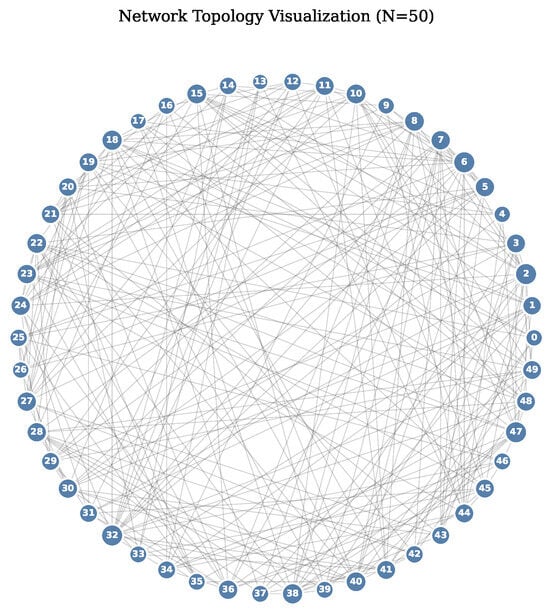
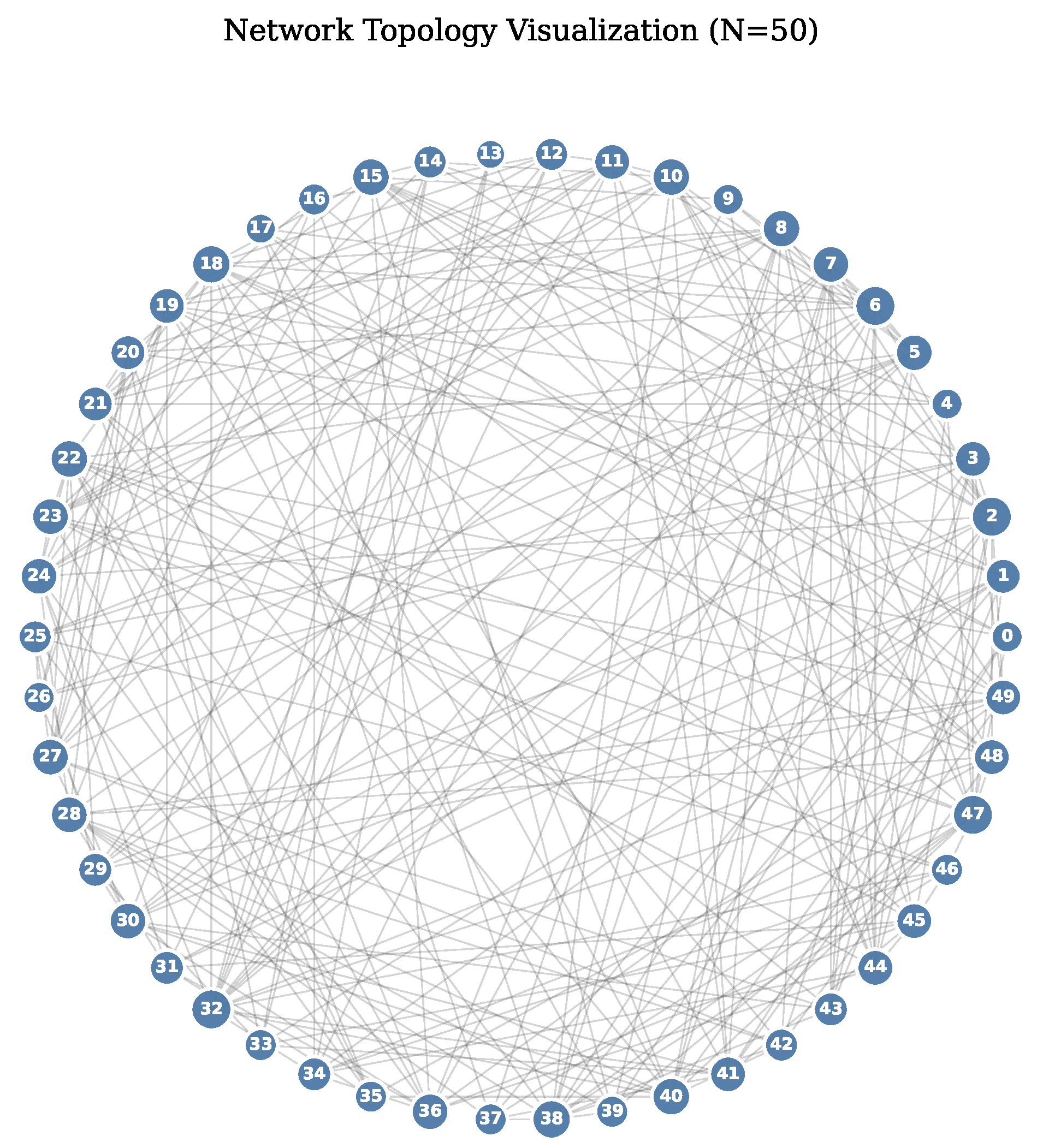
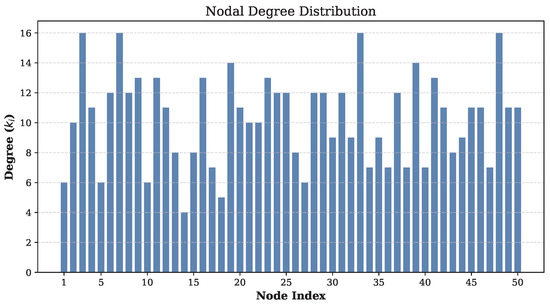
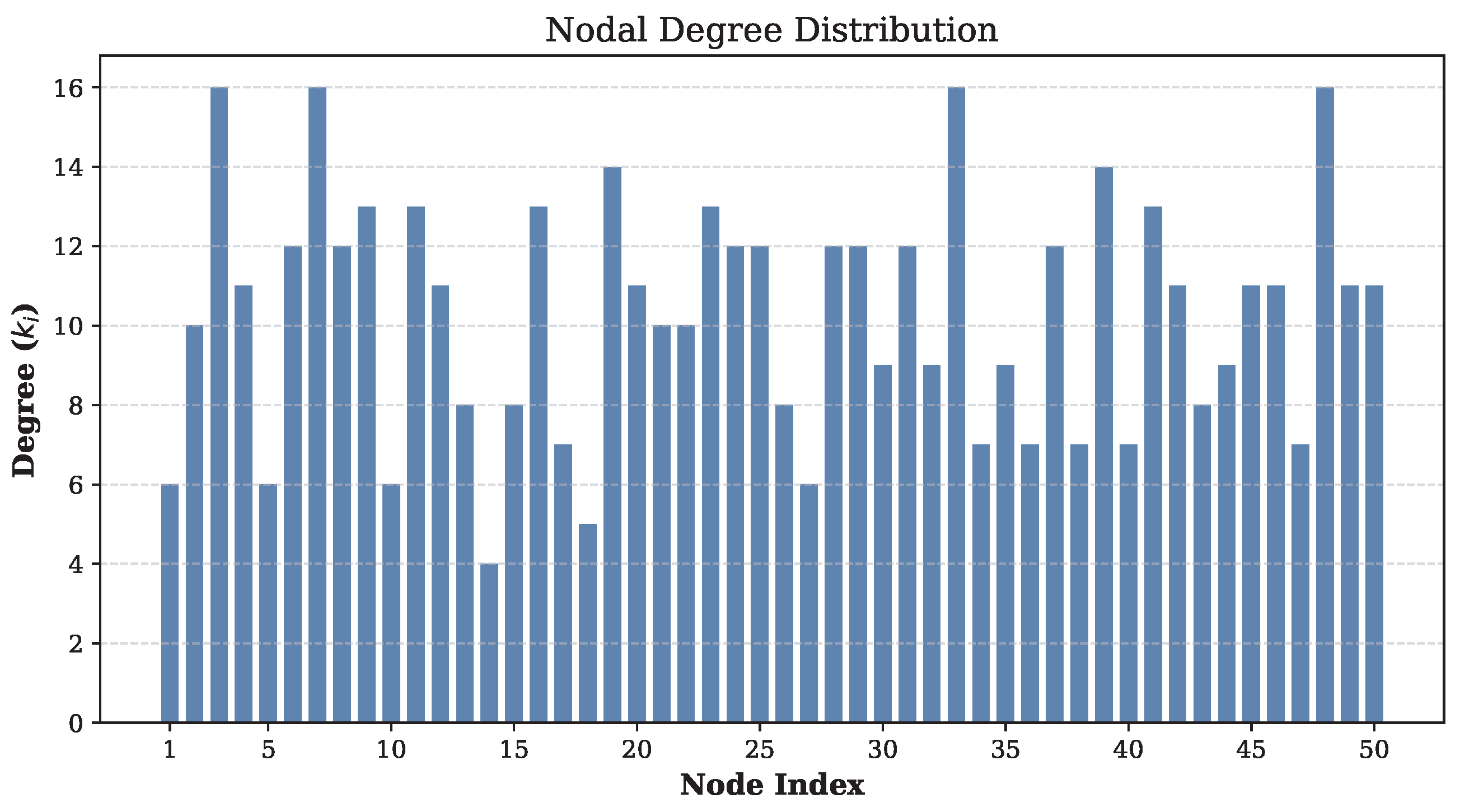
Visual exploration of the topological matrix and the degree distribution are provided in Figure 1 and Figure 2 and Table A1, respectively. The histogram vividly highlights a varied state of connectivity heterogeneity. This structural variance is historically crucial for pinning control; standard heuristic theories argue that nodes endowed with the highest centrality degrees generally exert maximum control authority. A core objective of our methodology is to forcefully test this hypothesis against the hyperchaotic paradigm.
Figure 1.
Visual abstract representation of the 50-node network topology utilized throughout the experimentation. The visualizer illustrates a highly interconnected dense core characterized by a pervasive global coupling ().
Figure 2.
Nodal degree frequency distribution of the 50-node topology. The substantial variance clearly highlights the innate heterogeneity in local connection topologies, traditionally serving as a heuristic predictor to designate highly influential candidate nodes for synchronization.
2.2. From Chaos to Hyperchaos: High-Dimensional System Dynamics
Standard temporal chaotic dynamics, such as the classical 3D Lorenz oscillator, generate an inherently unpredictable but strictly low-dimensional strange attractor structurally defined by a single expanding trajectory direction (quantified by one positive Lyapunov exponent ). In sharp contrast, a dynamical network transitions into hyperchaotic behavior when the minimal essential dimension is expanded to , forcing the dynamic spatial flow to infinitely stretch and fold across a minimum of two mutually independent directions ().
To embed this extreme non-linearity into our network, we adopt the generalized 4D hyperchaotic Lorenz system synthesized by Wang and Wang (2008) [18]. This system is mechanically derived from the canonical 3D Lorenz analog by mathematically injecting a continuous, nonlinear state-feedback control component w. The uncoupled autonomous continuous-time evolution of any individual node i is rigorously defined by the deterministic differential equations:
where the unified state vector is uniquely defined as . Operational parameters governing the chaotic bifurcation thresholds are frozen at the classic norms: , , , while the newly introduced parameter r precisely commands the hyperchaotic shift.
According to established non-linear dynamical theory [18], an authentic hyperchaotic attractor must sustain a bounded, dissipative continuous structure. The formal degree of physical volume contraction for the 4D flow is obtained by computing the vector field divergence:
Inserting the predefined spatial coordinates:
For the non-linear trajectories to be strictly physically bounded and dissipative within an invariant set attractor, it must hold that . Throughout all optimization runs, we securely fix the crucial bifurcation parameter at . This assignment explicitly satisfies the condition (). Under these parameters, spectral diagnostic matrices expose the unique presence of precisely two positive Lyapunov exponents: , physically validating and classifying the uncoupled state vector flow as genuinely hyperchaotic.
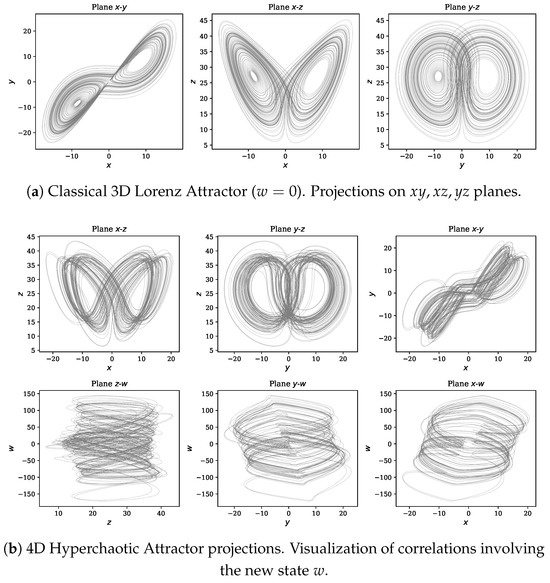
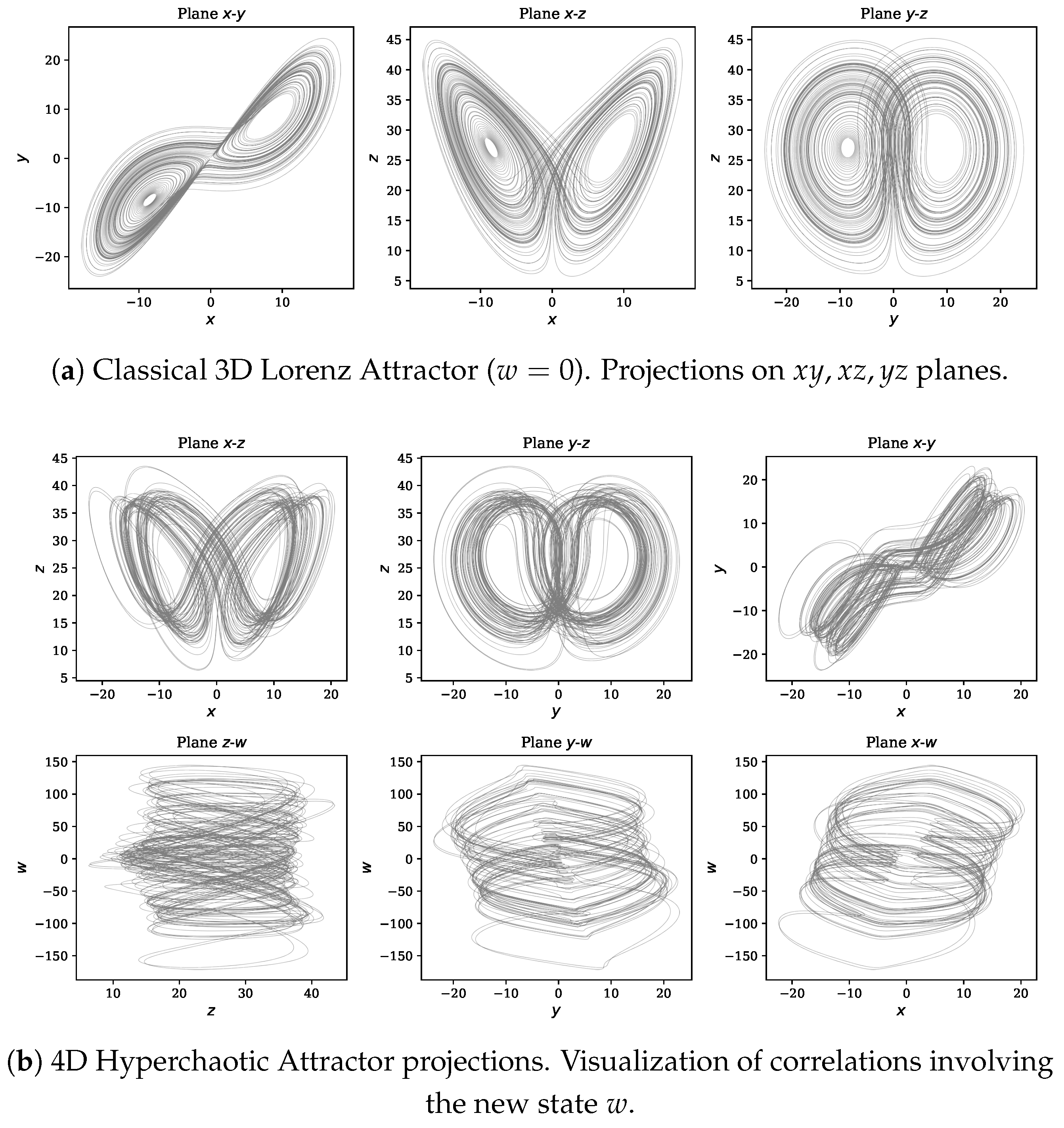
Phase-space dimensionality expansion severely complicates phase mapping, as illustrated in the projections in Figure 3. The incorporation of the continuous state variable w morphs the topology from a structured dual-scroll surface shown in Figure 3a into a volatile, densely wrapped spherical topology spanning multi-axial coordinates presented in Figure 3b.
Figure 3.
Visual comparison of phase space complexity. (a) The standard chaotic system generates a low-dimensional strange attractor. (b) The hyperchaotic system exhibits a denser topological structure with multiple instability directions due to the additional state dimension w.
2.3. Coupled Network and Impulsive Pinning Control Strategy
When the N autonomous hyperchaotic oscillators are embedded within the network matrix, they are physically intertwined via a continuous, degree-normalized diffusive coupling mechanism. The state trajectory of an individual node i under the influence of its interconnected neighborhood is formally modeled as:
where is the autonomous isolated chaotic field (1), defines the uniform global coupling scalar determining the interaction potential, refers to the static topological adjacency matrix, and is the exact in-degree of node i. This normalization guarantees that densely connected nodes do not become overwhelmingly saturated by external neighborhood energy matrices.
The active pinning control intervention vector is meticulously designed as an autonomous, localized, proportional linear regulator. To massively reduce requisite global system power margins, the vector does not exert force strictly continuously. An intermittent impulsive framework activates only after an initial transient stabilization delay ( s) structured as:
where and g represents the raw feedback compensation gain (), serves as the unified stable target trajectory (which for this configuration framework targets a regulated origin ), and the essential variable acts as the physical Boolean pin. If , the continuous controller is intrinsically bound to node i (it acts as a driver node); if , the target node remains freely suspended inside the standard diffusive system (functioning solely as an influenced node).
2.4. Binary Optimization Problem Formulation
The ultimate mechanical goal of this overarching framework is to forcibly propel the coupled dynamic multi-state synchronization error to its absolute zero-bound mathematical limit (). Given the unviable spatial complexity inherent in manually modeling and solving inverse multidimensional nonlinear topologies, the challenge seamlessly collapses into a computationally rigorous combinatorial binary optimization constraint problem.
Selected optimizer must intelligently filter and extract a highly robust Boolean location arrangement minimizing the summed terminal spatial discrepancy limit exactly at :
To assert strict practical viability modeling standard physical hardware/energy implementation constraints, the deployment matrix S is restricted. The controller logic strictly requires that precisely unique nodes are permanently activated inside the continuous graph. Consequently, the combinatorial optimization protocol must aggressively respect the rigid dimensionality limitation limits:
The extreme difficulty emerges mathematically: selecting K nodes out of a universe N directly triggers the immense binomial metric boundary , mapping over individual potential architectural paths in a notoriously bumpy and deceptive error phase landscape heavily plagued by topological local optima loops.
3. Methodology and Optimization Framework
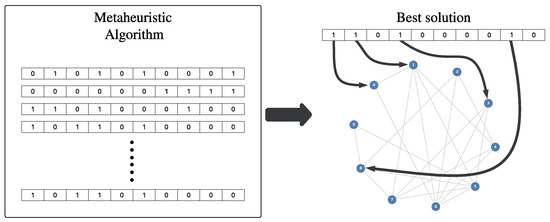
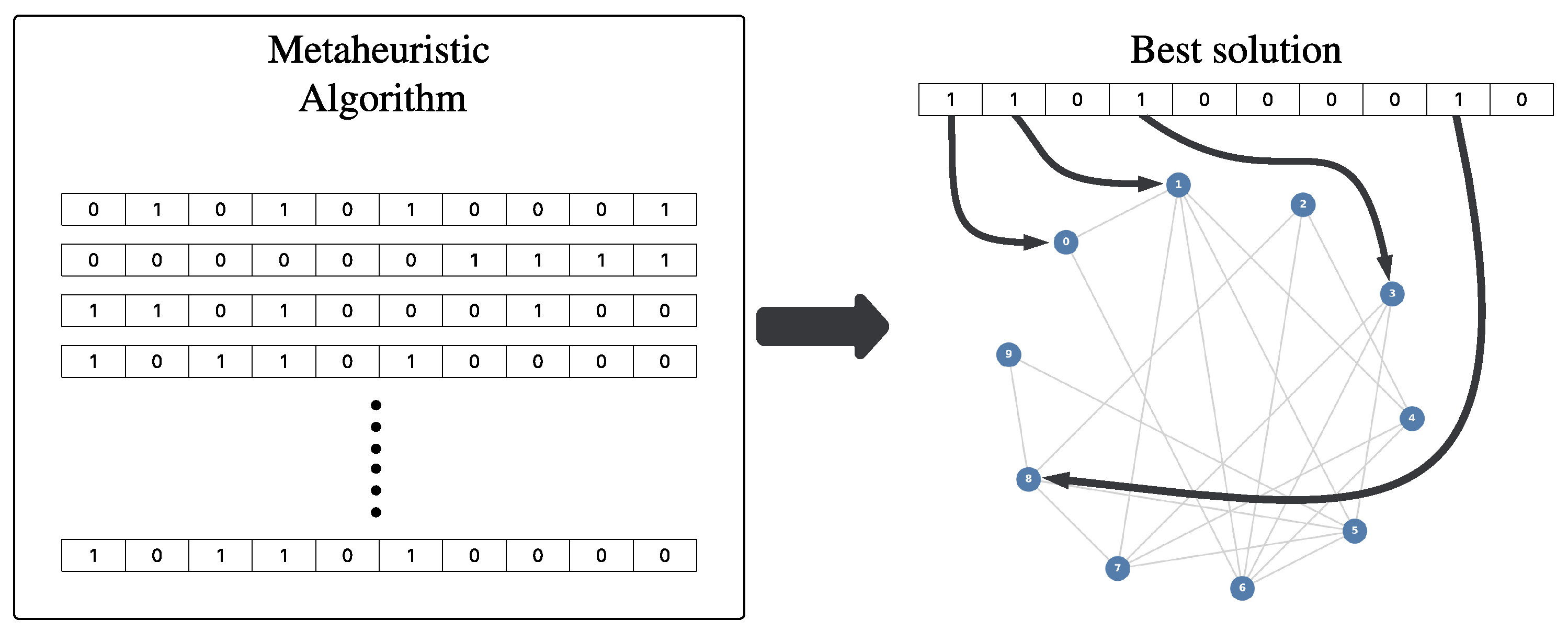
The selection of an optimal subset of driver nodes in a complex hyperchaotic network constitutes an NP-hard combinatorial optimization problem. The size of the search space for choosing exactly K nodes from a network of N nodes is given by the binomial coefficient . For our configuration (), this yields approximately possible binary combinations. To navigate this highly multimodal and rugged fitness landscape effectively, we designed a comprehensive optimization framework to select the pinned nodes as is shown in Figure 4 where is presented a network with ten nodes and four are selected as pinned.
Figure 4.
Metaheuristic algorithm selecting the best solution.
3.1. Fitness Function and Simulation Engine
The objective of the optimization process is to minimize the synchronization error. Simulation of the coupled network is numerically integrated using the Euler method with a micro-step of s over a total simulation time spanning s, totaling 5500 integration steps per evaluation.
Pinning control strategy is implemented as an impulsive controller to reduce the continuous energy output. The control input is applied intermittently (every 2 integration steps) and is activated only after an initial transient period ( s). The generalized fitness function assigned to a specific binary vector is modeled as the inverse of the accumulated absolute error of the network states relatively to the reference target plus a penalty:
where acts as a severe penalty function applied if the algorithm produces an invalid configuration where . In such cases, , drastically reducing the fitness to guide the evolutionary process away from infeasible sub-spaces.
3.2. Solution Encoding and Constraint Handling
While algorithms inherently attempt to stay within bounds, stochastic operators (like mutation or Lévy flights) can displace solutions. To systematically map infeasible vectors back into the constrained feasible subspace (), a stochastic Repair Mechanism is enforced on all candidate solutions post-generation [19]. By using the repairer, algorithms are forced to always move within the hyperplane of feasible solutions. The randomness of the repair prevents the introduction of deterministic biases that could artificially favor certain areas of the search space, thus preserving the integrity of the algorithms.
- Surplus reduction (): The algorithm identifies all indices where , randomly samples of these genes, and forcibly switches them to 0.
- Deficit augmentation (): The algorithm identifies inactive genes (), randomly samples indices, and forces them to 1.
3.3. Deterministic Baseline Framework
To establish a robust comparative framework systematically evaluating state-of-the-art (SOTA) deterministic methodologies, three non-stochastic baseline strategies are implemented. The first framework, Spectral Centrality Greedy (SCG), ranks discrete network elements based upon the absolute entries of the principal eigenvector defined by the transition matrix . This specific matrix formulation encapsulates the leading mode of the network’s random-walk dynamics and is deliberately selected over the unnormalized Laplacian matrix to maintain rigorous mathematical consistency with the degree-normalized diffusive coupling mechanism formalized in Equation (4). The second methodology, Algebraic-Connectivity Greedy (ACG), operates by iteratively appending the individual node that maximizes the algebraic connectivity () of the pinned random-walk Laplacian matrix . Finally, a Local Search 1-1 Swap (LS-1-1) procedure is introduced as an exhaustive local optimization framework; initialized from the resulting SCG configuration, it systematically executes pairwise permutations between pinned and unpinned nodes, strictly retaining structural swaps that monotonically diminish the overall synchronization error , continuing until a local minimum state is proven. Evaluation constraints and simulation conditions match the primary experimental framework.
3.4. Metaheuristic Solvers and Binarization Strategies
We evaluate a diverse pool of metaheuristics. A significant theoretical obstacle is that modern swarm algorithms (GWO, CS, SHO) natively operate in continuous search spaces (). Consequently, spatial adaptation techniques based on S-shaped transfer functions [20] are strictly implemented. The continuous positional element is flattened into a probability bound using a Sigmoid function, bounded at to prevent numerical overflow:
specific process of each algorithmic solver within our framework are detailed below.
Operating entirely in the discrete domain [21], the Genetic Algorithm (GA) utilizes a native binary encoding. Selection is performed via deterministic Tournament Selection (), followed by a single-point crossover operator (). To maintain population diversity without violating the cardinality constraint natively, the mutation operator () is customized: instead of flipping random single bits, it randomly selects one active node () and one inactive node () and swaps their states, inherently preserving .
The standard continuous Artificial Bee Colony (ABC) is adapted as a Discrete ABC (DisABC) [22] avoiding sigmoid functions. The population is divided into employed, onlooker, and scout bees. Employed bees explore the neighborhood of their memorized food source by applying direct boolean bit-flips [16]. Onlooker bees select food sources based on a roulette-wheel probability . If a food source does not improve after a predefined ‘limit’ of iterations (set to ), it is abandoned, and a scout bee randomly re-initializes exactly 10 novel driver nodes, effectively evading local hyperchaotic optima traps.
Grey Wolf Optimizer (GWO) inspired by the hierarchical hunting mechanism of wolves [15], the population is guided by the three best solutions observed (). To enhance exploration in the complex early stages of the synchronization topology, we introduced a non-linear decay for the search coefficient a:
this allows wolves to take larger positional leaps (via the binarization transfer function) at the start of the simulation, aggressively narrowing down into exploitation as [20].
The Cuckoo Search (CS) algorithm navigates the search space predominantly using heavy-tailed random walks known as Lévy Flights [14]. A new candidate nest is generated by adding a Lévy step to the current continuous position:
where is the step scaling factor and defines the Lévy tail index computed via Mantegna’s algorithm. To ensure high-level diversity [23], a discovery probability () is applied, wherein the worst-performing fraction of the nests is completely abandoned and replaced by randomly generated feasible configurations.
The Seahorse Optimizer (SHO) [13] introduces dual behavioral models dictated by dynamic gender roles. Male seahorses (assigned for exploitation) perform logarithmic spiral movements converging towards the elite individual to refine the local optimal topology. Female seahorses (assigned for exploration) perform Brownian motion characterized by a generalized Gaussian distribution () acting upon random points. A key modification in our framework is the stagnation swap: if an individual fails to improve its fitness for strictly 3 consecutive iterations, its “gender” is systematically swapped, forcing a shift from local exploitation back into broad structural exploration.
Bridging evolutionary biology with quantum mechanics [12], Quantum Genetic Algorithm (QGA) does not store standard bits but quantum bits (Q-bits) defined by probability amplitudes . In our architecture, the population maintains the probability vector of the ‘1’ state. Solutions are collapsed into classical discrete bits via observation against a uniform random threshold: . Instead of structural crossover, Q-bits’ phases are rotated towards the global best string using a quantum rotation gate [24] with a learning rate . White Gaussian noise () is injected during rotation to suppress premature phase convergence.
4. Green-AI Architecture for Sustainable Evaluation
Evaluating the fitness of a single dynamic node configuration invokes the extensive Euler numerical integration of a system of coupled non-linear differential equations comprising interconnected state variables. Over 5500 iterations per evaluation, population-based metaheuristics rapidly generate an immense CPU overhead and massive energy expenditure.
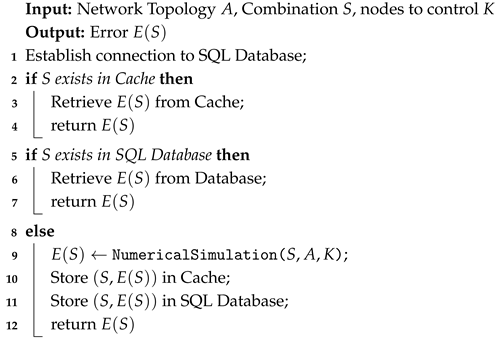
To confront this computational barrier from a framework of sustainability (Green AI), we engineered a unified, robust caching architecture leveraging RDBMS structural persistence (MySQL) as described below and with Algorithm 1.
- 1.
- Tier 1 (in-memory hashing): Every executed algorithm generates an internal hash-map dictionary to intercept immediately repeated evaluations within the scope of its discrete run.
- 2.
- Tier 2 (global SQL persistence): Before the heavy physical simulation is invoked, the optimizer generates a 50-char string hash corresponding to the specific selected combination of driver nodes (e.g., “00101…”) and queries a unified central database table.
- 3.
- Recycling physical intelligence: If a cache hit is verified, the previously computationally expensive synchronization error is instantaneously fetched via an query, bypassing the physical engine entirely. Conversely, upon a cache miss, the integration operates, and the novel error matrix is archived downstream.
By decoupling the physical evaluation engine from the stochastic generations, this Green-AI mechanism ensures that identical spatial configurations discovered transversally across different metaheuristics or independent executions strictly recycle previously harvested topological knowledge, accelerating cumulative research while minimizing carbon output.
| Algorithm 1: Pinning Control Metaheuristic with SQL-Memoization (Green-AI) |
 |
5. Results
Three experiments were conducted on a standardized computational framework to ensure fair comparability. The first experiment was conducted by simulating the hyperchaotic network dynamics using the Euler method with a fixed time step s and a total simulation time s. The control gain was set to , applied impulsively every 2 iterations. The topology for this experiment is described by the adjacency list in Table A1 of Appendix A.
To ensure reproducibility, the random number generators (Numpy 1.26.4 and Python 3.12 random) were initialized with fixed seeds (seed = 123 for physics simulation, seed = {1,2,3,...30} for stochastic algorithms). Table 1 details the specific hyper-parameters configured for each metaheuristic solver, selected based on standard literature recommendations and preliminary tuning.
Table 1.
Parameter configuration for the metaheuristic algorithms.
Before evaluating the metaheuristics, we established baseline performance metrics using topological heuristics and random selection. Three random configurations (“random”) were tested alongside strategies selecting “most connected” nodes and “least connected” nodes.
As shown in Table 2, random selection strategies yield inconsistent results. While selecting the first 10 nodes (Random_1) surprisingly yields a low error due to clustering in the lower indices, stochastic selections result in varying degrees of partial synchronization.
Table 2.
Synchronization error for Random node selection strategies.
In terms of topological attacks, we evaluated the impact of controlling the most connected nodes of the network (Table 3) versus the least connected nodes (Table 4). We performed three trials for each strategy to account for nodes with tied degrees.
Table 3.
Performance of Hub-based strategies (Most Connected).
Table 4.
Performance of Low-Degree strategies (Least Connected).
While targeting most connected nodes yields acceptable errors (∼), degree centrality alone does not guarantee optimal pinning in 4D hyperchaotic networks. To provide deterministic references beyond simple degree heuristics, Table 5 summarizes additional baseline strategies.
Table 5.
Deterministic baseline results for the first experiment.
5.1. Deterministic and Sota-Inspired Baselines
To properly contextualize the performance of the bio-inspired metaheuristics, it is essential to benchmark them against established deterministic protocol derived from the State-of-the-Art (SOTA) in network control theory. These baselines evaluate the efficacy of algebraic graph properties—specifically the spectral components of the modified Laplacian matrix—and structured combinatorial local search techniques in establishing robust synchronization. Following this theoretical framework, Table 5 reports the corresponding deterministic baseline errors and the respective number of objective evaluations required during the first experiment.
Quantitative outcomes, detailed in Table 5, underline a substantial variance concerning the predictive efficacy of deterministic structural mechanisms. The ACG strategy exhibited sub-optimal performance boundaries (), conveying that optimizing solely for the algebraic connectivity of modified Laplacians remains largely inadequate to suppress the multidirectional divergence inherent to 4D hyperchaotic network topologies. Conversely, the SCG approach generated a highly capable initial state vector (), providing empirical evidence that the principal eigenspace embedded within the transition matrix correlates profoundly with the distribution of control energy requirements. Utilizing this spectral vector as an initialization benchmark, the LS-1-1 algorithm extensively refined the discrete selection, minimizing the asymptotic error boundary to following 1601 physical error evaluations. This convergence mathematically implies that while the broader hyperchaotic combinatorial landscape displays extreme non-convexity, it locally preserves navigable gradient channels in the spatial vicinity of high-quality spectral seeds. Crucially, however, this precision demands an overarching computational cost of 1601 discrete objective evaluations specifically for the current 50-node network under a 40-10 structural configuration (40 unregulated nodes and 10 driver pins). It is essential to emphasize that this parameter constitutes the observed cost for a distinctly favorable SCG initialization. Mathematically, each iteration of the 1-1 localized search must exhaustively evaluate exactly adjacent combinatorial configurations. Consequently, utilizing divergent spectral seeds or arbitrary initial structures could precipitate a protracted descent, where reaching a standard algorithmic cutoff (e.g., 50 local iterations) would impose a prohibitive worst-case boundary of 20,001 structural evaluations before confirming convergence. As detailed in the subsequent section, the population-based metaheuristics evaluated in this study operate autonomously with substantially lower computational burdens (peaking globally at 924 evaluations), rigorously justifying the deployment of bio-inspired solvers to bypass the exorbitant and unpredictable cost of exhaustive combinatorial local search mechanics.
5.2. Comparative Analysis of Metaheuristic Solvers
Subsequent quantitative analyses pivot to benchmark the global search capabilities among the six proposed metaheuristic algorithms. The fundamental objective evaluates their autonomous structural capacity to globally discover optimal binary pinning matrices that minimize steady-state synchronization error autonomously, bypassing any reliance on heavily computed topological initialization inputs. Table 6 delineates the superior spatial configurations successfully synthesized by each respective solver.
Table 6.
Best solutions found by each algorithm sorted by minimization performance.
Artificial bee colony (ABC) algorithm emerged as the most competitive solver in this specific experiment, isolating a configuration that reduces the error to the order of . This mathematically favorable performance within the tested hyperchaotic environment can be attributed to the scout bees phase, which promotes continued exploration and helps circumvent stagnation in local optima. While ABC yielded the lowest absolute error in this initialization, the novel Seahorse Optimizer (SHO) and Cuckoo Search (CS) achieved errors in the highly competitive range, confirming the broader efficacy of modern bio-inspired solvers. Notably, all metaheuristics decisively outperformed the topological baselines (Table 3 and Table 4), corroborating that isolated degree connectivity is not a sufficient predictor of control efficacy in high-dimensional 4D systems.
Furthermore, integrating the specific boundary of objective evaluations reveals a profound operational efficiency. Executed independently to reflect worst-case un-cached loads, no individual metaheuristic exceeded 924 structural evaluations (ABC: 924, GA/QGA: 900, CS: 770, SHO: 620, GWO: 481). In stark contrast to the exhaustive deterministic protocol of LS-1-1—which commanded an overarching maximum cost of 1601 evaluations to synthesize a closely matched parameter domain—these bio-inspired architectures successfully traversed the identical multi-modal landscape while preserving up to a 69.9% relative physical evaluation reduction (in the case of GWO). This emphasizes that employing swarm-intelligence constraints averts exhaustive computational redundancy whilst securing competitive, globally optimal synchronization metrics.
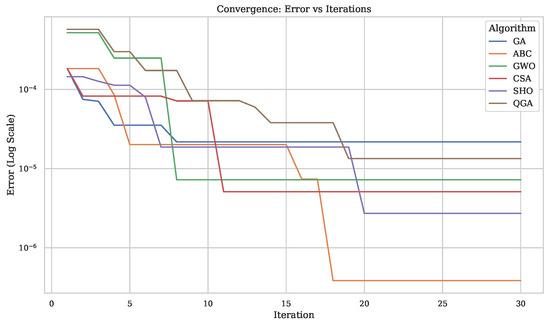
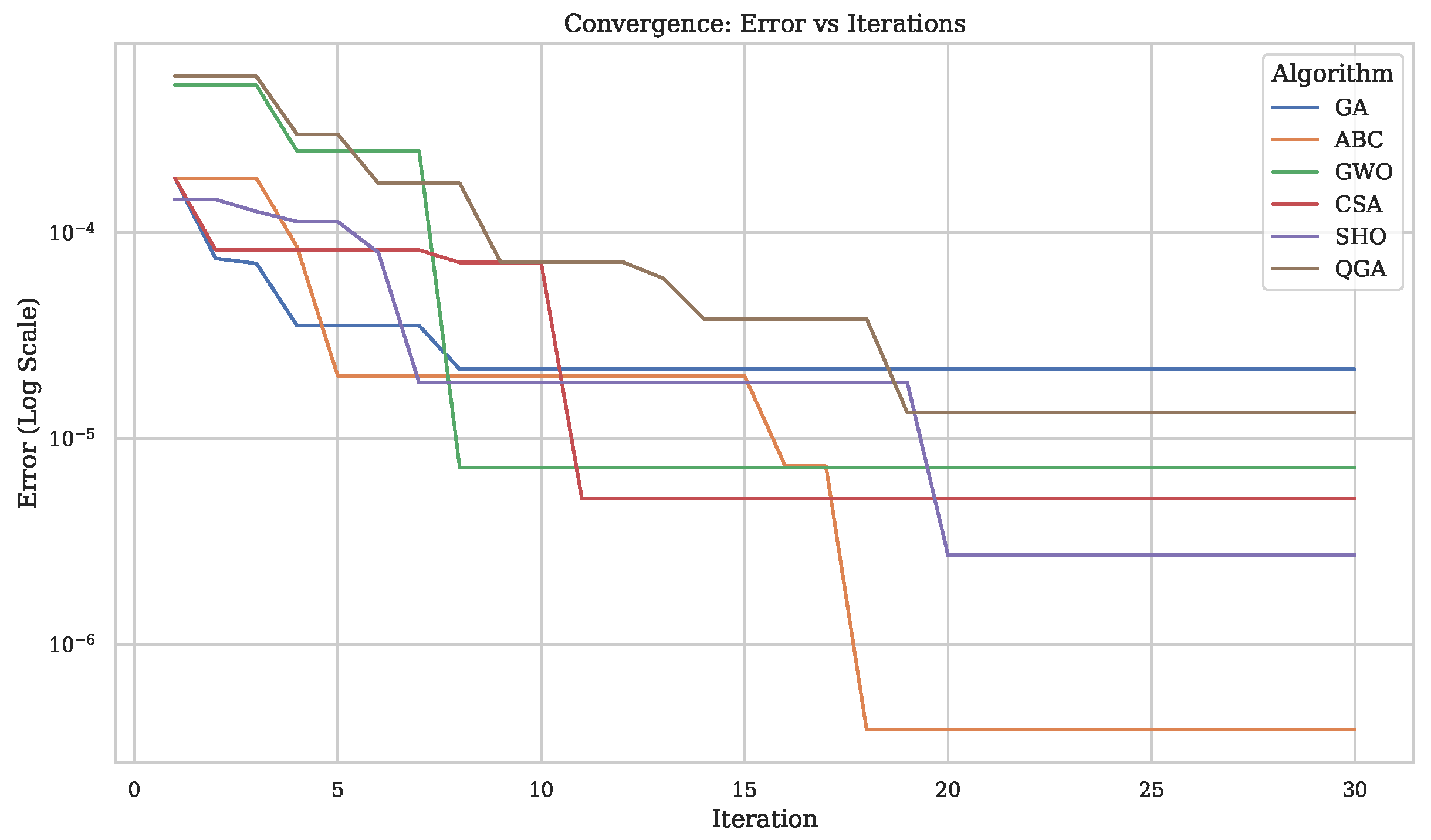
Convergence behavior of the algorithms is illustrated in Figure 5. ABC and SHO show a sustained capability to improve solution quality throughout the iterations, whereas classical GA exhibits premature convergence, flattening out after the first few iterations.
Figure 5.
Convergence profiles (Error vs. Iterations) for the evaluated metaheuristics. Note the logarithmic scale on the y-axis, highlighting the deep descent achieved by ABC and SHO.
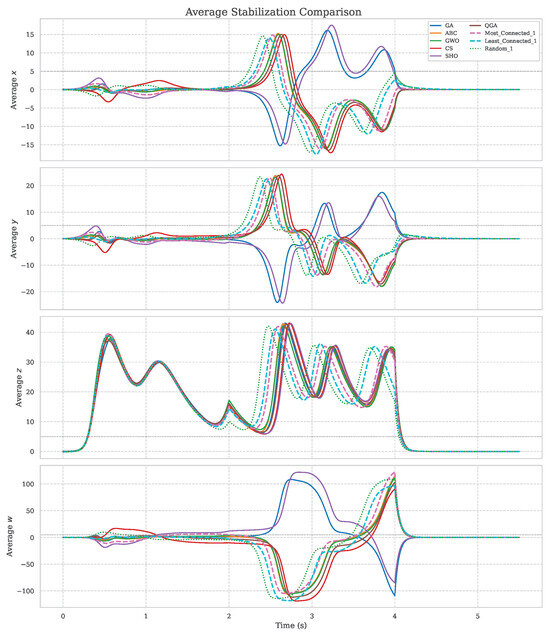
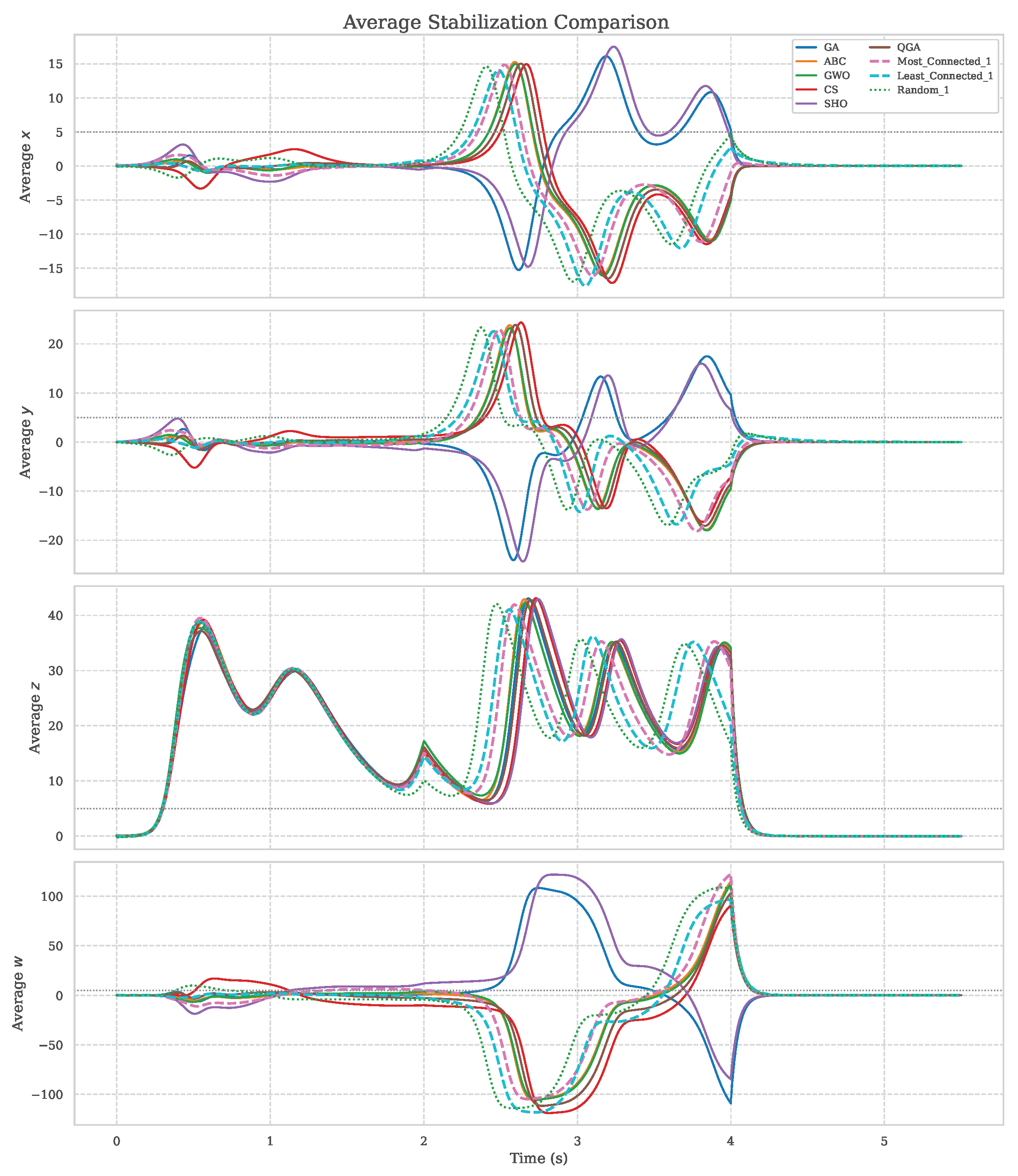
Additionally, Figure 6 visualizes the temporal stabilization of the network states () for the best solutions found. The trajectories show that the high-quality configuration identified by ABC mathematically forces the network states (solid lines) to synchronize with the reference signal (gray dotted line) effectively, minimizing residual oscillation compared to manual or baseline approaches.
Figure 6.
Average Network Stabilization. The curves depict the mean state trajectories of the network nodes under the control of the best solutions found. The ABC algorithm (blue) achieves the tightest synchronization with the reference state.
The second experiment was conducted employing a different connectivity configuration, which is shown in Table A2. For the metaheuristic algorithms, the maximum number of iterations was set to 20, and the penalty function was changed to the absolute value of the difference between the sum of pinned nodes and the required number of driver nodes (K):
Implementing this change to the penalty function makes it possible to directly assess, for each calculated and penalized error, how heavily a solution is penalized, rather than simply marking it as “penalized.” This allows for a more in-depth analysis of the behavior of metaheuristic algorithms, as well as an assessment of the quality of the proposed solutions.
To compare the metaheuristic algorithms, 600 random combinations for pinned node were generated and evaluated getting the results shown in Table 7 and selecting the three combinations with the most connected nodes obtaining the results presented in Table 8.
Table 7.
Metrics of random selection strategy.
Table 8.
Performance of most connected strategy for the second network.
To ensure statistical significance and account for the metaheuristics algorithms, each algorithm was carried out 30 times. This allowed us to report not only the best-found solutions but also mean and standard deviations values, providing a more reliable performance comparison presented in Table 9. Additionally, a Wilcoxon test was performed to validate the results against the best result of selecting the most connected nodes. The resulting p-values, detailed in Table 10, confirm that the superiority of the all algorithms compared except for QGA is statistically significant.
Table 9.
Metrics from all the metaheuristic algorithms for second network.
Table 10.
Wilcoxon Test against the result of selecting most connected nodes.
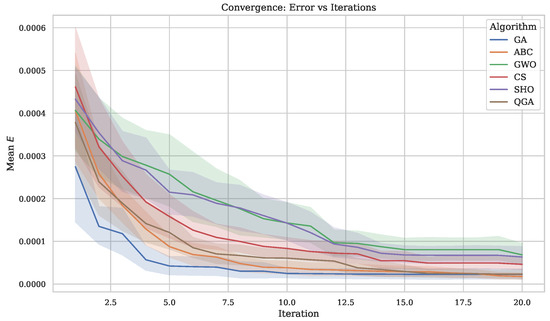
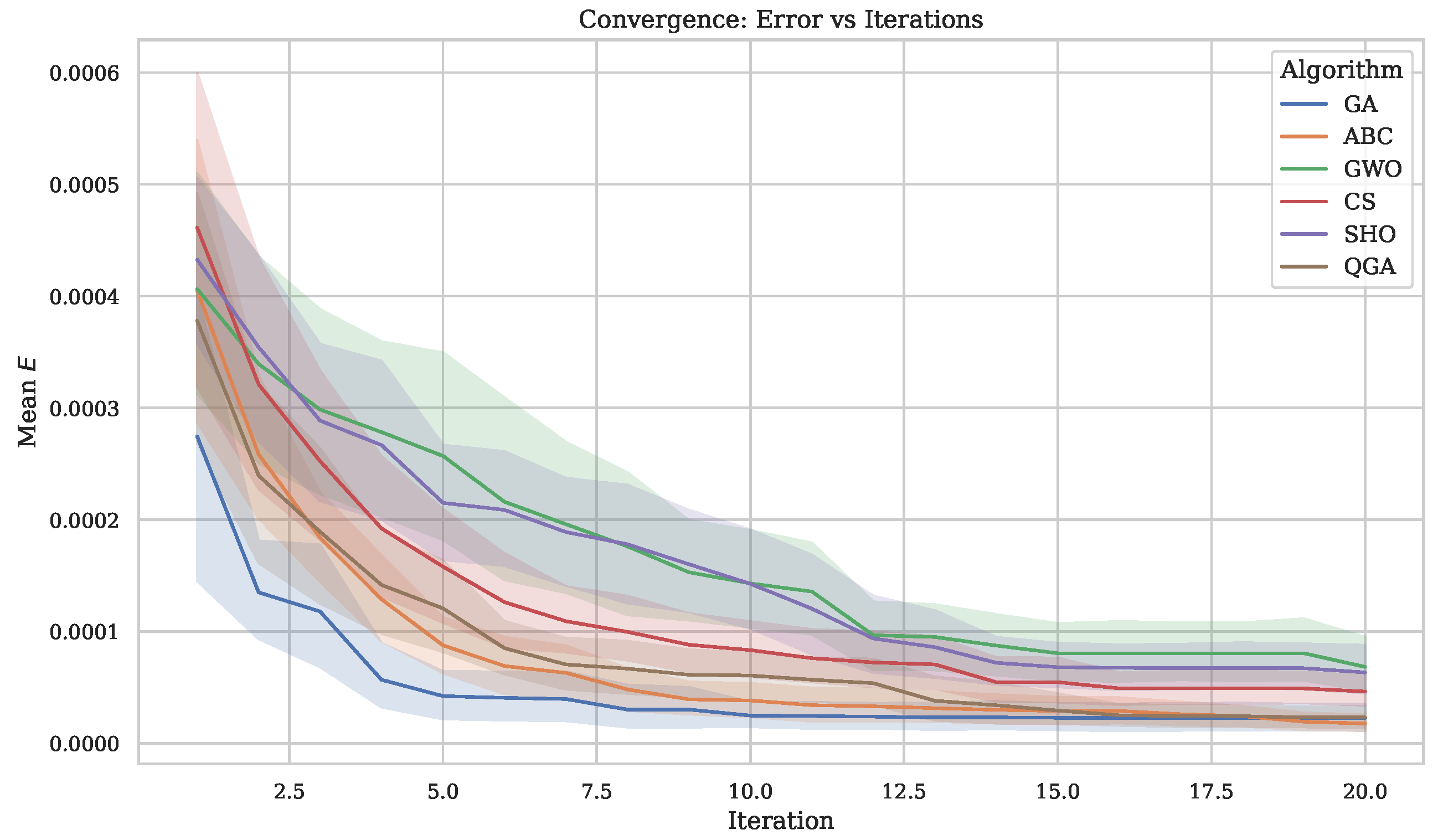
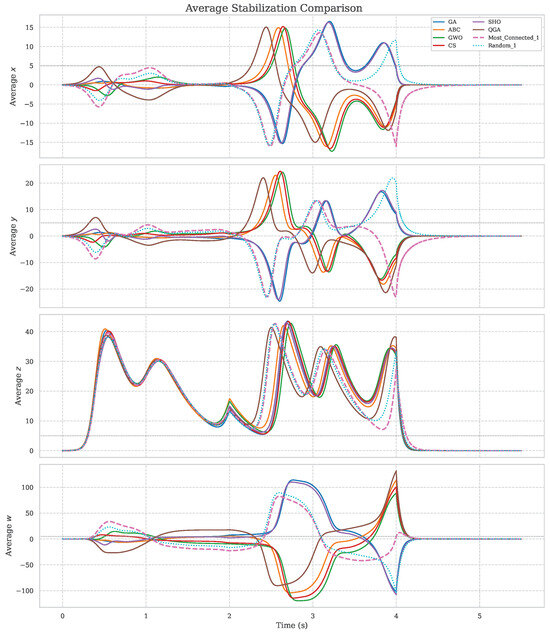
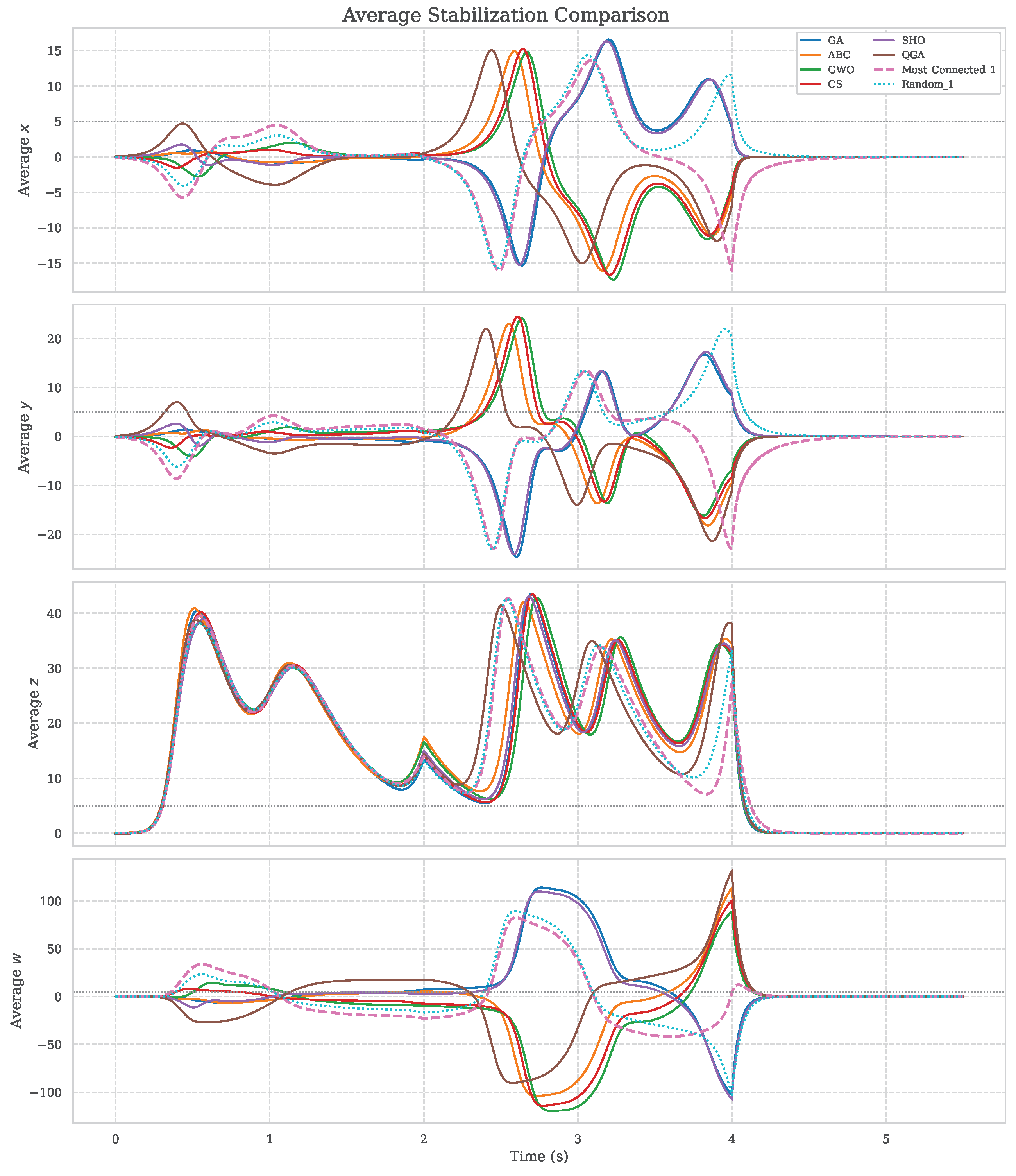
Mean convergence behavior for the second experiment is illustrated in Figure 7. ABC and GA show a consistent performance at getting solution quality showing the best Mean value of . Furthermore, Figure 8 visualizes how the network state () changes over time for the best solutions found by the different strategies.
Figure 7.
Convergence profiles (Error vs. Iterations) for the evaluated metaheuristics in the second experiments.
Figure 8.
Average Network Stabilization for the second network.
Execution times for initializing the population with and without Green-AI technique presented in Table 11 shows an improvement in the time efficiency of all evaluated algorithms. An average execution time was reduced from 125.4 s to 4.1 s representing a computational saving of at least 90%.
Table 11.
Time with and without Green-AI technique when initializing the population.
The third experiment was conducted employing a configuration with 20 nodes, which is shown in Table A3. For the metaheuristic algorithms, there are no changes with respect to the second experiment. Table 12 shows the error statistics with respect to the Monte Carlo random node selection baseline, and Table 13 presents the results of pinning the most connected nodes.
Table 12.
Metrics of random selection strategy in the third experiment.
Table 13.
Performance of most connected strategy for the third network.
As in the second experiment, each metaheuristic algorithm was carried out 30 times. Their metrics are presented in Table 14, and a Wilcoxon signed-rank test against the best result of selecting the most connected nodes is presented Table 15.
Table 14.
Metrics from all the metaheuristic algorithms for the third network.
Table 15.
Wilcoxon Test against the result of selecting most connected nodes fot third experiment.
Table 16 summarizes the configuration of each experiment.
Table 16.
Comparison of experimental setups, network, and validation parameters across all three experiments.
5.3. Green-AI Validation: Scaling and Cache Efficacy
To validate the collaborative efficiency and environmental scalability of the proposed SQL-memoization architecture, third experiment (utilizing the 20-node topological framework with 6 pinned nodes, delineated in Table A3 of Appendix A) provided an optimal testing ground. The intrinsically smaller combinatorial search space inherently heightens the probability of identical structural evaluations among disparate individual runs, allowing the Green-AI mechanism to rapidly populate its SQL registry and recycle numerical Euler integrations.
During this trial, 30 independent global executions per algorithm were recorded, distinctly logging the required objective evaluations against the ensuing cache hits and cache misses. The summarized performance metrics are aggregated in Table 17.
Table 17.
SQL-Memoization scalability metrics aggregated across 30 independent system executions for the 20-node framework.
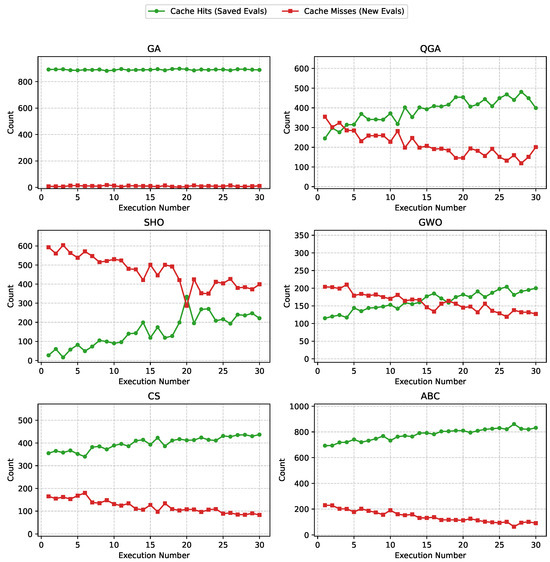
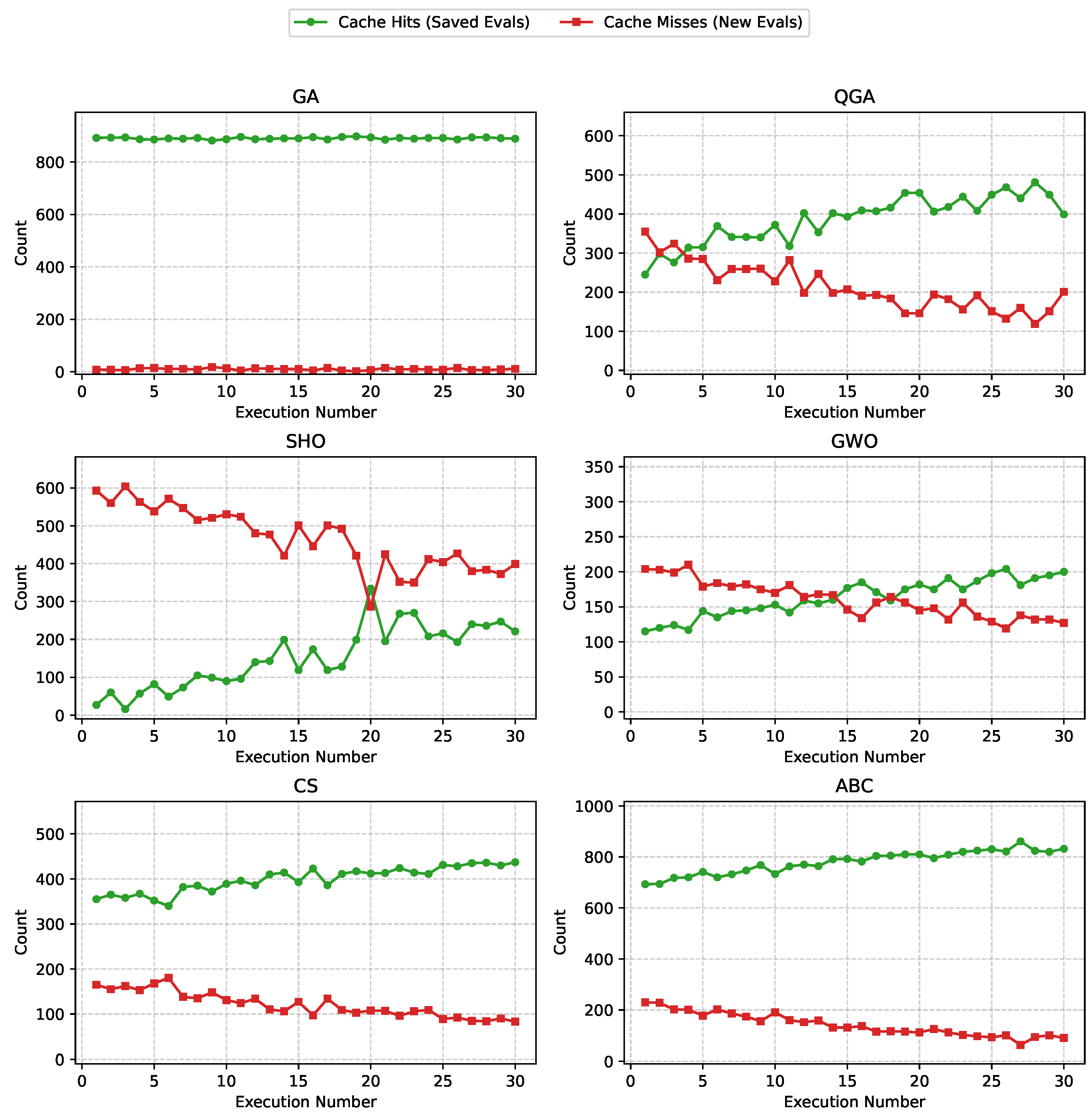
To visually comprehend this evolutionary memoization dynamic, Figure 9 illustrates the inverse relationship between cache hits and cache misses across the sequential execution timeline.
Figure 9.
Evolution of Cache Hits vs. Cache Misses across 30 sequential executions for the evaluated bio-inspired solvers. Green lines denote saved physical evaluations (Hits), whereas red lines indicate new spatial topologies sent to the Euler integrator (Misses).
The analytical trajectory exposes a profound shift in computational weight. Crucially, the SQL-memoization framework was not isolated per algorithm; rather, it functioned as a transversal, continuously expanding global repository. The sequential execution order for the third experiment was strictly scheduled as: SHO (complete 30 runs), followed respectively by QGA, GWO, CS, GA, and finally ABC. Because the cache is universally shared, algorithms executed later in the sequence inherently inherited the topological explorations mapped by their predecessors. As depicted in Figure 9, the Classical Genetic Algorithm (GA) and Cuckoo Search (CS) rapidly capitalize on this accumulated memory, successfully aborting nearly 99% and 76% of their requisite complex integrations respectively, satisfying their objective evaluations almost entirely via the global database from their very first execution. Even robustly convergent and highly explorative protocols that act later in the pipeline, like ABC, maintained a massive 84.61% overall caching resolution while continuing to enrich the repository. This compelling empirical evidence ratifies the fundamental premise of the Green-AI paradigm: as overlapping populations—even from distinct algorithmic architectures—continually explore analogous multidimensional topological pathways, preserving evaluations via an indexed global repository drastically decimates the energy-intensive processing demands standard to bio-inspired solvers.
To contextualize the physical magnitude of these reductions, it is critical to address the temporal and energetic cost of the numerical simulations. The overarching experimental framework was deployed across a distributed cluster of computing units. On one of the representative hardware blocks utilized, effectively solving a single instance of the objective function (encompassing a full 4D hyperchaotic integration over 5500 Euler steps) required approximately 23 s of raw CPU execution time (using Table A2). Aggregating the 30 global executions across the six metaheuristics yielded a staggering theoretical volume of 116,571 demanded structural evaluations. Operating strictly without memory, processing this massive combinatorial matrix sequentially on that specific node would impose an exorbitant computational delay exceeding 744 continuous hours (≈31 solid days). However, by successfully recovering 83,174 of these state requests transversally as cache hits across the shared SQL infrastructure, the Green-AI architecture proactively averted more than 531 h (≈22.1 days) of inherently iterative redundant processing. By directly circumventing this massive workload, the methodology guarantees significant energy sustainability while accelerating decentralized research workflows across heterogeneous hardware networks.
6. Conclusions
This paper addressed the highly complex problem of driver node selection in the pinning control of a complex dynamical network exhibiting 4D hyperchaotic Lorenz dynamics. Unlike low-dimensional chaotic systems, the multidirectional spatial expansion dictated by multiple positive Lyapunov exponents creates a severely rugged and multimodal combinatorial landscape. We formally framed this challenge as a strict constrained binary optimization problem, aiming to select an optimal subset of exactly K nodes to minimize synchronization error.
Our extensive simulation experiments show that advanced binary metaheuristics fundamentally outperform conventional topology-based heuristics. Relying exclusively on spatial connectivity metrics—such as targeting the highest degree nodes or employing random selection strategies proved strictly insufficient for establishing robust synchronization in hyperchaotic substrates. These baseline approaches consistently yielded high residual errors or total synchronization failure. The Wilcoxon test results shown that metaheuristics based on collective behavior significantly outperform the degree-selection strategy. The resulting p-values demonstrate that the proposed method outperforms GWO and ABC with statistical significance, as all respective p-values are strictly below the 0.05 threshold.
From a computational sustainability perspective, the implementation of our Green-AI architecture—employing a dual-tier SQL-based structural memoization—proved vital. By decoupling the physical Euler integration engine from the stochastic generations, the framework uniquely recycled thousands of prior evaluations transversally across different algorithms.
While this work successfully identified the optimal topological configuration for a fixed subset of controllers, future research will focus on deploying a multi-objective optimization framework to simultaneously minimize the synchronization error while dynamically determining the absolute minimum number of driver nodes required to stabilize the network. Additionally, integrating global optimization processes to tune the exact energetic gains of the intermittent impulsive controllers, as well as evaluating these robust solvers upon dynamically evolving (time-varying) non-linear topologies, remain highly appealing theoretical frontiers.
Author Contributions
Conceptualization, L.L.-S., G.M.-S. and A.Y.A.; data curation, A.Y.A. and L.L.-S.; funding acquisition, A.Y.A., J.G.A. and G.M.-S.; investigation, L.L.-S., G.M.-S. and R.F.C.; methodology, L.L.-S. and R.F.C.; project administration, A.Y.A., J.G.A. and G.M.-S.; software, L.L.-S. and R.F.C.; validation, A.Y.A., L.L.-S. and R.F.C.; visualization, A.Y.A., L.L.-S. and R.F.C.; writing original draft, A.Y.A., L.L.-S. and R.F.C.; writing—review and editing, J.G.A. and G.M.-S. All authors have read and agreed to the published version of the manuscript.
Funding
This research was funded by Universidad de Guadalajara.
Data Availability Statement
The data analyzed are available from the authors upon request.
Acknowledgments
The authors thank Universidad de Guadalajara for their support in this research.
Conflicts of Interest
The authors declare no conflicts of interest.
Appendix A
Table A1.
Adjacency list for the first experiment.
Table A2.
Adjacency List for the second experiment.
Table A3.
Adjacency List for the third experiment.
References
- Guo, W.; Sha, R.; Li, L.; Zhang, L.; Li, D.; Lu, H.; Hinz, M. Adaptive Genetic Selection based Pinning Control with Asymmetric Coupling for Multi-Network Heterogeneous Vehicular Systems. IEEE Trans. Veh. Technol. 2025, 75, 1948–1963. [Google Scholar] [CrossRef] [Scilit]
- Liu, H.; Lü, M.; Zhang, X.; Li, Z.; Chen, G.; Zeng, Z.; Lü, J. Optimizing pinning-synchronization and mining pinned-nodes of directed networks. IEEE Trans. Syst. Man Cybern. Syst. 2025, 55, 4600–4613. [Google Scholar] [CrossRef] [Scilit]
- Alanis, A.Y.; Hernandez-Barragan, J.; Ríos-Rivera, D.; Sanchez, O.D.; Martinez-Soltero, G. Constrained binary optimization approach for pinned node selection in pinning control of complex dynamical networks. Axioms 2023, 12, 1088. [Google Scholar] [CrossRef] [Scilit]
- Chen, M.; Manna, S.; Sarkar, A.; Noorwali, A.; Othman, K.M. Quantum neural computing enhanced five-dimensional hyperchaotic framework for secured and reliable communication on the Internet of Things systems. Clust. Comput. 2025, 28, 545. [Google Scholar] [CrossRef] [Scilit]
- Zhong, Y.; Lai, Q.; Zhu, C.; Qin, M. A new multi-image encryption scheme for Smart Home IoT integrating hyperchaos and compressive sensing. Comput. Stand. Interfaces 2025, 95, 104051. [Google Scholar] [CrossRef] [Scilit]
- Sajjadi, S.S.; Baleanu, D.; Jajarmi, A.; Pirouz, H.M. A new adaptive synchronization and hyperchaos control of a biological snap oscillator. Chaos Solitons Fractals 2020, 138, 109919. [Google Scholar] [CrossRef] [Scilit]
- Baleanu, D.; Sajjadi, S.S.; Asad, J.H.; Jajarmi, A.; Estiri, E. Hyperchaotic behaviors, optimal control, and synchronization of a nonautonomous cardiac conduction system. Adv. Differ. Equ. 2021, 2021, 157. [Google Scholar] [CrossRef] [Scilit]
- Li, K.; Lin, Y.; Wang, J. Synchronization of multi-directed hypergraphs via adaptive pinning control. Chaos Solitons Fractals 2024, 184, 115000. [Google Scholar] [CrossRef] [Scilit]
- Sun, S.; Wei, X.; Zhang, H.; Hu, X. Event-triggered-based finite-time pinning synchronization control for multi-layer complex networks. Trans. Inst. Meas. Control 2025, 47, 150–157. [Google Scholar] [CrossRef] [Scilit]
- Mao, Z.; Fan, T.; Lü, L. Perturbation-based pinning control strategy for enhanced synchronization in complex networks. IEEE Trans. Syst. Man Cybern. Syst. 2026, 56, 3328–3339. [Google Scholar] [CrossRef] [Scilit]
- Simon, D. Evolutionary Optimization Algorithms; John Wiley & Sons: Hoboken, NJ, USA, 2013. [Google Scholar]
- Malossini, A.; Blanzieri, E.; Calarco, T. QGA: A quantum genetic algorithm. Elettronico 2004, 1–19. Available online: https://iris.unitn.it/handle/11572/359207 (accessed on 31 May 2026).
- Zhao, S.; Zhang, T.; Ma, S.; Wang, M. Sea-horse optimizer: A novel nature-inspired meta-heuristic for global optimization problems. Appl. Intell. 2023, 53, 11833–11860. [Google Scholar] [CrossRef] [Scilit]
- Joshi, A.S.; Kulkarni, O.; Kakandikar, G.M.; Nandedkar, V.M. Cuckoo search optimization—A review. Mater. Today Proc. 2017, 4, 7262–7269. [Google Scholar] [CrossRef] [Scilit]
- Mirjalili, S.; Mirjalili, S.M.; Lewis, A. Grey wolf optimizer. Adv. Eng. Softw. 2014, 69, 46–61. [Google Scholar] [CrossRef] [Scilit]
- Karaboga, D. Artificial bee colony algorithm. Scholarpedia 2010, 5, 6915. [Google Scholar] [CrossRef] [Scilit]
- Abdulhakeem, R.M.; Kuchkarova, F.M. Metaheuristics in Sustainable and Green Optimization. Qubahan Techno J. 2023, 2, 1–17. [Google Scholar] [CrossRef] [Scilit]
- Wang, X.; Wang, M. A hyperchaos generated from Lorenz system. Phys. Stat. Mech. Its Appl. 2008, 387, 3751–3758. [Google Scholar] [CrossRef] [Scilit]
- Soto, R.; Crawford, B.; Misra, S.; Palma, W.; Monfroy, E.; Castro, C.; Paredes, F. Choice functions for Autonomous Search in Constraint Programming: GA vs PSO. Teh. Vjesn. 2013, 4, 621–627. [Google Scholar]
- Emary, E.; Zawbaa, H.M.; Hassanien, A.E. Binary grey wolf optimization approaches for feature selection. Neurocomputing 2016, 172, 371–381. [Google Scholar] [CrossRef] [Scilit]
- Holland, J.H. Adaptation in Natural and Artificial Systems; MIT Press: Cambridge, MA, USA, 1992. [Google Scholar]
- Kashan, M.H.; Nahavandi, N.; Kashan, A.H. DisABC: A new artificial bee colony algorithm for binary optimization. Appl. Soft Comput. 2012, 12, 342–352. [Google Scholar] [CrossRef] [Scilit]
- Rodrigues, D.; Pereira, L.A.; Nakamura, R.Y.; Costa, K.A.; Yang, X.S.; Souza, A.N.; Papa, J.P. A binary cuckoo search algorithm for feature selection. In Proceedings of the 2013 IEEE International Symposium on Circuits and Systems (ISCAS); IEEE: Piscataway, NJ, USA, 2013; pp. 465–468. [Google Scholar]
- Han, K.H.; Kim, J.H. Quantum-inspired evolutionary algorithm for a class of combinatorial optimization. IEEE Trans. Evol. Comput. 2002, 6, 580–593. [Google Scholar] [CrossRef] [Scilit]

Disclaimer/Publisher’s Note: The statements, opinions and data contained in all publications are solely those of the individual author(s) and contributor(s) and not of MDPI and/or the editor(s). MDPI and/or the editor(s) disclaim responsibility for any injury to people or property resulting from any ideas, methods, instructions or products referred to in the content. |
© 2026 by the authors. Licensee MDPI, Basel, Switzerland. This article is an open access article distributed under the terms and conditions of the Creative Commons Attribution (CC BY) license.