

Imputation Bias in ARIMA Air Quality Models


Abstract
1. Introduction
2. Related Work
2.1. Research Gaps
- Limited understanding of how commonly used imputation methods influence bias in ARIMA-based air quality forecasting.
- Inadequate evaluation of how preprocessing decisions propagate errors into time-series prediction models.
- Lack of focused studies isolating the effect of missing-data treatment from other modelling factors.
2.2. Contribution of This Study
- Systematic comparison of linear interpolation and mean/median imputation methods.
- Quantitative analysis of how the imputation choices affect the accuracy of the ARIMA forecast and the error metrics.
- Demonstration that preprocessing-stage imputation significantly impacts model bias and reliability.
- Provision of practical insights for handling missing data in environmental time-series analysis.
2.3. Study Limitations
- This study used a controlled univariate forecasting framework, using a single monitoring dataset and selected baseline imputation methods. Although this setup facilitates the clear isolation and evaluation of imputation-induced biases in ARIMA modelling, it does not fully capture the complexity of real world air quality forecasting systems in which meteorological variables, emission dynamics, spatial variability, and advanced multivariate models can substantially influence predictions. Consequently, the findings should be interpreted as relevant to comparative imputation analysis rather than as a universal forecasting solution.
- The dataset used in this research comprises hourly PM2.5 concentration measurements from a single monitoring station, thus limited for spatial variations in air pollution levels.
- The analysis of PM2.5 concentrations does not incorporate meteorological variables, such as temperature, humidity, and wind speed, which are known to influence pollutant dispersion and concentration levels.
- The study focuses exclusively on mean/median imputation and linear interpolation, overlooking other known imputation techniques.
3. Materials and Methods
3.1. Air Quality Dataset
3.2. Proposed Methodology
- Data Exploration and Transformation.
- Implementation of the baseline ARIMA Model.
- Implementation of Package’s Imputation Technique.
- Implementation of the Mean/Median Imputation Technique.
3.2.1. Data Exploration and Transformation
3.2.2. Implementation of Baseline ARIMA Model
3.2.3. Implementation of Package’s Imputation Technique
3.2.4. Implementation of Mean/Median Imputation Technique
3.3. Validation Techniques
4. Results & Discussion
4.1. Results
4.2. Validation-Based Discussion
5. Conclusions
Author Contributions
Funding
Data Availability Statement
Acknowledgments
Conflicts of Interest
Abbreviations
| AQ | Air Quality |
| ARIMA | AutoRegressive Integrated Moving Average |
| PM2.5 | Fine Particulate Matter 2.5 |
| AQE | Air Quality England |
| DEFRA | Department for Environment, Food & Rural Affairs |
| UK | United Kingdom |
| EU | European Union |
| ME | Mean Error |
| RMSE | Root Mean Square Error |
| MAE | Mean Absolute Error |
| MASE | Mean Absolute Scaled Error |
| ACF1 | Autocorrelation Function at leg 1 |
| CIB | Confidence Interval Bounds |
| OS | Open-Source |
| IoT | Internet of Things |
| LAQM | Local Air Quality Management |
| µg/m3 | Micrograms per cubic meter (Pollutant Unit) |
| BAM | beta attenuation monitor |
References
- Mehmood, K.; Bao, Y.; Cheng, W.; Khan, M.A.; Siddique, N.; Abrar, M.M.; Soban, A.; Fahad, S.; Naidu, R. Predicting the quality of air with machine learning approaches: Current research priorities and future perspectives. J. Clean. Prod. 2022, 379, 134656. [Google Scholar] [CrossRef]
- Liu, X.; Ngai, E.C.-H.; Zachariah, D. Scalable Belief Updating for Urban Air Quality Modeling and Prediction. ACM/IMS Trans. Data Sci. 2021, 2, 1–19. [Google Scholar] [CrossRef]
- Yan, S.; O’Connor, D.J.; Wang, X.; O’Connor, N.E.; Smeaton, A.F.; Liu, M. Comparative Analysis of Machine Learning-Based Imputation Techniques for Air Quality Datasets with High Missing Data Rates. In 2025 IEEE Symposia on Computational Intelligence for Energy, Transport and Environmental Sustainability (CIETES); IEEE: Piscataway, NJ, USA, 2025; pp. 1–8. [Google Scholar] [CrossRef]
- Hua, V.; Nguyen, T.; Dao, M.S.; Nguyen, H.D.; Nguyen, B.T. The impact of data imputation on air quality prediction problem. PLoS ONE 2024, 19, e0306303. [Google Scholar] [CrossRef] [PubMed]
- Silibello, C.; D’Allura, A.; Finardi, S.; Bolignano, A.; Sozzi, R. Application of bias adjustment techniques to improve air quality forecasts. Atmos. Pollut. Res. 2015, 6, 928–938. [Google Scholar] [CrossRef]
- Hanson, B.; Stall, S.; Cutcher-Gershenfeld, J.; Vrouwenvelder, K.; Wirz, C.; Rao, Y.; Peng, G. Garbage in, garbage out: Mitigating risks and maximizing benefits of AI in research. Nature 2023, 623, 28–31. [Google Scholar] [CrossRef]
- Qin, S.; Liu, F.; Wang, J.; Sun, B. Analysis and forecasting of the particulate matter (PM) concentration levels over four major cities of China using hybrid models. Atmos. Environ. 2014, 98, 665–675. [Google Scholar] [CrossRef]
- Yan, Z. Comparative Analysis of ARMA and ARIMA Models for Air Quality Prediction. Adv. Eng. Technol. Res. 2025, 14, 1349. [Google Scholar] [CrossRef]
- Shaadan, N.; Rahim, N.A.M. Imputation analysis for time series air quality (PM10) data set: A comparison of several methods. In Journal of Physics: Conference Series; IOP Publishing: Bristol, UK, 2019; Volume 1366, p. 012107. [Google Scholar] [CrossRef]
- Blair, G.S.; Henrys, P.A.; Leeson, A.; Watkins, J.; Eastoe, E.; Jarvis, S.G.; Young, P.J. Data science of the natural environment: A research roadmap. Front. Environ. Sci. 2019, 7, 121. [Google Scholar] [CrossRef]
- Rosales, C.M.; Bratburd, J.R.; Diez, S.; Duncan, S.; Malings, C.; Pant, P. Open air quality data platforms for environmental health research and action. Curr. Environ. Health Rep. 2025, 12, 27. [Google Scholar] [CrossRef]
- Dosemagen, S.; Williams, E. Data usability: The forgotten segment of environmental data workflows. Front. Clim. 2022, 4, 785269. [Google Scholar] [CrossRef]
- Okafor, N.U.; Alghorani, Y.; Delaney, D. Improving data quality of low-cost IoT sensors in environmental monitoring networks using data fusion and machine learning approach. ICT Express 2020, 6, 220–228. [Google Scholar] [CrossRef]
- DEFRA: Department for Environment, Food & Rural Affairs, Guidance. 2026. Available online: https://laqm.defra.gov.uk/guidance/ (accessed on 3 March 2026).
- Mikusch, G.; Petz, A.; Steiner, E.; Tabakovic, M.; Tellioglu, H. Environmental data sensing through participatory urbanism. A best-practice analysis and city-administration perspective. GI-Forum-J. Geogr. Inf. Sci. 2023, 11, 3–17. [Google Scholar] [CrossRef]
- Mahajan, S. Design and development of an open-source framework for citizen-centric environmental monitoring and data analysis. Sci. Rep. 2022, 12, 14416. [Google Scholar] [CrossRef] [PubMed]
- Katie, B. Internet of Things (IoT) for environmental monitoring. Int. J. Comput. Eng. 2024, 6, 29–42. [Google Scholar] [CrossRef]
- Kim, T.; Kim, J.; Yang, W.; Lee, H.; Choo, J. Missing value imputation of time-series air-quality data via deep neural networks. Int. J. Environ. Res. Public Health 2021, 18, 12213. [Google Scholar] [CrossRef] [PubMed]
- Jaoudé, A.A.; Abou, A.; Qamber, I.S.; Al-Hamad, M.Y.; Turabieh, H.; Sheta, A.; Braik, M.; Kovač-Andrić, E.; Saroha, S.; Aggarwal, S.K.; et al. Forecasting in mathematics: Recent advances, new perspectives and applications. In IntechOpen eBooks; IntechOpen: Rijeka, Croatia, 2020. [Google Scholar] [CrossRef]
- Phan, T.-T.-H.; Thi-Thu-Hong, P.H.A.N. Elastic Matching for Classification and Modelisation of Incomplete Time Series. Doctoral Dissertation, Université Paris Sud, Orsay, France, 2018. [Google Scholar]
- Ribeiro, S.M.; de Castro, C.L. Missing data in time series: A review of imputation methods and case study. Learn. Nonlinear Model. 2022, 20, 31. [Google Scholar] [CrossRef]
- Rahman, N.H.A.; Lee, M.H. Artificial neural network forecasting performance with missing value imputations. IAES Int. J. Artif. Intell. 2020, 9, 33–39. [Google Scholar] [CrossRef]
- Hoffman, S. Estimation of prediction error in regression air quality models. Energies 2021, 14, 7387. [Google Scholar] [CrossRef]
- Ramadan, M.S.; Abuelgasim, A.; Al Hosani, N. Advancing air quality forecasting in Abu Dhabi, UAE using time series models. Front. Environ. Sci. 2024, 12, 1393878. [Google Scholar] [CrossRef]
- Fatima, N.; Yousafzai, S.N.; Nemri, N.; Alsolai, H.; Ebad, S.A.; Sorour, S.; Gu, Y.; Syafrudin, M.; Fitriyani, N.L. Time series AQI forecasting using Kalman-integrated Bi-GRU and Chi-square divergence optimization. Sci. Rep. 2025, 15, 29157. [Google Scholar] [CrossRef]
- Safarov, R.; Shomanova, Z.; Nossenko, Y.; Kopishev, E.; Bexeitova, Z.; Kamatov, R. Filling gaps in PM2.5 time series: A broad evaluation from statistical to advanced neural network models. PLoS ONE 2025, 20, e0330211. [Google Scholar] [CrossRef]
- Bernacki, J.; Scherer, R. A Comprehensive Review of Data-Driven Techniques for Air Pollution Concentration Forecasting. Sensors 2025, 25, 6044. [Google Scholar] [CrossRef] [PubMed]
- Cujia, A.; Agudelo-Castañeda, D.; Pacheco-Bustos, C.; Teixeira, E.C. Forecast of PM10 time-series data: A study case in Caribbean cities. Atmos. Pollut. Res. 2019, 10, 2053–2062. [Google Scholar] [CrossRef]
- Libasin, Z.; Wan Mohamed Fauzi, W.S.; Idris, N.A.; Mazeni, N.A. Evaluation of Single Missing Value Imputation Techniques for Incomplete Air Particulates Matter (PM 10) Data in Malaysia. Pertanika J. Sci. Technol. 2021, 29, 3099–3112. [Google Scholar] [CrossRef]
- Díaz-González, L.; Trujillo-Uribe, I.; Pérez-Sansalvador, J.C.; Lakouari, N. Handling Missing Air Quality Data Using Bidirectional Recurrent Imputation for Time Series and Random Forest: A Case Study in Mexico City. AI 2025, 6, 208. [Google Scholar] [CrossRef]
- Nugroho, H.; Surendro, K. A comprehensive bibliometric analysis of missing value imputation. IEEE Access 2024, 12, 14819–14846. [Google Scholar] [CrossRef]
- Arnaut, F.; Đurđević, V.; Kolarski, A.; Srećković, V.A.; Jevremović, S. Improving air quality data reliability through bi-directional univariate imputation with the random forest algorithm. Sustainability 2024, 16, 7629. [Google Scholar] [CrossRef]
- AQE: About Air Quality England. 2020. Available online: https://www.airqualityengland.co.uk/about (accessed on 1 March 2026).
- Choudhary, A.; Kumar, P.; Sahu, S.K.; Pradhan, C.; Singh, S.K.; Gašparović, M.; Shukla, A.; Singh, A.K. Time Series Simulation and Forecasting of Air Quality Using In-situ and Satellite-Based Observations Over an Urban Region. Nat. Environ. Pollut. Technol. 2022, 21, 1137–1148. [Google Scholar] [CrossRef]
- Conner, A.; Hosking, S.; Lloyd, J.; Rao, A.; Shaddick, G.; Sharan, M. Tackling Climate Change with Data Science and AI; Zenodo: Geneva, Switzerland, 2023. [Google Scholar] [CrossRef]
- van der Aalst, W.M.; Bichler, M.; Heinzl, A. Responsible data science. Bus. Inf. Syst. Eng. 2017, 59, 311–313. [Google Scholar] [CrossRef]



| Error Metric | Model Score |
|---|---|
| Mean Error (ME) | 0.002 |
| Root Mean Square Error (RMSE) | 3.64 |
| Mean Absolute Error (MAE) | 2.50 |
| Mean Absolute Scaled Error (MASE) | 0.29 |
| Autocorrelation Function at leg 1 (ACF1) | 0.001 |
| Residual Standard Deviation (Sigma2) | 13.27 |
| Error Metric | Model Score |
|---|---|
| Mean Error (ME) | 0.00 |
| Root Mean Square Error (RMSE) | 3.35 |
| Mean Absolute Error (MAE) | 2.5 |
| Mean Absolute Scaled Error (MASE) | 0.25 |
| Autocorrelation Function at leg 1 (ACF1) | 0.0007 |
| Residual Standard Deviation (Sigma2) | 11.21 |
| Error Metric | Model Score |
|---|---|
| Mean Error (ME) | 0.00 |
| Root Mean Square Error (RMSE) | 3.10 |
| Mean Absolute Error (MAE) | 1.86 |
| Mean Absolute Scaled Error (MASE) | 0.28 |
| Autocorrelation Function at leg 1 (ACF1) | 0.001 |
| Residual Standard Deviation (Sigma2) | 9.62 |
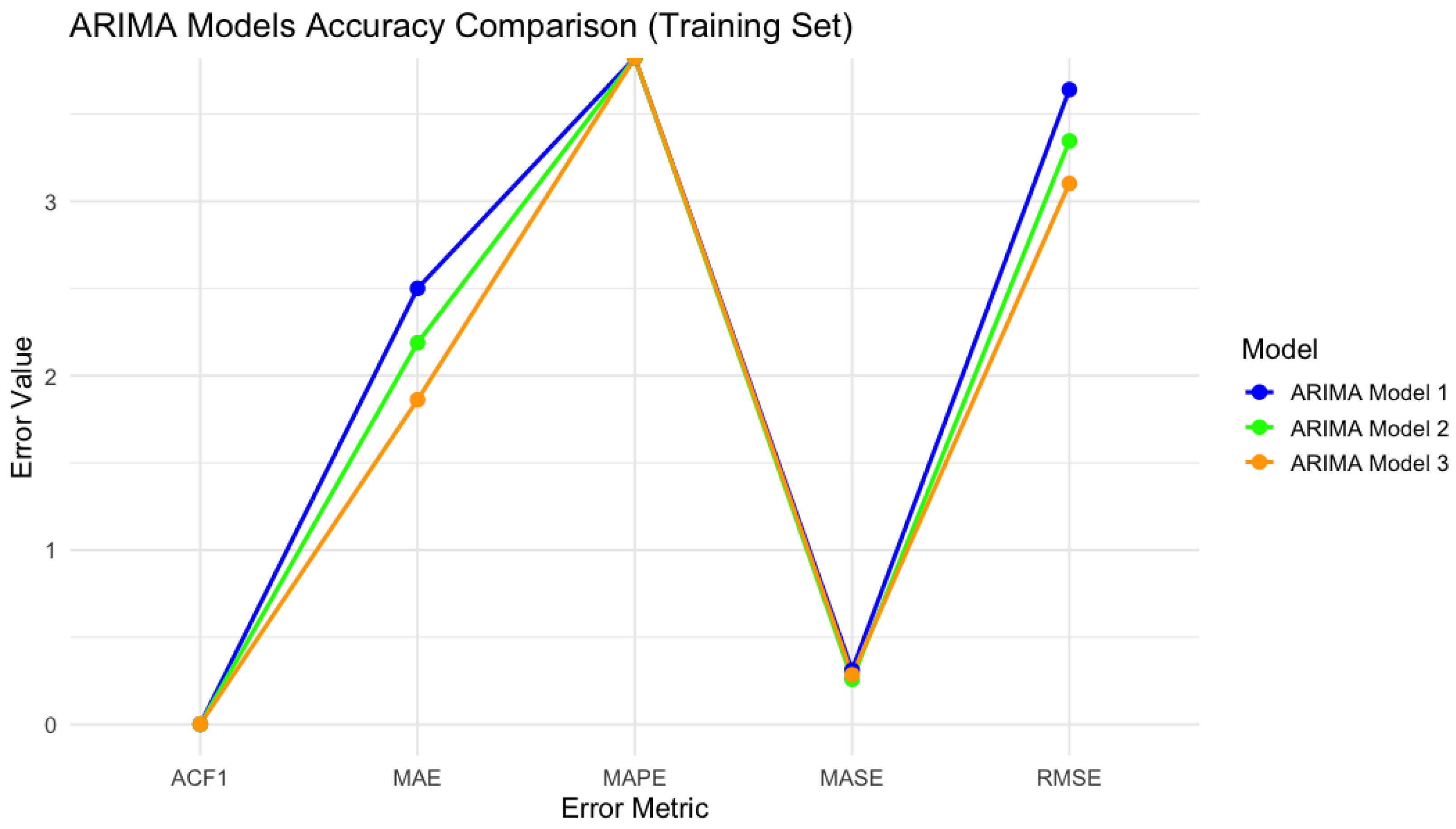
| Error Metric | ARIMA 1 | ARIMA 2 | ARIMA 3 |
|---|---|---|---|
| ME | 0.001949125 | 0.0000844 | −0.0003585713 |
| RMSE | 3.640386 | 3.346055 | 3.101502 |
| MAE | 2.500321 | 2.187955 | 1.861751 |
| MASE | 0.2934355 | 0.2586301 | 0.2842862 |
| ACF1 | 0.001194734 | 0.0007530299 | 0.001449699 |
Disclaimer/Publisher’s Note: The statements, opinions and data contained in all publications are solely those of the individual author(s) and contributor(s) and not of MDPI and/or the editor(s). MDPI and/or the editor(s) disclaim responsibility for any injury to people or property resulting from any ideas, methods, instructions or products referred to in the content. |
© 2026 by the authors. Licensee MDPI, Basel, Switzerland. This article is an open access article distributed under the terms and conditions of the Creative Commons Attribution (CC BY) license.
Share and Cite
Hussain, E.; Li, Y.; Ahad, A.R. Imputation Bias in ARIMA Air Quality Models. Algorithms 2026, 19, 449. https://doi.org/10.3390/a19060449
Hussain E, Li Y, Ahad AR. Imputation Bias in ARIMA Air Quality Models. Algorithms. 2026; 19(6):449. https://doi.org/10.3390/a19060449
Chicago/Turabian StyleHussain, Ejaz, Yang Li, and Atiqur Rahman Ahad. 2026. "Imputation Bias in ARIMA Air Quality Models" Algorithms 19, no. 6: 449. https://doi.org/10.3390/a19060449
APA StyleHussain, E., Li, Y., & Ahad, A. R. (2026). Imputation Bias in ARIMA Air Quality Models. Algorithms, 19(6), 449. https://doi.org/10.3390/a19060449