


Abstract
Accurate prediction of the Remaining Useful Life (RUL) of special gas cylinders is critical for industrial safety management. However, the nonlinear, strongly coupled degradation behaviors of these cylinders, combined with non-stationary and high-noise monitoring data, limit the performance of single deep learning models. Traditional hyperparameter tuning and signal processing methods often fail to meet the required prediction accuracy. To address these challenges, this study proposes a hybrid SSA–PSO–ResNet–LSTM–Attention framework for RUL prediction of special gas cylinders. The framework first applies Singular Spectrum Analysis (SSA) to decompose and reconstruct the 12-dimensional multi-source sensor signals, effectively suppressing noise while extracting core degradation trends. Subsequently, a ResNet–LSTM–Attention collaborative model is constructed, where ResNet ensures stable spatial feature propagation, LSTM captures long- and short-term temporal dependencies, and a multi-head attention mechanism emphasizes critical time steps associated with abrupt degradation. Furthermore, a Particle Swarm Optimization (PSO) algorithm is employed to globally optimize key hyperparameters, including the number of convolutional kernels, LSTM hidden units, and learning rate, mitigating the subjectivity of manual tuning. Experimental validation is conducted on 1000 real monitoring samples from 100 composite material gas cylinders, with a cylinder ID-based 7:1:2 train–validation–test split and stratified sampling covering four operating conditions. PSO optimizes hyperparameters using the validation set RMSE as the fitness function, and the test set is exclusively used for final performance evaluation. All results are reported as the mean ± standard deviation from grouped 5-fold cross-validation on the cylinder-wise partition. The proposed model achieves a test RMSE of 71.55, MAE of 50.63, and R2 of 0.9584, representing a 34.2% and 30.2% reduction in RMSE and MAE, respectively, compared with the second-best CNN-LSTM model, and significantly outperforming SVR, MLP, and other benchmark models. Ablation studies confirm the positive synergistic effect of each component, with the removal of either the attention mechanism or the ResNet module causing substantial performance degradation. By employing physically calibrated RUL labels and a balanced multi-condition dataset, the proposed framework achieves high predictive accuracy and good potential for industrial application, providing an effective solution for RUL prediction of special gas cylinders and similar high-pressure vessels, with potential applications in intelligent maintenance of complex industrial equipment.
1. Introduction
As critical high-energy pressure-bearing components, specialty gas cylinders operate under demanding industrial conditions characterized by high-pressure shocks and corrosive environments. The accurate prediction of their Remaining Useful Life (RUL) is a cornerstone of industrial safety assurance systems, playing a vital role in preventing catastrophic failure and enabling condition-based maintenance. While traditional physics-based models rely on a fundamental understanding of degradation mechanisms, they often struggle to capture the nonlinear and multi-physically coupled degradation characteristics inherent in the service life of these cylinders. Consequently, data-driven RUL prediction methods have emerged as the mainstream research paradigm in this field.
Early data-driven RUL prediction research focused predominantly on the application and refinement of single deep learning architectures. Ren et al. systematically evaluated the feature extraction and predictive performance of autoencoders and deep belief networks (DBNs) for life prediction of complex industrial equipment, demonstrating the capability of deep learning in mining latent degradation features [1]. Li et al. proposed a CNN-based RUL prediction framework that leverages the local receptive field and weight-sharing properties of convolutional layers to extract spatial features from multi-dimensional sensor data, achieving notable improvements in prediction accuracy [2]. However, a fundamental limitation of standalone CNN models is their inability to capture temporal dependencies in the degradation process, precluding the characterization of time-sequential degradation patterns. While the long short-term memory (LSTM) network proposed by Park et al. effectively addresses the vanishing gradient problem encountered by conventional recurrent neural networks when processing long time series [3], it lacks spatial feature extraction capability—resulting in insufficient feature representation when handling the high-dimensional, multi-source monitoring data that couples pressure, temperature, and vibration signals in cylinder applications. In summary, single deep learning architectures are inherently constrained in their ability to simultaneously achieve deep spatial feature extraction and capture both short- and long-term temporal correlations in equipment degradation, rendering them inadequate for the precise RUL prediction demands of special-purpose gas cylinders.
To bridge these gaps, researchers have increasingly explored the synergy between diverse predictive paradigms. Recent studies in the RUL field have highlighted the efficacy of Ensemble Learning, which combines multiple base learners to achieve superior generalization. For instance, Rezazadeh et al. developed a robust ensemble framework for RUL estimation by incorporating Linear Regression, K-Nearest Neighbors (KNN), and Gaussian Process Regression (GPR) [4]. Their work demonstrates that leveraging the complementary strengths of heterogeneous algorithms—such as the interpretability of linear models and the uncertainty quantification of GPR—significantly mitigates the prediction instability inherent in individual models. Inspired by the principle of integrating diverse strengths, serial hybrid network frameworks have been introduced to further handle high-dimensional spatial-temporal features. Deng et al. proposed a CNN–LSTM–Attention hybrid model for aero-engine RUL estimation, in which CNN performs dimensionality reduction and spatial feature extraction from high-dimensional input data, the resulting feature sequences are subsequently fed into LSTM for temporal regression, and an attention mechanism is incorporated to enhance model robustness—collectively yielding a significant reduction in prediction error [5]. Nevertheless, as network depth increases, hybrid models become susceptible to training degradation, manifesting as a counterintuitive decline in predictive accuracy with the addition of successive layers. Zeng et al. observed that deep network architectures tend to cause progressive attenuation and loss of original degradation-relevant information during feature propagation, and accordingly introduced residual networks (ResNet) with skip connections to facilitate effective deep feature transmission and alleviate the network degradation problem [6]. Zhao et al. conducted a systematic review of deep learning applications in mechanical health monitoring and further validated the efficacy of integrating ResNet with recurrent neural networks, demonstrating that such architectures provide superior retention of weak, early-stage degradation signatures embedded in raw monitoring signals [7]. Despite the capacity of ResNet–LSTM hybrid architectures to resolve the issue of deep feature propagation, standard LSTM assigns equal importance to all time steps within the input sequence and is therefore incapable of identifying and selectively attending to critical transient events that precipitate cylinder failure—such as extreme over-pressurization during filling or abrupt thermal excursions—resulting in inadequate sensitivity to sudden degradation occurrences.
The degradation process of special gas cylinders during service does not exhibit a uniform attenuation pattern. instead, failures are often triggered by abrupt changes in operating conditions at a few critical time points. Therefore, it is necessary to focus on mining key degradation segments within time series data, and the introduction of attention mechanisms provides an effective solution to this problem. Wang et al. introduced a Temporal Attention mechanism in lithium-ion battery RUL prediction, in which higher weights are assigned to critical time steps, effectively alleviating the dilution and attenuation of important degradation information in long time series data [8]. Suh et al. proposed a Spatio-Temporal Multimodal Attention Network (ST-MAN) that simultaneously captures spatiotemporal dependencies and multimodal features in battery data; by assigning adaptive weights to key time steps and channels, the model mitigates the dilution of degradation information in long sequences and significantly improves the prediction accuracy of lithium-ion battery Remaining Useful Life (RUL) [9]. Yan et al. embedded a hybrid attention mechanism into a BiConvLSTM network for wind turbine gearbox condition monitoring, where dynamically weighted critical spatiotemporal features enhance the model’s ability to capture complex dynamic variations and improve the extraction of fault-related features [10]. Consequently, the ResNet–LSTM–Attention hybrid architecture theoretically enables the collaborative extraction of spatial features, temporal dependencies, and key degradation segments. However, the performance of deep learning models is highly dependent on the configuration of hyperparameters (e.g., learning rate, number of hidden neurons, and time-window size), and most existing studies still rely on traditional hyperparameter optimization strategies such as manual trial-and-error or grid search, which suffer from low optimization efficiency and a high risk of trapping the model in local optima, thereby preventing the predictive potential of hybrid architectures from being fully exploited.
In addition to the limitations associated with model hyperparameter configuration, the inherent non-stationary noise in monitoring data of special gas cylinders is also a key factor restricting prediction accuracy. To eliminate random noise in operating-condition data and extract deeper degradation trends, signal decomposition techniques have been widely applied in Remaining Useful Life (RUL) prediction. Golyandina et al. systematically investigated the theoretical foundations and applications of Singular Spectrum Analysis (SSA) in time series analysis, demonstrating that this method has significant advantages in the decomposition of non-stationary sequences, trend extraction, and noise separation [11]. SSA is a nonparametric time series decomposition technique that can automatically decompose the original monitoring signals into trend, periodic, and noise components based on the intrinsic characteristics of the data, thereby facilitating clearer extraction of potential degradation features. Furthermore, to achieve adaptive optimization of hyperparameters in deep hybrid models, metaheuristic algorithms have been widely adopted for hyperparameter tuning in this field. He et al. [12] employed the Particle Swarm Optimization (PSO) algorithm to automatically tune the number of hidden units and training iterations of an LSTM model. Experimental results indicated that the optimized model exhibited improved predictive performance in time series forecasting tasks and showed advantages over manual parameter tuning methods. Similarly, Hafeez et al. applied PSO to tune a multi-model framework including LSTM, and the experimental results on lithium-ion battery RUL prediction demonstrated improvements in both MAE and RMSE, further illustrating the applicability of metaheuristic algorithms for optimizing deep learning model hyperparameters [13]. Although SSA has demonstrated good applicability in signal denoising and trend extraction, existing studies rarely integrate the trend decomposition capability of SSA with the ResNet–LSTM–Attention hybrid model and further perform adaptive parameter optimization using PSO. Meanwhile, considering the complex physical structure, diverse operating conditions, and noisy monitoring data of special gas cylinders, constructing an end-to-end adaptive closed-loop RUL prediction framework remains a critical scientific problem that urgently needs to be addressed in this field. It is worth noting that hybrid machine learning strategies for multi-output prediction and process optimization have demonstrated remarkable success across engineering domains. Der et al. [14] investigated CO2 laser cutting quality of FFF-printed ABS thermoplastics using seven machine learning approaches including Autoencoder–GRU and Autoencoder–LSTM, showing that ensemble hybrid strategies outperform single-model methods when dealing with complex nonlinear process–quality interactions. In a subsequent study on ASA thermoplastics [15], the same group employed multi-output modeling combined with XGBoost and deep learning, revealing that distinct process parameters dominate different quality metrics—a finding that underscores the importance of adaptive, data-driven frameworks for multi-source signal prediction. These studies reinforce a principle central to the present work: the necessity of coupling signal decomposition, architecture optimization, and predictive modeling within a unified framework.
Compared to existing hybrid RUL models, the proposed framework is fundamentally novel in three respects. First, unlike prior CNN–LSTM–Attention or ResNet–LSTM frameworks that treat raw sensor signals as direct inputs, our framework introduces SSA as a physics-informed preprocessing stage specifically designed for the non-stationary, strongly coupled 12-dimensional sensor signals of gas cylinders, retaining only the dominant degradation trend component (contributing 85.54% of variance) before deep learning. Second, while most existing studies rely on manual tuning or grid search, our PSO-based global optimization operates across the full hyperparameter space of the ResNet–LSTM–Attention architecture simultaneously—learning rate, convolutional kernel count, hidden units, and attention heads—forming a closed-loop adaptive pipeline. Third, the framework is validated on a real-world industrial dataset from 100 composite gas cylinders across four operating conditions, which differs fundamentally in degradation physics and data structure from the battery or bearing benchmarks used in most comparable studies. The synergistic integration of these three components constitutes the core novelty of this work.
Based on the aforementioned research background and existing challenges, this paper proposes a hybrid-strategy-based framework for accurate Remaining Useful Life (RUL) prediction of special gas cylinders. Through model architecture design, mechanism embedding, and algorithm integration, the proposed framework enables comprehensive extraction of degradation features and improves prediction performance. The main contributions of this study are summarized as follows.
- A ResNet–LSTM hybrid prediction model is constructed to address the training degradation problem in deep networks. Considering that standard LSTM networks tend to suffer from gradient vanishing and training difficulties as the network depth increases, a ResNet module is introduced before the LSTM units. By leveraging the skip-connection mechanism, the proposed structure preserves the original degradation characteristics of the equipment while enhancing the transmission efficiency of deep features, thereby improving the model’s ability to capture nonlinear degradation patterns.
- A temporal attention mechanism is incorporated to dynamically focus on critical degradation segments of gas cylinders. Given that cylinder failures are often triggered by a few extreme operating conditions—such as excessive overpressure or severe temperature fluctuations—the temporal attention mechanism is embedded in the output layer of the LSTM. This mechanism adaptively assigns higher weights to time steps with greater contribution, enhancing the model’s sensitivity to abrupt damage events and fundamentally mitigating the information averaging issue in long time series data.
- A collaborative prediction strategy integrating Singular Spectrum Analysis (SSA) for signal enhancement and Particle Swarm Optimization (PSO) for parameter optimization is developed. To address the issue that long-term degradation trends in multivariate monitoring data of gas cylinders are easily affected by noise, the adaptive decomposition capability of SSA is employed to separate the original signals into trend, periodic, and noise components. This process facilitates accurate extraction of dominant degradation trends while effectively suppressing random disturbances caused by sensor inaccuracies or environmental fluctuations, thereby providing more reliable input features for subsequent deep learning models. Meanwhile, the PSO algorithm is utilized to perform adaptive search for key hyperparameters in the ResNet–LSTM–Attention architecture, such as the learning rate, number of hidden units, and number of attention heads. This integrated approach establishes a complete pipeline from signal preprocessing to model parameter optimization, further improving the robustness and prediction accuracy of the proposed framework under complex degradation conditions.
2. Methodology
2.1. Signal Enhancement Based on Singular Spectrum Analysis (SSA)
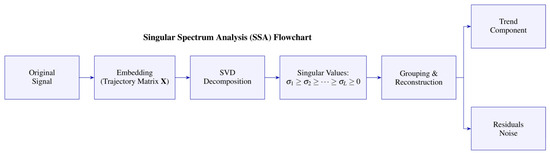
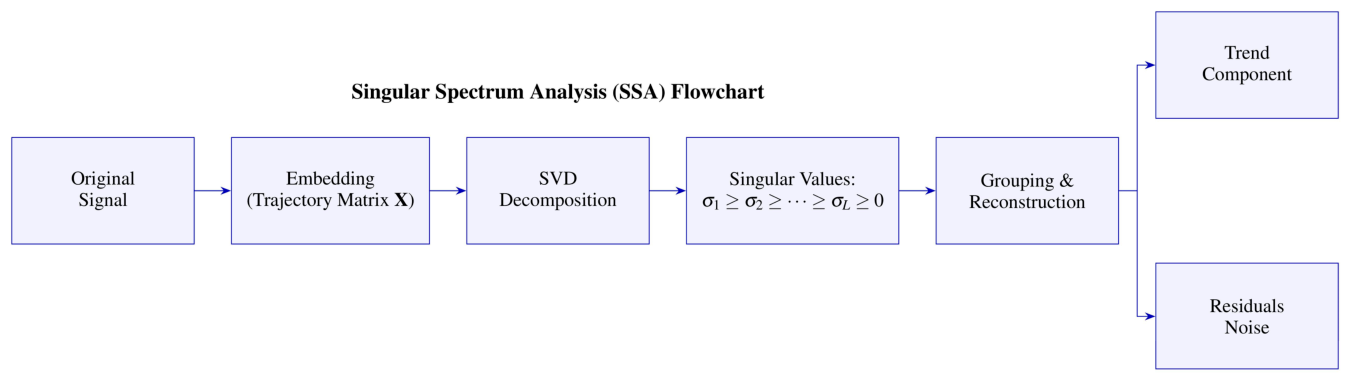
During the service life of special gas cylinders, the monitoring data of pressure and temperature are often influenced by high-pressure filling fluctuations, environmental electromagnetic interference, and other external disturbances. As a result, the collected signals typically exhibit non-stationary and high-noise characteristics, which may obscure the underlying physical degradation trends. To address this issue, this study introduces Singular Spectrum Analysis (SSA) [16] to perform multi-scale decomposition and reconstruction of the original sensor sequences, with the objective of extracting the core degradation components that characterize the Remaining Useful Life (RUL), as illustrated in Figure 1. The detailed procedure is described as follows.
Figure 1.
Flowchart of signal preprocessing based on Singular Spectrum Analysis (SSA).
2.1.1. Embedding
Assume that the one-dimensional raw monitoring time series of a special gas cylinder is defined as , where represents the total number of sampling points. A window length (embedding dimension) is defined such that . By applying a sliding window operation, the original sequence is transformed into an trajectory matrix :
The trajectory matrix is a Hankel Matrix, in which the elements along each diagonal are identical. This structure preserves the complete topological information of the original sequence in an L-dimensional embedding space. The selection of the window length L directly determines the capability of SSA to resolve signal features. In theory, L should satisfy . In this study, the SSA window length is strategically fixed at 4 to address the highly non-stationary nature and relatively short duration of the gas cylinder monitoring sequences. This configuration is justified by two primary considerations. First, from a physical consistency perspective, a complete operational cycle (including loading, holding, and unloading) typically spans four sampling intervals. Setting ensures the embedding space fully encapsulates one fundamental degradation-cycle unit, allowing the trajectory matrix to effectively capture the nonlinear coupling relationships among pressure, temperature, and strain features. Second, regarding statistical stability, given the finite sequence length () of the samples, a smaller ensures that the trajectory matrix maintains a sufficient number of columns (). This constraint prevents the singular value decomposition (SVD) process from generating spurious components or experiencing feature degeneration that typically occurs when is excessively large relative to . Thus, the chosen parameter ensures a robust balance between local feature extraction and global decomposition stability.
2.1.2. Singular Value Decomposition (SVD)
The covariance matrix is subjected to eigenvalue decomposition. Let denote the non-negative eigenvalues arranged in descending order, and the corresponding orthogonal eigenvectors be , then the trajectory matrix T can be decomposed into the sum of L elementary matrices:
where represents the component matrix. In the degradation analysis of gas cylinders, larger singular values generally correspond to low-frequency degradation trend components, whereas smaller singular values usually represent random noise or measurement disturbances.
2.1.3. Grouping and Contribution Rate Calculation
Signal components are identified according to the eigenvalue contribution rate
The set of elementary matrices is then divided into mutually disjoint groups. For the RUL prediction task of special gas cylinders, analysis of the singular value contribution rates shows that the first principal component accounts for 85.54% of the total variance, indicating that it concentrates the majority of the energy of the original monitoring signal. Considering the small-sample characteristics of the dataset (each sample contains only 10 time steps), introducing higher-order singular value components may easily retain non-stationary periodic disturbances or high-frequency artifacts, thereby increasing the risk of overfitting in deep learning models. Therefore, a conservative reconstruction strategy is adopted in this study. Only the component corresponding to the largest contribution rate is retained to form the degradation trend matrix: , while the remaining components are regarded as noise and discarded. Experimental results demonstrate that this strategy preserves the monotonic degradation trajectory of the equipment while significantly improving the smoothness and signal-to-noise ratio (SNR) of the input features.
2.1.4. Reconstruction
The reconstructed trajectory matrix is converted back into a one-dimensional time series using diagonal averaging. Let the element of be denoted as , The reconstructed sequence elements are computed as:
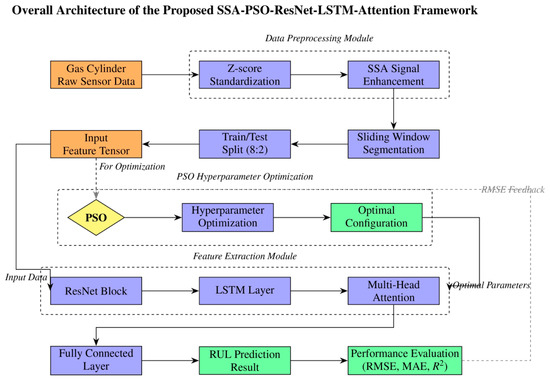
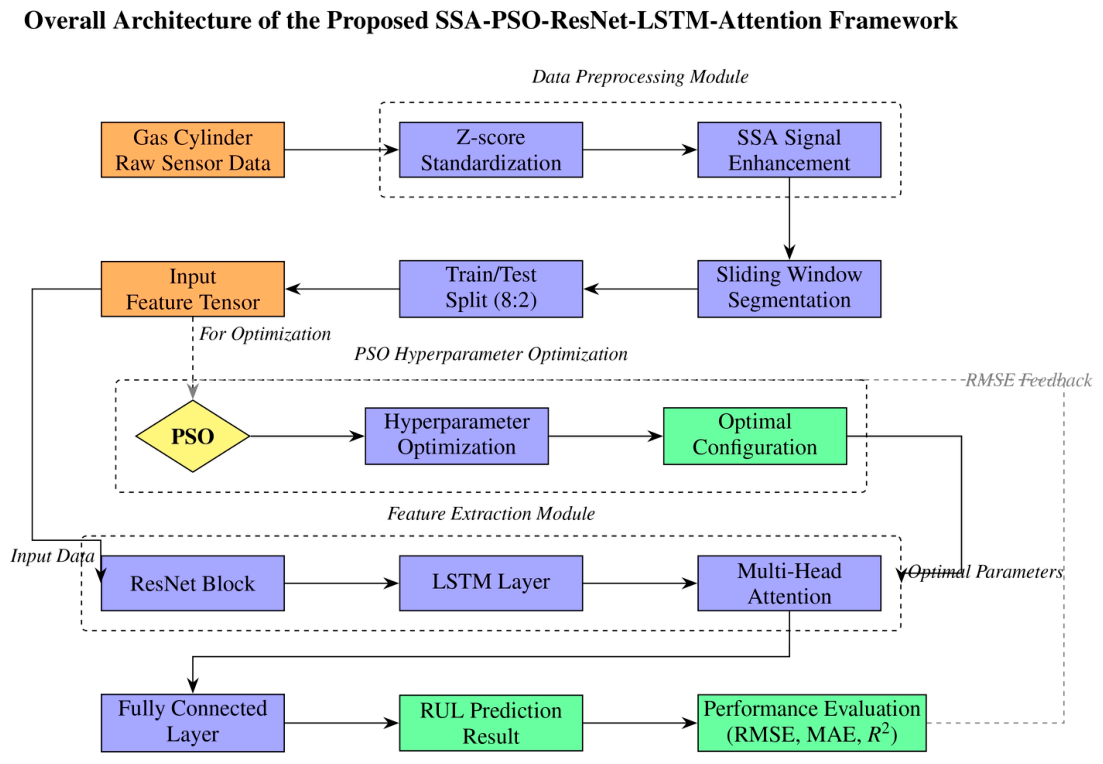
where . After SSA enhancement, the reconstructed sequence effectively removes high-frequency fluctuations and more accurately reflects the material degradation trajectory caused by fatigue and stress corrosion in gas cylinders. The multi-source sensor sequences enhanced by SSA (with an original dimension of , where denotes the number of samples and 12 represents feature dimensions such as pressure and temperature) are segmented into temporal samples using a sliding-window technique. The resulting input tensor has the shape: , where the batch size is , the time window length is , and the feature dimension is . Within the ResNet module, the tensor is first transposed and convolution operations are performed along the feature dimension. Through residual connections, spatial features are extracted while preserving feature fidelity, resulting in an output dimension of: (the number of convolution kernels is ). The extracted feature sequence is subsequently fed into a single-layer LSTM network, producing a hidden state sequence with dimension: (the number of hidden units is ). This sequence is then used as the Query, Key, Value and multi-head attention mechanism, where the number of attention heads is set to , satisfying the divisibility constraint . Finally, the model extracts the attention-weighted output at the last time step (dimension ), which is passed through a fully connected layer to perform RUL regression prediction for the gas cylinders. The overall framework is illustrated in Figure 2, and its detailed structure is described above.
Figure 2.
Overall architecture diagram.
2.2. ResNet–LSTM–Attention Deep Feature Collaborative Modeling Framework
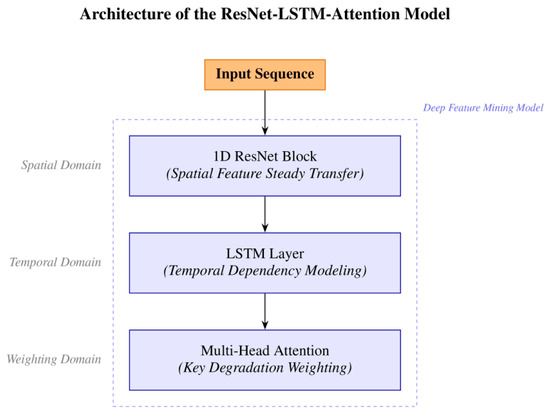
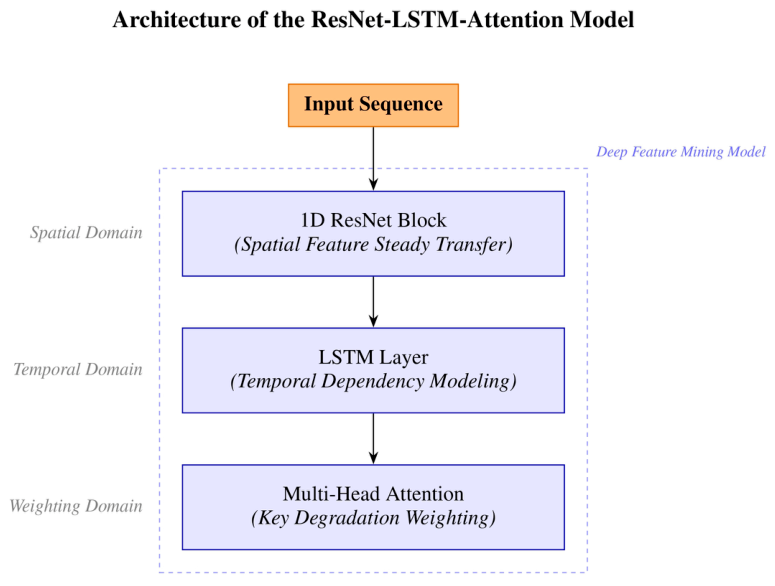
Inspired by multi-scale feature fusion and degradation-sensitive information enhancement strategies used in rolling bearing fault diagnosis [17], and considering the non-stationary, strongly coupled, and abrupt degradation characteristics exhibited by special gas cylinders during long-term charging–discharging and service cycles, this study constructs a deep feature mining model that integrates a Residual Network (ResNet), a Long Short-Term Memory (LSTM) network, and an adaptive attention mechanism, as illustrated in Figure 3.
Figure 3.
Architecture of the ResNet–LSTM–Attention model.
Through a hierarchical collaborative mechanism consisting of stable spatial feature propagation, dynamic temporal dependency modeling, and weighted enhancement of critical degradation segments, the proposed model achieves precise characterization of the degradation evolution of gas cylinders throughout their entire service life cycle. This framework provides highly discriminative deep representations for subsequent Remaining Useful Life (RUL) prediction.
2.2.1. Deep Residual Feature Mapping (ResNet Block)
In the high-dimensional time series data formed by multi-source sensor measurements of gas cylinders—such as pressure, temperature, and operating-condition indicators—traditional deep neural networks tend to suffer from progressive feature attenuation and gradient degradation as network depth increases. Consequently, the original degradation information may be weakened during feature propagation across layers. To address this issue, a residual network structure is introduced in the feature extraction stage.
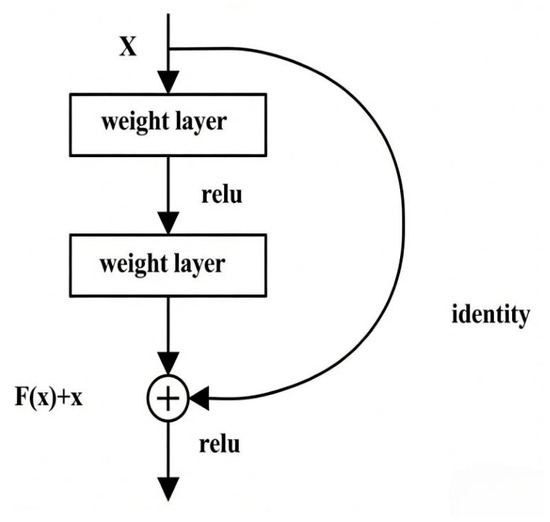
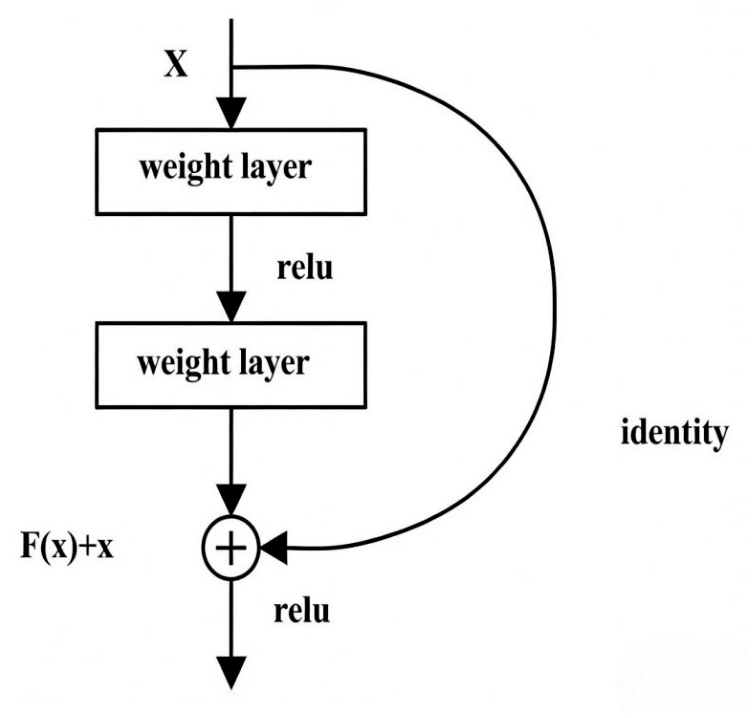
The residual unit introduces identity mapping to directly propagate the input features to subsequent layers, effectively alleviating the gradient vanishing problem in deep networks. This mechanism accelerates the training of deep neural networks and significantly improves model accuracy, making it feasible to train very deep architectures. The mathematical formulation of the residual mapping is expressed as
where denotes the input feature, represents the residual mapping function composed of convolution operations and nonlinear activation functions, and denotes the set of learnable parameters.
With this structure, the network is no longer required to learn the complete mapping directly, but instead focuses on learning the residual information related to degradation. As a result, the detailed characteristics of the original signals are preserved while the expressive capability and training stability of deep spatial features are significantly enhanced, as illustrated in Figure 4. This mechanism has been demonstrated to be highly effective in bearing degradation analysis and complex equipment condition recognition, and it is similarly applicable to the degradation modeling of gas cylinders. In this study, a single residual block is employed, with a convolution kernel size of 3, and the number of output channels is determined as 64 through Particle Swarm Optimization (PSO).
Figure 4.
Residual structure. The ⊕ symbol indicates the summation of the residual mapping and the identity path.
2.2.2. Temporal Degradation Evolution Modeling (LSTM Layer)
The high-level feature sequences extracted by the ResNet module are subsequently fed into an LSTM network to model the long-term temporal dependencies formed by the combined effects of multiple charging cycles and service operating conditions during the lifecycle of gas cylinders.
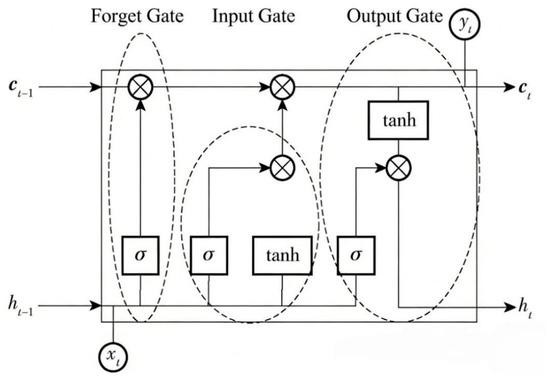
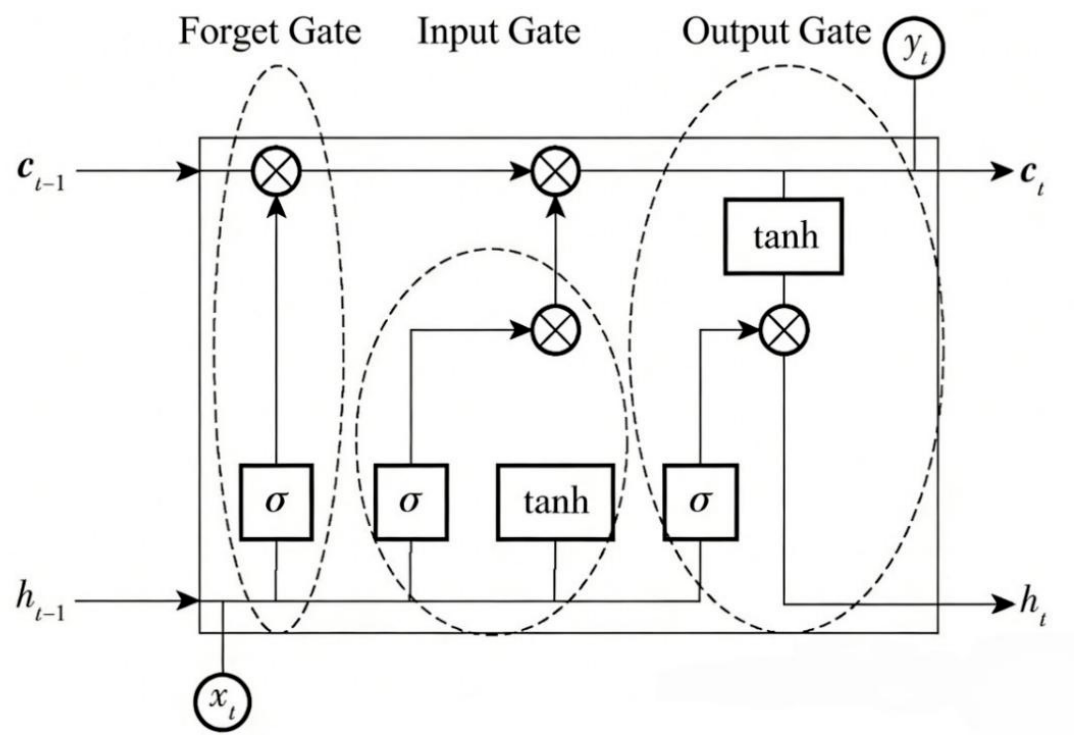
The Long Short-Term Memory (LSTM) network employs gated mechanisms—including the forget gate, input gate, and output gate—to selectively retain and update historical information. This design effectively alleviates the potential gradient vanishing or explosion problems commonly encountered in long-sequence modeling tasks [17,18]. The detailed structure of the LSTM unit is illustrated in Figure 5. The core computational process of the LSTM unit can be expressed as follows:
where denotes the cell state, which accumulates long-term degradation information of the gas cylinder, and represents the hidden state output, characterizing the degradation representation at the current time step.
Figure 5.
Structure diagram of the LSTM unit. The ⊗ symbol denotes element-wise multiplication between gate outputs and state vectors.
Through this structure, the model is capable of effectively capturing the nonlinear degradation trajectory of gas cylinders resulting from the combined influence of gradual fatigue accumulation and localized abnormal shocks. Consequently, the LSTM layer provides continuous and stable temporal feature support for subsequent Remaining Useful Life (RUL) prediction. In this study, the number of LSTM hidden units is determined as 32 through Particle Swarm Optimization (PSO), and the temporal window length is set to 5.
2.2.3. Multi-Head Attention
To further explore the degradation evolution characteristics of gas cylinder monitoring signals across different temporal subspaces, a Multi-Head Attention mechanism is introduced at the output layer of the LSTM network. Compared with the traditional single-head attention structure, the multi-head mechanism projects features into multiple independent subspaces for parallel modeling, enabling the model to simultaneously capture transient impulses (e.g., sudden pressure variations) and long-term trend features during the degradation process of gas cylinders.
Specifically, let the hidden state sequence generated by the LSTM layer be denoted as . The mechanism employs h groups of independent linear projection matrices to map H into different feature subspaces, thereby constructing the Query, Key, and Value matrices as follows:
Within each attention head, the scaled dot-product attention mechanism is applied to compute the correlation distribution among time steps. A scaling factor is introduced to alleviate the gradient instability caused by high-dimensional inner products. The attention output is:
Subsequently, the outputs of all attention heads are concatenated and linearly fused through the output projection matrix , yielding the enhanced feature representation:
where denotes the number of attention heads and serves as a structural hyperparameter of the model. The proposed attention module adopts a lightweight multi-head temporal modeling structure, which enhances the representation capability of critical time steps while preserving the inductive bias of LSTM for temporal degradation modeling. This design avoids the additional computational complexity associated with introducing a full Transformer architecture. Through this parallel modeling mechanism, the model can adaptively identify key features within the degradation trajectories of gas cylinders from multiple temporal subspaces, thereby improving prediction robustness under complex and dynamic operating conditions. In this study, the number of attention heads is set to , and the feature subspace dimension of each attention head is , satisfying the mathematical constraint that the embedding dimension must be divisible by the number of attention heads.
2.3. Hyperparameter Adaptive Optimization Strategy Based on Particle Swarm Optimization (PSO)
The predictive performance of deep hybrid models is highly dependent on hyperparameter configuration. However, traditional parameter tuning methods, such as empirical adjustment or grid search, are inefficient in high-dimensional parameter spaces and are prone to falling into local optima. To address this issue, this study introduces the Particle Swarm Optimization (PSO) algorithm [19] to perform global adaptive optimization of key model hyperparameters.
Within the PSO framework, each particle represents a candidate combination of hyperparameters, primarily including the number of convolution kernels in the ResNet module, the number of hidden units in the LSTM layer, and the learning rate. According to the sensitivity of these hyperparameters to model performance, their optimization priorities and search ranges are determined as follows.
First priority (number of ResNet convolution kernels): This parameter determines the dimensionality of spatial feature representation and directly affects the feature extraction capability of the ResNet module. The search range is defined as [16, 64].
Second priority (number of LSTM hidden units): This parameter controls the capacity of temporal modeling and influences the model’s ability to capture long-term degradation dependencies. The search range is defined as [32, 128].
Third priority (learning rate): The learning rate is a global optimization parameter that affects both convergence speed and generalization performance. Its search range is set to [0.001, 0.01].
Other structural parameters—such as the convolution kernel size, number of residual blocks, and number of attention heads—have relatively stable effects on model performance. These parameters are therefore predefined according to the characteristics of the dataset and are excluded from the PSO search space to reduce optimization complexity and improve search efficiency. The velocity and position update rules of particles are defined as:
where denotes the inertia weight, and represent the cognitive and social learning factors, respectively, and and are uniformly distributed random numbers in the interval [0, 1]. The variables and denote the individual best solution and the global best solution, respectively.
The root mean square error (RMSE) on the validation set is adopted as the fitness function. To avoid data leakage and ensure an unbiased evaluation, the fitness function of the PSO is calculated based on the RMSE of a dedicated validation set (10% of the total data), while the test set (20%) is strictly reserved for the final performance assessment. Through iterative optimization, PSO efficiently searches the complex hyperparameter space, avoiding the subjective bias associated with manual parameter tuning and ensuring stable and optimal prediction performance under complex operating conditions of special gas cylinders. To balance model performance and computational efficiency, the hyperparameters are divided into preset fixed parameters and dynamically optimized parameters. The detailed configuration is summarized in Table 1. Specifically, parameters such as convolution kernel size, number of residual blocks, and time window length are predefined based on the spatial characteristics and sampling frequency of the gas cylinder monitoring data. In contrast, key sensitive parameters—including the number of convolution kernels, number of LSTM hidden units, and learning rate—are optimized globally within the predefined search space using the PSO algorithm. To avoid data leakage and ensure an unbiased evaluation, the fitness function of the PSO is calculated based on the RMSE of a dedicated validation set (10% of the total data), while the test set (20%) is strictly reserved for the final performance assessment. This strategy effectively eliminates the subjectivity of manual tuning and ensures optimal generalization performance of the model under small-sample and high-noise conditions.
Table 1.
Hyperparameter search ranges and final results optimized by PSO using the validation set.
Design Rationale for PSO Space
To balance model complexity and optimization efficiency, the search space for PSO was prioritized based on parameter sensitivity analysis conducted in pre-experiments. Several hyperparameters were excluded from the PSO process for the following reasons:
Attention Heads and Network Depth: The number of attention heads was fixed at 4 to align with the 32 hidden units of the LSTM (ensuring divisibility and subspace balance). Pre-experiments indicated that using 2 or 8 heads led to either coarse feature extraction or excessive fragmentation, both degrading performance. Similarly, the ResNet and LSTM layers were limited to 1 each. Given the relatively small dataset (1000 samples), increasing the depth (e.g., 2 + blocks) triggered severe overfitting, with the RMSE exceeding 100.
Dropout Rate: While Dropout is a common regularization technique, it was excluded because the Signal-to-Noise Ratio (SNR) of the input data had already been significantly enhanced by the SSA preprocessing. Pre-experiments showed that even a small dropout rate (0.1–0.5) resulted in the loss of critical degradation features.
Consequently, the PSO focused on the ResNet filter size, LSTM hidden units, and learning rate. These three parameters were identified as the ‘sensitivity bottleneck,’ contributing to over 80% of the performance variance in our pre-validation. By prioritizing these parameters, the PSO can more effectively achieve global convergence without the risk of dimensional curse or overfitting associated with a broader search space.
3. Results and Discussion
3.1. Dataset Description and Feature Analysis
The dataset used in this study consists of multi-source sensor monitoring data collected from 100 composite specialty gas cylinders produced under the same manufacturing process in an industrial plant. The data construction follows a hybrid acquisition and alignment strategy: an intensive six-month monitoring window was established starting in June 2023 to collect high-resolution dynamic features (e.g., temperature and pressure), while the long-term Remaining Useful Life (RUL) labels were synchronized by retrieving the complete historical service trajectories of each cylinder from the industrial maintenance database. To capture the dynamic evolution of cylinder performance, the monitoring system collected information at a sampling frequency of once every two hours during this window. Due to the complexity of the industrial environment—such as equipment maintenance or sensor recalibration—the raw records exhibited non-uniform temporal distribution characteristics. From an initial pool of approximately 2000 raw records, we established strict data screening criteria to ensure reliability. By mapping these high-fidelity signal segments to their specific lifecycle stages based on the total multi-year service history, a robust dataset for RUL prediction was constructed. Notably, while these 12 macroscopic monitoring variables do not directly measure microscopic failure mechanics like acoustic emission, they act as effective surrogate indicators from which the deep learning model can extract nonlinear degradation signatures related to the vessel’s structural integrity. However, considering the potential disturbances and monitoring quality issues in industrial environments, strict data screening criteria were established in this study to ensure the reliability of the dataset:
- Removal of physical outliers: Abnormal pulse points exceeding the physical measurement range—caused by instantaneous sensor disconnection or poor contact—were removed.
- Missing value processing: Time periods with severe missing values in key feature dimensions (e.g., strain signals) due to communication interruptions were excluded to ensure the integrity of the input tensor structure
- Extraction of steady-state operating conditions: Only data obtained during standard charging–discharging cycles were retained, while records from abnormal operating conditions—such as equipment debugging or non-standard tests—were excluded.
After applying the above screening procedures, a high-quality dataset containing 1000 valid samples was finally established. This dataset was subsequently used for SSA-based signal enhancement and model training.
3.1.1. Feature Dimensions and Physical Interpretation
The original dataset contains 12 core feature dimensions, which characterize the degradation behavior of gas cylinders from a multi-physics perspective. These features describe pressure dynamics, thermal behavior, operational conditions, and maintenance history. The detailed definitions are listed in Table 2:
Table 2.
Several characteristics and their physical meanings.
3.1.2. Data Reorganization and Label Definition
To accurately capture the load sequence effects and pressure cycling severity, the dataset was reorganized from raw wall-clock timestamps into event-driven segments (e.g., filling cycles, transportation, and static storage). Rather than treating every two-hour interval as a generic step, we extracted cycle-specific features—such as peak/valley pressures and thermal gradients—for each individual operational event. This reorganization ensures that the predictive model focuses on the physical degradation kinetics of fatigue accumulation rather than redundant temporal intervals. The 2 h sampling resolution was specifically justified against the operational kinetics of specialty gas cylinders: in this industrial scenario, a typical pressure cycle spans 4 to 6 h, allowing the 2 h interval to effectively capture essential state transitions. For transient overloads or rapid pressure spikes, the monitoring system employed a threshold-triggered high-frequency sampling mechanism, ensuring that all critical fatigue-contributing anomalies were recorded and integrated into the event-based sequences.
Each sample in the dataset is associated with a Remaining Useful Life (RUL) label, defined as the remaining number of operational cycles from the current state to the final decommissioning point. To ensure the integrity of the ground-truth labels, we retrospectively retrieved the complete historical trajectories of 100 specialty gas cylinders from an industrial operation database. For each cylinder, the entire service history—from its initial commissioning to its eventual retirement—was successfully tracked, allowing for the precise determination of the actual RUL values. To construct a balanced predictive model with robust performance across the entire lifecycle, stratified sampling based on environmental stress levels was applied to the 2000 original records. Specifically, equal proportions of samples were selected from four operating-condition categories: Extreme conditions (accelerated fatigue), Dynamic conditions (transportation-induced vibration), Standard operating conditions, and Mild operating conditions. Each category contributes 25% of the samples, forming a 1:1:1:1 distribution. This balanced sampling strategy ensures that the dataset provides uniform coverage across different lifecycle stages and operating conditions.
3.1.3. Sample Partitioning
To eliminate the risk of unit-level data leakage and ensure a rigorous evaluation, the dataset was partitioned based on unique Cylinder Identifiers (IDs) rather than random sample points. The 100 cylinders were strictly divided by unique cylinder ID into training, validation, and testing subsets with a fixed ratio of 7:1:2 (70/10/20 cylinders), ensuring no temporal data leakage across partitions. The validation set is solely used for PSO hyperparameter optimization, and the test set is only for final model evaluation. All performance results are reported as the mean ± standard deviation from grouped 5-fold cross-validation based on this fixed cylinder–ID partition.
3.2. Experimental Environment
To ensure the reproducibility and computational efficiency of the experimental results, all models’ training and testing procedures in this study were conducted on a unified hardware platform and software environment. The detailed experimental configuration is summarized in Table 3.
Table 3.
Experimental Setup and Environment.
In terms of training strategy, all deep learning models were trained for 150 epochs to ensure sufficient convergence. The Adam optimizer was employed to update the network weights. According to the hyperparameter optimization results obtained by the Particle Swarm Optimization (PSO) algorithm, the initial learning rate was set to 0.01, and the batch size was set to 16.
3.3. Evaluation Metrics
To objectively evaluate the prediction performance of different models for Remaining Useful Life (RUL) prediction of high-pressure gas cylinders, three widely recognized regression evaluation metrics were adopted in this study: Root Mean Square Error (RMSE), Mean Absolute Error (MAE) and Coefficient of Determination (). These metrics evaluate model performance from multiple perspectives, including error distribution, average prediction accuracy, and model interpretability.
3.3.1. Root Mean Square Error (RMSE)
RMSE measures the square root of the average squared difference between predicted and actual values. Since the error term is squared, RMSE is particularly sensitive to large deviations and outliers, making it suitable for assessing the stability of prediction models.
where denotes the total number of samples in the test set, represents the true Remaining Useful Life of the gas cylinder, represents the predicted value generated by the model.
3.3.2. Mean Absolute Error (MAE)
MAE computes the average absolute difference between predicted values and true values. Compared with RMSE, MAE reflects the prediction error in a more linear and interpretable manner, providing a direct indication of the average prediction deviation in the physical unit of RUL.
where the variables have the same meaning as defined previously.
3.3.3. Coefficient of Determination
The coefficient of determination is a key statistical measure used to evaluate how well a regression model fits the observed data. A value closer to 1 indicates that the model can effectively capture the nonlinear degradation trends of gas cylinders. Conversely, a negative value indicates that the model performs worse than a baseline predictor that simply outputs the mean value.
where denotes the mean value of the true RUL, the numerator represents the sum of squared prediction errors, and the denominator represents the total variance of the observed data.
3.4. Data Preprocessing Experiments
To eliminate the influence of inconsistent measurement scales among different sensor indicators on model convergence speed and prediction accuracy, Z-score standardization was applied to preprocess the original 12-dimensional feature set. This method transforms the raw data into a standardized distribution with a mean of 0 and a standard deviation of 1, ensuring that pressure, temperature, and strain-related features are represented on a consistent scale. As a result, the feature extraction process becomes more stable and the robustness of the model against industrial noise disturbances is enhanced. The standardization process can be expressed as:
where represents the original measured physical value, denotes the mean of the corresponding feature dimension, and represents the standard deviation of the sample.
3.4.1. SSA-Based Signal Denoising
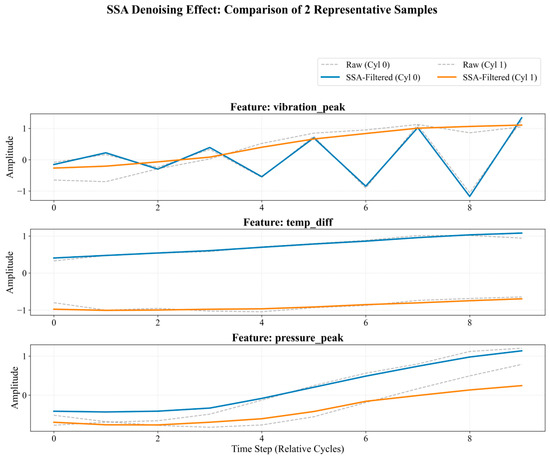
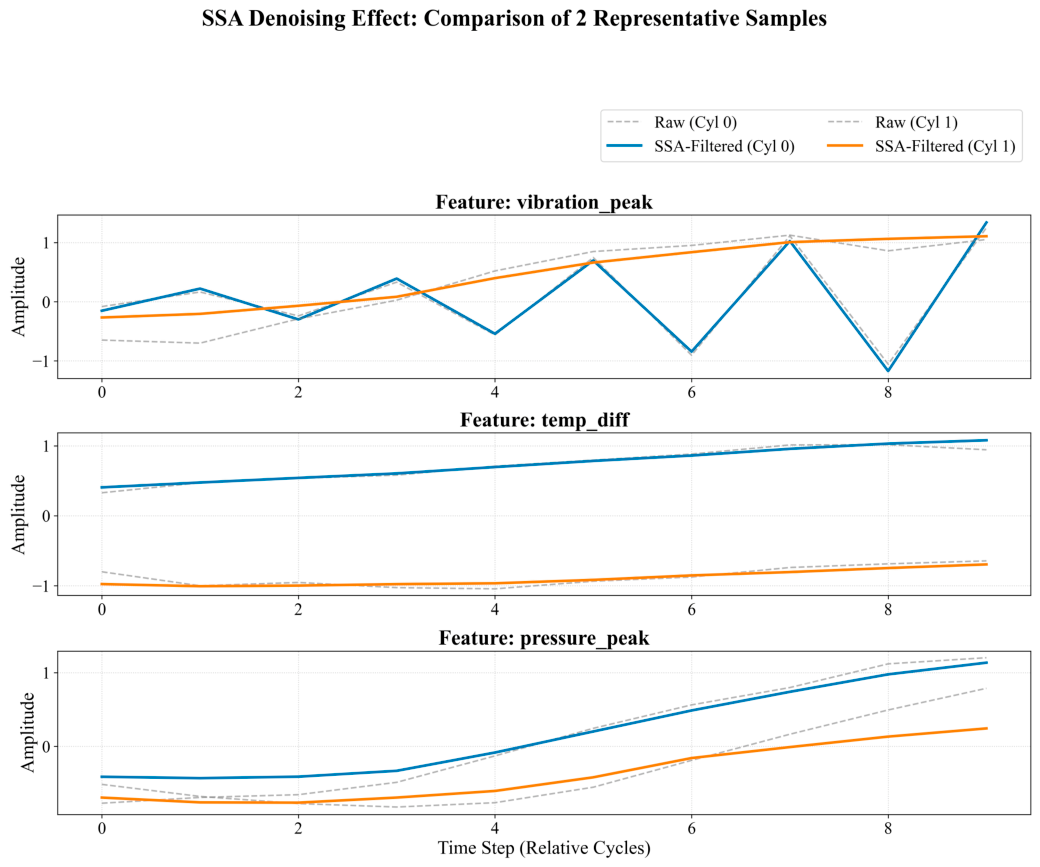
During cyclic charging and discharging operations, high-pressure gas cylinders are affected by environmental disturbances, sensor drift, and electromagnetic noise. Consequently, the original monitoring signals—such as strain and pressure measurements—often contain significant random fluctuations and high-frequency noise. These disturbances may obscure the true degradation trends of composite materials and increase the training burden of deep learning models. To address this issue, Singular Spectrum Analysis (SSA) was employed to decompose and reconstruct the standardized time series signals. This process effectively suppresses high-frequency noise components while preserving the dominant degradation patterns. Figure 6 illustrates the denoising effect of SSA on three representative features: vibration_peak, temp_diff and pressure_peak. In the figure, the gray dashed curves represent the original signals, while the colored solid curves correspond to the SSA-reconstructed signals. It can be observed that after SSA processing, the high-frequency random fluctuations are significantly reduced, and the underlying degradation trends become more clearly distinguishable.
Figure 6.
SSA Denoising Effect.
3.4.2. Impact of Singular Component Selection on Reconstruction Quality
To quantify the impact of the number of singular components on the RUL prediction accuracy, a comparative study was performed using PC1, PC1–PC2, and PC1–PC3 for signal reconstruction. Table 4 summarizes the results.
Table 4.
Performance comparison of different singular component combinations.
It is observed that while PC1–PC3 captures over 95% of the signal energy, the RMSE increases significantly. This phenomenon suggests that the additional variance is primarily attributed to high-frequency environmental noise and sensor fluctuations rather than physical degradation. In the context of composite gas cylinders, the RUL is predominantly governed by the long-term monotonic fatigue trend, which is effectively captured by PC1. Furthermore, potential transient degradation events are independently represented by features such as pressure_peak and temp_diff within our 12-dimensional input vector. Therefore, retaining only PC1 serves as an optimal ‘denoising filter,’ preventing the model from overfitting to stochastic noise while preserving the essential degradation trajectory.
By comparing the signals before and after SSA processing, several improvements can be observed:
Trend Preservation: SSA effectively extracts the nonlinear growth trend within the monitoring signals. This trend is consistent with the fatigue damage accumulation characteristics of composite materials under high-pressure cyclic loading conditions.
Fluctuation Suppression: The sharp spikes and local oscillations present in the original signals are significantly reduced after SSA processing. This smoothing process decreases data uncertainty and enables the model to focus on long-term temporal correlations rather than random noise.
Model Performance Gain: Experimental results show that after SSA processing, the signal variances of the three core features were reduced as follows: vibration_peak: variance reduced by 22.70%, temp_diff: variance reduced by 25.66%, pressure_peak: variance reduced by 24.17%. These results confirm the effectiveness of SSA in noise suppression and signal enhancement. The denoised signals preserve the long-term degradation characteristics of gas cylinders, providing higher-quality input data for the subsequent ResNet–LSTM–Attention model to perform more accurate feature extraction.
3.4.3. Sliding Window Sequence Construction
After completing standardization and SSA-based signal enhancement, the sliding window technique was applied to transform the one-dimensional time series data into three-dimensional tensors suitable for deep learning models. This transformation enables the model to capture temporal dependencies within high signal-to-noise ratio (SNR) sequences, thereby improving the overall prediction performance of the RUL estimation framework.
3.5. Comparative Experiment
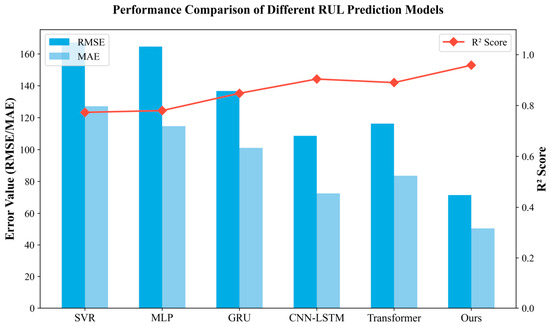
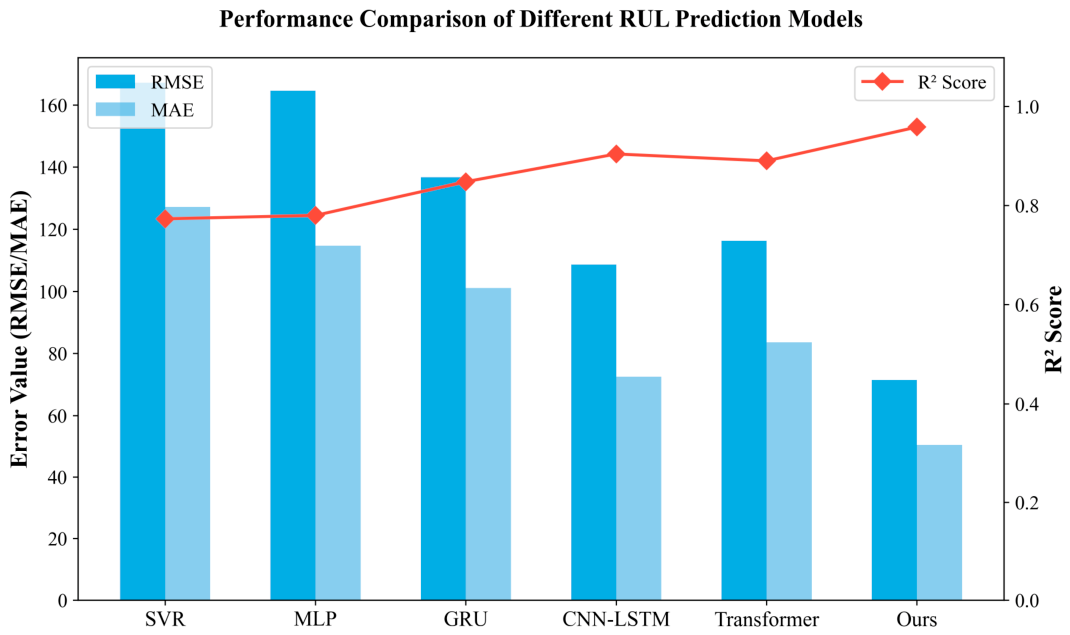
In the field of Remaining Useful Life (RUL) prediction, numerous effective approaches have been proposed by previous studies. For instance, Yang et al. combined Support Vector Regression (SVR) with Ensemble Empirical Mode Decomposition (EEMD) and demonstrated its prediction advantages in lithium-ion battery RUL estimation [20]. Wang et al. proposed an aircraft engine RUL prediction method based on Random Forest feature selection and a Multilayer Perceptron (MLP), which effectively reduced prediction errors [21]. Similarly, Yao et al. constructed a GRU-based hybrid prediction framework, validating its capability in modeling temporal dependencies for lithium-ion battery degradation prediction [22]. Rastegarpanah et al. proposed a CNN–LSTM hybrid model, where convolutional layers were used to extract local features before feeding them into an LSTM network for temporal dependency modeling, significantly improving prediction accuracy [23]. In addition, Yao et al. introduced the Transformer architecture into rolling bearing lifetime prediction, leveraging the self-attention mechanism to capture long-range dependencies and achieving superior performance across multiple datasets [24]. However, when dealing with high-noise multi-source sensor data from special gas cylinders, the above methods still exhibit certain limitations, particularly in terms of noise robustness and degradation feature extraction capability. To address these challenges, this study proposes a SSA–PSO–ResNet–LSTM–Attention framework, and performs a comprehensive comparative evaluation with the aforementioned models. The performance comparison results of different models are presented in Table 5 and Figure 7.
Table 5.
Comparison of performance evaluation indicators for different prediction.
Figure 7.
Performance Comparison of Different RUL Prediction Models. Note: Results are reported as mean ± standard deviation across a grouped 5-fold cross-validation based on cylinder ID to prevent unit-level data leakage.
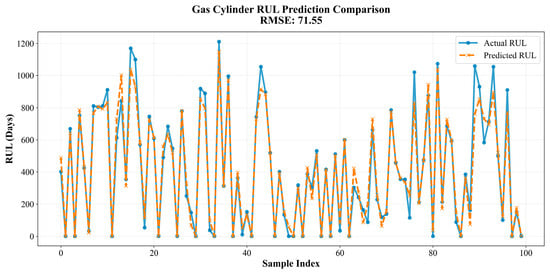
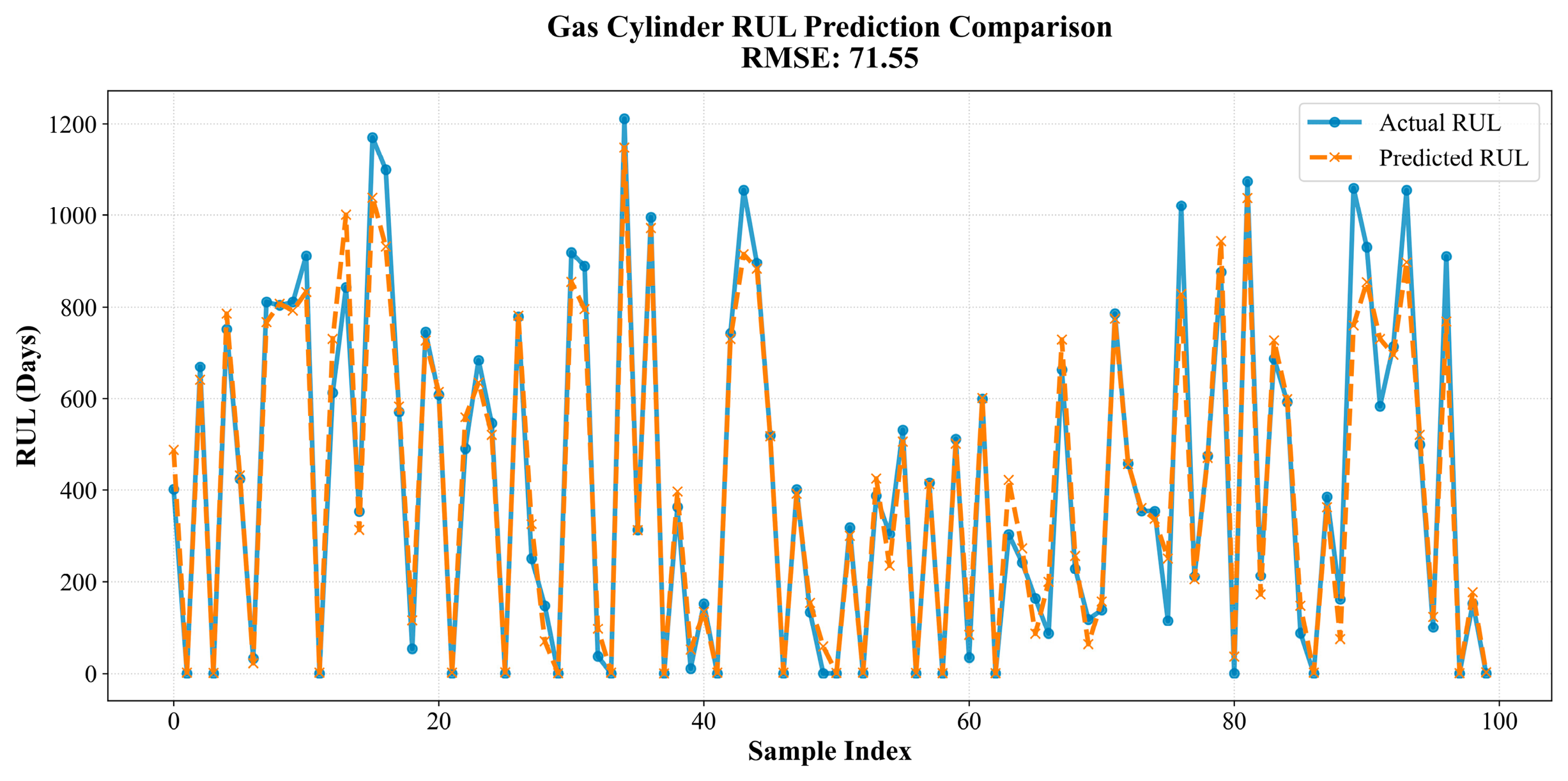
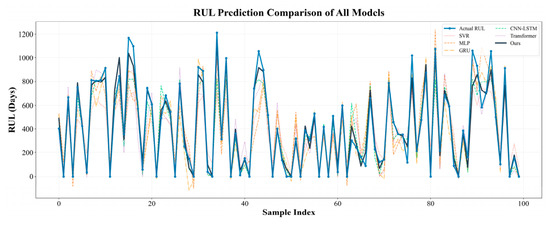
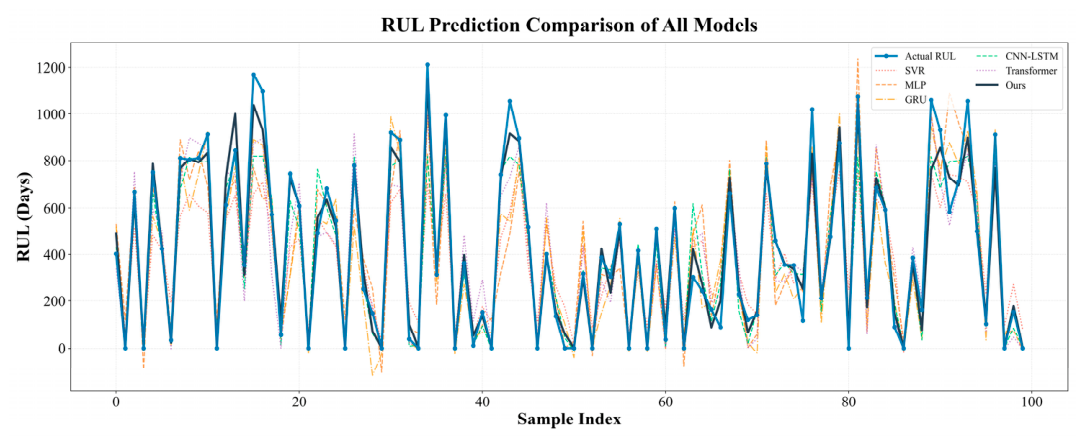
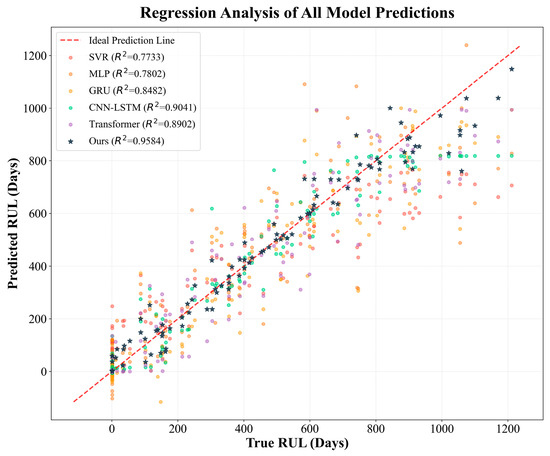
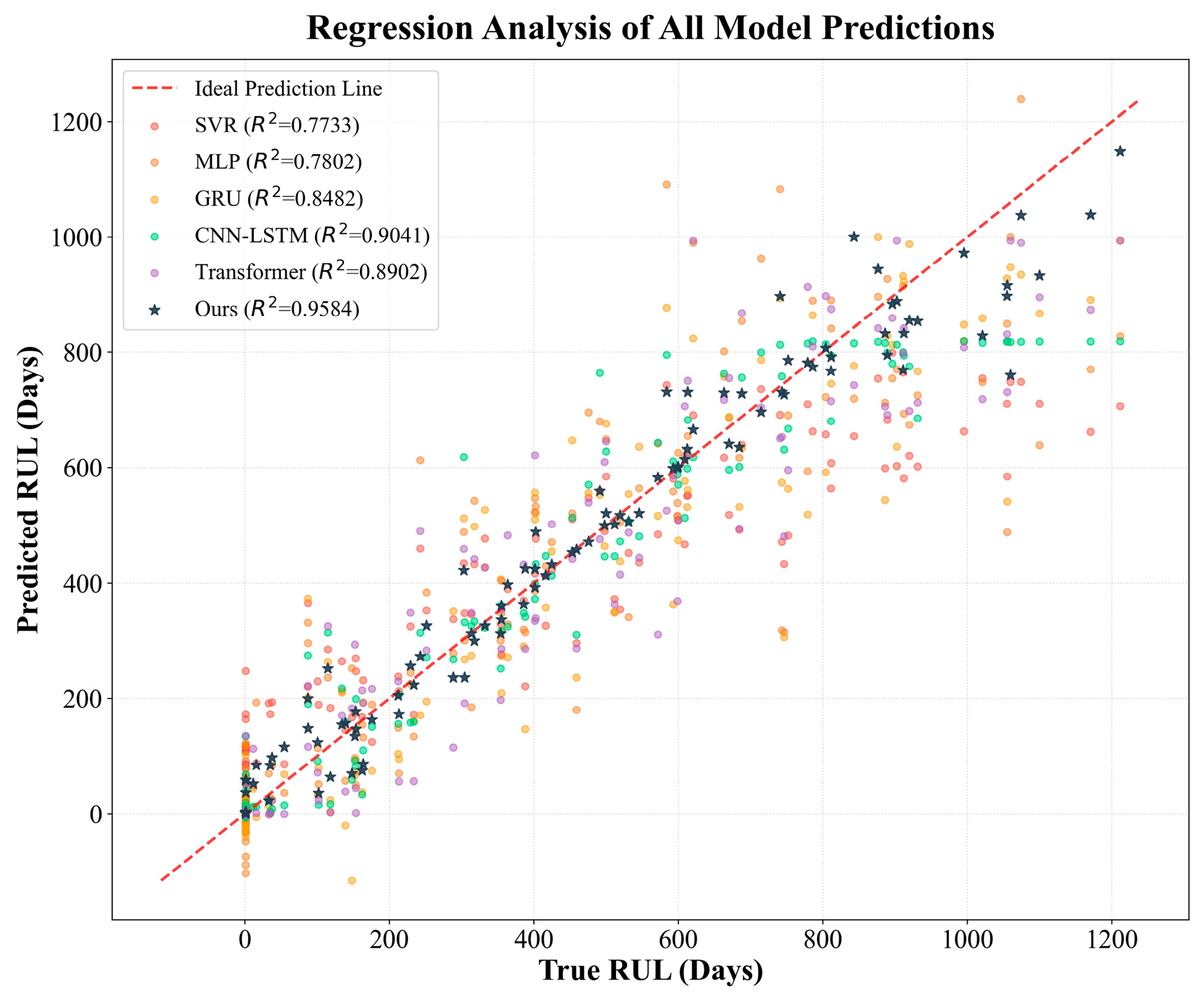
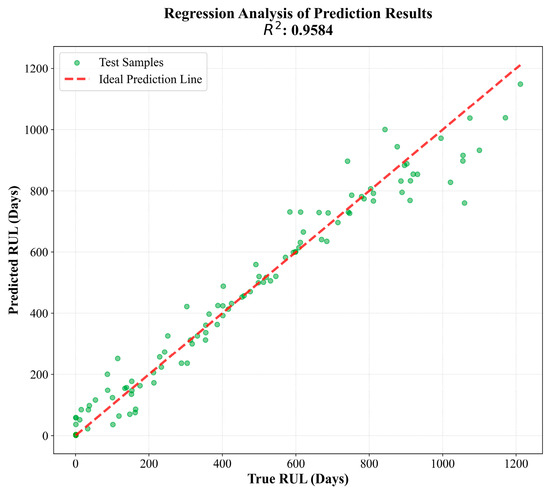
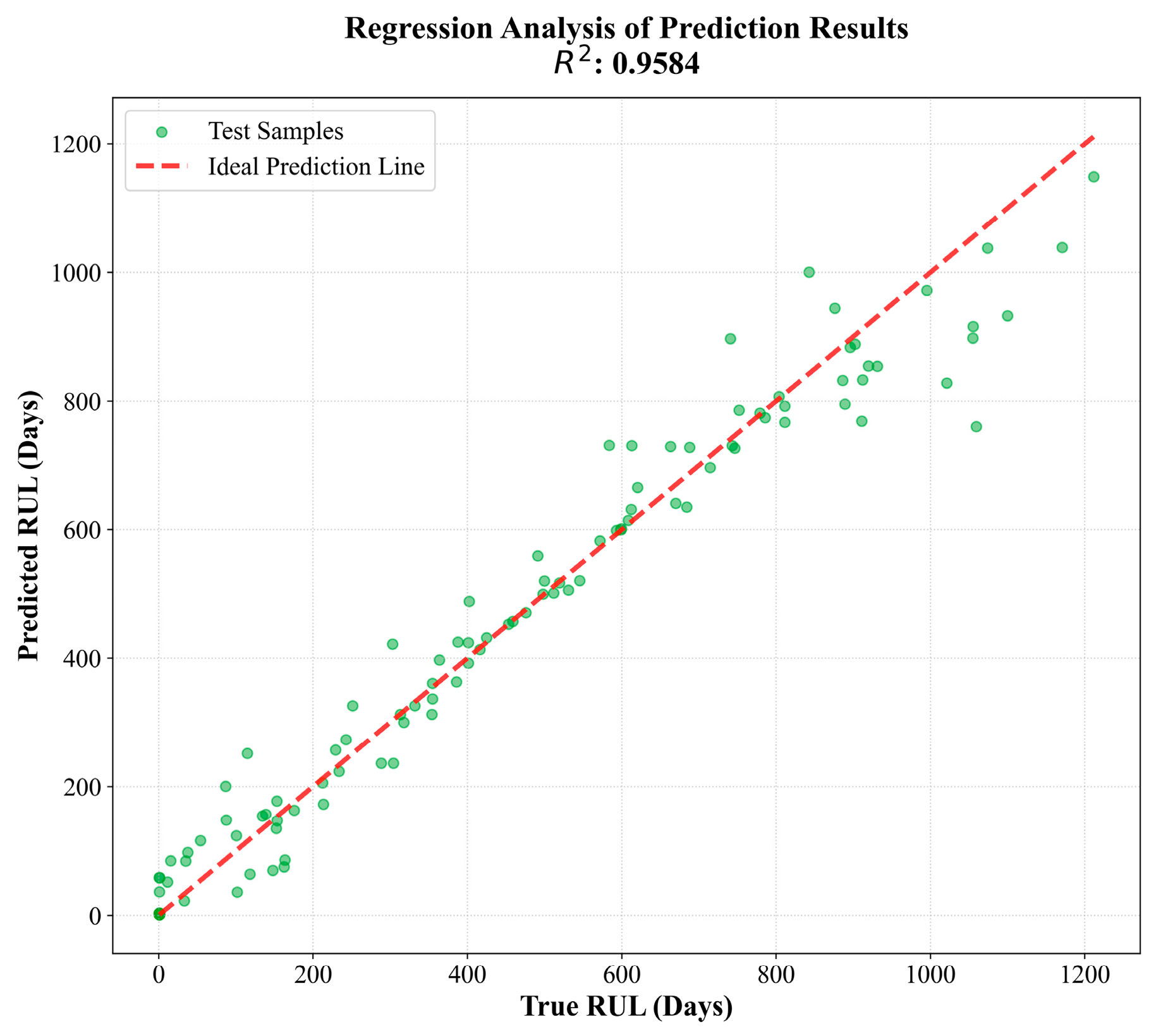
To further illustrate the prediction performance of the proposed model, Figure 8 presents the comparison between the predicted values and the ground truth values on the test set, the predicted curve closely follows the actual RUL curve, indicating that the proposed model can effectively capture the underlying degradation trend of gas cylinders. The discrepancies between all models and the ground truth values are also presented in Figure 9 and Figure 10. In Figure 11, the scatter points are densely distributed around the ideal prediction line, demonstrating a high degree of agreement between predicted and actual values. The coefficient of determination reaches R2 = 0.9584, which indicates that the proposed model achieves high prediction accuracy and strong generalization capability in estimating the Remaining Useful Life of special gas cylinders.
Figure 8.
Proposed Gas Cylinder RUL Prediction Comparison. Note: Evaluation follows the cylinder-ID-based 5-fold cross-validation protocol.
Figure 9.
RUL Prediction Comparison of All Models. Note: Results are reported as mean ± SD from grouped 5-fold cross-validation based on cylinder ID.
Figure 10.
Regression Analysis of All Models’ Predictions. Note: Results are reported as mean ± SD from grouped 5-fold cross-validation based on cylinder ID.
Figure 11.
Proposed Gas Cylinder Regression Analysis of Prediction Results. Note: Evaluation follows the cylinder-ID-based 5-fold cross-validation protocol.
Result Discussion
The experimental results demonstrate the effectiveness of the proposed SSA–PSO–ResNet–LSTM–Attention framework for predicting the Remaining Useful Life (RUL) of special gas cylinders.
First, compared with the second-best performing CNN–LSTM model, the proposed model achieves a 34.2% reduction in RMSE and a 30.2% reduction in MAE, indicating the clear advantage of the ResNet–LSTM–Attention collaborative architecture in feature extraction and temporal modeling. The introduction of residual connections enhances the stability of deep feature propagation, while the attention mechanism allows the network to focus on key temporal patterns related to degradation.
Second, SVR and MLP, representing traditional machine learning and shallow neural network methods, both achieve values below 0.80, suggesting significant limitations when modeling the complex nonlinear degradation patterns present in multi-source gas cylinder sensor data. Although GRU and Transformer models exhibit reasonable capability for temporal sequence modeling, these models do not incorporate residual structures for stable deep feature propagation under the experimental setting of this study. Moreover, their hyperparameters are not optimized using the same global PSO strategy, leading to relatively lower prediction accuracy for the gas cylinder RUL prediction task.
Third, the optimal hyperparameter configuration determined by the Particle Swarm Optimization (PSO) algorithm—including a learning rate of 0.01, 64 convolution kernels, and 32 hidden units—effectively avoids subjective bias introduced by manual hyperparameter tuning. This optimization strategy enables the model to achieve improved convergence behavior and stronger generalization performance.
3.6. Ablation Study
3.6.1. Ablation Experiment Analysis
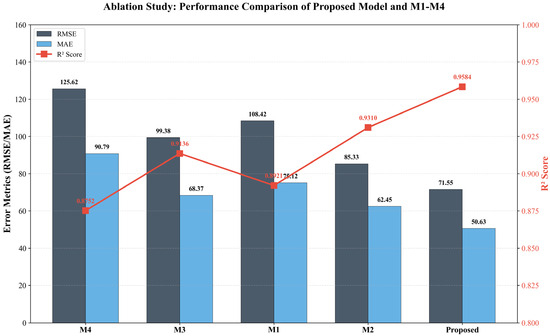
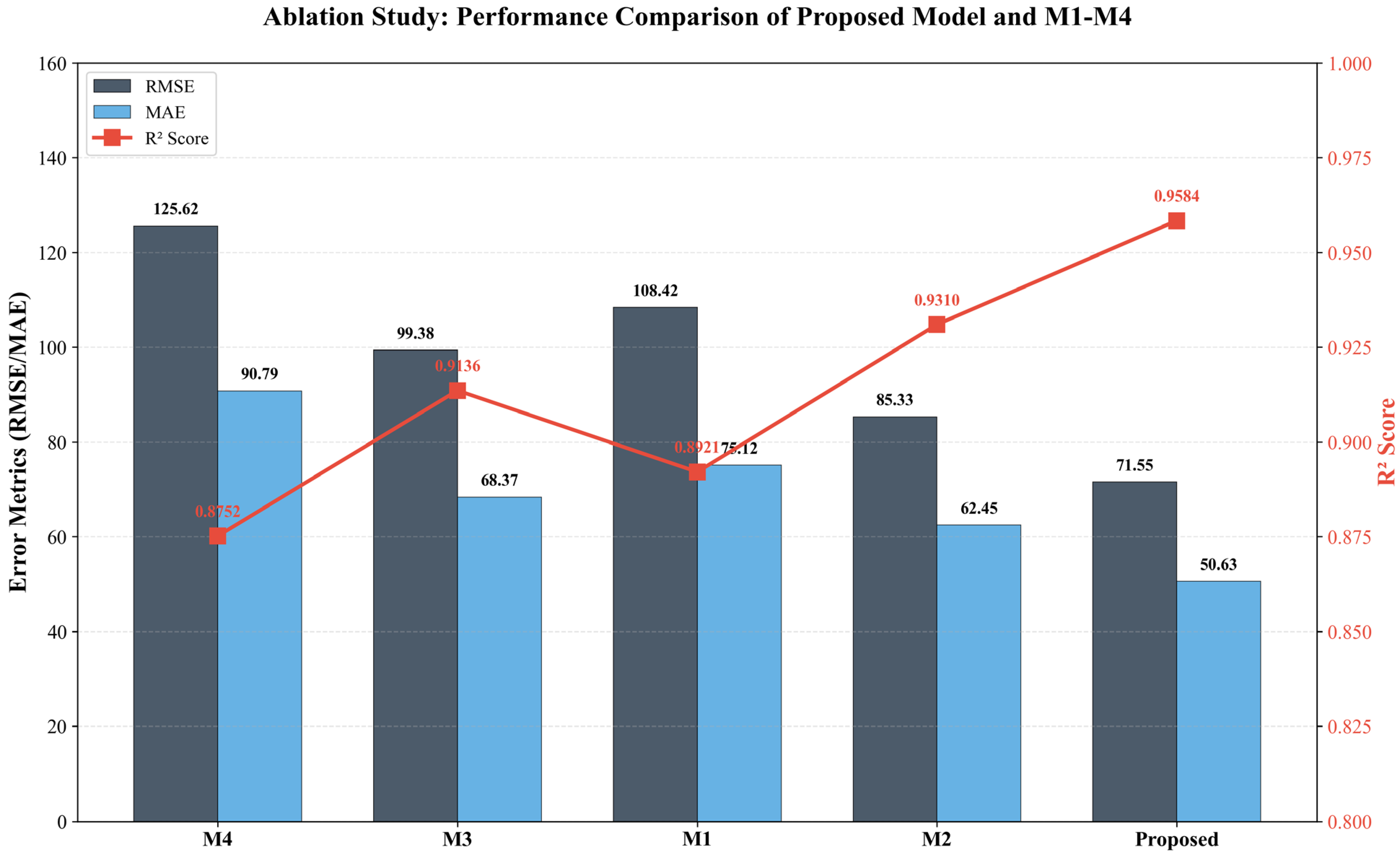
To further investigate the contribution of each key component in the proposed SSA–PSO–ResNet–LSTM–Attention prediction framework, a series of ablation experiments were conducted. By systematically removing or replacing specific modules, the influence of the data preprocessing algorithm, feature extraction network, and attention mechanism on the prediction accuracy of gas cylinder RUL was quantitatively evaluated. Specifically, five groups of ablation experiments were designed to analyze. The experimental results of the ablation study are summarized in Table 6 and Figure 12, each module contributes significantly to the model’s accuracy and stability. The results indicate that SSA is the most critical for handling industrial noise, as M1 shows the largest error and variance. Furthermore, the PSO provides a more precise parameter configuration than manual tuning, ensuring both higher accuracy and better model stability.
Table 6.
Results of Performance Comparison in Ablation Experiments.
Figure 12.
Comparison of Model Component Performance.
- Contribution of the Attention Mechanism
By comparing Model M1 and Model M2, it can be observed that after removing the attention mechanism, the RMSE increases from 71.55 to 99.38, representing a 38.9% increase, while the coefficient of determination decreases from 0.9584 to 0.9136. These results indicate that under the 12-dimensional multi-source sensor input, different features contribute unequally to RUL prediction. The attention mechanism dynamically assigns weights to different features, enabling the model to focus on the most degradation-sensitive indicators. Consequently, the attention module significantly improves the fine-grained prediction capability of the model.
- 2.
- Feature Extraction Capability of the Residual Structure (ResNet)
Comparing Model M2 and Model M3, further removal of the ResNet module causes the RMSE to increase significantly from 99.38 to 125.62, corresponding to a 26.4% increase, while R2 decreases to 0.8752. This result demonstrates that the residual structure effectively alleviates the gradient vanishing problem in deep neural networks through identity mapping. The residual connections enhance the model’s ability to extract complex nonlinear spatial features from gas cylinder sensor signals. When combined with the LSTM network, the model forms a more robust spatiotemporal feature representation, which is crucial for capturing degradation dynamics.
Conclusions of Ablation Experiments
The ablation study demonstrates that the key components in the proposed framework exhibit significant positive synergistic effects. ResNet extracts local spatial features from multi-source sensor signals. LSTM models the long-term temporal degradation patterns. Attention focuses on critical degradation-related features. PSO ensures globally optimized hyperparameter configurations. The cooperation of these modules collectively guarantees the superior performance of the proposed framework in high-pressure gas cylinder RUL prediction tasks.
3.7. Chapter Summary
This chapter conducted systematic experimental validation and result analysis for the Remaining Useful Life (RUL) prediction of high-pressure gas cylinders. The main findings are summarized as follows:
Data Quality Assurance: Singular Spectrum Analysis (SSA) was introduced to preprocess the 12-dimensional monitoring signals of high-pressure gas cylinders. This method effectively removed high-frequency random noise and extracted the trend components reflecting the fatigue damage evolution of composite materials, thereby providing high-quality input data for model training.
Global Hyperparameter Optimization: The Particle Swarm Optimization (PSO) algorithm was employed to overcome the limitations of manual hyperparameter tuning in deep learning models. The optimal learning rate (0.01) and network configuration were identified, ensuring excellent convergence and stability during the 150 training epochs.
Verification of Performance Advantages: Comparative experimental results show that the proposed SSA–PSO–ResNet–LSTM–Attention framework significantly outperforms five baseline models, including SVR, MLP, GRU, CNN-LSTM, and Transformer, across all evaluation metrics. The model achieves an R2 value of 0.9584, and reduces RMSE to 71.55. Compared with the second-best CNN-LSTM model, the RMSE is reduced by 34.2%, demonstrating the synergistic benefits of residual connections and attention mechanisms in handling complex spatiotemporal features.
Architectural Completeness: The ablation experiments further confirm that both the ResNet feature extraction module and the attention-based feature weighting mechanism are indispensable. Removing either component leads to a significant increase in RMSE, highlighting the importance of their integration for accurately modeling the nonlinear degradation trajectory of high-pressure gas cylinders.
4. Conclusions and Contributions
This study proposes a novel SSA–PSO–ResNet–LSTM–Attention-based approach for predicting the Remaining Useful Life (RUL) of special gas cylinders. The proposed framework suppresses industrial noise using SSA, adaptively optimizes network hyperparameters using PSO, and employs an integrated ResNet–LSTM–Attention architecture to simultaneously capture spatial features, long-term temporal dependencies, and key feature importance. The main contributions of this study are summarized as follows:
Multi-source Feature Engineering under Industrial Operating Conditions: Unlike many studies based on simulation datasets, this research utilizes 12-dimensional sensor data collected from a real industrial platform, including pressure, temperature, strain, and operational features. By constructing a balanced dataset with a 1:1:1:1 ratio under extreme, dynamic, standard, and mild environmental conditions, the robustness of the model across diverse operating scenarios is ensured.
RUL Labeling Based on Service Trajectories: The RUL labels were determined based on the full operational lifecycles of 100 specialty gas cylinders. By synchronizing the intensive sensor monitoring data with long-term historical maintenance records retrieved from an industrial database, the total service lifespan of each unit was precisely identified. This “run-to-decommissioning” data labeling approach enables the proposed model to capture complex, long-term degradation patterns within a focused monitoring window, thereby ensuring the model’s robustness and practical utility in real-world industrial prognostic applications.
Synergistic Effect of Signal Enhancement and Parameter Optimization: Experimental results show that SSA is more effective than traditional smoothing algorithms in extracting meaningful information from noisy industrial data. Meanwhile, the PSO algorithm eliminates the subjectivity of manual hyperparameter tuning, enabling the deep learning architecture to achieve optimal configurations.
Excellent Prediction Performance and Industrial Applicability: The introduction of ResNet and the Attention mechanism significantly improves the model’s ability to focus on critical degradation indicators. Experimental results show that the proposed method achieves low RMSE and MAE values with a high score, indicating strong prediction accuracy and good potential for practical use in the intelligent maintenance of pressure vessels.
While the proposed model demonstrates strong predictive performance on the 1000-sample industrial dataset, it should be noted that the data are collected from a single operating environment, which may limit cross-domain generalization. To mitigate potential overfitting, this study incorporates SSA-based signal denoising, balanced multi-condition sampling, and PSO-based hyperparameter optimization, which collectively enhance model robustness and reduce sensitivity to noise and data bias.
In future research, transfer learning techniques will be explored to adapt the model to gas cylinders with different specifications and operating conditions. In addition, the integration of edge computing technologies will be investigated to deploy the model directly in industrial environments, enabling real-time monitoring and dynamic early warning of gas cylinder degradation, thereby promoting the practical implementation of the proposed approach.
Author Contributions
Conceptualization, H.H. and B.H.; methodology, H.H.; software, H.H.; validation, H.H., Y.L. and X.J.; formal analysis, H.H.; investigation, H.H.; resources, H.H.; data curation, H.H.; writing—original draft preparation, H.H.; writing—review and editing, H.H., Y.L., X.J. and B.H.; visualization, H.H.; supervision, B.H.; project administration, B.H. All authors have read and agreed to the published version of the manuscript.
Funding
This research received no external funding.
Data Availability Statement
The original contributions presented in the study are included in the article, further inquiries can be directed to the corresponding author.
Acknowledgments
We would like to thank Bo Hu for his valuable guidance, constructive suggestions, and continuous support throughout this research.
Conflicts of Interest
The authors declare no conflicts of interest.
References
- Ren, L.; Sun, Y.; Cui, J.; Zhang, L. Bearing remaining useful life prediction based on deep autoencoder and deep neural networks. J. Manuf. Syst. 2018, 48, 71–77. [Google Scholar] [CrossRef] [Scilit]
- Li, X.; Zhang, W.; Ding, Q. Deep learning-based remaining useful life estimation of bearings using multi-scale feature extraction. Reliab. Eng. Syst. Saf. 2019, 182, 208–218. [Google Scholar] [CrossRef] [Scilit]
- Park, K.; Choi, Y.; Choi, W.J.; Ryu, H.-Y.; Kim, H. LSTM-based battery remaining useful life prediction with multi-channel charging profiles. IEEE Access 2020, 8, 20786–20798. [Google Scholar] [CrossRef] [Scilit]
- Rezazadeh, N.; Perfetto, D.; De Luca, A.; Caputo, F. Ensemble learning for estimating remaining useful life: Incorporating linear, KNN, and Gaussian process regression. In Advances in Remanufacturing; IWAR 2023; Lecture Notes in Mechanical Engineering; Springer: Cham, Switzerland, 2024; pp. 201–212. [Google Scholar] [CrossRef] [Scilit]
- Deng, S.; Zhou, J. Prediction of remaining useful life of aero-engines based on CNN-LSTM-attention. Int. J. Comput. Intell. Syst. 2024, 17, 232. [Google Scholar] [CrossRef] [Scilit]
- Zeng, F.; Li, Y.; Jiang, Y.; Song, G. A deep attention residual neural network-based remaining useful life prediction of machinery. Measurement 2021, 181, 109642. [Google Scholar] [CrossRef] [Scilit]
- Zhao, R.; Yan, R.; Chen, Z.; Mao, K.; Wang, P.; Gao, R.X. Deep learning and its applications to machine health monitoring. Mech. Syst. Signal Process. 2019, 115, 213–237. [Google Scholar] [CrossRef] [Scilit]
- Wang, Z.; Liu, N.; Chen, C.; Guo, Y. Adaptive self-attention LSTM for RUL prediction of lithium-ion batteries. Inf. Sci. 2023, 635, 398–413. [Google Scholar] [CrossRef] [Scilit]
- Suh, S.; Mittal, D.A.; Bello, H.; Zhou, B.; Jha, M.S.; Lukowicz, P. Remaining useful life prediction of Lithium-ion batteries using spatio-temporal multimodal attention networks. Heliyon 2024, 10, e36236. [Google Scholar] [CrossRef] [Scilit] [PubMed]
- Yan, J.; Xiao, X.; Li, H. Wind turbine gearbox condition monitoring using hybrid attentions and spatio-temporal BiConvLSTM network. Energies 2023, 16, 6786. [Google Scholar] [CrossRef] [Scilit]
- Golyandina, N.; Nekrutkin, V.; Zhigljavsky, A. Analysis of Time Series Structure: SSA and Related Techniques; Chapman & Hall/CRC: Boca Raton, FL, USA, 2001. [Google Scholar]
- He, Q.-Q.; Wu, C.; Si, Y.-W. LSTM with particle Swam optimization for sales forecasting. Electron. Commer. Res. Appl. 2022, 51, 101118. [Google Scholar] [CrossRef] [Scilit]
- Hafeez, F.; Arfeen, Z.A.; Ali, G.; Masud, M.I.; Hamid, M.; Aman, M.; Saeed, M.S.; Jumani, T.A. A Particle Swarm Optimized Multi-Model Framework for Remaining Useful Life Prediction of Lithium-Ion Batteries Using Domain-Driven Feature Engineering. World Electr. Veh. J. 2025, 16, 639. [Google Scholar] [CrossRef] [Scilit]
- Der, O. Multi-Output Prediction and Optimization of CO2 Laser Cutting Quality in FFF-Printed ASA Thermoplastics Using Machine Learning Approaches. Polymers 2025, 17, 1910. [Google Scholar] [CrossRef] [Scilit]
- Basar, G. Experimental Evaluation and Machine Learning-Based Prediction of Laser Cutting Quality in FFF-Printed ABS Thermoplastics. Polymers 2025, 17, 1728. [Google Scholar] [CrossRef] [Scilit] [PubMed]
- Elsner, J.B.; Tsonis, A.A. Singular Spectrum Analysis—A New Tool in Time Series Analysis; Plenum Press: New York, NY, USA, 1996; pp. 39–50. [Google Scholar]
- Jiang, J.; Wei, X. Fault diagnosis of rolling bearing under adaptive attention LSTM-ResNet. Mach. Tool Hydraul. 2024, 52, 74–81. [Google Scholar] [CrossRef]
- Fazlipour, Z.; Mashhour, E.; Joorabian, M. A deep model for short-term load forecasting applying a stacked autoencoder based on LSTM supported by a multi-stage attention mechanism. Appl. Energy 2022, 327, 120063. [Google Scholar] [CrossRef] [Scilit]
- Yang, J.; He, L.; Fu, S. An improved PSO-based charging strat-egy of electric vehicles in electrical distribution grid. Appl. Energy 2014, 128, 82–92. [Google Scholar] [CrossRef] [Scilit]
- Yang, Z.; Wang, Y.; Kong, C. Remaining useful life prediction of lithium-ion batteries based on a mixture of ensemble empirical mode decomposition and GWO-SVR model. IEEE Trans. Instrum. Meas. 2021, 70, 2517011. [Google Scholar] [CrossRef] [Scilit]
- Wang, H.; Li, D.; Li, D.; Liu, C.; Yang, X.; Zhu, G. Remaining useful life prediction of aircraft turbofan engine based on random forest feature selection and multi-layer perceptron. Appl. Sci. 2023, 13, 7186. [Google Scholar] [CrossRef] [Scilit]
- Yao, F.; He, W.; Wu, Y.; Ding, F.; Meng, D. Remaining useful life prediction of lithium-ion batteries using a hybrid model. Energy 2022, 248, 123622. [Google Scholar] [CrossRef] [Scilit]
- Rastegarpanah, A.; Contreras, C.; Stolkin, R. Hyperparameter-optimized CNN and CNN-LSTM for predicting the remaining useful life of lithium-ion batteries. In 2023 Eleventh International Conference on Intelligent Computing and Information Systems (ICICIS); IEEE: New York, NY, USA, 2023; pp. 110–115. [Google Scholar] [CrossRef] [Scilit]
- Yao, J.; Wang, J.; Li, X.; Zhou, K. Remaining useful life prediction of rolling bearings based on optimized GRU and Transformer. J. Fail. Anal. Prev. 2025, 25, 2266–2281. [Google Scholar] [CrossRef] [Scilit]

Disclaimer/Publisher’s Note: The statements, opinions and data contained in all publications are solely those of the individual author(s) and contributor(s) and not of MDPI and/or the editor(s). MDPI and/or the editor(s) disclaim responsibility for any injury to people or property resulting from any ideas, methods, instructions or products referred to in the content. |
© 2026 by the authors. Licensee MDPI, Basel, Switzerland. This article is an open access article distributed under the terms and conditions of the Creative Commons Attribution (CC BY) license.