


Abstract
In this study, the evaluation and ranking of competencies in traditional and agile project management were examined using a structured Multi-Criteria Decision-Making (MCDM) algorithm. To determine the most important competency group, a direct assessment method by experts was employed. The Analytic Hierarchy Process method extended with triangular fuzzy sets (FAHP) was used to determine the criteria weights applied for ranking the specific competencies within the most important groups. For ranking competencies within these key groups, the Technique for Order Preference by Similarity to Ideal Solution method extended with triangular fuzzy sets (FTOPSIS) was applied. The same algorithmic procedure was carried out for both traditional and agile project management approaches, in a case study conducted across four companies in the automotive industry. The study showed that, in traditional project management, the most important competency group is related to organizational and managerial skills and competencies. On the other hand, in agile project management, the most important competency group refers to contextual skills and competencies. Furthermore, within the traditional approach, the most significant specific competency is project goal orientation, while in the agile approach, the most significant specific competency is customer and stakeholder orientation.
1. Introduction
Contemporary business conditions—globalization, increased demand for high-quality customized products, rapid advancement and significant influence of information technologies, growing complexity of business operations, uncertainty, and numerous other factors pose substantial challenges for project management [1]. A project is a temporary endeavour undertaken with the aim of creating a unique product, service, or result [2]. Through projects, organizations implement strategic changes to adapt to a dynamic and changing environment.
Competencies of project managers and team members represent a critical factor in project success [3,4]. Competencies encompass technical knowledge, leadership skills, communication abilities, decision-making capabilities, and an understanding of the specificities of the business environment. Depending on the chosen project management methodology, the importance of particular competencies can vary significantly. Thus, there is a need for a systematic analysis and ranking of competencies according to their importance within different project management approaches.
One of the key challenges in contemporary project management is aligning the competency profiles of project managers and team members with organizational requirements and the nature of the project itself. In modern organizations facing rapid technological changes, market globalization, and increasing complexity of customer demands, project management has become a key mechanism for achieving strategic goals. The success of project management largely depends on a range of competencies possessed by project managers and team members. Traditional and agile project management approaches require different sets of skills and knowledge, making it essential to identify which competencies hold greater relative importance within each of these contexts.
The aim of this research paper is to identify and compare the importance of key competencies in traditional and agile project management by applying Multi-Criteria Decision-Making (MCDM) methods based on fuzzy logic. The case study was conducted in a company operating in the automotive industry.
The differences between competencies required by these two approaches indicate the necessity for contextual understanding and the selection of personnel aligned with the project and organizational requirements. For this reason, it becomes essential to identify a reliable method for evaluating and ranking competencies that are tailored to the specific conditions of each approach.
In this research, two fuzzy MCDM methods—Fuzzy Analytic Hierarchy Process (FAHP) and Fuzzy Technique for Order Preference by Similarity to Ideal Solution (FTOPSIS)—were employed to rank competencies according to their importance. The decision-making process was grounded in the evaluation of expert opinions in the field of project management, and the results highlight significant differences in the importance of specific competencies between traditional and agile project management approaches. The contribution of this study lies in improving personnel selection and training, as well as optimizing project management practices in line with environmental demands.
To determine the most important competency group for both traditional and agile project management approaches, a direct assessment method by experts was used. Their assessments were aggregated into a single evaluation using the fuzzy arithmetic mean operator. After that, the weights of the criteria used to rank competencies within the most important competency group were determined using the FAHP method. In this case, the problem was approached as a group decision-making task, where the assessments of experts were aggregated using the arithmetic mean operator.
The ranking of competencies was assessed based on three criteria: (1) the importance of the competency for successful project team leadership; (2) the relevance of the competency for collaboration among team members; and (3) the impact of the competency on project realization. The FAHP method was used to determine the criteria weights, and these weights were identical for both project management approaches.
For ranking competencies within the most significant competency group, the FTOPSIS method was employed. Thus, the research identified not only the competency group but also the specific competencies within the most critical group that could significantly influence the formation of project teams for each of the approaches considered. In other words, these are the competencies or skills that should be sought in new team members or developed further in existing team members.
A total of eleven experts from four different companies in the automotive industry participated in the study. All four companies are Tier-1 suppliers within the automotive supply chain.
2. Theoretical Background
In traditional project management, the emphasis is placed on planning and predictably following a project plan to optimize and enhance the efficiency of project activities [5,6]. The traditional approach is based on the premise that user requirements do not change and remain constant throughout the entire project. However, clients often find it difficult to fully articulate all requirements at the project’s outset [7]. When the project team clearly understands what is expected, activities are meticulously planned to deliver the requested solution. This approach highlights the importance of well organized and disciplined planning methods and strict change control, as the project progresses according to a predefined sequence [8].
Due to its formal nature, communication is usually hierarchical, and managers are perceived as central figures responsible for coordinating all aspects of the project. In [9], authors point out that this approach can be too rigid in environments where user requirements are subject to frequent changes. That is why agile models are increasingly being applied outside of the software industry, including marketing, product development, and education, to increase organizational agility and the ability to quickly adapt.
Agile project management emerged to overcome the shortcomings and inadequacies of traditional project management such as rigidity, poor responsiveness to changes, and detailed upfront planning. Traditional project management methods are not applicable to agile projects, as these projects typically start without fixed and immutable specifications, and frequent changes occur during project execution [10]. According to the authors [11], the manager’s role is changing from a traditional manager to a facilitator who encourages team collaboration, resolves obstacles, and fosters a culture of learning.
2.1. Competencies in Project Management
According to the Project Management Institute (PMI), project manager competencies are divided into three groups [12]: knowledge competencies, personal competencies, and performance competencies. Knowledge competencies refer to specific knowledge in the field of project management. Personal competencies refer to behaviours, attitudes, and personality characteristics that contribute to a project manager’s ability to better manage projects and include: communication, leadership, management, conceptual skills, effectiveness and professionalism. Performance competencies are related to what a manager can achieve by applying acquired knowledge and personal skills. These are: project integration management, project scope management, time management, cost management, quality management, human resource management, project communication management, risk management, procurement management and stakeholder management.
Based on the analysis of scientific research papers, the most important skills and competencies of agile project manager are: organizational skills, orientation to results and continuous improvement, organization of meetings, communication skills, orientation to problems that may occur, analytical thinking and reasoning, critical thinking, knowledge and understanding of the organization environment (supplier, customers), the skill of flexible analysis of the situation, the observation of emergency situations, understanding of uncertain, complex and abstract situations, management of changes and effective problem-solving [13,14].
The most important personal qualities of agile project managers are: leadership capabilities, emotional intelligence, professionalism, empathy and understanding, innovation, confidence, ability, efficient decision-making, charisma and positive attitude, self-consciousness, flexibility, reliability, and ethical behaviour [14]. Leadership skills, the ability to create a vision, creativity, tolerance, motivation, flexibility and communication are especially important. Authors [15] consider leadership skills to be the most important, highlighting them as a key factor in the success of project managers in different types of projects.
2.1.1. Traditional Project Management
Traditional project management, also known as the waterfall method or waterfall model, represents a linear and sequential approach to project management that is applied in the simplest situations when the project is short, when the goals and requirements of the users/clients are clear and when it is necessary to achieve results within the defined time, scope and budget [1]. The ultimate goal of traditional project management is to finalize the project within the planned deadline, and budget according to the defined scope [16]. Traditional approaches to project management, such as Project Management Body of Knowledge (PMBOK) [2] and PRojects IN Controlled Environments Version 2 (PRINCE2) [17], rely on precisely defined phases (initiation, planning, execution, monitoring and closure—which take place in a linear sequence), strict control and clearly structured documentation. In such an environment, the most important competencies include the ability to plan long-term, manage time and resources, manage risks, report skills, control and report skills, knowledge of standards and methodologies (such as PMBOK or PRINCE2).
Project managers have a leading role in project management and are key players in their successful implementation [8,18]. In the traditional project management approach, the project manager is responsible for achieving the project’s objectives, controlling the time, cost, and scope of the project. They must possess the appropriate qualities, knowledge, skills, competencies and abilities in order to be able to direct the work of a larger number of project team members towards the realization of the project’s goals. Authors [19] proposed a method for evaluating project managers based on the classification of competencies in three key dimensions: knowledge, performance and behaviour. For each of these dimensions, corresponding sub-criteria are defined, which enable a comprehensive assessment of the candidate.
2.1.2. Agile Project Management
Agile management as a method of project management was created as a response to the increasing uncertainty and variability in the business environment, especially in the IT industry and software development, in order to overcome the shortcomings and inadequacies of traditional project management such as rigidity, unresponsiveness to changes, and detailed planning [20]. With agile projects, traditional project management is not applicable because these projects usually start without firm and unchanging specifications and because frequent changes occur during project implementation. The agile project management approach is adequate in complex and uncertain situations when changes are frequent and unpredictable; if it is not possible to define the project plan to a high level of detail; and when it is not possible to carry out precise assessments, early predictions and solution design at the very beginning because changes in requirements are very frequent in order to more clearly define product requirements [5]. In this project management approach, the project manager is simultaneously a leader, entrepreneur, resource allocator, integrator, and negotiator [13]. As a leader, the project manager leads the project team, coordinates the activities of all members of the project team, and directs their activities [21].
In contrast to the traditional project manager who must possess strong organizational skills (goal orientation, the ability for strategic and short-term planning, meeting organization, and thorough understanding of the organizational structure and culture), as well as technical and project management skills (technical expertise, specialized knowledge related to the application of project management tools and techniques, cost and financial management, material resource management, human resource management, and project risk management), the agile project manager must particularly exhibit people-oriented skills (team coordination, member motivation, stress management, conflict resolution, the ability to organize training through seminars for project team members), contextual skills (understanding, analyzing, and interpreting the organization’s environment—suppliers, customers, customer orientation—and the ability to negotiate with clients), and skills that enable system stabilization during crisis situations (proactive problem analysis, effective problem-solving abilities, the capacity to comprehend complex and abstract situations, the ability to respond quickly to uncertainty, and a continuous drive for improvement).
2.2. Multi-Criteria Decision-Making in Project Management
The problem of ranking alternatives is well recognized in the literature and has been applied across numerous domains such as supplier selection [22], location selection [23], system reliability assessment [24,25], transport [26], material selection [27], vehicle selection [28,29], materials processing [30], renewable energy systems [31], information and communication technology [32], sports management [33], and many others. However, a review of the literature reveals that only a limited number of scientific studies have addressed the analysis and ranking of the skills and competencies that project managers and other team members involved in project implementation should possess within different project management approaches. Furthermore, the literature review indicates a notable scarcity of research aimed at quantitatively comparing the importance of individual competencies in different contexts, particularly through the application of MCDM methods.
In addition to the above, the use of fuzzy logic for evaluating expert subjective judgments has been especially underexplored, despite the fact that this methodology provides a robust means of integrating uncertainty and variability in assessments. Therefore, it can be concluded that there is a growing need for conducting research of this kind.
Despite the fact that MCDM methods have not been used for analyzing competencies in project management, they have generally been applied in project management in a broader sense. The study by authors of [34] provides a comprehensive overview of MCDM methods applied at various stages of the decision-making process for the selection of a project manager. In [35], authors developed a MCDM model for project manager selection, combining a group decision support system with a MCDM approach to effectively solve the candidate selection problem. Within the framework of the proposed model, the evaluation of candidates and the determination of criteria weights is done in a linguistic form which is then transformed into triangular fuzzy numbers, thereby enabling a better expression of uncertainty and subjectivity in the decision-making process. Following a similar principle, in [36], the authors selected the members of the process failure mode and effects analysis team, which can also be characterized as a type of project.
In modern project management conditions, the selection of a competent project manager is a key success factor. The authors of [37] developed a multi-criteria methodology for project manager selection based on grey criteria. They list oral communication skills, technical expertise, problem-solving ability and decision-making skills as the most important skills. In [38], the authors propose an innovative model for the evaluation of project managers that integrates the method of interval decision-making with a new model of project manager competencies. The authors point out that traditional approaches often ignore uncertainty and imprecision in evaluator assessments and introduce interval values in order to better capture the variations in assessments and the subjective perception of evaluation criteria.
The FAHP is an extension of the classical AHP method developed by the authors of [39], enabling analytical evaluation of decision-making problems under conditions of uncertainty, which is modelled using TFNs. Although numerous methods and approaches for determining criteria weights have been developed over time [40,41,42,43,44], AHP has remained one of the most widely used and respected in the relevant literature.
In traditional AHP, decision-makers express preferences between pairs of criteria using a numerical scale, which often fails to capture the inherent nature of human reasoning. In this context, fuzzy logic is employed to better model linguistic assessments, thereby reducing errors caused by cognitive limitations. Due to its ability to process imprecise and subjective data, FAHP has been widely applied in areas such as human resource management, risk assessment, and strategic planning.
The use of the FAHP enables a structural decomposition of the problem through a hierarchy of goals, criteria, and alternatives, while simultaneously incorporating uncertainty and linguistic values into the evaluation process [45]. The FAHP method utilizes fuzzy numbers to quantify imprecision in human judgement, which is particularly useful when experts express preferences using terms such as “slightly more important”, “significantly more important”, or “extremely more important”.
The FTOPSIS method is an extension of the classical TOPSIS approach developed by the authors of [46], and is based on the concept that the best alternative is the one closest to the ideal solution and farthest from the negative-ideal solution. In its fuzzy variant, the subjective evaluations of decision-makers are expressed as fuzzy numbers, allowing for greater flexibility in interpreting imprecise judgments. The Fuzzy TOPSIS method enables the selection of the best alternatives based on their proximity to the ideal and anti-ideal solutions. This method has proven to be highly useful in situations involving a large number of criteria with varying levels of importance, as it allows for the ranking of alternatives according to their relative closeness to an ideal competency profile. It is particularly well suited for ranking alternatives described by multiple quantitative and qualitative criteria, making it appropriate for the evaluation of competencies that encompass both technical and behavioural aspects.
In order to improve the decision-making process in the field of personnel selection, the authors of [47] applied the Fuzzy TOPSIS method within the framework of MCDM. The focus of their research was aimed at supporting decision-making in the selection of IT professionals, taking into account numerous criteria that include technical skills, work experience, interpersonal skills and other relevant characteristics of candidates.
The authors of [19] developed an integrated model that combines fuzzy AHP and TOPSIS techniques to improve the project selection process. Fuzzy AHP was used to determine the relative importance of criteria, taking into account imprecision and subjectivity in expert opinions. After that, the TOPSIS method was applied to rank the project alternatives in relation to the defined criteria.
In [48], a methodological framework for decision-making in the domain of project selection by applying an integrated approach that combines the FAHP and TOPFSIS techniques is applied. Given the multi-criteria nature of project selection problems, the authors emphasized the importance of appropriate weighting of criteria and the ranking of alternative solutions under conditions of uncertainty and imprecision, which are characteristic of real-world decision-making environments.
3. Research Methodology
3.1. Research Objectives
The objective of this research is to determine the most important competency group required for the successful implementation of projects under both traditional and agile project management approaches, as well as to rank the identified competencies within the most significant competency group for each of these approaches.
The methodological framework of this study is based on the quantitative MCDM approach, incorporating fuzzy logic to model subjective and imprecise expert assessments. Given the complexity of competency profiles and the differences between organizational project management approaches, two complementary methods were selected: FAHP and FTOPSIS. Through the application of these two methods, an objective ranking of competencies based on their relative importance was achieved, and the extent to which these competencies are expressed in different project management contexts was evaluated. These methods enable a structured identification of the importance of competencies and their assessment across different project management environments—both traditional and agile.
3.1.1. Research Questions
The research conducted in this paper aims to address the following research questions:
- Which project management competencies are of the greatest importance in traditional and agile approaches?
- What are the most important competencies within most significant competency groups in both project management approaches?
3.1.2. Research Hypotheses
The hypotheses were developed based on a review of the literature and the results of previous studies. The evidence supporting the hypotheses is related to the context of the automotive industry. The objective is to determine whether the results of studies conducted in other domains correspond to the results obtained by applying the proposed methodology and case study in the automotive industry. The hypotheses are as follows:
- H1: The importance of a competency group varies depending on the project management approach.
- H1 validation: The hypothesis is confirmed if different competency groups occupy the first rank in both approaches (traditional and agile). Otherwise, the hypothesis is rejected as false.
- H2: In traditional project management, the most important competencies are organizational and technical competencies.
- H2 validation: The hypothesis is considered confirmed if the competency groups organizational/managerial skills/competencies or technical project management skills/competencies occupy the first rank. Otherwise, the hypothesis is rejected as false.
- H3: In agile project management, the most significant competencies are contextual and people-oriented skills.
- H3 validation: The hypothesis is considered confirmed if the competency groups people-oriented skills/competencies or contextual skills/competencies occupy the first rank. Otherwise, the hypothesis is rejected as false.
3.2. The Algorithmic Implementation Steps
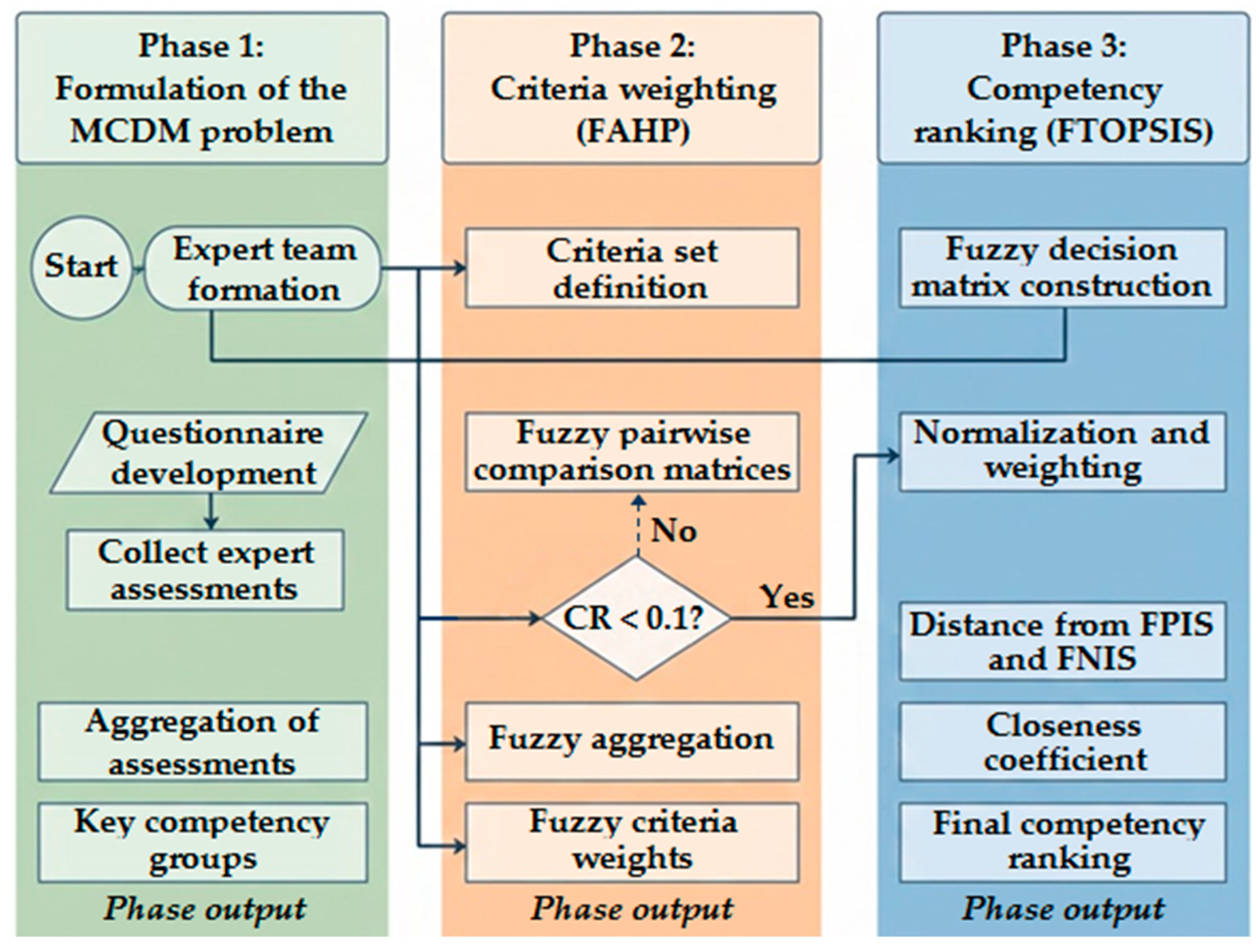
For the purpose of clarifying the applied approach, Figure 1 presents the research methodology graphically through an algorithm. Each of the steps shown are further explained below and, where necessary, supported by the corresponding mathematical equations.
Figure 1.
Algorithm of the FAHP–FTOPSIS approach application.
The abbreviations used in Figure 1 are defined in the Algorithmic Implementation Steps.
3.3. Algorithmic Implementation Steps of the FAHP–FTOPSIS Approach
To determine the most important competency group, , for both traditional and agile project management approaches, a direct expert assessment method was employed, and the obtained evaluations were aggregated using the arithmetic mean operator. A total of eleven experts (decision-makers), formally denoted as , from four companies operating in the automotive industry participated in this study. All four companies are Tier-1 suppliers within the automotive supply chain.
Based on a review of the literature and consultations with experts in the field of project management, a list of nine competency groups was defined, as follows:
- Personal traits ;
- Organizational/managerial skills/competencies ;
- Technical project management skills/competencies ;
- People-oriented skills/competencies ;
- Communication skills ;
- Task-oriented skills/competencies ;
- Skills related to self-development and the development of team members ;
- Contextual skills/competencies ;
- Skills for stabilizing systems during crisis situations .
In this study, the assessment of the competency groups, , was carried out by experts, :
- R&D Manager—Company 1 ;
- Production Manager—Company 1 ;
- Plant Manager—Company 1 ;
- Plant Manager—Company 2 ;
- Operations Manager—Company 2 ;
- Process Engineering Manager—Company 2 ;
- Quality Manager—Company 3 ;
- Supply Quality Engineer—Company 3 ;
- Plant Manager—Company 3 ;
- Quality Manager—Company 4 ;
- Maintenance Manager—Company 4 .
After identifying the most important competency groups for traditional and agile project management approaches, the weights of the criteria, based on which the competencies, , were evaluated were determined. For this purpose, the FAHP method was employed. In this paper, the following three criteria, , were considered:
- the importance of the competency for effective project team leadership ;
- the importance of the competency for collaboration among team members ;
- the impact of the competency on project implementation .
The criteria weights were determined at the level of each expert and then aggregated using the fuzzy arithmetic mean operator.
The competencies were identified based on data from the relevant literature. The FTOPSIS method was applied to determine the ranking of competencies within the most important competency group for both traditional and agile project management approaches.
Therefore, the algorithmic implementation steps were given in three phases: (1) determining the most important competency group; (2) determining the weights of criteria; and (3) ranking of competencies within the most important competency group.
3.3.1. Determining the Most Important Competency Group
Step 1: Individual assessments of experts, , of the importance of competency groups, , that is, the formation of the matrix of individual assessments, .
The evaluations were performed using five predefined linguistic terms modelled using TFNs, which can be represented as follows:
- The competency group has almost no importance (Z1): (1, 1, 5.5);
- The competency group has low importance (Z2): (1, 3, 7);
- The competency group has moderate importance (Z3): (2, 6, 8);
- The competency group has high importance (Z4): (3, 7, 9);
- The competency group has very high importance (Z5): (4.5, 9, 9).
Step 2: Aggregation of experts’ assessments using the fuzzy arithmetic mean operator:
Step 3: Defuzzification of the obtained values using the centroid method [49], , and ranking of the competency groups. The highest-ranked competency group is the one with the largest value of . The opposite also applies.
3.3.2. Determining the Criteria Weights
Step 1: Forming pairwise comparison matrices to determine the relative importance of the criteria:
In this study, the assessment of the relative importance of criteria, , was carried out by experts, . The evaluations were performed using five predefined linguistic terms, which can be represented as follows:
- The criteria are of equal importance (1): (1, 1, 1);
- Very slightly more important (): (1, 1, 5.5);
- Slightly more important (): (1, 3, 7);
- Moderately more important (): (2, 6, 8);
- Significantly more important (): (3, 7, 9);
- Extremely more important (): (4.5, 9, 9).
Step 2: Determining the consistency of experts’ assessments using the eigenvector method [50], with the prior use of the defuzzification method [49]. First, a defuzzied pairwise comparison matrix is formed, , so that:
Step 3: Determining the weights of criteria, , at the level of each decision maker , using the methodology developed in [51]. We can formally present the obtained relative criteria as follows:
Step 4: Aggregated criteria weights using the fuzzy arithmetic mean operator are calculated [52]. The aggregated criteria weights can be formally presented as follows:
In this way, the aggregated criteria weights on the basis of which the ranking of competencies within the most important competency group is performed.
3.3.3. Ranking of Competencies Within the Most Important Competency Group
Step 1: Formation of the fuzzy decision matrix . This matrix is formed based on the estimates of the experts. They expressed assessments using seven predefined linguistic terms, represented by TFNs:
- The competency has no importance (V1):(0, 0.15, 0.3);
- The competency has very low importance (V2):(0.1, 0.25, 0.4);
- The competency has low importance (V3):(0.2, 0.35, 0.5);
- The competency has moderate importance (V4):(0.35, 0.5, 0.65);
- The competency has high importance (V5):(0.5, 0.65, 0.8);
- The competency has very high importance (V6):(0.6, 0.75, 0.9);
- The competency has absolute importance (V7):(0.7, 0.85, 1).
The domain of these TFNs is defined on a measurement scale ranging [0–1]. A value of 0 indicates the lowest level of competency importance, while a value of 1 represents the highest level of competency importance.
The experts’ assessments are aggregated using the fuzzy arithmetic mean operator to obtain a unified decision matrix.
Step 2: Formation of a fuzzy normalized decision matrix . Normalization was performed using the linear sum-based normalization. The choice of normalization method is a very complex problem and can affect the final ranking of alternatives [53,54]. In this case, the linear sum-based normalization was chosen due to its consistency and reliability.
Step 3: Formation of a fuzzy weighted normalized decision matrix :
Step 4: Fuzzy Positive Ideal Solution (FPIS) and Fuzzy Negative Ideal Solution (FNIS):
, that is FPIS;
, that is FNIS.
Step 5: Determining distances from FPIS, to FNIS, . It is calculated according to a proposed procedure:
Distance from FPIS:
Distance from FNIS:
Step 6: Defuzzification of the obtained values and , applying the methodology presented in [49], so that:
Step 7: Determining the approximation coefficient , an alternative to the ideal solution:
where .
Step 8: Ranking of alternatives based on the value of the closeness coefficient , where the alternative with the highest value is ranked first. The reverse also holds true.
4. Case Study
This section presents the results obtained for traditional and agile project management using the FAHP–FTOPSIS algorithmic implementation steps. This is followed by a discussion on the obtained results.
4.1. Case 1: Traditional Project Management
According to Step 1 of Phase 1 of the methodological algorithm, the experts evaluated the importance of each competency group as presented in Table 1.
Table 1.
Expert evaluation of the importance of competency groups (traditional approach).
In the second step, the aggregation of experts’ assessments is performed using the fuzzy arithmetic mean operator, while in the third step, defuzzification and the ranking of competency groups are carried out. The calculated values, as well as the ranking of competency groups, are presented in Table 2.
Table 2.
Ranking of competency groups—traditional approach.
As shown in Table 2, within the traditional project management approach, the most important competency group is , i.e., organizational/managerial skills and competencies. Ranked second are technical project management skills and competencies , followed by personal traits competencies . The least important competency group for the traditional approach consists of the skills that support system stabilization during crisis situations .
In the second phase of the methodological algorithm, it is necessary to determine the criteria weights based on which the competencies within the most important group will be ranked. Eleven decision-makers provided their evaluations as follows (Step 1):
As can be seen in the previous matrices, the experts expressed their assessments of the relative importance of the criteria. Each criterion was compared with the other criteria through a pairwise comparison matrix. For this purpose, the previously defined fuzzy measurement scale from to was used. A reciprocal value indicates the inverse situation, i.e., that the considered criterion is less important relative to the one it is compared with. A value of one indicates a comparison of a criterion with itself.
In the second step of the second phase of the methodological algorithm, the consistency of the pairwise comparison matrices was checked. All matrices were consistent, i.e., the Consistency Ratio (CR) was less than 0.1. This was expected, as the pairwise comparison matrices were of size 3 × 3. In the third step, the weights of the criteria were determined at the level of each expert, as shown in Table 3.
Table 3.
Criteria weights per expert.
In step 4 of the methodological algorithm, the weights were aggregated using the fuzzy arithmetic mean operator: ; ; .
The calculated relative importance of the criteria will also be used in Case 2 (Agile Project Management).
In the third phase of the methodological algorithm, it is necessary to determine the ranking of competencies within the most important competency group by applying the FTOPSIS method, taking into account the calculated relative importance of the criteria. The fuzzy decision matrix is presented in Table 4.
Table 4.
The fuzzy decision matrix (at the level of each expert; traditional approach).
Within the competency group organizational/managerial skills and competencies , the following competencies were considered: project goal setting , project goal orientation , strategic planning ability , short-term planning ability , the ability to perceive the project as a whole , the ability to achieve project efficiency , result orientation and continuous improvement , negotiation skill , organizational skills , meeting management , understanding of the organization’s mission , analysis of organizational structure , knowledge of organizational culture , and ability to assess and manage values .
Then, by applying the fuzzy arithmetic mean operator, the experts’ assessments were aggregated into a single evaluation, as presented in Table 5.
Table 5.
The fuzzy decision matrix.
Then, in Step 2 of the methodological algorithm, the values were normalized using a linear normalization procedure. In Step 3, the normalized values were weighted, resulting in a weighted normalized fuzzy decision matrix (Table 6).
Table 6.
The weighted normalized fuzzy decision matrix.
In order to streamline the procedure and improve the clarity of the paper, only the defuzzied values of the distances from FPIS to FNIS are presented, as well as the closeness coefficient and the ranking of competencies (Table 7).
Table 7.
The ranking of competencies—traditional project management.
As can be seen from the obtained ranking (Table 7), the most important competency within the traditional project management approach is project goal orientation (). It is followed by the competency of perceiving the project as a whole () and the ability to achieve project efficiency (). Therefore, it is the responsibility of management to either recruit personnel or train existing staff to meet the requirements of these three key competencies. The least important competencies within the most important group are the organizational skills and the analysis of the organizational structure ().
4.2. Case 2: Agile Project Management
Since the methodology used in Case 2 is completely identical to that in Case 1, only the input data and the final solution (without intermediate steps) will be presented further. Table 8 presents the experts’ assessments of the importance of the competency groups, while Table 9 shows the ranking of the competency groups.
Table 8.
Expert evaluation of the importance of competency groups (agile approach).
Table 9.
Ranking of competency groups—agile approach.
As shown in Table 9, within the agile project management approach, the most important competency group is , i.e., contextual skills/competencies. The second-ranked group comprises people-oriented skills/competencies , while the third position is occupied by skills that support system stabilization during crisis situations . The least important competency group for the traditional approach includes skills related to self-development and the development of team members .
Within the competency group contextual skills/competencies , the following competencies are considered: knowledge and understanding of the environment (suppliers, customers) , the skill of thoroughly analyzing the environment , knowledge of processes , customer/stakeholder orientation , stakeholder management , ability to negotiate with stakeholders , skills in the field of marketing and sales , and orientation toward environmental protection .
The second phase of the methodological algorithm, determining the criteria weights used for ranking the competencies, is the same as in the case of traditional project management. Therefore, the same criteria weights are used in this case as well. In the third phase of the methodological algorithm, it is necessary to determine the ranking of competencies within the most important group by applying the FTOPSIS method. The fuzzy decision matrix is presented in Table 10, while the ranking of competencies is given in Table 11.
Table 10.
The fuzzy decision matrix (at the level of each expert; agile approach).
Table 11.
The ranking of competencies—agile project management.
Based on the obtained ranking, it can be concluded that the most important competency within the agile project management approach is customer/stakeholder orientation . It is followed by competencies such as the skill of thoroughly analyzing the environment and knowledge and understanding of the organizational environment (suppliers, customers) . The least important competency within the most important group is skills in the field of marketing and sales .
4.3. Comparative Analysis
To verify the stability and reliability of the obtained results, this section presents a comparative analysis of the results obtained using the FTOPSIS and Fuzzy RAnking based on the Distances and Range (FRADAR) methods. The RADAR method [55] is a novel MCDM technique that has been shown in previous studies to be reliable and to provide robust solutions [25,33,36,56,57]. It can be stated that benchmarking was conducted to determine whether FTOPSIS provides relevant results.
For the purpose of the sensitivity analysis, the same version of the FRADAR method proposed in [25] was used. To avoid overloading this paper with methodological details, the application procedure can be found in the referenced study. In the following section, only the final results of the FRADAR method, obtained using the same input data as for the FTOPSIS method, are presented, along with a comparative analysis, as shown in Table 12 and Table 13.
Table 12.
Comparative analysis of FTOPSIS and FRADAR results—traditional project management.
Table 13.
Comparative analysis of FTOPSIS and FRADAR results—agile project management.
By examining Table 12 and Table 13, it can be concluded that both FTOPSIS and FRADAR highlight the same most important competencies. The ranking of the top three competencies is identical for both the traditional and agile approaches. Differences occur only for competencies ranked lower, which is expected as the two methods are based on different mathematical foundations. While FTOPSIS is a compensatory method, FRADAR combines characteristics of both compensatory and non-compensatory approaches, aiming to emphasize stable alternatives across criteria. Despite these differences, the Pearson correlation coefficient between the closeness coefficient and the ranking index is very high: 0.83 for the traditional approach and 0.96 for the agile approach, and statistically confirms the robustness of the results.
4.4. Discussion
The obtained results confirm Hypothesis H1, indicating that the importance and manifestation of certain competencies vary depending on the project management approach (see Table 2 and Table 9). This phenomenon is particularly pronounced in the automotive industry, where traditional and agile approaches are often intertwined due to diverse customer requirements. On the one hand, the traditional approach is essential for meeting safety and quality regulatory requirements, while on the other hand, agile approaches are indispensable in the development process.
The final conclusion of this study is that, within the traditional project management approach, the most important competency group consists of organizational/managerial skills (see Table 7). This confirms hypothesis H2. Ranked second are technical project management skills, followed by people-oriented skills. These are then followed by personal attributes, task-oriented competencies, competencies related to self-development and the development of collaborators, and contextual competencies. The least important competency group for the traditional approach includes skills that support system stabilization during crisis situations.
The most important competency within the highest-ranked competency group in the traditional project management approach is project goal orientation (see Table 11). Tied in second place are the competency of perceiving the project as a whole and the ability to achieve project efficiency. The least important competency within the most important group is the analysis of the organizational structure.
The obtained results are consistent with the findings of previous studies conducted by the authors of [58,59,60]. In these research papers, the most important competencies of project managers are identified as conceptual and organizational skills (planning, organizing, strong goal orientation, ability to see the project as a whole), technical skills (special knowledge in use of tools and techniques; project knowledge; understanding methods, processes, and procedures; technology required; and skills in use of computer). These studies emphasize that project managers must possess task-oriented abilities, including negotiation skills, the ability to delegate tasks, the skill of clearly setting priorities, a rule-oriented mindset, and a focus on potential problems. A project manager must be capable of managing their own time and supporting team members in utilizing their time as efficiently as possible. Additionally, project managers must have the ability to manage limited financial and material resources and to maximize their utilization.
In the agile project management approach, the most important competency group consists of contextual skills. This confirms hypothesis H3. Second in rank are people-oriented competencies, followed by competencies that support system stabilization during crisis situations. These are followed by task-oriented competencies, personal attributes, communication skills, and organizational/managerial competencies. The least important competency group in the agile approach includes competencies related to self-development and the development of team members.
The most important competency within the agile project management approach is customer/stakeholder orientation. Ranked second is the skill of thoroughly analyzing the environment, while the third position is held by the competencies related to knowledge and understanding of the organizational environment (suppliers, customers). The least important competency within the most important group is skills in the field of marketing and sales.
The obtained results coincide with scientific research papers [59,61,62], according to which the most important skills/competencies are: leadership, team member motivation, communication, conceptual and organizational skills, interpersonal skills, flexibility, ability to make decisions, ability to solve problems, ability to manage people, conflict management and change management, and reliability. These authors point out that project managers must have the ability to lead their associates towards the vision and achievement of the pipeline, which can be achieved in different ways so that different leadership styles are distinguished: leadership by example, inspirational leadership, task-oriented leadership, relationship-oriented leadership, transactional leadership and transformational leadership. Also, they must have the ability to collaborate, that is, the ability to cooperate with other people in order to achieve common goals. Project managers are also expected to provide support and assistance to associates. Special emphasis must be placed on project team building skills, people development, transforming a dysfunctional group into a cohesive team and ensuring a harmonious work environment. Project managers must focus on encouraging communication between people, motivating them, and developing trust between them. The project manager monitors the results of the team members, encourages cooperation and rewards for certain achievements.
The most important competencies from the highest-ranked groups of competencies have a significant impact when forming a project team. These key competencies must be possessed by new team members who are expected to join the project team in the future. Furthermore, existing team members must continuously develop and enhance these competencies.
In practical terms, an illustrative example can be provided to explain the obtained results. If a project manager in an automotive company is leading a project aimed at the implementation of serial production of specific components/products, the key task is project goal orientation. The objective is to deliver the product on time, in the required quantities, and with the required quality. This represents an example of the traditional project management approach. In contrast, if the project focuses on the development of new materials, the emphasis would be on customer/stakeholder requirements, which may be of different natures.
5. Conclusions
Traditional project management is applied in projects with clearly defined goals, when the projects are fairly predictable and uncomplicated, not subject to frequent changes, have well defined scope and budget, and rely on established processes. On the other hand, agile project management is applied when project goals are unclear, or when the goals are defined but the means of achieving them are not, particularly in uncertain and complex projects. Agile project management places a strong emphasis on encouraging, empowering, and enabling self-organizing, cross-functional project teams to deliver working iterations of the product to customers/clients efficiently and continuously. Each of these project management approaches requires a distinct set of skills and competencies from all stakeholders involved in project implementation.
The results of this study indicate that the most important competency within the most significant competency group in the context of the traditional project management approach is goal orientation. The second most important competency is the ability to perceive the project as a whole. Ranked third is the capability to achieve project efficiency. The least important competency within the most significant group is the analysis of the organizational structure.
On the other hand, in the agile project management approach, the most important competency group consists of contextual skills. Ranked second are people-oriented competencies, followed by skills that contribute to system stabilization during crisis situations. These are followed by task-oriented competencies, personal attributes, communication skills, and organizational/managerial competencies. The least important competency group for the agile approach includes competencies related to self-development and the development of team members.
The most important competency within the agile project management approach is customer/stakeholder orientation. Ranked second is the skill of thoroughly analyzing the environment, followed by knowledge and understanding of the organizational environment (suppliers, customers). The least important competency within the most critical competency group is skills in the field of marketing and sales.
The contribution of this research paper is evident on theoretical, methodological, and practical levels. On the theoretical level, the study contributes to the project management literature through a comparative analysis of competencies in traditional and agile environments, thereby addressing the lack of integrated models in this field. On the methodological level, the research applies an integrated fuzzy MCDM approach, which enables the processing of imprecise and subjective expert evaluations, thus enhancing the validity and robustness of the results.
On a practical level, the findings can serve as a decision-support tool for project management offices or human resources departments for the following purposes:
- Selection and hiring of new employees. If the company primarily executes agile projects, candidate assessment should focus on environmental regulations and standards, as well as client orientation. On the other hand, if the traditional approach is more prevalent, the focus should be on technical knowledge that is critical for achieving project goals.
- Employee training design. Emphasis should be placed on developing the most important competencies among employees. This way, resources are directed toward improving the knowledge and skills that are most crucial for project success.
- Project team creation. The company should have a clear profile for project managers as well as team members. Depending on the project management approach, the appropriate members should be selected.
The limitations of this study are reflected in the sample size and the specificity of expert evaluations, which opens avenues for extending the research by including a larger number of experts from various sectors and geographic regions. Although the participants were carefully selected based on their expertise and practical experience in project management, the number of experts involved was relatively limited. Therefore, it should be emphasized that the obtained results are relevant for the considered companies, as well as for automotive industry companies with similar characteristics in terms of activities, size, level of automation, etc. It should be clearly stated that the results of this research cannot be generalized.
Competencies are often abstract and multidimensional, making them difficult to define and quantify unambiguously. While fuzzy methods are specifically designed to handle uncertainty and imprecision in expressing preferences, challenges remain in accurately interpreting linguistic terms and transforming them into numerical values. Additionally, individual differences in the understanding of terms such as “leadership”, “emotional intelligence” or “adaptability” may affect the consistency of evaluations. Future research could focus on the longitudinal monitoring of competency development throughout specific project cycles, as well as the integration of other MCDM methods to verify and compare results.
Although the integration of FAHP and FTOPSIS methods provides a systematic framework for priority analysis and ranking of alternatives, these methods do not account for interdependencies among criteria. This can also be characterized as a limitation of the applied MCDM approach. In real organizational environments, many competencies are not independent—for example, communication skills can significantly influence the quality of teamwork or leadership. Therefore, it is recommended to apply other fuzzy MCDM methods that enable modelling of interdependencies among competencies. These methods allow for mapping causal relationships between factors, which can help identify competencies that generate or enhance the development of others, thus enabling more precise design of training and development programmes for project teams.
Author Contributions
Conceptualization, M.S. and N.K.; methodology, N.K.; validation, M.D. and A.V.; formal analysis, M.S.; investigation, M.S.; resources, M.S. and M.D.; data curation, D.M.; writing—original draft preparation, M.S.; writing—review and editing, N.K., M.D. and D.M.; visualization, N.K.; supervision, A.V.; funding acquisition, A.V. and M.D. All authors have read and agreed to the published version of the manuscript.
Funding
This study is partly supported by the Ministry of Science, Technological Development and Innovation through co-financing of scientific research and development projects between the Republic of Serbia and the Republic of Italy 2024–2026, project AI-AGRI-HAND: AI-powered visio-tactile soft robotic hand for Agrifood farming.
Data Availability Statement
The original contributions presented in this study are included in the article. Further inquiries can be directed to the corresponding author.
Conflicts of Interest
The authors declare no conflicts of interest.
Abbreviations
The following abbreviations are used in this manuscript:
| FAHP | Fuzzy Analytic Hierarchy Process |
| FTOPSIS | Fuzzy Technique for Order Preference by Similarity to Ideal Solution |
| MCDM | Multi-Criteria Decision-Making |
| PMBOK | Project Management Body of Knowledge |
| PMI | Project Management Institute |
| PRINCE2 | PRojects IN Controlled Environments Version 2 |
| TFNs | Triangular Fuzzy Numbers |
References
- Effective Project Management: Traditional, Agile, Extreme, 5th ed.; Wysocki, R.K., Ed.; Wiley Pub: Indianapolis, IN, USA, 2009. [Google Scholar]
- ANSI/PMI 99-001-2008; A Guide to the Project Management Body of Knowledge: (PMBOK® Guide). An American National Standard; Project Management Institute: Newtown Square, PA, USA, 2008.
- Albert, M.; Balve, P.; Spang, K. Evaluation of Project Success: A Structured Literature Review. Int. J. Manag. Proj. Bus. 2017, 10, 796–821. [Google Scholar] [CrossRef] [Scilit]
- Carvalho, M.M.D.; Patah, L.A.; De Souza Bido, D. Project Management and Its Effects on Project Success: Cross-Country and Cross-Industry Comparisons. Int. J. Proj. Manag. 2015, 33, 1509–1522. [Google Scholar] [CrossRef] [Scilit]
- Diem, G. Agile and Traditional Project Management: Comparing Agile, Traditional and Hybrid Project Management Practices A Research Study of Project Management Professionals in Germany Gregor Diem. Ph.D. Thesis, Heriot-Watt University, Edinburgh, Scotland, 2021. [Google Scholar] [CrossRef]
- Rose, K.H. Book Review: Effective Project Management: Traditional, Agile, Extreme, Fifth Edition. Proj. Manag. J. 2010, 41, 84. [Google Scholar] [CrossRef] [Scilit]
- Hass, K.B. The Blending of Traditional and Agile Project Management. PM World Today 2007, 9, 1–8. [Google Scholar]
- Müller, R.; Turner, R. Leadership Competency Profiles of Successful Project Managers. Int. J. Proj. Manag. 2010, 28, 437–448. [Google Scholar] [CrossRef] [Scilit]
- Cicmil, S.; Williams, T.; Thomas, J.; Hodgson, D. Rethinking Project Management: Researching the Actuality of Projects. Int. J. Proj. Manag. 2006, 24, 675–686. [Google Scholar] [CrossRef] [Scilit]
- Bergmann, T.; Karwowski, W. Agile Project Management and Project Success: A Literature Review. In Advances in Human Factors, Business Management and Society; Kantola, J.I., Nazir, S., Barath, T., Eds.; Advances in Intelligent Systems and Computing; Springer International Publishing: Cham, Switzerland, 2019; Volume 783, pp. 405–414. [Google Scholar]
- Moe, N.B.; Dingsøyr, T.; Dybå, T. A Teamwork Model for Understanding an Agile Team: A Case Study of a Scrum Project. Inf. Softw. Technol. 2010, 52, 480–491. [Google Scholar] [CrossRef] [Scilit]
- Project Management Institute (Ed.) Project Manager Competency Development Framework, 3rd ed.; Project Management Institute: Newtown Square, PA, USA, 2017. [Google Scholar]
- Banerjee, S. Role of a Project Manager in Managing Agile Projects. J. Bus. Financ. Aff. 2016, 5, 1–4. [Google Scholar] [CrossRef]
- Sutling, K.; Mansor, Z.; Widyarto, S.; Letchmunan, S.; Arshad, N.H. Agile Project Manager Behavior: The Taxonomy. In Proceedings of the 2014 8th. Malaysian Software Engineering Conference (MySEC), Langkawi, Malaysia, 23–24 September 2014; IEEE: Langkawi, Malaysia, 2014; pp. 234–239. [Google Scholar]
- Turner, J.R.; Müller, R. The Project Manager’s Leadership Style as a Success Factor on Projects: A Literature Review. Proj. Manag. J. 2005, 36, 49–61. [Google Scholar] [CrossRef] [Scilit]
- Andrejić, M.D.; Đorović, B.D.; Pamučar, D.S. Managing Projects Using a Project Management Approach. Vojnoteh. Glas. 2011, 59, 142–157. [Google Scholar] [CrossRef] [Scilit]
- AXELOS. Managing Successful Projects with PRINCE2, 6th ed.; TSO (The Stationery Office): London, UK, 2017. [Google Scholar]
- Müller, R.; Turner, R. The Influence of Project Managers on Project Success Criteria and Project Success by Type of Project. Eur. Manag. J. 2007, 25, 298–309. [Google Scholar] [CrossRef] [Scilit]
- de Rezende, L.B.; Blackwell, P. Project Management Competency Framework. Iberoam. J. Proj. Manag. 2019, 10, 34–59. [Google Scholar]
- Meso, P.; Jain, R. Agile Software Development: Adaptive Systems Principles and Best Practices. Inf. Syst. Manag. 2006, 23, 19–30. [Google Scholar] [CrossRef] [Scilit]
- Hoda, R.; Noble, J.; Marshall, S. The Impact of Inadequate Customer Collaboration on Self-Organizing Agile Teams. Inf. Softw. Technol. 2011, 53, 521–534. [Google Scholar] [CrossRef] [Scilit]
- Więckowski, J.; Kizielewicz, B.; Shekhovtsov, A.; Sałabun, W. How Do the Criteria Affect Sustainable Supplier Evaluation?—A Case Study Using Multi-Criteria Decision Analysis Methods in a Fuzzy Environment. J. Eng. Manag. Syst. Eng. 2023, 2, 37–52. [Google Scholar] [CrossRef] [Scilit]
- Kozoderović, J.; Pajić, V.; Andrejić, M. A Multi-Criteria Analysis for E-Commerce Warehouse Location Selection Using SWARA and ARAS Methods. J. Eng. Manag. Syst. Eng. 2025, 4, 122–132. [Google Scholar] [CrossRef] [Scilit]
- Kushwaha, D.K.; Panchal, D.; Sachdeva, A. A Modified FMEA Approach Based Integrated Decision Framework for Overcoming the Problems of Sudden Failure and Accidental Hazards in Turbine and Alternator Unit. Facta Univ. Ser. Mech. Eng. 2023, 23, 459–478. [Google Scholar] [CrossRef] [Scilit]
- Komatina, N.; Marinković, D.; Tadić, D.; Pamučar, D. Advancing PFMEA Decision-Making: FRADAR Based Prioritization of Failure Modes Using AP, RPN, and Multi-Attribute Assessment in the Automotive Industry. Teh. Glas. J. 2025, 19, 442–451. [Google Scholar] [CrossRef] [Scilit]
- Petrović, N.; Marinković, D.; Komatina, N.; Runić-Ristić, M.; Qureshi, T.M.; Aleksić, A. Fuzzy MCDM Methodology Application in Analysis of Annual Operational Efficiency in Passenger and Freight Air Transport. Mathematics 2025, 13, 3535. [Google Scholar] [CrossRef] [Scilit]
- Więckowski, J.; Sałabun, W. Comparative Sensitivity Analysis in Composite Material Selection: Evaluating OAT and COMSAM Methods in Multi-Criteria Decision-making. Spectr. Mech. Eng. Oper. Res. 2025, 2, 1–12. [Google Scholar] [CrossRef] [Scilit]
- Tadić, D.; Lukić, J.; Komatina, N.; Marinković, D.; Pamučar, D. A Fuzzy Decision-Making Approach to Electric Vehicle Evaluation and Ranking. Teh. Vjesn. Gaz. 2025, 4, 1066–1075. [Google Scholar] [CrossRef] [Scilit]
- Yalçın, G.C. Development of a Fuzzy-Based Decision Support System for Sustainable Tractor Selection in Green Ports. Facta Univ. Ser. Mech. Eng. 2025, 23, 579–604. [Google Scholar] [CrossRef] [Scilit]
- Kawecka, E.; Perec, A.; Radomska-Zalas, A. Use of the Simple Multicriteria Decision-Making (MCDM) Method for Optimization of the High-Alloy Steel Cutting Processby the Abrasive Water Jet. Spectr. Mech. Eng. Oper. Res. 2024, 1, 111–120. [Google Scholar] [CrossRef] [Scilit]
- Mandal, N.; Sarkar, P.; Petrović, N. Multi-Criteria Decision-Making for Ranking Renewable Energy Sources: A Case Study from the Republic of Serbia. J. Eng. Manag. Syst. Eng. 2025, 4, 109–121. [Google Scholar] [CrossRef] [Scilit]
- Spasenić, I.; Tadić, D.; Čabarkapa, M.; Marinković, D.; Komatina, N. Cloud Platform Selection Using Extended Multi-Attribute Decision-Making Methods with Interval Type-2 Fuzzy Sets. Axioms 2025, 14, 469. [Google Scholar] [CrossRef] [Scilit]
- Komatina, N. Integrating Hybrid FAHP–FRADAR Approach and the FMEA Framework for Evidence-Informed Risk Assessment in Football Player Transfers. J. Data Sci. Intell. Syst. 2025. [Google Scholar] [CrossRef] [Scilit]
- Afshari, A.R.; Nikolić, M.; Akbari, Z. Review on Project Manager Selection Criteria and Methods; University of Novi Sad, Technical Faculty “Mihajlo Pupin”: Zrenjanin, Serbia, 2018; pp. 3–8. [Google Scholar]
- Chen, L.-S.; Cheng, C.-H. Selecting IS Personnel Use Fuzzy GDSS Based on Metric Distance Method. Eur. J. Oper. Res. 2005, 160, 803–820. [Google Scholar] [CrossRef] [Scilit]
- Komatina, N.; Marinković, D. Optimization of PFMEA Team Composition in the Automotive Industry Using the IPF-RADAR Approach. Algorithms 2025, 18, 342. [Google Scholar] [CrossRef] [Scilit]
- Zavadskas, E.K.; Turskis, Z.; Tamošaitienė, J. Multicriteria Selection of Project Managers by Applying Grey Criteria. Technol. Econ. Dev. Econ. 2008, 14, 462–477. [Google Scholar] [CrossRef] [Scilit]
- Sadeghi, H.; Mousakhani, M.; Yazdani, M.; Delavari, M. Evaluating Project Managers by an Interval Decision-Making Method Based on a New Project Manager Competency Model. Arab. J. Sci. Eng. 2014, 39, 1417–1430. [Google Scholar] [CrossRef] [Scilit]
- Saaty, T.L. The Analytic Hierarchy Process: Planning Setting Priorities, Resource Allocation; RWS Publications: Pittsburgh, PA, USA, 1980. [Google Scholar]
- Stevic, Z.; Ulutas, A.; Topal, A.; Marinkovic, D.; Cavoski, S. A New Objective Method for Determining Criteria Weights in MCDM Models—LOGSTA. Int. J. Simul. Model. 2025, 24, 589–600. [Google Scholar] [CrossRef] [Scilit]
- Kizielewicz, B.; Sałabun, W. SITW Method: A New Approach to Re-identifying Multi-Criteria Weights in Complex Decision Analysis. Spectr. Mech. Eng. Oper. Res. 2024, 1, 215–226. [Google Scholar] [CrossRef] [Scilit]
- Rezaei, J. Best-Worst Multi-Criteria Decision-Making Method. Omega 2015, 53, 49–57. [Google Scholar] [CrossRef] [Scilit]
- Więckowski, J.; Sałabun, W. Making More Informed Decisions in Multi-Criteria Problems under Uncertain Conditions of Criteria Weights: Drone Selection Study Case. Facta Univ. Ser. Mech. Eng. 2025. Online first. [Google Scholar] [CrossRef]
- Bošković, S.; Jovčić, S.; Simic, V.; Švadlenka, L.; Dobrodolac, M.; Bacanin, N. A New Criteria Importance Assessment (CIMAS) Method in Multi-Criteria Group Decision-Making: Criteria Evaluation for Supplier Selection. Facta Univ. Ser. Mech. Eng. 2025, 23, 335. [Google Scholar] [CrossRef] [Scilit]
- Uçal Sarý, I.; Öztayşi, B.; Kahraman, C. Fuzzy Analytic Hierarchy Process Using Type-2 Fuzzy Sets: An Application to Warehouse Location Selection. In Multicriteria Decision Aid and Artificial Intelligence; Doumpos, M., Grigoroudis, E., Eds.; Wiley: Hoboken, NJ, USA, 2013; pp. 285–308. [Google Scholar]
- Hwang, C.L.; Yoon, K. Methods for Multiple Attribute Decision Making. In Multiple Attribute Decision Making: Methods and Applications a State-of-the-Art Survey; Springer: Berlin/Heidelberg, Germany, 1981; pp. 58–191. [Google Scholar]
- Kelemenis, A.; Askounis, D. A New TOPSIS-Based Multi-Criteria Approach to Personnel Selection. Expert Syst. Appl. 2010, 37, 4999–5008. [Google Scholar] [CrossRef] [Scilit]
- Mahmoodzadeh, S.; Shahrabi, S.; Pariazar, M.; Zaeri, M.S. Project Selection by Using Fuzzy AHP and TOPSIS Technique. World Acad. Sci. Eng. Technol. 2007, 30, 333–338. [Google Scholar]
- Leekwijck, W.V.; Kerre, E.E. Defuzzification: Criteria and Classification. Fuzzy Sets Syst. 1999, 108, 159–178. [Google Scholar] [CrossRef] [Scilit]
- Saaty, T.L. The Modern Science of Multicriteria Decision Making and Its Practical Applications: The AHP/ANP Approach. Oper. Res. 2013, 61, 1101–1118. [Google Scholar] [CrossRef] [Scilit]
- Kahraman, C.; Öztayşi, B.; Uçal Sarı, İ.; Turanoğlu, E. Fuzzy Analytic Hierarchy Process with Interval Type-2 Fuzzy Sets. Knowl.-Based Syst. 2014, 59, 48–57. [Google Scholar] [CrossRef] [Scilit]
- Mendel, J.M. Uncertain Rule-Based Fuzzy Systems: Introduction and New Directions, 2nd ed.; Springer International Publishing: Cham, Switzerland, 2017. [Google Scholar]
- Petrović, N.; Jovanović, V.; Petrović, M.; Nikolić, B.; Mihajlović, J. Comparative Investigation of Normalization Techniques and Their Influence on MCDM Ranking—A Case Study. Spectr. Mech. Eng. Oper. Res. 2025, 2, 172–190. [Google Scholar] [CrossRef] [Scilit]
- Stević, Ž.; Baydaş, M.; Kavacık, M.; Ayhan, E.; Marinković, D. Selection of Data Conversion Technique via Sensitivity-Performance Matching: Ranking of Small E-Vans with PROBID Method. Facta Univ. Ser. Mech. Eng. 2024, 22, 643–671. [Google Scholar] [CrossRef] [Scilit]
- Komatina, N. A Compromise-Based MADM Approach for Prioritizing Failures: Integrating the RADAR Method within the FMEA Framework. J. Sist. Dan Manaj. Ind. 2024, 8, 73–88. [Google Scholar] [CrossRef] [Scilit]
- Karjust, K.; Mehrparvar, M.; Kaganski, S.; Raamets, T. Development of a Sustainability-Oriented KPI Selection Model for Manufacturing Processes. Sustainability 2025, 17, 6374. [Google Scholar] [CrossRef] [Scilit]
- Ni, N.; Baba, J. A Decision-Analytic Approach for Ranking the Sources of Teacher Self-Efficacy: A Hybrid SIWEC–BWM–E-RADAR Framework in Clinical ESP Teaching. J. Decis. Oper. Res. 2025, 10, 685–709. [Google Scholar] [CrossRef]
- Aramo-Immonen, H.; Bikfalvi, A.; Mancebo, N.; Vanharanta, H. Project Managers’ Competence Identification. Int. J. Hum. Cap. Inf. Technol. Prof. 2011, 2, 33–47. [Google Scholar] [CrossRef] [Scilit]
- El-Sabaa, S. The Skills and Career Path of an Effective Project Manager. Int. J. Proj. Manag. 2001, 19, 1–7. [Google Scholar] [CrossRef] [Scilit]
- Humphrey, B.; Stokes, J. The 21st Century Supervisor: Nine Essential Skills for Frontline Leaders; Jossey-Bass/Pfeiffer: Hoboken, NJ, USA, 2000. [Google Scholar]
- Madter, N.; Bower, D.A.; Aritua, B. Projects and Personalities: A Framework for Individualising Project Management Career Development in the Construction Industry. Int. J. Proj. Manag. 2012, 30, 273–281. [Google Scholar] [CrossRef] [Scilit]
- Tohidi, H.; Jabbari, M.M. Role of Human Aspects in Project Management. Procedia-Soc. Behav. Sci. 2012, 31, 837–840. [Google Scholar] [CrossRef] [Scilit]

Disclaimer/Publisher’s Note: The statements, opinions and data contained in all publications are solely those of the individual author(s) and contributor(s) and not of MDPI and/or the editor(s). MDPI and/or the editor(s) disclaim responsibility for any injury to people or property resulting from any ideas, methods, instructions or products referred to in the content. |
© 2026 by the authors. Licensee MDPI, Basel, Switzerland. This article is an open access article distributed under the terms and conditions of the Creative Commons Attribution (CC BY) license.