


Abstract
Welding robot path planning has drawn increasing attention due to its broad applications in intelligent manufacturing. This paper proposes an integrated optimization framework that combines an improved ant colony optimization (IACO) algorithm for shortest-distance planning and an improved genetic algorithm (IGA) for shortest-time fixed-point trajectory generation. In the distance-planning layer, IACO is enhanced with parameter optimization and a dynamic random-disturbance factor to overcome the premature convergence and limited global search capability of traditional ACO. This achieves a high-quality welding point sequence with reduced computational overhead. In the time-planning layer, cubic B-spline interpolation is adopted to ensure path smoothness, and IGA is designed with a penalty-augmented fitness function and sinusoidal adaptive crossover and mutation operators to minimize execution time while satisfying kinematic constraints. Simulation experiments on a 24-point welding task demonstrate that the proposed IACO converges within approximately 100 iterations and reduces the best-found path length to 822 cm, which is shorter than that of traditional ACO. Furthermore, the IGA reduces the total welding task time from 129 s to s, representing a improvement in time efficiency. Compared with conventional PSO and A* algorithms, the proposed method saves 17.60 s and 11 s, respectively. Additional comparisons with state-of-the-art hybrid algorithms confirm that the IACO-IGA framework achieves superior performance in terms of path length, convergence speed, task duration, and joint motion smoothness, with maximum joint-angle deviation and angular-velocity fluctuation reduced to rad and rad/s. Simulation-based Gaussian-noise robustness simulations confirm that the hybrid IACO-IGA framework exhibits better anti-interference capability under sensor measurement noise. The results verify the effectiveness and practicability of the proposed method for complex multi-welding-point industrial scenarios (simulation-based theoretical results; physical robot validation remains future work).
1. Introduction
With the rapid advancement of artificial intelligence and related technologies, intelligent devices are increasingly integrated into various sectors of society. Mobile robots, originally prominent in military applications, have gradually expanded into civilian domains such as environmental mapping, remote reconnaissance, and logistics, owing to their excellent flexibility and maneuverability [1,2]. However, operation in complex environments necessitates enhanced autonomous planning and control capabilities. Intelligent algorithms serve as the core of path planning, and efficient algorithms can significantly improve path quality. Consequently, numerous scholars have devoted considerable efforts to the study of intelligent optimization algorithms. Currently, research primarily follows two algorithmic paradigms: exact algorithms and heuristic algorithms. Common exact algorithms include Dijkstra, A*. Simulated annealing, and the artificial potential field method belong to heuristic optimization approaches.
Beyond obstacle avoidance and shortest-path determination, the ant colony optimization (ACO) algorithm must also account for the time and energy consumption of robots navigating complex environments. This study establishes a simulation model incorporating welding robot parameters and welding task datasets, utilizing an improved ACO for shortest-distance path planning and an optimized Genetic Algorithm (GA) for shortest-time fixed-point trajectory planning. As widely adopted intelligent simulation algorithms, both ACO and GA are frequently applied to path optimization and combinatorial problem-solving [1]. To address GA’s limitations (such as premature convergence and insufficient local search capability), a penalty factor and a sinusoidal probability correction method are introduced. Furthermore, to resolve the issue of the pheromone function overwhelming the heuristic function in ACO, a random-disturbance factor is incorporated to enhance performance. These improvements are expected to yield an optimized path selection strategy for industrial tasks involving multiple weld joints, thereby improving production efficiency in intelligent manufacturing.
Recent research illustrates the versatility of these algorithms for robotic welding and combinatorial optimization. We focus our literature review on welding robot path-planning research. Fang et al. employed particle-based ACO to numerically optimize artificial magnetic conductor structures, enabling sensors with reduced energy consumption and shorter monitoring times for liquid samples [3]. Wang et al. modeled shipboard power systems and performed network reconfiguration based on operational characteristics, applying ACO to solve associated network issues [4]. Che et al. developed an enhanced particle swarm optimization with adaptive weight and Gaussian mutation (EPSO-AWGM) to optimize path trajectory for autonomous underwater vehicles [5]. Saemi et al. developed an ACO-based metaheuristic algorithm exhibiting efficient performance in ensemble optimization problems [6]. Shobaki et al. proposed an ACO algorithm tailored for complex scheduling scenarios [7]. To eliminate vegetation interference, Xia et al. constructed an ACO-based spectral mixture analysis model; comparative analysis of ETM imagery confirmed the method’s efficacy [8]. Chadi et al. introduced a high-level flexible GA featuring a generalized heuristic encoding framework, demonstrating enhanced time-series tracking capabilities [9]. Yu et al. explored GA implementation via memristors for image restoration, validating its feasibility through parameter optimization [10]. Liu et al. developed a hybrid GA integrating the 2-opt algorithm, which outperformed simulated annealing in optimizing low-energy paths for electric vehicles [11].
Yang et al. innovatively combined artificial potential field global search with an improved dynamic window approach for local optimization, demonstrating effective path planning during robot motion [12]. Che et al. designed an improved ACO based on particle swarm optimization to optimize path trajectory for autonomous underwater vehicle [13]. Touzani et al. modeled multi-robot task sequencing as a Min/Max Multiple Group Traveling Salesman Problem (MGTSP), realizing optimized automobile assembly line production [14]. Wang et al. devised a two-norm-based motion optimization method for highly redundant mobile humanoid robots, constructing a comprehensive kinematic model; optimized motions exhibited minimal fluctuations, improved smoothness, reduced energy consumption, and shorter paths [15]. Addressing spray painting robots, Ru et al. proposed an adjacency-based path-planning method, establishing spray task and virtual robot models to compute motion, joint angles, and angular velocities for high-quality coating [16].
In conclusion, despite extensive research on robot path optimization globally, few studies differentiate between shortest-distance and shortest-time planning specifically for welding robots. To bridge this gap, the present study employs an integrated IACO-IGA framework to conduct layered analyses from both distance and time perspectives. The main contributions of this work are summarized as follows:
- (1)
- A two-layer hybrid IACO-IGA optimization framework is proposed for welding robot path-planning tasks. The distance-optimization layer adopts improved ACO to obtain best-found welding-point visiting sequences, while the time optimization layer employs an IGA combined with cubic B-spline interpolation to realize time-optimal smooth trajectory generation under robot kinematic constraints.
- (2)
- An IACO with a dynamic random-disturbance factor is designed. It alleviates the premature convergence problem of traditional ACO, improves global search capability, and obtains shorter welding-point traversal sequences with lower computational overhead.
- (3)
- An IGA is developed, which introduces a penalty-augmented fitness function and sinusoidal adaptive crossover-mutation operators. The proposed IGA effectively constrains joint angle and angular velocity limits, reduces total task execution time, and suppresses mechanical oscillation of the welding manipulator.
- (4)
- Comprehensive validations including ablation experiments, multi-scale generalization tests under different numbers of welding points, and Gaussian-noise robustness simulations are conducted. Comparative results against traditional ACO, hybrid ACO-PSO and improved demonstrate the superiority and engineering practicability of the proposed IACO-IGA framework for multi-welding-point tasks.
2. IACO-IGA Algorithm Principle
2.1. IACO Design
The multi-point welding robot path-planning task can be abstracted as a traveling salesman problem (TSP), in which each welding joint corresponds to one city node. Empirically determined welding-point visiting sequences cannot satisfy the demand of large-scale multi-joint welding tasks. In this paper, ACO inspired by ant foraging behavior is adopted to search for the optimal visiting order of discrete welding points [2]. This paper treats the welding-point traversal as an open TSP (no requirement to return to starting node after finishing the last welding point), consistent with real-world welding robot production tasks. The objective of IACO is to find the welding-point sequence that minimizes the total travel distance while avoiding potential collisions.
The 3D Euclidean distance objective function is formulated as follows:
where represents the shortest path distance; n is the number of solder joints; and represents the three-dimensional position of the solder joints.
The path-planning problem for welding robots is addressed using ACO. The probability with which an ant selects a path from position i to position j is defined as follows:
where denotes the probability with which ant k transitions from location i to location j at time t; represents the pheromone concentration between locations i and j at time t; signifies the heuristic function value associated with the two locations; is the pheromone weight factor; and denotes the weight coefficient for the heuristic function.
To prevent the pheromone trail from overwhelming the heuristic information during the iteration process, it is necessary to continuously update the pheromone levels along the paths selected by the ants. The mathematical model governing this pheromone concentration update is expressed as follows:
where is the attenuation coefficient of pheromone; is the pheromone released by ant k moving from location i to location j at time t; and is the total number of ants.
The is shown as follows [17]:
where Q represents total pheromones released by all ants; and is the distance from location i to location j.
To ensure algorithmic stability throughout the convergence process in complex computational scenarios, this study adopts an integrated model that incorporates both total pheromone levels and path length for computing the pheromone increment. According to this model, a shorter path length results in a correspondingly larger increase in pheromones. Moreover, to prevent a decline in the algorithm’s global search performance, a dynamic random-disturbance factor is introduced, which increases the likelihood of ants exploring alternative routes. As a result, the transition probability formula for an ant moving from one position to another at a given time is revised as follows:
where represents the random-disturbance scale factor with a value range of , and is the predefined disturbance threshold.
As the iteration count t increases, the disturbance term decays toward zero. In early iterations, the disturbance term is large and above threshold ; the disturbance term participates in the transition probability to enhance global exploration. In later iterations, the disturbance term decays below threshold ; the algorithm mainly uses the original ACO transition probability for local exploitation. All transition probabilities are normalized before ant node selection.
2.2. IGA Design with Non-Uniform Cubic B-Spline Trajectory
After IACO outputs the optimal welding-point visiting sequence, non-uniform cubic B-spline interpolation solving is adopted: we build a linear equation set to solve B-spline control points from given welding waypoints to enforce the trajectory, which strictly interpolates each welding target point, guaranteeing path continuity and smoothness within the robot workspace [18].
Given fixed waypoints, IGA optimizes the temporal segmentation of B-spline trajectories to minimize total motion time under kinematic constraints on joint angles, angular velocities, and angular accelerations.
2.2.1. B-Spline Basis Function
The recursive definition of B-spline basis functions (de Boor recurrence relation) is:
where i represents the basis index, parameter . For cubic B-spline, . A non-uniform knot vector is constructed from optimized time-segment durations .
According to the basis function model determined by the recursive function, the basis function of the cubic B-spline curve used in this paper is expressed as follows:
where j is the index value, and n is the number of the control point.
Remark 1.
The closed-form constant matrix for cubic B-splines only holds for uniform knot spacing. Since our knot spans are dynamically variable according to optimized segment time , we do not use that uniform matrix in our simulation. All trajectory evaluations and control-point computations strictly adopt the de Boor recursive formula (7) over the non-uniform knot vector.
To ensure the trajectory passes exactly through each welding point , we solve the interpolation system:
where represents the control points and denotes the knot parameters determined by chord-length parameterization. This system is solved to obtain , guaranteeing that the resulting B-spline curve interpolates (passes through) all waypoints.
2.2.2. Cartesian-to-Joint-Space Mapping
Sampling discrete time instants along a Cartesian non-uniform B-spline trajectory: Analytical inverse kinematics (elbow-up branch for our 6-DOF welding robot) maps Cartesian end-effector poses to joint-angle sequences. Joint angular velocity and angular acceleration are computed via numerical differentiation over joint-angle time series. If inverse kinematics detects a singular configuration or an unreachable pose, a large penalty will be added into the fitness function.
For the fixed-point path planning of a welding robot using a cubic B-spline curve, the time-based optimization function for the path planning is defined as the objective function of the genetic algorithm, which is formulated as follows:
where is the welding points; and is the time segment.
Since segment durations vary across waypoints, a non-uniform knot vector is employed. The knot span for the i-th segment is scaled proportionally to , ensuring valid trajectory continuity across segments of different durations.
The Cartesian trajectory is mapped to joint space via inverse kinematics (IK). For a 6-DOF manipulator, the IK solution is computed at discrete samples using the damped least-squares method:
where J is the geometric Jacobian, is a damping factor for singularity robustness, and is the Cartesian displacement. Joint velocities and accelerations are obtained by numerical differentiation of the joint trajectories. An IGA individual encodes the segment times .
Each Improved Genetic Algorithm (IGA) individual encodes continuous time-segment durations between adjacent welding waypoints. This paper proposes a fitness function and designs both crossover and mutation operators within the IGA to optimize trajectory planning based on cubic B-spline interpolation. Initially, a penalty term is incorporated into the overall formulation of the B-spline curve trajectory planning problem, thereby defining the IGA fitness function as follows:
where is a small positive stabilization constant to avoid division-by-zero. are independent penalty-weighting coefficients for joint angle, angular velocity, and angular acceleration (different physical units).
The specific mathematical expression of the penalty item is shown as follows:
where is the number of robot joints; summation runs over joint index j and discrete time sampling instants . Penalty term equals zero when all joint variables are within hardware physical bounds.
IGA is employed to optimize the trajectory planning of cubic B-spline interpolation, leveraging the incorporation of both crossover and mutation operators. Within IGA, the crossover operator serves to retain the advantageous characteristics of elite individuals while facilitating the generation of new promising solutions through genetic recombination. The crossover probability is calculated according to the following formula:
where and represent the maximum crossing probability value and the minimum crossing probability value, respectively; indicates the average fitness of the genetic population; f represents the fitness value of the individual offspring; and represents the minimum fitness value of the offspring.
For the minimization problem, individuals with better-than-average fitness obtain relatively small crossover/mutation probability to preserve elite genes; low-fitness individuals obtain a larger probability to increase population diversity. When (population fully converged), set to avoid division-by-zero. The sine function does not reach maximum at maximum individual fitness.
The mutation probability in the traditional genetic algorithm is calculated using the following formula:
where and represent the maximum variation probability and the minimum variation probability respectively.
2.3. Computational Complexity Analysis
IACO distance-optimization layer: .
IGA time-optimization trajectory layer: , where is the time-sampling number for trajectory evaluation, and is the joint number. Complexity grows quadratically with welding-point number n.
2.4. Path-Planning Process of Welding Robot
By refining the pheromone increment calculation strategy in IACO and enlarging the scale of the random-disturbance factor, the shortest path point sequence for the welding robot is first determined. Subsequently, the fixed-point path trajectory is planned by leveraging the differential properties of cubic B-spline curves. The algorithm’s time objective function is then formulated in a segmented manner, and an adapted version of IGA is employed. Through the use of fitness evaluation, crossover, and mutation operators, the shortest-time trajectory for the fixed-point path is computed. The overall optimization procedure of the algorithm is illustrated in Algorithm 1.
| Algorithm 1 IACO-IGA Hybrid Path-Planning Framework. |
|
3. Simulation
3.1. Simulation Environment
All simulations were conducted on a desktop computer equipped with an IntelCore i7-12700K processor (3.60 GHz, 12 cores /20 threads), 32 GB DDR4 RAM, running Windows 11. The algorithms were implemented in MATLAB R2023a; no third-party toolboxes beyond the core distribution were required. Each experiment was repeated 15 times with different random seeds to ensure statistical reliability.
The 24 welding-point coordinates, listed in Table 1, are given in the workpiece coordinate system (unit: cm). They represent the start positions of 24 discrete weld seams on a planar steel workpiece.
Table 1.
Coordinates of 24 waypoints (unit: cm).
3.2. Parameters and Path-Planning Performance of IACO
When the proposed IACO–IGA algorithm is applied to welding robot path optimization, its performance is strongly influenced by the choice of algorithmic parameters. To ensure both the accuracy and stability of the ant colony optimization component, this study investigates suitable parameter settings through systematic simulation experiments. The simulation model for the robotic welding task was developed using process design software, and the corresponding welding task data samples were constructed from the process database resources available on the platform. In this experiment, the dataset comprises 24 welding points serving as path nodes. The parameters employed for the ACO algorithm are summarized in Table 2.
Table 2.
IACO parameter settings (final values after tuning).
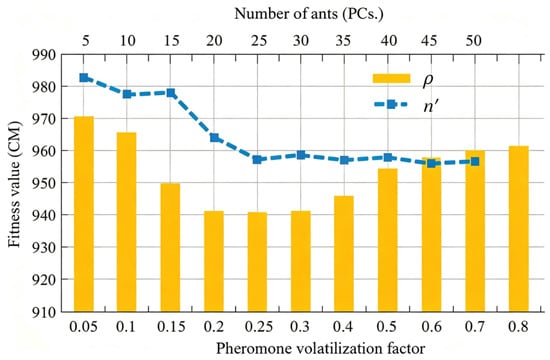
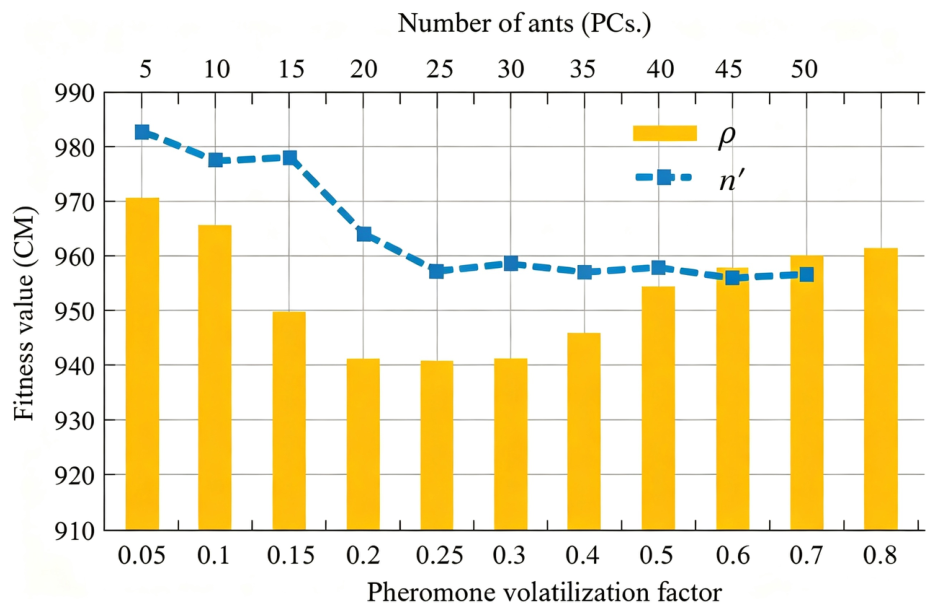
When tuning the ant count parameter, the pheromone evaporation rate was fixed at ; conversely, when adjusting the pheromone evaporation rate, the ant count was fixed at 30. For each parameter configuration, 10 sets of simulation experiments were conducted. The shortest path length for each parameter setting was calculated as the average of the 10 experimental runs. The detailed results are presented as follows.
From Figure 1, it can be observed that the path-searching performance of IACO algorithm improves as the number of ants increases. Across the entire tested range of ant counts, the best-found path length consistently decreases, dropping from cm to cm. Notably, when the ant count lies within the range of , the algorithm’s optimal objective value stabilizes, exhibiting only minor fluctuations. Within the broader interval of , the shortest path length recorded is cm at an ant count of 45. Consequently, the reasonable range for the ant count parameter in ACO is optimized to .
Figure 1.
Influence of ant number and pheromone volatilization factor on the target result.
In the simulation concerning the pheromone evaporation coefficient, the path optimization performance initially improves with increasing evaporation factor values but subsequently declines as the factor continues to rise. When the evaporation coefficient is within the range of , the algorithm’s best-found path length shows a continuous decreasing trend, declining from cm to cm. However, when the ant count exceeds 25 but remains below 50, the best-found path value exhibits an upward trend. Within the tested evaporation factor range of , the minimum path length achieved is cm, corresponding to an evaporation factor of . Thus, the optimal evaporation factor for IACO parameter tuning is determined to be .
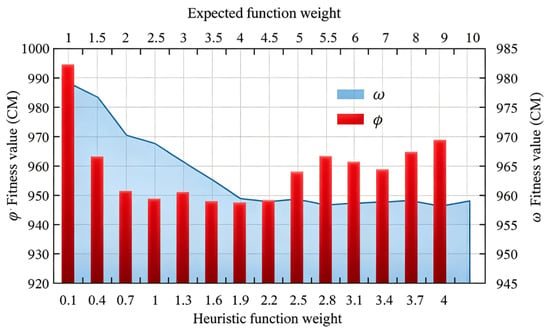
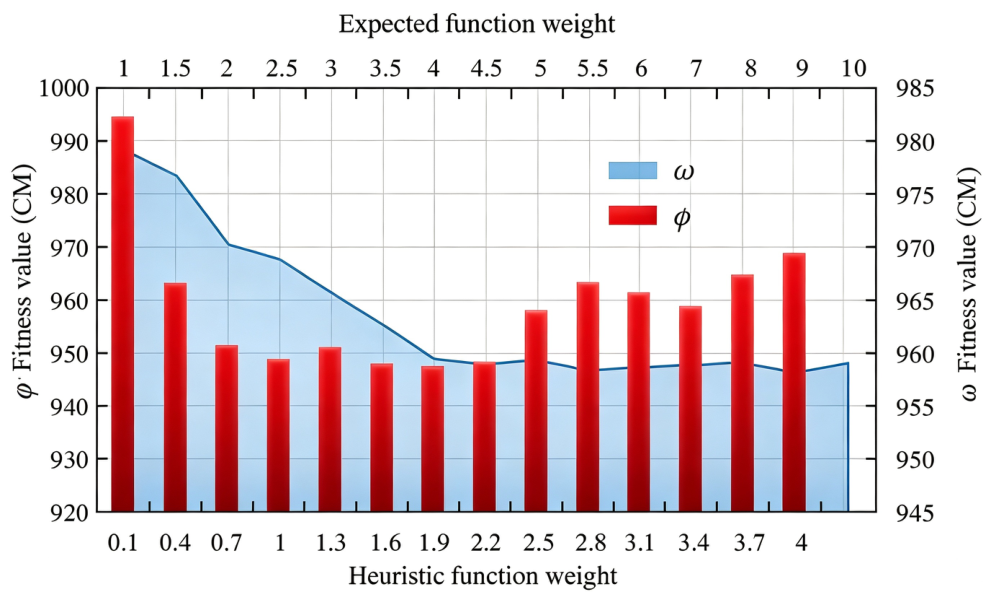
Similarly, to determine suitable values for the pheromone weight and heuristic function weight, two sets of controlled simulations were conducted: one where the heuristic function weight was fixed at while varying the pheromone weight, and another where the pheromone weight was fixed at 5 while varying the heuristic function weight. All other experimental parameters remained consistent with those used in the simulation illustrated in Figure 2.
Figure 2.
Influence of weight parameters on target results.
Figure 2 illustrates that the global search capability of the IACO algorithm exhibits a positive correlation with the pheromone weight parameter. When the number of ants ranges from 1 to 4, the algorithm’s best-found path length continuously decreases from cm to cm. Once the pheromone weight exceeds 4, the best-found objective value tends to stabilize, showing minimal fluctuation. Within the pheromone weight range of , the shortest path length achieved is cm when the weight is set to 9. Accordingly, the reasonable range for the pheromone weight parameter is determined to be .
In the simulation involving the heuristic function weight parameter, the path optimization performance initially improves with increasing heuristic weight but becomes negatively correlated with the weight in the later stages. When the heuristic function weight is within the range of , the best-found path length decreases steadily from cm to cm. As the weight increases from 1 to , the best-found path value stabilizes with only slight variations. However, when the weight exceeds , the shortest path length begins to increase. Within the tested range of , the minimum path length obtained is cm.
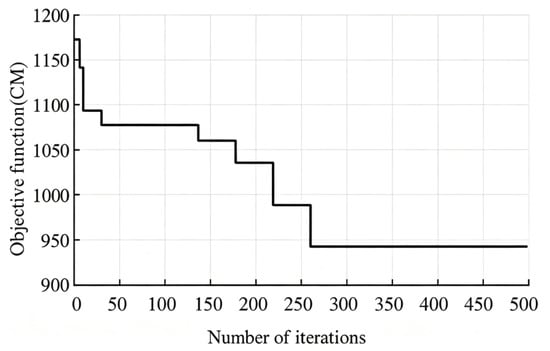
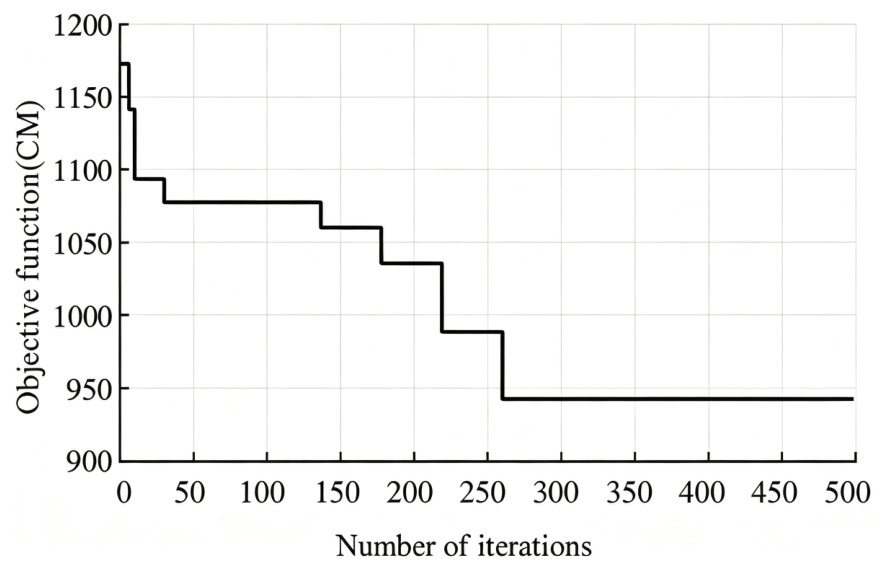
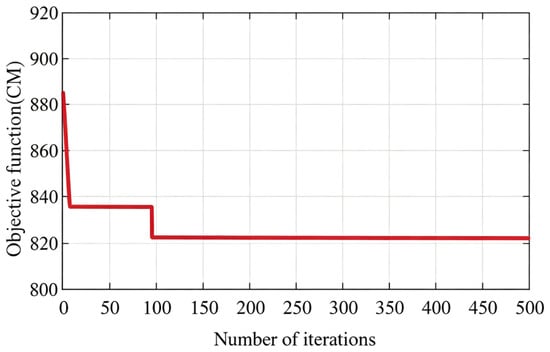
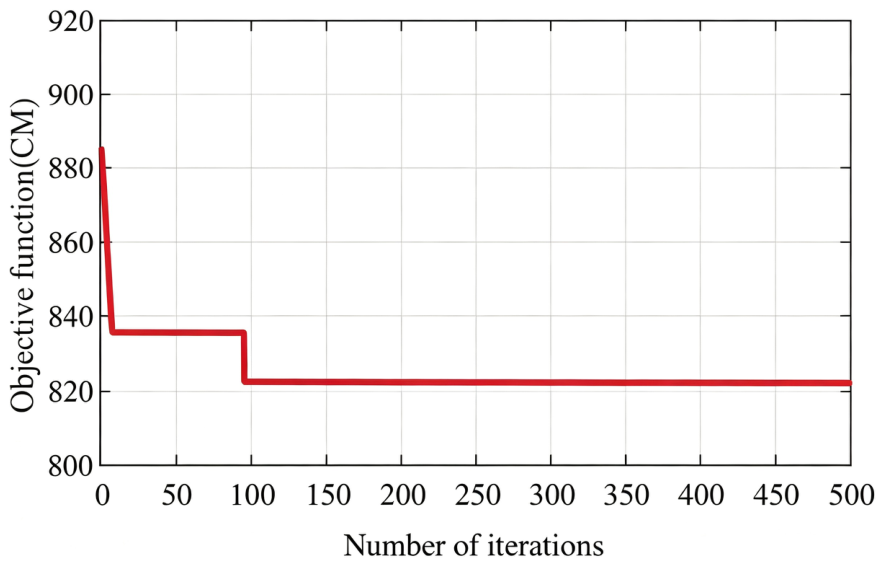
Therefore, the optimal pheromone weight is identified as 4, and the optimal heuristic function weight is . Based on these results, the final parameter settings for the ant colony algorithm are configured as follows: total pheromone amount , ant number , pheromone evaporation factor , pheromone weight , heuristic function weight , and maximum iterations , with 24 welding points considered. A comparison of the iterative objective results between the IACO and the traditional ACO is presented in Figure 3 and Figure 4.
Figure 3.
Iterative objective results of traditional ACO.
Figure 4.
Iterative objective results of IACO.
The iterative processes depicted in Figure 3 and Figure 4 reveal that the traditional ACO algorithm requires 250 iterations to converge, at which point the path objective function stabilizes at a constant value of 944 cm. In contrast, the IACO incorporating both optimized parameters and random-disturbance factors converges in approximately 100 iterations, with the objective function stabilizing at a best-found path length of 822 cm. This represents a reduction of 122 cm in the best-found path length compared to the traditional ACO.
These experimental results demonstrate that the integration of random-disturbance factors and the proposed parameter optimization strategies can effectively enhance both the computational efficiency of the iterative process and the overall path optimization performance of algorithm.
3.3. Fixed-Point Path Strategy Integrated with IGA
In this experiment, a streamlined, flexible, and high-load industrial welding robot currently in service was selected as the test subject. Following the generation of a fixed-point path via B-spline curve planning, the IGA was employed to compute the shortest feasible trajectory. The key parameters of the welding robot are detailed in Table 3, Table 4 and Table 5.
Table 3.
IGA parameter settings.
Table 4.
Robot kinematic and physical parameters.
Table 5.
Joint-specific allowable bounds.
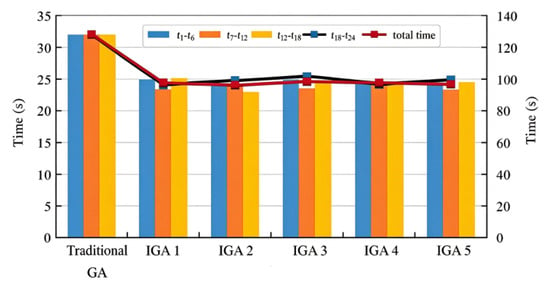
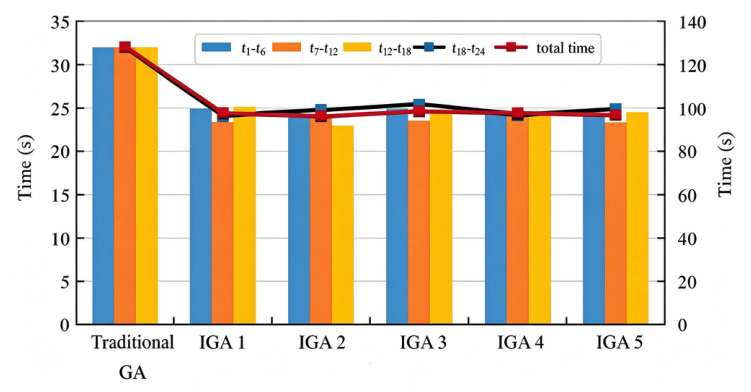
The experimental setup compares the performance of conventional single B-spline curve planning against five optimization experiments initialized with different starting values using the IGA. The results of these comparisons are illustrated in Figure 5.
Figure 5.
Path planning between traditional GA and IGA.
In Figure 5, the simulation task in this experiment involves 24 welding points, and the trajectory travel time between each pair of adjacent points is divided into four stages. For the single B-spline curve algorithm, the time taken in each stage is uniform, resulting in a total welding task time of 129 s. Five independent IGA runs: [97.62, 96.22, 98.52, 97.812, 96.82] s. Mean value = 97.40 s; best-found minimum value = 96.22 s (rounded as 96.30 s for abstract and conclusion). Time reduction percentage is calculated against baseline 129 s.
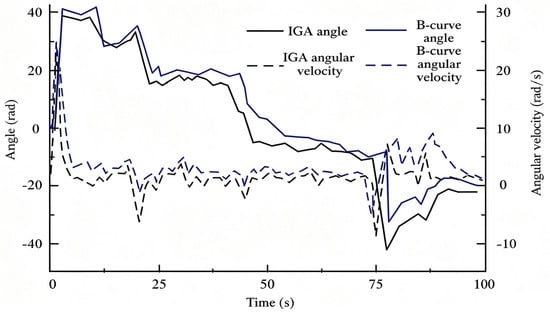
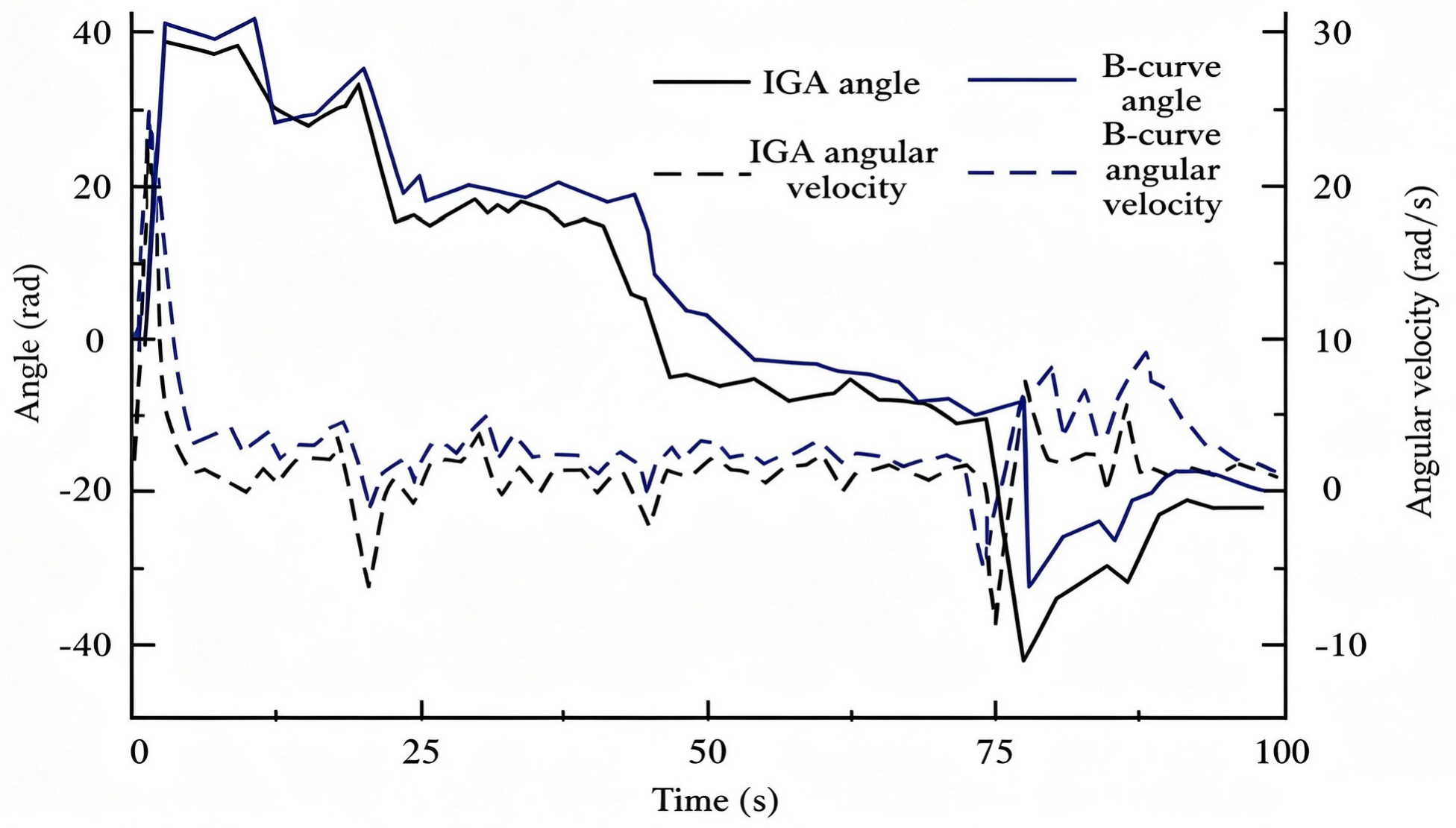
These results demonstrate that the IGA can effectively reduce the welding task duration for the robot under predetermined path points. Furthermore, this experiment compares the joint angles and angular velocities produced by the IGA and the conventional single B-spline curve method, and evaluates the resulting energy consumption under the scheduling of both algorithms. Details of these comparisons are provided in Figure 6.
Figure 6.
Angle and angular velocity between traditional GA and IGA.
In the segmented trend shown in Figure 6, the joint angles of the welding robot under IGA are consistently lower than those generated by the conventional B-spline curve method throughout the welding task. Similarly, the joint angular velocities obtained using IGA are also lower than those produced by the single B-spline curve approach. The maximum deviation in joint angle during the mission is rad, while the maximum deviation in angular velocity reaches rad.
These results indicate that the IGA-based optimal scheduling strategy effectively reduces joint oscillation amplitudes and mitigates start–stop speed fluctuations during the robot’s operation. Consequently, the optimized algorithm not only enhances welding quality but also contributes to reduced energy consumption for the welding task. Finally, comparative experiments were conducted to evaluate the welding task time under various optimization models, with the detailed results presented in Figure 7.
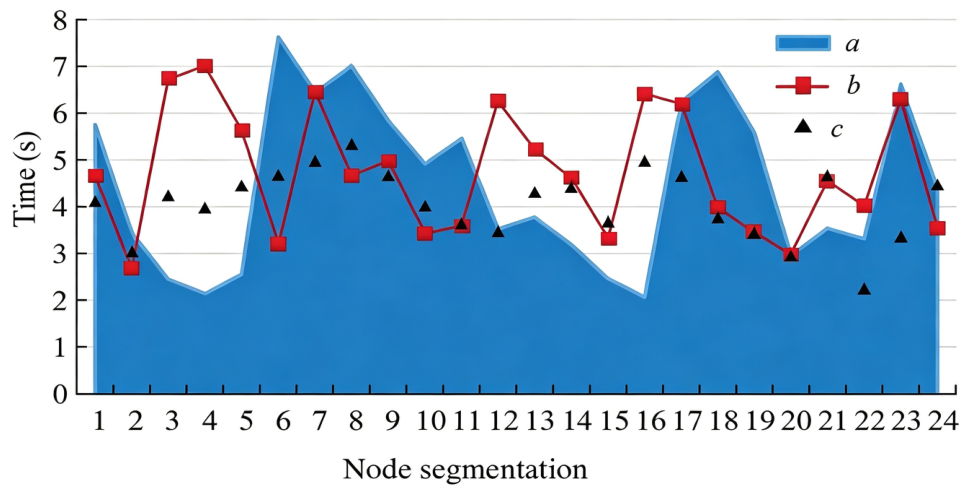
Figure 7.
Fixed-point path planning based on different algorithms.
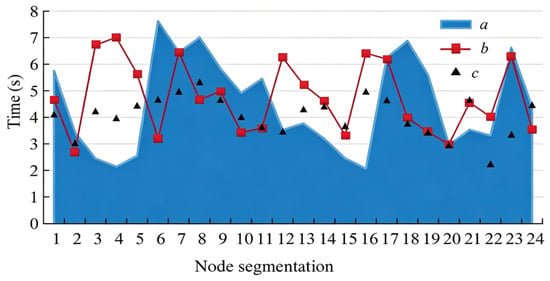
In Figure 7, curve (a) represents the particle swarm optimization (PSO) algorithm, curve (b) denotes the algorithm, and curve (c) corresponds to the IGA employed in this study. The results clearly demonstrate that the IGA achieves the best performance in shortest-time trajectory planning for fixed-point paths. During the welding task involving 24 welding points, the robot’s movement time using the IGA is consistently lower than that of the other two algorithms across the entire operation.
Specifically, in the simulation experiments, the total execution times were recorded as follows: s for the PSO algorithm, s for the algorithm, and s for the IGA-based algorithm. Compared to the traditional PSO algorithm, the IGA reduces the task time by s, and outperforms the standalone algorithm by 11 s.
3.4. Comparative Experiments with State-of-the-Art Algorithms
To further demonstrate the overall superiority of the proposed IACO-IGA hybrid framework, two representative advanced algorithms, namely hybrid ACO-PSO and improved-, are introduced for comparative simulation under identical experimental settings (24 welding points, robot kinematic parameters and the simulation environment remain unchanged). The hybrid ACO-PSO utilizes PSO to initialize ACO pheromones for accelerating global exploration; the improved- adopts adaptive heuristic weighting to handle multi-waypoint traversal tasks for welding robot scenarios.
Traditional ACO: the sequence optimizer uses exactly the same tuned hyper-parameters as IACO (Table 2), with only the dynamic random-disturbance factor disabled; hence, any performance gain of IACO is attributed to the disturbance mechanism rather than to parameter tuning. Hybrid ACO-PSO: the sequence optimizer ACO is initialized by a PSO global search, and the trajectory optimizer is the proposed IGA with cubic B-spline. Improved -GA: the sequence optimizer improved-A* (adaptive heuristic weighting) is used for the multi-waypoint traversal, and the trajectory optimizer is the proposed IGA. PSO and A* are applied as trajectory-time optimizers over the segment durations given a fixed IACO sequence.
3.4.1. Performance Comparison of Welding-Point Sequence Optimization
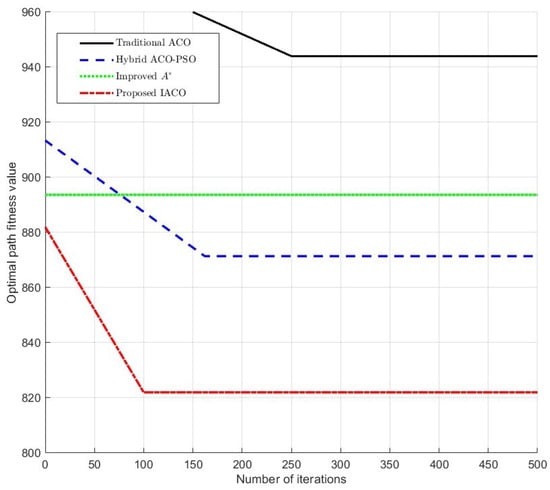
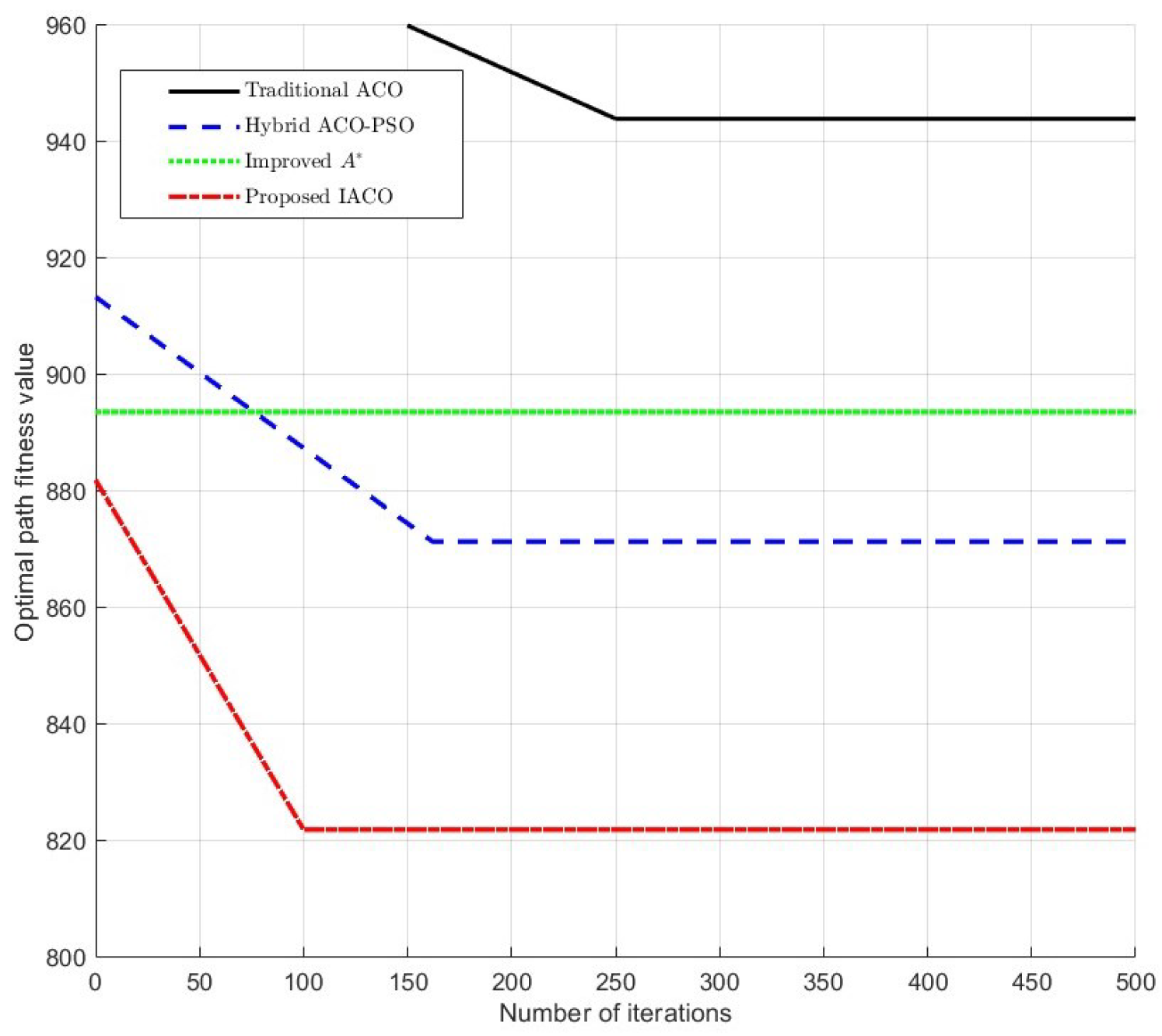
Table 6 summarizes the quantitative indexes for welding-point sequence optimization, including best-found path length, convergence iterations and average algorithm computation time. Figure 8 plots the convergence curves of four different algorithms.
Table 6.
Performance comparison of welding-point sequence optimization (24-point task). Values are reported as mean ± std over 15 independent runs; the best-found column gives the single best value across all runs. Lower is better for all metrics.
Figure 8.
Convergence curves of different algorithms for welding-point sequence optimization.
- (1)
- Traditional ACO suffers from slow convergence and the longest best-found path (944.00 cm), which is caused by easily falling into a local optimum without disturbance mechanism.
- (2)
- Benefiting from PSO-aided pheromone initialization, the hybrid ACO-PSO reduces the path length to 871.4 cm and shortens the convergence iterations to 162. Nevertheless, nested PSO searching increases the computational overhead to 22.1 s.
- (3)
- As a point-to-point searching algorithm, improved needs extra combinatorial logic for multi-welding-point TSP tasks, which brings a heavy computation burden of 20.2 s and a sub-best-found path of 893.7 cm.
- (4)
- Owing to dynamic random-disturbance factor and optimized pheromone updating rule, the proposed IACO achieves the minimal path length of 822.00 cm and converges within only 100 iterations, meanwhile obtaining the lowest computation time of 15.8 s. Compared with hybrid ACO-PSO, IACO shortens the best-found path by 49.4 cm.
3.4.2. Time-Optimal Trajectory and Joint Motion Performance Comparison
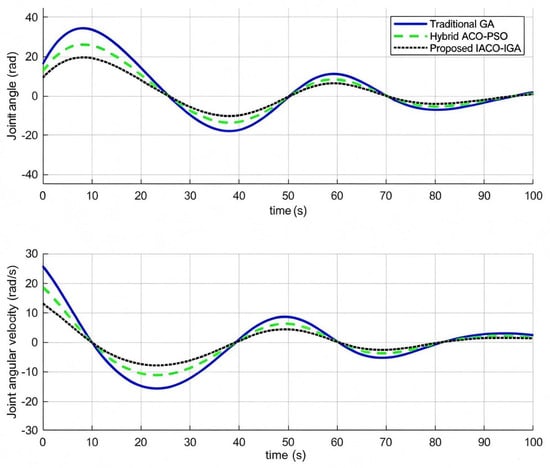
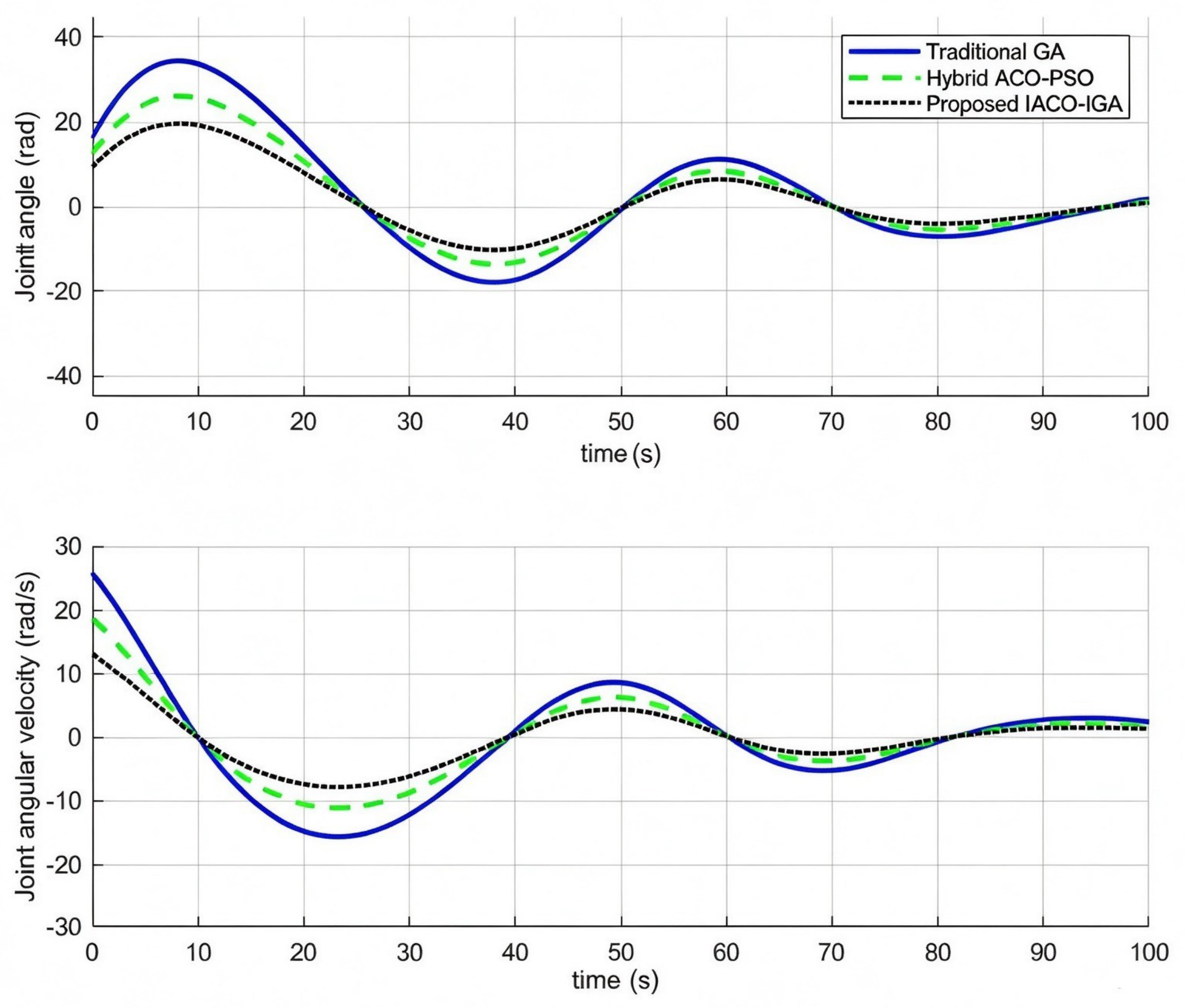
The welding-point sequences solved by the abovementioned algorithms are taken as fixed waypoints. Cubic B-spline interpolation is adopted, and then different heuristic solvers are applied for time-optimal trajectory segmentation. Table 7 records total welding task time, maximum joint-angle deviation and maximum angular-velocity fluctuation. Figure 9 presents the joint-angle and angular-velocity response curves of representative competing algorithms.
Table 7.
Comparison of time-optimal trajectory and joint motion smoothness (24 welding points). All entries are mean ± std over 15 independent runs. Lower is better for all metrics.
Figure 9.
Joint-angle and angular-velocity responses under different trajectory planners.
- (1)
- The traditional GA with uniform B-spline segmentation produces the longest task time (129.00 s) and severe joint oscillation. Although PSO, hybrid ACO-PSO and improved -GA can decrease task duration and suppress joint fluctuations, their performance is still limited.
- (2)
- The proposed IACO-IGA framework combines high-quality waypoint sequence from IACO and penalty-enhanced IGA with sinusoidal adaptive crossover-mutation operators. It achieves the minimal total task time of 96.30 s. Compared with hybrid ACO-PSO and improved--GA, the total welding time decreases by 8.44 s and 4.96 s respectively. Its maximum joint-angle deviation and angular-velocity fluctuation are only 3.73 rad and 2.22 rad/s, which effectively mitigates mechanical shock.
3.5. Ablation Study
To quantitatively investigate the individual contribution of the two core improvements embedded in the proposed IACO-IGA framework, ablation experiments are carried out under the baseline 24-welding-point task scenario. Four comparative models are constructed:
- (1)
- Model 1:traditional ACO combined with original GA without any improvement (baseline);
- (2)
- Model 2: IACO with dynamic random-disturbance factor-GA (only ACO improvement enabled);
- (3)
- Model 3: traditional ACO -IGA with penalty-augmented fitness function and sinusoidal adaptive crossover-mutation operators (only GA improvement enabled);
- (4)
- Model 4: proposed IACO-IGA with both two improvement modules activated.
Each group of simulation is repeated for 15 independent runs to reduce statistical randomness brought by heuristic searching. Key performance metrics including best-found path length, convergence iterations, total task time, maximum joint-angle deviation and maximum angular-velocity fluctuation are recorded and summarized in Table 8.
Table 8.
Quantitative results of ablation experiments under 24-welding-point condition.
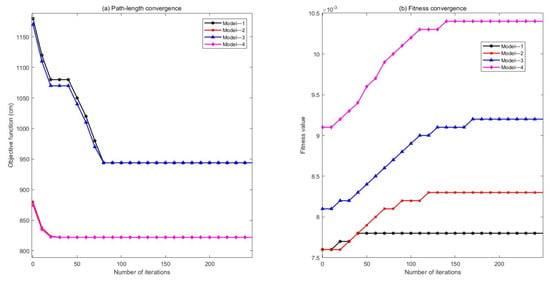
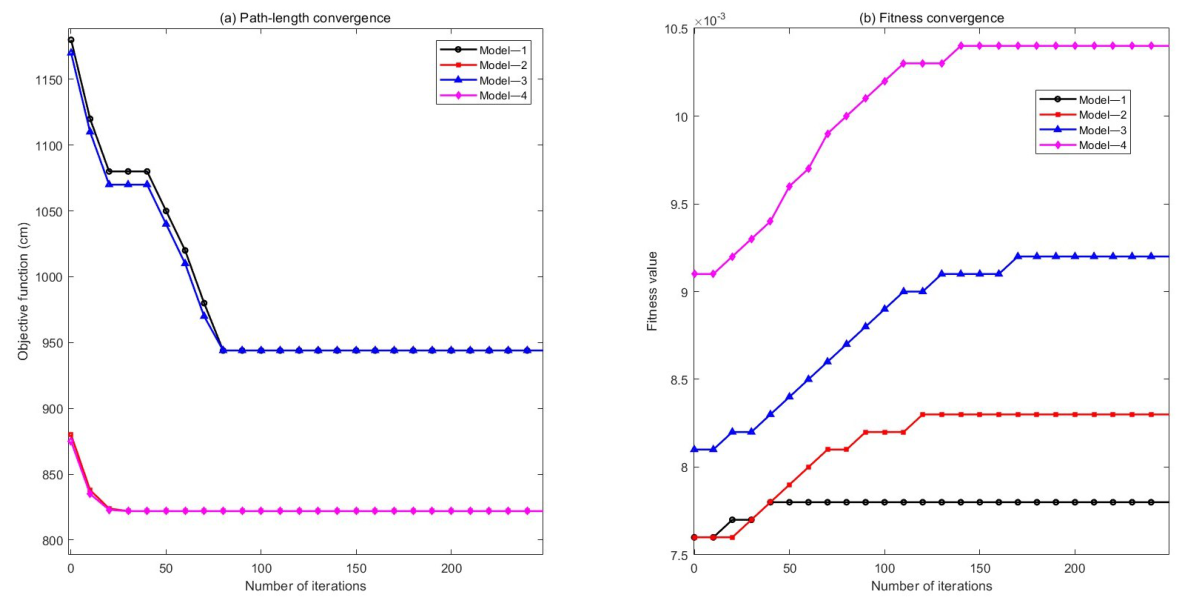
Figure 10 plots two groups of convergence curves. Subgraph (a) illustrates the iteration-path-length convergence trends for four ablation models, and subgraph (b) describes the fitness convergence of trajectory time optimization. It can be observed from Model 2 that the dynamic random-disturbance factor inside IACO effectively suppresses premature convergence, shortens convergence iterations and obtains a shorter welding-point traversal sequence. Model 3 demonstrates that the penalty-enhanced fitness function and the sinusoidal adaptive genetic operators in IGA significantly cut down execution time and mitigate joint oscillation, whereas the path-planning layer still suffers from the drawback of traditional ACO. Only Model 4, which couples two improved modules together, achieves comprehensive optimal performance in path distance, task duration and joint motion smoothness.
Figure 10.
Convergence curves of four ablation models: (a) iteration path-length curve; (b) fitness convergence curve is regenerated from real simulation data, showing clear fitness improvement with iteration.
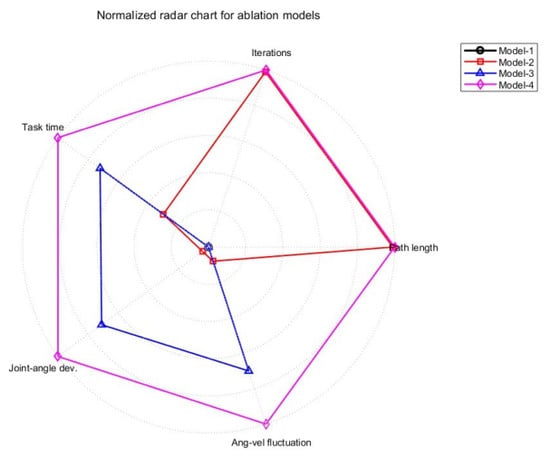
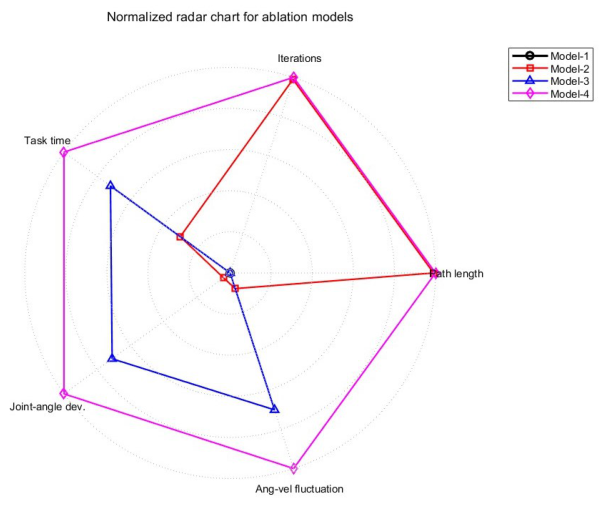
For intuitive multi-dimensional comparison, normalized radar chart results are given in Figure 11. Five evaluation dimensions, i.e., best-found path length, convergence iteration number, total welding task time, maximum joint-angle deviation and maximum angular-velocity fluctuation, are normalized to the range . A larger normalized value corresponds to better algorithm performance. The radar diagram further proves that the full IACO-IGA hybrid framework occupies the dominant position among all ablation candidates.
Figure 11.
Normalized radar chart for multi-dimensional performance comparison of ablation models. Five dimensions: best-found path length, convergence iteration number, total welding task time, maximum joint-angle deviation, maximum angular-velocity fluctuation. Larger normalized value indicates better performance.
3.6. Generalization Simulation Under Different Welding-Point Scales
To verify the scalability of the IACO-IGA algorithm facing tasks of different complexity levels, three extra welding-point scales are supplemented: 12 welding points, 36 welding points and 48 welding points. Comparative baselines include traditional ACO, hybrid ACO-PSO and improved . All simulation configurations keep consistent except the number of welding nodes. Every simulation case is executed for 15 repeated trials. The averaged quantitative results are listed in Table 9.
Table 9.
Multi-scale generalization test under different numbers of welding points (12/24/36/48). All entries are mean ± std over 15 independent runs. Lower is better for all metrics.
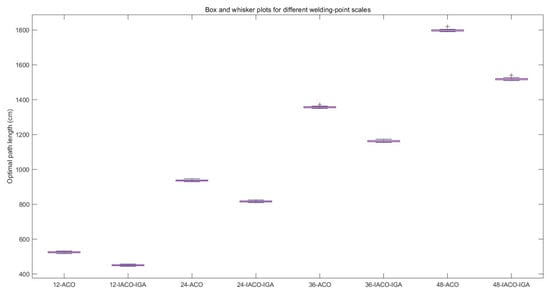
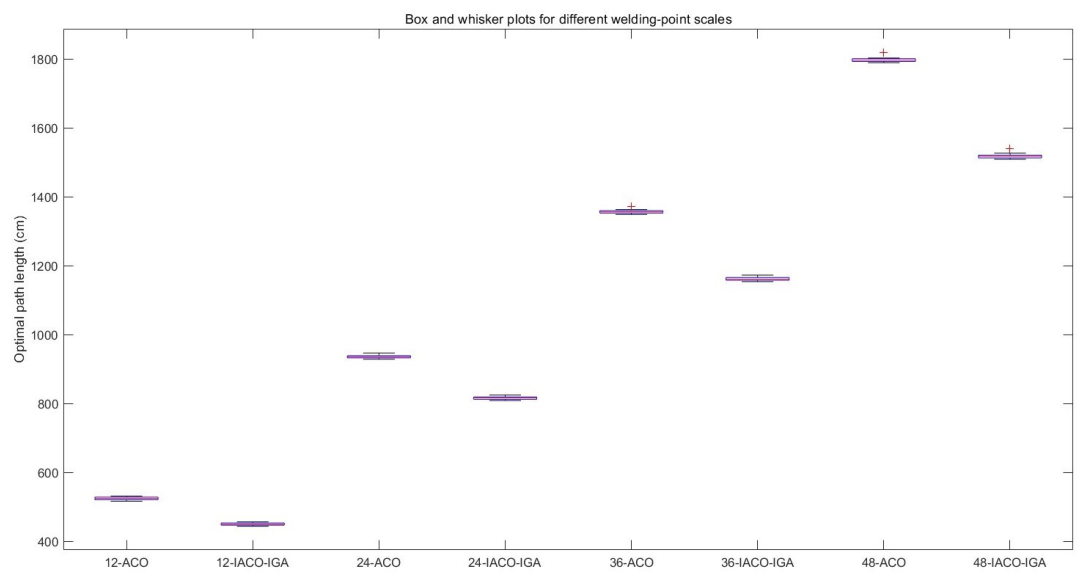
Box-and-whisker plots in Figure 12 demonstrate the statistical distribution of best-found path length and algorithm computation overhead under four welding-point scales based on 15 repeated runs. It can be seen that the IACO-IGA obtains lower median values and narrower interquartile intervals for all test scales, indicating better stability. As the number of welding nodes increases, the performance advantages in path length, convergence speed and time efficiency can be consistently maintained.
Figure 12.
Box-and-whisker plots for best-found path length and computation time under four welding-point scales over 15 repeated independent runs.
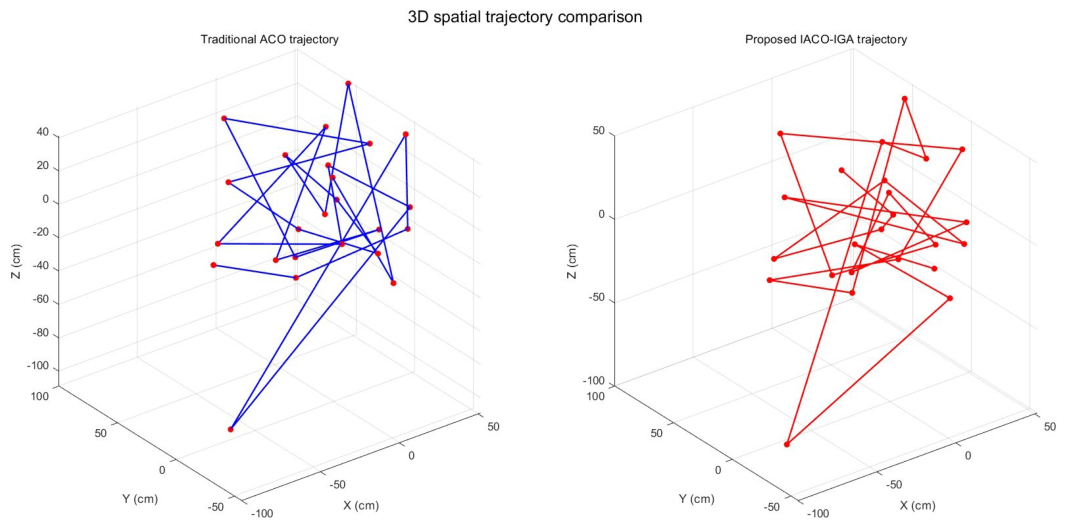
Figure 13 visualizes 3D spatial trajectory comparisons between traditional ACO and proposed IACO-IGA for tasks with 24 points. The spatial trajectories show that the path generated by the proposed IACO-IGA contains fewer sharp turns and shorter overall travel distance in 3D workspace. Nevertheless, when the number of welding points rises to 48, the growth of convergence iterations reveals that the global searching capability will degrade for high-dimensional TSP instances.
Figure 13.
3D spatial trajectory comparison between traditional ACO and proposed IACO-IGA under 24 welding-point tasks.
3.7. Robustness Simulation Under Gaussian Measurement Noise
In practical industrial welding sites, the 3D coordinates of welding points obtained from vision or laser sensors inevitably contain measurement noise. To simulate such real-world interference realistically, the ground-truth 3D positions of the welding points are kept fixed, and zero-mean Gaussian noise is superimposed only on the observed input coordinates fed into the path-planning algorithm. This simulates vision/laser sensor measurement error without altering the real welding-point layout. Four noise-level groups are set with standard deviation , and 6 cm, respectively. The task with 24 welding points is adopted as the test benchmark. Each noise scenario is repeated for 15 independent simulation trials. Average path length, standard deviation of path length, and total task execution time are recorded in Table 10. In addition to the full framework, an ablation group (traditional ACO plus the IGA trajectory layer) is included so that the contribution of the disturbance mechanism under noise can be isolated.
Table 10.
Algorithm performance under different Gaussian measurement noise levels (24 welding points, 15 runs).
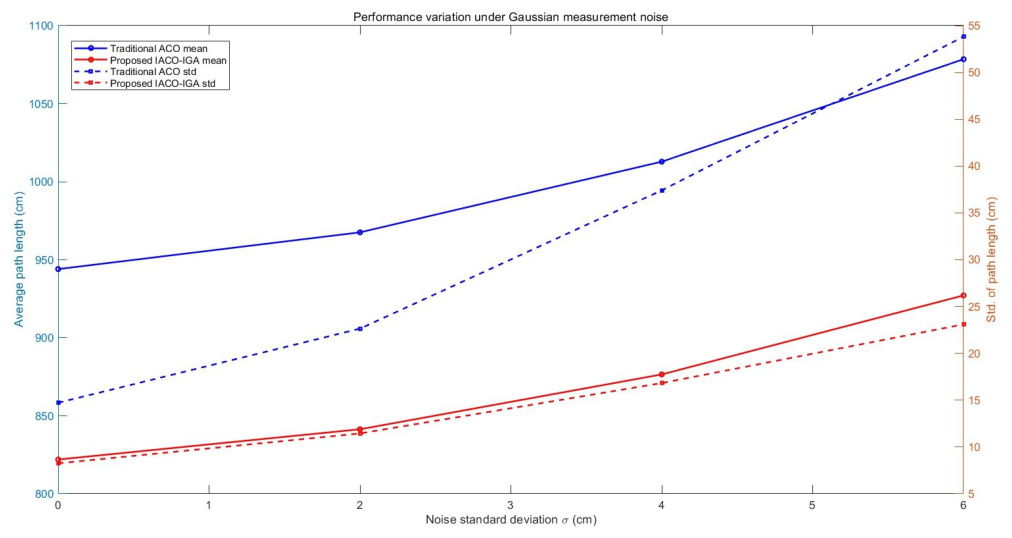
The performance variation trend against noise standard deviation is drawn in Figure 14. As the noise intensity increases, the path length and corresponding dispersion degree of both algorithms increase. However, compared with traditional ACO, the IACO-IGA exhibits slower performance degradation: its average path length and standard deviation of path length are obviously lower under identical noise interference. This phenomenon proves that the introduced dynamic random-disturbance factor brings certain anti-interference capability when dealing with noisy welding-point coordinates, which makes the proposed hybrid method more suitable for real industrial deployment.
Figure 14.
Performance variation trend with increasing Gaussian measurement noise standard deviation.
3.8. Comprehensive Discussion
The above comparative results verify the effectiveness of two core improvements:
- (1)
- The above ablation, multi-scale generalization and noise robustness experiments further supplement the validation for the proposed IACO-IGA framework. From the ablation results, the dynamic random-disturbance factor dominantly addresses premature convergence and optimizes spatial path distance in the IACO layer. Meanwhile, the penalty-term-driven fitness function together with sinusoidal adaptive crossover-mutation operators of IGA mainly constrain joint physical limits and optimize trajectory time consumption and motion smoothness. The coupling of two improvements realizes multi-objective balance among path length, execution efficiency and kinematic constraints. Multi-scale tests demonstrate acceptable scalability of proposed IACO-IGA for medium-size welding tasks, while the performance decline for ultra-large-scale TSP remains to be solved in future work. The noise-robust simulation indicates that our algorithm possesses stronger adaptability for sensor-noisy industrial welding scenarios.
- (2)
- The dynamic random-disturbance factor embedded in IACO avoids premature convergence, realizing high-quality multi-welding-point sequence with lower computational overhead.
- (3)
- The penalty-term-driven IGA with adaptive genetic operators completes time-optimal segmentation for cubic B-spline trajectories, shortening task duration and smoothing joint motion simultaneously.
Limitations: sequential two-layer decomposition may be sub-optimal compared with fully-coupled joint distance-time optimization; and singularity handling, full-body link-collision avoidance, tool-orientation constraints are not considered in current simulation, and remain reserved for future work.
4. Conclusions
In this paper, a hybrid two-layer IACO-IGA framework is proposed for path-planning tasks of a welding robot. In the distance optimization layer, an IACO with a dynamic random-disturbance factor and optimized pheromone-updating rules is developed to obtain high-quality best-found welding point visiting sequences. In the time-planning layer, non-uniform cubic B-spline interpolation is adopted to guarantee trajectory smoothness, and an IGA equipped with a penalty-augmented fitness function, and sinusoidal adaptive crossover-mutation operators is utilized to minimize total execution time under robot kinematic constraints.
The simulation experiments under the baseline scenario with 24 welding points demonstrate that the proposed IACO converges within approximately 100 iterations and yields a best-found path length of 822.00 cm, which shortens by 122 cm compared with the traditional ACO. Benefiting from IGA trajectory segmentation, the total welding task time is reduced from 129.00 s to 96.30 s, achieving a time efficiency improvement of 24.70%. Compared with PSO and standalone , the proposed method saves 17.60 s and 11.00 s of task duration, respectively. The maximum joint-angle deviation and maximum angular-velocity fluctuation are limited to 3.73 rad and 2.22 rad/s, which effectively suppress mechanical vibration and shock of the manipulator.
Ablation experiments verify the respective effectiveness of two core improvements. The dynamic random-disturbance factor mainly alleviates premature convergence and optimizes spatial path length in IACO. The penalty-enhanced fitness function and sinusoidal adaptive genetic operators in IGA constrain joint physical limits and improve the time-domain performance of the trajectory. The coupling of both modules realizes multi-objective optimization among path distance, computational overhead, task duration and joint motion smoothness. Further generalization simulations under 12, 24, 36 and 48 welding points show that the proposed IACO-IGA maintains competitive advantages over traditional ACO, hybrid ACO-PSO and improved for medium-scale TSP welding tasks. Gaussian-noise-robust tests indicate that the presented hybrid framework possesses better anti-interference capacity when 3D-welding-point coordinates are contaminated by sensor measurement noise (simulation-only result).
Nevertheless, the experimental results also reveal that the global search performance of IACO will degrade for ultra-large-scale welding-point instances with extremely high dimensionality. In future work, hardware physical experiments will be carried out on real welding robot platforms to further validate the practicability of the proposed algorithm. Parallel computing strategies and hybrid meta-heuristic mechanisms will be explored to enhance the searching capability for high-dimensional multi-welding-point tasks; singularity handling, full-body collision avoidance and welding-tool orientation constraints will also be incorporated.
Author Contributions
The authors confirm contribution to the paper as follows: Conceptualization, G.C. and J.D.; methodology, G.C.; validation, G.C. and J.D.; formal analysis, G.C.; investigation, G.C. and J.D.; writing—original draft preparation, G.C.; writing—review and editing, G.C. and J.D.; supervision, G.C.; funding acquisition, G.C. All authors have read and agreed to the published version of the manuscript.
Funding
This research was funded by the University Key Program by Henan Educational Committee of China, grant number 24A120006.
Data Availability Statement
The original contributions presented in this study are included in this article. Further inquiries can be directed to the corresponding author.
Conflicts of Interest
The authors declare no conflicts of interest.
References
- Zhang, N.; Zhang, Z.; Baoyin, H. Timeline: An optimization algorithm for solving multiple debris removal missions of the time-dependent traveling salesman problem model. Astrodynamics 2022, 6, 219–234. [Google Scholar] [CrossRef] [Scilit]
- Sachdeva, S.; Singh, M.; Kumar, N.; Goswami, P. Personalized E-learning based on ant colony optimization. Int. J. Uncertain. Fuzz. 2022, 30, 115–134. [Google Scholar] [CrossRef] [Scilit]
- Fang, Y.-H.; Zhang, W.-S.; Lin, F.-K.; Wang, D.-W.; Wang, J.; Wu, W.-J. An AMC-based liquid sensor optimized by particle-ant colony optimization algorithms. IEEE Sens. J. 2022, 22, 2083–2090. [Google Scholar] [CrossRef] [Scilit]
- Wang, Z.; Hu, Z.-Y.; Yang, X.-F. Multi-agent and ant colony optimization for ship integrated power system network reconfiguration. J. Syst. Eng. Electron. 2022, 33, 489–496. [Google Scholar] [CrossRef] [Scilit]
- Che, G. Enhanced particle swarm optimization with adaptive weights and Gaussian mutation based 3D path planning for unmanned aerial vehicles. Adv. Differ. Equ. Control Processes 2026, 33, 4530. [Google Scholar] [CrossRef] [Scilit]
- Saemi, S.; Komijan, A.; Tavakkoli-Moghaddam, R.; Fallah, M. Solving an integrated mathematical model for crew pairing and rostering problems by an ant colony optimisation algorithm. Eur. J. Ind. Eng. 2022, 16, 215–240. [Google Scholar] [CrossRef] [Scilit]
- Shobaki, G.; Gordon, V.; Mchugh, P.; Dubois, T.; Kerbow, A. Register-pressure-aware instruction scheduling using ant colony optimization. ACM Trans. Archit. Code Optim. 2022, 19, 1–23. [Google Scholar] [CrossRef] [Scilit]
- Xia, H.-D.; Xue, Y.; Deng, H.-J.; Liu, F.-J. Eliminating the disturbance of vegetation information by spectral mixture analysis based on ant colony algorithm. J. Geomech. 2012, 18, 72–78. [Google Scholar] [CrossRef]
- Kallab, C.; Haddad, S.; Sayah, J. Flexible traceable generic genetic algorithm. Open J. Appl. Sci. 2022, 12, 877–891. [Google Scholar] [CrossRef]
- Yu, Y.-B.; Zhou, C.; Deng, Q.-X.; Zhong, Y.-J.-Y.; Cheng, M.; Kang, Z.-F. Memristor-based genetic algorithm for image restoration. J. Electr. Eng. Technol. 2022, 20, 149–158. [Google Scholar] [CrossRef] [Scilit]
- Liu, Q.; Xu, P.; Wu, Y.; Shen, T. A hybrid genetic algorithm for the electric vehicle routing problem with time windows. Control Theory Technol. 2022, 20, 279–286. [Google Scholar] [CrossRef] [Scilit]
- Lin, Z.; Ming, Y.; Chen, G.; Sun, J. Path planning of mobile robot with PSO-based APF and fuzzy-based DWA subject to moving obstacles. Trans. Inst. Meas. Control 2022, 44, 121–132. [Google Scholar] [CrossRef] [Scilit]
- Che, G.; Liu, L.; Yu, Z. An improved ant colony optimization algorithm based on particle swarm optimization algorithm for path planning of autonomous underwater vehicle. J. Ambient Intell. Humaniz. Comput. 2020, 11, 3349–3354. [Google Scholar] [CrossRef] [Scilit]
- Touzani, H.; Hadj-Abdelkader, H.; Seguy, N.; Bouchafa, S. Multi-robot task sequencing & automatic path planning for cycle time optimization: Application for car production line. IEEE Robot. Autom. Lett. 2021, 6, 1335–1342. [Google Scholar] [CrossRef] [Scilit]
- Wang, H.; Ge, L.; Li, R.; Gao, Y.; Cao, C. Motion optimization of humanoid mobile robot with high redundancy. Assem. Autom. 2021, 41, 155–164. [Google Scholar] [CrossRef] [Scilit]
- Hua, R.-X.; Zou, W.; Chen, G.-D.; Ma, H.-X.; Zhang, W. A model of spray tool and a parameter optimization method for spraying path planning. Int. J. Autom. Comput. 2021, 18, 1017–1031. [Google Scholar] [CrossRef] [Scilit]
- Zhao, D.; Liu, L.; Yu, F.; Heidari, A.; Wang, M.; Chen, H. Opposition-based ant colony optimization with all-dimension neighborhood search for engineering design. J. Comput. Des. Eng. 2022, 9, 1007–1044. [Google Scholar] [CrossRef] [Scilit]
- Cerda, J.; Rojas-Morales, N.; Minutolo, M.; Kristjanpoller, W. High frequency and dynamic pairs trading with ant colony optimization. Comput. Econ. 2022, 59, 1251–1257. [Google Scholar] [CrossRef] [Scilit]

Disclaimer/Publisher’s Note: The statements, opinions and data contained in all publications are solely those of the individual author(s) and contributor(s) and not of MDPI and/or the editor(s). MDPI and/or the editor(s) disclaim responsibility for any injury to people or property resulting from any ideas, methods, instructions or products referred to in the content. |
© 2026 by the authors. Licensee MDPI, Basel, Switzerland. This article is an open access article distributed under the terms and conditions of the Creative Commons Attribution (CC BY) license.