


Abstract
Fires pose an enormous risk to human life and property. In the domain of fire warning, earlier approaches leveraging computer vision have achieved significant progress. However, these methods ignore the local and global motion characteristics of flames. To address this issue, a Local and Global Adaptive Enhancement (LGAE) network is proposed, which mainly includes the backbone block, the Local Adaptive Motion Enhancement (LAME) block, and the Global Adaptive Motion Enhancement (GAME) block. Specifically, the LAME block is designed to capture information about local motion, and the GAME block is devised to enhance information about global motion. Through the utilization of these two blocks, the fire recognition ability of LGAE is improved. To facilitate the research and development in the domain of fire recognition, we constructed a Large-scale Fire Video Recognition (LFVR) dataset, which includes 11,560 video clips. Extensive experiments were carried out on the LFVR and FireNet datasets. The F1 scores of LGAE on LFVR and FireNet were 88.93% and 93.18%, respectively. The experimental outcomes indicate that LGAE performs better than other methods on both LFVR and FireNet.
1. Introduction
In recent years, fires have posed a significant threat to lives and properties worldwide [1,2,3]. The methods based on computer vision play a pivotal role in fire warnings. Flame is a combustion phenomenon, and it is characterized by the generation of heat and light. Generally, flames can exhibit variations in shape over time and differ in color depending on the type of material being burned. The differences between flame and other movements are as follows: First, flames have no fixed shape or volume, and their appearance varies with factors such as wind speed, temperature, and the type of fuel. Second, flames cause thermal convection by heating the surrounding air, with hot air rising and cold air descending, thereby influencing the shape and direction of the flame. Third, the color of the flame depends on the combustion temperature and the substances involved in the combustion. The higher the temperature, the brighter the flame and the more it tends toward blue. When the temperature is lower, it presents as yellow or orange. Therefore, we hypothesize that analyzing flame movements can improve the accuracy of fire warnings. In the field of fire detection based on static images, local information (such as texture, color, shape, etc.) is vital. Moreover, the global contextual information also affects the accuracy of fire recognition.
Fire video recognition is the technical basis of fire detection. Over the past few years, video recognition approaches based on deep learning have attained remarkable success [4,5,6]. These methods can efficiently extract video features in the temporal domain and spatial domain, laying the foundation for identifying the video content. However, these methods ignore the local and global motion characteristics of flames. Generally, a deep neural network trained on a large-scale dataset can obtain better generalization ability. Therefore, large-scale datasets are crucial for the research of fire recognition. Currently, in the domain of fire video recognition, there is a shortage of large-scale datasets.
To address these issues, a Large-scale Fire Video Recognition (LFVR) dataset was built, and a Local and Global Adaptive Enhancement (LGAE) network for fire video recognition is proposed. The network mainly includes the backbone block, the Local Adaptive Motion Enhancement (LAME) block, and the Global Adaptive Motion Enhancement (GAME) block. The LAME block was designed to depict the local motion information, thus enhancing the ability to learn the local information about flames. To describe the global motion information, the GAME block was devised. GAME adaptively learns information about global data distribution, thereby establishing the global contextual information about flames. The fire recognition capability of LGAE is improved using these two blocks. On the LFVR dataset, the F1 score of LGAE was 88.93%. In addition, experimental results indicated that LGAE surpasses baseline methods and attained the highest performance. The primary contributions of this study are outlined below.
- The LGAE network was designed to recognize fire videos, and it mainly consists of LAME and GAME. By learning the local and global motion information, the ability of LGAE to recognize flames is improved.
- The LAME block was devised to depict the local motion information, which enhances the capacity for describing local movements of flames. The GAME block was designed to learn the global contextual information about flames.
- A large-scale dataset for fire video recognition was built, which includes 11,560 video clips. To our knowledge, LFVR is currently the largest dataset for fire video recognition. This dataset is public on https://github.com/yunyi9/LFVR (accessed on 19 November 2024).
2. Related Work
Recently, fire warning approaches based on computer vision have delivered significant progress [1,2,7,8]. In general, these methods can be divided into two categories, i.e., methods based on non-deep learning and methods based on deep learning. In this section, we mainly center on the related studies about datasets and methods for fire warnings.
2.1. Datasets for Fire Warnings
Being the foundation of fire warnings, the pursuit of better datasets never stops. As shown in Table 1, there are some public datasets used for fire warnings, significantly advancing research in this field.
Table 1.
Datasets about fires.
A fire recognition dataset was proposed in [9], which includes 226 still images with different resolutions. These images are categorized into two groups, i.e., 107 images without fires and 119 images containing fires. In the images containing fires, there are buildings on fires, industrial fires, car accidents, and riots. In images without fires, there are fire-like regions, e.g., sunsets, red or yellow objects, etc. Regarding evaluation, the F1 score was selected as the main metric.
In order to provide a video dataset for fire recognition, a fire video dataset was constructed [10]. In this dataset, there are 31 videos, of which 14 videos include fires and 17 videos have no fires. These videos were acquired both from real environments and the Internet. Among them, 80% of samples were utilized for testing, and 20% were employed for training. Moreover, accuracy was chosen as the primary metric.
The Corsican fire dataset is about wildfires in images and videos [11]. In this dataset, there are 500 still images of wildfires, 100 near-infrared images, and 5 multi-modal fire videos. All images in this dataset are correlated with corresponding annotations and descriptors. Moreover, the F1 score is used as the primary metric.
To create a diverse fire dataset, FireNet [12] was built by shooting videos and collecting images from the Internet. The training set of FireNet includes 1124 images including flames and 1301 images excluding flames. The test set of FireNet consists of 46 videos containing flames, 16 videos excluding flames, and another 160 images without flames. Furthermore, accuracy is the main metric.
To promote studies in fire detection, DFS was created by collecting images from real scenes [13], and it consists of 9462 images. Among them, there are 3357 images including large fires, 4722 images containing intermediate fires, 349 images including small fires, and 1034 images containing luminous objects. Three categories (i.e., “fire”, “smoke”, and “other”) are defined for fire detection. Moreover, mAP50 and mAP75 are used as metrics for evaluation.
The aforementioned classic public datasets promote research progress in the field of fire recognition. In general, the motion information of flames is the key factor for accurately recognizing fires. However, images cannot describe the temporal information of flame motion. Therefore, large-scale video datasets for fire recognition are significant for fire warnings.
2.2. Methods Based on Non-Deep Learning
Early methods based on non-deep learning mainly used color information to classify flames. Based on the YCbCr color space, a fire color classification model was designed to detect fire [14]. Based on texture features and flame colors, flames were detected in still images [9]. Through using the color, shape, and motion of flames, an expert system was designed to detect fire in videos [10]. For fire image detection, Bian et al. [15] proposed an algorithm based on Tchebichef moment invariants. Based on motion analysis, Torabian et al. [16] designed a method to detect fire. To improve the robustness of fire video detection, a Bayesian network was used to integrate a diverse array of information [17]. To address the problem from color space, an enhanced color space was devised based on chaos theory [18]. By utilizing the features of disordered movement and intense color, Dou et al. [19] designed an approach for fire video detection. Regarding fire image classification, Harkat et al. [20] used machine learning techniques to calculate high-order features.
2.3. Methods Based on Deep Learning
Recently, fire detection approaches based on deep learning have witnessed rapid development. In uncertain environments, Muhammad et al. [21] proposed a fire detection method, which used the lightweight MobileNetV2 [22]. To solve the issue that Convolutional Neural Network (CNN) is not good at processing fire information of arbitrary shapes, sizes, and occlusions, Shahid et al. [23] incorporated attention into CNN. A network based on CNN was designed to detect and locate fires [24]. This network produced masks through segmentation in the RGB image. Based on SLIC-DBSCAN-enhanced CNN, Sheng et al. [25] proposed a linear iterative clustering and density-based noise application spatial clustering method to identify fire and smoke. Based on the attention mechanism, an algorithm for fire video recognition was devised to reduce the probability of false alarms [26]. On the basis of transfer learning, Majid et al. [27] designed an algorithm, which used Grad-CAM [28] to visualize and localize fires in images. As previous methods were difficult to use in complex scenes with few detection targets, a method based on YOLOX [29] was devised [30]. An approach based on multi-task learning was designed to detect forest fires [31]. A method based on deep learning was devised to detect flames in videos [32]. For fire detection, a data augment method based on random images was proposed to enhance the generalization capacity [33]. A method based on PP-YOLO [34] was designed to enhance the performance of fire detection [35].
Unlike the above methods, the distinctive features of LGAE are outlined below. First, LAME was devised to enhance the local motion information about flames. Second, GAME was designed to depict the global motion information. Third, LGAE learns both global and local motion information through the utilization of GAME and LAME.
3. Large-Scale Fire Video Recognition Dataset
As indicated in Table 1, the quantity of videos in these datasets is relatively small. Therefore, a Large-scale Fire Video Recognition (LFVR) dataset was created. In total, there are 11,560 video clips in LFVR. As far as we know, LFVR is the largest dataset for fire video recognition.
3.1. Videos
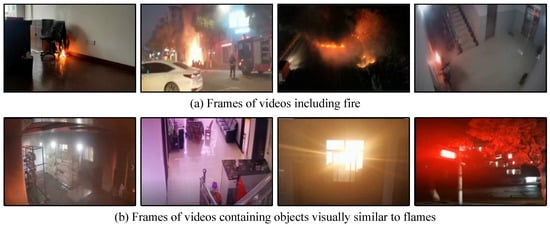
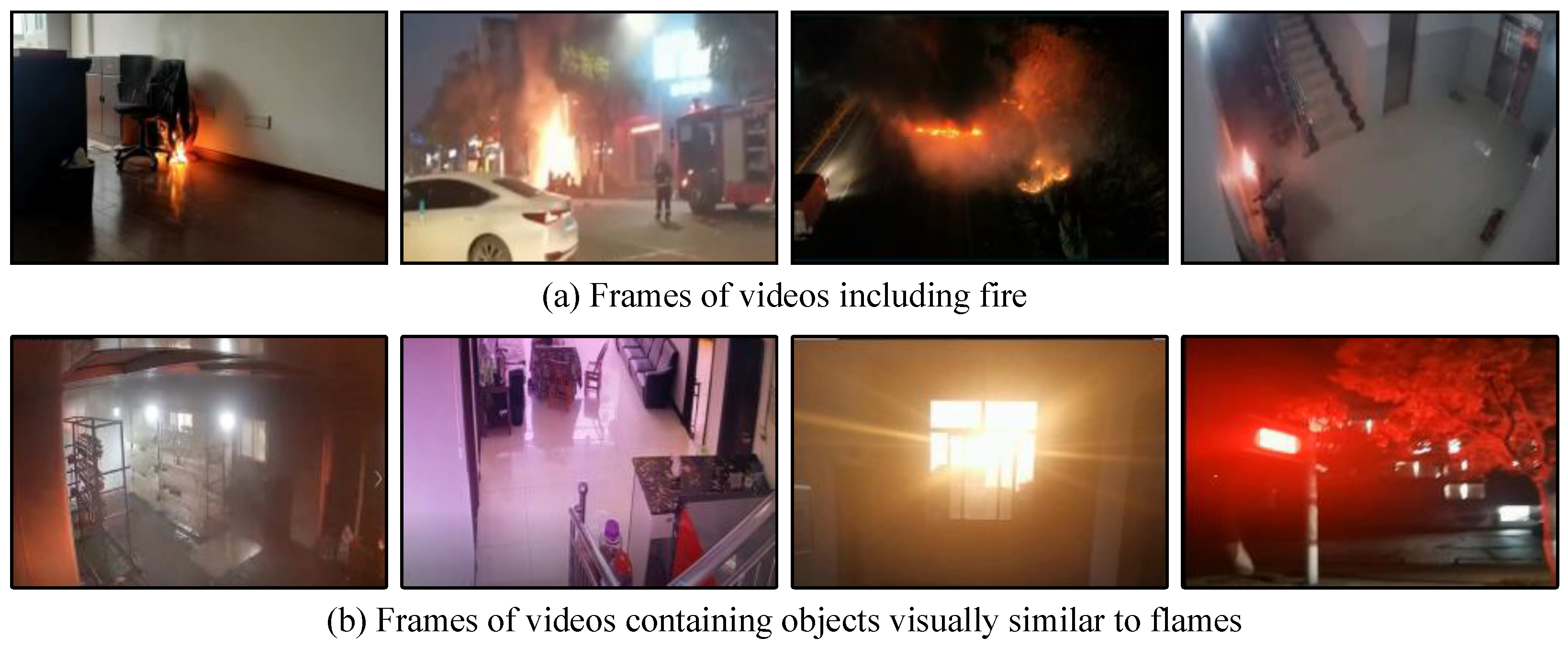
To obtain videos from some different scenes, videos were collected from two sources. First, 1000 long videos containing fires were downloaded from the Internet. The total duration of these 1000 videos is 63,589 s. In these videos, there are fires of different sizes, namely small fires, intermediate fires, and large fires. These videos contain a variety of fires, such as kitchen fires, factory fires, house fires, wildfires, etc. As shown in Figure 1a, there are various objects on fires in these videos, e.g., high-rise buildings on fires, cars on fires, electric vehicles on fires, furniture on fires, electrical appliances on fires, etc.
Figure 1.
Example frames from LFVR.
Second, 120 long videos without fires were obtained using cameras, and the total duration of these videos is 9846 s. Figure 1b shows some frames of non-fire videos from LFVR. In these videos, there are numerous objects that may be recognized as fires; for example, lights in factories, red objects in living rooms, lanterns on trees, people wearing red clothes, etc.
3.2. Annotations and Metrics
Generally, there is enough motion information in a 2 s video to distinguish whether an object is a moving object. Therefore, the aforementioned videos were cut into clips with a duration of 2 s and without overlap. Some clips that did not meet the requirements were discarded. Therefore, LFVR comprises a total of 11,560 video clips.
Following previous studies, two categories are defined in the LFVR dataset, i.e., “fire” and “non-fire”. Videos in the “non-fire” category do not contain fires but may sometimes be classified as the “fire” category and may trigger an alarm. A good annotation standard is essential for classification tasks. In practice, three annotators are employed to separately annotate these video clips. For a video clip, if the labels given by the three annotators are different, the video will be discarded.
Inspired by the classic dataset [36], three training-test splits were created for experiments. In the three split lists, the proportion of samples for training and testing was about 7:3. To avoid data bias, clips belonging to the same long video are assigned to the same set. The experiments of all methods were conducted with the three training-test splits. Following the previous research, the metrics of LFVR were F1 score and accuracy. In particular, F1 score was chosen as the main metric to avoid the impact caused by the imbalance of samples. Table 2 reports the statistical information of LFVR.
Table 2.
Statistical information of LFVR.
To mitigate the bias resulting from the data distribution, the average of three predicted F1 scores was reported in all experiments. Regarding the selection of hyperparameters, Split 1 was used to search for the optimal hyperparameters. Then, these hyperparameters were fixed when training and testing were carried out on Split 2 and Split 3.
4. Proposed LGAE
4.1. Framework of LGAE
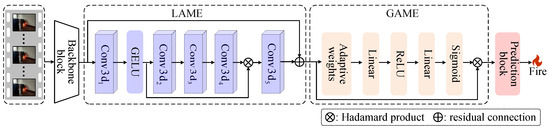
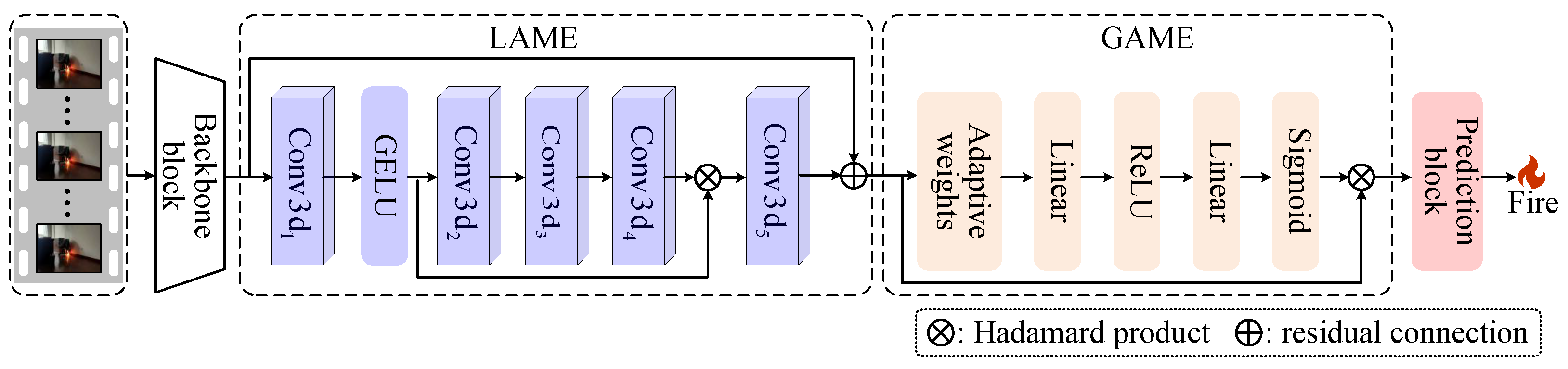
In this section, the architecture of LGAE is introduced. As illustrated in Figure 2, LGAE mainly includes the backbone block, the LAME block, the GAME block, and the prediction block.
Figure 2.
An overview of LGAE.
As introduced in [6], Video Swin Transformer (VST) has attained outstanding performance for action recognition, and it has 4 versions. Among these 4 versions, Swin-T has obtained relatively good performance with the fewest parameters. Because Swin-T achieves a balance between computational complexity and performance, it was chosen as the default backbone. Swin-T includes a 3D patch partition layer and has four stages. Let be the input of Swin-T, where H and W are the height and width of the input frame, respectively, and T represents the quantity of sampled frames. The shape of the output tensor of Swin-T is . In the experiments, T, H, W, and C were fixed at 32, 224, 224, and 96, respectively.
Regarding the prediction block, it mainly includes a 3D pooling layer and a linear layer. First, the pooling layer was employed to pool the input tensor into . Second, the linear layer was used to classify the output tensor. In subsequent sections, LAME and GAME will be introduced in detail.
4.2. LAME Block
The LAME block is one of the important blocks in the proposed LGAE. An overview of LAME is shown in Figure 2. Let the input tensor of LAME be , where represents the quantity of sampled frames; and individually indicate height and width, respectively; and denotes the quantity of channels. The process of LAME includes two stages.
In the first stage of LAME, is fed to the first 3D convolutional layer [37]. Then, GELU is used as the activation function. In this stage, local features are activated, and the shape of the output tensor remains unchanged. The calculation of the first stage of LAME can be formulated as follows:
where is the output tensor of the first stage of the LAME block, represents the Gaussian Error Linear Units (GELUs) function, and is function of the first convolutional layer.
In the second stage of the LAME block, Tensor is fed into the second, third, and fourth 3D convolutional layers. To guarantee that the input and output have an identical shape, the input and output channels of these convolutional layers are fixed at 768, and the stride of these layers is set to 1. To obtain different perspectives, the kernel sizes of these convolutional layers are fixed at 5, 7, and 1, respectively. To extract multi-scale information, the dilation of is set to 3. This process can be calculated as
where , , and are the functions of the second, third, and fourth convolutional layers, respectively, and is calculated by Equation (1).
The output tensor of the first Stage is adaptively enhanced by the tensor and the fifth convolutional layer. Finally, a residual connection is utilized to enhance the generalization capacity for this block. Therefore, the mapping function of LAME is as below.
where is the output of LAME, ⊗ is the Hadamard product with a broadcast mechanism, and represents the function of the fifth convolutional layer. By establishing the adaptive local feature enhancement model, the ability to describe the local information of flames is improved.
Moreover, the parameters and significance of convolutional layers are shown in Table 3, where “Out.” represents the number of output channels, “Ker.” denotes the size of the convolving kernel, “Str.” is the Stride, “Pad.” represents the padding, and “Dil.” is the spacing between kernel elements.
Table 3.
Parameters and significance of convolutional layers.
4.3. GAME Block
To depict the global motion characteristics, the GAME block was designed. As shown in Figure 2, GAME is mainly composed of an adaptive weight layer and two linear layers without additive bias.
First, an adaptive weight layer is devised to learn knowledge of the global motion, which is formulated as below.
where is the output tensor, is calculated by Equation (3), represents the adaptive learnable tensor, and is the Sigmoid function.
Second, the quantity of channels of tensor is reduced to using Tensor . Then, the quantity of channels is restored using Tensor . In our experiment, R was fixed at 4. Therefore, the global motion information was further enhanced using and . The calculation of this process can be formulated as below.
where represents the global weight tensor, denotes the function of rectified linear unit, and and are the two parameters of the two linear layers.
Third, Tensor is used to enhance Tensor , and a residual connection is also used to improve the generalization ability, which is formulated as follows:
where is calculated using Equation (5), and ⊗ is the Hadamard product with a broadcast mechanism. This block adaptively learns the global distribution information, thus enhancing the ability to depict the global motion information.
5. Experiments
The experimental settings are introduced in Section 5.1. Ablation experiments are elaborated in Section 5.2. Then, comparisons with other methods on the LFVR and FireNet datasets are reported in Section 5.3 and Section 5.4, respectively. Moreover, computational complexity is analyzed in Section 5.5, and the discussion are presented in Section 5.6.
5.1. Experimental Setup
As shown in Table 2, LFVR was divided into a training set and a test set, with about 70% of the data allocated for training and the remaining approximately 30% reserved for testing. Concerning the experiments on the FireNet dataset [12], all videos of this dataset were employed to test the network models trained on LFVR. Moreover, F1 score and accuracy were selected as the evaluation indicators for the two datasets.
Regarding the preprocessing of a video, 32 frames were sampled from a video. The short side was resized to 256 pixels, from which a pixel region is randomly cropped. Then, these cropped frames undergo random flipping with a 50% probability. Concerning the training process, the batch size, learning rate, and weight decay are fixed at 8, 0.0005, and 0.02, respectively. The coefficients used to calculate the running average of the gradient and its square are fixed at 0.9 and 0.999, respectively. Moreover, the linear warm-up and cosine annealing strategies are utilized to adjust the learning rate. The learning rate is increased linearly and subsequently decreased by employing the strategy of cosine annealing until the number of training epochs reaches 100. The AdamW [38] algorithm is used to optimize the neural network. In terms of the implementation, PyTorch (https://pytorch.org accessed on 19 November 2024) is used to implement the proposed network.
5.2. Ablation Experiments
On LFVR, ablation experiments are carried out to evaluate LGAE. VST [6] is chosen as the baseline, because it uses the same backbone as LGAE and attains excellent performance in the action recognition task. For the sake of a fair comparison, all experiments adhere to the same experimental settings described in Section 5.1.
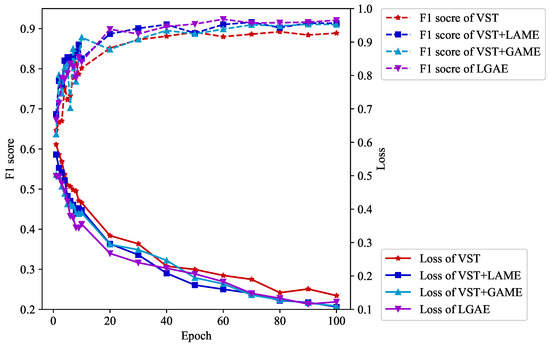
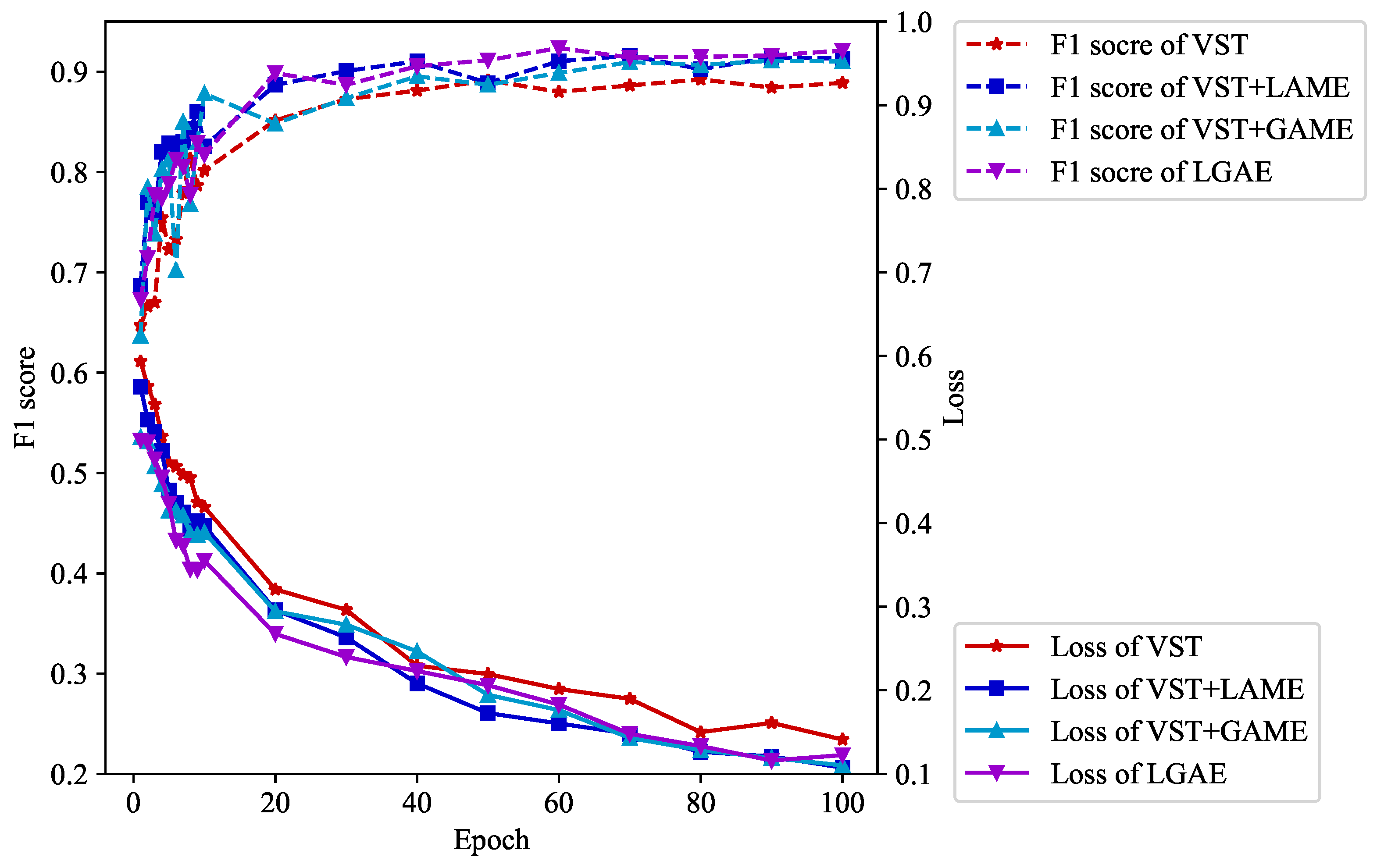
The evaluation of LGAE on Split 1 of LFVR is shown in Figure 3. In this figure, “VST+LAME” represents the network, which includes the backbone block, LAME, and the prediction block. Moreover, “VST+GAME” denotes the network containing the backbone block, GAME, and the prediction block.
Figure 3.
Evaluation of LGAE on Split 1 of LFVR.
As illustrated in Figure 3, the loss curves of VST, “VST+LAME”, “VST+GAME”, and LGAE tend to smooth, respectively, at the 80th, 70th, 90th, and 60th epochs, while the F1 scores of these four methods reach their maximum values. In the majority of epochs, LGAE attains better performance than VST on Split 1 of LFVR.
Based on the experimental rules of LFVR, on the training sets of Split 2 and Split 3, VST, “VST+LAME”, “VST+GAME”, and LGAE were trained for 80, 70, 90, and 60 epochs, respectively. Then, on the testing sets of Split 2 and Split 3, the values of F1 score and accuracy were calculated, respectively, using the trained network models. A comparison of these four methods on the LFVR dataset is shown in Table 4. In this table, “VST+GAME” refers to the network consisting of the backbone block, GAME, and the prediction block. Moreover, “VST+LAME” denotes the network, which includes the backbone block, LAME, and the prediction block.
Table 4.
Ablation experiments on LFVR.
Based on results in Table 4, we can derive the following inferences. First, on all three splits, both LAME and GAME improve the performance of the backbone in the aspect of fire video recognition. Second, after using the two blocks, there are some differences in the improvement of F1 scores on the three splits. Third, LAME and GAME are complementary, and the concurrent use of these two blocks can improve the experimental results. These ablation experiments demonstrate that LAME and GAME can enhance the ability to recognize fire videos.
5.3. Comparison on the LFVR Dataset
On the LFVR dataset, I3D [4], TimeSformer [5], and VST [6] were evaluated since they exhibit excellent performance in action recognition. To make a fair comparison, all of the experiments were conducted according to the experimental settings described in Section 5.1, except for the default parameters of these methods. The comparison is reported in Table 5.
Table 5.
Comparison with other methods on LFVR.
The F1 scores of TimeSformer and VST were 81.14% and 86.41%, respectively. This indicates that VST is more appropriate for recognizing fire videos than TimeSformer. After adding LAME and GAME, the F1 score of LGAE attained the best experimental result of 88.93%. This partly demonstrates that the ability of LGAE to recognize flames is enhanced through learning the local and global motion information.
5.4. Comparison on the FireNet Dataset
To further validate LGAE, experiments were carried out on FireNet [12]. As shown in Table 1, FireNet is the dataset that possesses the largest number of videos. The test set of FireNet includes 46 fire videos and 16 non-fire videos. The comparison between LGAE and other methods is reported in Table 6. In the experiments, all of the videos in FireNet were utilized as test data since these methods take video as input data. For all of the methods shown in Table 6, the models trained on Split 1 of LGAE were used to predict videos in FireNet.
Table 6.
Comparison between LGAE and other methods on FireNet.
Through comparing the results in Table 5 and Table 6, the following conclusions can be drawn. First, on FireNet, all of the models trained by these four networks on the LFVR dataset obtained preferable experimental results. This indicates that the models trained on LFVR possess excellent generalization capability. Second, the F1 scores of all methods in Table 5 are inferior to the corresponding ones in Table 6, whereas the accuracy values of all methods in Table 5 are higher than the corresponding ones in Table 6. This phenomenon could be attributed to the fact that the proportion of fire videos in FireNet is higher than that in the LFVR dataset. Third, LGAE attains the best results on both FireNet and LFVR.
5.5. Computational Complexity
The computational complexity of LGAE was analyzed. The number of parameters and testing time are reported in Table 7, where the testing time was measured in seconds. In this table, the “Average” column indicates the average time expended for testing a video using the corresponding method, and the “Total” column represents the total time spent testing all videos using the corresponding method. Regarding the testing time, all of he experiments were conducted on the test set of Split 1 with an NVIDIA GeForce RTX 3090 GPU. To be specific, all of the videos in the test set were fed into these neural networks separately, and the testing time of each video was calculated. Moreover, all of the methods employed the same experimental settings.
Table 7.
Comparison of the computational complexity.
As reported in Table 7, VST had the shortest testing time due to its minimal number of parameters. Among all methods, LGAE took the longest time to test a video. The average time for predicting a video by LGAE was 0.03374 s more than that by VST. However, the experimental result of LGAE was 2.52% higher than that of VST. In conclusion, the additional time cost was worthwhile compared with the improvement in experimental results, and LGAE attained a balance between computational complexity and recognition performance.
5.6. Analysis and Discussion
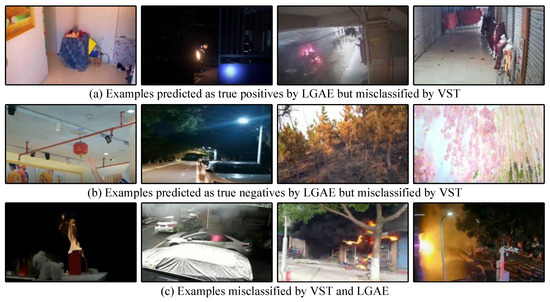
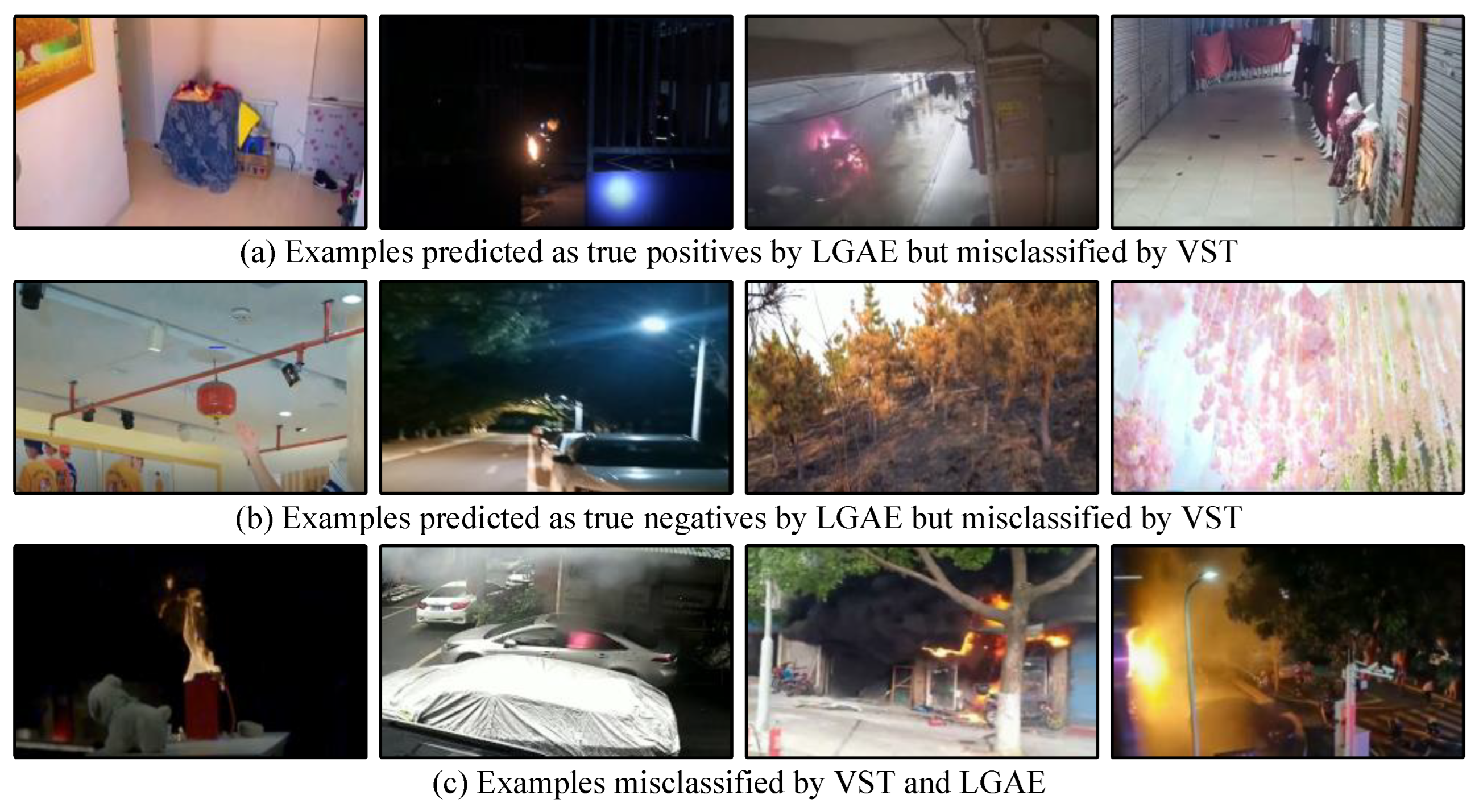
This section delves into a comprehensive and in-depth exploration of the experimental findings. Figure 4 shows some of the examples that were misclassified by VST or LGAE. As shown in Figure 4a, there are some examples of fire videos that were misclassified by VST but correctly classified by LGAE. Because the proportion of flames in these samples was relatively small, the VST method failed to identify the flames in these videos. By improving the ability to depict the local and global motion information, LGAE correctly identified these samples as fire videos.
Figure 4.
Some examples misclassified by VST or LGAE.
As shown in Figure 4b, there are non-fire examples that were misclassified by VST but correctly predicted by LGAE. Because certain objects in these videos possess colors or shapes similar to those of flames, VST recognizes them as videos containing flames. Through using LAME and GAME, LGAE correctly classifies these samples as non-fire videos. Moreover, Figure 4c shows examples misclassified by both VST and LGAE. This indicates that LFVR is a challenging dataset.
6. Conclusions
In this work, the LFVR dataset for fire video recognition was constructed, and LGAE was designed to recognize fire videos. LGAE mainly consists of the backbone block, LAME, and GAME. To be specific, GAME adaptively acquires information about global data distribution. Moreover, LAME was devised, which strengthens the capacity to describe the local motion information of flames. Therefore, the capability to recognize flames was enhanced through the integration of both local and global motion information. On the LFVR and FireNet datasets, LGAE achieved better performance than the baseline methods and attained the best results. Furthermore, the LFVR dataset is publicly available at (https://github.com/yunyi9/LFVR accessed on 19 November 2024).
Fire smoke covering open flames poses a challenge for fire detection algorithms that rely heavily on visual flame detection. In the future, LFVR will be expanded to include the category of smoke, and we will develop algorithms that can simultaneously recognize smoke and flames.
Author Contributions
Conceptualization, Y.Y.; methodology, Y.Y. and J.D.; software, J.D.; validation, J.D., Y.Y., T.W. and T.T.; formal analysis, Y.Y. and T.T.; investigation, J.D.; resources, Y.Y. and T.W.; data curation, J.D. and Y.Y.; writing—original draft preparation, J.D.; writing—review and editing, J.D., Y.Y., T.W. and T.T.; visualization, J.D. and Y.Y.; supervision, Y.Y.; project administration, Y.Y.; funding acquisition, Y.Y. and T.W. All authors have read and agreed to the published version of the manuscript.
Funding
This work was supported, in part, by the National Natural Science Foundation of China (Grant Nos. 62362003 and 62301087), and the Natural Science Foundation of Jiangxi Province (Grant Nos. 20232BAB202017 and 20242BAB26024).
Data Availability Statement
The data that support the findings of this study are available from the corresponding author upon reasonable request.
Conflicts of Interest
The authors declare no conflicts of interest.
References
- Bouguettaya, A.; Zarzour, H.; Taberkit, A.M.; Kechida, A. A review on early wildfire detection from unmanned aerial vehicles using deep learning-based computer vision algorithms. Signal Process. 2022, 190, 108309. [Google Scholar] [CrossRef] [Scilit]
- Carta, F.; Zidda, C.; Putzu, M.; Loru, D.; Anedda, M.; Giusto, D. Advancements in forest fire prevention: A comprehensive survey. Sensors 2023, 23, 6635. [Google Scholar] [CrossRef] [Scilit]
- Baranovskiy, N.V.; Podorovskiy, A.; Malinin, A. Parallel implementation of the algorithm to compute forest fire impact on infrastructure facilities of JSC Russian railways. Algorithms 2021, 14, 333. [Google Scholar] [CrossRef] [Scilit]
- Carreira, J.; Zisserman, A. Quo vadis, action recognition? A new model and the Kinetics dataset. In Proceedings of the IEEE Conference on Computer Vision and Pattern Recognition, Honolulu, HI, USA, 21–26 July 2017; pp. 4724–4733. [Google Scholar]
- Bertasius, G.; Wang, H.; Torresani, L. Is space-time attention all you need for video understanding? In Proceedings of the International Conference on Machine Learning, Online, 18–24 July 2021; pp. 813–824. [Google Scholar]
- Liu, Z.; Ning, J.; Cao, Y.; Wei, Y.; Zhang, Z.; Lin, S.; Hu, H. Video swin Transformer. In Proceedings of the IEEE/CVF Conference on Computer Vision and Pattern Recognition, New Orleans, LA, USA, 18–24 June 2022; pp. 3192–3201. [Google Scholar]
- Bu, F.; Gharajeh, M.S. Intelligent and vision-based fire detection systems: A survey. Image Vis. Comput. 2019, 91, 103803. [Google Scholar] [CrossRef] [Scilit]
- Pincott, J.; Tien, P.W.; Wei, S.; Calautit, J.K. Indoor fire detection utilizing computer vision-based strategies. J. Build. Eng. 2022, 61, 105154. [Google Scholar] [CrossRef] [Scilit]
- Chino, D.Y.T.; Avalhais, L.P.S.; Rodrigues, J.F.; Traina, A.J.M. BoWFire: Detection of fire in still images by integrating pixel color and texture analysis. In Proceedings of the SIBGRAPI Conference on Graphics, Patterns and Images, Salvador, Bahia, Brazil, 26–29 August 2015; pp. 95–102. [Google Scholar]
- Foggia, P.; Saggese, A.; Vento, M. Real-time fire detection for video-surveillance applications using a combination of experts based on color, shape, and motion. IEEE Trans. Circuits Syst. Video Technol. 2015, 25, 1545–1556. [Google Scholar] [CrossRef] [Scilit]
- Toulouse, T.; Rossi, L.; Campana, A.; Celik, T.; Akhloufi, M.A. Computer vision for wildfire research: An evolving image dataset for processing and analysis. Fire Saf. J. 2017, 92, 188–194. [Google Scholar] [CrossRef] [Scilit]
- Jadon, A.; Omama, M.; Varshney, A.; Ansari, M.S.; Sharma, R. FireNet: A specialized lightweight fire & smoke detection model for real-time IoT applications. arXiv 2019, arXiv:1905.11922. [Google Scholar]
- Wu, S.; Zhang, X.; Liu, R.; Li, B. A dataset for fire and smoke object detection. Multimed. Tools Appl. 2023, 82, 6707–6726. [Google Scholar] [CrossRef] [Scilit]
- Celik, T.; Demirel, H.; Ozkaramanli, H.; Uyguroglu, M. Fire detection using statistical color model in video sequences. J. Vis. Commun. Image Represent. 2007, 18, 176–185. [Google Scholar] [CrossRef] [Scilit]
- Bian, Y.; Yang, M.; Fan, X.; Liu, Y. A fire detection algorithm based on Tchebichef moment invariants and PSO-SVM. Algorithms 2018, 11, 79. [Google Scholar] [CrossRef] [Scilit]
- Torabian, M.; Pourghassem, H.; Mahdavi-Nasab, H. Fire detection based on fractal analysis and spatio-temporal features. Fire Technol. 2021, 57, 2583–2614. [Google Scholar] [CrossRef] [Scilit]
- Kim, B.; Lee, J. A Bayesian network-based information fusion combined with DNNs for robust video fire detection. Appl. Sci. 2021, 11, 7624. [Google Scholar] [CrossRef] [Scilit]
- Ding, X.; Gao, J. A new intelligent fire color space approach for forest fire detection. J. Intell. Fuzzy Syst. 2022, 42, 5265–5281. [Google Scholar] [CrossRef] [Scilit]
- Dou, Z.; Ma, X.; Xie, X.; Liu, H.; Guo, C. A hybrid method of detecting flame from video stream. IET Image Process. 2022, 16, 2937–2946. [Google Scholar] [CrossRef] [Scilit]
- Harkat, H.; Nascimento, J.M.; Bernardino, A.; Ahmed, H.F.T. Fire images classification based on a handcraft approach. Expert Syst. Appl. 2023, 212, 118594. [Google Scholar] [CrossRef] [Scilit]
- Muhammad, K.; Khan, S.; Elhoseny, M.; Hassan Ahmed, S.; Wook Baik, S. Efficient fire detection for uncertain surveillance environment. IEEE Trans. Ind. Inform. 2019, 15, 3113–3122. [Google Scholar] [CrossRef] [Scilit]
- Sandler, M.; Howard, A.; Zhu, M.; Zhmoginov, A.; Chen, L.C. MobileNetV2: Inverted residuals and linear bottlenecks. In Proceedings of the IEEE/CVF Conference on Computer Vision and Pattern Recognition, Salt Lake City, UT, USA, 18–22 June 2018; pp. 4510–4520. [Google Scholar]
- Shahid, M.; Virtusio, J.J.; Wu, Y.H.; Chen, Y.Y.; Tanveer, M.; Muhammad, K.; Hua, K.L. Spatio-temporal self-attention network for fire detection and segmentation in video surveillance. IEEE Access 2022, 10, 1259–1275. [Google Scholar] [CrossRef] [Scilit]
- Frizzi, S.; Bouchouicha, M.; Ginoux, J.M.; Moreau, E.; Sayadi, M. Convolutional neural network for smoke and fire semantic segmentation. IET Image Process. 2021, 15, 634–647. [Google Scholar] [CrossRef] [Scilit]
- Sheng, D.; Deng, J.; Xiang, J. Automatic smoke detection based on SLIC-DBSCAN enhanced convolutional neural network. IEEE Access 2021, 9, 63933–63942. [Google Scholar] [CrossRef] [Scilit]
- Ouyang, W.; Fang, Y.; Xiong, A.; He, H. Research on video fire detection algorithm based on attention mechanism. In Proceedings of the International Conference on Computer Communication and Artificial Intelligence, Guangzhou, China, 7–9 May 2021; pp. 25–29. [Google Scholar]
- Majid, S.; Alenezi, F.; Masood, S.; Ahmad, M.; Gündüz, E.S.; Polat, K. Attention based CNN model for fire detection and localization in real-world images. Expert Syst. Appl. 2022, 189, 116114. [Google Scholar] [CrossRef] [Scilit]
- Selvaraju, R.R.; Cogswell, M.; Das, A.; Vedantam, R.; Parikh, D.; Batra, D. Grad-CAM: Visual explanations from deep networks via gradient-based localization. Int. J. Comput. Vis. 2020, 128, 336–359. [Google Scholar] [CrossRef] [Scilit]
- Ge, Z.; Liu, S.; Wang, F.; Li, Z.; Sun, J. YOLOX: Exceeding YOLO series in 2021. arXiv 2021, arXiv:2107.08430. [Google Scholar]
- Zhang, J.; Ke, S. Improved YOLOX fire scenario detection method. Wirel. Commun. Mob. Comput. 2022, 2022, 9666265. [Google Scholar] [CrossRef] [Scilit]
- Lu, K.; Huang, J.; Li, J.; Zhou, J.; Chen, X.; Liu, Y. MTL-FFDET: A multi-task learning-based model for forest fire detection. Forests 2022, 13, 1448. [Google Scholar] [CrossRef] [Scilit]
- Hosseini, A.; Hashemzadeh, M.; Farajzadeh, N. UFS-Net: A unified flame and smoke detection method for early detection of fire in video surveillance applications using CNNs. J. Comput. Sci. 2022, 61, 101638. [Google Scholar] [CrossRef] [Scilit]
- Zhang, H.; Yang, S.; Wang, H.; Li, J.; Liu, H. Unified smoke and fire detection in an evolutionary framework with self-supervised progressive data augment. In Proceedings of the International Conference on Pattern Recognition and Artificial Intelligence, Chengdu, China, 19–21 August 2022; pp. 574–581. [Google Scholar]
- Long, X.; Deng, K.; Wang, G.; Zhang, Y.; Dang, Q.; Gao, Y.; Shen, H.; Ren, J.; Han, S.; Ding, E.; et al. PP-YOLO: An effective and efficient implementation of object detector. arXiv 2020, arXiv:2007.12099. [Google Scholar]
- Chen, C.; Yu, J.; Lin, Y.; Lai, F.; Zheng, G.; Lin, Y. Fire detection based on improved PP-YOLO. Signal Image Video Process. 2023, 17, 1061–1067. [Google Scholar] [CrossRef] [Scilit]
- Kuehne, H.; Jhuang, H.; Garrote, E.; Poggio, T.; Serre, T. HMDB: A large video database for human motion recognition. In Proceedings of the International Conference on Computer Vision, Barcelona, Spain, 6–13 November 2011; pp. 2556–2563. [Google Scholar]
- Ji, S.; Xu, W.; Yang, M.; Yu, K. 3D convolutional neural networks for human action recognition. IEEE Trans. Pattern Anal. Mach. Intell. 2013, 35, 221–231. [Google Scholar] [CrossRef] [Scilit] [PubMed]
- Loshchilov, I.; Hutter, F. Decoupled weight decay regularization. In Proceedings of the International Conference on Learning Representations, New Orleans, LA, USA, 6–9 May 2019. [Google Scholar]

Disclaimer/Publisher’s Note: The statements, opinions and data contained in all publications are solely those of the individual author(s) and contributor(s) and not of MDPI and/or the editor(s). MDPI and/or the editor(s) disclaim responsibility for any injury to people or property resulting from any ideas, methods, instructions or products referred to in the content. |
© 2025 by the authors. Licensee MDPI, Basel, Switzerland. This article is an open access article distributed under the terms and conditions of the Creative Commons Attribution (CC BY) license (https://creativecommons.org/licenses/by/4.0/).