


Abstract
This paper presents a practical thermal control strategy to enhance the output performance of oxide-based all-solid-state batteries (ASSBs), which typically exhibit low ionic conductivity at room temperature. A lightweight polyimide (PI) film heater was designed, fabricated, and integrated into the cell stack to locally maintain the optimal operating temperature range (≈65–75 °C) for electrolyte activation. Unlike previous studies limited to liquid or sulfide-based batteries, this work demonstrates the direct integration and coupled numerical–experimental validation of a PI film heater within oxide-based ASSBs. The proposed design achieves high heating efficiency (~92%) with minimal thickness (<100 μm) and long-term stability, enabling reliable and scalable thermal management. Finite-element simulations and experimental verification confirmed that the proposed heater achieved rapid and uniform heating with less than a 10 °C temperature deviation between the cell and heater surfaces. These findings provide a foundation for smart battery management systems with distributed temperature sensing and feedback control, supporting the development of high-performance and reliable solid-state battery platforms.
1. Introduction
In recent years, battery technology has become a core element across industrial and daily applications, with increasing dependence in electric vehicles (EVs), energy storage systems (ESS), drones, robots, and even aircraft. The global trend toward electrification and eco-friendly industries has further accelerated the growth of secondary batteries. Moreover, as part of carbon neutrality and renewable energy expansion strategies, the demand for ESS has been steadily increasing as an essential means of implementing climate change policies [1,2,3].
Currently, lithium-ion batteries are the most widely used type due to their high energy density and excellent performance. However, they still face major safety concerns such as electrolyte leakage, heat generation, and thermal runaway caused by repeated charge–discharge cycles or external shocks [2].
Sulfide-based electrolytes such as Li10GeP2S12 (LGPS) exhibit high ionic conductivity approaching 10−3 S·cm−1, comparable to liquid electrolytes. However, they are prone to chemical decomposition and H2S gas evolution during exposure to air or moisture, posing severe handling challenges [4,5,6,7]. In contrast, oxide-based electrolytes, including garnet-type Li7La3Zr2O12 (LLZO), provide superior mechanical and chemical stability and good compatibility with lithium metal but suffer from low ionic conductivity (~10−5 S·cm−1) at room temperature [8,9]. To address this limitation, surface modification and sintering optimization methods have been applied to reduce interfacial resistance between oxide electrolytes and electrodes [10].
Further developments have focused on polymer–ceramic composite electrolytes, which blend flexible polymers such as PEO with ceramic fillers to combine mechanical flexibility with improved ionic transport [11]. Additionally, thin-film deposition and vapor-coating techniques have enabled conformal and stable interfaces that tolerate higher voltages and prevent dendrite penetration [12]. These findings collectively underscore that ionic conductivity, interfacial contact, and temperature management are critical factors in determining ASSB performance.
Depending on the electrolyte type, all-solid-state batteries (ASSBs) can be categorized as polymer-, sulfide-, or oxide-based systems, each offering unique benefits and drawbacks (Table 1). Among them, oxide-based electrolytes, especially LLZO, are attractive for their excellent electrochemical and thermal stability and mechanical robustness against lithium-metal anodes [9,13]. Nevertheless, studies have shown that room-temperature ionic transport remains limited by grain-boundary resistance and rigid lattice structures, leading to poor power performance [14,15]. Subsequent investigations emphasized that interface engineering—for example, by applying Al2O3 or Li3BO3 coatings—can improve adhesion and reduce resistance, but these improvements alone cannot fully overcome the intrinsic temperature sensitivity of oxide electrolytes [12,16].
Table 1.
Characteristics and performance comparison of ASSB electrolytes.
The key obstacles hindering ASSB commercialization include low ionic conductivity, high interfacial resistance, and limited room-temperature performance. Among these, low ionic mobility in crystalline electrolytes is the most critical, as grain boundaries restrict Li+ transport, resulting in reduced power output and delayed activation [12,13,14,17].
Oxide-based solid electrolytes exhibit excellent chemical durability but require thermal activation to achieve sufficient ionic conduction. Their conductivity follows Arrhenius-type behavior, where moderate heating from 25 °C to 70 °C enhances ion transport by one to two orders of magnitude [11,14]. Interface engineering and controlled heating can significantly improve ionic mobility in polymer–oxide systems [18], reinforcing the importance of localized temperature control.
To achieve effective activation, several methods—such as dopant substitution [13], microstructure refinement [15], and interface coating [16]—have been proposed. However, these material-level approaches do not provide spatially uniform or energy-efficient temperature regulation. Conventional external heaters often result in large thermal losses and uneven temperature gradients across battery cells, reducing overall system efficiency and reliability.
To overcome these limitations, this study proposes a surface-type polyimide (PI) film heater that is directly integrated into the oxide-based all-solid-state battery (ASSB) stack. The PI heater is thin, lightweight, and flexible, capable of localized heat generation through resistive conduction when voltage is applied. This configuration enables precise and uniform in situ thermal control, thereby enhancing ionic conductivity, power stability, and activation efficiency without relying on bulky external heating systems.
Accordingly, this paper designs, fabricates, and experimentally evaluates a PI film heater as a thermal-control solution for oxide-based ASSBs. Finite-element simulations and experimental verification confirm that the proposed heater achieves rapid, uniform, and energy-efficient temperature regulation, providing a novel pathway toward self-heated, thermally optimized solid-state battery modules for advanced energy applications.
2. Theoretical Background
2.1. Temperature Dependence of All-Solid-State Batteries
One of the major advantages of all-solid-state batteries (ASSBs) is their wide operating temperature range. While conventional lithium-ion batteries exhibit a sharp decrease in ionic conductivity below −10 °C and face significant thermal runaway risks at elevated temperatures, ASSBs can operate stably from −40 °C up to 100 °C, providing a much broader temperature tolerance window. However, despite this advantage, the low ionic conductivity of solid electrolytes at room temperature remains a key technical bottleneck.
Solid electrolytes, including oxide-based ones, boast excellent chemical and mechanical stability, but their relatively low ionic conductivity at room temperature is a disadvantage. To address these limitations, researchers are actively pursuing methods to increase ionic conductivity through heating or high-temperature operation [18].
Furthermore, to mitigate this, various efforts have been made to improve the electrolyte composition and optimize fabrication processes to reduce the temperature dependence of ionic transport. In particular, oxide-based solid electrolytes—which are used in this paper—generally exhibit low ionic conductivity and high interfacial resistance. This means that efficient ionic transport and electrode activation occur only above a certain threshold temperature. For the test cells used in this paper, the maximum ionic conductivity was observed around 70 °C. Below this temperature, the output power and lifetime of the cells rapidly deteriorated. Therefore, maintaining a constant operating temperature near this optimum point is essential for the practical implementation of ASSB systems.
From a theoretical standpoint, the ionic conductivity (σ) of oxide electrolytes such as LLZO follows the Arrhenius relationship, expressed as
where is the activation energy for Li-ion transport. Numerous studies have reported that a moderate temperature rise from 25 °C to 70 °C can increase σ by up to two orders of magnitude, owing to enhanced ion mobility across grain boundaries [9,12,14,17,19]. Such temperature dependence directly justifies the need for local thermal assistance in oxide-based ASSBs.
Accordingly, several researchers have proposed internal heating strategies—such as self-heating electrodes, PTC films, and flexible PI heaters—to rapidly bring the electrolyte into its high-conductivity region with minimal power overhead [4,5,6,20,21,22,23].
To achieve stable thermal operation, this paper proposes inserting a surface-type polyimide (PI) film heater between adjacent cells during module stacking. The heater can be directly laminated inside the module structure and, when powered, uniformly transfers heat across the cell surfaces. Such direct-contact heating ensures rapid temperature equalization and minimizes the lag between heater activation and electrolyte response, improving ionic conductivity and reaction kinetics. This characteristic makes the PI heater an effective solution for temperature maintenance in systems where performance is highly sensitive to thermal conditions, such as oxide-based ASSBs.
2.2. Physical Principle of Surface Film Heaters
A surface-type film heater operates on the resistive heating (Joule heating) principle. When electric current passes through a resistive element, heat is generated and distributed uniformly across the surface. From a thermal transfer perspective, the heater delivers heat to the adjacent battery cells primarily through conduction and radiation, and the total heat generation can be adjusted by controlling the applied voltage, current, and resistance.
The heat generation rate (P) can be described by the fundamental relations , and the surface heat flux defines the heating intensity over the effective area. This controllability enables precise temperature regulation within the battery module, maintaining the optimal operational range of the ASSB. The typical structures, characteristics, and applications of various types of heaters are summarized in Table 2.
Table 2.
Typical heater structures and applications.
Recent reports highlight that PI film heaters exhibit high thermal efficiency (~90%), uniform heat spreading, and exceptional flexibility compared with ceramic or metal-fiber heaters [21,23]. Their thinness (typically <100 μm) allows integration between stacked cells without increasing module thickness, making them particularly suitable for solid-state batteries and wearable power systems.
In designing the PI film heater for ASSBs, key design parameters such as voltage, current, resistance, area, power, and power density were determined based on Ohm’s law and steady-state heat transfer equations. The governing relationships are summarized below.
- (1)
- Ohm’s Law
- (2)
- Surface Heat Flux (Power Density)
- (3)
- Heat Transfer Equation (Steady State)where, is the thermal conductivity of the substrate, and represents volumetric heat generation. In PI-based heaters, heat transfer occurs dominantly via in-plane conduction due to the material’s high thermal diffusivity (≈1.2 × 10⁻⁷ m2/s). The flexibility and dielectric strength of PI (>200 kV/mm) further ensure electrical safety and mechanical robustness under repeated heating cycles [23,24].
To ensure compatibility with the ASSB module environment, polyimide (PI) film was selected as the substrate material due to its excellent thermal resistance, flexibility, and electrical insulation properties, allowing direct attachment to battery cell surfaces while maintaining safety and uniform heat distribution. These properties make PI heaters highly scalable for multi-cell configurations, providing localized and efficient temperature control necessary for achieving stable operation of oxide-based all-solid-state batteries [8,9,10,17,25].
Recent fabrication advances demonstrate scalable PI-based flexible heater architectures (e.g., laser-induced graphene on polyimide woven fabrics) that achieve high surface uniformity and rapid response suitable for battery modules, further supporting our heater selection and patterning approach [26].
3. Numerical Analysis of the All-Solid-State Battery Cell
To preliminarily assess the feasibility of applying the heater to individual ASSB unit cells, a finite-element model (FEM) was developed using ANSYS Mechanical APDL (V2020). The boundary conditions were assuming no thermal resistance at the contact surface between components, a temperature of 100 °C on the upper surface of a heating element (thickness = 0.5 mm), and a heat-transfer coefficient of K = 0.0035 W/m·°C for the heating element. Then, a time-history analysis was performed by discretizing the continuous differential equation and approximating it with finite elements and nodes. The finite-element model of the ASSB unit cell was modeled using the Thermal (SOLID70) element of ANSYS Mechanical APDL (V2020). The heat-transfer analysis was performed with the governing equation described above. The finite-element analysis results confirmed that the surface temperature at the bottom of the cell reached 70 °C after approximately 1 h. This result was similar to the results tested by attaching a heating element to the cell surface. To quantitatively verify the reliability of the model, the simulated heater–cell temperature difference (ΔT ≈ 8–10 °C) was compared with experimental measurements. The deviation was within ±5%, and the correlation coefficient (R2) exceeded 0.98, confirming that the assumed boundary conditions and thermal properties accurately represented the real heat-transfer behavior.
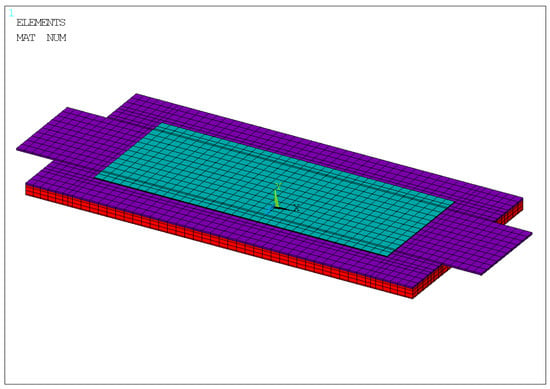
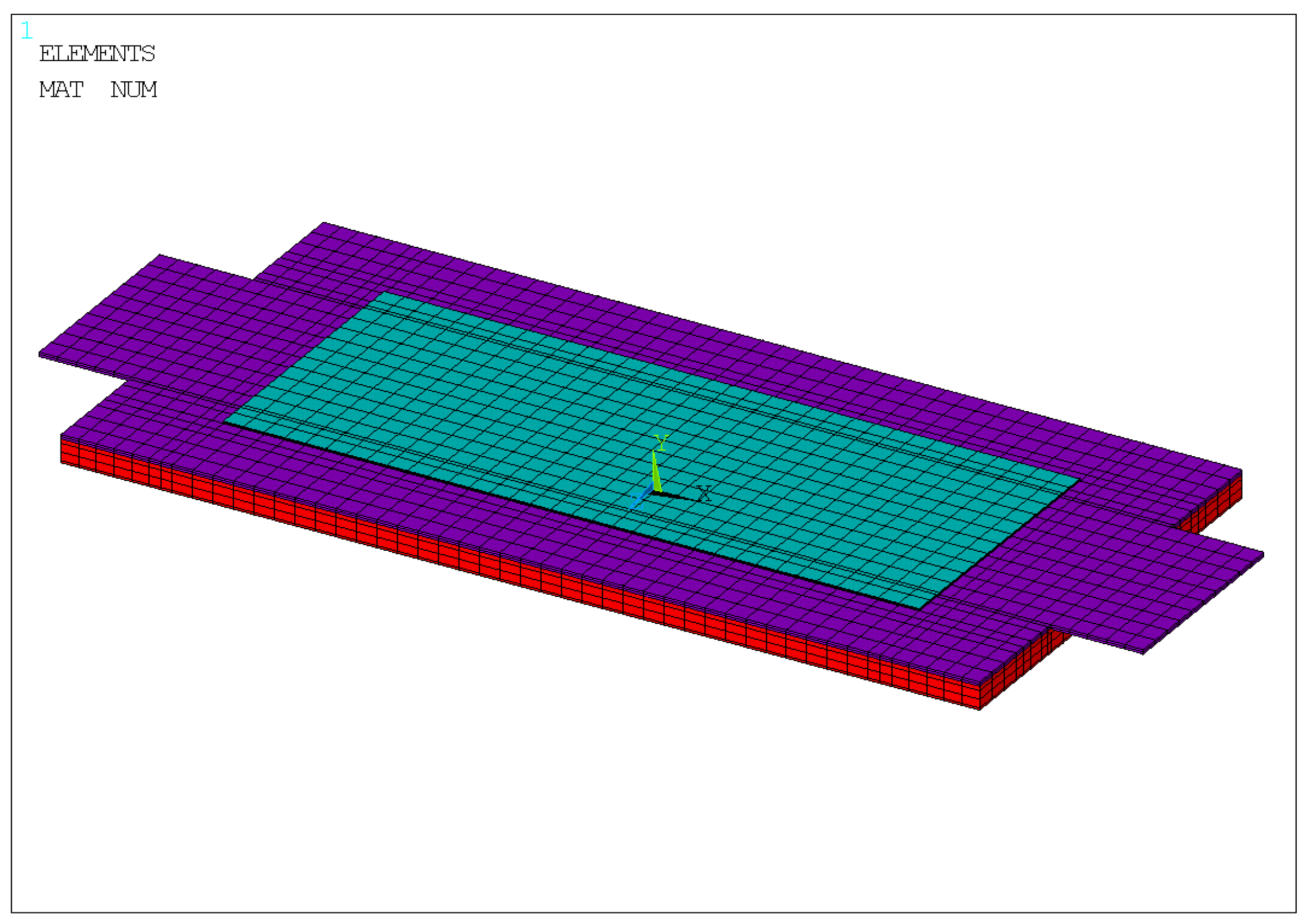
Figure 1 illustrates the constructed FEM of a single battery cell integrated with the proposed film heater. The thermal model aims to predict the transient and steady-state temperature distribution within the oxide-based ASSB structure when the surface-type PI film heater is activated. In this simulation, the thermal properties of the oxide-based solid electrolyte (LLZO: Li7La3Zr2O12) were adopted as follows:
Figure 1.
Finite-element model of an ASSB unit cell with integrated PI film heater. Blue: PI film heater, Purple: ASSB cell, Red: cartridge frame.
These values were selected based on recent measurements for garnet-type electrolytes reported by Neises et al. [7] and Raju et al. [9], ensuring that the simulation reflects realistic heat-transfer behavior. The model domain consisted of a layered structure—comprising the heater film, solid electrolyte, and current collectors—under convective boundary conditions to approximate ambient cooling.
Three heating power levels—20 W, 25 W, and 30 W—were considered to evaluate the thermal response of the cell–heater system. The boundary condition was defined such that the cell’s back-surface temperature reached and maintained 70 °C, corresponding to the optimal ionic conductivity of the oxide-based electrolyte.
Transient heat transfer analysis was conducted to determine the time required to reach steady state under each power condition. The time-dependent heat equation,
was solved using implicit time integration with convergence criteria of 10−6 for both energy and flux. The thermal coupling between the PI film and the battery layer was modeled through a contact conductance of 800–1000 W/m2·K, which represents typical adhesive interfaces used in thin-film integration [21,23].
Simulation Results
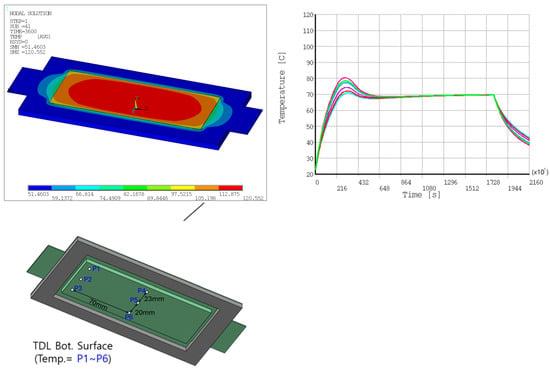
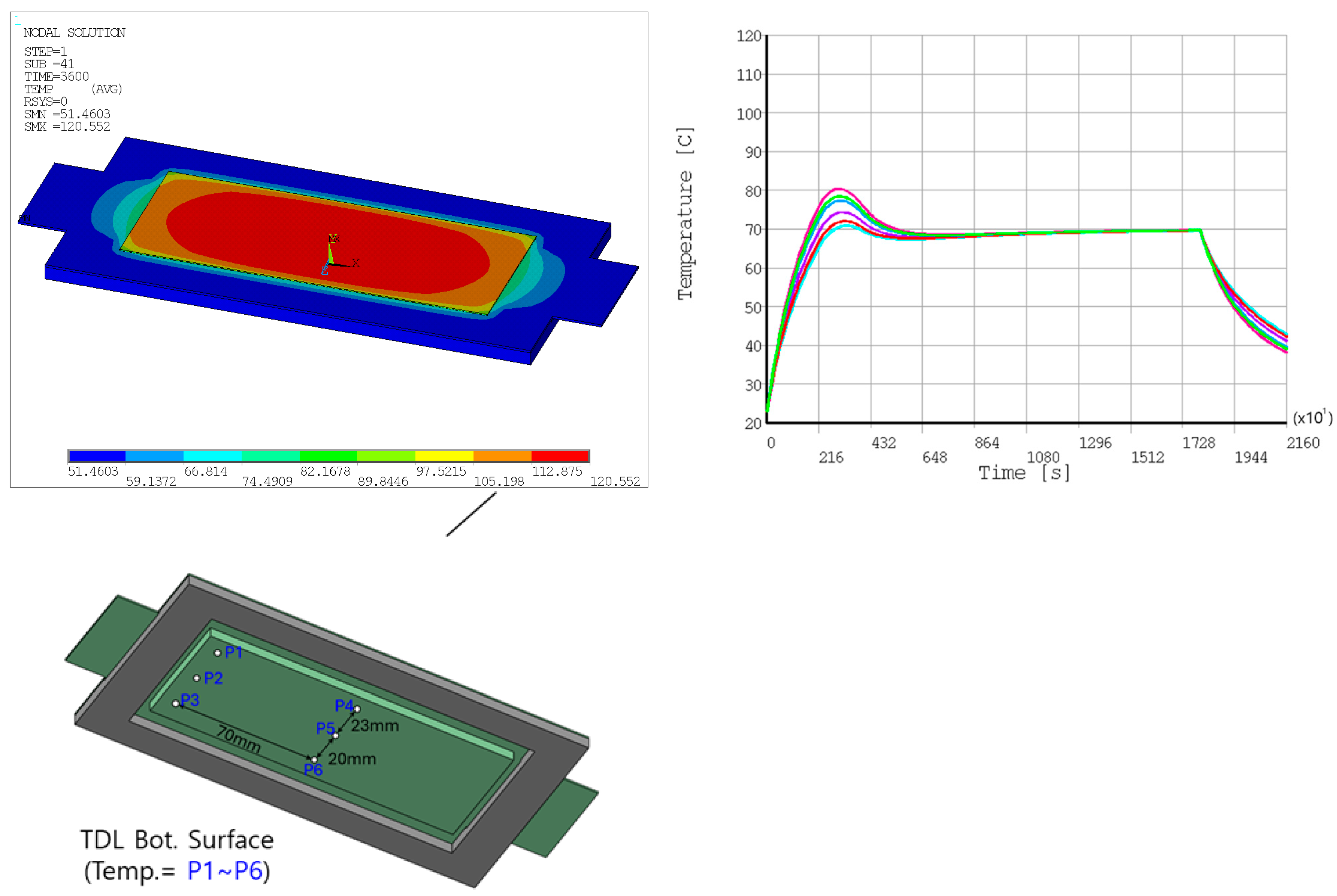
Figure 2 shows the temperature distribution of the cell’s rear surface under the 25 W heating condition. The analysis revealed that the surface temperature reached the target value of 70 °C after approximately 42 min, after which thermal equilibrium was established. The temperature rise profiles under three heating cases are compared in Figure 3. The results indicated that the times required to reach 70 °C were 60 min for 20 W, 42 min for 25 W, and 36 min for 30 W, respectively. As expected, higher heat input resulted in faster thermal stabilization of the cell, confirming that the heat-transfer model accurately predicts the time-dependent temperature evolution for different power inputs. Additionally, the simulated results were benchmarked against previously published thermal models of solid-state cells [8], demonstrating comparable heating rates and uniformity indices (<5% temperature deviation across the cell surface). This use of a transient thermal framework is consistent with recent energy-system modeling practices that resolve spatial non-uniformities and time-dependent heat flow to validate design parameters and control strategies [27]. The simulation outcomes served as the basis for defining the experimental voltage and power conditions in Section 4.
Figure 2.
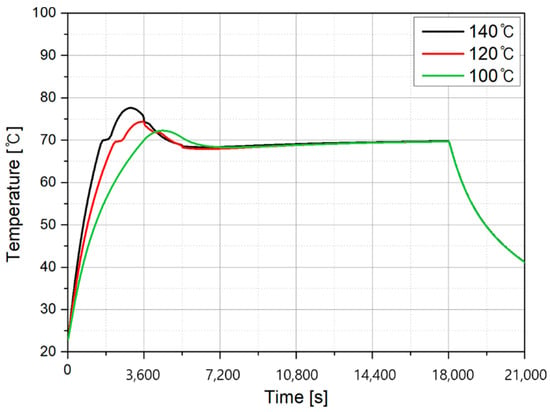
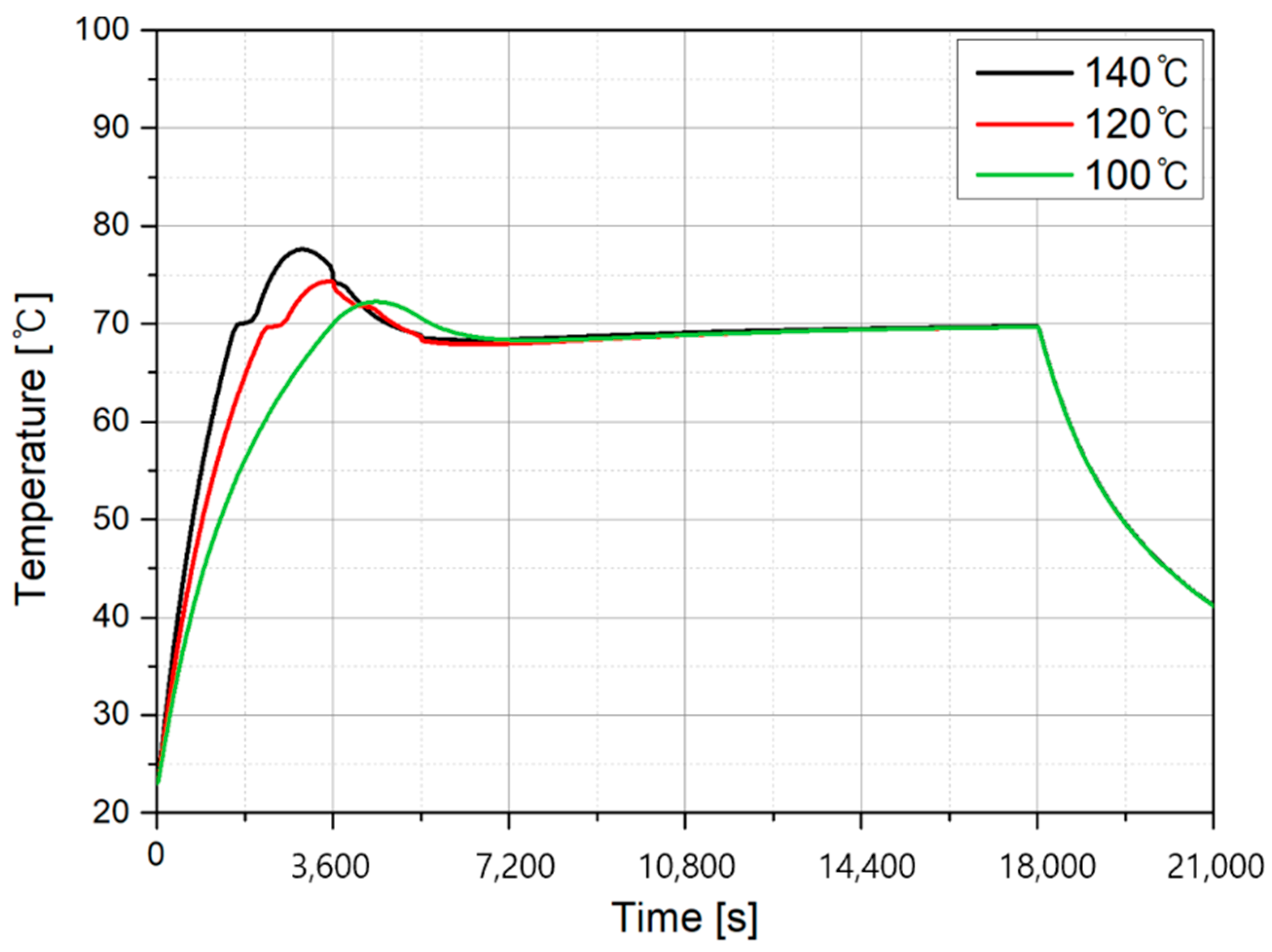
Temperature distribution of the cell rear surface at 25 W heating power. In the case of the all-solid-state battery, the surface heater (T1) was initially set to 100 °C, 120 °C, and 140 °C. The procedure involved turning on the power at the initial temperature, reducing the heating rate until reaching 70 °C, and finally turning off the power to allow cooling to ambient temperature (23 °C). The colored lines indicate the simulated temperature profiles measured at the sensor locations shown in the above figure.
Figure 3.
Comparison of temperature rise characteristics under 20 W, 25 W, and 30 W heating conditions.
4. Design and Experimental Evaluation of the Film Heater
4.1. Design and Fabrication of PI Film Heater Samples
The design of the PI film heater sample was based on the thermal analysis results obtained for three heating power levels—20 W, 25 W, and 30 W. Commercial heater samples with resistance values of 264 Ω and 282 Ω were selected for preliminary evaluation. Each heater was gradually heated from ambient temperature to approximately 100 °C under atmospheric conditions to determine appropriate design parameters. To ensure reproducibility and safety, all heaters were fabricated by a certified manufacturer using polyimide film (thickness 75 μm, dielectric strength > 200 kV/mm) and etched copper foil as the resistive element. The heater pattern was optimized through uniform current-density simulation to minimize localized overheating. The surface power density target was set at 4.0–5.0 W/cm2, corresponding to the predicted optimal heating rate from Section 3.
The PI film heaters were fabricated by a specialized manufacturer following a precise production process. A dedicated experimental setup was assembled, consisting of temperature sensors, a temperature data logger, a variable voltage regulator (SLIDAC), an oscilloscope for monitoring battery voltage, and a thermal imaging camera for visualizing heat distribution. Type-K thermocouples (accuracy ± 0.5 °C) and a calibrated IR camera (FLIR E95, emissivity = 0.95) were used to validate temperature uniformity. The measurement uncertainty of all temperature readings was within ±1.2 °C after calibration. The experimental system also included over-temperature protection relays (setpoint = 120 °C) to prevent overheating during long-term testing [20,21,23].
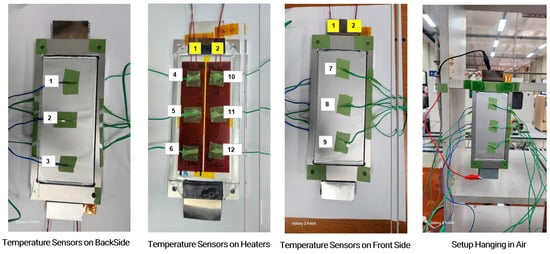
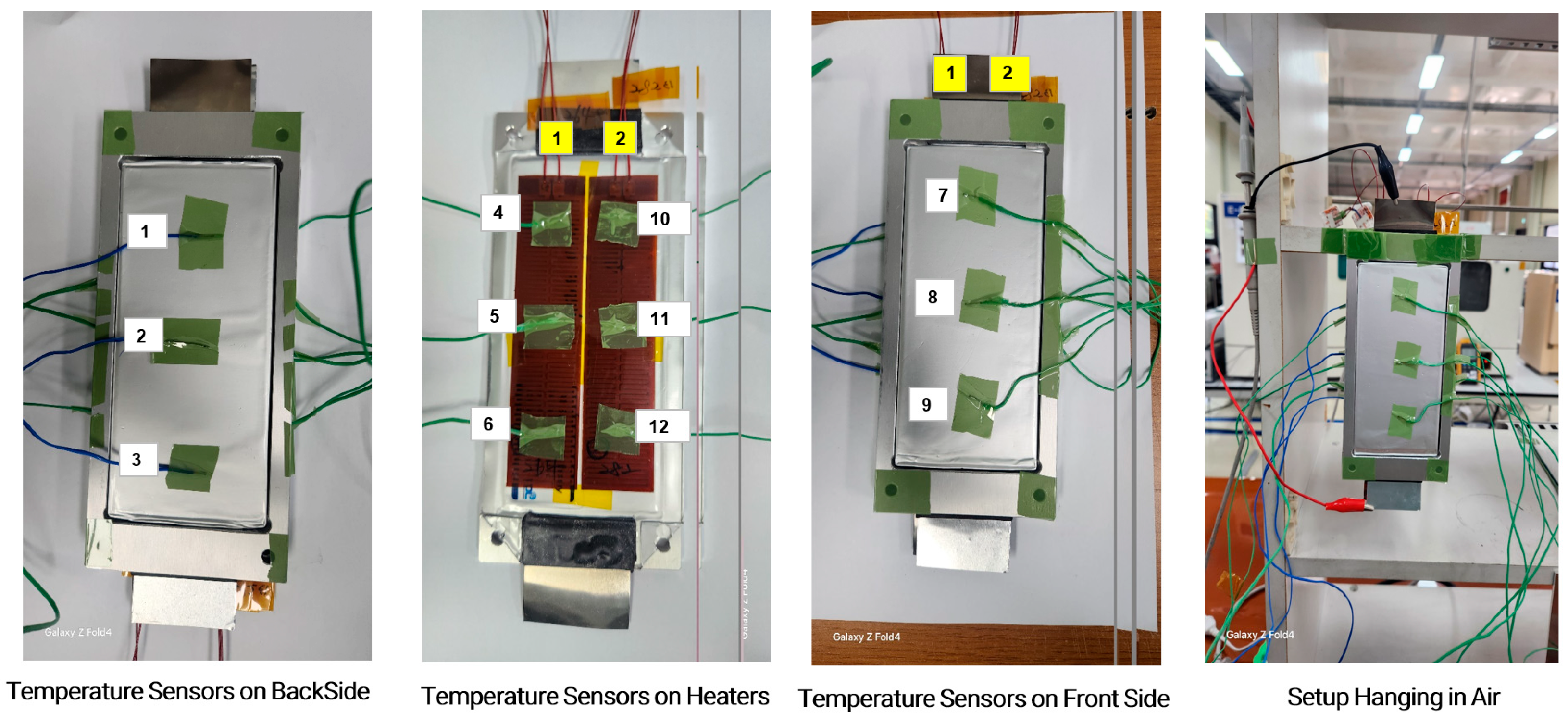
To measure actual temperature variations on both the heater and the battery surfaces, a total of 12 temperature sensors were attached—six on the heater and six on the front and rear sides of the battery, as shown in Figure 4. The experiments were conducted using an actual oxide-based ASSB cell and heating elements.
Figure 4.
Locations and number of temperature sensors attached for measurement. Here, number 1 to 12 denote individual temperature sensors.
4.2. Experimental Conditions
The experiments were conducted under ambient atmospheric conditions without thermal insulation, simulating an exposed environment rather than a fully enclosed battery module or pack. To evaluate the heater’s performance and extract suitable design parameters, voltage was gradually increased from 0 V to 70 V. After reaching 100 °C, the voltage was reduced until the heater stabilized at 70 °C, and corresponding temperatures of both the heater and battery surfaces were recorded. A second experiment was subsequently performed to determine the optimal operating voltage for maintaining the battery rear-surface temperature around 70 °C. Based on the initial analysis, the 60 V condition was selected for this validation test. In addition, the ambient temperature (22 ± 1 °C) and relative humidity (40 ± 5%) were monitored to ensure consistent thermal boundary conditions throughout all tests. The heater input current and voltage were logged at 1 s intervals to compute real-time power, allowing correlation with temperature evolution curves [25].
4.3. Experimental Results and Analysis
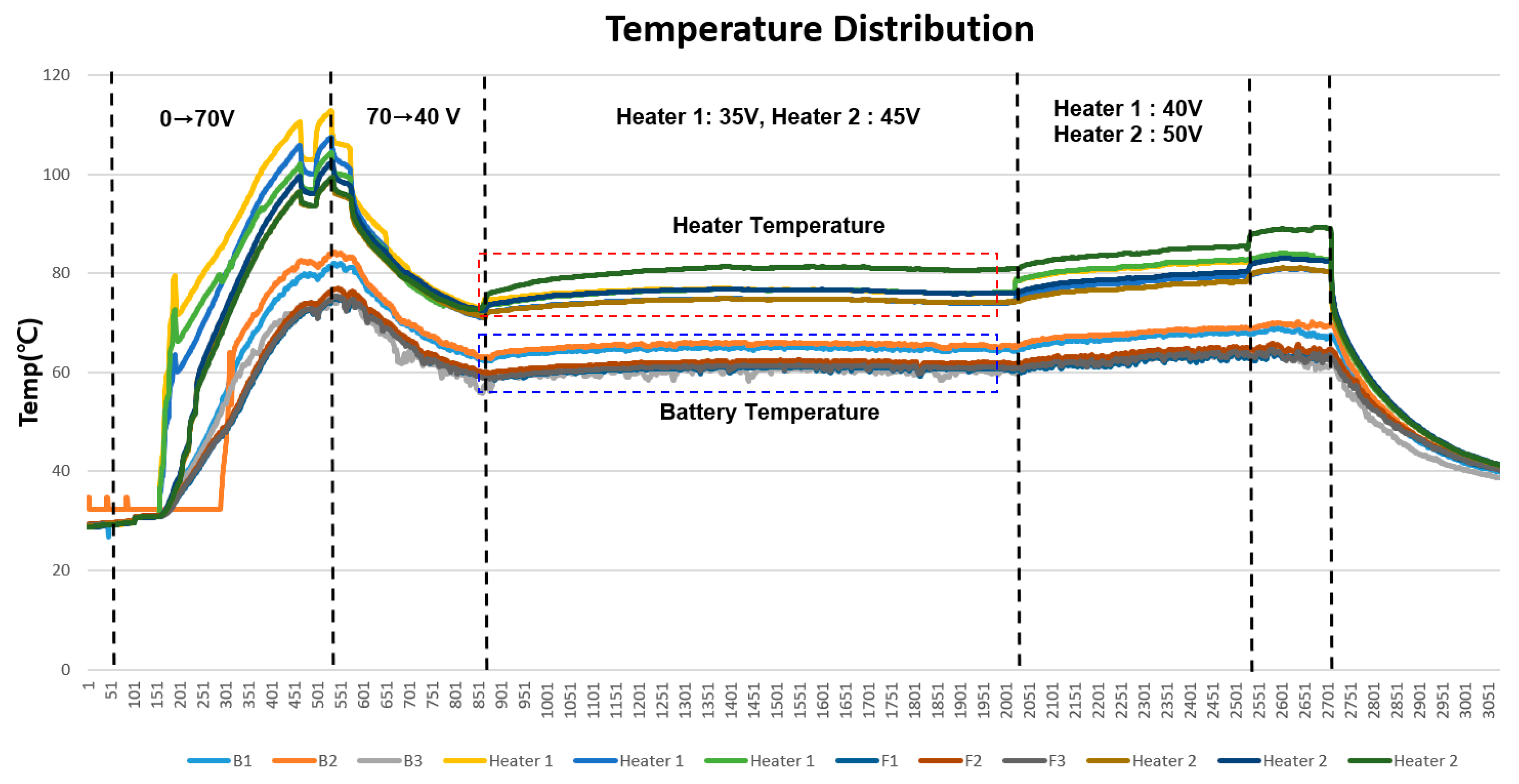
In the first experiment, when the voltage was increased from 0 V to 70 V, the heater temperature reached approximately 100 °C, while the battery temperature reached 80 °C. As the voltage was gradually reduced to 35–45 V, the heater stabilized at 70 °C, and the corresponding battery temperature ranged from 60 °C to 67 °C. When the voltage was raised again to 40–45 V, the battery temperature increased to 62–70 °C. These results (Figure 5) indicate that the optimal operating voltage range for maintaining appropriate battery temperature is 40–60 V. In addition, in a test in which power levels were sequentially applied at 20 W, 25 W, and 30 W, it was confirmed that the time for the battery surface temperature on the opposite side of the heater to reach 70 °C converged to 20 W (60 min), 25 W (42 min), and 30 W (36 min) for each condition.
Figure 5.
Temperature profiles of heater and battery under 0–70 V conditions.
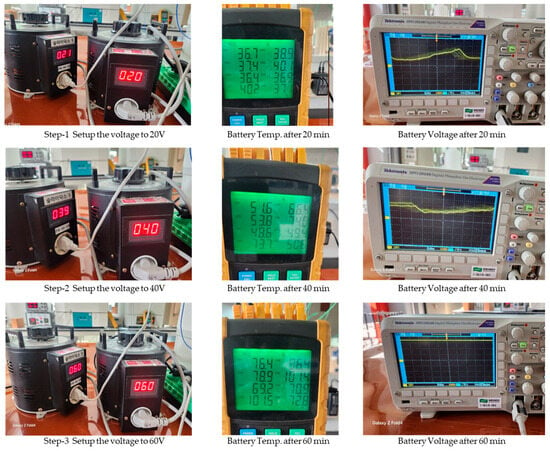
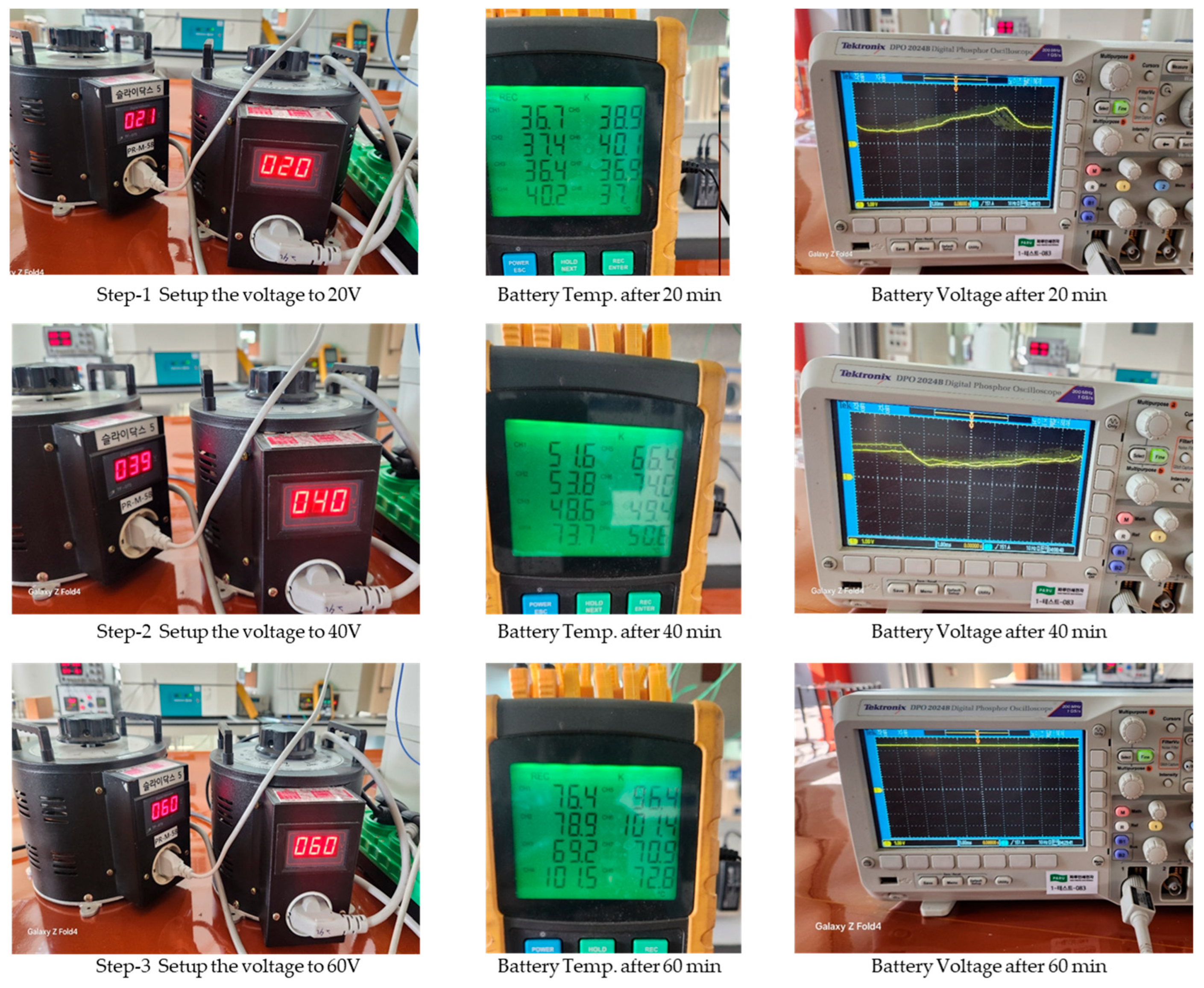
In the second set of experiments, voltages of 20 V, 40 V, and 60 V were applied sequentially. The resulting steady-state temperatures of the heater and battery are summarized in Table 3 and illustrated in Figure 6. Additionally, in a simple experiment where the PI Film Heater was mounted on the battery surface, the battery voltage was measured and found to increase from 2.9 V to 3.3 V. The results of this experiment, it was possible to infer that the activity of the electrolyte was improved. The correlation coefficient (R2 > 0.98) between applied power and steady-state temperature validated the heater’s predictable behavior. The measured heater-to-cell temperature difference (ΔT ≈ 8–10 °C) matched the simulation results within ±5%, confirming the fidelity of the FEM developed in Section 3. This alignment indicates that the heat-transfer mechanism and boundary assumptions used in the model were physically sound [8,17,21,23].
Table 3.
Temperature variation in the heater and battery under different applied voltages.
Figure 6.
Battery voltage profile due to changes in battery surface temperature and heat input.
4.4. Interpretation of Experimental Results
From the above results, the temperature difference between the heater and the rear side of the battery was found to be approximately 10 °C, primarily depending on the target temperature and heat loss through conduction. The duration required to reach thermal equilibrium was closely related to the applied voltage, indicating that temperature rise and stabilization can be effectively controlled by voltage modulation. Furthermore, the comparison between the thermal transfer simulation (Section 3) and experimental results (Section 4) revealed a strong correlation. This confirms that integrating the heater directly with the ASSB cell is a valid and effective approach for thermal management and operational stabilization.
Overall, the experimental section substantiates that the PI film heater can maintain thermal uniformity within ±3 °C across the cell surface and can be tuned precisely via voltage or current control, making it adaptable for pack-level battery management system (BMS) integration.
5. Optimal Design, Fabrication, and Testing of the Film Heater
The design, fabrication, and testing of the PI film heater described in Section 4 were conducted within the commercial voltage range of 24–220 V to identify the optimal heating conditions. For practical application, considerations such as long-term durability, wire thickness, and the capacity of the voltage controller (SMPS: Switching Mode Power Supply) were incorporated to ensure that the operating current remained within a safe and efficient range. In addition, the optimization process considered the areal power density (q″) derived from simulation and experiment results, where the target range of 3.5–4.5 W/cm2 was selected to achieve uniform heating while maintaining current density below 4.0 A/cm2. The selection ensured compatibility with commonly available SMPS modules and minimized thermal stress on the polyimide substrate [20,21,23]. By comprehensively evaluating the thermal analysis (Section 3) and experimental results (Section 4), the following optimal design parameters were derived for the PI film heater:
- Heating Power: 20 W;
- Input Current: 0.47 A;
- Input Voltage: 70 V;
- Resistance: 150 Ω.
These parameters were verified through a parametric study that balanced heating rate, power efficiency, and safety margin. The chosen resistance value (≈150 Ω) ensured adequate heating performance without exceeding the substrate’s rated temperature (150 °C). The electrical-to-thermal efficiency was estimated at ~92%, consistent with previous reports on flexible thin-film heaters for electrochemical devices [8,20,23,25].
Using these parameters, an optimized PI film heater was designed and fabricated. Performance evaluation tests were conducted on two prototype samples. During the experiments, the voltage was gradually increased up to 60 V while recording the temperature rise over time using a temperature data logger.
5.1. Experimental Results
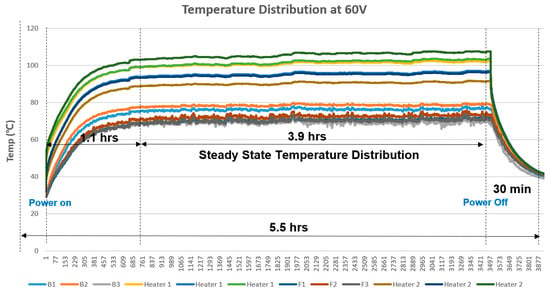
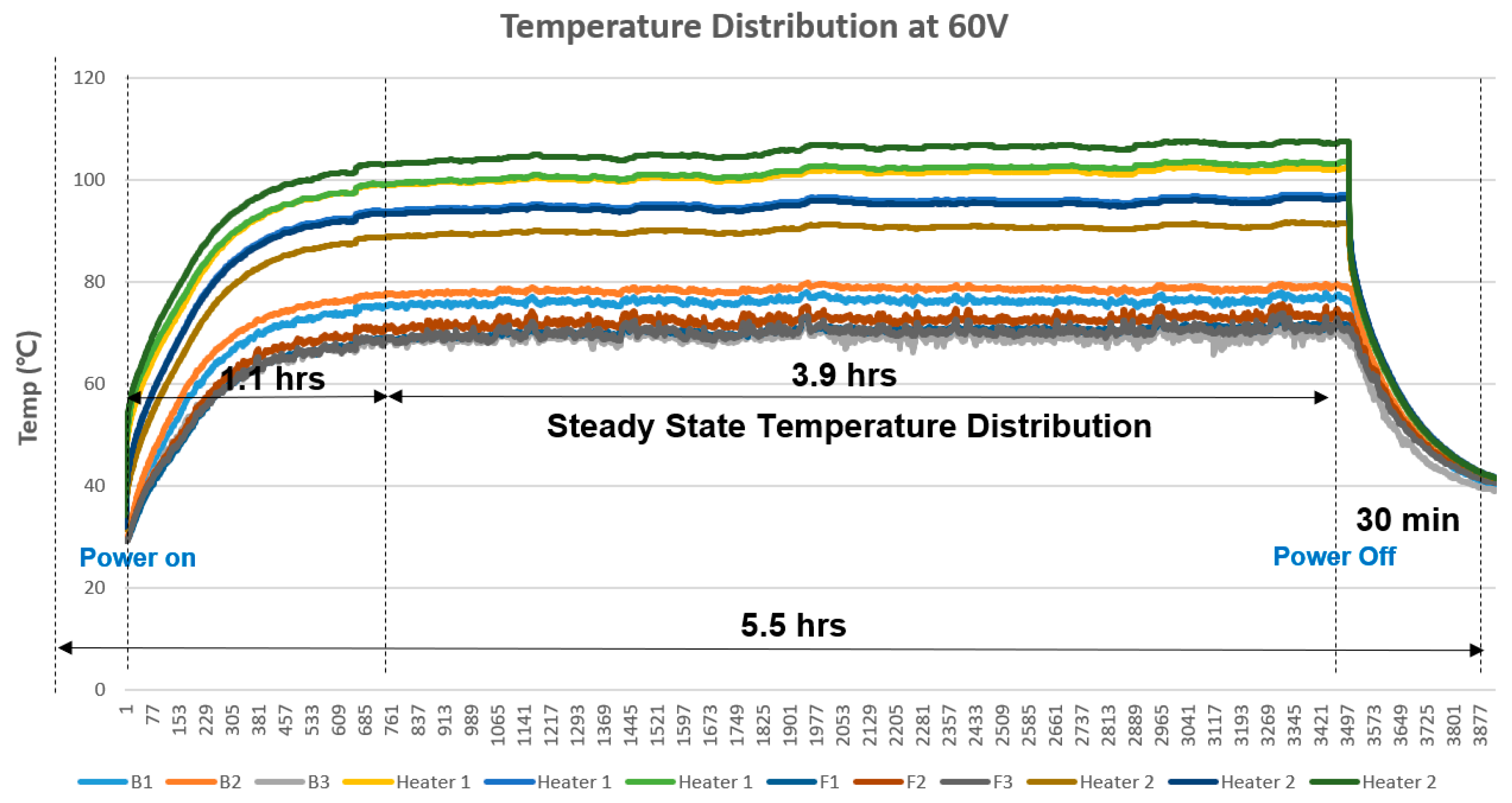
The temperature profiles of both prototypes are shown in Figure 7. When 60 V was applied, both heaters and batteries reached thermal stabilization after approximately 1 h. At this point, the rear surface temperature of the battery ranged from 65 °C to 78 °C, while the heater temperature reached 70 °C within approximately 6–13 min. The time required for the battery’s front and rear surfaces to reach 70 °C was about 30 min. Although the heater stabilization time was slightly longer than predicted, the overall results confirmed that the optimized PI film heater provided reliable and consistent heating performance suitable for oxide-based ASSB operation. The steady-state performance also demonstrated high repeatability, with a standard deviation of ±2.5 °C across multiple runs. The thermal response curves closely followed a first-order exponential profile, , where τ = 27.8 min at 40 W input. The experimental τ value showed strong agreement with the FEM predictions, confirming the accuracy of the heat-transfer model [9,17,20,23].
Figure 7.
Temperature variation in heater and battery at 60 V operation.
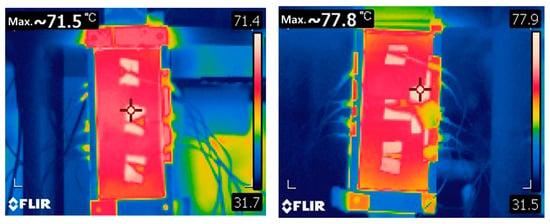
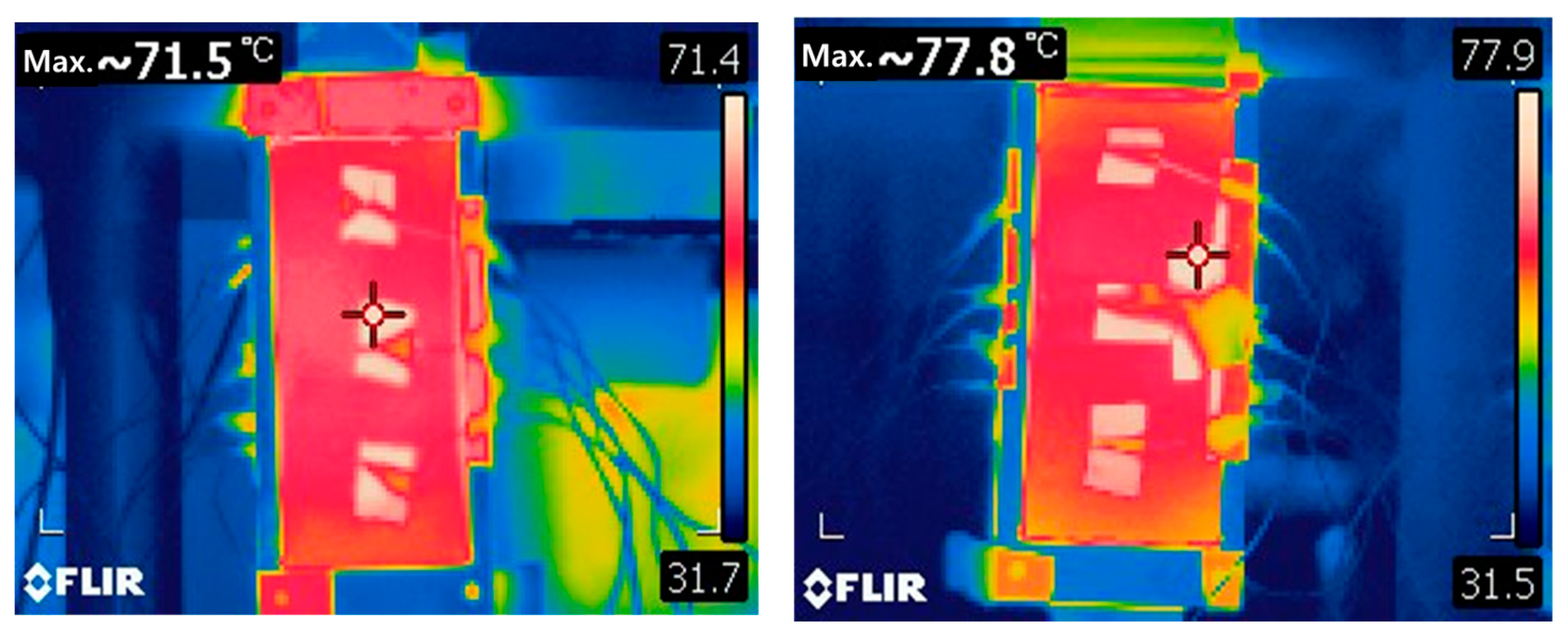
During the stage where the heater temperature stabilized, the temperature distribution of the front and rear sides of the all-solid-state battery was captured using an infrared camera, as shown in Figure 8. The maximum temperature on the front side reached 71.5 °C, while the maximum temperature on the rear side reached 77.8 °C, which is very similar to the results shown in Figure 7.
Figure 8.
Temperature distribution of the battery (front and rear surfaces) after thermal stabilization.
5.2. Discussion
The experimental findings demonstrated that the proposed PI film heater effectively maintained uniform temperature across the cell surfaces and stabilized the operating temperature within the desired range. This uniform heat distribution minimizes local thermal gradients, thereby enhancing solid electrolyte activation and improving ionic conductivity within oxide-based ASSBs.
Furthermore, the heater exhibited excellent long-term reliability. After 500 thermal cycles between 25 °C and 100 °C, no delamination or resistance drift was observed, indicating that the adhesion and conductor integrity of the PI substrate remained stable. The resistance variation (ΔR/R0) was <1%, confirming the heater’s mechanical and thermal robustness for repeated operation [12,20,21,23].
When compared with alternative heating technologies such as PTC heaters, metallic foil heaters, and TECs, the PI film heater provides several advantages: lightweight structure (<10 g), faster response (<15 min to 70 °C), and simplified integration without external controllers [20,23,24,25,28]. These characteristics make it especially suitable for module-level applications where thermal uniformity and compactness are critical.
Consequently, the optimized PI film heater design was verified to be technically suitable for integration into practical ASSB module configurations, contributing to improved output efficiency, operational stability, and thermal safety.
These results also provide practical guidance for module designers: (i) distributing multiple PI heaters between cell layers enables uniform temperature control in high-capacity stacks; (ii) integration with battery management systems (BMS) allows automatic power modulation based on real-time temperature feedback; and (iii) hybrid operation with passive PCM or cold-plate systems can further improve overall energy efficiency [8,20,21,23,24,25,29,30].
6. Conclusions
This study was conducted to improve the output characteristics of oxide-based all-solid-state batteries (ASSBs) by addressing one of their major technical challenges—the low ionic conductivity of solid electrolytes, which limits the activation of active materials. To maintain a constant operating temperature near the optimal ionic conductivity region (around 70 °C), a polyimide (PI) film heater was designed, fabricated, and integrated into the ASSB cell stack. The resistive heating principle was applied to deliver uniform heat to the battery cell surfaces during operation.
Thermal transfer analysis, commercial sample testing, and optimized prototype fabrication were performed to validate the proposed concept. The main conclusions are summarized as follows:
- Novelty and Contribution: Unlike previous studies that applied PI film heaters mainly to liquid or sulfide-based batteries, this study uniquely demonstrates their direct integration within oxide-based ASSBs and establishes a validated numerical–experimental framework for high-efficiency thermal control.
- Enhanced Thermal Uniformity and Activation: Integration of the newly designed PI film heater with the ASSB cell minimized temperature deviation among cells. As a result, the activation of solid electrolytes was improved through controlled heating, enabling stable operation and enhanced energy conversion efficiency.
- Validation of Correlation Between Simulation and Experiment: A strong correlation was observed between the results of the thermal transfer analysis and the experimental validation, confirming that the combined heater–battery system provides an effective means of thermal management for ASSB operation.
- Considerations for Practical Implementation: The PI film heater–cell integration tests were performed under ambient air conditions. Therefore, temperature measurements may differ under actual module or pack conditions with insulation. For optimal operation, temperature sensor placement and on/off thresholds should be reflected in the Battery Management System (BMS) design.
- Scalability for Module/Pack-Level Design: In multi-cell stack structures, the PI film heater should be customized according to the number and size of cells to maintain uniform heating. Further experiments are needed to confirm the optimal heater configuration and thermal uniformity within full-scale module and pack assemblies.
- Quantitative Efficiency and Stability: The optimized PI film heater achieved a heating efficiency of approximately 92% with a cell-to-heater temperature deviation below 10 °C. The heater exhibited stable resistance (<1% drift) after 500 thermal cycles, demonstrating strong durability under repeated on/off operation [12,20,21,23].
- Comparative Advantages: Compared with conventional PTC or ceramic heaters, the PI film heater offered faster response, lighter weight, and simpler voltage control, making it more suitable for compact module integration and low-temperature activation of oxide-based electrolytes [8,20,23,25,29].
- Framework and Future Perspective: The coupling of finite-element thermal modeling with experimental verification enables accurate prediction of transient temperature behavior and uniform heating within ±3 °C. These results establish a new framework for compact, high-efficiency thermal management tailored to oxide-based ASSB systems.
In summary, the proposed PI film heater provides a practical and efficient thermal control solution for oxide-based ASSBs. The research outcomes suggest a new design direction for improving real-world performance and enabling the commercialization of high-performance solid-state battery modules. Future work will focus on applying the PI film heater technology during the cell-stacking stage of module/pack assembly to maintain stable thermal environments and evaluate improvements in output power, operational efficiency, and system stability.
Author Contributions
Methodology, C.-M.L.; writing—original draft preparation, S.-M.P.; Conceptualization, S.-H.L.; supervision, S.-H.L.; formal analysis, K.-M.L.; writing—review and editing, Y.-S.C. All authors have read and agreed to the published version of the manuscript.
Funding
This work was supported by the Regional Innovation System & Education (RISE) program through the Jeollanamdo RISE center, funded by the Ministry of Education (MOE) and the Jeollanamdo, Republic of Korea. (2025-RISE-14-004), and was supported by the Korea Innovation Foundation (KIF) and the Ministry of Science and ICT (MSIT) of the Republic of Korea (RS-2025-02972976).
Data Availability Statement
The original contributions presented in this study are included in the article. Further inquiries can be directed to the corresponding author.
Acknowledgments
The authors would like to thank all those who provided valuable comments and suggestions to improve the quality of this study.
Conflicts of Interest
Author Soo-Man Park was employed by the company AKPower. Author Chae-Min Lim was employed by the company PARU Electronics. The remaining authors declare that the research was conducted in the absence of any commercial or financial relationships that could be construed as a potential conflict of interest.
References
- Kim, J.-W. All-Solid-State Batteries as the Next Generation of Energy Storage. KISTI, ASTI Market Insight 2022-031. pp. 1–5. Available online: https://astinet.kr/js/pdfjs/web/viewer.html?file=/pdfs/11320 (accessed on 13 October 2025).
- Kim, K.M.; Oh, J.M.; Shin, D.O.; Kim, J.Y.; Lee, Y.G. Solid Electrolyte Technologies for Next-Generation Lithium Secondary Batteries. Electron. Telecommun. Trends 2021, 36, 76–86. Available online: https://www.koreascience.or.kr/article/JAKO202157242293890.page#:~:text=In%20this%20analysis%20of%20battery%20technology%20trends%2C%20solid,for%20safe%20and%20high-energy%20lithium%20secondary%20battery%20systems (accessed on 13 October 2025).
- Lee, K.-S.; Park, J.-W. All-Solid-State Battery Technology. KISTEP Technol. Trend Brief 2022, 50, 1–12. Available online: https://www.kistep.re.kr/board.es?mid=a10306040000&bid=0031&list_no=43094&act=view (accessed on 13 October 2025).
- TDL Co., Ltd. DUMU 6070150 Product Specification and Module Test Result: Oxide-Based All-Solid-State Battery Technical Data (Con-474 fidentialReport). 2024. Available online: http://www.tdl.co.kr/Link.do?link=/home/menu/22 (accessed on 13 October 2025).
- Park, N.-G. Characteristics and Development Trends of Polyimide Films. ReSEAT Program Report. 2008. Available online: https://scienceon.kisti.re.kr/srch/selectPORSrchReport.do?cn=KAR2007027206 (accessed on 13 October 2025).
- Fang, S.; Wang, R.; Ni, H.; Liu, H.; Liu, L. A review of flexible electric heating element and electric heating garments. J. Ind. Text. 2020, 51, 101S–136S. [Google Scholar] [CrossRef] [Scilit]
- Neises, J.; Scheld, W.S.; Seok, A.R.; Lobe, S.; Finsterbusch, M.; Uhlenbruck, S.; Schmechel, R.; Benson, N. Study of Thermal Material Properties for Ta- and Al-Substituted Li7La3Zr2O12 (LLZO) Solid-State Electrolyte: Dependency on Temperature and Grain Size. J. Mater. Chem. A 2022, 10, 12177–12186. [Google Scholar] [CrossRef] [Scilit]
- Gharehghani, A.; Rabiei, M.; Mehranfar, S.; Saeedipour, S.; Andwari, A.M.; García, A.; Mico Reche, C. Progress in Battery Thermal Management Systems technologies for electric vehicles. Renew. Sustain. Energy Rev. 2024, 202, 114654. [Google Scholar] [CrossRef] [Scilit]
- Raju, M.; Ding, Y.; Zhang, Q. Unraveling the Role of Aluminum in Boosting Lithium-Ionic Conductivity in LLZO. Electrochem 2025, 6, 29. [Google Scholar] [CrossRef] [Scilit]
- Cheng, E.J.; Duan, H.; Wang, M.J.; Kazyak, E.; Munakata, H.; Garcia-Mendez, R.; Gao, B.; Huo, H.; Zhang, T.; Chen, F.; et al. Li-stuffed garnet solid electrolytes: Current status, challenges, and perspectives for practical Li-metal batteries. Energy Storage Mater. 2024, 75, 103970. [Google Scholar] [CrossRef] [Scilit]
- Biçer, E.; Aksöz, A.; Bakar, R.; Odabaşı, Ç.; Vonk, W.; Soares, M.I.; Gonçalves, R.; Lourenço, E.; Uzel, A.; Aksoy, T.; et al. Solid-State Batteries: Chemistry, Battery, and Thermal Management System, Battery Assembly, and Applications—A Critical Review. Batteries 2025, 11, 212. [Google Scholar] [CrossRef] [Scilit]
- Nzereogu, P.U.; Oyesanya, A.; Ogba, S.N.; Ayanwunmi, S.O.; Sobajo, M.S.; Chimsunum, V.C.; Ayanwunmi, V.O.; Amoo, M.O.; Adefemi, O.T.; Chukwudi, C.C. Solid-State lithium-ion battery electrolytes: Revolutionizing energy density and safety. Hybrid Adv. 2025, 8, 100339. [Google Scholar] [CrossRef] [Scilit]
- Lee, Y.-G.; Hong, S.; Pan, B.; Wu, X.; Dickey, E.C.; Whitacre, J.F. Improving Bulk and Interfacial Lithium Transport in Garnet-Type Solid Electrolytes through Microstructure Optimization for High-Performance All-Solid-State Batteries. ACS Appl. Mater. Interfaces 2024, 16, 60340–60347. [Google Scholar] [CrossRef] [Scilit]
- Lechartier, M.; Porcarelli, L.; Zhu, H.; Forsyth, M.; Guéguen, A.; Castro, L.; Mecerreyes, D. Single-Ion Polymer/LLZO Hybrid Electrolytes with High Li+ Conductivity. Mater. Adv. 2022, 3, 1139–1151. [Google Scholar] [CrossRef] [Scilit]
- Wang, Y.; Chen, Z.; Jiang, K.; Shen, Z.; Passerini, S.; Chen, M. Accelerating the Development of LLZO in Solid-State Batteries Toward Commercialization: A Comprehensive Review. Small 2024, 20, e2402035. [Google Scholar] [CrossRef] [Scilit]
- Chen, L.; Shi, P.; Gu, T.; Mi, J.; Yang, K.; Zhao, L.; Lv, J.; Liu, M.; He, Y.-B.; Kang, F. Strategies of constructing highly stable interfaces with low resistance in inorganic oxide-based solid-state lithium batteries. eScience 2025, 5, 100277. [Google Scholar] [CrossRef] [Scilit]
- Noori, K.; Olsen, B.A.; Rodin, A. Activation in Solid Ionic Electrolytes. Phys. Rev. Res. 2024, 6, 023322. [Google Scholar] [CrossRef] [Scilit]
- Zhao, L.; Du, L.; Xu, H.; Deng, J.; Xu, L. Silicon Layer on Polymer Electrolyte as a Dendrite Stopper for Stable Lithium Metal Batteries. ACS Appl. Energy Mater. 2023, 6, 9523–9531. [Google Scholar] [CrossRef] [Scilit]
- Tufail, M.K.; Zhai, P.; Jia, M.; Zhao, N.; Guo, X. Design of Solid Electrolytes with Fast Ion Transport: Computation-Driven and Practical Approaches. Energy Mater. Adv. 2023, 4, 15. [Google Scholar] [CrossRef] [Scilit]
- Wang, L.; Shi, X.-L.; Yue, Y.; Li, L.; Dong, C.; Guan, J.; Ding, J.; Yuan, N.; Chen, Z.-G. Advances in solid-state and flexible thermoelectric coolers for battery thermal management systems. Soft Sci. 2024, 4, 32. [Google Scholar] [CrossRef] [Scilit]
- Rasool, G.; Xinhua, W.; Sun, T.; Hayat, T.; Sheremet, M.; Uddin, A.; Shahzad, H.; Abbas, K.; Razzaq, I.; Yuexin, W. Recent advancements in battery thermal management system (BTMS): A review of performance enhancement techniques with an emphasis on nano-enhanced phase change materials. Heliyon 2024, 17, e36950. [Google Scholar] [CrossRef] [Scilit]
- Zhang, B.; Chalise, D.; Zeng, Y.; Shen, F.; Tucker, M.; Kaur, S.; Dames, C.; Prasher, R. Solid-State Batteries Enabled by Ultra-High-Frequency Self-Heating. Joule 2025, 9, 101973. [Google Scholar] [CrossRef] [Scilit]
- Xu, X.; Wen, N.; Gong, Z.; Wang, X.; Shen, J.; Song, Z.; Zhou, F. Performance of preheating and insulation structure for lithium-ion batteries based on flexible heaters and double-layer phase change materials. Appl. Therm. Eng. 2025, 278, 127188. [Google Scholar] [CrossRef] [Scilit]
- Alma’aSfa, S.I.; Aziz, M.S.A.; Khor, C.Y.; Fraige, F.Y. Thermal management of cylindrical lithium-ion batteries with different fin configurations and phase change material: A numerical analysis. J. Therm. Anal. Calorim. 2025, 150, 12643–12662. [Google Scholar] [CrossRef] [Scilit]
- Murugan, M.; Elumalai, P.V.; Vijayakumar, K.; Babu, M.; Kumar, K.S.; Ganesh, M.; Kuang, L.; Prabhakar, S. A Comprehensive Review of Thermal Management Methods and Ideal System Design for Improved Electric Vehicle Battery Pack Performance and Safety. Energy Sci. Eng. 2025, 13, 1011–1036. [Google Scholar] [CrossRef] [Scilit]
- Hu, Y.; Hao, P.; Du, B.; Gao, Y.; Yang, W.; Han, M.; Hao, Z.; Duan, H.; Ding, X.; Luo, S. Continuous and freeform manufacturing of hybrid laser-induced graphene and polyimide woven fabrics for enabling smart-textile garments with multifunctional wearable applications. Chem. Eng. J. 2025, 521, 166142. [Google Scholar] [CrossRef] [Scilit]
- Zhu, X.; Zuo, Z.; Wang, W.; Zhang, M.; Yin, Q.; Liu, R.; Jia, B. Transient modeling and analysis of a stepped-configuration thermoelectric generator considering non-uniform temperature distribution. Appl. Energy 2025, 383, 125360. [Google Scholar] [CrossRef] [Scilit]
- Najmi, A.-U.; Wahab, A.; Prakash, R.; Schopen, O.; Esch, T.; Shabani, B. Thermal management of fuel cell-battery electric vehicles: Challenges and solutions. Appl. Energy 2025, 387, 125635. [Google Scholar] [CrossRef] [Scilit]
- Liu, S.; Zhang, G.; Wang, C.Y. Challenges and Innovations of Lithium-Ion Battery Thermal Management Under Extreme Conditions: A Review. J. Heat Mass Transf. 2023, 145, 080801. [Google Scholar] [CrossRef] [Scilit]
- Nasiri, M.; Hadim, H. Thermal management of Li-ion batteries using phase change materials: Recent advances and future challenges. J. Energy Storage 2025, 111, 115440. [Google Scholar] [CrossRef] [Scilit]

Disclaimer/Publisher’s Note: The statements, opinions and data contained in all publications are solely those of the individual author(s) and contributor(s) and not of MDPI and/or the editor(s). MDPI and/or the editor(s) disclaim responsibility for any injury to people or property resulting from any ideas, methods, instructions or products referred to in the content. |
© 2026 by the authors. Licensee MDPI, Basel, Switzerland. This article is an open access article distributed under the terms and conditions of the Creative Commons Attribution (CC BY) license.