A Systematic Review of Building Energy Management Systems (BEMSs): Sensors, IoT, and AI Integration

 ,
,  ,
,  ,
,  , , ,
, , ,  and
and
Abstract
1. Introduction
2. Materials and Methods
2.1. Research Design and Scope
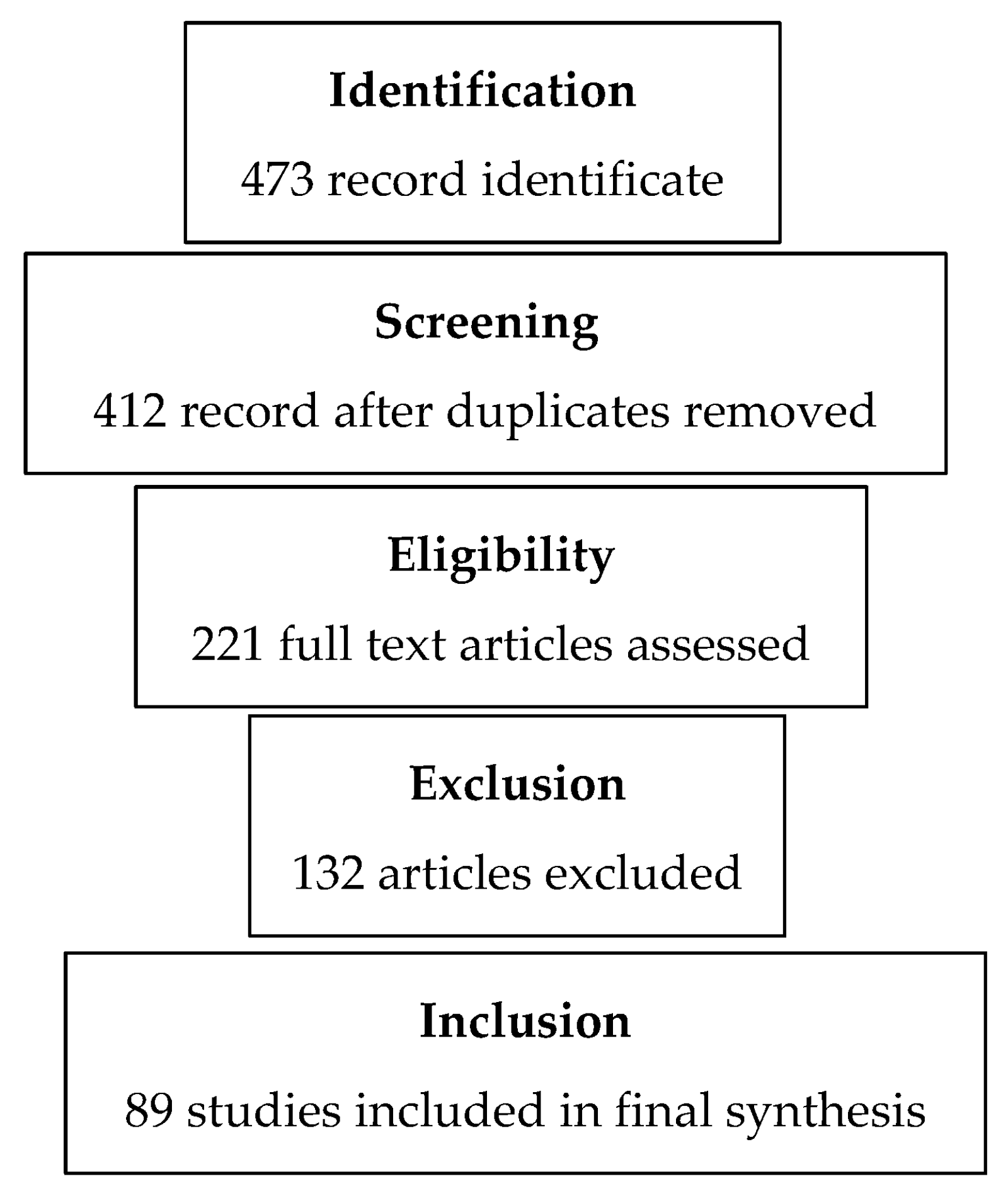
2.2. Literature Search Strategy
2.3. Eligibility, Inclusion Strategy, and Thematic Synthesis
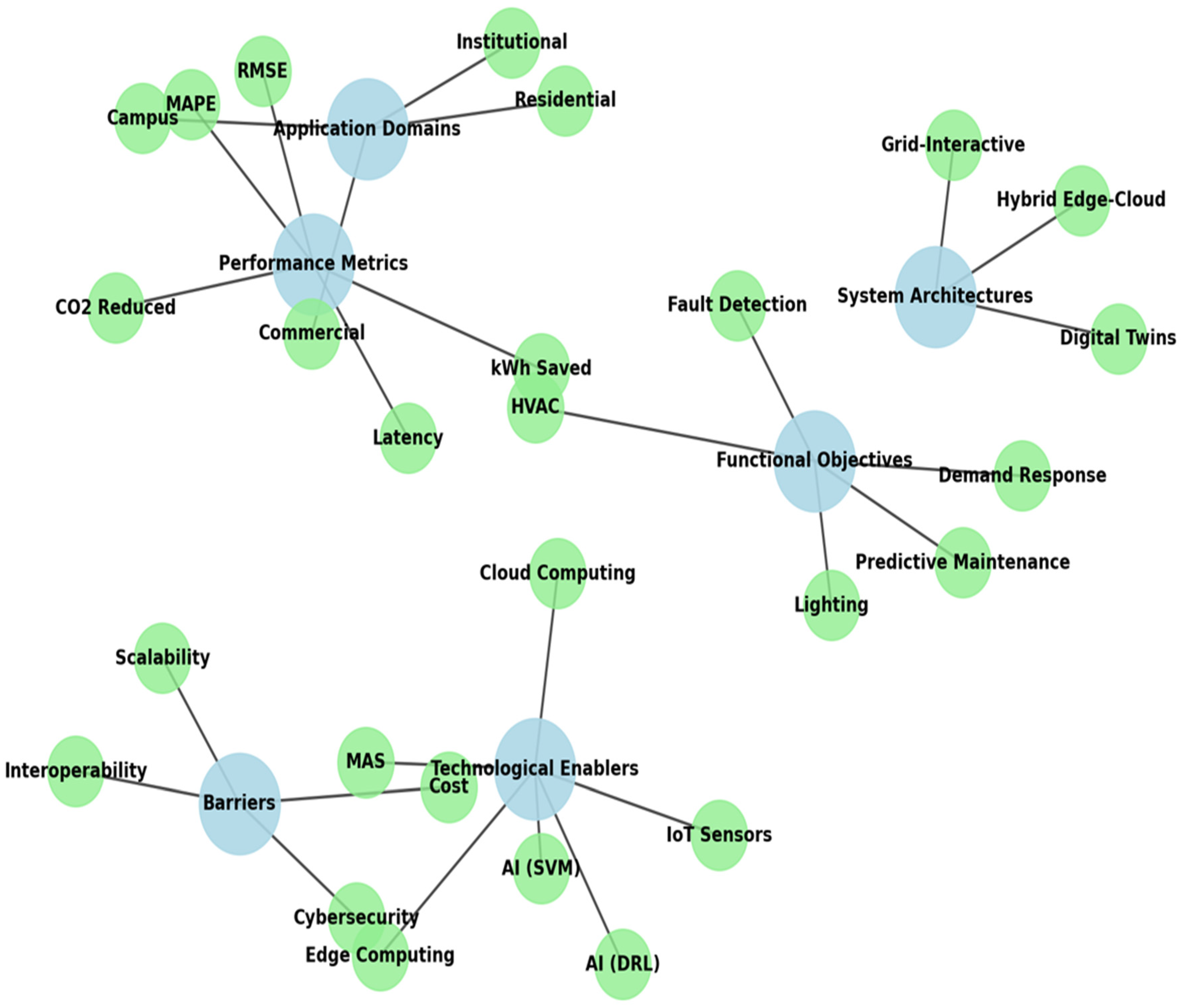
- Application domains, e.g., residential retrofits, commercial office complexes, smart campuses, and institutional buildings.
- Technological enablers, including IoT sensors, wireless sensor networks (WSN), cloud–edge hybrid systems, and AI algorithms such as SVM, DRL, and federated learning.
- Functional objectives, e.g., HVAC optimization, occupancy-driven control, predictive maintenance, anomaly detection, lighting automation, and grid interaction.
- Performance metrics, covering kWh savings, CO2 reduction, forecast accuracy, response latency, and scalability benchmarks.
- System architectures, including digital twin-enabled BEMSs, decentralized multi-agent systems, and cloud–edge hybrid deployments.
- Identified barriers, notably interoperability constraints, cybersecurity risks, cost barriers, scalability limitations, and regulatory gaps.
2.4. Analytical Framework, Reproducibility Ethics, and Transparency Standards
3. Results
4. Discussion
5. Conclusions
- Scalability and affordability—developing modular, low-cost solutions suitable for small- and medium-sized buildings, which represent the majority of the global building stock.
- Federated and privacy-preserving AI—advancing models that safeguard data security while enabling distributed, multi-building learning and control.
- Semantic interoperability—establishing standardized frameworks to integrate heterogeneous IoT devices, digital twins, and legacy systems within unified BEMS architectures.
- Resilience and adaptability—designing BEMSs capable of maintaining functionality under cyberattacks, hardware faults, and extreme climate conditions.
- Policy and regulation alignment— Policy and regulation alignment—bridging technological advancements with international policy instruments, such as the Energy Performance of Buildings Directive (EPBD), to accelerate adoption and ensure compliance with emerging legal frameworks. To enhance the practical visibility and strategic usability of these directions, a structured research roadmap is provided in Table 3. This roadmap summarizes the thematic focus, expected outcomes, and implementation relevance of each future research direction, thereby serving as a concise guide for both academic and industrial stakeholders.
Supplementary Materials
Author Contributions
Funding
Data Availability Statement
Acknowledgments
Conflicts of Interest
References
- Shah, S.F.A.; Iqbal, M.; Aziz, Z.; Rana, T.A.; Khalid, A.; Cheah, Y.-N.; Arif, M. The Role of Machine Learning and the Internet of Things in Smart Buildings for Energy Efficiency. Appl. Sci. 2022, 12, 7882. [Google Scholar] [CrossRef]
- Mazhar, T.; Malik, M.A.; Haq, I.; Rozeela, I.; Ullah, I.; Khan, M.A.; Adhikari, D.; Ben Othman, M.T.; Hamam, H. The Role of ML, AI and 5G Technology in Smart Energy and Smart Building Management. Electronics 2022, 11, 3960. [Google Scholar] [CrossRef]
- Minoli, D.; Sohraby, K.; Occhiogrosso, B. IoT Considerations, Requirements, and Architectures for Smart Buildings—Energy Optimization and Next-Generation Building Management Systems. IEEE Internet Things J. 2017, 4, 269–283. [Google Scholar] [CrossRef]
- Lee, D.; Chen, L. Sustainable Air-Conditioning Systems Enabled by Artificial Intelligence: Research Status, Enterprise Patent Analysis, and Future Prospects. Sustainability 2022, 14, 7514. [Google Scholar] [CrossRef]
- Yayla, A.; Swierczewska, K.S.; Kaya, M.; Karaca, B.; Arayici, Y.; Ayözen, Y.E.; Tokdemir, O.B. Artificial Intelligence (AI)-Based Occupant-Centric Heating Ventilation and Air Conditioning (HVAC) Control System for Multi-Zone Commercial Buildings. Sustainability 2022, 14, 16107. [Google Scholar] [CrossRef]
- Lee, D.; Tsai, F.-P. Air Conditioning Energy Saving from Cloud-Based Artificial Intelligence: Case Study of a Split-Type Air Conditioner. Energies 2020, 13, 2001. [Google Scholar] [CrossRef]
- Aliero, M.S.; Asif, M.; Ghani, I.; Pasha, M.F.; Jeong, S.R. Systematic Review Analysis on Smart Building: Challenges and Opportunities. Sustainability 2022, 14, 3009. [Google Scholar] [CrossRef]
- Kim, D.; Yoon, Y.; Lee, J.; Mago, P.J.; Lee, K.; Cho, H. Design and Implementation of Smart Buildings: A Review of Current Research Trend. Energies 2022, 15, 4278. [Google Scholar] [CrossRef]
- Agharazi, H.; Prica, M.D.; Loparo, K.A. A Two-Level Model Predictive Control-Based Approach for Building Energy Management Including Photovoltaics, Energy Storage, Solar Forecasting and Building Loads. Energies 2022, 15, 3521. [Google Scholar] [CrossRef]
- Ahmed, M.A.; Chavez, S.A.; Eltamaly, A.M.; Garces, H.O.; Rojas, A.J.; Kim, Y.-C. Toward an Intelligent Campus: IoT Platform for Remote Monitoring and Control of Smart Buildings. Sensors 2022, 22, 9045. [Google Scholar] [CrossRef]
- Massaro, A.; Starace, G. Advanced and Complex Energy Systems Monitoring and Control: A Review on Available Technologies and Their Application Criteria. Sensors 2022, 22, 4929. [Google Scholar] [CrossRef]
- Starace, G.; Tiwari, A.; Colangelo, G.; Massaro, A. Advanced Data Systems for Energy Consumption Optimization and Air Quality Control in Smart Public Buildings Using a Versatile Open-Source Approach. Electronics 2022, 11, 3904. [Google Scholar] [CrossRef]
- Al-Obaidi, K.M.; Hossain, M.; Alduais, N.A.M.; Al-Duais, H.S.; Omrany, H.; Ghaffarianhoseini, A. A Review of Using IoT for Energy Efficient Buildings and Cities: A Built Environment Perspective. Energies 2022, 15, 5991. [Google Scholar] [CrossRef]
- Hossain, J.; Kadir, A.F.A.; Hanafi, A.N.; Shareef, H.; Khatib, T.; Baharin, K.A.; Sulaima, M.F. A Review on Optimal Energy Management in Commercial Buildings. Energies 2023, 16, 1609. [Google Scholar] [CrossRef]
- Liu, H.; Liang, J.; Liu, Y.; Wu, H. A Review of Data-Driven Building Energy Prediction. Buildings 2023, 13, 532. [Google Scholar] [CrossRef]
- Popa, A.; Ramallo González, A.P.; Jaglan, G.; Fensel, A. A Semantically Data-Driven Classification Framework for Energy Consumption in Buildings. Energies 2022, 15, 3155. [Google Scholar] [CrossRef]
- Delgoshaei, P.; Heidarinejad, M.; Austin, M.A. A Semantic Approach for Building System Operations: Knowledge Representation and Reasoning. Sustainability 2022, 14, 5810. [Google Scholar] [CrossRef]
- Sievers, J.; Blank, T. A Systematic Literature Review on Data-Driven Residential and Industrial Energy Management Systems. Energies 2023, 16, 1688. [Google Scholar] [CrossRef]
- Lee, J.; Woo, D.-O.; Jang, J.; Junghans, L.; Leigh, S.-B. Collection and Utilization of Indoor Environmental Quality Information Using Affordable Image Sensing Technology. Energies 2022, 15, 921. [Google Scholar] [CrossRef]
- Krishnan, P.; Prabu, A.V.; Loganathan, S.; Routray, S.; Ghosh, U.; AL-Numay, M. Analyzing and Managing Various Energy-Related Environmental Factors for Providing Personalized IoT Services for Smart Buildings in Smart Environment. Sustainability 2023, 15, 6548. [Google Scholar] [CrossRef]
- Peinturier, L.; Wallom, D.C.H. Building Energy Simulation Calibration Accuracy and Modelling Complexity: Implications for Energy Performance Improvement. Energy Build. 2025, 344, 115971. [Google Scholar] [CrossRef]
- Ntafalias, A.; Tsakanikas, S.; Skarvelis-Kazakos, S.; Papadopoulos, P.; Skarmeta-Gómez, A.F.; González-Vidal, A.; Tomat, V.; Ramallo-González, A.P.; Marin-Perez, R.; Vlachou, M.C. Design and Implementation of an Interoperable Architecture for Integrating Building Legacy Systems into Scalable Energy Management Systems. Smart Cities 2022, 5, 1421–1440. [Google Scholar] [CrossRef]
- Garlik, B. Energy Centers in a Smart City as a Platform for the Application of Artificial Intelligence and the Internet of Things. Appl. Sci. 2022, 12, 3386. [Google Scholar] [CrossRef]
- Althaus, P.; Redder, F.; Ubachukwu, E.; Mork, M.; Xhonneux, A.; Müller, D. Enhancing Building Monitoring and Control for District Energy Systems: Technology Selection and Installation within the Living Lab Energy Campus. Appl. Sci. 2022, 12, 3305. [Google Scholar] [CrossRef]
- Gualandri, F.; Kuzior, A. Home Energy Management Systems Adoption Scenarios: The Case of Italy. Energies 2023, 16, 4946. [Google Scholar] [CrossRef]
- Korkas, C.; Dimara, A.; Michailidis, I.; Krinidis, S.; Marin-Perez, R.; Martínez García, A.I.; Skarmeta, A.; Kitsikoudis, K.; Kosmatopoulos, E.; Anagnostopoulos, C.-N.; et al. Integration and Verification of PLUG-N-HARVEST ICT Platform for Intelligent Management of Buildings. Energies 2022, 15, 2610. [Google Scholar] [CrossRef]
- Sadri, H.; Yitmen, I.; Tagliabue, L.C.; Westphal, F.; Tezel, A.; Taheri, A.; Sibenik, G. Integration of Blockchain and Digital Twins in the Smart Built Environment Adopting Disruptive Technologie—A Systematic Review. Sustainability 2023, 15, 3713. [Google Scholar] [CrossRef]
- Wang, W.-C.; Dwijendra, N.K.A.; Sayed, B.T.; Alvarez, J.R.N.; Al-Bahrani, M.; Alviz-Meza, A.; Cárdenas-Escrocia, Y. Internet of Things Energy Consumption Optimization in Buildings: A Step toward Sustainability. Sustainability 2023, 15, 6475. [Google Scholar] [CrossRef]
- Afonso, J.A.; Monteiro, V.; Afonso, J.L. Internet of Things Systems and Applications for Smart Buildings. Energies 2023, 16, 2757. [Google Scholar] [CrossRef]
- Villa, V.; Bruno, G.; Aliev, K.; Piantanida, P.; Corneli, A.; Antonelli, D. Machine Learning Framework for the Sustainable Maintenance of Building Facilities. Sustainability 2022, 14, 681. [Google Scholar] [CrossRef]
- Khan, M.H.; Asar, A.U.; Ullah, N.; Albogamy, F.R.; Rafique, M.K. Modeling and Optimization of Smart Building Energy Management System Considering Both Electrical and Thermal Load. Energies 2022, 15, 574. [Google Scholar] [CrossRef]
- Sivakumar, S.; Kanagachidambaresan, G.R.; Mwanandiye, E.S. An effective IoT-based demand response for energy-efficient smart homes. Energy Inform 2025, 8, 125. [Google Scholar] [CrossRef]
- Neves-Silva, R.; Camarinha-Matos, L.M. Simulation-Based Decision Support System for Energy Efficiency in Buildings Retrofitting. Sustainability 2022, 14, 12216. [Google Scholar] [CrossRef]
- Adewale, B.A.; Ene, V.O.; Ogunbayo, B.F.; Aigbavboa, C.O. A Systematic Review of the Applications of AI in a Sustainable Building’s Lifecycle. Buildings 2024, 14, 2137. [Google Scholar] [CrossRef]
- Das, H.P.; Lin, Y.W.; Agwan, U.; Spangher, L.; Devonport, A.; Yang, Y.; Drgoňa, J.; Chong, A.; Schiavon, S.; Spanos, C.J. Machine Learning for Smart and Energy-Efficient Buildings. Environ. Data Sci. 2024, 3, e1. [Google Scholar] [CrossRef]
- Apanavičienė, R.; Shahrabani, M.M.N. Key Factors Affecting Smart Building Integration into Smart City: Technological Aspects. Smart Cities 2023, 6, 1832–1857. [Google Scholar] [CrossRef]
- Belcher, E.J.; Abraham, Y.S. Lifecycle Applications of Building Information Modeling for Transportation Infrastructure Projects. Buildings 2023, 13, 2300. [Google Scholar] [CrossRef]
- Aliero, M.S.; Pasha, M.F.; Toosi, A.N.; Ghani, I. The COVID-19 Impact on air Condition Usage: A Shift Towards Residential Energy Saving. Environ. Sci. Pollut. Res. 2022, 29, 85727–85741. [Google Scholar] [CrossRef]
- Martinez-Molina, A.; Alamaniotis, M. Enhancing Historic Building Performance with the Use of Fuzzy Inference System to Control the Electric Cooling System. Sustainability 2020, 12, 5848. [Google Scholar] [CrossRef]
- Ullah, F.; Al-Turjman, F.; Nayyar, A. IoT-based Green City Architecture Using Secured and Sustainable Android Services. Environ. Technol. Innov. 2020, 20, 101091. [Google Scholar] [CrossRef]
- Haseeb, K.; Lee, S.; Jeon, G. EBDS: An Energy-Efficient Big Data-Based Secure Framework Using Internet of Things for Green Environment. Environ. Technol. Innov. 2020, 20, 101129. [Google Scholar] [CrossRef]
- Talebi, A.; Hatami, A. Online Fuzzy Control of HVAC Systems Considering Demand Response and Users’ Comfort. Energy Sources Part B Econ. Plan. Policy 2020, 15, 403–422. [Google Scholar] [CrossRef]
- Ko, H.; Kim, J.H.; An, K.; Mesicek, L.; Marreiros, G.; Pan, S.B.; Kim, P. Smart Home Energy Strategy Based on Human Behaviour Patterns for Transformative Computing. Inf. Process. Manag. 2020, 57, 102256. [Google Scholar] [CrossRef]
- Sherian, S.A.; Omar, T.R.; Kim, S. Net-Zero Smart Home Monitoring System. In Proceedings of the 2025 IEEE Conference on Technologies for Sustainability (SusTech), Los Angeles, CA, USA, 20–23 April 2025; pp. 1–8. [Google Scholar] [CrossRef]
- Chamandoust, H.; Derakhshan, G.; Hakimi, S.M.; Bahramara, S. Tri-objective Scheduling of Residential Smart Electrical Distribution Grids with Optimal Joint of Responsive Loads with Renewable Energy Sources. J. Energy Storage 2020, 27, 101112. [Google Scholar] [CrossRef]
- Pawar, P.; TarunKumar, M.; Vittal, K.P. An IoT based Intelligent Smart Energy Management System with Accurate Forecasting and Load Strategy for Renewable Generation. Measurement 2020, 152, 107187. [Google Scholar] [CrossRef]
- Borda, D.; Bergagio, M.; Amerio, M.; Masoero, M.C.; Borchiellini, R.; Papurello, D. Development of Anomaly Detectors for HVAC Systems Using Machine Learning. Processes 2023, 11, 535. [Google Scholar] [CrossRef]
- Paukstadt, U.; Becker, J. Uncovering the Business Value of the Internet of Things in the Energy Domain—A Review of Smart Energy Business Models. Electron. Mark. 2021, 31, 51–66. [Google Scholar] [CrossRef]
- Zakirullin, R.S. A Smart Window for Angular Selective Filtering of Direct Solar Radiation. ASME. J. Sol. Energy Eng. 2020, 142, 011001. [Google Scholar] [CrossRef]
- Samadi, A.; Saidi, H.; Latify, M.A.; Mahdavi, M. Home Energy Management System Based on Task Classification and the Resident’s Requirements. Int. J. Electr. Power Energy Syst. 2020, 118, 105815. [Google Scholar] [CrossRef]
- Ullah, I.; Hussain, I.; Singh, M. Exploiting Grasshopper and Cuckoo Search Bio-Inspired Optimization Algorithms for Industrial Energy Management System: Smart Industries. Electronics 2020, 9, 105. [Google Scholar] [CrossRef]
- Trivedi, D.; Badarla, V. Occupancy Detection Systems for Indoor Environments: A Survey of Approaches and Methods. Indoor Built Environ. 2019, 29, 1053–1069. [Google Scholar] [CrossRef]
- Dai, X.; Liu, J.; Zhang, X. A Review of Studies Applying Machine Learning Models to Predict Occupancy and Window-Opening Behaviours in Smart Buildings. Energy Build. 2020, 223, 110159. [Google Scholar] [CrossRef]
- Simsek, Y.; Santika, W.G.; Anisuzzaman, M.; Urmee, T.; Bahri, P.A.; Escobar, R. An Analysis of Additional Energy Requirement to Meet the Sustainable Development Goals. J. Clean. Prod. 2020, 272, 122646. [Google Scholar] [CrossRef]
- Cespedes-Cubides, A.S.; Jradi, M. A review of building digital twins to improve energy efficiency in the building operational stage. Energy Inform. 2024, 7, 11. [Google Scholar] [CrossRef]
- Taboada-Orozco, A.; Yetongnon, K.; Nicolle, C. Smart Buildings: A Comprehensive Systematic Literature Review on Data-Driven Building Management Systems. Sensors 2024, 24, 4405. [Google Scholar] [CrossRef]
- Ali, D.M.T.E.; Motuzienė, V.; Džiugaitė-Tumėnienė, R. AI-Driven Innovations in Building Energy Management Systems: A Review of Potential Applications and Energy Savings. Energies 2024, 17, 4277. [Google Scholar] [CrossRef]
- Safari, A.; Daneshvar, M.; Anvari-Moghaddam, A. Energy Intelligence: A Systematic Review of Artificial Intelligence for Energy Management. Appl. Sci. 2024, 14, 11112. [Google Scholar] [CrossRef]
- Rao, C.K.; Sahoo, S.K.; Yanine, F.F. A Comprehensive Review of Smart Energy Management Systems for Photovoltaic Power Generation Utilizing the Internet of Things. Unconv. Resour. 2025, 7, 100197. [Google Scholar] [CrossRef]
- Arun, M.; Barik, D.; Othman, N.A.; Praveenkumar, S.; Tudu, K. Investigating the Performance of AI-driven Smart Building Systems Through Advanced Deep Learning Model Analysis. Energy Rep. 2025, 13, 5885–5899. [Google Scholar] [CrossRef]
- Tasmant, H.; Bossoufi, B.; Alaoui, C.; Siano, P. A Review of Machine Learning and IoT-based Energy Management Systems for AC Microgrids. Comput. Electr. Eng. 2025, 127 Pt A, 110563. [Google Scholar] [CrossRef]
- Hwang, J.; Kim, J.; Yoon, S. DT-BEMS: Digital Twin-Enabled Building Energy Management System for Information Fusion and Energy Efficiency. Energy 2025, 326, 136162. [Google Scholar] [CrossRef]
- Ramadan, R.; Huang, Q.; Zalhaf, A.S.; Bamisile, O.; Li, J.; Mansour, D.-E.A.; Lin, X.; Yehia, D.M. Energy Management in Residential Microgrid Based on Non-Intrusive Load Monitoring and Internet of Things. Smart Cities 2024, 7, 1907–1935. [Google Scholar] [CrossRef]
- Islam, F.; Ahmed, I.; Mihet-Popa, L. Development and Testing of an IoT Platform with Smart Algorithms for Building Energy Management Systems. Energy Build. 2025, 344, 115970. [Google Scholar] [CrossRef]
- Fang, M.; Misnan, M.S.; Halim, N.H.F.A. A Systematic Literature Review on Energy Efficiency Analysis of Building Energy Management. Buildings 2024, 14, 3136. [Google Scholar] [CrossRef]
- Roka, R.; Figueiredo, A.; Vieira, A.; Cardoso, C. A Systematic Review of Sensitivity Analysis in Building Energy Modeling: Key Factors Influencing Building Thermal Energy Performance. Energies 2025, 18, 2375. [Google Scholar] [CrossRef]
- Palley, B.; Poças Martins, J.; Bernardo, H.; Rossetti, R. Integrating Machine Learning and Digital Twins for Enhanced Smart Building Operation and Energy Management: A Systematic Review. Urban Sci. 2025, 9, 202. [Google Scholar] [CrossRef]
- Amangeldy, B.; Tasmurzayev, N.; Imankulov, T.; Baigarayeva, Z.; Izmailov, N.; Riza, T.; Abdukarimov, A.; Mukazhan, M.; Zhumagulov, B. AI-Powered Building Ecosystems: A Narrative Mapping Review on the Integration of Digital Twins and LLMs for Proactive Comfort, IEQ, and Energy Management. Sensors 2025, 25, 5265. [Google Scholar] [CrossRef]
- Chen, G.; Lu, S.; Zhou, S.; Tian, Z.; Kim, M.K.; Liu, J.; Liu, X. A Systematic Review of Building Energy Consumption Prediction: From Perspectives of Load Classification, Data-Driven Frameworks, and Future Directions. Appl. Sci. 2025, 15, 3086. [Google Scholar] [CrossRef]
- Zhang, T.; Strbac, G. Novel Artificial Intelligence Applications in Energy: A Systematic Review. Energies 2025, 18, 3747. [Google Scholar] [CrossRef]
- Jørgensen, B.N.; Ma, Z.G. Impact of EU Laws on the Adoption of AI and IoT in Advanced Building Energy Management Systems: A Review of Regulatory Barriers, Technological Challenges, and Economic Opportunities. Buildings 2025, 15, 2160. [Google Scholar] [CrossRef]
- Rojek, I.; Mikołajewski, D.; Mroziński, A.; Macko, M.; Bednarek, T.; Tyburek, K. Internet of Things Applications for Energy Management in Buildings Using Artificial Intelligence—A Case Study. Energies 2025, 18, 1706. [Google Scholar] [CrossRef]
- Saad Alotaibi, B.; Ibrahim Shema, A.; Umar Ibrahim, A.; Awad Abuhussain, M.; Abdulmalik, H.; Aminu Dodo, Y.; Atakara, C. Assimilation of 3D printing, Artificial Intelligence (AI) and Internet of Things (IoT) for the construction of eco-friendly intelligent homes: An explorative review. Heliyon 2024, 10, e36846. [Google Scholar] [CrossRef] [PubMed]
- Shahrabani, M.M.N.; Apanaviciene, R. An AI-Based Evaluation Framework for Smart Building Integration into Smart City. Sustainability 2024, 16, 8032. [Google Scholar] [CrossRef]
- Dai, X.; Chen, R.; Guan, S.; Li, W.T.; Yuen, C. Building Gym: An Open-Source Toolbox for AI-based Building Energy Management Using Reinforcement Learning. Build. Simul. 2025, 18, 1909–1927. [Google Scholar] [CrossRef]
- Fei, L.; Shahzad, M.; Abbas, F.; Muqeet, H.A.; Hussain, M.M.; Bin, L. Optimal Energy Management System of IoT-Enabled Large Building Considering Electric Vehicle Scheduling, Distributed Resources, and Demand Response Schemes. Sensors 2022, 22, 7448. [Google Scholar] [CrossRef]
- Kim, M.-L.; Park, K.-J.; Son, S.-Y. Occupancy-Based Energy Consumption Estimation Improvement Through Deep Learning. Sensors 2023, 23, 2127. [Google Scholar] [CrossRef]
- El Husseini, F.; Noura, H.N.; Salman, O.; Chahine, K. Machine Learning in Smart Buildings: A Review of Methods, Challenges, and Future Trends. Appl. Sci. 2025, 15, 7682. [Google Scholar] [CrossRef]
- Cicero, S.; Guarascio, M.; Guerrieri, A.; Mungari, S. A Deep Anomaly Detection System for IoT-Based Smart Buildings. Sensors 2023, 23, 9331. [Google Scholar] [CrossRef]
- Niknia, S.; Ghiai, M. Simulation-Based Prediction of Office Buildings Energy Performance Under RCP Scenarios Across All U.S. Climate Zones. Architecture 2025, 5, 34. [Google Scholar] [CrossRef]
- Eze, V.H.U.; Eze, E.C.; Alaneme, G.U.; Bubu, P.E. Recent Progress and Emerging Technologies in Geothermal Energy Utilization for Sustainable Building Heating and Cooling: A Focus on Smart System Integration and Enhanced Efficiency. Front. Built Environ. 2025, 11, 1594355. [Google Scholar] [CrossRef]
- Poyyamozhi, M.; Murugesan, B.; Rajamanickam, N.; Shorfuzzaman, M.; Aboelmagd, Y. IoT—A Promising Solution to Energy Management in Smart Buildings: A Systematic Review, Applications, Barriers, and Future Scope. Buildings 2024, 14, 3446. [Google Scholar] [CrossRef]
- Mahmud, N.A.; Dahlan, N.Y. Optimum Energy Management Strategy with Enhanced Time of Use Tariff for Campus Building Using Particle Swarm Optimization. Indones. J. Electr. Eng. Comput. Sci. 2022, 28, 644–653. [Google Scholar] [CrossRef]
- Zhou, J. Multi-dimensional Model and Interactive Simulation of Intelligent Construction Based on Digital Twins. Sci. Rep. 2025, 15, 32189. [Google Scholar] [CrossRef] [PubMed]
- Chew, M.Y.L.; Teo, E.A.L.; Shah, K.W.; Kumar, V.; Hussein, G.F. Evaluating the Roadmap of 5G Technology Implementation for Smart Building and Facilities Management in Singapore. Sustainability 2020, 12, 10259. [Google Scholar] [CrossRef]
- Mazhar, T.; Irfan, H.M.; Haq, I.; Ullah, I.; Ashraf, M.; Shloul, T.A.; Ghadi, Y.Y.; Imran; Elkamchouchi, D.H. Analysis of Challenges and Solutions of IoT in Smart Grids Using AI and Machine Learning Techniques: A Review. Electronics 2023, 12, 242. [Google Scholar] [CrossRef]
- Gaitan, N.C.; Ungurean, I.; Roman, C.; Francu, C. An Optimizing Heat Consumption System Based on BMS. Appl. Sci. 2022, 12, 3271. [Google Scholar] [CrossRef]
- Moraliyage, H.; Dahanayake, S.; De Silva, D.; Mills, N.; Rathnayaka, P.; Nguyen, S.; Alahakoon, D.; Jennings, A. A Robust Artificial Intelligence Approach with Explainability for Measurement and Verification of Energy Efficient Infrastructure for Net Zero Carbon Emissions. Sensors 2022, 22, 9503. [Google Scholar] [CrossRef]
- Teixeira, N.; Barreto, R.; Gomes, L.; Faria, P.; Vale, Z. A Trustworthy Building Energy Management System to Enable Direct IoT Devices’ Participation in Demand Response Programs. Electronics 2022, 11, 897. [Google Scholar] [CrossRef]
- European Union. General Data Protection Regulation (GDPR) (EU) 2016/679; Official Journal of the European Union: Brussels, Belgium, 2016. [Google Scholar]
- ISO/IEC 27001:2022; Information Security, Cybersecurity and Privacy Protection—Information Security Management Systems—Requirements. International Organization for Standardization: Geneva, Switzerland, 2022.
- Page, M.J.; McKenzie, J.E.; Bossuyt, P.M.; Boutron, I.; Hoffmann, T.C.; Mulrow, C.D.; Shamseer, L.; Tetzlaff, J.M.; Akl, E.A.; Brennan, S.E.; et al. The PRISMA 2020 statement: An updated guideline for reporting systematic reviews. BMJ 2021, 372, n71. [Google Scholar] [CrossRef]



| Tool/Library (Version) | Function | Application in Study |
|---|---|---|
| pandas (v2.2.2) | Data tabulation and matrix handling | Structuring bibliometric datasets and co-occurrence matrices |
| NumPy (v1.26.4) | Statistical operations | Normalization, descriptive statistics, correlation analysis |
| scikit-learn (v1.5.1) | Regression and classification | Outlier detection, performance evaluation of predictive models |
| matplotlib (v3.9.0)/seaborn (v0.13.2) | Visualization | Heatmaps, scatter plots, bar graphs, and trend analysis |
| NVivo 14 (v14.2) | Thematic coding | Manual classification of literature into thematic domains |
| VOSviewer (v1.6.20) | Network and bibliometric mapping | Keyword clusters, co-authorship, and co-occurrence networks |
| Metric | Purpose | Interpretation |
|---|---|---|
| MAPE | Accuracy of predictions | Lower % indicates higher prediction accuracy |
| RMSE | Error magnitude | Smaller values reflect better model fit |
| R2 | Explained variance | Values closer to 1 indicate stronger performance |
| F1-score | Classification balance | Higher scores reflect better precision-recall trade-off |
| Research Direction | Thematic Focus | Expected Outcome | Practical Relevance |
|---|---|---|---|
| Scalability and affordability | Modular, low-cost BEMS architectures | Increased accessibility for SMEs and public buildings | Enhances large-scale adoption |
| Federated and privacy-preserving AI | Secure, distributed data learning models | Improved trust and data protection | Supports GDPR [90] and ISO/IEC 27001 [91] compliance |
| Semantic interoperability | Standardized IoT and digital twin communication protocols | Unified cross-platform data exchange | Enables system integration across vendors |
| Resilience and adaptability | Fault-tolerant and cyber-secure BEMSs | Reliable operation under disruptions | Improves emergency response and continuity |
| Policy and regulation alignment | Integration with EPBD and smart grid standards | Policy-driven adoption and compliance | Strengthens alignment with EU sustainability goals |
Disclaimer/Publisher’s Note: The statements, opinions and data contained in all publications are solely those of the individual author(s) and contributor(s) and not of MDPI and/or the editor(s). MDPI and/or the editor(s) disclaim responsibility for any injury to people or property resulting from any ideas, methods, instructions or products referred to in the content. |
© 2025 by the authors. Licensee MDPI, Basel, Switzerland. This article is an open access article distributed under the terms and conditions of the Creative Commons Attribution (CC BY) license (https://creativecommons.org/licenses/by/4.0/).
Share and Cite
Akbulut, L.; Taşdelen, K.; Atılgan, A.; Malinowski, M.; Coşgun, A.; Şenol, R.; Akbulut, A.; Petryk, A. A Systematic Review of Building Energy Management Systems (BEMSs): Sensors, IoT, and AI Integration. Energies 2025, 18, 6522. https://doi.org/10.3390/en18246522
Akbulut L, Taşdelen K, Atılgan A, Malinowski M, Coşgun A, Şenol R, Akbulut A, Petryk A. A Systematic Review of Building Energy Management Systems (BEMSs): Sensors, IoT, and AI Integration. Energies. 2025; 18(24):6522. https://doi.org/10.3390/en18246522
Chicago/Turabian StyleAkbulut, Leyla, Kubilay Taşdelen, Atılgan Atılgan, Mateusz Malinowski, Ahmet Coşgun, Ramazan Şenol, Adem Akbulut, and Agnieszka Petryk. 2025. "A Systematic Review of Building Energy Management Systems (BEMSs): Sensors, IoT, and AI Integration" Energies 18, no. 24: 6522. https://doi.org/10.3390/en18246522
APA StyleAkbulut, L., Taşdelen, K., Atılgan, A., Malinowski, M., Coşgun, A., Şenol, R., Akbulut, A., & Petryk, A. (2025). A Systematic Review of Building Energy Management Systems (BEMSs): Sensors, IoT, and AI Integration. Energies, 18(24), 6522. https://doi.org/10.3390/en18246522