1. Introduction
While demand for heat and power grows and places greater pressure on energy systems, combined heat and power (CHP) offers a higher efficiency pathway to meet this demand more sustainably [
1,
2]. The key advantage of CHP over conventional production methods is higher energy efficiency, as electricity and heat are produced simultaneously from a single fuel source [
3]. A CHP system operates under storage capacity and output bounds and transactions with external networks to handle imbalances between production and demand [
4,
5]. As a result, the task is to allocate production across time under inventory and output limits and to govern exchanges with external networks, and the solution must produce feasible decisions rapidly for operational updates [
6,
7].
In practical CHP operation, planning involves reconciling time-varying demand and production costs profiles with operational limits [
8,
9]. In many Asian countries, heat demand is higher at night, whereas power demand is typically higher during the day, and the production costs for both are usually lower during daytime than nighttime [
10]. In particular, several studies focused on situations where heat and power cannot be produced simultaneously, and only either heat mode or power mode can be selected at a time [
11,
12]. Weather, seasonal factors, and changes in industrial activity further drive frequent shifts in demand for heat and power which makes it difficult to respond to demand variability [
4,
13]. Therefore, rapid CHP production planning is essential to track these fluctuations, and the need for speed under constraints makes the problem challenging [
14,
15].
CHP planning has relied on two main approaches, mathematical programming and rule-based methods [
4,
16]. Mixed integer programming provides optimality-guarantees when constraints are fully modeled, and time is sufficient where a solid baseline for small or moderate instances [
10]. As the number of constraints increases and the planning horizon lengthens, computational effort grows rapidly and repeated solving under changing demand and production costs make real-time operation difficult [
14,
16]. Rule-based methods avoid heavy computation and deliver transparent fast decisions that keep capacity and inventory feasible in a pre-given setting [
17,
18]. Rule-based methods’ responses to time varying interactions among demand, production costs, inventory, and startup behavior are weak, and averaging future inputs can miss peaks and spikes, which leads to unnecessary external purchases or forced sales and lowers economic performance [
10].
Recent research has actively explored employing machine learning and deep learning methods for CHP operational planning [
10,
13]. These methods have shown potential for predicting efficient operational strategies by learning complex patterns from historical data. While in the current situation with constraints, predicted values of the model can subtly violate the constraints, leading to an infeasible outcome. Against this background, a prior study that applied deep learning to the heat production planning problem successfully demonstrated the applicability of deep learning for efficient heat production planning by focusing solely on heat production [
10]. However, this approach has a limitation as it fails to sufficiently address the characteristics of a CHP system, which is the combined production and linkage problem of heat and power [
19,
20].
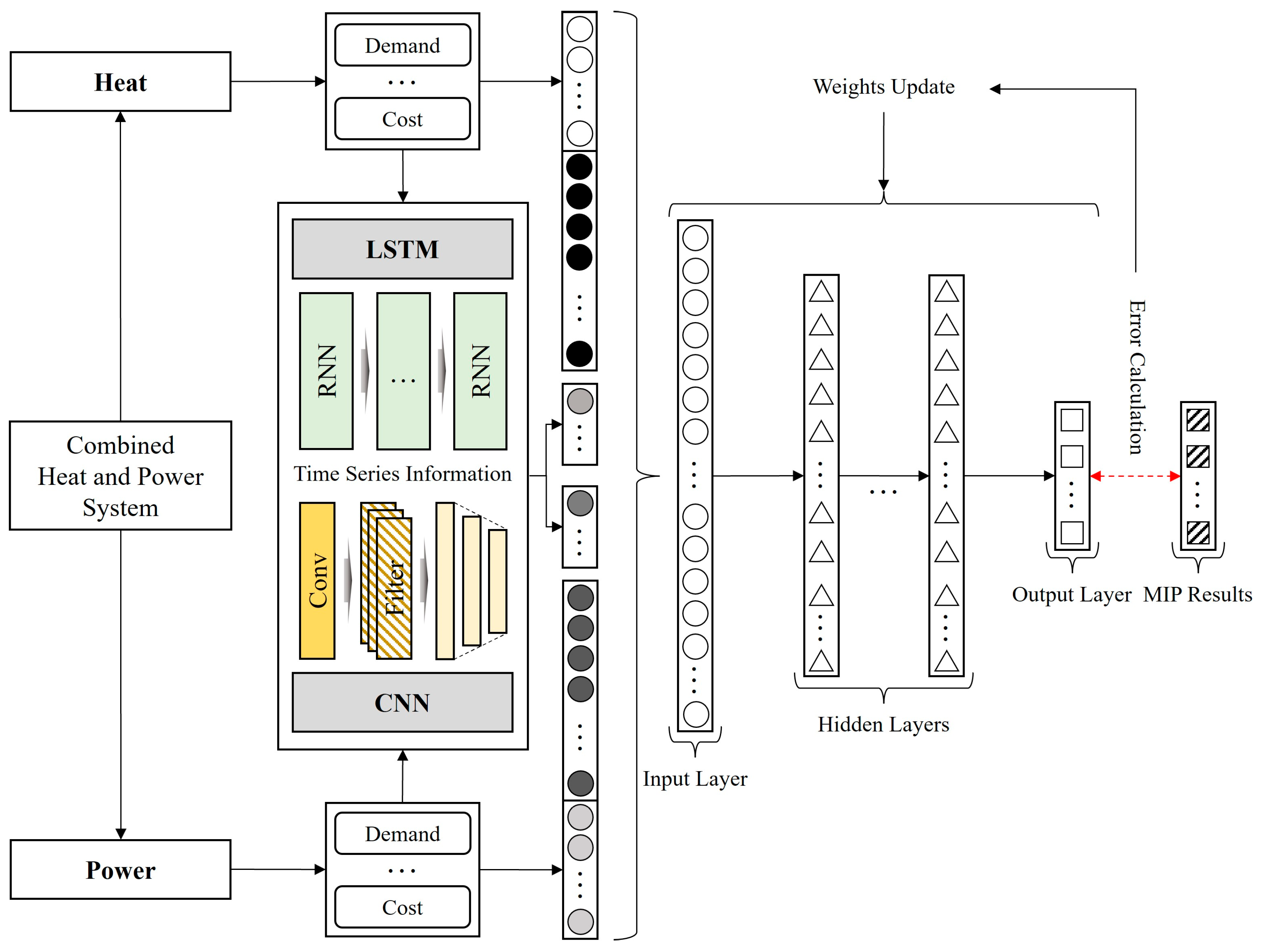
To overcome the limitations of existing research, in this paper, we propose the Hybrid Time series Informed neural Network (HYTIN) to effectively reduce the overall operational cost of a complex CHP system planning problem by learning long- and short-term patterns from the time series information for both heat and power. The long- and short-term time series patterns from the demand and production costs of both heat and power are encoded by using LSTM or CNN. The MIP constraints proposed in a prior study were expanded to obtain high-quality and feasible solutions for joint heat and power planning [
10]. Through extensive experiments, HYTIN trained on these solutions was shown to effectively solve unseen production planning problems. Furthermore, an ablation study was conducted to evaluate the four combinations of heat, power, LSTM, and CNN.
The organization of this paper is as follows.
Section 2 reviews the related prior studies. The detailed definition of the CHP system operational planning problem and the mathematical modeling of MIP are discussed in
Section 3.
Section 4 describes the theoretical background and the specific algorithm of the HYTIN proposed in this study.
Section 5 verifies the performance of the proposed methodology through simulations and experimental results using real data. Finally, the conclusion of this study and suggestions for future research directions are summarized in
Section 6.
2. Literature Review
Hybrid deep learning forecasters improve short- and mid-horizon accuracy across electricity–heat–cooling by combining CNN/LSTM/Attention with decomposition, transfer learning, and multi-task objectives [
21,
22,
23,
24,
25,
26,
27]. Explainable and privacy-preserving variants extend applicability in operational environments through reservoir-computing XAI and federated learning that approaches centralized accuracy while mitigating data-sharing risks [
28,
29]. Domain-specific models for CHP heating load demonstrate robust, season-long online deployment via strand-based LSTM with careful preprocessing and loss design [
30]. Despite these advances, most forecasting studies still stop at continuous load prediction and do not directly yield discrete, constraint-aware dispatch decisions [
21,
22,
23,
24,
25,
26,
27,
28,
29,
30].
Several works couple improved forecasts with optimization to lower costs and emissions, using genetic algorithms, robust formulations, and ensemble selection to translate predictive gains into dispatch or unit commitment benefits [
31,
32,
33,
34,
35]. Parallel efforts deploy deep reinforcement learning single- and multi-agent to enhance flexibility and cost control in CHP and integrated energy systems, with promising results but persistent challenges in hard-constraint satisfaction, action-space exclusivity, and robustness across seeds and scenarios [
36,
37,
38,
39,
40,
41,
42,
43,
44,
45]. Physics-informed surrogates accelerate inner-loop evaluations by orders of magnitude, enabling near-real-time planning provided the surrogate is well-trained over the relevant operating envelope [
46].
Reliability-aware operation has also been explored by several scholars. Specifically, a safe policy learning framework coordinates multi-energy microgrids with green hydrogen while managing congestion and shows how data-driven controllers incorporate operational safety during dispatch [
47]. A state-similarity method was proposed to accelerate reliability assessment and quickly provide risk indicators [
48].
Prior studies are predominantly simulation-based, emphasize continuous load prediction over discrete dispatch, and frequently rely on ex-post feasibility repair rather than ensuring feasibility at inference. Many DRL approaches omit explicit mutually exclusive action sets for heat versus power and provide limited safety guarantees under hard constraints. Surrogate methods, while fast, are not always integrated with learned dispatch policies to enforce constraints online. Safety-aware learning and reliability screening are often treated as separate modules rather than being enforced within the planner during inference, which leaves gaps in formal constraint satisfaction and real-time risk control.
3. Problem Description
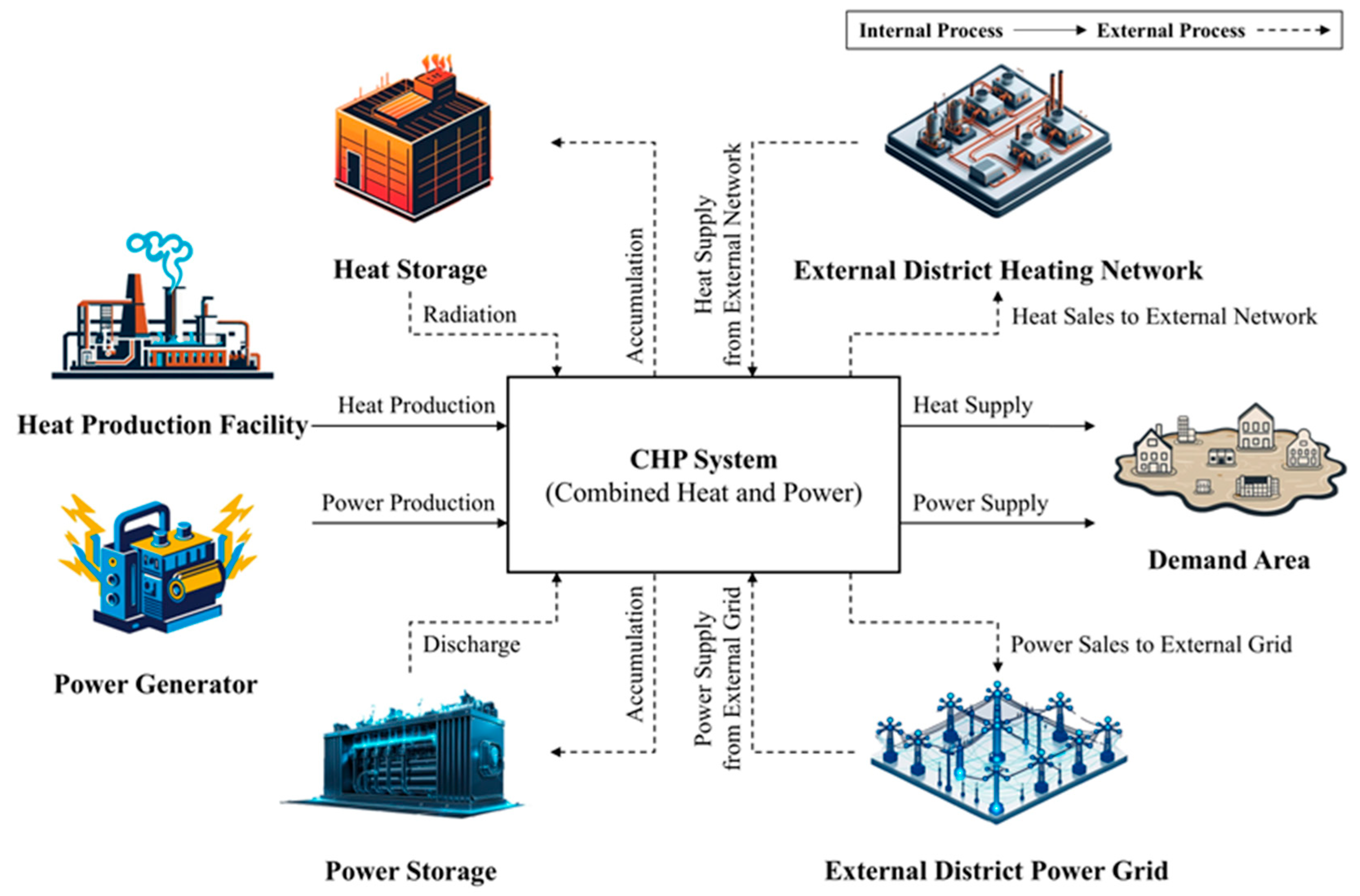
Figure 1 illustrates the overall flow of a CHP system considered in this research. The objective of the CHP system is to minimize total operation cost while maximizing energy supply efficiency by balancing production, storage, supply, and interactions with external networks to meet demand.
The CHP system consists of an internal process and an external process. The internal process produces heat and power and supplies them to the demand area, while the external process connects storage units and external networks. When on site production exceeds demand, the surplus is stored in heat or power storage, and any remaining excess is sold to the district heating network or the power grid. When demand exceeds on site supply, heat or power is released from storage, and any remaining deficit is purchased from the external networks. These storage operations and external transactions add constraints beyond basic production and supply, and they are central to balancing the plan. Because external sales and purchases carry penalty costs, the planning objective is to set production levels and storage actions that meet demand while limiting reliance on external networks.
In order to design the mathematical programming model, the parameters and decision variables are shown in
Table 1. While a prior study addressed a mathematical programming problem for heat only, this research expands the scope to include both heat and power [
10]. The constraints for our CHP system are particularly more complicated due to a path conflict between the heat and power processes where simultaneous production is not possible.
The decision variables in our model include the production volume (), selected production level (), inventory (), and supply to and from external networks (, ), where i ∈ {h, p} for heat and power, at a time t. Additionally, for the heat and power line, a minimum operation time () and a minimum idle time () are given, where a duration of (t, t + − 1) or (t, t + − 1) is enforced when the operation starts or shuts down at time t. While these minimum time constraints apply independently to each unit, the key challenge is that simultaneous production of heat and power is not possible within this specific system. Therefore, we formulated the problem as deciding on a production level (k) at time t, where the production volume is automatically determined once the level is chosen. A typical production facility has minimum and maximum operational capacities. Production decisions are often made by using a set of pre-defined, fixed values between these minimum () and maximum () capacities. We set our production volume at production level k () to be one of the seven discrete levels k ∈ {1, 2, ..., 7}.
When production exceeds demand, excess inventory (
) is stored. Conversely, when demand surpasses production, inventory is discharged from storage. At the same time, the storage unit has minimum (
) and maximum (
) limits. If the system needs to discharge inventory but the storage is already at its minimum level, it requires a supply from external networks (
). Conversely, if the system needs to accumulate more inventory but storage is at its maximum level, it must sell the excess energy to external networks (
). Both scenarios incur high costs. Values for external exchange costs (
, ) and storage costs (
), based on the Korea district heating corporation, were addressed by prior work, and each cost is allowed to vary over time [
10]. In contrast, production costs (
) and demand (
) maintain a real-world setting by fluctuating over time due to factors such as season, fuel source, and other external conditions. Operation costs are calculated using an exchange rate of USD 0.00072 per KRW 1, as of 10:44 AM UTC on 17 July 2025.
The objective function (1) is designed to minimize the total operation cost, which is composed of four distinct cost terms. These terms include production costs, inventory holding costs at the storage facility, and exchange costs to and from external networks. When transactions with external networks occur, we assume the volume of exchange is unlimited, but it incurs high costs. Thus, the mathematical model is structured to allow transactions with external networks only out of necessity.
The inventory balancing constraint (2), a well-known constraint for this type of problem, ensures inventory volume at time t is a function of internal production and external exchanges for both heat and power. Constraints (3) and (4) are related to production capacity. If a facility is operating, its state variable () is set to 1 to satisfy these constraints. Constraint (6) ensures that only one of the k production levels is selected at any given time, while constraint (5) automatically calculates the production volume based on that chosen level. Constraints (8) and (9) enforce minimum operation and idle times. Since the problem is modeled as a MIP, these constraints significantly add complexity to model computing. Furthermore, constraint (7) defines the startup and shutdown states for each facility. Finally, constraints (10) and (11) define the minimum and maximum storage capacity limits. In this model, the state variables , and are binary, while all other variables are continuous, defined as constraints (12) to (14). Constraint (15) defines as the production volume for each of the seven discrete levels. Level k = 1 represents the off state in which production volume is 0. Heat production levels, k = 2, 3, 4, each correspond to production volume ,,. For power, levels k = 5, 6, 7 are, respectively, assigned to production volume ,,.
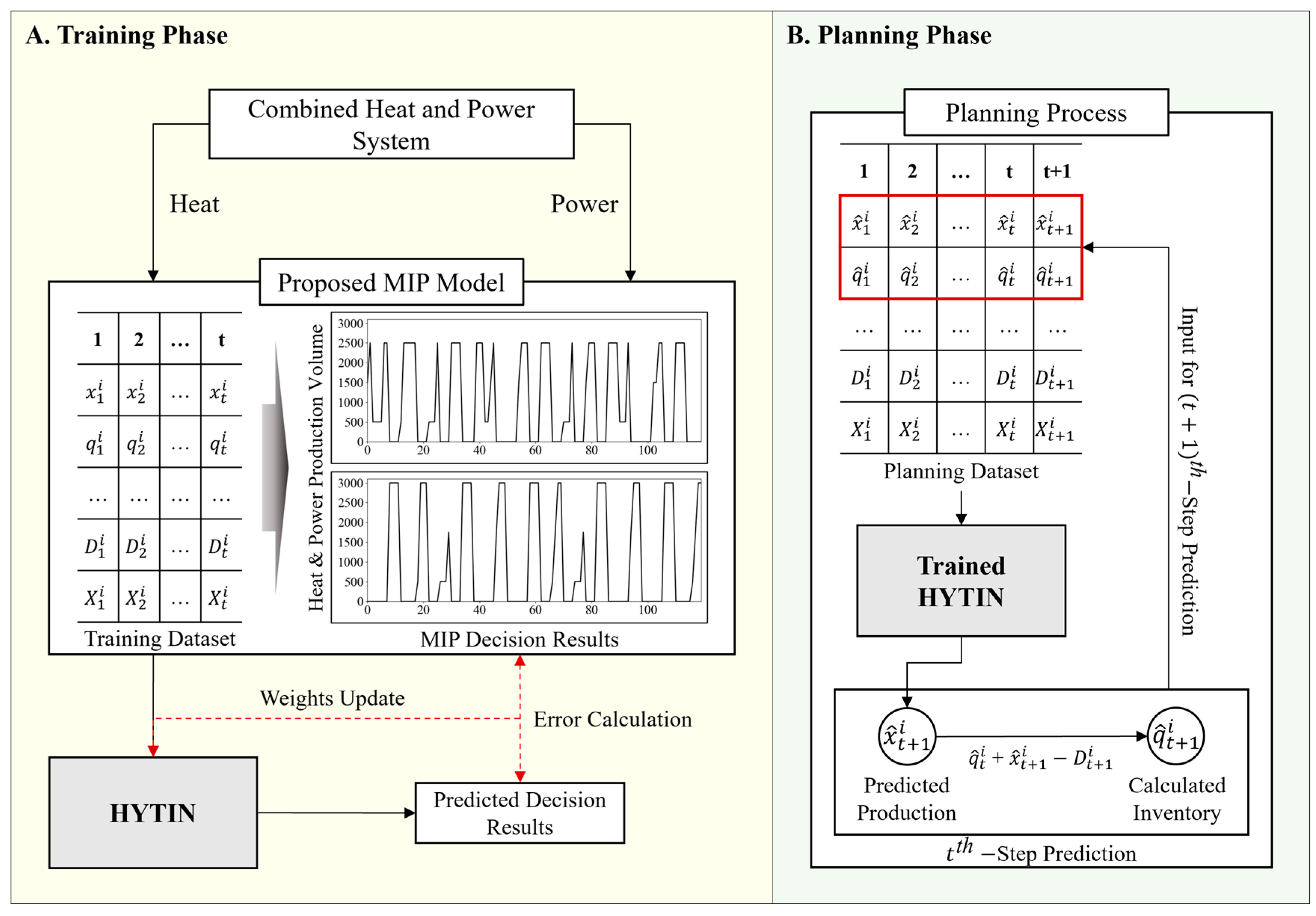
To train the proposed model, we generated a set of operation scenarios using the MIP model. We chose this approach because real-world operation data is often insufficient for deep learning and contains decisions that are not necessarily optimal for a given problem. Since the MIP model generates high-quality solutions that satisfy all operational constraints within an hour, we utilized the MIP model to generate diverse operational scenarios and used the resulting decision outcomes as the training data for our deep learning model. Consequently, using the MIP decision results to train the deep learning model is expected to produce solutions efficiently, allowing for rapid decision-making regardless of the input provided.
5. Computational Experiments
5.1. Datasets
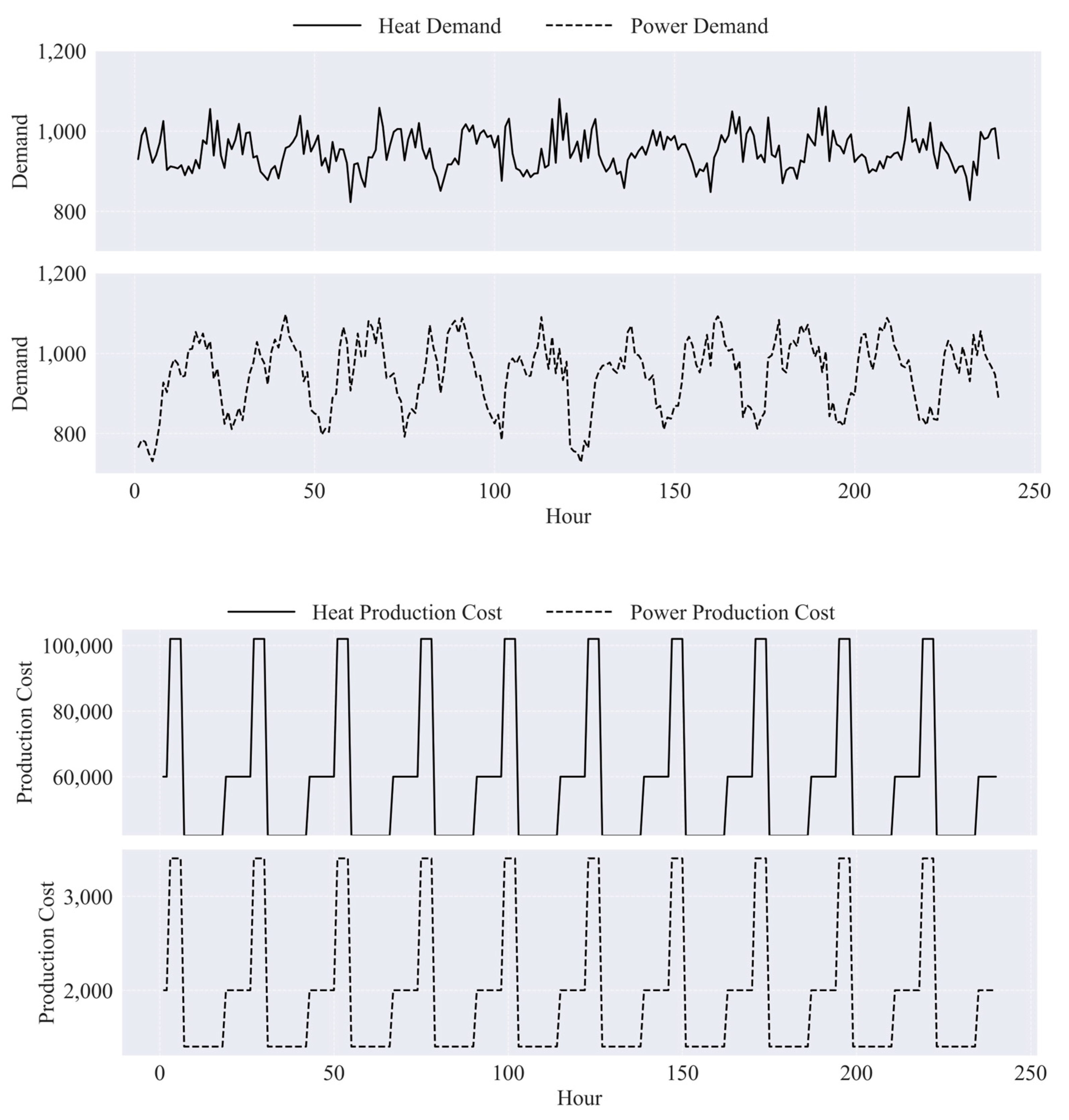
Figure 4 presents 240 h samples from recorded demand and production cost series in South Korea. The three-year record indicates that each heat and power demand has similar averages while power varies more. Production costs follow Korean day–night pricing rules, although the magnitudes differ; both series follow the same day–night structure, yielding aligned patterns [
10]. Most patterns are opposite across the two products, yet overlap occurs at several points, which makes complicated switching decisions. For example, when production cost is low and demand is high, the production level must be high for the operation cost to be measured as low. Consequently, the parts considered important by the data are decided through the decision process.
To enlarge the training datasets, we simulate additional demand sequences with Gaussian noise [
50,
51]. The mean
and standard deviation
are estimated from historical data, and simulated demand is drawn as
with integer rounding. On the other hand, production cost values are taken directly from historical data. This produced 1,800,000 h of operational time series which were grouped into units of 120 h. The 120 h window matches a common operating cycle in which weekend demand is served from storage, which explains the inventory bounds used in planning. We split the pool into 80% for training and 20% for validation.
We partitioned the test pool into ten datasets. Each dataset contains ten independent planning cycles of 120 h. The test pool contains 12,000 h, which corresponds to one hundred planning cycle scenarios. Scenarios are drawn to represent all seasons and to keep weekday and weekend patterns in balance. All datasets share the same limits and cost coefficients to ensure a common operational setting.
5.2. Experiment Settings
As explained in
Section 4.1, we train HYTIN by using MIP decision results as to guide planning in similar scenarios. The MIP model was optimized using the Gurobi solver on a computer equipped with 64 GB of memory and 24-core CPUs.
Table 3 shows the total operation cost results by varying the time limit for the MIP solver across ten datasets. Bold indicates the best results for each dataset, with the lowest cost. The table represents total operation cost for runs capped at 100 s, 300 s, 3600 s, and 7200 s. We set a maximum running time of MIP to 7200 s, due to the computing resources. Relative to 300 s, the average change is +0.11% at 100 s, −0.06% at 3600 s, and −0.07% at 7200 s. Since the practitioners should quickly make planning decisions to deal with the variations in demand and production costs, the computation time limit for the MIP solver is required to be less than a few minutes. Furthermore, as shown in
Table 3, extending the run to two hours brings little additional cost reduction. Therefore, to effectively create as many production plans for training HYTIN as possible within a limited time, we set the MIP time limit to 300 s. This choice provides the best balance between decision quality and the computational speed needed to generate a large training dataset.
To ensure the effective performance of HYTIN, we determined the final parameters through extensive experimentation. Following prior research, the depth of the fully connected hidden layers was set to five, with sizes of 1024, 512, 128, 64, and 32. The LSTM uses two layers, and the CNN uses 1-D convolution to finally embed the time series information into a 128-dimensional hidden dimension. The learning rate was set to 0.001, and early stopping was implemented to prevent overfitting. We used ReLU as an activation function and Adam as the optimizer. We used cross-entropy as the loss function and applied SoftMax to the final output, as this is a production level selection problem.
We compare HYTIN with DHPP and with the MIP solver [
16]. As MIP decision results are not necessarily going to be optimal due to the time limitation, the predictions by using DHPP or HYTIN are possibly going to yield a lower cost than the MIP decision results. Even though HYTIN does not match every production level, decisions that improve inventory management are possible to reduce external transactions and lower operation costs.
Our primary objective is to minimize total operation cost, and our secondary objective is to classify production levels with accurate on-off decisions. We report four metrics aligned with this goal. First, the total operation cost is the sum over the horizon of production cost, inventory holding, and external transactions, where purchases add cost and sales reduce cost. Second, accuracy measures how similar the predicted production level (
) and production levels (
) from the MIP decision results are at each time step. For a horizon of length
T, accuracy is defined in Equation (23):
where 1{⋅} refers to the indicator that equals one when the statement is true and zero otherwise.
Third, HP-Off accuracy checks whether the predicted production level belongs to the same group as the true level when levels are grouped into Off, Heat, and Power. Let the set of production levels be
U = {1,…,
k}. Partition
U into three disjoint subsets
O for Off,
H for heat, and
P for power with
O ∪
H ∪
P =
U,
O ∩
H = ⌀,
O ∩
P = ⌀ and
H ∩
P = ⌀.
While Equation (24) defines the grouping map
f, for a horizon of length
T, HP-Off accuracy is calculated as follows:
Equation (25) provides the metric which gives credit when prediction and truth fall in the same group and averages this agreement over the horizon. It depends only on group membership, so it remains valid when the number of heat or power levels or their identifiers change. In our experiments one concrete instance is O = {1}, H = {2,3,4}, and P = {5,6,7}.
Lastly, On-Off accuracy is a binary measure that checks production versus idle, Equation (26). For this metric we use a binary version of the grouping map
g. We let
g(
u) = 0 for state on with
u ∈
O, and otherwise
g(
u) = 1 for state off with
u ∈
H ∪
P. 5.3. Experiment Results
Table 4 and
Table 5 present the comparative results across ten datasets and the improvement ratios (IR) of HYTIN over the baselines. Boldface marks the best value in each column for each part, the lowest total cost and the highest accuracy measures. The average total operation cost with HYTIN is 9,760,775 USD, while MIP records 10,184,265 USD and DHPP records 10,993,122 USD. The corresponding IR are 4.16% relative to MIP and 11.21% relative to DHPP. HYTIN achieves the lowest cost in most datasets and remains close in the remaining cases, which indicates stable gains rather than isolated wins. For runtime, planning all 100 sets takes 30,000 s with MIP, whereas DHPP and HYTIN are complete in 16 s.
In
Table 4, the percentage shown next to the MIP total operation cost is the average MIP gap across sets under a 300 s time limit. The MIP gap is the relative difference, in percentage, between the solver’s best incumbent solution and the best bound (theoretically lower bound). The average gap equals 31.02%, indicating the mean cost obtained within the allotted time is not certified optimal and that solutions up to 31.02% lower may exist. For example, in Dataset 5 the MIP gap is 8.26%, and HYTIN does not improve the MIP schedule. In contrast, Dataset 10 shows a 47.93% gap, which indicates substantial potential for improvement, and HYTIN achieves a lower total cost.
Accuracy yielded by HYTIN was 80.99% on average, while that of DHPP was 75.57%. Although accuracy is not the objective of the production planning problem considered in this paper, higher accuracy implies that HYTIN reproduces MIP solver patterns more closely while still improving economics. HYTIN lifts HP-Off accuracy from 69.88% to 87.40%, which is an increase of 20.05% in relative terms. HYTIN also raises On-Off accuracy from 90.38% to 95.44%, which is an increase of 5.28% relatively. These improvements align with the observed cost reductions, indicating that HYTIN learns when to keep a product idle, when to produce, and when to transition, which reduces unnecessary purchases and forced sales while satisfying operational limits.
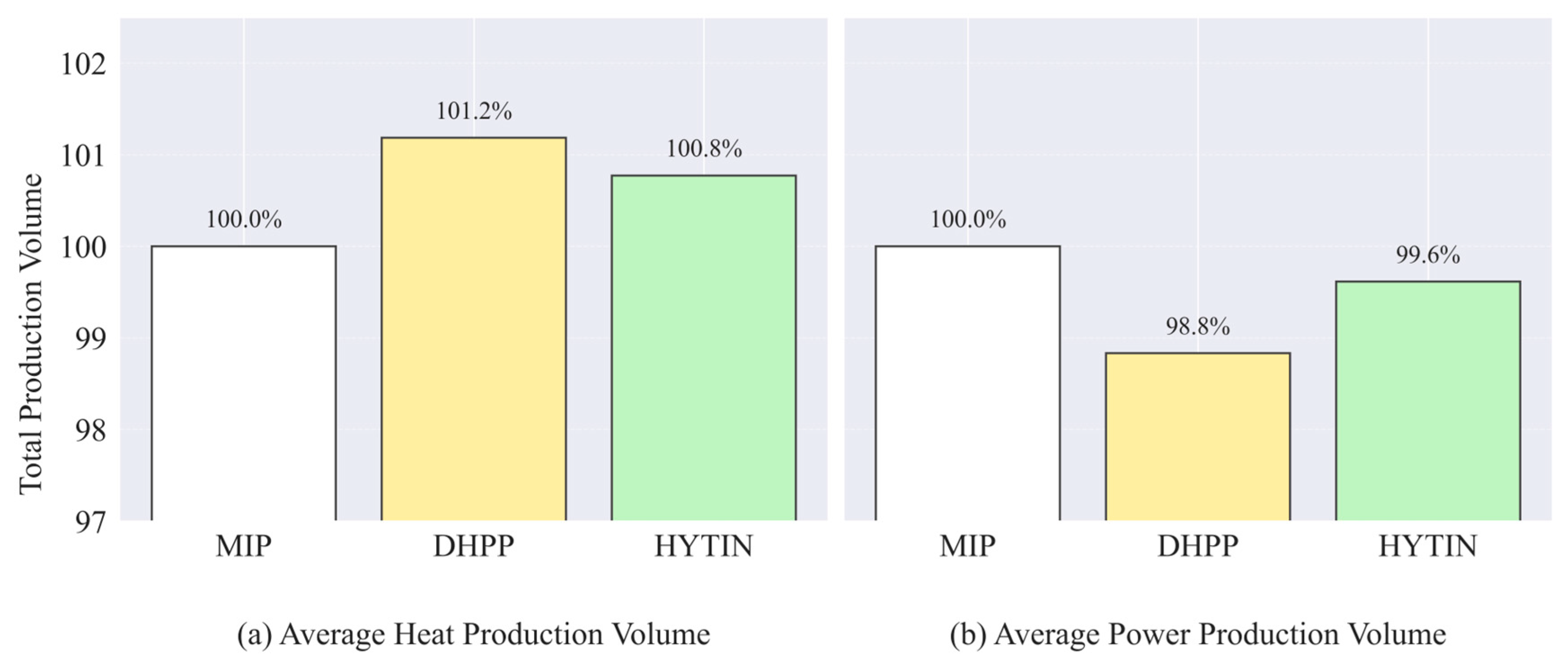
Figure 5 shows that HYTIN stays closer to the MIP totals for both products, which indicates a more balanced mix across the horizon. For (a), the average heat production volume, DHPP produces 101.2% on average and HYTIN produces 100.8%. For (b), the average power production volume, DHPP produces 98.8% and HYTIN produces 99.6%. In the absolute unit gap from MIP, DHPP records about 135,000 for heat and 132,500 for power, while HYTIN records about 88,000 for heat and 43,750 for power.
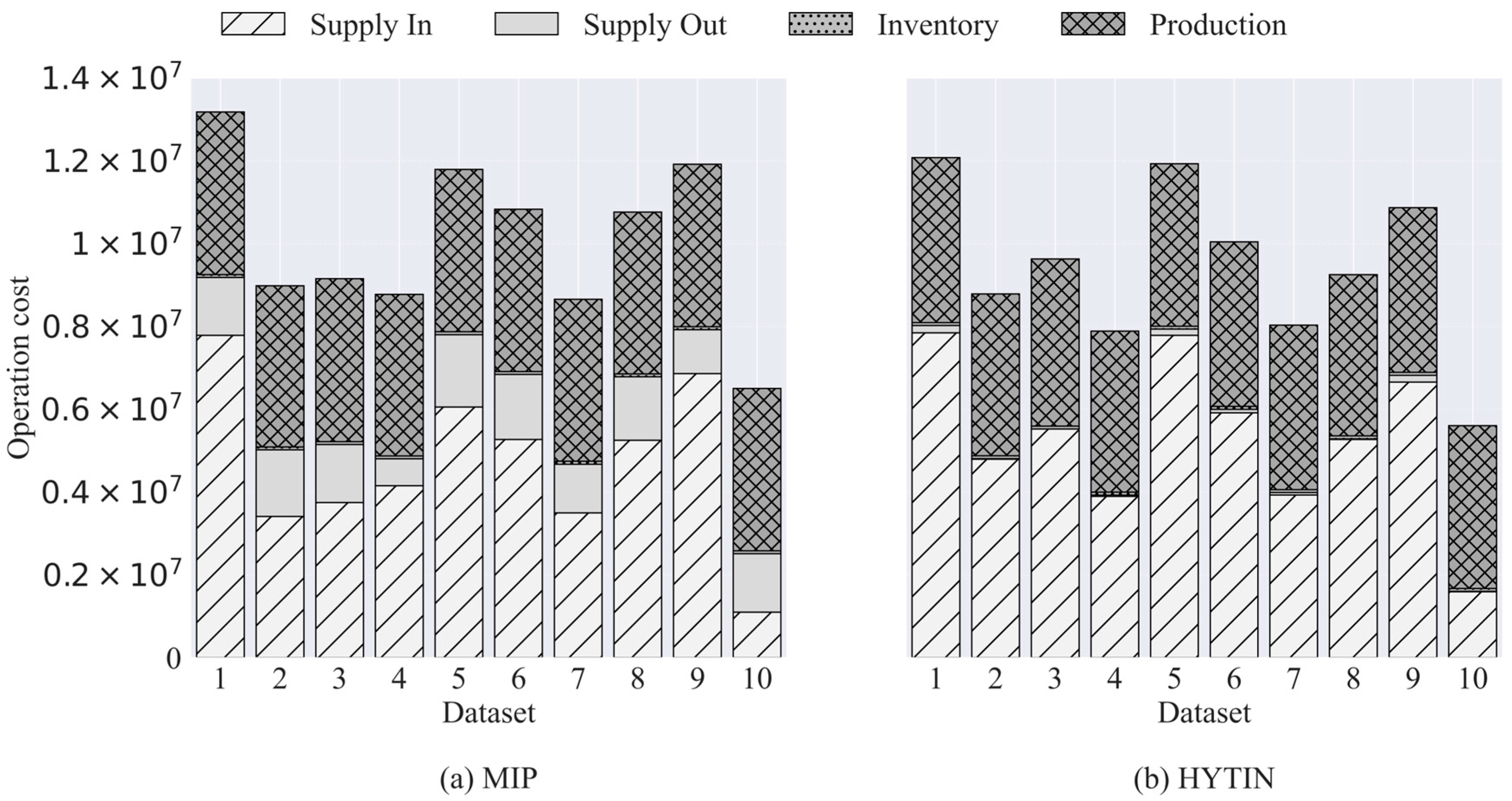
Figure 6 compares the composition of operation cost by dataset for (a) MIP and (b) HYTIN where HYTIN lowers total operation cost mainly by reducing supply-out costs. HYTIN shows more supply-in in several datasets, yet total external transactions are lower because supply-out is smaller, especially in datasets four and ten. As
Figure 5 shows, production volumes remain close to the MIP baseline, so production costs are similar. The operation cost advantage, therefore, comes mainly from fewer sales to external networks rather than from changes in production, which is consistent with the aim of limiting external transactions.
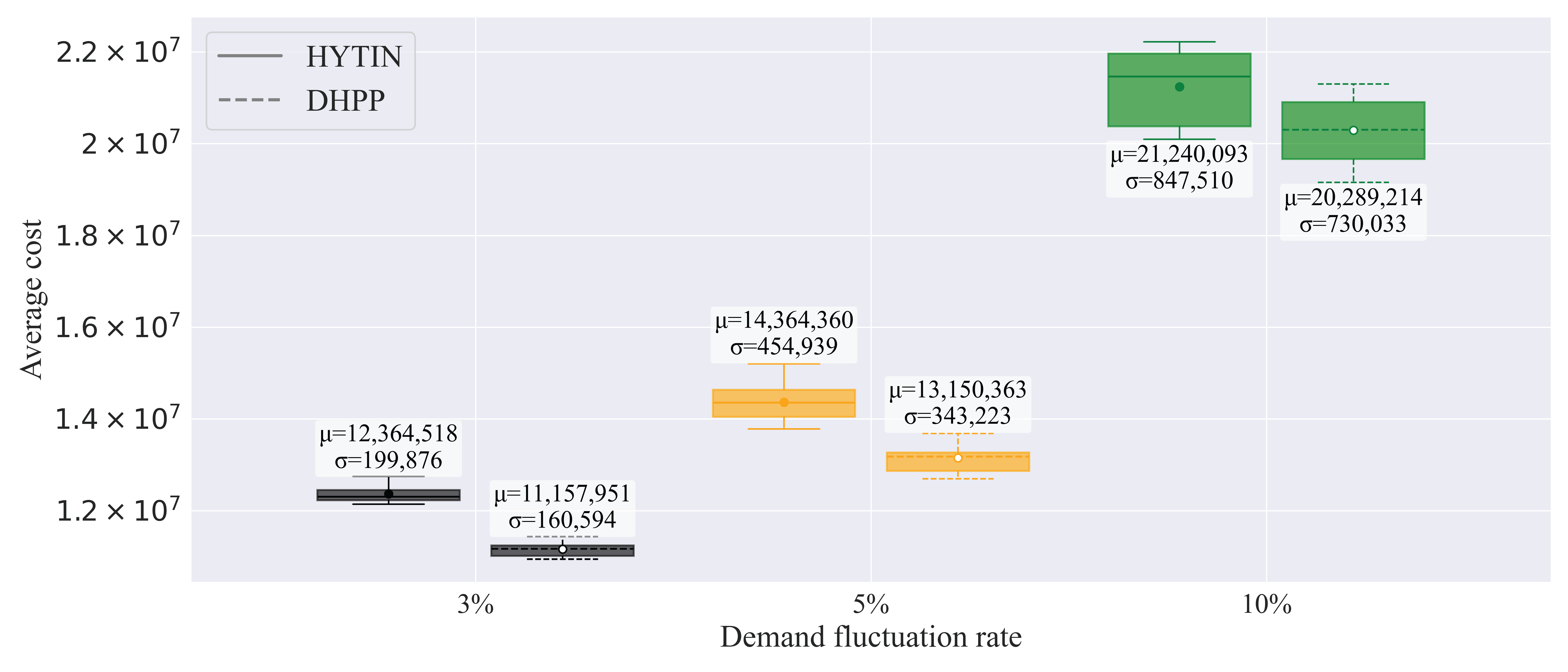
We further conducted an uncertainty analysis by planning the existing known 24 h demand while assuming the real demand differed by 3%, 5%, and 10%. For each level the actual demand was randomly generated within the ranges [0.97·
, 1.03·
], [0.95·
, 1.05·
], and [0.90·
, 1.10·
]. As shown in
Figure 7, HYTIN yields lower total operation cost than the DHPP baseline across all cases. Under 3%, 5%, and 10% fluctuation, mean operation cost over 10 repetitions, and relative improvements for HYTIN are 9.76%, 8.45%, and 4.47%. Standard deviations are also lower for HYTIN at every level, indicating more robust planning under demand mismatch.
5.4. Ablation Study
We run an ablation study to identify the most effective encoder pairing for heat and for power. Four variants are tested within HYTIN. L-C uses LSTM for heat and CNN for power. L-L and C-C apply the same encoder to both products. C-L swaps the assignment and encodes heat with CNN and power with LSTM. This study examines whether a sequence-oriented encoder for heat and a pattern encoder for power yields better planning under our constraints.
In
Table 6 and
Table 7, boldface marks the best value in each column for each dataset, and in the average row it marks the best overall average.
Table 6 reports the total operation cost for the four variants according to the datasets. The L-C configuration yields the lowest average cost at 9,710,076 USD. It achieves the best or near best cost in most datasets, while L-L and C-L are consistently higher and C-C is competitive only in a few cases. These results indicate that combining a sequence-oriented encoder for heat with a local pattern encoder for power produces decisions that reduce purchases from external networks and avoid forced sales, which lowers total cost.
Table 7 summarizes HP-Off accuracy and On-Off accuracy. C-C attains the highest average HP-Off accuracy at 87.69%, while L-C is close at 87.40% and ahead of L-L and C-L. For On-Off accuracy L-C is the best at 95.44%, followed by L-L at 95.07%, C-C at 95.33%, and C-L at 95.10%. In practice the higher On-Off accuracy of L-C translates into better control of production versus idle states, fewer unnecessary startups, and smoother inventory use, which aligns with the cost advantage observed in
Table 6. Although C-C has a slight edge in HP-Off accuracy, the overall operation cost with C-C is higher than with L-C, so we adopt L-C as the default.
Based on the results, it can be said that a recurrent encoder captures extended temporal context and improves the timing of heat production and storage actions. Furthermore, a one-dimensional convolution captures sharper spikes and local peak patterns effectively. The L-C pairing therefore aligns encoder bias with the characteristics of each product. The result is higher On-Off accuracy, competitive HP-Off accuracy, and the lowest total operation cost among the tested variants.
6. Conclusions
This study addressed the production planning problem of the CHP system while not allowing simultaneous production of heat and power. We proposed an HYTIN that aims to decide feasible production levels given demand and production cost profiles with inventory states. To achieve this, HYTIN was trained with the production plans generated by an MIP solver, and then it quickly solved an unseen production planning problem to accommodate the frequent variations in demand and production costs.
Experiments show that HYTIN lowers operation cost relative to prior baselines and improves decision quality. It attains higher alignment with the MIP solver and records higher HP-Off and On-Off accuracy. Cost breakdowns indicate fewer external purchases and fewer forced sales, while average heat and power volumes remain close to the MIP decision results. The ablation study supports the LSTM for heat and CNN for power pairing, which matches long horizon thermal dynamics for heat and short-term variability for power. We cap the MIP solver at three hundred seconds to match real operational turnaround, and results with longer limits show little additional benefit, which supports this choice.
Yet, the proposed method relies on specific forecast inputs and a single MIP solver configuration, while assuming a single plant with non-parallel production paths and fixed production level. This poses a limitation since employing the approach to CHP systems with different structures or cost settings may require retraining. In future works, discrete production levels will be replaced by continuous outputs by employing regression-based models. Furthermore, we plan to extend the proposed model to handle multi-level plants and to incorporate simultaneous co-production of heat and power by utilizing graph-based networks, thereby improving its applicability to more general industrial settings. In addition, future work considers stochastic cost and demand so that planning decisions are optimized under time varying price and load uncertainty.