


To the Editor:
Diabetic foot ulcers are a challenging problem for patients and surgeons because successful healing requires strict medical compliance, intensive local wound care, minimization of contributing factors, and frequent operative debridements and reconstructions.[1] We present the case of a diabetic male cardiac patient with a trophic ulcer on the amputation stump of the second toe of the right foot treated with tarsal tunnel release and autologous peripheral blood mononuclear cell (PBMNC) implantation.
Case Report
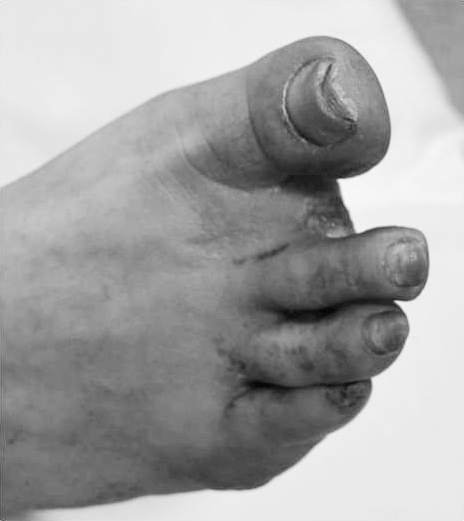
A 61-year-old white man was referred to the Department of Plastic and Reconstructive Surgery of the University of Sassari with a trophic ulcer of the amputation stump of the second toe of the right foot. Clinical examination revealed a 1-cm, circular, shallow, nongranulating wound associated with painful dysesthesia and plantar hypoesthesia, gait impairment, and foot paresthesia when standing (Fig. 1). The patient was a heavy smoker (30 cigarettes per day), and he had type 2 diabetes mellitus (hemoglobin A1c level of 7%) controlled by oral hypoglycemic drug therapy (metformin, 1.5 g/d), postischemic dilated cardiomyopathy (bearing an implantable cardioverter defibrillator), three-vessel coronary artery disease not amenable to revascularization, hypertension, and dyslipidemia. The patient underwent amputation of the right second toe 4 months earlier. Physical examination revealed pain with forced dorsiflexion, and positivity to the Semmes-Weinstein monofilament test and the Tinel test. Routine preoperative laboratory test results were within normal ranges. The patient underwent ecocolor Doppler of the lower extremities, which demonstrated peripheral obliterative arteriopathy in Fontaine stage II. The bacterial wound culture was negative. Preoperative electroneurography and transcutaneous oximetry (PtcO2) were performed.
Figure 1.
Clinical view of the tarsal tunnel release.
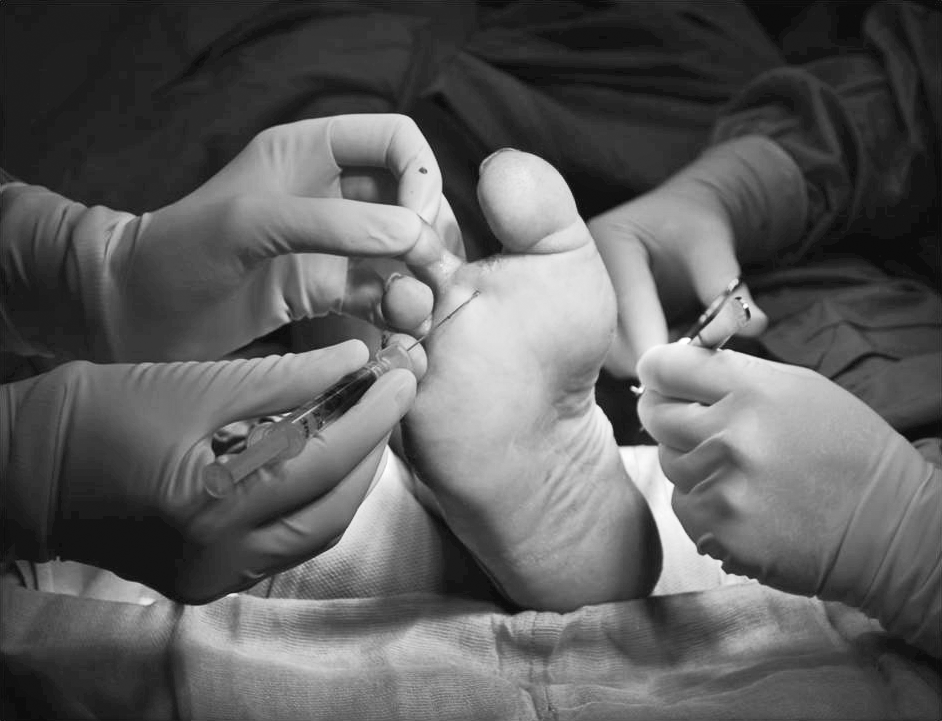
The patient underwent tarsal tunnel release on the right foot under spinal anesthesia and with a pneumatic tourniquet. At the same time, he received perilesional infiltration of autologous PBMNCs obtained through a peripheral venous blood sample (100 mL) by selective filtration using the Pall Celeris system (Pall Medical Corp, Port Washington, New York) (Fig. 2). Injections were performed with an 18-gauge needle in boli of 0.5 mL at a 2.5-cm depth for a total volume of 12 mL of PBMNC concentrate.
Figure 2.
Intraoperative view of the perilesional infiltration of autologous peripheral blood mononuclear cells.
The surgical wound was dressed with the Robert Jones bandage. The patient received analgesic (paracetamol, 1 g three times daily), antibiotic (levofloxacin, 500 mg twice a day), and anticoagulant (enoxaparin, 4,000 IU/d) drug therapy. The postoperative course was straightforward, and the patient was discharged on the second postoperative day.
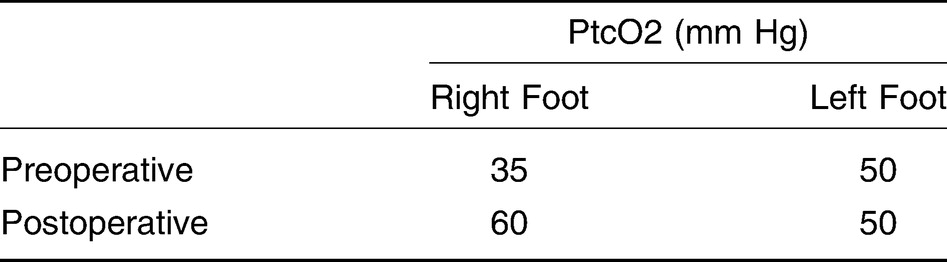
Three weeks after surgery, complete healing of the ulcer was observed, and the patient reported pain reduction, gait improvement, and the ability to wear closed-toed shoes. Clinical examination showed negative Tinel test results, and 1-month postoperative PtcO2 values demonstrated an improvement in peripheral blood flow (Table 1).
Table 1.
Preoperative and Postoperative Transcutaneous Oximetry (PtcO2) Values
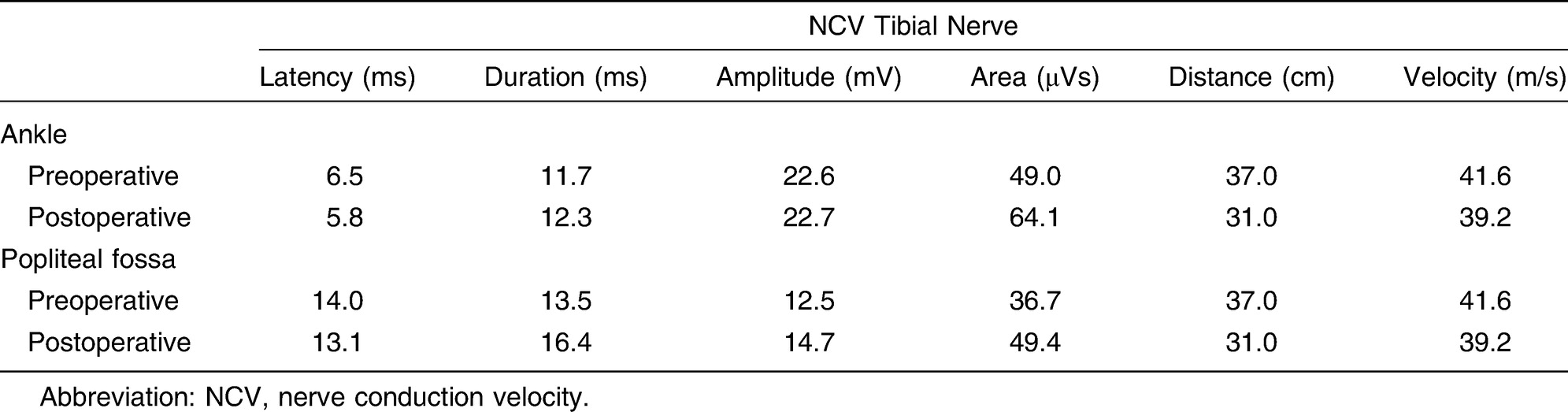
At the 6-month postoperative follow-up visit, electroneurography showed an improvement in the conduction velocity of the posterior tibial nerve at the ankle and the popliteal fossa (Table 2). The patient remained in stable condition with the wound healed and showed no signs of recurrence.
Table 2.
Preoperative and Postoperative Electroneurography Values
Discussion
Several studies indicate that peripheral neuropathy is the most important factor in ulcer formation, increasing the risk of foot ulceration.[2] Surgical decompression of peripheral nerves in patients with diabetes is reported to substantially improve sensitivity at the extremities and to reduce the incidence of diabetic foot wounds and amputations.[3,4] In addition to the improvements in the neurologic symptoms, surgical decompression of the tarsal tunnel may produce an increase in microcirculation as well. The postoperative improvement of nerve function is demonstrated by improvement in pain levels, recovery of sensation, improved balance, and decreased ulceration and amputation,[5] and changes in oxygenation are demonstrated by using PtcO2.[6] The technique of PtcO2 allows estimation of the partial pressure of oxygen on the skin surface by using noninvasive heated electrodes.[1] Because oxygen is carried to tissues by blood flow in the arteries, PtcO2 is an indirect measure of blood flow. Although several factors other than vascular flow may be involved in tissue oxygenation, such as basement membrane thickening, nitrous oxide levels, dimethyl arginine, etc, this test is conceived to determine how severely tissues are deprived of blood flow, which helps predict wound healing.[7]
With reference to the ischemic damage related to diabetic microangiopathy, presently, there are no validated therapeutic options available for the reduced angiogenesis in diabetic foot. Hyperbaric oxygen therapy has been suggested to improve wound tissue hypoxia and to enhance perfusion and has, therefore, been promoted as a useful adjunct in clinical practice for diabetic foot wounds.[8] Recent literature describes the efficacy of PBMNCs for therapeutic angiogenesis.[9,10,11,12,13,14] The implantation of PBMNCs into ischemic limbs induces collateral vessel formation by supplying angiogenic factors (mainly vascular endothelial growth factor) and cytokines.[15] It has been demonstrated that these cells are able to stimulate vasculogenesis and to accelerate skin repair by collagen deposition and reepithelialization. The therapeutic potential of the implanted cells consists of improved endothelial function, stimulatory effects on the kinetics of circulating endothelial cells and endothelial precursor cells, and augmentation of microcirculatory blood flow.[15,16]
In this study, autologous PBMNCs were implanted in the perilesional area to improve the impaired blood flow and heal the ulcer. The Pall Celeris system is a new device that processes a peripheral blood venous sample and produces by selective filtration a mononuclear cell concentrated solution certified for therapeutic use. The concentrated mononuclear cells are injected in the ischemic area. The main advantages of this product are the rapid cell processing, the ease of use, and the closed disposable system. In addition, filtration is considered to be minimal manipulation, and, as such, the use of this device in the operating room does not necessitate special permissions.
Similar results have been reported with the use of bone marrow mononuclear cells; however, compared with bone marrow aspiration, the collection of PBMNCs does not require general anesthesia and, therefore, is safe to apply to patients in whom anesthesia is contraindicated. Moreover, the implantation of these cells can be repeated easily, which could enhance the effects of the first implantation on vascularization.
It should, however, be noted that the concurrent use of neurolysis and PBMNC infiltration makes it difficult to understand whether only one of these interventions was responsible for the result or whether they were both necessary. Nevertheless, successfully healing open wounds consists of avoiding the risk of the wound becoming infected, leading to sepsis and the amputation complication cascade, with its attendant mortality risk.
In summary, according to our experience, the combined treatment of diabetic foot ulcer with tarsal tunnel release and perilesional injections of PBMNCs should be further investigated to establish a safe and effective therapeutic strategy.
Financial Disclosure
None reported.
Conflicts of Interest
None reported.
References
- Ducic I, Felder JMIII, Iorio ML: The role of peripheral nerve surgery in diabetic limb salvage. Plast Reconstr Surg127(suppl 1): 259S, 2011.
- Wu SC, Driver VR, Wrobel JS, et al: Foot ulcers in the diabetic patient, prevention and treatment. Vasc Health Risk Manag3: 65, 2007.
- Lee CH, Dellon AL: Prognostic ability of Tinel sign in determining outcome for decompression surgery in diabetic and nondiabetic neuropathy. Ann Plast Surg53: 523, 2004.
- Dellon AL, Muse VL, Nickerson DS: Prevention of ulceration, amputation and reduction of hospitalization: outcomes of a prospective multi-center trial of tibial neurolysis in patients with diabetic neuropathy. J Reconstr Microsurg28: 241, 2012.
- Zhang W, Zhong W, Yang M, et al: Evaluation of the clinical efficacy of multiple lower-extremity nerve decompression in diabetic peripheral neuropathy. Br J Neurosurg27: 795, 2013.
- Trignano E, Fallico N, Chen HC, et al: Evaluation of peripheral microcirculation improvement of foot after tarsal tunnel release in diabetic patients by transcutaneous oximetry. Microsurgery36: 37, 2016.
- Fife CE, Smart DR, Sheffield PJ, et al: Transcutaneous oximetry in clinical practice: consensus statements from an expert panel based on evidence. 36: 43, 2009.
- Lipsky BA, Berendt AR: Hyperbaric oxygen therapy for diabetic foot wounds: has hope hurdled hype?Diabetes Care33: 1143, 2010.
- Reddy AM, Kwak BK, Shim HJ, et al: A long-term outcome of therapeutic angiogenesis by transplantation of peripheral blood stem cells in critical limb ischemia after interventional revascularization. Diagn Interv Radiol19: 76, 2013.
- Moriya J, Minamino T, Tateno K, et al: Long-term outcome of therapeutic neovascularization using peripheral blood mononuclear cells for limb ischemia. Circ Cardiovasc Interv2: 245, 2009.
- Matoba S, Tatsumi T, Murohara T, et al: TACT Follow-up Study Investigators: Long-term clinical outcome after intramuscular implantation of bone marrow mononuclear cells (Therapeutic Angiogenesis by Cell Transplantation [TACT] trial) in patients with chronic limb ischemia. Am Heart J156: 1010, 2008.
- Hoshino J, Ubara Y, Hara S, et al: Quality of life improvement and long-term effects of peripheral blood mononuclear cell transplantation for severe arteriosclerosis obliterans in diabetic patients on dialysis. Circ J71: 1193, 2007.
- Kawamura A, Horie T, Tsuda I, et al: Prevention of limb amputation in patients with limbs ulcers by autologous peripheral blood mononuclear cell implantation. Ther Apher Dial9: 59, 2005.
- Iba O, Matsubara H, Nozawa Y, et al: Angiogenesis by implantation of peripheral blood mononuclear cells and platelets into ischemic limbs. Circulation 106: 2019, 2002. Retraction in Circulation127: e842, 2013.
- Spaltro G, Straino S, Gambini E, et al: Characterization of the Pall Celeris system as a point-of-care device for therapeutic angiogenesis. Cytotherapy17: 1302, 2015.
- De Angelis B, Gentile P, Orlandi F, et al: Limb rescue: a new autologous-peripheral blood mononuclear cells technology in critical limb ischemia and chronic ulcers. Tissue Eng Part C Methods21: 423, 2015.
© 2017 American Podiatric Medical Association