


Abstract
Development in the textile industry leads to an increased demand for the use of various dyes. Moreover, there is the use of some dyes in the food industry as well as medical diagnostics. Thereby, increased demand for dyes in various fields has resulted in dye-containing wastewater. Only a small portion of the generated wastewater is adequately treated. The rest is usually dumped or otherwise directly discharged into the sewage system, which ultimately enters rivers, lakes, and streams. The handling and disposal of such concentrated wastewater, especially the dye-containing wastewater, is considered to be a major environmental issue from the moment of its generation to its ultimate disposal. Conventional water treatment methods such as flotation, filtration, adsorption, etc., are non-destructive physical separation processes. They only transfer the pollutants to other phases, thereby generating concentrated deposits. The advanced oxidation process (AOP) is one of the most effective emerging methods for the treatment of wastewater containing chemical pollutants. The method involves the formation and interaction of highly reactive hydroxyl radicals under suitable activation conditions. These radicals are non-selective and efficient for the destruction and eventual mineralization of recalcitrant organic pollutants. This review aims at the pros and cons of using photocatalysis as an efficient AOP to degrade dye-containing wastewater.
1. Introduction
Dyes can be described as the substances used to impart color to a given substrate in various industries such as silk, paper, and paints [1]. Dyes can be classified in multiple ways based on industrial applications and by their chemical types or chromophore structures [2]. Dyes are characterized by the capacity to absorb light radiation in the visible spectrum, which is the wavelength from 380 to 750 nm [1]. Dyes are organic compounds consisting of two groups in their molecules, which are the chromophore and the auxochrome [3]. The most common chromophores of dyes are azo (-N=N-), nitro (-NO2), nitroso (-N=O), thiocarbonyl (-C=S), and alkenes (-C=C-) [3]. The chromophore is the active site of the dyes, which is the absorbing part of the visible spectrum. The electronic properties of the chromophore result in the color imparted by the dyes [1]. The auxochrome in the chromogenic molecules may intensify the color of the dye and acidic groups such as SO3 and COOH are frequently introduced into dye structures to enhance their solubility [4].
Table 1 shows the classification of dyes based on their applications. Dyes also can be divided into cationic, anionic, and non-ionic dyes. Cationic dyes have cationic functional groups that may dissolve into positively charged ions in an aqueous solution, such as Methylene blue (MB), Rhodamine B (RhB), Malachite green (MG), Rhodamine 6G (Rh6G), and Crystal violet (CV). Because the onium group is the most frequent cationic functional group, most of the cations are N+ ions. Anionic dyes include Acid orange 7 (AO7), Eosin Y (EY), Methyl orange (MO), Acid red 14 (AR14), Alizarin red S (ARS), Rose Bengal (RB), Phenol red (PR), etc. Anionic functional groups are found in all anionic dyes [5].

Table 1.
Classification of dyes based on industrial application.
Ensuring the availability of clean water is essential for humans and terrestrial and aquatic animals and plants. In compliance with the sustainable development goals (SDG) to ensure this availability in the pursuit of global economic growth and industrial developments, generated wastewater has to be treated and remediated for reuse. Textile industries comprise one of the most labor-intensive industries, providing employment to various downstream and upstream sectors. At the same time, this industry produces a large amount of dye-contaminated wastewater that is released into rivers and streams. Modern dyes are synthetically designed to withstand weathering processes or biodegradation. Over the last few decades, researchers and scientists have investigated new techniques and methods to treat and remediate dye-contaminated wastewater. This review paper explores the current and updated trends in this field with a focus on photolysis and photocatalysis treatment processes.
Occurrence of Dyes in the Aquatic Environment
In the last few decades, the contamination of water by dyes has continuously existed due to the release of dyes from industrial textile discharge. In Malaysia, the textile and dyestuff industry is one of the developing industries that contribute to the country’s economic growth. However, these dyestuff industries require high water consumption, which produces a massive quantity of pollutants and is often disposed into water bodies with little to no pre-treatment, leading to critical environmental problems [8]. The wastewater discharged from the dyestuff industries has been considered the primary source of water contamination and pollution [9]. Owing to the presence of aromatic rings and reactive ring groups such as sulfur and naphthol along with heavy metals such as chromium, lead, copper, cadmium, and mercury, textile wastewater is regarded as highly toxic [4].
The basic textile processing technology includes desizing, scouring, bleaching, mercerizing, and the dyeing process. The different dyes, inorganic and organic-based compounds used in the wet processing, etc., will influence the wastewater components [10]. Wet processes often use many chemicals and large quantities of water; 1 kg (kg) of fabric requires around 80–150 m3 of water [11]. Table 2 shows the wet processes producing textile wastewater in which the dyeing, printing, and finishing steps give the most contribution to fluctuations in water quality parameters such as pH, temperature, COD, BOD, color, and salinity.
Table 2.
Textile wastewater produced by wet processes.
2. Dye-Removal Methods
Dyes are noticeable even in small amounts and present as more aesthetically displeasing in contaminated wastewater bodies [6]. Moreover, many dyes are hazardous for aquatic organisms and humans. Hence, the interest in the treatment of dye wastewater for reuse has been great due to the shortage of clean, natural water sources [2]. An effective method is a must to remove large amounts of dyes rapidly, cost-effectively, and without producing secondary contaminants [7]. Conventional dye removal methods have been classified into three main categories, which are physical, chemical, and biological methods.
2.1. Physical
Physical methods are primarily used to separate large dissolved matter and to recover and reuse valuable substances used in the main processes [13]. Many physical technologies have been applied to the removal of dyes, such as ion exchange, adsorption, and the membrane filtration method [14]. The coagulation or flocculation process is primarily utilized for the effective removal of dispersed dyes. However, it has the downside of increasing sludge formation volume [2,15]. This treatment method is commonly applied as a pre-treatment step for the removal of dyes from effluents [16]. Filtration methods such as reverse osmosis, microfiltration, and nanofiltration are used to remove the dyes from water for reuse, but this technique is not cost-effective, as it requires high maintenance costs [2]. Another physical method is the adsorption, which is more efficient for the decolorization of dyes than the coagulation method. It uses low-cost adsorbents such as polymeric resins and bentonite clay, but it is not cost-efficient as the adsorbents are usually used once without being able to reuse [2].
2.2. Biological
Biological treatment is a widely used technique in wastewater treatment that has been used for over 150 years [6]. This technique is based on the activated sludge that contains a variety of aerobic and anaerobic microorganisms such as bacteria and green algae [4]. The biological method is preferred over physical and chemical practices as no hazardous by-products are produced, and it is a more cost-effective method on an industrial scale [2]. Laccase is one of the examples of enzymes of interest for dye removal due to its physicochemical properties as a promising biocatalyst. The mechanism of laccase on dye degradation is by catalyzing three types of reaction: the direct oxidation of phenolic substances, the indirect oxidation of non-phenolic substrates, and coupling reactions with reactive intermediate radicals formed during direct oxidation [2]. However, despite the advantages of the biological method, its effectiveness for dye removal is limited since many dyes are not biodegradable and are toxic to microbes as synthetic dyes are designed in such a manner.
2.3. Chemical
The chemical method of dye removal can be classified into two categories, which are conventional chemical treatments and chemical oxidation processes [17]. In conventional chemical treatment methods, treatments such as adsorption using various adsorbents, coagulation, and flocculation methods and electrochemical methods merely transform the organic pollutants from one phase to another, i.e., causing secondary pollution [6]. The advantages of the conventional chemical method are lower sludge generation and high pollutant removal efficiency, while high operational and chemical costs and secondary waste are some of the disadvantages of chemical treatment methods [4]. Among the chemical methods, oxidation is effective and practical for large-scale wastewater treatment [18]. Chemical oxidation degrades organic molecules by using powerful oxidizing chemicals such as ozone, hydrogen peroxide, chlorine, and potassium permanganate [6]. The fundamental chemical oxidation process happens naturally when air and oxygen are present, but it is insufficient for heavily contaminated wastewater. Hence, there is a significant necessity to develop methods that can remove the pollutants effectively.
3. Advanced Oxidation Processes (AOPs)
In recent years, advanced oxidation processes (AOPs), which use combinations of ultraviolet irradiation, catalysts, and oxidants to produce hydroxyl radicals (•OH) in solutions have received attention as a technology for the degradation of harmful organic compounds in wastewater. AOPs were first proposed for the treatment of drinking water in the 1980s and later AOPs have been utilized for the treatment of various types of wastewaters [19]. Due to the complicated aromatic structure and resistant nature of dyes and compounds, conventional biological and chemical oxidation approaches are ineffective for the degradation of these compounds [20]. AOPs are viewed as a highly competitive technology in water treatment for removing organic pollutants that are not biodegradable and inactivating pathogenic microorganisms that cannot be treated with traditional techniques [21]. AOPs are mainly used to destroy organic contaminants in water and sewage [19].
In order to identify the formation as well as the reaction mechanism of reactive oxygen species (ROS) in each of the AOP systems, it is critical to study the principles and the degradation mechanism of organic pollutants under these AOPs. The presence of ROS is termed as responsible for the effective mineralization of various organic pollutants under different AOPs. ROS can be produced by external energy sources such as photo, sono, electro, etc., in the presence and absence of catalysts as well as secondary oxidants. AOPs are the oxidation processes that require the rapid generation of hydroxyl radicals (•OH), which is a highly reactive oxygen species, in sufficient quantities to allow the organic contaminants to be oxidized and mineralized by the free radicals to mineral salts, water, and carbon dioxide [22]. Hydroxyl radicals are non-selective in nature and can react with a wide variety of pollutants without any other additives, with rate constants typically in the order of 106 to 109 mol. l.s.−1 [13]. AOPs start with the generation of OH radicals which then attack the targeted pollutants [22]. After the process of AOP methods, new oxidized intermediates are produced with lower molecular weights, or in the case of complete mineralization, carbon dioxide and water are produced [13].
AOPs can be classified based on homogenous and heterogenous reactions and based on the presence of irradiation (Figure 1). Homogenous reactions occur in a single phase. Meanwhile, a heterogenous reaction is when the reactants are components of two or more phases, in which, in AOPs, the pollutant is liquid and the catalyst is solid [23,24,25]. There are many developed methods of AOPs for wastewater treatment processes, as the basic chemical oxidation process is not enough for severely contaminated wastewater [18]. The literature has shown that hydroxyl radicals with high oxidizing potential can be generated through different types of AOPs for the degradation of dyes such as photocatalysis [26], photolysis, UV/H2O2 [27], photolysis, UV/O3 [28], photo-Fenton [29], electrochemical oxidation [30], ozonation [31], and sonolysis [32]. The benefits of AOPs include rapid reaction rates and non-selective oxidation, which allows multiple pollutants to be treated at the same time and can reduce the toxicity of the pollutants. Mineralization can be completed by AOPs, but it can be costly, thus biological treatment is preferable for the final stage of the treatment of dyes [33].
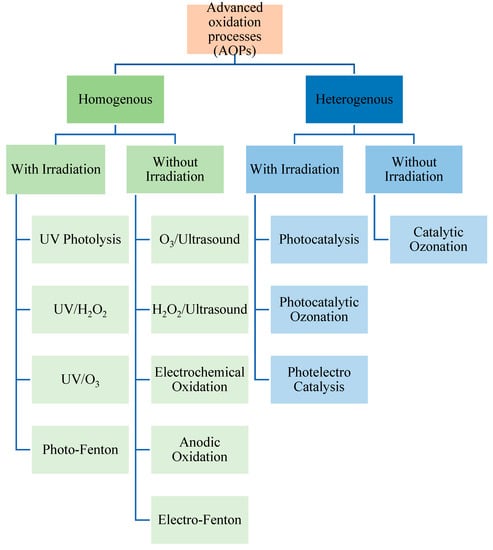
Figure 1.
Different AOP-based treatment methods. Source: Khan et al. [34].
4. Photochemical Treatment of Dyes
Photodegradation is one example of an advanced oxidation process (AOP). This method is the chemical breakdown of a large molecule into non-toxic molecules in which the process of hydroxyl radicals initiated by photons absorbed in the wavelength of UV, visible, and infra-red (IR) spectral ranges, with or without the presence of a catalyst or oxidants [19,34]. Hydroxyl radical generation can be accelerated by the combinations of some commonly used oxidants. The photodegradation of dyes is considered the most promising technology for the treatment of industrial wastewater processes as it is environmentally friendly, low-cost, and does not cause any secondary pollution [35]. The techniques available for the photodegradation of dyes are UV photolysis, photooxidation by oxidizing agents including hydroxyl radicals, hydrogen peroxide, ozone, and photocatalytic UV oxidation [34].
History
Humans first used photochemistry in 1500, when Canaanite peoples arrived along the Mediterranean’s eastern shore. The current organic photochemistry stage began in 1866 when Russian scientist Carl Julius von Fritzche found that when a concentrated anthracene solution was subjected to UV light, it precipitated. This precipitation occurs as a result of anthracene molecules joining together in pairs, or dimers, which are no longer soluble. Scientists have found that the materials (dyes and phosphors) must have the capability to absorb optical radiation. Photocatalysis studies using TiO2 have been reported since the early 20th century. In 1938, the photodegradation of dyes by TiO2 was reported. UV absorption produces active oxygen species on the TiO2 surface, causing the photodegradation of dyes. It was also discovered that TiO2 did not alter throughout the photoreaction, despite the fact that the photocatalyst terminology was not used for TiO2 in the paper and it was instead referred to as a photosensitizer [36].
5. Current Developments in UV Radiation Sources
Ultraviolet (UV) radiation is in the electromagnetic spectrum that human eyes cannot see [23,24,25]. There are three classifications of UV radiation based on the interaction of UV radiation with biological materials, which are UV-A (400–315 nm), UV-B (315–280 nm), and UV-C (280–100 nm) [23,24,25]. UV-A, also known as black light, is related to skin aging and has recently been linked to skin cancer in humans and animals. UV-B is also associated with the risk of skin cancer and it contributes to erythema (sunburn), but in contrast, it is also important in the synthesis of vitamin D, which suggests that it may potentially reduce the risk of prostate, breast, and colon cancer and is also used in phototherapy for baby jaundice [37]. UV-C’s effects on organisms are negligible, as it is completely filtered out by the Earth’s atmosphere, but UV-C is valuable as a research tool and a sterilizing procedure due to its bactericidal properties at wavelengths of 260–280 nm [25,37]. UV light is used in these photochemical techniques due to the greater energy of their photons, as shown by Planck’s equation [38]:
where is the energy of a photon, is the wavelength of the radiation, is the Planck’s constant, and is the speed of light.
Different types of sources have been used in photochemical AOPs for dye degradation, such as high-pressure mercury lamps (infrared radiation, UV, and visible range), low-pressure mercury lamps ( = 254 nm), pulsed UV lamps, ultraviolet light-emitting diodes (UV LEDs), microwave-powered electrodeless discharge lamps ( = 254 nm), tungsten lamps (λ > 410 nm), and continuously operated xenon lamps ( = 400–1000 nm) [8]. Several factors can influence the efficacy of the radiation system, including wastewater characteristics, UV intensity, microbe exposure period to UV, and the reactor design [39].
Continuous-wave mercury vapor lamps are commonly used in photochemical AOPs, in which the lamps are arc discharge instruments that emit UV radiation by creating an electric arc between the two electrodes in specifically constructed lamps containing mercury vapor or a combination of mercury and another gas [40]. The energy released by the excitation of the mercury vapor results in the emission of UV radiation. However, there are concerns over mercury toxicity, high energy needs, mechanical instability, and the cleaning costs of the application of mercury lamps, thus emphasizing the need to find alternative UV sources [33].
5.1. Pulsed UV Lamps
Pulsed UV (PUV) lamps are a non-mercury alternative to mercury vapor lamps. PUV lamps are a method that was initially developed for and has been used extensively in the inactivation of bacteria and viruses and is now utilized in industry to decontaminate the cups used in food packaging [8,41]. PUV is based on the use of xenon lamps and it generates polychromatic high-intensity light in a very short period using high-power electrical pulses [33]. The release occurs in a non-toxic, rare-gas environment and can use flashlamps or surface discharge lamps. PUV lamps are instant-on lights that do not require the warm-up period which is required for mercury vapor lamps and also possess higher efficiency [33]. As PUV contains a significant amount of UV light, a potential application of this technology might be its usage as a part of an AOP for the breakdown of polluting dyes. A few studies to assess the performance of PUV have been conducted on dyes such as MG dye and azo dyes in the UV/H2O2 process [8,41].
5.2. Ultraviolet Light Emitting Diodes (LEDs)
A light-emitting diode (LED) is a semiconductor device that emits light in a restricted range using electroluminescence [33]. LEDs are made of non-toxic materials and use less energy than conventional lamps because they convert more energy into light and lose less energy as heat. Furthermore, LEDs are durable and emit only the required wavelengths that will save energy. The small size of an LED may be advantageous in some applications [33]. UV LEDs are considered an efficient technology for water treatment, as LEDs with low wavelengths have been developed.
5.3. Microwaved Electrodeless Discharge Lamp
Microwave-assisted electrodeless discharge lamps also have been widely used and can emit light covering a wide spectrum from vacuum UV to infrared when bombarded with an electromagnetic field [33]. Longer lives are predicted for these lamps since the light lacks an electrode [40]. The microwave power was totally used in the experimental setup to create UV radiation and volumetric heating, both of which contributed to the dye degradation process and resulted in no microwave power energy loss. MWEDL is considered to be effective on an industrial scale for water treatment as well, depending on the reactor configuration [33].
6. Photolysis
Photolysis is termed photodegradation by the irradiation of UV light applied to degrade the compounds that absorb light at shorter wavelengths [22]. The interaction of the light with molecules causes the molecules to degrade into simpler fragments [38]. This method’s processes include UV/photolysis, UV/H2O2, UV/ozone, and photo-Fenton [22].
6.1. Direct Photolysis
UV/photolysis is a process that uses UV irradiation without oxidants and catalysts to break down the contaminants into smaller molecules [42]. The water molecule is cleaved under UV irradiation and transformed into hydrogen and hydroxyl radicals [20]. The photolysis reaction of dye can be represented by the following equation:
Dye + hν + (oxygen) → products
H2O + hν → •OH + H
Dye + •OH → products
6.2. Photolysis Method Based on H2O2 (UV/H2O2)
The UV/H2O2 process is a method that employs hydrogen peroxide in conjunction with UV radiation. Hydrogen peroxide involves external activation, such as UV light, and the photolysis of hydrogen peroxide will produce an effective oxidizing species, hydroxyl radical (•OH) [18]. The generation of hydroxyl radicals by the reaction of UV/H2O2 is as follows:
H2O2 + hν → 2•OH
6.3. Photolysis Method Based on O3 (UV/O3)
In the UV/O3 process, the generation of hydroxyl radicals occurs via ozone photolysis in the presence of water [18]:
O3 + hν + H2O → 2•OH + O2
Table 3 shows previous studies on the degradation of dyes via photolysis.
Table 3.
Various photolysis processes for degradation of dyes.
6.4. Photo-Fenton
Photo-Fenton is a process utilizing the combination of UV radiation with Fenton’s reagents (solution of hydrogen peroxide with ferrous iron), and as the light irradiation increases, the Fenton process efficiency will also increase. Irradiation with UV light could speed up the degradation of organic pollutants. The reactions of photo-Fenton are shown in Equations (7)–(9). UV light causes not only the production of more hydroxyl radicals but also the reuse of ferrous catalysts through Fe3+ reduction (Equation (8)) [45]. The decomposition of Fe(OH)2+ also enhances more •OH radicals (Equation (9)) [18]:
Fe2+ + H2O2 + hv → •OH + Fe3++ OH−
Fe3+ + H2O + hv → •OH + Fe2++ H+
Fe(OH)2+ + hν → Fe2+ + •OH
7. Factors Affecting the Degradation Rate of Photolysis Methods
7.1. Contact Time
Previous studies have reported that dye concentration in aqueous solutions decreases with irradiation exposure time. Joseph et al. [42] have reported that MB concentration degraded more with longer irradiation time. Safni et al. [74] have also reported that the degradation percentage of orange F3R by photolysis increased with increasing irradiation time with or without catalysts. This is because the longer the UV irradiation time, the more energy is absorbed by dye molecules from photons which facilitate them to degrade. The degradation efficiency also increases with irradiation time, because more hydroxyl radicals can be generated to oxidize the organic pollutants to break down into simpler molecules [42,74].
7.2. Radiation Source
Primarily, artificial light sources are purposely used in the photolysis process in wastewater treatment to maintain stable intensities and avoid other environmental factors. The intensity and wavelength of the light source significantly affect the photodegradation rate [34]. A shorter wavelength gives higher-energy photons, which will increase the degradation efficiency [42]. The higher intensity means more photons can be absorbed to generate hydroxyl radicals. However, in most photolysis experiments, very high-intensity light is avoided due to the probability of temperature rise, which could cause a thermal reaction [34]. The effects of UV irradiation intensities have been studied by Jamal et al. [43] and Algubili et al. [75]. They reported that the degradation percentage of dyes increased after treatment with increasing intensities of UV irradiation. The effect of different types of UV irradiation has been proven by Joseph et al. [42], who found that between four types of irradiation, UV-C (254 nm), UV-B (311 nm), UV-A (365 nm), and a solar lamp (610 nm), UV-C degraded MB dye almost 80% in only 1 h compared to after 5 h using UV-B, UV-A, and solar, which were only 12.07, 38.24, and 29.56, respectively.
7.3. pH of the Medium
The pH of the medium plays a vital role as a parameter of the degradation efficiency of dyes due to the wide range of pH values of dye effluents. In previous studies, researchers have performed comparative experiments on different pH conditions in the photochemical process. Ghodbane and Hamdaoui [50] have reported that the degradation rate of AB25 in acidic solutions (1.4–3) is higher, decreases from pH 1.4 to 5.7, and there is nearly no change in the pH range of 5.7–9.3. Then, higher decolorization rates were observed in a basic solution (10.5–11.8) because of the higher facility of OH radicals generated at these pH values. Mullapudi et al. [27] have reported that the maximum degradation of AR27 and MB by UV/H2O2 was achieved in the pH range of 3–9. The efficiency of degradation was decreased when the pH of the solution increased from 10 to 11. It can be explained that at higher pH, H2O2 deprotonates to form hydroperoxy anion (HO2−) which is a conjugate base of H2O2. The formed hydroperoxy anion reacts with OH− radicals and H2O2, yielding dioxygen and water, thereby reducing the availability of hydroxyl radicals to attack the target molecule and affecting the degradation efficiency [41].
7.4. Initial Concentration of Dyes
Many researchers have performed photolytic experiments by varying the initial concentration of dyes to investigate the effects on the degradation of dyes and organic pollutants. It is proven that the higher the initial concentration of dye, the lower the degradation rate. At high concentrations, the penetration of photons entering the solution diminishes, resulting in an inner filter effect and the solution is not accessible by UV light [75,76]. Bendjama et al. [49] have reported that the degradation efficiency of CB dye decreased with increasing initial concentration. For example, complete degradation was achieved for a dye concentration of 5 mg/L, and the result observed decreased to about 95% for 20 mg/L, 80% for 30 mg/L, and 37.4% for 50 mg/L of CB. Ghodbane and Hamdaoui [50] also reported that the degradation rate of AB25 dye decreased with an increasing initial concentration of dye. Similarly, it was also reported by Soltani and Entezari [77] that the photocatalytic degradation of MB dye is affected by the initial concentration, as the degradation rates were decreased when the initial concentration of MB was increased.
8. Photocatalysis
Photocatalysis is a heterogenous AOP using light irradiation and a semiconductor photocatalyst that absorbs light, which differs from other treatment techniques because this process performs oxidation and reduction simultaneously [22,78]. There are many semiconductor materials that have been used as catalysts for the degradation of organic pollutants and dyes, including TiO2, ZnO, Fe2O3, SnO2, ZrO2, CdS, ZnS, and many more. A number of studies have demonstrated that photocatalysis is a reliable and efficient method for degrading dyes in water. Table 4 lists the photocatalytic dye degradation used in the previous literature.
Table 4.
Various photocatalysts studied for the degradation of dyes.
8.1. Photocatalysts
8.1.1. Titanium Dioxide, TiO2, and Metal Oxide Semiconductors
Among the various photocatalysts, TiO2 is practically the only material appropriate for industrial applications at the moment and, most likely, in the future. This is due to the fact that TiO2 has the most efficient photoactivity, the best stability, and is inexpensive and readily available [44,78]. TiO2 degrades well-known cationic dyes such as MB, MG, MR, and basic violet. Basic dyes with high molecular weight are vulnerable to OH• and radicals produced by TiO2 [105]. Other than TiO2, metal oxide semiconductors such as SnO2, ZnO, NiO, ZrO2, and ZnS have been used as photocatalytic materials. Among the metal oxides, ZnO has also been utilized as a photocatalytic material in wastewater treatment for decolorization It is low-cost, chemically stable, and has a larger light absorption spectrum than TiO2 [105].
8.1.2. Modifications to Enhance Photocatalyst Activity
Metal Doping
The drawback of using TiO2 as a photocatalyst is that it can be operated only under UV irradiation (250 nm–350 nm) [105]. Because of the magnitude of its band gap energy (3.0–3.3 eV), TiO2 absorbs only a small percentage of the solar spectrum radiation [106,107]. In order to enhance the photocatalytic activity of TiO2, the researchers make nanocomposites with metal and non-metal because it can be enhanced by decreasing the unwanted recombination of photoinduced holes and electrons and expanding the catalyst’s photo response to the visible light area [108]. Metal ions such as manganese (Mn), zinc (Zn), aluminum (Al), iron (Fe), nickel (Ni), silver (Ag), palladium (Pd), chromium (Cr), vanadium (V), and platinum (Pt) have been widely used for doping with catalysts in order to minimize the band gap energy, which will improve the efficiency of UV light photocatalysis [108]. However, metal doping was also reported to have thermal instability and an increase in carrier trapping, which may decrease the photocatalytic efficiency [106]. Tolia et al. [96] have investigated the photocatalytic degradation of MG dye using Mn-doped ZnS and undoped ZnS nanoparticles. They found that with the doped photocatalyst, the rate of decolorization was increased as the Mn ion also functions as an oxidizing agent. However, it was discovered that increasing the doping concentration decreases photodegradation efficiency because the increase in manganese ions replaces Zn ions in the ZnS lattice structure and creates MnS, which reduces the activity of trapping electrons or holes.
Non-Metal Doping
Doping with non-metal also can enhance the efficiency of photocatalysis by suppressing electron-hole recombination and increasing the redox potential of OH•. Non-metal materials that have been utilized for doping are S, C, B, N, P, I, and F [109]. The inclusion of a co-dopant in photocatalysis can result in fast recombination of hole-electron pairs, implying that co-dopant TiO2 has greater photocatalytic degradation efficiency than single dopant TiO2. However, too much TiO2 doping would be unfavorable to the photocatalytic activity of the photocatalyst. Thus, an optimal amount of dopant is utilized to optimize the effectiveness of the photocatalytic activity [108]. Nitrogen doping onto TiO2 is considered due to high stability, small ionization, and comparable atomic size with oxygen that is better than standard TiO2 and shows improved photocatalytic activity in the visible region [107]. In the photocatalysis of reactive red 4 (RR4), complete degradation was observed with N-doped TiO2 after 60 min of LED light irradiation compared to only 40% or RR4 dye removed by undoped TiO2 [97]. The result clearly demonstrated that the N element in TiO2 lowered the band-gap energy, resulting in the photocatalyst being active under low visible light energy.
8.2. Mechanism of Photocatalysis
The schematic diagram of the general mechanism of photocatalysis is illustrated in Figure 2.
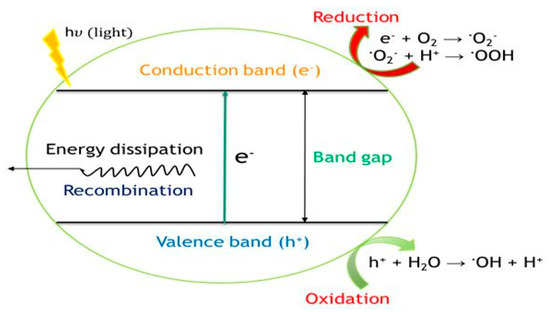
Figure 2.
Schematic diagram of the mechanism of photocatalysis. Source: Mishra et al. [78].
The transport of pollutants from the surrounding environment to the photocatalyst surface is the first step in photocatalysis. The dye compounds are initially adsorbed onto the surface, where oxidation and reduction reactions take place [105]. The photocatalyst usually has band structures that include an empty conduction band and a filled valence band. When light strikes a semiconductor, its energy photons exceed the semiconductor’s energy gap, and electrons are excited from the valence band to the conduction band by leaving holes behind (Equation (12)) [78]. The activated holes in the valence band (hVB+) react with water, generating hydroxyl radicals (•OH) (Equation (13)) and electrons in the conduction band (eCB−), generating superoxide radicals (Equation (14)) [78]. These radicals then degrade the pollutants into intermediates and further degrade to obtain H2O and CO2 (Equations (15) and (16)) [22]. The products are then desorbed from the surface of the photocatalyst and moved back into the aqueous phase [105]. The summarized reactions in the photocatalysis process are as follows:
Photocatalyst + hν → hVB+ + eCB−
H2O + hVB+ → •OH (hydroxyl radical) + H+
O2 + eCB− → O2 (superoxide radical)
•OH + Pollutant → Intermediates → H2O + CO2
•O2 + Pollutant → Intermediates → H2O + CO2
8.3. Factors Affecting Photocatalysis Process on Degradation of Dyes
8.3.1. Effect of pH
The key mechanism of the adsorptive removal of dyes in an aqueous solution is electrostatic interactions between dyes and metal catalysts. Metal hydroxyl groups (M-OH) are formed as a result of the adsorption of H2O molecules and the dissociation of OH− groups at the metal surface. When the solution pH is lower than the zero-point charge (ZPC) of the photocatalysts, the surface is positively charged (Equation (16)). On the other hand, when the solution pH is greater than the ZPC of the photocatalysts, the surface is negatively charged (Equation (17)) [5,88,89]. A high adsorption capacity is observed when anionic or cationic dyes are adsorbed on the photocatalyst surface at acidic or basic pH [5].
Laohaprapanon et al. [90] reported that the rapid color removal rates of RB5 under pH 3–9 were related to the photocatalytic activity of ZnO (pHzpc = pH 9). This can be explained on the basis of the electrostatic interactions between the anionic dyes with the positive catalyst surface of ZnO under lower pH. However, they also reported that the highest color removal rate was found at pH 11 due to direct dye photolysis and the photocatalytic activity of ZnO. Although lower adsorption at high pH, the possible reason is due to the fact that more hydroxyl radicals are generated from a high concentration of hydroxyl ions. A similar result has been reported by Kansal et al. [91] for RB5 and RO4. Juang et al. [93] also reported that an acidic medium is favorable for the photodegradation process of AO7 and RR2. Jawad et al. [88] reported that MB, which is basically a cationic dye, has the highest photocatalytic efficiency by TiO2 (pHzpc = pH 6.8) in an alkaline medium. This is because, at high pH, the TiO2 surface is negatively charged, which causes more adsorption on the catalyst surface due to electrostatic interaction, and also more hydroxyl radicals are generated because more hydroxyl ions are available on the surface.
8.3.2. Effect of Photocatalyst Loading
The photodegradation of dye increases as the amount of the photocatalyst increases. With increasing catalyst concentration, the number of active sites on the surface of the photocatalyst also increases. As a result, the production of OH radicals is increased, which is responsible for the degradation of dye solution [35]. Putri et al. [82] investigated the effect of photocatalyst—C-N-codoped TiO2—dosage on the degradation of violet-3B. They found that the removal percentage of the dye was increased up to 83% as the catalyst dosage increased up to 0.3 g/L. However, the removal percentage was decreased when the dosage was more than 0.3 g/L, which is due to the increased turbidity of the dye solution which results in the lower penetration of light and increased light scattering [105]. Similar results were reported by Gupta et al. [83] in photocatalysis of tartrazine dye using TiO2, wherein, by increasing the catalyst dosage from 0.02 g/l to 0.18 g/L, the degradation rate was increased, and then, with a catalyst dose of more than 0.18 g/L, the degradation remained constant. They also explained that when the amount of catalyst increases, the total active surface also increases. Simultaneously, UV-light penetration and the photoactivated volume of the suspension will be reduced due to the high dosage of the photocatalyst.
9. Energy Consumption and Cost–Benefit Analysis
UV-based processes for water treatment depend on the energy consumption in which electrical energy consumption represents a large amount of energy used. As a result, the decreased energy consumption would result in a larger yield and more accessibility of the approach. The amount of electrical energy consumed is determined by a variety of parameters, including the light source, the structure of the pollutants, and the type of reactor used [110]. Since electrical energy is so crucial in AOPs, the IUPAC has proposed a standard for addressing electrical energy used and reaction yield in UV-based AOPs [111].
where is the power of the used light source (kW), is irradiation time (min), is the volume of experimented solution (l), and are the initial and final concentrations of contaminants. is the amount of energy required to degrade the pollutant’s concentration in 1 m3 volume (kWh).
Mohajerani et al. [13] stated that UV/H2O2 operation normally has a fixed cost of $58,000 and the cost of the UV lamp is $15,000 per year for a treatment plant. T The reduction in the number of UV lamps and reactors needed for the effective treatment of wastewater by the presence of H2O2 and increasing the dose of H2O2. An economic analysis of photocatalysis has been studied by Raju et al. [112], by comparing the cost of the process of UV alone, UV-TiO2, granular activated carbon (GAC) alone, UV-GAC, and UV-GAC-TiO2. The analysis of the cost is in terms of US Dollars (USD) per kilogram (kg) of total volatile solids (TVS) utilized by the experimental results using the Equations (20) and (21).
where is the initial concentration of TVS, is the final concentration of TVS, and the total power consumed involves the power consumed for the peristaltic pump and/or UV lamps and operating the stirrer. Among the processes, they concluded that UV-GAC-TiO2 photocatalysis is the most cost-effective for wastewater treatment under batch and continuous operations.
10. Reaction Kinetics Model
In the process of photolysis, kinetic studies indicate the information on the optimum conditions for the degradation of dyes such as the initial concentration of dyes. The degradation kinetics of dyes can be determined by regressing the data obtained for the first-order kinetic Equation (22), pseudo-first-order kinetic Equation (23), second-order kinetic Equation (24), and pseudo-second-order kinetic equation Equation (25) [113]. The kinetic orders are being calculated to determine which order will fit the experimental data the best.
where A0 is the initial absorbance of the dye (A), At is the effluent absorbance of the dye at time t, Ae is the equilibrium absorbance of the dye, and k1 (min−1) and k2 (A−1 min−1) are the rate constants of the first-order and second-order kinetic equations [113]. Multiple studies of the photodegradation of dyes have been proven to be fitted to first-order reactions and pseudo-first-order reactions.
ln At = ln A0 − k1t
ln (At−Ae) = log (At−Ae) − k1(2.303)t
1/At = 1/A0 + k2t
t/At = 1/(k2Ae2) + (1/Ae)t
A mathematical model was studied under the heterogeneous photocatalytic degradation of wastewater containing petroleum [114]. The various parameters influencing the mechanism of degradation, such as the mass transfer step, the kinetics of the mineralization, etc., were considered as the model parameters. Mass balances were chosen as the bulk region and the catalyst phase was considered as the solid phase in order to develop the model. The degradation mechanism of the solid phase was considered in two stages, such as an equivalent intermediate (EI), in which the toluene is transformed to EI, and in the second stage, the oxidation of EI gives carbon dioxide (CO2). The results found a good correlation between modeling and empirical data in terms of degradation and mineralization. The simulation of the degradation kinetics of the target pollutant was obtained in the absence of a reaction pathway. A good similarity with the experiment was obtained for the target pollutant from the model.
11. Conclusions
One of the reasons for water pollution is the discharge of dye effluent into water bodies. Dye effluents in wastewater must be treated using efficient dye removal processes before being released into the environment, as they are one of the causes of water pollution. It was confirmed that AOPs that facilitate the combination of ultraviolet irradiation, catalysts, and oxidants to produce hydroxyl radicals (•OH) in solutions can be used as an effective technology for the degradation of dye-containing wastewater.
- AOPs are confirmed as a highly competitive technology in water treatment for removing organic pollutants, especially dyes.
- Different types of AOPs, such as photocatalysis, photolysis, UV/H2O2, photolysis, UV/O3, photo-Fenton, electrochemical oxidation, ozonation, sonolysis, etc., can be effectively used for the treatment of dye-containing wastewater.
- This paper thoroughly investigated the current utilization of photolysis and photocatalytic treatment processes, which are among effective AOPs, for the degradation of dye-containing wastewater.
- The study confirmed that photocatalysis could be used for the complete mineralization of various dyes present in water using light and a photocatalyst by the simultaneous occurrence of oxidation and reduction reactions.
- pH, the initial concentration of the dye, catalyst loading, etc., were identified to have an influence on the photocatalytic degradation of the dye.
- A recent development in the photocatalytic process using TiO2 is the photocatalyst modification by metal and non-metal doping, which results in improved photocatalytic activity in the presence of visible radiation.
- Utilizing a cost-effective and sustainable energy source for the photocatalytic degradation of pollutants is very effective.
- Sunlight as energy for the photocatalytic degradation of various dyes and other organic pollutants will be more efficient in terms of energy utilization.
- The combination of various AOPs such as photocatalysis combined with sonolysis, ozonation, electrolysis, Fenton, etc., will be major aspects for the complete mineralization of various organic pollutants. It will be effective, as there is a synergistic effect, by combining one or more AOPs, which will eliminate the drawbacks of individual processes.
- Scaling up an energy-efficient, cost-effective, and sustainable technique for the complete mineralization of various types of organic pollutants from water by using a reusable energy source, sunlight, and individual AOPs or hybrid AOPs is the challenging future aspect.
Author Contributions
S.M.A. Writing—review & editing. C.G.J. Supervision, Funding acquisition, Resource, Project administration, Writing—review & editing. C.K.P. Writing—review & editing. N.A.A. Writing—review & editing. S.N.M. Investigation, Writing—original draft. V.V. Writing—review & editing. All authors have read and agreed to the published version of the manuscript.
Funding
This research was funded by Research Management Center of Universiti Malaysia Sabah grant number GUG0315-1/2019. And The APC was funded by Research Management Center of Universiti Malaysia Sabah.
Data Availability Statement
Not applicable.
Acknowledgments
This research was supported by the Research Management Center of Universiti Malaysia Sabah (Grant No. GUG0315-1/2019). These contributions are gratefully acknowledged.
Conflicts of Interest
The authors declare no conflict of interest.
References
- Gürses, A.; Açıkyıldız, M.; Güneş, K.; Gürses, M.S. Dyes and pigments: Their structure and properties. In Dyes and Pigments; Springer: Berlin/Heidelberg, Germany, 2016; pp. 13–29. [Google Scholar]
- Morsy, S.A.G.Z.; Tajudin, A.A.; Ali, M.S.M.; Shariff, F.M. Current development in decolorization of synthetic dyes by immobilized laccases. Front. Microbiol. 2020, 11, 572309. [Google Scholar] [CrossRef] [PubMed]
- Benkhaya, S.M.; Rabet, S.; El Harfi, A. A review on classifications, recent synthesis and applications of textile dyes. Inorg. Chem. Commun. 2020, 115, 107891. [Google Scholar] [CrossRef]
- Piaskowski, K.; Świderska-Dąbrowska, R.; anf Zarzycki, P.K. Dye removal from water and wastewater using various physical, chemical, and biological processes. J. AOAC Int. 2018, 101, 1371–1384. [Google Scholar] [CrossRef]
- Chiu, Y.-H.; Chang, T.-F.; Chen, C.-Y.; Sone, M.; Hsu, Y.-J. Mechanistic insights into photodegradation of organic dyes using heterostructure photocatalysts. Catalysts 2019, 9, 430. [Google Scholar] [CrossRef] [Green Version]
- Hunger, K. Industrial Dyes: Chemistry, Properties, Applications; Wiley-VCH Verlag GmbH & Co. KGaA: Weinheim, Germany, 2003. [Google Scholar]
- Katheresan, V.; Kansedo, J.; Lau, S.Y. Efficiency of various recent wastewater dye removal methods: A review. J. Environ. Chem. Eng. 2018, 6, 4676–4697. [Google Scholar] [CrossRef]
- Navarro, P.; Gabaldón, J.A.; Gómez-López, V.M. Degradation of an azo dye by a fast and innovative pulsed light/H2O2 advanced oxidation process. Dye. Pigment. 2017, 136, 887–892. [Google Scholar] [CrossRef]
- Javaid, R.; Qazi, U.Y. Catalytic oxidation process for the degradation of synthetic dyes: An overview. Int. J. Environ. Res. Public Health 2019, 16, 2066. [Google Scholar] [CrossRef] [Green Version]
- Carmen, Z.; Daniela, S. Textile organic dyes—Characteristics, polluting effects and separation/elimination procedures from industrial effluents-A critical overview. In Organic Pollutants Ten Years after the Stockholm Convention—Environmental and Analytical Update; IntechOpen: Rijeka, Croatia, 2012; pp. 55–86. [Google Scholar]
- Ghaly, A.; Ananthashankar, R.; Alhattab, M.; Ramakrishnan, V. Production, characterization and treatment of textile effluents: A critical review. J. Chem. Eng. Process Technol. 2013, 5, 182. [Google Scholar]
- Naveed, S.; Bhatti, I. Membrane technology and its suitability for treatment of textile wastewater in Pakistan. J. Res. 2006, 17, 155–164. [Google Scholar]
- Mohajerani, M.; Mehrvar, M.; Ein-Mozaffari, F. An overview of the integration of advanced oxidation technologies and other processes for water and wastewater treatment. Int. J. Eng. IJE 2009, 3, 131. [Google Scholar]
- Yagub, M.T.; Sen, T.K.; Afroze, S.; Ang, H.M. Dye and its removal from aqueous solution by adsorption: A review. Adv. Colloid Interface Sci. 2014, 209, 172–184. [Google Scholar] [CrossRef] [PubMed]
- Adegoke, K.A.; Bello, O.S. Dye sequestration using agricultural wastes as adsorbents. Water Resour. Ind. 2015, 12, 8–24. [Google Scholar] [CrossRef] [Green Version]
- Yeap, K.L.; Teng, T.T.; Poh, B.T.; Morad, N.; Lee, K.E. Preparation and characterization of coagulation/flocculation behavior of a novel inorganic–organic hybrid polymer for reactive and disperse dyes removal. Chem. Eng. J. 2014, 243, 305–314. [Google Scholar] [CrossRef]
- Buthiyappan, A.; Abdul Aziz, A.R.; Wan Daud, W.M.A. Recent advances and prospects of catalytic advanced oxidation process in treating textile effluents. Rev. Chem. Eng. 2016, 32, 2. [Google Scholar] [CrossRef]
- Muruganandham, M.; Suri, R.P.S.; Jafari, S.; Sillanpää, M.; Lee, G.-J.; Wu, J.J.; Swaminathan, M. Recent developments in homogeneous advanced oxidation processes for water and wastewater treatment. Int. J. Photoenergy 2014, 2014, 821674. [Google Scholar] [CrossRef] [Green Version]
- Deng, Y.; Zhao, R. Advanced oxidation processes (AOPs) in wastewater treatment. Curr. Pollut. Rep. 2015, 1, 167–176. [Google Scholar] [CrossRef] [Green Version]
- Peter, A.; Mihaly-Cozmuta, A.; Nicula, C.; Mihaly-Cozmuta, L.; Jastrzębska, A.; Olszyna, A.; Baia, L. UV light-assisted degradation of methyl orange, methylene blue, phenol, salicylic acid, and rhodamine B: Photolysis versus photocatalyis. Water Air Soil Pollut. 2017, 228, 1. [Google Scholar] [CrossRef]
- Garrido-Cardenas, J.A.; Esteban-García, B.; Agüera, A.; Sánchez-Pérez, J.A.; Manzano-Agugliaro, F. Wastewater treatment by advanced oxidation process and their worldwide research trends. Int. J. Environ. Res. Public Health 2020, 17, 170. [Google Scholar] [CrossRef] [Green Version]
- Khan, S.H.; Yadav, V.K. Advanced Oxidation Processes for Wastewater Remediation: An Overview. In Removal of Emerging Contaminants Through Microbial Processes; Springer: Singapore, 2021. [Google Scholar]
- Britannica, T. (Ed.) Ultraviolet radiation. In Encyclopedia Britannica; 2021; Available online: https://www.britannica.com/science/ultraviolet-radiation (accessed on 15 June 2022).
- Britannica, T. (Ed.) Heterogeneous reaction. In Encyclopedia Britannica; 1998; Available online: https://www.britannica.com/science/heterogeneous-reaction (accessed on 15 June 2022).
- Britannica, T. (Ed.) Homogeneous reaction. In Encyclopedia Britannica; 2016; Available online: https://www.britannica.com/science/homogeneous-reaction (accessed on 15 June 2022).
- Hossain, S.; Chun, D.-M. ZnO decorated polydimethylsiloxane sponges as photocatalysts for effective removal of methylene blue dye. Mater. Chem. Phys. 2020, 255, 123589. [Google Scholar] [CrossRef]
- Mullapudi, V.B.K.; Salveru, A.; Kora, A.J. An in-house UV-photolysis setup for the rapid degradation of both cationic and anionic dyes in dynamic mode through UV/H2O2-based advanced oxidation process. Int. J. Environ. Anal. Chem. 2020, 100, 1–17. [Google Scholar] [CrossRef]
- Lovato, M.E.; Fiasconaro, M.L.; Martín, C.A. Degradation and toxicity depletion of RB19 anthraquinone dye in water by ozone-based technologies. Water Sci. Technol. 2017, 75, 813–822. [Google Scholar] [CrossRef] [PubMed] [Green Version]
- Fuentealba, D.; Venegas, C.; Morales, M.; Waissbluth, O. Comparing photo-Fenton degradation of malachite green using FeII and FeIII salts under UVA light irradiation. J. Braz. Chem. Soc. 2016, 27, 341–348. [Google Scholar]
- Chanikya, P.; Nidheesh, P.V.; Babu, D.S.; Gopinath, A.; Kumar, M.S. Treatment of dyeing wastewater by combined sulfate radical based electrochemical advanced oxidation and electrocoagulation processes. Sep. Purif. Technol. 2021, 254, 117570. [Google Scholar] [CrossRef]
- Dias, N.C.; Bassin, J.P.; Sant’Anna, G.L.; Dezotti, M. Ozonation of the dye reactive red 239 and biodegradation of ozonation products in a moving-bed biofilm reactor: Revealing reaction products and degradation pathways. Int. Biodeterior. Biodegrad. 2019, 144, 104742. [Google Scholar] [CrossRef]
- Eren, Z.; Ince, N.H. Sonolytic and sonocatalytic degradation of azo dyes by low and high frequency ultrasound. J. Hazard. Mater. 2010, 177, 1019–1024. [Google Scholar] [CrossRef]
- Vilhunen, S.; Sillanpää, M. Recent developments in photochemical and chemical AOPs in water treatment: A mini-review. Rev. Environ. Sci. Bio/Technol. 2010, 9, 323–330. [Google Scholar] [CrossRef]
- Khan, I.; Saeed, K.; Ali, N.; Khan, I.; Zhang, B.; Sadiq, M. Heterogeneous photodegradation of industrial dyes: An insight to different mechanisms and rate affecting parameters. J. Environ. Chem. Eng. 2020, 8, 104364. [Google Scholar] [CrossRef]
- Rafiq, A.; Ikram, M.; Ali, S.; Niaz, F.; Khan, M.; Khan, Q.; Maqbool, M. Photocatalytic degradation of dyes using semiconductor photocatalysts to clean industrial water pollution. J. Ind. Eng. Chem. 2021, 97, 111–112. [Google Scholar] [CrossRef]
- Hashimoto, K.; Irie, H.; Fujishima, A. TiO2 photocatalysis: A historical overview and future prospects. Jpn. J. Appl. Phys. 2005, 44, 8269–8285. [Google Scholar] [CrossRef]
- Gallagher, R.P.; Lee, T.K.; Bajdik, C.D.; Borugian, M. Ultraviolet radiation. Chronic Dis. Inj. Can. 2010, 29, 51–68. [Google Scholar] [CrossRef]
- Cuerda-Correa, E.M.; Alexandre-Franco, M.F.; Fernández-González, C. Advanced oxidation processes for the removal of antibiotics from water. An overview. Water 2019, 12, 102. [Google Scholar] [CrossRef] [Green Version]
- Mohammed, H.A.; Khaleefa, S.A.; Basheer, I.M. Photolysis of methylene blue dye using an advanced oxidation process (ultraviolet light and hydrogen peroxide). J. Eng. Sustain. Dev. 2021, 25, 59–67. [Google Scholar] [CrossRef]
- Asano, T.; Burton, F.; Leverenz, H. Water reuse. In Issues, Technologies and Applications, 1st ed.; Inc. Metcalf and Eddy, McGraw-Hill Companies Inc.: New York, NY, USA, 2006. [Google Scholar]
- Navarro, P.; Zapata, J.P.; Gotor, G.; Gonzalez-Olmos, R.; Gómez-López, V.M. Degradation of malachite green by a pulsed light/H2O2 process. Water Sci. Technol. 2019, 79, 260–269. [Google Scholar] [CrossRef]
- Joseph, C.; Taufiq-Yap, Y.H.; Elilarasi, L.; Krishnan, V. Remediation of cationic dye simulated wastewater using photolysis: Parametric and kinetic studies. Malays. J. Chem. 2017, 19, 82–98. [Google Scholar]
- Jamal, M.; Muneer, M.; Iqbal, M. Photo-degradation of monoazo dye blue 13 using advanced oxidation process. Chem. Int. 2015, 1, 12–16. [Google Scholar]
- De Lima, L.B.; Pereira, L.O.; de Moura, S.G.; Magalhães, F. Degradation of organic contaminants in effluents—Synthetic and from the textile industry-by Fenton, photocatalysis, and H2O2 photolysis. Environ. Sci. Pollut. Res. 2016, 24, 6299–6306. [Google Scholar] [CrossRef]
- Grčić, I.; Papić, S.; Mesec, D.; Koprivanac, N.; Vujević, D. The kinetics and efficiency of UV assisted advanced oxidation of various types of commercial organic dyes in water. J. Photochem. Photobiol. A Chem. 2014, 273, 49–58. [Google Scholar] [CrossRef]
- Nikravesh, B.; Shomalnasab, A.; Nayyer, A.; Aghababaei, N.; Zarebi, R.; Ghanbari, F. UV/Chlorine process for dye degradation in aqueous solution: Mechanism, affecting factors and toxicity evaluation for textile wastewater. J. Environ. Chem. Eng. 2020, 8, 104244. [Google Scholar] [CrossRef]
- Wang, S.; Luo, C.; Tan, F.; Cheng, X.; Ma, Q.; Wu, D.; Li, P.; Zhang, F.; Ma, J. Degradation of Congo red by UV photolysis of nitrate: Kinetics and degradation mechanism. Sep. Purif. Technol. 2021, 262, 118276. [Google Scholar] [CrossRef]
- Wen, D.; Li, W.; Lv, J.; Qiang, Z.; Li, M. Methylene blue degradation by the VUV/UV/persulfate process: Effect of pH on the roles of photolysis and oxidation. J. Hazard. Mater. 2020, 391, 121855. [Google Scholar] [CrossRef]
- Bendjama, H.; Merouani, S.; Hamdaoui, O.; Bouhelassa, M. UV-photolysis of Chlorazol Black in aqueous media: Process intensification using acetone and evidence of methyl radical implication in the degradation process. J. Photochem. Photobiol. A Chem. 2019, 368, 268–275. [Google Scholar] [CrossRef]
- Ghodbane, H.; Hamdaoui, O. Decolorization of antraquinonic dye, C.I. Acid Blue 25, in aqueous solution by direct UV irradiation, UV/ H2O2 and UV/Fe(II) processes. Chem. Eng. J. 2010, 160, 226–231. [Google Scholar] [CrossRef]
- Egerton, T.A.; Purnama, H. Does hydrogen peroxide really accelerate TiO2 UV-C photocatalyzed decolouration of azo-dyes such as reactive orange 16? Dye. Pigment. 2014, 101, 280–285. [Google Scholar] [CrossRef]
- Mitrovic, J.; Radovic, M.; Bojic, D.; Andjelkovic, T.; Purenovic, M.; Bojic, A. Decolorization of textile azo dye reactive orange 16 with UV/ H2O2 process. J. Serb. Chem. Soc. 2012, 77, 465–481. [Google Scholar] [CrossRef]
- Guimarães, J.R.; Guedes Maniero, M.; de Araújo, R.N. A comparative study on the degradation of RB-19 dye in an aqueous medium by advanced oxidation processes. J. Environ. Manag. 2012, 110, 33–39. [Google Scholar] [CrossRef] [PubMed]
- Ma, C.-M.; Hong, G.-B.; Chen, H.-W.; Hang, N.-T.; Shen, Y.-S. Photooxidation contribution study on the decomposition of azo dyes in aqueous solutions by VUV-based AOPs. Int. J. Photoenergy 2011, 2011, 156456. [Google Scholar] [CrossRef]
- Dhruv, B.; Abhipsa, M. UV/Fe+3 Photolysis process optimization using response surface methodology for decolorization of reactive red 120 dye simulated wastewater. In Recent Trends in Civil Engineering; Springer: Singapore, 2021. [Google Scholar]
- Zuorro, A.; Lavecchia, R. Evaluation of UV/ H2O2 advanced oxidation process (AOP) for the degradation of diazo dye reactive green 19 in aqueous solution. Desalination Water Treat. 2014, 52, 1571–1577. [Google Scholar] [CrossRef]
- Marhoon, A.A.; Saeed, S.I.; Ahmed, L.M. Application of some effects on the degradation of the aqueous solution of fuchsine dye by photolysis. J. Glob. Pharma Technol. 2019, 11, 76–81. [Google Scholar]
- Gole, V.L.; Gogate, P.R. Degradation of brilliant green dye using combined treatment strategies based on different irradiations. Sep. Purif. Technol. 2014, 133, 212–220. [Google Scholar] [CrossRef]
- Sartaj, S.; Ali, N.; Khan, A.; Malik, S.; Bilal, M.; Khan, M.; Ali, N.; Hussain, S.; Khan, H.; Khan, S. Performance evaluation of photolytic and electrochemical oxidation processes for enhanced degradation of food dyes laden wastewater. Water Sci. Technol. 2020, 81, 971–984. [Google Scholar] [CrossRef] [Green Version]
- Kalsoom, U.; Ashraf, S.S.; Meetani, M.A.; Rauf, M.A.; Bhatti, H.N. Degradation and kinetics of H2O2 assisted photochemical oxidation of Remazol Turquoise Blue. Chem. Eng. J. 2012, 200, 373–379. [Google Scholar] [CrossRef]
- Rauf, M.A.; Marzouki, N.; Körbahti, B.K. Photolytic decolorization of Rose Bengal by UV/H2O2 and data optimization using response surface method. J. Hazard. Mater. 2008, 159, 602–609. [Google Scholar] [CrossRef] [PubMed]
- Aliouche, S.; Djebbar, K.; Sehili, T. Removal of an azo dye (Alizarin yellow) in homogeneous medium using direct photolysis, acetone/UV, H2O2/UV, /UV, H2O2//UV, and /heat. Desalination Water Treat. 2016, 57, 18182–18193. [Google Scholar] [CrossRef]
- Körbahti, B.K.; Rauf, M.A. Determination of optimum operating conditions of carmine decoloration by UV/H2O2 using response surface methodology. J. Hazard. Mater. 2009, 161, 281–286. [Google Scholar] [CrossRef] [PubMed]
- Elmorsi, T.M.; Riyad, Y.M.; Mohamed, Z.H.; Abd El Bary, H.M.H. Decolorization of mordant red 73 azo dye in water using H2O2/UV and photo-Fenton treatment. J. Hazard. Mater. 2010, 174, 352–358. [Google Scholar] [CrossRef]
- Bousnoubra, I.; Djebbar, K.; Abdessemed, A.; Sehili, T. Decolorization of methyl green and bromocresol purple in mono and binary systems by photochemical processes: Direct UV photolysis, Acetone/UV and H2O2/UV. A comparative study. Desalination Water Treat. 2016, 57, 27710–27725. [Google Scholar] [CrossRef]
- Chenini, H.; Djebbar, K.; Zendaoui, S.M.; Sehili, T.; Zouchoune, B. Removal of an azo dye (Orange G) by various methods in homogeneous phase: Comparative study. Jordan J. Chem. 2011, 6, 307–319. [Google Scholar]
- Ding, X.; Gutierrez, L.; Croue, J.-P.; Li, M.; Wang, L.; Wang, Y. Hydroxyl and sulfate radical-based oxidation of RhB dye in UV/ H2O2 and UV/persulfate systems: Kinetics, mechanisms, and comparison. Chemosphere 2020, 253, 126655. [Google Scholar] [CrossRef]
- Maleki, A.; Mahvi, A.H.; Ebrahimi, R.; Zandsalimi, Y. Study of photochemical and sonochemical processes efficiency for degradation of dyes in aqueous solution. Korean J. Chem. Eng. 2010, 27, 1805–1810. [Google Scholar] [CrossRef]
- Kasiri, M.B.; Khataee, A.R. Photooxidative decolorization of two organic dyes with different chemical structures by UV/ H2O2 process: Experimental design. Desalination 2011, 270, 151–159. [Google Scholar] [CrossRef]
- Haji, S.; Benstaali, B.; Al-Bastaki, N. Degradation of methyl orange by UV/ H2O2 advanced oxidation process. Chem. Eng. J. 2011, 168, 134–139. [Google Scholar] [CrossRef]
- Jian-xiao, L.V.; Ying, C.; Guo-hong, X.; Ling-yun, Z.; Su-fen, W. Decoloration of methylene blue simulated wastewater using a UV- H2O2 combined system. J. Water Reuse Desalination 2011, 1, 45–51. [Google Scholar] [CrossRef] [Green Version]
- Chekir, N.; Tassalit, D.; Benhabiles, O.; Kasbadji Merzouk, N.; Ghenna, M.; Abdessemed, A.; Issaadi, R. A comparative study of tartrazine degradation using UV and solar fixed bed reactors. Int. J. Hydrogen Energy 2017, 42, 8948–8954. [Google Scholar] [CrossRef]
- Zukawa, T.; Sasaki, Y.; Kurosawa, T.; Kamiko, N. Photolysis of Indigo Carmine solution by planar vacuum-ultraviolet (147 nm) light source. Chemosphere 2019, 214, 123–129. [Google Scholar] [CrossRef]
- Safni, M.; Putri, R.; Wellia, D.; Septiani, U. Photodegradation of orange F3R dyes: Effect of light sources and the addition of CN—Codoped TiO2 catalyst. Pharma Chem. 2017, 9, 1–5. [Google Scholar]
- Algubili, A.M.; Alrobayi, E.M.; Alkaim, A.F. Photocatalytic degradation of remazol brilliant blue dye by ZnO/UV process. Int. J. Chem. Sci. 2015, 13, 911–921. [Google Scholar]
- Daneshvar, N.; Behnajady, M.A.; Mohammadi, M.K.A.; Dorraji, M.S.S. UV/ H2O2 treatment of rhodamine b in aqueous solution: Influence of operational parameters and kinetic modeling. Desalination 2008, 230, 16–26. [Google Scholar] [CrossRef]
- Soltani, T.; Entezari, M.H. Photolysis and photocatalysis of methylene blue by ferrite bismuth nanoparticles under sunlight irradiation. J. Mol. Catal. A Chem. 2013, 377, 197–203. [Google Scholar] [CrossRef]
- Mishra, N.; Reddy, R.; Kuila, A.; Rani, A.; Nawaz, A.; Pichiah, S. A review on advanced oxidation processes for effective water treatment. Curr. World Environ. 2017, 12, 469–489. [Google Scholar] [CrossRef]
- Damodar, R.A.; You, S.-J. Performance of an integrated membrane photocatalytic reactor for the removal of Reactive Black 5. Sep. Purif. Technol. 2010, 71, 44–49. [Google Scholar] [CrossRef]
- Bansal, P.; Sud, D. Photodegradation of commercial dye, Procion Blue HERD from real textile wastewater using nanocatalysts. Desalination 2011, 267, 244–249. [Google Scholar] [CrossRef]
- Soni, H.; Kumar, N.J.I. UV light induced photocatalytic degradation of malachite green on TiO2 nanoparticles. Int. J. Recent Res. Rev. 2014, 3, 10–15. [Google Scholar]
- Putri, R.A.; Safni, S.; Jamarun, N.; Septiani, U.; Kim, M.-K.; Zoh, K.-D. Degradation and mineralization of violet-3B dye using C-N-codoped TiO2 photocatalyst. Environ. Eng. Res. 2020, 25, 529–535. [Google Scholar] [CrossRef] [Green Version]
- Gupta, V.K.; Jain, R.; Nayak, A.; Agarwal, S.; Shrivastava, M. Removal of the hazardous dye—Tartrazine by photodegradation on titanium dioxide surface. Mater. Sci. Eng. C 2011, 31, 1062–1067. [Google Scholar] [CrossRef]
- Hadjltaief, B.H.; Ben Zina, M.; Galvez, M.E.; Da Costa, P. Photocatalytic degradation of methyl green dye in aqueous solution over natural clay-supported ZnO–TiO2 catalysts. J. Photochem. Photobiol. A Chem. 2016, 315, 25–33. [Google Scholar] [CrossRef] [Green Version]
- Lee, P.-W.; Ong, S.-T.; Hung, Y.-T.; Lee, S.-L. Photodegradation of malachite green by immobilization of titanium dioxide on glass plates. Asian J. Chem. 2013, 25, 755–758. [Google Scholar] [CrossRef]
- Bindhu, M.R.; Willington, T.D.; Hatshan, M.R.; Chen, S.-M.; Chen, T.-W. Environmental photochemistry with Sn/F simultaneously doped TiO2 nanoparticles: UV and visible light induced degradation of thiazine dye. Environ. Res. 2022, 207, 112108. [Google Scholar] [CrossRef]
- Sharma, S.K.; Bhunia, H.; Bajpai, P.K. Photocatalytic decolorization kinetics and mineralization of Reactive Black 5 aqueous solution by UV/TiO2 nanoparticles. CLEAN—Soil Air Water 2012, 40, 1290–1296. [Google Scholar] [CrossRef]
- Jawad, A.H.; Mubarak, N.S.A.; Ishak, M.A.M.; Ismail, K.; Nawawi, W.I. Kinetics of photocatalytic decolourization of cationic dye using porous TiO2 film. J. Taibah Univ. Sci. 2018, 10, 352–362. [Google Scholar] [CrossRef] [Green Version]
- Joseph, C.G.; Taufiq-Yap, Y.H.; Puma, G.L.; Sanmugam, K.; Quek, K.S. Photocatalytic degradation of cationic dye simulated wastewater using four radiation sources, UVA, UVB, UVC and solar lamp of identical power output. Desalination Water Treat. 2016, 57, 7976–7987. [Google Scholar] [CrossRef]
- Laohaprapanon, S.; Matahum, J.; Tayo, L.; You, S.-J. Photodegradation of Reactive Black 5 in a ZnO/UV slurry membrane reactor. J. Taiwan Inst. Chem. Eng. 2015, 49, 136–141. [Google Scholar] [CrossRef]
- Kansal, S.K.; Kaur, N.; Singh, S. Photocatalytic degradation of two commercial reactive dyes in aqueous phase using nanophotocatalysts. Nanoscale Res. Lett. 2009, 4, 709–716. [Google Scholar] [CrossRef] [PubMed] [Green Version]
- Kong, J.-Z.; Li, A.-D.; Li, X.-Y.; Zhai, H.-F.; Zhang, W.-Q.; Gong, Y.-P.; Li, H.; Wu, D. Photo-degradation of methylene blue using Ta-doped ZnO nanoparticle. J. Solid State Chem. 2010, 183, 1359–1364. [Google Scholar] [CrossRef]
- Juang, R.-S.; Lin, S.-H.; Hsueh, P.-Y. Removal of binary azo dyes from water by UV-irradiated degradation in TiO2 suspensions. J. Hazard. Mater. 2010, 182, 820–826. [Google Scholar] [CrossRef]
- Vaiano, V.; Sacco, O.; Sannino, D.; Ciambelli, P. Nanostructured N-doped TiO2 coated on glass spheres for the photocatalytic removal of organic dyes under UV or visible light irradiation. Appl. Catal. B Environ. 2015, 170, 153–161. [Google Scholar] [CrossRef]
- Shinde, D.R.; Tambade, P.S.; Chaskar, M.G.; Gadave, K.M. Photocatalytic degradation of dyes in water by analytical reagent grades ZnO, TiO2 and SnO2: A comparative study. Drink. Water Eng. Sci. 2017, 10, 109–117. [Google Scholar] [CrossRef] [Green Version]
- Tolia, J.; Chakraborty, M.; Murthy, Z. Photocatalytic degradation of malachite green dye using doped and undoped ZnS nanoparticles. Pol. J. Chem. Technol. 2012, 14, 16–21. [Google Scholar] [CrossRef] [Green Version]
- Azami, M.S.; Nawawi, W.I.; Jawad, A.H.; Ishak, M.A.M.; Ismail, K. N-doped TiO2 synthesised via microwave induced photocatalytic on RR4 dye removal under LED light irradiation. Sains Malays. 2017, 46, 1309–1316. [Google Scholar] [CrossRef]
- Tammina, S.K.; Mandal, B.K.; Kadiyala, N.K. Photocatalytic degradation of methylene blue dye by nonconventional synthesized SnO2 nanoparticles. Environ. Nanotechnol. Monit. Manag. 2018, 10, 339–350. [Google Scholar] [CrossRef]
- Khatri, A.; Rana, P.S. Visible light assisted photocatalysis of Methylene Blue and Rose Bengal dyes by iron doped NiO nanoparticles prepared via chemical co-precipitation. Phys. B Condens. Matter 2020, 579, 411905. [Google Scholar] [CrossRef]
- Reddy, C.V.; Reddy, I.N.; Ravindranadh, K.; Reddy, K.R.; Kim, D.; Shim, J. Ni-dopant concentration effect of ZrO2 photocatalyst on photoelectrochemical water splitting and efficient removal of toxic organic pollutants. Sep. Purif. Technol. 2020, 252, 117352. [Google Scholar] [CrossRef]
- Nguyen, C.H.; Fu, C.-C.; Juang, R.-S. Degradation of methylene blue and methyl orange by palladium-doped TiO2 photocatalysis for water reuse: Efficiency and degradation pathways. J. Clean. Prod. 2018, 202, 413–427. [Google Scholar] [CrossRef]
- Tichapondwa, S.M.; Newman, J.P.; Kubheka, O. Effect of TiO2 phase on the photocatalytic degradation of methylene blue dye. Phys. Chem. Earth Parts A/B/C 2020, 118, 102900. [Google Scholar] [CrossRef]
- Kazeminezhad, I.; Sadollahkhani, A. Influence of pH on the photocatalytic activity of ZnO nanoparticles. J. Mater. Sci. Mater. Electron. 2016, 27, 4206–4215. [Google Scholar] [CrossRef]
- Azzaz, A.A.; Assadi, A.A.; Jellali, S.; Bouzaza, A.; Wolbert, D.; Rtimi, S. Discoloration of simulated textile effluent in continuous photoreactor using immobilized titanium dioxide: Effect of zinc and sodium chloride. J. Photochem. Photobiol. A Chem. 2018, 358, 111–120. [Google Scholar] [CrossRef]
- Anwer, H.; Mahmood, A.; Lee, J.; Kim, K.-H.; Park, J.-W.; Yip, A.C.K. Photocatalysts for degradation of dyes in industrial effluents: Opportunities and challenges. Nano Res. 2019, 12, 955–972. [Google Scholar] [CrossRef]
- Sacco, O.; Stoller, M.; Vaiano, V.; Ciambelli, P.; Chianese, A.; Sannino, D. Photocatalytic degradation of organic dyes under visible light on N-doped TiO2 Photocatalysts. Int. J. Photoenergy 2012, 2012, 626759. [Google Scholar] [CrossRef] [Green Version]
- Khan, T.T.; Bari, G.A.K.M.R.; Kang, H.-J.; Lee, T.-G.; Park, J.-W.; Hwang, H.; Hossain, S.; Mun, J.; Suzuki, N.; Fujishima, A.; et al. Synthesis of N-doped TiO2 for efficient photocatalytic degradation of atmospheric NOx. Catalysts 2021, 11, 109. [Google Scholar] [CrossRef]
- Al-Mamun, M.R.; Kader, S.; Islam, M.S.; Khan, M.Z.H. Photocatalytic activity improvement and application of UV-TiO2 photocatalysis in textile wastewater treatment: A review. J. Environ. Chem. Eng. 2019, 7, 103248. [Google Scholar] [CrossRef]
- Wu, Y.; Xing, M.; Zhang, J. Gel-hydrothermal synthesis of carbon and boron co-doped TiO2 and evaluating its photocatalytic activity. J. Hazard. Mater. 2011, 192, 368–373. [Google Scholar] [CrossRef]
- Eskandarian, M.R.; Ganjkhanloo, M.; Rasoulifard, M.H.; Hosseini, S.A. Energy-efficient removal of acid red 14 by UV-LED/persulfate advanced oxidation process: Pulsed irradiation, duty cycle, reaction kinetics, and energy consumption. J. Taiwan Inst. Chem. Eng. 2021, 127, 129–139. [Google Scholar] [CrossRef]
- Bolton, J.R.; Bircher, K.G.; Tumas, W.; Tolman, C.A. Figures-of-merit for the technical development and application of advanced oxidation technologies for both electric- and solar-driven systems (IUPAC Technical Report). Pure Appl. Chem. 2001, 73, 627–637. [Google Scholar] [CrossRef]
- Raju, A.; Vishnuganth, M.; Asha, R.; Remya, N.; Selvaraju, N.; Kumar, M. Livestock wastewater treatment in batch and continuous photocatalytic systems: Performance and economic analyses. Water Air Soil Pollut. 2015, 226, 132. [Google Scholar]
- Basturk, E.; Karatas, M. Decolorization of antraquinone dye Reactive Blue 181 solution by UV/H2O2 process. J. Photochem. Photobiol. A Chem. 2015, 299, 67–72. [Google Scholar] [CrossRef]
- Rabahi, A.; Assadi, A.A.; Nasrallah, N. Photocatalytic treatment of petroleum industry wastewater using recirculating annular reactor: Comparison of experimental and modeling. Environ. Sci. Pollut. Res. 2019, 26, 19035–19046. [Google Scholar] [CrossRef]
Publisher’s Note: MDPI stays neutral with regard to jurisdictional claims in published maps and institutional affiliations. |
© 2022 by the authors. Licensee MDPI, Basel, Switzerland. This article is an open access article distributed under the terms and conditions of the Creative Commons Attribution (CC BY) license (https://creativecommons.org/licenses/by/4.0/).