


Abstract
Diabetic foot ulcers are among the most severe complications of diabetes mellitus, disproportionately affecting populations in low- and middle-income countries. Digital health technologies have emerged as promising tools for prevention, diagnosis, and management; however, their effectiveness, usability, and applicability within public health systems remain insufficiently defined. This systematic review aimed to critically synthesize the clinical effectiveness, perceived usability, and methodological quality of digital interventions for the care of individuals with diabetes-related foot ulcers. A comprehensive search was performed in PubMed, Scopus, Web of Science, Embase, and Google Scholar for studies published between 2012 and 2024. Eighteen studies met the inclusion criteria, encompassing mobile health applications, wearable sensor devices, artificial intelligence-based tools, and telehealth platforms. Methodological quality was assessed using the Mixed Methods Appraisal Tool. Artificial intelligence-driven approaches demonstrated high diagnostic accuracy, with sensitivity and specificity above 90% for ulcer detection and classification. Mobile applications showed positive effects on self-efficacy, glycemic control, and adherence to preventive foot care, while usability scores were consistently high. Wearable sensor devices demonstrated potential for reducing ulcer recurrence, though supporting evidence remains limited. Across studies, recurrent methodological limitations included small sample sizes, absence of control groups, lack of economic evaluations, and barriers related to digital literacy and interoperability between systems. Most investigations were conducted in high-income countries, with limited consideration of public health contexts such as the Brazilian Unified Health System. In conclusion, digital health technologies show promise in improving the care of individuals with diabetes-related foot complications but face significant challenges regarding scalability, equity of access, and integration into public healthcare systems. Future research should prioritize context-adapted designs, robust clinical trials, and economic evaluations to inform health policies and support the rational adoption of these tools within universal health coverage frameworks. PROSPERO registration number: CRD420251023152.
1. Introduction
Diabetic foot ulcers (DFU) are among the most severe and recurrent complications of diabetes mellitus, affecting 15–25% of patients during their lifetime [1]. They account for up to 85% of non-traumatic lower-limb amputations and are closely linked to functional decline, increased mortality, and substantial economic burden, particularly in low- and middle-income countries (LMICs) [2,3].
Despite advances in management—including surgical debridement, advanced wound dressings, and intensive glycemic control—recurrence rates remain high, with nearly 40% of patients experiencing a new ulcer within one year of initial healing [4]. In health systems with limited infrastructure and workforce shortages, such as those in parts of Latin America, these challenges are compounded by barriers to early diagnosis, continuity of care, and patient education.
In response, digital health technologies have gained prominence in clinical practice. These include mobile applications for self-care, wearable sensors for early detection of plantar changes, artificial intelligence (AI)-driven systems for automated triage, and telehealth platforms for remote monitoring [5,6,7]. When effectively implemented, such tools can expand access to healthcare, reduce hospitalizations, and strengthen disease surveillance in both urban and rural populations.
However, the literature demonstrates marked heterogeneity in the technologies evaluated, the outcomes measured, and the methodological quality of studies [8,9]. Moreover, most innovations are developed in high-income countries (HICs) and often fail to address structural barriers typical of public health systems, including low digital literacy, poor internet connectivity, fragmented electronic health records, and limited regulatory frameworks for digital innovation.
Thus, beyond clinical efficacy, it is essential to examine how digital interventions interact with public health governance, resource allocation, and equity of access—particularly within universal health systems such as the Brazilian Unified Health System (SUS). As digital health strategies become central to chronic disease management, their implementation must be critically appraised in terms of system capacity, workforce readiness, and the ethical implications of technological exclusion.
Against this backdrop, the present systematic review critically synthesizes current evidence on digital health technologies for the prevention, monitoring, and treatment of DFU. The review emphasizes clinical effectiveness, usability, and methodological rigor, while also addressing broader implications for access, equity, and health system integration in resource-constrained contexts.
2. Methods
This systematic review was conducted in accordance with the Preferred Reporting Items for Systematic Reviews and Meta-Analyses (PRISMA 2020) guidelines. The protocol was prospectively registered in the PROSPERO database (CRD420251023152). All methodological steps were performed independently by two trained reviewers to ensure transparency, reproducibility, and methodological rigor. Discrepancies were resolved by consensus with a third reviewer [10].
2.1. Data Sources and Search Strategy
A comprehensive literature search was conducted in PubMed/MEDLINE, Scopus, and Web of Science. The search covered studies published between 1 January 2012, and 15 April 2025, reflecting a 13-year period of rapid expansion in digital health technologies applied to diabetic foot care.
The search strategy combined controlled vocabulary (Medical Subject Headings [MeSH] and Health Sciences Descriptors [DeCS]) with free-text terms, organized into three domains: (i) clinical condition (“diabetes mellitus,” “diabetic foot,” “foot ulcer”); (ii) digital technologies (“mobile applications,” “electronic health,” “mobile health,” “artificial intelligence,” “wearable sensors”); and (iii) intervention functionalities (“self-care,” “health education,” “remote monitoring,” “psychometric validation”). Boolean operators (“AND,” “OR”) were used to combine terms, and the syntax was adapted to each database. The complete search strategy is provided in Supplementary Material File S1.
Gray literature was also screened through Google Scholar, restricted to the first 60 results ranked by relevance. Reference lists of included articles were manually examined to identify additional eligible studies, and the ClinicalTrials.gov registry was consulted. Non-peer-reviewed documents (e.g., preprints, patents, dissertations, and technical reports) were excluded.
2.2. Eligibility Criteria
This review included empirical studies with human participants diagnosed with type 1 or type 2 diabetes mellitus, evaluating digital health technologies for the prevention, detection, monitoring, education, or remote support of plantar foot ulcers. Eligible interventions comprised mobile health applications, wearable sensors, artificial intelligence (AI)-based systems, digital platforms, and clinical decision-support tools.
Studies were required to report at least one clinical outcome (e.g., ulcer incidence or recurrence, wound-healing time, glycemic control) or one psychometric outcome (e.g., usability, self-efficacy, adherence to foot care, technology acceptance). Only articles published between January 2012 and April 2025 were considered.
Exclusion criteria included publications not in English, Portuguese, or Spanish; literature reviews, editorials, letters, or conference abstracts; studies using animal models or computer simulations without clinical validation; and studies lacking measurable clinical or psychometric outcomes.
2.3. Study Selection
The study selection followed three sequential steps: (i) removal of duplicates, (ii) screening of titles and abstracts, and (iii) full-text assessment. The Rayyan QCRI platform was used to enable blinded screening and decision tracking [11]. Two independent reviewers (T.C.D.d.O. and A.F.d.O.) performed the selection, achieving a Cohen’s kappa coefficient of 0.84, which indicates substantial agreement. Discrepancies were resolved by a third reviewer (L.W.P.d.S.). When full texts were unavailable, corresponding authors were contacted via institutional email or through the ResearchGate platform.
2.4. Data Extraction
Data extraction was conducted using a structured Microsoft Excel® spreadsheet, pilot-tested on five randomly selected studies. Two reviewers (T.C.D.d.O. and A.F.d.O.) independently extracted the data, and discrepancies were resolved through discussion with a third reviewer (L.W.P.d.S.).
Extracted variables included study identification (first author, year), country of origin, study design, sample characteristics, type of digital technology, clinical and operational outcomes, psychometric instruments, and main findings.
2.5. Methodological Quality Assessment
The methodological quality of included studies was assessed using tools appropriate to each study design. Randomized controlled trials were evaluated with the Cochrane Risk of Bias 2.0 (RoB 2.0), which covers randomization, deviations from intended interventions, missing data, outcome measurement, and reporting bias. Non-randomized studies were assessed with the Risk Of Bias In Non-randomized Studies of Interventions (ROBINS-I), which examines seven domains including confounding, participant selection, and selective reporting.
Observational studies were appraised using the Newcastle–Ottawa Scale (NOS), covering selection, comparability, and outcome assessment. For studies involving technological development, psychometric validation, or qualitative methods, checklists from the Joanna Briggs Institute (JBI) were applied. Psychometric studies were further evaluated for content validity, internal consistency (e.g., Cronbach’s alpha ≥ 0.80), and statistical robustness.
Reporting guidelines—including the Consolidated Standards of Reporting Trials (CONSORT), Strengthening the Reporting of Observational Studies in Epidemiology (STROBE), and Quality Assessment of Diagnostic Accuracy Studies (QUADAS)—were also used to support methodological appraisal.
All assessments were independently conducted by two reviewers (A.F.d.O. and L.W.P.d.S.) following prior calibration on a pilot set of studies. Discrepancies were resolved by consensus. Risk of bias was classified as high when two or more domains showed “critical risk,” moderate when one critical or multiple concerns were identified, and low otherwise.
2.6. Data Synthesis
Given the heterogeneity in study design, population characteristics, technologies evaluated, and outcomes measured, a meta-analysis was not feasible. Instead, a narrative and systematic synthesis was performed in accordance with the Synthesis Without Meta-analysis (SWiM) framework.
To enable structured comparison, studies were grouped by primary type of digital technology: (i) mobile health applications and platforms, (ii) artificial intelligence (AI)-based algorithms and computer vision systems, (iii) wearable sensors and embedded medical devices, and (iv) integrated platforms or clinical decision-support systems. Within each category, outcomes were classified into three domains: clinical outcomes (e.g., ulcer healing, recurrence, glycemic control [HbA1c]); operational outcomes (e.g., treatment adherence, frequency of use, user engagement); and psychometric outcomes (e.g., usability, self-efficacy, perceived usefulness, satisfaction).
Two reviewers independently analyzed and interpreted the findings, with discrepancies resolved through discussion. Summary tables were developed to facilitate cross-category comparisons. Although statistical pooling of effect sizes was not possible, consistent patterns were identified and critically examined, including limitations in external validity and implications for public health policy and digital equity.
3. Results
3.1. Search Results
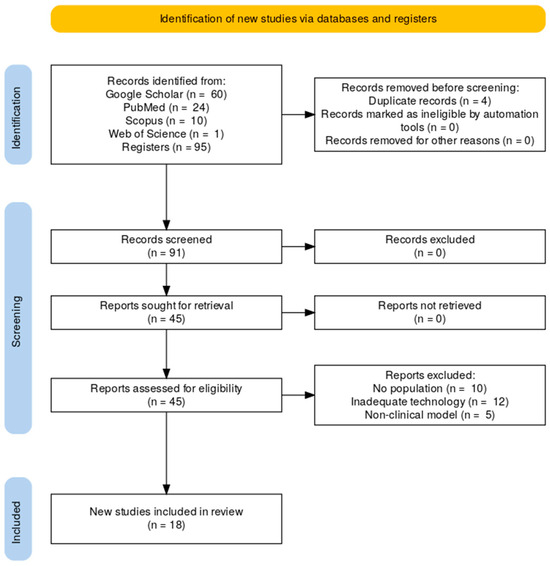
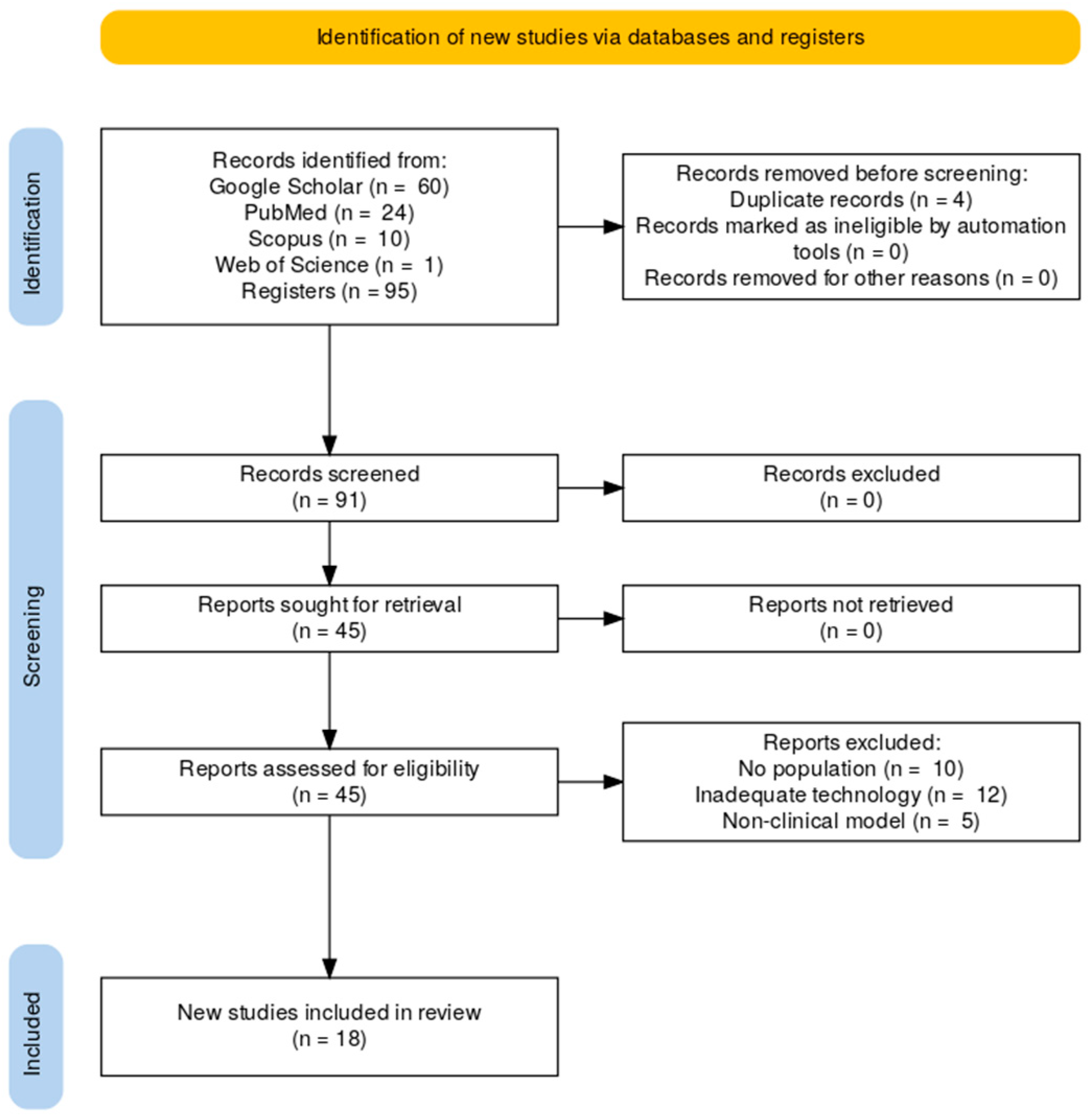
The systematic search of PubMed, Scopus, and Web of Science initially identified 95 records. After duplicate removal, 49 unique studies remained. Title and abstract screening excluded 46 records that did not meet the predefined eligibility criteria. The full texts of the remaining 45 studies were then assessed for eligibility, of which 27 were excluded due to lack of clinical or psychometric outcomes, ineligible populations, use of non-digital technologies, or incompatible study designs.
In total, 18 studies met all inclusion criteria and were retained for this systematic review [2,12,13,14,15,16,17,18,19,20,21,22,23,24,25,26,27,28]. The selection process, conducted in accordance with the Preferred Reporting Items for Systematic Reviews and Meta-Analyses (PRISMA 2020) guidelines, is illustrated in Figure 1.
Figure 1.
Study selection flowchart through literature search.
3.2. Characteristics of the Included Studies
The included populations varied considerably in sample size, age distribution, and clinical complexity. Samples ranged from healthy young adults, primarily recruited for device validation, to individuals with diabetes mellitus presenting with recurrent plantar ulcers, peripheral neuropathy, prior lower-limb amputations, and multiple cardiovascular or metabolic comorbidities. Most studies included middle-aged or elderly participants, reflecting the demographic profile most affected by DFU. Several also reported concomitant medication use, particularly antidiabetic agents (insulin, oral hypoglycemic drugs), cardiovascular therapies (antihypertensives, statins, antiplatelet agents), and treatments for neuropathic pain, all of which may influence ulcer healing, recurrence risk, and adherence to digital interventions.
Sample sizes ranged from single-patient case reports to large image datasets used for computational model training and validation. The digital technologies evaluated were categorized into four groups: (i) mobile health applications and platforms (e.g., INTELLIN®, MyFootCare, Minuteful, CARPeDia, Swift Medical Connect); (ii) artificial intelligence (AI) algorithms and computer vision systems (e.g., Faster Region-Based Convolutional Neural Network [R-CNN], Support Vector Machine [SVM], DenseNet, Mask R-CNN, Region-Based Fully Convolutional Network); (iii) wearable sensors and embedded devices, including smart insoles (Orpyx®), sensorized boots with inertial measurement units, and plantar thermometry systems (TempStat™); and (iv) clinical decision-support systems, often integrated with electronic medical records and used in outpatient care.
Each category presented distinct strengths and limitations. Mobile applications were widely accessible and user-friendly, improving self-management and adherence, but their effectiveness depended on sustained engagement and digital literacy. AI-based systems achieved the highest technical performance, often surpassing 90% accuracy for ulcer detection and classification, though their generalizability was constrained by small datasets and lack of external validation. Wearable sensors enabled continuous monitoring of plantar pressure and temperature, supporting early detection of recurrence risk, but faced challenges of cost, usability, and long-term adherence. Clinical decision-support systems enhanced professional decision-making when integrated with electronic records, although their direct impact on outcomes remained less validated and depended on interoperability and infrastructure. No single technology emerged as universally superior; instead, complementary or hybrid approaches may offer the most comprehensive solutions for DFU care.
Outcomes were classified into four domains: (i) clinical (ulcer recurrence, progression, new ulcer incidence); (ii) technical (accuracy, sensitivity, specificity, intersection over union [IoU], mean average precision [mAP]); (iii) operational (treatment adherence, user engagement, frequency of image transmission, interaction time); and (iv) psychometric (usability, satisfaction, perceived value).
Of the 18 studies included, 7 employed validated psychometric instruments, such as the System Usability Scale (SUS), EuroQol five-dimension instrument (EQ-5D), Technology Acceptance Model (TAM), self-efficacy scales (Cronbach’s alpha ≥ 0.82), and adapted tools including the National Patient Survey and the OPUS scale [2,12,17,20,23,25,27]. The remaining 11 relied on non-standardized qualitative analyses, ad hoc questionnaires, or lacked structured psychometric assessment, limiting comparability and reproducibility [13,14,15,16,18,19,21,22,24,26,28].
AI-based approaches demonstrated high technical performance, with accuracy above 90% for ulcer detection and classification, comparable to experienced clinical evaluators [16,29]. Nonetheless, most studies used small datasets under controlled conditions, limiting external validity. Performance may vary in real-world clinical environments, where image quality, population heterogeneity, and workflow integration are critical. Large-scale, multicenter validation is therefore required before clinical adoption.
Mobile health applications targeting education and self-care were associated with improved self-efficacy, adherence, and glycemic control, including significant reductions in glycated hemoglobin (HbA1c) [23]. Plantar sensor technologies proved effective for early detection of pressure and temperature changes, enabling timely interventions such as offloading and footwear adjustments [14,25]. However, long-term adherence was inconsistent, influenced by comfort, device durability, and daily usability. Most studies also involved small samples and short follow-up, limiting evidence strength. Still, plantar sensors hold promise as cost-effective adjuncts to clinical monitoring in high-risk populations.
Key methodological limitations included socioeconomic barriers (restricted access to mobile devices, poor connectivity), low digital literacy, technical failures in system interoperability, and small sample sizes that undermined statistical power and generalizability [8,23,30,31,32,33,34].
Table 1 presents a summary of the key methodological characteristics and empirical findings of the studies included in this systematic review.
Table 1.
Characteristics of the included studies.
3.3. Quality Assessment
Among the randomized clinical trials (n = 3), Chen et al. [23] and Hellstrand Tang et al. [27] reported adequate randomization and partial blinding, minimizing potential performance bias. Only Chen et al. [23] explicitly described the use of intention-to-treat analysis. The protocol by Lazo-Porras et al. [14] was considered eligible; however, as no outcome data were available, a full methodological appraisal was not possible.
For studies focused on the development and validation of digital technologies (n = 9), quality appraisal considered detailed reporting of system architectures, use of cross-validation techniques (e.g., k-fold, external validation), and robust performance metrics such as accuracy, sensitivity, specificity, intersection over union (IoU), and mean average precision (mAP) [2,13,15,16,17,18,22,24,25]. Six studies applied either cross-validation or external testing, while three provided comprehensive descriptions of modeling strategies. Notably, Goyal et al. [16] and Ferreira et al. [2] explicitly acknowledged algorithmic limitations, enhancing transparency and reproducibility in computational analyses.
Studies evaluating wearable sensors or embedded medical devices (n = 4) [18,19,25,28] emphasized in-field clinical validation, use of objective indicators of user engagement (e.g., duration of use, number of alerts generated), and integration with mobile platforms or electronic health records. Park et al. [25] and Matijevich et al. [28] reported the most rigorous protocols in this category, although heterogeneity in engagement metrics limited direct comparability.
In usability and perception studies (n = 6) [2,12,17,23,25,27], validated psychometric instruments were frequently applied, including the System Usability Scale (SUS), Technology Acceptance Model (TAM), EuroQol five-dimension instrument (EQ-5D), and adapted tools such as the National Patient Survey and the OPUS scale. Mean scores consistently exceeded 80, indicating high acceptability. In contrast, two studies relied solely on non-standardized qualitative methods or ad hoc questionnaires and were thus classified as presenting a moderate risk of descriptive bias [19,26].
One study (n = 1), Haycocks et al. [21], employed a mixed-methods design that combined quantitative outcomes (e.g., SINBAD score, cost–utility analysis using Markov modeling) with qualitative usability evaluation. However, the absence of validated psychometric instruments and a formal methodological framework for qualitative analysis led to classification as moderate risk.
Overall, studies were stratified into three levels of bias risk: (i) low risk, assigned to 13 investigations with robust design, validated outcome measures, and well-defined populations (e.g., Chen et al. [23], Ferreira et al. [2], Zoppo et al. [18]); (ii) moderate risk, assigned to four studies with limitations such as small sample sizes, absence of control groups, or reliance on unvalidated instruments (e.g., Ploderer et al. [19], Kong et al. [24], Keegan et al. [26], Haycocks et al. [21]); and (iii) high or undefined risk, attributed to the protocol by Lazo-Porras et al. [14] and to studies that did not adequately report psychometric assessment strategies.
Table 2 provides a structured synthesis of methodological validation, use of psychometric instruments, and risk-of-bias assessment across all included studies, complementing the narrative description and facilitating rapid cross-study comparison.
Table 2.
Sintese Quality assessment.
4. Discussion
To our knowledge, this is the first systematic review to comprehensively synthesize evidence on digital health technologies applied to the prevention, detection, and management of diabetic foot ulcers (DFU). The findings indicate that mobile applications, wearable sensors, artificial intelligence (AI)-based algorithms, and integrated platforms hold considerable potential to enhance diagnostic accuracy, promote patient engagement, and enable remote lesion monitoring across diverse care settings.
AI-based interventions emerged as the most technically advanced. Studies employing convolutional neural networks (CNNs)—including Faster R-CNN, Mask R-CNN—and DenseNet architectures reported sensitivity and specificity above 90%, approaching or surpassing the diagnostic performance of clinical specialists. Despite these promising results, most studies were limited by small datasets, absence of external validation, and scarce evidence of real-world implementation. Variability in image quality, device resolution, and workflow integration further constrained generalizability. Standardization of datasets and adherence to frameworks such as CONSORT-AI and STARD-AI are essential to strengthen reproducibility and reliability.
Mobile applications demonstrated improvements in self-care, treatment adherence, and glycemic control, particularly when grounded in behavioral models such as Bandura’s Theory of Self-Efficacy. For example, Chen et al. [23] reported significant increases in self-efficacy scores and reductions in glycated hemoglobin among users of an educational platform. These tools are low-cost and accessible, making them attractive in public health contexts. However, their effectiveness depends heavily on sustained engagement and digital literacy. Socioeconomic inequalities, lack of device compatibility, and poor internet connectivity remain critical barriers, especially in low-resource and older populations. Gaps in digital literacy, rural connectivity, and affordability further reinforce inequities in access.
Sensor-based technologies, including smart insoles and thermal or pressure monitoring systems, provided continuous and objective detection of plantar load and temperature variations—risk factors strongly associated with ulcer recurrence. Studies such as Matijevich et al. [28] reported recurrence prevention benefits during longitudinal follow-up. Nonetheless, limited sample sizes, lack of control groups, non-standardized adherence measures, and issues of cost, comfort, and durability reduced scalability. Long-term adherence was frequently undermined by integration challenges with daily routines.
Emerging imaging modalities, such as infrared thermography and automated wound measurement, remain exploratory but show potential for broader integration. For instance, Wijesinghe et al. [16] developed an AI-powered telehealth prototype that combined retinal and DFU imaging, achieving >97% classification accuracy. Despite strong technical performance, these approaches remain underrepresented in the literature, warranting further validation in diverse clinical contexts.
Assessments of usability and user perception revealed substantial methodological heterogeneity. While some studies employed validated instruments such as the System Usability Scale (SUS), others relied on non-standardized questionnaires or qualitative assessments, limiting comparability. Haycocks et al. [21], for example, relied exclusively on non-validated self-reported data, while Ploderer et al. [26] applied Likert scales without psychometric validation. These weaknesses underscore the importance of employing culturally adapted and validated tools, particularly for low-literacy and digitally vulnerable populations.
Geographical disparities were also evident. Most studies originated from high-income countries (e.g., United States, United Kingdom, Canada), where research focused primarily on technical validation and usability under controlled conditions. In contrast, studies from low- and middle-income countries (LMICs), such as Brazil and Peru, emphasized barriers related to infrastructure, health equity, and system integration, particularly within universal health systems such as the Brazilian Unified Health System (SUS). These systems face persistent challenges, including the absence of standardized national digital health protocols, fragmented electronic infrastructures, and insufficient policy frameworks for innovation.
Another critical gap is the paucity of robust economic evaluations. Only a minority of studies assessed cost-effectiveness, cost–utility, or organizational impact in real-world settings. Such analyses are crucial for decision-makers in resource-constrained contexts, where evidence of economic value is essential to justify technology adoption and guide rational allocation of scarce resources. Without this, innovations risk remaining confined to pilot projects.
Comparative synthesis across technology categories suggests complementary strengths and limitations. Mobile applications are accessible but dependent on literacy and engagement. AI systems achieved the highest diagnostic accuracy (>90%) but require larger, more diverse datasets and multicenter validation. Wearable sensors provide continuous monitoring but face adherence, usability, and cost barriers. Imaging-based modalities remain exploratory but present opportunities for integration into hybrid digital ecosystems. No single technology emerged as universally superior; instead, hybrid or integrated strategies appear most promising for comprehensive, equitable, and sustainable DFU management.
Despite the enthusiasm surrounding digital health, this review identified significant methodological limitations. Few studies employed randomized controlled designs or intention-to-treat analyses, and statistical modeling was often limited. The wide variation in outcomes—spanning computational metrics (e.g., accuracy, sensitivity), clinical endpoints (e.g., recurrence, healing time), and psychometric measures (e.g., usability, self-efficacy)—precluded meta-analysis and hampered comparability. Furthermore, while age and medication use were frequently reported, few studies explored their influence on technology adoption, adherence, or clinical outcomes, representing critical gaps for future research.
Methodological quality appraisal indicated that most studies presented low or moderate risk of bias. Investigations with robust designs, validated outcomes, and well-defined populations (e.g., Chen et al. [23], Ferreira et al. [2], Zoppo et al. [18]) were classified as low risk. Conversely, studies with small samples, lack of control groups, or reliance on unvalidated instruments (e.g., Kong et al. [19], Ploderer et al. [26], Haycocks et al. [21]) were deemed moderate risk. The protocol by Lazo-Porras et al. [14] was considered high or undefined risk due to the absence of outcome data.
Among the strengths of this review are the comprehensiveness of the search strategy, critical appraisal stratified by technology type, outcome domain, and study design, and the use of validated tools for bias assessment across diverse methodological frameworks. Limitations include the exclusion of studies in non-Latin languages and heterogeneity in reporting standards, which limited comparability. Future reviews should adopt mixed-methods approaches and advanced synthesis frameworks such as SWiM (Synthesis Without Meta-analysis), supplemented by sensitivity analyses.
In summary, digital health technologies represent a transformative frontier in DFU management. Yet their integration into clinical practice requires more than technical validation: it demands investment in digital infrastructure, development of standardized protocols, establishment of regulatory frameworks, and robust economic and implementation studies. Only through such measures can these innovations be scaled equitably and sustainably within real-world health systems.
5. Conclusions
Digital health technologies for diabetic foot ulcer (DFU) care have shown promising results in both prevention and remote monitoring. Artificial intelligence (AI)–based tools achieved high diagnostic accuracy in detecting and segmenting foot ulcers, while mobile health applications—particularly those grounded in behavioral models—improved self-efficacy, self-care behaviors, and glycemic control. Wearable sensors integrated into digital platforms demonstrated potential for reducing ulcer recurrence among high-risk patients.
Nevertheless, significant gaps remain. Most studies were limited by small sample sizes, lack of control groups, absence of external validation for computational models, and reliance on non-standardized psychometric instruments. These methodological weaknesses reduce robustness and reproducibility, restricting safe translation into real-world clinical practice.
Future research should prioritize randomized controlled trials, long-term follow-up, and comprehensive economic evaluations. Importantly, digital interventions must be adapted to the structural and operational realities of public health systems, particularly in low- and middle-income countries (LMICs), where inequities and resource constraints are most pronounced. In this context, health authorities operating under universal health coverage models—such as the Brazilian Unified Health System (SUS)—should advance a strategic agenda for digital health integration. This includes investments in interoperable and scalable platforms integrated with health information systems, capacity-building initiatives to strengthen digital literacy and care coordination in primary care, and the development of regulatory frameworks and public policies that promote equitable access to digital tools for vulnerable populations.
Such measures are essential not only to foster technological innovation but also to ensure that digital health functions as a mechanism for inclusion, access, and quality care—rather than as an additional driver of exclusion—within health systems committed to universality, equity, and comprehensiveness.
Supplementary Materials
The following supporting information can be downloaded at: https://www.mdpi.com/article/10.3390/ijerph22091430/s1, File S1: Search criteria for articles in the databases.
Author Contributions
Conceptualization, T.C.D.d.O. and A.F.d.O.; methodology, L.d.C.A. and L.W.P.d.S.; validation, M.P.M.d.S. and L.W.P.d.S.; formal analysis, V.d.C.F. and C.A.S.; investigation, P.A.R.P. and A.P.S.C.; resources, L.W.P.d.S.; data curation, S.G.B.D.; writing—original draft preparation, L.W.P.d.S.; writing—review and editing, T.C.D.d.O.; visualization, M.P.M.d.S. and P.A.d.M.C.; supervision, L.W.P.d.S. All authors have read and agreed to the published version of the manuscript.
Funding
This research received no external funding.
Conflicts of Interest
The authors declare no conflicts of interest.
References
- Lee, S.H.; Kim, S.H.; Kim, K.B.; Kim, H.S.; Lee, Y.K. Factors Influencing Wound Healing in Diabetic Foot Patients. Medicina 2024, 60, 723. [Google Scholar] [CrossRef] [Scilit] [PubMed]
- Ferreira, A.C.B.H.; Ferreira, D.D.; Barbosa, B.H.G.; de Oliveira, U.A.; Padua, E.A.; Chiarini, F.O.; Lopes, M.H.B.d.M.; Premaor, M.O. Neural network-based method to stratify people at risk for developing diabetic foot: A support system for health professionals. PLoS ONE 2023, 18, e0288466. [Google Scholar] [CrossRef] [Scilit]
- Armstrong, D.G.; Tan, T.W.; Boulton, A.J.M.; Bus, S.A. Diabetic Foot Ulcers: A Review. JAMA 2023, 330, 62–75. [Google Scholar] [CrossRef] [Scilit] [PubMed]
- Armstrong, D.G.; Boulton, A.J.M.; Bus, S.A. Diabetic Foot Ulcers and Their Recurrence. N. Engl. J. Med. 2017, 376, 2367–2375. [Google Scholar] [CrossRef] [Scilit]
- Lung, C.W.; Wu, F.L.; Liao, F.; Pu, F.; Fan, Y.; Jan, Y.K. Emerging technologies for the prevention and management of diabetic foot ulcers. J. Tissue Viability 2020, 29, 61–68. [Google Scholar] [CrossRef] [Scilit]
- Rosa, C.; Marsch, L.A.; Winstanley, E.L.; Brunner, M.; Campbell, A.N.C. Using digital technologies in clinical trials: Current and future applications. Contemp. Clin. Trials 2021, 100, 106219. [Google Scholar] [CrossRef] [Scilit] [PubMed]
- Kumar Pendyala, S. Real-Time Analytics and Clinical Decision Support Systems: Transforming Emergency Care [Internet]. Available online: www.ijfmr.com (accessed on 10 July 2025).
- Deniz-Garcia, A.; Fabelo, H.; Rodriguez-Almeida, A.J.; Zamora-Zamorano, G.; Castro-Fernandez, M.; del Pino Alberiche Ruano, M.; Solvoll, T.; Granja, C.; Schopf, T.R.; Callico, G.M.; et al. Quality, Usability, and Effectiveness of mHealth Apps and the Role of Artificial Intelligence: Current Scenario and Challenges. J. Med. Internet Res. 2023, 25, e44030. [Google Scholar] [CrossRef] [Scilit]
- Bastardo, R.; Pavão, J.; Rocha, N.P. Methodological Quality of User-Centered Usability Evaluation of Digital Applications to Promote Citizens’ Engagement and Participation in Public Governance: A Systematic Literature Review. Digital 2024, 4, 740–761. [Google Scholar] [CrossRef] [Scilit]
- Page, M.J.; McKenzie, J.E.; Bossuyt, P.M.; Boutron, I.; Hoffmann, T.C.; Mulrow, C.D.; Shamseer, L.; Tetzlaff, J.M.; Akl, E.A.; Brennan, S.E.; et al. The PRISMA 2020 statement: An updated guideline for reporting systematic reviews. BMJ 2021, 372, 71. [Google Scholar] [CrossRef] [Scilit]
- Ouzzani, M.; Hammady, H.; Fedorowicz, Z.; Elmagarmid, A. Rayyan-a web and mobile app for systematic reviews. Syst. Rev. 2016, 5, 210. [Google Scholar] [CrossRef] [Scilit]
- Hazenberg, C.E.V.B.; Bus, S.A.; Kottink, A.I.R.; Bouwmans, C.A.M.; Schönbach-Spraul, A.M.; van Baal, S.G. Telemedical home-monitoring of diabetic foot disease using photographic foot imaging—A feasibility study. J. Telemed. Telecare 2012, 18, 32–36. [Google Scholar] [CrossRef] [Scilit]
- Wang, L.; Pedersen, P.C.; Strong, D.M.; Tulu, B.; Agu, E.; Ignotz, R. Smartphone-based wound assessment system for patients with diabetes. IEEE Trans. Biomed. Eng. 2015, 62, 477–488. [Google Scholar] [CrossRef] [Scilit]
- Lazo-Porras, M.; Bernabe-Ortiz, A.; Sacksteder, K.A.; Gilman, R.H.; Malaga, G.; Armstrong, D.G.; Miranda, J.J. Implementation of foot thermometry plus mHealth to prevent diabetic foot ulcers: Study protocol for a randomized controlled trial. Trials 2016, 17, 206. [Google Scholar] [CrossRef] [Scilit] [PubMed]
- Wang, L.; Pedersen, P.C.; Agu, E.; Strong, D.i.M.; Tulu, B. Area Determination of Diabetic Foot Ulcer Images Using a Cascaded Two-Stage SVM-Based Classification. IEEE Trans. Biomed. Eng. 2017, 64, 2098–2109. [Google Scholar] [CrossRef] [Scilit]
- Goyal, M.; Reeves, N.D.; Rajbhandari, S.; Yap, M.H. Robust Methods for Real-Time Diabetic Foot Ulcer Detection and Localization on Mobile Devices. IEEE J. Biomed. Health Inform. 2019, 23, 1730–1741. [Google Scholar] [CrossRef] [Scilit]
- Wijesinghe, I.; Gamage, C.; Perera, I.; Chitraranjan, C. A Smart Telemedicine System with Deep Learning to Manage Diabetic Retinopathy and Foot Ulcers. In MERCon 2019—Proceedings, 5th International Multidisciplinary Moratuwa Engineering Research Conference; Institute of Electrical and Electronics Engineers Inc.: New York, NY, USA, 2019; pp. 686–691. [Google Scholar]
- Zoppo, G.; Marrone, F.; Pittarello, M.; Farina, M.; Uberti, A.; Demarchi, D.; Secco, J.; Corinto, F.; Ricci, E. AI technology for remote clinical assessment and monitoring. J. Wound Care 2020, 29, 692–706. [Google Scholar] [CrossRef] [Scilit]
- Kong, L.Y.; Ramirez-Garcialuna, J.L.; Fraser, R.D.J.; Wang, S.C. A 57-year-old man with type 1 diabetes mellitus and a chronic foot ulcer successfully managed with a remote patient-facing wound care smartphone application. Am. J. Case Rep. 2021, 22, e933879-1–e933879-7. [Google Scholar] [CrossRef] [Scilit]
- Bahaadinbeigy, K.; Sheikhtaheri, A.; Fatehi, F.; Moulaei, K. Development and Usability Evaluation of a Telemedicine System for Management and Monitoring of Patients with Diabetic Foot. Health Inf. Res. 2022, 28, 77–88. [Google Scholar] [CrossRef] [Scilit] [PubMed]
- Haycocks, S.; Cameron, R.; Edge, M.; Budd, J.; Chadwick, P. Implementation of a novel mHealth application for the management of people with diabetes and recently healed foot ulceration: A feasibility study. Digit. Health 2022, 8, 20552076221142103. [Google Scholar] [CrossRef] [Scilit]
- Cassidy, B.; Hoon Yap, M.; Pappachan, J.M.; Ahmad, N.; Haycocks, S.; O’Shea, C.; Fernandez, C.J.; Chacko, E.; Jacob, K.; Reeves, N.D. Artificial intelligence for automated detection of diabetic foot ulcers: A real-world proof-of-concept clinical evaluation. Diabetes Res. Clin. Pract. 2023, 205, 110951. [Google Scholar] [CrossRef] [Scilit] [PubMed]
- Chen, S.M.; Wu, C.J. Investigating the effects of digital foot self-management program on enhancing self-efficacy and self-care behavior among community-dwelling older adults with type 2 diabetes: A randomized controlled trial. Digit Health 2023, 9, 20552076231220791. [Google Scholar] [CrossRef] [Scilit] [PubMed]
- Keegan, A.C.; Bose, S.; McDermott, K.M.; Starks White, M.P.; Stonko, D.P.; Jeddah, D.; Lev-Ari, E.; Rutkowski, J.; Sherman, R.; Abularrage, C.J.; et al. Implementation of a patient-centered remote wound monitoring system for management of diabetic foot ulcers. Front. Endocrinol. 2023, 14, 1157518. [Google Scholar]
- Park, C.; Mishra, R.; Vigano, D.; Macagno, M.; Rossotti, S.; D’Huyvetter, K.; Garcia, J.; Armstrong, D.G.; Najafi, B. Smart Offloading Boot System for Remote Patient Monitoring: Toward Adherence Reinforcement and Proper Physical Activity Prescription for Diabetic Foot Ulcer Patients. J. Diabetes Sci. Technol. 2023, 17, 42–51. [Google Scholar] [CrossRef] [Scilit]
- Ploderer, B.; Clark, D.; Brown, R.; Harman, J.; Lazzarini, P.A.; Van Netten, J.J. Self-Monitoring Diabetes-Related Foot Ulcers with the MyFootCare App: A Mixed Methods Study. Sensors 2023, 23, 2547. [Google Scholar] [CrossRef] [Scilit]
- Hellstrand Tang, U.; Tranberg, R.; Sundberg, L.; Scandurra, I. How do patients and healthcare professionals experience foot examinations in diabetes care?—A randomised controlled study of digital foot examinations versus traditional foot examinations. BMC Health Serv. Res. 2024, 24, 1387. [Google Scholar] [CrossRef] [Scilit]
- Matijevich, E.; Minty, E.; Bray, E.; Bachus, C.; Hajizadeh, M.; Liden, B. A Multi-Faceted Digital Health Solution for Monitoring and Managing Diabetic Foot Ulcer Risk: A Case Series. Sensors 2024, 24, 2675. [Google Scholar] [CrossRef] [Scilit] [PubMed]
- Zhou, G.X.; Tao, Y.K.; Hou, J.Z.; Zhu, H.J.; Xiao, L.; Zhao, N.; Wang, X.-W.; Du, B.-L.; Zhang, D. Construction and validation of a deep learning-based diagnostic model for segmentation and classification of diabetic foot. Front. Endocrinol. 2025, 16, 1543192. [Google Scholar] [CrossRef] [Scilit] [PubMed]
- de Morais, G.H.D.; de Araújo, J.F.; Mendes, A.D.C.M.; da Silva, C.B. Letramento digital em saúde: Capacidades, desafios e impactos na autonomia do indivíduo. Cad. Pedagógico 2025, 22, e13122. Available online: https://ojs.studiespublicacoes.com.br/ojs/index.php/cadped/article/view/13122 (accessed on 15 July 2025). [CrossRef] [Scilit]
- Shiferaw, K.B.; Roloff, M.; Waltemath, D.; Zeleke, A.A. Guidelines and Standard Frameworks for AI in Medicine: Protocol for a Systematic Literature Review. JMIR Res. Protoc. 2023, 12, e47105. [Google Scholar] [CrossRef] [Scilit]
- Lu, T.; Lin, Q.; Yu, B.; Hu, J. A systematic review of strategies in digital technologies for motivating adherence to chronic illness self-care. npj Health Syst. 2025, 2, 13. Available online: https://www.nature.com/articles/s44401-025-00017-4 (accessed on 15 July 2025). [CrossRef] [Scilit]
- Cruchinho, P.; López-Franco, M.D.; Capelas, M.L.; Almeida, S.; Bennett, P.M.; da Silva, M.M.; Teixeira, G.; Nunes, E.; Lucas, P.; Gaspar, F. Translation, Cross-Cultural Adaptation, and Validation of Measurement Instruments: A Practical Guideline for Novice Researchers. J. Multidiscip. Healthc. 2024, 17, 2701–2728. [Google Scholar] [CrossRef] [Scilit] [PubMed]
- Montgomery, R.M. Evaluating Health Technologies in the Brazilian Public and Supplementary Health Systems: Policy, Economic, and Public Health Implications [Internet]. 2025. Available online: https://www.preprints.org/manuscript/202502.0657/v1 (accessed on 15 July 2025).

Disclaimer/Publisher’s Note: The statements, opinions and data contained in all publications are solely those of the individual author(s) and contributor(s) and not of MDPI and/or the editor(s). MDPI and/or the editor(s) disclaim responsibility for any injury to people or property resulting from any ideas, methods, instructions or products referred to in the content. |
© 2025 by the authors. Licensee MDPI, Basel, Switzerland. This article is an open access article distributed under the terms and conditions of the Creative Commons Attribution (CC BY) license (https://creativecommons.org/licenses/by/4.0/).