



Int. J. Environ. Res. Public Health, Volume 22, Issue 11 (November 2025) – 161 articles
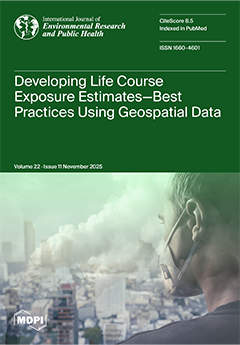
Cover Story (view full-size image):
The concept and promise of the exposome for identifying the specific environmental factors that affect the onset and progression of disease is approached with life course exposure estimates that describe environmental stressors and exposure over an individual’s lifetime. Current practices, largely based on residential and occupational histories, temporo-spatial datasets, and geostatistical operations, are evolving rapidly and addressing exposures to pollutants in air, water and soil, temperature extremes, noise, and other environmental factors. These methods must address issues of individual mobility, missing and incorrect data, incompatible scaling of datasets, and surrogacy, e.g., the use of proximity as an exposure metric. The recognition and resolution of these issues is critical for accuracy of life course exposure estimates. View this paper
- Issues are regarded as officially published after their release is announced to the table of contents alert mailing list.
- You may sign up for e-mail alerts to receive table of contents of newly released issues.
- PDF is the official format for papers published in both, html and pdf forms. To view the papers in pdf format, click on the "PDF Full-text" link, and use the free Adobe Reader to open them.
Previous Issue
Next Issue
