


Abstract
Organizational Health Literacy (OHL) is described as a new concept to remote health organizations to implement practices, policies, and systems that make it easier for patients to use, understand, and navigate health information to take care their own health. In Iran, there is no consensus on the attributes of OHL, and its practical implications and scope have not been evaluated. This manuscript is one of the first attempts to explain the attributes of the OHL in health care centers in Iran. This study is a content analysis survey, which was guided by the attributes of the OHL provided by Brach et al. and 26 semi-structured interviews were conducted with Iranian health professionals and employees of healthcare organizations from June 2020 to January 2021. A data analysis was performed using the MAXQDA 10 software. Across the study, ten sub-themes, 21 subcategories, and 67 codes emerged. The 10 main attributes of OHL were management, integration of health literacy in the organization, workforce, participation, range of HL skills, HL strategies, access, media variety, the role of the organization in crisis, and costs. These attributes may guide the planning of health care centers improvements and have the potential to promote health service reforms and public health policy.
1. Introduction
In 1974, the concept of health literacy (HL) was introduced [1] and it was defined as “the cognitive and social skills, which determine the motivation and ability of individuals to gain access to, understand and use information in ways, which promote and maintain good health”. Defined this way, HL goes beyond the concept of health behaviors and health education-linked communication, and addresses the political, social, and environmental characteristics that influence community health [2,3].
In Iran, the first study on HL was related to 2007. In this study, the TOFHLA questionnaire was used to investigate the level of HL in the Iranian population. The results of the study showed that 71.9% of the population participating in this study had inadequate and borderline levels of HL [4]. Therefore, the attention of health researchers was drawn to HL, and many studies on HL were subsequently conducted in Iran [5,6,7]. Researchers designed and localized the HL questionnaires, and adopted intervention measures to promote the HL of different groups of people [8]. In addition to the above, scientific conferences and congresses focusing on HL were held in Iran, and different journals on the HL concept were established [9,10]. However, according to a newly published review study in 2021, insufficient HL is common in the Iranian population [7,11]. Their finding highlighted some of the major challenges and gaps in the field of HL in Iran such as the lack of a clear and fixed definition for HL, the lack of OHL-related attributes and guidelines in health services to manage patients based on their HL levels, no locally comprehensive screening instrument for HI in Iran, and poor patient-health provider communication skills [7,12]. Therefore, promoting HL in Iran is necessary to provide the base on which the Iranian population are enabled to improve their own health through making better decisions related to their health condition, involve successfully with self-care skills and health community action, and push authorities to meet their duties in addressing health equity [5,7]. Meeting the HL needs in Iran will promote progress in decreasing health inequity. Efforts to improve HL are crucial in whether the environmental, economic, and social promotion are fully realized [12].
Several studies have shown HL activities should be considered in the health care organization structure [13,14,15]. Organizational Health Literacy (OHL) are organizations that “facilitate the guidance, understanding, and use of information and services for health care” [16]. Although, the OHL concept started in 2012 and several researches were conducted on OHL’s concept, there are not enough studies on the implementation of OHL structure [13]. Brach et al. expressed ten attributes for OHL [3], which are used by several tools related to OHL. These attributes include: (1) leadership that makes HL integral to its mission, structure, and operations; (2) integrates HL into planning, evaluation measures, patient safety, and quality improvement; (3) prepares the workforce to be health literate and monitors progress; (4) includes populations served in the design, implementation, and evaluation of health information and services; (5) meets the needs of populations with a range of HL skills while avoiding stigmatization; (6) uses HL strategies in interpersonal communications and confirms understanding at all points of contact; (7) provides easy access to health information and services and navigation assistance; (8) designs and distributes print, audiovisual, and social media content that is easy to understand and act on; (9) addresses HL in high-risk situations, including care transitions and communications about medicines; and (10) communicates clearly what health plans cover and what individuals will have to pay for services [3].
It is evident that HL is not still integrated into the health organization’s strategic planning and vision in Iran. Therefore, health policymakers and researchers face more challenges in what they recognize about attributes of the OHL and what steps they should use in OHL-related attributes to improve HL skills [6,7,17]. Since no action has been taken in Iran for the OHL, this study aims to explain the attributes and content of the OHL in health care centers in Iran. Such information helps health services to effectively implement OHL-related attributes to improve the quality of health service and personal health literacy skills in the community.
2. Materials and Methods
2.1. Study Design
In this study, we implement an exploratory design and qualitative approach of semi-structured interviews to understand the health professional’s perspectives about the attributes of the OHL in Iran. The theoretical framework was designed based on ten OHL-related attributes, which were expressed by Brach et al.
2.2. Study Setting
This study was conducted on 26 participants selected from different cities (Mashhad, Tehran, Tabriz, Yasuj, Maragheh, Bojnourd, Zahedan, Torbat Heydariyeh, Kurdistan, and Chenaran) from June 2020 to January 2021. Owing to the outbreak of COVID-19, the interview was conducted over the phone. Twenty-six interviews were conducted with health professionals and health center staff from different cities in Iran.
2.3. Participants
The study participants were selected from different medical and healthcare specializations such as health educators, health service managers, healthcare providers, physicians, pharmacists, nurses, and midwives. A security guard who was also working in healthcare centers was selected to participate in this study. We used the target-based sampling method and the snowball method with maximum variability to find eligible participants. Sampling was gradually continued until the data were saturated (Table 1).
Table 1.
Characteristics of the study participants.
2.4. Data Collection Tools and Procedures
The interview records were designed based on the attributes of OHL that were defined by Brach et al.’s [3]. All interviews were conducted by telephone because of the COVID-19 pandemic. The researcher made telephone calls to the participants and explained the objectives of the study to them. A specific time was then set for the interviews. An informed consent form and interview guide questions were emailed to participants. Interviews were recorded with the permission of the participants, through a special software installed on the researcher’s mobile phone. The average interview time was 45 min.
2.5. Research Questions
The researcher’s first question from the participants was, what do you think about the OHL-related attributes? Then, semi-structured questions were used during the interview. The semi-structured questions were designed according to the attributes of Brach et al. as follows:
- How do we involve the management of the organization in HL?
- How do employees prepare to carry out HL activities in the organization?
- How can people participate in the organization?
- What features do you think the media should have that are easy for people to read, understand and practice?
- How can we be sure that people have understood our content?
- How is HL the focus of an organization’s activities?
- How to use HL skills to meet people’s needs?
- What factors or conditions do you think facilitate access to health information and services?
- How can the organization improve the HL of people in dangerous medical and nursing conditions?
- How can HL be useful for information on health insurance and health care coverage and costs?
2.6. Data Processing and Analysis
The Lundman and Graneheim method was used for analysis [18]. The text of the interviews was implemented verbatim. The text was summarized into semantic units and the initial codes were extracted. Then, the abstract codes were formed according to the participants’ experiences, which led to forming overt and covert concepts. All codes were categorized into sub-categories; therefore, the main themes were formed. We used MAXQDA version 10 to conduct data analysis, coding, and the extraction of categories and themes. In order to achieve trustworthiness (transferability, credibility, and reliability), measures were taken in the steps of the research process.
3. Results
The study involved 26 people, half of whom were female interviewees and other participants were members of health faculty (Table 1). In this study, 57.6% of participants had a PhD degree and 88.6% of participants were specialists in the field of health education. The average work experience of the participants was 16.8 ± 1.8 years, ranging from 4 to 33 years. Participants from 10 cities (Mashhad, Tehran, Tabriz, Yasuj, Maragheh, Bojnourd, Zahedan, Torbat Heydariyeh, Kurdistan, and Chenaran) attended this study. The characteristics of the interviewees are shown in Table 1.
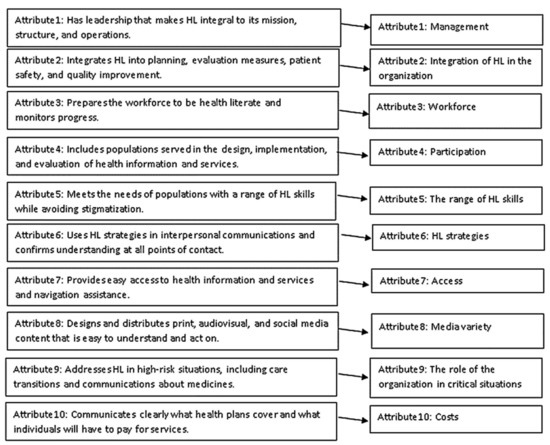
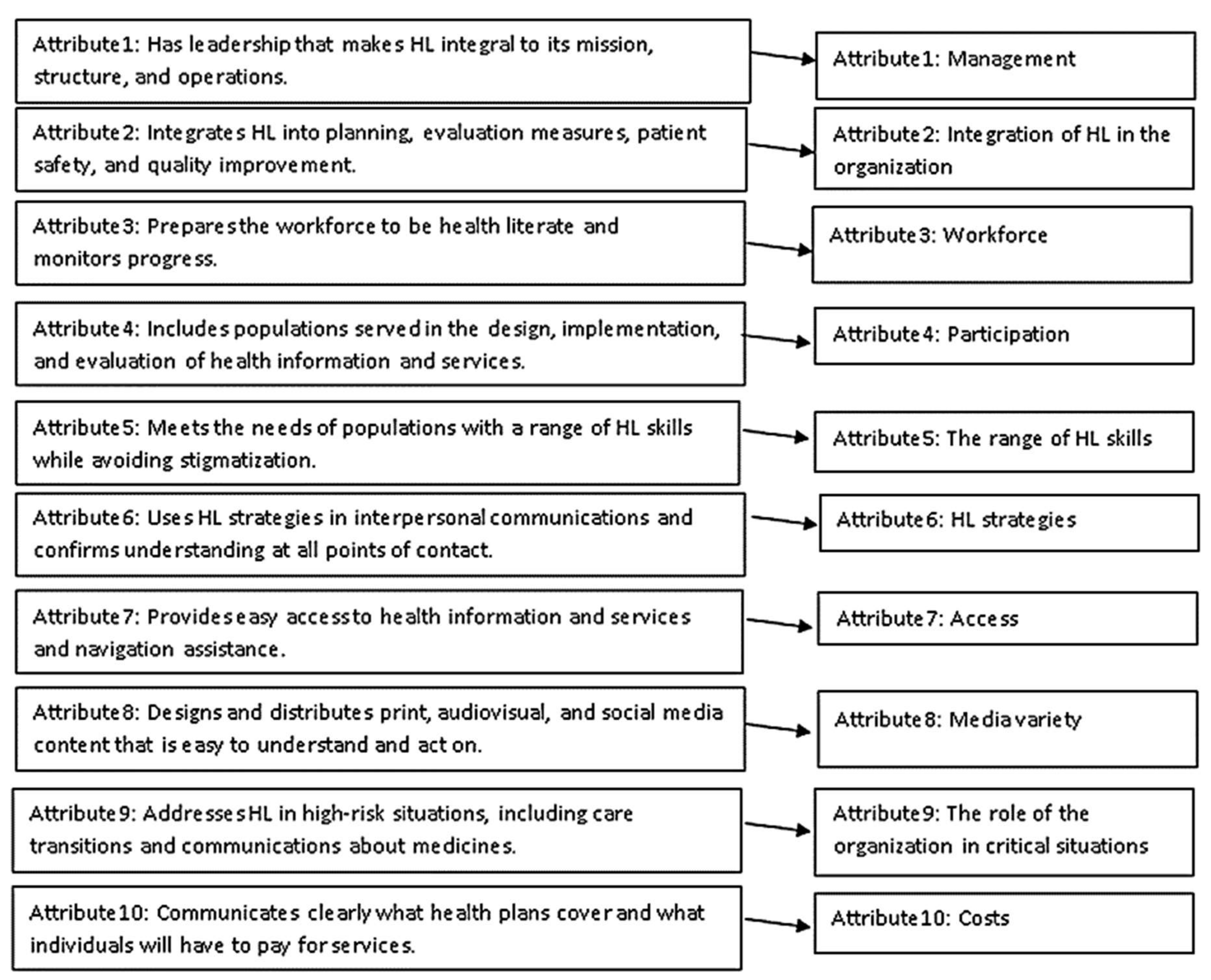
The average duration of the interview was 44.8 ± 13.04 min, ranging from 25 min to 80 min. Figure 1 shows the attributes of the OHL presented by Brach et al. and its changes in the current qualitative research. In 26 interviews, 895 initial codes were extracted from interviews. Analogous codes were then merged, and finally, during this inductive process, 67 codes were revealed in 21 subcategories, 10 sub-theme, and one theme. The main theme, sub-themes, subcategories, codes, and meaning units are shown in Table 2 and Figure 1.
Figure 1.
Changes from attributes of the OHL (provided by Brach et al.) to sub-themes (quality content analysis).
Table 2.
Content analysis of the health professionals and the workforce of health care centers about the attributes of the OHL in Iran.
4. Discussion
The present qualitative study was conducted to explain the characteristics of the OHL in health care centers in Iran. This qualitative study is based on the content analysis of the ten attributes of Brach et al. [3]. We identified 10 main attributes of OHL in Iran through depth 26 interviews with health professionals and health care center staff. These attributes include management, integration of HL in the organization, workforce, participation, range of HL skills, HL strategies, access, media variety, the role of the organization in crisis, and costs.
4.1. Manengment
Management is one of the main attributes of the OHL, which has been introduced as a leader in various studies [6]. In the present study, participants preferred to use the word “management” instead of using the word “leadership”, so to localize the attributes of the OHL, the word management was used instead of leadership. Several studies introduced leadership as the first attribute of OHLs in healthcare centers [6,17]. It has been also introduced as one of the attributes of the OHL in the tools or guidelines (AHRQ, OHLO, HLHO-10, VHLO, Org-HLR, and C-CAT) [6]. In this study, four subcategories were created for the leadership through the interviews including ‘appreciation of the staff implementing HL’, ‘encouraging other organizations to use HL’, ‘appointing a supervisor to implement HL’, and ‘handling people’s complaints’. Appreciating employees in the health organization plays critical role in the improving OHL structure. Borkowski believes that leaders can help employees to cope with change and help them strive to achieve their goals and incentives. Leaders in healthcare centers should be so that employees can easily share their point of view toward the OHL [19]. Another subtheme of managers in this study is to encourage other organizations to use HL. This encouragement is possible by providing reasonable evidence. Providing credible evidence is important to other organizations for two reasons: first, lack of evidence is considered as a major obstacle to the organization’s progress toward HL. Palumbo et al. indicated that inadequate evidence is the main obstacle to the organization’s transition to an OHL [20]. Second, the lack of compelling evidence has prevented health providers from considering the OH concept as a health priority [6,17]. For example, Cooper et al. pointed out that the lack of credible and reliable action reports prevented health policymakers and managers from accepting OHLs as a health priority [21]. Therefore, one of the important missions of OHL managers is to provide reliable reports to promote the transformation of the HEALTH organization into an OHL structure [6,17].
The leader has several responsibilities to develop the OHL structures, but the two tasks that emerged from the perspective of the participants in the present study were the appointment of a supervisor to oversee the implementation of HL in the organization and the handling of public complaints. The leader of the organization should appoint a person to supervise the HL activities in the organization so that the supervisor can follow the HL activities in the organization in a more specialized way. In the study of Brach et al., appointing a person in charge and delegating authority to oversee HL is one of the main tasks of the leader in an OHL [3].
4.2. Integration of HL in the Organization
The second attribute of the OHL is the integration of HL into the organization’s activities. In order to integrate HL into the organization, our research participants believe that changing both the structure and function of the health organization is essential to facilitate the integration of HL into the organization’s activities. Hence, two subcategories were created under the headings of ‘integrating HL in the structure of the organization’ and ‘integrating HL in the functioning of the organization’, and three codes were obtained, as follow: explaining HL in goals and statements clients health, the providing documents for the implementation of HL, and the evaluation of HL promotion activities.
Abrams et al. (2014) indicated that for the integration of HL into the organization’s structure, HL measures must be defined in the goals and statements of the organization [22]. Likewise, appropriate guidelines must be designed for improving the level of HL skills among employees and clients in the health organization because promoting HL in health workers not only improves the patient perception toward health information but also greatly increases patient-provider interactions [23,24]. Positive interactions between service providers and patients are known to as the main facilitator to improve patient health outcomes because patients who are satisfied with their healthcare providers are more likely to adhere to treatment plans and participate in improving their own health [25]. Likewise, documentation is the other main subtheme that shows HL activities are being implemented and evaluated in the health organization [6]. The results of a review study conducted in 2021 by Palumbo et al., show that although many barriers, such as lack of time and limited available resources, prevent the transition to an OHL, one of the steps that must be taken to overcome the existing barriers is to make more efforts to evaluate the OHL and to clarify its role in preventative medicine [26].
4.3. Workforce
Workforces of OHL’s play a key role in solving HL issues and helping to bridge the gap between limited HL and health-related outcomes [27,28]. The workforce in tools (AHRQ, OHLO, HLHO-10, VHLO, Org-HLR, and C-CAT) has also been introduced as one of the attributes of the OHL [6]. In this study, the workforce was identified based on two sub-categories of ‘training’ and ‘employment’. For the training sub-category, four codes were obtained under the headings of ‘HL training for employees’, ‘appointing the person in charge of HL training for employees’, ‘teaching communication strategies to employees’, and ‘employees’ access to HL training materials’. For the employment sub-category, three codes were obtained under the three headings of ‘hiring employees proficient in common language’, ‘hiring employees familiar with HL’, and ‘having HL in the employee job description’. “The OHL supports HL training for all health care workers”, said Brach et al. [3]. In most studies, the focus is more on training medical and nursing staff who are in close contact with clients [29,30]. Other health care workers have also been ignored. Therefore, although HL skills are important for nurses and physicians, all employees should receive HL training [23,24]. Our finding is consistent with several studies on HL that reported health workers usually lack adequate knowledge and skills to effectively communicate with patients with low HL [30,31]. Therefore, it is essential that health workers who work in health care systems have the adequate skills to effectively communicate with patients [19]. In addition, hiring people who are familiar with HL skills should be a priority. Brach et al. also believed that the organization should employ a different workforce with HL expertise [3]. As stated in the study by Brach et al., bilingual staff with HL skills should be employed in the OHL to assist clients whose language is different, and if this is not possible, an interpreter should be employed in the organization [3].
4.4. Participation
Another attribute of the OHL in Iranian healthcare centers is participation [6]. For the participation sub-theme in this study, two subcategories were obtained with the titles of public participation and employee participation, which covered five codes including “survey of clients regarding the choice of treatment methods’, ‘planning to employ volunteers and health liaisons’, ‘existence of instructions for employee participation in HL planning’, ‘existence of instructions for employee participation in implementing HL’, and ‘existence of instructions for employee participation in HL assessments’. Brega et al., highlighted patient participation as one of the conceptual frameworks of OHL [24]. It has been reported that patients with more participation are likely to make better health decisions and take appropriate steps to properly manage chronic health conditions [32]. There is evidence that increasing patient participation is important for improving health outcomes, especially for patients with limited HL skills [33]. In Iran, surveying clients in the choice of treatment methods is not a routine issue and most physicians make their own decisions and the patient is required to comply with it, which should be corrected in the OHL structure to increase patient participation. Various studies have shown that patients and organizations benefit from the active participation of patients to make better health decisions about their health [34]. Further, a guideline must be designed to increase employee participation in the planning, implementation, and evaluation of HL in the health organization. Borkowski (2011) pointed out that employee participation can also reduce resistance to change and help employees develop a positive view toward OHL. In addition, employee involvement may help sustain the effective use of the OHL’s actions [19].
4.5. The Range of HL Skills
The range of HL skills is another main attribute of the OHL in the present study, which was considered in several OHL tools (AHRQ, OHLO, HLHO-10, an Org-HLR) [6]. The sub-theme of HL skills in this study was identified with two subcategories under the headings of ‘essential HL skills in relation to clients’ and ‘needs assessment using HL skills’. These sub-themes included five codes: ‘welcoming and evaluating the needs of clients upon entering the organization’, ‘ensuring that the client’s needs met when leaving the organization’, ‘gather essential information from clients (only once in the organization)’, ‘identify and guide clients in need of additional assistance’, and ‘determining the HL status of clients’. Therefore, in the OHL, a series of essential HL skills should be considered, for example, the customer should be welcomed by the health staff when entering the organization and the client’s needs are measured upon entering the organization. For example, ask the patient, why were you referred to the organization? Or what is the problem? Then when leaving the organization, check if their needs have been met [3,6]. In the convenience for the client, their essential information (e.g., demographic information, and information related to medical and laboratory records) should be taken and registered in the system. Likewise, avoiding asking repetitive and boring questions is essential [30,31].
4.6. HL Strategies
The sixth attribute of the OHL in our study is the strategies of the OHL. The category of ‘HL strategies’ was identified based on two sub-categories of ‘HL strategies by employees in the field of verbal interaction with clients’ and ‘observance of HL strategies by employees in the field of support and writing with clients’. Likewise, eight codes were obtained under the headings of ‘using simple, clear, and understandable language’, ‘talk to clients with appropriate voice and medium speed’, ‘ensure you understand the content provided by clients by getting feedback’, ‘answering clients’ questions and encouraging them to ask questions’, ‘allocate enough time for each interaction’, ‘provide training clearly by stating the main and important points’, ‘provide training according to the economic ability of clients’, and ‘provide written training to clients according to their characteristics’ formed.
Adhering to verbal HL strategies is very important [27]. In order to improve the communication between patients and health providers, the US centers for disease control and prevention made the following recommendations in 2011: (1) use a simple language, use less medical terminology, (2) use the medical terms if there is no easier and more familiar term to replace, and (3) use feedback to ensure that clients understand [24,29]. Another code in this subcategory is answering clients’ questions and encouraging them to ask questions. Patients with limited HL are often embarrassed to admit that they do not understand and ask fewer questions [35]. Therefore, the staff of OHLs should have the characteristics of encouraging clients to ask questions. Encouraging clients to ask questions is one of the tools for promoting clients’ self-management and empowerment [36]. Brach et al. believe that HL campaigns should be launched to encourage questions, and that all questions should be answered satisfactorily [3]. Another code obtained in this study is to allocate enough time for each interaction. It was evidenced that patients are often misunderstood to interpret medical information when receiving a large amount of medical information within a few minutes after visiting a doctor [37,38]. In a study that examined how much information patients remember when visiting a doctor, found that the ability to maintain verbal health information is challenging, even for those with adequate HL skills [39]. Therefore, it is important to improve written communication because it is well-known that health materials help increase the understanding of health information and are useful for patients at all levels of HL, not just those with a low level of HL [40,41].
4.7. Access
Access is the seventh attribute of the OHL, which was obtained from this qualitative study. It is also used in five tools (AHRQ, OHLO, HLHO-10, VHLO, and Org-HLR) as one of the main attributes of the OHL [6]. Two sub-categories were obtained under the headings of ‘obtaining services and buildings’ and ‘obtaining understandable and executable information’; and seven codes were defined for the sub-category of “access to services and buildings” which includes: ‘easy access to information about the organization and services provided’, ‘use understandable boards and guides in the organization’, ‘appropriate number and arrangement of chairs in the organization’, ‘easy access to appointment scheduling methods and their accuracy’, ‘considering a suitable space for parking vehicles’, ‘possibility of clients’ access to valid educational resources’, and ‘sending the needy to help and charity centers’. Likewise, three codes were obtained for the category of “access to understandable and executable information” which are ‘design all forms and documents in simple and understandable language’, ‘evaluate all content distributed in the organization by getting feedback from clients’, and ‘preparation of forms and documents in the common language of the clients’.
Several studies reported that OHL is responsible to provide easy access to the health services and information [30,31] such as designing health facilities that help patients find their way, using easily understood signage and symbols in language, facilitating navigational inquiries, co-locate and integrating multiple services in the same facility, help patient to better understand what health care service and benefits are offered, assist people to arrange appointments with other health providers, maintain user-friendly communication skills, develop electronic health applications based on friendly design and patients with limited HL [12,30,31]. According to Egbert and Nana (2009), “the most obvious way to work on limited HL is to have more access to information” [42,43,44]. Although the use of patient portals and other online resources has increased access to health information, patients with limited HL rarely use the internet to obtain health information [45]. This places more responsibility on health care providers to ensure that patients with limited HL have the right health information to make informed health decisions. Patients with limited HL almost always have difficulty understanding written health information [46,47,48] and the inability to read and understand written health information leads to poor health outcomes and reduced quality of patient interactions with service providers [29]. Therefore, all forms and documents should be designed in a simple and understandable language and made available to clients, and by receiving feedback from clients, ensure that the written materials are easily understood by clients [46].
4.8. Media Variety
The eighth attribute of the OHL that was obtained in this study is the media variety, which has been introduced as one of the attributes of the OHL in three tools (AHRQ, OHLO, and HLHO-10) [6]. Regarding the media variety sub-theme, two subcategories were obtained under the headings, ‘media design and distribution’ and ‘optimal media features’. These two subcategories contain 12 codes, which are: ‘preparation of educational materials using HL strategies in different formats and their distribution through several channels’, ‘availability of various media for clients with different levels of HL’, ‘existence of educational media in the common languages of the clients’, ‘limited number of messages and use of short sentences’, ‘clear and understandable messages’, ‘use images’, ‘economic cost-effectiveness of the media’, ‘prepare based on HL strategies’, ‘fits the characteristics of the audience’, ‘be reliable’, ‘create attention’, and ‘up to date’. Ryan et al. (2014) evaluated the readability of written health materials distributed to patients with limited HL at an academic science center and found that 29% of the evaluated materials were unsuitable for patients with limited HL [49]. Since the high level of education alone does not reflect the HL status of patients, patients with above-average reading skills and those with a university degree may have difficulty understanding certain medical terms [50].
Therefore, OHLs should provide educational materials using HL strategies in different formats and distribute them to clients through several channels. This helps client to use health information depending on their abilities and preferences [42,43,44].
In 2009, a guide on creating easy-to-understand and easy-to-use health materials was published, which contained important recommendations for providing HL training materials for patients, here are some of these recommendations: start with the most important information to increase understanding, avoid giving too much information because it is easier to understand short messages, use pictures if necessary, try to avoid the use of medical or other technical terms, and consider the format of the document, such as using large fonts, bold headings, standard font styles, and a lot of white space, another important piece of advice is to consider the needs of specific patients to ensure that the material is appropriate for the target audience [12,42,43,44]. In some cases, obtaining feedback from patients or other members of the community will be helpful in designing, implementing, and evaluating educational materials for the patient [51]. This content is consistent with the codes related to the subcategory of desirable media features in our study.
4.9. The Role of the Organization in Critical Situations
High-risk situations are the ninth attribute of an OHL [29]. In the qualitative study conducted, the participants’ opinion was that instead of using risk terms, the term critical conditions should be used. Hence, the term critical condition is used in coding. Amongst the three tools (AHRQ, OHLO, and HLHO-10) [6,52], high risk is introduced as one of the attributes of OHLs. This qualitative study was conducted at the time of the COVID-19 epidemic, so participants often generalized critical and high-risk conditions to the COVID-19 epidemic and considered the conditions as risk conditions for health care organizations. For the role of the organization in critical situations, three subcategories were obtained under the headings: ‘provide understandable information’, ‘supplies’ and ‘provide training’, which includes seven codes, which are: ‘continual and transparent information in critical situations’, ‘ensure that informed consent forms are comprehensible to clients’, ‘existence and use of teaching aids’, ‘providing facilities based on the needs of individuals’, ‘educate employees about critical situations’, ‘educate clients in critical situations’ and ‘educate employees about critical situations’.
In critical situations, the organization’s clients should be provided with easy-to-understand information and their HL levels should be improved. Improving HL in critical situations means that health organizations carry out processes to help patients in critical situations [42,43,44]. When dealing with important issues, HL skills may be greatly reduced, because patients are often very emotional, more stressed, and may have difficulty paying attention to their health. In times of crisis, promoting the use of HL practices ensures that patients have clear and understandable information when making decisions in times of distress. Patients dealing with chronic illnesses who need to make important care decisions often need to understand informed consent forms [29]. Therefore, the OHL should design the forms in an easy-to-understand manner and ensure that these forms are easy to understand [16]. Hence, in addition to comprehensible information, appropriate media and training to the crisis and, and understandable forms should be provided to clients in crisis situations. We must also educate employees about emergency situations in order to interact with customers, and provide facilities according to individual needs.
4.10. Costs
Cost is the main attribute of the OHL because of its effect on conveying information about health plans and health care bills, (such as co-payments, out-of-pocket expenses), and health insurance [3]. Amongst the four tools (AHRQ, OHLO, HLHO-10, and Org-HLR) cost is also considered as one of the attributes of an OHL [15]. The cost includes two sub-categories ‘information about costs’ and ‘the provision of necessary funds for HL activities in the organization’. Four codes were also derived from cost including ‘clearly inform clients about costs before providing any service’, ‘providing information to clients about the amount of insurance coverage’, ‘allocate specific budgets to support HL activities’, and ‘existence of forms of attracting public aid in order to finance HL’. Therefore, information about costs should be considered in the organization’s agenda, and its rule should be implemented in a clear and understandable way.
In OHL, information about costs should be on the organization’s agenda, and this information should be performed in a clear and understandable way. In the past few years, the healthcare industry has undergone tremendous changes. Numerous health insurance companies have proposed a lot of health insurance plans that contain specific guidelines on underwriting services, joint payments, deductions, and how to file a claim. For patients with adequate HL skills, understanding health insurance plans can be challenging. Therefore, when interpreting health plan information, it is recommended that healthcare providers consider the importance and complexity of the information to improve understanding [53,54]. Therefore, the OHL should have clear information about the amount of expenses covered by insurance for clients. Carrying out the activities of the OHL, of course, has costs, and in the OHL, a specific budget must be considered to support the activities of the HL [12,17]. Of course, this budget allocation will be compensated after a while because the implementation of HL in the organization will reduce costs. Because improving patient outcomes reduces unnecessary use of medical services, the cost of medical care is also reduced [55,56]. In any case, a specific budget must be considered for the HL activities in the organization. In order to provide the necessary funds for the activities of the OHL, a form can be prepared to attract public assistance in the organization and provide it to people who are interested and able to participate in this matter.
4.11. Essential Work for the Future
Although the approach of Organizational Health Literacy receives support from Iranian policymakers and healthcare stakeholders, an inadequate level of HL affects large parts of the Iranian population and contributes to unpleasant health outcomes such as limited skills to manage own health and take medication properly, more use of emergency care and hospitalizations [11,12,57]. It seems that shifting health care systems toward effective OHL is a complicated process. According to our findings, 10 main attributes of OHL were defined that characterize an OHL as explained in Table 2. These attributes include the management, integration of HL in the organization, workforce, participation, range of HL skills, HL strategies, access, media variety, the role of the organization in crisis, and costs. The authors argue that there is a need to consider HL as an organizational priority in the healthcare services and a well-designed intervention based on HL strategies should be developed at the organizational level to be responsive. So far, study on OHL reveals that to become health literate, future studies need to include plan organizational self-assessment to better understand HL-based facilitators and barriers, address the relevant attributes of an OHL by emphasizing the integration of HL in the organization structures and workforce, training their health providers in practical communication skills, design visual/audio/written health information tailored to the different levels of HL and patient’s HL needs, and design monitoring systems that identify needs of the patient and the efficacy of interventions programs based HL strategies from the patient perspective.
In this process, different health professionals are vulnerable groups who are considered as change agents because they are at the forefront of educating patients and have the main role in taking over pivotal responsibilities to facilitate organizational change to an OHL [11]. Therefore, there is the need for encouraging health professionals to attend in the implementation of “Health Literacy Universal Precautions”, which aims to promote health professionals’ skills and ability to approach all patients who are have limited information related to improving their own health. Future studies need to examine how different health providers in Iranian healthcare services might contribute to organizational change.
5. Limitations
This study was conducted in the time of the COVID-19 pandemic, so due to traffic restrictions and quarantine in Iran, the interviews were conducted by telephone. Likewise, all participants in this study were specialists and staff of health care centers and their job conflicted with the prevalence of COVID-19; therefore, the interviews were conducted slowly. Another limitation was finding terms and concepts appropriate to the Persian language and culture for the interviews because no studies have been conducted on the OHL in Iran.
6. Conclusions
The purpose of this study was to determine the attributes of the OHL in health care centers in Iran. In this study, a main theme titled “attributes of Health Literacy Organizations” and 10 sub-themes of attributes of Iranian OHLs were obtained. The ten main attributes of OHL identified in Iran included management, integration of health literacy in the organization, workforce, participation, range of HL skills, HL strategies, access, media variety, and the role of the organization in crisis, and costs. A qualitative research process for the first time attempted to describe the attributes and capabilities of OHL in Iran. Hence, this study was able to draw the attributes of the OHL in accordance with the culture of Iranian society and pave the way for health care organizations in Iran to form an OHL. These attributes may guide the planning of health care centers improvements, and has the potential to promote health service reforms and public health policy.
Author Contributions
N.P., M.M. (Mehrsadat Mahdizadehand), H.T. designed the project. E.C.K. managed the project and E.C.K. and M.M. (Mohammad Moghzi) collected all the interviews and field notes. H.D. and A.J. analyzed the qualitative data. S.B.T.S. edited the Manuscripts and revise manuscript. N.P., S.B.T.S. and E.C.K. were responsible for manuscript preparation. Supervision and conceptualization: N.P. All authors have read and agreed to the published version of the manuscript.
Funding
This project was funded by the Mashhad University of Medical Sciences of Iran (project grant 980188). The funder had no role in the study design, data collection and analysis, decision to publish, or manuscript preparation.
Institutional Review Board Statement
The study was conducted according to the guidelines of the Declaration of Helsinki, and approved by the by the Ethics Committee of Mashhad University of Medical Sciences (IR.MUMS.REC.1398.161).
Informed Consent Statement
Informed written consent was obtained from all subjects involved in the study.
Data Availability Statement
No new data were created or analyzed in this study. Data sharing is not applicable to this article.
Acknowledgments
The authors wish to express their gratitude towards the vice president of research in Mashhad University of Medical Sciences and the esteemed participants.
Conflicts of Interest
The authors declare no conflict of interest.
Abbreviations
| OHL | Organizational Health Literacy |
| HL | Health Literacy |
References
- Simonds, S.K. Health education as social policy. Health Educ.Monogr. 1974, 2 (Suppl. S1), 1–10. [Google Scholar] [CrossRef]
- Frisch, A.; Camerini, L.; Diviani, N.; Schulz, P.J. Defining and measuring health literacy: How can we profit from other literacy domains? Health Promot. Int. 2012, 27, 117–126. [Google Scholar] [CrossRef] [PubMed]
- Brach, C.; Keller, D.; Hernandez, L.M.; Baur, C.; Parker, R.; Dreyer, B.; Schyve, P.; Lemerise, A.J.; Schillinger, D.; Agency for Healthcare Research and Quality. Ten Attributes of Health Literate Health Care Organizations; NAM Perspectives: Washington, DC, USA, 2012; pp. 1–26. [Google Scholar]
- Tehrani Banihashemi, S.-A.; Haghdoost, A.A.; Amirkhani, M.A.; Alavian, S.-M.; Asgharifard, H.; Baradaran, H.; Barghamdi, M.; Parsinia, S.; Fathi Ranjbar, S. Health literacy and the influencing factors: A study in five provinces of Iran. Strides Dev. Med. Educ. 2007, 4, 1–9. [Google Scholar]
- Jafari, A.; Sany, S.B.T.; Peyman, N. The Status of Health Literacy in Students Aged 6 to 18 Old Years: A Systematic Review Study. Iran. J. Public Health 2021, 50, 448–458. [Google Scholar] [CrossRef] [PubMed]
- Mahdifar, M.; Sany, S.B.T.; Ghavami, V.; Vahedian-Shahroodi, M. Health Literacy and Body Image Concern Among Healthcare Employees in Binaloud, Iran. J. Health Lit. 2021, 6, 31–40. [Google Scholar] [CrossRef]
- Tavakoly Sany, S.B.; Doosti, H.; Mahdizadeh, M.; Orooji, A.; Peyman, N. The Health Literacy Status and Its Role in Interventions in Iran: A Systematic and Meta-Analysis. Int. J. Environ. Res. Public Health 2021, 18, 4260. [Google Scholar] [CrossRef] [PubMed]
- Sany, S.B.T.; Behzhad, F.; Ferns, G.; Peyman, N. Communication skills training for physicians improves health literacy and medical outcomes among patients with hypertension: A randomized controlled trial. BMC Health Serv. Res. 2020, 20, 1–10. [Google Scholar] [CrossRef]
- Charoghchian Khorasani, E.; Peyman, N.; Tehrani, H. Model Design of Health Literacy Organization in Health Care Centers in Iran Mashhad, in Mashhad University of Medical Sciences; Mashhad University of Medical Sciences: Mashhad, Iran, 2021. [Google Scholar]
- Peyman, N.; Rezai-Rad, M.; Tehrani, H.; Gholian-Aval, M.; Vahedian-Shahroodi, M.; Miri, H.H. Digital Media-based Health Intervention on the promotion of Women’s physical activity: A quasi-experimental study. BMC Public Health 2018, 18, 1–7. [Google Scholar] [CrossRef]
- Dadipoor, S.; Ramezankhani, A.; Aghamolaei, T.; Rakhshani, F.; Safari-Moradabadi, A. Evaluation of Health Literacy in the Iranian Population. Health Scope 2018, 7, 62212. [Google Scholar] [CrossRef]
- Khorasani, E.C.; Sany, S.B.T.; Orooji, A.; Ferns, G.; Peyman, N. Health Literacy in Iranian Women: A Systematic Review and Meta-Analysis. Iran. J. Public Health 2020, 49, 860. [Google Scholar] [CrossRef]
- Farmanova, E. Organization of Health Services for Minority Populations: The Role of Organizational Health Literacy and an Active Offer of Health Services in French in Ontario. Ph.D. Thesis, Université d’Ottawa/University of Ottawa, ON, Canada, 2017. [Google Scholar]
- Palumbo, R.; Annarumma, C. The importance of being health literate: An organizational health literacy approach. In Proceedings of the EISIC-Ex Toulon-Verona Conference, Liverpool, UK, 28–29 August 2014; pp. 247–262. [Google Scholar]
- Charoghchian Khorasani, E.; Tavakoly Sany, S.B.; Tehrani, H.; Doosti, H.; Peyman, N. Review of Organizational Health Literacy Practice at Health Care Centers: Outcomes, Barriers and Facilitators. Int. J. Environ. Res. Public Health 2020, 17, 7544. [Google Scholar] [CrossRef] [PubMed]
- Baker, D.W. The meaning and the measure of health literacy. J. Gen. Intern. Med. 2006, 21, 878–883. [Google Scholar] [CrossRef]
- Eslami, V.; Tavakkoli-Sani, S.; Ghavami, V.; Peyman, N. The Relationship of Health literacy with Preventive Behaviors of Urinary Tract Infection in Pregnant Women. J. Health Lit. 2021, 2, 65–69. [Google Scholar] [CrossRef]
- Graneheim, U.H.; Lundman, B. Qualitative content analysis in nursing research: Concepts, procedures and measures to achieve trustworthiness. Nurse Educ. Today 2004, 24, 105–112. [Google Scholar] [CrossRef] [PubMed]
- Nancy Borkowski, D.B.A.; Meese, K.A. Organizational Behavior in Health Care, 2nd ed.; Jones and Bartlett Publishers: Sudbury, ON, Canada, 2011. [Google Scholar]
- Palumbo, R.; Annarumma, C.; Manna, R.; Musella, M.; Adinolfi, P. Improving quality by involving patient. The role of health literacy in influencing patients’ behaviors. Int. J. Healthc. Manag. 2019, 14, 144–152. [Google Scholar]
- Kaper, M.; Sixsmith, J.; Meijering, L.; Vervoordeldonk, J.; Doyle, P.; Barry, M.M.; De Winter, A.F.; Reijneveld, S.A. Implementation and Long-Term Outcomes of Organisational Health Literacy Interventions in Ireland and The Netherlands: A Longitudinal Mixed-Methods Study. Int. J. Environ. Res. Public Health 2019, 16, 4812. [Google Scholar] [CrossRef]
- Abrams, M.A.; Kurtz-Rossi, S.; Riffenburgh, A.; Savage, B.A. Building health literate organizations: A guidebook to achieving organizational change. J. Res. Pract. Adult Lit. Second. Basic Educ. 2015, 4, 1–74. [Google Scholar]
- Prince, L. Assessing Organizational Health Literacy at an Academic Health Center: A Quantitative Research Study; University of Arkansas: Arkansas, AR, USA, 2017. [Google Scholar]
- Cormier, C.M.; Kotrlik, J.W. Health literacy knowledge and experiences of senior baccalaureate nursing students. J. Nurs. Educ. 2009, 48, 237–248. [Google Scholar]
- McCleary-Jones, V. A Systematic Review of the Literature on Health Literacy in Nursing Education. Nurse Educ. 2016, 41, 93–97. [Google Scholar] [CrossRef]
- Brega, A.; Barnard, J.; Mabachi, N.; Weiss, B.; DeWalt, D.; Brach, C.; West, D. AHRQ Health Literacy Universal Precautions Toolkit, 2nd ed.; Agency for Healthcare Research and Quality: Rockville, MD, USA, 2015; Volume 20, pp. 12–67. [Google Scholar]
- Adams, R.J. Improving health outcomes with better patient understanding and education. Risk Manag. Health Policy 2010, 3, 61–72. [Google Scholar] [CrossRef]
- Palumbo, R. Leveraging Organizational Health Literacy to Enhance Health Promotion and Risk Prevention: A Narrative and Interpretive Literature Review. Yale J. Biol. Med. 2021, 94, 115–128. [Google Scholar] [PubMed]
- Wynia, M.K.; Osborn, C.Y. Health Literacy and Communication Quality in Health Care Organizations. J. Health Commun. 2010, 15, 102–115. [Google Scholar] [CrossRef]
- Andrulis, D.P.; Brach, C. Integrating Literacy, Culture, and Language to Improve Health Care Quality for Diverse Populations. Am. J. Health Behav. 2007, 31, 122–133. [Google Scholar] [CrossRef]
- Coleman, C.A.; Appy, S. Health literacy teaching in US medical schools, 2010. Fam. Med. 2012, 44, 504–507. [Google Scholar] [PubMed]
- Kaphingst, K.A.; Weaver, N.L.; Wray, R.J.; Brown, M.L.R.; Buskirk, T.; Kreuter, M.W. Effects of patient health literacy, patient engagement and a system-level health literacy attribute on patient-reported outcomes: A representative statewide survey. BMC Health Serv. Res. 2014, 14, 475. [Google Scholar] [CrossRef]
- Hibbard, J.H.; Greene, J.; Overton, V. Patients with lower activation associated with higher costs: Delivery systems should know their patients’ scores. Health Aff. 2013, 32, 216–222. [Google Scholar] [CrossRef]
- Koh, H.K.; Brach, C.; Harris, L.M.; Parchman, M.L. A proposed “health literate care model’ would constitute a systems approach to improving patients” engagement in care. Health Aff. 2013, 32, 357–367. [Google Scholar] [CrossRef]
- Paasche-Orlow, M.; Wolf, M.S. Evidence does not support clinical screening of literacy. J. Gen. Intern. Med. 2007, 23, 100–102. [Google Scholar] [CrossRef]
- Behzad, F.; Taghipour, A.H.E. Promoting Level of Health Literacy & Self Efficacy of Chronic Patients Referred to Health Centers through Educating Health Literacy for the Staffs of Health Centers in Mashhad Mashhad University of Medical Sciences, Mashhad. 2013, 5, 11–45. [Google Scholar]
- Imani, J.H. Ashnaie ba ravesh Delphi va karborde an dar tasmimgiri. Faslnameh Modiriat Shahri 2000, 1, 9–35. [Google Scholar]
- Julie, M.; Cooper, B.S. Health Literacy in Practice Program, Evaluation Report. Western Michigan University; School of Social Work: Michigan, MI, USA, 2011; pp. 1–156. [Google Scholar]
- McCarthy, D.M.; Waite, K.R.; Curtis, L.M.; Engel, K.G.; Baker, D.W.; Wolf, M.S. What Did the Doctor Say? Health Literacy and Recall of Medical Instructions. Med. Care 2012, 50, 277–282. [Google Scholar] [CrossRef]
- Center for Health Literacy. Little Rock, A.R. Academic Health Center. 2014, pp. 11–23. Available online: http://healthliteracy.ahc.edu (accessed on 1 June 2017).
- Pignone, M.; DeWalt, D.A.; Sheridan, S.; Berkman, N.; Lohr, K.N. Interventions to improve health outcomes for patients with low literacy. J. Gen. Intern. Med. 2005, 20, 185–192. [Google Scholar] [CrossRef]
- Otal, D.; Wizowski, L.; Pemberton, J.; Nagel, K.; Fitzgerald, P.; Walton, J.M. Parent health literacy and satisfaction with plain language education materials in a pediatric surgery outpatient clinic: A pilot study. J. Pediatr. Surg. 2012, 47, 964–969. [Google Scholar] [CrossRef] [PubMed]
- Cloonan, P.; Wood, J.; Riley, J.B. Reducing 30-Day Readmissions. JONA: J. Nurs. Adm. 2013, 43, 382–387. [Google Scholar] [CrossRef]
- Frosch, D.L.; Elwyn, G. Don’t Blame Patients, Engage Them: Transforming Health Systems to Address Health Literacy. J. Health Commun. 2014, 19, 10–14. [Google Scholar] [CrossRef] [PubMed]
- Gu, Y.; Orr, M.; Warren, J. Health literacy and patient portals. J. Prim. Health Care 2015, 7, 172–175. [Google Scholar] [CrossRef] [PubMed]
- DeWalt, D.A.; Broucksou, K.A.; Hawk, V.; Brach, C.; Hink, A.; Rudd, R.; Callahan, L. Developing and testing the health literacy universal precautions toolkit. Nurs. Outlook 2011, 59, 85–94. [Google Scholar] [CrossRef]
- Weiss, B.D. Reading level: Not the only determinant of readability. Fam.Med. 2014, 46, 563. [Google Scholar]
- Parnell, T.A.; McCulloch, E.C.; Mieres, J.H.; Edwards, F. North Shore Long Island Jewish Health System Health Literacy as an Essential Component to Achieving Excellent Patient Outcomes. NAM Perspect. 2014, 4, 41–49. [Google Scholar] [CrossRef]
- Ryan, L.; Logsdon, M.C.; McGill, S.; Stikes, R.; Senior, B.; Helinger, B.; Small, B.; Davis, D.W. Evaluation of Printed Health Education Materials for Use by Low-Education Families. J. Nurs. Sch. 2014, 46, 218–228. [Google Scholar] [CrossRef]
- Mayer, G.; Villaire, M. Enhancing written communication to address health literacy. Online J. Issues Nurs. 2009, 14, 3. [Google Scholar] [CrossRef]
- Somers, S.A.; Mahadevan, R. Health Literacy Implications of the Affordable Care Act; Center for Health Care Strategies: Washington, DC, USA, 2010; Volume 4, pp. 112–129. Available online: https://www.chcs.org/media/Health_Literacy_Implications_of_the_Affordable_Care_Act.pdf (accessed on 1 December 2021).
- Siuki, H.A.; Peyman, N.; Vahedian-Shahroodi, M.; Gholian-Aval, M.; Tehrani, H. Health Education Intervention on HIV/AIDS Prevention Behaviors among Health Volunteers in Healthcare Centers: An Applying the Theory of Planned Behavior. J. Soc. Serv. Res. 2019, 45, 582–588. [Google Scholar] [CrossRef]
- Parker, R. What an Informed Patient Means for the Future of Healthcare. PharmacoEconomics 2006, 24, 29–33. [Google Scholar] [CrossRef] [PubMed]
- Villaire, M.; Mayer, G. Health literacy: The low-hanging fruit in health care reform. J. Health Care Financ. 2009, 36, 55–59. [Google Scholar]
- Ginsburg, J. Controlling Health Care Costs while Promoting the Best Possible Health Outcomes; American College of Physicians: Philadelphia, PA, USA, 2009; Volume 4, pp. 34–39. Available online: https://www.acponline.org/system/files/documents/advocacy/current_policy_papers/assets/controlling_healthcare_costs.pdf (accessed on 1 December 2021).
- Eichler, K.; Wieser, S.; Brügger, U. The costs of limited health literacy: A systematic review. Int. J. Public Health 2009, 54, 313–324. [Google Scholar] [CrossRef] [PubMed]
- Tavakoly Sany, S.B.; Peyman, N.; Behzhad, F.; Esmaily, H.; Taghipoor, A.; Ferns, G. Health providers’ communication skills training affects hypertension outcomes. Med. Teach. 2017, 40, 154–163. [Google Scholar] [CrossRef]

Publisher’s Note: MDPI stays neutral with regard to jurisdictional claims in published maps and institutional affiliations. |
© 2022 by the authors. Licensee MDPI, Basel, Switzerland. This article is an open access article distributed under the terms and conditions of the Creative Commons Attribution (CC BY) license (https://creativecommons.org/licenses/by/4.0/).