


Abstract
Mothers’, fathers’, or guardians’ support for disclosures of diverse gender identity has significant relationships with decreased suicidality for transgender children and adolescents. They play an essential role in facing transphobia, protecting trans children, and strengthening the expression of their identity. These guardians need structural, emotional, and informative support; they need to be prepared to recognize and manage of their own feelings, as well as deal with the challenges that come with new social contexts of transphobia in schools, health institutions, and other community spaces. This study aimed to analyze the scientific evidence on the dynamics of secondary social networks to support mothers, fathers, or guardians of transgender children and adolescents. This is a systematic review of qualitative studies, guided by PRISMA guidelines. Controlled and free vocabularies were used to survey the primary studies in the following databases: EMBASE; Scopus; MEDLINE; Cumulative Index to Nursing and Allied Health Literature (CINAHL); PsycInfo; Latin American and Caribbean Literature in Health Sciences (LILACS); and Web of Science. A total of 28 articles made up the final sample of this review. Secondary social networks were described as fragile, characterized by conflicting and broken ties with healthcare services and professionals, isolation and unpreparedness from schools, and emotional and informational support from peer groups and some qualified healthcare professionals. The literature shows the potential of the dynamics of secondary social support networks; however, it presented the unpreparedness of professionals and institutional policies for welcoming transgender children and adolescents and their families, with the peer group being the main emotional and informative support network.
1. Introduction
Gender-diverse youth are significantly more likely to reveal their identity to the people in their lives, including their parents, than their cisgender and heterosexual counterparts. In comparison, parents of gender-diverse children are more likely to reject them [1].
The support of mothers, fathers, or guardians towards their children’s gender identity is extremely significant for lessening suicidal tendencies among transgender youth. This support also lessens physical abuse at school [2].
For transgender children and adolescents, the lack of support from their guardians, particularly their fathers, was found to be associated with an increase in domestic physical abuse [2,3].
Guardians play an essential role in facing transphobia, protecting and strengthening trans children in the expression of their identity. These guardians need to be educated and supported in the path towards recognizing and managing their own feelings [2] as well as in dealing with the challenges that arise within their networks, especially in schools and community spaces, and from healthcare providers [4,5,6,7].
These networks can contribute to strengthening emotional, face-to-face, instrumental, informational, and self-support support, in order to provide changes from a situation of dependence to one of the autonomies of the target audience [8,9].
Although guardian support is sought, it is scarcely offered. However, these findings come from studies around the children, which justifies the importance of targeting parents and guardians directly to know their experiences and perspectives.
Given the above, the present study aimed to analyze scientific evidence on the dynamics of secondary social networks in supporting mothers, fathers, or guardians of transgender children and adolescents. As recommended by Page et al. [10], the research was registered on the platform “PROSPERO: A registry for systematic review protocols” (registration: CRD42022301747). From a preliminary search in MEDLINE, Cochrane Database of Systematic Reviews, JBI Evidence Synthesis, and PROSPERO, no protocol or review records on the topic were identified, which highlights the innovative potential of this study in relation to the field of scientific evidence available.
2. Materials and Methods
The present study is a systematic review of qualitative studies that is a continuation of a review entitled “Dynamics of primary social networks to support mothers, fathers, or guardians of transgender children and adolescents: a systematic review”, previously developed by the authors of this paper and published in this journal (International Journal of Environmental Research and Public Health) [5].
This review was guided by the Joanna Briggs Institute Manual for Evidence Synthesis—Systematic reviews of qualitative evidence [11] and Preferred Reporting Items for Systematic Review and Meta-Analysis (PRISMA) recommendations [10]. Qualitative studies examine a given phenomenon in depth in order to analyze nuances that are not achieved in other types of studies, which is essential for the understanding of social networks and their aspects in the health field [12].
The development of this review took place in six stages: theme and guiding question identification; establishment of inclusion and exclusion criteria; definition of information to be extracted from selected studies; assessment of studies included in the systematic review; interpretation of results and synthesis of knowledge [13].
Following the steps, the study’s guiding question was established: “What is the scientific evidence on the dynamics of secondary social networks in supporting mothers, fathers, or guardians of transgender children and adolescents?” This question was defined through the PICo strategy: P (population: mothers, fathers, or guardians of transgender children and adolescents); I (phenomenon of interest: social support); Co (context: social network). In accordance with the social network theoretical framework [8], the guiding question listed studies that responded to the investigation of the dynamics of secondary networks with the description of the relational phenomena present in the networks: alliances; conflicts; discontinuity; ruptures; wear and tear; and transgressions. Thus, it was possible to identify the relationships and functions that compose it.
Original qualitative articles, in all languages, that deal with the social network dynamics through experiences verbalized by the mothers, fathers, or guardians of transgender children and/or adolescents were included. Children and adolescents were defined as people up to 19 years of age, according to the World Health Organization (WHO) classification [14]. Excluded literature comprised the following: duplicate publications; gray literature (abstracts published in proceedings, newspaper news, dissertations, theses, book chapters, letters to the editor, and pre-print publications); other types of study (non-qualitative); studies whose results from the population of interest were not presented separately from other populations (in addition to parents of children and adolescents, including parents of young adults; in addition to parents of transgender people, including parents of LGBTQIA+ people (lesbian, gay, bisexual, transgender/transvestite, queer, intersex, and other identities/orientations); and parents, interviewing children); and papers which did not present results on the social network dynamics.
The article search was carried out in December 2021 through the Central Library system of the University of São Paulo and CAPES journal, which provided access to the following databases: EMBASE, Scopus, MEDLINE, Cumulative Index to Nursing and Allied Health Literature (CINAHL), PsycInfo, Latin American and Caribbean Literature in Health Sciences (LILACS), and Web of Science. For the searches, neither year of publication nor language limits were used.
The search strategy was composed of controlled and free vocabularies combined by Boolean OR operators to distinguish them and Boolean AND operators to associate them, in order to integrate and direct the maximum number of studies on the subject. The same search strategy was readjusted for each database according to their specificities—see published protocol [15].
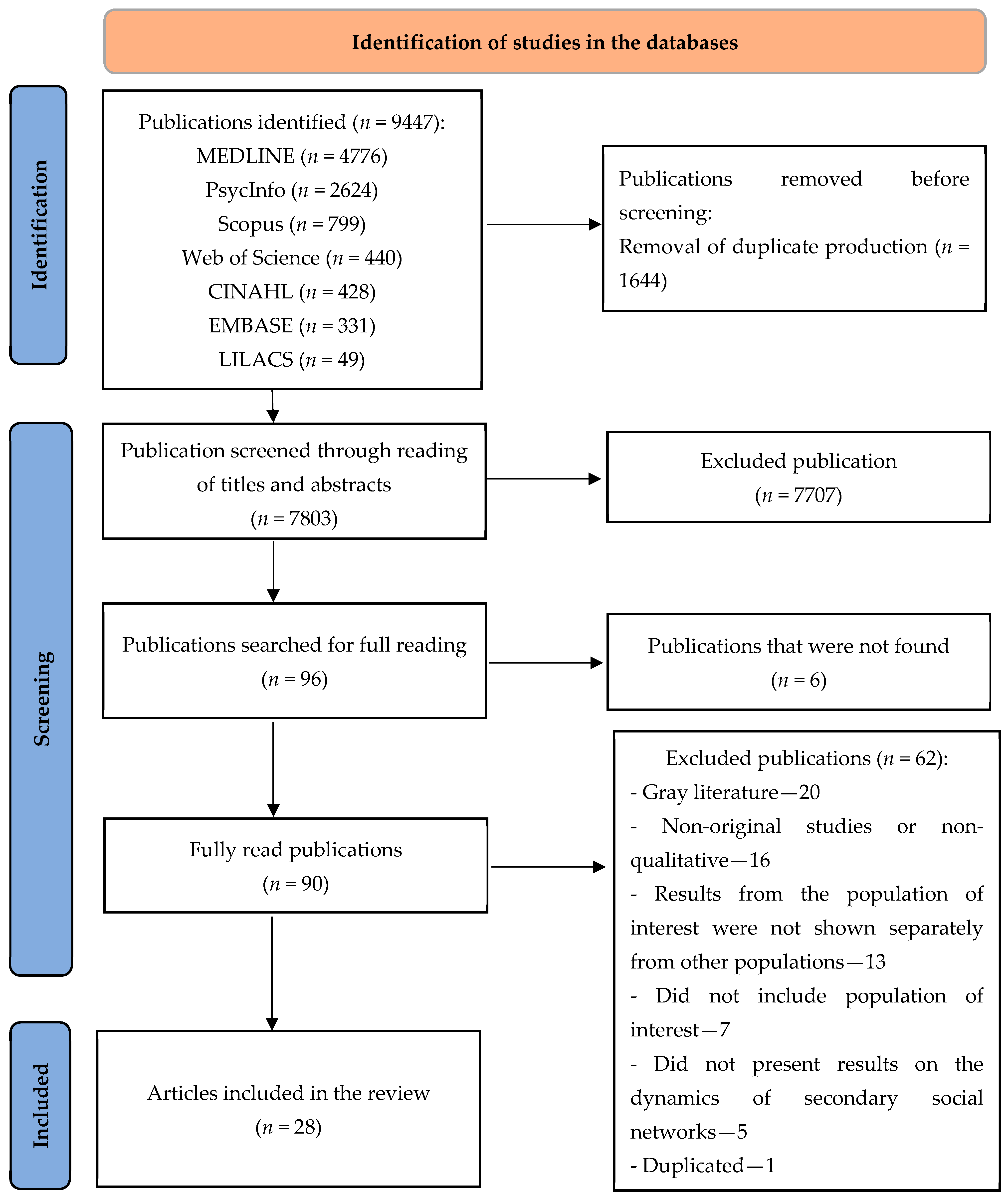
After surveying the studies in the databases, they were transferred to the Rayyan QCRI online platform [16] for the due exclusion of duplicate studies and subsequent reading of titles and abstracts by two independent researchers, and a third evaluator, for decision in cases of disagreement or doubt between the first two. Therefore, the studies selected in this first stage were submitted to full reading, which allowed analyzing their relevance in relation to their inclusion in the review. The study selection process is presented in the flowchart according to the Preferred Reporting Items for Systematic Review and Meta-Analyses (PRISMA 2020) recommendations [10].
Data extraction was performed using a form adapted from Lockwood et al. [11], composed of author, year and journal of publication, study description (method, phenomenon of interest (objective), study site, participants, data analysis, results, conclusions, and comments). An assessment of the methodological quality of studies included in this review was performed using a checklist for assessing qualitative research proposed by The Joanna Briggs Institute [11].
The results were submitted to a qualitative synthesis in the light of the social network framework proposed by Sanicola [8]. The listed category and the subcategories were validated through discussions with research groups with expertise in the framework, method, and theme in order to ensure the necessary rigor for the discussion of results.
3. Results
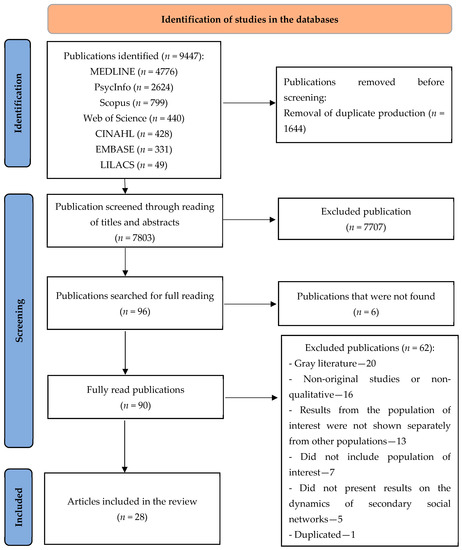
The study selection step is detailed in the flowchart in Figure 1, which indicates the survey of 9447 publications in the databases and the final selection of 28 qualitative articles to compose the sample of this study.
Figure 1.
Flowchart of studies selected for systematic review on the dynamics of secondary social networks to support mothers, fathers, or guardians of transgender children and adolescents. Ribeirão Preto, SP, Brazil, 2022. Source: Adapted from Page et al. [10].
The articles were published in 2009 (3.5%) [17], 2011 (3.5%) [18], 2013 (3.5%) [19], 2014 (7.1%) [20,21], 2015 (3.5%) [22], 2016 (7.1%) [23,24], 2018 (7.1%) [25,26], 2019 (17.8%) [27,28,29,30,31], 2020 (17.8%) [32,33,34,35,36], and 2021 (28.5%) [37,38,39,40,41,42,43,44]. All articles (100%) were published in English, of which 17 (60.7%) [17,18,21,22,23,24,25,26,27,28,29,32,33,34,35,37,40,44] originated in America, 3 (32.1%) [20,30,31,35,36,37,38,39,41,42] originated in Europe, and 2 (7.1%) [19,43] originated in Oceania. The information synthesis and the main results of the articles included in the final sample of this review are presented in Table 1.
Table 1.
Information and synthesis of the main results of studies selected for systematic review on the dynamics of secondary social networks to support mothers, fathers, or guardians of transgender children and adolescents. Ribeirao Preto, SP, Brazil, 2022.
The methodological quality of the articles included in the final sample of this review was assessed and they all showed congruence in the following aspects: philosophical perspective and research methodology; research methodology and research question or objectives; research methodology and data collection methods; participants and their voices adequately represented; compliance with ethical issues and conclusions of data analysis or interpretation [20,21,22,23,24,25,26,27,28,29,30,31,32,33,34,35,36,37,38,39,40].
Regarding the studies’ limitations, it was identified that congruence between research methodology and data representation and analysis was not clear [17] nor presented [27] in two of the studies. There was no clear congruence between research methodology and interpretation of results in two other studies [34,44]. In 11 studies, there was no clarity in the statement that locates the researcher culturally or theoretically [17,18,19,23,25,27,29,34,36,43,44]. In one study, the researcher’s influence on the research and vice versa was not addressed [30]. These results are summarized in Table 2.
Table 2.
Methodological quality of articles included in this systematic review on the dynamics of secondary social networks to support mothers, fathers, or guardians of transgender children and adolescents. Ribeirao Preto, SP, Brazil, 2022.
4. Discussion
The struggle for the transgender cause emerged in studies carried out with mothers, fathers, and guardians of transgender children and adolescents. This took place through coping with barriers to recognizing gender identity and extended to the search for emotional, face-to-face, instrumental, informational, and self-support support to guarantee rights in the context of secondary social networks that participate directly or indirectly in the lives of their children.
In the studies included in this review, the secondary networks determining support were healthcare services [17,18,19,20,21,22,23,24,25,26,27,29,31,32,33,34,35,36,39,40,41,42,43,44], schools [17,18,19,20,21,22,23,24,25,26,27,28,31,35,38,41,42], peer groups [31,36,37,41], parents’ work environment [25,32], and associations (third-sector networks) [35]. Other studies also mentioned the importance of support from religious institutions [19,35], and the non-recognition of religious leaders, whose micro and macro social aggressions were related to the lack of protection and risk of suicide of their children [25,41].
The close contact with children contributed to recognizing gender identity disclosed in childhood and adolescence [32], in which parents were informed directly by the children who insisted that they were of another gender [18], and despite the overload and misinformation, parents reported that they sought support [32]. In this thematic category, secondary social networks are presented in subtopics to facilitate a better understanding.
4.1. Healthcare Services
In the health field, it is emphatic in some studies that healthcare services are unprepared for the care of transgender children and adolescents at all levels of care [18,20,27,39], with the non-use of the social name and the lack of information for parents on issues such as hormone therapy [27]. Parents demand professional awareness, so that healthcare professionals are trained, able to answer questions, and can provide adequate assistance [18].
Some studies showed that participants reported recognizing their transgender children and committing to their wellbeing in order to protect them from bullying, depression, anxiety, self-harm, and suicide [22,34,41]. Parents found it difficult to identify local services that could take care of the demands their children had, sometimes associated with suffering in relation to the gender assigned at birth. In this sense, parents felt confused and sought professional help to offer a “diagnostic path”, understanding of the transgender origin and nature, and access to “treatment” options [39], in addition to vaccination clinics where gender identity was recognized [22].
Parents who participated in a study developed in Canada reported barriers in the clinics’ bureaucratic processes, such as waiting times for the start of hormone therapy and the lack of therapists for their children, which generated greater tension in parents [31]. The barriers to care culminate in the anguish of parents due to the potential emotional suffering of their children due to the delay in hormone therapy. Parents perceived themselves to have a role in promoting their children’s wellbeing through direct communication, emotional support, and bonding with healthcare professionals [32].
In another study, it was mentioned that, although medicalization has facilitated access to services, for many, it remained given the implicit suggestion of a possible “treatment” or even a cure. Most participants tended to agree that it would be preferable not to medicalize their children. Many parents shared that their children felt depressed or lonely [22].
Transgender identity is not a disease [23,26,42]; however, biopsychosocial factors can trigger intense suffering and disorders of psychic origin, such as depression, anxiety, and risk of suicide, especially because society does not understand it and because of the frequency of instances of transphobia [22,34,41].
The demands of transgender children and adolescents need to be incorporated into comprehensive healthcare at all levels of care, in addition to offering specialized services for referrals when necessary. Transgender people have both general and specific health demands. Thus, professionals need to be able to welcome a person holistically in the face of their needs, and provide calm and respectful assistance, since being transgender is neither a pathology nor an isolated condition, but a way of being and existing that needs to be recognized and naturalized.
A study carried out in the United States of America with parents of children with gender variance referred to the recommendations from healthcare professionals to discourage parents from allowing their children to express their gender. However, parents perceived that this attitude generated conflict and tension for their children [17].
In this regard, another study carried out in the United Kingdom revealed the importance of valuing the experiences and demands of transgender people and their families, and promoting their participation in health planning. However, the professional imposition of inappropriate behavior was more frequent in parents’ experience, in addition to counseling that reduced the reports from their children, leading to a situation in which parents “did not take it seriously” [27].
Support from healthcare professionals, both emotional and informative, and from other parents (in person and online) was mentioned in a study carried out in Canada. These behaviors contributed to the parents’ understanding of the situation and their role. However, other parents reported feeling excluded from decision-making processes and some described communication problems with healthcare professionals and denial of timely access to necessary care [32].
Gender variation is still perceived by some professionals as a pathology [23]. A study carried out in Italy revealed that parents educated healthcare professionals on the transgender issue, which generated negative, conflicting interactions (fights) between parents and professionals. Specialized services were essentially located in hospitals, where the ambience was reminiscent of illness [42].
In a study carried out in a children’s hospital in the USA, parents/caregivers were hesitant about hormone therapy for their children for fear of possible long-term risks, but they agreed to start hormone therapy after seeking information from professionals on the internet and from personal contacts. The guidance of healthcare professionals contributed to reducing parents’ anxieties [29].
Studies have presented informational support from healthcare professionals for recognizing gender identity by parents [23,34,41]. In this process, therapists are a fundamental member of the support network for counseling, as long as they understand the needs of children and parents to develop their role [40].
Parents need professional support to understand that they are not to blame, that it is okay to stand up for their children’s gender identity, and that there are other families dealing with similar issues. As children enter puberty, parents expressed the need for a “solution” to promote their children’s wellbeing and expressed the need for speaking publicly about the needs of children with gender variance [19].
4.2. Peer Groups
Questioning the concepts of “being a man” or “being a woman”—with reference to a given social, cultural, and historical structure—demands an approximation with other experiences, criticalities, and exchanges of knowledge. A study carried out in Italy revealed that, for parents, being in the LGBT+ community was a means of obtaining information, but it did not contribute to the early identification of how their child was experiencing their gender identity [40]. In this regard, the knowledge produced in the LGBT+ community needs greater reach and a social structure that provides a legitimate recognition of gender variations as ways of being and existing.
Groups of peers and/or the friendships between them proved to be important for parents as these allow the sharing of experiences, help in the process of inner change among parents, and the understanding of children as complex human beings—not restricted to gender [19,20,31,35,41,44]. A study carried out in a Pediatric Hospital in Italy with 12 months of group meetings contributed to a decrease in isolation and an increase in self-confidence and hope to support their children. Parents changed their minds about showing their children courage, love, and understanding, and emphasized the importance of welcoming and supporting them. Their participation in the parent group showed positive results by forming a support network and sharing experiences [36].
Community support and strong peer group identification can mitigate stigma [19,44]; contact with other parents of children with gender variance and access to support groups, both face-to-face and online, have been identified as necessary for helping parents (S24, S25) [19,31]. A study carried out in Canada revealed that contact with other parents who went through the same process and meeting in groups were essential factors for recognizing their children’s gender identity. Other participants reported that support from healthcare professionals was more important and that they sought out therapists to help deal with their own emotions [31].
The peer group can be developed and coordinated by mothers, fathers, or guardians of transgender children and adolescents, with activities restricted to members or open. In such peer groups, the exchange of experience, open dialogues or dialogues directed to preestablished themes can be offered with the participation of guests, as well as the support of interdisciplinary professionals able, for instance, to accommodate rights and health demands. These groups can also be organized by a reference professional and have the participation of health teams or a specific specialty, such as therapeutic groups.
A study carried out in France presented the experience of La Salpetrière Hospital in Paris, which carries out a “multi-family” therapeutic group with transgender parents and adolescents of two–twenty families. In these groups, adolescents show humor and laughter, even when painful situations are discussed. The parent group is less harmonious—while some trivialize their family situation, others evoke their anxieties and feel supported and safe, speaking in the group, and sometimes they are emotional. Some left the group after a few sessions, while others remained [43].
The concern of parents with their children’s bodies is recurrent, doubts include the following: What are the postoperative side effects? How do we assess the risk of failure? What if they want to reverse the operation? Do we know enough about the undesirable effects of puberty blockers or hormones on bones? The theme of grief due to children being idealized by parents also emerged. Verbal exchanges between parents mediated by therapists provided satisfactory results in coping with psychological distress or difficulties in family relationships [43]. The respectful bond between tutors (parents and caregivers) provides compliance and strong support to healthcare, in addition to reducing stigma and increasing the comfort of tutors [44].
The group of peers and/or friendship between them proved to be important for parents as it makes it possible to share experiences, help in the process of inner change for parents and the change in their understanding of their children as complex human beings—not restricted to gender [20,36,41].
In a study developed in Canada, parents reported concern about their children’s safety due to the context of transphobia, and reported feeling isolated from other parents because they did not have an empathic feeling for what they were going through. Parents stated that the group was important for their understanding of their children’s transition, supporting them and themselves in this context [37].
A study carried out in Italy also mentioned the benefits of group meetings, which were concerned with the future of their children. Parents changed their minds on the issue of showing their children courage, love, and understanding, and emphasized the importance of welcoming and supporting them. The 12 months of group meetings helped parents to reduce isolation in relation to the issue of their children’s gender identity and to better understand and deal with these issues. Parents’ participation in the parents’ group showed positive results through the formation of a support network and the sharing of experiences relevant to the parents’ experience. They felt less lonely, more self-confident, and positive and hopeful about supporting their children [36].
Another study carried out in Italy described the needs of parents and referred to the importance of a peer group to receive care and later welcome other parents. Group participation changed parents’ perspectives on gender issues, as they reflected on the discrimination LGBTQI+ people are experiencing after witnessing their children’s experiences [42].
4.3. Children’s Schools
The school environment is configured as a secondary network that participates in the formation process of individuals, ranging from the learning of basic disciplinary contents to forms of interaction and establishment of norms for social life. Thus, school environments have an important role in the conduction of principles that guide and shape interpersonal relationships. However, in the context of gender variation, traditional school conduct, in which activities are divided in a binary way between female and male, sometimes limits and excludes transgender children from their full development.
Studies carried out in Canada sought to understand the needs of parents of transgender children and adolescents in the development of their children, and the unpreparedness of schools in supporting and protecting these children was reported [22,26]. The school has a critical role [35]; however, there is no recognition [20], no teachings about gender diversity, and no bathrooms for transgender children, with activities and spaces segregated by gender being predominant [24,27], leading families to relocate [20].
Some parents in Italy reported that in kindergarten and elementary school the context was more welcoming; however, binary curriculums for activities, principals’ resistance to adjustments for fear of the reaction of other parents, negative experiences in high school, and lack of support from teachers were reported. Despite parents requesting the use of their children’s social name at school, these requests were not met and parents had to appeal to the law, presenting constitutional articles at school, with the support of peer groups for referrals [42].
In a study carried out in the USA, it was mentioned that parents struggle to create an environment that is conducive to education when guiding teachers and other educators on the needs of their children with gender variation. Parents report that they were less accepted when their children were nonbinary, and they reported an avoidance of unsafe spaces where others could judge their parenting in relation to their children. Furthermore, they reported fear of stigma from other parents who reported that gender variation could influence their own children, and mentioned uncertainty about the future as a source of stress—fearing hormonal transitions and the world’s intolerance towards their children [23].
Participants in a study carried out in the United Kingdom reported parents’ search for information, articulation of knowledge, and assessment of their children’s needs at school, with some being welcoming and others resistant to adapting to the demands. The needs listed included recognition of gender expression, choice of uniform, pronouns, and use of changing rooms and bathrooms. School nurses and psychologists showed broad support [28].
In Canada, parents reported being very concerned about de-pathologizing their children’s transgender identities and expressed extreme concern for their safety due to the constant risk of transphobia at school from peers and teachers, in addition to the binary curriculum structure [26]. Integration between parents and teachers is essential for school reorganization that encompasses transgender students’ gender diversity and other students’ education on the subject [28].
The changes in the school cycle (from preschool to elementary/high school) were considered moments of tiredness by parents of one of the studies, as new schools could be unwelcoming; in addition, bullying was frequent and generated fear that suicidal feelings in children would increase. Parents with transgender children were also asked by parents of other children about supporting the transition and about feeling their children were being subjected to gender diversity. In this context, parents put themselves in the role of tending to their children’s feelings and encouraging them to go to school [28]. In addition to bullying, transgender children have also received death threats. Parents encouraged their children to respond to the offensive jokes of their schoolmates, encouraging them to take a stand in these situations [17].
A study carried out in Australia identified verbal and physical violence at school during the reports of mothers of transgender children. These children suffered from isolation and superficial schooling practices and pedagogies, with supposed support. The school proposed that children use the bathroom for the disabled, and the offer of protection from harassment took place through the removal of transgender children from their classroom and activities—behaviors that contributed to greater social isolation. Support for these children is seen as a burden by schools and not as an opportunity for criticism and growth [38]. The school was referred to as an ineffective support network, with an impact on social, emotional, physical, and academic wellbeing [20,38].
4.4. Other Social Networks and Sociopolitical and Cultural Contexts
Discrimination against transgender children and adolescents was mentioned in a study carried out in the USA as coming from other parents or unknown community members. In the same study, it was also found that society was uninformed about the needs and challenges faced by parents, including discrimination in travel contexts related to ticket issuance, in which identity documentation should be presented; in addition, cases of misgendering were reported, in which people are assigned a gender that does not correspond to their identity—either intentionally or apparently inadvertently [30].
Another important social network listed by the participants of a study carried out in the USA is the institution/workplace of the parents of transgender children and adolescents. The study reported the importance of a supervisor’s understanding and authorization for parents to accompany their children to medical appointments [35]. Another study pointed to associations, third-sector networks, as facilitators in the positive evolution of the social transition process [33].
In the field of politics, government, and legislative support, parents expressed the relentless day-to-day problems of realizing that their child—in addition to being marginalized—is also denied their rights in school, policies, government legislation, and health resources. Additionally, happiness, success, fulfillment, peace, security, and supportive personal relationships were variously mentioned by parents as a “right” of their children. Parents’ needs vary depending on their level of knowledge, their child’s age, and how recently they became aware of their child’s gender variance [18].
Other relevant factors are community attitudes and the current political climate, finances related to children’s gender transition, participants’ hopes and concerns about acceptance by others, safety, and community attitudes. In one of the studies, parents expressed difficulty concerning the level of support and the lack of understanding from hairdressers, nurses, teachers, and other parents/caregivers. There were difficulties with their children’s legal gender transition, both personally and in relation to the sociopolitical climate in the USA [41].
Parents report that supportive cultures and societies that do not impose or reinforce stereotypes are critical for ensuring consistent support for their children. Such a culture/society might involve contact with transgender people (visibility and positive portrayals of transgender individuals and communities) and financial, legal, and government support (paying counseling and other professional expenses; politicians and leaders aware of the problems faced by parents of children with gender variation) [19].
It is urgent to understand the process of gender development in transgender children and youth. This will help improve clinical, social, medical, and educational interventions to better serve young people and their families and overcome the different levels of oppression they face. Support from local and wider community networks includes assistance and acceptance from local faith groups, clubs, and schools, and more tolerance for gender variation in society at large [19].
It is important to mention that support for those responsible for trans children and adolescents does not replace comprehensive care and listening to said group, but must occur in a complementary way. The broader scientific literature also highlights the risks of transphobic violence perpetrated mainly by those responsible, in addition to teachers and healthcare providers [2]. These studies are generally carried out with children and adolescents for an overall understanding of the problem.
In general, the methodological quality of the studies included in the final sample of this review were satisfactory; however, it is recommended that the identified limitations be considered with regard to obtaining greater clarity and advocating for the inclusion of relevant information. Thus, studies need to pay attention to clarity between method and data analysis, interpretation of results, statements that locate the researcher culturally or theoretically, and consider the researcher’s influence on the research, so that qualitative nuances are better understood and contextualized.
The present study had limitations, such as the non-inclusion of gray literature and the lack of a manual study search. On the other hand, this study considered that original articles published in journals indexed in the elected databases and identified from the formulated search strategy were sufficient for envisioning the proposed investigation and prioritizing the studies’ methodological quality. Moreover, the decision to include only original articles allowed the inclusion of research results that have greater theoretical and methodological rigor—ensured by expert reviewers.
5. Conclusions
The studies included in this review presented the challenges faced by mothers, fathers, or guardians of transgender children and adolescents in achieving rights-based support, especially in social, healthcare, and education services, in addition to informal exchanges and links.
Secondary social networks, especially healthcare services and children’s schools, proved to be potential networks to strengthen bonds for emotional and informational support; however, the literature shows a lack of preparation among professionals and institutional policies to welcome transgender children and adolescents and their families.
On the other hand, peer groups stood out as an important support network for mothers, fathers, and guardians, whereby members can meet and share their anxieties, exchange experiences, and acquire knowledge.
The information synthesized in this review can contribute to the development of resources and measures to strengthen ties that consider transgender demands in health institutions, schools, and the community, in addition to influencing the development of policies and proposing future research on health promotion.
Author Contributions
Conceptualization, P.D.A., R.L.P.A. and A.A.M.; methodology, P.D.A., R.L.P.A., I.L.S.M., M.G.B.F.F. and A.A.M.; formal analysis, P.D.A., R.L.P.A., I.L.S.M., M.G.B.F.F., J.A.N. and A.A.M.; investigation, P.D.A., R.L.P.A., I.L.S.M., M.G.B.F.F., J.A.N. and A.A.M.; data curation, P.D.A., R.L.P.A., I.L.S.M., M.G.B.F.F. and A.A.M.; writing—original draft preparation, P.D.A., R.L.P.A., I.L.S.M., M.G.B.F.F. and A.A.M.; writing—review and editing, P.D.A., R.L.P.A., I.L.S.M., M.G.B.F.F., A.B.M.V., E.C.A., P.F.P., R.A.A., I.C.P., J.G.A.B., S.A.A., J.A.N. and A.A.M.; visualization, P.D.A., R.L.P.A., I.L.S.M., M.G.B.F.F., A.B.M.V., E.C.A., P.F.P., R.A.A., I.C.P., J.G.A.B., S.A.A., J.A.N. and A.A.M.; supervision, R.L.P.A. and A.A.M.; project administration, P.D.A., R.L.P.A. and A.A.M.; funding acquisition, P.D.A., R.L.P.A. and A.A.M. All authors have read and agreed to the published version of the manuscript.
Funding
This study was financed by the Coordenação de Aperfeiçoamento de Pessoal de Nível Superior—Brazil (CAPES)—Finance Code 001 (Research funding—Process number: 23038.010138/2021-28 and Doctoral scholarship—Process number: 88887.357857/2019-00) and the Conselho Nacional de Desenvolvimento Científico and Tecnológico—Brazil (CNPq) (Research productivity scholarship—Process number 310712/2019-0).
Institutional Review Board Statement
Not applicable.
Informed Consent Statement
Not applicable.
Conflicts of Interest
The authors declare no conflict of interest.
References
- Jones, T.; Hillier, L. Comparing Trans-Spectrum and Same-sex- Attracted Youth in Australia: Increased Risks, Increased Activisms. J. LGBT Youth 2013, 10, 287–307. [Google Scholar] [CrossRef] [Scilit]
- Hillier, L.; Jones, T.; Monagle, M.; Overton, N.; Gahan, L.; Blackman, J.; Mitchell, A. Writing Themselves in 3. Melbourne: ARCSHS. 2010, pp. 74–75. Available online: https://www.acon.org.au/wp-content/uploads/2015/04/Writing-Themselves-In-3-2010.pdf (accessed on 25 November 2021).
- Grossman, A.H.; D’Augelli, A.R.; Howell, T.J.; Hubbard, S. Parents’ reactions to transgender youths’ gender nonconforming expression and identity. J. Gay Lesbian Soc. Serv. 2005, 18, 3–16. [Google Scholar] [CrossRef] [Scilit]
- Inwards-Breland, D.J.; DiVall, S.; Salehi, P.; Crouch, J.M.; Negaard, M.; Lu, A.; Kantor, A.; Albertson, K.; Ahrens, K.R. Youth and parent experiences in a multidisciplinary gender clinic. Transgend. Health 2019, 4, 100–106. [Google Scholar] [CrossRef] [Scilit] [PubMed]
- Abreu, P.D.D.; Andrade, R.L.D.P.; Maza, I.L.D.S.; Faria, M.G.B.F.D.; Nogueira, J.D.A.; Monroe, A.A. Dynamics of Primary Social Networks to Support Mothers, Fathers, or Guardians of Transgender Children and Adolescents: A Systematic Review. Int. J. Environ. Res. Public Health 2022, 19, 7941. [Google Scholar] [CrossRef] [Scilit]
- Westwater, J.J.; Riley, E.A.; Peterson, G.M. What about the family in youth gender diversity? A literature review. Int. J. Transgend. 2019, 20, 351–370. [Google Scholar] [CrossRef] [Scilit]
- Matsuno, E.; McConnell, E.; Dolan, C.V.; Israel, T. “I Am Fortunate to Have a Transgender Child”: An Investigation into the Barriers and Facilitators to Support between Parents of Trans and Nonbinary Youth. J. GLBT Fam. Stud. 2022, 18, 1–19. [Google Scholar] [CrossRef] [Scilit]
- Sanicola, L. As Dinâmicas de Rede e o Trabalho Social, 2nd ed.; Veras: Sao Paulo, Brazil, 2015. [Google Scholar]
- Lúcio, F.P.S.; Abreu, P.D.; Vasconcelos, E.M.R.; Araújo, E.C. Social network: Evaluation of the support or containment contexts of lesbian mothers. Rev. Bras. Enferm. 2018, 71, 490–495. [Google Scholar] [CrossRef] [Scilit]
- Page, M.J.; McKenzie, J.E.; Bossuyt, P.M.; Boutron, I.; Hoffmann, T.C.; Mulrow, C.D.; Shamseer, L.; Tetzlaff, J.M.; Akl, E.A.; Brennan, S.E.; et al. The PRISMA 2020 statement: An updated guideline for reporting systematic reviews. BMJ 2021, 372, 71. [Google Scholar] [CrossRef] [Scilit]
- Lockwood, C.; Porrit, K.; Munn, Z.; Rittenmeyer, L.; Salmond, S.; Bjerrum, M.; Loveday, H.; Carrier, J.; Stannard, D. Chapter 2: Systematic Reviews of Qualitative Evidence. In JBI Manual for Evidence Synthesis; Aromataris, E., Munn, Z., Eds.; Joanna Briggs Institute: Adelaide, Australia, 2020; Available online: https://synthesismanual.jbi.global (accessed on 12 December 2021).
- Lopes, A.L.M.; Fracolli, L.A. Revisão sistemática de literatura e metassíntese qualitativa: Considerações sobre sua aplicação na pesquisa em enfermagem. Texto Contexto Enferm. 2008, 17, 771–778. [Google Scholar] [CrossRef] [Scilit]
- Melnyk, B.M.; Fineout-Overholt, E. Evidence-Based Practice in Nursing & Healthcare: A Guide to Best Practice, 4th ed.; Wolters Kluwer Health: Philadelphia, PA, USA, 2018. [Google Scholar]
- Brasil. Ministério da Saúde. In Secretaria de Atenção em Saúde. Departamento de Ações Programáticas Estratégicas. Diretrizes nacionais para a atenção integral à saúde de adolescentes e jovens na promoção, proteção e recuperação da saúde; Ministério da Saúde, Brasilia, Brazil; 2010. Available online: https://bvsms.saude.gov.br/bvs/publicacoes/diretrizes_nacionais_atencao_saude_adolescentes_jovens_promocao_saude.pdf (accessed on 15 December 2021).
- Abreu, P.D.; Andrade, R.L.P.; Maza, I.L.S.; Faria, M.G.B.F.; Nogueira, J.A.; Monroe, A.A. Social network dynamics to support mothers, fathers or guardians of transgender children and adolescents: A systematic review protocol. Res. Soc. Dev. 2022, 11, e51611427585. [Google Scholar] [CrossRef] [Scilit]
- Ouzzani, M.; Hammady, H.; Fedorowicz, Z.; Elmagarmid, A. Rayyan—A web and mobile app for systematic reviews. Syst. Rev. 2016, 5, 210. [Google Scholar] [CrossRef] [Scilit] [PubMed]
- Hill, D.B.; Menvielle, E. “You have to give them a place where they feel protected and safe and loved”: The views of parents who have gender-variant children and adolescents. J. LGBT Youth 2009, 6, 243–271. [Google Scholar] [CrossRef] [Scilit]
- Riley, E.A.; Sitharthan, G.; Clemson, L.; Diamond, M. The needs of gender-variant children and their parents: A parent survey. Int. J. Sex. Health 2011, 23, 181–195. [Google Scholar] [CrossRef] [Scilit]
- Riley, E.A.; Sitharthan, G.; Clemson, L.; Diamond, M. Recognising the needs of gender-variant children and their parents. Sex Educ. 2013, 13, 644–659. [Google Scholar] [CrossRef] [Scilit]
- Kuvalanka, K.A.; Weiner, J.L.; Mahan, D. Child, family, and community transformations: Findings from interviews with mothers of transgender girls. J. GLBT Fam. Stud. 2014, 10, 354–379. [Google Scholar] [CrossRef] [Scilit]
- Platero, R. (LUCAS). The Influence of Psychiatric and Legal Discourses on Parents of Gender-Nonconforming Children and Trans Youths in Spain. J. GLBT Fam. Stud. 2014, 10, 145–167. [Google Scholar] [CrossRef] [Scilit]
- Sansfaçon, A.P.; Robichaud, M.; Dumais-Michaud, A. The experience of parents who support their children’s gender variance. J. LGBT Youth 2015, 12, 39–63. [Google Scholar] [CrossRef] [Scilit]
- Grey, S.A.O.; Sweeney, K.K.; Randazzo, R.; Levitt, H.M. “Am I doing the right thing?”: Pathways to parenting a gender variant child. Fam. Process. 2016, 55, 123–138. [Google Scholar] [CrossRef] [Scilit]
- Pyne, J. “Parenting is not a job … it’s a relationship”: Recognition and relational knowledge among parents of gender non-conforming children. J. Progress. Hum. Serv. 2016, 27, 21–48. [Google Scholar] [CrossRef] [Scilit]
- Alegría, C.A. Supporting families of transgender children/youth: Parents speak on their experiences, identity, and views. Int. J. Transgend. 2018, 19, 132–143. [Google Scholar] [CrossRef] [Scilit]
- Newhook, J.T.; Benson, K.; Bridger, T.; Crowther, C.; Sinnott, R. The TransKidsNL Study: Healthcare and Support Needs of Transgender Children, Youth, and Families on the Island of Newfoundland. Can. J. Commun. Ment. Health 2018, 37, 13–28. [Google Scholar] [CrossRef] [Scilit]
- Carlile, A. The experiences of transgender and non-binary children and young people and their parents in healthcare settings in England, UK: Interviews with members of a family support group. Int. J. Transgend. 2019, 21, 16–32. [Google Scholar] [CrossRef] [Scilit] [PubMed]
- Davy, Z.; Cordoba, S. School Cultures and Trans and Gender-diverse Children: Parents’ Perspectives. J. GLBT Fam. Stud. 2020, 16, 349–367. [Google Scholar] [CrossRef] [Scilit]
- Daley, T.; Grossoehme, D.; McGuire, J.K.; Corathers, S.; Conard, L.A.; Lipstein, E.A. “I Couldn’t See a Downside”: Decision-Making About Gender-Affirming Hormone Therapy. J. Adolesc. Health 2019, 65, 274–279. [Google Scholar] [CrossRef] [Scilit] [PubMed]
- Hidalgo, M.A.; Chen, D. Experiences of gender minority stress in cisgender parents of transgender/gender-expansive prepubertal children: A qualitative study. J. Fam. Issues 2019, 40, 865–886. [Google Scholar] [CrossRef] [Scilit]
- Sansfaçon, A.P.; Kirichenko, V.; Holmes, C.; Feder, S.; Lawson, M.L.; Ghosh, S.; Ducharme, J.; Newhook, J.T. Parents’ journeys to acceptance and support of gender-diverse and trans children and youth. J. Fam. Issues 2020, 41, 1214–1236. [Google Scholar] [CrossRef] [Scilit]
- Clark, B.A.; Marshall, S.K.; Saewyc, E.M. Hormone therapy decision-making processes: Transgender youth and parents. J. Adolesc. 2020, 79, 136–147. [Google Scholar] [CrossRef] [Scilit]
- Testoni, I.; Pinducciu, M.A. Grieving those who still live: Loss experienced by parents of transgender children. Gend. Stud. 2020, 18, 142–162. [Google Scholar] [CrossRef] [Scilit]
- Thornburgh, C.; Kidd, K.M.; Burnett, J.D.; Sequeira, G.M. Community-Informed Peer Support for Parents of Gender-Diverse Youth. Pediatrics 2020, 146, e20200571. [Google Scholar] [CrossRef] [Scilit]
- Bhattacharya, N.; Budge, S.L.; Pantalone, D.W.; Katz-Wise, S.L. Conceptualizing relationships among transgender and gender diverse youth and their caregivers. J. Fam. Psychol. 2021, 35, 595–605. [Google Scholar] [CrossRef] [Scilit]
- Caldarera, A.M.; Davidson, S.; Vitiello, B.; Baietto, C. A psychological support group for parents in the care of families with gender diverse children and adolescents. Clin. Child Psychol. Psychiatry 2021, 26, 64–78. [Google Scholar] [CrossRef] [Scilit] [PubMed]
- Dangaltcheva, A.; Booth, C.; Moretti, M.M. Transforming connections: A trauma-informed and attachment-based program to promote sensitive parenting of trans and gender non-conforming youth. Front. Psychol. 2021, 12, 643823. [Google Scholar] [CrossRef] [Scilit] [PubMed]
- Ferfolja, T.; Ullman, J. Inclusive pedagogies for transgender and gender diverse children: Parents’ perspectives on the limits of discourses of bullying and risk in schools. Pedagog. Cult. Soc. 2021, 29, 793–810. [Google Scholar] [CrossRef] [Scilit]
- Frigerio, A.; Montali, L.; Anzani, A.; Prunas, A. “We’ll accept anything, as long as she is okay”: Italian parents’ narratives of their transgender children’s coming-out. J. GLBT Fam. Stud. 2021, 17, 432–449. [Google Scholar] [CrossRef] [Scilit]
- Iudici, A.; Orczyk, G. Understanding and Managing Gender Identity Variance in Minors: A Qualitative Research on the Parental Role in Italy. Sex. Cult. 2021, 25, 1567–1587. [Google Scholar] [CrossRef] [Scilit]
- Katz-Wise, S.L.; Galman, S.C.; Friedman, L.E.; Kidd, K.M. Parent/caregiver narratives of challenges related to raising transgender and/or nonbinary youth. J. Fam. Issues 2021, 0, 1–25. [Google Scholar] [CrossRef] [Scilit]
- Lorusso, M.; Albanesi, C. When the context rows against. Voicing parents of transgender children and teenagers in Italy: A qualitative study. J. Community Appl. Soc. Psychol. 2021, 31, 732–748. [Google Scholar] [CrossRef] [Scilit]
- Rabain, N.S. Why multi-family groups for transgender adolescents and their parents? Front. Sociol. 2021, 5, 628047. [Google Scholar] [CrossRef] [Scilit]
- Szilagyi, N.; Olezeski, C.L. Challenges in providing care for parents of transgender youth during the coronavirus pandemic. Smith Coll. Stud. Soc. Work 2021, 91, 85–114. [Google Scholar] [CrossRef] [Scilit]

Publisher’s Note: MDPI stays neutral with regard to jurisdictional claims in published maps and institutional affiliations. |
© 2022 by the authors. Licensee MDPI, Basel, Switzerland. This article is an open access article distributed under the terms and conditions of the Creative Commons Attribution (CC BY) license (https://creativecommons.org/licenses/by/4.0/).