The Therapeutic Pipeline for Eosinophilic Esophagitis: Current Landscape and Future Directions
 , , , , , , ,
  and
and
Abstract
1. Introduction
2. Pharmacotherapies for Eosinophilic Esophagitis
2.1. Topical Swallowed Corticosteroids
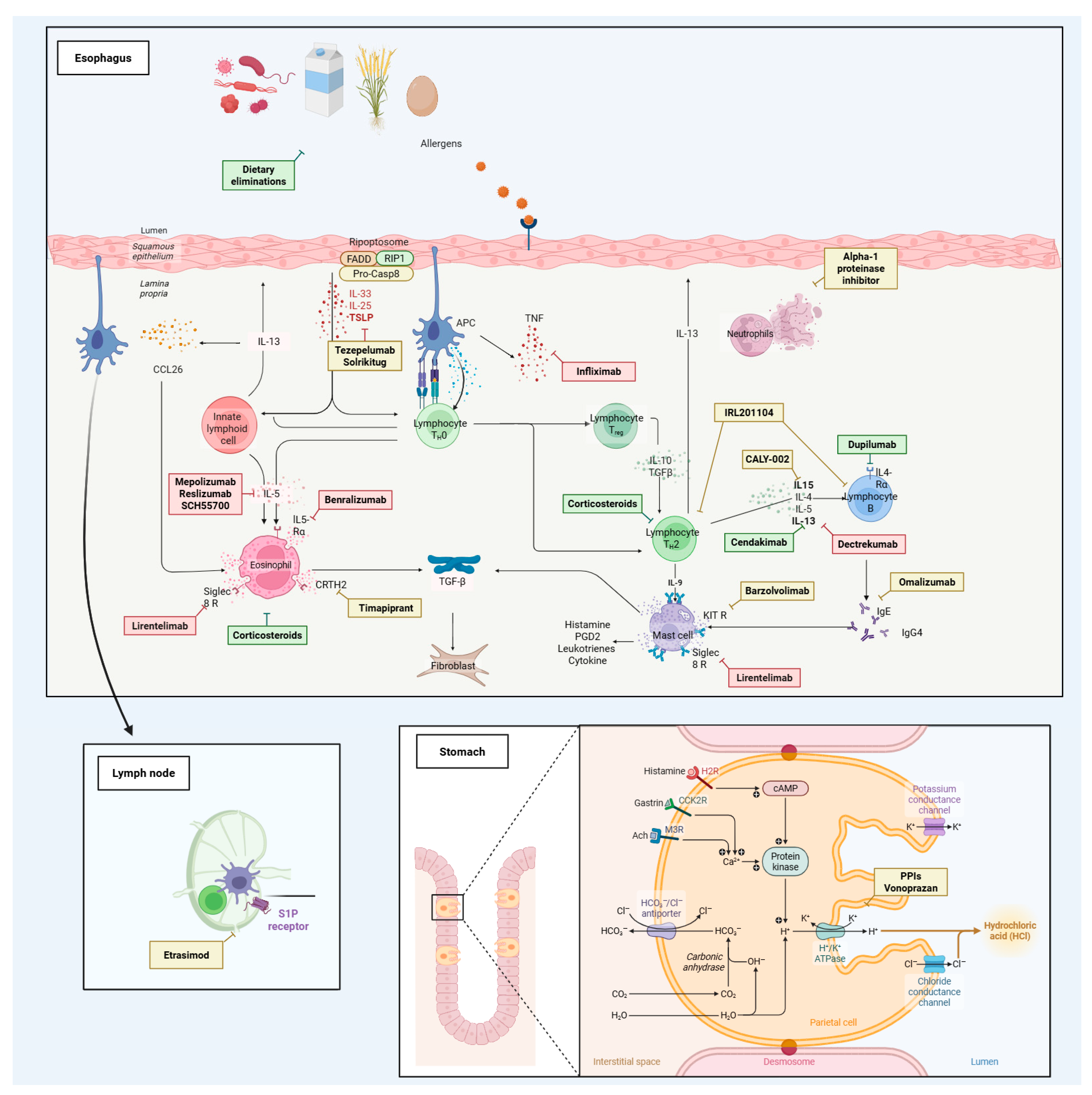
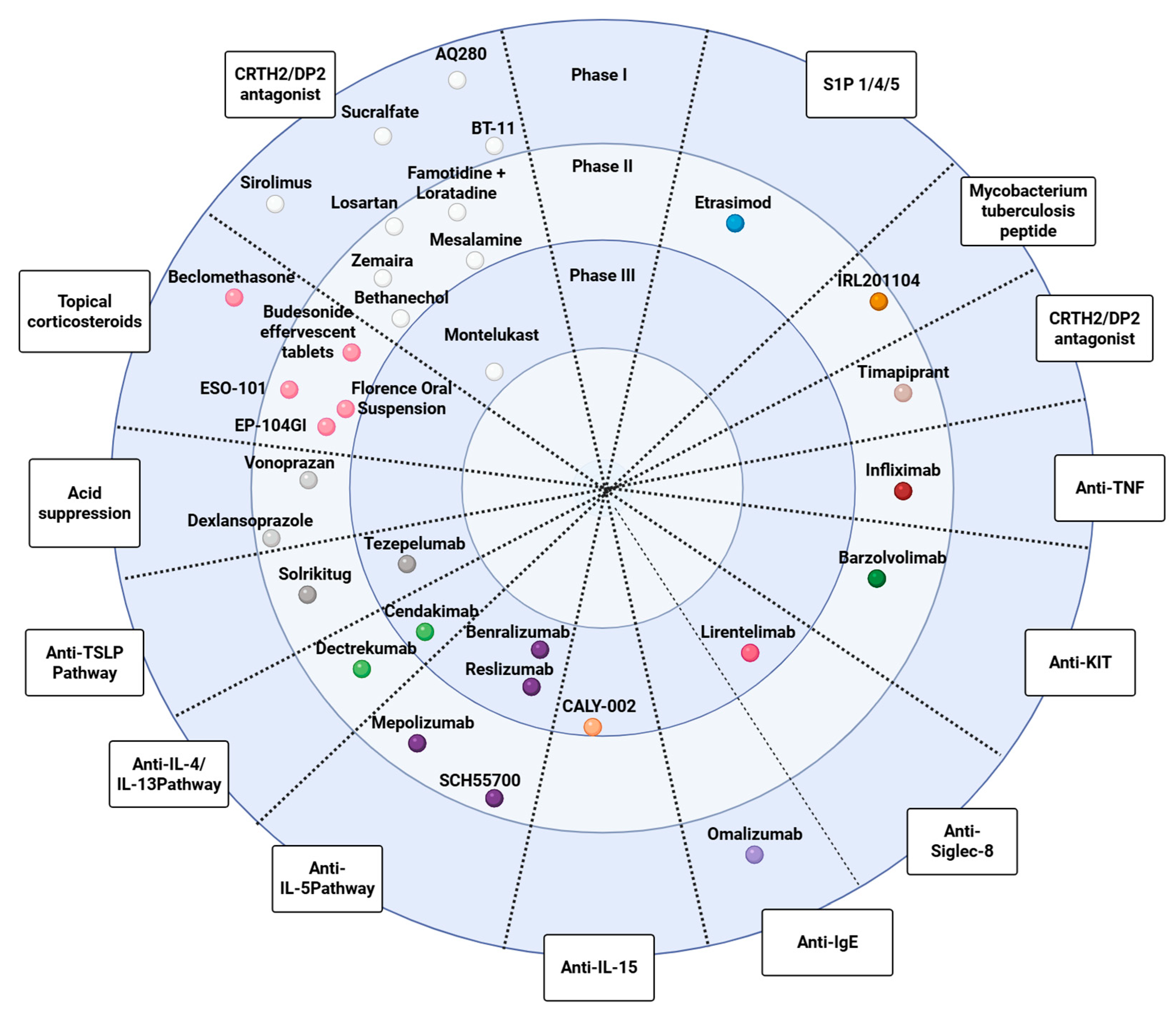
- Budesonide Orally Disintegrating Tablets (ODT): This formulation dissolves in saliva and coats the esophagus. In a Phase 3 placebo-controlled induction trial (6-week, EOS1 study), budesonide ODT 1 mg twice daily achieved complete clinical-histologic remission in 58% of adults versus 0% on placebo (primary endpoint). Histologic remission alone (≤5 eos/hpf) was reached in 93% on budesonide vs. 0% placebo [50]. A 48-week maintenance trial (EOS2) in patients who achieved remission showed 75% of patients on budesonide ODT (0.5 mg or 1.0 mg BID) remained in remission, compared to only 4% on placebo (p < 0.001). Time to relapse in the placebo arm was short (~87 days), underscoring the need for maintenance therapy in this chronic disease [51]. Budesonide ODT was well tolerated, with candidiasis occurring in ~12–16% on drug vs. none on placebo, and a few asymptomatic cortisol decreases were noted [51]. Budesonide ODT became the first esophagus-targeted therapy approved for EoE, authorized in Europe in 2018 for adults [52] and subsequently in Canada and Australia [53], but it is still not approved by the US Food and Drug Administration (USFDA). Consistently, a recent 11-center prospective real-world cohort (n = 233) using budesonide ODT 1 mg BID for 12 weeks (with most patients tapered to 1 mg QD for maintenance) showed deep histologic remission in 84% at induction and maintenance of deep remission in 78% at 52 weeks, with mainly mild adverse events (12% overall) and oral candidiasis in 9% [54].
- Budesonide Oral Suspension (BOS): This approach is a viscous budesonide slurry that the patient swallows to coat the esophagus. In the 12-week induction Phase 3 U.S. trial, which included 318 pediatric and adult patients, BOS 2 mg twice daily significantly outperformed placebo, with 53.1% vs. 1.0% of patients achieving histologic remission (≤6 eos/hpf; Δ ≈ 52%, p < 0.001) [55]. Symptomatic improvement (≥30% reduction in Dysphagia Symptom Questionnaire score) occurred in 52.6% on BOS vs. 39.1% on placebo (Δ13%, p = 0.024). Endoscopic severity scores (EREFS) and mean dysphagia scores also improved significantly more with BOS [55]. The suspension was generally safe and well-tolerated, with mostly mild-to-moderate adverse events (similar to placebo) [55]. Based on these results, budesonide BOS was approved by the USFDA in early 2024 as the first official oral treatment for EoE in the US [56]. The approval is for induction therapy (up to 12 weeks) in adolescents (≥11 years) and adults with active EoE. Notably, maintenance use beyond 12 weeks is not yet USFDA-approved [53], although long-term extension studies on other formulations show continued efficacy and safety up to at least 48 weeks [51].
- Fluticasone Orally Disintegrating Tablet (APT-1011): Fluticasone, a potent topical steroid, was originally used by swallowing the puff from an asthma inhaler, with variable success [45]. To improve delivery, an effervescent oral disintegrating tablet (APT-1011) was developed. The Phase 2b FLUTE trial evaluated APT-1011 in 106 adults over 12 weeks of induction and 40 weeks of maintenance [57]. At week 12, histologic remission (≤6 eos/hpf) was achieved in 80–86% of patients on high-dose regimens (e.g., 3 mg BID or 1.5 mg BID) versus 0% on placebo (p < 0.001). Endoscopic severity scores markedly improved on fluticasone with EREFS falling from 5 to 2 points, while barely changing on placebo. Dysphagia symptom frequency also improved significantly more with fluticasone than placebo, and improvements were sustained through 52 weeks on continued therapy [57]. The BID regimens had more frequent candida infections, but overall, APT-1011 was well tolerated. Notably, even a lower dose, 3 mg once daily at bedtime, achieved a 67% remission rate with a favorable safety profile [57]. To date, a Phase 3, randomized, double-blind study (FLUTE 3) has enrolled adults with eosinophilic esophagitis between December 2022 and August 2024. Participants received a 3 mg bedtime orally disintegrating tablet of APT-1011 for 24 weeks. Investigators have evaluated dysphagia symptom reduction, histologic remission, and safety. Completers may have entered a longer open-label extension, allowing efficacy monitoring. Secondary outcomes included quality-of-life scores and corticosteroid exposure over time [58].
- Extended-release fluticasone suspension (EP-104GI): In an open-label, dose-escalation, phase 1b/2a study (RESOLVE), adults with active EoE received a single intra-esophageal injection of polymer-coated fluticasone crystals at 4–20 sites (4–64 mg). Among 18 patients treated with 6 mg, the peak eosinophil counts fell 55–94%, and the highest 64 mg dose achieved 62% histologic remission (≤6 eos/hpf) plus 65–66% reductions in composite EoEHSS stage/grade. Straumann Dysphagia Index scores dropped 3–5 points (46–71%) by week 12 and remained improved at week 24–36 in earlier cohorts. Serum cortisol/glucose were normal, and only mild–moderate procedure-related AEs (e.g., transient chest pain, nausea) occurred—no oral/GI candidiasis or adrenal suppression [59].
- Mometasone furoate (ESO-101): ESO-101 is a thin, muco-adhesive polymer film that unrolls in the esophagus at bedtime, providing prolonged, targeted steroid exposure while maintaining <0.1% systemic bioavailability. In the ACESO Phase 2 randomized, double-blind induction study (28 days; n = 43), a once-nightly 800 µg dose lowered peak eosinophil counts by a mean 49 eos/hpf versus +7 with placebo (p = 0.03). Histologic remission (<15 eos/hpf) was reached in 48% of treated adults and deep remission (<6 eos/hpf) in 44%, compared with 0% on placebo; endoscopic inflammatory + fibrostenotic scores (EREFS) likewise improved (median −3 vs. +1). No treatment-emergent serious adverse events, candidiasis, or clinically significant cortisol changes were observed, supporting an excellent safety profile [60]. Building on these results, ESO-101 is now being evaluated in an ongoing global Phase 3 trial (NCT04849390) designed to confirm efficacy and support regulatory filing [61]. Earlier evidence with a mometasone furoate oral spray (200 µg four times daily for 8 weeks) showed a median 6.5-point reduction in the Watson Dysphagia Scale versus 0 with placebo (p < 0.05), demonstrating symptomatic benefit even without esophageal-specific delivery [62].
- Florence Oral Suspension (FOS): This swallow-and-coat liquid formulation is being tested as another esophagus-targeted topical steroid for EoE. A national, randomized, double-blind Phase 2 study in Brazil (EMS0718; NCT02873468) is currently enrolling 116 adults to compare three twice-daily concentrations—30, 60 and 90 µg/mL—with placebo over a 100-day induction period [63]. The primary endpoint is complete histologic response (≤6 eosinophils/high-power-field) at day 100, with parallel assessments of symptom relief and safety. Recruitment began on 19 April 2021 and remains underway; topline efficacy and safety results are still pending, and study completion is projected for 2026 [63]. If the dose-ranging data confirm meaningful remission with an acceptable safety profile, FOS could advance to Phase 3 trials and expand the therapeutic toolkit for long-term management of this chronic disease. At present, it remains an investigational product with no regulatory approvals. Additionally, early Phase 1b/2a data from the RESOLVE study of EP-104GI (extended-release fluticasone via intra-esophageal injection) reported in late September 2025 showed that the highest-dose cohort (8 mg per injection) achieved the largest improvements to date in histologic/tissue outcomes and eosinophil reduction with no serious adverse events or candidiasis; based on these results, the 8 mg dose was endorsed for testing in the randomized Phase 2b and the trial size is being expanded to ≥120 patients [64].
2.2. Potassium-Competitive Acid Blocker
2.3. Biologic Therapies Targeting Type 2 Inflammation
2.3.1. IL-5 Pathway Inhibitors (Anti-IL-5 and IL-5Rα)
- Mepolizumab (anti-IL-5): Mepolizumab, an IgG1 antibody binding IL-5, was one of the first biologics tried in EoE. Nearly a decade ago, two small, randomized trials including both adults and children evaluated mepolizumab in the setting of EoE. Both studies demonstrated significant reductions in esophageal eosinophil counts but failed to achieve histologic remission [74,75]. Clinical results remain inconsistent, with the initial pediatric trial showing no meaningful symptom relief, while the adult study recorded only a modest yet statistically significant reduction in dysphagia, but overall results were inconsistent [74,75]. More recently, a multicentre RCT (NCT03656380) included 66 adolescents and adults with active EoE to 300 mg SC monthly for 3 months vs. placebo [76]. The primary endpoint, change in EEsAI score, was not met (−15.4 ± 18.1 vs. −8.3 ± 18.0; p = 0.14). Despite this, mepolizumab produced a strong biologic effect, with peak eosinophils falling from 113 to 36 eos/hpf, giving higher histologic responses (<15 eos/hpf 42%; ≤6 eos/hpf 34%) versus 3% on placebo. Extending treatment to a 6-month period maintained eosinophil suppression, but symptom scores showed no significant differences (−18.3 vs. −18.6; p = 0.85), and endoscopic gains were modest with no impact on fibrosis [76]. The safety profile was favorable, marked by mild injection-site reactions and no serious adverse events attributable to the drug [76]. Given the inconclusive efficacy, mepolizumab development in EoE did not progress beyond Phase 2. Thus, Mepolizumab is approved for other eosinophilic disorders like asthma and eosinophilic granulomatosis, but not for EoE.
- Reslizumab (anti-IL-5): Reslizumab was tested in a large Phase 2/3 trial in 226 children and adolescents with EoE [77]. Similar to other anti-IL-5, the treatment caused a significant drop in eosinophil counts (median reduction range 40–60% from baseline at highest doses) compared to minimal change on placebo. However, the therapy did not lead to full histologic remission in most patients, as no dose group achieved a median <5 eos/hpf [77]. Importantly, symptoms did not improve any more than placebo, and there were no significant differences in physician global assessment or patient symptom scores between reslizumab and placebo arms. Both coprimary endpoints, defined as eosinophil count and symptom score, were not met. In summary, while reslizumab significantly reduced esophageal eosinophilia, it failed to improve EoE symptoms [77]. After these results, reslizumab was not pursued further for EoE. Long-term follow-up showed no major safety issues over 9 years with reslizumab in patients with EoE, but also no new efficacy signal [78].
- Benralizumab (anti-IL-5Rα): Benralizumab is an IL-5 receptor–α antibody that not only blocks IL-5 signaling but also causes antibody-dependent cell-mediated cytotoxicity, aiding in achieving a near-complete eosinophil depletion [79]. The phase-3 MESSINA trial tested benralizumab in 211 patients aged 12–65 years with symptomatic, histologically active EoE who were randomized 1:1 to receive subcutaneous benralizumab 30 mg or placebo every four weeks for 24 weeks [80]. Histologic response, defined as ≤6 eos/hpf, was achieved in 87.4% of benralizumab recipients versus 6.5% with placebo (difference 80.8%; 95% CI 72.9–88.8; p < 0.001). Conversely, dysphagia improved minimally with a least-squares mean change in Dysphagia Symptom Questionnaire score that differed by only 3.0 points in favour of benralizumab (p = 0.18), and endoscopic and quality-of-life measures showed no meaningful advantages. Adverse events occurred in 64.1% of the benralizumab group and 61.7% of controls, with similar types and no treatment-related discontinuations [80]. The original design of this study planned that participants could enter a 28-week open-label phase with a long-term extension, yet the sponsor terminated this part of the study after week 52 because the sustained eosinophil depletion still did not yield clinically meaningful symptom relief. Among the 210 patients who had received at least one dose, 205 (98%) rolled over into the open-label period, 161 (76%) reached the week-52 visit, and 93 proceeded to the optional extension. However, 95% of these withdrew when the trial was halted, and full results from this extension remain unpublished in the peer-reviewed literature [81].
2.3.2. IL-13 and IL-4 Pathway Inhibitors
- Dupilumab (anti-IL-4Rα): Dupilumab is a fully human monoclonal antibody that binds IL-4Rα, preventing both IL-4 and IL-13 from activating their receptor pathway [82]. It is a well-established treatment for atopic dermatitis, asthma, and sinus polyposis—conditions that frequently coexist with EoE [83,84,85]. In a double-blind, randomized phase-2 trial enrolling 47 adults with active EoE, weekly subcutaneous dupilumab 300 mg for 12 weeks produced multidimensional benefits over placebo [86]. Dysphagia improved significantly (mean SDI change −3.0 vs. −1.3; ≥3-point response 39% vs. 13%). Peak oesophageal eosinophil counts fell by 96 eos/hpf (−93%) compared with a 10 eos/hpf rise (+12%) on placebo. Endoscopic activity regressed (EREFS −1.9 vs. −0.3) and oesophageal distensibility increased 18% while remaining static in controls. Adverse events were mainly mild injection-site erythema (35%) and nasopharyngitis (22%), with no serious drug-related events or deaths [86]. Building on this, the Phase 3 program (LIBERTY-EoE trials) was conducted in patients aged ≥12. In two independent 24-week placebo-controlled trials (Part A and Part B, n ≈ 80 each), dupilumab 300 mg weekly produced high rates of histologic remission and clinical improvement. In Part A, 60% of dupilumab-treated patients achieved histologic remission (≤6 eos/hpf) compared to only 5% on placebo. Similarly, 59% vs. 6% achieved remission in Part B [87]. Dupilumab also significantly improved symptoms: patients experienced a 21–22 point improvement (reduction) in their Dysphagia Symptom Questionnaire (DSQ) scores, versus a 10-point improvement on placebo [88]. The dupilumab–placebo difference of 12 points was clinically meaningful, reflecting substantial symptom relief by 24 weeks [88]. These positive results were published and led to USFDA approval in May 2022 as the first treatment for EoE [44]. Dupilumab is approved in the US, EU, and other regions for adolescents and adults with EoE, and in 2023, the USFDA expanded its indication to include children as young as 1 year (based on pediatric trial data). In clinical practice, dupilumab has become a breakthrough option—inducing histologic remission in 60% of patients and significantly improving dysphagia, while being generally well tolerated. Common side effects include injection site reactions and peripheral blood eosinophilia (transient), and in other conditions, dupilumab is associated with rare conjunctivitis or arthritic reactions, but overall, it has a favorable safety profile with no immunosuppression [87,88]. The success of dupilumab confirms that blocking IL-4/IL-13 can effectively treat EoE [82].
- Cendakimab (Anti-IL-13): Cendakimab (formerly called RPC4046, also code-named CC-93538) is a humanized monoclonal antibody that antagonizes IL-13 by preventing it from binding to both IL-13 receptor α-1 and α-2 subunits [89]. In a Phase 2 trial of adults with active EoE (RPC4046-EoE Study), cendakimab showed strong biologic activity: after 16 weeks of weekly therapy, patients had a reduction of nearly 100 eos/hpf in peak esophageal eosinophil counts from baseline, whereas placebo had essentially no change. Endoscopic improvement was also notable—the treatment group had significant regression of features of the EREFS score, compared to placebo. On symptoms, the Phase 2 showed a positive trend: dysphagia symptom scores improved more in the 360 mg cendakimab group than placebo, but the difference fell just short of statistical significance at 16 weeks (p = 0.073) [89]. Nonetheless, given the marked histologic and endoscopic efficacy, the trial was considered positive. Cendakimab was well tolerated in Phase 2, with headache and upper respiratory infections the most common adverse events with a similar rate to placebo [89]. In an open-label extension trial, long-term treatment with cendakimab was generally well tolerated and led to sustained or improved endoscopic, histologic, and clinical outcomes over 52 weeks, supporting its potential as a maintenance therapy for eosinophilic esophagitis. The Phase 3 trial of cendakimab in EoE (a large multinational study enrolling 430 patients aged 12–75) was recently completed, and results are available on clinicaltrials [90]. In this trial, patients received cendakimab 360 mg either every week or every other week (after an initial 24-week induction) vs. placebo. Both weekly and every-other-week cendakimab regimens significantly reduced dysphagia frequency (mean reduction of 4.7 days vs. 2.7 days with placebo) and achieved histologic remission (≤6 eos/hpf) in 36–39% of patients compared to 0.9% with placebo at week 24. These effects were maintained through week 48, with continued symptom improvement and sustained histologic response. The safety profile was favorable, with no new safety signals and a low incidence of serious adverse events [90].
- Dectrekumab (Anti-IL-13): Dectrekumab (QAX576) is a fully human monoclonal antibody targeting IL-13. In a proof-of-concept Phase 2 trial (adult EoE patients), intravenous dectrekumab achieved significant histological improvements: mean esophageal eosinophil counts dropped 60% from baseline (versus a 23% increase with placebo, p = 0.004) [91]. The drug’s administration showed a trend toward improved dysphagia symptoms compared with placebo. However, the predefined primary endpoint (≥75% eosinophil reduction in a set proportion of patients) was not met, and complete histologic remission was not achieved. Dectrekumab was generally well tolerated, with no serious adverse events reported [91].
2.3.3. Thymic Stromal Lymphopoietin
- Tezepelumab: Tezepelumab has demonstrated clinical efficacy in severe asthma, earning USFDA approval for this indication. Its elevated presence in EoE biopsy samples suggests it may also help sustain the local Th2-skewed inflammatory milieu. The CROSSING trial (NCT05583227) is an ongoing, randomised, double-blind, placebo-controlled, multicentre trial in 360 adolescents and adults aged 12–80 years with symptomatic, histologically active EoE [94]. Participants receive subcutaneous tezepelumab or placebo every four weeks for a 52-week double-blind period. Co-primary end-points are histologic remission (≤6 eosinophils per high-power field) and change in Dysphagia Symptom Questionnaire (DSQ) score at week 16; key secondary outcomes include endoscopic improvement, quality-of-life scores, steroid-free remission and maintenance of response through week 52. An optional open-label extension will follow to collect long-term safety and durability data through January 2027, the planned primary-completion date. The trial is recruiting across North America, Europe and Asia-Pacific [94]. No results have yet been posted, but a 2024 case report described complete clinical and transcriptomic remission in a teenager with steroid-refractory EoE who received tezepelumab for co-existing asthma [95].
- Solrikitug: Solrikitug is a next-generation human IgG1 monoclonal antibody against TSLP. Its efficacy in EoE is being tested in ALAMERE (NCT06598462), a phase 2, randomised, double-blind, placebo-controlled study that began on 16 October 2024 and is currently recruiting around 157 adults with symptomatic, histologically active EoE at about 80 centres across North America, Europe, Asia-Pacific and Australia [96]. Participants receive one of three subcutaneous dose levels of solrikitug or a matching placebo every four weeks for a 24-week blinded treatment period; completers may roll into a 28-week open-label extension, after which a 16-week safety follow-up brings total participation to 68 weeks. Co-primary endpoints at week 24 are histologic remission defined as peak oesophageal eosinophil density ≤ eos/hpf and change from baseline in the 14-day DSQ, while ranked secondary outcomes examine endoscopic and detailed histologic scores, steroid-free clinico-histologic remission, durability of response through week 52, and standard safety, pharmacokinetic and immunogenicity parameters. Top-line primary data are expected by 30 April 2027, with final database lock targeted for 31 August 2027, and no results have yet been reported [96].
2.3.4. Sialic-Acid-Binding Immunoglobulin-like Lectin (Siglec)-8
- Lirentelimab (AK002): Lirentelimab is a humanised IgG1 monoclonal antibody that binds Siglec-8. The KRYPTOS trial (NCT04322708) is a multicentre, randomised, double-blind, placebo-controlled phase 2/3 study in 277 adolescents and adults aged 12–80 years with symptomatic, histologically active EoE. Participants received six monthly intravenous infusions of high-dose lirentelimab (1 mg kg−1 loading, then 3 mg kg−1), low-dose lirentelimab (1 mg kg−1 throughout) or placebo over a 24-week double-blind period, with an optional 24-week open-label extension for long-term follow-up [99]. Co-primary end-points were histologic remission (≤6 eos/hpf) at week 24 and change in mean daily Dysphagia Symptom Questionnaire (DSQ) score over weeks 23–24; secondary outcomes included endoscopic improvement, quality-of-life measures and safety [99]. The study met its histologic target, with remission in 88% (high dose) and 92% (low dose) versus 11% with placebo, but the symptom co-primary end-point was not reached (least-squares mean DSQ change −17.4, −11.9 and −14.6, respectively). Adolescents showed a numerically greater DSQ improvement (−18.4 and −16.4 vs. −8.9). Infusion-related reactions and headache were the most frequent adverse events; only three serious adverse events occurred across all arms [100]. Although an open-label extension is continuing to gather durability and safety data, the discordance between robust tissue responses and modest symptomatic benefit has tempered enthusiasm for this approach.
2.3.5. Immunoglobulin E (IgE) Neutralization
- Omalizumab: Omalizumab is a humanised IgG1 monoclonal against IgE-driven inflammation. Two clinical studies have explored its role in eosinophilic oesophagitis (EoE). A 12-week, open-label, single-centre phase 1b pilot study enrolled 15 adolescents and adults (median age 14 years, range 12–71) who received weight- and IgE-adjusted subcutaneous omalizumab every 2–4 weeks [101]. Histological-clinical remission (≤15 eos) was achieved in 33% of patients, with significant falls in peak eosinophil counts from 31 to 19 eos/hpf (p = 0.034), mast-cell density and symptom scores, and no serious adverse events. A 16-week, randomised, double-blind, placebo-controlled phase 2 trial allocated 30 mostly adult patients to omalizumab (n = 16) or placebo (n = 14) every 2–4 weeks [102]. Omalizumab produced no significant reduction in eosinophil burden or dysphagia scores, despite effective depletion of tissue IgE, indicating that IgE is not a dominant driver of EoE in this population. Collectively, these findings imply that while anti-IgE therapy can induce remission in a paediatric-leaning subgroup with low peripheral eosinophilia, its overall efficacy in adult EoE appears limited.
2.3.6. Mycobacterium Tuberculosis Chaperonin 60.1 Peptide
- IRL201104: also known as “1104” is a first-in-class synthetic peptide derived from Mycobacterium tuberculosis chaperonin 60.1. A Phase 2a trial with a 2-week regimen of three doses in active EoE demonstrated promising results [103]. IRL201104 led to a 50% reduction in peak esophageal eosinophil counts from baseline and significantly improved patient-reported dysphagia symptom scores compared to placebo, with relief persisting 4 weeks beyond the last dose [103]. Treated patients showed broad immunologic shifts, including normalization of key EoE-related cytokine transcripts and markers of barrier function. The peptide was well tolerated, with no serious adverse events or any treatment discontinuations due to drug-related effects [103]. On the strength of Phase 2a data, IRL201104 received USFDA Orphan Drug Designation for EoE. A longer Phase 2b trial, using higher doses and extended dosing, is planned to further assess efficacy and durability in 2025 [104].
2.3.7. IL-15 Pathway Inhibitors
- CALY-002 is a humanized monoclonal antibody against interleukin-15 (IL-15), a cytokine that drives T-cell and innate lymphocyte activation. A Phase 1a/1b trial tested single doses in healthy volunteers and multiple doses in EoE patients [105]. In healthy subjects, CALY-002 was well tolerated and demonstrated clear on-target activity (dose-dependent reductions in NK cell counts, reflecting IL-15 blockade) [105]. Preliminary results in EoE patients showed promising efficacy. CALY-002 markedly reduced esophageal eosinophil density and histologic damage while improving dysphagia symptoms in steroid-refractory EoE. No serious adverse events were observed; early studies report a good overall safety profile for IL-15 inhibition in EoE. CALY-002 holds orphan designation for EoE in both the EU and the US.
2.3.8. Sphingosine-1-Phosphate Receptor (S1P) Modulator
- Etrasimod (APD334): This drug is a once-daily oral S1P 1/4/5 modulator and in the phase 2b VOYAGE study (NCT04682639) involving 108 adults with active EoE, the 2 mg dose for 24 weeks produced a 52.4% reduction in peak esophageal eosinophil counts versus a 61% increase on placebo at week 24, after meeting the primary endpoint at week 16 (−46% versus baseline) [107]. Histologic remission (<15 eos/hpf) was achieved in ~33% of patients and a significant improvement in EREFS (−1.3 points) and patient-reported outcomes, including a −21.6-point fall in the DSQ among participants without prior dilation. The therapy showed a favorable safety profile, with mainly mild or moderate events (transient first-dose bradycardia, modest transaminase rises) and no study withdrawals for drug reasons. Benefits in histology, endoscopy and symptoms were maintained through week 52 in the open-label extension, with no new safety signals [107]. On 8 June 2021, the molecule received USFDA Orphan Drug Designation for EoE [108], but the manufacturer has halted development for this indication. In the 2025 pipeline update dated 29 April 2025, etrasimod for EoE is listed among the programs discontinued from development, and no Phase 3 trial is registered [109].
2.3.9. Anti-KIT Monoclonal Antibody
- Barzolvolimab (CDX-0159): This is a first-in-class mast cell–depleting antibody under investigation for EoE. A Phase 2 trial (“EvolvE”, NCT05774184) in patients with active EoE is evaluating subcutaneous barzolvolimab 300 mg every 8 weeks versus placebo in a 16-week double-blind period, followed by a 12-week open-label extension [112]. The primary endpoint is a reduction in peak esophageal intraepithelial mast cell density at 12 weeks, with key secondary endpoints including improvements in dysphagia symptom scores and peak eosinophil counts [112]. Screening biopsies from 117 candidates showed a strong correlation between mast-cell and eosinophil densities, supporting KIT blockade as a mechanistic strategy in EoE [113]. Enrollment concluded in February 2025, and topline efficacy data are expected in the second half of 2025 [112]. If the Phase 2 outcomes are positive, this therapy could represent a novel treatment avenue in EoE by addressing a previously under-recognized driver of disease.
2.3.10. α1-Proteinase Inhibitor
- Zemaira (α1-proteinase inhibitor, human) is an intravenous, plasma-derived A1PI long used for α1-antitrypsin deficiency. The Phase 2 open-label Zemaira Eosinophilic Esophagitis Pilot Study (ZEEPS, NCT05485155) is now recruiting adults with active, treatment-refractory EoE at NIH and Cincinnati Children’s. Participants receive 120 mg kg−1 IV weekly for 8 weeks (follow-up 12 weeks); primary read-outs include peak eosinophil density and dysphagia scores. Total planned enrollment is 15 [115]. Decades of augmentation-therapy experience and pre-clinical data showing A1PI reversal of KLK5-driven pathology support a favorable safety outlook and a protease-targeted, steroid-sparing strategy for EoE [114].
3. Challenges in Eosinophilic Esophagitis Clinical Trials and Potential Solutions
3.1. Symptom-Histology Discordance: A Fundamental Challenge
3.2. Endpoint Selection and Validation
3.3. Recruitment and Inclusion Challenges: Expanding the Trial Population
3.4. Ethical Considerations in Placebo Use: Balancing Science and Patient Care
3.5. Psychiatric Comorbidities: The Overlooked Dimension
3.6. Diet Therapy Trials: Unique Challenges and Opportunities
3.7. Long-Term Disease Modification: The Frontier of EoE Research
3.8. Pediatric-Specific Considerations
3.9. Future Therapeutic Directions
4. Conclusions
Author Contributions
Funding
Institutional Review Board Statement
Informed Consent Statement
Data Availability Statement
Conflicts of Interest
Abbreviations
| AE | Adverse event |
| APC | Antigen-presenting cell |
| BET | Budesonide effervescent tablet |
| BID | Twice daily |
| BOS | Budesonide oral suspension |
| CCL26 | Chemokine (eotaxin-3) |
| CRTH2/DP2 | Chemoattractant receptor-homologous molecule expressed on Th2 cells/prostaglandin D2 receptor 2 |
| DSQ | Dysphagia Symptom Questionnaire |
| EGJ | Esophagogastric junction |
| EMA | European Medicines Agency |
| EoE | Eosinophilic esophagitis |
| EoEHSS | EoE Histology Scoring System |
| EEsAI | EoE Activity Index |
| EREFS | EoE Endoscopic Reference Score |
| USFDA | U.S. Food and Drug Administration |
| FLIP | Functional lumen imaging probe |
| HPF/eos/hpf | High-power field/eosinophils per high-power field |
| HR | Histologic remission |
| IgE | Immunoglobulin E |
| IL | Interleukin (e.g., IL-4, IL-5, IL-13, IL-15) |
| ILC2 | Type-2 innate lymphoid cell |
| JAK | STAT-Janus kinase-signal transducer and activator of transcription |
| KIT | Stem cell factor receptor (CD117) |
| mAb | Monoclonal antibody |
| ODT | Orally disintegrating tablet |
| OLE | Open-label extension |
| P-CAB (PCAB) | Potassium-competitive acid blocker |
| PPI | Proton-pump inhibitor |
| PRO | Patient-reported outcome |
| RCT | Randomized controlled trial |
| RDBPC | Randomized double-blind placebo-controlled |
| SAE | Serious adverse event |
| SC/IV/PO | Subcutaneous/Intravenous/Oral |
| Siglec-8 | Sialic-acid-binding immunoglobulin-like lectin-8 |
| S1P | Sphingosine-1-phosphate |
| STC | Swallowed topical corticosteroid |
| Th2 | Type-2 helper T cell |
| TNF | Tumor necrosis factor |
| TSLP | Thymic stromal lymphopoietin |
References
- de Bortoli, N.; Visaggi, P.; Penagini, R.; Annibale, B.; Baiano Svizzero, F.; Barbara, G.; Bartolo, O.; Battaglia, E.; Di Sabatino, A.; De Angelis, P.; et al. The 1st EoETALY Consensus on the Diagnosis and Management of Eosinophilic Esophagitis-Current Treatment and Monitoring. Dig. Liver Dis. Off. J. Ital. Soc. Gastroenterol. Ital. Assoc. Study Liver 2024, 56, 1173–1184. [Google Scholar] [CrossRef] [PubMed]
- Pouw, R.E.; Barret, M.; Biermann, K.; Bisschops, R.; Czakó, L.; Gecse, K.B.; de Hertogh, G.; Hucl, T.; Iacucci, M.; Jansen, M.; et al. Endoscopic Tissue Sampling—Part 1: Upper Gastrointestinal and Hepatopancreatobiliary Tracts. European Society of Gastrointestinal Endoscopy (ESGE) Guideline. Endoscopy 2021, 53, 1174–1188. [Google Scholar] [CrossRef]
- Lucendo, A.J.; Santander, C.; Savarino, E.; Guagnozzi, D.; Pérez-Martínez, I.; Perelló, A.; Guardiola-Arévalo, A.; Barrio, J.; Elena Betoré-Glaria, M.; Gutiérrez-Junquera, C.; et al. EoE CONNECT, the European Registry of Clinical, Environmental, and Genetic Determinants in Eosinophilic Esophagitis: Rationale, Design, and Study Protocol of a Large-Scale Epidemiological Study in Europe. Ther. Adv. Gastroenterol. 2022, 15, 17562848221074204. [Google Scholar] [CrossRef]
- Mari, A.; Calabrese, F.; Pasta, A.; Lorenzon, G.; Weusten, B.; Keller, J.; Visaggi, P.; Roman, S.; Marabotto, E.; Dickman, R.; et al. Esophageal and Oropharyngeal Dysphagia: Clinical Recommendations From the United European Gastroenterology and European Society for Neurogastroenterology and Motility. United Eur. Gastroenterol. J. 2025, 13, 855–901. [Google Scholar] [CrossRef] [PubMed]
- Dellon, E.S.; Hirano, I. Epidemiology and Natural History of Eosinophilic Esophagitis. Gastroenterology 2018, 154, 319–332.e3. [Google Scholar] [CrossRef]
- Muir, A.; Falk, G.W. Eosinophilic Esophagitis: A Review. JAMA 2021, 326, 1310–1318. [Google Scholar] [CrossRef]
- de Bortoli, N.; Visaggi, P.; Penagini, R.; Annibale, B.; Baiano Svizzero, F.; Barbara, G.; Bartolo, O.; Battaglia, E.; Di Sabatino, A.; De Angelis, P.; et al. The 1st EoETALY Consensus on the Diagnosis and Management of Eosinophilic Esophagitis—Definition, Clinical Presentation and Diagnosis. Dig. Liver Dis. Off. J. Ital. Soc. Gastroenterol. Ital. Assoc. Study Liver 2024, 56, 951–963. [Google Scholar] [CrossRef]
- Ryu, S.; Lee, K.H.; Tizaoui, K.; Terrazzino, S.; Cargnin, S.; Effenberger, M.; Shin, J.I.; Kronbichler, A. Pathogenesis of Eosinophilic Esophagitis: A Comprehensive Review of the Genetic and Molecular Aspects. Int. J. Mol. Sci. 2020, 21, 7253. [Google Scholar] [CrossRef]
- Visaggi, P.; Ghisa, M.; Barberio, B.; Marabotto, E.; de Bortoli, N.; Savarino, E. Systematic Review: Esophageal Motility Patterns in Patients with Eosinophilic Esophagitis. Dig. Liver Dis. 2022, 54, 1143–1152. [Google Scholar] [CrossRef] [PubMed]
- Visaggi, P.; Ghisa, M.; Marabotto, E.; Venturini, A.; Stefani Donati, D.; Bellini, M.; Savarino, V.; de Bortoli, N.; Savarino, E. Esophageal Dysmotility in Patients with Eosinophilic Esophagitis: Pathogenesis, Assessment Tools, Manometric Characteristics, and Clinical Implications. Esophagus 2023, 20, 29–38. [Google Scholar] [CrossRef]
- Ghisa, M.; Laserra, G.; Marabotto, E.; Ziola, S.; Tolone, S.; de Bortoli, N.; Frazzoni, M.; Mauro, A.; Penagini, R.; Savarino, V.; et al. Achalasia and Obstructive Motor Disorders Are Not Uncommon in Patients with Eosinophilic Esophagitis. Clin. Gastroenterol. Hepatol. 2021, 19, 1554–1563. [Google Scholar] [CrossRef]
- Racca, F.; Pellegatta, G.; Cataldo, G.; Vespa, E.; Carlani, E.; Pelaia, C.; Paoletti, G.; Messina, M.R.; Nappi, E.; Canonica, G.W.; et al. Type 2 Inflammation in Eosinophilic Esophagitis: From Pathophysiology to Therapeutic Targets. Front. Physiol. 2021, 12, 815842. [Google Scholar] [CrossRef]
- Chehade, M.; Falk, G.W.; Aceves, S.; Lee, J.K.; Mehta, V.; Leung, J.; Shumel, B.; Jacob-Nara, J.A.; Deniz, Y.; Rowe, P.J.; et al. Examining the Role of Type 2 Inflammation in Eosinophilic Esophagitis. Gastro Hep Adv. 2022, 1, 720–732. [Google Scholar] [CrossRef] [PubMed]
- Doyle, A.D.; Masuda, M.Y.; Kita, H.; Wright, B.L. Eosinophils in Eosinophilic Esophagitis: The Road to Fibrostenosis Is Paved with Good Intentions. Front. Immunol. 2020, 11, 603295. [Google Scholar] [CrossRef]
- Simon, D.; Wardlaw, A.; Rothenberg, M.E. Organ-Specific Eosinophilic Disorders of the Skin, Lung, and Gastrointestinal Tract. J. Allergy Clin. Immunol. 2010, 126, 3–5. [Google Scholar] [CrossRef] [PubMed]
- Martin, L.J.; He, H.; Collins, M.H.; Abonia, J.P.; Biagini Myers, J.M.; Eby, M.; Johansson, H.; Kottyan, L.C.; Khurana Hershey, G.K.; Rothenberg, M.E. Eosinophilic Esophagitis (EoE) Genetic Susceptibility Is Mediated by Synergistic Interactions between EoE-Specific and General Atopic Disease Loci. J. Allergy Clin. Immunol. 2018, 141, 1690–1698. [Google Scholar] [CrossRef]
- Hahn, J.W.; Lee, K.; Shin, J.I.; Cho, S.H.; Turner, S.; Shin, J.U.; Yeniova, A.Ö.; Koyanagi, A.; Jacob, L.; Smith, L.; et al. Global Incidence and Prevalence of Eosinophilic Esophagitis, 1976–2022: A Systematic Review and Meta-Analysis. Clin. Gastroenterol. Hepatol. Off. Clin. Pract. J. Am. Gastroenterol. Assoc. 2023, 21, 3270–3284.e77. [Google Scholar] [CrossRef]
- Thel, H.L.; Anderson, C.; Xue, A.Z.; Jensen, E.T.; Dellon, E.S. Prevalence and Costs of Eosinophilic Esophagitis in the United States. Clin. Gastroenterol. Hepatol. 2025, 23, 272–280.e8. [Google Scholar] [CrossRef]
- Dellon, E.S.; Liacouras, C.A.; Molina-Infante, J.; Furuta, G.T.; Spergel, J.M.; Zevit, N.; Spechler, S.J.; Attwood, S.E.; Straumann, A.; Aceves, S.S.; et al. Updated International Consensus Diagnostic Criteria for Eosinophilic Esophagitis: Proceedings of the AGREE Conference. Gastroenterology 2018, 155, 1022–1033.e10. [Google Scholar] [CrossRef]
- Feo-Ortega, S.; Lucendo, A.J. Evidence-Based Treatments for Eosinophilic Esophagitis: Insights for the Clinician. Ther. Adv. Gastroenterol. 2022, 15, 17562848211068665. [Google Scholar] [CrossRef] [PubMed]
- Runge, T.M.; Eluri, S.; Cotton, C.C.; Burk, C.M.; Woosley, J.T.; Shaheen, N.J.; Dellon, E.S. Outcomes of Esophageal Dilation in Eosinophilic Esophagitis: Safety, Efficacy, and Persistence of the Fibrostenotic Phenotype. Am. J. Gastroenterol. 2016, 111, 206–213. [Google Scholar] [CrossRef]
- Farah, A.; Assaf, T.; Hindy, J.; Abboud, W.; Mahamid, M.; Savarino, E.V.; Mari, A. The Dynamic Evolution of Eosinophilic Esophagitis. Diagnostics 2025, 15, 240. [Google Scholar] [CrossRef] [PubMed]
- Facchin, S.; Bonazzi, E.; Tomasulo, A.; Bertin, L.; Lorenzon, G.; Maniero, D.; Zingone, F.; Cardin, R.; Barberio, B.; Ghisa, M.; et al. Could Modulating the Esophageal Microbiome Be the Answer for Eosinophilic Esophagitis Treatment? Expert Rev. Gastroenterol. Hepatol. 2025, 19, 853–861. [Google Scholar] [CrossRef]
- Visaggi, P.; Savarino, E.; Del Corso, G.; Hunter, H.; Baiano Svizzero, F.; Till, S.J.; Dunn, J.; Wong, T.; de Bortoli, N.; Zeki, S. Six-Food Elimination Diet Is Less Effective During Pollen Season in Adults with Eosinophilic Esophagitis Sensitized to Pollens. Am. J. Gastroenterol. 2023, 118, 1957–1962. [Google Scholar] [CrossRef]
- Visaggi, P.; Baiano Svizzero, F.; Savarino, E. Food Elimination Diets in Eosinophilic Esophagitis: Practical Tips in Current Management and Future Directions. Best Pract. Res. Clin. Gastroenterol. 2023, 62–63, 101825. [Google Scholar] [CrossRef]
- Molina-Infante, J.; Arias, Á.; Alcedo, J.; Garcia-Romero, R.; Casabona-Frances, S.; Prieto-Garcia, A.; Modolell, I.; Gonzalez-Cordero, P.L.; Perez-Martinez, I.; Martin-Lorente, J.L.; et al. Step-up Empiric Elimination Diet for Pediatric and Adult Eosinophilic Esophagitis: The 2-4-6 Study. J. Allergy Clin. Immunol. 2018, 141, 1365–1372. [Google Scholar] [CrossRef]
- Pasta, A.; Calabrese, F.; Furnari, M.; Savarino, E.V.; Visaggi, P.; Bodini, G.; Formisano, E.; Zentilin, P.; Giannini, E.G.; Marabotto, E. Endoscopic Management of Eosinophilic Esophagitis: A Narrative Review on Diagnosis and Treatment. J. Clin. Med. 2025, 14, 3756. [Google Scholar] [CrossRef]
- Lucendo, A.J.; Arias, Á.; González-Cervera, J.; Yagüe-Compadre, J.L.; Guagnozzi, D.; Angueira, T.; Jiménez-Contreras, S.; González-Castillo, S.; Rodríguez-Domíngez, B.; De Rezende, L.C.; et al. Empiric 6-Food Elimination Diet Induced and Maintained Prolonged Remission in Patients with Adult Eosinophilic Esophagitis: A Prospective Study on the Food Cause of the Disease. J. Allergy Clin. Immunol. 2013, 131, 797–804. [Google Scholar] [CrossRef]
- Kagalwalla, A.F.; Wechsler, J.B.; Amsden, K.; Schwartz, S.; Makhija, M.; Olive, A.; Davis, C.M.; Manuel-Rubio, M.; Marcus, S.; Shaykin, R.; et al. Efficacy of a 4-Food Elimination Diet for Children with Eosinophilic Esophagitis. Clin. Gastroenterol. Hepatol. Off. Clin. Pract. J. Am. Gastroenterol. Assoc. 2017, 15, 1698–1707.e7. [Google Scholar] [CrossRef] [PubMed]
- Molina-Infante, J.; Gonzalez-Cordero, P.L.; Arias, A.; Lucendo, A.J. Update on Dietary Therapy for Eosinophilic Esophagitis in Children and Adults. Expert Rev. Gastroenterol. Hepatol. 2017, 11, 115–123. [Google Scholar] [CrossRef] [PubMed]
- Kliewer, K.L.; Gonsalves, N.; Dellon, E.S.; Katzka, D.A.; Abonia, J.P.; Aceves, S.S.; Arva, N.C.; Besse, J.A.; Bonis, P.A.; Caldwell, J.M.; et al. One-Food versus Six-Food Elimination Diet Therapy for the Treatment of Eosinophilic Oesophagitis: A Multicentre, Randomised, Open-Label Trial. lancet. Gastroenterol. Hepatol. 2023, 8, 408–421. [Google Scholar] [CrossRef] [PubMed]
- Mayerhofer, C.; Kavallar, A.M.; Aldrian, D.; Lindner, A.K.; Müller, T.; Vogel, G.F. Efficacy of Elimination Diets in Eosinophilic Esophagitis: A Systematic Review and Meta-Analysis. Clin. Gastroenterol. Hepatol. Off. Clin. Pract. J. Am. Gastroenterol. Assoc. 2023, 21, 2197–2210.e3. [Google Scholar] [CrossRef] [PubMed]
- Warners, M.J.; Vlieg-Boerstra, B.J.; Verheij, J.; van Rhijn, B.D.; Van Ampting, M.T.J.; Harthoorn, L.F.; de Jonge, W.J.; Smout, A.J.P.M.; Bredenoord, A.J. Elemental Diet Decreases Inflammation and Improves Symptoms in Adult Eosinophilic Oesophagitis Patients. Aliment. Pharmacol. Ther. 2017, 45, 777–787. [Google Scholar] [CrossRef] [PubMed]
- Marabotto, E.; Pasta, A.; Calabrese, F.; Ribolsi, M.; Mari, A.; Savarino, V.; Savarino, E.V. The Clinical Spectrum of Gastroesophageal Reflux Disease: Facts and Fictions. Visc. Med. 2024, 40, 242–249. [Google Scholar] [CrossRef]
- Navarro, P.; Laserna-Mendieta, E.J.; Guagnozzi, D.; Casabona, S.; Perelló, A.; Savarino, E.; de la Riva, S.; Olalla, J.M.; Ghisa, M.; Serrano-Moya, N.; et al. Proton Pump Inhibitor Therapy Reverses Endoscopic Features of Fibrosis in Eosinophilic Esophagitis. Dig. Liver Dis. 2021, 53, 1479–1485. [Google Scholar] [CrossRef]
- Frazzoni, M.; Frazzoni, L.; De Bortoli, N.; Russo, S.; Tolone, S.; Arsiè, E.; Conigliaro, R.; Penagini, R.; Savarino, E. Response of Eosinophilic Oesophagitis to Proton Pump Inhibitors Is Associated with Impedance-pH Parameters Implying Anti-Reflux Mechanism of Action. Aliment. Pharmacol. Ther. 2021, 53, 1183–1189. [Google Scholar] [CrossRef]
- Frazzoni, M.; Penagini, R.; Frazzoni, L.; de Bortoli, N.; Mauro, A.; Tolone, S.; Bertani, H.; Marsico, M.; Marocchi, M.; Marchi, S.; et al. Role of Reflux in the Pathogenesis of Eosinophilic Esophagitis: Comprehensive Appraisal with off- and on PPI Impedance-pH Monitoring. Am. J. Gastroenterol. 2019, 114, 1606–1613. [Google Scholar] [CrossRef]
- Visaggi, P.; Barberio, B.; Del Corso, G.; de Bortoli, N.; Black, C.J.; Ford, A.C.; Savarino, E. Comparison of Drugs for Active Eosinophilic Oesophagitis: Systematic Review and Network Meta-Analysis. Gut 2023, 72, 2019–2030. [Google Scholar] [CrossRef]
- Visaggi, P.; Ghisa, M.; Vespa, E.; Barchi, A.; Mari, A.; Pasta, A.; Marabotto, E.; de Bortoli, N.; Savarino, E.V. Optimal Assessment, Treatment, and Monitoring of Adults with Eosinophilic Esophagitis: Strategies to Improve Outcomes. Immuno Targets Ther. 2024, 13, 367–383. [Google Scholar] [CrossRef]
- Meek, P.D.; Hemstreet, B. Emerging Therapies for Eosinophilic Esophagitis. Pharmacother. J. Hum. Pharmacol. Drug Ther. 2023, 43, 338–348. [Google Scholar] [CrossRef]
- Yang, E.-J.; Jung, K.W. Role of Endoscopy in Eosinophilic Esophagitis. Clin. Endosc. 2025, 58, 1–9. [Google Scholar] [CrossRef]
- Dellon, E.S.; Muir, A.B.; Katzka, D.A.; Shah, S.C.; Sauer, B.G.; Aceves, S.S.; Furuta, G.T.; Gonsalves, N.; Hirano, I. ACG Clinical Guideline: Diagnosis and Management of Eosinophilic Esophagitis. Am. J. Gastroenterol. 2025, 120, 31–59. [Google Scholar] [CrossRef]
- Chehade, M.; Hiremath, G.S.; Zevit, N.; Oliva, S.; Pela, T.; Khodzhayev, A.; Jacob-Nara, J.; Radwan, A. Disease Burden and Spectrum of Symptoms That Impact Quality of Life in Pediatric Patients with Eosinophilic Esophagitis. Gastro Hep Adv. 2024, 3, 1054–1068. [Google Scholar] [CrossRef] [PubMed]
- Al-Horani, R.A.; Chiles, R. First Therapeutic Approval for Eosinophilic Esophagitis. Gastroenterol. Insights 2022, 13, 238–244. [Google Scholar] [CrossRef]
- Andreae, D.A.; Hanna, M.G.; Magid, M.S.; Malerba, S.; Andreae, M.H.; Bagiella, E.; Chehade, M. Swallowed Fluticasone Propionate Is an Effective Long-Term Maintenance Therapy for Children with Eosinophilic Esophagitis. Am. J. Gastroenterol. 2016, 111, 1187–1197. [Google Scholar] [CrossRef]
- Krishna, S.G.; Kakati, B.R.; Olden, K.W.; Brown, D.K. Treatment of Eosinophilic Esophagitis. Gastroenterol. Hepatol. 2011, 7, 55–59. [Google Scholar]
- González-Cervera, J.; Lucendo, A.J. Eosinophilic Esophagitis: An Evidence-Based Approach to Therapy. J. Investig. Allergol. Clin. Immunol. 2016, 26, 8–18, quiz 2p following 18. [Google Scholar] [CrossRef]
- Barchi, A.; Girelli, M.; Ventimiglia, A.; Mandarino, F.V.; Danese, S.; Passaretti, S.; Yacoub, M.-R.; Nannipieri, S.; Ciliberto, A.F.; Albarello, L.; et al. Orally Dispersible Swallowed Topical Corticosteroids in Eosinophilic Esophagitis: A Paradigm Shift in the Management of Esophageal Inflammation. Pharmaceutics 2025, 17, 1325. [Google Scholar] [CrossRef] [PubMed]
- Gupta, S.K.; Hill, M.; Vitanza, J.M.; Farber, R.H.; Desai, N.K.; Williams, J.; Song, I.H. Pharmacokinetics of Budesonide Oral Suspension in Children and Adolescents with Eosinophilic Esophagitis. J. Pediatr. Gastroenterol. Nutr. 2022, 75, 186–191. [Google Scholar] [CrossRef]
- Lucendo, A.J.; Miehlke, S.; Schlag, C.; Vieth, M.; von Arnim, U.; Molina-Infante, J.; Hartmann, D.; Bredenoord, A.J.; Ciriza de Los Rios, C.; Schubert, S.; et al. Efficacy of Budesonide Orodispersible Tablets as Induction Therapy for Eosinophilic Esophagitis in a Randomized Placebo-Controlled Trial. Gastroenterology 2019, 157, 74–86.e15. [Google Scholar] [CrossRef]
- Straumann, A.; Lucendo, A.J.; Miehlke, S.; Vieth, M.; Schlag, C.; Biedermann, L.; Vaquero, C.S.; Ciriza de Los Rios, C.; Schmoecker, C.; Madisch, A.; et al. Budesonide Orodispersible Tablets Maintain Remission in a Randomized, Placebo-Controlled Trial of Patients with Eosinophilic Esophagitis. Gastroenterology 2020, 159, 1672–1685.e5. [Google Scholar] [CrossRef]
- Jorveza|European Medicines Agency (EMA). Available online: https://www.ema.europa.eu/en/medicines/human/EPAR/jorveza (accessed on 30 April 2025).
- Schoepfer, A.M.; Safroneeva, E. Pharmacologic Treatment of Eosinophilic Esophagitis: Efficacious, Likely Efficacious, and Failed Drugs. Inflamm. Intest. Dis. 2024, 9, 199–209. [Google Scholar] [CrossRef]
- Maniero, D.; Ghisa, M.; Bruschi, A.; Lorenzon, G.; Bertin, L.; Giorgini, G.; Bendia, E.; Coletta, M.; Penagini, R.; Visaggi, P.; et al. Effectiveness and Safety of Orodispersible Budesonide for Eosinophilic Esophagitis: A Multicenter Real-World Study. Clin. Gastroenterol. Hepatol 2025, in press. [Google Scholar] [CrossRef]
- Hirano, I.; Collins, M.H.; Katzka, D.A.; Mukkada, V.A.; Falk, G.W.; Morey, R.; Desai, N.K.; Lan, L.; Williams, J.; Dellon, E.S.; et al. Budesonide Oral Suspension Improves Outcomes in Patients with Eosinophilic Esophagitis: Results from a Phase 3 Trial. Clin. Gastroenterol. Hepatol. 2022, 20, 525–534.e10. [Google Scholar] [CrossRef] [PubMed]
- FDA Approves EOHILIA (Budesonide Oral Suspension)|Takeda News. Available online: https://www.takeda.com/newsroom/newsreleases/2024/fda-approves-eohilia/ (accessed on 2 May 2025).
- Dellon, E.S.; Lucendo, A.J.; Schlag, C.; Schoepfer, A.M.; Falk, G.W.; Eagle, G.; Nezamis, J.; Comer, G.M.; Knoop, K.; Hirano, I. Fluticasone Propionate Orally Disintegrating Tablet (APT-1011) for Eosinophilic Esophagitis: Randomized Controlled Trial. Clin. Gastroenterol. Hepatol. 2022, 20, 2485–2494.e15. [Google Scholar] [CrossRef]
- 24-Week Induction Study of APT-1011 in Adult Subjects with Eosinophilic Esophagitis (EoE) (FLUTE-3); Identifier NCT05634746; National Library of Medicine (US): Bethesda, MD, USA, 2022. Available online: https://clinicaltrials.gov/study/NCT05634746 (accessed on 25 October 2025).
- Study Details|NCT05608681|A Trial to Evaluate EP-104GI in Adults with Eosinophilic Esophagitis (EoE)|ClinicalTrials.gov. (n.d.). Available online: https://clinicaltrials.gov/study/NCT05608681 (accessed on 25 October 2025).
- Lucendo, A.J.; Nantes-Castillejo, Ó.; Straumann, A.; Biedermann, L.; Bredenoord, A.J.; Guagnozzi, D.; Blas-Jhon, L.; Wiechowska-Kozlowska, A.; Weidlich, S.; von Arnim, U.; et al. Clinical Trial: Safety and Efficacy of a Novel Oesophageal Delivery System for Topical Corticosteroids Versus Placebo in the Treatment of Eosinophilic Oesophagitis. Aliment. Pharmacol. Ther. 2025, 61, 444–455. [Google Scholar] [CrossRef] [PubMed]
- NCT04849390|A Study to Investigate the Efficacy and Tolerability of ESO-101 in Patients with Eosinophilic Esophagitis|ClinicalTrials.gov. (n.d.). Available online: https://clinicaltrials.gov/study/NCT04849390 (accessed on 25 October 2025).
- Tytor, J.; Larsson, H.; Bove, M.; Johansson, L.; Bergquist, H. Topically Applied Mometasone Furoate Improves Dysphagia in Adult Eosinophilic Esophagitis—Results from a Double-Blind, Randomized, Placebo-Controlled Trial. Scand. J. Gastroenterol. 2021, 56, 629–634. [Google Scholar] [CrossRef]
- Efficacy and Safety of Three Doses of Florence Oral Suspension in Adults with Eosinophilic Esophagitis (EMS0718–FLORENCE); Identifier NCT02873468; National Library of Medicine (US): Bethesda, MD, USA, 2016. Available online: https://clinicaltrials.gov/study/NCT02873468 (accessed on 25 October 2025).
- Eupraxia Pharmaceuticals Inc. Eupraxia Pharmaceuticals Announces Positive Data from Highest-Dose Cohort in the Ongoing RESOLVE Trial in Eosinophilic Esophagitis, and Plans for Expansion of EP-104GI Development Programs. 2025. Available online: https://eupraxiapharma.gcs-web.com/news-releases/news-release-details/eupraxia-pharmaceuticals-announces-positive-data-highest-dose (accessed on 25 October 2025).
- Ma, J.; Altomare, A.; Guarino, M.; Cicala, M.; Rieder, F.; Fiocchi, C.; Li, D.; Cao, W.; Behar, J.; Biancani, P.; et al. HCl-Induced and ATP-Dependent Upregulation of TRPV1 Receptor Expression and Cytokine Production by Human Esophageal Epithelial Cells. Am. J. Physiol. Gastrointest. Liver Physiol. 2012, 303, G635–G645. [Google Scholar] [CrossRef]
- Kubo, K.; Kimura, N. Long-Term Follow-up of Patients Developing Gastric Mucosal Lesions after Initiating the Potassium-Competitive Acid Blocker Vonoprazan. Clin. Endosc. 2024, 57, 549–551. [Google Scholar] [CrossRef]
- Marabotto, E.; Calabrese, F.; Pasta, A.; Visaggi, P.; de Bortoli, N.; Mari, A.; Tolone, S.; Ghisa, M.; Bertin, L.; Savarino, V.; et al. Evaluating Vonoprazan for the Treatment of Erosive GERD and Heartburn Associated with GERD in Adults. Expert Opin. Pharmacother. 2024, 25, 2319–2325. [Google Scholar] [CrossRef] [PubMed]
- Kuzumoto, T.; Tanaka, F.; Sawada, A.; Nadatani, Y.; Otani, K.; Hosomi, S.; Kamata, N.; Taira, K.; Nagami, Y.; Tanigawa, T.; et al. Vonoprazan Shows Efficacy Similar to That of Proton Pump Inhibitors with Respect to Symptomatic, Endoscopic, and Histological Responses in Patients with Eosinophilic Esophagitis. Esophagus 2021, 18, 372–379. [Google Scholar] [CrossRef]
- Sawada, A.; Ihara, Y.; Imai, T.; Tanaka, F.; Fujiwara, Y. Real World Treatment Patterns in Patients with Eosinophilic Esophagitis in Japan. Sci. Rep. 2024, 14, 27490. [Google Scholar] [CrossRef]
- Phathom Pharmaceuticals, Inc. A Phase 2, Randomized, Double-Blind, Multi-Center, 3-Part Study in Adult and Adolescent Subjects with Eosinophilic Esophagitis (EoE) to Evaluate the Safety and Efficacy of Vonoprazan 10 mg and 20 mg Compared to Placebo After 12 Weeks and to Evaluate the Safety and Efficacy of Vonoprazan 10 mg and 20 mg Up to 52 Week; Identifier NCT06851559; National Library of Medicine (US): Bethesda, MD, USA, 2025. Available online: https://clinicaltrials.gov/study/NCT06851559 (accessed on 25 October 2025).
- Massironi, S.; Mulinacci, G.; Gallo, C.; Elvevi, A.; Danese, S.; Invernizzi, P.; Vespa, E. Mechanistic Insights into Eosinophilic Esophagitis: Therapies Targeting Pathophysiological Mechanisms. Cells 2023, 12, 2473. [Google Scholar] [CrossRef]
- Uchida, A.M.; Burk, C.M.; Rothenberg, M.E.; Furuta, G.T.; Spergel, J.M. Recent Advances in the Treatment of Eosinophilic Esophagitis. J. Allergy Clin. Immunol. Pract. 2023, 11, 2654–2663. [Google Scholar] [CrossRef]
- Lombardi, C.; Comberiati, P.; Ridolo, E.; Cottini, M.; Yacoub, M.R.; Casagrande, S.; Riccò, M.; Bottazzoli, M.; Berti, A. Anti-IL-5 Pathway Agents in Eosinophilic-Associated Disorders Across the Lifespan. Drugs 2024, 84, 661–684. [Google Scholar] [CrossRef]
- Straumann, A.; Conus, S.; Grzonka, P.; Kita, H.; Kephart, G.; Bussmann, C.; Beglinger, C.; Smith, D.A.; Patel, J.; Byrne, M.; et al. Anti-Interleukin-5 Antibody Treatment (Mepolizumab) in Active Eosinophilic Oesophagitis: A Randomised, Placebo-Controlled, Double-Blind Trial. Gut 2010, 59, 21–30. [Google Scholar] [CrossRef] [PubMed]
- Assa’ad, A.H.; Gupta, S.K.; Collins, M.H.; Thomson, M.; Heath, A.T.; Smith, D.A.; Perschy, T.L.; Jurgensen, C.H.; Ortega, H.G.; Aceves, S.S. An Antibody against IL-5 Reduces Numbers of Esophageal Intraepithelial Eosinophils in Children with Eosinophilic Esophagitis. Gastroenterology 2011, 141, 1593–1604. [Google Scholar] [CrossRef] [PubMed]
- Dellon, E.S.; Peterson, K.A.; Mitlyng, B.L.; Iuga, A.; Bookhout, C.E.; Cortright, L.M.; Walker, K.B.; Gee, T.S.; McGee, S.J.; Cameron, B.A.; et al. Mepolizumab for Treatment of Adolescents and Adults with Eosinophilic Oesophagitis: A Multicentre, Randomised, Double-Blind, Placebo-Controlled Clinical Trial. Gut 2023, 72, 1828–1837. [Google Scholar] [CrossRef] [PubMed]
- Spergel, J.M.; Rothenberg, M.E.; Collins, M.H.; Furuta, G.T.; Markowitz, J.E.; Fuchs, G.; O’Gorman, M.A.; Abonia, J.P.; Young, J.; Henkel, T.; et al. Reslizumab in Children and Adolescents with Eosinophilic Esophagitis: Results of a Double-Blind, Randomized, Placebo-Controlled Trial. J. Allergy Clin. Immunol. 2012, 129, 456–463.e1–3. [Google Scholar] [CrossRef]
- Markowitz, J.E.; Jobe, L.; Miller, M.; Frost, C.; Laney, Z.; Eke, R. Safety and Efficacy of Reslizumab for Children and Adolescents with Eosinophilic Esophagitis Treated for 9 Years. J. Pediatr. Gastroenterol. Nutr. 2018, 66, 893–897. [Google Scholar] [CrossRef]
- Hassani, M.; Koenderman, L. Immunological and Hematological Effects of IL-5(Rα)-Targeted Therapy: An Overview. Allergy 2018, 73, 1979–1988. [Google Scholar] [CrossRef]
- Rothenberg, M.E.; Dellon, E.S.; Collins, M.H.; Bredenoord, A.J.; Hirano, I.; Peterson, K.A.; Brooks, L.; Caldwell, J.M.; Fjällbrant, H.; Grindebacke, H.; et al. Eosinophil Depletion with Benralizumab for Eosinophilic Esophagitis. N. Engl. J. Med. 2024, 390, 2252–2263. [Google Scholar] [CrossRef]
- A Study of Benralizumab in Patients with Eosinophilic Esophagitis. Available online: https://www.astrazenecaclinicaltrials.com/study/D3255C00001/ (accessed on 2 May 2025).
- Le Floc’h, A.; Allinne, J.; Nagashima, K.; Scott, G.; Birchard, D.; Asrat, S.; Bai, Y.; Lim, W.K.; Martin, J.; Huang, T.; et al. Dual Blockade of IL-4 and IL-13 with Dupilumab, an IL-4Rα Antibody, Is Required to Broadly Inhibit Type 2 Inflammation. Allergy 2020, 75, 1188–1204. [Google Scholar] [CrossRef]
- Colque-Bayona, M.; Hernández-Cano, N.; Tomás-Pérez, M.; Caballero, T.; Quirce, S.; Domínguez-Ortega, J. Global Influence of Dupilumab on Quality of Life in a Severe Asthma Patient with T2 Multimorbidities: A Case Report on Atopic Dermatitis, Chronic Rhinosinusitis with Nasal Polyposis, and Eosinophilic Esophagitis. J. Asthma 2024, 61, 762–765. [Google Scholar] [CrossRef] [PubMed]
- Simpson, E.L.; Bieber, T.; Guttman-Yassky, E.; Beck, L.A.; Blauvelt, A.; Cork, M.J.; Silverberg, J.I.; Deleuran, M.; Kataoka, Y.; Lacour, J.-P.; et al. Two Phase 3 Trials of Dupilumab versus Placebo in Atopic Dermatitis. N. Engl. J. Med. 2016, 375, 2335–2348. [Google Scholar] [CrossRef] [PubMed]
- Bachert, C.; Han, J.K.; Desrosiers, M.; Hellings, P.W.; Amin, N.; Lee, S.E.; Mullol, J.; Greos, L.S.; Bosso, J.V.; Laidlaw, T.M.; et al. Efficacy and Safety of Dupilumab in Patients with Severe Chronic Rhinosinusitis with Nasal Polyps (LIBERTY NP SINUS-24 and LIBERTY NP SINUS-52): Results from Two Multicentre, Randomised, Double-Blind, Placebo-Controlled, Parallel-Group Phase 3 Trials. Lancet 2019, 394, 1638–1650. [Google Scholar] [CrossRef] [PubMed]
- Hirano, I.; Dellon, E.S.; Hamilton, J.D.; Collins, M.H.; Peterson, K.; Chehade, M.; Schoepfer, A.M.; Safroneeva, E.; Rothenberg, M.E.; Falk, G.W.; et al. Efficacy of Dupilumab in a Phase 2 Randomized Trial of Adults with Active Eosinophilic Esophagitis. Gastroenterology 2020, 158, 111–122.e10. [Google Scholar] [CrossRef]
- Rothenberg, M.E.; Dellon, E.S.; Collins, M.H.; Hirano, I.; Chehade, M.; Bredenoord, A.J.; Lucendo, A.J.; Spergel, J.M.; Sun, X.; Hamilton, J.D.; et al. Efficacy and Safety of Dupilumab up to 52 Weeks in Adults and Adolescents with Eosinophilic Oesophagitis (LIBERTY EoE TREET Study): A Multicentre, Double-Blind, Randomised, Placebo-Controlled, Phase 3 Trial. Lancet Gastroenterol. Hepatol. 2023, 8, 990–1004. [Google Scholar] [CrossRef]
- Dellon, E.S.; Rothenberg, M.E.; Collins, M.H.; Hirano, I.; Chehade, M.; Bredenoord, A.J.; Lucendo, A.J.; Spergel, J.M.; Aceves, S.; Sun, X.; et al. Dupilumab in Adults and Adolescents with Eosinophilic Esophagitis. N. Engl. J. Med. 2022, 387, 2317–2330. [Google Scholar] [CrossRef]
- Hirano, I.; Collins, M.H.; Assouline-Dayan, Y.; Evans, L.; Gupta, S.; Schoepfer, A.M.; Straumann, A.; Safroneeva, E.; Grimm, M.; Smith, H.; et al. RPC4046, a Monoclonal Antibody Against IL13, Reduces Histologic and Endoscopic Activity in Patients with Eosinophilic Esophagitis. Gastroenterology 2019, 156, 592–603.e10. [Google Scholar] [CrossRef]
- A Phase 3, Multicenter, Multinational, Randomized, Double-Blind, Placebo-Controlled Induction and Maintenance Study to Evaluate the Efficacy and Safety of CC-93538 in Adult and Adolescent Subjects with Eosinophilic Esophagitis (CC-93538-EE-001); Identifier NCT04753697; National Library of Medicine (US): Bethesda, MD, USA, 2021. Available online: https://clinicaltrials.gov/study/NCT04753697 (accessed on 25 October 2025).
- Rothenberg, M.E.; Wen, T.; Greenberg, A.; Alpan, O.; Enav, B.; Hirano, I.; Nadeau, K.; Kaiser, S.; Peters, T.; Perez, A.; et al. Intravenous Anti-IL-13 mAb QAX576 for the Treatment of Eosinophilic Esophagitis. J. Allergy Clin. Immunol. 2015, 135, 500–507. [Google Scholar] [CrossRef]
- Hirano, I.; Dellon, E.S.; Falk, G.W.; Gonsalves, N.P.; Furuta, G.T.; Bredenoord, A.J.; Ascent Working Group. Ascending to New Heights for Novel Therapeutics for Eosinophilic Esophagitis. Gastroenterology 2024, 166, 1–10. [Google Scholar] [CrossRef] [PubMed]
- Sindher, S.B.; Barshow, S.; Tirumalasetty, J.; Arasi, S.; Atkins, D.; Bauer, M.; Bégin, P.; Collins, M.H.; Deschildre, A.; Doyle, A.D.; et al. The Role of Biologics in Pediatric Food Allergy and Eosinophilic Gastrointestinal Disorders. J. Allergy Clin. Immunol. 2023, 151, 595–606. [Google Scholar] [CrossRef]
- NCT05583227. Available online: https://www.clinicalresearch.com/find-trials/Study/NCT05583227 (accessed on 2 May 2025).
- Sharlin, C.S.; Collins, M.H.; Bolton, S.M.; Osswald, G.A.; Safadi, G.S.; Kliewer, K.L.; Rothenberg, M.E.; Shoda, T.; Mukkada, V.A. Induction of Sustained Remission and Reversal of Pathologic Transcriptome Achieved with Tezepelumab in an Adolescent with Eosinophilic Esophagitis. J. Allergy Clin. Immunol. Pract. 2024, 12, 3147–3149.e2. [Google Scholar] [CrossRef] [PubMed]
- Uniquity One (UNI). A Phase 2, Randomized, Double-Blind, Multicenter, Placebo Controlled Study with an Open Label Extension to Investigate the Efficacy and Safety of NSI-8226 in Adults with Eosinophilic Esophagitis (ALAMERE) (NSI-8226-201); Identifier NCT06598462; National Library of Medicine (US): Bethesda, MD, USA, 2024. Available online: https://clinicaltrials.gov/study/NCT06598462 (accessed on 25 October 2025).
- Bochner, B.S. Siglec-8 on Human Eosinophils and Mast Cells, and Siglec-F on Murine Eosinophils, Are Functionally Related Inhibitory Receptors. Clin. Exp. Allergy 2009, 39, 317–324. [Google Scholar] [CrossRef]
- Schanin, J.; Gebremeskel, S.; Korver, W.; Falahati, R.; Butuci, M.; Haw, T.J.; Nair, P.M.; Liu, G.; Hansbro, N.G.; Hansbro, P.M.; et al. A Monoclonal Antibody to Siglec-8 Suppresses Non-Allergic Airway Inflammation and Inhibits IgE-Independent Mast Cell Activation. Mucosal Immunol. 2021, 14, 366–376. [Google Scholar] [CrossRef]
- A Phase 2/3, Multicenter, Randomized, Double-Blind, Placebo-Controlled Study to Evaluate the Efficacy and Safety of Lirentelimab (AK002) in Adult and Adolescent Patients with Active Eosinophilic Esophagitis (KRYPTOS); Identifier NCT04322708; National Library of Medicine (US): Bethesda, MD, USA, 2023. Available online: https://clinicaltrials.gov/study/NCT04322708 (accessed on 25 October 2025).
- Dellon, E.; Chehade, M.; Genta, R.M.; Leiman, D.A.; Peterson, K.A.; Spergel, J.; Wechsler, J.; Bortey, E.; Chang, A.T.; Hirano, I. S446 Results from KRYPTOS, a Phase 2/3 Study of Lirentelimab (AK002) in Adults and Adolescents with EoE. Off. J. Am. Coll. Gastroenterol. ACG 2022, 117, e316. [Google Scholar] [CrossRef]
- Loizou, D.; Enav, B.; Komlodi-Pasztor, E.; Hider, P.; Kim-Chang, J.; Noonan, L.; Taber, T.; Kaushal, S.; Limgala, R.; Brown, M.; et al. A Pilot Study of Omalizumab in Eosinophilic Esophagitis. PLoS ONE 2015, 10, e0113483. [Google Scholar] [CrossRef]
- Clayton, F.; Fang, J.C.; Gleich, G.J.; Lucendo, A.J.; Olalla, J.M.; Vinson, L.A.; Lowichik, A.; Chen, X.; Emerson, L.; Cox, K.; et al. Eosinophilic Esophagitis in Adults Is Associated with IgG4 and Not Mediated by IgE. Gastroenterology 2014, 147, 602–609. [Google Scholar] [CrossRef] [PubMed]
- Alba, J.D.; Ravanetti, L.; Corrigall, V.; Eggleton, P.; Foulkes, R. IRL201104, A Novel Immunomodulatory Peptide, Shows Efficacy In An Allergen Driven Model Of Atopic Dermatitis. J. Allergy Clin. Immunol. 2025, 155, AB434. [Google Scholar] [CrossRef]
- A Phase 2a, Double-Blind, Placebo-Controlled, Multi-Center Study to Assess the Efficacy, Safety, and Tolerability of IRL201104 in Adult Participants with Active Eosinophilic Esophagitis (EoE); Identifier NCT05084963; National Library of Medicine (US): Bethesda, MD, USA, 2021. Available online: https://clinicaltrials.gov/study/NCT05084963 (accessed on 25 October 2025).
- A Multicentre, SAD, and MAD Clinical Trial to Evaluate the Safety, Tolerability, Pharmacokinetics, and Pharmacodynamics of IV Treatment of CALY-002 in Healthy Subjects and Subjects with Celiac Disease and Eosinophilic Esophagitis (CALY-CL19-001); Identifier NCT04593251; National Library of Medicine (US): Bethesda, MD, USA, 2024. Available online: https://clinicaltrials.gov/study/NCT04593251 (accessed on 25 October 2025).
- Cartier, A.; Hla, T. Sphingosine 1-Phosphate: Lipid Signaling in Pathology and Therapy. Science 2019, 366, eaar5551. [Google Scholar] [CrossRef] [PubMed]
- Dellon, E.S.; Collins, M.H.; Bredenoord, A.J.; Philpott, H.; Biedermann, L.; Dulcine, M.; Nguyen-Cleary, T.; Su, C.; Yu, J.; Tan, H.; et al. Etrasimod as a Treatment for Eosinophilic Oesophagitis (VOYAGE): A Double-Blind, Placebo-Controlled, Randomised, Phase 2 Trial. Lancet Gastroenterol. Hepatol. 2025, 10, 622–633. [Google Scholar] [CrossRef] [PubMed]
- Arna-20211231. Available online: https://www.sec.gov/Archives/edgar/data/1080709/000108070922000006/arna-20211231.htm (accessed on 25 July 2025).
- Pfizer Inc. Pfizer Pipeline. Q1 2025 Pipeline Update (Programs Discontinued from Development Since February 4, 2025). Pfizer Inc. [Internet]. Available online: https://cdn.pfizer.com/pfizercom/product-pipeline/Q1_2025_Pipeline_Update_29APR2025.pdf?VersionId=7hjVCBiYrHhTyTEE1tgA5DD8Hp4qB0vo (accessed on 29 April 2025).
- Alvarado, D.; Maurer, M.; Gedrich, R.; Seibel, S.B.; Murphy, M.B.; Crew, L.; Goldstein, J.; Crocker, A.; Vitale, L.A.; Morani, P.A.; et al. Anti-KIT Monoclonal Antibody CDX-0159 Induces Profound and Durable Mast Cell Suppression in a Healthy Volunteer Study. Allergy 2022, 77, 2393–2403. [Google Scholar] [CrossRef]
- Alvarado, D.; Lu, Y.; Shoda, T.; Caldwell, J.M.; Keler, T.; Rothenberg, M.E. Strong Association of Mast Cells with Eosinophilic Esophagitis-Specific Signatures. Allergy 2023, 78, 583–586. [Google Scholar] [CrossRef]
- A Phase 2, Randomized, Double-Blind, Placebo-Controlled Study to Assess the Efficacy and Safety of Barzolvolimab (CDX-0159) in Adults with Active Eosinophilic Esophagitis (The “EvolvE” Study); Identifier NCT05774184; National Library of Medicine (US): Bethesda, MD, USA, 2025. Available online: https://clinicaltrials.gov/study/NCT05774184 (accessed on 25 October 2025).
- Alvarado, D.; Bloom, B.J.; Meltzer-Podolske, M.C.; Crowley, E.; Rogalski, M.; Young, D.; Dellon, E.S. Mo1345: Intraepithelial Mast Cells Are Elevated in Active Eosinophilic Esophagitis and Correlate with Eosinophils: Baseline Data from a Randomized Controlled Trial of Barzolvolimab. Gastroenterology 2025, 169, S-1110. [Google Scholar] [CrossRef]
- Azouz, N.P.; Klingler, A.M.; Pathre, P.; Besse, J.A.; Baruch-Morgenstern, N.B.; Ballaban, A.Y.; Osswald, G.A.; Brusilovsky, M.; Habel, J.E.; Caldwell, J.M.; et al. Functional Role of Kallikrein 5 and Proteinase-Activated Receptor 2 in Eosinophilic Esophagitis. Sci. Transl. Med. 2020, 12, eaaz7773. [Google Scholar] [CrossRef] [PubMed]
- An Open-Label Study of Zemaira (Alpha 1-Trypsin Inhibitor) in Subjects with Eosinophilic Esophagitis (Zemaira Eosinophilic Esophagitis Pilot Study–ZEEPS); Identifier NCT05485155; National Library of Medicine (US): Bethesda, MD, USA, 2025. Available online: https://clinicaltrials.gov/study/NCT05485155 (accessed on 25 October 2025).
- Dellon, E.S. Eosinophilic Esophagitis: What’s in a Name? Dig. Dis. Sci. 2024, 69, 330–334. [Google Scholar] [CrossRef]
- Bertin, L.; Savarino, E.V. Editorial: Targeting the Future of Eosinophilic Oesophagitis Management. Aliment. Pharmacol. Ther. 2025, 61, 587–588. [Google Scholar] [CrossRef]
- Greuter, T.; Straumann, A.; Fernandez-Marrero, Y.; Germic, N.; Hosseini, A.; Yousefi, S.; Simon, D.; Collins, M.H.; Bussmann, C.; Chehade, M.; et al. Characterization of Eosinophilic Esophagitis Variants by Clinical, Histological, and Molecular Analyses: A Cross-Sectional Multi-Center Study. Allergy 2022, 77, 2520–2533. [Google Scholar] [CrossRef]
- Underwood, B.; Troutman, T.D.; Schwartz, J.T. Breaking down the Complex Pathophysiology of Eosinophilic Esophagitis. Ann. Allergy Asthma Immunol. 2023, 130, 28–39. [Google Scholar] [CrossRef]
- Beveridge, C.A.; Hermanns, C.; Thanawala, S.; Chatterjee, A.; Sharma, N.; Vura, N.V.R.K.; Yang, Q.; Qin, Y.; Thota, P.; Hoscheit, M.; et al. Predictors of Persistent Symptoms in Eosinophilic Esophagitis after Remission: Fibrostenosis, Eosinophilia, Anxiety, and Depression. Dis. Esophagus 2025, 38, doae110. [Google Scholar] [CrossRef]
- Center for Drug Evaluation and Research. Eosinophilic Esophagitis: Developing Drugs for Treatment Guidance for Industry. Available online: https://www.fda.gov/regulatory-information/search-fda-guidance-documents/eosinophilic-esophagitis-developing-drugs-treatment-guidance-industry (accessed on 5 December 2024).
- Ruffner, M.A.; Cianferoni, A. Phenotypes and Endotypes in Eosinophilic Esophagitis. Ann. Allergy Asthma Immunol. 2020, 124, 233–239. [Google Scholar] [CrossRef] [PubMed]
- Shoda, T.; Wen, T.; Aceves, S.S.; Abonia, J.P.; Atkins, D.; Bonis, P.A.; Caldwell, J.M.; Capocelli, K.E.; Carpenter, C.L.; Collins, M.H.; et al. Eosinophilic Oesophagitis Endotype Classification by Molecular, Clinical, and Histopathological Analyses: A Cross-Sectional Study. Lancet Gastroenterol. Hepatol. 2018, 3, 477–488. [Google Scholar] [CrossRef] [PubMed]
- Wechsler, J.B.; Bolton, S.M.; Amsden, K.; Wershil, B.K.; Hirano, I.; Kagalwalla, A.F. Eosinophilic Esophagitis Reference Score Accurately Identifies Disease Activity and Treatment Effects in Children. Clin. Gastroenterol. Hepatol. 2018, 16, 1056–1063. [Google Scholar] [CrossRef] [PubMed]
- Araujo, I.K.; Shehata, C.; Hirano, I.; Gonsalves, N.; Kahrilas, P.J.; Tetreault, M.-P.; Schauer, J.M.; Farina, D.; Peterson, S.; Kou, W.; et al. The Severity of Reduced Esophageal Distensibility Parallels Eosinophilic Esophagitis Disease Duration. Clin. Gastroenterol. Hepatol. 2024, 22, 513–522.e1. [Google Scholar] [CrossRef]
- Carlson, D.A.; Hirano, I.; Gonsalves, N.; Kahrilas, P.J.; Araujo, I.K.; Yang, M.; Tetreault, M.-P.; Pandolfino, J.E. Composite Score of Physiomechanical Esophageal Function Using Functional Lumen Imaging Probe Panometry in Eosinophilic Esophagitis. Gastrointest. Endosc. 2024, 99, 499–510.e1. [Google Scholar] [CrossRef]
- Carlson, D.A.; Hirano, I.; Gonsalves, N.; Kahrilas, P.J.; Araujo, I.K.; Yang, M.; Tetreault, M.-P.; Pandolfino, J.E. A PhysioMechanical Model of Esophageal Function in Eosinophilic Esophagitis. Gastroenterology 2023, 165, 552–563.e4. [Google Scholar] [CrossRef]
- Visaggi, P.; Del Corso, G.; Solinas, I.; Ovidi, F.; Adamo, G.; Dulmin, I.; Baiano Svizzero, F.; Bellini, M.; Savarino, E.V.; de Bortoli, N. Adaptive Behaviors, Esophageal Anxiety, and Hypervigilance Modify the Association Between Dysphagia Perception and Histological Disease Activity in Eosinophilic Esophagitis. Am. J. Gastroenterol. 2024, 120, 1750–1759. [Google Scholar] [CrossRef]
- de Rooij, W.E.; Evertsz, F.B.; Lei, A.; Bredenoord, A.J. General Well-Being and Coping Strategies in Adult Eosinophilic Esophagitis Patients. J. Neurogastroenterol. Motil. 2022, 28, 390–400. [Google Scholar] [CrossRef]
- de Rooij, W.E.; Bennebroek Evertsz’, F.; Lei, A.; Bredenoord, A.J. Mental Distress among Adult Patients with Eosinophilic Esophagitis. Neurogastroenterol. Motil. 2021, 33, e14069. [Google Scholar] [CrossRef]
- Sorge, A.; Aldinio, G.; Marinoni, B.; Visaggi, P.; Penagini, R.; Maniero, D.; Ghisa, M.; Marabotto, E.; de Bortoli, N.; Pasta, A.; et al. Distribution of Esophageal Inflammation in Patients with Eosinophilic Esophagitis and Its Impact on Diagnosis and Outcome. Dig. Liver Dis. 2025, 57, 260–265. [Google Scholar] [CrossRef]
- Bell, J.; Cook, S.; Edwards, T.L.; Rice, T.W.; Self, W.H.; Wheeler, A.; Rhoads, J.; Stewart, T.G.; Pulley, J.M.; Benhoff, K.; et al. Using a Multicultural and Multilingual Awareness-Raising Strategy to Enhance Enrollment of Racially Underrepresented Minoritized Communities—The PassITON Trial. J. Clin. Transl. Sci. 2022, 7, e9. [Google Scholar] [CrossRef]
- Chang, J.W.; Chen, V.L.; Rubenstein, J.H.; Dellon, E.S.; Wallner, L.P.; De Vries, R. What Patients with Eosinophilic Esophagitis May Not Share with Their Providers: A Qualitative Assessment of Online Health Communities. Dis. Esophagus 2022, 35, doab073. [Google Scholar] [CrossRef]
- Kewalramani, A.; Waddell, J.; Puppa, E.L. Telemedicine during the Coronavirus Disease 2019 Pandemic for Pediatric Patients with Eosinophilic Esophagitis. Ann. Allergy. Asthma. Immunol. 2021, 127, 395–397. [Google Scholar] [CrossRef] [PubMed]
- van Rhijn, B.D.; Warners, M.J.; Curvers, W.L.; van Lent, A.U.; Bekkali, N.L.; Takkenberg, R.B.; Kloek, J.J.; Bergman, J.J.G.H.M.; Fockens, P.; Bredenoord, A.J. Evaluating the Endoscopic Reference Score for Eosinophilic Esophagitis: Moderate to Substantial Intra- and Interobserver Reliability. Endoscopy 2014, 46, 1049–1055. [Google Scholar] [CrossRef] [PubMed]
- Rivas, A.; Ahmed, N.S.; Yuan, Y.; Qasim, A.; O’Gorman, D.B.; Feagan, B.G.; Jairath, V.; Bredenoord, A.J.; Dellon, E.S.; Ma, C. Meta-Analysis: Evaluating Placebo Rates Across Outcomes in Eosinophilic Oesophagitis Randomised Controlled Trials. Aliment. Pharmacol. Ther. 2025, 61, 32–43. [Google Scholar] [CrossRef] [PubMed]
- Enck, P.; Klosterhalfen, S. Placebos and the Placebo Effect in Drug Trials. Handb. Exp. Pharmacol. 2019, 260, 399–431. [Google Scholar] [CrossRef]
- Muir, A.; Moore, H.; Spergel, J. To Treat or Not to Treat: The Minimally Symptomatic EoE Patient. Ann. Allergy Asthma Immunol. 2019, 122, 572–573. [Google Scholar] [CrossRef]
- Millum, J.; Grady, C. The Ethics of Placebo-Controlled Trials: Methodological Justifications. Contemp. Clin. Trials 2013, 36, 510–514. [Google Scholar] [CrossRef]
- Abe, Y.; Kikuchi, R.; Sasaki, Y.; Mizumoto, N.; Yagi, M.; Onozato, Y.; Watabe, T.; Goto, H.; Miura, T.; Sato, R.; et al. Long-Term Course of Untreated Asymptomatic Esophageal Eosinophilia and Minimally Symptomatic Eosinophilic Esophagitis. Endosc. Int. Open 2024, 12, E545–E553. [Google Scholar] [CrossRef]
- Ben-Eltriki, M.; Rafiq, A.; Paul, A.; Prabhu, D.; Afolabi, M.O.S.; Baslhaw, R.; Neilson, C.J.; Driedger, M.; Mahmud, S.M.; Lacaze-Masmonteil, T.; et al. Adaptive Designs in Clinical Trials: A Systematic Review-Part I. BMC Med. Res. Methodol. 2024, 24, 229. [Google Scholar] [CrossRef] [PubMed]
- Muehlemann, N.; Zhou, T.; Mukherjee, R.; Hossain, M.I.; Roychoudhury, S.; Russek-Cohen, E. A Tutorial on Modern Bayesian Methods in Clinical Trials. Ther. Innov. Regul. Sci. 2023, 57, 402–416. [Google Scholar] [CrossRef]
- Choodari-Oskooei, B.; Blenkinsop, A.; Handley, K.; Pinkney, T.; Parmar, M.K.B. Multi-Arm Multi-Stage (MAMS) Randomised Selection Designs: Impact of Treatment Selection Rules on the Operating Characteristics. BMC Med. Res. Methodol. 2024, 24, 124. [Google Scholar] [CrossRef]
- Djulbegovic, B.; Kumar, A.; Glasziou, P.P.; Perera, R.; Reljic, T.; Dent, L.; Raftery, J.; Johansen, M.; Di Tanna, G.L.; Miladinovic, B.; et al. New Treatments Compared to Established Treatments in Randomized Trials. Cochrane Database Syst. Rev. 2012, 10, MR000024. [Google Scholar] [CrossRef] [PubMed]
- Clemmensen, P.; Holmvang, L.; Grande, P.; Wagner, G.S. “Add-on” Research in Clinical Trials: Are We Asking the Right Questions? J. Electrocardiol. 1999, 32, 108–110. [Google Scholar] [CrossRef] [PubMed]
- Sedgwick, P. What Is a Crossover Trial? BMJ 2014, 348, g3191. [Google Scholar] [CrossRef]
- Taft, T.H.; Carlson, D.A.; Simons, M.; Zavala, S.; Hirano, I.; Gonsalves, N.; Pandolfino, J.E. Esophageal Hypervigilance and Symptom-Specific Anxiety in Patients with Eosinophilic Esophagitis. Gastroenterology 2021, 161, 1133–1144. [Google Scholar] [CrossRef]
- Mirmiran, P.; Bahadoran, Z.; Gaeini, Z. Common Limitations and Challenges of Dietary Clinical Trials for Translation into Clinical Practices. Int. J. Endocrinol. Metab. 2021, 19, e108170. [Google Scholar] [CrossRef] [PubMed]
- Tien, D.S.; Hockey, M.; So, D.; Stanford, J.; Clarke, E.D.; Collins, C.E.; Staudacher, H.M. Recommendations for Designing, Conducting, and Reporting Feeding Trials in Nutrition Research. Adv. Nutr. 2024, 15, 100283. [Google Scholar] [CrossRef]
- Fink, M.; Simons, M.; Tomasino, K.; Pandit, A.; Taft, T. When Is Patient Behavior Indicative of Avoidant Restrictive Food Intake Disorder (ARFID) Vs Reasonable Response to Digestive Disease? Clin. Gastroenterol. Hepatol. 2022, 20, 1241–1250. [Google Scholar] [CrossRef]
- Fonseca, N.K.O.; Curtarelli, V.D.; Bertoletti, J.; Azevedo, K.; Cardinal, T.M.; Moreira, J.D.; Antunes, L.C. Avoidant Restrictive Food Intake Disorder: Recent Advances in Neurobiology and Treatment. J. Eat. Disord. 2024, 12, 74. [Google Scholar] [CrossRef]
- Visaggi, P.; Mariani, L.; Pardi, V.; Rosi, E.M.; Pugno, C.; Bellini, M.; Zingone, F.; Ghisa, M.; Marabotto, E.; Giannini, E.G.; et al. Dietary Management of Eosinophilic Esophagitis: Tailoring the Approach. Nutrients 2021, 13, 1630. [Google Scholar] [CrossRef] [PubMed]
- Ketchem, C.J.; Starling, A.S. Insights into the Natural History and Disease Course of Eosinophilic Esophagitis. Ann. Allergy Asthma Immunol. 2025, 135, 155–161. [Google Scholar] [CrossRef] [PubMed]
- Chang, N.C.; Thakkar, K.P.; Ketchem, C.J.; Eluri, S.; Reed, C.C.; Dellon, E.S. A Gap in Care Leads to Progression of Fibrosis in Eosinophilic Esophagitis Patients. Clin. Gastroenterol. Hepatol. 2022, 20, 1701–1708.e2. [Google Scholar] [CrossRef] [PubMed]
- Runge, T.M.; Eluri, S.; Woosley, J.T.; Shaheen, N.J.; Dellon, E.S. Control of Inflammation Decreases the Need for Subsequent Esophageal Dilation in Patients with Eosinophilic Esophagitis. Dis. Esophagus 2017, 30, 1–7. [Google Scholar] [CrossRef]
- Knezevic, N.N.; Sic, A.; Worobey, S.; Knezevic, E. Justice for Placebo: Placebo Effect in Clinical Trials and Everyday Practice. Medicines 2025, 12, 5. [Google Scholar] [CrossRef]
- Dellon, E.S.; Savarino, E.V.; Zaghloul, S.; Angello, J.T.; Zhang, M.; Raphael, B.P.; Radwan, A.; Bredenoord, A.J. Study Design of the Phase IV, Randomized, Placebo-Controlled REMOdeling with Dupilumab in Eosinophilic Esophagitis Long-Term (REMODEL) Trial. Ther. Adv. Gastroenterol. 2025, 18, 17562848251383782. [Google Scholar] [CrossRef]
- Hirano, I.; Furuta, G.T. Approaches and Challenges to Management of Pediatric and Adult Patients with Eosinophilic Esophagitis. Gastroenterology 2020, 158, 840–851. [Google Scholar] [CrossRef]
- Oliva, S.; Arrigo, S.; Bramuzzo, M.; Cisarò, F.; Dabizzi, E.; Di Nardo, G.; Gandullia, P.; Martinelli, M.; Mennini, M.; Monica, F.; et al. Eosinophilic Esophagitis in Children and Adolescents: A Clinical Practice Guideline. Ital. J. Pediatr. 2025, 51, 242. [Google Scholar] [CrossRef]
- Główczewski, A.; Krogulska, A. Formulations of Topical Steroids in Eosinophilic Esophagitis-Current Treatment and Emerging Possibilities. J. Clin. Med. 2022, 11, 1454. [Google Scholar] [CrossRef]
- Mehta, P.; Pan, Z.; Zhou, W.; Kwan, B.M.; Furuta, G.T. Medication Adherence Rates in Adolescents with Eosinophilic Esophagitis Are Low and Are Associated with Health Habits. J. Pediatr. Gastroenterol. Nutr. 2023, 77, 532–535. [Google Scholar] [CrossRef] [PubMed]
- Brokmann, F.; Simonek, P.; Rosenbaum, C. Modification of the Biorelevant Release Testing of Esophageal Applied Mucoadhesive Films and Development of Formulation Strategies to Increase the Mucosal Contact Time. Pharmaceutics 2024, 16, 1021. [Google Scholar] [CrossRef]
- Prasher, A.; Shrivastava, R.; Dahl, D.; Sharma-Huynh, P.; Maturavongsadit, P.; Pridgen, T.; Schorzman, A.; Zamboni, W.; Ban, J.; Blikslager, A.; et al. Steroid Eluting Esophageal-Targeted Drug Delivery Devices for Treatment of Eosinophilic Esophagitis. Polymers 2021, 13, 557. [Google Scholar] [CrossRef]
- Lim, A.W.; Talley, N.J.; Walker, M.M.; Storm, G.; Hua, S. Current Status and Advances in Esophageal Drug Delivery Technology: Influence of Physiological, Pathophysiological and Pharmaceutical Factors. Drug Deliv. 2023, 30, 2219423. [Google Scholar] [CrossRef]
- Spennacchio, A.; Lopalco, A.; Racaniello, G.F.; Cutrignelli, A.; la Forgia, F.M.; Fontana, S.; Cristofori, F.; Francavilla, R.; Lopedota, A.A.; Denora, N. Mucoadhesive Budesonide Solution for the Treatment of Pediatric Eosinophilic Esophagitis. Pharmaceuticals 2024, 17, 550. [Google Scholar] [CrossRef]
- Mennini, M.; Tambucci, R.; Riccardi, C.; Rea, F.; De Angelis, P.; Fiocchi, A.; Assa’ad, A. Eosinophilic Esophagitis and Microbiota: State of the Art. Front. Immunol. 2021, 12, 595762. [Google Scholar] [CrossRef] [PubMed]
- Sherrill, J.D.; Rothenberg, M.E. Genetic and Epigenetic Underpinnings of Eosinophilic Esophagitis. Gastroenterol. Clin. N. Am. 2014, 43, 269–280. [Google Scholar] [CrossRef]
- Noble, S.-L.; Tyrrell, R.; Mules, T.C.; Inns, S. Non-Invasive Biomarkers to Diagnose and Monitor Eosinophilic Esophagitis: A Systematic Review. Front. Med. 2025, 12, 1607306. [Google Scholar] [CrossRef]
- Dellon, E.S.; Higgins, L.L.; Beitia, R.; Rusin, S.; Woosley, J.T.; Veerappan, R.; Selitsky, S.R.; Parker, J.S.; Genta, R.M.; Lash, R.H.; et al. Prospective Assessment of Serum Periostin as a Biomarker for Diagnosis and Monitoring of Eosinophilic Esophagitis. Aliment. Pharmacol. Ther. 2016, 44, 189–197. [Google Scholar] [CrossRef]
- Buendia, M.A.; Choksi, Y.A.; Hiremath, G. Relapse of Eosinophilic Esophagitis on Dupilumab. JPGN Rep. 2022, 3, e273. [Google Scholar] [CrossRef] [PubMed]
- Visaggi, P.; Del Corso, G.; Baiano Svizzero, F.; Ghisa, M.; Bardelli, S.; Venturini, A.; Stefani Donati, D.; Barberio, B.; Marciano, E.; Bellini, M.; et al. Artificial Intelligence Tools for the Diagnosis of Eosinophilic Esophagitis in Adults Reporting Dysphagia: Development, External Validation, and Software Creation for Point-of-Care Use. J. Allergy Clin. Immunol. Pract. 2024, 12, 1008–1016.e1. [Google Scholar] [CrossRef] [PubMed]
- Xu, X.; Chen, H.; Chen, Y.; Fan, L. Application of Artificial Intelligence in Eosinophilic Esophagitis. Front. Immunol. 2025, 16, 1712113. [Google Scholar] [CrossRef] [PubMed]



| Drug Type | Drug Name | Phase | Approved | Regulatory Status | Study Status (NCT) | Years | Age Range |
|---|---|---|---|---|---|---|---|
| PHASE 1 AND EARLY PHASE STUDIES | |||||||
| Bioavailability study | AQ280 | Phase 1 | No | Bioavailability comparison of capsule vs. tablet formulations | Active, not recruiting (NCT07093008) | 2025+ | 18–65 years |
| SAD/MAD/Food effect study | AQ280 | Phase 1 | No | Safety, tolerability, and pharmacokinetics completed | Completed WITH RESULTS (NCT05485779) | 2022–2023 | 18–65 years |
| Orodispersible formulation | BT-11 | Phase 1 | No | Safety and pharmacokinetics study | Withdrawn (NCT04835168) | 2022 | 18–65 years |
| Drug-drug interaction study | Cendakimab | Phase 1 | No | Disease-mediated drug interactions | Completed (NCT05175352) | 2022–2024 | 18–75 years |
| Mucosal protectant | Sucralfate | Early Phase 1 | No | Effectiveness and mucosal impedance | Completed (NCT02353078) | 2015–2016 | 18–80 years |
| Biomarker identification | Omalizumab | Phase 1 | No | Identify responder markers | Completed (NCT01040598) | 2009–2011 | 12–76 years |
| Inflammatory markers study | Beclomethasone dipropionate | Phase 1 | No | Effect on inflammatory markers | Completed (NCT01016223) | 2010–2012 | 18–65 years |
| Intestinal permeability | Absorbable sugars | Phase 1 | No | GI permeability in response to steroids | Completed (NCT01641913) | 2012–2014 | 18–80 years |
| Efficacy evaluation | Montelukast | Phase 1 | No | Effectiveness and safety evaluation | Completed (NCT00511316) | 2007–2015 | 18–100 years |
| Hypereosinophilic syndrome | SCH55700 (Anti-IL-5) | Phase 1/2 | No | Early anti-IL-5 antibody study | Completed (NCT00017862) | 2001–2003 | All ages |
| Immunosuppressant | Sirolimus | Phase 1 | No | Safety in eosinophil-associated GI disorders | Terminated (NCT01814059) | 2013–2015 | 18–65 years |
| Drug Name | Phase, Approved | Regulatory Status | Study Status (NCT) | Years | Age Range |
|---|---|---|---|---|---|
| Budesonide ODT | 3, yes | EMA approved (Europe 2018), Health Canada, TGA (Australia); Not USFDA approved | Recruiting (NCT06596252); Completed (NCT02434029, NCT02493335) | 2016–2018, 2024+ | 18–75 |
| Budesonide Oral Suspension (BOS) | 3, yes | USFDA approved (2024)—First official oral treatment for EoE in US | Terminated (NCT03245840); Completed (NCT02605837) | 2020–2024 | 11–55 |
| Budesonide effervescent tablets | 2, no | Dose-ranging study vs. viscous suspension | Completed (NCT02280616) | 2011–2014 | 18–75 |
| Budesonide viscous (pediatric) | 2, no | Pediatric dose-ranging study | Completed WITH RESULTS (NCT00762073) | 2009–2010 | 2–18 |
| Budesonide + PPI | 2, no | Combination with lansoprazole | Completed WITH RESULTS (NCT00638456) | 2008–2009 | 1+ |
| Budesonide (Swiss study) | 2, no | Induction and maintenance study | Completed (NCT00271349) | 2005–2008 | 14–70 |
| Budesonide Oral Suspension | 2, no | Early development study | Completed WITH RESULTS (NCT01642212) | 2012–2014 | 11–40 |
| Fluticasone propionate (early) | 2, no | Early topical steroid study | Completed (NCT00275561) | 2005–2010 | 18–60 |
| Fluticasone propionate (pediatric) | 3, no | Swallowed Flovent vs. placebo | Completed (NCT00266578) | 2002–2012 | 3–30 |
| Mometasone-furoate inhaler | 2, no | Aerosolized steroid study | Terminated (NCT02113267) | 2014–2018 | 18+ |
| Florence Oral Suspension | 2, no | Phase 2 recruiting | Recruiting (NCT02873468) | 2016+ | 18+ |
| Fluticasone ODT (APT-1011) | 3, no | FLUTE 3 trial completed; awaiting regulatory submission | Completed (NCT05634746, NCT04281108); Phase 2 (NCT03191864) | 2017, 2020–2022 | 18+ |
| Injectable extended-release fluticasone (EP-104GI) | 1/2, no | In development | Recruiting (NCT05608681) | 2022+ | 18–75 |
| Mometasone furoate (ESO-101) | 2, no | Phase 2 completed; Phase 3 needed | Completed (NCT04849390) | 2021–2023 | 18–70 |
| ANTI-IL-5 PATHWAY | |||||||
| Anti-IL-5 monoclonal antibody | Mepolizumab | Phase 2 | No | Development discontinued for EoE | Completed (NCT03656380, NCT00358449, NCT00274703) | 2006–2010, 2018–2020 | 16–75 years |
| Anti-IL-5 monoclonal antibody | Reslizumab | Phase 2/3 | No | Development discontinued for EoE | Completed (NCT00538434) | 2012 | 5–18 years |
| Anti-IL-5Rα monoclonal antibody | Benralizumab | Phase 3 | No | Development terminated for EoE | Terminated WITH RESULTS (NCT04543409) | 2024 | 12–65 years |
| Early anti-IL-5 antibody | SCH55700 | Phase 2 | No | Early IL-5 inhibitor study completed | Completed (NCT00017862) | 2006–2008 | All ages |
| ANTI-IL-4/IL-13 PATHWAY | |||||||
| Anti-IL-4Rα monoclonal antibody | Dupilumab | Phase 3 | Yes | USFDA approved (2022), EMA approved—First biologic for EoE | Completed WITH RESULTS (NCT03633617, NCT04394351, NCT02379052) | 2015–2018, 2019–2022 | 1+ years (pediatric), 12+ years (adult) |
| Anti-IL-13 monoclonal antibody | Cendakimab (CC-93538) | Phase 3 | No | Phase 3 positive results: Significant improvements in symptoms and eosinophils sustained through 48 weeks; regulatory submission expected | Active not recruiting (NCT04991935); Completed WITH RESULTS (NCT04753697); Phase 2 (NCT02098473) | 2024–2027; 2014–2019, 2022–2024 | 12–75 years |
| Anti-IL-13 monoclonal antibody | Dectrekumab (QAX576) | Phase 2 | No | Development discontinued | Completed (NCT01022970) | 2014 | 18–50 years |
| ANTI-TSLP PATHWAY | |||||||
| Anti-TSLP monoclonal antibody | Tezepelumab | Phase 3 | No | Phase 3 ongoing | Active, not recruiting (NCT05583227) | 2023–2027 | 12–80 years |
| Anti-TSLP monoclonal antibody | Solrikitug | Phase 2 | No | Phase 2 ongoing | Recruiting (NCT06598462) | 2027+ | 18–75 years |
| OTHER BIOLOGICS | |||||||
| Anti-Siglec-8 monoclonal antibody | Lirentelimab (AK002) | Phase 2/3 | No | Development challenges due to mixed efficacy | Completed WITH RESULTS (NCT04322708) | 2022 | 12–80 years |
| Anti-IgE monoclonal antibody | Omalizumab | Phase 2 | No | Limited efficacy demonstrated | Completed WITH RESULTS (NCT00123630) | 2008–2012 | 12–60 years |
| Anti-IL-15 monoclonal antibody | CALY-002 | Phase 1a/1b | No | Early development; EU and US Orphan Drug Designation | Phase 1 ongoing | 2024+ | TBD |
| Anti-KIT monoclonal antibody | Barzolvolimab (CDX-0159) | Phase 2 | No | Phase 2 results expected H2 2025 | Active, not recruiting (NCT05774184) | 2023–2025 | 18+ years |
| Anti-TNF monoclonal antibody | Infliximab | Phase 2 | No | Phase 2 completed | Completed (NCT00523354) | 2010–2013 | 18–70 years |
| ACID SUPPRESSION/EOTAXIN 3 INHIBITION | |||||||
| PCAB (Potassium-competitive acid blocker) | Vonoprazan | Phase 2 | No | Phase 2 not yet started | Not yet recruiting (NCT06851559) | 2026+ | 12+ years |
| PPI | Esomeprazole | Phase 2/3 | No | Multiple studies completed | Completed (NCT00123656, NCT00728481) | 2008 | 18–80 years |
| PPI | Dexlansoprazole | Phase 1/2 | No | Study withdrawn | Withdrawn (NCT01479231) | 2012–2013 | 18–80 years |
| OTHER THERAPIES | |||||||
| Anti-inflammatory (5-ASA) | Mesalazine | Phase 2 | No | Phase 2 completed | Completed (NCT05488405) | 2022–2024 | 18–75 years |
| Alpha-1 proteinase inhibitor | Zemaira | Phase 2 | No | Phase 2 recruiting | Recruiting (NCT05485155) | 2022+ | 18–70 years |
| H2 antagonist/Antihistamine | Famotidine + Loratadine | Phase 2 | No | Development terminated | Terminated WITH RESULTS (NCT04248712) | 2020–2021 | 18+ years |
| ARB (Angiotensin receptor blocker) | Losartan | Phase 2 | No | Multiple Phase 2 trials completed | Completed WITH RESULTS (NCT03029091, NCT01808196) | 2013–2018 | 5–25 years |
| Epicutaneous immunotherapy | Viaskin Milk Patch | Phase 2 | No | Phase 2 completed | Completed WITH RESULTS (NCT02579876) | 2016–2019 | 4–17 years |
| Cholinergic agonist | Bethanechol | Phase 2 | No | Development terminated | Terminated WITH RESULTS (NCT02058537) | 2014–2016 | 18–75 years |
| Leukotriene receptor antagonist | Montelukast | Phase 3 | No | Study withdrawn | Withdrawn (NCT01702701) | 2012 | 18+ years |
| Anti JAK1 | AQ280 | Phase 1 | No | Novel mechanism (undisclosed) in development | Phase 1 studies completed and ongoing (NCT05485779, NCT07093008) | 2022+ | 18–65 years |
| Mycobacterium tuberculosis peptide | IRL201104 | Phase 2 | No | Phase 2b planned; USFDA Orphan Drug Designation | Completed WITH RESULTS (NCT05084963)—modest efficacy: 8 mg dose showed −31.6 eos/hpf reduction vs. −7.8 placebo | 2022–2025 | 18–75 years |
| S1P 1/4/5 modulator (oral) | Etrasimod (APD334) | Phase 2b | No | Development discontinued despite positive Phase 2 | Completed WITH RESULTS (NCT04682639) | 2023 | 18–65 years |
| CRTH2/DP2 antagonist | OC000459 (Timapiprant) | Phase 2 | No | Phase 2 completed | Completed (NCT01056783) | 2012–2015 | 18–75 years |
| COMPARISONS | |||||||
| Dupilumab vs. Topical steroid | Dupilumab vs. Fluticasone | Phase 2 | No | Head-to-head comparison in stenotic EoE | Recruiting (NCT06705387) | 2024–2027 | 12–25 years |
| Dietary intervention | Six-food vs. One-food elimination diet | Phase 2/3 | No | SOFEED study comparing elimination diets | Completed WITH RESULTS (NCT02778867) | 2016–2019 | 18–60 years |
| Dietary intervention | One-food vs. Four-food elimination diet | Phase 2/3 | No | Pediatric diet comparison with glucocorticoids | Completed WITH RESULTS (NCT02610816) | 2016–2018 | 6–17 years |
| Treatment comparison | Budesonide vs. Elimination diet | Phase 2 | No | Direct therapy comparison | Terminated WITH RESULTS (NCT01821898) | 2013–2018 | 3–17 years |
Disclaimer/Publisher’s Note: The statements, opinions and data contained in all publications are solely those of the individual author(s) and contributor(s) and not of MDPI and/or the editor(s). MDPI and/or the editor(s) disclaim responsibility for any injury to people or property resulting from any ideas, methods, instructions or products referred to in the content. |
© 2025 by the authors. Licensee MDPI, Basel, Switzerland. This article is an open access article distributed under the terms and conditions of the Creative Commons Attribution (CC BY) license (https://creativecommons.org/licenses/by/4.0/).
Share and Cite
Pasta, A.; Bertin, L.; Mari, A.; Calabrese, F.; Farah, A.; Navazzotti, G.; Ghisa, M.; Savarino, V.; Savarino, E.V.; Giannini, E.G.; et al. The Therapeutic Pipeline for Eosinophilic Esophagitis: Current Landscape and Future Directions. Pharmaceuticals 2025, 18, 1882. https://doi.org/10.3390/ph18121882
Pasta A, Bertin L, Mari A, Calabrese F, Farah A, Navazzotti G, Ghisa M, Savarino V, Savarino EV, Giannini EG, et al. The Therapeutic Pipeline for Eosinophilic Esophagitis: Current Landscape and Future Directions. Pharmaceuticals. 2025; 18(12):1882. https://doi.org/10.3390/ph18121882
Chicago/Turabian StylePasta, Andrea, Luisa Bertin, Amir Mari, Francesco Calabrese, Amir Farah, Giulia Navazzotti, Matteo Ghisa, Vincenzo Savarino, Edoardo Vincenzo Savarino, Edoardo Giovanni Giannini, and et al. 2025. "The Therapeutic Pipeline for Eosinophilic Esophagitis: Current Landscape and Future Directions" Pharmaceuticals 18, no. 12: 1882. https://doi.org/10.3390/ph18121882
APA StylePasta, A., Bertin, L., Mari, A., Calabrese, F., Farah, A., Navazzotti, G., Ghisa, M., Savarino, V., Savarino, E. V., Giannini, E. G., & Marabotto, E. (2025). The Therapeutic Pipeline for Eosinophilic Esophagitis: Current Landscape and Future Directions. Pharmaceuticals, 18(12), 1882. https://doi.org/10.3390/ph18121882