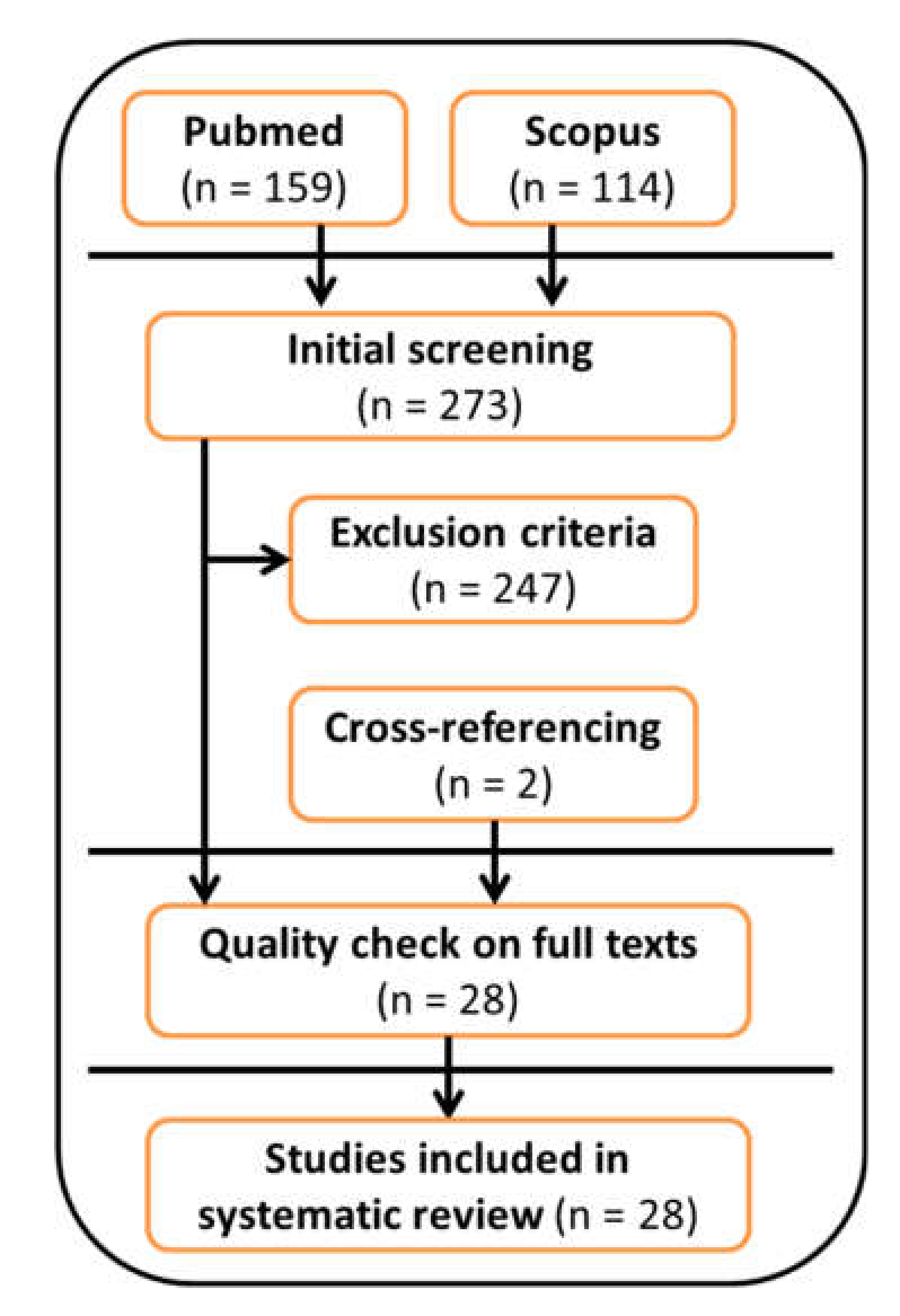
Wearable Inertial Sensors to Assess Gait during the 6-Minute Walk Test: A Systematic Review



Abstract
1. Introduction
2. Materials and Methods
2.1. Search Strategy
2.2. Study Selection and Quality Assessment
2.3. Data Extraction
3. Results
3.1. Quality Assessment
3.2. Aims and Study Design
3.3. Population Characteristics
3.4. Sensor Characteristics
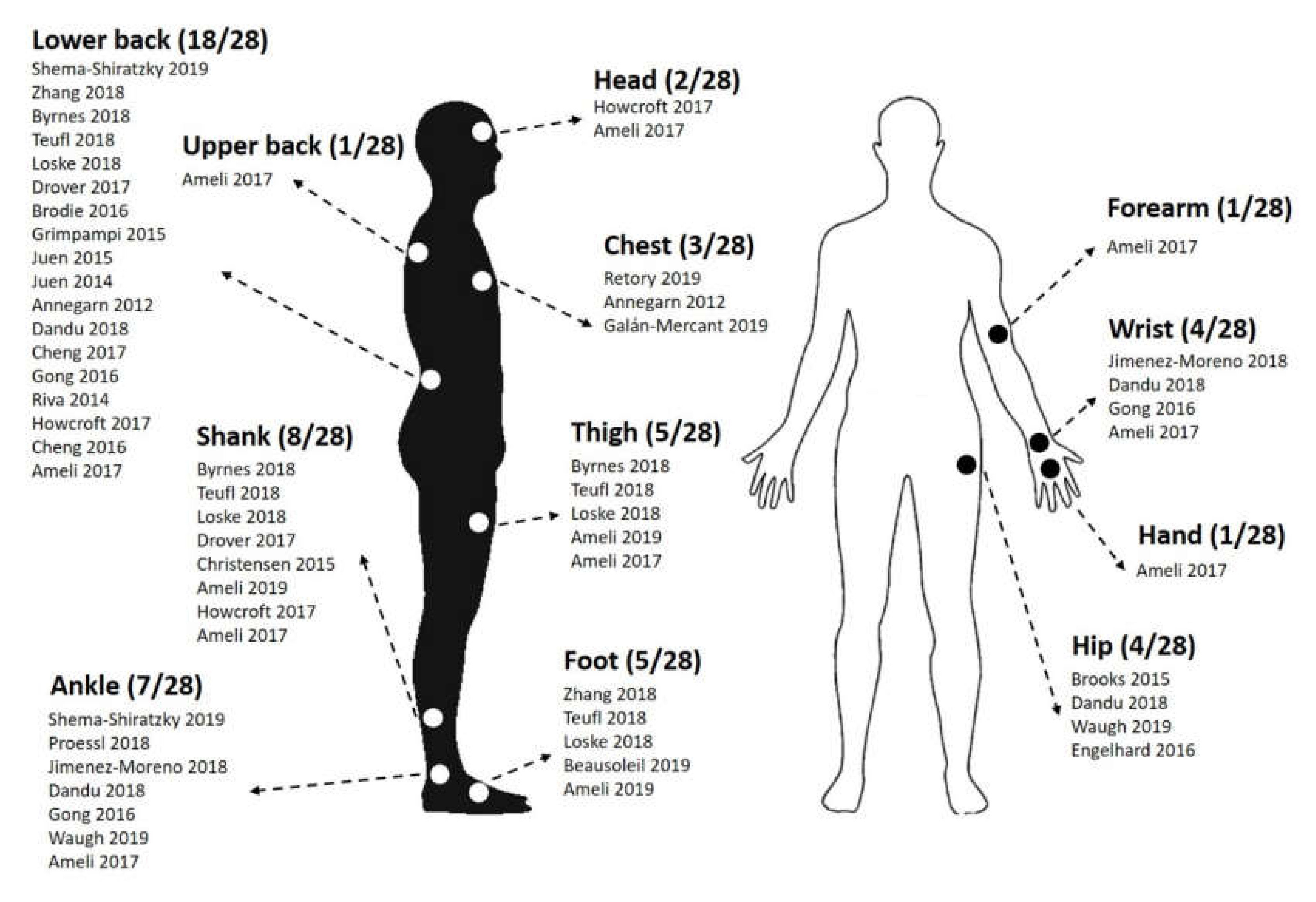
3.5. Sensor Number and Locations
3.6. 6MWT Characteristics
3.7. Parameters Extracted during the 6MWT
4. Discussion
Clinical Implications
5. Conclusions
Supplementary Materials
Author Contributions
Funding
Conflicts of Interest
References
- Holland, A.E.; Spruit, M.A.; Troosters, T.; Puhan, M.A.; Pepin, V.; Saey, D.; McCormack, M.C.; Carlin, B.W.; Sciurba, F.C.; Pitta, F.; et al. An official European respiratory society/American thoracic society technical standard: Field walking tests in chronic respiratory disease. Eur. Respir. J. 2014, 44, 1428–1446. [Google Scholar] [CrossRef] [PubMed]
- Crapo, R.O.; Casaburi, R.; Coates, A.L.; Enright, P.L.; MacIntyre, N.R.; McKay, R.T.; Johnson, D.; Wanger, J.S.; Zeballos, R.J.; Bittner, V.; et al. ATS statement: Guidelines for the six-minute walk test. Am. J. Respir. Crit. Care Med. 2002, 166, 111–117. [Google Scholar]
- Enright, P.L.; McBurnie, M.A.; Bittner, V.; Tracy, R.P.; McNamara, R.; Arnold, A.; Newman, A.B. The 6-min walk test: A quick measure of functional status in elderly adults. Chest 2003, 123, 387–398. [Google Scholar] [CrossRef] [PubMed]
- Giannitsi, S.; Bougiakli, M.; Bechlioulis, A.; Kotsia, A.; Michalis, L.K.; Naka, K.K. 6-min walking test: A useful tool in the management of heart failure patients. Ther. Adv. Cardiovasc. Dis. 2019, 13, 1753944719870084. [Google Scholar] [CrossRef]
- Karanth, M.P.S.; Awad, N.T. Six minute walk test: A tool for predicting mortality in chronic pulmonary diseases. J. Clin. Diagn. Res. 2017, 11, OC34. [Google Scholar] [CrossRef]
- Du Bois, R.M.; Albera, C.; Bradford, W.Z.; Costabel, U.; Leff, J.A.; Noble, P.W.; Sahn, S.A.; Valeyre, D.; Weycker, D.; King, T.E. 6-min walk distance is an independent predictor of mortality in patients with idiopathic pulmonary fibrosis. Eur. Respir. J. 2014, 43, 1421–1429. [Google Scholar] [CrossRef]
- Beretta, E.; Storm, F.A.; Strazzer, S.; Frascarelli, F.; Petrarca, M.; Colazza, A.; Cordone, G.; Biffi, E.; Morganti, R.; Maghini, C.; et al. Effect of robotic-assisted gait training in a large population of children with motor impairment due to cerebral palsy or acquired brain injury. Arch. Phys. Med. Rehabil. 2020, 101, 112. [Google Scholar] [CrossRef]
- Beretta, E.; Molteni, E.; Biffi, E.; Morganti, R.; Avantaggiato, P.; Strazzer, S. Robotically-driven orthoses exert proximal-to-distal differential recovery on the lower limbs in children with hemiplegia, early after acquired brain injury. Eur. J. Paediatr. Neurol. 2018, 22, 652–661. [Google Scholar] [CrossRef]
- Alhamad, E.H.; Shaik, S.A.; Idrees, M.M.; Alanezi, M.O.; Isnani, A.C. Outcome measures of the 6 min walk test: Relationships with physiologic and computed tomography findings in patients with sarcoidosis. BMC Pulm. Med. 2010, 10, 42. [Google Scholar] [CrossRef]
- Borg, G.A.V. Psychophysical bases of perceived exertion. Med. Sci. Sports Exerc. 1982, 14, 377–381. [Google Scholar] [CrossRef]
- Okuro, R.T.; de Oliveira Ribeiro, M.A.G.; Ribeiro, J.D.; Minsky, R.C.; Schivinski, C.I.S. Alternative indexes to estimate the functional capacity from the 6-min walk test in children and adolescents with Cystic Fibrosis. Respir. Care 2017, 62, 324–332. [Google Scholar] [CrossRef] [PubMed]
- Ben Mansour, K.; Rezzoug, N.; Gorce, P. Analysis of several methods and inertial sensors locations to assess gait parameters in able-bodied subjects. Gait Posture 2015, 42, 409–414. [Google Scholar] [CrossRef] [PubMed]
- Godinho, C.; Domingos, J.; Cunha, G.; Santos, A.T.; Fernandes, R.M.; Abreu, D.; Gonçalves, N.; Matthews, H.; Isaacs, T.; Duffen, J.; et al. A systematic review of the characteristics and validity of monitoring technologies to assess Parkinson’s disease. J. Neuroeng. Rehabil. 2016, 13, 24. [Google Scholar] [CrossRef] [PubMed]
- Kavanagh, J.J.; Menz, H.B. Accelerometry: A technique for quantifying movement patterns during walking. Gait Posture 2008, 28, 1–15. [Google Scholar] [CrossRef] [PubMed]
- Herrera-May, A.L.; Aguilera-Cortés, L.A.; García-Ramírez, P.J.; Manjarrez, E. Resonant magnetic field sensors based on MEMS technology. Sensors 2009, 9, 7785–7813. [Google Scholar] [CrossRef] [PubMed]
- Shull, P.B.; Jirattigalachote, W.; Hunt, M.A.; Cutkosky, M.R.; Delp, S.L. Quantified self and human movement: A review on the clinical impact of wearable sensing and feedback for gait analysis and intervention. Gait Posture 2014, 40, 11–19. [Google Scholar] [CrossRef]
- Sabatini, A.M. Quaternion-based extended Kalman filter for determining orientation by inertial and magnetic sensing. IEEE Trans. Biomed. Eng. 2006, 53, 1346–1356. [Google Scholar] [CrossRef]
- Taborri, J.; Palermo, E.; Rossi, S.; Cappa, P. Gait Partitioning Methods: A Systematic Review. Sensors 2016, 16, 66. [Google Scholar] [CrossRef]
- Zijlstra, W.; Hof, A. Assessment of spatio-temporal gait parameters from trunk accelerations during human walking. Gait Posture 2003, 18, 1–10. [Google Scholar] [CrossRef]
- Moe-Nilssen, R. A new method for evaluating motor control in gait under real-life environmental conditions. Part 1: The Instrument. Clin. Biomech. 1998, 13, 328–335. [Google Scholar] [CrossRef]
- Hausdorff, J.M.; Peng, C.K.; Ladin, Z.; Wei, J.Y.; Goldberger, A.L. Is walking a random walk? Evidence for long-range correlations in stride interval of human gait. J. Appl. Physiol. 1995, 78, 349–358. [Google Scholar] [CrossRef] [PubMed]
- Hausdorff, J.M. Gait dynamics, fractals and falls: Finding meaning in the stride-to-stride fluctuations of human walking. Hum. Mov. Sci. 2007, 26, 555–589. [Google Scholar] [CrossRef] [PubMed]
- Kang, H.G.; Dingwell, J.B. Effects of walking speed, strength and range of motion on gait stability in healthy older adults. J. Biomech. 2008, 41, 2899–2905. [Google Scholar] [CrossRef] [PubMed]
- Picerno, P. 25 years of lower limb joint kinematics by using inertial and magnetic sensors: A review of methodological approaches. Gait Posture 2017, 51, 239–246. [Google Scholar] [CrossRef]
- Liu, T.; Inoue, Y.; Shibata, K. Development of a wearable sensor system for quantitative gait analysis. Meas. J. Int. Meas. Confed. 2009, 42, 978–988. [Google Scholar] [CrossRef]
- Caldas, R.; Mundt, M.; Potthast, W.; Buarque de Lima Neto, F.; Markert, B. A systematic review of gait analysis methods based on inertial sensors and adaptive algorithms. Gait Posture 2017, 57, 204–210. [Google Scholar] [CrossRef]
- Demchenko, Y.; Grosso, P.; De Laat, C.; Membrey, P. Addressing big data issues in Scientific Data Infrastructure. In Proceedings of the International Conference on Collaboration Technologies and Systems, CTS 2013, San Diego, CA, USA, 20–24 May 2013. [Google Scholar]
- Moher, D.; Shamseer, L.; Clarke, M.; Ghersi, D.; Liberati, A.; Petticrew, M.; Shekelle, P.; Stewart, L.A.; Group, P. Preferred reporting items for systematic review and meta-analysis protocols (PRISMA-P) 2015 statement. Syst. Rev. 2015, 4, 1. [Google Scholar] [CrossRef]
- Ghislieri, M.; Gastaldi, L.; Pastorelli, S.; Tadano, S.; Agostini, V. Wearable Inertial Sensors to Assess Standing Balance: A Systematic Review. Sensors 2019, 19, 4075. [Google Scholar] [CrossRef]
- Taborri, J.; Agostini, V.; Artemiadis, P.K.; Ghislieri, M.; Jacobs, D.A.; Roh, J.; Rossi, S. Feasibility of Muscle Synergy Outcomes in Clinics, Robotics, and Sports: A Systematic Review. Appl. Bionics Biomech. 2018. [Google Scholar] [CrossRef]
- Luppino, F.S.; de Wit, L.M.; Bouvy, P.F.; Stijnen, T.; Cuijpers, P.; Penninx, B.W.J.H.; Zitman, F.G. Overweight, Obesity, and Depression. Arch. Gen. Psychiatry 2010, 67, 220–229. [Google Scholar] [CrossRef]
- Cooper, H.M. Research Synthesis and Meta-Analysis: A Step-by-Step Approach; SAGE Publications: London, UK, 2016. [Google Scholar]
- Downs, S.H.; Black, N. The feasibility of creating a checklist for the assessment of the methodological quality both of randomised and non-randomised studies of health care interventions. J. Epidemiol. Community Health 1998, 52, 377–384. [Google Scholar] [CrossRef] [PubMed]
- Kuijpers, T.; Van Der Windt, D.A.W.M.; Van Der Heijden, G.J.M.G.; Bouter, L.M. Systematic review of prognostic cohort studies on shoulder disorders. Pain 2004, 109, 420–431. [Google Scholar] [CrossRef]
- Cohen, J. Statistical Power Analysis for the Behavioral Sciences; Lawrence Earlbam Associates: Hillsdale, NJ, USA, 1988. [Google Scholar]
- McHugh, M.L. Interrater reliability: The kappa statistic. Biochem. Medica 2012, 22, 276–282. [Google Scholar] [CrossRef]
- Shema-Shiratzky, S.; Gazit, E.; Sun, R.; Regev, K.; Karni, A.; Sosnoff, J.J.; Herman, T.; Mirelman, A.; Hausdorff, J.M. Deterioration of specific aspects of gait during the instrumented 6-min walk test among people with multiple sclerosis. J. Neurol. 2019, 266, 3022–3030. [Google Scholar] [CrossRef] [PubMed]
- Retory, Y.; David, P.; Niedzialkowski, P.; de Picciotto, C.; Bonay, M.; Petitjean, M. Gait Monitoring and Walk Distance Estimation with an Accelerometer During 6-Minute Walk Test. Respir. Care 2019, 64, 923–930. [Google Scholar] [CrossRef]
- Zhang, W.; Smuck, M.; Legault, C.; Ith, M.A.; Muaremi, A.; Aminian, K. Gait symmetry assessment with a low back 3d accelerometer in post-stroke patients. Sensors 2018, 18, 3322. [Google Scholar] [CrossRef] [PubMed]
- Byrnes, S.K.; Nüesch, C.; Loske, S.; Leuenberger, A.; Schären, S.; Netzer, C.; Mündermann, A. Inertial sensor-based gait and attractor analysis as clinical measurement tool: Functionality and sensitivity in healthy subjects and patients with symptomatic lumbar spinal stenosis. Front. Physiol. 2018, 9, 1095. [Google Scholar] [CrossRef]
- Teufl, W.; Miezal, M.; Taetz, B.; Fröhlich, M.; Bleser, G. Validity, test-retest reliability and long-term stability of magnetometer free inertial sensor based 3D joint kinematics. Sensors 2018, 18, 1980. [Google Scholar] [CrossRef]
- Proessl, F.; Swanson, C.W.; Rudroff, T.; Fling, B.W.; Tracy, B.L. Good agreement between smart device and inertial sensor-based gait parameters during a 6-min walk. Gait Posture 2018, 64, 63–67. [Google Scholar] [CrossRef]
- Loske, S.; Nüesch, C.; Byrnes, K.S.; Fiebig, O.; Schären, S.; Mündermann, A.; Netzer, C. Decompression surgery improves gait quality in patients with symptomatic lumbar spinal stenosis. Spine J. 2018, 18, 2195–2204. [Google Scholar] [CrossRef]
- Drover, D.; Howcroft, J.; Kofman, J.; Lemaire, E.D. Faller classification in older adults using wearable sensors based on turn and straight-walking accelerometer-based features. Sensors 2017, 17, 1321. [Google Scholar] [CrossRef] [PubMed]
- Brodie, M.A.D.; Psarakis, M.; Hoang, P. Gyroscopic corrections improve wearable sensor data prior to measuring dynamic sway in the gait of people with Multiple Sclerosis. Comput. Methods Biomech. Biomed. Eng. 2016, 19, 1339–1346. [Google Scholar] [CrossRef] [PubMed]
- Grimpampi, E.; Oesen, S.; Halper, B.; Hofmann, M.; Wessner, B.; Mazzà, C. Reliability of gait variability assessment in older individuals during a six-minute walk test. J. Biomech. 2015, 48, 4185–4189. [Google Scholar] [CrossRef] [PubMed]
- Brooks, G.C.; Vittinghoff, E.; Iyer, S.; Tandon, D.; Kuhar, P.; Madsen, K.A.; Marcus, G.M.; Pletcher, M.J.; Olgin, J.E. Accuracy and Usability of a Self-Administered Six-Minute Walk Test Smartphone Application. Circ. Heart Fail. 2015, 8, 905–913. [Google Scholar] [CrossRef]
- Christiansen, C.L.; Bade, M.J.; Paxton, R.J.; Stevens-Lapsley, J.E. Measuring movement symmetry using tibial-mounted accelerometers for people recovering from total knee arthroplasty. Clin. Biomech. 2015, 30, 732–737. [Google Scholar] [CrossRef]
- Juen, J.; Cheng, Q.; Schatz, B. A Natural Walking Monitor for Pulmonary Patients Using Mobile Phones. IEEE J. Biomed. Health Inform. 2015, 19, 1399–1405. [Google Scholar] [CrossRef]
- Juen, J.; Cheng, Q.; Prieto-Centurion, V.; Krishnan, J.A.; Schatz, B. Health monitors for chronic disease by gait analysis with mobile phones. Telemed. J. e-Health 2014, 20, 1035–1041. [Google Scholar] [CrossRef]
- Annegarn, J.; Spruit, M.A.; Savelberg, H.H.C.M.; Willems, P.J.B.; van de Bool, C.; Schols, A.M.W.J.; Wouters, E.F.M.; Meijer, K. Differences in walking pattern during 6-min walk test between patients with COPD and healthy subjects. PLoS ONE 2012, 7, e37329. [Google Scholar] [CrossRef]
- Beausoleil, S.; Miramand, L.; Turcot, K. Evolution of gait parameters in individuals with a lower-limb amputation during a six-minute walk test. Gait Posture 2019, 72, 40–45. [Google Scholar] [CrossRef]
- Galán-Mercant, A.; Ortiz, A.; Herrera-Viedma, E.; Tomas, M.T.; Fernandes, B.; Moral-Munoz, J.A. Assessing physical activity and functional fitness level using convolutional neural networks. Knowl.-Based Syst. 2019, 185, 104939. [Google Scholar] [CrossRef]
- Ameli, S.; Naghdy, F.; Stirling, D.; Naghdy, G.; Aghmesheh, M. Chemotherapy-induced fatigue estimation using hidden Markov model. Biocybern. Biomed. Eng. 2019, 39, 176–187. [Google Scholar] [CrossRef]
- Jimenez-Moreno, A.C.; Charman, S.J.; Nikolenko, N.; Larweh, M.; Turner, C.; Gorman, G.; Lochmüller, H.; Catt, M. Analyzing walking speeds with ankle and wrist worn accelerometers in a cohort with myotonic dystrophy. Disabil. Rehabil. 2018, 41, 2972–2978. [Google Scholar] [CrossRef] [PubMed]
- Dandu, S.R.; Engelhard, M.M.; Qureshi, A.; Gong, J.; Lach, J.C.; Brandt-Pearce, M.; Goldman, M.D. Understanding the physiological significance of four inertial gait features in multiple sclerosis. IEEE J. Biomed. Health Inform. 2018, 22, 40–46. [Google Scholar] [CrossRef] [PubMed]
- Cheng, Q.; Juen, J.; Bellam, S.; Fulara, N.; Close, D.; Silverstein, J.C.; Schatz, B. Predicting Pulmonary Function from Phone Sensors. Telemed. e-Health 2017, 23, 913–919. [Google Scholar] [CrossRef]
- Ameli, S.; Naghdy, F.; Stirling, D.; Naghdy, G.; Aghmesheh, M. Objective clinical gait analysis using inertial sensors and six minute walking test. Pattern Recognit. 2017, 63, 246–257. [Google Scholar] [CrossRef]
- Gong, J.; Qi, Y.; Goldman, M.D.; Lach, J. Causality Analysis of Inertial Body Sensors for Multiple Sclerosis Diagnostic Enhancement. IEEE J. Biomed. Health Inform. 2016, 20, 1273–1280. [Google Scholar] [CrossRef]
- Riva, F.; Grimpampi, E.; Mazzà, C.; Stagni, R. Are gait variability and stability measures influenced by directional changes? Biomed. Eng. Online 2014, 13, 56. [Google Scholar] [CrossRef]
- Waugh, J.L.S.; Huang, E.; Fraser, J.E.; Beyer, K.B.; Trinh, A.; McIlroy, W.E.; Kulić, D. Online Learning of Gait Models from Older Adult Data. IEEE Trans. Neural Syst. Rehabil. Eng. 2019, 27, 733–742. [Google Scholar] [CrossRef]
- Engelhard, M.M.; Dandu, S.R.; Patek, S.D.; Lach, J.C.; Goldman, M.D. Quantifying Six-Minute Walk Induced Gait Deterioration with Inertial Sensors in Multiple Sclerosis Subjects. Gait Posture 2016, 49, 340–345. [Google Scholar] [CrossRef]
- Howcroft, J.; Kofman, J.; Lemaire, E.D. Prospective Fall-Risk Prediction Models for Older Adults Based on Wearable Sensors. IEEE Trans. Neural Syst. Rehabil. Eng. 2017, 25, 1812–1820. [Google Scholar] [CrossRef]
- Cheng, Q.; Juen, J.; Hsu-Lumetta, J.; Schatz, B. Predicting Transitions in Oxygen Saturation Using Phone Sensors. Telemed. e-Health 2016, 22, 132–137. [Google Scholar] [CrossRef] [PubMed]
- Tamburini, P.; Storm, F.; Buckley, C.; Bisi, M.C.; Stagni, R.; Mazzà, C. Moving from laboratory to real life conditions: Influence on the assessment of variability and stability of gait. Gait Posture 2018, 59, 248–252. [Google Scholar] [CrossRef] [PubMed]
- Storm, F.A.; Nair, K.P.S.; Clarke, A.J.; Van der Meulen, J.M.; Mazzà, C. Free-living and laboratory gait characteristics in patients with multiple sclerosis. PLoS ONE 2018, 13, e0196463. [Google Scholar] [CrossRef]
- Muro-de-la-Herran, A.; García-Zapirain, B.; Méndez-Zorrilla, A. Gait analysis methods: An overview of wearable and non-wearable systems, highlighting clinical applications. Sensors 2014, 14, 3362–3394. [Google Scholar] [CrossRef]
- El-Gohary, M.; Pearson, S.; McNames, J.; Mancini, M.; Horak, F.; Mellone, S.; Chiari, L. Continuous monitoring of turning in patients with movement disability. Sensors 2014, 14, 356–369. [Google Scholar] [CrossRef]
- Mizrahi, J.; Verbitsky, O.; Isakov, E. Shock accelerations and attenuation in downhill and level running. Clin. Biomech. 2000, 15, 15–20. [Google Scholar] [CrossRef]
- Morrison, S.; Newell, K.M. Bilateral organization of physiological tremor in the upper limb. Eur. J. Appl. Physiol. Occup. Physiol. 1999, 80, 564–574. [Google Scholar] [CrossRef] [PubMed]
- Cappozzo, A. Low frequency self-generated vibration during ambulation in normal men. J. Biomech. 1982, 15, 599–609. [Google Scholar] [CrossRef]
- Antonsson, E.K.; Mann, R.W. The frequency content of gait. J. Biomech. 1985, 18, 39–47. [Google Scholar] [CrossRef]
- Mitschke, C.; Kiesewetter, P.; Milani, T.L. The effect of the accelerometer operating range on biomechanical parameters: Stride length, velocity, and peak tibial acceleration during running. Sensors 2018, 18, 130. [Google Scholar] [CrossRef]
- Brodie, M.; Walmsley, A.; Page, W. The static accuracy and calibration of inertial measurement units for 3D orientation. Comput. Methods Biomech. Biomed. Eng. 2008, 11, 641–648. [Google Scholar] [CrossRef] [PubMed]
- Arvidsson, D.; Fridolfsson, J.; Börjesson, M.; Andersen, L.B.; Ekblom, Ö.; Dencker, M.; Brønd, J.C. Re-examination of accelerometer data processing and calibration for the assessment of physical activity intensity. Scand. J. Med. Sci. Sports 2019, 29, 1442–1452. [Google Scholar] [CrossRef] [PubMed]
- Yang, C.-C.; Hsu, Y.-L. A review of accelerometry-based wearable motion detectors for physical activity monitoring. Sensors 2010, 10, 7772–7788. [Google Scholar] [CrossRef] [PubMed]
- Buckley, C.; Galna, B.; Rochester, L.; Mazzà, C. Quantification of upper body movements during gait in older adults and in those with Parkinson’s disease: Impact of acceleration realignment methodologies. Gait Posture 2016, 52, 265–271. [Google Scholar] [CrossRef]
- Hubble, R.P.; Naughton, G.A.; Silburn, P.A.; Cole, M.H. Wearable sensor use for assessing standing balance and walking stability in people with Parkinson’s disease: A systematic review. PLoS ONE 2015, 10, e0123705. [Google Scholar] [CrossRef]
- Sciurba, F.; Criner, G.J.; Lee, S.M.; Mohsenifar, Z.; Shade, D.; Slivka, W.; Wise, R.A. Six-Minute Walk Distance in Chronic Obstructive Pulmonary Disease: Reproducibility and Effect of Walking Course Layout and Length. Am. J. Respir. Crit. Care Med. 2003, 167, 1522–1527. [Google Scholar] [CrossRef]
- Aminian, S.; Hinckson, E.A. Examining the validity of the ActivPAL monitor in measuring posture and ambulatory movement in children. Int. J. Behav. Nutr. Phys. Act. 2012, 9, 119. [Google Scholar] [CrossRef]
- Esliger, D.W.; Rowlands, A.V.; Hurst, T.L.; Catt, M.; Murray, P.; Eston, R.G. Validation of the GENEA accelerometer. Med. Sci. Sports Exerc. 2011, 43, 1085–1093. [Google Scholar] [CrossRef]
- Dijkstra, B.; Zijlstra, W.; Scherder, E.; Kamsma, Y. Detection of walking periods and number of steps in older adults and patients with Parkinson’s disease: Accuracy of a pedometer and an accelerometry-based method. Age Ageing 2008, 37, 436–441. [Google Scholar] [CrossRef]
- Fortune, E.; Lugade, V.; Morrow, M.; Kaufman, K. Validity of using tri-axial accelerometers to measure human movement—Part II: Step counts at a wide range of gait velocities. Med. Eng. Phys. 2014, 36, 659–669. [Google Scholar] [CrossRef]
- Doheny, E.P.; Walsh, C.; Foran, T.; Greene, B.R.; Fan, C.W.; Cunningham, C.; Kenny, R.A. Falls classification using tri-axial accelerometers during the five-times-sit-to-stand test. Gait Posture 2013, 38, 1021–1025. [Google Scholar] [CrossRef] [PubMed]
- Bellanca, J.L.; Lowry, K.A.; VanSwearingen, J.M.; Brach, J.S.; Redfern, M.S. Harmonic ratios: A quantification of step to step symmetry. J. Biomech. 2013, 46, 828–831. [Google Scholar] [CrossRef] [PubMed]
- Kusmirek, S.; Hana, K.; Socha, V.; Prucha, J.; Kutilek, P.; Svoboda, Z. Postural instability assessment using trunk acceleration frequency analysis. Eur. J. Physiother. 2016, 18, 237–244. [Google Scholar] [CrossRef]
- Sekine, M.; Tamura, T.; Yoshida, M.; Suda, Y.; Kimura, Y.; Miyoshi, H.; Kijima, Y.; Higashi, Y.; Fujimoto, T. A gait abnormality measure based on root mean square of trunk acceleration. J. Neuroeng. Rehabil. 2013, 10, 4–8. [Google Scholar] [CrossRef] [PubMed]
- Dingwell, J.B.; Cusumano, J.P.; Cavanagh, P.R.; Sternad, D. Local Dynamic Stability Versus Kinematic Variability of Continuous Overground and Treadmill Walking. J. Biomech. Eng. 2001, 123, 27. [Google Scholar] [CrossRef]
- Sabatini, A.M. Estimating three-dimensional orientation of human body parts by inertial/magnetic sensing. Sensors 2011, 11, 1489–1525. [Google Scholar] [CrossRef]
- Bartels, B.; de Groot, J.F.; Terwee, C.B. The Six-Minute Walk Test in Chronic Pediatric Conditions: A Systematic Review of Measurement Properties. Phys. Ther. 2013, 93, 529–541. [Google Scholar] [CrossRef]


| Item | Description | Outcome |
|---|---|---|
| Aim of the work | ||
| 1 | Description of a specific, clearly stated purpose (IV) | 1, 0.5 or 0 |
| 2 | The research question is scientifically relevant (EV) | 1, 0.5 or 0 |
| Inclusion criteria (selection bias) | ||
| 3 | Description of inclusion and/or exclusion criteria (IV/EV) | 1, 0.5 or 0 |
| Data collection and processing (performance bias) | ||
| 4 | Data collection is clearly described and reliable (IV/EV) | 1, 0.5 or 0 |
| 5 | Data processing is clearly described and reliable (IV/EV) | 1, 0.5 or 0 |
| 6 | Algorithms are clearly described and referenced (IV/EV) | 1, 0.5 or 0 |
| Data loss (attrition bias) | ||
| 7 | Drop-outs <20% (EV) | 1, 0.5 or 0 |
| Outcomes (detection bias) | ||
| 8 | Outcomes are topic relevant (EV) | 1, 0.5 or 0 |
| 9 | The work answers the scientific question stated in the aim (IV) | 1, 0.5 or 0 |
| Presentation of the results | ||
| 10 | Presentation of the results is sufficient to assess the adequacy of the analysis (IV) | 1, 0.5 or 0 |
| 11 | The main findings are clearly described (IV) | 1, 0.5 or 0 |
| Statistical approach | ||
| 12 | Appropriate statistical analysis techniques (SV) | 1, 0.5 or 0 |
| 13 | Clearly states the statistical test used (SV) | 1, 0.5 or 0 |
| 14 | Actual probability values reported for the main outcomes (SV) | 1, 0.5 or 0 |
| 15 | Sufficient number of subjects (SV) | 1, 0.5 or 0 |
| ID | Paper | Aim | Study Design | Population Characteristics, Age (mean ± SD) and Male/Female Ratio | Population Characteristics | Sensor Type | Sensor Number | Sensor SF | Sensor Range | Raw signal Filter (Cut-Off Frequency) |
|---|---|---|---|---|---|---|---|---|---|---|
| 1 | Shema-Shiratzky 2019 [37] | To determine which gait features become worse during sustained walking in people with MS | Pilot | 58 relapsing–remitting MS (49.0 ± 10.0, 17/41) | EDSS 2–6 | 3D ACC and 3D GYRO (OPAL, Apdm) | 3 | 128 Hz | ± 16 g; ± 2000 deg/s | / |
| 2 | Retory 2019 [38] | To determine gait parameters in subjects with high or low body mass index | Validation | 10 controls (43.8 ± 12.8, 3/7) 13 non-overweight (42.2 ± 13.6, 4/9) 29 overweight (43.8 ± 12.8, 4/25) | BMI < 25kg/m2 BMI > 30kg/m2 | 3D ACC (Nox-T3, Polygraph) | 1 | 10 Hz | ± 2 g | LP 5th order Butter. (2.5 Hz) |
| 3 | Zhang 2018 [39] | To propose and evaluate a gait symmetry index | Feasibility | 16 post-stroke (54, range 23–74, 9/7) 9 controls (35, range 25–48, 5/4) | SIS 190-288 | 3D ACC and 3D GYRO (MTw Awinda, XSens) | 3 | 100 Hz | / | LP 2nd order Butter. (10 Hz) |
| 4 | Byrnes 2018 [40] | To determine characteristics of the attractor for acceleration gait data | Feasibility | 19 sLSS (73.8 ± 5.3, 11/8) 24 controls (59.9 ± 10.5, 9/15) | ODI 27.9% ± 16.9% | 3D IMU (RehaGait system, Hasomed GmbH) | 7 | 400 Hz | ± 16 g; ± 2000 deg/s; ± 1.3 Gs | LP 4th order Butter. |
| 5 | Teufl 2018 [41] | To evaluate the performance of an algorithm for the calculation of 3D joint angles | Validation | 28 healthy (24.0 ± 2.7, 13/15) | / | 3D ACC and 3D GYRO (MTw Awinda, XSens) | 7 | 60 Hz | / | / |
| 6 | Proessl 2018 [42] | To investigate agreement between smart device and IMU-based gait parameters during prolonged walking | Validation | 20 healthy (25.0 ± 3.7, 13/7) | / | 3D ACC (Ipod Touch, Apple) | 1 | 100 Hz | / | / |
| 7 | Loske 2018 [43] | To check if gait quality improves postoperatively | Cohort | 20 sLSS 20 controls (60.5 ± 11.4) | ODI 30.7% ± 16.3% | 3D IMU (RehaGait system, Hasomed GmbH) | 7 | 400 Hz | / | / |
| 8 | Drover 2017 [44] | To validate a novel wearable sensor based faller classification method | Validation | 76 older adults (74.15 ± 7.0) | / | 3D ACC (X16-1C, Gulf Coast Data Concepts) | 3 | 50 Hz | / | / |
| 9 | Brodie 2016 [45] | To validate an adaptive filter designed to improve the quality of accelerometer data | Validation | 5 MS (68 ± 8, 0/5) 13 controls (32 ± 6, 4/9) | EDSS 4.3 ± 1.0 | 3D IMU (OPAL, Apdm) | 1 | 128 Hz | ± 6 g; ± 2000 deg/s | LP 4th order Butter. |
| 10 | Grimpampi 2015 [46] | To assess the reliability of gait variability assessment in healthy older individuals based on lower trunk accelerations | Validation | 29 older adults (84 ± 5, 5/24) | / | 3D ACC and 3D GYRO (Freesense, Sensorize) | 1 | / | / | / |
| 11 | Brooks 2015 [47] | To develop and validate a self-administered 6MWT mobile application. | Validation | 103 CHF and pHTN | / | 3D ACC (iPhone 4s, Apple) | 1 | / | / | / |
| 12 | Christiansen 2015 [48] | To examine movement symmetry changes over the first 26 weeks following unilateral TKA | Pilot | 24 unilateral TKA (65.2 ± 9.2)19 controls (61.3 ± 9.2) | / | 3D ACC (Delsys) | 1 | 1000 Hz | ± 10 g | LP 4th order Butter. (40 Hz) |
| 13 | Juen 2015 [49] | To evaluate six machine learning methods to obtain gait speed during natural walking | Pilot | 28 pulmonary disease (range 50–89, 12/16) 10 controls (age range 18–69, 3/7) | / | 3D ACC (S5 and Galaxy Ace, Samsung) | 1 | 60 Hz | / | / |
| 14 | Juen 2014 [50] | To monitor health status using smartphones | Pilot | 30 COPD (53 ± 11, 3/27) | GOLD 1–2 | 3D ACC (Galaxy Ace, Samsung) | 1 | 60 Hz | / | / |
| 15 | Annegarn 2012 [51] | To determine walking patterns during the 6MWT of COPD patients and healthy elderly subjects | Cohort | 79 COPD (64.3 ± 8.9, 47/32) 24 controls (63.7 ± 5.9, 15/9) | GOLD 1–2-3–4 | 3D ACC (Minimod, McRoberts) | 1 | 100 Hz | ± 2 g | LP 4th order Butter. (20 Hz) |
| 16 | Beausoleil 2019 [52] | To quantify the evolution of gait parameters along a 6MWT in LLA population | Pilot | 15 LLA (59 ± 12, 10/5) | / | 3D ACC and 3D GYRO (Physilog 4, GaitUp) | 2 | 200 Hz | ± 3 g; ± 600°/s | / |
| 17 | Galán-Mercant 2019 [53] | To predict physical activity and functional fitness using deep learning | Pilot | 17 older adults (83.26 ± 6.56, 3/14) | / | 3D ACC (iPhone 4, Apple) | 1 | 32 Hz | / | LP 5th order Butter. (16 Hz) |
| 18 | Ameli 2019 [54] | To objectively assess the effects of chemotherapy-induced fatigue on gait characteristics | Pilot | 4 breast cancer (50 ± 2.5) | / | 3D IMU (MTx, Xsens) | 6 | 60 Hz | / | / |
| 19 | Jimenez-Moreno 2018 [55] | To compare accelerometry data between a DM1 cohort and healthy controls | Validation | 30 MD1 (48, range 25–72, 20/10) 14 controls (32, range 23–47, 6/8) | / | 3D ACC (GENEActiv, Activinsights) | 4 | / | / | / |
| 20 | Dandu 2018 [56] | To explore the physiological and clinical meaning of four objective measures of walking impairment. | Pilot | 115 MS | Mild (EDSS 0–2.5), moderate (3.0–4.0) and severe ( > 4.0) | 3D ACC (GT3X, ActiGraph)3D ACC and 3D GYRO (in-house) | 6 | 30 Hz, 128 Hz | / | BP (1–3 Hz) |
| 21 | Cheng 2017 [57] | To validate a model for the prediction of pulmonary function, based on motion sensor data from mobile phones | Validation | 25 COPD (76, range 55–95, 15/10) | GOLD 1–2-3 | 3D ACC (Galaxy S5, Samsung and Optimus Zone2, LG) | 2 | / | / | / |
| 22 | Ameli 2017 [58] | To study the effects of fatigue induced by chemotherapy on PPS of cancer patients | Pilot | 4 cancer patients | / | 3D IMU (MTx, Xsens) | 17 | 60 Hz | / | / |
| 23 | Gong 2016 [59] | To propose a causality analysis method that may aid disease diagnosis | Pilot | 28 MS (40.5 ± 9.4, 7/21) 13 controls (39.3 ± 10.3, 6/7) | Mild (EDSS 0–2.5) and moderate (3.0–4.0) | 3D ACC and 3D GYRO (in-house) | 5 | 128 Hz | ± 16 g; ± 2000°/s | / |
| 24 | Riva 2014 [60] | To evaluate the influence of directional changes and SF on gait variability and stability measures | Validation | 51 healthy (23 ± 3) | / | 3D ACC and 3D GYRO (FreeSense, Sensorize) | 1 | 100 Hz - 200 Hz | / | Signal used unfiltered |
| 25 | Waugh 2019 [61] | To propose an individualized model of gait | Validation | 92 older adults (86 ± 5, 33/53) | / | 3D ACC (X6-2, X6-2mini, X8m-3, X16-2, Gulf Coast Data Concepts) | 3 | 40 Hz - 50 Hz | ± 2, 8, or 16 g | LP 4th order Butter. (10 Hz) |
| 26 | Engelhard 2016 [62] | To discover and validate objective evidence of gait alteration using dynamic time warping | Pilot | 96 MS (46, range 19–61, 13/73) 29 controls (40, range 19–54, 9/20) | Mild (EDSS 0–2.5), moderate (3.0–4.5) and severe (5.0–6.5) | 3D ACC (ActiGraph GT3X) | 1 | 30 Hz | / | / |
| 27 | Howcroft 2017 [63] | To identify the optimal wearable sensor type, location, and combination for prospective fall-risk prediction | Pilot | 76 older adults (75.2 ± 6.6, 31/44) | Fallers and non fallers | 3D ACC (X16-1C, Gulf Coast Data Concepts) | 4 | 50 Hz | / | LP 5th order Butter. (12.5 Hz) |
| 28 | Cheng 2016 [64] | To propose a gait model to predict saturation categories | Validation | 20 COPD (66.3, range 43–81, 9/11) | GOLD 1–2 | 3D IMU (Droid 4 Mini, Motorola) | 1 | 60 Hz | / | / |
| Population | N (% of Articles) | Total N of Patients | N with Controls | Total N of Controls |
|---|---|---|---|---|
| Multiple sclerosis (MS) | 5 (17.9%) | 302 | 3 | 55 |
| Chronic obstructive pulmonary disease (COPD) | 4 (14.3%) | 126 | 1 | 24 |
| Healthy elderly | 4 (14.3%) | 214 | 0 | / |
| Healthy | 3 (10.7%) | 99 | 0 | / |
| Symptomatic lumbar spinal stenosis (sLSS) | 2 (7.1%) | 39 | 2 | 44 |
| Cancer | 2 (7.1%) | 8 | 0 | / |
| Unilateral total knee arthoplasty (TKA) | 1 (3.6%) | 24 | 1 | 19 |
| Myotonic dystrophy type 1 (DM1) | 1 (3.6%) | 30 | 1 | 14 |
| Overweight | 1 (3.6%) | 29 | 1 | 23 |
| Healthy elderly fallers | 1 (3.6%) | 28 | 1 | 47 |
| Pulmonary disease | 1 (3.6%) | 28 | 1 | 10 |
| Post-stroke | 1 (3.6%) | 16 | 1 | 9 |
| Congestive heart failure (CHF) or pulmonary hypertension (pHTN) | 1 (3.6%) | 103 | 0 | / |
| Lower limb amputees (LLA) | 1 (3.6%) | 15 | 0 | / |
| TOTAL | 28 | 1061 | 12 | 245 |
| Measure | Type | Definition | References |
|---|---|---|---|
| Number of steps | Event | Local maximum of the filtered acceleration signal | [38] |
| Number of U-turns | Event | Threshold at 95th percentile of vertical acceleration lower RMS curve | [38] |
| Distance | Spatio-temporal | Distance walked within 6MWT | [47,49,50] |
| Gait speed | Spatio-temporal | Distance traveled divided by time taken (m/s) | [37,52] |
| Cadence | Spatio-temporal | Steps taken divided by given time interval (steps/s) | [37,42,43,44,45,46,51,52,63] |
| Stance time | Spatio-temporal | Time between heel strike and toe-off | [52] |
| Stride time SD | Spatio-temporal | Stride time is defined as the time between two consecutive heel-strikes of the same foot | [46,60] |
| Stride time variability | Spatio-temporal | Stride time SD divided by mean stride time (%) | [37,60] |
| Swing time variability | Spatio-temporal | Swing time SD divided by mean swing time (%). Swing time is defined as the time interval between toe-off and the subsequent heel-strike of the same foot | [37] |
| Step length | Spatio-temporal | Number of steps between 2 consecutive U-turns divided by time taken | [38] |
| Stance ratio | Spatio-temporal | Percentage of the gait cycle during which the foot is in stance phase (%) | [39] |
| Load ratio | Spatio-temporal | Percentage of the stance corresponding to loading phase defined as the time between heel strike and toe strike (%) | [39] |
| Foot flat ratio | Spatio-temporal | Percentage of the stance corresponding to the foot-flat phase (%) | [39] |
| Push ratio | Spatio-temporal | Percentage of the stance corresponding to push phase defined as the time between heel off and toe off (%) | [39] |
| Symmetry of foot pitch angular velocity | Spatio-temporal | Pearson correlation coefficient (-) | [39] |
| Symmetry of foot pitch angular velocity | Spatio-temporal | Mean absolute difference between each left and right signal sample of cycle n divided by the mean range of the signals in the cycle (-) | [39] |
| Coefficient of stride cycle repetition | Spatio-temporal | Sum of positive autocorrelation coefficients of the three axes as a function of t (-) | [39] |
| Coefficient of step repetition | Spatio-temporal | Norm of autocorrelation coefficients as a function of t (-) | [39] |
| Gait asymmetry | Spatio-temporal | Percentage difference between left and right leg gait cycles (%) | [43] |
| Width and length of Poincaré plots | Spatio-temporal | Width and length of the long and short axis of the stride duration elliptical data plots between successive gait cycles (-) | [60] |
| Flat foot ratio | Spatio-temporal | Foot flat time as a percentage of the whole gait cycle (s) | [52] |
| Minimal toe clearance | Spatio-temporal | Minimal toe clearance during the swing phase (m) | [52] |
| Stride regularity | Frequency | Unbiased and normalized autocorrelation coefficient at the second dominant period (-) | [37] |
| Step regularity | Frequency | Unbiased and normalized autocorrelation coefficient at the first dominant period (-) | [37] |
| First quartile of Fourier transform (FQFFT) | Frequency | Percentage of acceleration frequencies within the first quartile of an FFT frequency plot (%) | [44,63] |
| Ratio of even/odd harmonics (REOH) | Frequency | Ratio of acceleration signal in phase with stride frequency (-) | [44,60,63] |
| Peak frequency | Frequency | Frequency of greatest magnitude in spectrum (Hz) | [57,64] |
| Shannon enthropy | Frequency | Expected value of signal information | [57,64] |
| Root mean square (RMS) | Acceleration descriptive statistics | RMS of the accelerations in anteroposterior, mediolateral and vertical directions | [46,57,64] |
| Acceleration maximum | Acceleration descriptive statistics | Acceleration maximum of positive and negative axis direction | [44,63] |
| Acceleration mean | Acceleration descriptive statistics | Acceleration mean of positive and negative axis direction | [44,57,63] |
| Acceleration standard deviation | Acceleration descriptive statistics | Acceleration standard deviation of positive and negative axis direction | [44,57,63] |
| Acceleration coefficient of variance | Acceleration descriptive statistics | Acceleration mean divided by standard deviation | [57,64] |
| Interstride trunk variability | Acceleration descriptive statistics | Mean values of the unbiased autocorrelation coefficients of the three acceleration components | [46,51] |
| Initial peak acceleration | Acceleration descriptive statistics | Peak tibial acceleration after foot contact | [48] |
| Absolute symmetry index | Acceleration descriptive statistics | Absolute differences in initial peak acceleration between limbs (%) | [48] |
| Walking intensity | Acceleration descriptive statistics | Integral of the modulus accelerometer output | [51] |
| Resultant acceleration | Acceleration descriptive statistics | Square root of the sum of squared acceleration signals in AP, ML an V directions | [53] |
| Euclidean norm minus one | Acceleration descriptive statistics | Resultant acceleration minus one | [55] |
| Short-term lyapunov exponents | Non-linear indexes | Quantifies stride-to-stride local dynamic stability of walking | [60,63] |
| Recurrence quantification analysis | Non-linear indexes | Provides a characterization of a variety of features of a given time series, including a quantification of deterministic structure and non-stationarity, based on the construction of recurrence plots. | [60] |
| Multiscale entropy | Non-linear indexes | Quantifies the complexity or irregularity of a time series | [60] |
| Index of harmonicity | Non-linear indexes | Quantifies the contribution of the stride frequency to the signal power relative to higher harmonics | [60] |
| Sample entropy | Non-linear indexes | Negative logarithm of the probability that if two sets of simultaneous data points of length m have distance <r then two sets of simultaneous data points of length m + 1 also have distance <r | [37] |
| Path length | Kinematics | Ratio between the length of the real path of the foot in 3D space (including both stride length and width) and stride length of one cycle (% stride length) | [39] |
| Strike angle | Kinematics | Angle between the foot and the ground at heel strike in sagittal plane (deg) | [39] |
| Lift off angle | Kinematics | Angle between the foot and the ground at toe off in sagittal plane (deg) | [39] |
| Max angular velocity | Kinematics | Maximum pitch foot angular velocity during swing phase (deg/s) | [39] |
| Hip, knee, ankle joint, and pelvis angles | Kinematics | Joint angles using Euler angle decomposition (deg) | [41,45,54,58] |
| Causality index | Other | Sum of the number of significant relationships remaining after thresholding the pairwise causality matrix | [56] |
| Kernel density estimation (KDE) peak | Other | Peak of the density functions at 100 equally spaced inertial gait data amplitude values | [56] |
| Dynamic time warping (DTW) score | Other | Summarizes the degree of similarity between sequences following alignment | [56] |
| Warp score | Other | Summarizes the number of “warps”, or repetitions of samples, needed to achieve an optimal alignment between sequences. | [56,62] |
| Change in acceleration pattern between two conditions (δM) | Other | Difference between two attractors | [40] |
| Change in variability around the attractor (δD) | Other | Change in acceleration variability between conditions | [40] |
| Attractor-based index | Other | Product of δM and δD | [40] |
© 2020 by the authors. Licensee MDPI, Basel, Switzerland. This article is an open access article distributed under the terms and conditions of the Creative Commons Attribution (CC BY) license (http://creativecommons.org/licenses/by/4.0/).
Share and Cite
Storm, F.A.; Cesareo, A.; Reni, G.; Biffi, E. Wearable Inertial Sensors to Assess Gait during the 6-Minute Walk Test: A Systematic Review. Sensors 2020, 20, 2660. https://doi.org/10.3390/s20092660
Storm FA, Cesareo A, Reni G, Biffi E. Wearable Inertial Sensors to Assess Gait during the 6-Minute Walk Test: A Systematic Review. Sensors. 2020; 20(9):2660. https://doi.org/10.3390/s20092660
Chicago/Turabian StyleStorm, Fabio Alexander, Ambra Cesareo, Gianluigi Reni, and Emilia Biffi. 2020. "Wearable Inertial Sensors to Assess Gait during the 6-Minute Walk Test: A Systematic Review" Sensors 20, no. 9: 2660. https://doi.org/10.3390/s20092660
APA StyleStorm, F. A., Cesareo, A., Reni, G., & Biffi, E. (2020). Wearable Inertial Sensors to Assess Gait during the 6-Minute Walk Test: A Systematic Review. Sensors, 20(9), 2660. https://doi.org/10.3390/s20092660