


Abstract
Understanding how environmental heterogeneity shapes animal movement is a central goal of movement ecology, yet movement metrics derived from GPS data often integrate multiple behavioural states, complicating ecological interpretation. We analysed 30,323 GPS observations from six juvenile white storks (Ciconia ciconia) to disentangle the effects of habitat and behavioural state on movement speed and altitude above ground level. Behaviour was classified into resting, local movement, and flight based on speed thresholds and incorporated into linear mixed-effects models alongside habitat. Behavioural state was the dominant determinant of movement metrics. Relative to resting, flight increased speed by approximately 43 km h−1 and altitude above ground level by approximately 566 m, whereas habitat effects were significant but substantially smaller. Differences in movement metrics among habitats were largely explained by variation in the distribution of behavioural states, with cropland dominated by resting behaviour and water associated primarily with flight. Sensitivity analyses based on alternative behavioural thresholds, leave-one-individual-out models, flight-only analyses, and alternative treatments of altitude above ground level produced consistent results. These findings demonstrate that habitat-associated variation in movement metrics is primarily mediated by behavioural state rather than representing a direct consequence of habitat alone. Our results highlight the importance of explicitly accounting for behavioural heterogeneity when linking movement to environmental conditions and provide a refined interpretation of the energy landscape framework.
1. Introduction
Animal movement is a fundamental ecological process linking individuals with spatially heterogeneous environments and shaping population dynamics, species interactions, and ecosystem functioning [1]. Understanding how organisms respond to environmental variability during movement remains a central goal of movement ecology. For migratory species, this challenge is particularly pronounced because individuals traverse large geographic areas characterized by diverse habitat types, topographic conditions, and atmospheric environments.
For soaring birds, movement efficiency depends strongly on atmospheric processes such as thermal uplift, which enables individuals to gain altitude with minimal energetic expenditure [2]. The formation and intensity of thermals are influenced by land surface properties, linking habitat structure directly to flight performance and movement behaviour. This relationship underpins the energy landscape framework, which conceptualizes spatial variation in energetic costs and opportunities as a major driver of movement decisions [3]. Under this framework, animals are expected to move in ways that exploit favourable environmental conditions while minimizing energetic expenditure.
In White Storks (Ciconia ciconia), migration behaviour is strongly influenced by soaring–gliding flight dynamics and atmospheric conditions [4,5]. Previous studies have demonstrated that migration speed and flight altitude are closely associated with thermal convection, wind conditions, and large-scale atmospheric structure [4,6,7]. In addition, migration in this species is highly social. Juveniles migrate together with experienced individuals, and movement decisions are influenced by flock dynamics and collective behaviour [5,8]. Consequently, movement responses emerge not only from environmental conditions but also from behavioural interactions and social information transfer.
Recent advances in high-resolution GPS telemetry have enabled detailed quantification of animal movement across space and time [9]. These technologies allow researchers to link movement trajectories with environmental variables such as habitat type, topography, and weather conditions. However, interpretation of movement metrics derived from tracking data remains challenging because variables such as speed and altitude integrate multiple behavioural states, including resting, foraging, local movement, and directed migratory flight.
Recent developments in movement analysis and data-driven behavioural classification have further highlighted the complexity of movement responses to environmental variability [10,11]. Behavioural state refers to distinct modes of activity underlying observed movement patterns and inferred from tracking data. Mixing behavioural states within analyses represents a major limitation for ecological inference because observed movement metrics may reflect behavioural allocation rather than direct environmental effects. For example, low speeds recorded within a habitat may indicate increased resting or foraging activity rather than reduced movement efficiency, whereas high speeds may reflect transient flight behaviour rather than intrinsically favourable habitat conditions. Without explicitly accounting for behavioural heterogeneity, analyses risk incorrectly attributing behavioural effects to habitat characteristics [12].
Juvenile White Storks provide a particularly informative system for examining these relationships because they combine extensive migratory movement with substantial behavioural variability. Although juveniles are strongly influenced by environmental conditions, they also migrate socially within flocks and may acquire migratory information through interactions with experienced individuals [5,8]. Migration in this species therefore emerges from interactions among atmospheric conditions, habitat structure, behavioural state, and social processes.
In this study, we analyse GPS telemetry data from juvenile White Storks to disentangle the effects of habitat and behavioural state on movement speed and altitude. We explicitly classify behavioural states based on movement speed and incorporate both habitat and behaviour into mixed-effects models. This approach allows us to test two key hypotheses: (1) behavioural state explains a larger proportion of variation in movement metrics than habitat alone, and (2) apparent habitat effects on movement are mediated through differences in behavioural state distribution across habitats.
By addressing these questions, we aim to refine the interpretation of habitat–movement relationships and provide new insight into how energy landscapes shape movement through behavioural processes. More broadly, this study highlights the importance of integrating behavioural classification into movement ecology analyses to improve ecological inference from high-resolution tracking data.
2. Methods
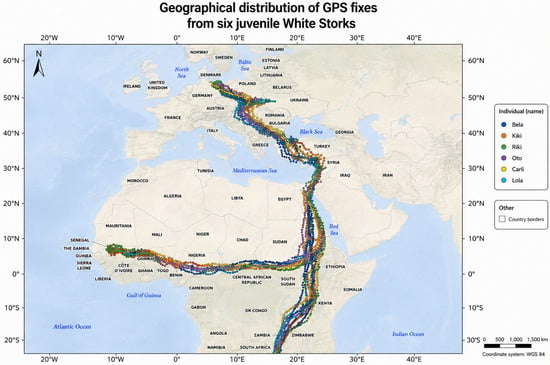
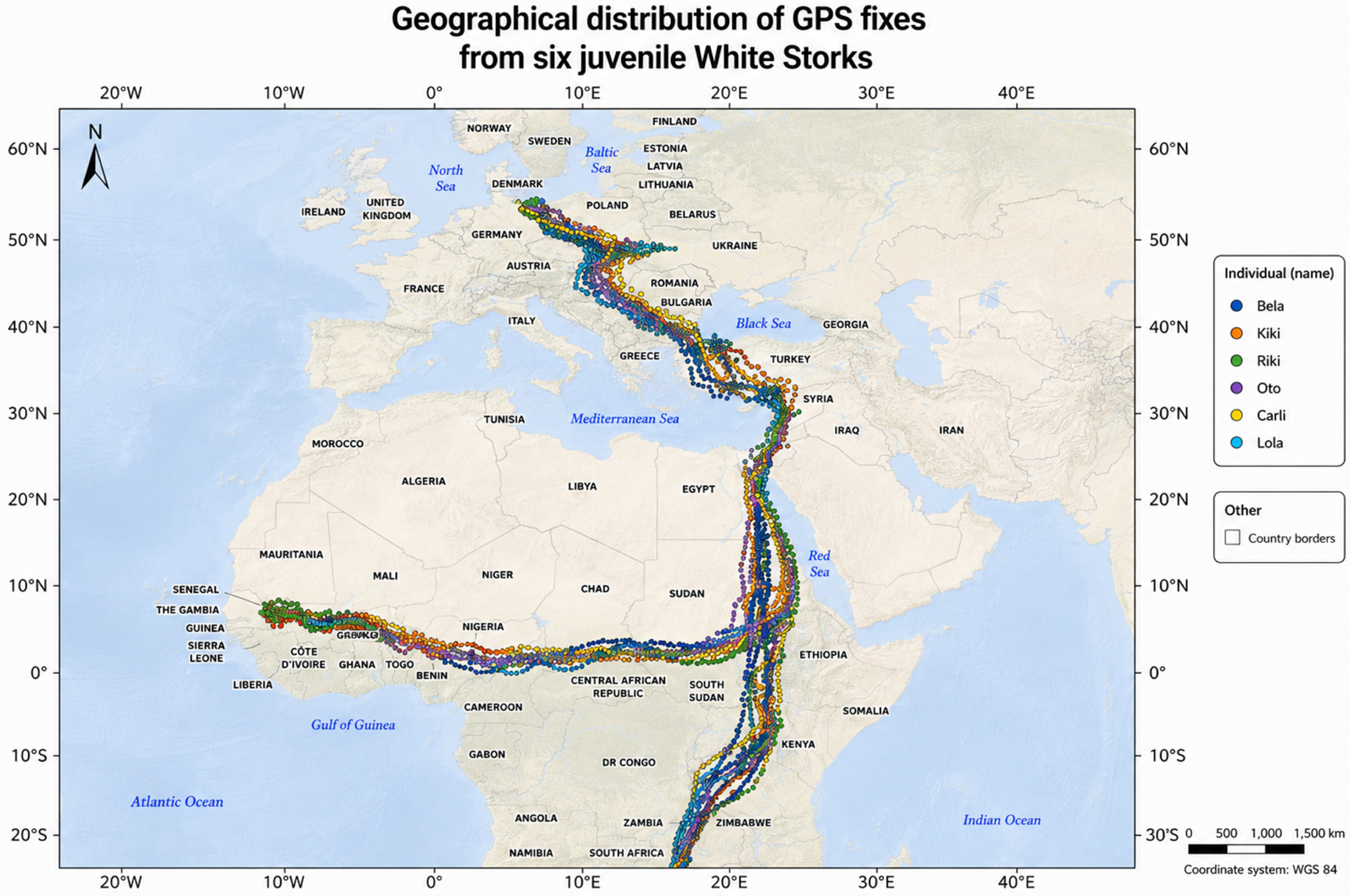
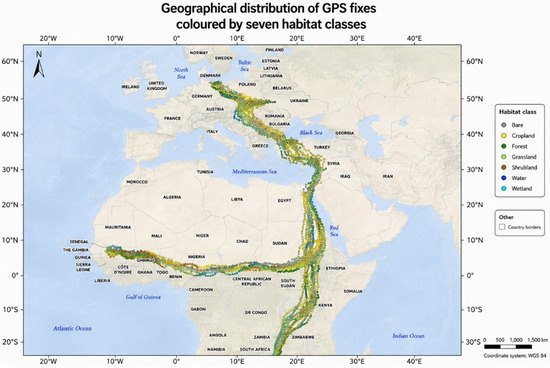
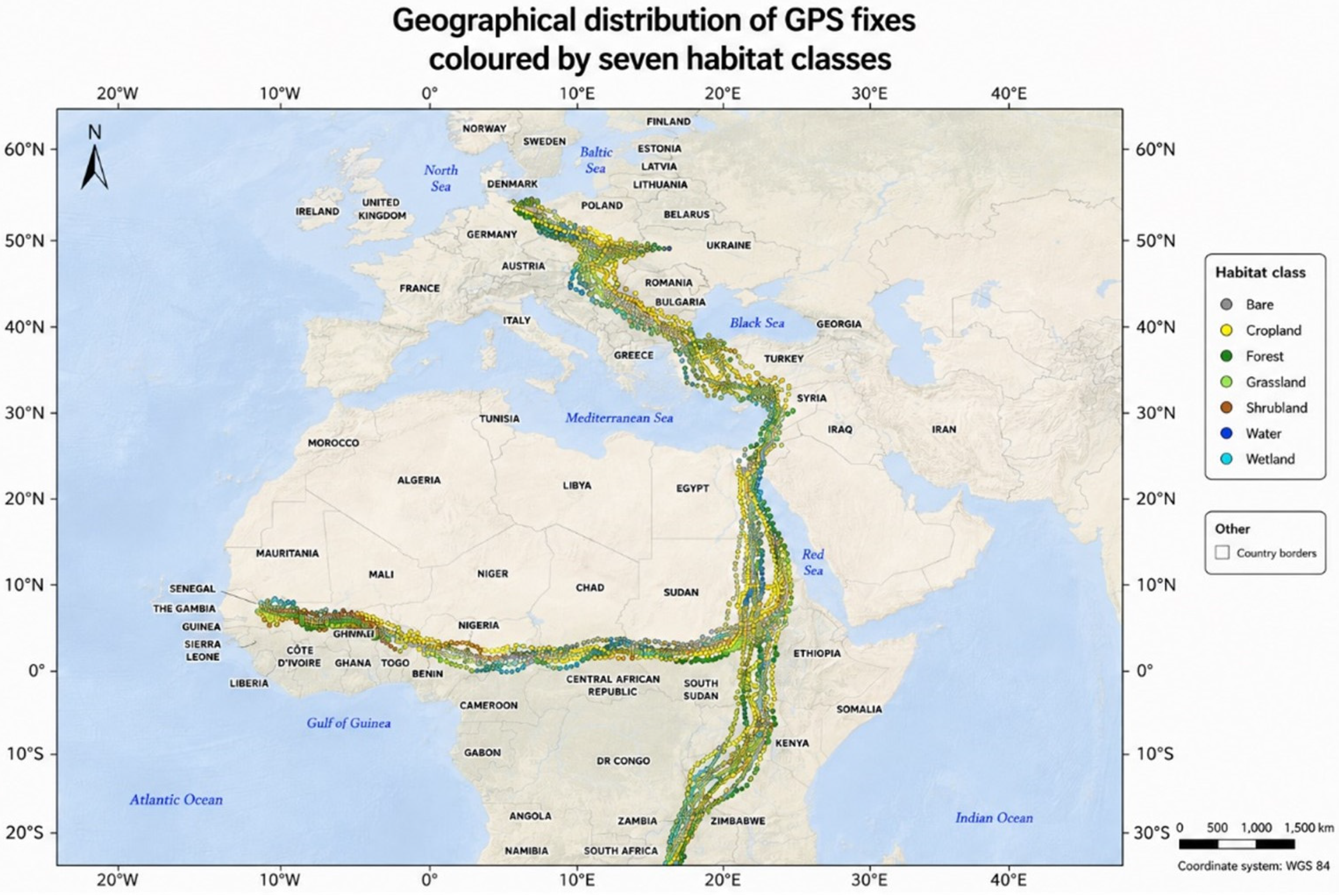
Individuals were equipped with GPS telemetry devices as part of an ongoing movement-monitoring programme. GPS locations were recorded at regular intervals and compiled into a spatial database containing geographic coordinates, movement variables, and habitat information. The dataset encompassed multiple migratory periods and represented movements across breeding regions, migratory corridors, stopover areas, and wintering grounds. GPS observations covered complete migratory trajectories across years and major migratory corridors (Figure 1). Habitat composition along migratory pathways is illustrated in Figure 2.
Figure 1.
Geographical distribution of GPS fixes from the six juvenile White Storks included in the analyses, showing their complete migratory trajectories across the study period.
Figure 2.
Geographic distribution of GPS fixes coloured according to the seven habitat classes used in the statistical analyses (bare, cropland, forest, grassland, shrubland, water, and wetland). Any map categories displayed for visualization only were not included as analytical habitat classes.
Spatial processing and statistical analyses were conducted in R version 4.3 [13].
Movement data were collected using high-resolution GPS tracking devices attached to individual birds. The dataset comprised 30,323 GPS locations from six individuals, spanning multiple habitat types encountered during migration. Each GPS record included spatial coordinates, timestamp, ground speed (km h−1), and altitude above mean sea level (MSL). Elevation data were derived from a digital elevation model (SRTM) [14], allowing calculation of altitude above ground level (AGL). Movement speed (km h−1) was obtained directly from the GPS data. Altitude above ground level (AGL) was calculated as:
where ground elevation was extracted from the SRTM dataset at each GPS location. This correction allowed separation of vertical movement from topographic variation. Although subtraction of terrain elevation removed the effect of topography, GPS altitude and terrain elevation are both subject to measurement error, resulting in some negative AGL values. Therefore, additional sensitivity analyses were performed using AGL values with negative observations set to zero and using an inverse hyperbolic sine transformation. Movement speed (km h1) was derived directly from telemetry-derived movement variables. Variation in movement speed across habitat classes is presented in Figure 3.
AGL = GPS altitude − terrain elevation
Figure 3.
Distribution of movement speed (km h−1) across habitat classes. Boxplots show the median, interquartile range, whiskers (1.5 × IQR), and distribution of observations. Habitat-specific sample sizes are provided in Table 1.
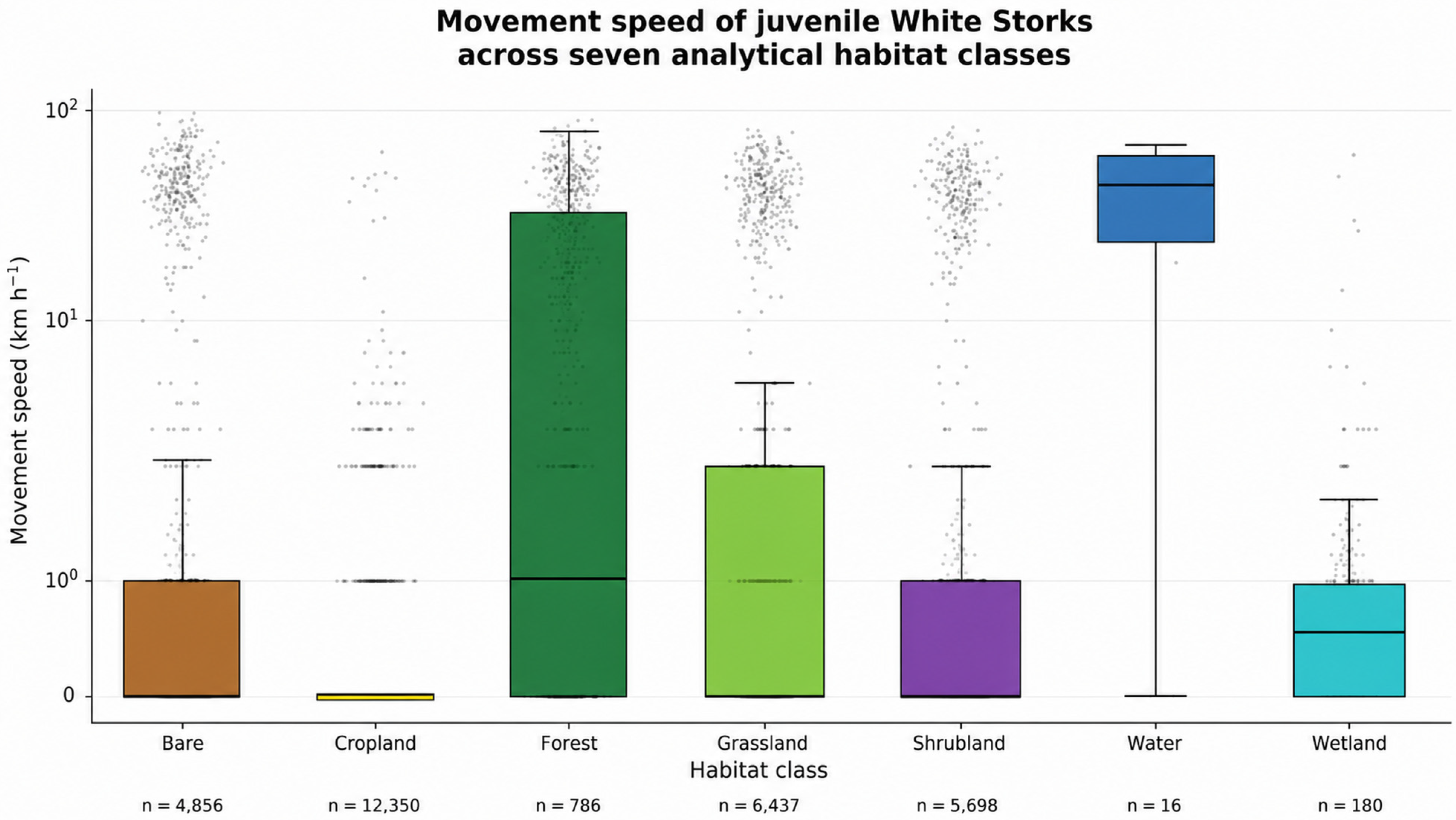
Table 1.
Distribution of behavioural states (resting, local movement, and flight) across habitat classes. Values represent the number of GPS observations classified into each behavioural state within each habitat. Uneven distributions reflect both habitat availability and behavioural preferences, and are explicitly accounted for in subsequent analyses.
Each GPS location was assigned a habitat class based on land cover data. Habitat categories included cropland, grassland, shrubland, forest, bare areas, water, and wetland, representing the dominant land cover types encountered along the migration route.
Land cover information was extracted within a spatial buffer (170 m radius) around each GPS point to account for positional uncertainty and local habitat heterogeneity. Habitat classes were treated as categorical variables in subsequent analyses.
Habitat representation was uneven across the dataset; however, all observations were retained to preserve ecological realism, and this imbalance is explicitly considered in interpretation. To account for behavioural heterogeneity, movement records were classified into three behavioural states based on speed thresholds:
Resting: speed < 2 km h−1; Local movement: 2–10 km h−1; Flight: >10 km h−1.
These thresholds were chosen to distinguish stationary or near-stationary behaviour from active movement and sustained flight, following established approaches in movement ecology. While speed-based classification is a simplification, it provides a robust and reproducible method for separating major behavioural modes in large datasets. Because White Storks combine soaring and gliding flight with intermittent resting and foraging behaviour during migration [4,5], explicitly accounting for behavioural allocation was considered essential to avoid confounding behavioural and habitat effects.
More advanced approaches such as hidden Markov models or accelerometer-based classification can provide finer behavioural resolution [10,11], but speed-based classification remains a robust and reproducible approach for large GPS datasets. Although speed-based classification does not capture the full complexity of behaviour, it provides a transparent and reproducible framework suitable for large-scale GPS datasets.
We evaluated the effects of habitat and behavioural state on movement speed and altitude using linear mixed-effects models. Two response variables were analysed:
- Movement Speed (Km H−1);
- Altitude Above Ground Level (M).
Two separate linear mixed-effects models were fitted using the lme4 package [15]:
Speed ~ Habitat + Behaviour + (1 | BirdID)
AGL ~ Habitat + Behaviour + (1 | BirdID)
In both models, habitat and behavioural state were included as fixed effects, while BirdID was included as a random intercept to account for repeated observations from the same individual. Bare habitat and resting behaviour were used as the reference categories.
Model assumptions were assessed through visual inspection of residual plots. Residual skewness and heteroscedasticity were also evaluated to assess model fit. Model performance was quantified using marginal and conditional R2 values [16]. Marginal R2 represents the variance explained by the fixed effects, whereas conditional R2 represents the variance explained by both fixed and random effects.
Given the observational nature of the dataset, habitat representation was uneven, with some habitat classes containing substantially more observations than others. This imbalance was retained in the analyses to preserve ecological realism but was considered explicitly when interpreting the model estimates.
Behavioural state and habitat were not statistically or ecologically independent because certain habitats were more frequently associated with particular behaviours, such as resting in cropland or flight over open areas. Including behavioural state in the models therefore allowed habitat effects to be evaluated after accounting for differences in behavioural allocation. Because behavioural state was classified using movement speed, an additional model restricted to flight observations was fitted as a sensitivity analysis to evaluate habitat effects independently of behavioural state classification. To evaluate the robustness of the results, several sensitivity analyses were performed. Behavioural state thresholds were modified by increasing the flight threshold from 10 to 12 km h−1, leave-one-individual-out analyses were conducted by sequentially excluding each bird, and additional models were fitted after removing extreme observations. For AGL, models using the original values were compared with models in which negative values were set to zero and with inverse hyperbolic sine-transformed AGL values.
All analyses were conducted in R [13]. Linear mixed-effects models were fitted using lme4 [15]. Marginal and conditional R2 values were calculated using the MuMIn package [17]. Data processing and manipulation were performed using dplyr [18], and graphical outputs were produced using ggplot2 [19].
Variation in movement speed and altitude among habitat classes was visualized using boxplots showing medians, interquartile ranges, whiskers extending to 1.5 times the interquartile range, and distributional variability. Behavioural state composition across habitats was summarized using proportional distributions of behavioural observations. Geographic patterns were visualized using maps representing complete migratory trajectories across years.
All analyses were conducted using reproducible analytical workflows implemented in R. Statistical code, derived variables, and processing procedures are available from the corresponding author upon reasonable request.
3. Results
The analysed dataset comprised 30,323 GPS telemetry observations from six juvenile White Storks tracked across multiple years, encompassing migratory movements from breeding areas through migratory corridors and wintering regions. GPS fixes spanned a broad geographic extent and included multiple habitat categories representing heterogeneous environmental conditions encountered during migration.
Cropland represented the dominant habitat category within the dataset, followed by grassland, shrubland, and bare habitats, whereas wetland and water habitats contained comparatively fewer observations. Behavioural allocation varied strongly among habitat types, suggesting that habitat use was closely associated with behavioural context.
Behavioural composition differed substantially among habitat classes (Table 1). Resting behaviour predominated within cropland habitats, whereas habitats associated with migratory movement contained proportionally larger fractions of flight observations.
Grassland and shrubland habitats exhibited mixed behavioural composition, reflecting combined use for movement and temporary stopover activities. Water-associated observations were rare but characterized by relatively greater proportions of flight behaviour, consistent with directed movement rather than stationary activities.
These patterns indicate that habitat classes differ not only environmentally but also behaviourally, suggesting that movement metrics measured within habitats reflect behavioural allocation in addition to direct environmental influences.
Movement speed varied among habitat categories (Figure 3). Cropland habitats exhibited relatively low median movement speeds, whereas habitats associated with directed movement showed elevated values and greater variability.
Speed distributions were strongly right-skewed across habitats, reflecting occasional episodes of sustained migratory flight embedded within a broader distribution dominated by low-speed activities. Interquartile ranges differed among habitats, indicating habitat-specific variation in behavioural composition.
Habitats characterized by greater proportions of flight behaviour exhibited broader speed distributions and elevated upper tails, whereas habitats dominated by resting behaviour showed compressed distributions concentrated near low movement speeds.
These observations suggest that behavioural state composition contributes substantially to habitat-associated variation in movement speed.
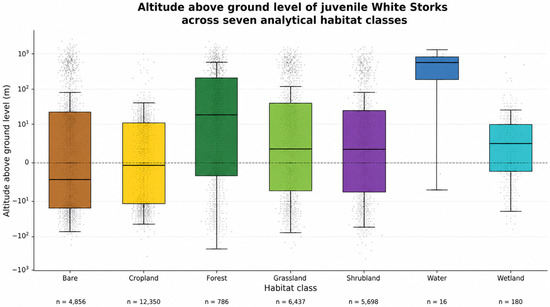
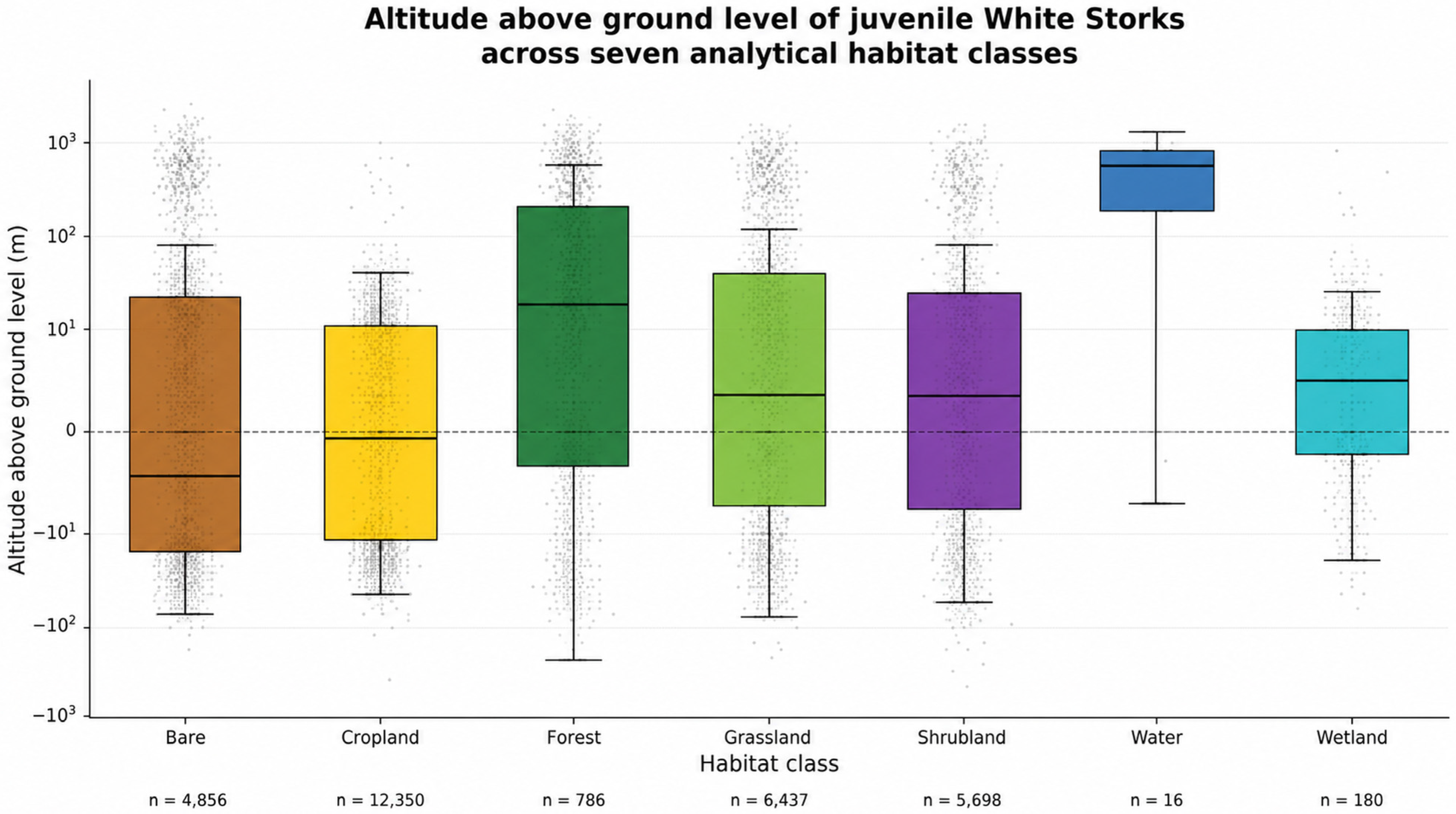
Altitude above ground level also differed among habitat classes (Figure 4). Habitats associated with greater flight activity exhibited elevated altitude distributions and increased variability relative to habitats dominated by resting or local movement.
Figure 4.
Distribution of altitude above ground level (AGL) across habitat classes. Boxplots show the median, interquartile range, whiskers (1.5 × IQR), and distribution of observations. Habitat-specific sample sizes are provided in Table 2.
Altitude distributions were positively skewed across all habitat classes, reflecting episodic soaring flight occurring within broader behavioural repertoires. Upper distribution tails extended substantially higher in habitats associated with migratory movement, consistent with altitude gains achieved during soaring behaviour.
Water-associated observations exhibited particularly high altitude values despite limited sample size, whereas cropland habitats showed generally lower altitudes corresponding to increased stationary or local activities.
Overall, habitat-associated altitude differences mirrored behavioural state distributions more strongly than habitat identity alone.
Linear mixed-effects models identified behavioural state as the strongest predictor of both movement speed and altitude (Table 2). Relative to resting behaviour, flight behaviour produced substantially greater movement speeds and higher altitudes, whereas local movement showed intermediate values.
Table 2.
Effects of habitat type and behavioural state on movement speed and altitude above ground level (AGL), estimated using linear mixed-effects models. Estimates (β) are shown relative to the reference category (bare habitat, resting behaviour). Behavioural state had a substantially larger effect size than habitat across both models. Only coefficients available in the reported analysis output are shown; em dashes indicate values not reported in the available output.
(a) behavioural state; (b) altitude (AGL) model.
Habitat effects remained statistically detectable after accounting for behavioural state but were considerably smaller than behavioural effects. This pattern indicates that behavioural allocation explains a substantial proportion of habitat-associated variation observed in movement metrics.
The very small difference between marginal and conditional R2 indicated that the random intercept for BirdID explained little additional variance after accounting for habitat and behavioural state.
Model explanatory power further supported behavioural dominance, with behavioural predictors accounting for substantially greater variance than habitat variables alone.
GPS observations covered complete migratory trajectories across years and demonstrated consistent use of major migratory corridors (Figure 2). Spatial patterns reflected movement between breeding regions, migratory stopovers, and wintering areas.
Habitat-coloured GPS fixes illustrated that behavioural and environmental heterogeneity were distributed throughout migratory pathways rather than confined to discrete geographic regions. This spatial complexity further supports the need to explicitly integrate behavioural state when interpreting habitat–movement relationships.
Altitude Above Ground Level.
Altitude above ground level (AGL) also varied across habitats. Mean AGL ranged from 4.35 m in cropland to 584.05 m over water, with intermediate values in forest (218.76 m), bare areas (127.08 m), grassland (124.55 m), shrubland (95.65 m), and wetland (12.97 m). Median AGL values were low in most terrestrial habitats but substantially higher over water, reflecting differences in behavioural state distribution.
The altitude model showed patterns consistent with those observed for speed. Relative to resting behaviour, local movement increased AGL by 10.097 m (SE = 4.1149, p = 0.015), while flight increased AGL by 566.086 m (SE = 3.398, p < 0.001). Local movement increased speed by 2.456 km h−1, and flight by 43.035 km h−1.
Because behavioural states were defined using speed thresholds, the magnitude of these effects was expected and should not be interpreted independently of the classification procedure.
Habitat effects were again secondary. Compared to bare habitat, AGL was significantly lower in cropland (β = −14.773, p < 0.001), grassland (β = −14.620, p < 0.001), and shrubland (β = −18.143, p < 0.001), while water was associated with higher altitude (β = 136.121, p = 0.008). Forest and wetland did not differ significantly from the reference category.
The direction and interpretation of the principal model results remained consistent across all alternative analytical specifications. Sensitivity analyses including alternative behavioural thresholds, leave-one-individual-out analyses, exclusion of extreme observations, flight-only models, and alternative treatments of altitude above ground level all produced qualitatively similar conclusions (Table 3). These analyses support the robustness of the reported habitat and behavioural state effects.
Table 3.
Sensitivity and robustness analyses used to assess the influence of behavioural state classification, individual birds, extreme observations, and alternative treatments of altitude above ground level (AGL).
Across both models, behavioural state consistently explained a substantially larger proportion of variation than habitat. The magnitude of behavioural coefficients was an order of magnitude greater than that of habitat effects, indicating that differences between resting, local movement, and flight dominate observed variation in both speed and altitude.
After accounting for habitat and behavioural state, the contribution of individual identity was small, as indicated by the minimal difference between the marginal and conditional R2 values (Table 4).
Table 4.
Performance and diagnostic statistics of the linear mixed-effects models used to analyse movement speed and altitude above ground level (AGL). Marginal R2 represents the variance explained by the fixed effects, whereas conditional R2 includes both fixed and random effects. Bird identity was included as a random intercept in all models. The small differences between marginal and conditional R2 indicate that individual identity explained little additional variation after accounting for habitat and behavioural state. The inverse hyperbolic sine transformation improved the distribution of AGL residuals, although some heteroscedasticity remained.
Habitat effects on movement metrics were statistically significant but modest relative to behavioural effects. These patterns were consistent across both response variables, indicating a general effect of behavioural state on movement metrics.
4. Discussion
Our results demonstrate that behavioural state is the primary determinant of movement speed and altitude in juvenile White Storks, whereas habitat effects are comparatively weaker and largely mediated through behavioural allocation. This finding highlights the importance of explicitly accounting for behavioural heterogeneity when interpreting movement–environment relationships from GPS telemetry data. Apparent habitat-specific differences in movement metrics cannot be interpreted solely as direct environmental effects because habitats differ substantially in the behavioural states expressed within them.
The strongest effects observed in our models were associated with behavioural state. The movement speed model showed high explanatory power (marginal R2 = 0.832; conditional R2 = 0.832), whereas the raw AGL model explained a moderate proportion of the variance (marginal and conditional R2 = 0.510). Applying an inverse hyperbolic sine transformation improved the AGL model fit (marginal R2 = 0.666) by reducing residual skewness, although some heteroscedasticity remained (Table 3). Flight behaviour was associated with substantially higher speeds and altitudes than resting or local movement. For movement speed, however, this large effect should be interpreted with caution because behavioural states were defined using speed thresholds. Nevertheless, the flight-only sensitivity analysis demonstrated that habitat effects remained detectable after restricting the analysis to flight observations, supporting the robustness of the principal conclusions. Similar patterns have been documented in White Storks and other soaring migrants, where movement performance depends primarily on flight mode and atmospheric conditions rather than habitat alone [4,6,7]. Consequently, analyses that fail to distinguish behavioural states may incorrectly attribute behavioural variation to habitat effects.
The observed habitat differences are therefore best interpreted as behaviour-mediated rather than habitat-deterministic. Cropland, which dominated the dataset, was associated primarily with resting behaviour and consequently exhibited low median speeds and altitudes. In contrast, habitats characterized by more frequent flight behaviour showed substantially elevated movement metrics. This pattern suggests that habitats influence movement indirectly through their association with behavioural allocation across the migratory landscape.
The predominance of resting records in cropland may reflect several, non-exclusive functions of agricultural landscapes during migration. Croplands can provide accessible foraging opportunities, open visibility and suitable temporary resting areas, and may therefore be used both for daytime stopovers and for roosting in the surrounding landscape. However, the present speed-based classification cannot distinguish foraging, daytime resting, and nocturnal roosting, and no inference can be made about microhabitat quality within individual cropland sites. Future studies combining GPS fixes with time-of-day information, accelerometry, and field-based characterization of roost sites would help resolve these finer-scale behavioural processes.
For soaring birds such as White Storks, movement ecology is tightly linked to atmospheric structure and thermal dynamics. Flight during migration relies on the efficient exploitation of thermal uplift, allowing birds to gain altitude while minimizing energetic expenditure [2,4]. Previous studies have demonstrated that migration altitude and movement speed vary with thermal convection, wind conditions, season, and latitude [6,7]. Similarly, large-scale analyses of White Stork migration have shown that migratory routes and movement strategies are strongly shaped by atmospheric conditions and the availability of soaring opportunities [5]. Although atmospheric variables were not analysed directly in the present study, these processes provide an important ecological context for interpreting the observed behavioural patterns.
Habitat-associated behavioural patterns may therefore partly reflect local atmospheric conditions rather than habitat structure alone. For example, land surface heating can influence the availability and strength of convective uplift, while wind direction and boundary layer development can alter flight altitude, speed, and the timing of departures. The relatively high-altitude observations over water should not be interpreted as evidence that water generates favourable thermals; they are more plausibly associated with sustained crossing flights and with atmospheric conditions encountered before or during those crossings. Integrating GPS data with meteorological reanalysis products would allow future studies to test whether apparent habitat effects are mediated by atmospheric structure.
Importantly, migration in White Storks is also strongly social. Juveniles rarely migrate independently and instead travel within flocks containing experienced individuals, where movement decisions may emerge through collective behaviour and social information transfer [5,8]. Consequently, juvenile movement responses should not be interpreted exclusively as direct reactions to environmental conditions. Instead, observed movement trajectories likely emerge from interactions among habitat, atmospheric conditions, flock dynamics, and behavioural state. Integrating these processes is essential for understanding migration ecology in large soaring birds.
Although the analysis included only six individuals, leave-one-individual-out models showed that the principal effects were not driven by any single bird. Nevertheless, individual physiological condition, prior experience, and social position within a flock may contribute to variation in migratory performance and behavioural allocation, particularly during the first migration. The Slovenian origin of the tracked birds is also relevant because this region lies close to a transition between major European migratory routes. Accordingly, the trajectories represented here should be interpreted as individual examples within a broader and potentially flexible flyway system rather than as a complete description of population-level migration.
Our findings support and extend the energy landscape framework [3]. Rather than affecting movement only through direct energetic constraints, landscapes influence movement by structuring behavioural opportunities under different environmental conditions. The resulting movement patterns therefore emerge from behavioural responses to heterogeneous energy landscapes rather than from habitat effects alone. This interpretation is consistent with previous studies demonstrating that White Stork migration is governed by a combination of behavioural decisions and atmospheric processes operating across multiple spatial scales [4,5,6,7].
The results also emphasize the broader methodological value of behavioural classification in movement ecology. High-resolution tracking data allow researchers to quantify movement in considerable detail [9], but raw metrics such as speed and altitude integrate multiple underlying behaviours. Without explicit behavioural classification, variation among habitats can be misinterpreted as a direct environmental response. More advanced approaches, including hidden Markov models and classifications incorporating auxiliary sensor data, may provide finer behavioural resolution [10,11]. Nevertheless, the present speed-based classification offered a transparent and reproducible framework for separating broad behavioural states.
Several limitations should nevertheless be acknowledged. The small number of tracked individuals also limits population-level inference, even though leave-one-individual-out analyses indicated that no single bird disproportionately influenced the results. Habitat representation was highly uneven, with some habitat classes containing relatively few observations. In particular, inference for water and wetland habitats should remain cautious because of the limited sample sizes. Altitude above ground level also contains uncertainty because GPS altitude and terrain elevation are both subject to measurement error, resulting in some negative AGL values. However, alternative treatments of AGL and additional sensitivity analyses yielded consistent conclusions. Furthermore, atmospheric variables such as wind speed, thermal uplift intensity, and boundary layer structure were not included directly in the analyses, despite their known importance for soaring migration [6,7]. Future work should therefore integrate meteorological variables and more advanced behavioural classification approaches to better resolve the mechanisms underlying movement decisions.
Despite these limitations, this study provides robust evidence that behavioural classification substantially improves ecological interpretation of movement data. Explicitly accounting for behavioural heterogeneity reduces overestimation of direct habitat effects and allows a more mechanistic interpretation of movement–environment relationships. More broadly, our results demonstrate that movement metrics derived from tracking data should be interpreted within a behavioural framework that considers behavioural state alongside habitat characteristics and other environmental drivers.
Author Contributions
Conceptualization, D.D.; fieldwork organization and coordination, D.D.; literature review, D.D.; data curation and data cleaning, A.R.; formal analysis, A.R.; methodology, A.R. and D.D.; interpretation of results, D.D. and A.R.; writing—original draft preparation, A.R.; writing—review and editing, D.D. and A.R.; placing the results into the broader ecological context, D.D. All authors have read and agreed to the published version of the manuscript.
Funding
This work was supported by the ESA Network of Resources Initiative. White Stork telemetry was supported by Elektro Ljubljana d.d. and Comita d.d. The funding bodies had no role in study design, data collection, analysis, interpretation of data, or manuscript preparation.
Institutional Review Board Statement
The Slovenian Environment Agency (ARSO) has granted all required permits (no. 35601-3/2015-4, 35601-55/2016-4, 35601-39/2019-4, 35601-73/2020-7, 35601-41/2021-6) for the installation of transmitters on Storks, ensuring that the procedures adhere to strict animal welfare standards and minimize any disturbance or stress to the birds.
Data Availability Statement
The data supporting the findings of this study, together with derived variables and analytical procedures, are available from the corresponding author upon reasonable request.
Acknowledgments
The authors gratefully acknowledge DOPPS—BirdLife Slovenia (Društvo za opazovanje in proučevanje ptic Slovenije) for coordinating the White Stork monitoring programme and supporting the fieldwork. We sincerely thank all volunteers, field assistants, and collaborators who participated in locating nests, capturing birds, deploying GPS transmitters, and collecting the long-term telemetry data that made this study possible. We also thank everyone involved in maintaining the monitoring programme and managing the telemetry database.
Conflicts of Interest
The authors declare no conflicts of interest.
References
- Nathan, R.; Getz, W.M.; Revilla, E.; Holyoak, M.; Kadmon, R.; Saltz, D.; Smouse, P.E. A movement ecology paradigm for unifying organismal movement research. Proc. Natl. Acad. Sci. USA 2008, 105, 19052–19059. [Google Scholar] [CrossRef]
- Pennycuick, C.J. Modelling the Flying Bird; Academic Press: London, UK, 2008. [Google Scholar]
- Shepard, E.L.C.; Wilson, R.P.; Rees, W.G.; Grundy, E.; Lambertucci, S.A.; Vosper, S.B. Energy landscapes shape animal movement ecology. Am. Nat. 2011, 178, 247–259. [Google Scholar] [CrossRef]
- Liechti, F.; Ehrich, D.; Bruderer, B. Flight behaviour of White Storks (Ciconia ciconia) on their migration over South Israel. Ardea 1996, 84, 3–13. [Google Scholar]
- Berthold, P.; van den Bossche, W.; Fiedler, W.; Gorney, E.; Kaatz, M.; Leshem, Y.; Nowak, E.; Querner, U. Der Zug des Weißstorchs (Ciconia ciconia): Eine besondere Zugform auf Grund neuer Ergebnisse. J. Für Ornithol. 2001, 142, 73–92. [Google Scholar] [CrossRef]
- Shamoun-Baranes, J.; Baharad, A.; Alpert, P.; Berthold, P.; Yom-Tov, Y.; Dvir, Y.; Leshem, Y. The effect of wind, season and latitude on the migration speed of White Stork Ciconia ciconia along the eastern migration route. J. Avian Biol. 2003, 34, 97–104. [Google Scholar] [CrossRef]
- Shamoun-Baranes, J.; Liechti, F.; Yom-Tov, Y.; Leshem, Y. Using a convection model to predict altitudes of White Stork migration over Central Israel. Bound.-Layer Meteorol. 2003, 107, 673–681. [Google Scholar] [CrossRef]
- Gordo, O.; Brotons, L.; Ferrer, X.; Comas, P. Do changes in climate patterns in wintering areas affect the timing of the spring arrival of trans-Saharan migrant birds? Glob. Change Biol. 2007, 13, 161–169. [Google Scholar] [CrossRef]
- Bridge, E.S.; Thorup, K.; Bowlin, M.S.; Chilson, P.B.; Diehl, R.H.; Fléron, R.W.; Hartl, P.; Kays, R.; Kelly, J.F.; Robinson, W.D.; et al. Technology on the move: Recent and forthcoming innovations for tracking migratory birds. BioScience 2011, 61, 689–698. [Google Scholar] [CrossRef]
- McClintock, B.T.; Langrock, R.; Gimenez, O.; Cam, E.; Borchers, D.L.; Glennie, R.; Patterson, T.A. Uncovering ecological state dynamics with hidden Markov models. Ecol. Lett. 2020, 23, 187–203. [Google Scholar] [CrossRef]
- Saldanha, S.; Cox, S.L.; Militão, T.; González-Solís, J. Animal behaviour on the move: The use of auxiliary information and semi-supervision to improve behavioural inferences from hidden Markov models applied to GPS tracking datasets. Mov. Ecol. 2023, 11, 41. [Google Scholar] [CrossRef]
- Wilson, R.P.; Shepard, E.L.C.; Liebsch, N. Prying into the intimate details of animal lives: Use of a daily diary on animals. Endanger. Species Res. 2008, 4, 123–137. [Google Scholar] [CrossRef]
- R Core Team. R: A Language and Environment for Statistical Computing; R Foundation for Statistical Computing: Vienna, Austria, 2023; Available online: https://www.R-project.org/ (accessed on 20 July 2026).
- Farr, T.G.; Rosen, P.A.; Caro, E.; Crippen, R.; Duren, R.; Hensley, S.; Kobrick, M.; Paller, M.; Rodriguez, E.; Roth, L.; et al. The Shuttle Radar Topography Mission. Rev. Geophys. 2007, 45, RG2004. [Google Scholar] [CrossRef]
- Bates, D.; Mächler, M.; Bolker, B.; Walker, S. Fitting linear mixed-effects models using lme4. J. Stat. Softw. 2015, 67, 1–48. [Google Scholar] [CrossRef]
- Nakagawa, S.; Schielzeth, H. A general and simple method for obtaining R2 from generalized linear mixed-effects models. Methods Ecol. Evol. 2013, 4, 133–142. [Google Scholar] [CrossRef]
- Barton, K. MuMIn: Multi-Model Inference. R Package Version 1.47.5. 2023. Available online: https://CRAN.R-project.org/package=MuMIn (accessed on 20 July 2026).
- Wickham, H.; François, R.; Henry, L.; Müller, K. dplyr: A Grammar of Data Manipulation. R Package Version 1.1.0. 2023. Available online: https://CRAN.R-project.org/package=dplyr (accessed on 20 July 2026).
- Wickham, H. ggplot2: Elegant Graphics for Data Analysis; Springer: New York, NY, USA, 2016. [Google Scholar]

Disclaimer/Publisher’s Note: The statements, opinions and data contained in all publications are solely those of the individual author(s) and contributor(s) and not of MDPI and/or the editor(s). MDPI and/or the editor(s) disclaim responsibility for any injury to people or property resulting from any ideas, methods, instructions or products referred to in the content. |
© 2026 by the authors. Licensee MDPI, Basel, Switzerland. This article is an open access article distributed under the terms and conditions of the Creative Commons Attribution (CC BY) license.