
Review Reports
by
- Yuting Liu 1,†,
- Yibin Zheng 1,† and
- Jie Lou 1,*
- et al.
Reviewer 1: Anonymous Reviewer 2: Anonymous Reviewer 3: Anonymous
Round 1
Reviewer 1 Report
Comments and Suggestions for AuthorsIn the review paper, entitled: „Platelet-Derived Components: A Multifaceted Arsenal for Anti-Aging Therapies” by Dr Yuting Liu et al., the Authors provided a comprehensive literature review devoted to human blood platelets-derived products, such as platelet-rich plasma (PRP), platelet-rich fibrin (PRF) and platelet-derived components in respect to their anti-aging potential. The Authors focues on therapeutic potential of Platelet-Derived Components (PDC) in regenerative medicine, specifically targeting skin and bone aging. In my opinion, the paper is a nicely written. I appreciate a fact that the Authors have reviewed 154 references. I like also 6 informative figures, however some of them are reproduced with a permission from other publications, and graphical abstract. However, I have several minor comments listed below:
- Title of the paper: While a title suggests a broad scope ("Anti-Aging Therapies"), the manuscript focuses almost exclusively on skin and bone. The authors should either narrow the title (e.g., "...for Skin and Bone Anti-Aging") or briefly discuss why these two tissues were selected as the primary models for PDC-based aging interventions.
- The association of Section 2 with anti-aging: Section 2 and Figure 1 discuss platelets as delivery vehicles but focus mainly on cancer and thrombosis. To increase the manuscript cohesion and clarity, the authors should consider to explicitly discuss how these delivery platforms can be adapted for anti-aging purposes, such as the delivery of antioxidants or specific regenerative peptides.
- In the "Discussion and Outlook" section, the authors correctly identify the lack of standardization as a major problem. It would be advantageous to include a summary showing the existing classification systems of PRP (such as PAW or PLRA) and discuss their significance in the standardizaton.
- The graphical abstract and figures contain several typo errors that should be corrected
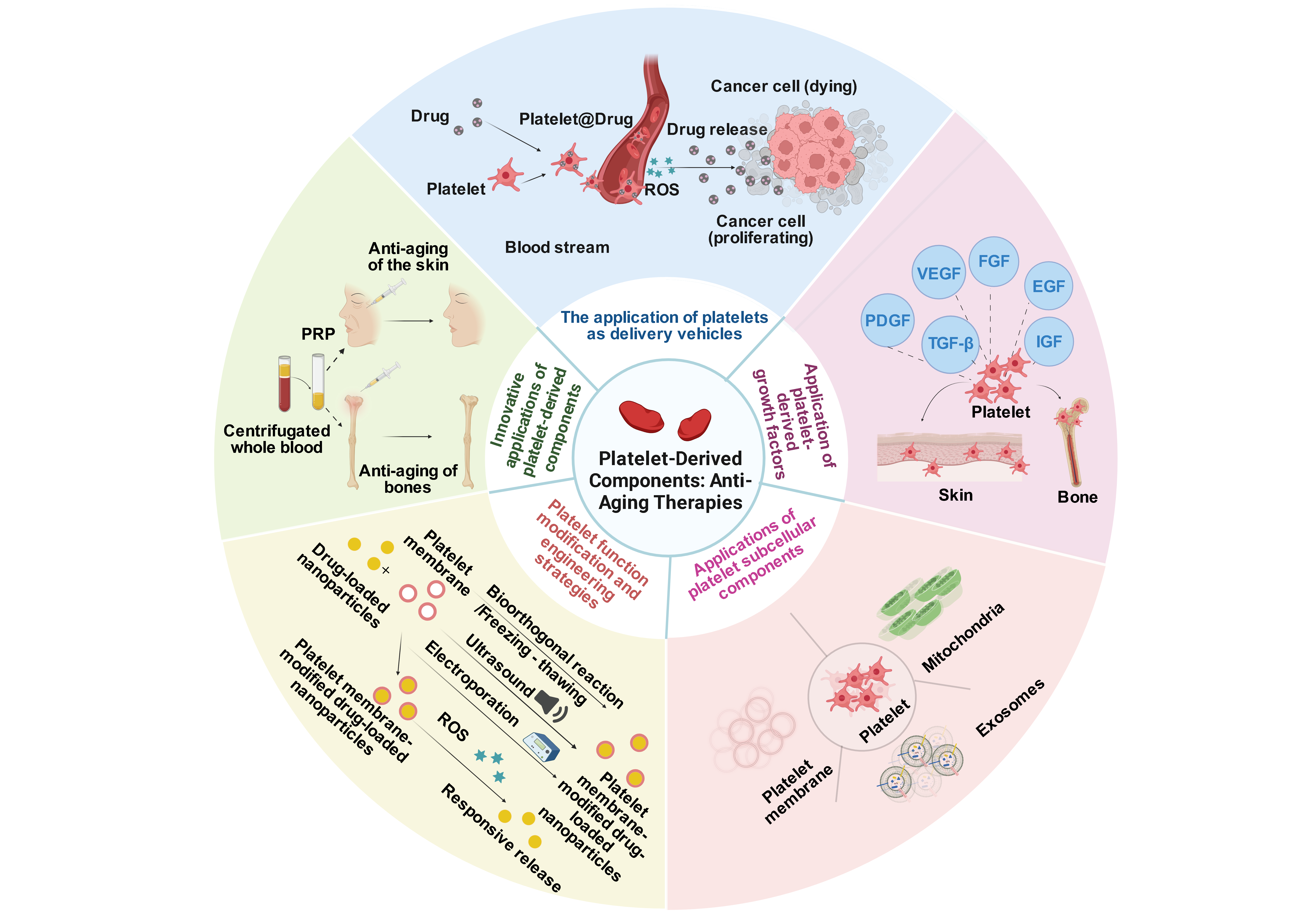
- a) Graphical Abstract (Page 2):
Change "Innovative soplications" -> "Innovative applications".
"Pistolet-Durived" -> "Platelet-Derived".
"nastoparticles" -> "nanoparticles".
"sicbeslar" -> "subcellular".
b) Figure 1 (Page 4):
"membarne" -> "membrane".
"Contrilled release" -> "Controlled release".
c) Figure 2 (Page 5):
Ensure consistency in the spelling of growth factors (e.g., verify "PDAF" vs. "PDGF").
Author Response
In the review paper, entitled: „Platelet-Derived Components: A Multifaceted Arsenal for Anti-Aging Therapies” by Dr Yuting Liu et al., the Authors provided a comprehensive literature review devoted to human blood platelets-derived products, such as platelet-rich plasma (PRP), platelet-rich fibrin (PRF) and platelet-derived components in respect to their anti-aging potential. The Authors focus on therapeutic potential of Platelet-Derived Components (PDC) in regenerative medicine, specifically targeting skin and bone aging. In my opinion, the paper is nicely written. I appreciate the fact that the Authors have reviewed 154 references. I like also 6 informative figures, however some of them are reproduced with permission from other publications, and graphical abstract. However, I have several minor comments listed below:
Comments 1: Title of the paper: While a title suggests a broad scope ("Anti-Aging Therapies"), the manuscript focuses almost exclusively on skin and bone. The authors should either narrow the title (e.g., "...for Skin and Bone Anti-Aging") or briefly discuss why these two tissues were selected as the primary models for PDC-based aging interventions.
Response: We thank the reviewer for this valuable suggestion regarding scope consistency. To align the title with the actual focus of the review, we have revised the title to: “Platelet-Derived Components for Skin and Bone Aging and Age-Associated Pathologies: Mechanisms, Bioengineering Strategies, and Clinical Translation.” We have also revised the opening sentence of the Abstract to explicitly state that the review centers mainly on skin and bone aging and to justify this focus based on clinical accessibility and the strength of available preclinical/clinical evidence:
“Advances in regenerative medicine have positioned platelets and their derivatives—including platelet-rich plasma, platelet-rich fibrin, platelet lysate, extracellular vesicles, and purified growth factors—as promising interventions specifically for skin and bone aging, two clinically accessible tissues with robust preclinical and clinical evidence for platelet-derived component–based rejuvenation and regeneration.”
In the Introduction, we added a concise rationale explaining why skin and bone were selected as exemplar tissues for PDC-based anti-aging, highlighting their quantifiable ECM-centered aging phenotypes with standardized histologic/imaging/functional readouts, clinical tractability for localized minimally invasive delivery and longitudinal monitoring, and comparatively mature translational evidence base for PDC-mediated rejuvenation/regeneration. This is covered in Section 1, Pages 2-3, Lines 70-82.
Comments 2: The association of Section 2 with anti-aging: Section 2 and Figure 1 discuss platelets as delivery vehicles but focus mainly on cancer and thrombosis. To increase the manuscript cohesion and clarity, the authors should consider explicitly discuss how these delivery platforms can be adapted for anti-aging purposes, such as the delivery of antioxidants or specific regenerative peptides.
Response: Thank you for this important suggestion. We agree that the original Section 2 and Figure 1 primarily emphasized oncology and thrombo-inflammatory applications, which could weaken the conceptual linkage to anti-aging. To improve cohesion and clarity, we have added an explicit anti-aging “bridge” statement in the opening paragraph of Section 2 to explain why platelet-inspired delivery logic is directly relevant to aging tissues (e.g., inflammaging, elevated ROS, and protease-driven ECM remodeling) and to highlight anti-aging cargos such as antioxidants/ROS-scavenging agents and regenerative peptides. This is presented in Section 2, Pages 3-4, Lines 123-130.
In addition, we revised the key advantages in Section 2 to include anti-aging-oriented examples:
(1) “Natural targeting” now discusses exploiting inflammation/damage tropism for photoaged skin and degenerative osteoarticular niches. This can be found in Section 2, Pages 4, Lines 144-148.
(2) “High loading capacity and carrier versatility” now explicitly lists anti-oxidative agents and regenerative peptides as representative anti-aging payloads. This is covered in Section 2, Pages 4, Lines 156-159.
(3) “Microenvironment-responsive release” now draws a direct analogy from tumor MMP responsiveness to protease- and ROS-rich niches in photoaged skin and osteoarthritic joints for on-demand release of antioxidants/regenerative peptides.
These revisions collectively strengthen the anti-aging rationale of Section 2 while keeping Figure 1 as an overview of translational platelet-mimetic platforms. This is presented in Section 2, Pages 4, Lines 169-172.
Comments 3: In the "Discussion and Outlook" section, the authors correctly identify the lack of standardization as a major problem. It would be advantageous to include a summary showing the existing classification systems of PRP (such as PAW or PLRA) and discuss their significance in the standardization.
Response: We thank the reviewer for this valuable suggestion. We agree that lack of standardization is a major barrier to reproducibility and cross-study comparability in PRP/PDC-based anti-aging research. In the original manuscript, the “Discussion and Outlook” section mentioned standardization only in general terms, without a concise summary of existing PRP classification systems (e.g., PAW or PLRA) or a clear discussion of why such classification is critical for standardization.
To address this comment, we replaced the original, general Discussion paragraph with a more structured “Discussion and Outlook” section (Sections 7.1–7.3). In particular, we added a dedicated subsection Section 7.2 (“Standardization: Why PRP Classification Matters”) to explicitly emphasize that PRP represents a heterogeneous family of preparations. These revisions can be found in Section 7.2, Pages 16-17, Lines 527-547.We explain the key sources of variability—(i) platelet concentration and total injected platelet dose, (ii) leukocyte/neutrophil and RBC contamination, (iii) fibrin architecture, and (iv) activation method—and discuss how these factors can materially influence outcomes and hinder inter-study comparisons if not consistently reported.
In addition, we included Table 3 (“Representative PRP classification and reporting frameworks relevant to standardization”), summarizing major classification/reporting systems, including PAW and PLRA (together with DEPA, MARSPILL, and MIBO), and highlighting the variables captured and their relevance to standardization. Finally, to make this section more actionable without adding redundancy, we added a concise reporting recommendation at the end of Section 7.2, encouraging quantitative disclosure of baseline/final cell counts, preparation/activation parameters, injected volume, and total delivered platelet dose to improve reproducibility and facilitate future meta-analyses.
Comments 4: The graphical abstract and figures contain several typo errors that should be corrected.
Comment a): Graphical Abstract (Page 2):
Change "Innovative soplications" -> "Innovative applications".
"Pistolet-Durived" -> "Platelet-Derived".
"nastoparticles" -> "nanoparticles".
"sicbeslar" -> "subcellular".
Response: We carefully re-checked the graphical abstract files and performed an additional round of proofreading. In the revised version, the graphical abstract has been verified to contain the correct spellings (e.g., “Innovative applications”, “Platelet-Derived”, “nanoparticles”, and “subcellular”), Please see the picture below. We apologize for any confusion and have ensured that the final graphical abstract is free of typographical errors.
Comment b): Figure 1 (Page 4):
"membarne" -> "membrane".
"Contrilled release" -> "Controlled release".
Response: Thank you for your careful check. We re-examined Figure 1 and confirmed that the term “membrane” is correctly spelled in our figure. However, we agree that the label “Contrilled release” contained a typographical error. In the revised manuscript, we have corrected it to “Controlled release.” Please see the picture below. Since Figure 1 is adapted from Ref. [26] (Han et al., Eur J Pharm Biopharm, 2022) under the CC BY 4.0 license, we also updated the figure caption to: “Figure 1. The current development of platelet-membrane-coated nanoparticles in targeted therapy [26]. Adapted from Han, Eur J Pharm Biopharm; published by Elsevier, 2022, under the CC BY 4.0 license, with minor modifications.”

Comment c): Figure 2 (Page 5):
Ensure consistency in the spelling of growth factors (e.g., verify "PDAF" vs. "PDGF").
Response: We appreciate this suggestion. We checked Figure 2 and the relevant text and confirmed that the growth factor abbreviation is used consistently throughout the manuscript (e.g., “PDGF”). We also performed an additional consistency check in the revised version.
Reviewer 2 Report
Comments and Suggestions for AuthorsThis review should more clearly distinguish between concepts such as "skin aging" and "bone aging," which represent natural processes of bodily aging, and pathological (inflammatory) processes in these tissues.
Indeed, in the current version of the review, the therapeutic use of platelet-derived components in pathological processes accompanied by inflammatory components is practically equated to the use of these same components for activating regeneration and rejuvenation processes. Or do the authors not see the difference between normal and pathological processes?
Although the authors briefly described what they mean by the process of "skeletal aging," it remains unclear what physiological processes underlie skin aging. Some mechanisms are shown in Figure 3, but they are not described in the text of the review.
Thus, the review needs to more clearly differentiate between pathological (typically inflammatory and immune-inflammatory processes) and normal processes of skin aging and changes in bone tissue during normal aging of the body. With such a differentiation, it is necessary to show the difference (limitations) in the application of platelet-derived components in the treatment of pathological conditions and in the normal aging of the body. I also suggest that the authors consider changing the title of the review – if the material in this article goes beyond the application of platelet-derived components only for rejuvenation and tissue regeneration.
Author Response
Comments 1: This review should more clearly distinguish between concepts such as "skin aging" and "bone aging," which represent natural processes of bodily aging, and pathological (inflammatory) processes in these tissues.
Response: Thank you for this important comment. We agree that physiological aging and age-associated pathological (inflammatory) processes should not be used interchangeably. To address this, we revised the manuscript to explicitly define and consistently apply terminology distinguishing physiological (intrinsic) aging from age-associated pathologies (e.g., photoaging, chronic wounds, osteoarthritis, osteoporosis).
Specifically, we (i) rewrote the introductory description of skin and skeletal aging to clarify that intrinsic aging represents a natural, gradual decline in tissue structure and function, while persistent high-amplitude inflammation is more characteristic of extrinsic stressors (e.g., UV-driven photoaging) or disease states. This is addressed in Section 1, Pages 2, Lines 56-69; (ii) added a “Terminology and scope” paragraph stating that “skin aging” and “skeletal aging” refer to physiological aging unless otherwise specified, and that photoaging/OA/OP are labeled explicitly as pathological processes. These revisions can be found in Section 1, Pages 3, Lines 83-89; and (iii) revised the opening of the skeletal section to avoid framing osteoporosis/osteoarthritis as synonymous with normal skeletal aging, instead describing them as age-associated diseases arising from age-related vulnerability combined with additional inflammatory or biomechanical drivers. This is presented in Section 3.2, Pages 8, Lines 264-272. These changes improve conceptual clarity and help interpret PDC outcomes, which are frequently assessed in disease or injury models rather than in purely physiological aging settings.
Comments 2: Indeed, in the current version of the review, the therapeutic use of platelet-derived components in pathological processes accompanied by inflammatory components is practically equated to the use of these same components for activating regeneration and rejuvenation processes. Or do the authors not see the difference between normal and pathological processes?
Response: We thank the reviewer for this important point. We fully agree that therapeutic effects observed in pathological/injury settings (typically featuring high-amplitude inflammation and tissue damage) should not be equated with “rejuvenation” under physiological intrinsic aging, where the baseline state is closer to homeostatic remodeling with low-grade inflammaging. Accordingly, in the revised manuscript we explicitly separate these two contexts throughout the review and clarify that the same platelet-derived components can produce different outcomes depending on baseline tissue state and therapeutic goals. In particular, when evidence comes from age-associated inflammatory/degenerative conditions (e.g., photoaging, chronic wounds, osteoarthritis, osteoporosis), we interpret benefits primarily as anti-inflammatory, reparative, or disease-modifying effects, rather than direct reversal of physiological aging.
Specifically, we revised:
(1) the Abstract to clarify that much of the evidence derives from injury/disease models and to distinguish pathology-targeted repair from rejuvenation in intrinsic aging. This is addressed in Abstract, Pages 1, Lines 22-25.
(2) Terminology and scope to label photoaging/chronic wounds/OA/OP explicitly as age-associated pathologies and to state an “interpretation rule” that improvements in these models should be read as repair/disease modification. These revisions can be found in Section 1, Pages 3, Lines 90-92.
(3) Section 2 to note that platelet targeting/homing via injury- and inflammation-associated cues is most relevant in overt pathology, whereas intrinsic aging without lesions may rely more on local delivery and microenvironment tuning. This is presented in Section 2, Pages 4, Lines 133-136.
(4) Section 3.1 (skin) to emphasize that many “rejuvenation” datasets are generated in photoaged/stressed skin and therefore reflect pathology-related inflammation/matrix damage. This can be found in Section 3.1, Pages 7, Lines 229-231.
(5) Section 3.2 (skeleton) to clarify that OA/OP are not synonymous with normal skeletal aging and that summarized PRP/PDC studies mainly test pathological microenvironments. This is covered in Section 3.2, Pages 8, Lines 272-275.
(6) the Discussion to provide a conceptual framework separating “pathology repair” from “physiological rejuvenation,” caution against over-interpreting pathology endpoints (e.g., wound closure, pain relief) as rejuvenation, and recommend aging-relevant endpoints and safety monitoring for aging-focused translation. This discussion can be found in Section 7.1, Pages 16, Lines 515-526.
Comments 3: Although the authors briefly described what they mean by the process of "skeletal aging," it remains unclear what physiological processes underlie skin aging. Some mechanisms are shown in Figure 3, but they are not described in the text of the review.
Response: Thank you for this important comment. We agree that the physiological processes underlying intrinsic (chronological) skin aging were not sufficiently articulated in the main text and that Figure 3 needed explicit textual interpretation. To address this, we added a new mechanistic paragraph at the beginning of Section 3.1 (PRP in Skin Anti-Aging). This paragraph maps each major element in Figure 3 to the corresponding physiological process of intrinsic skin aging, including: (i) reduced epidermal stem/progenitor output and slower keratinocyte turnover leading to epidermal thinning and delayed barrier repair; (ii) dermal fibroblast senescence with impaired anabolic signaling (e.g., reduced TGF-β/Smad activity) and increased ROS-associated stress responses; (iii) increased MMP-mediated ECM degradation and collagen fragmentation; and (iv) low-grade inflammaging with inflammasome-associated pathways (e.g., NLRP3), collectively contributing to dryness, laxity, fine wrinkling, and impaired repair capacity. We also used the existing references already cited in the manuscript (e.g., [4,9–13,56-57]) to support these statements and linked these intrinsic-aging processes to the PRP intervention nodes shown in Figure 3 (e.g., growth-factor signaling, ECM turnover rebalance, angiogenesis support, anti-oxidative/anti-inflammatory modulation, and hyaluronic-acid induction; [56]). The additional paragraph can be found in Section 3.1, Pages 7, Lines 213-228.
Comments 4: With such a differentiation, it is necessary to show the difference (limitations) in the application of platelet-derived components in the treatment of pathological conditions and in the normal aging of the body. I also suggest that the authors consider changing the title of the review – if the material in this article goes beyond the application of platelet-derived components only for rejuvenation and tissue regeneration.
Response: We thank the reviewer for this important suggestion. We agree that evidence obtained from injury or age-associated pathological contexts should not be directly equated with physiological (intrinsic) aging, and that the review should explicitly clarify the resulting limitations in interpretation and translation. Accordingly, we revised the manuscript to (i) make the scope and terminology explicit and (ii) add a concise limitations-oriented comparison between pathology-targeted repair and physiological aging.
Specifically, we revised:
(1) Title revised to reflect the broader scope beyond “rejuvenation/regeneration” alone. We updated the title to include “Aging and Age-Associated Pathologies”, consistent with the content reviewed.
(2) Abstract revised to explicitly state the evidence-context limitation. We added a statement clarifying that much of the available evidence derives from injury models or age-associated diseases (e.g., photoaging, chronic wounds, osteoarthritis, osteoporosis) and that direct extrapolation to physiological aging is limited, while noting that the review explicitly contrasts these contexts and their endpoints. This is presented in Abstract, Pages 1, Lines 37-41.
(3) Introduction strengthened (Terminology and scope paragraph). We clarified that “skin aging” and “bone aging” refer to physiological aging unless otherwise specified, and that photoaging/chronic wounds/OA/OP are age-associated pathologies rather than synonyms of normal aging; therefore, benefits observed in pathology models should be interpreted primarily as disease-modifying or reparative effects. This is covered in Section 1, Pages 3, Lines 83-95.
(4) Discussion updated with a concise limitations paragraph (single paragraph). In Section 7.1, we added one paragraph contrasting injury/disease-enriched microenvironments with physiological aging (lower-amplitude inflammaging and less overt ECM exposure), emphasizing that pathology-model endpoints (e.g., pain relief, wound closure, defect filling) should not be over-interpreted as “true rejuvenation,” and recommending aging-relevant endpoints, durability assessment, and systematic safety monitoring (fibrosis/aberrant angiogenesis/thrombosis risks), especially under repeated dosing. These revisions can be found in Section 7.1, Pages 16, Lines 515-526.
Reviewer 3 Report
Comments and Suggestions for AuthorsIn the manuscript entitled "Platelet-Derived Components: A Multifaceted Arsenal for Anti-Aging Therapies" the authors discussed about platelet derivatives such as PRP and extracellular vesicles as promising and versatile tools for couteracting skin and bone aging through tissue regeneration and oxidative stress reduction. Clinical studies confirm their efficacy and safety, although challenges remain regarding dose standardization and the development of engineered formulations to optimize results. The manuscript is well-written and the topic interesting with appropriate references and up-to-date, however I suggest to summarize all the clinical trials and challenges in a paragraph or a summarizing table.
Author Response
Comments 1: In the manuscript entitled "Platelet-Derived Components: A Multifaceted Arsenal for Anti-Aging Therapies" the authors discussed platelet derivatives such as PRP and extracellular vesicles as promising and versatile tools for counteracting skin and bone aging through tissue regeneration and oxidative stress reduction. Clinical studies confirm their efficacy and safety, although challenges remain regarding dose standardization and the development of engineered formulations to optimize results. The manuscript is well-written and the topic interesting with appropriate references and up-to-date, however I suggest to summarize all the clinical trials and challenges in a paragraph or a summarizing table.
Response: Thank you for this helpful suggestion. We agree that a consolidated overview of the clinical evidence and the remaining translational challenges would improve readability and strengthen the review. Accordingly, we have added a single, high-density summary paragraph that integrates the key clinical studies (skin and bone indications) and the major challenges (including dose/administration standardization, heterogeneity in PRP/EV preparations, outcome inconsistency, limited long-term follow-up, and the need for engineered/optimized formulations to enhance reproducibility and efficacy). This newly added content can be found in Section 7.1, Pages 15-16, Lines 486-508.
In response to the reviewer’s preference for either a paragraph or a table, we implemented the paragraph-based summary to maintain narrative flow and avoid redundancy, while still covering all clinical trials discussed in the manuscript together with the principal bottlenecks for clinical translation.
Round 2
Reviewer 1 Report
Comments and Suggestions for AuthorsThe Authors have corrected the manuscpript and addressed all my comments. I have no further questions and suggestions.
Author Response
Comments: The Authors have corrected the manuscript and addressed all my comments. I have no further questions and suggestions.
Response: We are grateful to the reviewer for the constructive feedback and for acknowledging that the revised manuscript has addressed all comments. We appreciate your time and support, and we have no further response to this comment.
Reviewer 2 Report
Comments and Suggestions for AuthorsThe authors have done an excellent job editing the article. Minor revisions are needed to improve the quality of presentation and readability. This includes standardizing abbreviations. I think it's best to present the list of abbreviations in alphabetical order. Some abbreviations are expanded upon their first mention in the text, while others are included only at the end (in the list of abbreviations). This should be standardized (i.e., stick to one of the options; perhaps a better approach is to include the expansion of each abbreviation upon its first mention in the text). If a term appears only once, there is no need to include its abbreviation (e.g., HPE). A consistent abbreviation should also be used. For example, the authors use TNF in the list of abbreviations, which is correct according to the new nomenclature (without alpha), but TNF-alpha is used in the text (see lines 281, 482-483).
Author Response
Comments: The authors have done an excellent job editing the article. Minor revisions are needed to improve the quality of presentation and readability. This includes standardizing abbreviations. I think it's best to present the list of abbreviations in alphabetical order. Some abbreviations are expanded upon their first mention in the text, while others are included only at the end (in the list of abbreviations). This should be standardized (i.e., stick to one of the options; perhaps a better approach is to include the expansion of each abbreviation upon its first mention in the text). If a term appears only once, there is no need to include its abbreviation (e.g., HPE). A consistent abbreviation should also be used. For example, the authors use TNF in the list of abbreviations, which is correct according to the new nomenclature (without alpha), but TNF-alpha is used in the text (see lines 281, 482-483).
Response: Thank you for this constructive suggestion. We have systematically reviewed and standardized abbreviations throughout the manuscript to improve readability and consistency. Specifically, we have:
(1) Reordered the Abbreviations list in alphabetical order and standardized the formatting of entries to ensure consistency across the list.
(2) Adopted a uniform approach of expanding each abbreviation upon its first mention in the main text (e.g., “platelet-derived component (PDC)”, “platelet-rich plasma (PRP)”, “reactive oxygen species (ROS)”), while retaining the Abbreviations list for readers’ convenience.
(3) Removed abbreviations for terms that appear only once in the manuscript and revised the corresponding text accordingly; HPE is a representative example, which is now written in full without introducing an abbreviation, and such one-time abbreviations have also been removed from the Abbreviations list.
In addition, to address the nomenclature consistency issue highlighted by the reviewer, we have standardized the terminology for tumor necrosis factor by using “TNF” consistently throughout the manuscript (without “alpha”), in accordance with the Abbreviations list. For example, in the OA section we revised the sentence to: “soluble tumor necrosis factor (TNF) receptors can sequester TNF,”. This is presented in Section 3.2, Pages 8, Lines 280-281. Meanwhile, we updated other instances previously written as “TNF-α” to “TNF” to maintain consistent usage across the text. This is covered in Section 6.6, Pages 15, Lines 477-479. All corresponding changes have been incorporated into the revised manuscript.
Reviewer 3 Report
Comments and Suggestions for AuthorsNo further comments.
Author Response
Comments: No further comments.
Response: Thank you for your time and careful re-evaluation. We are pleased that the revisions have addressed all concerns, and we have no further comments.