1. Introduction
Tuna (Osteichthyes: Perciformes: Scombridae) is a general term for several genera of fish with a corselet (significantly enlarged scales on the thoracic area and anterior to the lateral line). Tuna are widely distributed in the vast waters of the tropical, subtropical and temperate regions of the Atlantic, Pacific and Indian Oceans [
1,
2]. It is an important commercial edible fish, with strong reproductive ability, high economic value, low fat, and high protein. It is one of the three most nutritious fish recommended by the World Health Nutrition Organization [
3,
4,
5]. Tuna peptides are typically prepared by pyrolyzing, chemically degrading, or enzymatically hydrolyzing macromolecular proteins in tuna [
6,
7]. Tuna peptides exhibit a wide range of biological functions, including antioxidant, immune regulation, uric acid lowering, anti-fatigue, anti-osteoporosis, antibacterial, and anti-inflammatory activities, and weight loss [
8,
9,
10,
11,
12]. Among these, their antioxidant properties are of particular note, rendering them promising candidates as functional ingredients in cosmetic and skincare formulations, where they could help protect the skin from oxidative stress [
13]. However, the particular fishy odor of tuna peptides limits the application and development of tuna peptides in the fields of cosmetics [
14].
The main fishy odor substances in tuna peptide products include hexanal, heptanal, nonanal, 2-hexenal, 1-octen-3-ol, and trimethylamine [
15]. These compounds primarily originate from the oxidation of unsaturated fatty acids and the degradation of trimethylamine oxide during processing and storage. Their low odor thresholds and lipophilic nature enable them to form stable complexes by binding strongly to the hydrophobic regions of peptides and proteins, which renders their removal by simple physical methods particularly challenging [
16]. The commonly used deodorization methods for small-molecule peptides are roughly divided into four categories: physical, biological, chemical, and combined deodorization [
17,
18,
19,
20]. Liu et al. [
15] tried to eliminate the fishy odor substances in the enzymatic hydrolyzate of tuna by physical deodorization and found that the optimum conditions for deodorization were 3% activated carbon, pH = 3.0, temperature = 70 °C, and time = 60 min, which reduced the volatile substances by 85.39%. Pan et al. [
21] tried to remove the odor of tiger puffer skin gelatin by biological deodorization, and found that aldehyde and ester volatile substances were reduced by 82.7% and 94.0%, respectively, with 1% yeast, but alcohol volatile substances increased by 10.2%. Huang et al. [
20] used a combined deodorization method to remove the fishy odor from cod skin and found that the optimum deodorization process was fermentation with 1.5% yeast powder for 90 min at pH 5.0 and 35 °C, followed by a reaction with 2.0% powdered activated carbon for 70 min at 40 °C. Yeast powder is used for three reasons: (1) its loose structure can adsorb fishy odor substances; (2) enzymes in the yeast react with the fishy odor substances (e.g., ketones and aldehydes) to convert them into odorless substances; (3) some intermediate products of fermentation may mask the fishy odor.
Compared with other deodorization methods, chemical deodorization has the advantages of a large processing capacity, high deodorization efficiency, and simple operation, and therefore is considered to be promising for industrial application [
22]. Qiu et al. [
23] extracted fishy odor substances from the enzymatic hydrolysate of mackerel, using ether for deodorization. After three extractions with ether, the sensory score of the hydrolysate decreased from 9.0 to 4.5, indicating a mediocre deodorization effect. Moreover, it can easily lead to organic solvent residues. Du et al. [
24] found that ozone completely or partially removed fishy odor components, such as aldehydes, ketones, and alcohols, in silver carp surimi. Ozone works by producing extremely active and strongly oxidizing monatomic oxygen and hydroxyl radicals to oxidize fishy odor substances in water. The disadvantage of this method is that the oxidizing property of ozone is too strong, which easily causes protein denaturation. Among chemical oxidants, hydrogen peroxide (H
2O
2) presents itself as a promising alternative. It is an environmentally benign oxidant that decomposes into water and oxygen, leaving no harmful residues. Its efficacy in eliminating odors has been demonstrated in seafood. Wang et al. [
25] found that using 80 mM H
2O
2 during the rinsing stage of skipjack tuna surimi gel preparation significantly reduced the fishy odor of the product and improved its texture and whiteness. Their molecular dynamics simulations further revealed that H
2O
2 treatment weakened the binding capacity of myosin to key fishy odor molecules such as octanal and 1-octen-3-ol, thereby reducing the stability of the complex. Meanwhile, Liu et al. [
15] reached similar conclusions in their study on deodorizing sea cucumber peptides. By using 816.2 mmol/L medical-grade H
2O
2 under mild conditions (35 °C, 30 min), they successfully achieved effective deodorization. Moreover, the total nitrogen and amino acid nitrogen contents of the treated products remained stable, indicating minimal impact on the main active components. However, its application in deodorizing tuna peptides, particularly under mild conditions using low concentrations, remains underexplored. Antioxidant capacity of tuna peptides is considered one of the most important parameters related to the quality of final products. Products containing tuna peptides with higher antioxidant capacity showed better sensory quality and stability [
26]. However, hydrogen peroxide with a high concentration (30%) shows a very strong oxidizing ability. Comparatively, the concentration of medical-grade hydrogen peroxide is about 3%, which is a mild antiseptic used on the skin to prevent infection of minor cuts, scrapes, and burns [
27].
MnO
2 was employed to catalytically decompose residual H
2O
2 after deodorization. However, since this step may introduce trace amounts of manganese into the peptide matrix, quantification of residual manganese was necessary to assess its potential impact on product safety and quality, particularly for cosmetic applications where heavy metal content is strictly regulated [
28].
In this study, oxidation with medical hydrogen peroxide (mass concentration 3%) was used to deodorize tuna peptides. Sensory evaluation, GC/MS, total nitrogen determination, amino acid nitrogen determination and ABTS radical scavenging assay showed that hydrogen peroxide has a very significant deodorizing effect on tuna peptides. We also examined the effects of hydrogen peroxide concentration and reaction temperature and time on the deodorization of tuna peptides to identify the optimal conditions of deodorization by hydrogen peroxide oxidation.
3. Discussion
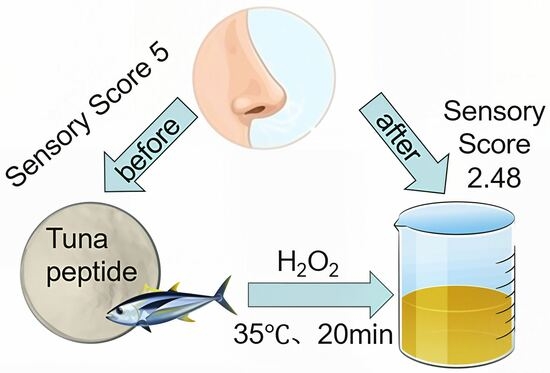
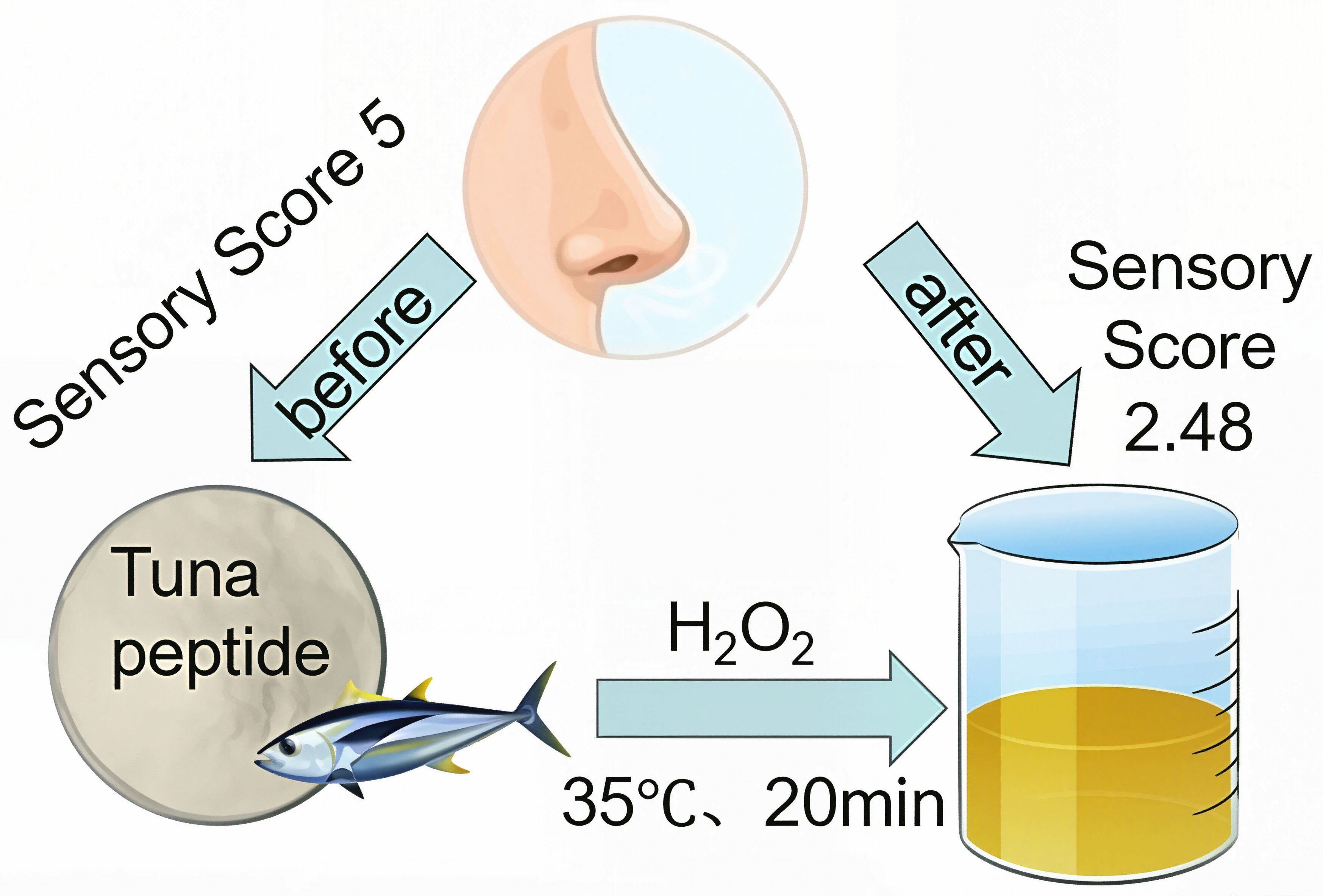
Hydrogen peroxide exhibited significant deodorization efficacy on tuna peptides, with concentration identified as the key influencing factor. Under optimized conditions (798 mmol/L H
2O
2, 35 °C, 20 min), the sensory score decreased from 5.0 to 2.48. The odor reduction achieved was comparable to that reported for yeast–activated carbon combined methods, yet with a substantially shorter processing time [
14].
GC–MS analysis confirmed the complete removal of key fishy aldehydes (octanal and heptanal) and a 44.8–54.7% reduction in other volatiles. Notably, the oxidation generated low-odor ketones (3-heptanone, 2-octanone), providing direct evidence for the chemical conversion of pungent aldehydes. Compared to physical adsorption, which removes volatiles via physisorption [
14], H
2O
2 oxidation enables both removal and chemical transformation of odorants. In contrast to yeast fermentation, which may generate new odorants [
21,
30,
31], H
2O
2-mediated hydroxyl radical oxidation provides more comprehensive elimination of odorous compounds.
The deodorization mechanism involves the generation of hydroxyl radicals (·OH) from H
2O
2 decomposition, which rapidly oxidize aldehydes, ketones, and sulfur-containing compounds into low-odor or odorless products. This radical-mediated pathway is similar to that proposed for ozone treatment of silver carp surimi [
24], but with the distinct advantage of milder oxidizing conditions that minimize collateral damage to peptide structures. Indeed, the deodorization process was accompanied by only mild peptide-bond cleavage, as evidenced by a 9.7% decrease in total nitrogen and a 41.9% increase in amino nitrogen—a level of modification substantially lower than that associated with ozone treatment, which often induces extensive protein denaturation and functionality loss [
24,
32].
Despite this limited structural modification, the treated peptides retained strong antioxidant activity, with ABTS and DPPH radical scavenging rates of 91.5% and 78.3%, This level of bioactivity preservation is notably higher than that reported for harsher chemical methods. For instance, ozone treatment of aquatic products has been associated with significant protein denaturation and loss of functional properties [
24,
32], while solvent extraction methods carry inherent risks of toxic residue retention and potential degradation of peptide integrity [
23,
33]. LC–MS analysis further revealed that several antioxidant-rich peptides, including the representative sequence DFDHSCQRETPSVVAMIYPFVG, remained stable or even increased in abundance post-treatment, indicating selective protection of functional peptide sequences under mild oxidative conditions. This selective stability suggests that these peptides may possess inherent structural resistance to oxidative degradation, contributing to the overall preservation of bioactivity.
Residual H2O2 was effectively eliminated via MnO2 quenching, with post-treatment levels below the detection limit. Although manganese was introduced during this step, its concentration in the final cosmetic formulation (at 1% peptide incorporation) remained within acceptable safety thresholds. The method is operationally simple, leaves no harmful residues, and is readily scalable. Successful incorporation of the deodorized peptides into a moisturizer confirmed its practical applicability and sensory acceptability.
In summary, mild H2O2 oxidation offers an efficient deodorization strategy for tuna peptides, combining effective odor removal with preservation of antioxidant activity. The mechanism involves hydroxyl radical-mediated oxidation of odorants coupled with selective protection of functional peptides, offering advantages over physical adsorption (mere transfer of odorants), biological fermentation (potential generation of new off-odorants), and harsh chemical treatments (extensive protein damage).
4. Materials and Methods
4.1. Materials
Tuna peptides (with a peptide mass fraction of 85%) were purchased from Liaoning Tai’ai Peptide Biotechnology Co., Ltd. (Shenyang, China). The purchased tuna peptides were prepared from yellowfin tuna as the raw material. Tuna peptides exhibited a weight distribution: >2 kDa (4.33%), 1–2 kDa (13.32%), 0.5–1 kDa (30.63%), and <0.5 kDa (51.72%). Hydrogen peroxide (mass fraction of about 3%) was obtained from Guangdong Hengjian Pharmaceutical Co., Ltd. (Foshan, China). The hydrogen peroxide test strips were purchased from MACHEREY-NAGEL (Düren, Germany). All other reagents used were of analytical grade.
Instruments used included a gas chromatograph–mass spectrometer (GC-MS; 7890A-5975C) (Agilent Technologies, Santa Clara, CA, USA), a liquid chromatography mass spectrometer (LC-MS; Easy nLC-Q-Exactive HF-X) (Thermo Fisher Scientific, Waltham, MA, USA), a inductively coupled plasma optical emission spectrometer (ICP-OES; 720ES) (Agilent Technologies, Santa Clara, CA, USA), a water bath constant temperature magnetic stirrer (DZKW-S-8) (Beijing Yongguangming Medical Instrument Co., Ltd., Beijing, China), a Kjeldahl nitrogen analyzer (K9860) (Jinan Hanon Instruments Co., Ltd., Jinan, China), a freeze-dryer (Labconco, Kansas City, MO, USA), a Midea refrigerator (BCD-112CM) (Midea Group, Foshan, China), a MAPADA ultraviolet-visible spectrophotometer (V-1100D) (Shanghai MAPADA Instruments Co., Ltd., Shanghai, China), a high-speed disperser (IKA Works, Staufen, Germany), and a Sartorius electronic balance (BSA224S-CW) (Sartorius AG, Göttingen, Germany).
4.2. Determination and Dilution of Hydrogen Peroxide
A sodium oxalate standard solution was prepared by dissolving 1.6841 g in distilled water. The solution was used to standardize potassium permanganate via triplicate titrations, which consumed 22.5, 22.5, and 22.4 mL, respectively, yielding a standardized concentration of 0.22 mol/L. Subsequently, the standardized potassium permanganate was employed to titrate medical-grade hydrogen peroxide. The titrations required 14.3, 14.3, and 14.2 mL in three repeated measurements, resulting in a determined hydrogen peroxide concentration of 798 mmol/L, corresponding to a mass fraction of 2.7% [
34]. Hydrogen peroxide solutions with volume fractions of 100% (798 mmol/L), 50% (399 mmol/L), 10% (79.8 mmol/L), 2% (15.96 mmol/L), and 0.5% (3.99 mmol/L) were prepared for single-factor experiments.
4.3. Deodorization of Tuna Peptides
Tuna peptide powder (1 g) was dissolved in 2 mL of deionized water in a beaker. The tuna peptide solution was treated with hydrogen peroxide [
35] at five designated concentrations (0.5%, 2%, 10%, 50%, or 100%) by thoroughly mixing 1 mL of the solution with 3 mL of H
2O
2. The reaction was conducted under controlled conditions in a constant-temperature water bath. A full-factorial experimental design was implemented to systematically evaluate all combinations of three key parameters: hydrogen peroxide concentration (five levels: 0.5%, 2%, 10%, 50%, and 100%), incubation temperature (five levels: 25, 30, 35, 40, and 45 °C), and treatment time (five levels: 5, 10, 20, 30, and 60 min). Upon completion of the oxidation reaction, a trace amount of manganese dioxide was introduced into each sample to catalytically decompose any residual hydrogen peroxide [
36].
4.4. Sensory Evaluation
Ten panelists (five from inland provinces and five from coastal provinces; age range: 18–60 years; five men and five women) performed a descriptive sensory analysis of the samples at room temperature. All panelists were healthy adult volunteers who were fully informed about the nature of the samples (food-grade tuna peptides) and the experimental procedure, and provided informed consent prior to participation. The panelists underwent one week of training prior to the evaluation, as per the procedure outlined in Chen et al. [
36]. Training protocols included familiarization with the “fishy odor” attribute using a defined set of chemical references (e.g., heptanal and nonanal solutions at specified concentrations) as well as repeated exposure to tuna peptide samples spanning the full intensity range. Samples (approximately 10 mL) were dispensed into identical opaque containers and presented in a randomized order. Panelists were instructed to cleanse their palates with water and unsalted crackers between sample evaluations. The filtrate was sensory evaluated using a 5-point scale (1, no fishy odor; 2, slight fishy odor; 3, moderate fishy odor; 4, heavy fishy odor; 5, very heavy fishy odor). The sensory evaluation criteria are shown in
Table 6. Water without adding tuna peptides was used as a standard for no fishy odor and untreated tuna peptides for heavy fishy odor. All samples, including controls, were evaluated in triplicate by each panelist across three independent sessions. Statistical analysis was performed using one-way analysis of variance (ANOVA) with SPSS software (version 26.0, IBM Corp., Armonk, NY, USA), with
p < 0.05 considered statistically significant [
37].
A composite score S was obtained according to the following equation (Equation (1)):
where S is the composite score from the sensory evaluation; Bi is the score given by the panelists; and n is the total number of sensory evaluation panelists.
4.5. Single-Factor Experimental Design
4.5.1. Hydrogen Peroxide Concentration
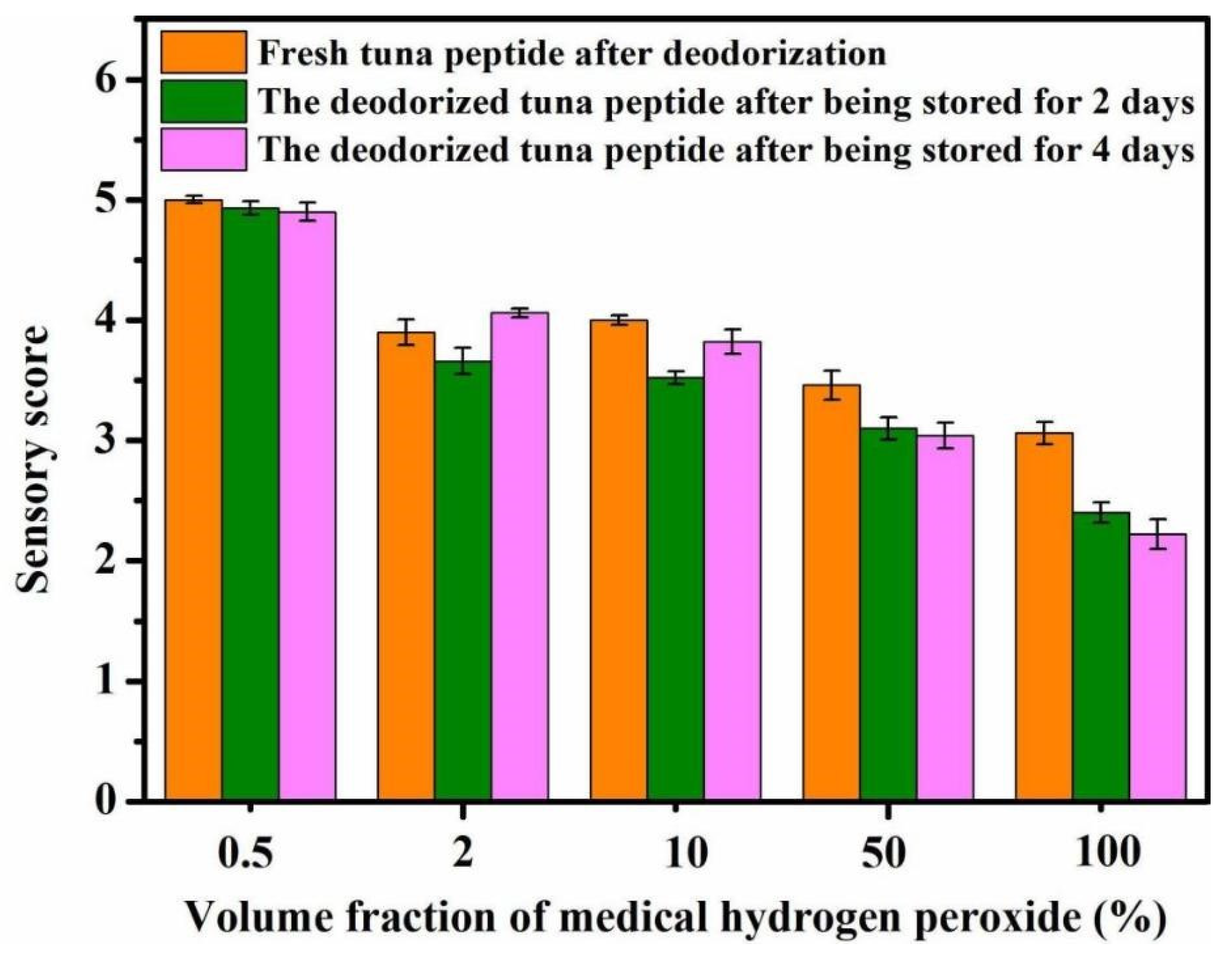
At a reaction time of 20 min at 25 °C, the deodorizing effects of hydrogen peroxide concentrations of 0.5%, 2%, 10%, 50%, and 100% on tuna peptides were investigated. For the experiments of studying the deodorizing effects of hydrogen peroxide concentrations, the concentration of hydrogen peroxide value ratio/peptide was 3.99, 15.96, 79.8, 399, and 798 mmol/(g·L), respectively.
4.5.2. Reaction Time
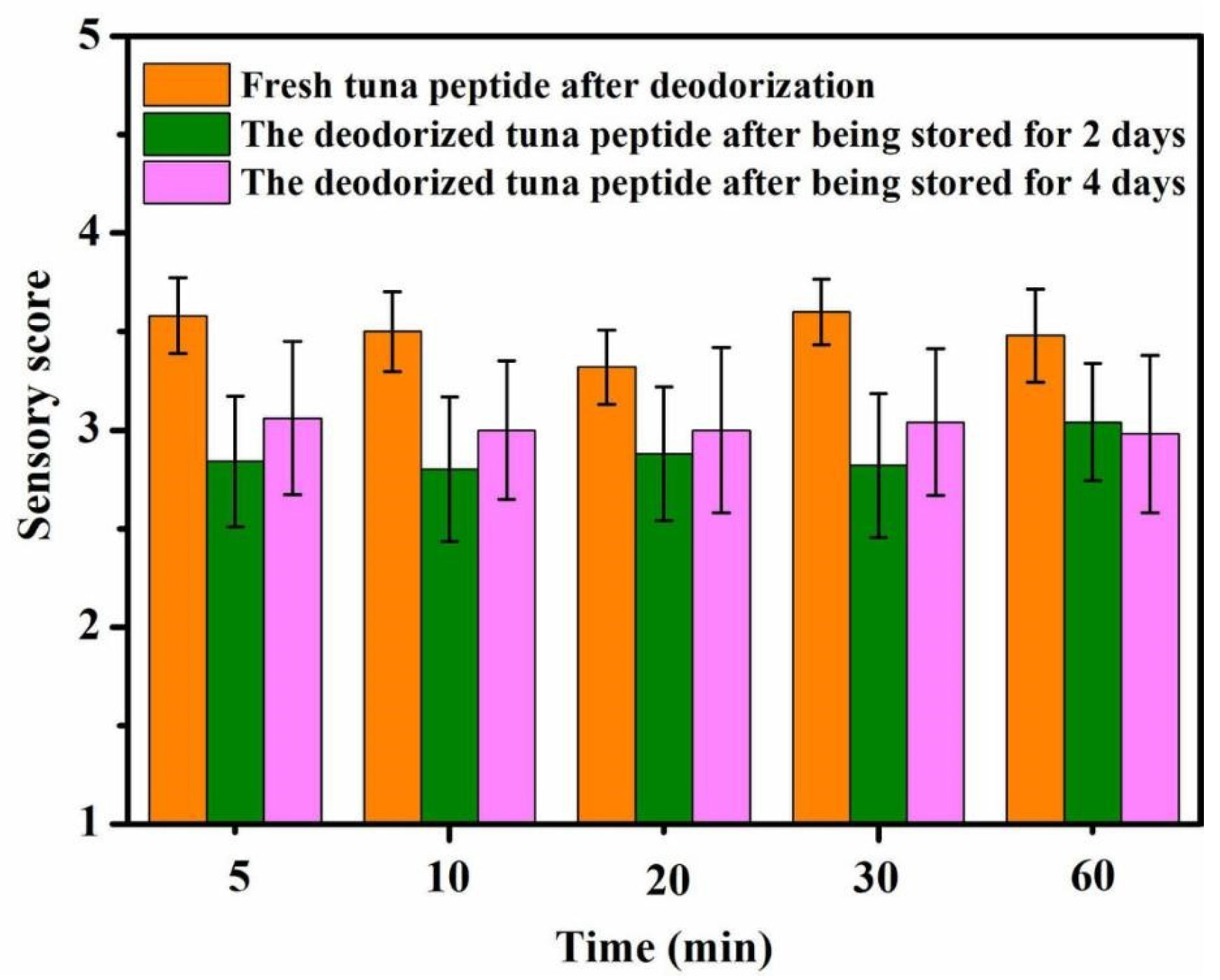
At a hydrogen peroxide concentration of 10% at 25 °C, the deodorizing effects of reaction times of 5, 10, 20, 30, and 60 min on tuna peptides were investigated.
4.5.3. Reaction Temperature
At a hydrogen peroxide concentration of 10% and a reaction time of 20 min, the deodorizing effects of reaction temperatures of 25, 30, 35, 40, and 45 °C on tuna peptides were investigated.
4.6. Orthogonal Experimental Design for Deodorization
To systematically optimize the deodorization process, a three-factor, five-level orthogonal experimental design was implemented. The design investigated the effects of hydrogen peroxide concentration (Factor A), reaction time (Factor B), and reaction temperature (Factor C) on the deodorization efficiency of tuna peptides. The specific level settings are presented in
Table 7. The experimental data were statistically analyzed using Analysis of Variance (ANOVA) and Tukey’s multiple comparison test (
p < 0.05) via SPSS software. This analysis aimed to determine the significance of each factor, their order of influence, and ultimately identify the optimal deodorization conditions.
4.7. SPME-GC/MS Determination
HP-5MS (30 m × 0.25 mm × 0.25 μm) was used as the separation column. The injection temperature was 250 °C, the carrier gas was He, and the flow rate was 1.0 L/min. The sample was splitless-injected. The initial column temperature was kept at 40 °C for 2 min, then raised to 160 °C at 4 °C/min, again raised to 250 °C at 8 °C/min, and maintained at that temperature for 10 min. The mass spectrometry (MS) conditions were: solvent cut time 1 min, electron impact (EI) ion source, ion source temperature 230 °C, ionization voltage 70 eV, scan mass range 30–500 m/z, interface temperature 280 °C, and quadrupole temperature 150 °C.
The untreated and treated samples of tuna peptides were analyzed by GC-MS. To investigate the content of volatile substances, the peak areas of the main volatile substances in the samples were determined by observing the characteristic peaks of the ions. All samples were analyzed in randomized order. Procedural blanks (using the same solvents and undergoing identical extraction and derivatization steps without any tuna peptide) were included in each analytical batch to monitor for background contamination.
4.8. Determination of Total Nitrogen and Amino Acid Nitrogen
4.8.1. Total Nitrogen
First, 0.4 g of the untreated and treated samples of tuna peptides were each transferred to a digestion tube (designated as tubes 1 and 2), followed by the addition of 0.3 g of copper sulfate pentahydrate and 3 g of potassium sulfate as catalysts, respectively. Next, 10 mL of concentrated sulfuric acid was drawn from each of the two digestion tubes. A small funnel was placed on the top of each tube. The digestion tubes were then heated using a graphite block digester according to the following program: 170 °C for 30 min, 270 °C for 30 min, 400 °C for 90 min, and cooling to room temperature.
Prepared sodium hydroxide solution, boric acid solution, and deionized water were added to the Kjeldahl nitrogen analyzer and preheated. After preheating, Erlenmeyer flask 1 was collected and connected to an absorption tube. The contents were diluted with 10 mL of water. Then, 25 mL of boric acid solution and 65 mL of 40% sodium hydroxide solution were added. The mixture was distilled for 5 min and rinsed with 10 mL of water. After distillation, the liquid in Erlenmeyer flask 1 was titrated with 0.1 mol/L hydrochloric acid standard solution. Similarly, the treated samples were distilled and titrated following the same procedure. The volume of hydrochloric acid standard solution consumed (VHCl) was recorded for each sample and used to calculate the total nitrogen content [
38].
4.8.2. Amino Acid Nitrogen
First, 1.0 g of the untreated and treated tuna peptides were each dissolved in 65 mL of deionized water, and the pH was adjusted to 8.2. Then, pH = 8.2 neutral formaldehyde solution was added, the solution stirred and titrated against 0.1 mol/L sodium hydroxide solution. The endpoint of the titration was reached when the pH became 9.2 and remained unchanged for 30 s after the addition of the last drop of sodium hydroxide (NaOH) solution. At this point, the amount of NaOH solution used was read off the burette scale was recorded. The volume of NaOH standard solution consumed (V
NaOH) was the amount needed to raise the pH of the enzymatic hydrolysate to 9.2 after adding the neutral formaldehyde solution. A blank control was prepared in the same way, and the volume of NaOH was recorded [
39].
4.9. Fishy Odor Test of Tuna Peptide Cosmetics
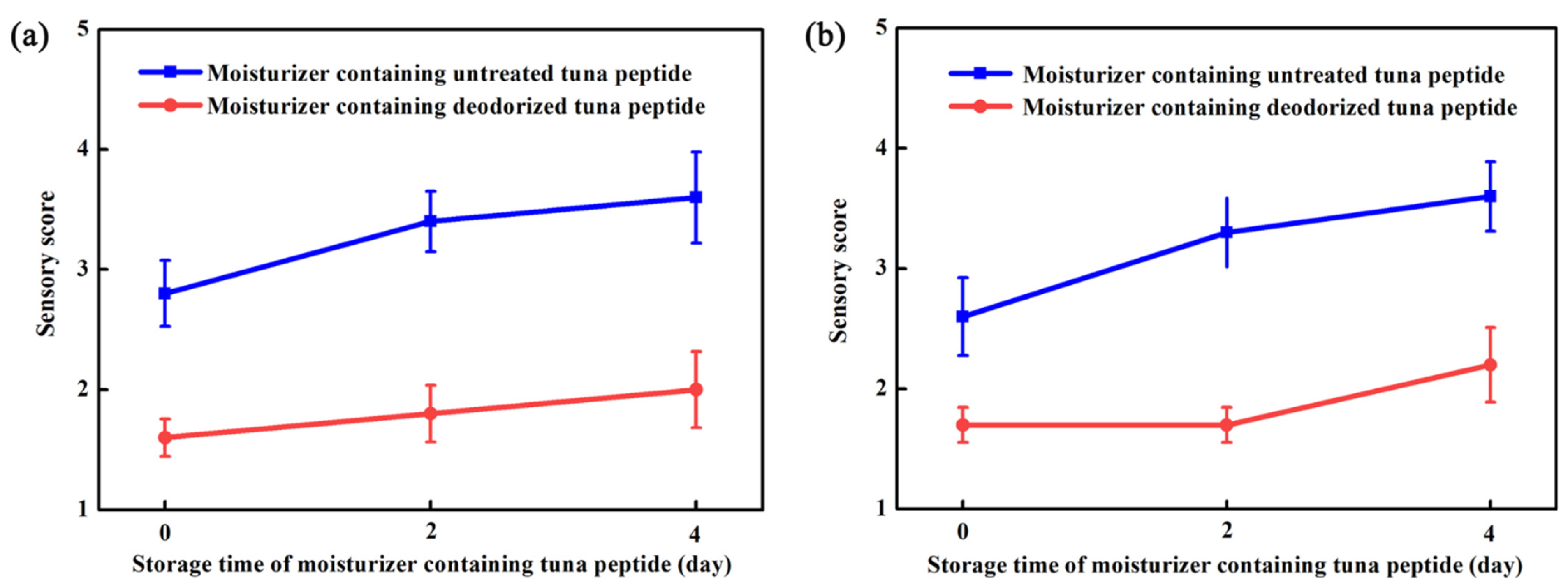
The untreated and well-deodorized samples of tuna peptides were each added to a moisturizer (the tuna peptides make up 1% of the total raw materials of the moisturizer, the detailed formulation of the moisturizer base is provided in
Table S1) to test the deodorizing effect of hydrogen peroxide on the actual product. Sensory evaluation of the fishy odor was done of the moisturizer, both in paste form and after spreading.
4.10. Determination of Antioxidant Activity
4.10.1. Sample Preparation
Freeze-dried samples of the original and hydrogen peroxide-treated tuna peptides were precisely weighed (0.035 g each) and dissolved in 10 mL of deionized water to obtain stock solutions at a concentration of 3.5 mg/mL.
4.10.2. ABTS Radical Scavenging Assay
The ABTS radical cation stock solution was generated by mixing equal volumes of 7.0 mmol/L ABTS aqueous solution and 2.45 mmol/L potassium persulfate solution, followed by incubation in the dark at room temperature for 12–16 h. Prior to analysis, this stock solution was diluted with deionized water to achieve an absorbance of 0.70 ± 0.02 at 734 nm. For the assay, 1 mL of the sample stock solution (or deionized water for the blank control) was combined with 3 mL of the diluted ABTS working solution. The mixture was vortexed thoroughly, allowed to react in the dark for 10 min, and the absorbance was measured immediately at 734 nm [
40].
4.10.3. DPPH Radical Scavenging Assay
A 0.1 mmol/L working solution of DPPH was prepared fresh in absolute ethanol. For the assay, 2 mL of the sample stock solution (or deionized water for the blank) was mixed with 2 mL of the DPPH solution. The reaction mixture was vortexed and incubated in the dark at room temperature for 30 min. Subsequently, the absorbance was measured at 517 nm [
40].
The radical scavenging activity for both assays was calculated as a percentage using the following formula:
where A
0 represents the absorbance of the blank control, and A represents the absorbance of the sample reaction mixture. All measurements were performed in triplicate.
4.11. Quantification of Residual Hydrogen Peroxide
Residual hydrogen peroxide was assessed using a two-tiered analytical approach. Initial screening was conducted with commercial Quantofix Peroxide 25 test strips. a test strip was immersed in the sample solution for 1 s, withdrawn, and the developed color was compared against the provided color scale after 15 s. This method served for rapid on-site semi-quantitative evaluation [
41].
For precise quantification, a spectrophotometric method based on the titanium oxysulfate reaction was employed. A 10% (
v/
v) titanium oxysulfate working solution was prepared. A calibration curve was constructed using hydrogen peroxide standards (0–8 μg/mL) prepared in a 0.5% untreated peptide matrix (
Figure S8). For analysis, 2.00 mL of sample or standard was mixed with 1.00 mL of the colorimetric reagent. After incubation at room temperature for 15 min, the absorbance was measured at 410 nm, using a sample blank (peptide solution mixed with water) as the reference [
42].
4.12. Quantification of Residual Manganese
The manganese content in the deodorized tuna peptide solution was determined using inductively coupled plasma optical emission spectrometry (ICP-OES). The instrument was operated under the following optimized conditions: radiofrequency power, 1.20 kW; plasma gas flow, 15.0 L/min; auxiliary gas flow, 1.50 L/min; nebulizer gas flow, 0.75 L/min; and sample uptake delay, 15 s. Quantification was performed at the characteristic manganese emission line of 257.610 nm. External calibration was conducted using a series of manganese standard solutions (0, 0.05, 0.1, 0.5, and 1.0 mg/L) prepared in 2% (
v/
v) nitric acid [
43].
4.13. LC/MS Determination
4.13.1. Sample Preparation
Peptide extraction was performed by homogenizing 1 mg of dried peptide or 100 µL of peptide solution with 100 µL of 0.1% trifluoroacetic acid (TFA), followed by centrifugation at 14,000×
g for 10 min. The supernatant was subjected to ultrafiltration using a 10 kDa cutoff device (PALL) at 13,500×
g for 10 min. Peptide concentration in the filtrate was determined spectrophotometrically, after which samples were desalted with a C18 solid-phase extraction cartridge using acetonitrile conditioning, TFA equilibration, and elution with 70% acetonitrile [
44].
4.13.2. Chromatographic Separation
Desalted peptides were separated on a nano-flow HPLC system (Easy nLC, Thermo Scientific) equipped with a trapping column (100 µm × 2 cm, 5 µm C18) and an analytical column (75 µm × 10 cm, 3 µm C18). Separation was achieved at 250 nL/min using a gradient of 0.1% formic acid in water (solvent A) and 0.1% formic acid in 84% acetonitrile (solvent B): 0–35% B over 50 min, 35–100% B from 50 to 58 min, and 100% B from 58 to 60 min.
4.13.3. Mass Spectrometric Identification
MS analysis was conducted on a Q-Exactive HF-X mass spectrometer (Thermo Fisher Scientific) in positive ion mode over a 60 min gradient. Full MS scans (300–1800 m/z) were acquired at a resolution of 70,000 (at m/z 200) with an AGC target of 3 × 10⁶ and maximum IT of 10 ms. For MS/MS, the top 10 most intense precursors were fragmented via HCD (isolation window 2 m/z, NCE 30 eV), with MS/MS spectra collected at a resolution of 17,500 (at m/z 200), an underfill ratio of 0.1%, and an AGC target of 1 × 10⁵. Dynamic exclusion was set to 40 s.




 ,
,