Peptides from General By-Products: Unveiling Their Potential Biological Activities in Human Health
 ,
,  ,
,  ,
,  ,
,  ,
,  , , and
Abstract
1. Introduction
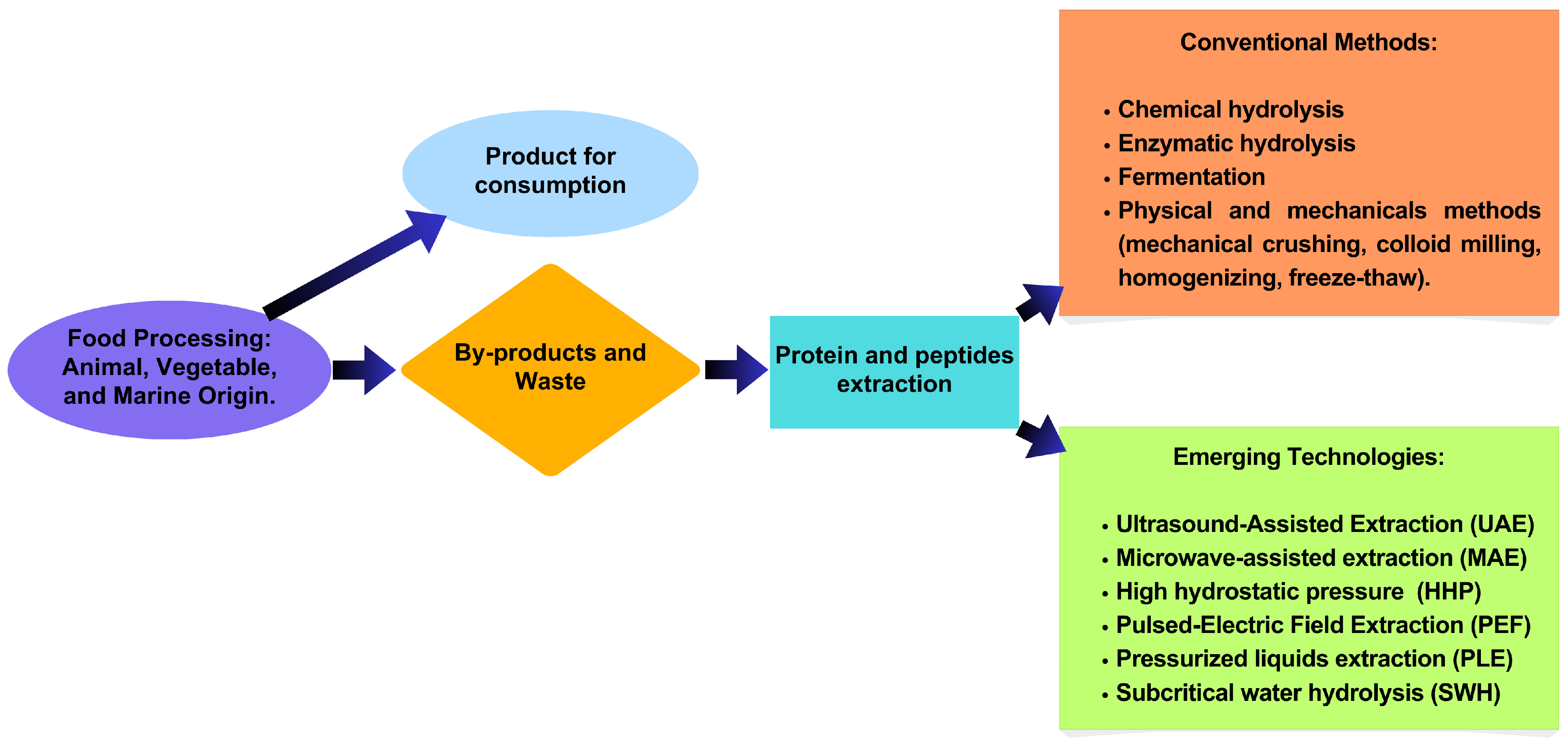
2. Conventional Methods for Obtaining Peptides
2.1. Chemical Hydrolysis
2.2. Enzymatic Hydrolysis
2.3. Fermentation
2.4. Physical and Mechanical Methods

| Type | Microorganism | Fermentation | Food Matrix | Reference |
|---|---|---|---|---|
| Bacteria | Bacillus, Bifidobacterium, Lactobacillus, Pediococcus, Streptococcus, Weissella | Submerged Fermentation | Apple, carp head clam, crab shell, fish, meat, milk, sardinella muscle, sea bass, shrimp paste | [23,24,36,38,39,40] |
| Bifidobacterium, Cordyceps, Lactobacillus, Lactococcus, Pediococcus | Solid State Fermentation | Cassava, cottonseed meal, dehusked barley, jatropha seed, lentil, maize, rice, oat, red sorghum, shrimp, soybean, wheat bran. | [25,34,41,42,43] | |
| Fungi | Aspergillus, Candida, Cordyceps, Galactomyces, Rhizopus | Submerged Fermentation | Barley, bean, chokeberry, grapefruit, milk, plum, turbot skin | [23,24,44,45,46] |
| Aspergillus, Lentinus, Mucor, Rhizopus, Thamnidium, Trichoderma | Solid State Fermentation | Brewers spent grain, brown rice, chickpea, colored quinoa, lupin, maize, moringa, oat, olive, orange peel, peanut, pineapple peels, quinoa, soybean, wheat, | [25,34,47,48] | |
| Yeast | Kluyveromyces, Monascus, Pichia, Saccharomyces, Torulaspora | Submerged Fermentation | Apple, milk, porcine liver | [44,49] |
| Pichia kudriavzevii, Saccharomyces, Yarrowia lipolytica | Solid State Fermentation | Guar and copra meal, nut oil cake, quinoa, soja, rye bread, wheat. | [34,50,51,52,53] |
3. Emerging Technologies for Peptide Production
3.1. Ultrasound-Assisted Extraction (UAE)
3.2. Microwave-Assisted Extraction (MAE)
3.3. High Hydrostatic Pressure (HHP)
3.4. Pulsed-Electric Field Extraction (PEF)
3.5. Pressurized Liquid Extraction (PLE)
3.6. Subcritical Water Hydrolysis (SWH)
| By-Product | Treatment Type | Extraction Conditions | Protein, Hydrolysate, or Peptide Fraction | Outcomes | Reference |
|---|---|---|---|---|---|
| Ultrasound-assisted extraction (UAE) | |||||
| Carp scales | Distilled water | Temperature: 60 °C Extraction time: 1, 3, and 5 h | Gelatin with high protein content (84.15 ~ 91.85%) | Protein extraction yield: 46.67% | [67] |
| Slurry from fabrication of milk soy | Distilled water | 20 kHz, 400 W for 0, 0.5, 1, 5, and 15 min. | Size of the products was not defeminated | Protein extraction yield: 60% | [68] |
| Jackfruit leaves | 0.5 M NaCl | 10, 15, or 20 min at 25 °C and 42 kHz. | 70 Da to 14 kDa | Protein extraction yield: 96.3 mg/g | [69] |
| Bovine bones | Pepsin, 76.25 × 10⁴ U/g (double hydrolysis) | power of 413.90 W/L, pH 9, for 2.01 h. | Size of the products was not defeminated | Yield of the peptide: 21.04%. | [70] |
| Microwave-assisted extraction (MAE) | |||||
| Trout by-products | Hydrolyzed with alcalase 0.5, 1.7, and 3.0% (w/v), respectively, for 3, 5, and 15 min | For the microwave heating treatments (1200 W, 20% power with 50% duty cycle at 50–55 °C) | Hydrophobic amino acids and histidine | As E:S and hydrolysis time increased, the hydrolysis degree increased, ranging from 11% to 23%. | [56] |
| Jackfruit leaves | 0.5 M NaCl | Microwave power at 1200 W, applying pulses of 30 s for 4 min | 70 to 14 kDa | Protein extraction yield: 87.6 ± 0.8 mg/g | [69] |
| Sesame bran | Deionized water, 1.94 AU/100 g of alcalase | Microwave power at 750 W, 49 °C, for 8 min | 22–30 kDa | Extraction yield: 43.8 to 61.6% | [71] |
| Coffee green beans | Alkaline-acid extraction | Microwave power at 900 W, 50% capacity for 240 s. | Asp, Phe, Glu, Lys | The combination with alkali extraction increases the protein extraction by 77%. | [57] |
| High hydrostatic pressure (HHP) | |||||
| Jackfruit leaves | 0.5 M NaCl | 100, 200, or 300 MPa, for periods of 10, 15, and 20 min | 70 Da to 14 kDa | Protein extraction yield: 147.3 mg/g | [69] |
| Bighead carp bones | 1 M NaOH, hydrolyzed with alcalase (3 mL/100 mL) | 250 MPa for 35 min. | Protein content: 5.7 mg/mL All essential amino acids | Soluble protein content increased with increasing pressure and holding time. The process accelerated hydrolysis and facilitated the release of free amino acids. | [72] |
| Pulsed-Electric Field Extraction (PEF) | |||||
| Fishbone | Pepsin 1% | Electric field strength 22.79 kV/cm and pulse number 9 | Collagen | 3.875 mg/mL | [73] |
| Waste breast Muscle from chicken | Combined with mechanical pressing | 37.6 ± 4.69 J/g | Size of the products was not defeminated | Extraction of 12% of the initial biomass with the protein content of 78 mg/mL from the liquid fraction. | [65] |
| Subcritical water hydrolysis (SWH) | |||||
| Tuna skin | Different temperature (150–300 °C) at pressure (50–100 bar) and reaction time 5 min | Peptides of molecular size less than 600 Da and some free amino acids | The degree of hydrolysis was highest at 250 °C | [74] | |
| Porcine placenta | Assisted by hydrolysis with trypsin | Processing at 37.5 MPa and 200 °C | Peptides of 626 Da | SCW pre-treatment followed by trypsin produced peptides of 626 Da SCW alone produced peptides of 10 kDa | [75] |
4. Sources of Peptide Extraction
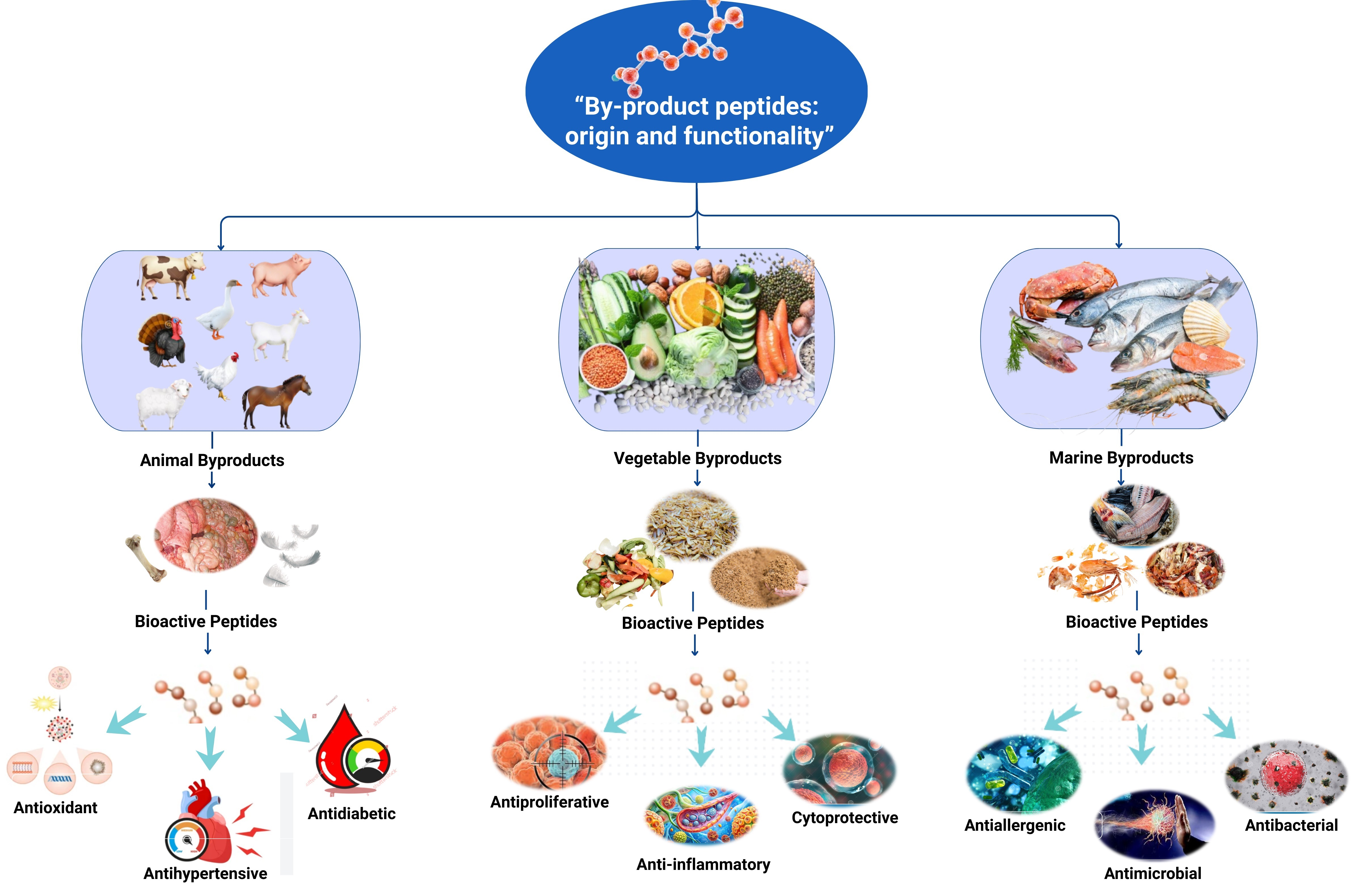
4.1. Peptides from Animal By-Products
| By-Product | Process | Peptide/Sequence | Bioactivity | Reference |
|---|---|---|---|---|
| Egg yolk protein | Hydrolysis with proteinase from Cucurbita ficifolia | LAPSLPGKPKPD, RASDPLLSV, RNDDLNYIQ, AGTTCLFTPLALPYDYSH. | Antioxidant activity, inhibition of α-glucosidase and DPP-IV. | [82] |
| Egg yolk protein | Hydrolysis with pepsin | YINQMPQKSRE, YINQMPQKSREA, VTGRFAGHPAAQ, YIEAVNKVSPRAGQF. | Antioxidant activity and inhibits DPP-IV, ACE, and α-glucosidase. | [83] |
| Chicken intestine | Autolytic digestion | ARIYH, LRKGNLE, RVWCP. | ACE inhibitory activity | [84] |
| Ground turkey head | Hydrolysis with enzyme cocktail (alcalase, flavoenzyme, trypsin) | Collagen peptide of low molecular weight (555.26–2093.74 Da). | Anti-inflammatory and anticholesterolemic. | [85] |
| Sheep abomasum | Hydrolysis with neutrase, alcalase, and papain | LEDGLK, IDDVLK. | Antioxidant activity | [86] |
| Bovine hair | Hydrolysis with alcalase | CERPTCCEHS | Antioxidant activity, inhibits hemolysis and lipid peroxidation, protects against DNA damage | [87] |
| Duck liver | Fermentation with Bacillus subtilis | MYGAVTPVK, NWEKIR, APGIIP, RWWQLR. | High antioxidant activity reduces intracellular oxidative damage | [88] |
| Mechanical chicken deboning residue | Hydrolysis with the proteases flavourzyme and corolase | Dipeptides with leucine or isoleucine at the N-terminal | Inhibits DPP-IV and increases glucose uptake. | [89] |
| Dry-cured ham by-products | Hydrolysis with acid and heat | Not specified (212 identified) | ACE, endothelin-converting enzyme (ECE), platelet-activating factor-acetylhydrolase (PAF-AH), and DPP-IV inhibitory activity | [90] |
| Milk permeates | Solid-phase | Sequences derive from α and β caseins, lactoperoxidase, lipoprotein lipase, glycosylation-dependent cell adhesion molecule 1, and polymeric immunoglobulin receptor. | Increase antioxidant enzymes and inhibit oxidative stress by activating the Keap1/Nrf2 axis. | [91] |
| Combs and wattles of chicken | Hydrolysis with alcalase | APGLPGPR, Piro-GPPGPT, FPGPPGP. | Inhibitory activity of ACE | [92] |
| Bovine hemoglobin | Pig pepsin | TKAVEHLDDLPGALSELSDLHAHKLRVDPVNFKLLSHSLL; LDDLPGALSELSDLHAHKLRVDPVNFKLLSHSL, KLLSHSL, LLSHSL. | Antimicrobial and antihypertensive | [93] |
| Bovine hemoglobin | Pepsin | Neokyotophin (NKT) peptide | Antimicrobial activity | [94] |
4.2. Peptides from Vegetable By-Products
| By-Product | Process | Fraction/Peptide/Sequence | Bioactivity/Assays | Reference |
|---|---|---|---|---|
| Grain, seed, and oilseed | ||||
| Pumpkin (Cucurbita maxima) oil cake | Hydrolysis 1. Pepsin 2. papain | Fraction Hydrolysates and <1 kDa | ACE inhibition and DPP-IV inhibition activity/in vitro | [101] |
| Pumpkin oil cake | In silico | IAF (Ile-Ala-Phe) | Antihypertensive/in silico | [109] |
| Olive seed | Hydrolysis with alcalase (AH) and with papain (PH) | Hydrolysates (AH y PH) | Antioxidant (Caco-2 Cells)/in vitro Inhibits DPP-IV (Caco-2 Cells)/in vitro | [110] [111] |
| Olive seeds | Hydrolysis with alcalase | ADLY, FLPH, KLPLL, and TLVY | Anticholesteremic (HEPG-2)/In vivo | [103] |
| Olive seeds Genotypes (Manzanilla, Gordal, Verdiel, Cornicabra, and Lechin) | Hydrolysis with alcalase | Hydrolysate (Identified Peptides: KLPLL, WSPLNN, TLPLL, ALMSPH, FVVLK, SSPLL, KLGNF, SHTLVY, VVVVPH, VVLK, ALMAPH, HTLY, VFDGE, FLPH, TLVY, WSMH, QGDLL, WNVN) | Antioxidant Antiproliferative (Cel. HeLa, PC-3, and HT-29)/In vitro | [106] |
| Black sesame cake | Flavourzyme | Fractions <3, 3–10, and >10 kDa | Inhibitor of DPP-IV, ACE, α-amylase, α-glucosidase, and pancreatic lipase/In vitro | [100] |
| Rice bran | Hydrolysis with Trypsin | Hydrolysates (Identified Peptide: AFDEGPWPK (1045.48 Da)) | Antioxidant (ORAC and DPPH)/In vitro | [97] |
| Rice bran | Hydrolysis with alcalase, pepsin, and trypsin. | Fraction <3 KDa (alcalase) (Identified Peptides: STCCK KICILVFTLTTC and FMKSK) | ACE inhibition and antioxidant activity/In vitro | [98] |
| Wheat bran | Hydrolysis with alcalase | Fraction <1 kDa | Antioxidant, renin inhibition, and angiotensin-converting enzyme (ACE) inhibition/in vitro and systolic blood pressure decrease in vivo | [99] |
| Palm kernel cake | Hydrolysis with papain | YGIKVGYAIP, GGIF (substrate-type), and GIFE (true-inhibitor type) | angiotensin-converting enzyme (ACE) inhibition | [102] |
| Fruits’ by-products | ||||
| Watermelon seeds | Hydrolysis with alcalase | Fraction <1 kDa (Identified Peptides: RDPEER, KELEEK, DAAGRLQE, LDDDGRL, and GFAGDDAPRA | Antioxidant Cytoprotective effects/in vitro (HepG2 cells) | [104] |
| Tomato seeds | Hydrolysis with alcalase | Hydrolysates | Antioxidant, calcium binding, and angiotensin-converting enzyme (ACE) inhibition | [105] |
| Peach seeds | Hydrolysis with alcalase Genotype Campiel | Hydrolysates Identified Peptides (LVAVSLL, LVDGF, VELT, YQLS) | Antioxidant Antiproliferative (HeLa, PC-3, and HT-29 Cells) | [106] |
| Plant waste or underutilized parts | ||||
| Cauliflower, broccoli, cabbage, beetroot leaves | Hydrolysis with pepsin and pancreatin (GSD) | Hydrolysates | Antioxidant | [107] |
| Moringa (leaves) | Hydrolysis with pepsin and pancreatin (GSD) | Hydrolysates | Antioxidant Anti-inflammatory | [108] |
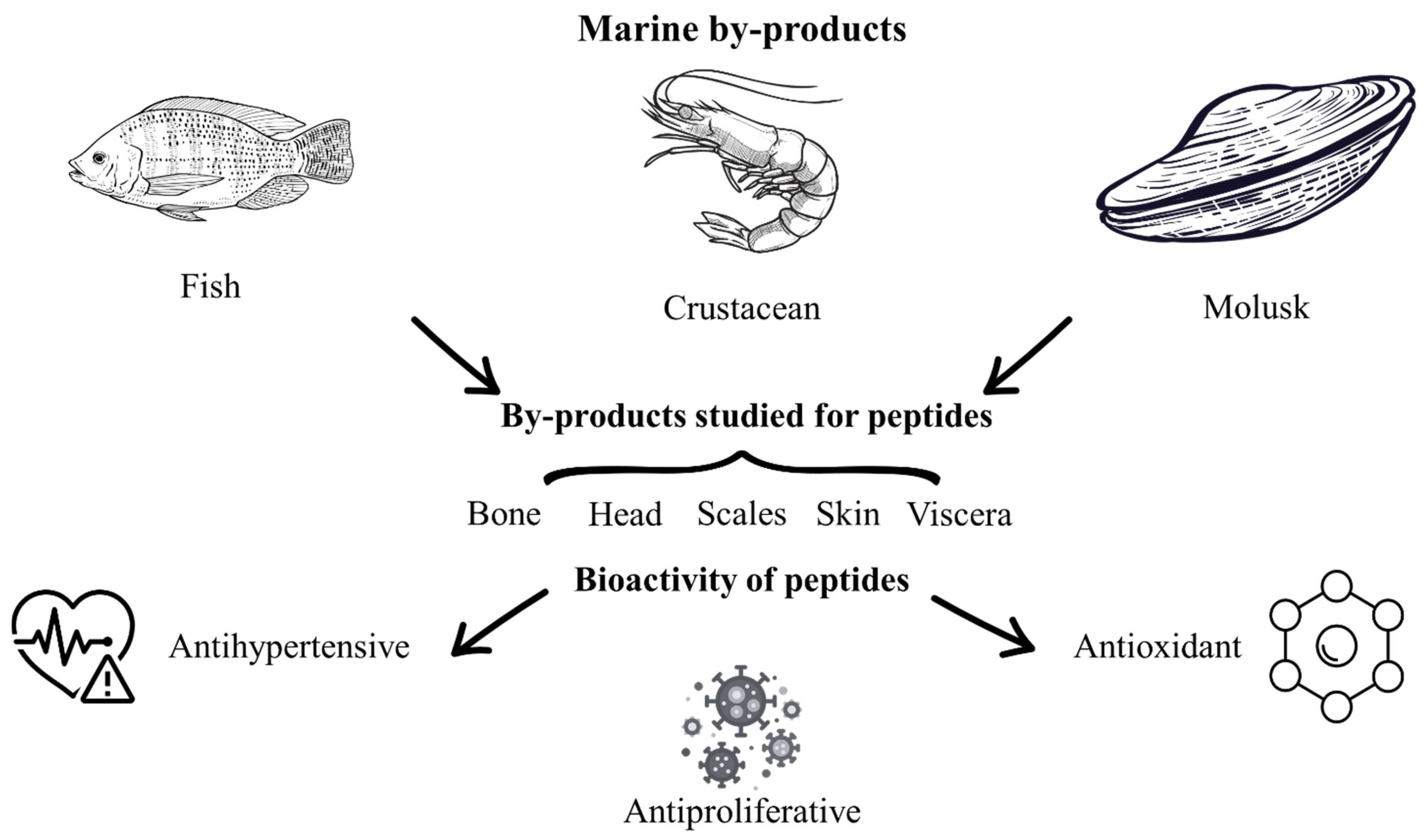
4.3. Peptides from Marine By-Products
5. Purification and Identification of Peptide By-Products
5.1. Ultrafiltration
5.2. Mass Spectrometry (MS)
5.3. In Silico
| By-Product/ Extraction | Purification/Fractionation | Identification In Vitro | In Silico Tool/Database/ Software | Peptide/Sequence | Activity | Reference |
|---|---|---|---|---|---|---|
| Duck liver fermented using Bacillus subtilis | Sephadex G-15 gel filtration chromatography. RP-HPLC: columna C18 (150 mm × 2.1 mm, 130 Å, 2.7 µ) at 40 °C. Elution solution A: 100% acetonitrile, B: 0.1% trifluoroacetic acid. UV wavelength 220 nm | LC-MS/MS. | BIOPEP | MYGAVTPVK, NWEKIR, APGIIPR, RWWQLR | In silico Antithrombotic, antioxidant, ACE, DPP-IV, and renin inhibitory activity. In vitro Protect HepG2 cells from oxidative stress, reduce inflammatory cytokines TNF-α and IL-1β, increase antioxidant enzymes activity (SOD, CAT, and GSH-Px), and inhibit lipid oxidation (MDA) | [88] |
| Duck plasma/hydrolysis alcalase | Ultrafiltration (10 and 3 kDa molecular weight cutoffs), size-exclusion chromatography (Sephadex G-25 column), and HPLC system with phase reverse column (300SB-C18 4.6 mm × 250 mm). | Nano-LC-MS/MS, Hypersil Gold C18 column (2.1 mm × 150 mm, 1.7 μm) | Not evaluated | LDGP, TGVGTK, EVGK, RCLQ, LHDVK, KLGA, AGGVPAG | In vitro Antioxidant capacity: Reduce ABTS and DPPH activity | [142] |
| Smooth-hound (M. mustelus) fish viscera/hydrolysis with Esperase (protease from Bacillus sp.) | Ultrafiltration membrane (Amicon MWCO of 50 kDa and 5 kDa), RP-HPLC, C18 column (250 mm × 4.6 mm) | NanoESI-LC-MS/MS, nano HPLC capillary column C18 (3 μm, 75 μm × 12.3 cm) | BIOPEP | IAGPPGSAGPAG, VVPFEGAV, PLPKRE, PTVPKRPSPT | In silico ACE inhibitory activity, antioxidant, and anti-thrombotic In vitro Strong ACE inhibitory activity In vivo Blood-lowering in hypertensive rats | [143] |
| Milk permeate | Fractionation by solid-phase extraction with a STRATA C18 E cartridge. RP-HPLC, SNAP KP-C18-HS 12 g column (particle size 50 μm, surface area 400 m2/g, pore volume 0.95 mL/g, 90 Å pore diameter. | LC-MS/MS, column XB-C18 Aeris Peptide 3.6 μm | Mascot Search engine, UnitProt database | Sequences derive from α and β caseins, lactoperoxidase, lipoprotein lipase, glycosylation-dependent cell adhesion molecule 1, and polymeric immunoglobulin Receptor. | In vitro Protect against oxidative stress by Keap1/Nrf2 activation and antioxidant enzymes In vivo Protect a zebrafish model from cold stress. | [91] |
| Bovine blood/hydrolysis with alcalase, netrase, and papain. | Ultrafiltration membrane (Amicon MWCO 3–10 kDa, size exclusión chromatography (Superdex peptide 10/300 GL column UV at wavelength 215 nm | LC-MS/MS, C18 column (15 cm × 75 µm with a particle size of 3 µm) | DFBP program | IAWGK, VDLL, MTTPNK, VEDVK, MPLVR, TVIL, KIII, LPQL, DFPGLQ | In silico Antioxidant activity, ACE, and DPP-IV inhibitory In vitro Antioxidant activity: ABTS, DPPH, and metal chelating activity | [144] |
| Bovine hemoglobin/ hydrolysis with pepsin | Ultrafiltration membrane (regenerated cellulose, MWCO 1–3 kg.mol−1). Size exclusion chromatography, column Superdex peptide HR10/3000 (10 mm × 300 mm) | RP-HPLC/MS, column C18 Prophere (250 mm × 21 mm, 5 µ diameter beads) | Not evaluated | Neokyotorphin (NKY) peptide | In vitro High antimicrobial activity against Micrococcus gluteus, Listeria innocua, Escherichia coli, and Salmonella enteritis. | [94] |
| Pectoral fin from Salmon/hydrolysis with pepsin | To fractionate, Sephadex G-25 gel permeation chromatography column (2.7 cm × 98 cm). UV at wavelength 280 nm. The RP-HPLC column Hypersil Gold C18 (20 mm × 250 mm, 5 µm. | Hybrid Quadrupole-TOF LC-MS/MS coupled with ESI source | Not evaluated | Pro-Ala-Tyr (PAY) | In vitro Anti-inflammatory activity, by inhibition of NO/iNOS and PGE2/COX-2 pathway, besides inhibiting TNF-α, IL-6 and IL-1β | [136] |
| Yellow tuna (Thunnus albacores) viscera/hydrolysis with Protamex | Sequential ultrafiltration membranes (cellulose) by Amicon (molecular weight cutoff of 3, 10, and 30 kDa) | HPLC, column Ultrasphere ODS 5 μm particle size, 4.6 mm × 25 cm. | Not evaluated | Peptides <3 kDa with cationic and hydrophobic amino acids | In vitro High antibacterial activity against Listeria, Staphylococcus, E. coli, and Pseudomonas. Potent antioxidant activity: DPPH, ABTS, and ferric reducing antioxidant. | [132] |
| Sorghum spent grain/hydrolysis with Neutral protease-Purazyme and Flavourzyme | Sephadex G-25 molecular exclusión, column (20 cm × 0.8 cm). UV at 220 and 280 nm | LC-ESI-Q-TOF | PepDraw PepRank BIOPEP-UVW | GGAAGGR, PPPGSKSYGT, AGLPTEEKPPLL, QADPKTFYGLM, GPPKVAPGK, DISASFGGEWL | In silico Antioxidant, DPP-IV inhibitor. In vitro Antimicrobial: growth inhibition of Bacillus cereus. Antioxidant: ABTS scavenging (2.27 mg/mL). Antidiabetogenic (DPP-IV inhibition) IC50 5.49 mg/mL. | [145] |
| Seed tomato fermented using Bacillus subtilis | Size-exclusion chromatography Sephadex G-50 column. UV spectrophotometer at wavelength 214, 254, and 280 nm | HPLC with a Pico Tag column (300 mm × 4 mm, 5 µm). MALDI-ToF/ToF | Not evaluated | Peptides with 500–850 Da and 1200–1500 Da of molecular weight | In vitro Antioxidant and ACE inhibitory activity | [146] |
| Cauliflower leaves hydrolysis with trypsin | First purification in a solid phase C18 cartridges, then fractionated by a PLR-S column (4.6 mm × 250 mm, 5 µm) in an RP-HPLC at 214 nm, finally purified through an HILIC column (100 mm × 2.1 mm, 2.6 µm) in a RP-HPLC at 214 nm. | NanoHPLC-MS/MS with a 300 m ID × 5 mm Acclaim PepMap 100 C18 (5 μm particle size, 100 Å pore size) pre-column | PeptideRanker | FFAPYAPNFPFK, GGPVPAPCCAGVSK, ILYDFCFLR, | In silico e in vitro: ACE inhibitory activity | [147] |
| Cherry seed/hydrolysis with alcalase, thermolysin, and flavourzyme | SDS-PAGE and RP-HPLC (Poros R2/10 Perfusion column 4.6 mm D × 50 mm) with fluorescence detector at λexc 280 and λem 360 nm. Then, a hydrolysis was performed, and a fractionation by ultrafiltration. | HPLC-Q-TOF-MS, ES-C18 (100 mm × 2.1 mm, 2.7 μm particle size, 160 Å pore size) column | Not evaluated | Peptides of molecular weights below 5 kDa (Mw < 1.3 kDa) | In vitro: Antioxidant capacity | [148] |
| Corn silk/hydrolysis trypsin | Purified by ultrafiltration (membrane molecular weight cut-offs (MWCO) 3 kDa), gel filtration chromatography (Sephadex-G25 column 1.6 cm × 70 cm at 280 nm), and strong-cation-exchange solid-phase extraction (STRATA SCX cartridge) | LC-MS/MS | PEP-FOLD 3.5 AnOxPePred | 29 peptides, MCFHHHFHK, VHFNKGKKR, PVVWAAKR, NDGPSR | In silico: Antioxidant Inhibitors of Keap1-Nrf2 interaction, myeloperoxidase, and xanthine oxidase. No toxic, no allergenic, and cell-penetrating potential. In vitro: Antioxidant capacity | [149] |
| Asparagus officinalis L./hydrolysis with alcalase | HPLC connected to Xbridge BEH preparative C18 5 μm OBD 19 × 250 mm | NanoHPLC-MS/MS, 25 cm long fused silica nanocolumn, 75 μm ID, and a precolumn PepMap 100 C18 (5 μm particle size and 100 Å pore size). | Not evaluated | PDWFLLL, FAPVPFDF, MLLFPM, FIARNFLLGW, ASQSIWLPGWL. | In vitro: ACE inhibitory activity | [150] |
6. Biological Activities of Peptides from By-Products of Plant, Animal, and Marine Origin
6.1. Antioxidant
6.2. Immunomodulatory and Anti-Inflammatory
6.3. Antihypertensive
6.4. Antiproliferative or Anticancer
6.5. Antimicrobial
6.6. Hypocholesterolemic
6.7. Opioid Activity
7. Application of Peptides
8. Conclusions and Future Perspectives
Author Contributions
Funding
Conflicts of Interest
References
- Zhu, Q.; Chen, Z.; Paul, P.K.; Lu, Y.; Wu, W.; Qi, J. Oral delivery of proteins and peptides: Challenges, status quo and future perspectives. Acta Pharm. Sin. B 2021, 11, 2416–2448. [Google Scholar] [CrossRef]
- Wang, S.; Wang, X.; Luo, Y.; Liang, Y. A comprehensive review of conventional and stimuli-responsive delivery systems for bioactive peptides: From food to biomedical applications. Adv. Compos. Hybrid Mater. 2025, 8, 12. [Google Scholar] [CrossRef]
- Siebert, K.J. Quantitative structure−activity relationship modeling of peptide and protein behavior as a function of amino acid composition. J. Agric. Food Chem. 2001, 49, 851–858. [Google Scholar] [CrossRef] [PubMed]
- Li, Y.-W.; Li, B.; He, J.; Qian, P. Quantitative structure–activity relationship study of antioxidative peptide by using different sets of amino acids descriptors. J. Mol. Struct. 2011, 998, 53–61. [Google Scholar] [CrossRef]
- Liu, W.; Chen, X.; Li, H.; Zhang, J.; An, J.; Liu, X. Anti-inflammatory function of plant-derived bioactive peptides: A review. Foods 2022, 11, 2361. [Google Scholar] [CrossRef] [PubMed]
- Murray, B.; FitzGerald, R. Angiotensin converting enzyme inhibitory peptides derived from food proteins: Biochemistry, bioactivity and production. Curr. Pharm. Des. 2007, 13, 773–791. [Google Scholar] [CrossRef]
- Görgüç, A.; Gençdağ, E.; Yılmaz, F.M. Bioactive peptides derived from plant origin by-products: Biological activities and techno-functional utilizations in food developments—A review. Food Res. Int. 2020, 136, 109504. [Google Scholar] [CrossRef]
- Kehinde, B.A.; Sharma, P. Recently isolated antidiabetic hydrolysates and peptides from multiple food sources: A review. Crit. Rev. Food Sci. Nutr. 2020, 60, 322–340. [Google Scholar] [CrossRef]
- Chai, T.-T.; Ee, K.-Y.; Kumar, D.T.; Manan, F.A.; Wong, F.-C. Plant bioactive peptides: Current status and prospects towards use on human health. Protein Pept. Lett. 2021, 28, 623–642. [Google Scholar]
- Ulug, S.K.; Jahandideh, F.; Wu, J. Novel technologies for the production of bioactive peptides. Trends Food Sci. Technol. 2021, 108, 27–39. [Google Scholar] [CrossRef]
- Bechaux, J.; Ferraro, V.; Sayd, T.; Chambon, C.; Le Page, J.F.; Drillet, Y.; Gatellier, P.; Santé-Lhoutellier, V. Workflow towards the generation of bioactive hydrolysates from porcine products by combining in silico and in vitro approaches. Food Res. Int. 2020, 132, 109123. [Google Scholar] [CrossRef]
- Loow, Y.-L.; Wu, T.Y.; Jahim, J.M.; Mohammad, A.W.; Teoh, W.H. Typical conversion of lignocellulosic biomass into reducing sugars using dilute acid hydrolysis and alkaline pretreatment. Cellulose 2016, 23, 1491–1520. [Google Scholar] [CrossRef]
- Bechaux, J.; Gatellier, P.; Le Page, J.-F.; Drillet, Y.; Sante-Lhoutellier, V. A comprehensive review of bioactive peptides obtained from animal byproducts and their applications. Food Funct. 2019, 10, 6244–6266. [Google Scholar] [CrossRef] [PubMed]
- Franca-Oliveira, G.; Fornari, T.; Hernández-Ledesma, B. A review on the extraction and processing of natural source-derived proteins through eco-innovative approaches. Processes 2021, 9, 1626. [Google Scholar] [CrossRef]
- Vogelsang-O’Dwyer, M.; Sahin, A.W.; Arendt, E.K.; Zannini, E. Enzymatic hydrolysis of pulse proteins as a tool to improve techno-functional properties. Foods 2022, 11, 1307. [Google Scholar] [CrossRef]
- Mullally, M.M.; O’Callaghan, D.M.; FitzGerald, R.J.; Donnelly, W.J.; Dalton, J.P. Proteolytic and Peptidolytic Activities in Commercial Pancreatic Protease Preparations and Their Relationship to Some Whey Protein Hydrolyzate Characteristics. J. Agric. Food Chem. 1994, 42, 2973–2981. [Google Scholar] [CrossRef]
- Bhat, Z.; Kumar, S.; Bhat, H.F. Bioactive peptides from egg: A review. Nutr. Food Sci. 2015, 45, 190–212. [Google Scholar] [CrossRef]
- Urakova, I.; Pozharitskaya, O.; Demchenko, D.; Shikov, A.; Makarov, V. The biological activities of fish peptides and methods of their isolation. Russ. J. Mar. Biol. 2012, 38, 417–422. [Google Scholar] [CrossRef]
- Arshad, N.; Siow, H.-L.; Ngoh, Y.-Y.; Sofian, N.A.H.S.; Gan, C.-Y. Enzyme and bioactive peptides—A strategy for discovery and identification of antihypertensive peptides. In Enzymes in Food Biotechnology; Elsevier: Amsterdam, The Netherlands, 2019; pp. 343–367. [Google Scholar]
- Chauhan, V.; Kanwar, S.S. Bioactive peptides: Synthesis, functions and biotechnological applications. In Biotechnological Production of Bioactive Compounds; Elsevier: Amsterdam, The Netherlands, 2020; pp. 107–137. [Google Scholar]
- Martínez-Augustin, O.; Rivero-Gutiérrez, B.; Mascaraque, C.; Sánchez de Medina, F. Food Derived Bioactive Peptides and Intestinal Barrier Function. Int. J. Mol. Sci. 2014, 15, 22857–22873. [Google Scholar] [CrossRef]
- Sanjukta, S.; Rai, A.K. Production of bioactive peptides during soybean fermentation and their potential health benefits. Trends Food Sci. Technol. 2016, 50, 1–10. [Google Scholar] [CrossRef]
- Chai, K.F.; Voo, A.Y.H.; Chen, W.N. Bioactive peptides from food fermentation: A comprehensive review of their sources, bioactivities, applications, and future development. Compr. Rev. Food Sci. Food Saf. 2020, 19, 3825–3885. [Google Scholar] [CrossRef] [PubMed]
- Martí-Quijal, F.J.; Khubber, S.; Remize, F.; Tomasevic, I.; Roselló-Soto, E.; Barba, F.J. Obtaining Antioxidants and Natural Preservatives from Food By-Products through Fermentation: A Review. Fermentation 2021, 7, 106. [Google Scholar] [CrossRef]
- De Villa, R.; Roasa, J.; Mine, Y.; Tsao, R. Impact of solid-state fermentation on factors and mechanisms influencing the bioactive compounds of grains and processing by-products. Crit. Rev. Food Sci. Nutr. 2023, 63, 5388–5413. [Google Scholar] [CrossRef]
- Lübeck, M.; Lübeck, P.S. Fungal cell factories for efficient and sustainable production of proteins and peptides. Microorganisms 2022, 10, 753. [Google Scholar] [CrossRef]
- Raveschot, C.; Cudennec, B.; Coutte, F.; Flahaut, C.; Fremont, M.; Drider, D.; Dhulster, P. Production of bioactive peptides by Lactobacillus species: From gene to application. Front. Microbiol. 2018, 9, 2354. [Google Scholar] [CrossRef]
- Sila, A.; Bougatef, A. Antioxidant peptides from marine by-products: Isolation, identification and application in food systems. A review. J. Funct. Foods 2016, 21, 10–26. [Google Scholar] [CrossRef]
- Ucak, I.; Afreen, M.; Montesano, D.; Carrillo, C.; Tomasevic, I.; Simal-Gandara, J.; Barba, F.J. Functional and Bioactive Properties of Peptides Derived from Marine Side Streams. Mar. Drugs 2021, 19, 71. [Google Scholar] [CrossRef]
- Borrajo, P.; Pateiro, M.; Barba, F.J.; Mora, L.; Franco, D.; Toldrá, F.; Lorenzo, J.M. Antioxidant and Antimicrobial Activity of Peptides Extracted from Meat By-products: A Review. Food Anal. Methods 2019, 12, 2401–2415. [Google Scholar] [CrossRef]
- S. Vallabha, V.; Tiku, P.K. Antihypertensive Peptides Derived from Soy Protein by Fermentation. Int. J. Pept. Res. Ther. 2014, 20, 161–168. [Google Scholar] [CrossRef]
- Mirzaei, M.; Shavandi, A.; Mirdamadi, S.; Soleymanzadeh, N.; Motahari, P.; Mirdamadi, N.; Moser, M.; Subra, G.; Alimoradi, H.; Goriely, S. Bioactive peptides from yeast: A comparative review on production methods, bioactivity, structure-function relationship, and stability. Trends Food Sci. Technol. 2021, 118, 297–315. [Google Scholar] [CrossRef]
- Lucia, B.; Esteban Vera, P.; Fernanda, M.; Lucila, S.; Josefina, M.V.; Elvira, M.H. Lactic Acid Bacteria as Cell Factories for the Generation of Bioactive Peptides. Protein Pept. Lett. 2017, 24, 146–155. [Google Scholar] [CrossRef] [PubMed]
- Feng, X.; Ng, K.; Ajlouni, S.; Zhang, P.; Fang, Z. Effect of Solid-State Fermentation on Plant-Sourced Proteins: A Review. Food Rev. Int. 2023, 40, 2580–2617. [Google Scholar] [CrossRef]
- Phongthai, S.; Homthawornchoo, W.; Rawdkuen, S. Preparation, properties and application of rice bran protein: A review. Int. Food Res. J. 2017, 24, 25–34. Available online: http://www.ifrj.upm.edu.my/24%20(01)%202017/(2).pdf (accessed on 15 September 2025).
- Ortizo, R.G.; Sharma, V.; Tsai, M.-L.; Wang, J.-X.; Sun, P.-P.; Nargotra, P.; Kuo, C.-H.; Chen, C.-W.; Dong, C.-D. Extraction of Novel Bioactive Peptides from Fish Protein Hydrolysates by Enzymatic Reactions. Appl. Sci. 2023, 13, 5768. [Google Scholar] [CrossRef]
- Tonolo, F.; Coletta, S.; Fiorese, F.; Grinzato, A.; Albanesi, M.; Folda, A.; Ferro, S.; De Mario, A.; Piazza, I.; Mammucari, C.; et al. Sunflower seed-derived bioactive peptides show antioxidant and anti-inflammatory activity: From in silico simulation to the animal model. Food Chem. 2024, 439, 138124. [Google Scholar] [CrossRef]
- Chang, O.K.; Seol, K.H.; Jeong, S.G.; Oh, M.H.; Park, B.Y.; Perrin, C.; Ham, J.S. Casein hydrolysis by Bifidobacterium longum KACC91563 and antioxidant activities of peptides derived therefrom. J. Dairy Sci. 2013, 96, 5544–5555. [Google Scholar] [CrossRef]
- Chen, Q.; Kong, B.; Han, Q.; Liu, Q.; Xu, L. The role of bacterial fermentation in the hydrolysis and oxidation of sarcoplasmic and myofibrillar proteins in Harbin dry sausages. Meat Sci. 2016, 121, 196–206. [Google Scholar] [CrossRef]
- Elfahri, K.R.; Donkor, O.N.; Vasiljevic, T. Potential of novel Lactobacillus helveticus strains and their cell wall bound proteases to release physiologically active peptides from milk proteins. Int. Dairy J. 2014, 38, 37–46. [Google Scholar] [CrossRef]
- Spaggiari, M.; Ricci, A.; Calani, L.; Bresciani, L.; Neviani, E.; Dall’Asta, C.; Lazzi, C.; Galaverna, G. Solid state lactic acid fermentation: A strategy to improve wheat bran functionality. LWT 2020, 118, 108668. [Google Scholar] [CrossRef]
- Tamene, A.; Kariluoto, S.; Baye, K.; Humblot, C. Quantification of folate in the main steps of traditional processing of tef injera, a cereal based fermented staple food. J. Cereal Sci. 2019, 87, 225–230. [Google Scholar] [CrossRef]
- Zhang, L.; Gao, W.; Chen, X.; Wang, H. The Effect of Bioprocessing on the Phenolic Acid Composition and Antioxidant Activity of Wheat Bran. Cereal Chem. 2014, 91, 255–261. [Google Scholar] [CrossRef]
- Chaves-López, C.; Serio, A.; Paparella, A.; Martuscelli, M.; Corsetti, A.; Tofalo, R.; Suzzi, G. Impact of microbial cultures on proteolysis and release of bioactive peptides in fermented milk. Food Microbiol. 2014, 42, 117–121. [Google Scholar] [CrossRef] [PubMed]
- Gaspar-Pintiliescu, A.; Oancea, A.; Cotarlet, M.; Vasile, A.M.; Bahrim, G.E.; Shaposhnikov, S.; Craciunescu, O.; Oprita, E.I. Angiotensin-converting enzyme inhibition, antioxidant activity and cytotoxicity of bioactive peptides from fermented bovine colostrum. Int. J. Dairy Technol. 2020, 73, 108–116. [Google Scholar] [CrossRef]
- Wang, K.; Niu, M.; Song, D.; Liu, Y.; Wu, Y.; Zhao, J.; Li, S.; Lu, B. Evaluation of biochemical and antioxidant dynamics during the co-fermentation of dehusked barley with Rhizopus oryzae and Lactobacillus plantarum. J. Food Biochem. 2020, 44, e13106. [Google Scholar] [CrossRef]
- Bhanja Dey, T.; Kuhad, R.C. Upgrading the antioxidant potential of cereals by their fungal fermentation under solid-state cultivation conditions. Lett. Appl. Microbiol. 2014, 59, 493–499. [Google Scholar] [CrossRef]
- Starzyńska-Janiszewska, A.; Stodolak, B.; Socha, R.; Mickowska, B.; Wywrocka-Gurgul, A. Spelt wheat tempe as a value-added whole-grain food product. LWT 2019, 113, 108250. [Google Scholar] [CrossRef]
- Li, Y.; Sadiq, F.A.; Liu, T.; Chen, J.; He, G. Purification and identification of novel peptides with inhibitory effect against angiotensin I-converting enzyme and optimization of process conditions in milk fermented with the yeast Kluyveromyces marxianus. J. Funct. Foods 2015, 16, 278–288. [Google Scholar] [CrossRef]
- Dileep, N.; Pradhan, C.; Peter, N.; Kaippilly, D.; Sashidharan, A.; Sankar, T.V. Nutritive value of guar and copra meal after fermentation with yeast Saccharomyces cerevisiae in the diet of Nile tilapia, Oreochromis niloticus. Trop. Anim. Health Prod. 2021, 53, 416. [Google Scholar] [CrossRef]
- Koistinen, V.M.; Mattila, O.; Katina, K.; Poutanen, K.; Aura, A.-M.; Hanhineva, K. Metabolic profiling of sourdough fermented wheat and rye bread. Sci. Rep. 2018, 8, 5684. [Google Scholar] [CrossRef]
- Mandal, S.; Ghosh, K. Optimization of Tannase Production and Improvement of Nutritional Quality of Two Potential Low-Priced Plant Feedstuffs under Solid State Fermentation by Pichia kudriavzevii Isolated from Fish Gut. Food Biotechnol. 2013, 27, 86–103. [Google Scholar] [CrossRef]
- Starzyńska-Janiszewska, A.; Bączkowicz, M.; Sabat, R.; Stodolak, B.; Witkowicz, R. Quinoa Tempe as a Value-Added Food: Sensory, Nutritional, and Bioactive Parameters of Products from White, Red, and Black Seeds. Cereal Chem. 2017, 94, 491–496. [Google Scholar] [CrossRef]
- Shen, L.; Pang, S.; Zhong, M.; Sun, Y.; Qayum, A.; Liu, Y.; Rashid, A.; Xu, B.; Liang, Q.; Ma, H. A comprehensive review of ultrasonic assisted extraction (UAE) for bioactive components: Principles, advantages, equipment, and combined technologies. Ultrason. Sonochem. 2023, 101, 106646. [Google Scholar] [CrossRef] [PubMed]
- Kim, M.-J.; Shin, W.-S. Structural and functional modification of proteins from black soybean Aquasoya via ultrasonication. Ultrason. Sonochem. 2022, 91, 106220. [Google Scholar] [CrossRef] [PubMed]
- Nguyen, E.; Jones, O.; Kim, Y.H.B.; San Martin-Gonzalez, F.; Liceaga, A.M. Impact of microwave-assisted enzymatic hydrolysis on functional and antioxidant properties of rainbow trout Oncorhynchus mykiss by-products. Fish. Sci. 2017, 83, 317–331. [Google Scholar] [CrossRef]
- Prandi, B.; Di Massimo, M.; Tedeschi, T.; Rodríguez-Turienzo, L.; Rodríguez, Ó. Ultrasound and microwave-assisted extraction of proteins from coffee green beans: Effects of process variables on the protein integrity. Food Bioproc. Technol. 2022, 15, 2712–2722. [Google Scholar] [CrossRef]
- Al-Ruwaih, N.; Ahmed, J.; Mulla, M.F.; Arfat, Y.A. High-pressure assisted enzymatic proteolysis of kidney beans protein isolates and characterization of hydrolysates by functional, structural, rheological and antioxidant properties. LWT 2019, 100, 231–236. [Google Scholar] [CrossRef]
- López-Pedrouso, M.; Zaky, A.A.; Lorenzo, J.M.; Camiña, M.; Franco, D. A review on bioactive peptides derived from meat and by-products: Extraction methods, biological activities, applications and limitations. Meat Sci. 2023, 204, 109278. [Google Scholar] [CrossRef]
- Mannozzi, C.; Fauster, T.; Haas, K.; Tylewicz, U.; Romani, S.; Dalla Rosa, M.; Jaeger, H. Role of thermal and electric field effects during the pre-treatment of fruit and vegetable mash by pulsed electric fields (PEF) and ohmic heating (OH). Innov. Food Sci. Emerg. Technol. 2018, 48, 131–137. [Google Scholar] [CrossRef]
- Puértolas, E.; Luengo, E.; Álvarez, I.; Raso, J. Improving mass transfer to soften tissues by pulsed electric fields: Fundamentals and applications. Annu. Rev. Food Sci. Technol. 2012, 3, 263–282. [Google Scholar] [CrossRef]
- Wang, L. Chapter 2 Advances in extraction of plant products in nutraceutical processing. In Handbook of Nutraceuticals; CRC Press: London, UK, 2011; Volume 2, pp. 15–52. [Google Scholar]
- Hernández-Corroto, E.; Plaza, M.; Marina, M.L.; García, M.C. Sustainable extraction of proteins and bioactive substances from pomegranate peel (Punica granatum L.) using pressurized liquids and deep eutectic solvents. Innov. Food Sci. Emerg. Technol. 2020, 60, 102314. [Google Scholar] [CrossRef]
- Sánchez-Elvira, A.; Hernández-Corroto, E.; García, M.; Castro-Puyana, M.; Marina, M. Sustainable extraction of proteins from lime peels using ultrasound, deep eutectic solvents, and pressurized liquids, as a source of bioactive peptides. Food Chem. 2024, 458, 140139. [Google Scholar] [CrossRef] [PubMed]
- Ghosh, S.; Gillis, A.; Sheviryov, J.; Levkov, K.; Golberg, A. Towards waste meat biorefinery: Extraction of proteins from waste chicken meat with non-thermal pulsed electric fields and mechanical pressing. J. Clean. Prod. 2019, 208, 220–231. [Google Scholar] [CrossRef]
- Zhu, Z.; Zhu, W.; Yi, J.; Liu, N.; Cao, Y.; Lu, J.; Decker, E.A.; McClements, D.J. Effects of sonication on the physicochemical and functional properties of walnut protein isolate. Food Res. Int. 2018, 106, 853–861. [Google Scholar] [CrossRef]
- Tu, Z.-C.; Huang, T.; Wang, H.; Sha, X.-M.; Shi, Y.; Huang, X.-Q.; Man, Z.-Z.; Li, D.-J. Physico-chemical properties of gelatin from bighead carp (Hypophthalmichthys nobilis) scales by ultrasound-assisted extraction. J. Food Sci. Technol. 2015, 52, 2166–2174. [Google Scholar] [CrossRef]
- Preece, K.E.; Hooshyar, N.; Krijgsman, A.; Fryer, P.J.; Zuidam, N.J. Intensified soy protein extraction by ultrasound. Chem. Eng. Process. 2017, 113, 94–101. [Google Scholar] [CrossRef]
- Moreno-Nájera, L.C.; Ragazzo-Sánchez, J.A.; Gastón-Peña, C.R.; Calderón-Santoyo, M. Green technologies for the extraction of proteins from jackfruit leaves (Artocarpus heterophyllus Lam). Food Sci. Biotechnol. 2020, 29, 1675–1684. [Google Scholar] [CrossRef]
- Yang, L.; Guo, Z.; Wei, J.; Han, L.; Yu, Q.-l.; Chen, H.; Chen, Y.; Zhang, W. Extraction of low molecular weight peptides from bovine bone using ultrasound-assisted double enzyme hydrolysis: Impact on the antioxidant activities of the extracted peptides. LWT 2021, 146, 111470. [Google Scholar] [CrossRef]
- Görgüç, A.; Özer, P.; Yılmaz, F.M. Microwave-assisted enzymatic extraction of plant protein with antioxidant compounds from the food waste sesame bran: Comparative optimization study and identification of metabolomics using LC/Q-TOF/MS. J. Food Process. Preserv. 2020, 44, e14304. [Google Scholar] [CrossRef]
- Hemker, A.K.; Nguyen, L.T.; Karwe, M.; Salvi, D. Effects of pressure-assisted enzymatic hydrolysis on functional and bioactive properties of tilapia (Oreochromis niloticus) by-product protein hydrolysates. LWT 2020, 122, 109003. [Google Scholar] [CrossRef]
- He, G.; Yan, X.; Wang, X.; Wang, Y. Extraction and structural characterization of collagen from fishbone by high intensity pulsed electric fields. J. Food Process. Eng. 2019, 42, e13214. [Google Scholar] [CrossRef]
- Ahmed, R.; Chun, B.-S. Subcritical water hydrolysis for the production of bioactive peptides from tuna skin collagen. J. Supercrit. Fluids 2018, 141, 88–96. [Google Scholar] [CrossRef]
- Jung, K.-H.; Choi, Y.-C.; Chun, J.-Y.; Min, S.-G.; Hong, G.-P. Effects of concentration and reaction time of trypsin, pepsin, and chymotrypsin on the hydrolysis efficiency of porcine placenta. Korean J. Food Sci. Anim. Resour. 2014, 34, 151–157. [Google Scholar] [CrossRef]
- Montesano, D.; Gallo, M.; Blasi, F.; Cossignani, L. Biopeptides from vegetable proteins: New scientific evidences. Curr. Opin. Food Sci. 2020, 31, 31–37. [Google Scholar] [CrossRef]
- Albenzio, M.; Santillo, A.; Caroprese, M.; Della Malva, A.; Marino, R. Bioactive Peptides in Animal Food Products. Foods 2017, 6, 35. [Google Scholar] [CrossRef]
- Romero-Garay, M.G.; Montalvo-González, E.; Hernández-González, C.; Soto-Domínguez, A.; Becerra-Verdín, E.M.; De Lourdes García-Magaña, M. Bioactivity of peptides obtained from poultry by-products: A review. Food Chem. X 2022, 13, 100181. [Google Scholar] [CrossRef]
- Dibdiakova, J.; Matic, J.; Wubshet, S.G.; Uhl, W.; Manamperuma, L.D.; Rusten, B.; Vik, E.A. Membrane Separation of Chicken Byproduct Hydrolysate for Up-Concentration of Bioactive Peptides. Membranes 2024, 14, 28. [Google Scholar] [CrossRef]
- Lee, S.-J.; Kim, K.H.; Kim, Y.-S.; Kim, E.-K.; Hwang, J.-W.; Lim, B.O.; Moon, S.-H.; Jeon, B.-T.; Jeon, Y.-J.; Ahn, C.-B.; et al. Biological activity from the gelatin hydrolysates of duck skin by-products. Process Biochem. 2012, 47, 1150–1154. [Google Scholar] [CrossRef]
- Lee, S.-J.; Kim, Y.-S.; Hwang, J.-W.; Kim, E.-K.; Moon, S.-H.; Jeon, B.-T.; Jeon, Y.-J.; Kim, J.M.; Park, P.-J. Purification and characterization of a novel antioxidative peptide from duck skin by-products that protects liver against oxidative damage. Food Res. Int. 2012, 49, 285–295. [Google Scholar] [CrossRef]
- Zambrowicz, A.; Eckert, E.; Pokora, M.; Bobak, Ł.; Dąbrowska, A.; Szołtysik, M.; Trziszka, T.; Chrzanowska, J. Antioxidant and antidiabetic activities of peptides isolated from a hydrolysate of an egg-yolk protein by-product prepared with a proteinase from Asian pumpkin (Cucurbita ficifolia). RSC Adv. 2015, 5, 10460–10467. [Google Scholar] [CrossRef]
- Zambrowicz, A.; Pokora, M.; Setner, B.; Dąbrowska, A.; Szołtysik, M.; Babij, K.; Szewczuk, Z.; Trziszka, T.; Lubec, G.; Chrzanowska, J. Multifunctional peptides derived from an egg yolk protein hydrolysate: Isolation and characterization. Amino Acids 2015, 47, 369–380. [Google Scholar] [CrossRef] [PubMed]
- Mane, S.; Jamdar, S.N. Purification and identification of Ace-inhibitory peptides from poultry viscera protein hydrolysate. J. Food Biochem. 2017, 41, e12275. [Google Scholar] [CrossRef]
- Khiari, Z.; Ndagijimana, M.; Betti, M. Low molecular weight bioactive peptides derived from the enzymatic hydrolysis of collagen after isoelectric solubilization/precipitation process of turkey by-products. Poult. Sci. 2014, 93, 2347–2362. [Google Scholar] [CrossRef] [PubMed]
- Liu, B.; Aisa, H.A.; Yili, A. Isolation and identification of two potential antioxidant peptides from sheep abomasum protein hydrolysates. Eur. Food Res. Technol. 2018, 244, 1615–1625. [Google Scholar] [CrossRef]
- Zeng, W.-C.; Zhang, W.-H.; He, Q.; Shi, B. Purification and characterization of a novel antioxidant peptide from bovine hair hydrolysates. Process Biochem. 2015, 50, 948–954. [Google Scholar] [CrossRef]
- Fan, X.; Han, Y.; Sun, Y.; Zhang, T.; Tu, M.; Du, L.; Pan, D. Preparation and characterization of duck liver-derived antioxidant peptides based on LC-MS/MS, molecular docking, and machine learning. LWT 2023, 175, 114479. [Google Scholar] [CrossRef]
- Lima, R.d.C.L.; Berg, R.S.; Rønning, S.B.; Afseth, N.K.; Knutsen, S.H.; Staerk, D.; Wubshet, S.G. Peptides from chicken processing by-product inhibit DPP-IV and promote cellular glucose uptake: Potential ingredients for T2D management. Food Funct. 2019, 10, 1619–1628. [Google Scholar] [CrossRef]
- Gallego, M.; Mora, L.; Hayes, M.; Reig, M.; Toldrá, F. Peptides with Potential Cardioprotective Effects Derived from Dry-Cured Ham Byproducts. J. Agric. Food Chem. 2019, 67, 1115–1126. [Google Scholar] [CrossRef]
- Scalcon, V.; Fiorese, F.; Albanesi, M.; Folda, A.; Betti, G.; Bellamio, M.; Feller, E.; Lodovichi, C.; Arrigoni, G.; Marin, O.; et al. By-Products Valorization: Peptide Fractions from Milk Permeate Exert Antioxidant Activity in Cellular and In Vivo Models. Antioxidants 2024, 13, 1221. [Google Scholar] [CrossRef]
- Bezerra, T.K.A.; de Lacerda, J.T.J.G.; Salu, B.R.; Oliva, M.L.V.; Juliano, M.A.; Pacheco, M.T.B.; Madruga, M.S. Identification of Angiotensin I-Converting Enzyme-Inhibitory and Anticoagulant Peptides from Enzymatic Hydrolysates of Chicken Combs and Wattles. J. Med. Food 2019, 22, 1294–1300. [Google Scholar] [CrossRef]
- Adje, E.Y.; Balti, R.; Kouach, M.; Guillochon, D.; Nedjar-Arroume, N. α 67-106 of bovine hemoglobin: A new family of antimicrobial and angiotensin I-converting enzyme inhibitory peptides. Eur. Food Res. Technol. 2011, 232, 637–646. [Google Scholar] [CrossRef]
- Beaubier, S.; Przybylski, R.; Bodin, A.; Nedjar, N.; Dhulster, P.; Kapel, R. Ultrafiltration Fractionation of Bovine Hemoglobin Hydrolysates: Prediction of Separation Performances for Optimal Enrichment in Antimicrobial Peptide. Membranes 2021, 11, 73. [Google Scholar] [CrossRef] [PubMed]
- Sosalagere, C.; Kehinde, B.A.; Sharma, P. Isolation and functionalities of bioactive peptides from fruits and vegetables: A reviews. Food Chem. 2022, 366, 130494. [Google Scholar] [CrossRef] [PubMed]
- Hernández-Corroto, E.; Marina, M.L.; García, M.C. Bioactive peptides from fruit food waste after simulated gastrointestinal digestion. In Protein Digestion-Derived Peptides; Elsevier: Amsterdam, The Netherlands, 2024; pp. 409–442. [Google Scholar]
- Ren, L.-K.; Fan, J.; Yang, Y.; Liu, X.-F.; Wang, B.; Bian, X.; Wang, D.-F.; Xu, Y.; Liu, B.-X.; Zhu, P.-Y. Identification, in silico selection, and mechanism study of novel antioxidant peptides derived from the rice bran protein hydrolysates. Food Chem. 2023, 408, 135230. [Google Scholar] [CrossRef] [PubMed]
- Kumar, A.; Singh, N.; Joshi, R. Comprehensive characterization of bioactive peptides in rice bran protein hydrolysates: A multi-platform approach for metabolomic profiling, identification, and molecular docking analysis. Cereal Chem. 2024, 101, 1000–1019. [Google Scholar] [CrossRef]
- Zou, Z.; Wang, M.; Wang, Z.; Aluko, R.E.; He, R. Antihypertensive and antioxidant activities of enzymatic wheat bran protein hydrolysates. J. Food Biochem. 2020, 44, e13090. [Google Scholar] [CrossRef]
- Chaipoot, S.; Punfa, W.; Ounjaijean, S.; Phongphisutthinant, R.; Kulprachakarn, K.; Parklak, W.; Phaworn, L.; Rotphet, P.; Boonyapranai, K. Antioxidant, anti-diabetic, anti-obesity, and antihypertensive properties of protein hydrolysate and peptide fractions from black sesame cake. Molecules 2022, 28, 211. [Google Scholar] [CrossRef]
- Lin, C.T.; Tejano, L.A.; Panjaitan, F.C.A.; Permata, V.N.S.; Sevi, T.; Chang, Y.W. Protein identification and potential bioactive peptides from pumpkin (Cucurbita maxima) seeds. Food Sci. Nutr. 2024, 12, 5388–5402. [Google Scholar] [CrossRef]
- Zarei, M.; Ghanbari, R.; Zainal, N.; Ovissipour, R.; Saari, N. Inhibition kinetics, molecular docking, and stability studies of the effect of papain-generated peptides from palm kernel cake proteins on angiotensin-converting enzyme (ACE). Food Chem. 2022, 5, 100147. [Google Scholar] [CrossRef]
- Prados, I.M.; Orellana, J.; Marina, M.L.; García, M.C. Identification of peptides potentially responsible for in vivo hypolipidemic activity of a hydrolysate from olive seeds. J. Agric. Food Chem. 2020, 68, 4237–4244. [Google Scholar] [CrossRef]
- Wen, C.; Zhang, J.; Feng, Y.; Duan, Y.; Ma, H.; Zhang, H. Purification and identification of novel antioxidant peptides from watermelon seed protein hydrolysates and their cytoprotective effects on H2O2-induced oxidative stress. Food Chem. 2020, 327, 127059. [Google Scholar] [CrossRef]
- Meshginfar, N.; Mahoonak, A.S.; Hosseinian, F.; Tsopmo, A. Physicochemical, antioxidant, calcium binding, and angiotensin converting enzyme inhibitory properties of hydrolyzed tomato seed proteins. J. Food Biochem. 2019, 43, e12721. [Google Scholar] [CrossRef] [PubMed]
- Hernández-Corroto, E.; Marina, M.L.; García, M.C. Multiple protective effect of peptides released from Olea europaea and Prunus persica seeds against oxidative damage and cancer cell proliferation. Food Res. Int. 2018, 106, 458–467. [Google Scholar] [CrossRef] [PubMed]
- Sedlar, T.; Čakarević, J.; Tomić, J.; Popović, L. Vegetable by-products as new sources of functional proteins. Plant Foods Hum. Nutr. 2021, 76, 31–36. [Google Scholar] [CrossRef] [PubMed]
- Avilés-Gaxiola, S.; León-Félix, J.; Jiménez-Nevárez, Y.B.; Angulo-Escalante, M.A.; Ramos-Payán, R.; Colado-Velázquez, J., III; Heredia, J.B. Antioxidant and anti-inflammatory properties of novel peptides from Moringa oleifera Lam. leaves. S. Afr. J. Bot. 2021, 141, 466–473. [Google Scholar] [CrossRef]
- Liang, F.; Shi, Y.; Shi, J.; Zhang, T.; Zhang, R. A novel Angiotensin-I-converting enzyme (ACE) inhibitory peptide IAF (Ile-Ala-Phe) from pumpkin seed proteins: In silico screening, inhibitory activity, and molecular mechanisms. Eur. Food Res. Technol. 2021, 247, 2227–2237. [Google Scholar] [CrossRef]
- Bartolomei, M.; Capriotti, A.L.; Li, Y.; Bollati, C.; Li, J.; Cerrato, A.; Cecchi, L.; Pugliese, R.; Bellumori, M.; Mulinacci, N. Exploitation of olive (Olea europaea L.) seed proteins as upgraded source of Bioactive peptides with multifunctional properties: Focus on antioxidant and dipeptidyl-dipeptidase—IV inhibitory activities, and glucagon-like peptide 1 improved modulation. Antioxidants 2022, 11, 1730. [Google Scholar] [CrossRef]
- Bartolomei, M.; Li, J.; Capriotti, A.L.; Fanzaga, M.; d’Adduzio, L.; Laganà, A.; Cerrato, A.; Mulinacci, N.; Cecchi, L.; Bollati, C. Olive (Olea europaea L.) seed as new source of cholesterol-lowering bioactive peptides: Elucidation of their mechanism of action in HepG2 cells and their trans-epithelial transport in differentiated Caco-2 cells. Nutrients 2024, 16, 371. [Google Scholar] [CrossRef]
- Al Khawli, F.; Martí-Quijal, F.J.; Ferrer, E.; Ruiz, M.-J.; Berrada, H.; Gavahian, M.; Barba, F.J.; de la Fuente, B. Chapter One-Aquaculture and its by-products as a source of nutrients and bioactive compounds. In Advances in Food and Nutrition Research; Lorenzo, J.M., Barba, F.J., Eds.; Academic Press: Amsterdam, The Netherlands, 2020; Volume 92, pp. 1–33. [Google Scholar]
- Zaky, A.A.; Simal-Gandara, J.; Eun, J.-B.; Shim, J.-H.; Abd El-Aty, A.M. Bioactivities, Applications, Safety, and Health Benefits of Bioactive Peptides From Food and By-Products: A Review. Front. Nutr. 2022, 8, 815640. [Google Scholar] [CrossRef]
- Rodríguez-Jiménez, J.; Anaya-Esparza, L.; Martínez-Montaño, E.; Montalvo-González, E.; García-Magaña, M. Bioactive peptides from by-products of shrimp processing: A review. Int. Food Res. J. 2024, 31, 530–550. [Google Scholar] [CrossRef]
- Rajanbabu, V.; Chen, J.-Y.; Wu, J.-L. Antimicrobial Peptides from Marine Organisms. In Springer Handbook of Marine Biotechnology; Kim, S.-K., Ed.; Springer: Berlin/Heidelberg, Germany, 2015; pp. 747–758. [Google Scholar]
- Vincent, S.A.; Mathew, P.; Antony, S.P. Shrimp Antimicrobial Peptides: A Multitude of Possibilities. Int. J. Pept. Res. Ther. 2022, 28, 153. [Google Scholar] [CrossRef]
- Pavlicevic, M.; Maestri, E.; Marmiroli, M. Marine Bioactive Peptides—An Overview of Generation, Structure and Application with a Focus on Food Sources. Mar. Drugs 2020, 18, 424. [Google Scholar] [CrossRef] [PubMed]
- Lorenzo, J.M.; Munekata, P.E.S.; Gómez, B.; Barba, F.J.; Mora, L.; Pérez-Santaescolástica, C.; Toldrá, F. Bioactive peptides as natural antioxidants in food products—A review. Trends Food Sci. Technol. 2018, 79, 136–147. [Google Scholar] [CrossRef]
- Tacias-Pascacio, V.G.; Castañeda-Valbuena, D.; Morellon-Sterling, R.; Tavano, O.; Berenguer-Murcia, Á.; Vela-Gutiérrez, G.; Rather, I.A.; Fernandez-Lafuente, R. Bioactive peptides from fisheries residues: A review of use of papain in proteolysis reactions. Int. J. Biol. Macromol. 2021, 184, 415–428. [Google Scholar] [CrossRef] [PubMed]
- Cheung, R.C.; Ng, T.B.; Wong, J.H. Marine Peptides: Bioactivities and Applications. Mar. Drugs 2015, 13, 4006–4043. [Google Scholar] [CrossRef]
- Chandimali, N.; Bak, S.-G.; Hyun Park, E.; Lim, H.-J.; Won, Y.-S.; Kim, B.; Lee, S.-J. Bioactive peptides derived from duck products and by-products as functional food ingredients. J. Funct. Foods 2024, 113, 105953. [Google Scholar] [CrossRef]
- Liu, R.; Xing, L.; Fu, Q.; Zhou, G.-H.; Zhang, W.-G. A Review of Antioxidant Peptides Derived from Meat Muscle and By-Products. Antioxidants 2016, 5, 32. [Google Scholar] [CrossRef]
- Espinoza, D.; Castillo, A. Technological advances in obtaining, identifying and producing protein hydrolysates from fish residues by enzymatic action: Bioactive and technofunctional properties, application in food, market and regulation. Sci. Agropecu. 2022, 13, 135–148. [Google Scholar] [CrossRef]
- Martínez-Maqueda, D.; Hernández-Ledesma, B.; Amigo, L.; Miralles, B.; Gómez-Ruiz, J.Á. Extraction/Fractionation Techniques for Proteins and Peptides and Protein Digestion. In Proteomics in Foods: Principles and Applications; Toldrá, F., Nollet, L.M.L., Eds.; Springer: Boston, MA, USA, 2013; pp. 21–50. [Google Scholar]
- Jiang, Y.; Sun, J.; Chandrapala, J.; Majzoobi, M.; Brennan, C.; Zeng, X.-A.; Sun, B. Recent progress of food-derived bioactive peptides: Extraction, purification, function, and encapsulation. Food Front. 2024, 5, 1240–1264. [Google Scholar] [CrossRef]
- Kaur, N.; Sharma, P.; Jaimni, S.; Kehinde, B.A.; Kaur, S. Recent developments in purification techniques and industrial applications for whey valorization: A review. Chem. Eng. Commun. 2020, 207, 123–138. [Google Scholar] [CrossRef]
- Ratnaningsih, E.; Reynard, R.; Khoiruddin, K.; Wenten, I.G.; Boopathy, R. Recent Advancements of UF-Based Separation for Selective Enrichment of Proteins and Bioactive Peptides—A Review. Appl. Sci. 2021, 11, 1078. [Google Scholar] [CrossRef]
- Cermeño, M.; Kleekayai, T.; Amigo-Benavent, M.; Harnedy-Rothwell, P.; FitzGerald, R.J. Current knowledge on the extraction, purification, identification, and validation of bioactive peptides from seaweed. Electrophoresis 2020, 41, 1694–1717. [Google Scholar] [CrossRef] [PubMed]
- An, Y.; Goldman, R. Analysis of peptides by denaturing ultrafiltration and LC-MALDI-TOF-MS. In The Low Molecular Weight Proteome; Methods in Molecular Biology; Springer: New York, NY, USA, 2013; Volume 1023, pp. 13–19. [Google Scholar] [CrossRef]
- Mourot, P.; Oliver, M. Comparative Evaluation of Ultrafiltration Membranes for Purification of Synthetic Peptides. Sep. Sci. Technol. 1989, 24, 353–367. [Google Scholar] [CrossRef]
- Doyen, A.; Beaulieu, L.; Saucier, L.; Pouliot, Y.; Bazinet, L. Impact of Ultrafiltration Membrane Material on Peptide Separation from a Snow Crab Byproduct Hydrolysate by Electrodialysis with Ultrafiltration Membranes. J. Agric. Food Chem. 2011, 59, 1784–1792. [Google Scholar] [CrossRef] [PubMed]
- Pezeshk, S.; Ojagh, S.M.; Rezaei, M.; Shabanpour, B. Fractionation of Protein Hydrolysates of Fish Waste Using Membrane Ultrafiltration: Investigation of Antibacterial and Antioxidant Activities. Probiotics Antimicrob. Proteins 2019, 11, 1015–1022. [Google Scholar] [CrossRef]
- Urban, P.L. Quantitative mass spectrometry: An overview. Philos. Trans. A Math Phys. Eng. Sci. 2016, 374, 20150382. [Google Scholar] [CrossRef]
- Domon, B.; Aebersold, R. Mass Spectrometry and Protein Analysis. Science 2006, 312, 212–217. [Google Scholar] [CrossRef]
- Fricker, L.D. Limitations of Mass Spectrometry-Based Peptidomic Approaches. J. Am. Soc. Mass Spectrom. 2015, 26, 1981–1991. [Google Scholar] [CrossRef]
- Ahn, C.-B.; Cho, Y.-S.; Je, J.-Y. Purification and anti-inflammatory action of tripeptide from salmon pectoral fin byproduct protein hydrolysate. Food Chem. 2015, 168, 151–156. [Google Scholar] [CrossRef]
- Martinez, D.R.G. In Silico methods for the study of the interactions between drugs and their protein targets. Mex. J. Med. Res. ICSA 2024, 12, 67–71. [Google Scholar] [CrossRef]
- Hashemi, Z.S.; Zarei, M.; Fath, M.K.; Ganji, M.; Farahani, M.S.; Afsharnouri, F.; Pourzardosht, N.; Khalesi, B.; Jahangiri, A.; Rahbar, M.R.; et al. In silico Approaches for the Design and Optimization of Interfering Peptides Against Protein–Protein Interactions. Front. Mol. Biosci. 2021, 8, 669431. [Google Scholar] [CrossRef]
- Morena, F.; Cencini, C.; Calzoni, E.; Martino, S.; Emiliani, C. A Novel Workflow for In Silico Prediction of Bioactive Peptides: An Exploration of Solanum lycopersicum By-Products. Biomolecules 2024, 14, 930. [Google Scholar] [CrossRef] [PubMed]
- Minkiewicz, P.; Iwaniak, A.; Darewicz, M. BIOPEP-UWM Database of Bioactive Peptides: Current Opportunities. Int. J. Mol. Sci. 2019, 20, 5978. [Google Scholar] [CrossRef] [PubMed]
- Senadheera, T.R.; Hossain, A.; Dave, D.; Shahidi, F. In silico analysis of bioactive peptides produced from underutilized sea cucumber by-products—A bioinformatics approach. Mar. Drugs 2022, 20, 610. [Google Scholar] [CrossRef] [PubMed]
- Yang, J.; Huang, J.; Dong, X.; Zhang, Y.; Zhou, X.; Huang, M.; Zhou, G. Purification and identification of antioxidant peptides from duck plasma proteins. Food Chem. 2020, 319, 126534. [Google Scholar] [CrossRef]
- Abdelhedi, O.; Nasri, R.; Jridi, M.; Mora, L.; Oseguera-Toledo, M.E.; Aristoy, M.-C.; Amara, I.B.; Toldrá, F.; Nasri, M. In silico analysis and antihypertensive effect of ACE-inhibitory peptides from smooth-hound viscera protein hydrolysate: Enzyme-peptide interaction study using molecular docking simulation. Process Biochem. 2017, 58, 145–159. [Google Scholar] [CrossRef]
- Boonkong, S.; Luasiri, P.; Pongsetkul, J.; Suwanandgul, S.; Chaipayang, S.; Molee, W.; Sangsawad, P. Exploring the Utilization of Bovine Blood as a Source of Antioxidant Peptide: Production, Concentration, Identification, and In Silico Gastrointestinal Digestion. Food Sci. Anim. Resour. 2024, 44, 1283–1304. [Google Scholar] [CrossRef]
- Garzón, A.G.; Veras, F.F.; Brandelli, A.; Drago, S.R. Purification, identification and in silico studies of antioxidant, antidiabetogenic and antibacterial peptides obtained from sorghum spent grain hydrolysate. LWT 2022, 153, 112414. [Google Scholar] [CrossRef]
- Moayedi, A.; Mora, L.; Aristoy, M.C.; Hashemi, M.; Safari, M.; Toldrá, F. ACE-Inhibitory and Antioxidant Activities of Peptide Fragments Obtained from Tomato Processing By-Products Fermented Using Bacillus subtilis: Effect of Amino Acid Composition and Peptides Molecular Mass Distribution. Appl. Biochem. Biotechnol. 2017, 181, 48–64. [Google Scholar] [CrossRef]
- Zenezini Chiozzi, R.; Capriotti, A.L.; Cavaliere, C.; La Barbera, G.; Piovesana, S.; Laganà, A. Identification of three novel angiotensin-converting enzyme inhibitory peptides derived from cauliflower by-products by multidimensional liquid chromatography and bioinformatics. J. Funct. Foods 2016, 27, 262–273. [Google Scholar] [CrossRef]
- García, M.C.; Endermann, J.; González-García, E.; Marina, M.L. HPLC-Q-TOF-MS identification of antioxidant and antihypertensive peptides recovered from cherry (Prunus cerasus L.) subproducts. J. Agric. Food Chem. 2015, 63, 1514–1520. [Google Scholar] [CrossRef]
- Ong, J.-H.; Koh, J.-A.; Cao, H.; Tan, S.-A.; Abd Manan, F.; Wong, F.-C.; Chai, T.-T. Purification, Identification and Characterization of Antioxidant Peptides from Corn Silk Tryptic Hydrolysate: An Integrated In Vitro-In Silico Approach. Antioxidants 2021, 10, 1822. [Google Scholar] [CrossRef] [PubMed]
- Montone, C.M.; Zenezini Chiozzi, R.; Marchetti, N.; Cerrato, A.; Antonelli, M.; Capriotti, A.L.; Cavaliere, C.; Piovesana, S.; Laganà, A. Peptidomic Approach for the Identification of Peptides with Potential Antioxidant and Anti-Hyperthensive Effects Derived From Asparagus By-Products. Molecules 2019, 24, 3627. [Google Scholar] [CrossRef] [PubMed]
- Loi, M.; Paciolla, C. Plant antioxidants for food safety and quality: Exploring new trends of research. Antioxidants 2021, 10, 972. [Google Scholar] [CrossRef] [PubMed]
- Chai, T.-T.; Xiao, J.; Dass, S.M.; Teoh, J.-Y.; Ee, K.-Y.; Ng, W.-J.; Wong, F.-C. Identification of antioxidant peptides derived from tropical jackfruit seed and investigation of the stability profiles. Food Chem. 2021, 340, 127876. [Google Scholar] [CrossRef]
- Esteve, C.; Marina, M.; García, M. Novel strategy for the revalorization of olive (Olea europaea) residues based on the extraction of bioactive peptides. Food Chem. 2015, 167, 272–280. [Google Scholar] [CrossRef]
- O’Sullivan, S.M.; Lafarga, T.; Hayes, M.; O’Brien, N.M. Bioactivity of bovine lung hydrolysates prepared using papain, pepsin, and Alcalase. J. Food Biochem. 2017, 41, e12406. [Google Scholar] [CrossRef]
- Verma, A.K.; Chatli, M.K.; Kumar, P.; Mehta, N. Antioxidant and antimicrobial activity of protein hydrolysate extracted from porcine liver. Indian J. Anim. Sci. 2017, 87, 711–717. [Google Scholar] [CrossRef]
- Lima, K.O.; de Quadros, C.d.C.; da Rocha, M.; de Lacerda, J.T.J.G.; Juliano, M.A.; Dias, M.; Mendes, M.A.; Prentice, C. Bioactivity and bioaccessibility of protein hydrolyzates from industrial byproducts of Stripped weakfish (Cynoscion guatucupa). LWT 2019, 111, 408–413. [Google Scholar] [CrossRef]
- Ayat, A.; Shakir, K. Functional properties of catfish skin collagen hydrolysates. Iraqi J. Agric. Sci. 2021, 52, 1528–1540. [Google Scholar] [CrossRef]
- Dhingra, A.K.; Chopra, B. Inflammation as a therapeutic target for various deadly disorders: A review. Curr. Drug Targets 2020, 21, 582–588. [Google Scholar] [CrossRef]
- Saisavoey, T.; Sangtanoo, P.; Reamtong, O.; Karnchanatat, A. Anti-inflammatory effects of lychee (Litchi chinensis Sonn.) seed peptide hydrolysate on RAW 264.7 macrophage cells. Food Biotechnol. 2018, 32, 79–94. [Google Scholar] [CrossRef]
- McCarthy, A.L.; O’Callaghan, Y.C.; Connolly, A.; Piggott, C.O.; FitzGerald, R.J.; O’Brien, N.M. In vitro antioxidant and anti-inflammatory effects of brewers’ spent grain protein rich isolate and its associated hydrolysates. Food Res. Int. 2013, 50, 205–212. [Google Scholar] [CrossRef]
- Yang, Y.; Zhu, L.; Guo, Z.; Liu, C.; Hu, B.; Li, M.; Gu, Z.; Xin, Y.; Sun, H.; Guan, Y. Yak bone collagen-derived anti-inflammatory bioactive peptides alleviate lipopolysaccharide-induced inflammatory by inhibiting the NF-κB signaling pathway and nitric oxide production. Food Biosci. 2023, 52, 102423. [Google Scholar] [CrossRef]
- Lennon, S.L.; DellaValle, D.M.; Rodder, S.G.; Prest, M.; Sinley, R.C.; Hoy, M.K.; Papoutsakis, C. 2015 Evidence analysis library evidence-based nutrition practice guideline for the management of hypertension in adults. J. Acad. Nutr. Diet. 2017, 117, 1445–1458.e17. [Google Scholar] [CrossRef]
- Vásquez-Villanueva, R.; Orellana, J.M.; Marina, M.L.; García, M.C. Isolation and characterization of angiotensin converting enzyme inhibitory peptides from peach seed hydrolysates: In vivo assessment of antihypertensive activity. J. Agric. Food Chem. 2019, 67, 10313–10320. [Google Scholar] [CrossRef]
- Ma, K.; Wang, Y.; Wang, M.; Wang, Z.; Wang, X.; Ju, X.; He, R. Antihypertensive activity of the ACE–renin inhibitory peptide derived from Moringa oleifera protein. Food Funct. 2021, 12, 8994–9006. [Google Scholar] [CrossRef]
- Anand, U.; Dey, A.; Chandel, A.K.S.; Sanyal, R.; Mishra, A.; Pandey, D.K.; De Falco, V.; Upadhyay, A.; Kandimalla, R.; Chaudhary, A. Cancer chemotherapy and beyond: Current status, drug candidates, associated risks and progress in targeted therapeutics. Genes Dis. 2023, 10, 1367–1401. [Google Scholar] [CrossRef]
- Dia, V.P.; Krishnan, H.B. BG-4, a novel anticancer peptide from bitter gourd (Momordica charantia), promotes apoptosis in human colon cancer cells. Sci. Rep. 2016, 6, 33532. [Google Scholar] [CrossRef]
- Hung, C.-C.; Yang, Y.-H.; Kuo, P.-F.; Hsu, K.-C. Protein hydrolysates from tuna cooking juice inhibit cell growth and induce apoptosis of human breast cancer cell line MCF-7. J. Funct. Foods 2014, 11, 563–570. [Google Scholar] [CrossRef]
- Lu, J.; Hou, H.; Fan, Y.; Yang, T.; Li, B. Identification of MMP-1 inhibitory peptides from cod skin gelatin hydrolysates and the inhibition mechanism by MAPK signaling pathway. J. Funct. Foods 2017, 33, 251–260. [Google Scholar] [CrossRef]
- Vásquez-Villanueva, R.; Muñoz-Moreno, L.; Carmena, M.J.; Marina, M.L.; García, M.C. In vitro antitumor and hypotensive activity of peptides from olive seeds. J. Funct. Foods 2018, 42, 177–184. [Google Scholar] [CrossRef]
- Mondal, S.K.; Perumal, V.; Das, R.; Roymahapatra, G. Antimicrobial and anticancer activity of a novel peptide (musterolysin) extracted from slurry of mustard oil refinery industry. ES Food Agrofor. 2022, 10, 24–29. [Google Scholar] [CrossRef]
- Ma, S.; Huang, D.; Zhai, M.; Yang, L.; Peng, S.; Chen, C.; Feng, X.; Weng, Q.; Zhang, B.; Xu, M. Isolation of a novel bio-peptide from walnut residual protein inducing apoptosis and autophagy on cancer cells. BMC Complement. Altern. Med. 2015, 15, 413. [Google Scholar] [CrossRef] [PubMed]
- Haney, E.F.; Mansour, S.C.; Hancock, R.E. Antimicrobial peptides: An introduction. In Antimicrobial Peptides: Methods and Protocols; Humana Press: New York, NY, USA, 2017; pp. 3–22. [Google Scholar] [CrossRef]
- Lei, J.; Sun, L.; Huang, S.; Zhu, C.; Li, P.; He, J.; Mackey, V.; Coy, D.H.; He, Q. The antimicrobial peptides and their potential clinical applications. Am. J. Transl. Res. 2019, 11, 3919. Available online: https://pmc.ncbi.nlm.nih.gov/articles/PMC6684887/ (accessed on 12 August 2025). [PubMed]
- Djellouli, M.; López-Caballero, M.E.; Arancibia, M.Y.; Karam, N.; Martínez-Alvarez, O. Antioxidant and antimicrobial enhancement by reaction of protein hydrolysates derived from shrimp by-products with glucosamine. Waste Biomass Valor. 2020, 11, 2491–2505. [Google Scholar] [CrossRef]
- Wald, M.; Schwarz, K.; Rehbein, H.; Bußmann, B.; Beermann, C. Detection of antibacterial activity of an enzymatic hydrolysate generated by processing rainbow trout by-products with trout pepsin. Food Chem. 2016, 205, 221–228. [Google Scholar] [CrossRef]
- Tan, Y.N.; Ayob, M.K.; Wan Yaacob, W.A. Purification and characterisation of antibacterial peptide-containing compound derived from palm kernel cake. Food Chem. 2013, 136, 279–284. [Google Scholar] [CrossRef]
- Suarez, M.; Haenni, M.; Canarelli, S.; Fisch, F.; Chodanowski, P.; Servis, C.; Michielin, O.; Freitag, R.; Moreillon, P.; Mermod, N. Structure-function characterization and optimization of a plant-derived antibacterial peptide. Antimicrob. Agents Chemother. 2005, 49, 3847–3857. [Google Scholar] [CrossRef]
- Wergedahl, H.; Gudbrandsen, O.A.; Muna, Z.; Berge, R.K.; Liaset, B.; Lied, E.; Espe, M.; Mørk, S. Fish protein hydrolysate reduces plasma total cholesterol, increases the proportion of HDL cholesterol, and lowers acyl-CoA: Cholesterol acyltransferase activity in liver of Zucker rats. J. Nutr. 2004, 134, 1320–1327. [Google Scholar] [CrossRef]
- Prados, I.M.; Marina, M.L.; García, M.C. Isolation and identification by high resolution liquid chromatography tandem mass spectrometry of novel peptides with multifunctional lipid-lowering capacity. Food Res. Int. 2018, 111, 77–86. [Google Scholar] [CrossRef]
- Khaled, H.B.; Ghlissi, Z.; Chtourou, Y.; Hakim, A.; Ktari, N.; Fatma, M.A.; Barkia, A.; Sahnoun, Z.; Nasri, M. Effect of protein hydrolysates from sardinelle (Sardinella aurita) on the oxidative status and blood lipid profile of cholesterol-fed rats. Food Res. Int. 2012, 45, 60–68. [Google Scholar] [CrossRef]
- Karoud, W.; Brahmi, N.; Hamed, H.; Allagui, M.S.; Bougatef, A.; Sila, A. Hake heads proteins hydrolysates as a source of bioactive peptides with prevention against hypercholesterolemia in mice: The involvement of oxidative dysfunction in hepatic tissues. Food Chem. Adv. 2023, 2, 100266. [Google Scholar] [CrossRef]
- Lin, Y.-T.; Yu, Y.-L.; Hong, W.-C.; Yeh, T.-S.; Chen, T.-C.; Chen, J.-C. NPFFR2 activates the HPA axis and induces anxiogenic effects in rodents. Int. J. Mol. Sci. 2017, 18, 1810. [Google Scholar] [CrossRef] [PubMed]
- Toldrá, F.; Reig, M.; Aristoy, M.C.; Mora, L. Generation of bioactive peptides during food processing. Food Chem. 2018, 267, 395–404. [Google Scholar] [CrossRef] [PubMed]
- Xing, L.; Li, G.; Toldrá, F.; Zhang, W. The physiological activity of bioactive peptides obtained from meat and meat by-products. In Advances in Food and Nutrition Research; Elsevier: Amsterdam, The Netherlands, 2021; Volume 97, pp. 147–185. [Google Scholar]
- Mann, B.; Athira, S.; Sharma, R.; Kumar, R.; Sarkar, P. Bioactive peptides from whey proteins. In Whey Proteins; Elsevier: Amsterdam, The Netherlands, 2019; pp. 519–547. [Google Scholar]
- Hartmann, R.; Meisel, H. Food-derived peptides with biological activity: From research to food applications. Curr. Opin. Biotechnol. 2007, 18, 163–169. [Google Scholar] [CrossRef] [PubMed]
- Kaur, J.; Kumar, V.; Sharma, K.; Kaur, S.; Gat, Y.; Goyal, A.; Tanwar, B. Opioid peptides: An overview of functional significance. Int. J. Pept. Res. Ther. 2020, 26, 33–41. [Google Scholar] [CrossRef]
- Faustino, M.; Veiga, M.; Sousa, P.; Costa, E.M.; Silva, S.; Pintado, M. Agro-food byproducts as a new source of natural food additives. Molecules 2019, 24, 1056. [Google Scholar] [CrossRef]
- Choi, H.-I.; Park, J.-I.; Kim, H.-J.; Kim, D.-W.; Kim, S.-S. A novel L-ascorbic acid and peptide conjugate with increased stability and collagen biosynthesis. BMB Rep. 2009, 42, 743–746. [Google Scholar] [CrossRef]
- Ledwoń, P.; Errante, F.; Papini, A.M.; Rovero, P.; Latajka, R. Peptides as active ingredients: A challenge for cosmeceutical industry. Chem. Biodivers. 2021, 18, e2000833. [Google Scholar] [CrossRef]
- Song, D.W.; Kim, S.H.; Kim, H.H.; Lee, K.H.; Ki, C.S.; Park, Y.H. Multi-biofunction of antimicrobial peptide-immobilized silk fibroin nanofiber membrane: Implications for wound healing. Acta Biomater. 2016, 39, 146–155. [Google Scholar] [CrossRef]
- Addad, S.; Exposito, J.-Y.; Faye, C.; Ricard-Blum, S.; Lethias, C. Isolation, characterization and biological evaluation of jellyfish collagen for use in biomedical applications. Mar. Drugs 2011, 9, 967–983. [Google Scholar] [CrossRef]
- Dieterich, F. Development and characterization of protein hydrolysates originated from animal agro industrial byproducts. J. Dairy Vet. Anim. Res. 2014, 1, 1–7. [Google Scholar] [CrossRef]

Disclaimer/Publisher’s Note: The statements, opinions and data contained in all publications are solely those of the individual author(s) and contributor(s) and not of MDPI and/or the editor(s). MDPI and/or the editor(s) disclaim responsibility for any injury to people or property resulting from any ideas, methods, instructions or products referred to in the content. |
© 2025 by the authors. Licensee MDPI, Basel, Switzerland. This article is an open access article distributed under the terms and conditions of the Creative Commons Attribution (CC BY) license (https://creativecommons.org/licenses/by/4.0/).
Share and Cite
Colón-Sandoval, A.; Contreras-Angulo, L.A.; Cabanillas-Bojórquez, L.A.; Gutiérrez-Grijalva, E.P.; León-Félix, J.; Leyva-López, N.; López-Martínez, L.X.; García-Cebreros, M.D.; Heredia, J.B. Peptides from General By-Products: Unveiling Their Potential Biological Activities in Human Health. Molecules 2025, 30, 4821. https://doi.org/10.3390/molecules30244821
Colón-Sandoval A, Contreras-Angulo LA, Cabanillas-Bojórquez LA, Gutiérrez-Grijalva EP, León-Félix J, Leyva-López N, López-Martínez LX, García-Cebreros MD, Heredia JB. Peptides from General By-Products: Unveiling Their Potential Biological Activities in Human Health. Molecules. 2025; 30(24):4821. https://doi.org/10.3390/molecules30244821
Chicago/Turabian StyleColón-Sandoval, Alejandra, Laura A. Contreras-Angulo, Luis A. Cabanillas-Bojórquez, Erick Paul Gutiérrez-Grijalva, Josefina León-Félix, Nayely Leyva-López, Leticia Xochitl López-Martínez, Miriam D. García-Cebreros, and José Basilio Heredia. 2025. "Peptides from General By-Products: Unveiling Their Potential Biological Activities in Human Health" Molecules 30, no. 24: 4821. https://doi.org/10.3390/molecules30244821
APA StyleColón-Sandoval, A., Contreras-Angulo, L. A., Cabanillas-Bojórquez, L. A., Gutiérrez-Grijalva, E. P., León-Félix, J., Leyva-López, N., López-Martínez, L. X., García-Cebreros, M. D., & Heredia, J. B. (2025). Peptides from General By-Products: Unveiling Their Potential Biological Activities in Human Health. Molecules, 30(24), 4821. https://doi.org/10.3390/molecules30244821