


Abstract
Herein, we report an efficient one-pot synthesis of bridged aminodiperoxides via a three-component reaction of 1,5-diketones with geminal bishydroperoxides and ammonium acetate. The synthesized aminodiperoxides are stable despite containing an unprotected secondary NH-group adjacent to two peroxide functionalities. Under optimal conditions, the reaction affords aminodiperoxides in high yields (up to 88%) with outstanding selectivity and high atom economy, thereby eliminating the need for column chromatographic purification. The synthesized aminodiperoxides exhibit potent cytotoxicity and remarkable selectivity toward Jurkat, K562, and A549 cancer cell lines, and are significantly superior to the clinically used anticancer agent camptothecin. Among all tested compounds, 3ec is the most promising candidate, exhibiting high activity and selectivity toward all tested cell lines (Jurkat: CC50 = 12.9 µM, SI = 67.09; K562: CC50 = 19.6 µM, SI = 44.28; A549: CC50 = 48.2 µM, SI = 17.98). Furthermore, a novel class of fungicidal compounds has been discovered. The aminodiperoxides exhibit fungicidal activity against phytopathogenic fungi, in some cases comparable to the commercial fungicide Triadimefon.
1. Introduction
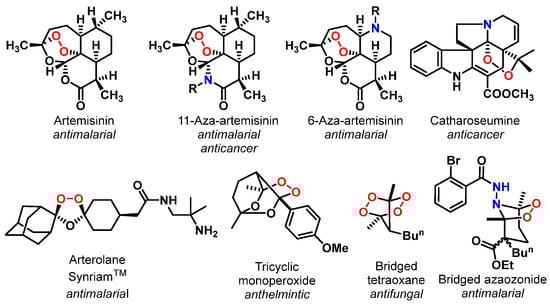
Cyclic peroxides represent a structurally unique class of organic compounds with notable biological activities. Natural peroxide artemisinin and its semi-synthetic derivatives, as well as the synthetic ozonide arterolane exhibit high antimalarial activity [1,2] and are used as active components in modern antimalarial medicines. Moreover, synthetic peroxides demonstrate anthelmintic [3], antileishmanial [4], antimalarial [5], anticancer [6,7], antitubercular [8,9], fungicidal [10], and antiviral [11,12,13,14,15] activities. Progress in medicinal peroxide chemistry drives the development of novel types of peroxides. Thus, methods have been developed for the synthesis of stable bioactive cyclic peroxides, including 1,2-dioxolanes [16,17], 1,2,4-trioxolanes (ozonides) [18,19,20,21], 1,2,4,5-tetraoxanes [22,23]. In recent years, nitrogen-containing organic peroxides have attracted considerable attention. The incorporation of nitrogen into peroxide frameworks can substantially modify biological activity, primarily through the expansion of hydrogen-bonding interactions with biomolecules. For example, 11-aza-artemisinin and 6-aza-artemisinin (Figure 1) are more potent than artemisinin [2,24,25,26]. Recent studies have demonstrated that azaozonides exhibit antimalarial activity that is not observed in their parent ozonides [5]. Nevertheless, azaperoxides remain an unexplored area in both organic chemistry and medicinal chemistry.
Figure 1.
Bioactive cyclic organic peroxides.
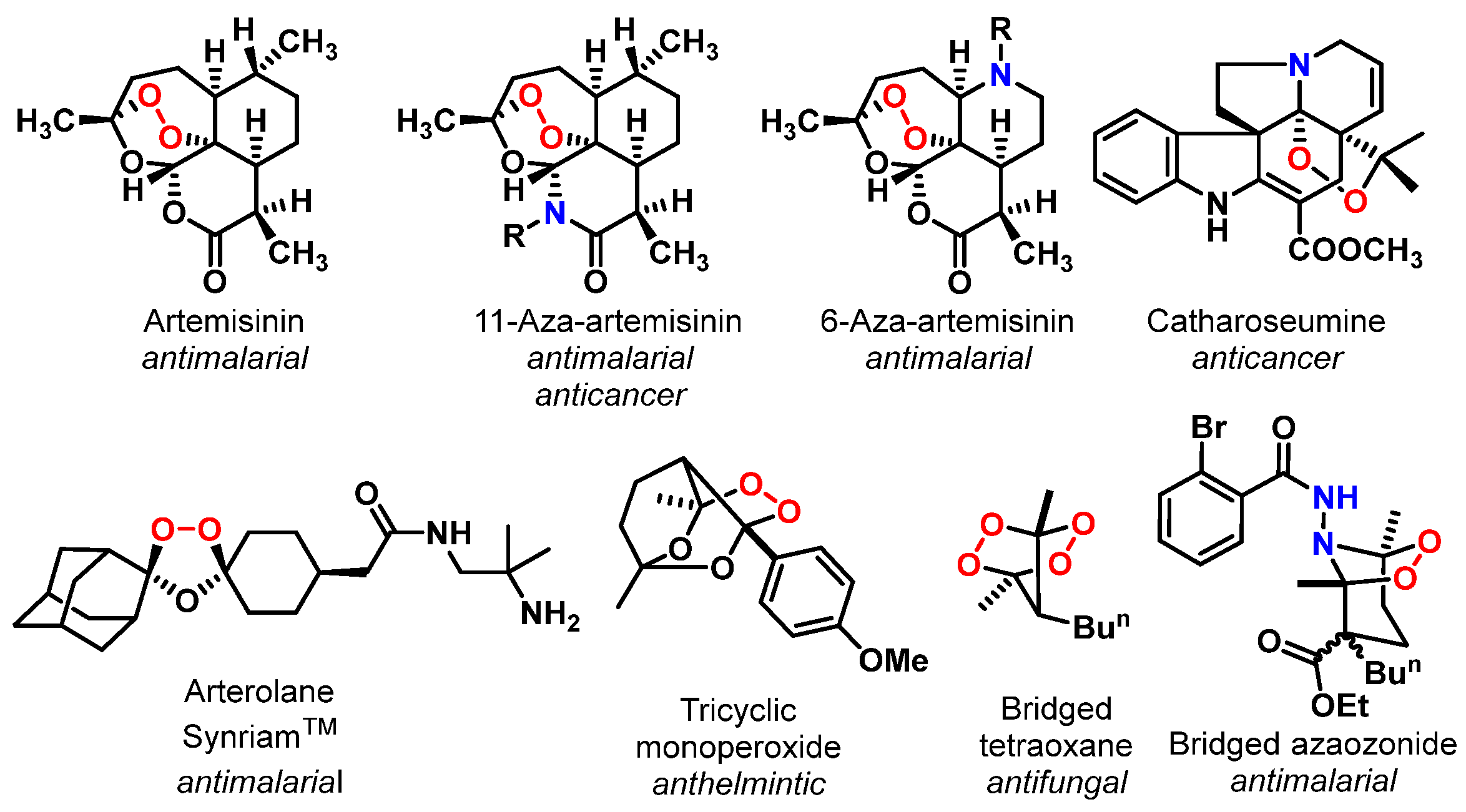
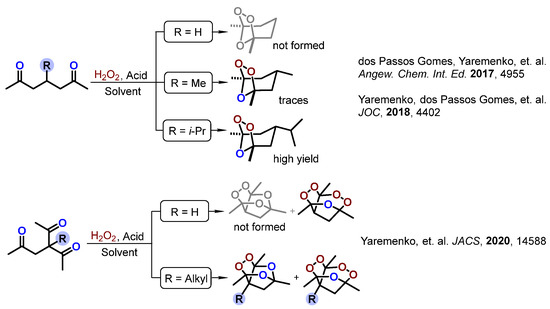
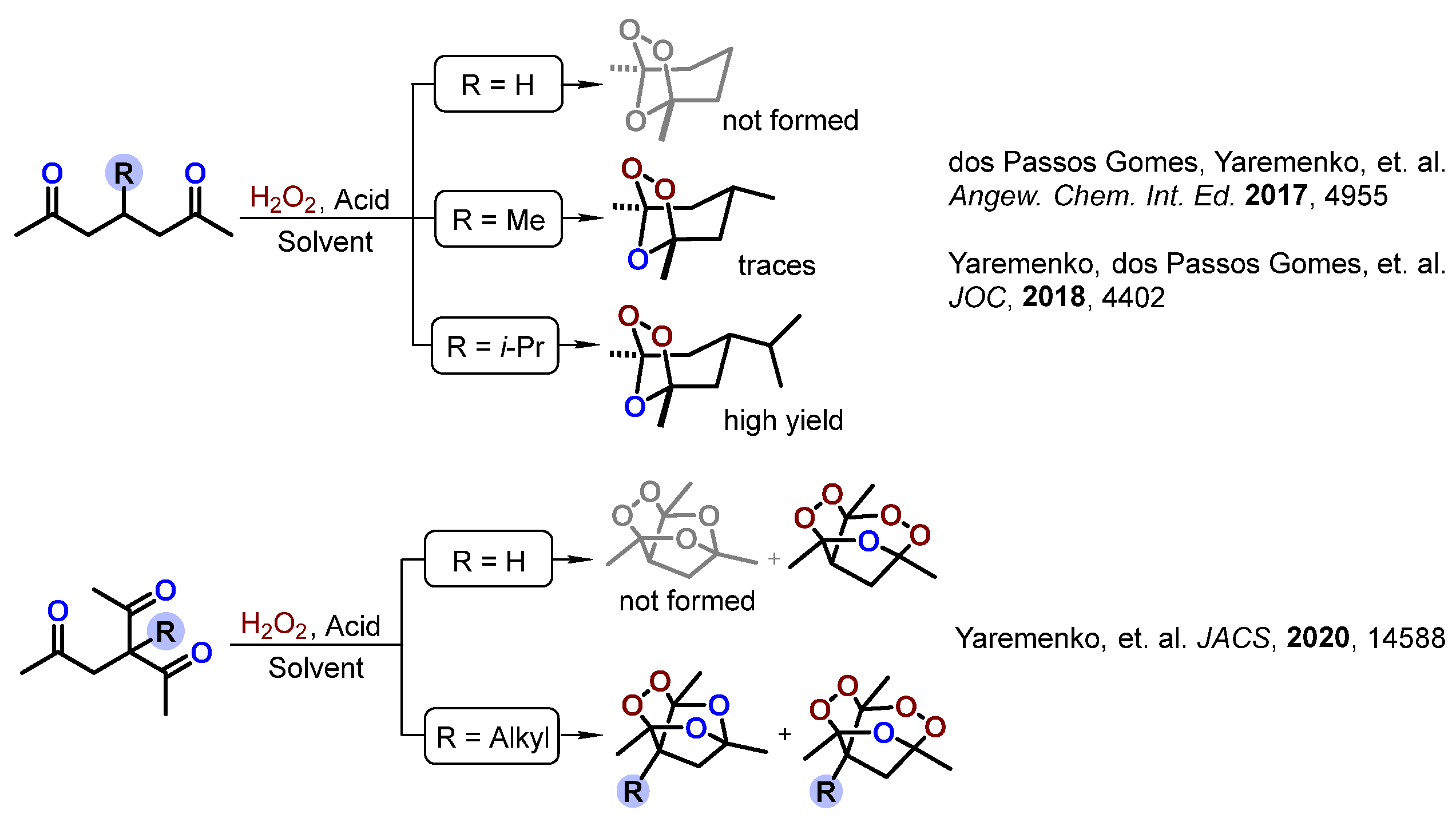
The fundamental challenge in cyclic azaperoxide chemistry lies in their non-standard nature: the cycle contains two antagonistic fragments—an oxidizing O–O group and an oxidizable ‘NH’ or ‘NR’ group, while still avoiding self-oxidation. Although the first cyclic aminoperoxides were obtained more than 50 years ago, their synthetic methods remain limited. They include ozonolysis of alkenes [27] in the presence of primary amines; ozonolysis of vinyl ethers [28] in the presence of imines; ozonolysis of O-methylated dioximes [29,30,31]; cycloaminomethylation of H2O2 and hydroperoxides with 1,3,5-triaryl-1,3,5-triazinanes; O2 addition to iminium ion [32]; and the opening/recyclization of pentaoxa- and heptaoxaspiroalkanes in the presence of nitrogen source [33,34]. The most convenient starting substrates for the construction of azaperoxides are carbonyl compounds. However, even in this case, synthetic approaches remain limited. They are mainly based on the condensation of highly reactive ketones [35], strained alicyclic 1,5-diketones [36,37], acyclic 1,5-diketones [38,39], and triketones [40] with hydrogen peroxide and N-component. With regard to aminodiperoxides, it has been reported that Sm(NO3)3·6H2O-catalyzed three-component reaction of primary arylamines with geminal bishydroperoxides or 1,1′-peroxybis(1-hydroperoxycycloalkanes) and reactive pentane-1,5-dial affords bridged aminodiperoxides (bridged tetraoxazaspirocycloalkanes) [41,42]. These reactions require a catalyst, even though aldehydes are more reactive than ketones toward nucleophiles and can form peroxides more easily under mild conditions [43]. In the absence of a catalyst, peroxides either did not form or were formed in very low yields. Samarium probably coordinates the active species, thereby facilitating the assembly of the aminodiperoxide ring. In the case of the less reactive 1,5-diketone, the formation of an aminodiperoxide without the use of such a coordinating metal is not obvious. Moreover, even slight changes in the structure of the starting ketone can lead to unpredictable outcomes. Several examples of such sensitivity are shown in Scheme 1 [20,21,44].
Scheme 1.
The non-obvious nature of peroxide assembly from diketones [20,21] and triketones [44].
It should be noted that the discovery of bioactive peroxides is challenging, too. The peroxide may either interact directly with the target or undergo a series of transformations to form products that subsequently act on the target. The O–O bond cleavage in the cyclic peroxide scaffold generates O-centred radicals that rapidly rearrange via β-scission to form C-centred radicals. This radical cascade underlies the powerful biological activity observed in peroxides [45]. This study addresses the above-mentioned fundamental challenges and reveals the potential of these unconventional compounds for medicinal chemistry.
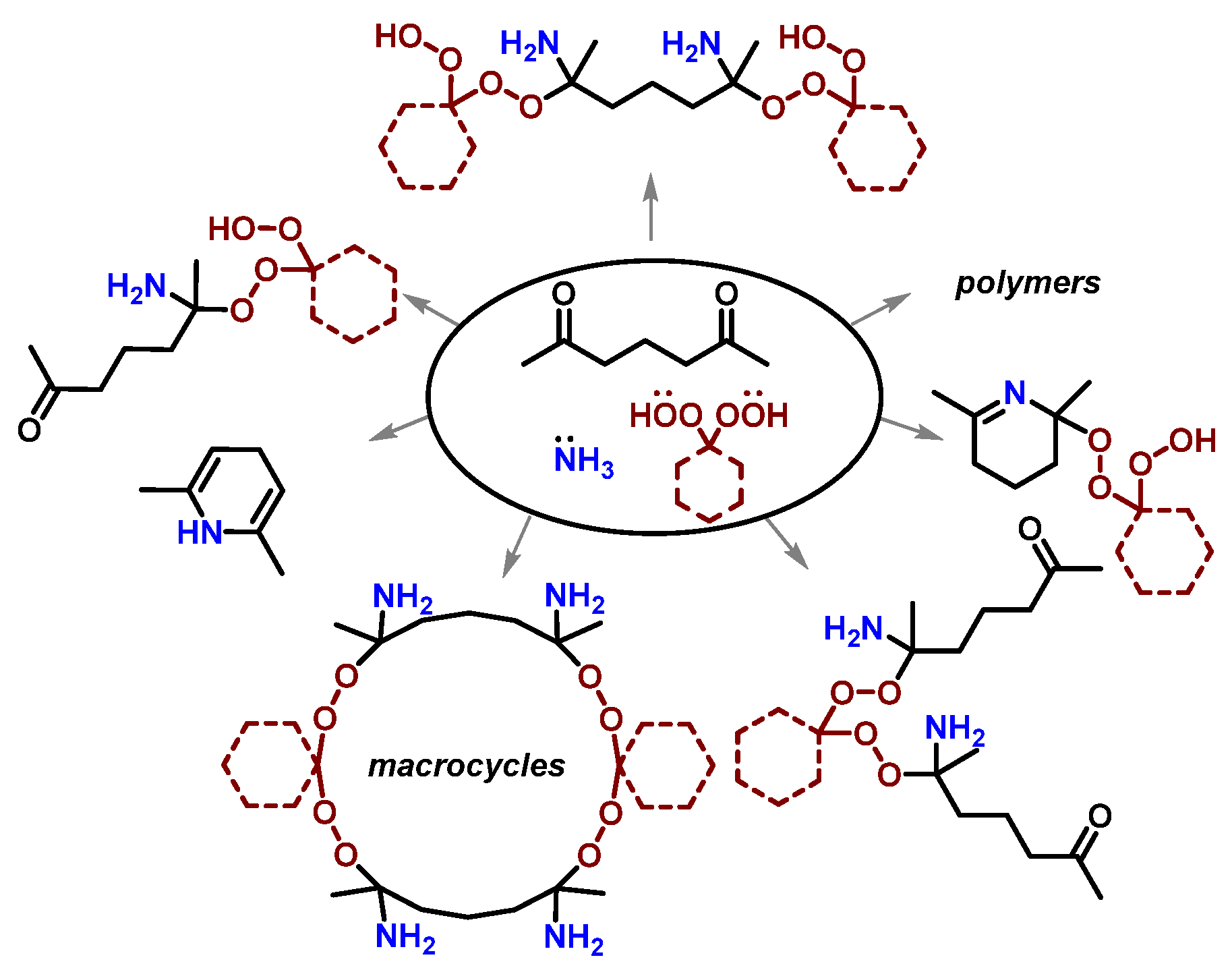
Herein, we investigated whether a selective three-component condensation of less reactive 1,5-diketones as carbonyl substrates, a geminal bishydroperoxides as the peroxide source, and NH-group source as an N-nucleophile could be achieved. This reaction system contains a carbonyl compound with two electrophilic centres and two different nucleophiles, including a geminal bishydroperoxide, which itself has two nucleophile sites. Such conditions are favourable for the formation of a complex mixture of products, including various dimeric and polymeric byproducts. The principal challenge of this transformation is the control of selectivity as illustrated by several number of possible products shown in Figure 2 [38,41,42].
Figure 2.
The complexity of the synthesis of aminodiperoxides from 1,5-diketones.
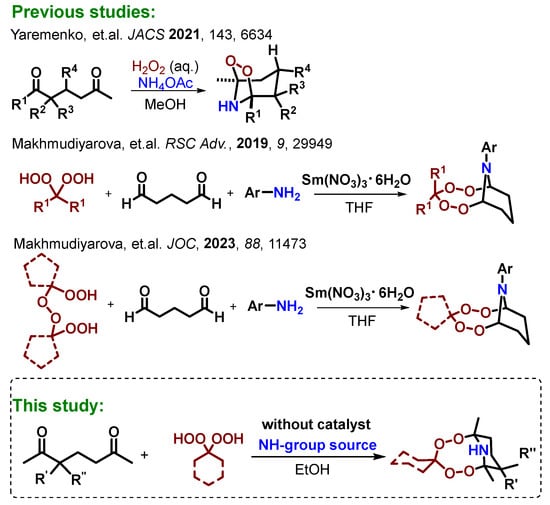
In this work, the selective synthesis of bridged aminodiperoxides based on the three-component reaction of 1,5-diketones with geminal bishydroperoxides and NH-group source was successfully developed (Scheme 2).
Scheme 2.
Synthesis of azadiperoxides [38,41,42].
It is surprising that a stable cycle formed with an unprotected secondary NH-group adjacent to two peroxide functionalities. The synthesized aminodiperoxides were tested against Jurkat, K562, and A549 cancer cell lines, and their fungicidal activity was evaluated against six phytopathogenic fungi.
2. Results and Discussion
2.1. Synthesis of the Aminodiperoxides
To establish the optimal conditions for the assembly of bridged aminodiperoxides, we selected the condensation of ethyl 2-acetyl-2-(4-chlorobenzyl)-5-oxohexanoate (1l) with 1,1-bishydroperoxycyclohexane (2a) and an NH-group source as a model reaction. The effect of the relative amounts of 2a and NH-group source, the solvent, and the reaction time on the yield of aminodiperoxide product 3la is shown in Table 1.
Table 1.
Optimization of the Reaction Conditions [a].
The initial procedure for the condensation of diketone 1l with bishydroperoxide 2a and an NH-group source was as follows: bishydroperoxide 2a and the NH-group source (NH3(aq), NH3 in MeOH, NH4OAc, or HCOONH4) were added to a solution of diketone 1l (0.200 g; 0.62 mmol) in MeOH, EtOH, or THF at room temperature. The reaction progress was monitored by TLC control. When aqueous ammonia was used as the NH-group source, aminodiperoxide 3la was obtained in 38% yield (Table 1, entry 1), while using a methanolic ammonia, afforded it in 31% yield (Table 1, entry 2). Replacement of ammonia with ammonium acetate significantly increased the yield of 3la (Table 1, entry 3). When THF used as the solvent, the complete conversion of the starting diketone 1l was achieved within 4 h, affording product 3la in 72% yield (Table 1, entry 4). Notably, when EtOH was used as the solvent, aminodiperoxide 3la precipitated as a single diastereomer as white crystals without requiring further purification by column chromatography (Table 1, entry 5). The increasing of the reaction time from 1 h to 2 h and then to 24 h resulted in a significant increase in the yield of 3la from 51% to 71% and 77%, respectively (Table 1, entries 6, 7). Surprisingly, when the reaction mixture was stirred at room temperature for 24 h and then kept at −22 °C overnight, the yield of aminodiperoxide 3la increased by an additional 11%, reaching 88%. (Table 1, entry 8). In contrast, the use of ammonium formate afforded 3la in 67% yield. (Table 1, entry 9). In all cases, no formation of aminodiperoxide 3la′ was observed.
Additionally, we performed 1H, 13C, 15N, and 1H-15N HMBC NMR monitoring of the discovered three-component reaction of 1,5-diketone 1l with geminal bishydroperoxide 2a and an NH-group source (NH4OAc) directly in an NMR tube, using EtOH-d6 as the solvent. The formation of the target aminodiperoxides 3la + 3la′ proceeds rapidly after mixing the substrates and reagent. Within 10 minutes without stirring, the reaction was mostly complete (conversion of 1l was ~80%), and after ~20–30 minutes, the 1H NMR signals of the starting diketone 1l disappeared completely. Aminodiperoxides 3la and 3la′ were formed as a mixture of two diastereomers in a ratio of 3la:3la′~2.5:1. After two hours, the 3la:3la′ ratio changes only slightly, reaching ~3:1. Complete isomerization into the major diastereomer 3la was observed after 20 h (see the Supplementary Materials).
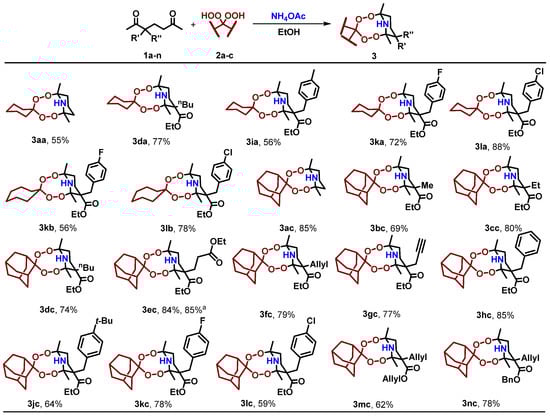
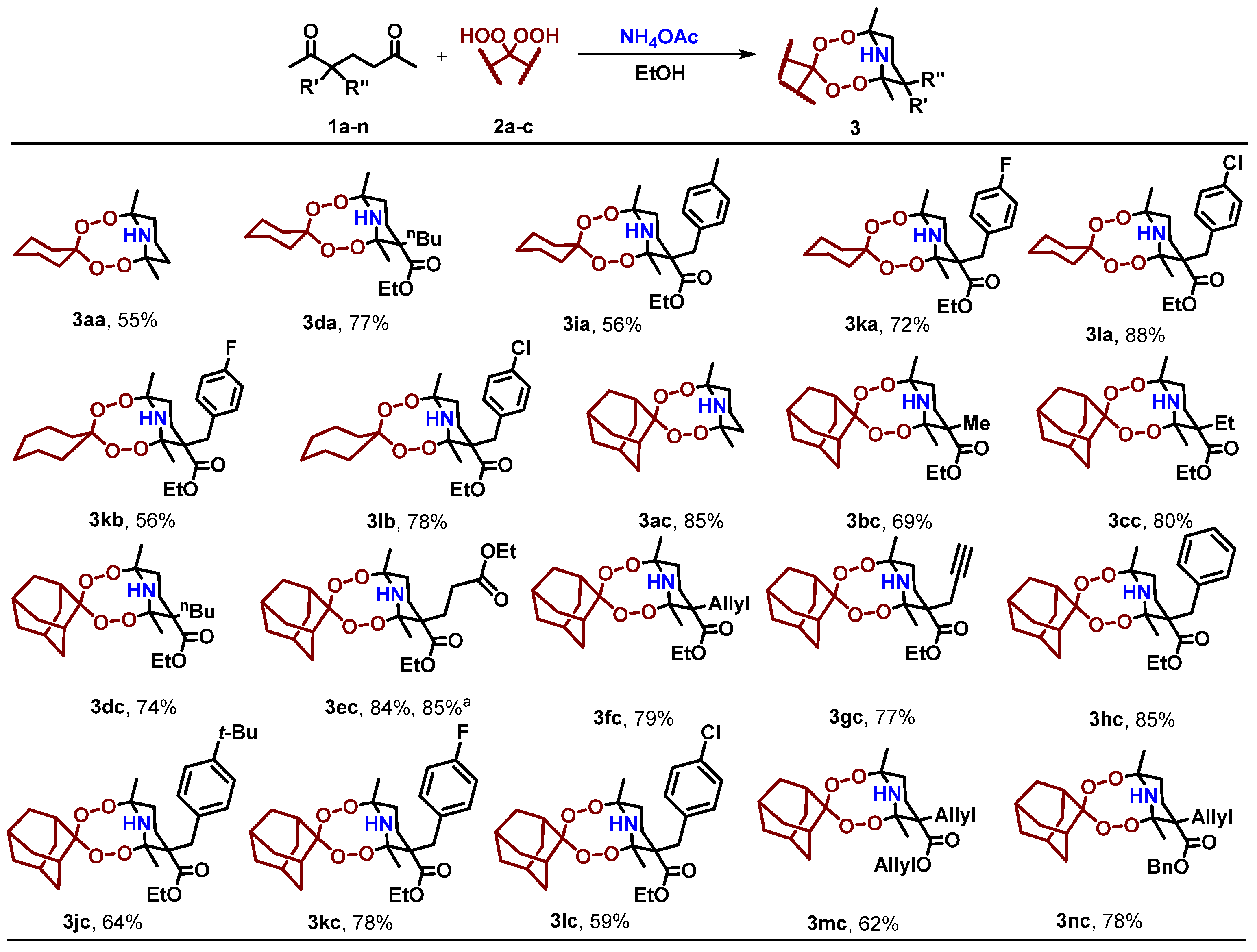
With the optimal conditions in hand (Table 1, entry 8), we explored the scope and limitations of the aminodiperoxide assembly by entering diketones 1a–n and bishydroperoxides 2a–c into a three-component reaction with NH4OAc (Scheme 3). In all cases, aminodiperoxides were obtained as single diastereomers in high yields (up to 88% for aminodiperoxide 3la). The scalability of the method was demonstrated by the synthesis of aminodiperoxide 3ec, employing 1.0 g of diketone 1e as the starting material, which afforded the product in 85% yield.
Scheme 3.
The scope of synthesized aminodiperoxides 3. General procedure: NH4OAc (0.133–0.361 g, 1.73–4.68 mmol, 3 mol NH4OAc/1 mol of 1,5-diketone 1a–n) and bishydroperoxide 2 (1.5 equiv) were successively added with stirring to a solution of 1,5-diketone 1 (0.200 g, 0.58–1.56 mmol, 1 equiv.) in EtOH (3 mL) at 20–25 °C. The reaction mixture was stirred at 20–25 °C for 24 h, then was kept at −22 °C overnight. a Scaled to 1.0 g of diketone 1e.
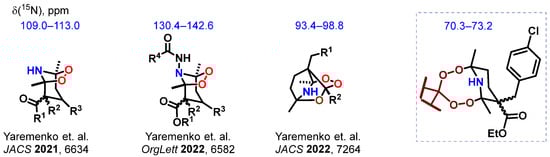
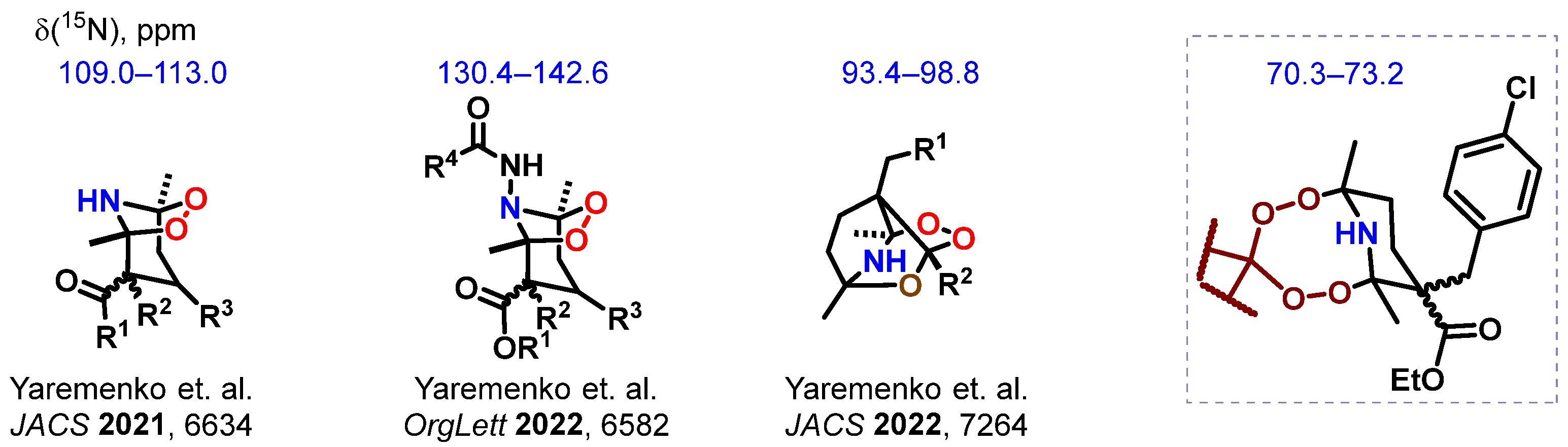
The structures of compounds 3 was confirmed by 1H and 13C NMR spectroscopy and HRMS data. In particular, for aminodiperoxide 3la, the characteristic peaks in the 1H NMR spectrum appear as singlets at 1.41 and 1.62 ppm (s, 3H, CH3). In the 13C NMR spectrum, the characteristic signals are observed at 109.2 (OCO), and at 88.8, 94.1 ppm (CH3CNH). Additionally, 2D 1H–15N HMBC NMR experiments were performed for both diastereomers, and 15N chemical shifts were measured for this class of aminoperoxides (see the Supplementary Materials). For the major diastereomer 3la, the 15N signal was observed at 70.3 ppm, whereas for the minor diastereomer 3la′ it appeared at 73.2 ppm. Interestingly, the 15N chemical shifts in the azamonoperoxides from our previous studies are significantly different and observed in the region typical for amides (Figure 3).
Figure 3.
Summarized data of the 15N chemical shifts for various types of azaperoxides [38,39,40].
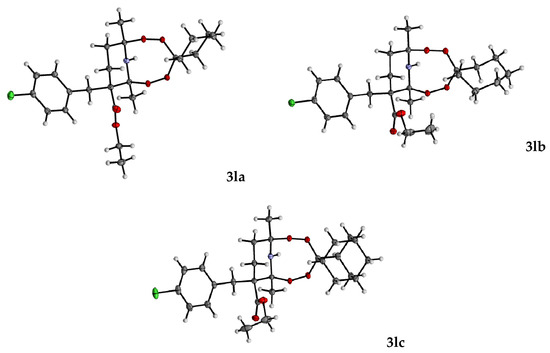
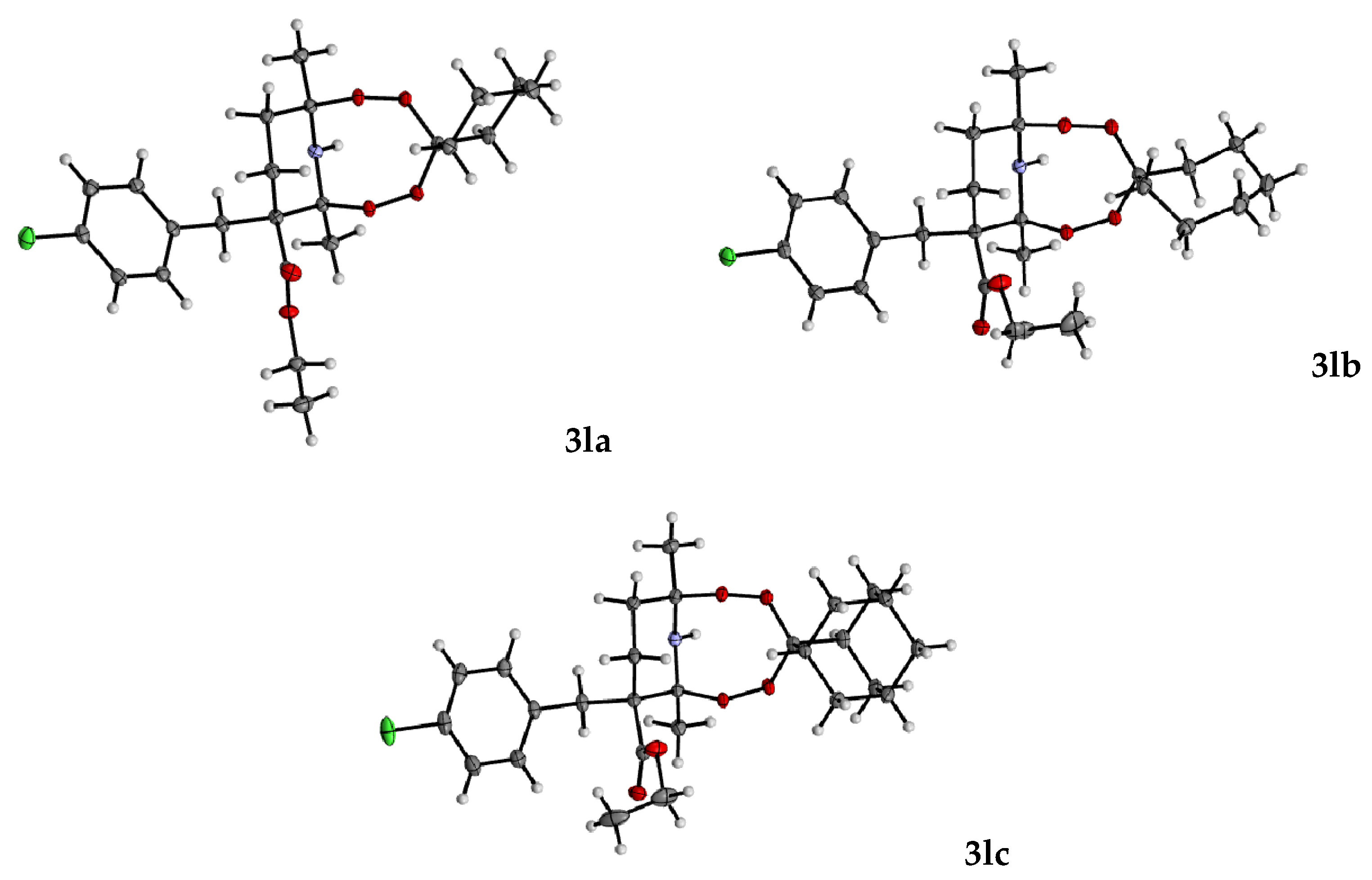
The stereochemical and NMR assignments were further confirmed by single-crystal X-ray analysis for 3la, 3lb and 3lc (Figure 4).
Figure 4.
Molecular structures of 3la, 3lb and 3lc. Atoms are presented as atomic displacement parameters (ADPs) ellipsoids (50% probability).
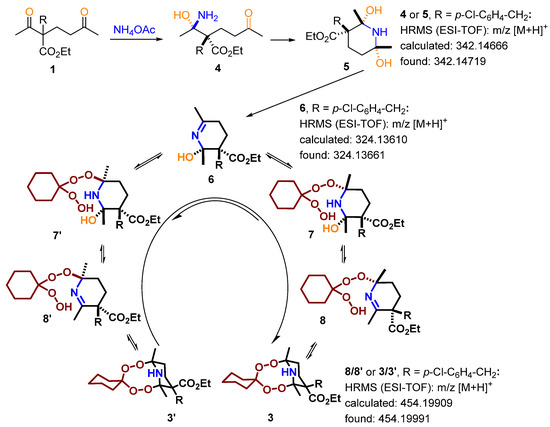
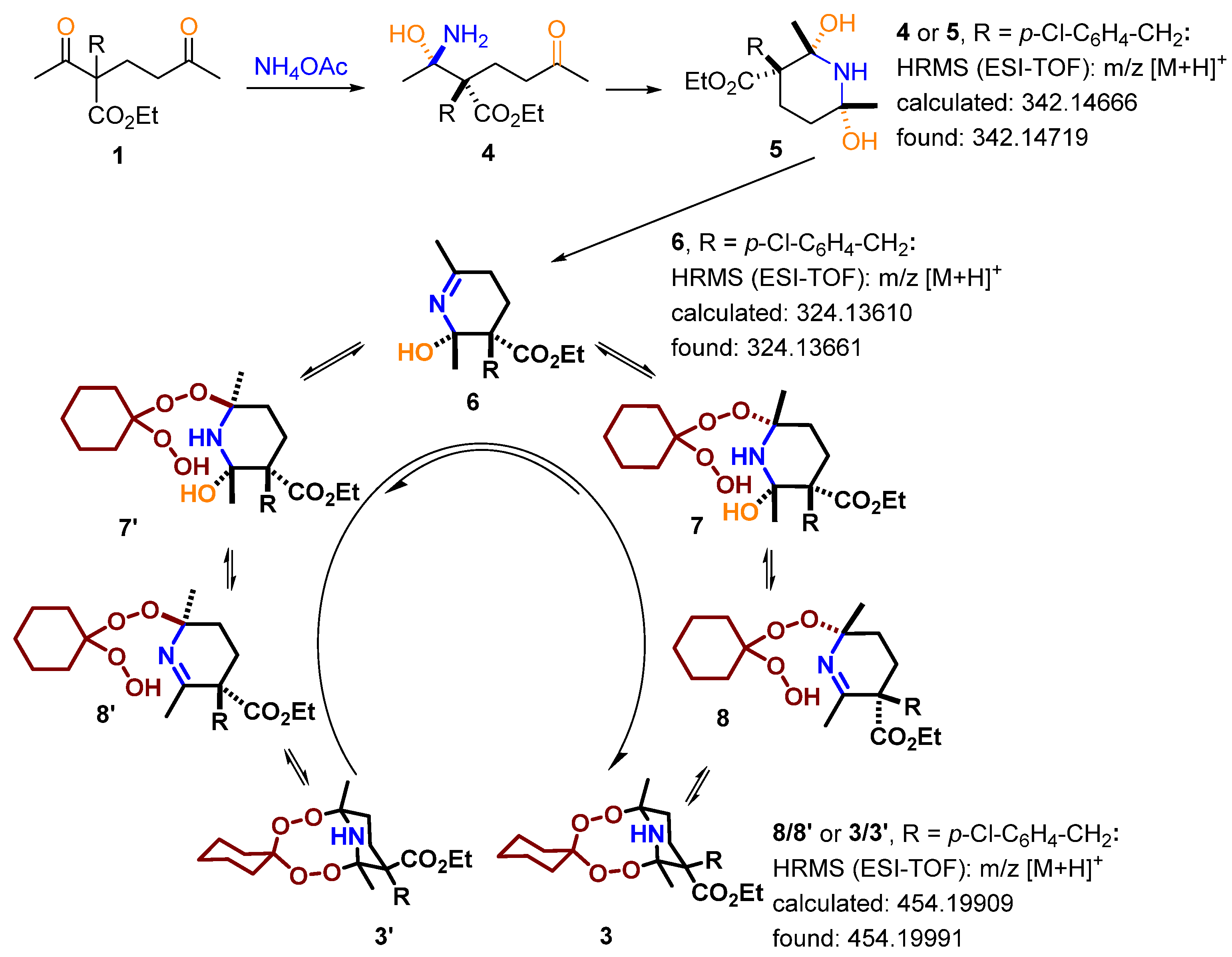
Based on the literature reports on the synthesis of aminoperoxides from 1,5-diketones [38] and our experimental observations, we propose the following route for the assembly of aminodiperoxides (Scheme 4). The reaction begins with the nucleophilic addition of ammonia to one of the carbonyl groups of the starting 1,5-diketone 1, forming intermediate 4, followed by an intramolecular nucleophilic attack of the NH2 group on the second carbonyl group, yielding intermediate 5. The reaction then proceeds through a series of elimination and addition steps: first, a water molecule is eliminated from 5 upon protonation of the OH-group, yielding imine 6, which undergoes nucleophilic addition of the geminal bishydroperoxide 2 from one of two sides. To complete the formation of the peroxide ring, intermediate 7 or 7′ undergoes elimination of the water to form imines 8 or 8′, respectively. Subsequent intramolecular nucleophilic attack by the OOH group on the imine carbon then affords aminodiperoxide 3 or 3′. The minor diastereomer 3′ slowly transforms into the major diastereomer 3. Since the formation of aminodiperoxides 3 proceeds very rapidly, it was not possible to detect the key intermediates by NMR spectroscopy. However, in the synthesis of aminodiperoxide 3la (R = p-Cl-C6H4-CH2), high-resolution mass spectrometry enabled the detection of intermediates 4 or 5, 6, as well as 8/8′ or products 3/3′ (compounds 4 and 5, 8, 8′, 3, and 3′ have identical molecular formulas).
Scheme 4.
The proposed pathway for the assembly of aminodiperoxides 3 and 3′.
Since cyclic peroxides exhibit a wide range of biological activities, in the next step of this study, we investigated the synthesized aminodiperoxides 3 for their anticancer activity against Jurkat, K562, and A549 cancer cell lines, as well as their fungicidal activity against phytopathogenic fungi.
2.2. In Vitro Cytotoxicity of the Aminodiperoxides
The cytotoxicity of aminodiperoxides was evaluated against Jurkat (T-lymphoblastic leukemia) and K562 (chronic myeloid leukemia) oncohematologic cell lines, A549 non-small lung cancer cells, and HEK293 normal epithelial cells using flow cytometry. The results were compared with those for natural peroxide artemisinin, and the widely used cytostatic agent camptothecin (Table 2).
Table 2.
The cytotoxic activity of aminodiperoxides against Jurkat, K562, and A549 cancer cell lines and HEK293 normal cells (CC50 values, mean ± SD) [a].
The obtained results indicate that the cytotoxicity of aminodiperoxides depends significantly on their structure. Compound 3ec, bearing two ethoxycarbonyl groups and an adamantyl substituent, showed the highest activity and selectivity against all three cancer cells under investigation. Pronounced activity against Jurkat and K562 cell lines was also observed for aminodiperoxides 3fc, 3mc, and 3nc, which contain allyl and adamantyl fragments. Interestingly, compound 3hc bearing an unsubstituted benzyl moiety, and compound 3jc with a tert-butyl substituent on the phenyl ring, demonstrated good activity and selectivity towards Jurkat and K562 cell lines, whereas the cytotoxicity of the halogen-substituted analogues 3kc and 3lc was significantly lower. Although aminodiperoxide 3ka showed the best cytotoxicity (CC50 = 11.9 μM), it exhibited only moderate selectivity towards Jurkat cells and very low selectivity towards A549 non-small lung cancer cells. Overall, the cytotoxicity and selectivity of aminodiperoxides against A549 cells are comparable to those of artemisinin, while the cytotoxic activity and selectivity of the lead compounds towards Jurkat and K562 cell lines significantly exceed that of artemisinin. In all cases, aminodiperoxides were superior to camptothecin in both cytotoxicity and selectivity.
Aminodiperoxides 3ec, 3fc, 3hc, 3jc, 3mc, and 3nc, which were the most active and selective toward oncohematological cell lines, were further evaluated using real-time cell analysis (RTCA). RTCA assays allow for the monitoring of diverse cellular processes, including cell adhesion, cell morphology, receptor-mediated signalling, and cell proliferation. This method is now widely used to monitor the compound-mediated cytotoxicity [46,47].
A parameter termed cell index (CI) was derived [48] to represent cell status based on the measured electrical impedance. Cell death or toxicity-induced cell detachment, or cell rounding leads to a decrease in CI [46,47,48].
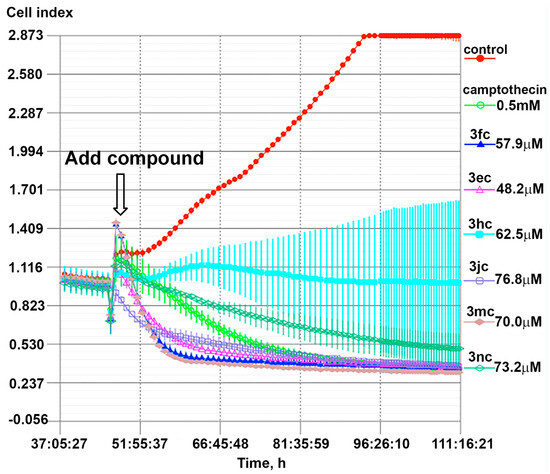
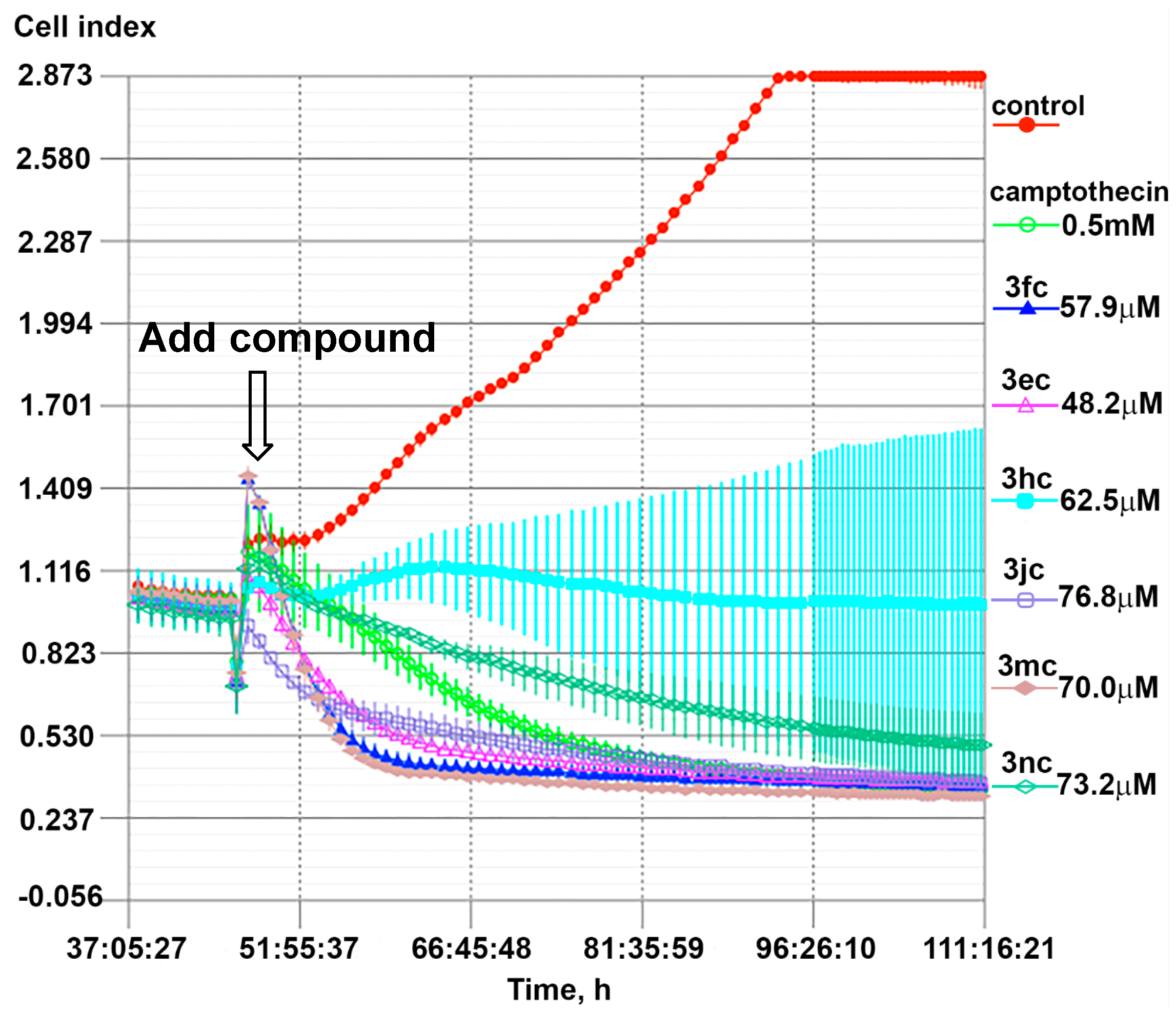
In this study, we monitored changes in A549 cells’ adhesion to collagen type IV-treated substrates following treatment with aminodiperoxides 3ec, 3fc, 3hc, 3jc, 3mc, and 3nc (Figure 5). Camptothecin, a classical cytostatic, was used as a positive control due to its antitumor activity against a wide range of cell lines [49].
Figure 5.
Real-time xCELLigence Cell Index Assay after treatment of A549 cells with test compounds. Each curve is an average of two wells ± SD. The panel is normalized to the time of compound addition. The control sample is highlighted in red.
Analysis of the curves of the dependence of CI on the cultivation time of the A549 cell culture revealed a significant decrease in CI after the addition of aminodiperoxides. The observed uniform decrease in CI during incubation after the addition of both aminodiperoxides and camptothecin indicates the pronounced cytotoxicity of aminodiperoxides, especially compounds 3ec, 3fc, 3jc, 3mc, and 3nc. These results confirm the antiproliferative potential of aminodiperoxides, but further investigation of the mechanism of cell death is necessary.
2.3. In Vitro Fungicidal Activity of the Aminodiperoxides
The aminodiperoxides 3 were tested against plant pathogenic fungi of various taxonomic classes that cause significant damage to agriculture and crop production—Venturia inaequalis (V.i.); Rhizoctonia solani (R.s.), Fusarium oxysporum (F.o.), Fusarium moniliforme (F.m.), Bipolaris sorokiniana (B.s.), Sclerotinia sclerotiorum (S.s.). The effect of the tested aminodiperoxides on the mycelium radial growth in the potato-saccharose agar was measured at the concentration of 30 mg/L. Triadimefon was used as a reference compound (Table 3).
Table 3.
Inhibition of mycelium growth of pathogenic fungi by aminodiperoxides 3.
Aminodiperoxide 3ia was found to be most active against V.i. and showed activity comparable to that of the commercial fungicide Triadimefon. Aminodiperoxides 3ia and 3gc also demonstrated activity against R.s. comparable to Triadimefon. Compounds 3kb and 3lb showed slightly higher activity than Triadimefon against B.s. These results identify aminodiperoxides as a new class of fungicidal compounds. The preliminary findings will serve as the basis for more detailed future studies.
3. Materials and Methods
Caution: Although we have encountered no difficulties in working with the peroxides described below, the proper precautions, such as the use of shields, fume hoods, and the avoidance of transition metal salts, heating, and shaking, should be taken whenever possible.
NMR spectra were recorded on a commercial instrument (Bruker, Daltonic, Germany, 300.13 MHz for 1H, 75.48 MHz for 13C) in CDCl3. High resolution mass spectra (HRMS) were measured using electrospray ionization (ESI) (Bruker, Daltonic, Germany). The measurements were performed in a positive ion mode (interface capillary voltage 4500 V); the mass ratio was from m/z 50 to 3000 Da; external/internal calibration was performed with Electrospray Calibrant Solution. A syringe injection was used for solutions in MeCN (flow rate 3 µL/min). Nitrogen was applied as a dry gas; interface temperature was set at 180 °C. Elemental analysis (C, H, N) was carried out using a CHN analyzer (Leco TruSpec Micro, MI, USA), and calculated values confirm a purity of >95% for all biologically tested compounds. The TLC analysis was carried out on silica gel chromatography plates Alugram UV254 (Macherey-Nagel, Duren, Germany); Sorbent: Silica 60, specific surface (BET) ~500 m2/g, mean pore size 60 Å, specific pore volume 0.75 mL/g, particle size 5–17 µm; Binder: highly polymeric product, which is stable in almost all organic solvents and resistant towards aggressive visualization reagents. The melting points were determined on a Kofler hot-stage apparatus. Chromatography of triketones was performed on silica gel (0.060–0.200 mm, 60 A, CAS 7631-86-9 (Acros Organics, Geel, Belgium). Chromatography of peroxides was performed on silica gel (0.040–0.060 mm, 60 A, CAS 7631-86-9 (Acros Organics, Geel, Belgium).
2-Adamantanone, cyclohexanone, cycloheptanone, heptane-2,6-dione, ethyl acetoacetate, tert-butyl acetoacetate, allyl alcohol, benzyl alcohol, methyl vinyl ketone, CeCl3·7H2O, benzyl and alkyl halides, were purchased from Acros Organics, Geel, Belgium. Ammonium acetate (NH4OAc), ethanol (EtOH), ethyl acetate (EA), petroleum ether (PE) (40/70), methanol (MeOH), tetrahydrofuran (THF), H2O2 (35% aqueous solution), NH4OAc, HCOONH4, NH3(aq), were purchased from commercial suppliers.
3.1. Synthesis of 1,5-Diketones 1a–n
1,5-Diketones 1a–l [10,20,21] and 1m,n were synthesized according to a known procedures. 1,5-diketones 1a–n are known compounds.
3.2. Synthesis of Bishydroperoxides
2a–c Bishydroperoxides 2a–c are known compounds. Bishydroperoxides 2a–c were synthesized according to a known procedures [50].
3.3. Procedure for the Synthesis of Aminodiperoxide 3la with Use NH3, Ammonium Salts and 1,1-Dihydroperoxycyclohexane 2a (Table 1, Entries 1–9)
A 22% aq. solution of NH3 (0.26 mL, 3.08 mmol, 5 mol NH3/1 mol of 1l) (entry 1), 7M methanolic solution of NH3 (0.44 mL, 3.08 mmol, 5 mol NH3/1 mol of 1l) (entry 2), NH4OAc (0.142–0.237 g, 1.85–3.08 mmol, 3.0–5.0 mol NH4OAc/1 mol of 1l) (entries 3–8) or HCOONH4 (0.117 g, 3.08 mmol, 3.0 mol HCOONH4/1 mol of 1l) (entry 9) and 1,1-dihydroperoxycyclohexane 2a (0.137 g, 0.92 mmol, 1.5 mol 2a/1.0 mol of 1l) were successively added with stirring to a solution of 1,5-diketone 1l (0.200 g, 0.62 mmol) in MeOH (2–3 mL) (entries 1–3), THF (3 mL) (entry 4), EtOH (3 mL) (entries 5–9) at 20–25 °C.
For entries 1–7, the reaction mixture was stirred at 20–25 °C for 0.5–24 h. Then CHCl3 (30 mL) and water (10 mL) were added. The organic layer was separated, and the aqueous layer was extracted with CHCl3 (3 × 30 mL). The combined organic phases were dried over MgSO4, and the solvent was removed in a vacuum of a water jet pump. Aminodiperoxide 3la was isolated by chromatography on SiO2 using PE:EA mixture as the eluent with a gradient of ethyl acetate (EA) from 5 to 9 vol. % (entries 1–4). In entries 5–7, the precipitated crystals were filtered and washed with a cold EtOH/H2O mixture (40:60, v/v). Pure aminodiperoxide 3la was obtained.
In the case of entries 8, 9 the reaction mixture was stirred at 20–25 °C for 24 h, then was kept at −22 °C overnight. The precipitated crystals were filtered and washed with a cold EtOH/H2O mixture (40:60, v/v). Pure aminodiperoxide 3la was obtained.
3.4. General Procedure for the Synthesis of Aminodiperoxides 3aa, 3da, 3ia, 3ka, 3la, 3kb, 3lb, 3ac–3hc, 3jc–3nc from 1,5-Diketones 1a–n and Corresponding Bishydroperoxides 2a–c
Ammonium acetate (0.133–0.361 g, 1.73–4.68 mmol, 3 mol NH4OAc/1 mol of 1,5-diketone 1a–n) and corresponding 1,1-dihydroperoxycyclohexane 2a (0.137–0.347 g, 0.92–2.34 mmol, 1.5 mol 2a/1.0 mol of 1a,d,i,k,l), 1,1-dihydroperoxycycloheptane 2b (0.150–0.158 g, 0.92–0.97 mmol, 1.5 mol 2b/1.0 mol of 1k,l) or 2,2-dihydroperoxyadamantane 2c (0.173–0.469 g, 0.87–2.34 mmol, 1.5 mol 2c/1.0 mol of 1a–h,j–n) were successively added with stirring to a solution of 1,5-diketone 1a–n (0.200 g, 0.58–1.56 mmol) in EtOH (3 mL) at 20–25 °C. The reaction mixture was stirred at 20–25 °C for 24 h. Then the reaction mixture was kept at −22 °C overnight. In the case of 3aa, 3ia, 3ka, 3la, 3kb, 3lb, 3ac–3hc, 3jc–3nc: the precipitated crystals were filtered and washed with cold EtOH/H2O mixture (40:60, v/v). Pure aminodiperoxides 3aa, 3ia, 3ka, 3la, 3kb, 3lb, 3ac–3hc, 3jc–3nc were obtained.
In the case of 3da, then CHCl3 (30 mL) and water (10 mL) were added. The organic layer was separated, and the aqueous layer was extracted with CHCl3 (3 × 30 mL). The combined organic phases were dried over MgSO4, and the solvent was removed in a vacuum of a water jet pump. Aminodiperoxide 3da was isolated by chromatography on SiO2 using PE:EA (30:1) mixture as the eluent.
Compounds: 3aa: 0.220 g, 0.85 mmol, yield 55%; 3da: 0.233 g, 0.60 mmol, yield 77%; 3ia: 0.159 g, 0.37 mmol, yield 56%; 3ka: 0.204 g, 0.47 mmol, yield 72%; 3la: 0.275 g, 0.54 mmol, yield 88%; 3kb: 0.165 g, 0.37 mmol, yield 56%; 3lb: 0.227 g, 0.49 mmol, yield 78%; 3ac: 0.410 g, 1.32 mmol, yield 85%; 3bc: 0.256 g, 0.65 mmol, yield 69%; 3cc: 0.287 g, 0.70 mmol, yield 80%; 3dc: 0.254 g, 0.58 mmol, yield 74%; 3ec: 0.224 g, 0.47 mmol, yield 84%; 3fc: 0.277 g, 0.66 mmol, yield 79%; 3gc: 0.271 g, 0.65 mmol, yield 77%; 3hc: 0.276 g, 0.59 mmol, yield 85%; 3jc: 0.196 g, 0.37 mmol, yield 64%; 3kc: 0.250 g, 0.51 mmol, yield 78%; 3lc: 0.184 g, 0.36 mmol, yield 59%; 3mc: 0.212 g, 0.49 mmol, yield 62%; 3nc: 0.250 g, 0.52 mmol, yield 78%.
3.5. Synthesis of Aminodiperoxide 3ec Scaled Up to 1.0 g of 1,5-Diketone 1e
Ammonium acetate (0.770 g, 9.99 mmol, 3 mol NH4OAc/1 mol of 1,5-diketone 1e) and 2,2-dihydroperoxyadamantane 2c (1.0 g, 4.99 mmol, 1.5 mol 2c/1.0 mol of 1e) were successively added with stirring to a solution of 1,5-diketone 1e (1.0 g, 3.33 mmol) in EtOH (6 mL) at 20–25 °C. The reaction mixture was stirred at 20–25 °C for 24 h. Then the reaction mixture was kept at −22 °C overnight. The precipitated crystals were filtered and washed with a cold EtOH/H2O mixture (40:60, v/v). Pure aminodiperoxide 3ec was obtained (1.37 g, 2.84 mmol, yield 85%).
- (1R*,7S*)-1,7-Dimethyl-2,3,5,6-tetraoxa-11-azaspiro[bicyclo [5.3.1]undecane-4,1′-cyclohexane], 3aa. White crystals. Mp = 46–48 °C. Rf = 0.41 (TLC, PE:EA, 10:1). 1H NMR (300.13 MHz, CDCl3), δ: 3.63 (br. s, 1H), 2.22–2.13 (m, 1H), 2.04–1.84 (m, 2H), 1.77–1.66 (m, 2H), 1.61–1.38 (m, 11H), 1.34 (s, 6H). 13C NMR (75.48 MHz, CDCl3), δ: 108.6, 89.6, 31.9, 31.1, 29.9, 26.8, 25.5, 22.9, 21.9, 16.8. Anal. Calcd for C13H23NO4: C, 60.68; H, 9.01; N, 5.44. Found: C, 60.79; H, 9.13; N, 5.55. HRMS (ESI-TOF): m/z [M + H]+: calculated for [C13H24NO4]+: 258.1700; found: 258.1691.
- Ethyl (1R*,7S*,8S*)-8-butyl-1,7-dimethyl-2,3,5,6-tetraoxa-11-azaspiro[bicyclo [5.3.1]undecane-4,1′-cyclohexane]-8-carboxylate, 3da. Colourless oil. Rf = 0.53 (TLC, PE:EA, 10:1). 1H NMR (300.13 MHz, CDCl3), δ: 4.26–4.14 (m, 1H), 4.13–4.00 (m, 1H), 3.41 (br. s, 1H), 2.52 (td, J = 14.5, 6.0 Hz, 1H), 2.28–2.06 (m, 2H), 1.88–1.73 (m, 3H), 1.70–1.10 (m, 23H), 0.88 (t, J = 7.1 Hz, 3H). 13C NMR (75.48 MHz, CDCl3), δ: 173.5, 109.2, 94.1, 88.9, 60.7, 50.3, 31.2, 30.4, 30.0, 28.4, 26.7, 25.6, 23.2, 23.0, 21.9, 21.3, 20.8, 14.3, 14.1. Anal. Calcd for C20H35NO6: C, 62.31; H, 9.15; N, 3.63. Found: C, 62.48; H, 9.28; N, 3.82. HRMS (ESI-TOF): m/z [M +H]+: calculated for [C20H36NO6]+: 386.2537; found: 386.2527.
- Ethyl (1R*,7S*,8R*)-1,7-dimethyl-8-(4-methylbenzyl)-2,3,5,6-tetraoxa-11-azaspiro[bicyclo [5.3.1]undecane-4,1′-cyclohexane]-8-carboxylate, 3ia. White crystals. Mp = 95–96 °C. Rf = 0.58 (TLC, PE:EA, 10:1). 1H NMR (300.13 MHz, CDCl3), δ: 7.05 (d, J = 7.9 Hz, 2H), 6.97 (d, J = 7.9 Hz, 2H), 4.38–4.16 (m, 1H), 4.15–4.02 (m, 1H), 3.45 (br. s, 1H), 3.40 (d, J = 13.6 Hz, 1H), 3.01 (d, J = 13.6 Hz, 1H), 2.41 (td, J = 14.4, 4.3 Hz, 1H), 2.30 (s, 3H), 2.23–2.02 (m, 2H), 1.81 (td, J = 14.4, 4.3 Hz, 1H), 1.69–1.35 (m, 16H), 1.24 (t, J = 7.1 Hz, 3H). 13C NMR (75.48 MHz, CDCl3), δ: 173.0, 136.3, 134.1, 129.7, 129.2, 109.2, 94.2, 88.8, 60.8, 51.2, 36.4, 31.2, 30.0, 28.7, 26.7, 25.6, 23.0, 21.9, 21.4, 21.1, 20.6, 14.2. Anal. Calcd for C24H35NO6: C, 66.49; H, 8.14; N, 3.23. Found: C, 66.60; H, 8.22; N, 3.31. HRMS (ESI-TOF): m/z [M + H]+: calculated for [C24H36NO6]+: 434.2537; found: 434.2532.
- Ethyl (1R*,7S*,8R*)-8-(4-fluorobenzyl)-1,7-dimethyl-2,3,5,6-tetraoxa-11-azaspiro[bicyclo [5.3.1]undecane-4,1′-cyclohexane]-8-carboxylate, 3ka. White crystals. Mp = 134–135 °C. Rf = 0.50 (TLC, PE:EA, 10:1). 1H NMR (300.13 MHz, CDCl3), δ: 7.10–7.00 (m, 2H), 6.98–6.88 (m, 2H), 4.29–4.15 (m, 1H), 4.14–4.00 (m, 1H), 3.48 (br. s, 1H), 3.39 (d, J = 13.7 Hz, 1H), 3.03 (d, J = 13.7 Hz, 1H), 2.43 (td, J = 14.3, 4.3 Hz, 1H), 2.23–2.07 (m, 2H), 1.78 (td, J = 14.3, 4.4 Hz, 1H), 1.68–1.37 (m, 16H), 1.22 (t, J = 7.1 Hz, 3H). 13C NMR (75.48 MHz, CDCl3), δ: 172.7, 161.8 (d, 1JCF = 244.3 Hz), 132.7 (d, 4JCF = 3.4 Hz), 131.2 (d, 3JCF = 7.7 Hz), 115.2 (d, 2JCF = 21.0 Hz), 109.2, 94.1, 88.8, 61.0, 51.2, 35.9, 31.2, 30.0, 28.7, 26.7, 25.6, 22.9, 21.9, 21.3, 20.5, 14.2. Anal. Calcd for C23H32FNO6: C, 63.14; H, 7.37; F, 4.34; N, 3.20. Found: C, 63.28; H, 7.45; F, 4.41; N, 3.30. HRMS (ESI-TOF): m/z [M + H]+: calculated for [C23H33FNO6]+: 438.2286; found: 438.2298.
- Ethyl (1R*,7S*,8R*)-8-(4-chlorobenzyl)-1,7-dimethyl-2,3,5,6-tetraoxa-11-azaspiro[bicyclo [5.3.1]undecane-4,1′-cyclohexane]-8-carboxylate, 3la. White crystals. Mp = 131–132 °C. Rf = 0.37 (TLC, PE:EA, 10:1). 1H NMR (300.13 MHz, CDCl3), δ: 7.21 (d, J = 8.4 Hz, 2H), 7.02 (d, J = 8.4 Hz, 2H), 4.28–4.15 (m, 1H), 4.13–4.01 (m, 1H), 3.47 (br. s, 1H), 3.39 (d, J = 13.6 Hz, 1H), 3.02 (d, J = 13.6 Hz, 1H), 2.44 (td, J = 14.3, 4.3 Hz, 1H), 2.24–2.08 (m, 2H), 1.76 (td, J = 14.3, 4.3 Hz, 1H), 1.68–1.33 (m, 16H), 1.22 (t, J = 7.1 Hz, 3H). 13C NMR (75.48 MHz, CDCl3), δ: 172.8, 135.8, 132.7, 131.2, 128.6, 109.2, 94.1, 88.8, 61.0, 51.2, 36.1, 31.2, 30.0, 28.7, 26.7, 25.6, 22.9, 21.9, 21.3, 20.5, 14.2. Anal. Calcd for C23H32ClNO6: C, 60.85; H, 7.11; Cl, 7.81; N, 3.09. Found: C, 61.00; H, 7.28; Cl, 8.02; N, 3.19. HRMS (ESI-TOF): m/z [M + H]+: calculated for [C23H33ClNO6]+: 454.1991; found: 454.1991.
- Ethyl (1R*,7S*,8R*)-8-(4-fluorobenzyl)-1,7-dimethyl-2,3,5,6-tetraoxa-11-azaspiro[bicyclo [5.3.1]undecane-4,1′-cycloheptane]-8-carboxylate, 3kb. White crystals. Mp = 113–115 °C. Rf = 0.51 (TLC, PE:EA, 10:1). 1H NMR (300.13 MHz, CDCl3), δ: 7.09–7.00 (m, 2H), 6.97–6.87 (m, 2H), 4.26–4.02 (m, 2H), 3.49 (br. s, 1H), 3.38 (d, J = 13.7 Hz, 1H), 3.03 (d, J = 13.7 Hz, 1H), 2.41 (td, J = 14.2, 4.7 Hz, 1H), 2.34–2.23 (m, 2H), 1.77 (td, J = 14.2, 4.7 Hz, 1H), 1.59–1.38 (m, 18H), 1.22 (t, J = 7.1 Hz, 3H). 13C NMR (75.48 MHz, CDCl3), δ: 172.8, 161.9 (d,1JCF = 245.0 Hz), 131.3 (d, 4JCF = 3.4 Hz), 131.2 (d, 3JCF = 7.7 Hz), 115.3 (d, 2JCF = 21.0 Hz), 114.7, 94.1, 88.8, 61.0, 51.2, 35.9, 35.4, 31.5, 30.5, 30.3, 28.7, 26.6, 23.4, 22.4, 21.3, 20.4, 14.2. Anal. Calcd for C24H34FNO6: C, 63.84; H, 7.59; F, 4.21; N, 3.10. Found: C, 63.99; H, 7.65; F, 4.32; N, 3.19. HRMS (ESI-TOF): m/z [M + K]+: calculated for [C24H34FNKO6]+: 490.2002; found: 490.1989.
- Ethyl (1R*,7S*,8R*)-8-(4-chlorobenzyl)-1,7-dimethyl-2,3,5,6-tetraoxa-11-azaspiro[bicyclo [5.3.1]undecane-4,1′-cycloheptane]-8-carboxylate, 3lb. White crystals. Mp = 149–151 °C. Rf = 0.48 (TLC, PE:EA, 10:1). 1H NMR (300.13 MHz, CDCl3), δ: 7.21 (d, J = 8.1 Hz, 2H), 7.01 (d, J = 8.1 Hz, 2H), 4.28–4.01 (m, 2H), 3.48 (br. s, 1H), 3.39 (d, J = 13.6 Hz, 1H), 3.03 (d, J = 13.6 Hz, 1H), 2.42 (td, J = 14.4, 4.7 Hz, 1H), 2.35–2.24 (m, 2H), 1.84–1.36 (m, 19H), 1.23 (t, J = 7.1 Hz, 3H). 13C NMR (75.48 MHz, CDCl3), δ: 172.8, 135.7, 132.7, 131.2, 128.6, 114.7, 94.1, 88.7, 61.0, 51.2, 36.1, 35.4, 31.5, 30.5, 30.3, 28.7, 26.6, 23.4, 22.4, 21.3, 20.5, 14.2. Anal. Calcd for C24H34ClNO6: C, 61.60; H, 7.32; Cl, 7.57; N, 2.99. Found: C, 61.71; H, 7.42; Cl, 7.65; N, 3.09. HRMS (ESI-TOF): m/z [M + H]+: calculated for [C24H35ClNO6]+: 468.2147; found: 468.2136.
- (1R*,7S*)-1,7-dimethyl-2,3,5,6-tetraoxa-11-azaspiro[bicyclo [5.3.1]undecane-4,1′-cyclohexane], 3ac. White crystals. Mp = 123–125 °C. Rf = 0.64 (TLC, PE:EA, 10:1). 1H NMR (300.13 MHz, CDCl3), δ: 3.66 (br. s, 1H), 2.97–3.05 (m, 1H), 1.42–2.09 (m, 19H), 1.35 (s, 6H). 13C NMR (75.48 MHz, CDCl3), δ: 110.6, 89.5, 37.7, 34.6, 33.6, 33.3, 32.1, 30.8, 27.4, 27.1, 17.0. Anal. Calcd for C17H27NO4: C, 65.99; H, 8.80; N, 4.53. Found: C, 66.12; H, 8.98; N, 4.65. HRMS (ESI-TOF): m/z [M + H]+: calculated for [C17H28NO4]+: 310.2013; found: 310.2016.
- Ethyl (1S*,1′R*,2R*,5R*,7′S*,8′S*)-1′,7′,8′-trimethyl-2′,3′,5′,6′-tetraoxa-11′-azaspiro[adamantane-2,4′-bicyclo [5.3.1]undecane]-8′-carboxylate, 3bc. White crystals. Mp = 100–102 °C. Rf = 0.57 (TLC, PE:EA, 10:1). 1H NMR (300.13 MHz, CDCl3), δ: 4.26–3.98 (m, 2H), 3.42 (br. s, 1H), 3.07–2.96 (m, 1H), 2.77–2.58 (m, 1H), 2.06–1.93 (m, 4H), 1.86–1.71 (m, 4H), 1.70–1.51 (m, 8H), 1.47 (s, 3H), 1.40–1.29 (m, 6H), 1.24 (t, J = 7.1 Hz, 3H). 13C NMR (75.48 MHz, CDCl3), δ: 174.2, 111.1, 93.4, 88.7, 60.8, 46.6, 37.7, 34.6, 34.5, 33.6, 33.2, 33.0, 30.8, 28.6, 27.4, 26.7, 26.5, 21.6, 20.1, 14.2. Anal. Calcd for C21H33NO6: C, 63.78; H, 8.41; N, 3.54. Found: C, 63.92; H, 8.52; N, 3.63. HRMS (ESI-TOF): m/z [M + H]+: calculated for [C21H34NO6]+: 396.2381; found: 396.2379.
- Ethyl (1S*,1′R*,2R*,5R*,7′S*,8′S*)-8′-ethyl-1′,7′-dimethyl-2′,3′,5′,6′-tetraoxa-11′-azaspiro[adamantane-2,4′-bicyclo [5.3.1]undecane]-8′-carboxylate, 3cc. White crystals. Mp = 131–133 °C. Rf = 0.68 (TLC, PE:EA, 10:1). 1H NMR (300.13 MHz, CDCl3), δ:4.30–3.98 (m, 2H). 3.41 (br. s, 1H), 3.10–2.97 (m, 1H), 2.49 (td, J = 14.6, 5.8 Hz, 1H), 2.11–1.40 (m, 21H), 1.33 (s, 3H), 1.24 (t, J = 7.1 Hz, 3H), 0.74 (t, J = 7.5 Hz, 3H). 13C NMR (75.48 MHz, CDCl3), δ: 173.3, 111.0, 93.8, 88.6, 60.5, 50.7, 37.6, 34.5, 34.4, 33.5, 33.1, 32.9, 30.7, 28.2, 27.3, 26.6, 23.2, 21.1, 19.9, 14.2, 8.6. Anal. Calcd for C22H35NO6: C, 64.52; H, 8.61; N, 3.42. Found: C, 64.61; H, 8.73; N, 3.50. HRMS (ESI-TOF): m/z [M + H]+: calculated for [C22H36NO6]+: 410.2537; found: 410.2528.
- Ethyl (1S*,1′R*,2R*,5R*,7′S*,8′S*)-8′-butyl-1′,7′-dimethyl-2′,3′,5′,6′-tetraoxa-11′-azaspiro[adamantane-2,4′-bicyclo [5.3.1]undecane]-8′-carboxylate, 3dc. White crystals. Mp = 107–108 °C. Rf = 0.73 (TLC, PE:EA, 10:1). 1H NMR (300.13 MHz, CDCl3), δ: 4.28–4.13 (m, 1H), 4.11–3.98 (m, 1H), 3.41 (br. s, 1H), 3.11–2.92 (m, 1H), 2.77–2.58 (m, 1H), 2.06– 1.10 (m, 31H), 0.88 (t, J = 7.1 Hz, 3H). 13C NMR (75.48 MHz, CDCl3), δ: 173.4, 111.0, 93.8, 88.6, 60.5, 50.3, 37.6, 34.5, 34.4, 33.5, 33.1, 32.9, 30.7, 30.2, 28.4, 27.3, 26.6, 23.1, 21.1, 20.6, 14.2, 14.0. Anal. Calcd for C24H39NO6: C, 65.88; H, 8.98; N, 3.20. Found: C, 65.99; H, 9.11; N, 3.33. HRMS (ESI-TOF): m/z [M + H]+: calculated for [C24H40NO6]+: 438.2850; found: 438.2842.
- Ethyl (1S*,1′R*,2R*,5R*,7′S*,8′R*)-8′-(3-ethoxy-3-oxopropyl)-1′,7′-dimethyl-2′,3′,5′,6′-tetraoxa-11′-azaspiro[adamantane-2,4′-bicyclo [5.3.1]undecane]-8′-carboxylate, 3ec. White crystals. Mp = 107–109 °C. Rf = 0.37 (TLC, PE:EA, 10:1). 1H NMR (300.13 MHz, CDCl3), δ: 4.00–4.28 (m, 4H), 3.40 (br. s, 1H), 3.07–2.98 (m, 1H), 2.65–2.48 (m, 1H), 2.38–2.25 (m, 1H), 2.18 (td, J = 14.0, 4.6 Hz, 2H), 2.08–1.91 (m, 5H), 1.91–1.45 (m, 15H), 1.35 (s, 3H), 1.25 (t, J = 7.1 Hz, 3H), 1.24 (t, J = 7.1 Hz, 3H). 13C NMR (75.48 MHz, CDCl3), δ: 173.1, 172.7, 111.0, 93.5, 88.5, 60.8, 60.5, 49.8, 37.5, 34.4, 34.4, 33.5, 33.1, 32.9, 30.7, 29.6, 28.2, 27.3, 26.5, 25.6, 21.1, 20.7, 14.19, 14.15. Anal. Calcd for C25H39NO8: C, 62.35; H, 8.16; N, 2.91. Found: C, 62.49; H, 8.30; N, 3.05. HRMS (ESI-TOF): m/z [M + H]+: calculated for [C25H40NO8]+: 482.2748; found: 482.2749.
- Ethyl (1S*,1′R*,2R*,5R*,7′S*,8′R*)-8′-allyl-1′,7′-dimethyl-2′,3′,5′,6′-tetraoxa-11′-azaspiro[adamantane-2,4′-bicyclo [5.3.1]undecane]-8′-carboxylate, 3fc. White crystals. Mp = 108–109 °C. Rf = 0.48 (TLC, PE:EA, 10:1). 1H NMR (300.13 MHz, CDCl3), δ: 5.62–5.45 (m, 1H), 5.15–4.98 (m, 2H), 4.28–4.00 (m, 2H), 3.42 (br. s, 1H), 3.07–2.98 (m, 1H), 2.83–2.72 (m, 1H), 2.62–2.39 (m, 2H), 2.07–1.93 (m, 4H), 1.91–1.45 (m, 15H), 1.35 (s, 3H), 1.24 (t, J = 7.1 Hz, 3H). 13C NMR (75.48 MHz, CDCl3), δ: 172.8, 133.5, 118.3, 111.0, 93.3, 88.5, 60.7, 49.9, 37.5, 35.4, 34.5, 34.4, 33.5, 33.1, 32.9, 30.6, 28.0, 27.3, 26.6, 21.2, 21.0, 14.2. Anal. Calcd for C23H35NO6: C, 65.54; H, 8.37; N, 3.32. Found: C, 65.54; H, 8.37; N, 3.32. HRMS (ESI-TOF): m/z [M + H]+: calculated for [C23H36NO6]+: 422.2537; found: 422.2531.
- Ethyl (1S*,1′R*,2R*,5R*,7′S*,8′R*)-1′,7′-dimethyl-8′-(prop-2-yn-1-yl)-2′,3′,5′,6′-tetraoxa-11′-azaspiro[adamantane-2,4′-bicyclo [5.3.1]undecane]-8′-carboxylate, 3gc. White crystals. Mp = 134–135 °C. Rf = 0.63 (TLC, PE:EA, 10:1). 1H NMR (300.13 MHz, CDCl3), δ: 4.20–4.04 (m, 2H), 3.10 (br. s, 1H), 3.10–2.90 (m, 2H), 2.78–2.66 (m, 1H), 2.59 (td, J = 13.6, 5.6 Hz, 1H), 2.07–1.92 (m, 5H), 1.87–1.50 (m, 12H), 1.41 (s, 3H), 1.33 (s, 3H), 1.26 (t, J = 7.1 Hz, 3H). 13C NMR (75.48 MHz, CDCl3), δ: 171.9, 111.2, 92.7, 88.6, 80.1, 71.3, 61.2, 49.8, 37.6, 34.6, 34.5, 33.6, 33.2, 33.0, 30.8, 28.4, 27.4, 26.6, 22.1, 21.7, 21.1, 14.3. Anal. Calcd for C23H33NO6: C, 65.85; H, 7.93; N, 3.34. Found: C, 65.99; H, 8.11; N, 3.49. HRMS (ESI-TOF): m/z [M + H]+: calculated for [C23H34NO6]+: 420.2381; found: 420.2378.
- Ethyl (1S*,1′R*,2R*,5R*,7′S*,8′R*)-8′-benzyl-1′,7′-dimethyl-2′,3′,5′,6′-tetraoxa-11′-azaspiro[adamantane-2,4′-bicyclo [5.3.1]undecane]-8′-carboxylate, 3hc. White crystals. Mp = 163–164 °C. Rf = 0.69 (TLC, PE:EA, 10:1). 1H NMR (300.13 MHz, CDCl3), δ: 7.34–7.20 (m, 3H), 7.16–7.08 (m, 2H), 4.32–4.00 (m, 2H), 3.49 (br. s, 1H), 3.48 (d, J = 13.7 Hz, 1H), 3.17–2.98 (m, 2H), 2.44 (td, J = 14.3, 4.6 Hz, 1H), 2.10–1.96 (m, 4H), 1.91–1.52 (m, 15H), 1.45 (s, 3H), 1.25 (t, J = 7.1 Hz, 3H). 13C NMR (75.48 MHz, CDCl3), δ: 173.1, 137.4, 129.9, 128.4, 126.7, 111.1, 94.0, 88.7, 60.8, 51.3, 37.7, 36.8, 34.6, 34.5, 33.6, 33.2, 33.0, 30.8, 28.8, 27.4, 26.8, 21.3, 20.6, 14.2. Anal. Calcd for C27H37NO6: C, 68.77; H, 7.91; N, 2.97. Found: C, 68.88; H, 7.99; N, 3.09. HRMS (ESI-TOF): m/z [M + H]+: calculated for [C27H38NO6]+: 472.2694; found: 472.2674.
- Ethyl (1S*,1′R*,2R*,5R*,7′S*,8′R*)-8′-(4-(tert-butyl)benzyl)-1′,7′-dimethyl-2′,3′,5′,6′-tetraoxa-11′-azaspiro[adamantane-2,4′-bicyclo [5.3.1]undecane]-8′-carboxylate, 3jc. White crystals. Mp = 135–137 °C. Rf = 0.59 (TLC, PE:EA, 10:1). 1H NMR (300.13 MHz, CDCl3), δ: 7.24 (d, J = 8.4 Hz, 2H), 7.00 (d, J = 8.2 Hz, 2H), 4.29–4.16 (m, 1H), 4.14–4.02 (m, 1H), 3.38 (br. s, 1H), 3.41 (d, J = 13.7 Hz, 1H), 3.06–2.96 (m, 2H), 2.44 (td, J = 14.3, 4.6 Hz, 1H), 2.10–1.52 (m, 19H), 1.45 (s, 3H), 1.29 (s, 9H), 1.25 (t, J = 7.1 Hz, 3H). 13C NMR (75.48 MHz, CDCl3), δ: 173.1, 149.4, 134.2, 129.5, 125.3, 111.1, 94.0, 88.7, 60.8, 51.2, 37.7, 36.3, 34.6, 34.5, 33.6, 33.2, 33.0, 31.5, 30.8, 28.8, 27.4, 26.8, 21.4, 20.6, 14.2. Anal. Calcd for C31H45NO6: C, 70.56; H, 8.60; N, 2.65. Found: C, 70.71; H, 8.75; N, 2.79. HRMS (ESI-TOF): m/z [M + H]+: calculated for [C31H46NO6]+: 528.3320; found: 528.3316.
- Ethyl (1S*,1′R*,2R*,5R*,7′S*,8′R*)-8′-(4-fluorobenzyl)-1′,7′-dimethyl-2′,3′,5′,6′-tetraoxa-11′-azaspiro[adamantane-2,4′-bicyclo [5.3.1]undecane]-8′-carboxylate, 3kc. White crystals. Mp = 165–166 °C. Rf = 0.58 (TLC, PE:EA, 10:1). 1H NMR (300.13 MHz, CDCl3), δ: 7.10–7.00 (m, 2H), 6.98–6.87 (m, 2H), 4.31–4.14 (m, 1H), 4.11–3.96 (m, 1H), 3.51 (br. s, 1H), 3.40 (d, J = 13.7 Hz, 1H), 3.12–2.93 (m, 2H), 2.41 (td, J = 14.2, 4.7 Hz, 1H), 2.11–1.38 (m, 22H), 1.22 (t, J = 7.1 Hz, 3H). 13C NMR (75.48 MHz, CDCl3), δ: 172.8, 161.9 (d, 1JCF = 245.0 Hz), 131.3 (d, 4JCF = 3.4 Hz), 131.2 (d, 3JCF = 7.7 Hz), 115.3 (d, 2JCF = 21.0 Hz), 111.0, 93.8, 88.5, 60.7, 51.2, 37.5, 35.7, 34.5, 34.4, 33.5, 33.1, 32.9, 30.7, 28.6, 27.3, 26.6, 21.1, 20.3, 14.1. Anal. Calcd for C27H36FNO6: C, 66.24; H, 7.41; F, 3.88; N, 2.86. Found: C, 66.35; H, 7.52; F, 3.99; N, 2.98. HRMS (ESI-TOF): m/z [M + H]+: calculated for [C27H37FNO6]+: 490.2599; found: 490.2585.
- Ethyl (1S*,1′R*,2R*,5R,7′S*,8′R*)-8′-(4-chlorobenzyl)-1′,7′-dimethyl-2′,3′,5′,6′-tetraoxa-11′-azaspiro[adamantane-2,4′-bicyclo [5.3.1]undecane]-8′-carboxylate, 3lc. White crystals. Mp = 167–169 °C. Rf = 0.41 (TLC, PE:EA, 10:1). 1H NMR (300.13 MHz, CDCl3), δ: 7.21 (d, J = 8.3 Hz, 2H), 7.01 (d, J = 8.3 Hz, 2H), 4.30–3.95 (m, 2H), 3.48 (br. s, 1H), 3.41 (d, J = 13.3 Hz, 1H), 3.09–2.92 (m, 2H), 2.42 (td, J = 14.3, 4.7 Hz, 1H), 2.10–1.50 (m, 19H), 1.46–1.34 (m, 3H), 1.22 (t, J = 7.1 Hz, 3H). 13C NMR (75.48 MHz, CDCl3), δ: 172.9, 135.9, 132.6, 131.3, 128.6, 111.1, 93.9, 88.6, 60.9, 51.3, 37.6, 36.0, 34.6, 34.5, 33.6, 33.2, 33.0, 30.8, 28.7, 27.4, 26.7, 21.2, 20.5, 14.2. Anal. Calcd for C27H36ClNO6: C, 64.09; H, 7.17; Cl, 7.01; N, 2.77. Found: C, 64.21; H, 7.30; Cl, 7.19; N, 2.88. HRMS (ESI-TOF): m/z [M + H]+: calculated for [C27H37ClNO6]+: 506.2304; found: 506.2300.
- Allyl (1S*,1′R*,2R*,5R*,7′S*,8′R*)-8′-allyl-1′,7′-dimethyl-2′,3′,5′,6′-tetraoxa-11′-azaspiro[adamantane-2,4′-bicyclo [5.3.1]undecane]-8′-carboxylate, 3mc. White crystals. Mp = 79–81 °C. Rf = 0.66 (TLC, PE:EA, 10:1). 1H NMR (300.13 MHz, CDCl3), δ: 5.97–5.80 (m, 1H), 5.64–5.44 (m, 1H), 5.37–5.28 (m, 1H), 5.23–5.17 (m, 1H), 5.14–5.00 (m, 2H), 4.66 (dd, J = 13.5, 5.5 Hz, 1H), 4.52 (dd, J = 13.5, 5.5 Hz, 1H), 3.41 (br. s, 1H), 3.07–2.97 (m, 1H), 2.79 (dd, J = 14.0, 5.9 Hz, 1H), 2.64–2.42 (m, 2H), 2.07–1.45 (m, 16H), 1.50 (s, 3H), 1.45 (s, 3H). 13C NMR (75.48 MHz, CDCl3), δ: 172.6, 133.4, 132.4, 118.6, 117.8, 111.1, 93.5, 88.7, 65.4, 50.3, 37.7, 35.6, 34.6, 34.5, 33.6, 33.2, 33.0, 30.8, 28.1, 27.4, 26.7, 21.3, 21.1. Anal. Calcd for C24H35NO6: C, 66.49; H, 8.14; N, 3.23. Found: C, 66.61; H, 8.22; N, 3.35. HRMS (ESI-TOF): m/z [M + H]+: calculated for [C24H36NO6]+: 434.2537; found: 434.2529.
- Benzyl (1S*,1′R*,2R*,5R*,7′S*,8′R*)-8′-allyl-1′,7′-dimethyl-2′,3′,5′,6′-tetraoxa-11′-azaspiro[adamantane-2,4′-bicyclo [5.3.1]undecane]-8′-carboxylate, 3nc. White crystals. Mp = 148–149 °C. Rf = 0.58 (TLC, PE:EA, 10:1). 1H NMR (300.13 MHz, CDCl3), δ: 7.40–7.28 (m, 5H), 5.61–5.39 (m, 1H), 5.25–4.95 (m, 4H), 3.44 (br. s, 1H), 3.09–2.94 (m, 1H), 2.81 (dd, J = 14.1, 6.0 Hz, 1H), 2.45–2.65 (m, 2H), 2.07–1.93 (m, 4H), 1.89–1.44 (m, 15H), 1.44 (s, 3H). 13C NMR (75.48 MHz, CDCl3), δ: 172.9, 136.3, 133.4, 128.5, 128.0, 127.9, 118.7, 111.1, 93.6, 88.7, 66.7, 50.3, 37.7, 35.7, 34.6, 34.5, 33.6, 33.2, 33.1, 30.8, 28.1, 27.4, 26.7, 21.3, 21.2. Anal. Calcd for C28H37NO6: C, 69.54; H, 7.71; N, 2.90. Found: C, 69.70; H, 7.82; N, 2.99. HRMS (ESI-TOF): m/z [M + H]+: calculated for [C28H38NO6]+: 484.2694; found: 484.2683.
3.6. Evaluation of Cytotoxic Activity and Selectivity
3.6.1. Cell Culture
Jurkat (Catalogue No. 88042803), K562 (Catalogue No. 89121407), A549 (Catalogue No. 86012804), and HEK293 (Catalogue No. 85120602) cell lines were obtained from the European Authentic Cell Culture Collection (ECACC, Wiltshire, UK) and further cultured according to established standard protocols and sterile methods. Cells were cultured in RPMI 1640 (for Jurkat and K562) and DMEM (for A549 and HEK293) media (Gibco, Waltham, MA, USA) supplemented with 4 μM glutamine, 10% FBS (Sigma, St. Louis, MO, USA) and 100 U/mL penicillin-streptomycin (Sigma). All cell types were cultured in a humidified atmosphere of 5% CO2 at 37 °C. The cells were subcultured at two-day intervals at a seeding density of 1 × 10⁵ cells per 24-well plate in RPMI with 10% FBS. The cells were then seeded into 24-well plates at a density of 5 × 10⁴ cells per well and incubated overnight.
3.6.2. In Vitro Cytotoxicity
Dissolution of the compounds tested was initially performed in dimethyl sulfoxide (DMSO) with an initial solution of 100 mM in 10% DMSO. The solution was then diluted in complete culture medium, namely Dulbecco’s Modified Eagle Medium (DMEM) (Gibco, Waltham, MA, USA), or Roswell Park Memorial Institute medium (RPMI) (Gibco, Waltham, MA, USA). Substances were added at concentrations of 100, 10, 1, and 0.1 μM on the day after seeding and incubated for 24 h. The assessment of cell viability was conducted by employing 7-AAD (7-aminoactinomycin D) dye (eBioscience™, Thermo Fisher Scientific, Waltham, MA, USA). Following incubation with the test compounds, the cells were harvested, washed with phosphate-buffered saline (PBS), and subjected to centrifugation at 400× g for five minutes. The cell sediment was resuspended in 200 μL of staining buffer for flow cytometry (PBS without calcium and magnesium, 2.5% FBS) and stained with 1 mM 7-AAD dye solution for 15 min in the dark at room temperature. Subsequently, all experimental and control samples were analyzed on a BD FACSAria™ III Cell Sorter flow cytometer (BD, Franklin Lakes, NJ, USA). The CC50 values characterizing cytotoxicity parameters (i.e., the concentration of compound required for 50% inhibition of cell viability in vitro) were calculated, logC versus % inhibition was plotted, and statistical data processing was performed using Excel and GraphPad Prism v.8.0.2 (San Diego, CA, USA, 2019). Data obtained in three independent experiments were expressed as the mean of three measurements for each concentration ± standard deviation, relative to control values (0.1% DMSO), which were taken as 100%.
3.6.3. Real-Time Cell Analysis (RTCA)
RTCA was performed using iCELLigence system (ACEA Biosciences Inc., San Diego, CA, USA), equipped with microelectronic plates (E-Plates) integrated with gold microelectrode arrays on a glass substrate in the bottom of the wells. The A549 cells (5 × 10⁴ cells/well) in 450 µL DMEM were seeded in each well of the E-Plate L8. After seeding the cells, the plate was left in a CO2 incubator for 30 min to synchronize cell attachment to the substrate. The test compounds and camptothecin in DMSO solutions were added to E-Plate L8 after approximately 48 h. The DMSO concentration did not exceed 0.1% (maximum: 0.2%). All wells and all compound concentrations contained the same amount of DMSO. The impedance was recorded in 1 h intervals. The cell index (i.e., cell-electrode impedance of the E-Plate well) was calculated using xCELLigence RTCA Software Pro Version 2.8 as (Rn − Rb)/15, where Rb is the background impedance of the well measured with medium alone and Rn is the impedance of the well measured at any time (t) with cells present [51].
3.6.4. Statistics
The normality of the distribution of the results obtained was checked. The Chi-square test was used for this purpose. The data were expressed as mean ± standard deviation. Student’s t-test was used for statistical comparison of results. A p-value less than 0.01 and less than 0.05 was considered statistically significant. Regression analysis and stepwise analysis of variance (ANOVA) were used for statistical analysis.
3.7. Bioassay of Fungicidal Activity
The antifungal activities were tested according to the conventional procedure [52] with 6 phytopathogenic fungi from different taxonomic classes: Venturia inaequalis (V.i.), Rhizoctonia solani (R.s.), Fusarium oxysporum (F.o.), Fusarium moniliforme (F.m.), Bipolaris sorokiniana (B.s.), Sclerotinia sclerotiorum (S.s.). The effect of the chemicals on mycelial radial growth was determined by dissolving a concentration 3 mg × mL−1 in acetone and suspending aliquots in potato-saccharose agar at 50 °C to achieve final concentrations of 0.3–30 µg × mL−1. The final acetone concentration of both fungicide-containing and control samples was 10 mL × L−1. Petri dishes containing 15 mL of the agar medium were inoculated by placing 2 mm mycelial agar discs on the agar surface. Plates were incubated at 25 °C, and radial growth was measured after 72 h. The mixed medium without a sample was used as the blank control. Three replicates of each test were carried out. The mycelium elongation diameter (mm) of fungi settlements was measured after 72 h of culture. The growth inhibition rates were calculated with the following equation: I = [(DC − DT)/DC] ×100%. Here, I is the growth inhibition rates (%), DC is the control settlement diameter (mm), and DT is the treatment group fungi settlement diameter (mm). Commercially available agricultural fungicide Triadimefon was used as positive control.
4. Conclusions
A one-pot atom-economical and cost-effective reaction system for the assembly of aminodiperoxides via a three-component reaction of 1,5-diketones with geminal bishydroperoxides and ammonium acetate has been developed. This approach does not require catalyst or harsh conditions. Under optimal conditions, a wide range of aminodiperoxides was obtained in yields up to 88%. The synthesized aminodiperoxides demonstrated cytotoxicity and selectivity against Jurkat, K562, and A549 cancer cell lines and were significantly superior to cytostatic camptothecin. Furthermore, the aminodiperoxides exhibited fungicidal activity against phytopathogenic fungi of various taxonomic classes, in some cases comparable to the commercial fungicide Triadimefon. These findings highlight the potential of these unconventional compounds for medicinal chemistry and provide a new source for the development of anticancer and antifungal agents via the structural modification of aminodiperoxides. The results will be valuable for the discovery of new bioactive compounds and for the general design of multicomponent reactions involving electrophiles and nitrogen nucleophiles.
Supplementary Materials
The following supporting information can be downloaded at https://www.mdpi.com/article/10.3390/molecules30244703/s1, 1H-, 13C-NMR, and HRMS of isolated compounds, single-crystal X-ray data for compounds 3la, 3lb, and 3lc (PDF). Deposition numbers 2480403 (for 3la), 2480408 (for 3lb), and 2480409 (for 3lc) contain the supplementary crystallographic data for this paper. These data are provided free of charge by the joint Cambridge Crystallographic Data Centre and Fachinformationszentrum Karlsruhe Access Structures service. The authors have cited additional references within the Supporting Information [53,54,55,56,57].
Author Contributions
Conceptualization, I.A.Y. and A.O.T.; Methodology, Y.Y.B., P.S.R., V.E.T., L.U.D. and R.A.N.; Investigation, Y.Y.B., P.S.R., V.E.T., L.U.D. and R.A.N.; Writing—Original Draft Preparation, Y.Y.B. and P.S.R.; Writing—Review and Editing, A.I.I., I.A.Y. and A.O.T.; Supervision, A.O.T.; Project Administration, A.I.I.; Funding Acquisition, A.I.I. All authors have read and agreed to the published version of the manuscript.
Funding
This study was supported by the Russian Science Foundation (grant No. 19-73-20190).
Institutional Review Board Statement
Jurkat, K562, A549 and HEK293 cell lines were obtained from the European Collection of Authenticated Cell Cultures (ECACC) and further cultured according to established standard protocols and sterile methods. This study was approved by the local ethics committee of the Zelinsky Institute of Organic Chemistry of the Russian Academy of Sciences (approval #209 and approval date 12 July 2024).
Informed Consent Statement
Not applicable.
Data Availability Statement
The data presented in this study are available in insert article and Supplementary Materials.
Acknowledgments
Crystal structure determination was performed in the Department of Structural Studies of Zelinsky Institute of Organic Chemistry, Moscow.
Conflicts of Interest
The authors have declared no conflicts of interest.
References
- Giannangelo, C.; Fowkes, F.J.I.; Simpson, J.A.; Charman, S.A.; Creek, D.J. Ozonide Antimalarial Activity in the Context of Artemisinin-Resistant Malaria. Trends Parasitol. 2019, 35, 529–543. [Google Scholar] [CrossRef] [Scilit]
- Karnatak, M.; Hassam, M.; Singh, A.S.; Yadav, D.K.; Singh, C.; Puri, S.K.; Verma, V.P. Novel hydrazone derivatives of N-amino-11-azaartemisinin with high order of antimalarial activity against multidrug-resistant Plasmodium yoelii nigeriensis in Swiss mice via intramuscular route. Bioorg. Med. Chem. Lett. 2022, 58, 128522. [Google Scholar] [CrossRef] [Scilit] [PubMed]
- Biendl, S.; Häberli, C.; Chen, G.; Wang, W.; Zhong, L.; Saunders, J.; Pham, T.; Wang, X.; Wu, J.; Charman, S.A.; et al. In Vitro and In Vivo Antischistosomal Activity Profiling and Pharmacokinetics of Ozonide Carboxylic Acids. ACS Infect. Dis. 2023, 9, 643–652. [Google Scholar] [CrossRef] [Scilit] [PubMed]
- Cabral, L.I.L.; Pomel, S.; Cojean, S.; Amado, P.S.M.; Loiseau, P.M.; Cristiano, M.L.S. Synthesis and Antileishmanial Activity of 1,2,4,5-Tetraoxanes against Leishmania donovani. Molecules 2020, 25, 465. [Google Scholar] [CrossRef] [Scilit] [PubMed]
- Coghi, P.; Yaremenko, I.A.; Prommana, P.; Nasim, A.A.; Belyakova, Y.Y.; Chen, R.; Radulov, P.S.; Uthaipibull, C.; Terent’ev, A.O.; Wong, V.K.W. N-Substituted Bridged Azaozonides as Promising Antimalarial Agents. ChemMedChem 2025, 20, e2500181. [Google Scholar] [CrossRef] [Scilit]
- Abrams, R.P.; Carroll, W.L.; Woerpel, K.A. Five-Membered Ring Peroxide Selectively Initiates Ferroptosis in Cancer Cells. ACS Chem. Biol. 2016, 11, 1305–1312. [Google Scholar] [CrossRef] [Scilit]
- Gao, F.; Sun, Z.; Kong, F.; Xiao, J. Artemisinin-derived hybrids and their anticancer activity. Eur. J. Med. Chem. 2020, 188, 112044. [Google Scholar] [CrossRef] [Scilit]
- Chaudhary, S.; Sharma, V.; Jaiswal, P.K.; Gaikwad, A.N.; Sinha, S.K.; Puri, S.K.; Sharon, A.; Maulik, P.R.; Chaturvedi, V. Stable aricyclic antitubercular ozonides derived from Artemisinin. Org. Lett. 2015, 17, 4948–4951. [Google Scholar] [CrossRef] [Scilit]
- Zhou, F.-W.; Lei, H.-S.; Fan, L.; Jiang, L.; Liu, J.; Peng, X.-M.; Xu, X.-R.; Chen, L.; Zhou, C.-H.; Zou, Y.-Y.; et al. Design, synthesis, and biological evaluation of dihydroartemisinin–fluoroquinolone conjugates as a novel type of potential antitubercular agents. Bioorg. Med. Chem. Lett. 2014, 24, 1912–1917. [Google Scholar] [CrossRef] [Scilit]
- Yaremenko, I.A.; Radulov, P.S.; Belyakova, Y.Y.; Demina, A.A.; Fomenkov, D.I.; Barsukov, D.V.; Subbotina, I.R.; Fleury, F.; Terent’ev, A.O. Catalyst Development for the Synthesis of Ozonides and Tetraoxanes Under Heterogeneous Conditions: Disclosure of an Unprecedented Class of Fungicides for Agricultural Application. Chem. Eur. J. 2020, 26, 4734–4751. [Google Scholar] [CrossRef] [Scilit]
- Chou, S.W.; Marousek, G.; Auerochs, S.; Stamminger, T.; Milbradt, J.; Marschall, M. The unique antiviral activity of artesunate is broadly effective against human cytomegaloviruses including therapy-resistant mutants. Antivir. Res. 2011, 92, 364–368. [Google Scholar] [CrossRef] [Scilit] [PubMed]
- Reiter, C.; Frohlich, T.; Gruber, L.; Hutterer, C.; Marschall, M.; Voigtlander, C.; Friedrich, O.; Kappes, B.; Efferth, T.; Tsogoeva, S.B. Highly potent artemisinin-derived dimers and trimers: Synthesis and evaluation of their antimalarial, antileukemia and antiviral activities. Bioorg. Med. Chem. 2015, 23, 5452–5458. [Google Scholar] [CrossRef] [Scilit]
- Efferth, T. Beyond malaria: The inhibition of viruses by artemisinin-type compounds. Biotechnol. Adv. 2018, 36, 1730–1737. [Google Scholar] [CrossRef] [Scilit]
- Zhou, Y.; Gilmore, K.; Ramirez, S.; Settels, E.; Gammeltoft, K.A.; Pham, L.V.; Fahnøe, U.; Feng, S.; Offersgaard, A.; Trimpert, J.; et al. In vitro efficacy of artemisinin-based treatments against SARS-CoV-2. Sci. Rep. 2021, 11, 14571. [Google Scholar] [CrossRef] [Scilit]
- Ghosh, A.K.; Miller, H.; Knox, K.; Kundu, M.; Henrickson, K.J.; Arav-Boger, R. Inhibition of Human Coronaviruses by Antimalarial Peroxides. ACS Infect. Dis. 2021, 7, 1985–1995. [Google Scholar] [CrossRef] [Scilit]
- Ferrié, L. Chapter Two—Advances in the synthesis of 1,2-dioxolanes and 1,2-dioxanes. In Advances in Heterocyclic Chemistry; Scriven, E.F.V., Ramsden, C.A., Eds.; Academic Press: Cambridge, MA, USA, 2021; Volume 135, pp. 57–146. [Google Scholar]
- Champciaux, B.; Jamey, N.; Figadère, B.; Ferrié, L. Peroxycarbenium-Mediated Asymmetric Synthesis of 1,2-Dioxanes and 1,2-Dioxolanes. J. Am. Chem. Soc. 2025, 147, 3353–3359. [Google Scholar] [CrossRef] [Scilit]
- Griesbaum, K.; Liu, X.; Kassiaris, A.; Scherer, M. Ozonolyses of O-Alkylated Ketoximes in the Presence of Carbonyl Groups: A Facile Access to Ozonides. Liebigs Ann. 1997, 1997, 1381–1390. [Google Scholar] [CrossRef] [Scilit]
- Akimova, T.I.; Soldatkina, O.A. Method of Producing 1,2,4-Trioxolanes. RU Patent 2578609, 27 March 2016. [Google Scholar]
- dos Passos Gomes, G.; Yaremenko, I.A.; Radulov, P.S.; Novikov, R.A.; Chernyshev, V.V.; Korlyukov, A.A.; Nikishin, G.I.; Alabugin, I.V.; Terent’ev, A.O. Stereoelectronic Control in the Ozone-Free Synthesis of Ozonides. Angew. Chem. Int. Ed. 2017, 56, 4955–4959. [Google Scholar] [CrossRef] [Scilit]
- Yaremenko, I.A.; Gomes, G.D.P.; Radulov, P.S.; Belyakova, Y.Y.; Vilikotskiy, A.E.; Vil, V.A.; Korlyukov, A.A.; Nikishin, G.I.; Alabugin, I.V.; Terent’ev, A.O. Ozone-Free Synthesis of Ozonides: Assembling Bicyclic Structures from 1,5-Diketones and Hydrogen Peroxide. J. Org. Chem. 2018, 83, 4402–4426. [Google Scholar] [CrossRef] [Scilit]
- Ghorai, P.; Dussault, P.H. Broadly Applicable Synthesis of 1,2,4,5-Tetraoxanes. Org. Lett. 2008, 11, 213–216. [Google Scholar] [CrossRef] [Scilit]
- Amado, P.S.M.; Frija, L.M.T.; Coelho, J.A.S.; O’Neill, P.M.; Cristiano, M.L.S. Synthesis of Non-symmetrical Dispiro-1,2,4,5-Tetraoxanes and Dispiro-1,2,4-Trioxanes Catalyzed by Silica Sulfuric Acid. J. Org. Chem. 2021, 86, 10608–10620. [Google Scholar] [CrossRef] [Scilit] [PubMed]
- Bonepally, K.R.; Hiruma, T.; Mizoguchi, H.; Ochiai, K.; Suzuki, S.; Oikawa, H.; Ishiyama, A.; Hokari, R.; Iwatsuki, M.; Otoguro, K.; et al. Design and De Novo Synthesis of 6-Aza-artemisinins. Org. Lett. 2018, 20, 4667–4671. [Google Scholar] [CrossRef] [Scilit] [PubMed]
- Bonepally, K.R.; Takahashi, N.; Matsuoka, N.; Koi, H.; Mizoguchi, H.; Hiruma, T.; Ochiai, K.; Suzuki, S.; Yamagishi, Y.; Oikawa, H.; et al. Rapid and Systematic Exploration of Chemical Space Relevant to Artemisinins: Anti-malarial Activities of Skeletally Diversified Tetracyclic Peroxides and 6-Aza-artemisinins. J. Org. Chem. 2020, 85, 9694–9712. [Google Scholar] [CrossRef] [Scilit] [PubMed]
- Rathi, K.; Hassam, M.; Singh, C.; Puri, S.K.; Jat, J.L.; Prakash Verma, V. Novel ether derivatives of 11-azaartemisinins with high order antimalarial activity against multidrug-resistant Plasmodium yoelii in Swiss mice. Bioorg. Med. Chem. Lett. 2024, 103, 129700. [Google Scholar] [CrossRef] [Scilit]
- Ushigoe, Y.; Satake, S.; Masuyama, A.; Nojima, M.; McCullough, K.J. Synthesis of 1,2,4-dioxazolidine derivatives by the ozonolysis of indenes in the presence of primary amines. J. Chem. Soc. Perkin Trans. 1 1997, 13, 1939–1942. [Google Scholar] [CrossRef] [Scilit]
- McCullough, K.J.; Mori, M.; Tabuchi, T.; Yamakoshi, H.; Kusabayashi, S.; Nojima, M. [3 + 2] Cycloadditions of carbonyl oxides to imines: An alternative approach to the synthesis of 1,2,4-dioxazolidines. J. Chem. Soc. Perkin Trans. 1 1995, 1, 41–48. [Google Scholar] [CrossRef] [Scilit]
- Griesbaum, K.; Liu, X.; Henke, H. N-Methoxy-1,2,4-Dioxazolidines by Ozonolysis Reactions. J. Org. Chem. 1998, 63, 1086–1089. [Google Scholar] [CrossRef] [Scilit]
- Lee, K.-R.; Eun Lee, S.; Sung Huh, T. Syntheses of O-Methylated-1,2,4-dioxazolidines by Ozonolyses of O-Methylated Dioximes. Bull. Korean Chem. Soc. 2000, 21, 1039–1040. [Google Scholar]
- Kazakova, O.B.; Kazakov, D.V.; Yamansarov, E.Y.; Medvedeva, N.I.; Tolstikov, G.A.; Suponitsky, K.Y.; Arkhipov, D.E. Synthesis of triterpenoid-based 1,2,4-trioxolanes and 1,2,4-dioxazolidines by ozonolysis of allobetulin derivatives. Tetrahedron Lett. 2011, 52, 976–979. [Google Scholar] [CrossRef] [Scilit]
- Kootstra, J.; Mehara, J.; Veenstra, M.J.; Le Cacheux, M.; Oddone, L.E.; Pereverzev, A.Y.; Roithová, J.; Harutyunyan, S.R. Unveiling New Reactivities in Complex Mixtures: Synthesis of Tricyclic Pyridinium Derivatives. J. Am. Chem. Soc. 2025, 147, 5132–5139. [Google Scholar] [CrossRef] [Scilit]
- Makhmudiyarova, N.N.; Khatmullina, G.M.; Rakhimov, R.S.; Meshcheryakova, E.S.; Ibragimov, A.G.; Dzhemilev, U.M. The First Example of Catalytic Synthesis of N-Aryl-Substituted Tetraoxazaspiroalkanes. Tetrahedron 2016, 72, 3277–3281. [Google Scholar] [CrossRef] [Scilit]
- Makhmudiyarova, N.N.; Ishmukhametova, I.R.; Dzhemileva, L.U.; Tyumkina, T.V.; D’yakonov, V.A.; Ibragimov, A.G.; Dzhemilev, U.M. Synthesis and anticancer activity novel dimeric azatriperoxides. RSC Adv. 2019, 9, 18923–18929. [Google Scholar] [CrossRef] [Scilit] [PubMed]
- Hawkins, E.G.E. Reactions of organic peroxides. Part XI. Amino-peroxides from cyclic ketones. J. Chem. Soc. C. 1969, 20, 2671–2677. [Google Scholar] [CrossRef] [Scilit]
- Kaminskii, V.A.; Alekseev, V.I.; Tilichenko, M.N. Aminoperoxidation of 2,2′-methylenedicyclohexanone. Chem. Heterocycl. Compd. 1972, 8, 1551–1552. [Google Scholar] [CrossRef] [Scilit]
- Shumakov, S.A.; Kaminskii, V.A.; Tilichenko, M.N. Hydroacridines and Related-Compounds. 22. Synthesis of Compounds with 2,6-Epidioxipiperidine Structures. Chem. Heterocycl. Compd. 1985, 21, 72–77. [Google Scholar] [CrossRef] [Scilit]
- Yaremenko, I.A.; Belyakova, Y.Y.; Radulov, P.S.; Novikov, R.A.; Medvedev, M.G.; Krivoshchapov, N.V.; Korlyukov, A.A.; Alabugin, I.V.; Terent’ev, A.O. Marriage of Peroxides and Nitrogen Heterocycles: Selective Three-Component Assembly, Peroxide-Preserving Rearrangement, and Stereoelectronic Source of Unusual Stability of Bridged Azaozonides. J. Am. Chem. Soc. 2021, 143, 6634–6648. [Google Scholar] [CrossRef] [Scilit]
- Yaremenko, I.A.; Belyakova, Y.Y.; Radulov, P.S.; Novikov, R.A.; Medvedev, M.G.; Krivoshchapov, N.V.; Alabugin, I.V.; Terent’ev, A.O. Cascade Assembly of Bridged N-Substituted Azaozonides: The Counterintuitive Role of Nitrogen Source Nucleophilicity. Org. Lett. 2022, 24, 6582–6587. [Google Scholar] [CrossRef] [Scilit]
- Yaremenko, I.A.; Belyakova, Y.Y.; Radulov, P.S.; Novikov, R.A.; Medvedev, M.G.; Krivoshchapov, N.V.; Korlyukov, A.A.; Alabugin, I.V.; Terent′ev, A.O. Inverse α-Effect as the Ariadne’s Thread on the Way to Tricyclic Aminoperoxides: Avoiding Thermodynamic Traps in the Labyrinth of Possibilities. J. Am. Chem. Soc. 2022, 144, 7264–7282. [Google Scholar] [CrossRef] [Scilit]
- Makhmudiyarova, N.N.; Shangaraev, K.R.; Dzhemileva, L.U.; Tyumkina, T.V.; Mescheryakova, E.S.; D’Yakonov, V.A.; Ibragimov, A.G.; Dzhemilev, U.M. New synthesis of tetraoxaspirododecane-diamines and tetraoxazaspirobicycloalkanes. RSC Adv. 2019, 9, 29949–29958. [Google Scholar] [CrossRef] [Scilit]
- Makhmudiyarova, N.N.; Ishmukhametova, I.R.; Tyumkina, T.V.; Mescheryakova, E.S.; Dzhemileva, L.; D’yakonov, V.; Terent’ev, A.O.; Dzhemilev, U.M. Multicomponent Assembly of Bicyclic Aza-peroxides Catalyzed by Samarium Complexes and Their Cytotoxic Activity. J. Org. Chem. 2023, 88, 11473–11485. [Google Scholar] [CrossRef] [Scilit]
- Alabugin, I.V.; Kuhn, L.; Medvedev, M.G.; Krivoshchapov, N.V.; Vil’, V.A.; Yaremenko, I.A.; Mehaffy, P.; Yarie, M.; Terent’ev, A.O.; Zolfigol, M.A. Stereoelectronic power of oxygen in control of chemical reactivity: The anomeric effect is not alone. Chem. Soc. Rev. 2021, 50, 10253–10345. [Google Scholar] [CrossRef] [Scilit]
- Yaremenko, I.A.; Radulov, P.S.; Medvedev, M.G.; Krivoshchapov, N.V.; Belyakova, Y.Y.; Korlyukov, A.A.; Ilovaisky, A.I.; Terent′ev, A.O.; Alabugin, I.V. How to Build Rigid Oxygen-Rich Tricyclic Heterocycles from Triketones and Hydrogen Peroxide: Control of Dynamic Covalent Chemistry with Inverse α-Effect. J. Am. Chem. Soc. 2020, 142, 14588–14607. [Google Scholar] [CrossRef] [Scilit] [PubMed]
- Woodley, C.M.; Amado, P.S.M.; Cristiano, M.L.S.; O’Neill, P.M. Artemisinin inspired synthetic endoperoxide drug candidates: Design, synthesis, and mechanism of action studies. Med. Res. Rev. 2021, 41, 3062–3095. [Google Scholar] [CrossRef] [Scilit] [PubMed]
- Abassi, Y.A.; Xi, B.; Zhang, W.; Ye, P.; Kirstein, S.L.; Gaylord, M.R.; Feinstein, S.C.; Wang, X.; Xu, X. Kinetic Cell-Based Morphological Screening: Prediction of Mechanism of Compound Action and Off-Target Effects. Chem. Biol. 2009, 16, 712–723. [Google Scholar] [CrossRef] [Scilit] [PubMed]
- Stefanowicz-Hajduk, J.; Ochocka, J.R. Real-time cell analysis system in cytotoxicity applications: Usefulness and comparison with tetrazolium salt assays. Toxicol. Rep. 2020, 7, 335–344. [Google Scholar] [CrossRef] [Scilit]
- Solly, K.; Wang, X.; Xu, X.; Strulovici, B.; Zheng, W. Application of Real-Time Cell Electronic Sensing (RT-CES) Technology to Cell-Based Assays. Assay Drug Dev. Technol. 2004, 2, 363–372. [Google Scholar] [CrossRef]
- Ulukan, H.; Swaan, P.W. Camptothecins. Drugs 2002, 62, 2039–2057. [Google Scholar] [CrossRef] [Scilit]
- Terent’ev, A.O.; Platonov, M.M.; Tursina, A.I.; Chernyshev, V.V.; Nikishin, G.I. Synthesis of Cyclic Peroxides Containing the Si-gem-bisperoxide Fragment. 1,2,4,5,7,8-Hexaoxa-3-silonanes as a New Class of Peroxides. J. Org. Chem. 2008, 73, 3169–3174. [Google Scholar] [CrossRef] [Scilit]
- Keogh, R.J. New technology for investigating trophoblast function. Placenta 2010, 31, 347–350. [Google Scholar] [CrossRef] [Scilit]
- NIITEKhIM. Metodicheskie Rekomendatsii po Opredeleniyu Fungitsidnoi Aktivnosti Novykh Soedinenii [Guidelines for Determination of Fungicidal Activity of New Compounds]; NIITEKhIM: Cherkassy, USSR, 1984; p. 32. (In Russian) [Google Scholar]
- CrysAlisPro, Version 1.171.41.106a; Rigaku Oxford Diffraction: England, UK, 2021.
- Dolomanov, O.V.; Bourhis, L.J.; Gildea, R.J.; Howard, J.A.K.; Puschmann, H. OLEX2: A complete structure solution, refinement and analysis program. J. Appl. Cryst. 2009, 42, 339–341. [Google Scholar] [CrossRef] [Scilit]
- Macrae, C.F.; Sovago, I.; Cottrell, S.J.; Galek, P.T.A.; McCabe, P.; Pidcock, E.; Platings, M.; Shields, G.P.; Stevens, J.S.; Towler, M.; et al. Mercury 4.0: From visualization to analysis, design and prediction. J. Appl. Cryst. 2020, 53, 226–235. [Google Scholar] [CrossRef] [Scilit]
- Sheldrick, G. SHELXT—Integrated space-group and crystal-structure determination. Acta Crystallogr. A 2015, 71, 3–8. [Google Scholar] [CrossRef] [Scilit]
- Sheldrick, G. Crystal structure refinement with SHELXL. Acta Crystallogr. C 2015, 71, 3–8. [Google Scholar] [CrossRef] [Scilit]


Disclaimer/Publisher’s Note: The statements, opinions and data contained in all publications are solely those of the individual author(s) and contributor(s) and not of MDPI and/or the editor(s). MDPI and/or the editor(s) disclaim responsibility for any injury to people or property resulting from any ideas, methods, instructions or products referred to in the content. |
© 2025 by the authors. Licensee MDPI, Basel, Switzerland. This article is an open access article distributed under the terms and conditions of the Creative Commons Attribution (CC BY) license (https://creativecommons.org/licenses/by/4.0/).