Article

Competition of the Addition/Cycloaddition Schemes in the Reaction Between Fluorinated Nitrones and Arylacetylenes: Comprehensive Experimental and DFT Study


by
Szymon Jarzyński
1,
Andrzej Krempiński
2,
Anna Pietrzak
3,
Radomir Jasiński
4,* and
Emilia Obijalska
2,*
1
Faculty of Chemistry, Department of Organic Chemistry, University of Lodz, Tamka 12, 91-403 Lodz, Poland
2
Faculty of Chemistry, Department of Organic and Applied Chemistry, University of Lodz, 91-403 Lodz, Poland
3
Institute of General and Ecological Chemistry, Lodz University of Technology, Żeromskiego 116, 90-924 Lodz, Poland
4
Cracow University of Technology, Department of Organic Chemistry and Technology, Warszawska 24, 31-155 Kraków, Poland
*
Authors to whom correspondence should be addressed.
Molecules 2025, 30(23), 4578; https://doi.org/10.3390/molecules30234578

Submission received: 24 October 2025 / Revised: 12 November 2025 / Accepted: 26 November 2025 / Published: 28 November 2025
(This article belongs to the Special Issue Current Development of Asymmetric Catalysis and Synthesis)

Abstract

The course of the reactions of acetylenes with fluorinated nitrones in the presence of Zn(OTf)2 and Et2Zn was investigated. The formation of hydroxylamines and/or 1,2-oxazolines as products was observed. The desired hydroxylamines were formed as main products if reactions were carried out with the usage of Et2Zn. In order to explain the obtained results, quantum mechanical calculations of the reaction paths leading to both products were carried out. Further research allowed us to develop the enantioselective variant of described reactions with the usage of enantiomerically pure AziPhenol ligand bearing chiral aziridine scaffold.

1. Introduction

The synthesis of organofluorine compounds is an intensively developed field of organic chemistry. Compounds containing fluorine atoms (in particular small fluoroalkyl substituents) in their structure exhibit interesting physicochemical and biological properties [1,2,3,4]. On the other hand, nitrones are an extremely important class of building blocks that have been used for the synthesis of various organic derivatives [5,6]. For example, propargyl N-hydroxylamines obtained by the addition of acetylenes to nitrones constitute an interesting class of compounds that can be easily transformed into valuable compounds e.g., 4-isoxazolines, isoxazoles, pyrimidines, acylaziridines, α,β-unsaturated compounds [7,8,9,10,11,12,13]. Fluorinated nitrones, which are now easily synthesized from commercially available reagents [14,15,16], are powerful building blocks that can be used to incorporate CF3 and CHF2 substituents into organic molecules. To date, nitrones have not been widely explored in organic synthesis. Examples of their use are cycloadditions of nitrones with alkenes, alkynes leading to the formation of oxazolines [17], oxazolidines [18] and β-lactams [15]. Other reactions described in the literature are the addition of Grignard reagents to obtain the corresponding hydroxylamines [19]. Additionally, since data on enantioselective protocols of additions of nucleophiles to fluorinated nitrones have not been reported. The only example of an enantioselective reaction using nitrones derived from fluorinated aldehydes is the Kinugasa reaction but reported enantioselectivities were very low [15]. Several examples described in the literature concern enantioselective additions of nucleophiles to fluorinated imines [20].
This article describes the results of research on the addition of various acetylenes to nitrones derived from trifluoro- and difluoroacetaldehydes. Contrary to such reactions with non-fluorinated substrates [21], additions to fluorinated nitrones have not been studied. In the extension of the research, it was also decided to develop an enantioselective variant of the reaction.

2. Results and Discussion

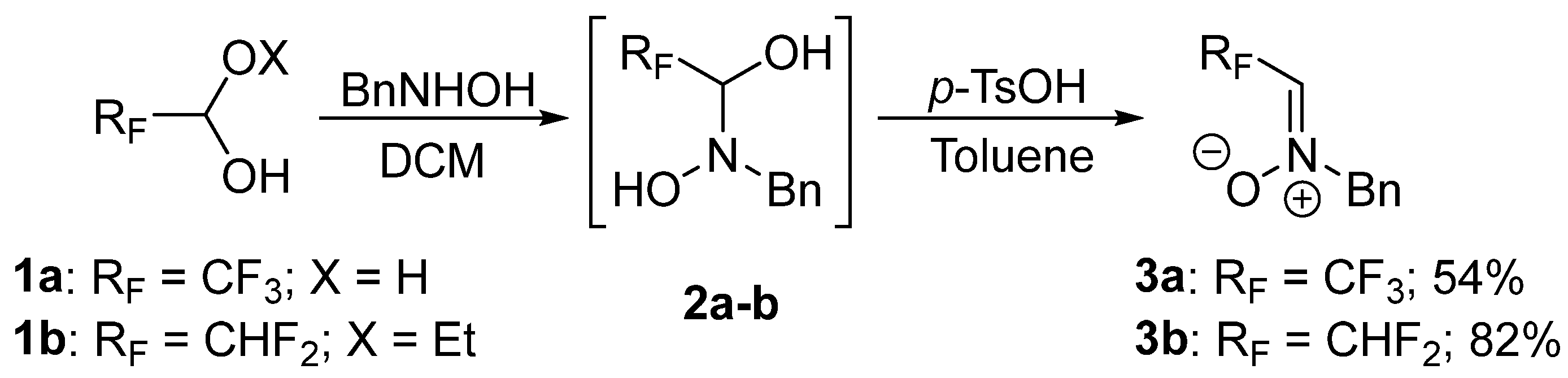
The key starting materials, i.e., the nitrones 3a,b, were obtained according to a previously published procedure involving the reaction of the appropriate hydroxylamine with trifluoroacetaldehyde hydrate or difluoroacetaldehyde ethyl hemiacetal (Scheme 1) [14,15,16].

2.1. Additions of Acetylenes to Fluorinated Nitrones

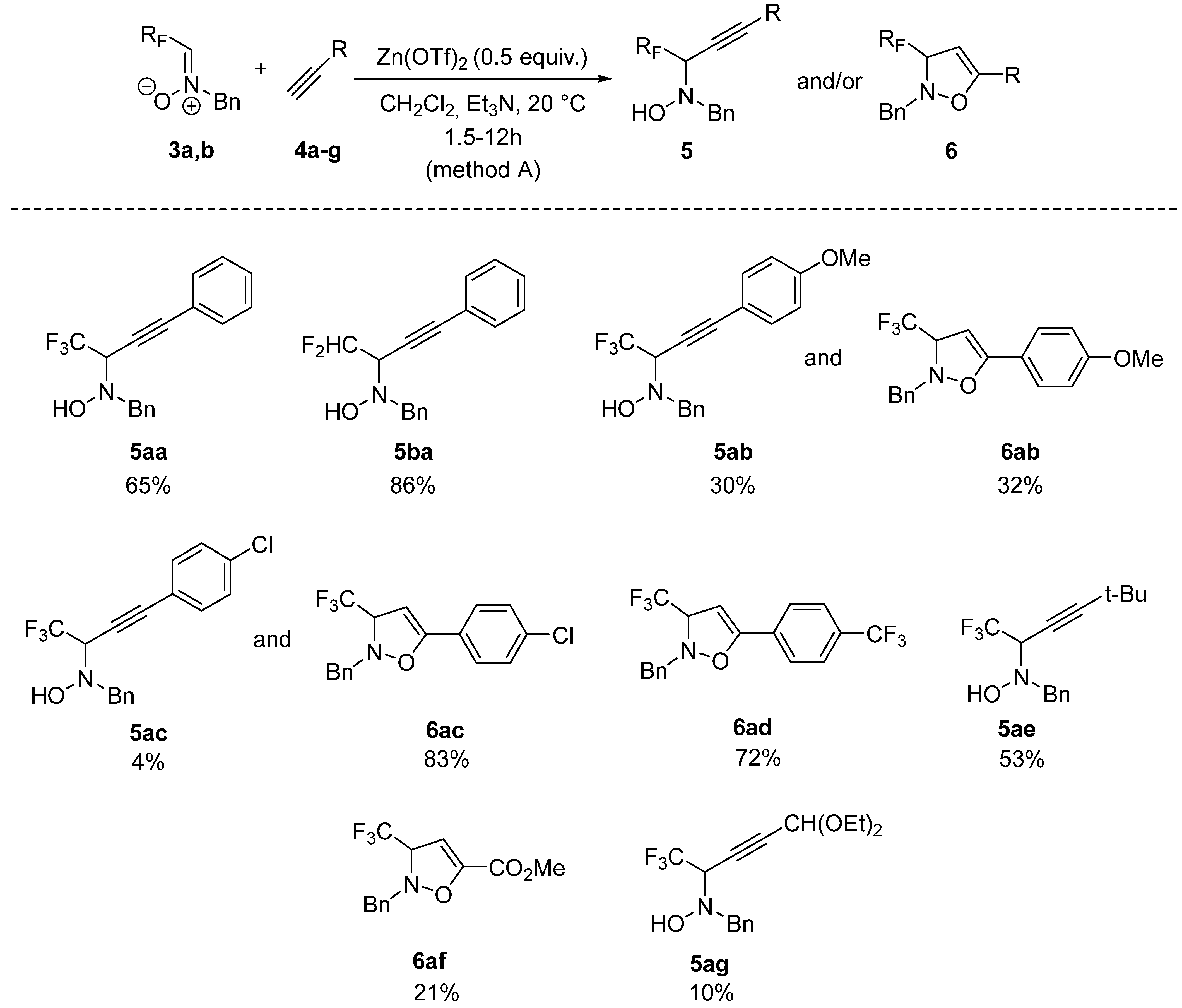
The goal of the studies was to investigate the scope and application of additions of diverse acetylenes to nitrones derived from fluorinated aldehydes and the elaboration of enantioselective protocol of this reaction. In the course of experimental work two procedures previously described in the literature for non-fluorinated substrates were applied [7,22]. Method A was based on the reaction of an appropriate nitrone with acetylene in the presence of zinc triflate and triethylamine [22]. The optimization of the amount of reagents used was performed for model substrates 3a and 4a. As described in the literature, it was noted that to obtain satisfactory reaction yields, a 2–3-fold excess of acetylene 4a should be used.
The optimal amount of Zn(OTf)2 was 0.5 equivalents relative to the amount of used nitrone of type 3. The application of larger amounts (eg. 1.2 equiv) of this catalyst did not significantly change the yield or the proportion of obtained products. Reactions of the N-alkyl-C-(fluoroalkyl) nitrones 3a,b with the acetylenes 4a-g were performed under optimized conditions (Scheme 2). The reaction time was monitored by TLC (the disappearance of the spot from the substrate was followed) and it varied (1.5–12 h) depending on the type of substituents in the used substrates. Longer reaction times were observed for substrates containing sterically hindered substituents or an electron-donating group on the aromatic ring. The change of the CF3 substituent to CHF2 in the molecule of the starting nitrone 3 did not change the reaction time, but the hydroxylamine 5ba was isolated with a higher yield than product 5aa. In the case of using phenylacetylene 4b having an OMe substituent in the aryl ring, isoxazoline 6ab and the expected hydroxylamine 5ab were isolated as products in similar amounts. The incorporation of the electron-withdrawing Cl or CF3 group to the phenyl ring resulted in obtaining isoxazolines 6ac and 6ad as a major or sole product. A similar result was observed in the case of using methyl propiolate (4g) as a substrate. In the case of acetylene bearing a tert-butyl substituent, adduct 5ae was isolated in comparable yield to that obtained in the reaction with 4a. Using acetylenes 4h-k with more complex substituents (CH(OMe)2, P(O)(OEt)2, piryd-2-yl, CH2OSiMe3), the expected products were obtained in low yields, or no product could be identified or isolated in pure form.
In the summary of this part of the research, it can be stated that the additions of acetylenes 4 to fluorinated nitrones 3 performed in the presence of zinc triflate did not lead to hydroxylamines 5 satisfactory results (in terms of hydroxylamine formation). Only in the case of using acetylenes with an alkyl or an unsubstituted phenyl ring attached to the carbon atom of a triple bond, the yields were satisfying. Therefore, carrying out the reaction under these conditions cannot be considered as a good general method for obtaining the expected fluorinated hydroxylamines of type 5.
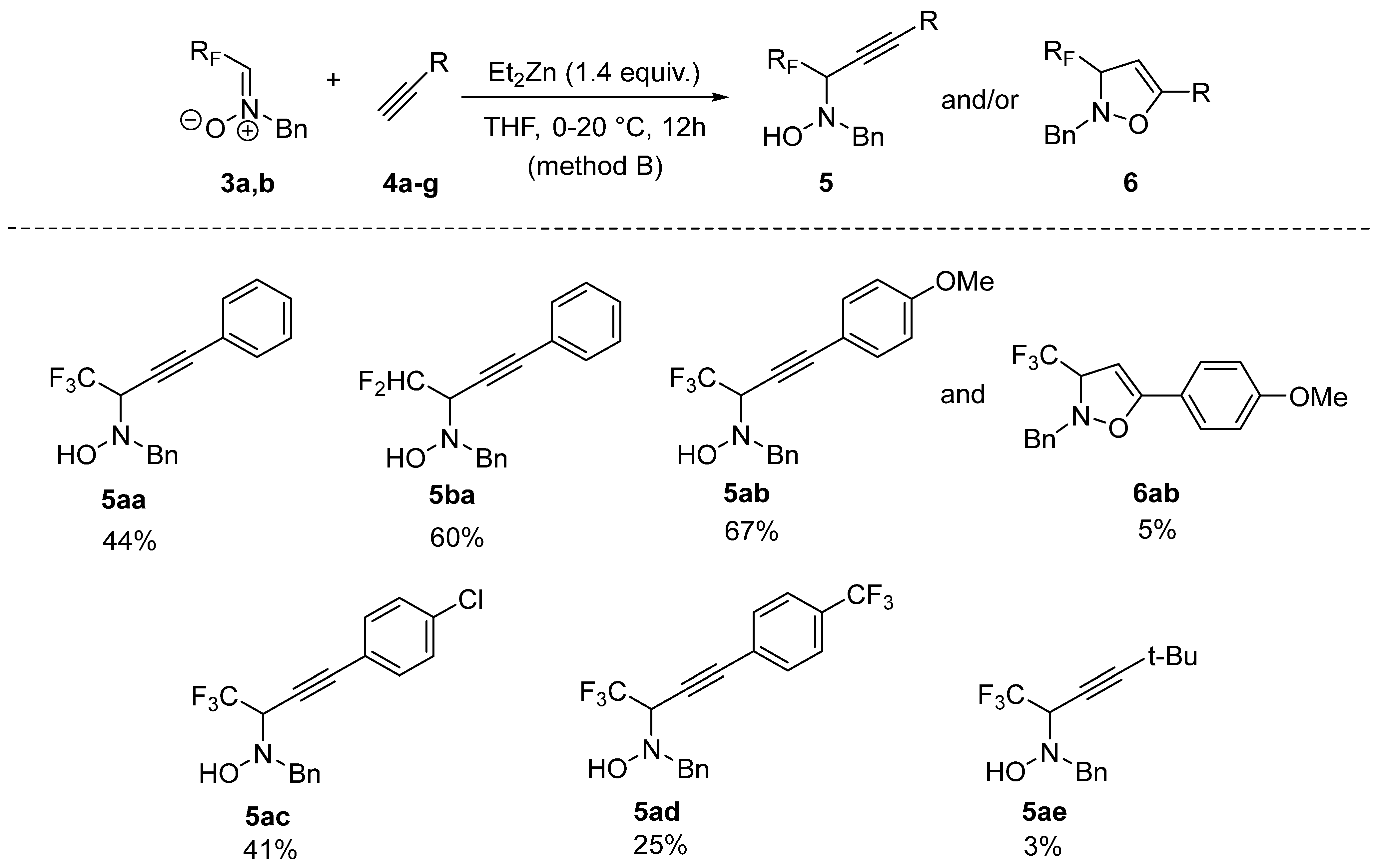
Due to unsatisfactory results of the reaction between C-(fluoroalkyl) nitrones of type 3 and acetylenes 4 obtained in the presence of a catalytic amount of Zn(OTf)2, it was decided to test other reaction conditions [7]. Additions were performed with a slight excess of substituted alkynylzinc generated using a stoichiometric amount of diethylzinc and the corresponding acetylenes 4a-k (Scheme 3). It has been observed that the reactions conducted under these conditions give better results in terms of selectivity of obtained hydroxylamines 5 from aromatic acetylenes. It was noticed that in the case of the usage of acetylenes 4c,d bearing electron-withdrawing substituents (Cl, CF3) in the aryl ring as substrates, the hydroxylamines 5 were isolated with lower yields than in reactions with acetylenes 4a,b bearing an unsubstituted phenyl ring or electron-donating group attached to aryl ring. Unfortunately, the reaction carried out with the usage of the acetylene having a sterically hindered t-Bu substituent led to the formation of desired product 5ae in trace amount. In the case of using of acetylenes containing substituents such as CH(OEt)2, CH2OSiMe3, CO2Me, P(O)(OEt)2, piryd-2-yl attached to the carbon atoms of a triple bond formation of unidentified decomposition products was observed.
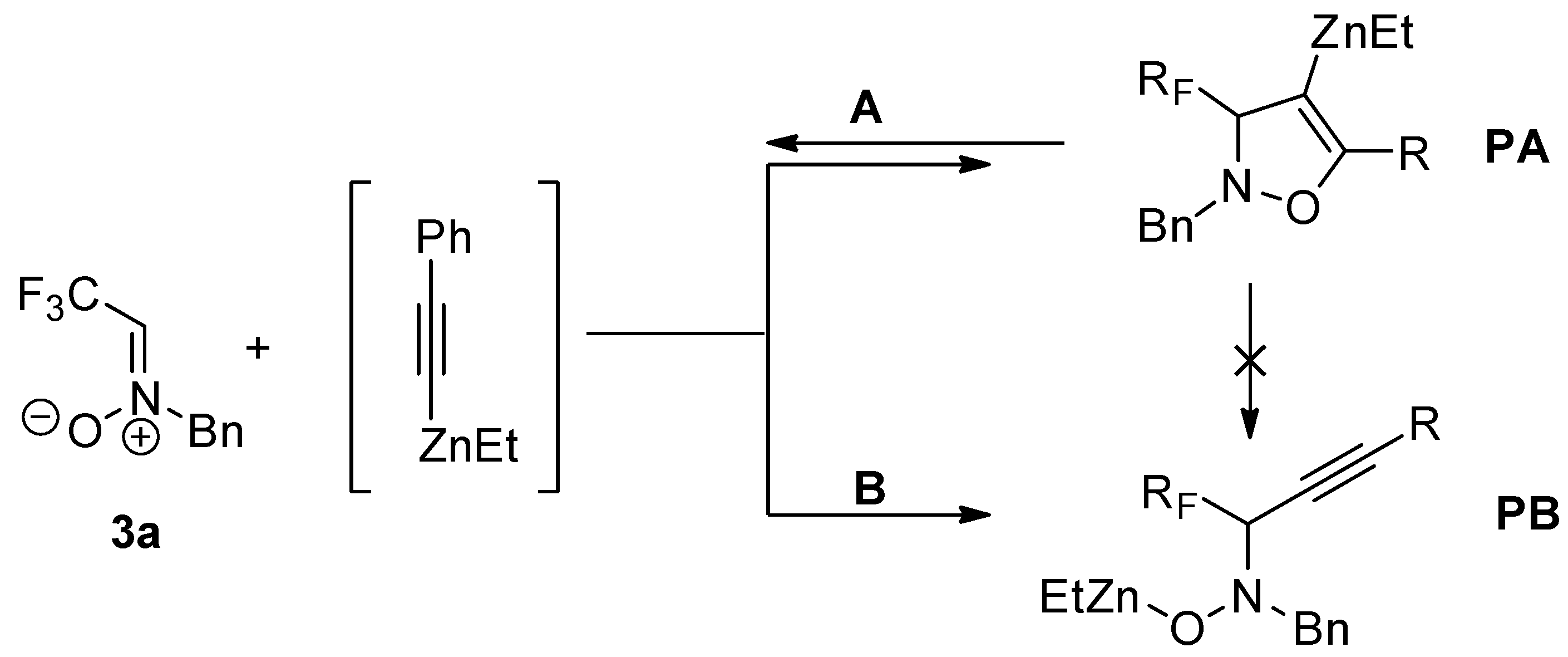
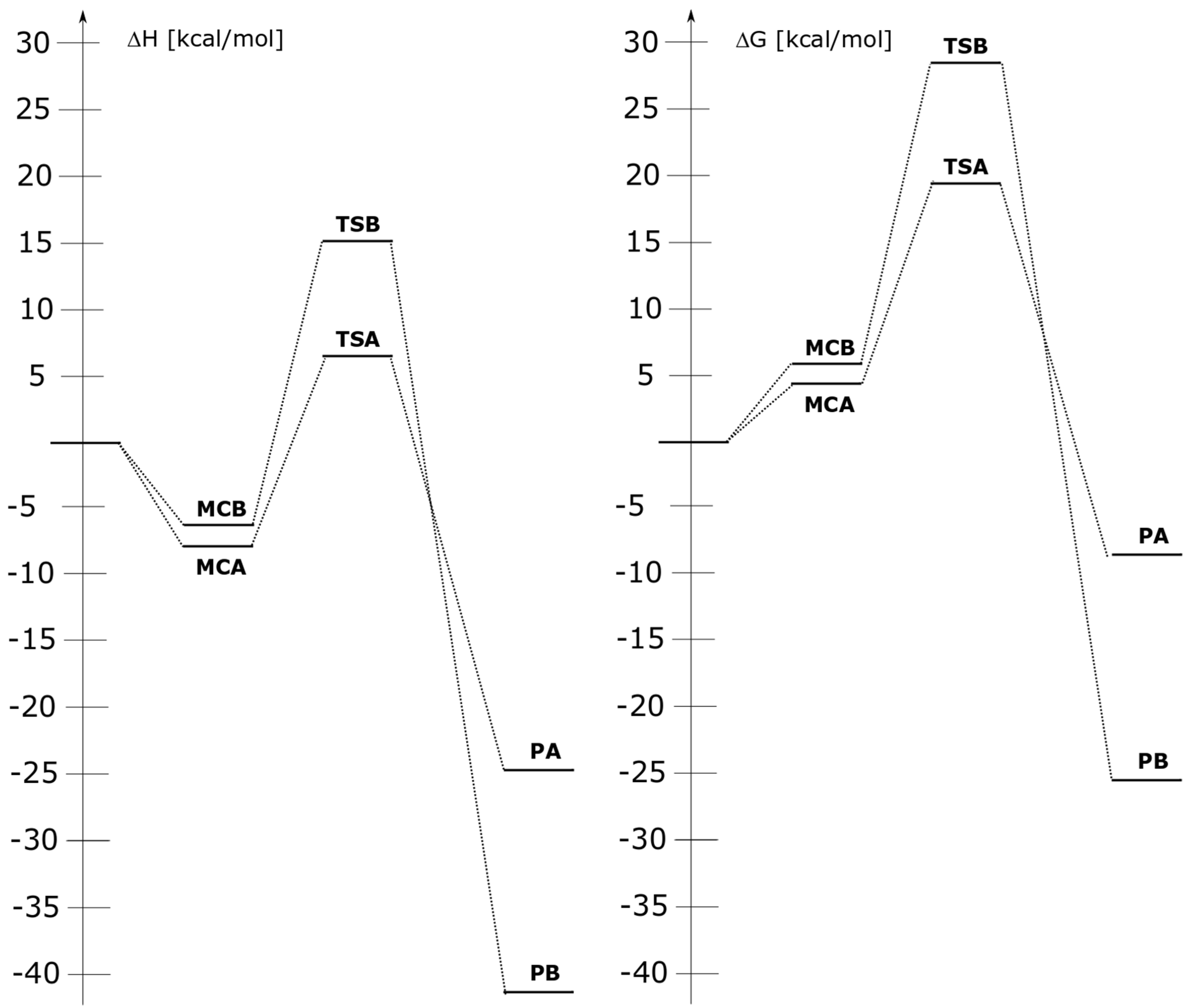
The observed composition of postreaction mixtures can be explained on the basis of the comprehensive quantum chemical analysis of the reaction mechanism (Figure 1 and Figure 2; Scheme 4). For this purpose, results from the wb97xd/6-311+G(d) (PCM) computational study were used. Within these considerations, the addition process between nitrone 3a and (2-phenyletynyl)zinc (Scheme 4) was used. This step is crucial because it is known from the literature that the energy of formation of (2-phenyletynyl)zinc from phenylacetylene 4a and diethylzinc is negligible and does not limit the addition process [21,23].
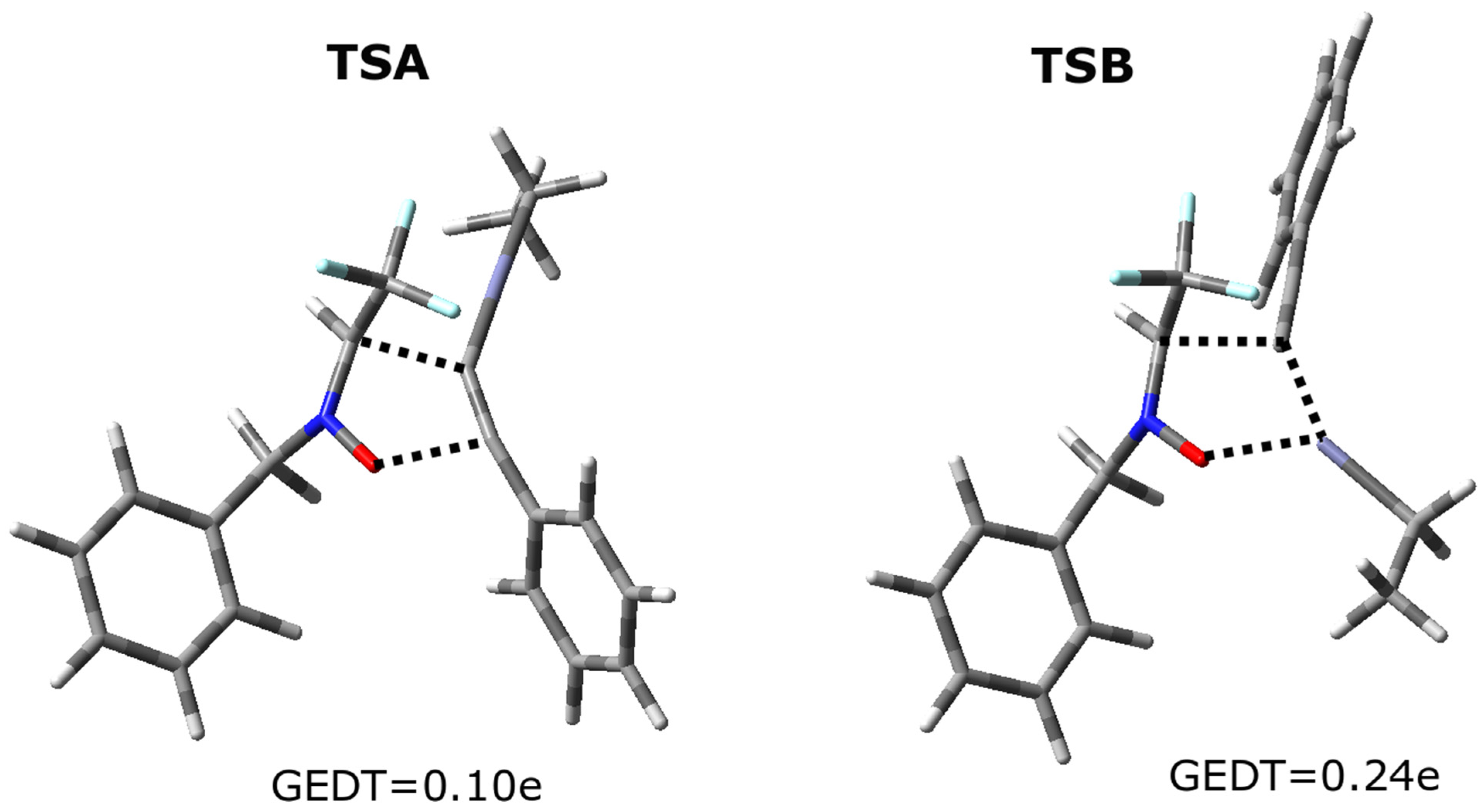
Independently of the reaction path, the initial interactions between reagents lead to the formation of respective pre-reaction complex (MCA and MCB for paths A and B, respectively). This is connected with the decreasing of the enthalpy of reaction system about few kcal/mol. The entropic factor determines however, positive values of the Gibbs free energy for considered transformations. This excludes the existence of MCs as relatively stable intermediates. Within MCs, substructures of addents adopts the orientation determined the further course of transformation. It should be underlined, that any new bonds are not formed however at this stage. Next, the key interatomic distances exist beyond of the range typical for respective bonds within transition states [24]. Lastly, the electron density transfer (GEDT) between structures is not observed within both MCs. So, the localized structures can be considered as orientation, but not charge-transfer complexes [25]. The further transformation of MCs along the reaction coordinate leads to the area associated with the existence of the transition state (TSA and TSB for paths A and B, respectively). The clear increase in the energy of the reaction system is a consequence of this process. It is interesting that the favored from the kinetic point of view is the formation of the isoxazoline-type adduct via TSA. The structure of this TS is typical for the one-step [3 + 2] cycloaddition process with the participation of bent-type TACs [26,27,28] and exhibits a moderately polar nature (GEDT = 0.10e). For the contrast, the less kinetic favored TSB is evidently more polar (GEDT = 0.24e). Both TSs are connected directly with respective valleys of adducts. So, all new sigma-bonds must be formed at this stage. This was confirmed by the IRC analysis. Analysis of thermochemistry of products derived from IRC experiments show clearly that, from a thermodynamic point of view, the more favored is not [3 + 2] cycloaddition product (PA), but hydroxylamine derivative PB. So, in the light of our DFT computational study, the isoxazoline-type adduct should be treated as the primary reaction product, which is further converted to the more thermodynamically stable hydroxylamine-type product. It should be underlined-that the conversion of PA in PB is realized via dissociation to the individual nitrone–acetylene pair, and next, via the secondary addition according to the path B. All attempts for the localization of reaction channel leading directly from the PA in PB were not successful.
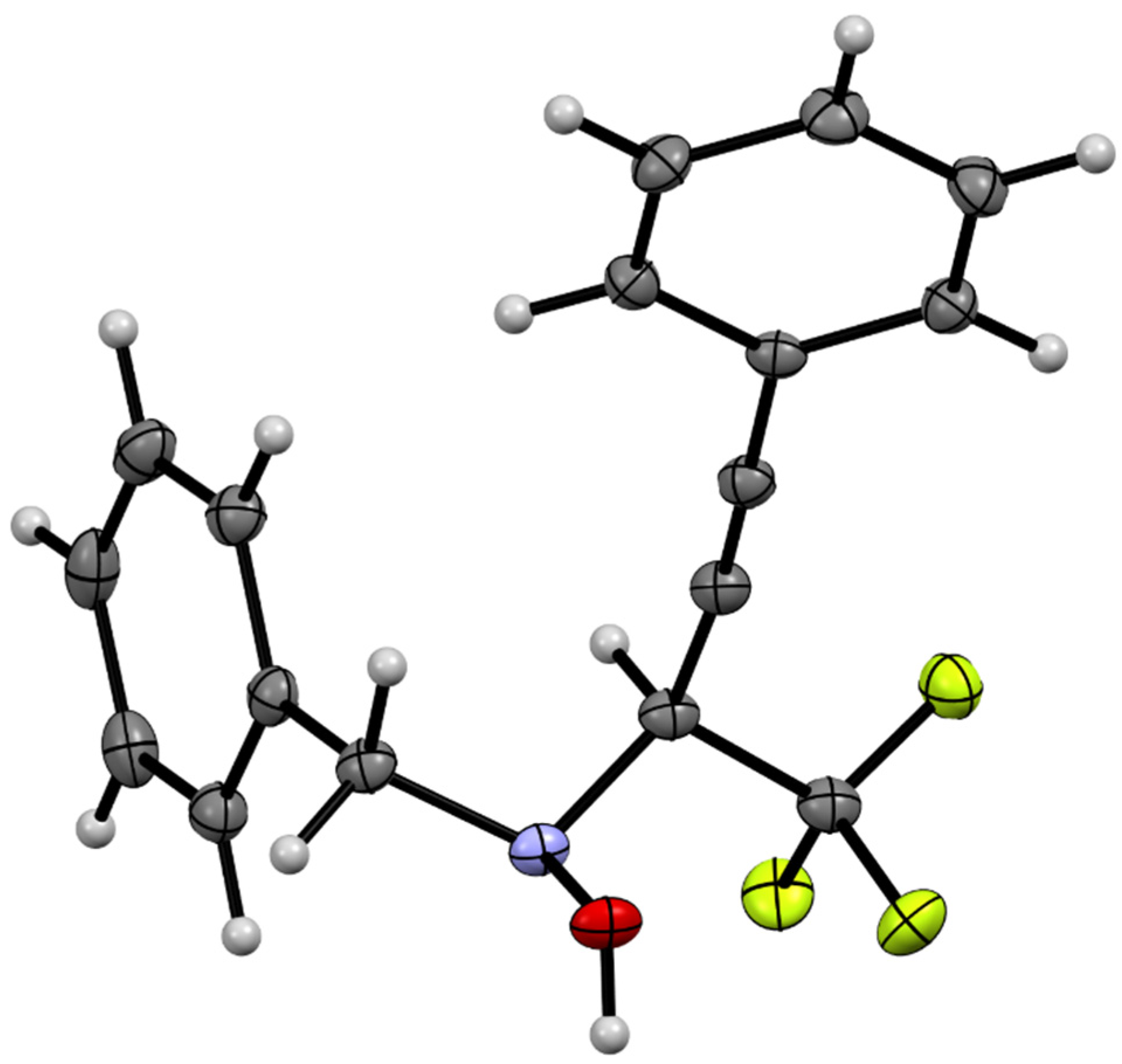
The structures of all products were confirmed by spectroscopic methods. For example, a shift in the characteristic quartet derived from the hydrogen atom of the CH group from 6.87 ppm (3a) to 4.33 ppm (5aa) was observed in the 1H-NMR spectrum. Additionally, a singlet derived from the dynamic proton of the OH group (5.12 ppm) and two doublets (4.01 and 4.27 ppm) from the diastereotopic CH2 protons of the benzyl group in 1H-NMR spectrum of 5aa appeared. Also, in the 13C-NMR spectrum, a shift in the quartet derived from the carbon atom of the C=N bond of the nitrone 3a (122.6 ppm) to the region characteristic for the signals of the C-sp3 atom in the product molecule 5aa (60.7 ppm) was observed. In the case of the 1H-NMR spectrum of an exemplary oxazoline 6ab, the lack of a singlet derived from a proton of OH group was noticed. Instead, there was a doublet derived from olefinic proton of oxazoline ring (5.01 ppm). In addition, the signal of the proton of the CHCF3 group appeared in the form of a doublet of quartet at 4.43 ppm, which proves that there is a coupling with three fluorine atoms and with an olefinic proton. Also in the 13C-NMR spectrum recorded for 6ab was a shift in the signals from carbon atoms of C≡C bond of hydroxylamine 5ab occurring in the region characteristic for the signals of the C-sp atoms (75.0 and 89.5 ppm) to the region characteristic for the signals of the C-sp2 atoms (83.4 and 157.4 ppm) in the product molecule 6ab. Eventually, the structure of the obtained hydroxylamines of type 5 was confirmed by an X-ray structure registered for one product 5aa (Figure 3).

2.2. Enantioselective Protocol

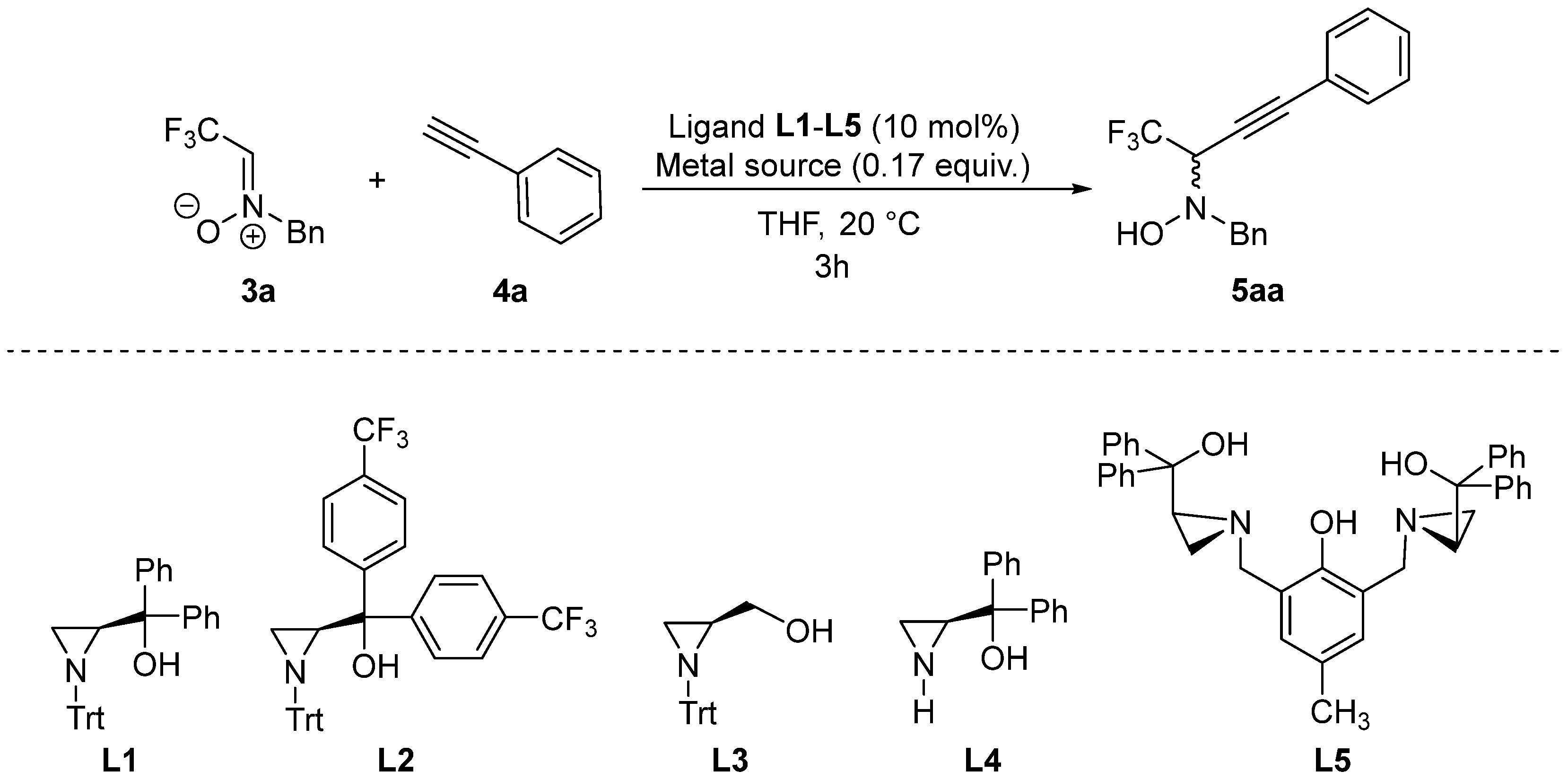
Due to the better results of reactions carried out with the use of Et2Zn, the enantioselective protocol was also optimized with the use of this reagent. To this end, several ligands previously proven to be efficient in asymmetric catalysis were examined [29,30,31,32]. Our initial investigation began by testing several catalysts bearing the chiral aziridine ring reacting in situ with ZnEt2 to evaluate their catalytic ability. The optimization of the enantioselective addition of phenylacetylene 4a to nitrone 3a started with the screening of several chiral aziridine alcohols L1-L5 which were synthesized as previously described (Scheme 5) [32,33,34]. Table 1 summarizes the comparison of the results obtained for various chiral ligands. The simple β-amino alcohol catalysts L1-L4 exhibited poor enantioselectivity. Fortunately, the ligand screening compromised that the AziPhenol ligand L5 provided the best results in terms of both the yield and enantioselectivity, and the desired product was isolated in 67% yield and 44% ee. When the metal source was changed from ZnEt2 to Zn(OTf)2, a pronounced decrease in both the yield and enantiomeric excess was observed (Table 1, entry 6). Consequently, the most efficient ligand L5 was selected for further optimization involving solvent, temperature, catalyst loading, and additive effects.
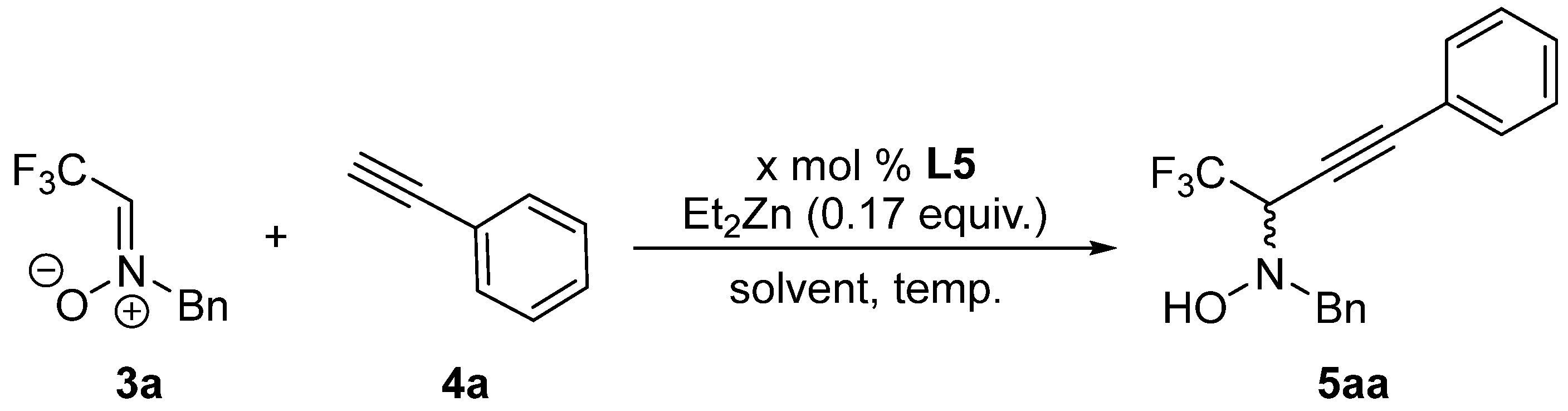
The initial studies towards the development of efficient conditions began with the evaluation of various solvents (Scheme 6). The screening of a variety of solvents including toluene, dichloromethane (DCM) and diethyl ether (Et2O) was performed (Table 2, entries 2–4). The reactions carried out in halogenated and aromatic solvents, such as dichloromethane and toluene, proceeded in good yields, but significantly lower enantioselectivity was observed. As shown in Table 2, the use of THF afforded superior results with respect to the yield and enantiomeric excess (entry 1) compared with the other solvents examined (entries 2–4). Subsequently, the catalyst loading amount and reaction temperature were also screened. Temperature was shown to have a significant effect on the yields and enantioselectivity (Table 2, entries 5–7). Decreasing the reaction temperature from 20 °C to −20 °C improved both the yield and stereoselectivity of the product 5aa formation; however, it also resulted in a longer reaction time. Additionally, lowering the temperature to −78 °C caused a small decrease in yield and ee of product 5aa. No significant changes in the stereoselectivities of the reaction were observed when a 20 mol % catalyst was used (Table 2, entry 8). Reducing the catalyst loading to 5 mol% caused a slight decrease in both the yield and enantiomeric excess of the product, and a longer reaction time was required. It revealed that 10 mol% of ligand is necessary for optimal yield and enantioselectivity. Further optimization aimed at improving catalytic activity revealed that 4 Å molecular sieves significantly influenced both the reactivity and stereoselectivity of the system. Such additives are known to play a crucial role in numerous zinc-catalyzed asymmetric transformations [35,36]. To our great delight, when 4 Å molecular sieves were added to the reaction, the conversion and enantioselectivity were enhanced; the desired product was obtained in 80% yield and 58% ee. Therefore, the optimized reaction conditions are summarized in entry 10 of Table 2.
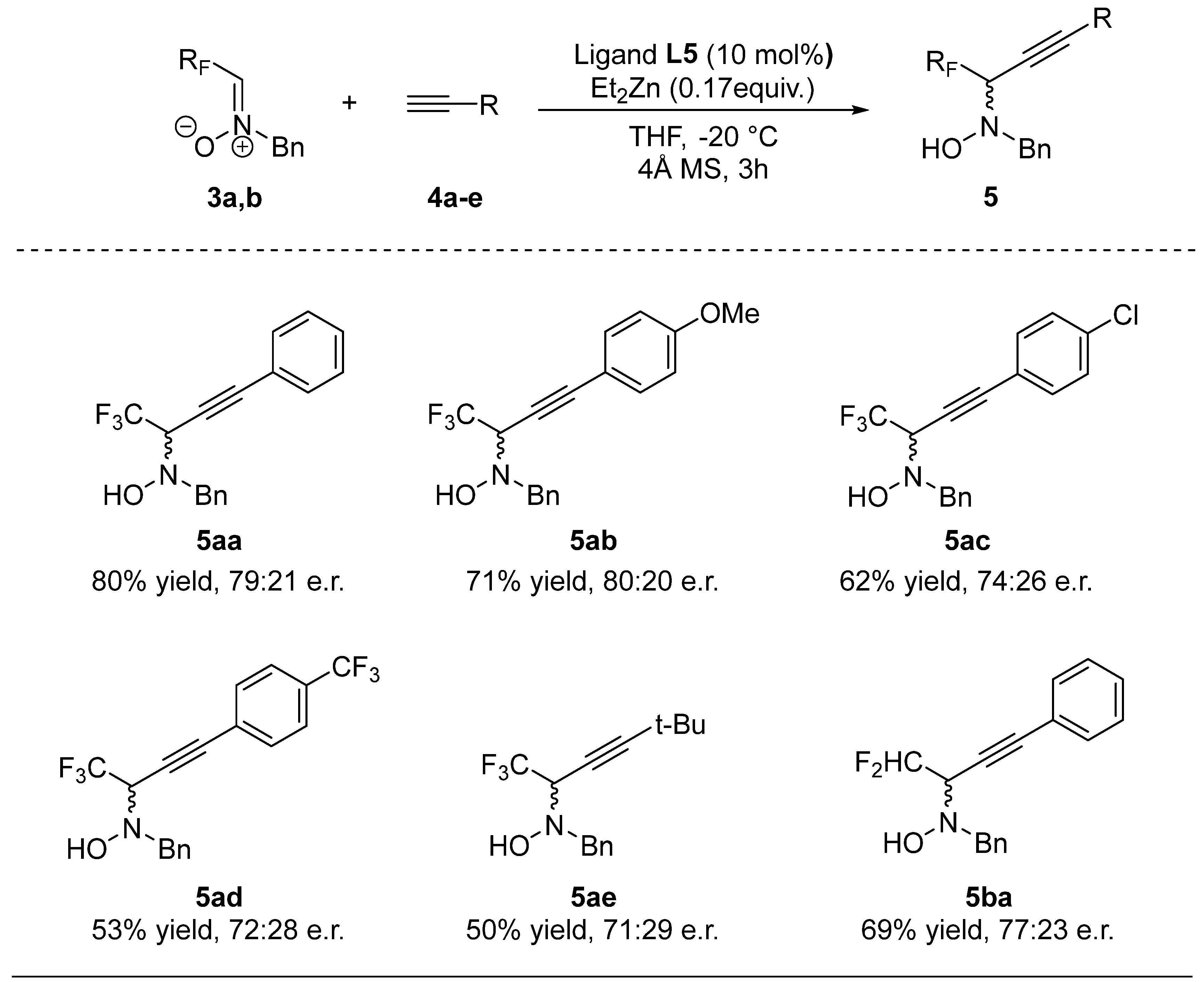
With the optimized reaction conditions in hand, we next examined the substrate scope of the developed protocol (Scheme 7). Regardless of the electronic nature of the substituents on the phenyl ring, the reactions afforded good yields, although variations in enantioselectivity were observed. Substrate 4b, which contained an electron-donating substituent (-OMe) in the para position of the phenyl ring, was well tolerated and led to the desired product in the highest yield and enantioselectivity. It was noticed that in the case of the usage of acetylenes bearing electron-withdrawing substituents (Cl, CF3) in the aryl ring as substrates, the products were isolated in lower yields and enantioselectivities. Surprisingly, in the presence of chiral ligands, the reaction product of acetylene 4e with a sterically hindered t-Bu substituent was obtained in good yield but the decrease in yield and enantioselectivity was observed. However, changing of the CF3 substituent to CHF2 in the starting nitrone 3 resulted in a slight decrease in the yield, but the desired product was isolated with similar enantiomeric excess. In contrast, extending the reaction time to 12 h under the optimized conditions led to the formation of a complex reaction mixture, from which the cyclic products 6aa-6ad were isolated in low yields and with poor enantioselectivity (<10%).

3. Materials and Methods

3.1. General Information

Solvents and chemicals were purchased and used without further purification. Tetrahydrofuran (THF) and toluene (PhMe) were distilled over sodium/benzophenone(violet-colored solution prior to use). Dichloromethane (DCM) was distilled over sodium hydride. Zinc triflate (Zn(OTf)2), diethyl zinc (Et2Zn) (1M solution in hexane), triethylamine (Et3N) and diverse acetylenes were purchased from Sigma-Aldrich (Merck, Poznań, Poland). Obtained products were purified by standard column chromatography on silica gel (230–400 mesh Merck, Poznań, Poland) or FLASH column chromatography using Grace Reveleris X2 apparatus with UV–Vis and ELSD detection (commercially available 12 g SiO2 columns, pressure 20–25 psi, solvent flow rate 25–28 mL/min). Unless stated otherwise, yields refer to analytically pure samples. NMR spectra were recorded with Bruker Avance III 600 MHz (1H NMR [600 MHz]; 13C NMR [151 MHz]; 19F NMR [565 MHz]) instrument. Chemical shifts are reported in ppm relative to solvent residual peaks (1H NMR: δ = 7.26 ppm [CHCl3]; 13C NMR: δ = 77.0 ppm [CDCl3]). For detailed peak assignments 2D (HMQC) spectra were measured. IR Spectra were measured with an Agilent Cary 630 FTIR spectrometer (in neat). MS Spectra were recorded on Varian 500 MS LS IonTrap spectrometer. The HPLC analysis were carried out using an Agilent 1260 Infinity system (Agilent, Waldbronn, Germany)at 25 °C using chiral columns Chiralcel AD and Chiralcel AD-H. Single-crystal XRD measurements were performed with a Rigaku XtaLAB Synergy, Pilatus 300K diffractometer. Melting points were determined in capillaries with a Stuart SMP30 apparatus (Stone, United Kingdom).

3.2. Synthesis of Nitrones Derived from Trifluoroacetaldehyde and Difluoroacetaldehyde

N-Benzyl C-(trifluoromethyl)nitrone (3a) and N-Benzyl C-(difluoromethyl)nitrone (3b) were prepared following the published protocol [14,15,16]. Chiral ligands (L1-L5) were also synthetized according to previously described methods [32,33,34]. More experimental data, e.g., NMR spectra of the products 5,6, chromatograms and RTG structure details of nitrone 3a and hydroxylamine 5aa can be found in Supplementary Material.

3.3. Reactions of Nitrones 3 Derived from Fluorinated Aldehydes with Acetylenes 4

(a) 
Reactions leading to racemic products
Method A—A general procedure: Appropriate acetylene 4a-g (3 mmol) and Et3N (152 mg, 1.5 mmol) were added to a suspension of Zn(OTf)2 (182 mg, 0.5 mmol) in anhydrous DCM (5 mL) placed in a dried round-bottom flask. The reaction was carried out under an inert gas atmosphere (argon). This mixture was magnetically stirred for 20 min at room temperature. Next, a solution of a corresponding nitrone 3a,b (1 mmol) in DCM (1 mL). was added dropwise. The progress of the reaction was controlled by TLC (SiO2; petroleum ether: ethyl acetate 3:2) and reaction completion time varied (1.5 h–12 h). Then a saturated NH4Cl solution was added to the reaction mixture. The organic layer was separated, and water layer was extracted with DCM (3 × 15 mL). Combined organic layers were dried over anhydrous Na2SO4 and filtrated. Next, the solvent was evaporated under reduced pressure. Products were purified by automated flash chromatography (SiO2 12 g cartridges; petroleum ether with increasing amount of DCM (0–60%) as an eluent).
Method B—A general procedure: Appropriate acetylene 4a-g (1.4 mmol) was added to a solution of diethylzinc (1.4 mmol) in anhydrous THF placed in a dried round-bottom flask. The reaction was carried out under an inert gas atmosphere (argon). This mixture was magnetically stirred for 20 min at room temperature. Then the flask was placed in an ice bath (~0 °C) and next a solution of a corresponding nitrone 3a,b (1 mmol) in THF (1 mL) was added dropwise. The progress of the reaction was controlled by TLC (SiO2; petroleum ether: ethyl acetate 3:2) and the time of completion of the reaction was about 12 h. Then a saturated NH4Cl solution was added to the reaction mixture. The organic layer was separated, and water layer was extracted with DCM (3 × 15 mL). Combined organic layers were dried over anhydrous Na2SO4 and filtrated. Next, the solvent was evaporated under reduced pressure. Products were purified by automated flash chromatography (SiO2 12 g cartridges; petroleum ether with increasing amount of DCM (0–60%) as an eluent). Analytically pure products were, in most cases, obtained by crystallization from an appropriate solvent.
N-Benzyl-N-(1,1,1-trifluoro-4-phenylbut-3-yn-2-yl)hydroxylamine (5aa). Yield: 198 mg (65%) (for method A), 134 mg (44%) (for method B); colorless crystals, m.p. 102–104 °C (DCM/petroleum ether). 1H NMR (600 MHz, CDCl3): δ 4.01, 4.27 (2d, 2H, 2JH,H = 12.84 Hz, CH2Ph), 4.33 (q, 1H, 3JH,F = 6.84 Hz, CH), 5.12 (s, 1H, OH), 7.32–7.43 (m, 8 arom. H), 7.56–7.59 (m, 2 arom. H) ppm. 13C NMR (150 MHz, CDCl3): δ 60.7 (q, 2JC,F = 31.5 Hz, CH), 62.2 (CH2Ph), 76.5 (q, 3JC,F = 3,0 Hz, C≡CPh), 89.5 (C≡CPh), 121.6, 135.9 (2 arom. C), 123.1 (q, 1JC,F = 279.0 Hz, CF3), 128.0, 128.4, 128.6, 129.2, 129.4, 132.2 (10 arom. CH) ppm. 19F NMR (565 MHz, CDCl3): δ −71.47 (d, 3F, 3JF,H = 6.84 Hz, CF3) ppm. IR: v 3275m (O-H), 2879w, 1491w, 1463w, 1359m, 1289m, 1187s, 1139vs, 1075s, 1030m, 818s, 751vs, 689vs cm−1. ESI-MS (m/z): 306 (60, [M+H]+), 328 (100, [M+Na] +). Elemental analysis for C17H14F3NO (305.3) calculated: C 66.88, H 4.62, N 4.59; found: C 66.90, H 4.58, N 4.83.
N-Benzyl-N-(1,1-difluoro-4-phenylbut-3-yn-2-yl)hydroxylamine (5ba). Yield: 247 mg (86%) (for method A), 172 mg (60%) (method B); colorless crystals m.p. 85–87 °C (DCM/petroleum ether). 1H NMR (600 MHz, CDCl3): δ 3.99, 4.23 (2d, 2H, 2JH,H = 12.84 Hz, CH2Ph), 4.04–4.09 (m, 1H, CH), 5.06 (s, 1H, OH), 6.01 (dt, 1H, 3JH,H = 5.10 Hz, 2JH,F = 56.05 Hz, CHF2), 7.31–7.42 (m, 8 arom. H), 7.55–7.57 (m, 2 arom. H) ppm. 13C NMR (150 MHz, CDCl3): δ 61.6 (t, 2JC,F = 25.5 Hz, CH), 62.3 (CH2Ph), 78.6 (dd, 3JC,F = 3.0 Hz, C≡CPh), 89.4 (C≡CPh), 113.7 (dd, 1JC,F(1) = 243.0 Hz, 1JC,F(2) = 244.5 Hz, CHF2), 121.9, 135.9 (2 arom. C) 128.0, 128.4, 128.6, 129.0, 129.6, 132.1 (10 arom. CH) ppm. 19F NMR (565 MHz, CDCl3): δ −125.22 (ddd, 1F, 3JF(1),H = 10.79 Hz, 2JF(1),H = 56.05 Hz, 2JF,F = 284.15 Hz, CHF2), −121.55 (ddd, 1F, 3JF(2),H = 8.02 Hz, 2JF(2),H = 56.50 Hz, 2JF,F = 284.15 Hz, CHF2) ppm. IR: v 3237m (O-H), 2876w, 1491w, 1444m, 1384m, 1109s, 1087s, 1060s, 689vs, 540vs cm−1. ESI-MS (m/z): 288 (45, [M+H]+), 310 (100, [M+Na]+). Elemental analysis for C17H15F2NO (287.3) calculated: C 71.07, H 5.26, N 4.88; found: C 71.26, H 5.02, N 5.17.
N-Benzyl-N-[1,1,1-trifluoro-4-(4′-methoxyphenyl)but-3-yn-2-yl]hydroxylamine (5ab). Yield: 101 mg (30%) (method A), 225 mg (67%) (method B); colorless crystals, m.p. 102–104 °C (Et2O/petroleum ether). 1H NMR (600 MHz, CDCl3): δ 3.84 (s, 3H, OCH3), 3.99, 4.24 (2d, 2H, 2JH,H = 12.78 Hz, CH2Ph), 4.31 (q, 1H, 3JH,F = 6.84 Hz, CH), 5.22 (br.s, 1H, OH), 6.87–6.89 (m, 2 arom. H), 7.31–7.34 (m, 1 arom. H), 7.36–7.38 (m, 2 arom. H), 7.41–7.42 (m, 2 arom. H), 7.50–7.51 (m, 2 arom. H) ppm. 13C NMR (150 MHz, CDCl3): δ 55.3 (OCH3), 60.7 (q, 2JC,F = 31.5 Hz, CH), 62.2 (CH2Ph), 75.0 (C≡CPh), 89.5 (C≡CPh), 113.5, 135.8, 160.2 (3 arom. C), 114.0, 128.0, 128.7, 129.4, 133.7 (9 arom. CH) ppm. 19F NMR (565 MHz, CDCl3): δ −71.58 (d, 3F, 3JF,H = 6.84 Hz, CF3) ppm. IR: v 3269m (O-H), 3026w, 2933w, 2885w, 2236w, 1610m, 1513s, 1454m, 1357m, 1271s, 1174s, 1133vs, 1000s, 972w, 827vs, 760s cm−1. ESI-MS (m/z): 336 (100, [M+H]+). Elemental analysis for C18H16F3NO (335.1) calculated: C 64.47, H 4.81, N 4.18; found: C 64.47, H 4.92, N 4.47.
2-Benzyl-5-(4′-methoxyphenyl)-3-(trifluoromethyl)-2,3-dihydroizoxazole (6ab). Yield: 107 mg (32%) (method A); 17 mg (5%) (method B); colorless crystals; m.p. 84–85 °C (Et2O/petroleum ether). 1H NMR (600 MHz, CDCl3): δ 3.83 (s, 3H, CH3), 4.02, 4.38 (2d, 2H, 2JH,H = 12.80 Hz, CH2Ph), 4.43 (dq, 1H, 3JH,H = 2.90 Hz, 3JH,F = 6.50 Hz, CHCF3), 5.01 (d, 1H, 3JH,H = 2.90 Hz, C=CH), 6.94–6.85 (m, 2 arom. H), 7.40–7.29 (m, 3 arom. H), 7.45–7.40 (m, 2 arom. H), 7.53–7.45 (m, 2 arom. H) ppm. 13C NMR (150 MHz, CDCl3): δ55.5 (CH3), 63.7 (CH2Ph), 70.8 (q, 2JC,F = 32.3 Hz, CHCF3), 83.4 (q, C=CH), 114.1, 127.8, 128.2, 128.7, 129.8 (9 arom. CH), 124.2 (q, 1JC,F = 282.0 Hz, CF3), 120.1, 134.9, 161.0 (3 arom. C), 157.4 (C=CH) ppm. 19F NMR (565 MHz, CDCl3): δ −77.78 (d, 3F, 3JF,H = 6.50 Hz, CF3) ppm. IR: v 3034w, 2974w, 2940w, 2847w, 1662m, 1606m, 1513m, 1457w, 1428w, 1375w, 1256s, 1167s, 1126vs, 1047m, 1021m, 880m, 834m cm−1. ESI-MS (m/z): 336 (100, [M+H]+). Elemental analysis for C18H16F3NO (335.1) calculated: C 64.47, H 4.81, N 4.18; found: C 63.39, H 6.39, N 14.97.
N-Benzyl-N-[1,1,1-trifluoro-4-(4′-chlorophenyl)but-3-yn-2-yl]hydroxylamine (5ac). Yield: 14 mg (4%) (method A), 139 mg (41%) (method B); colorless crystals, m.p. 78–80 °C (Et2O/petroleum ether) 1H NMR (600 MHz, CDCl3): δ 3.99, 4.24 (2d, 2H, 2JH,H = 12.78 Hz, CH2Ph), 4.31 (q, 1H, 3JH,F = 6.84 Hz, CH), 5.21 (s, 1H, OH), 7.32–7.41 (m, 7 arom. H), 7.48–7.50 (m, 2 arom. H) ppm. 13C NMR (150 MHz, CDCl3): δ 60.6 (q, 2JC,F = 31.6 Hz, CH), 62.2 (CH2Ph), 77.6 (C≡CPh), 88.2 (C≡CPh), 120.0, 135.3, 135.7 (3 arom. C), 123.0 (q, 1JC,F = 279.2 Hz, CF3), 128.1, 128.6, 128.7, 129.4, 133.4 (9 arom. CH) ppm. 19F NMR (565 MHz, CDCl3): δ −71.41 (d, 3F, 3JF,H = 6.84 Hz, CF3) ppm. IR: v 3273m (O-H), 2877w, 2225w, 1490s, 1457m, 1394m, 1349s, 1263s, 1185s, 1133vs, 1085vs, 1006s, 972m, 920m, 979m, 820s, 753s, 700s cm−1. ESI-MS (m/z): 340 (100, [MCl-35+H]+), 342 (36, [M Cl-37+H]+). Elemental analysis for C17H13ClF3NO (339.7) calculated: C 60.10, H 3.86, N 4.12; found: C 60.00, H 3.78, N 4.42.
2-Benzyl-5-(4′-chlorophenyl)-3-(trifluoromethyl)-2,3-dihydroizoxazole (6ac). Yield: 302 mg (89%) (method A); colorless crystals; m.p. 116–117 °C (Et2O/petroleum ether). 1H NMR (600 MHz, CDCl3): δ 4.04, 4.37 (2d, 2H, 2JH,H = 12.90 Hz, CH2Ph), 4.47 (dq, 1H, 3JH,H = 2.90 Hz, 3JH,F = 6.50 Hz, CHCF3), 5.14 (d, 1H, 3JH,H = 2.90 Hz, C=CH), 7.39–7.32 (m, 5 arom. H), 7.42–7.40 (m, 2 arom. H), 7.50–7.46 (m, 2 arom. H) ppm. 13C NMR (150 MHz, CDCl3): δ 63.8 (CH2Ph), 70.8 (q, 2JC,F = 32.5 Hz, CHCF3), 86.0 (q, 3JC,F = 1.5 Hz, C=CH), 124.0 (q, 1JC,F = 280.2 Hz, CF3), 126.0, 134.6, 136.1 (3 arom. C), 127.5, 128.3, 128.7, 129.0, 129.8 (10 arom. CH), 156.6 (C=CH) ppm. 19F NMR (565 MHz, CDCl3): δ −71.32 (d, 3F, 3JF,H = 6.50 Hz, CF3) ppm. IR: v 3127w, 3090w, 3034w, 2959w, 2896w, 2840w, 1651w, 1490m, 1453w, 1375m, 1341m, 1275s, 1222m, 1163s, 1129vs, 1085m, 1039m, 1010m, 879m, 834m, 798m cm−1. ESI-MS (m/z): 340 (100, [MCl-35+H]+), 342 (28, [MCl-37+H]+). Elemental analysis for C17H13ClF3NO (339.7) calculated: C 60.10, H 3.86, N 4.12; found: C 60.06, H 3.87, N 4.28.
N-Benzyl-N-[1,1,1-trifluoro-4-(4′-trifluoromethylphenyl)but-3-yn-2-yl]hydroxylamine (5ad). Yield: 93 mg (25%) (method B); colorless crystals; m.p. 101–103 °C (Et2O/petroleum ether). 1H NMR (600 MHz, CDCl3): δ 4.00, 4.26 (2d, 2H, 2JH,H = 12.84 Hz, CH2Ph), 4.33 (q, 1H, 3JH,F = 6.84 Hz, CH), 5.16 (s, 1H, OH), 7.32–7.42 (m, 5 arom. H), 7.62–7.63 (m, 2 arom. H), 7.66–7.67 (m, 2 arom. H) ppm. 13C NMR (150 MHz, CDCl3): δ 60.5 (q, 2JC,F = 31.7 Hz, CH), 62.3 (CH2Ph), 79.2 (q, 3JC,F = 1.5 Hz, C≡CPh), 87.8 (C≡CPh), 123.0 (q, 1JC,F = 279.3 Hz, CF3), 123.7 (q, 1JC,F = 270.5 Hz, CF3), 125.3 (q, 3JC,F = 7.5 Hz, 2 arom. CH), 128.1, 128.7, 129.4, 132.5 (9 arom. CH), 130.9 (q 2JC,F = 7.5 Hz, 1 arom. C), 135.6 (1 arom. C) ppm. 19F NMR (565 MHz, CDCl3): δ −62.90 (s, 3F, 3JF,H = 6.84 Hz, CF3), −77.53 (d, 3F, 3JF,H = 6.84 Hz, CHCF3) ppm. IR: v 3422m (O-H), 3272w, 1618m, 1457m, 1405m, 1327s, 1275s, 1174s, 1126vs, 1003vs, 1050s, 1014s, 954w, 879w, 835s, 745s cm−1. ESI-MS (m/z): 374 (100, [M+H]+). Elemental analysis for C18H13F6NO (373.1) calculated: C 57.92, H 3.51, N 3.71; found: C 57.83, H 3.54, N 3.98.
2-Benzyl-5-(4′-trifluoromethylphenyl)-3-(trifluoromethyl)-2,3-dihydroizoxazole (6ad). Yield: 269 mg (72%) (method A); colorless crystals; m.p. 129–131 °C (Et2O/petroleum ether). 1H NMR (600 MHz, CDCl3): δ 4.06 (d, 1H, 2JH,H = 12.60 Hz, CH2Ph), 4.39 (d, 1H, 2JH,H = 12.60 Hz, CH2Ph), 4.51 (dq, 1H, 3JH,H = 3.00 Hz, 3JH,F = 6.06 Hz, CHCF3), 5.28 (d, 1H, 3JH,H =3.00 Hz, C=CH), 7.33–7.39 (m, 3 arom. H), 7.42–7.43 (m, 2 arom. H), 7.63–7.67 (m, 4 arom. H) ppm. 13C NMR (150 MHz, CDCl3): δ 63.7 (CH2Ph), 70.6 (q, 2JC,F = 32.3 Hz, CHCF3), 87.5 (C=CH), 123.7 (q, 1JC,F = 270.5 Hz, CF3), 123.8 (q, 1JC,F = 278.4 Hz, CF3), 125.5 (q, 3JC,F = 3.8 Hz, 2 arom. CH) 126.4, 128.3, 128.6, 129.6 (7 arom. CH), 130.6, 134.3 (2 arom. C), 131.7 (q, 2JC,F = 27.6 Hz, 1 arom. C) 156.1 (C=CH) ppm. 19F NMR (565 MHz, CDCl3): δ −62.90 (s, 3F, CF3), −77.53 (d, 3F, 3JF,H = 6.06 Hz, CHCF3) ppm. IR: v 3127w, 3041w, 2903w, 1651w, 1414w, 1367w, 1330m, 1274m, 1159s, 1107vs, 1060s, 1017m, 850s cm−1. ESI-MS (m/z): 374 (35, [M+H]+), 396 (100, [M+Na]+). Elemental analysis for C18H13F6NO (373.1) calculated: C 57.92, H 3.51, N 3.71; found: C 57.73, H 3.69, N 4.01.
N-Benzyl-N-(1,1,1-trifluoro-5,5-dimethylheks-3-yn-2-yl)hydroxyloamine (5ae). Yield: 151 mg (53%) (method A), 9 mg (3%) (method B); colorless crystals; m.p. 75–77 °C (DCM/petroleum ether). 1H NMR (600 MHz, CDCl3): δ 1.32 (s, 9H, 3CH3), 3.87, 4.15 (2d, 2H, 2JH,H = 12.85 Hz, CH2Ph), 4.07 (q, 1H, 3JH,F = 6.95 Hz, CH), 4.94 (s, 1H, OH), 7.30–7.33 (m, 2 arom. H). 7.34–7.38 (m, 3 arom. H) ppm. 13C NMR (150 MHz, CDCl3): δ 27.7 (C(CH3)3), 30.8 (3CH3), 60.2 (q, 2JC,F = 31.5 Hz, CH), 62.0 (CH2Ph), 65.6 (q, 3JC,F = 3.0 Hz, C≡Ct-Bu), 99.2 (C≡Ct-Bu), 123.2 (q, 1JC,F = 279.0 Hz, CF3), 127.9, 128.6, 129.4 (5 arom. CH), 136.0 (1 arom. CH) ppm. 19F NMR (565 MHz, CDCl3): δ −72.02 (d, 3F, 3JF,H = 6.95 Hz, CF3) ppm. IR: v 3269m (O-H), 2970m, 2922m, 2873m, 2240w, 1457m, 1360s, 1278s, 1203w, 1166s, 1130vs, 1092m, 1062m, 998m, 976w, 924w, 864m, 820s, 764s, 701vs cm−1. ESI-MS (m/z): 286 (100, [M+H]+), 308 (55, [M+Na]+). Elemental analysis for C15H18F3NO (285.3) calculated: C 63.15, H 6.36, N 4.91; found: C 63.39, H 6.39, N 5.14.
Methyl 2-Benzyl-3-(trifluoromethyl)-4-isoxazoline-5-carboxylate (6af). Yield: 60 mg (21%) (method A); colorless crystals; m.p. 81–84 °C (DCM/petroleum ether). 1H NMR (600 MHz, CDCl3): δ 3.85 (s, 3H, CO2CH3) 4.0, 4.38 (2d, 2H, 2JH,H = 12.96 Hz, CH2Ph), 4.46 (dq, 1H, 4JH,H = 3.06 Hz, 3JH,F = 6.40 Hz, CH), 5.65 (d, 1H, 4JH,H = 3.06 Hz, C=CH), 7.32–7.39 (m, 5 arom. H) ppm. 13C NMR (150 MHz, CDCl3): δ 52.7 (CO2CH3), 63.5 (CH2Ph), 70.0 (q, 2JC,F = 31.5 Hz, CH), 99.6 (q, 3JC,F = 1.5 Hz, CH=CCO2CH3), 123.2 (q, 1JC,F = 279.0 Hz, CF3), 128.4, 128.7, 129.7 (5 arom. CH), 133.5 (1 arom. C), 149.5 (CH=CCO2CH3), 158.2 (C=O) ppm. 19F NMR (565 MHz, CDCl3): δ −77.02 (d, 3F, 3JF,H = 6.40 Hz, CF3) ppm. IR: v 3145w, 3090w, 3012w, 2959w, 2900w, 1733vs (C=O), 1647m, 1446m, 1334m, 1278m, 1226s, 1177s, 1121vs, 1067m, 1010m, 969m, 879m, 801m, 723vs cm−1. ESI-MS (m/z): 288 (35, [M+H]+), 310 (100, [M+Na]+). Elemental analysis for C13H12F3NO3 (287.1) calculated: C 54.36, H 4.21, N 4.88; found: C 54.27, H 4.39, N 5.00.
N-Benzyl-N-(5,5-diethoxy-1,1,1-trifluoropent-3-yn-2-yl)hydroxylamine (5ag). Yield: 33 mg (10%) (method A); colorless oil. 1H NMR (600 MHz, CDCl3): δ 1.25–1.28 (m, 6H, 2OCH2CH3), 3.63–3.69 (m, 2H, OCH2CH3), 3.76–3.83 (m, 2H, CH2CH3), 3.91, 4.19 (2d, 2H, 2JH,H = 12.84 Hz, CH2Ph), 4.16 (dq, 1H, 5JH,H = 1.17 Hz, 3JH,F = 6.42 Hz, CH), 5.20 (s, 1H, OH), 5.38 (d, 1H, 5JH,H = 1.17 Hz, CH(OEt)2), 7.30–7.38 (m, 5 arom. H) ppm. 13C NMR (150 MHz, CDCl3): δ 15.05, 15.06 (2OCH2CH3), 60.1 (q, 2JC,F = 31.5 Hz, CH), 61.1, 61.2 (2OCH2CH3), 62.2 (CH2Ph), 73.0 (C≡CCH(OEt)2), 85.1 (C≡CCH(OEt)2), 91.1 (CH(OEt)2), 122.9 (q, 1JC,F = 279.0 Hz, CF3), 128.0, 128.6, 129.4 (5 arom. CH), 135.7 (1 arom. C) ppm. 19F NMR (565 MHz, CDCl3): δ −71.46 (d, 3F, 3JF,H = 6.42 Hz, CF3) ppm. IR: v 3331w (O-H), 2978w, 2926w, 2859w, 1673w, 1454w, 1353w, 1271m, 1384m, 1177s, 1140vs, 1051s, 928w, 883w, 827w cm−1. HRMS (TOF AP+) m/z [M+H]+ calcd C16H21NO3F3: 332.1474, found: 332.1470; [M+Na]+ calcd C16H2ONO3F3Na: 354.1293, found: 354.1297.
(b) 
Enantioselective reactions
General procedure. Under an argon atmosphere, THF (0.5 mL) was syringed into a round-bottomed flask with a rubber septum containing the AziPhenol ligand (6 mg, 0.01 mmol). A solution of diethylzinc (200 μL of 1.0 M solution in hexane, 0.02 mmol) was added dropwise at room temperature. The mixture was stirred at room temperature until the solution became slightly cloudy. Then 40 mg 4Å MS was added to the mixture and cooled to −20 °C for an additional 10 min before Et2Zn (1.5 mL of 1.0 M solution in hexane, 0.15 mmol) and the appropriate acetylene (0.15 mmol) in THF (0.5 mL) were added to the mixture. The nitrone (0.1 mmol) was dissolved in 1.0 mL of THF and added dropwise to the mixture and stirred at −20 °C. The progress of the reaction was controlled by TLC (SiO2; hexane: ethyl acetate 3:2) and the time of completion of the reaction was about 3h. Then, a saturated NH4Cl solution was added to the reaction mixture. The organic layer was separated, and the water layer was extracted with DCM (3 × 10 mL). Combined organic layers were dried over anhydrous Na2SO4 and filtrated. Next, the solvent was evaporated under reduced pressure. The crude mixture was purified by column chromatography (silica gel, hexane with ethyl acetate in gradient) to afford the corresponding products.
N-Benzyl-N-(1,1,1-trifluoro-4-phenylbut-3-yn-2-yl)hydroxylamine (5aa): 79:21 e.r.; [ a ] D 22 = −24.8 (c 0.3, CHCl3); HPLC analysis: Chiralcel AD-H, Hexanes: iPrOH = 90:10, flow = 1.0 mL/min, retention time: 6.59 (minor), 7.39 (major) min, wavelength = 250 nm.
N-Benzyl-N-[1,1,1-trifluoro-4-(4′-methoxyphenyl)but-3-yn-2-yl]hydroxylamine (5ab): 80:20 e.r.; [ a ] D 22 = −40.9 (c 0.3, CHCl3); HPLC analysis: Chiralcel AD-H, Hexanes: iPrOH = 95:5, flow = 1.0 mL/min, retention time: 18.54 (minor), 20.29 (major) min, wavelength = 250 nm.
N-Benzyl-N-[1,1,1-trifluoro-4-(4′-chlorophenyl)but-3-yn-2-yl]hydroxylamine (5ac): 74:26 e.r.; [ a ] D 22 = −33.4 (c 0.3, CHCl3); HPLC analysis: Chiralcel AD-H, Hexanes: iPrOH = 95:5, flow = 1.0 mL/min, retention time: 12.65 (minor), 17.19 (major) min, wavelength = 250 nm.
N-Benzyl-N-[1,1,1-trifluoro-4-(4′-trifluoromethylphenyl)but-3-yn-2-yl]hydroxylamine (5ad): 72:28 e.r.; [ a ] D 22 = −20.5 (c 0.3, CHCl3); HPLC analysis: Chiralcel AD-H, Hexanes: iPrOH = 95:5, flow = 1.0 mL/min, retention time: 13.38 (minor), 17.84 (major) min, wavelength = 250 nm.
N-Benzyl-N-(1,1,1-trifluoro-5,5-dimethylheks-3-yn-2-yl)hydroxyloamine (5ae): 71:29 e.r.; [ a ] D 22 = −9.9 (c 0.3, CHCl3); HPLC analysis: Chiralcel AD, Hexanes: iPrOH = 98:2, flow = 0.5 mL/min, retention time: 12.55 (minor), 14.23 (major) min, wavelength = 250 nm.
N-Benzyl-N-(1,1-difluoro-4-phenylbut-3-yn-2-yl)hydroxylamine (5ba): 77:23 e.r.; [ a ] D 22 = −19.2 (c 0.3, CHCl3); HPLC analysis: Chiralcel AD-H, Hexanes: iPrOH = 90:10, flow = 0.7 mL/min, retention time: 12.55 (minor), 14.23 (major) min, wavelength = 250 nm.
2-Benzyl-5-phenyl-3-(trifluoromethyl)-2,3-dihydroisoxazole (6aa): 50:50 e.r.; HPLC analysis: Chiralcel AD, Hexanes: iPrOH = 90:10, flow = 0.5 mL/min, retention time: 9.36, 10.14 min, wavelength = 250 nm.
2-Benzyl-5-(4′-methoxyphenyl)-3-(trifluoromethyl)-2,3-dihydroizoxazole (6ab): 51:49 e.r.; HPLC analysis: Chiralcel AD, Hexanes: iPrOH = 95:5, flow = 0.5 mL/min, retention time: 13.23, 14.15 min, wavelength = 250 nm.
2-Benzyl-5-(4′-chlorophenyl)-3-(trifluoromethyl)-2,3-dihydroizoxazole (6ac): 53:47 e.r.; HPLC analysis: Chiralcel AD, Hexanes: iPrOH = 98:2, flow = 0.3 mL/min, retention time: 10.65, 11.24 min, wavelength = 250 nm.
2-Benzyl-5-(4′-trifluoromethylphenyl)-3-(trifluoromethyl)-2,3-dihydroizoxazole (6ad): 51:49 e.r.; HPLC analysis: Chiralcel AD, Hexanes: iPrOH = 95:5, flow = 0.5 mL/min, retention time: 5.40, 5.78 min.

3.4. Computational Study

All calculations reported in this work were performed using the “Ares” cluster in the “Cyfronet” computational center in Cracow. The wb97xd functional and the 6-311+G(d) basis set included in the GAUSSIAN 09 package [37] were used. For all structures optimization the Berny algorithm was applied. Localized critical points were checked by vibrational frequency analyses to see whether they constituted minima or maxima on the potential energy surface (PES). All transition structures (TSs) showed a single imaginary frequency, whereas reactants, products and pre-reaction complexes had none. The intrinsic reaction coordinate (IRC) path was traced in order to check the energy profiles connecting each transition structure to the two associated minima of the proposed mechanism. GEDT indices were estimated according to Domingo equations [38]. The reaction environment polarity (THF) was simulated using polarizable continuum model (PCM) [39].

4. Conclusions

A method of synthesis of fluorinated hydroxylamines of type 5 was developed by adding acetylenes 4 to nitrones 3 derived from fluorinated aldehydes 1. In these reactions, the formation of hydroxylamines 5 and/or oxazolines 6 was observed as products. However, the expected hydroxylamines 5 were the only or the main products in the reactions conducted in the presence of diethylzinc. Theoretical calculations clearly indicate that oxazolines 6 are the kinetic products and hydroxylamines 5 are the thermodynamic products of the studied process. In the extension of the studies the first enantioselective protocol of addition of acetylenes 4 to RF-nitrones 3 was elaborated. The desired products 5 were isolated in good yields and with moderate enantioselectivities. The obtained hydroxylamines 5 consist of an interesting class of building blocks for use in organic synthesis. In the literature, propargyl N-hydroxylamines have been used for acylaziridines [10], propargylamines by reduction [40,41,42], α,β-unsaturated ketones by the sequence of isomerization and hydrolysis reactions [7].

Supplementary Materials

The following supporting information can be downloaded at: https://www.mdpi.com/article/10.3390/molecules30234578/s1. Copies of 1H and 13C spectra of all new compounds, HPLC chromatograms and crystallographic data [43,44,45,46]. Figure S1: Molecular structure of 5aa (left) and 3a (right). Displacement ellipsoids are drawn at 50% probability level; Figure S2: Partial packing diagram of 5aa (left) and 3a (right). Displacement ellipsoids are drawn at 50% probability level; Figure S3: Selected interactions stabilizing molecular and supramolecular structure of 5aa; Figure S4: Selected interactions stabilizing molecular and supramolecular structure of 3a. Table S1: Selected structural data for 5aa and 3a; Table S2: Bond Lengths for 3a_DEPO; Table S3: Bond Angles for 5aa_DEPO; Table S4: Bond Angles for 3a_DEPO; Table S5: Torsion Angles for 5aa_DEPO; Table S6: Torsion Angles for 3a_DEPO.

Author Contributions

Conceptualization and methodology, E.O., S.J. and R.J.; investigation, E.O., A.K. (part of bachelor’s thesis), S.J. (preparative procedures), A.P. (crystallographic measurements, analysis and their description), R.J. (DFT calculations); writing—original draft preparation, E.O., S.J. (preparative part), R.J. (calculations) and A.P. (crystallographic data description), writing—review and editing, E.O. and R.J.; supervision, E.O. and R.J.; project administration, E.O.; funding acquisition, E.O., S.J. and R.J.; All authors have read and agreed to the published version of the manuscript.

Funding

This research was funded by the University of Lodz in the framework of IDUB grant (S.J.; Grant No. 23/IDUB/MLOD/2021).

Institutional Review Board Statement

Not applicable.

Informed Consent Statement

Not applicable.

Data Availability Statement

Data are contained within the article.

Acknowledgments

We gratefully acknowledge the Polish high-performance computing infrastructure PLGrid (HPC Center: ACK Cyfronet AGH) for providing computer facilities and support within computational grant no. PLG/2025/018201.

Conflicts of Interest

The authors declare no conflicts of interest.

References

  1. Maienfish, P.; Hall, R.G. The importance of fluorine in the life science industry. Chimia 2004, 58, 93–99. [Google Scholar] [CrossRef]
  2. Kirsch, P. Modern Fluoroorganic Chemistry; Wiley-VCH: Weinheim, Germany, 2004. [Google Scholar]
  3. Bégué, J.-P.; Bonnet-Delpon, D. Bioorganic and Medicinal Chemistry of Fluorine; Wiley: Hoboken, NJ, USA, 2008. [Google Scholar]
  4. Nair, A.S.; Singh, A.K.; Kumar, A.; Kumar, S.; Sukumaran, S.; Koyiparambath, V.P.; Pappachen, L.K.; Rangarajan, T.M.; Kim, H.; Mathew, B. FDA-Approved Trifluoromethyl Group-Containing Drugs: A Review of 20 Years. Processes 2022, 10, 2054. [Google Scholar] [CrossRef]
  5. Feuer, H. Nitrile Oxides, Nitrones and Nitronates in Organic Synthesis: Novel Strategies in Synthesis; John Wiley & Sons: Hoboken, NJ, USA, 2007. [Google Scholar]
  6. Murahashi, S.-I.; Imada, Y. Synthesis and transformations of nitrones for organic synthesis. Chem. Rev. 2019, 119, 4684–4716. [Google Scholar] [CrossRef]
  7. Das, P.; Hamme II, A.T. Zinc mediated direct transformation of propargyl N-hydroxylamines to α,β-unsaturated ketones and mechanistic insight. Tetrahedron Lett. 2017, 58, 1086–1089. [Google Scholar] [CrossRef] [PubMed]
  8. Wang, Q.; Chit Tsui, G. Copper-mediated domino cyclization/trifluoromethylation of propargylic N-hydroxylamines: Synthesis of 4-trifluoromethyl-4-isoxazolines. J. Org. Chem. 2018, 83, 2971–2979. [Google Scholar] [CrossRef] [PubMed]
  9. Ariyama, T.; Kusakabe, T.; Sato, K.; Funatogawa, M.; Lee, D.; Takahashi, K.; Kato, K. Pd(II)-Catalyzed ligand-controlled synthesis of 2,3-dihydroisoxazole-4-carboxylates and bis(2,3-dihydroisoxazol-4-yl)methanones. Heterocycles 2016, 93, 512–528. [Google Scholar] [CrossRef]
  10. Miyamoto, Y.; Wada, N.; Soeta, T.; Fujinami, S.; Inomata, K.; Ukaji, Y. One-pot stereoselective synthesis of 2-acylaziridines and 2-acylpyrrolidines from N-(propargylic)hydroxylamines. Chem. Asian J. 2013, 8, 824–831. [Google Scholar] [CrossRef]
  11. Norihiro, W.; Kentaro, K.; Yutaka, U.; Katsuhiko, I. Selective Transformation of N-(propargylic)hydroxylamines into 4-isoxazolines and acylaziridines promoted by metal salts. Chem. Lett. 2011, 40, 440–442. [Google Scholar] [CrossRef]
  12. Reddy, C.R.; Vijaykumar, J.; Jithender, E.; Pavan, G.; Reddy, K.; Grée, R. One-pot synthesis of 3,5-disubstituted isoxazoles from propargylic alcohols through propargylic N-hydroxylamines. Eur. J. Org. Chem. 2012, 2012, 5767–5773. [Google Scholar] [CrossRef]
  13. Gayon, E.; Szymczyk, M.; Gérard, H.; Vrancken, E.; Campagne, J.-M. Stereoselective and catalytic access to β-enaminones: An entry to pyrimidines. J. Org. Chem. 2012, 77, 9205–9220. [Google Scholar] [CrossRef]
  14. Mlostoń, G.; Obijalska, E.; Celeda, M.; Mittermeier, V.; Linden, A.; Heimgartner, H. 1,3-Dipolar cycloadditions of fluorinated nitrones with thioketones. J. Fluor. Chem. 2014, 165, 27–32. [Google Scholar] [CrossRef]
  15. Kowalski, M.K.; Mlostoń, G.; Obijalska, E.; Linden, A.; Heimgartner, H. First application of fluorinated nitrones for the synthesis of fluoroalkylated β-lactams via the Kinugasa reaction. Tetrahedron 2016, 72, 5305–5313. [Google Scholar] [CrossRef]
  16. Jasiński, R. A new mechanistic insight on β-lactam systems formation from 5-nitroisoxazolidines. RSC Adv. 2015, 5, 50070–50072. [Google Scholar] [CrossRef]
  17. Tanaka, K.; Ohsuga, M.; Sugimoto, Y.; Okafuji, Y.; Mitsuhashi, K. Applications of the fluorinated 1,3-dipolar compounds as the building blocks of the heterocycles with fluorine groups. Part XII. Synthesis of trifluoromethylisoxazolines and their rearrangement into trifluoromethylaziridines. J. Fluor. Chem. 1988, 39, 39–45. [Google Scholar] [CrossRef]
  18. Tanaka, K.; Sugimoto, Y.; Okafuji, Y.; Tachikawa, M.; Mitsuhashi, K. Regio- and stereoselectivity of cycloadditions of C-(Trifluoromethyl)nitrone with olefins. J. Heterocycl. Chem. 1989, 26, 381–385. [Google Scholar] [CrossRef]
  19. Milcent, T.; Hinks, N.; Bonnet-Delpon, D.; Crousse, B. Trifluoromethyl nitrones: From fluoral to optically active hydroxylamines. Org. Biomol. Chem. 2010, 8, 3025–3030. [Google Scholar] [CrossRef]
  20. Zhang, Y.; Nie, J.; Zhang, F.-G.; Ma, J.-A. Zinc mediated enantioselective addition of terminal 3-en-1-ynes to cyclic trifluoromethyl ketimines. J. Fluor. Chem. 2018, 208, 1–9. [Google Scholar] [CrossRef]
  21. Frantz, D.E.; Fässler, R.; Carreira, E.M. Catalytic in Situ Generation of Zn(II)-Alkynilides under Mild Conditions: A Novel C=N Addition Process Utilizing Terminal Acetylenes. J. Am. Chem. Soc. 1999, 121, 11245–11246. [Google Scholar] [CrossRef]
  22. Aschwanden, P.; Frantz, D.E.; Carreira, E.M. Synthesis of 2,3-Dihydroisoxazoles from Propargylic N-Hydroxylamines via Zn(II)-Catalyzed Ring-Closure Reaction. Org. Lett. 2000, 2, 2331–2333. [Google Scholar] [CrossRef] [PubMed]
  23. Karabuga, S.; Karakaya, I.; Ulukanli, S. 3-Aminoquinazolinones as chiral ligands in catalytic enantioselective diethylzinc and phenylacetylene addition to aldehydes. Tetrahedron Asymmetry 2014, 25, 851–855. [Google Scholar] [CrossRef]
  24. Wróblewska, A.; Sadowski, M.; Jasiński, R. Selectivity and molecular mechanism of the Au(III)-catalyzed [3+2] cycloaddition reaction between (Z)-C,N-diphenylnitrone and nitroethene in the light of the molecular electron density theory computational study. Chem. Heterocycl. Compd. 2024, 60, 639–645. [Google Scholar] [CrossRef]
  25. Domingo, L.R.; Ríos-Gutiérrez, M. A Useful Classification of Organic Reactions Based on the Flux of the Electron Density. Sci. Radices 2023, 2, 1–24. [Google Scholar] [CrossRef]
  26. Mondal, A.; Mohammad-Salim, H.A.; Acharjee, N. Unveiling substituent effects in [3+2] cycloaddition reactions of benzonitrile N-oxide and benzylideneanilines from the molecular electron density theory perspective. Sci. Radices 2023, 2, 75–92. [Google Scholar] [CrossRef]
  27. Kula, K.; Sadowski, M. Regio- and stereoselectivity of [3+2] cycloaddition reactions between (Z)-1-(anthracen-9-yl)-N-methyl nitrone and analogs of trans-β-nitrostyrene on the basis of MEDT computational study. Chem. Heterocycl. Compd. 2023, 59, 138–144. [Google Scholar] [CrossRef]
  28. Chafaa, F.; Nacereddine, A.K. A molecular electron density theory study of mechanism and selectivity of the intramolecular [3+2] cycloaddition reaction of a nitrone–vinylphosphonate adduct. Chem. Heterocycl. Compd. 2023, 59, 171–178. [Google Scholar] [CrossRef]
  29. Braga, A.L.; Paixão, M.W.; Westermann, B.; Schneider, P.H.; Wessjohann, L.A. Acceleration of Arylzinc Formation and Its Enantioselective Addition to Aldehydes by Microwave Irradiation and Aziridine-2-methanol Catalysts. J. Org. Chem. 2008, 73, 2879–2882. [Google Scholar] [CrossRef] [PubMed]
  30. Carlos, A.M.M.; Contreira, M.E.; Martins, B.S.; Immich, M.F.; Moro, A.V.; Lüdtke, D.S. Catalytic asymmetric arylation of aliphatic aldehydes using a B/Zn exchange reaction. Tetrahedron 2015, 71, 1202–1206. [Google Scholar] [CrossRef]
  31. Wang, M.-C.; Wang, Y.-H.; Li, G.-W.; Sun, P.-P.; Tian, J.-X.; Lu, H.-J. Applications of conformational design: Rational design of chiral ligands derived from a common chiral source for highly enantioselective preparations of (R)- and (S)-enantiomers of secondary alcohols. Tetrahedron Asymmetry 2011, 22, 761–768. [Google Scholar] [CrossRef]
  32. Jarzyński, S.; Leśniak, S.; Pieczonka, A.M.; Rachwalski, M. N-Trityl-aziridinyl alcohols as highly efficient chiral catalysts in asymmetric additions of organozinc species to aldehydes. Tetrahedron Asymmetry 2015, 26, 35–40. [Google Scholar] [CrossRef]
  33. Jarzyński, S.; Utecht, G.; Leśniak, S.; Rachwalski, M. Highly enantioselective asymmetric reactions involving zinc ions promoted by chiral aziridine alcohols. Tetrahedron Asymmetry 2017, 28, 1774–1779. [Google Scholar] [CrossRef]
  34. Bonini, B.F.; Capitò, E.; Comes-Franchini, M.; Fochi, M.; Riccia, A.; Zwanenburg, B. Aziridin-2-yl methanols as organocatalysts in Diels–Alder reactions and Friedel–Crafts alkylations of N-methyl-pyrrole and N-methyl-indole. Tetrahedron Asymmetry 2006, 17, 3135–3143. [Google Scholar] [CrossRef]
  35. Trost, B.M.; Hung, C.-I.J.; Koester, D.C.; Miller, Y. Development of Non-C2-symmetric ProPhenol Ligands. The Asymmetric Vinylation of N-Boc Imines. Org. Lett. 2015, 17, 3778–3781. [Google Scholar] [CrossRef]
  36. Gao, Y.-Y.; Hua, Y.-Z.; Wang, M.-C. Asymmetric 1,6-Conjugate Addition of para-Quinone Methides for the Synthesis of Chiral β,β-Diaryl-α-Hydroxy Ketones. Adv. Synth. Catal. 2018, 360, 80–85. [Google Scholar] [CrossRef]
  37. Frisch, M.J.; Trucks, G.W.; Schlegel, H.B.; Scuseria, G.E.; Robb, M.A.; Cheeseman, J.R.; Scalmani, G.; Barone, V.; Petersson, G.A.; Nakatsuji, H.; et al. Gaussian 09. Revision D.01; Gaussian, Inc.: Wallingford, CT, USA, 2013. [Google Scholar]
  38. Domingo, L.R. A new C–C bond formation model based on the quantum chemical topology of electron density. RSC Adv. 2014, 4, 32415–32428. [Google Scholar] [CrossRef]
  39. Scalmani, G.; Frisch, M.J.J. Continuous surface charge polarizable continuum models of solvation. I. General formalism. Chem. Phys. 2010, 132, 114110. [Google Scholar] [CrossRef]
  40. Supranovich, V.I.; Levin, V.V.; Struchkova, M.I.; Dilman, A.D. Photocatalytic Reductive Fluoroalkylation of Nitrones. Org. Lett. 2018, 20, 840–843. [Google Scholar] [CrossRef] [PubMed]
  41. Nelson, D.W.; Owens, J.; Hiraldo, D. α-(Trifluoromethyl)amine Derivatives via Nucleophilic Trifluoromethylation of Nitrones. Org. Chem. 2001, 66, 2572–2582. [Google Scholar] [CrossRef]
  42. Konno, T.; Moriyasu, K.; Ishihara, T. A Remarkable Access to γ-Fluoroalkylated Propargylamine Derivatives or Fluoroalkylated Dihydroisoxazoles via the Reaction of Fluoroalkylated Acetylides with Various Nitrones. Synthesis 2009, 7, 1087–1094. [Google Scholar] [CrossRef]
  43. Agilent. CrysAlis PRO; Agilent Technologies Ltd.: Yarnton, UK, 2014. [Google Scholar]
  44. Sheldrick, G.M. SHELXT–Integrated space-group and crystal-structure determination. Acta Cryst. 2015, A71, 3–8. [Google Scholar] [CrossRef] [PubMed]
  45. Hübschle, C.B.; Sheldrick, G.M.; Dittrich, B. ShelXle: A Qt graphical user interface for SHELXL. J. Appl. Cryst. 2011, 44, 1281–1284. [Google Scholar] [CrossRef]
  46. Sheldrick, G.M. Crystal structure refinement with SHELXL. Acta Cryst. 2015, C71, 3–8. [Google Scholar] [CrossRef]
Scheme 1. Synthesis of fluorinated nitrones.
Molecules 30 04578 sch001
Scheme 2. Additions of acetylenes to fluorinated nitrones in the presence of Zn(OTf)2.
Molecules 30 04578 sch002
Scheme 3. Addition of acetylenes to fluorinated nitrones in the presence of Et2Zn.
Molecules 30 04578 sch003
Scheme 4. Competitive paths of the reaction between nitrone 3a and (2-phenyletynyl)zinc considered in the framework of the DFT study.
Molecules 30 04578 sch004
Scheme 5. Additions of acetylene 4a to nitrone 3a in the presence of diverse chiral aziridine ligands.
Molecules 30 04578 sch005
Scheme 6. Enantioselective additions of phenylacetylene (4a) to nitrone 3a in diverse solvents.
Molecules 30 04578 sch006
Scheme 7. Enantioselective additions of acetylenes 4a-e to nitrones 3a-b under the optimal conditions (All reactions were carried out with 3 (0.1 mmol), 4 (0.15 mmol), ligand (0.01 mmol) and Et2Zn (0.17 mmol) in THF (2.0 mL) under nitrogen at −20 °C for 3 h; 20 mg of 4Å MS was added; Isolated yield after column chromatography; Determined by chiral HPLC).
Molecules 30 04578 sch007
Figure 1. The enthalpy and Gibbs free energy profiles for the addition processes between nitrone 3a and (2-phenyletynyl)zinc in the light of the wb97xd/6-311+G(d) (PCM) calculations.
Molecules 30 04578 g001
Figure 2. Views of TSs for the addition processes between nitrone 3a and (2-phenyletynyl)zinc in the light of the wb97xd/6-311+G(d) (PCM) calculations.
Molecules 30 04578 g002
Figure 3. Single crystal X-ray analysis of 5aa. Displacement ellipsoids are drawn at a 50% probability level.
Molecules 30 04578 g003
Table 1. Effects of ligand and metal reagent on the asymmetric additions of phenylacetylene 4a to nitrone 3a under the indicated conditions a.
EntryLigandMYield [%] be.r. [%] c
1L1Et2Zn5154:46
2L2Et2Zn5859:41
3L3Et2Zn3851:49
4L4Et2Zn6057:43
5L5Et2Zn6772:28
6 dL5Zn(OTf)22152:48
a All reactions were carried out with 3a (0.1 mmol), 4a (0.15 mmol), ligand (0.01 mmol) and Et2Zn (0.17 mmol) in THF (2.0 mL) under nitrogen at 20 °C for 3 h. b Isolated yield after silica gel chromatography. c Determined by chiral HPLC. d Zn(OTf)2 (0.05 mmol).
Table 2. Screening Conditions for Reaction in the Presence of Ligand L5 a.
EntryLigand (mol%)SolventTime [h]T [°C]Yield [%] ce.r. [%] d
110THF3206772:28
210DCM3205664:36
310Toluene3204959.5:40.5
410Et2O3202355:45
510THF407074:26
610THF4−207676.5:23.5
710THF4−786875:25
820THF4−207376:24
95THF5−207773.5:26.5
10 b10THF4−208079:21
a Unless otherwise noted, all reactions were carried out with 3a (0.1 mmol), 4a (0.15 mmol), ligand (0.01 mmol) and Et2Zn (0.17 mmol) in THF (2.0 mL) under nitrogen at for 3 h. b 40 mg of 4 Å MS were added. c Isolated yield after column chromatography. d Determined by chiral HPLC.
Disclaimer/Publisher’s Note: The statements, opinions and data contained in all publications are solely those of the individual author(s) and contributor(s) and not of MDPI and/or the editor(s). MDPI and/or the editor(s) disclaim responsibility for any injury to people or property resulting from any ideas, methods, instructions or products referred to in the content.